Crash of a Cessna 560 Citation Encore in Upland: 1 killed

Date & Time: Jun 24, 2006 at 2226 LT
Type of aircraft:
Registration:
N486SB
Flight Type:
Survivors:
Yes
Schedule:
San Diego - Upland
MSN:
560-0580
YOM:
2001
Crew on board:
1
Crew fatalities:
Pax on board:
2
Pax fatalities:
Other fatalities:
Total fatalities:
1
Captain / Total flying hours:
2951
Captain / Total hours on type:
268.00
Aircraft flight hours:
2513
Circumstances:
The airplane touched down at night about 1,400 feet down the 3,864-foot runway and overran the runway surface, coming to rest about 851 feet beyond the departure end. The pilot was operating the airplane using a single-pilot waiver that he obtained two months prior to the accident. The airplane was certified by the Federal Aviation Administration with a flight crew of two. The pilot was returning from a personal event with his family, and landing at his home airport when the accident occurred. Witnesses stated that the pilot’s approach into the airport was not consistent with previous approaches in which the airplane would touch down directly on the runway numbers. They also stated that they heard the thrust reversers deploy, and then return to the stowed position. The airplane flight manual states that once the thrust reversers have been deployed, a pilot should not attempt to restow the thrust reversers and take off. Two sink rate warnings were issued during the approach to landing which should have alerted the pilot of the unstabilized approach. Performance calculations showed that the airplane would have required an additional 765 to 2,217 feet of runway for a full stop landing.
Probable cause:
The pilot's unstabilized approach to the runway and failure to obtain the proper touchdown point, which resulted in a runway overrun.
Final Report:


Crash of a Pilatus PC-12/47 in Big Timber: 2 killed

Date & Time: Jun 24, 2006 at 1420 LT
Type of aircraft:
Operator:
Registration:
N768H
Flight Phase:
Flight Type:
Survivors:
No
Schedule:
Big Timber - Big Timber
MSN:
716
YOM:
2006
Crew on board:
2
Crew fatalities:
Pax on board:
0
Pax fatalities:
Other fatalities:
Total fatalities:
2
Captain / Total flying hours:
3200
Aircraft flight hours:
41
Circumstances:
The private pilot receiving instruction and his flight instructor departed on runway 06 with a headwind of 17 knots gusting to 23 knots. Witnesses said that the pilot had transmitted on Common Traffic Advisor Frequency the intention of practicing a loss of engine power after takeoff, and turning 180 degrees to return to the airport. Another witness said that the airplane pitched up 30 degrees while simultaneously banking hard to the right in an uncoordinated manner. He said that as the airplane rolled to the right, the nose of the airplane yawed down to nearly 45 degrees below the horizon. Subsequently, the airplane's wings rolled level, but the aircraft was still pitched nose down. He said the airplane appeared to be recovering from its dive. A witness said that the airplane appeared to be in a landing flare when he observed dirt and grass flying up behind the aircraft. He said the airplane's right wing tip and engine impacted terrain, and a fire ensued that consumed the airplane. Examination of the accident site revealed that the airplane's right wingtip hit a 10 inch in diameter rock and immediately impacted a wire fence 10 inches above the ground. Approximately 120 feet of triple wire fence continued with the airplane to the point of rest. No preimpact engine or airframe anomalies which might have affected the airplane's performance were identified. The weight and balance was computed for the accident airplane at the time of the accident and the center of gravity was determined to be approximately one inch forward of the forward limit.
Probable cause:
The flight instructor's failure to maintain an adequate airspeed while maneuvering, which led to an inadvertent stall.
Final Report:

Crash of an Excel Jet Sport Jet I in Colorado Springs

Date & Time: Jun 22, 2006 at 0953 LT
Type of aircraft:
Operator:
Registration:
N350SJ
Flight Phase:
Flight Type:
Survivors:
Yes
Schedule:
Colorado Springs - Colorado Springs
MSN:
001
YOM:
2006
Crew on board:
1
Crew fatalities:
Pax on board:
1
Pax fatalities:
Other fatalities:
Total fatalities:
0
Captain / Total flying hours:
5307
Captain / Total hours on type:
11.00
Aircraft flight hours:
24
Circumstances:
According to the pilot, passenger, and several witnesses, during takeoff the light jet became airborne momentarily, and then banked aggressively to the left. It impacted the runway in a left wing low attitude and cartwheeled down the runway. An examination of the airplane's systems revealed no anomalies. Approximately 1.5 minutes before the airplane was cleared for takeoff, a De Havilland Dash 8 (DH-8) airplane departed. A wake turbulence study conducted by an NTSB aircraft performance engineer concluded that even slight movement in the atmosphere would have caused the circulation of the vortices near the accident site to decay to zero within two minutes, that is, before the time accident jet would have encountered the wake from the DH-8. The study states, in part: "Given the time of day of the accident, consistent reports of easterly surface wind speeds on the order of 6 to 7 knots, higher wind speeds aloft, and the mountainous terrain near Colorado Springs, it is unlikely that the atmosphere was quiescent enough to allow the wake vortices near the Sport-Jet to retain any significant circulation after two minutes. Furthermore, easterly surface winds would have blown the wake vortices well to the west of the runway by the time of the accident. Consequently, while in smooth air the wake vortices from the DH-8 that preceded Sport-Jet off of the runway may have retained enough circulation after two minutes to produce rolling moments on Sport-Jet on the order of the rolling moment available from the Sport-Jet's ailerons, it is most likely that the wake vortices were neither strong enough nor close enough to the Sport-Jet to cause the violent roll to the left reported by the pilot and witnesses to the accident."
Probable cause:
A loss of control for an undetermined reason during takeoff-initial climb that resulted in an in-flight collision with terrain.
Final Report:

Crash of a Beechcraft A90 King Air in Tampa: 1 killed

Date & Time: Jun 12, 2006 at 1235 LT
Type of aircraft:
Operator:
Registration:
N7043G
Flight Type:
Survivors:
Yes
Schedule:
Sarasota - Tampa
MSN:
LM-37
YOM:
1967
Crew on board:
2
Crew fatalities:
Pax on board:
0
Pax fatalities:
Other fatalities:
Total fatalities:
1
Captain / Total flying hours:
2120
Captain / Total hours on type:
457.00
Copilot / Total flying hours:
1208
Copilot / Total hours on type:
44
Aircraft flight hours:
15671
Circumstances:
The first officer reported that during cruise flight, both propeller secondary low pitch stop (SLPS) lights illuminated, indicating the SLPS system prevented both propellers from going below the low pitch hydraulic mechanical stop. The right occurred first, then the left approximately 1 minute later. Emergency procedures to correct the condition were ineffective. The right propeller feathered at some point during the flight, and the first officer reported that while operating single engine, they experienced a problem with the propeller governor. The flight proceeded direct to an airport with short runways approximately 3.2 nautical miles (nm) northwest of their present position, rather than to an air carrier airport located 8.5 nm away. The captain entered a close-in right base to runway 35 (2,688 feet long runway), while flying at 155 knots (51 knots above single engine reference speed). He turned onto final approach with the landing gear and flaps retracted, but overshot the runway. The airplane contacted a taxiway near the departure end of intended runway, and then collided with several obstacles before coming to rest at a house located past the departure end of runway 35. A post crash fire consumed the cockpit, cabin, and sections of both wings. Post accident examination of the airframe, engines, and propellers revealed no evidence of preimpact failure or malfunction. No determination was made as to the reason for the annunciation of both SLPS lights.
Probable cause:
The poor in-flight planning decision by the captain for his failure to establish the airplane on a stabilized approach for a forced landing, resulting in the airplane landing on a taxiway near the departure end of the runway. Contributing to the accident were the failure or malfunction of the primary hydraulic low pitch stop of both propellers for undetermined reasons, the excessive approach airspeed and the failure of the captain to align the airplane with the runway for the forced landing.
Final Report:

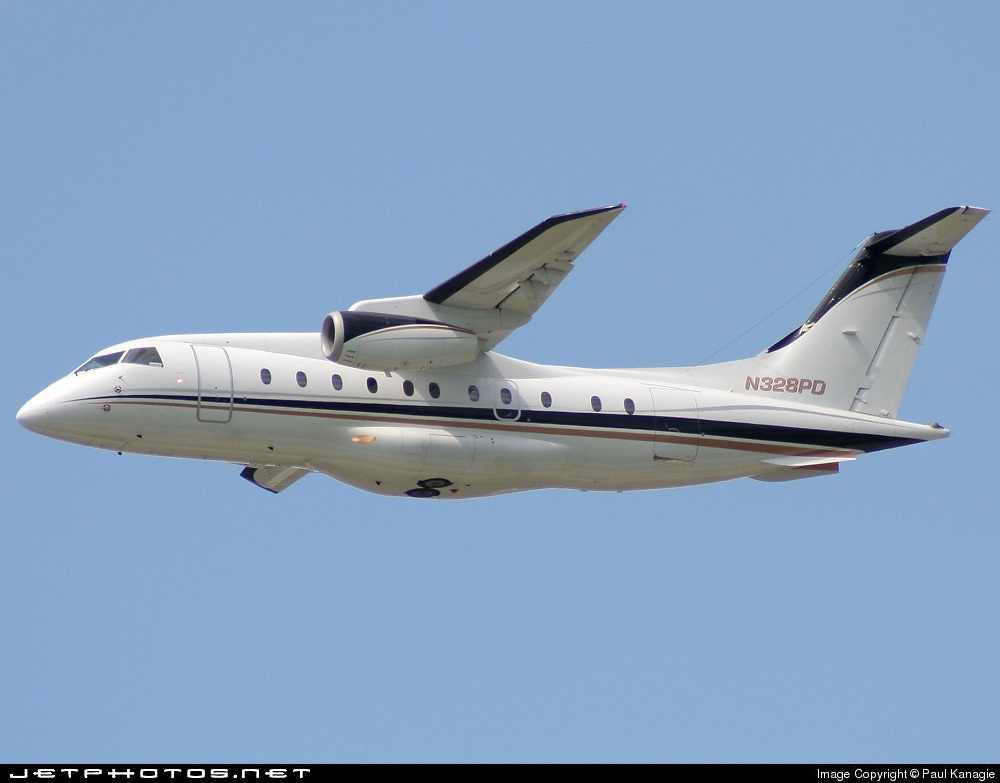
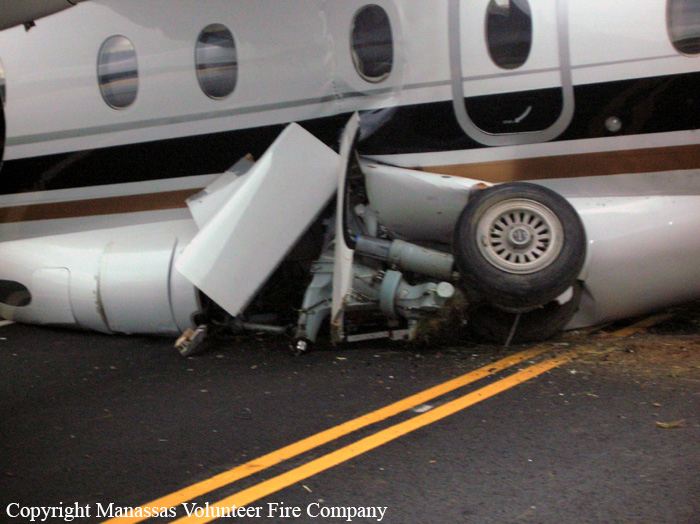
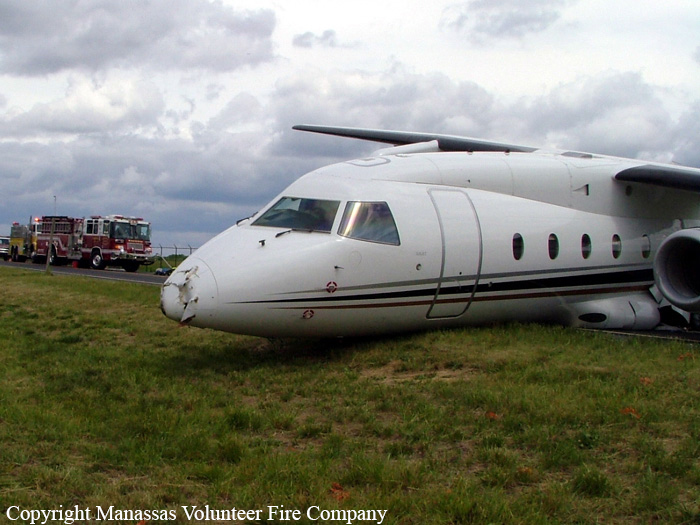
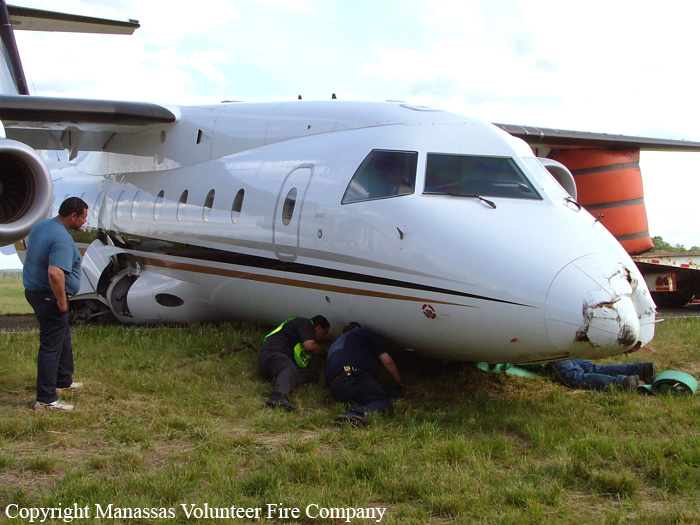
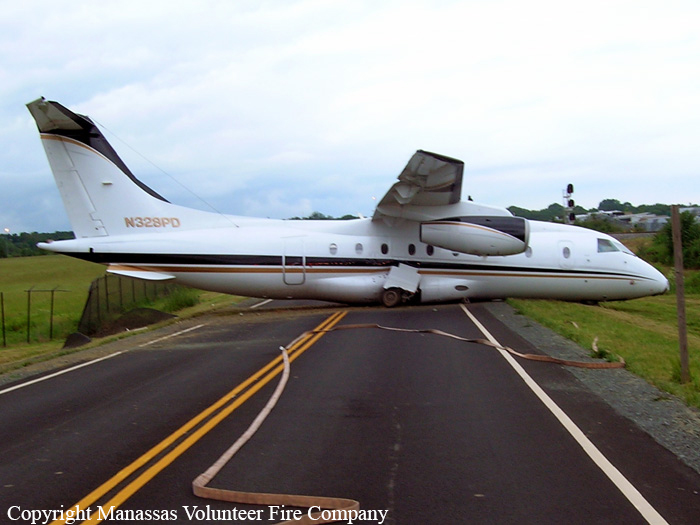
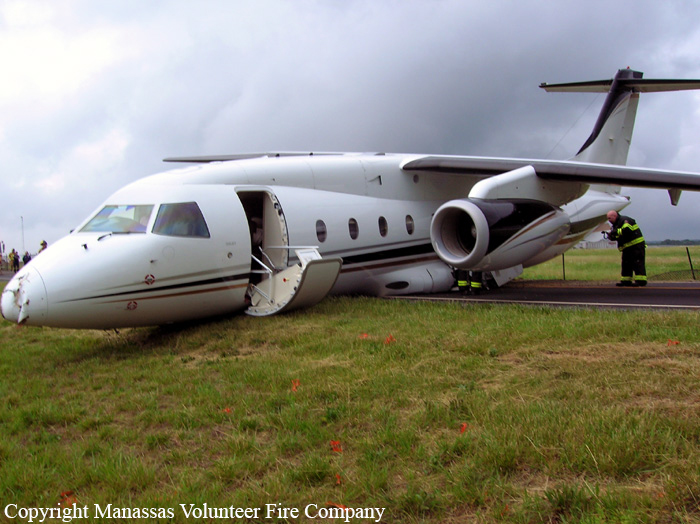
Crash of a Dornier DO328Jet in Manassas

Date & Time: Jun 3, 2006 at 0719 LT
Type of aircraft:
Operator:
Registration:
N328PD
Flight Phase:
Flight Type:
Survivors:
Yes
Schedule:
Manassas - Myrtle Beach
MSN:
3105
YOM:
2000
Crew on board:
3
Crew fatalities:
Pax on board:
5
Pax fatalities:
Other fatalities:
Total fatalities:
0
Captain / Total flying hours:
15615
Captain / Total hours on type:
2523.00
Copilot / Total flying hours:
819
Copilot / Total hours on type:
141
Aircraft flight hours:
2830
Circumstances:
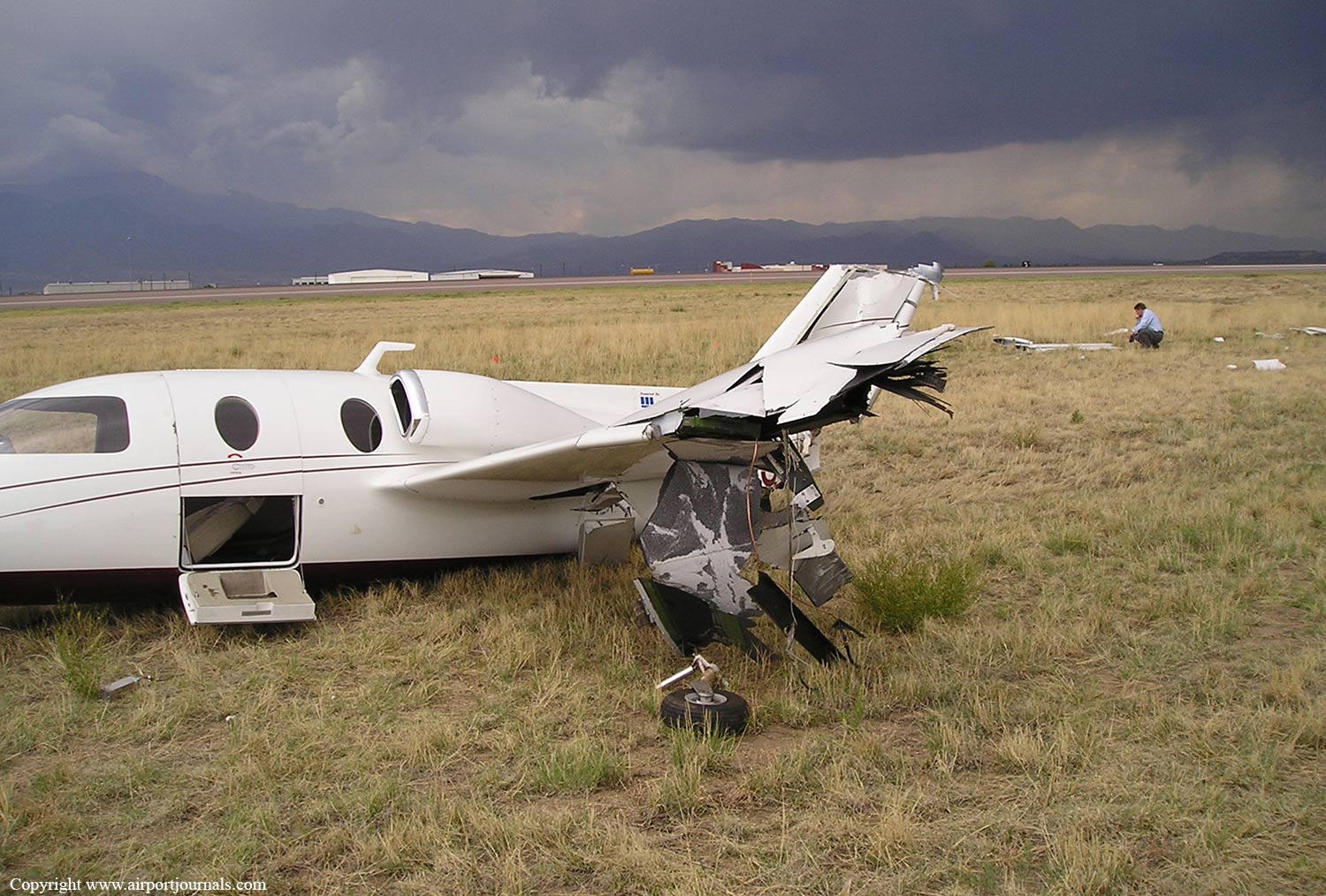
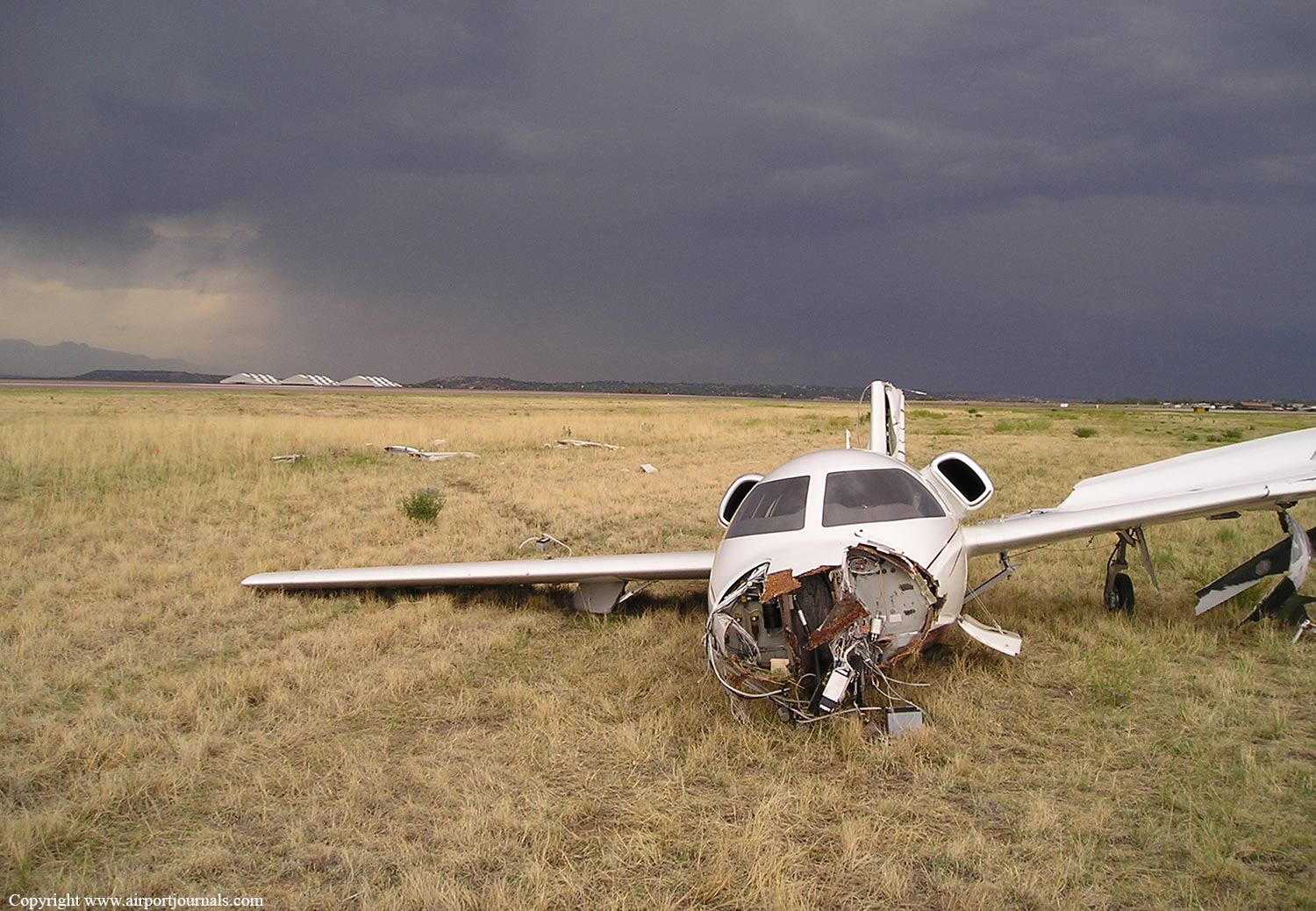
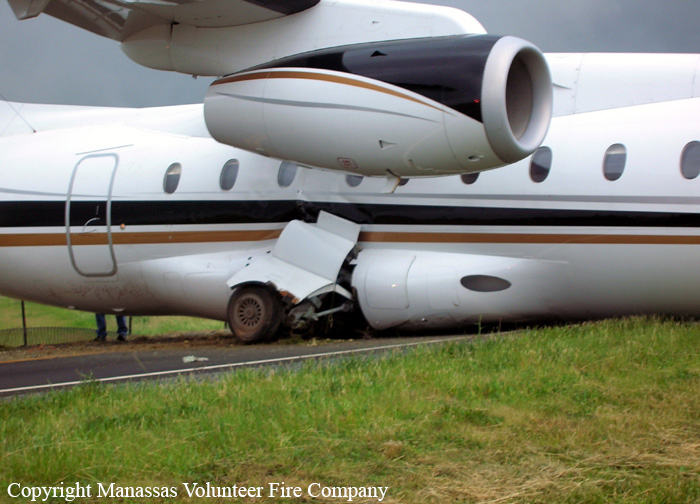
Prior to departure on the maintenance repositioning flight, the captain discussed with the first officer an uneven fuel balance that they could "fix" once airborne, and a 25,000 feet msl restriction because of an inoperative air conditioning/pressurization pack. The captain also commented about the right pack "misbehaving", and a bleed valve failure warning. The captain also commented about aborting below 80 knots for everything, except for the bleed shutoff valve. During the takeoff roll, a single chime was heard, and the first officer reported a bleed valve fail message. The captain responded, "ignore it." Another chime was heard, and the first officer reported "lateral mode fail, pusher fail." The captain asked about airspeed and was advised of an "indicated airspeed miscompare." The captain initiated the aborted takeoff approximately 13 seconds after the second chime was heard. The crew was unable to stop the airplane, and it went off the end of the runway, and impacted obstructions and terrain. According to the flight data recorder, peak groundspeed was 152 knots and the time the aborted takeoff was initiated, and indicated airspeed was 78.5 knots. The captain and the airplane owner's director of maintenance were aware of several mechanical discrepancies prior to the flight, and the captain had advised the first officer that the flight was for "routine maintenance," but that the airplane was airworthy. Prior to the flight the first officer found "reddish clay" in one of the pitot tubes and removed it. A mechanic and the captain examined the pitot tube, and determined the tube was not obstructed. The captain's pitot tube was later found to be partially blocked with an insect nest. A postaccident examination of the airplane and aircraft maintenance log revealed that no discrepancies were entered in the log, and no placards or "inoperative" decals were affixed in the cockpit.
Probable cause:
The partially blocked pitot system, which resulted in an inaccurate airspeed indicator display, and an overrun during an aborted takeoff. A factor associated with the accident was the pilot-in-command's delayed decision to abort the takeoff.
Final Report:

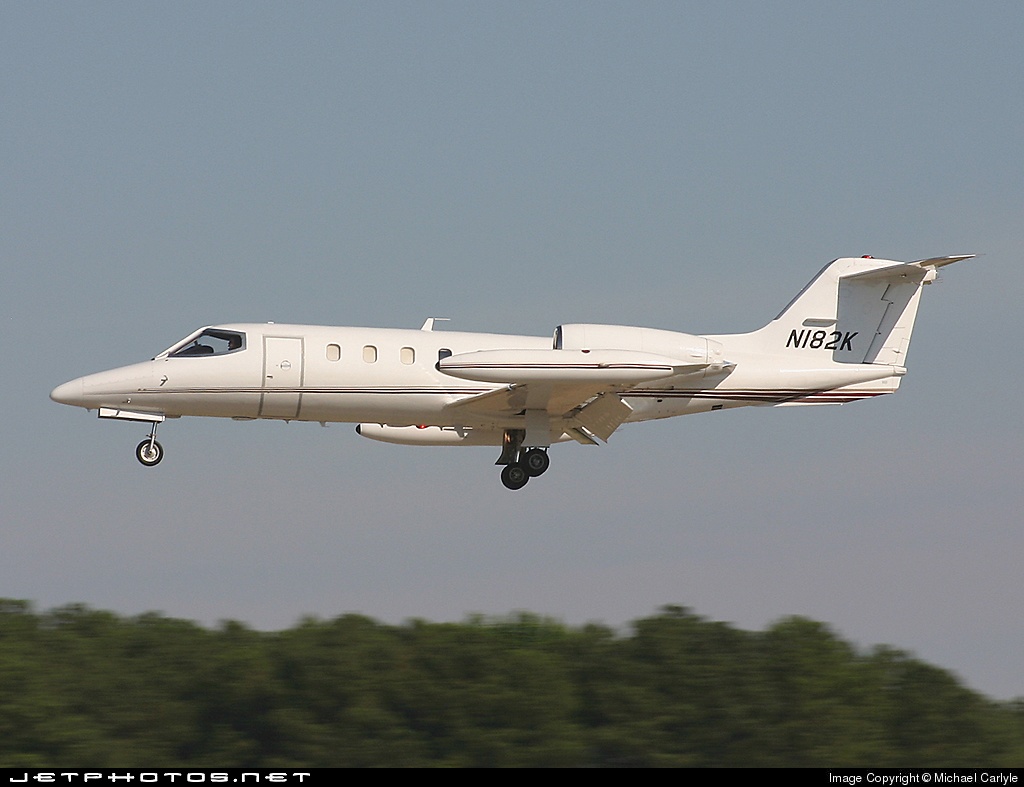
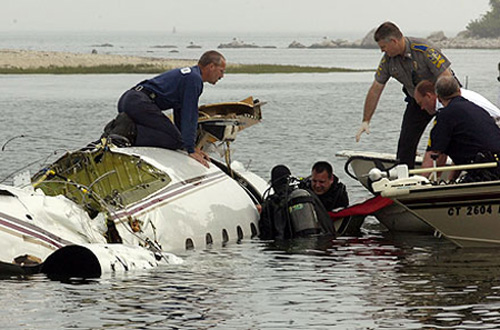
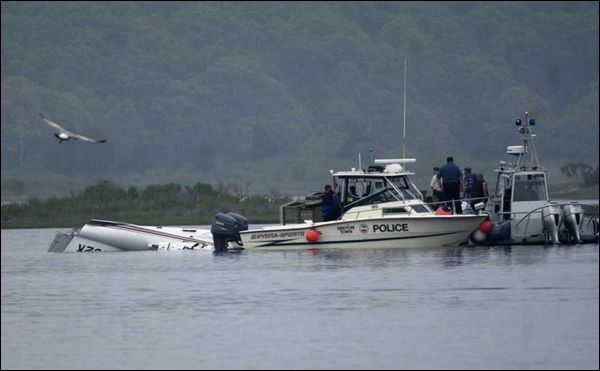
Crash of a Learjet 35A off Groton: 2 killed

Date & Time: Jun 2, 2006 at 1440 LT
Type of aircraft:
Operator:
Registration:
N182K
Survivors:
Yes
Schedule:
Atlantic City - Groton
MSN:
35-293
YOM:
1980
Crew on board:
2
Crew fatalities:
Pax on board:
3
Pax fatalities:
Other fatalities:
Total fatalities:
2
Captain / Total flying hours:
18750
Captain / Total hours on type:
7500.00
Copilot / Total flying hours:
3275
Copilot / Total hours on type:
289
Aircraft flight hours:
11704
Circumstances:
The crew briefed the Instrument Landing System approach, including the missed approach procedures. Weather at the time included a 100-foot broken cloud layer, and at the airport, 2 miles visibility. The approach was flown over water, and at the accident location, there was dense fog. Two smaller airplanes had successfully completed the approach prior to the accident airplane. The captain flew the approach and the first officer made 100-foot callouts during the final descent, until 200 feet above the decision height. At that point, the captain asked the first officer if he saw anything. The first officer reported "ground contact," then noted "decision height." The captain immediately reported "I got the lights" which the first officer confirmed. The captain reduced the power to flight idle. Approximately 4 seconds later, the captain attempted to increase power. However, the engines did not have time to respond before the airplane descended into the water and impacted a series of approach light stanchions, commencing about 2,000 feet from the runway. Neither crew member continued to call out altitudes after seeing the approach lights, and the captain descended the airplane below the decision height before having the requisite descent criteria. The absence of ground references could have been conducive to a featureless terrain illusion in which the captain would have believed that the airplane was at a higher altitude than it actually was. There were
no mechanical anomalies which would have precluded normal airplane operation.
Probable cause:
The crew's failure to properly monitor the airplane's altitude, which resulted in the captain's inadvertent descent of the airplane into water. Contributing to the accident were the foggy weather conditions, and the captain's decision to descend below the decision height without sufficient visual cues.
Final Report:

Crash of a De Havilland DHC-2 Beaver in Hallo Bay

Date & Time: May 22, 2006 at 1300 LT
Type of aircraft:
Operator:
Registration:
N1543
Flight Phase:
Survivors:
Yes
Schedule:
Hallo Bay-Kodiak
MSN:
1687
YOM:
1967
Crew on board:
1
Crew fatalities:
Pax on board:
5
Pax fatalities:
Other fatalities:
Total fatalities:
0
Captain / Total flying hours:
7460
Captain / Total hours on type:
40.00
Aircraft flight hours:
16360
Circumstances:
The commercial certificated pilot was departing a remote bay with five passengers in an amphibious float-equipped airplane on the return portion of a Title 14, CFR Part 135 sightseeing flight. The pilot began the takeoff run toward the north, with the wind from the north between 15 to 20 knots, and 4 to 6 foot sea swells. When the airplane had climbed to about 10 to 15 feet, the pilot said a windshear was encountered, which pushed the airplane down. The airplane's floats struck a wave, missed about 4 to 5 swells, and then struck another wave, which produced a loud "bang." The company guide, seated in the right front seat, told the pilot that the right float assembly was broken and displaced upward. The airplane cleared a few additional swells, and then collided with the water. Both float assemblies were crushed upward, and the left float began flooding. The guide exited the airplane onto the right float, and made a distress call via a satellite telephone. All occupants donned a life preserver as the airplane began sinking. The pilot said that after about 15 minutes, the rising water level in the airplane necessitated an evacuation, and all occupants exited into the water, and held onto the right float as the airplane rolled left. The airplane remained floating from the right float, and was being moved away from shore by wind and wave action. The pilot said that one passenger was washed away from the float within about 5 minutes, and two more passengers followed shortly thereafter. Within about 5 minutes after entering the water, the pilot said he lost his grip on the float, and does not remember anything further until regaining consciousness in a hospital. He was told by medical staff that he had been severely hypothermic. U.S. Coast Guard aircraft were already airborne on a training mission, and diverted to rescue the occupants. About 1320, a C-130 flew overhead, and began dropping inflatable rafts. The company guide was the only one able to climb into a raft. When the helicopters arrived, they completed the rescue using a hoist and a rescue swimmer. The passengers reported that they also were unable to hold onto the airplane after entering the water, became unconscious, and were severely hypothermic upon reaching a hospital. The airplane was not equipped with a life raft, and was not required to be so equipped.
Probable cause:
The pilot's inadequate evaluation of the weather conditions, and his selection of unsuitable terrain (rough water) for takeoff, which resulted in a collision with ocean swells during takeoff initial climb, and a hard emergency landing and a roll over. Factors contributing to the accident were a windshear, rough water, and buckling of the float assemblies when the airplane struck the waves.
Final Report:

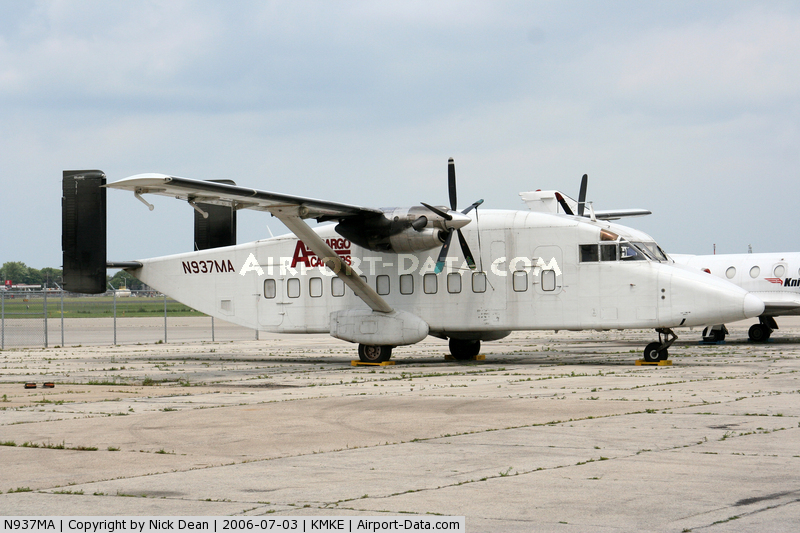
Crash of a Short 330-200 in Myrtle Beach

Date & Time: May 18, 2006 at 0745 LT
Type of aircraft:
Operator:
Registration:
N937MA
Flight Type:
Survivors:
Yes
Schedule:
Greensboro – Myrtle Beach
MSN:
3040
YOM:
1980
Flight number:
SNC1340
Crew on board:
2
Crew fatalities:
Pax on board:
0
Pax fatalities:
Other fatalities:
Total fatalities:
0
Aircraft flight hours:
21095
Circumstances:
Following an uneventful cargo flight from Greensboro, NC, the aircraft made a wheels-up landing on runway 18 at Myrtle Beach Airport, SC. The aircraft slid on its belly for few dozen metres before coming to rest on the main runway. Both pilots escaped uninjured while the aircraft was damaged beyond repair.
Probable cause:
NTSB did not conduct any investigation on this event.

Crash of a Piper PA-60 Aerostar (Ted Smith 600) in Camp Hill: 2 killed

Date & Time: May 10, 2006 at 0921 LT
Operator:
Registration:
N68999
Flight Phase:
Survivors:
No
Schedule:
Cornelia – Pensacola
MSN:
60-8265-023
YOM:
1982
Crew on board:
1
Crew fatalities:
Pax on board:
1
Pax fatalities:
Other fatalities:
Total fatalities:
2
Captain / Total flying hours:
2500
Circumstances:
The pilot obtained a weather briefing from an Automated Flight Service Station (AFSS) and filed an IFR flight plan before departing on an IFR flight from Cornelia, Georgia, to Pensacola, Florida, on May 10, 2006.The flight service specialist provided information on a line of embedded thunderstorm activity along the route from Atlanta to Mobile including SIGMETs and advised that tops were forecasted to be at 41,000 to 50,000 feet. The specialist suggested that the pilot not depart immediately because of the weather, but said that it might be possible to land at an intermediate stop ahead of the weather, possibly in Pensacola or further north in the Crestview area. The pilot filed an IFR flight plan from Cornelia to Pensacola at 16,000 feet. The pilot called the AFSS again and requested an IFR clearance. The specialist responded that the clearance was on request, and that he would work on the void time and placed the pilot on hold. The specialist obtained the clearance from Atlanta Center and returned back to provide the clearance to the pilot. The pilot was not on the telephone line. The pilot departed Cornelia without an IFR clearance and contacted Atlanta Center. The controller informed the pilot on initial contact that he was not on his assigned heading, altitude, correct transponder code, and subsequently handed the pilot off to another controller. The flight was subsequently cleared direct to Panama City, Florida, and the pilot was instructed to climb to 16,000 feet. Atlanta Center broadcasted weather alerts over the radio frequency the pilot was on for Center Weather Advisory 101, SIGMETS 73C, 74C,and AIRMET Sierra between 0903 to 0913 CDT. The National Weather Service Storm Prediction Center, issued Severe Thunderstorm Watch 329 valid from 0635 CDT until 1300 CDT. The National Weather Service Aviation Weather Center issued Convective SIGMET 73C valid from 0855 CDT until 1055 CDT. The SIGMET was for a line of thunderstorms 40 nautical miles wide, and moving from 280 degrees at 35 knots. The tops of the thunderstorms were at 44,000 feet, with 2-inch hail, and possible wind gusts up to 60 knots. These weather alerts included the route of flight for the accident airplane. The controllers did not issue the pilot with severe radar-depicted weather information that was displayed on the controller's radar display. The airplane was observed on radar level at 16,000 feet at 09:19:48 CDT heading southwest. The airplane was observed to began a continuous left turn northwest bound at 15,700 feet at 09:20:38. The pilot called Atlanta center at 09:20:48 CDT and stated, "Aero Star six eight triple nine we're going to make a reverse." and there was no further radio contact with the pilot. The last radar return was at 09:20:59. The airplane was at 15, 600 feet. The wreckage was located on May 11, 2006. Examination of the wreckage revealed the right wing separated 9 feet 2 inches outboard of the wing root. The separated outboard section of the right wing was not recovered. The components were forwarded to the NTSB Laboratory for further examination. Examination of the components revealed the deformation patterns found on the fracture surfaces were consistent with upward bending overstress of the right wing.
Probable cause:
The pilot's continued flight into known thunderstorms resulting in an in-flight break up. A factor in the accident was air traffic controller's failure to issue extreme weather radar echo intensity information displayed on the controller's radar to the pilot.
Final Report:

Crash of a Cessna 421B Golden Eagle II in Marathon

Date & Time: May 8, 2006 at 0800 LT
Operator:
Registration:
N988GM
Flight Type:
Survivors:
Yes
Schedule:
Pompano Beach - Marathon
MSN:
421B-0535
YOM:
1973
Crew on board:
2
Crew fatalities:
Pax on board:
0
Pax fatalities:
Other fatalities:
Total fatalities:
0
Captain / Total flying hours:
1450
Aircraft flight hours:
5307
Circumstances:
The commercial certificated pilot was positioning the multi-engine, retractable landing gear airplane for a corporate passenger flight under Title 14, CFR Part 91, when the accident occurred. Upon landing at the destination, the pilot aborted the landing, and after climbing to about 100 feet agl descended, impacting in a canal. A witness who was not looking towards the runway, reported hearing the sound of a twin engine airplane approaching with the engines at reduced power, and then heard a scraping noise similar to the recent gear-up landing he had witnessed. Looking toward the runway, he said the airplane was midfield, left of the runway centerline, about 20 feet in the air with the landing gear retracted, and that he saw a cloud of dust, and heard what he thought was full engine power being applied. He said the airplane climbed to about 100 feet agl, and disappeared from view. Another witness with a portable VHF radio tuned to the unicom frequency, reported hearing the pilot say he was "doing an emergency go-around." The airplane descended striking utility poles, and impacted in a saltwater canal. An examination of the airport runway revealed a set of parallel propeller strike marks. The left and right sets of marks were 109 and 113 feet long, and the mark's center-to-center measurement is consistent with the engine centerline-to-centerline measurement for the accident airplane. No landing gear marks were observed. The airplane's six propeller blades had extensive torsional twisting and bending, as-well-as extensive chord wise scratching and abrasion. Several of the blades had fractured or missing tips. An examination of the cockpit showed the landing gear retraction/extension handle was in the up/retracted position, and the landing gear extension warning horn circuit breaker was in the pulled/tripped position. The landing gear emergency extension handle was in the stowed position. The nose landing gear was damaged during final impact, and was not functional. During the postimpact examination, both the left and right main landing gear were stowed in the up and locked/retracted position. The landing gear were released/unlocked and operated appropriately using the emergency extension handle. An examination of the left and right main landing gear showed no damage to the wheel doors, leg doors, wheels, or tires. All linkages and locking devices were undamaged, and appeared to function normally.
Probable cause:
The pilot's failure to extend the landing gear prior to landing, which resulted in the propellers striking the runway, an aborted landing, and an in-flight collision with terrain.
Final Report: