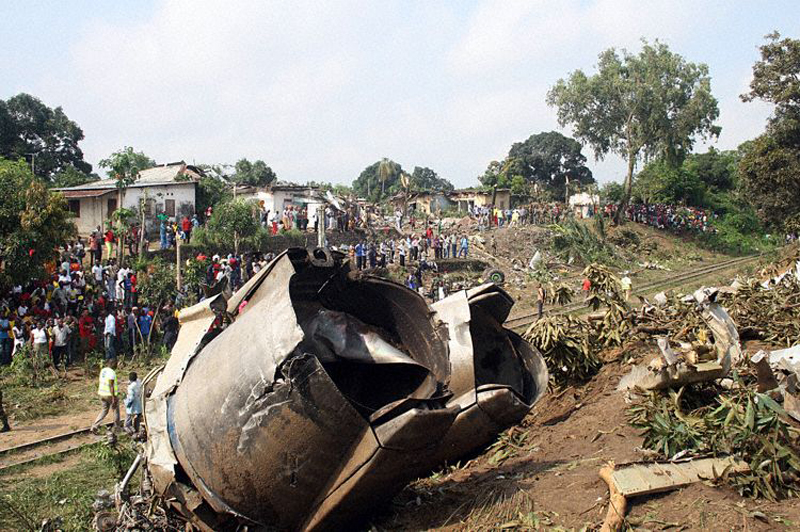
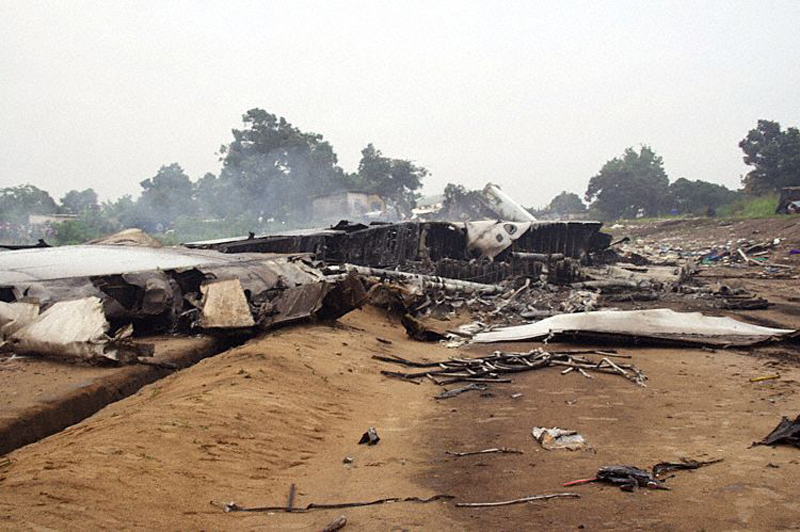
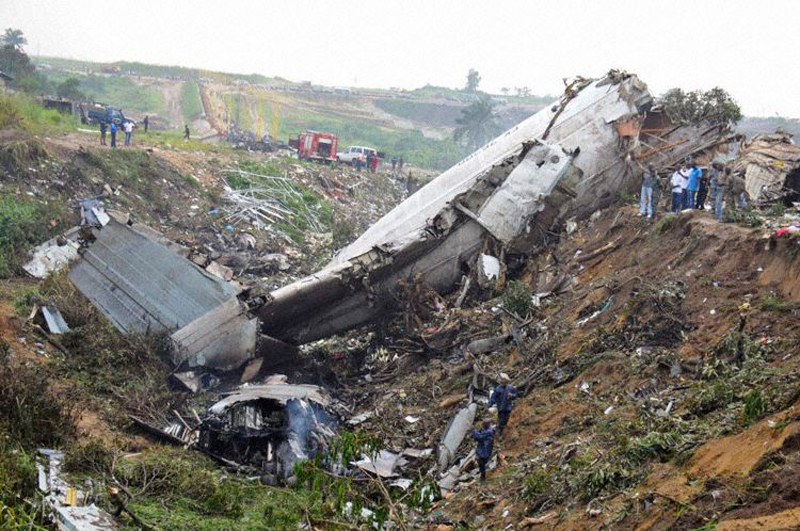
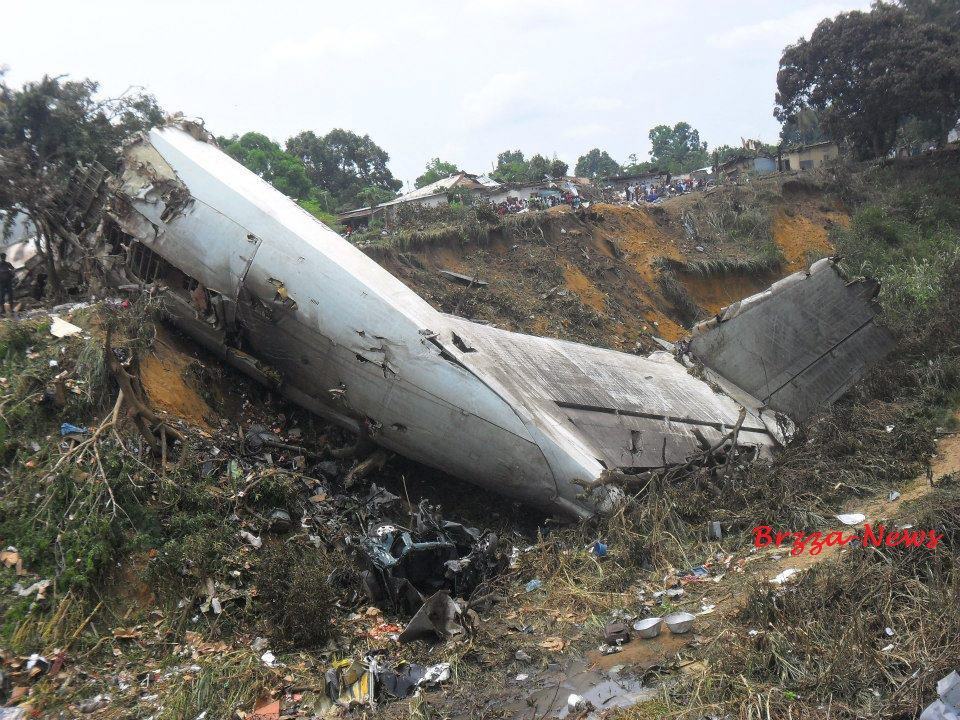
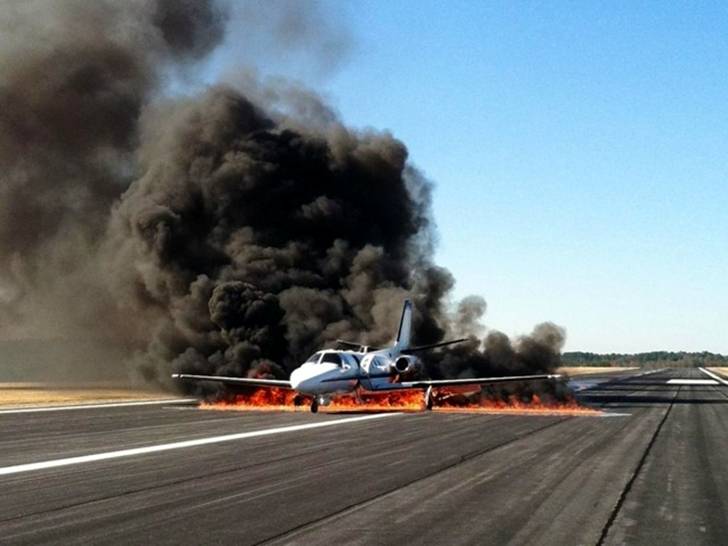
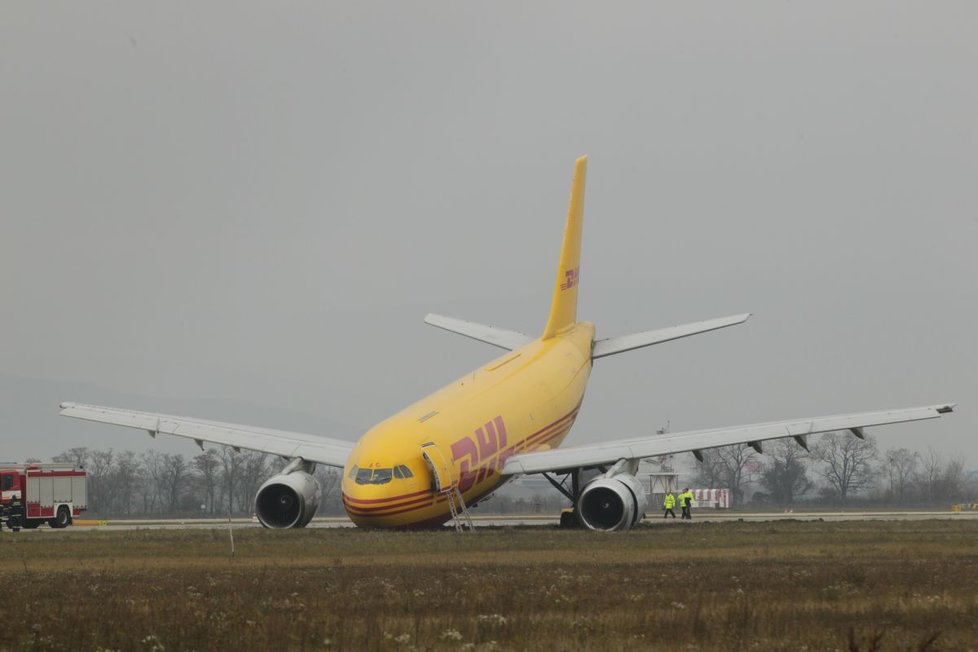
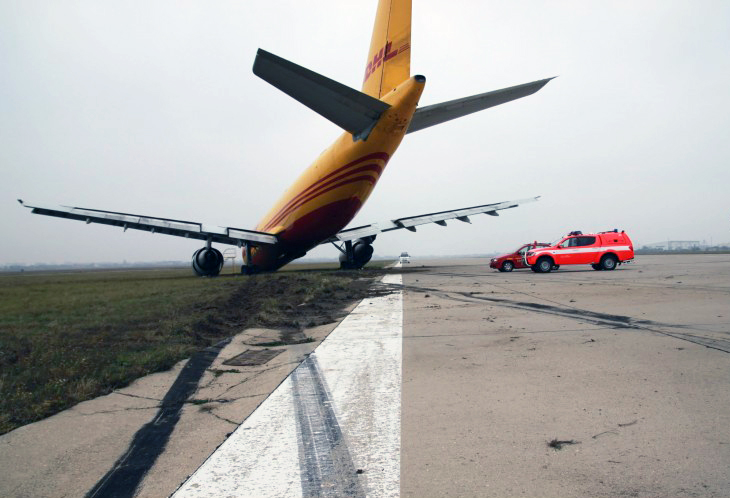
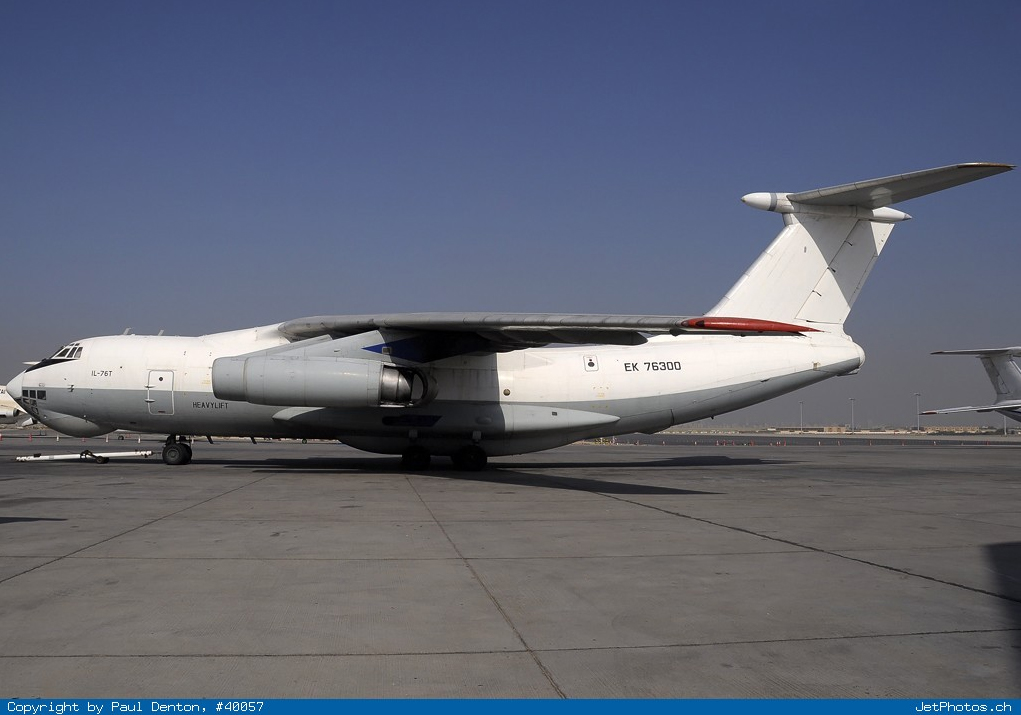
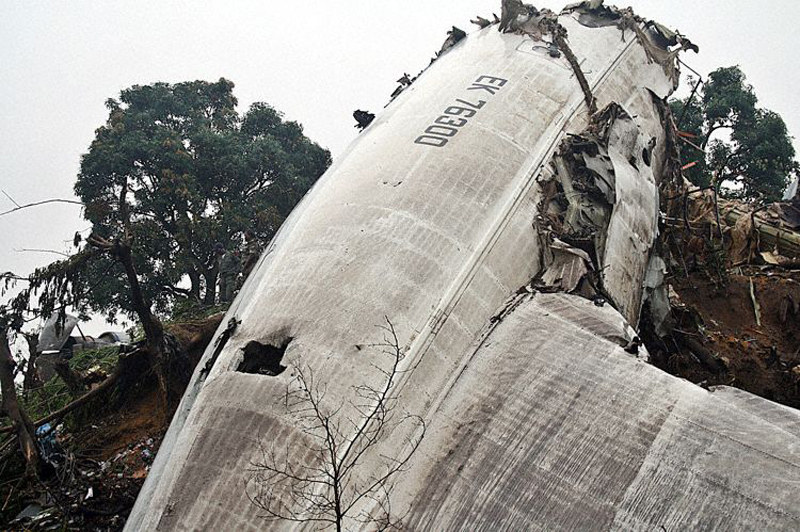
Crash of an Ilyushin II-76T in Brazzaville: 32 killed

Date & Time: Nov 30, 2012 at 1730 LT
Type of aircraft:
Operator:
Registration:
EK-76300
Flight Type:
Survivors:
No
Schedule:
Pointe-Noire - Brazzaville
MSN:
0834 10300
YOM:
1978
Country:
Region:
Crew on board:
6
Crew fatalities:
Pax on board:
1
Pax fatalities:
Other fatalities:
Total fatalities:
32
Circumstances:
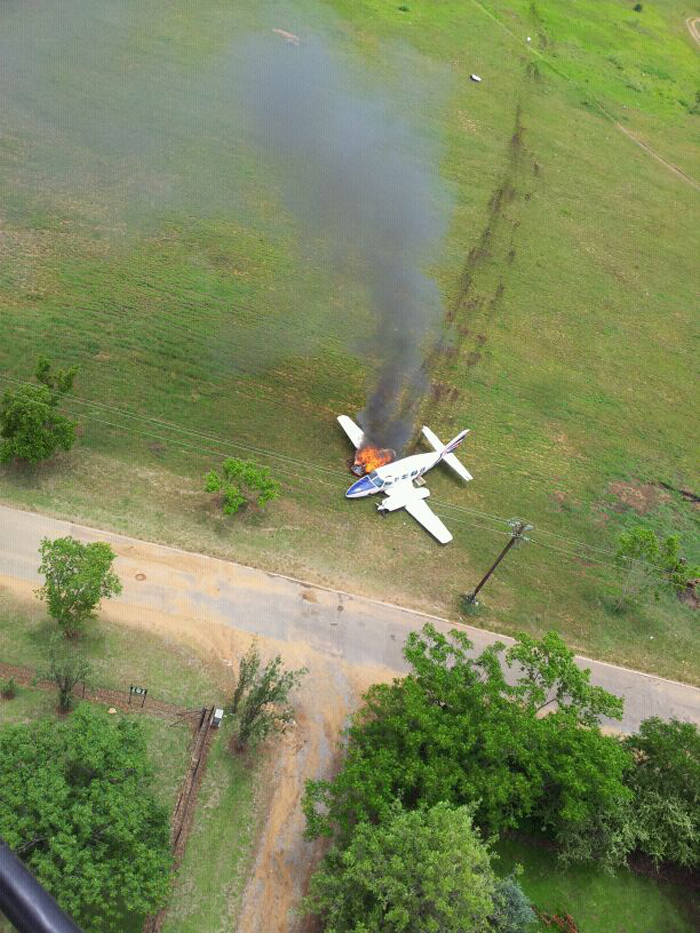
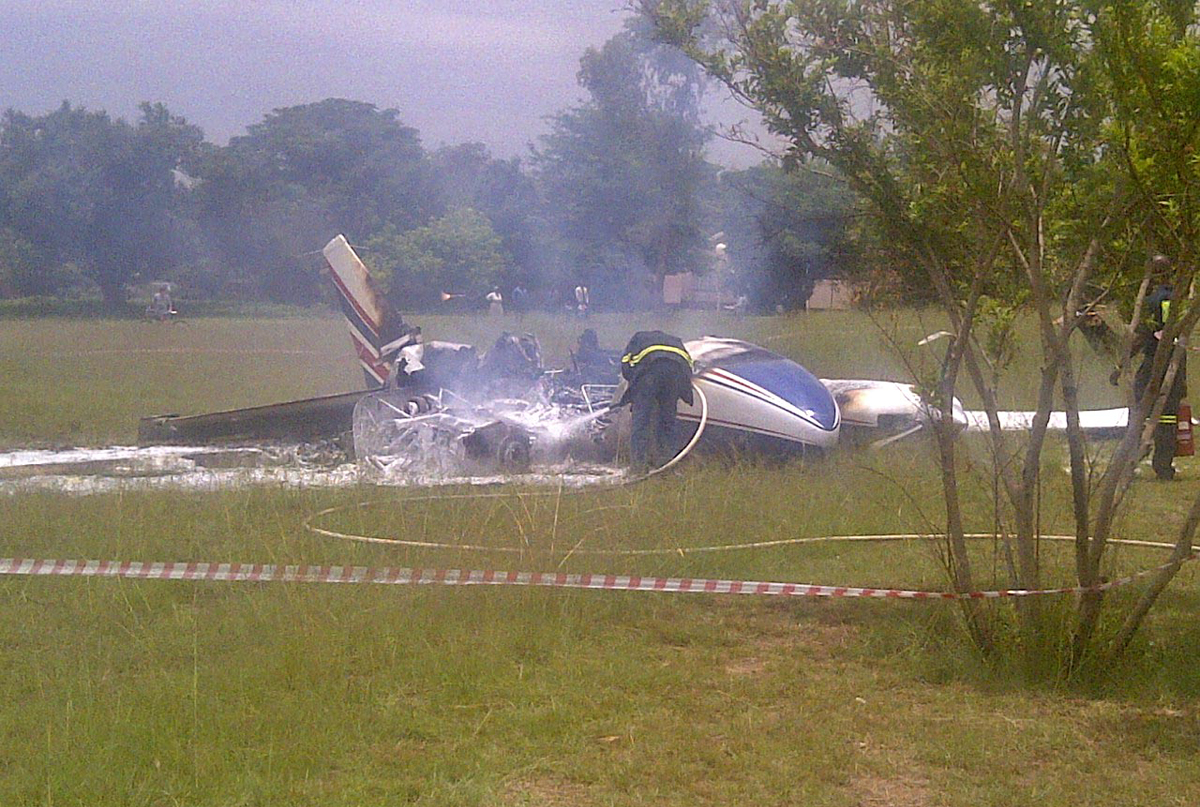
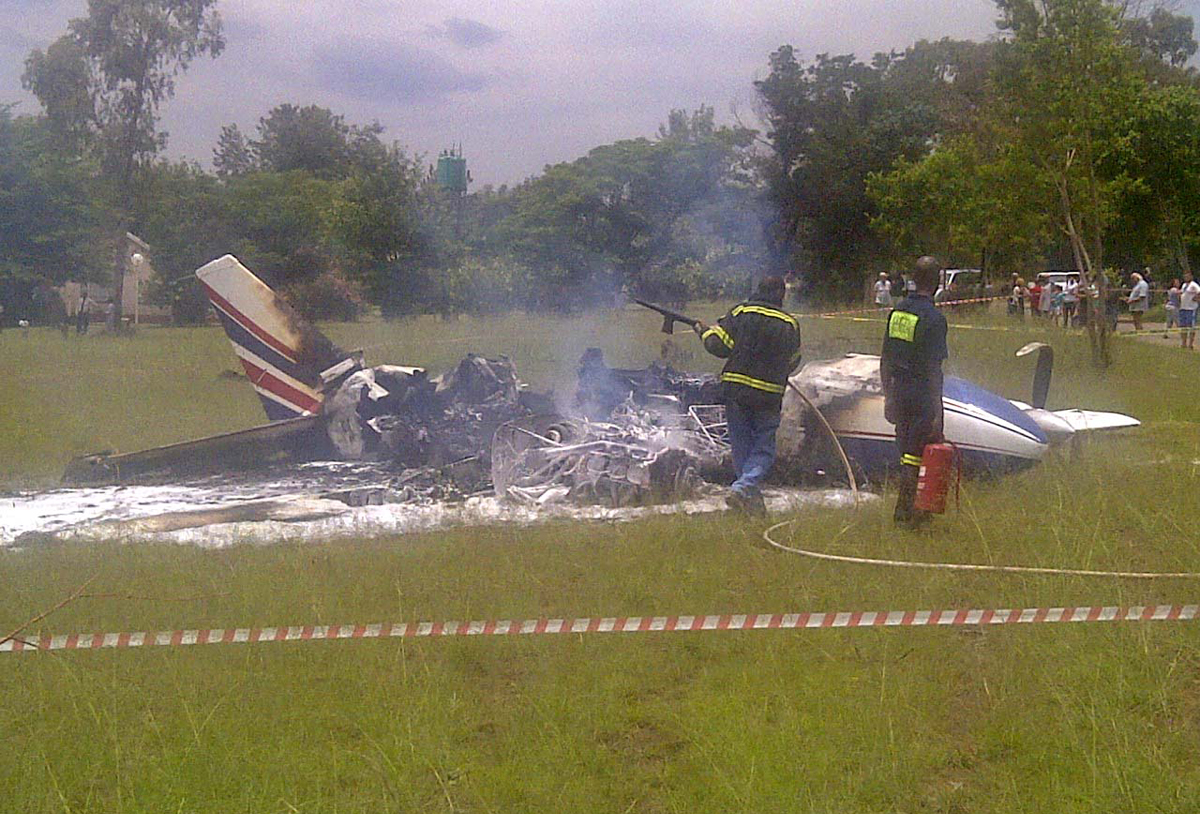
The four engine aircraft was completing a cargo flight from Pointe-Noire to Brazzaville, carrying one passenger, a crew of six and a load consisting of automobiles and various goods. On final approach to runway 05L in poor weather conditions, the crew descended too low on the glide when the aircraft impacted houses and tree tops and eventually crashed in the district of La Poudrière, about 900 metres short of runway. All 7 occupants were killed as well as 25 people on the ground. Fourteen other people were injured. At the time of the accident, weather conditions were poor with thunderstorm activity, rain falls and limited visibility. MAK stated in February 2013 that they received the FDR from the Congolese authorities but the recorders show mechanical damages as a result of the impact forces.
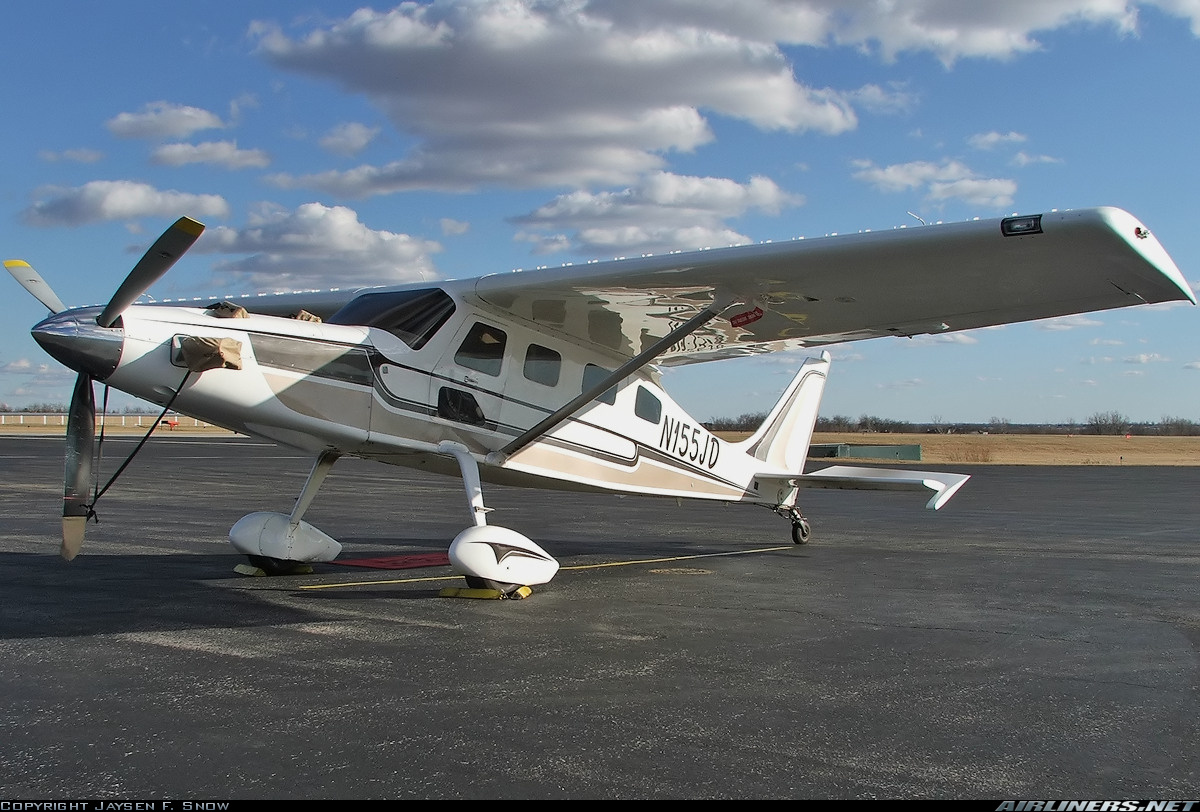
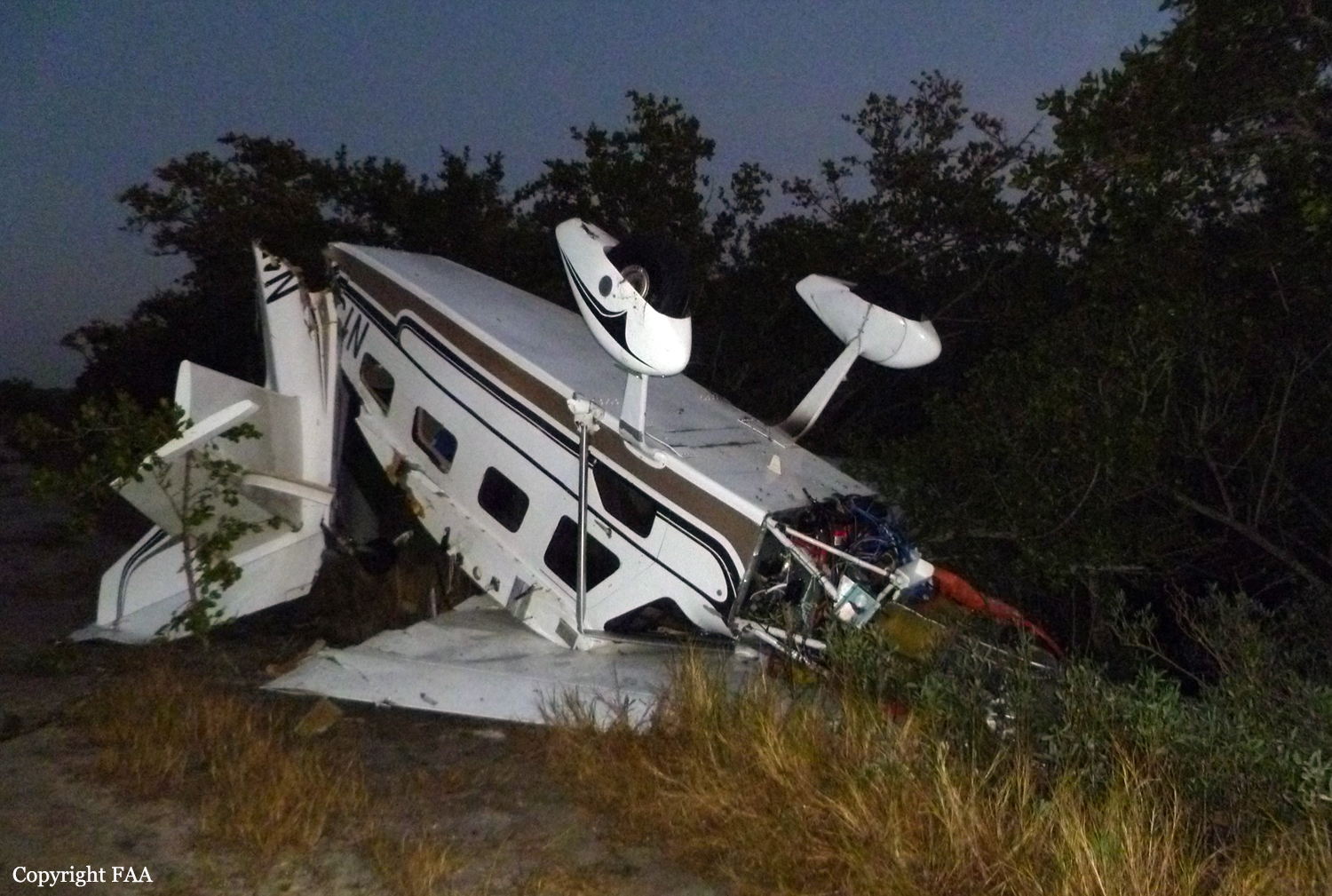
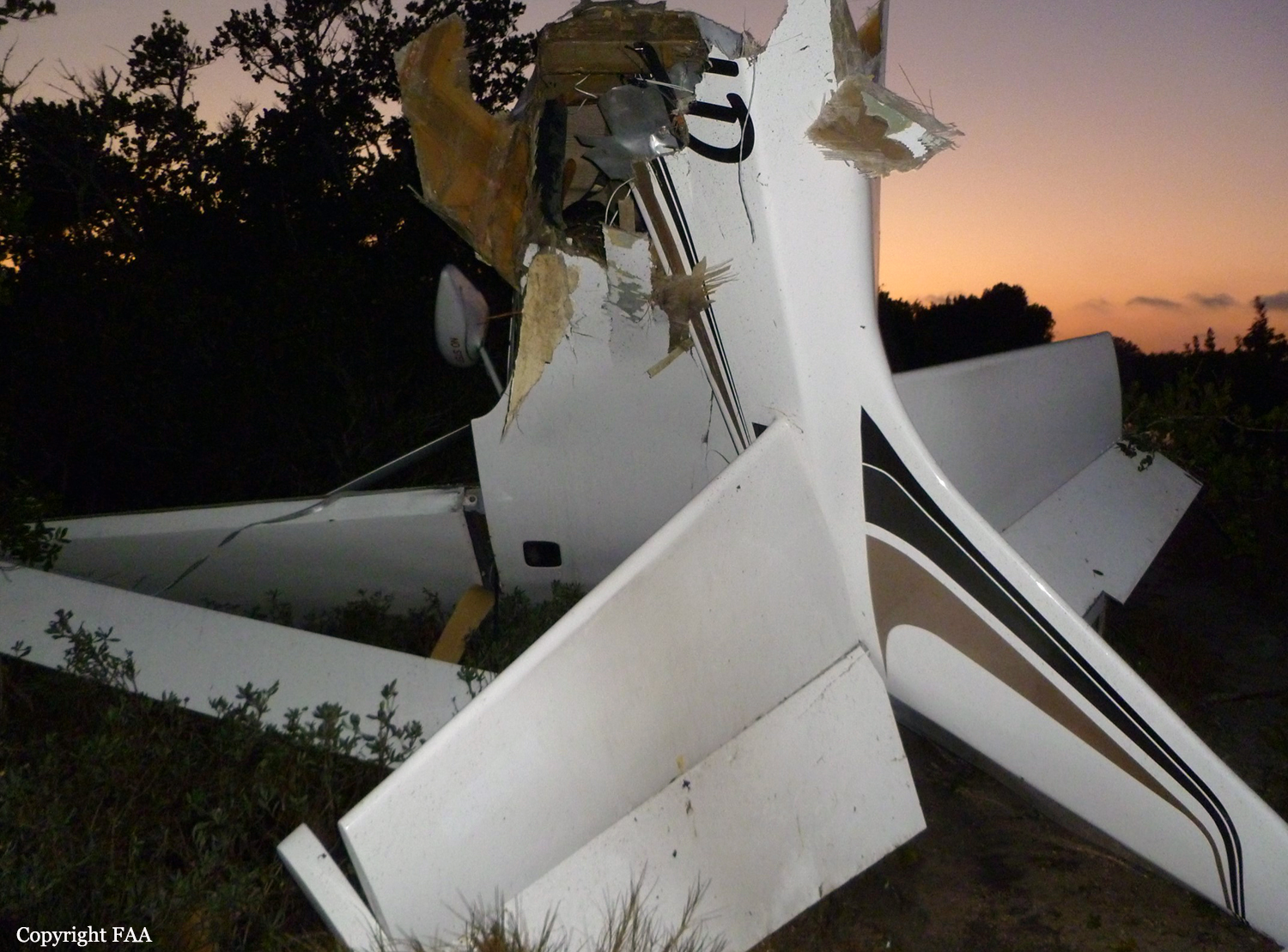
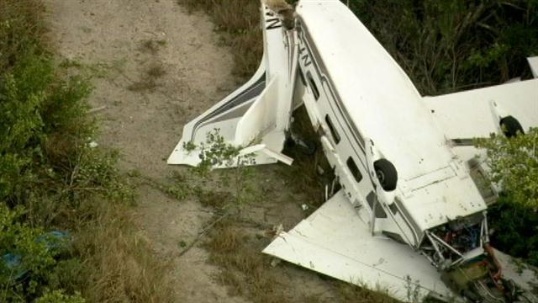
Crash of a Comp Air CA-8 in Merritt Island

Date & Time: Nov 28, 2012 at 1435 LT
Type of aircraft:
Operator:
Registration:
N155JD
Flight Type:
Survivors:
Yes
Schedule:
Merritt Island - Merritt Island
MSN:
998205
YOM:
2001
Crew on board:
1
Crew fatalities:
Pax on board:
1
Pax fatalities:
Other fatalities:
Total fatalities:
0
Captain / Total flying hours:
5569
Captain / Total hours on type:
102.00
Aircraft flight hours:
923
Circumstances:
On November 28, 2012, about 1435 eastern standard time, an experimental amateur-built Comp Air 8 (CA-8), N155JD, operated by a private individual, was substantially damaged during a go-around, while attempting to land at the Merritt Island Airport (COI), Merritt Island, Florida. The certificated commercial pilot sustained serious injuries and a passenger sustained minor injuries. Visual meteorological conditions prevailed and no flight plan was filed for the personal flight that was conducted under the provisions of 14 Code of Federal Regulations Part 91. The pilot reported that he flew from Smithfield, North Carolina, to Marion, South Carolina (MAO), without incident. After refueling, he departed MAO for COI. While en route, approximately 150 miles north of Ormond Beach, Florida, the airplane began to experience a left rolling tendency, which required right aileron control inputs to counteract. He configured the fuel selector to the left fuel tank in an attempt to lighten the wing and compensate for the turning tendency; however, the force required to maintain directional control became greater as the flight progressed. The pilot subsequently entered the traffic pattern at COI for runway 29, a 3,601-foot-long, 75- foot-wide, asphalt runway. While maneuvering in the traffic pattern, full right aileron control was required to maintain straight and level flight, and only a slight relaxing of right aileron control was needed to turn left. The pilot had difficulty compensating for a northwest crosswind, which resulted in the airplane drifting to the southern edge of the runway. He performed a go-around and lined-up on the northern side of the runway 29 approach course for a second landing attempt, which again resulted in a go-around. When the pilot applied engine power, the airplane began to slowly roll to the left despite right aileron and rudder control inputs. He decreased engine power; however, the airplane's left wing struck the ground and the airplane flipped-over. The left wing, propeller, and empennage separated during the impact sequence. The airplane's flight controls were electrically actuated. On site examination of the airplane by a Federal Aviation Administration (FAA) inspector did not reveal any preimpact malfunctions, which would have precluded normal operation. The fuel tanks were compromised during the accident. The airplane's rudder, elevator, and aileron control servos were removed for further examination. According to the FAA inspector, the rudder and elevator control servos functioned normally; however, the aileron control servo sustained impact damage during the accident sequence and could not be tested. The six seat, high-wing, tail-wheel, turboprop airplane, serial number 998205, was constructed primarily of composite material and was equipped with a Walter M601D series, 650 horsepower engine, with an AVIA 3-bladed constant-speed propeller. According to FAA records, the airplane was issued an experimental airworthiness certificate on April 26, 2001. The airplane was purchased from one of the builders, by the commercial pilot, through a corporation, on September 30, 2012. At that time, the airplane had been operated for about 925 total hours and had undergone a condition inspection. The pilot reported about 5,570 hours of total flight experience, which included about 100 hours in the same make and model as the accident airplane. In addition, the pilot had accumulated about 23 hours and 5 hours in make and model, during the 30 and 90 days preceding the accident, respectively. Winds reported at an airport located about 8 miles southeast of the accident site, about the time of the accident, were from 340 degrees at 16 knots.
Probable cause:
The pilot's improper decision to continue a cross-country flight as a primary control (aileron) system anomaly progressively worsened. Contributing to the accident was an aileron control system anomaly, the reason for which could not be determined because the aileron control system could not be tested due to impact damage, and the pilot’s inability to compensate for crosswind conditions encountered during the approach due to the aileron problem.
Final Report:

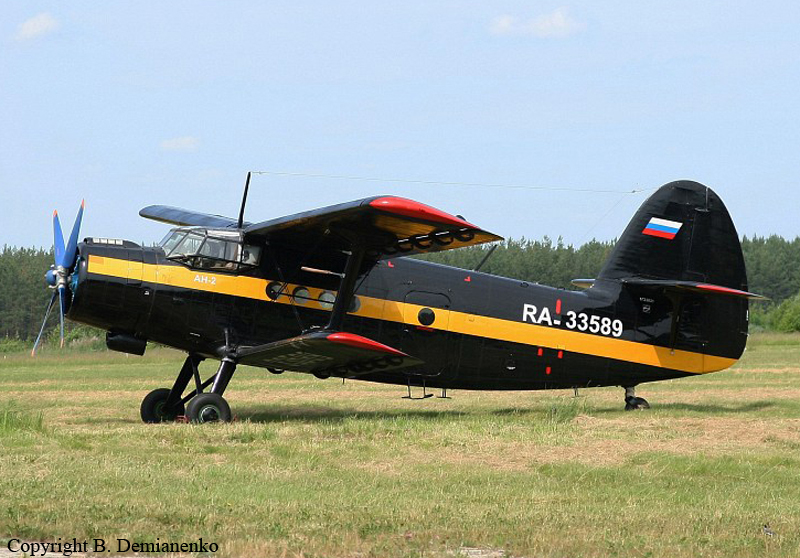
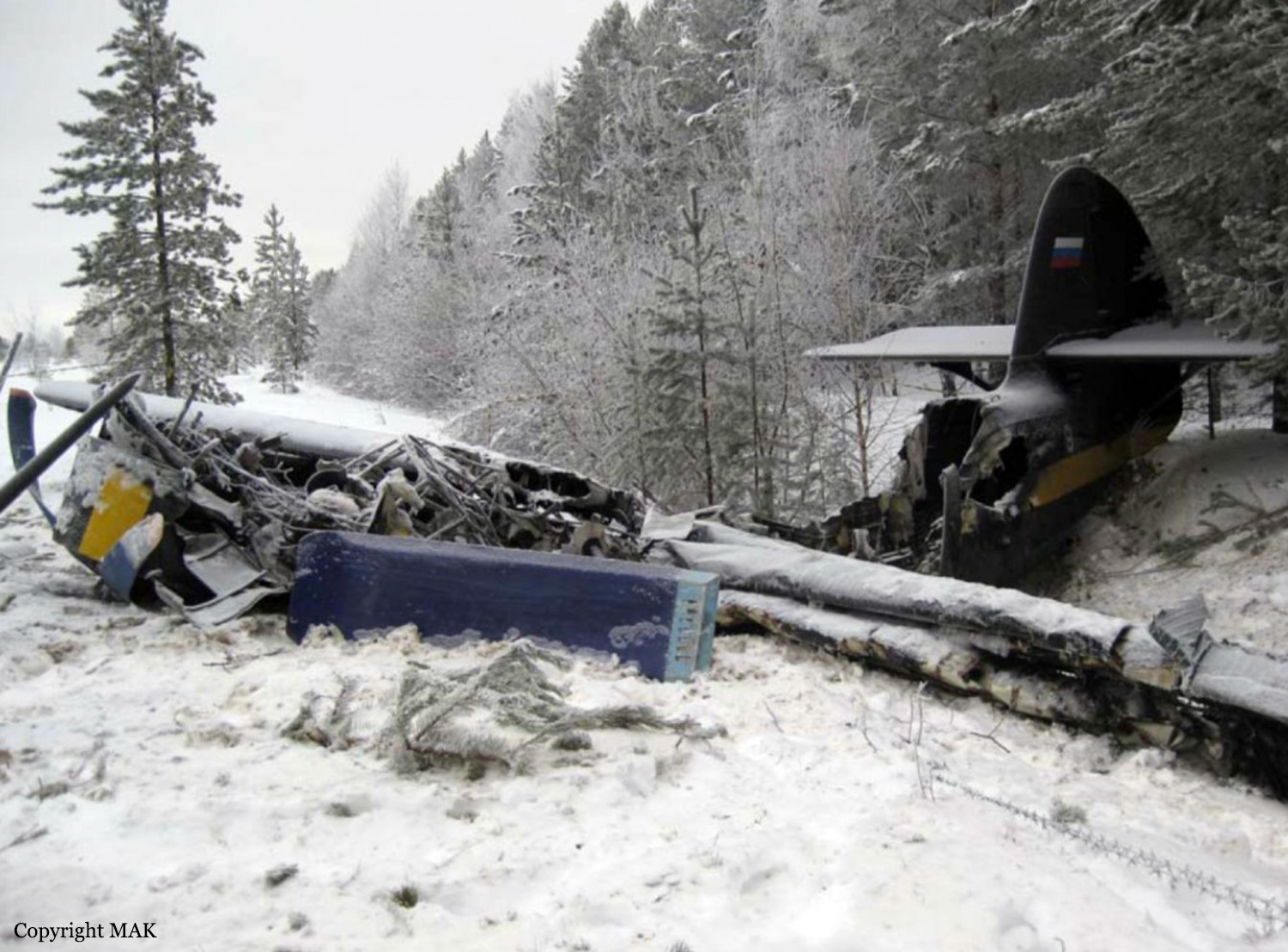
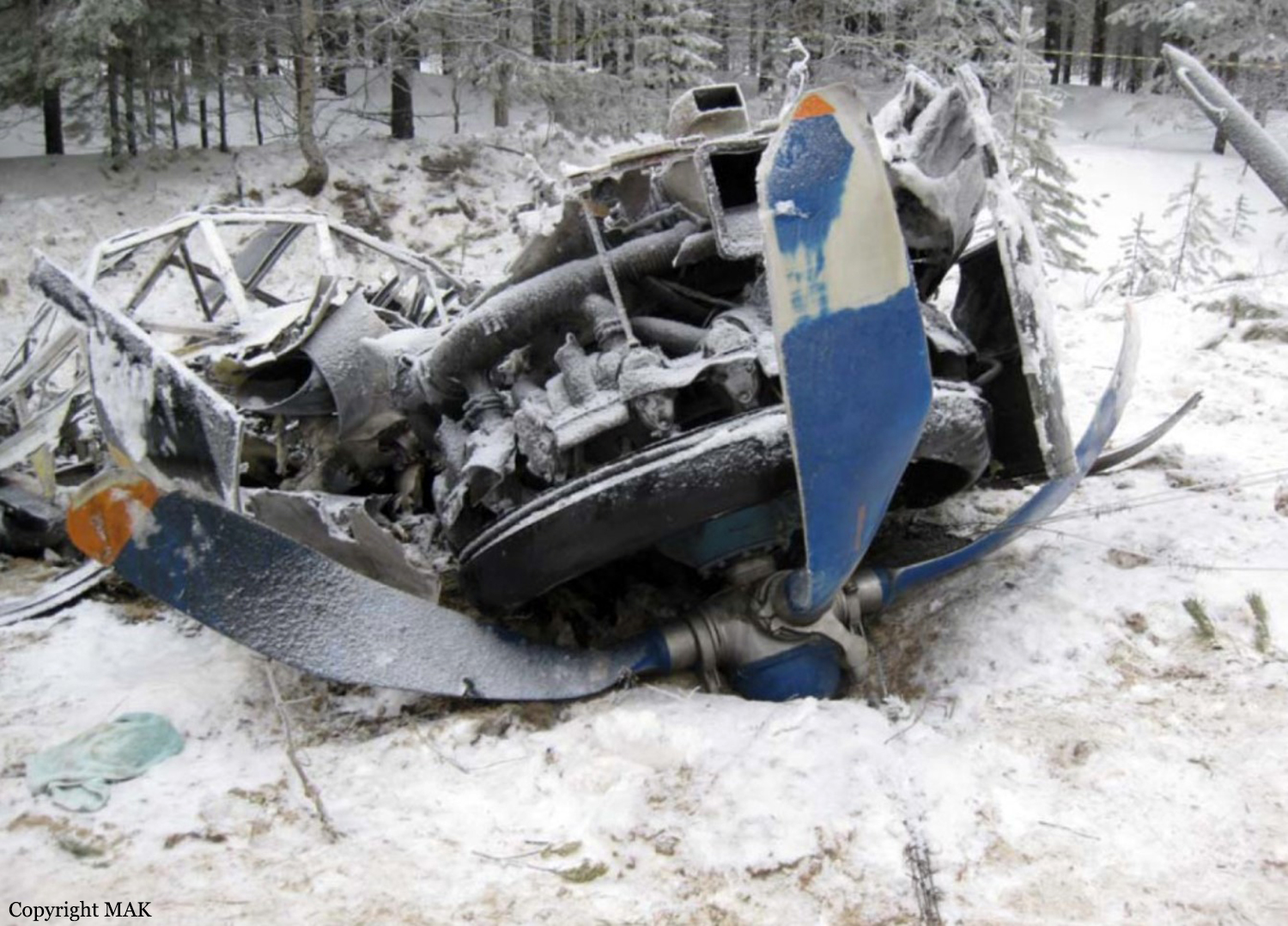
Crash of a PZL-Mielec AN-2R in Yugorsk: 1 killed

Date & Time: Nov 25, 2012 at 1120 LT
Type of aircraft:
Registration:
RA-33589
Flight Phase:
Survivors:
Yes
Schedule:
Yugorsk - Yugorsk
MSN:
1G230-31
YOM:
1988
Country:
Region:
Crew on board:
1
Crew fatalities:
Pax on board:
9
Pax fatalities:
Other fatalities:
Total fatalities:
1
Captain / Total flying hours:
12116
Captain / Total hours on type:
3068.00
Aircraft flight hours:
1250
Circumstances:
The single engine aircraft was engaged in a local skydiving mission, carrying one pilot and 9 skydivers. Shortly after take off from runway 31, while climbing to a height of about 80 meters, the engine suffered a power loss. The pilot initiated a left turn to reach the airport when the aircraft rolled to an angle of 60° then stalled and crashed in a snow covered field near a forest, bursting into flames. The aircraft was destroyed by a post impact fire. Nine occupants escaped injured and a passenger was killed.
Probable cause:
Most probably the accident with and An-2 RA-33589 aircraft was caused by aircraft beyond stall angle of attack entry during dynamic turn for emergency landing with reverse runway heading due to engine failure after take-off at low-altitude followed by shaking and its power loss resulted in aircraft ground impact with bank angle more than 60°. Engine failure was caused by high-temperature damage and destruction of cylinder-piston group details due to it inadequate technical operation and using motor gasoline in aircraft fuel flow system which quality didn't comply with requirements for preferred AI-95 gasoline in accordance with aeronautical equipment flight service evaluation program, Order of Ministry of Transport of the Russian Federation № НА-131-р from April 11, 2001 and engineering solution № АБ-1236-2003 from May 22, 2003. Most probably the contributing factor was partial skill loss of An-2 aircraft control by aircraft pilot in command (PIC). Flight operation was performed by PIC, meteorological minimas and which authorizations written in Private-Pilot License and the fact of medical flight-expert commission procedure were not documented. PIC's decision to perform straight-ahead landing most probably didn't allow to reduce the severity of accident consequences.
Final Report:

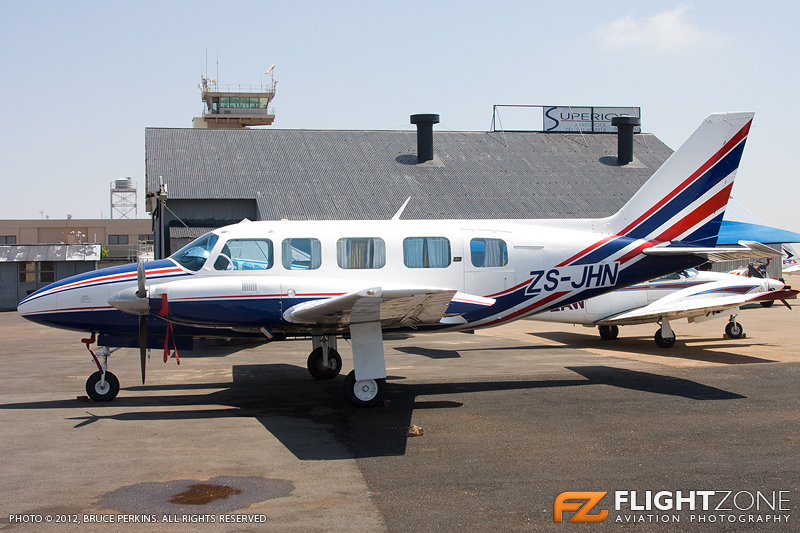
Crash of a Piper PA-31-350 Navajo Chieftain in Grand Central

Date & Time: Nov 25, 2012 at 1027 LT
Registration:
ZS-JHN
Flight Type:
Survivors:
Yes
Schedule:
Grand Central – Tzaneen
MSN:
31-7405496
YOM:
1974
Country:
Region:
Crew on board:
1
Crew fatalities:
Pax on board:
0
Pax fatalities:
Other fatalities:
Total fatalities:
0
Captain / Total flying hours:
1699
Captain / Total hours on type:
1.00
Aircraft flight hours:
8029
Circumstances:
On the morning of 25 November 2012 at 0902Z the pilot, sole occupant on board the aircraft, took off from FAGC to FATZ. He filed an IFR flight plan to cruise at F110 in controlled airspace. The take-off roll and initial climb from RWY 17 was uneventful and passing FL075 FAGC Tower Controller transferred the aircraft to Johannesburg Approach Control (Approach) on 124.5 MHz. On contact with Approach the pilot was cleared to climb to FL110. On the climb approaching FL090 the aircraft lost power on the left engine, oil pressure dropped and the cylinder head temperature increased. He then advised Approach of the problem and requested to level out at FL090 to attempt to identify the problem. He requested radar vectors from Approach to route direct to FAGC and proceeded to shut down the left engine. The pilot continued routing FAGC using the right engine but was unable to maintain height. He noticed the oil pressure and manifold pressure on the right engine dropping. The pilot also reported seeing fire through the cooling vents of the right engine cowling. The pilot requested distance to FAGC from Approach and was told it is 2.5nm (nautical miles) and the aircraft continued loosing height. An update from Approach seconds later indicated that the aircraft was 1nm from FAGC. The pilot decided to do a wheels up forced landing on an open field when he realized that the aircraft was too low. He landed wheels up in a wings level attitude. The aircraft impacted and skidded across an uneven field and came to a stop 5m from Donovan Street. The pilot disembarked the aircraft and attempted to put out the fire which had started inflight on the right engine but without success. Eventually the right wing and the fuselage were engulfed by fire. Minutes later the FAGC fire department using two vehicles extinguished the fire. The pilot escaped with no injuries and the aircraft was destroyed by the ensuing fire.
Probable cause:
An inspection the left wings outboard tank was full and the main tank was empty. Both fuel selectors were also found on main tanks (left and right) position. Unsuccessful forced landing due to fuel starvation and the cause of the fire was undetermined. The left engine failed because of fuel exhaustion and the cause of fire could not be determined.
Final Report:

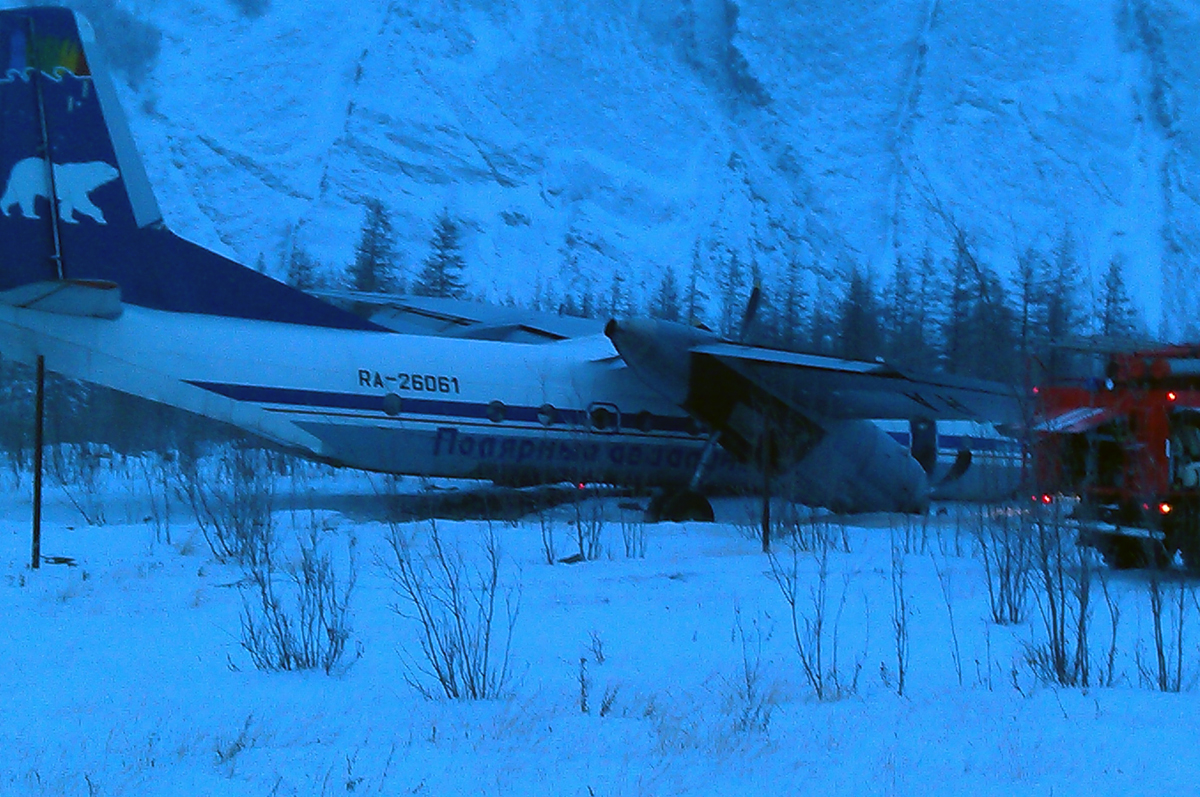
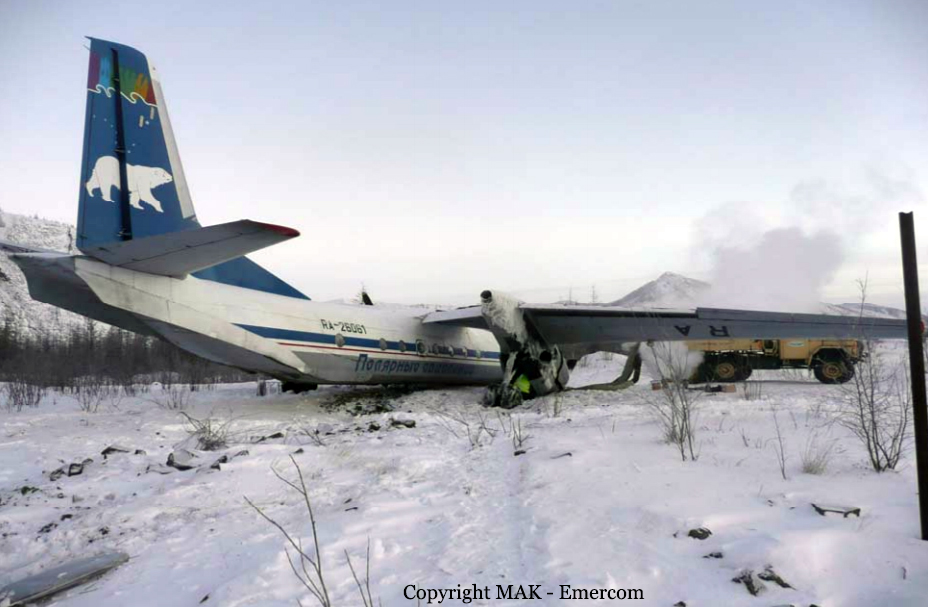
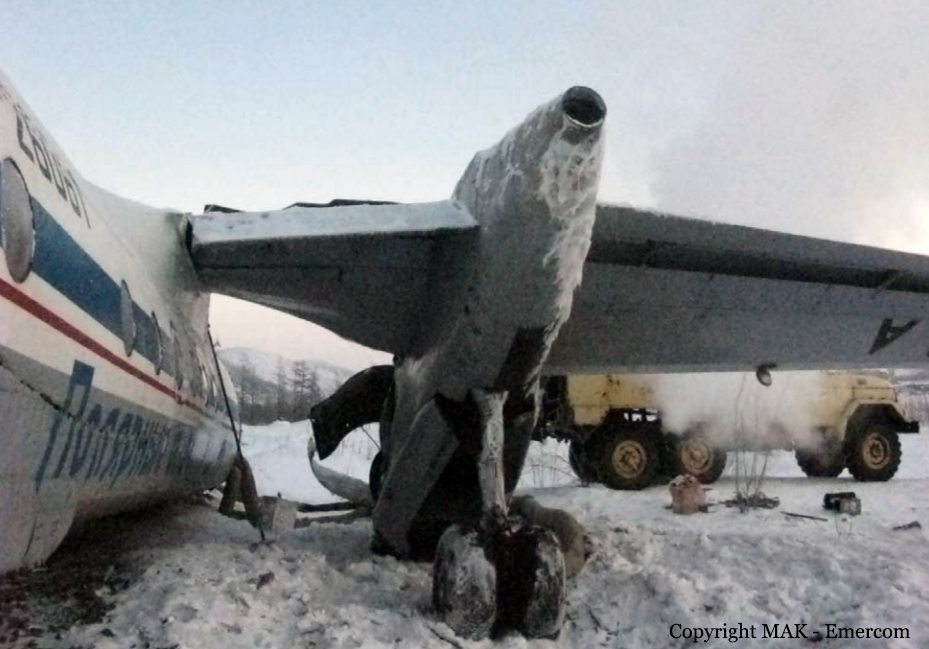
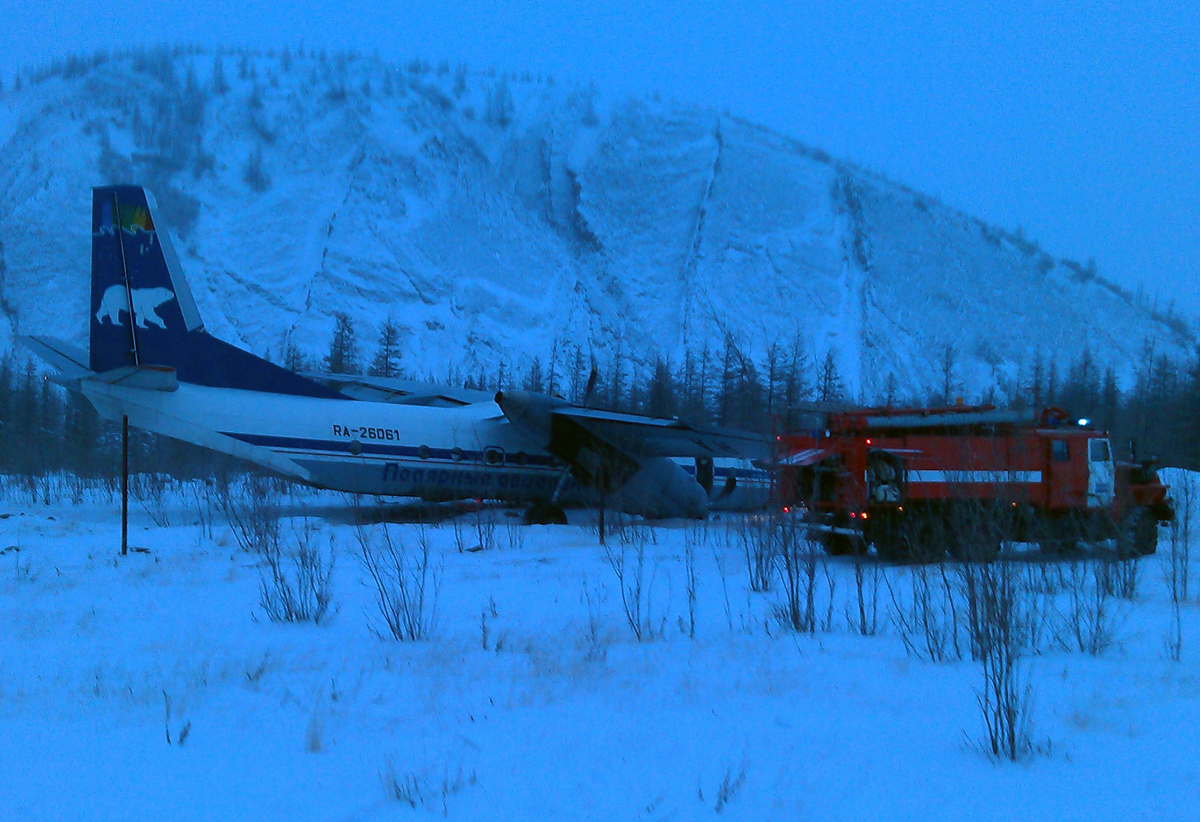
Crash of an Antonov AN-26B-100 in Deputatsky

Date & Time: Nov 21, 2012 at 1431 LT
Type of aircraft:
Operator:
Registration:
RA-26061
Survivors:
Yes
Schedule:
Yakutsk - Deputatsky
MSN:
111 08
YOM:
1981
Flight number:
PI227
Country:
Region:
Crew on board:
6
Crew fatalities:
Pax on board:
23
Pax fatalities:
Other fatalities:
Total fatalities:
0
Captain / Total flying hours:
8845
Captain / Total hours on type:
1150.00
Copilot / Total flying hours:
2566
Copilot / Total hours on type:
245
Aircraft flight hours:
22698
Aircraft flight cycles:
11257
Circumstances:
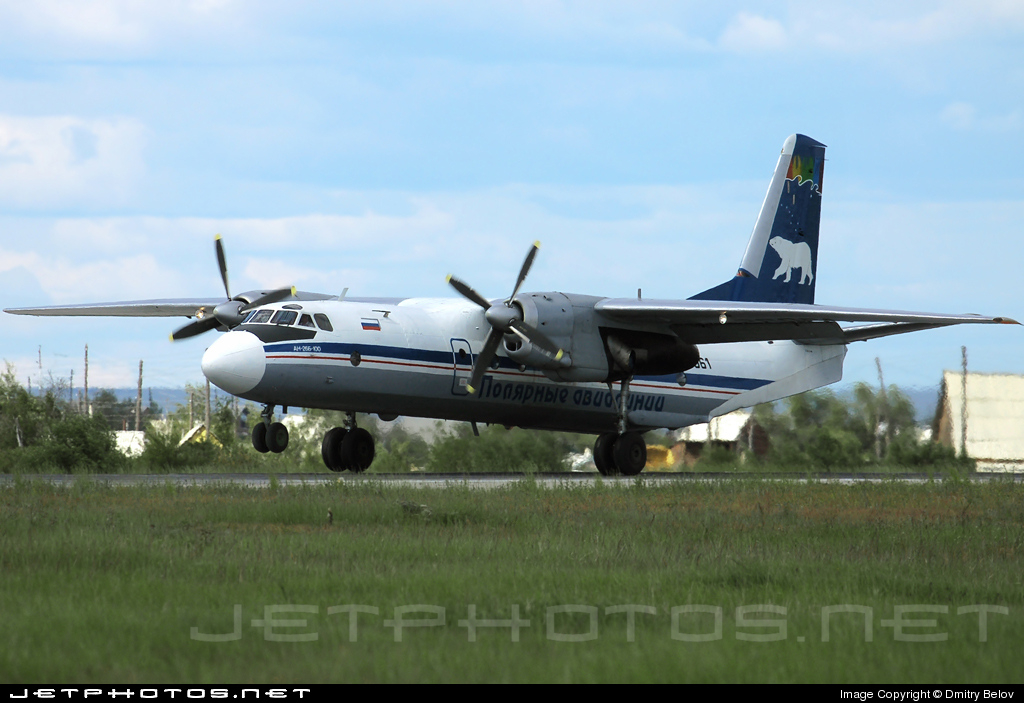
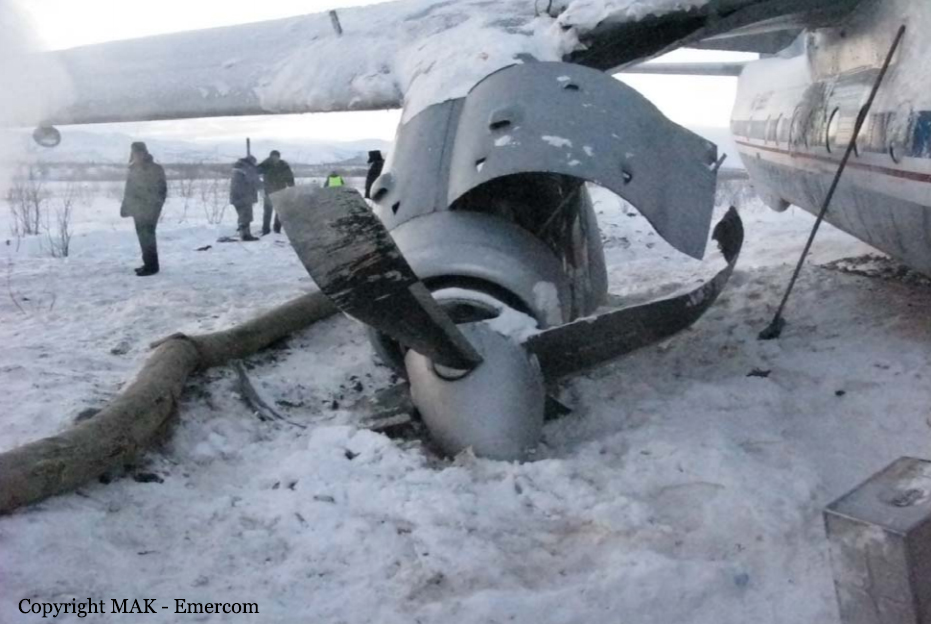
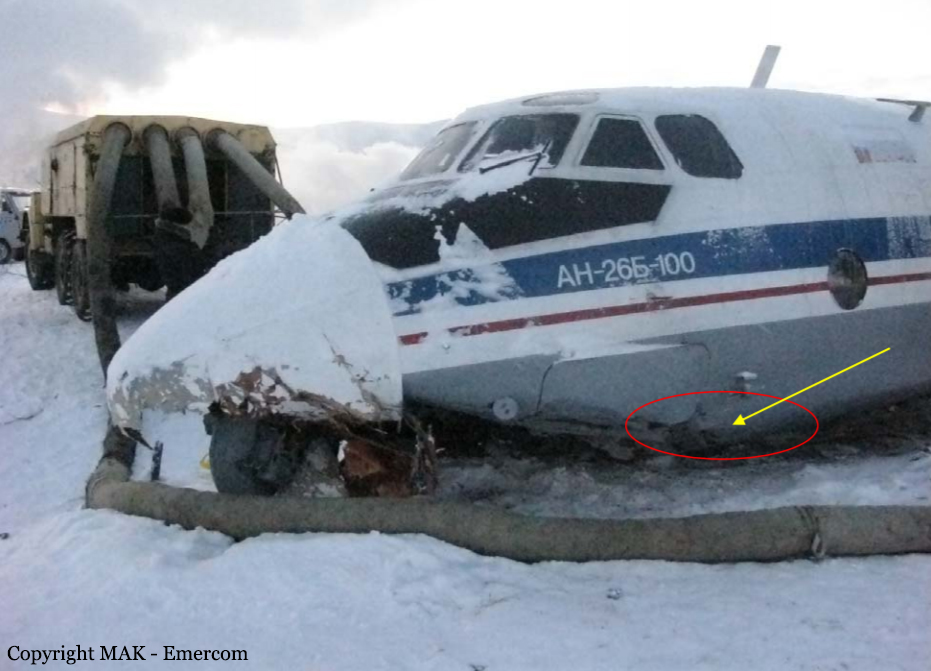
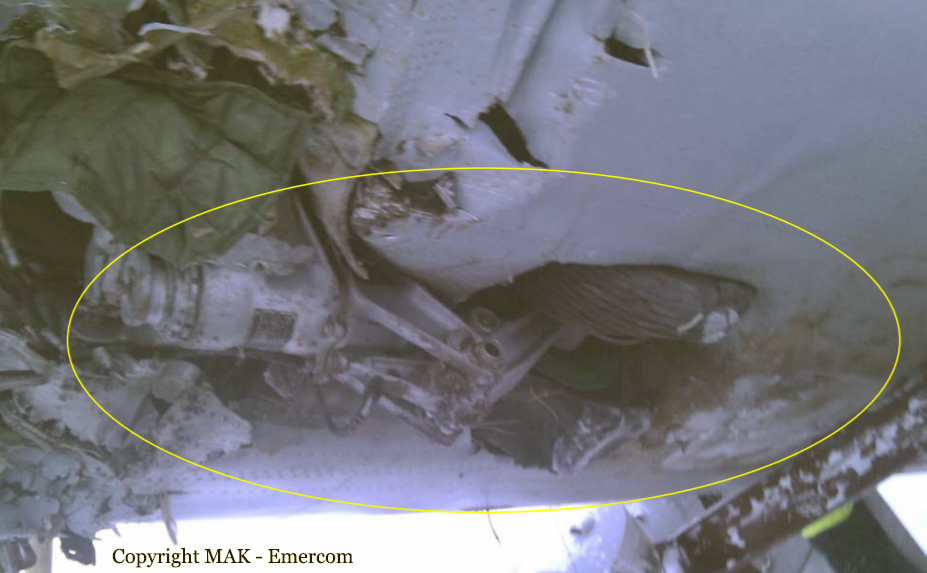
Following an uneventful flight from Yakutsk-Magan Airport, crew started the descent to runway 10. On touch down on a snow covered runway, aircraft landed slightly to the left of the centerline. After a course of 350 meters, left main gear hit a snow berm of 20-50 cm high. Aircraft continued to the left, veered off runway and came to rest in snow covered field with its right main gear and right wing severely damaged. All 29 occupants were evacuated safely while the aircraft was damaged beyond repair.
Probable cause:
The non-fatal accident with An-26B RA-26061 aircraft was caused by its RWY overrun that resulted in aircraft structure damage. The accident was possible due to combination of the following factors:
- Pilot's error resulted in approach procedure correction up to the moment of landing resulted in offset approach towards unpaved RWY axis and considerably to the left from its axis;
- Non-compliance of unpaved RWY of "Deputatsky" Airport" condition with Civil aerodrome operation manual requirements RF-94, in part of interface between cleaned and uncleaned surface of unpaved RWY with slope no more than 1:10;
- Nose-left moment during main landing gear movement along interface from recent snow up to 30-50 cm as a result of both left landing gear wheels dipping into snow.
Final Report:

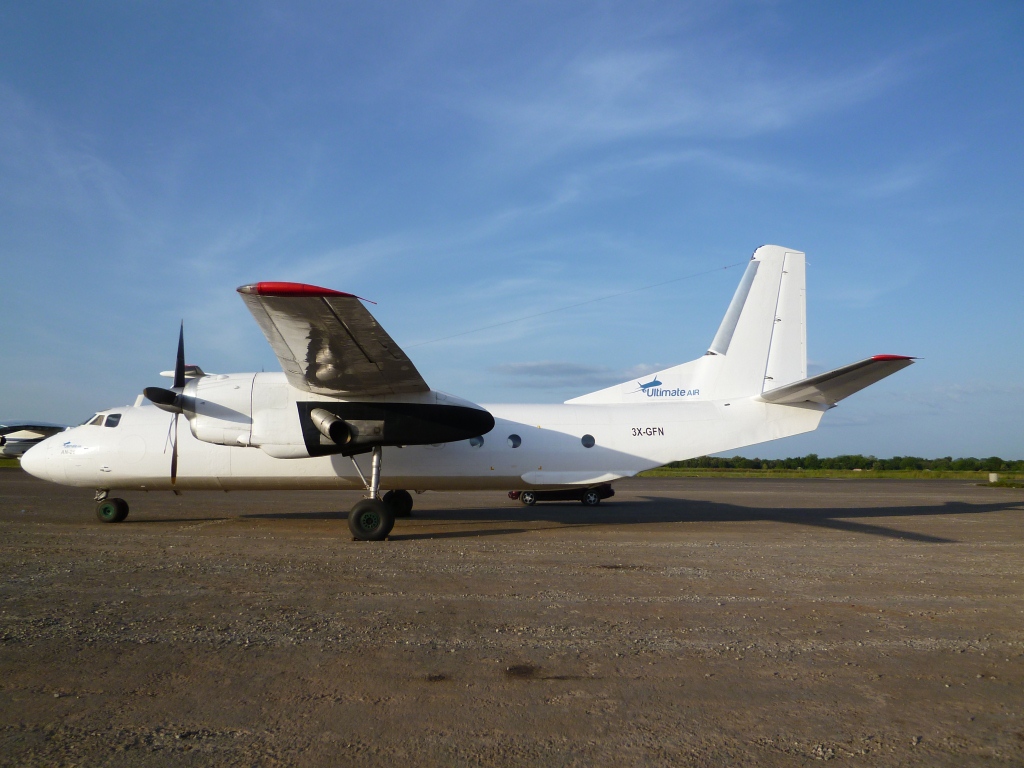
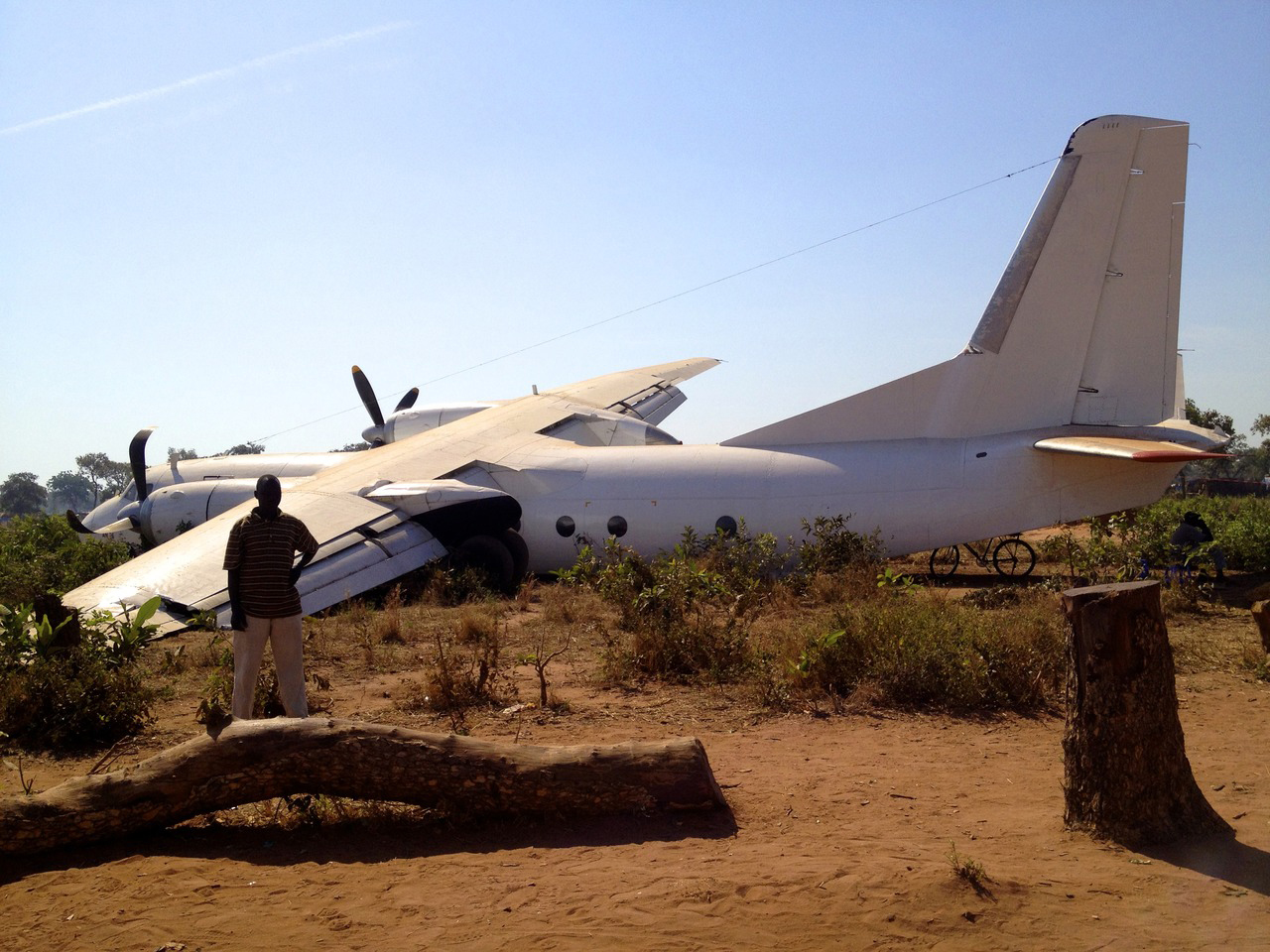
Crash of an Antonov AN-26B-100 in Yida

Date & Time: Nov 19, 2012
Type of aircraft:
Operator:
Registration:
3X-GFN
Flight Type:
Survivors:
Yes
Schedule:
Entebbe - Yida
Country:
Region:
Crew on board:
4
Crew fatalities:
Pax on board:
0
Pax fatalities:
Other fatalities:
Total fatalities:
0
Circumstances:
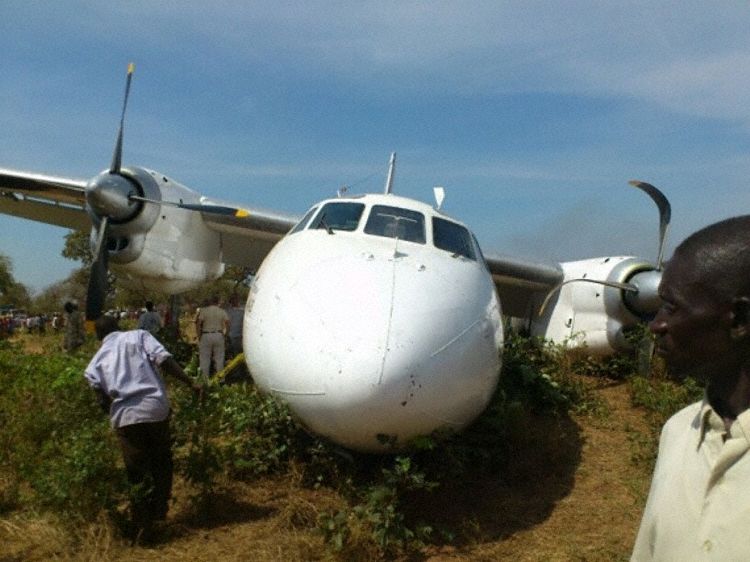
The aircraft was completing a cargo flight from Entebbe, carrying four crew members and a load consisting of foodstuffs. After landing, the aircraft was unable to stop within the remaining distance. It overran, lost its left main gear and came to rest in bushes. While all four occupants escaped uninjured, the aircraft was damaged beyond repair.

Crash of a Cessna 208B Grand Caravan in Snow Lake: 1 killed

Date & Time: Nov 18, 2012 at 0956 LT
Type of aircraft:
Operator:
Registration:
C-GAGP
Flight Phase:
Survivors:
Yes
Schedule:
Snow Lake - Winnipeg
MSN:
208B-1213
YOM:
2006
Country:
Crew on board:
1
Crew fatalities:
Pax on board:
7
Pax fatalities:
Other fatalities:
Total fatalities:
1
Captain / Total flying hours:
2865
Captain / Total hours on type:
1020.00
Aircraft flight hours:
1487
Circumstances:
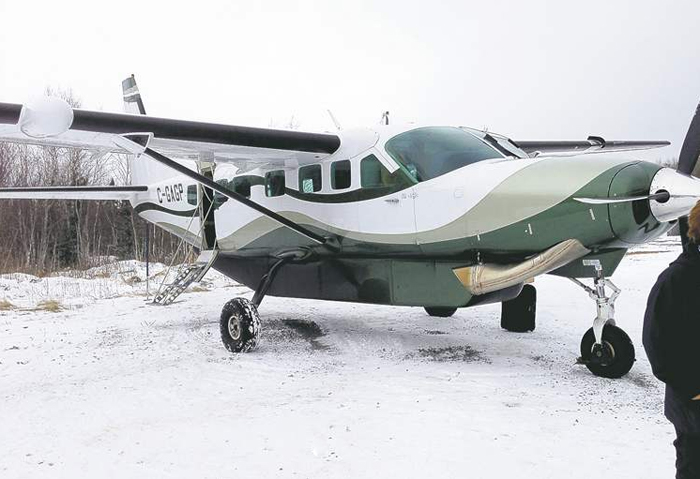
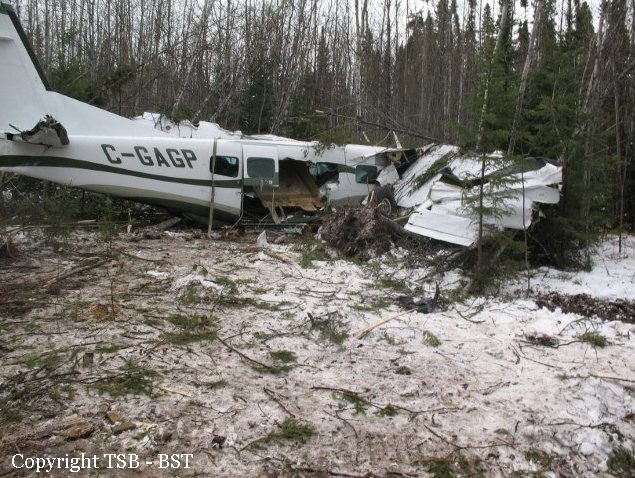
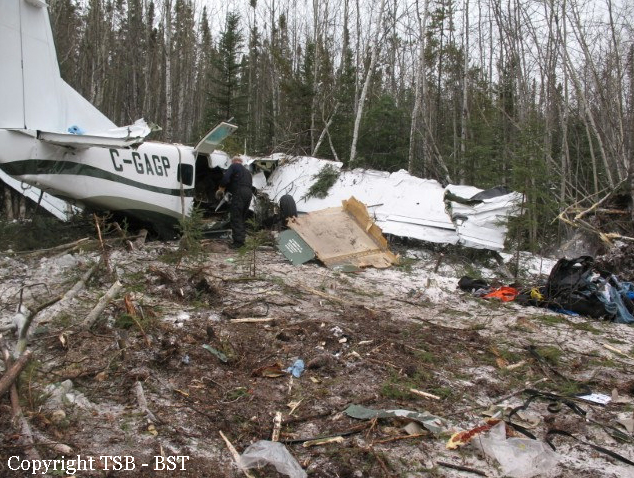
The Gogal Air Services Limited Cessna 208B (registration C-GAGP, serial number 208B1213) departed Runway 21 at Snow Lake en route to Winnipeg, Manitoba, with the pilot and 7 passengers on board. At approximately 0956 Central Standard Time, shortly after take-off, the aircraft descended and struck the terrain in a wooded area approximately 0.9 nautical miles beyond the departure end of the runway. The pilot was fatally injured, and the 7 passengers sustained serious injuries. The aircraft was destroyed by impact forces, and a small fire ensued near the engine. The aircraft’s emergency locater transmitter activated. First responders attended the scene, and the injured passengers were taken to area hospitals. The aircraft’s fuel cells ruptured, and some of the onboard fuel spilled at the site.
Probable cause:
Findings as to causes and contributing factors:
1. The aircraft departed Snow Lake overweight and with an accumulation of ice on the leading edges of its wings and tail from the previous flight. As a result, the aircraft had reduced take-off and climb performance and increased stall speed, and the protection afforded by its stall warning system was impaired.
2. A breakdown in the company’s operational control resulted in the flight not operating in accordance with the Canadian Aviation Regulations and the company operations manual.
3. As a result, shortly after departure, the aircraft stalled at an altitude from which recovery was not possible.
Findings as to risk:
1. If companies operate in instrument meteorological conditions for which they are not authorized, there is an increased risk that accidents may occur.
2. If Transport Canada does not provide the same degree of oversight for repetitive charter operations as it does for a scheduled operator, the risks in the operator’s activities may not be fully evaluated.
3. If passenger briefings are not provided and passengers are not properly seated and restrained, there is an increased risk of injuries to those passengers and the other occupants in the event of an accident.
4. If flights are conducted without ensuring an ice-free airframe, there is a risk of decreased aircraft performance and of loss of control and collision with terrain.
Other findings:
1. On impact, the aircraft’s seats and cabin deformed as designed, and this deformation partially attenuated the impact forces.
Final Report:

Crash of a Piper PA-46-500TP Malibu Meridian in La Crete: 1 killed

Date & Time: Nov 17, 2012 at 1810 LT
Registration:
C-GWEI
Flight Type:
Survivors:
No
Schedule:
High Level – La Crete
MSN:
46-97351
YOM:
2008
Country:
Crew on board:
1
Crew fatalities:
Pax on board:
0
Pax fatalities:
Other fatalities:
Total fatalities:
1
Circumstances:
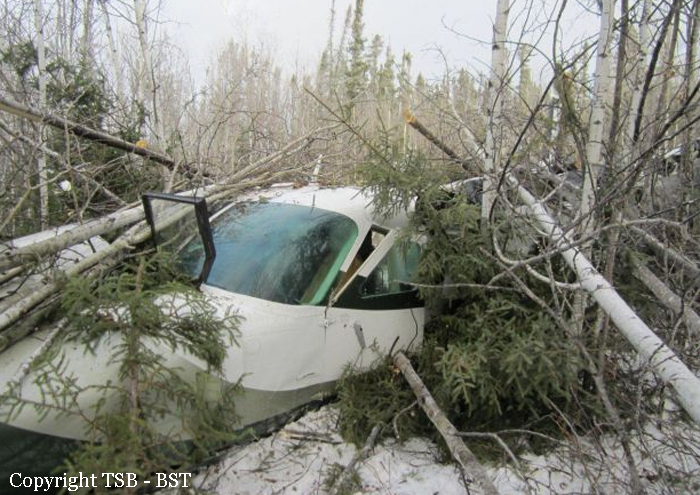
While descending to La Crete Airport, the pilot encountered foggy conditions and the visibility dropped to 100 metres. By night, the single engine aircraft descended too low, impacted ground and crashed in a snow covered field located few km northeast of the airport. The aircraft was destroyed and the pilot, sole on board, was killed.
Probable cause:
It was determined that the pilot continued the descent under VFR mode in IMC conditions, resulting in a controlled flight into terrain.

Crash of a Cessna 550 Citation II in Greenwood

Date & Time: Nov 17, 2012 at 1145 LT
Type of aircraft:
Operator:
Registration:
N6763L
Flight Type:
Survivors:
Yes
Schedule:
Greenwood - Greenwood
MSN:
550-0673
YOM:
1991
Crew on board:
2
Crew fatalities:
Pax on board:
0
Pax fatalities:
Other fatalities:
Total fatalities:
0
Captain / Total flying hours:
11592
Captain / Total hours on type:
903.00
Copilot / Total flying hours:
4501
Copilot / Total hours on type:
13
Aircraft flight hours:
8611
Circumstances:
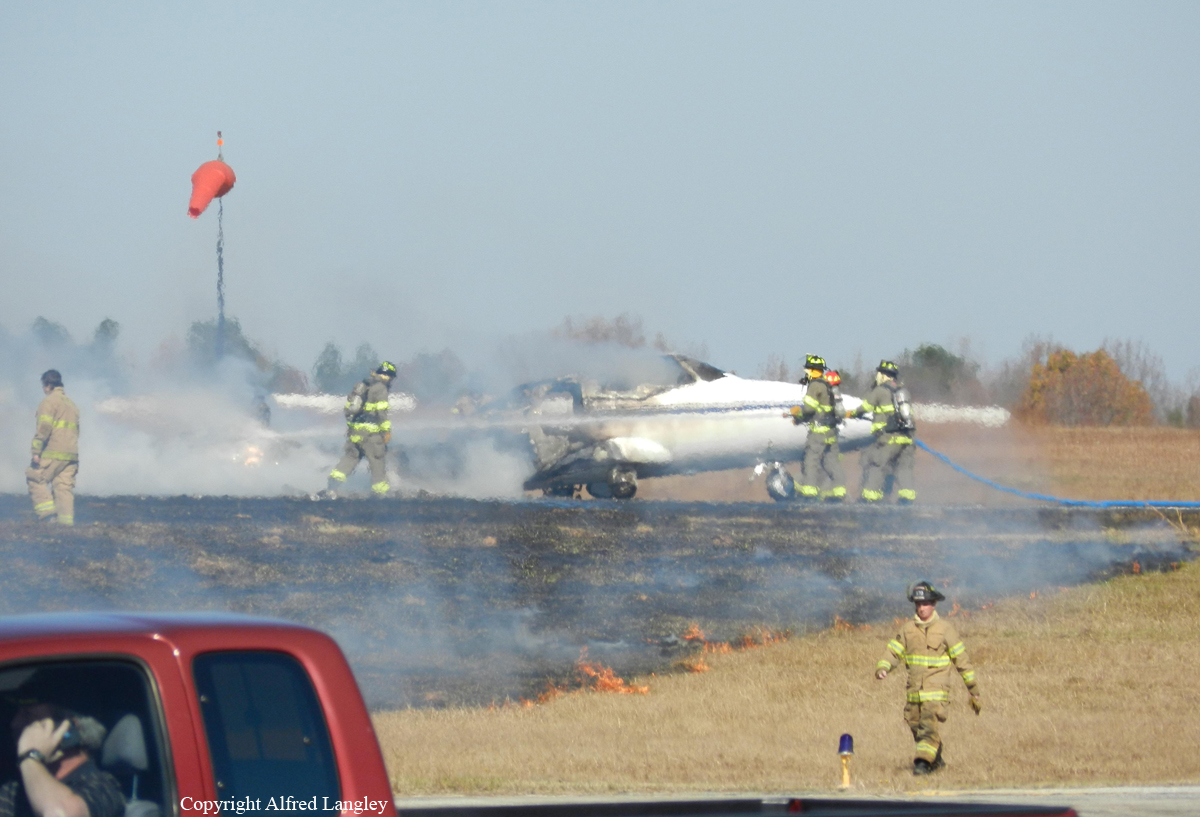
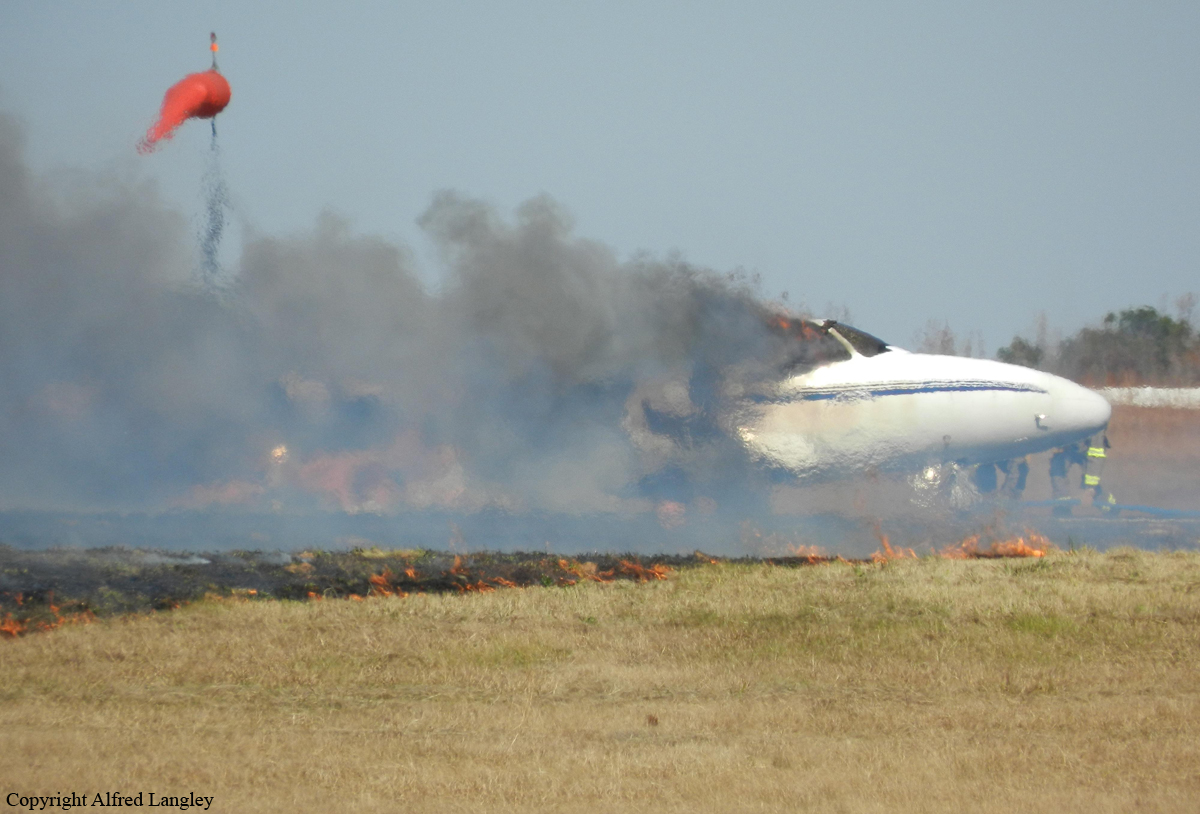
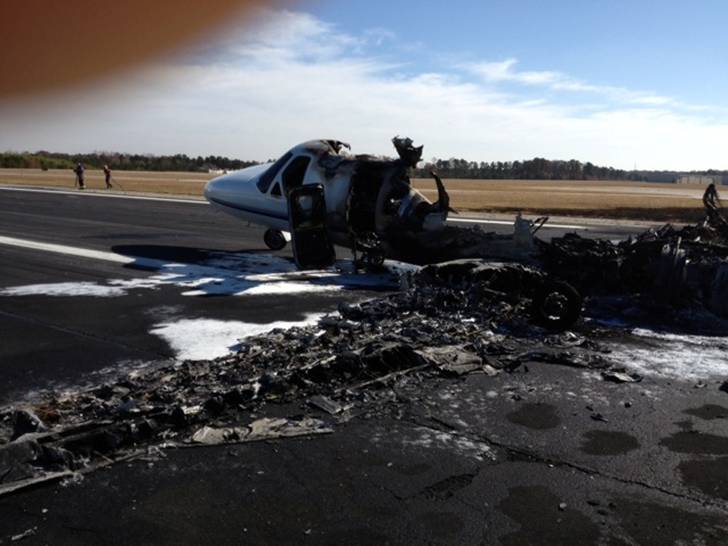
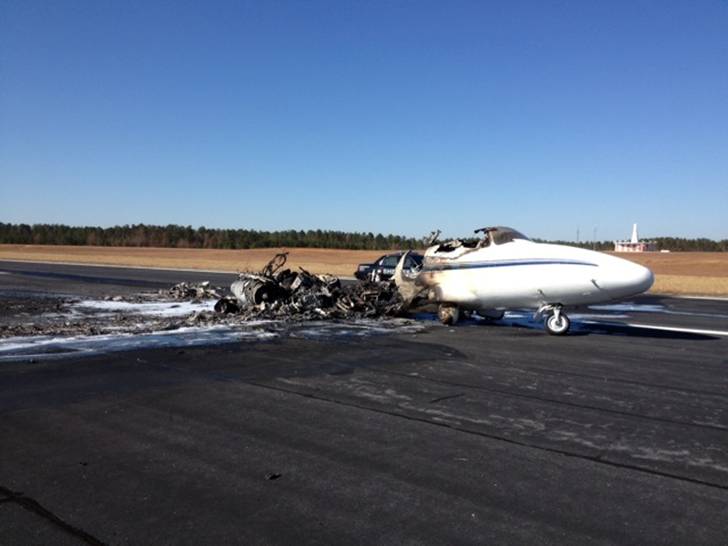
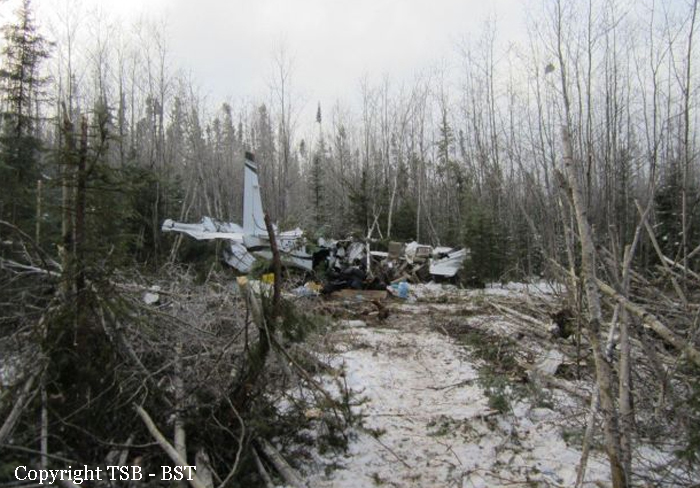
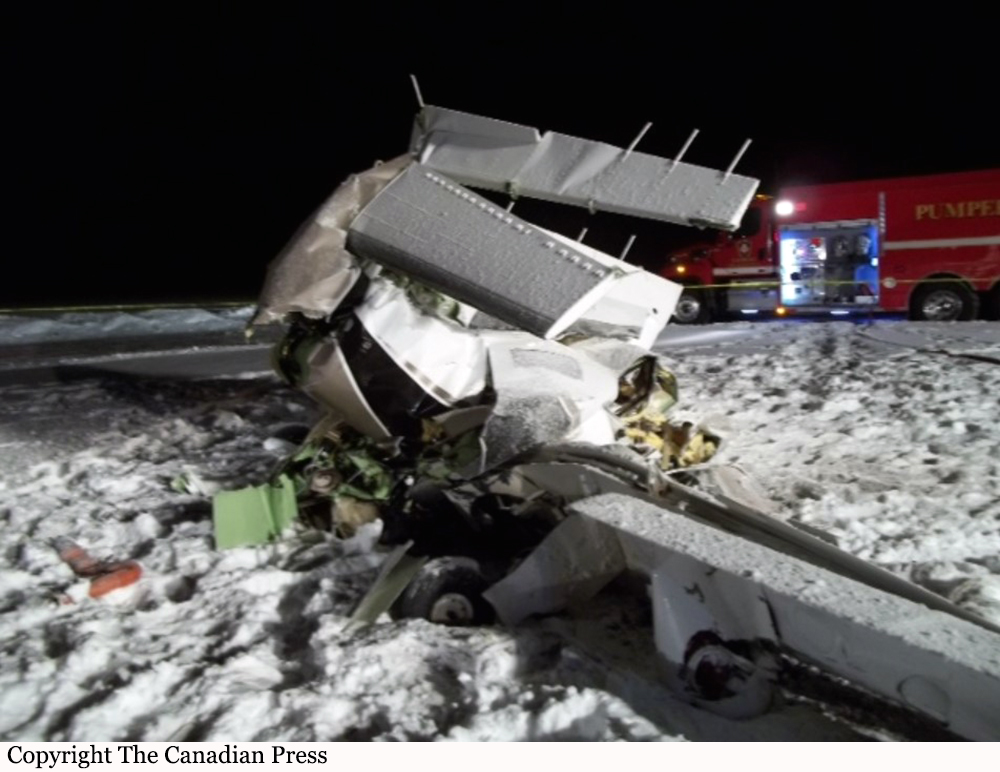
The aircraft, registered to the United States Customs Service, and operated by Stevens Aviation, Inc., was substantially damaged during collision with a deer after landing on Runway 9 at Greenwood County Airport (GRD), Greenwood, South Carolina. The airplane was subsequently consumed by postcrash fire. The two certificated airline transport pilots were not injured. Visual meteorological conditions prevailed, and no flight plan was filed for the maintenance test flight, which was conducted under the provisions of Title 14 Code of Federal Regulations Part 91. According to the pilot, the purpose of the flight was to conduct a test of the autopilot and flight director systems on board the airplane, following a "cockpit modernization" their company had performed. The airplane completed the NDB/GPS RWY 27 instrument approach procedure and then circled to land on Runway 9. About 5 seconds into the landing rollout, a deer appeared from the wood line and ran into the path of the airplane. The deer struck the airplane at the leading edge of the left wing above the left main landing gear, and ruptured an adjacent fuel cell. The pilot was able to maintain directional control, and the airplane was stopped on the runway, spilling fuel and on fire. The crew performed an emergency shutdown of the airplane and egressed without injury.Greenwood County Airport did not have a fire station co-located on the airport facility. The fixed base operator called 911 at the time of the accident, and the fire trucks arrived approximately 10 minutes after notification.
Probable cause:
Collision with a deer during the landing roll, which resulted in a compromised fuel tank and a postimpact fire. In a telephone interview, the manager of the Greenwood County Airport explained that Greenwood was not an FAR Part 139 Airport, and while there was no published Wildlife Management Program for the airport, she had been very proactive about eradicating wildlife that could pose a hazard to safety on the airport property, primarily deer and wild turkey. She contacted the United States Department of Agriculture (USDA) for guidance and advice and she attended a wildlife management course. Among the suggestions offered by the USDA, was to remove the deer habitat. The manager proposed adding the area between the runway and taxiway to an approach clearing project in order to reduce the habitat. The manager worked with a local charity and local hunters with depredation permits to take deer on the airport property, and their efforts averaged 50 deer a year. The hunts were conducted in stands away from runways and on property not aviation related. The nearest deer stand was 1 mile from the runway, and the hunters fired only shotguns. The hunts were conducted between the hours of 0700 and 1000. On the morning of the accident, the last shot was fired at 0930.When asked why the hunters were still on the property at the time of the accident, the manager said they had stayed to eat lunch, and repeated that the hunt was long over and that the last shot was fired hours before the accident. She offered that the deer struck by the airplane was probably flushed from the woods by another deer or a coyote, whose population has also grown in recent years.After the accident, the Federal Aviation Administration contacted the state and had the Greenwood County Airport added to a list of airports where funding for improvements had been allotted. A second 10-foot perimeter fence was added around the existing 6-foot fence, and since its construction only 4 deer have been taken inside the perimeter, and no wild turkeys have been sighted
Final Report:

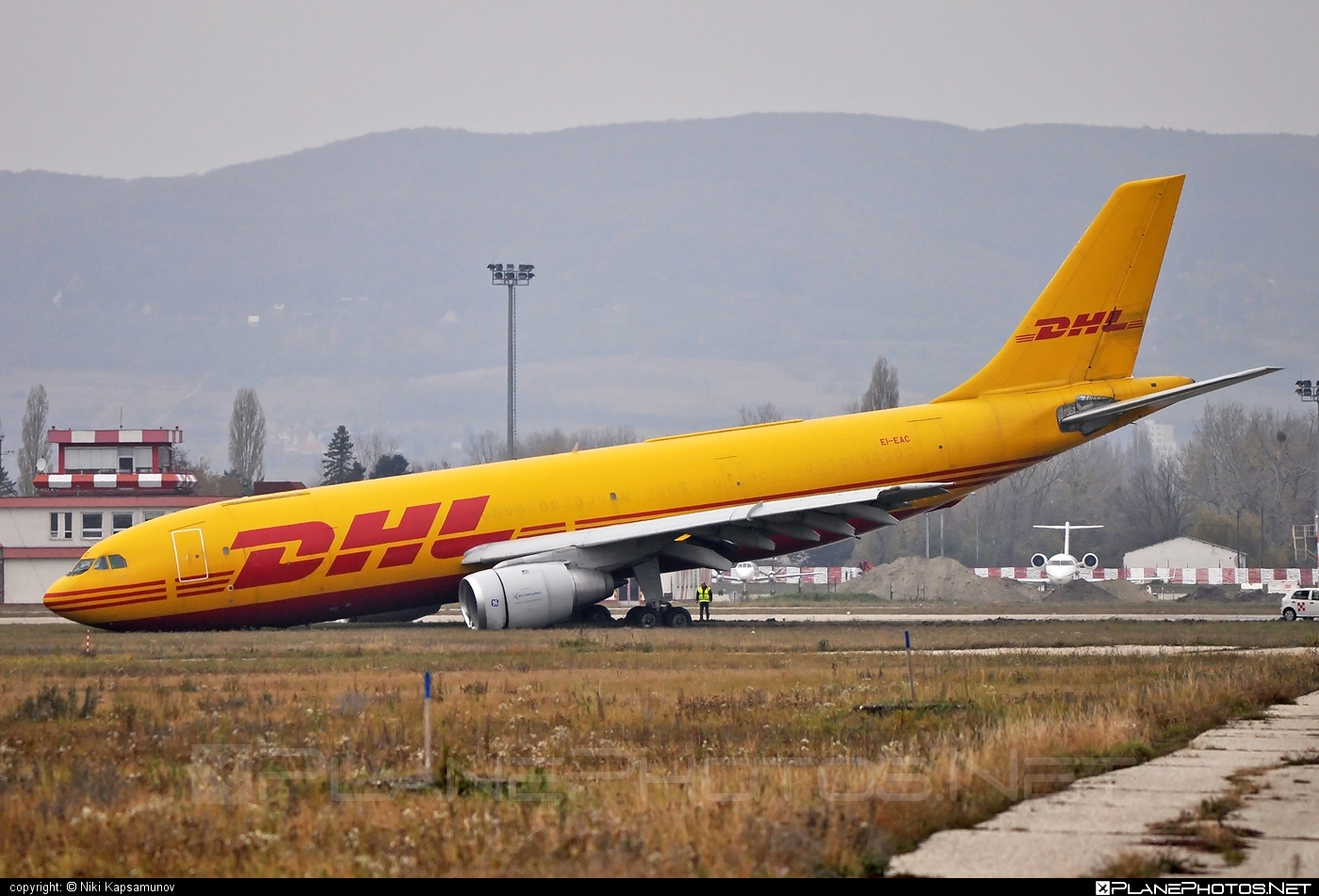
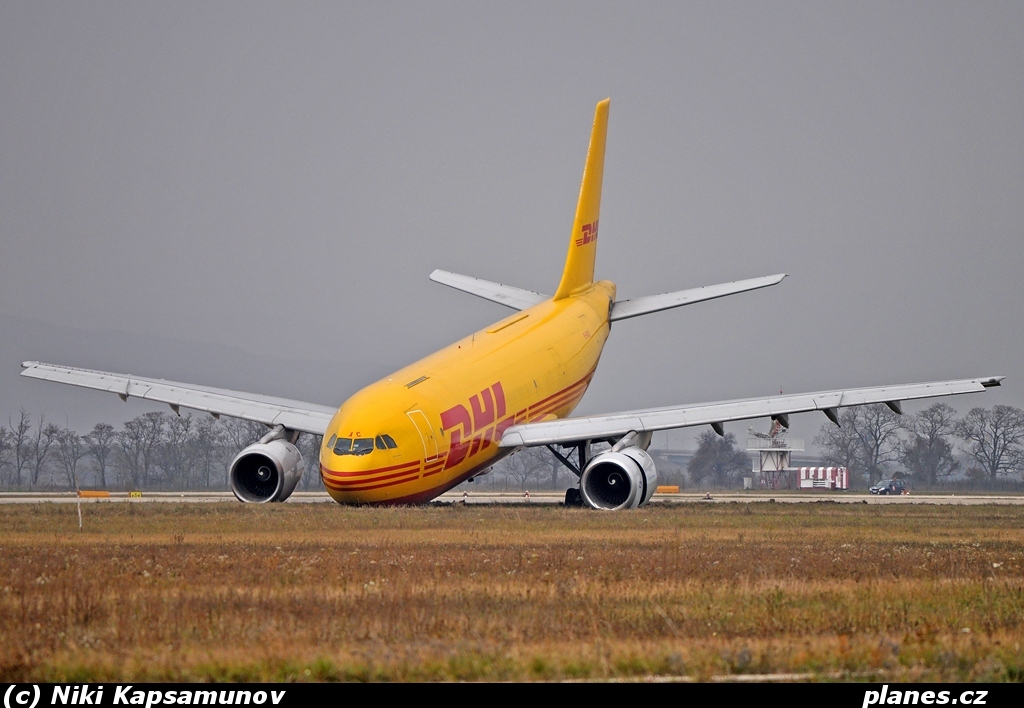
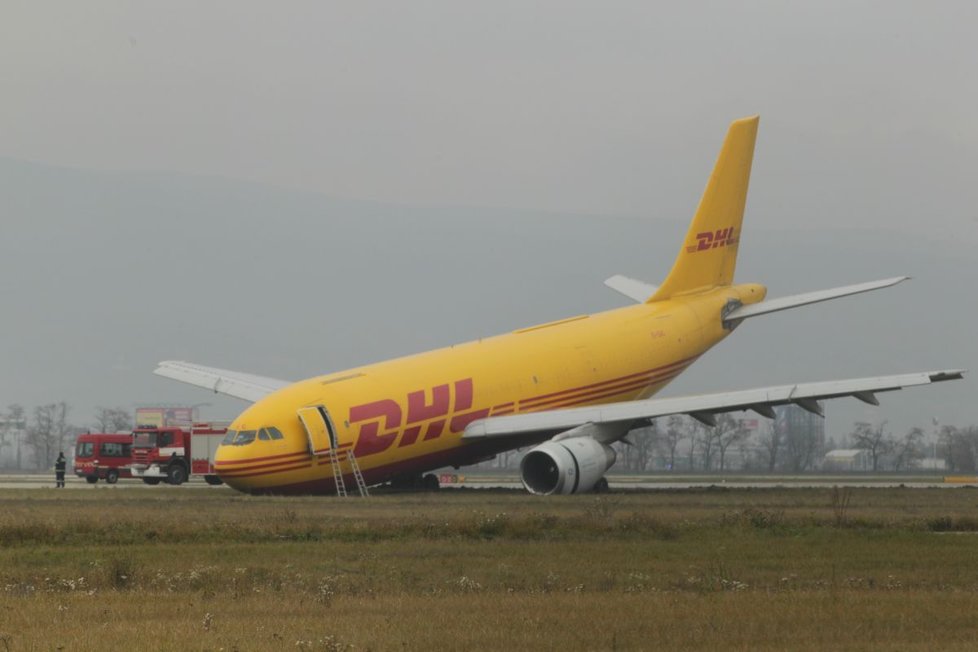
Crash of an Airbus A300B4-203F in Bratislava

Date & Time: Nov 16, 2012 at 0525 LT
Type of aircraft:
Operator:
Registration:
EI-EAC
Flight Type:
Survivors:
Yes
Schedule:
Leipzig - Bratislava
MSN:
250
YOM:
1983
Flight number:
DHL6321
Country:
Region:
Crew on board:
3
Crew fatalities:
Pax on board:
0
Pax fatalities:
Other fatalities:
Total fatalities:
0
Circumstances:
The crew took off from Leipzig Airport at 0438LT bound for Bratislava Airport (Slovakia). The approximately forty-five minutes flight took place without incident and the crew was cleared for the ILS approach to runway 22. The Captain was PF. During the descent, the controller informed the crew that the wind was from  120° at  7  kt. The crew selected the slats and flaps at 25°. The antiskid and the autobrake were armed in MED mode. The ILS 22 approach was stable until the wheels touched down. The main landing gear touched the runway about 700 m from the threshold of runway  22. The crew deployed the thrust reversers. About six seconds after the nose gear touched, the crew felt strong vibrations that increased as the speed dropped. At 85 kt, the thrust reversers were retracted. The aeroplane veered towards the left. The PF explained that he applied energetic braking and tried in vain to counter the rocking by using the rudder pedals then the nose gear steering control. He  added that the sequence occurred so quickly that he did not think to use differential braking to try to keep the aeroplane on the runway. The aeroplane exited the runway to the left at a speed of about 45 kt. Its nose gear struck a concrete inspection pit and collapsed. The aeroplane skidded for a few dozen metres before coming to a stop. The crew evacuated the aeroplane. Between the start of the vibrations and the aeroplane stopping, it had rolled about 400 metres.
Probable cause:
Incorrect installation of one or more washers on the nose gear torque link centre hinge made it impossible to lock the hinge shaft nut effectively. The unscrewing and the detachment of the latter in service caused the loss of nose gear steering. Free on its axle, the nose gear bogie began to shimmy, which made the aeroplane veer to the left. The aeroplane exited the runway and the nose gear collapsed during the collision with a concrete inspection pit for access to the runway lighting electric cables.The runway excursion was due to the incorrect and undetected re-assembly of the nose gear torque links. Despite the presence of a detailed diagram, the absence of clear and detailed instructions in the text of the manufacturer’s AMM, allowing the operator to ensure that the assembly was correct, contributed to the incorrect assembly. The failure of the nose gear was due to the collision with an obstacle in the runway  strip. The absence of any regulation requiring that equipment in the immediate vicinity of a runway or of a runway overrun area be designed so as to limit as much as possible any damage to aeroplanes, in case of a runway excursion, contributed to the accident.
Final Report: