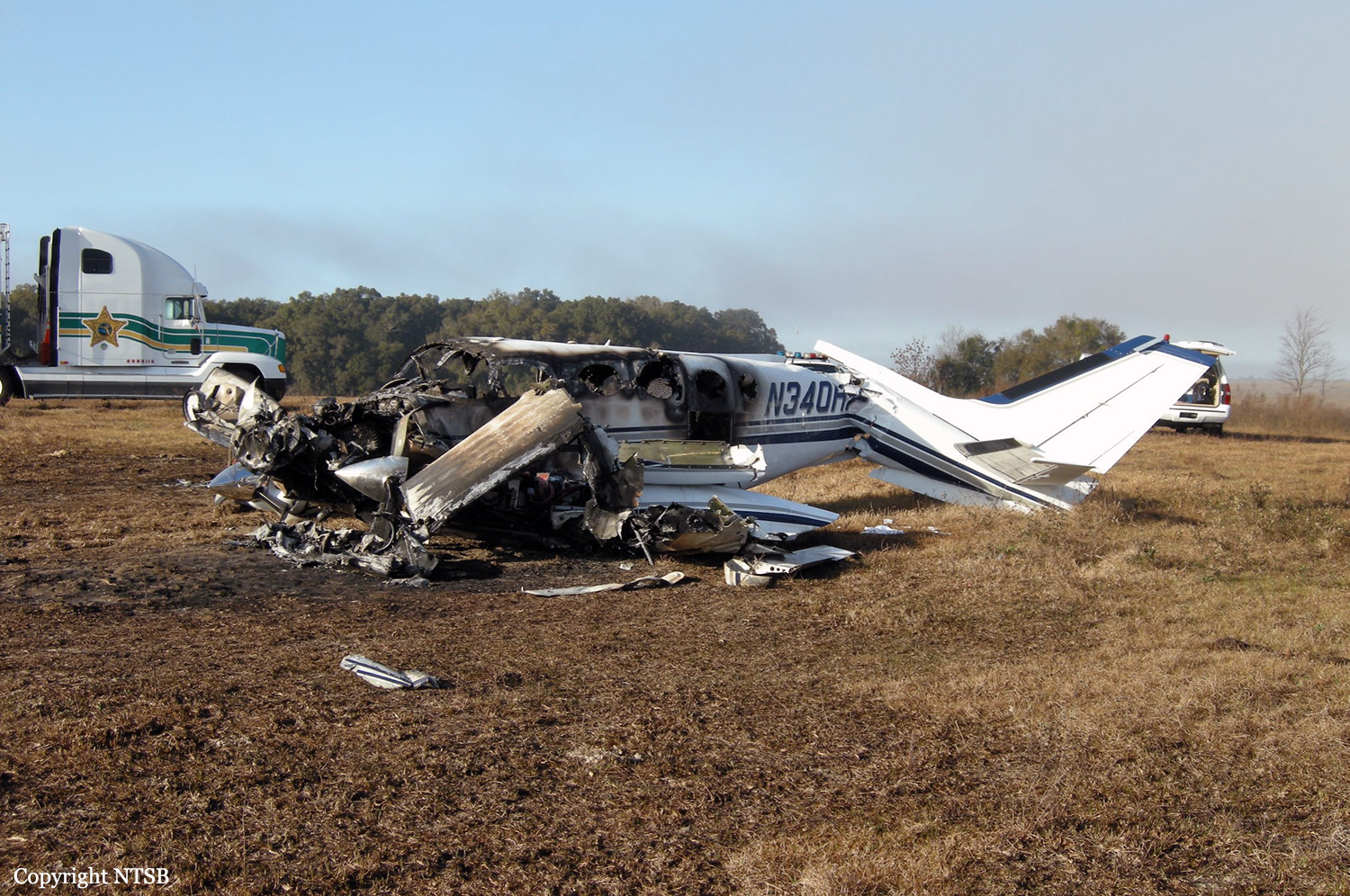
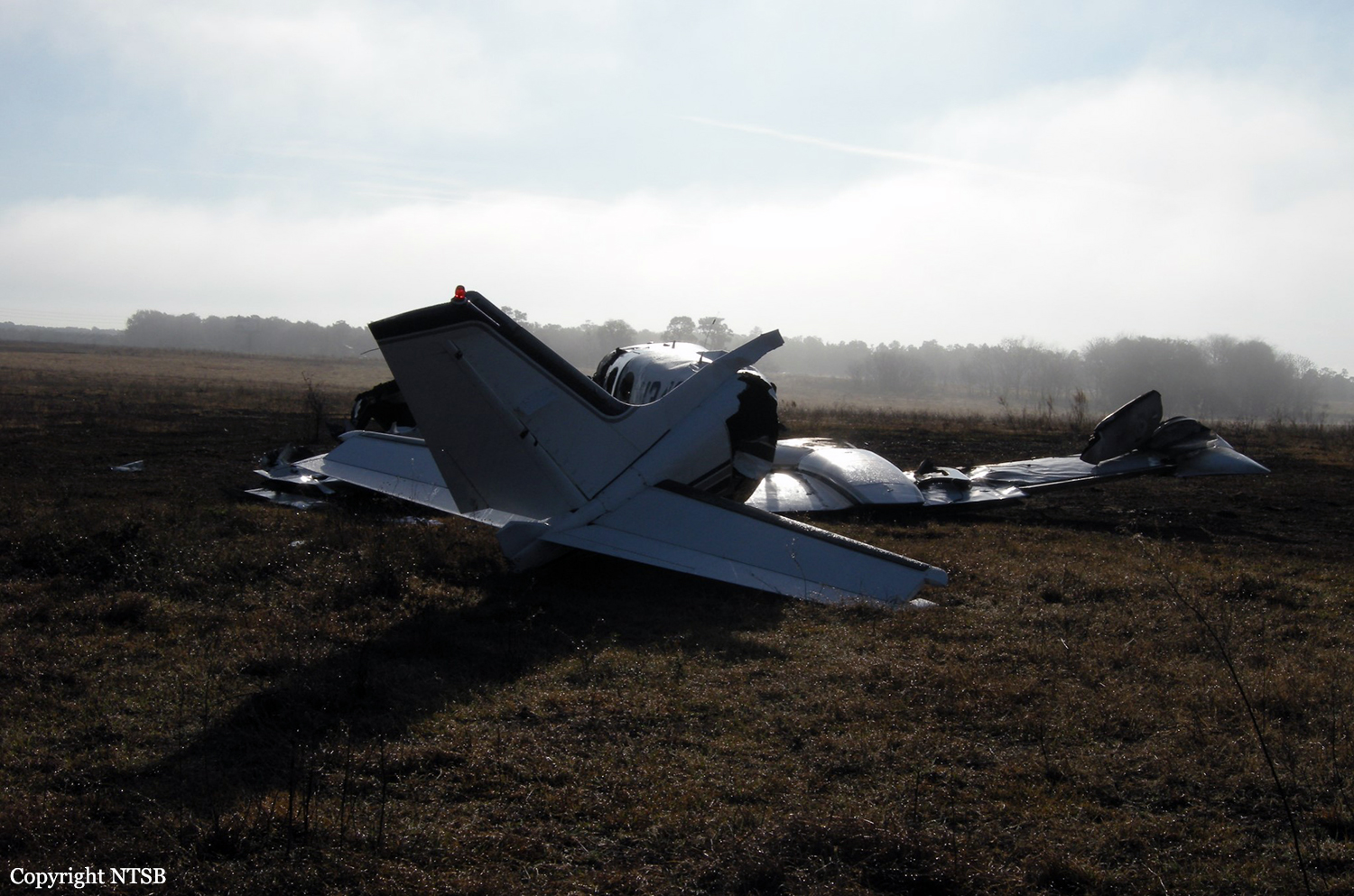
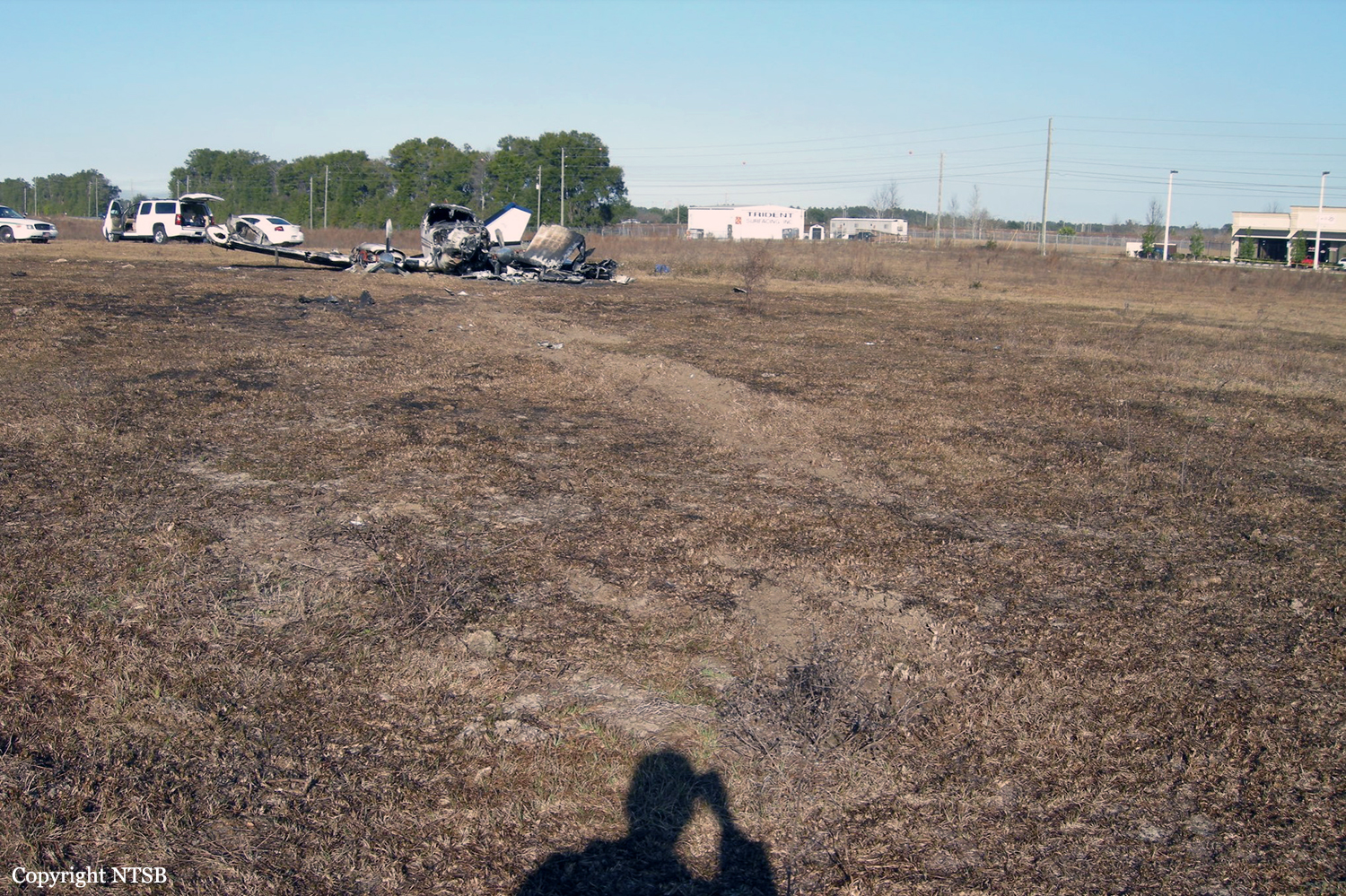
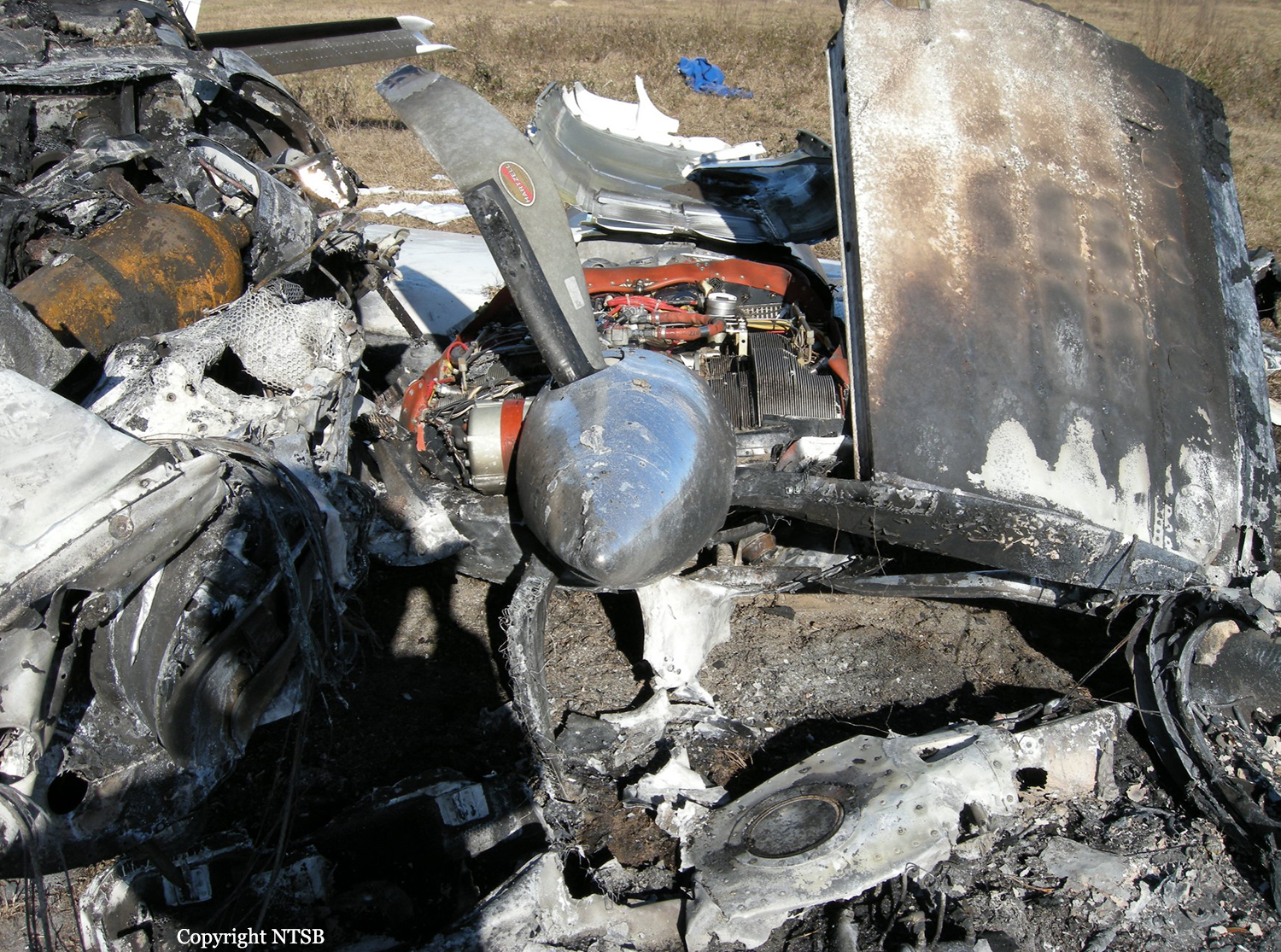
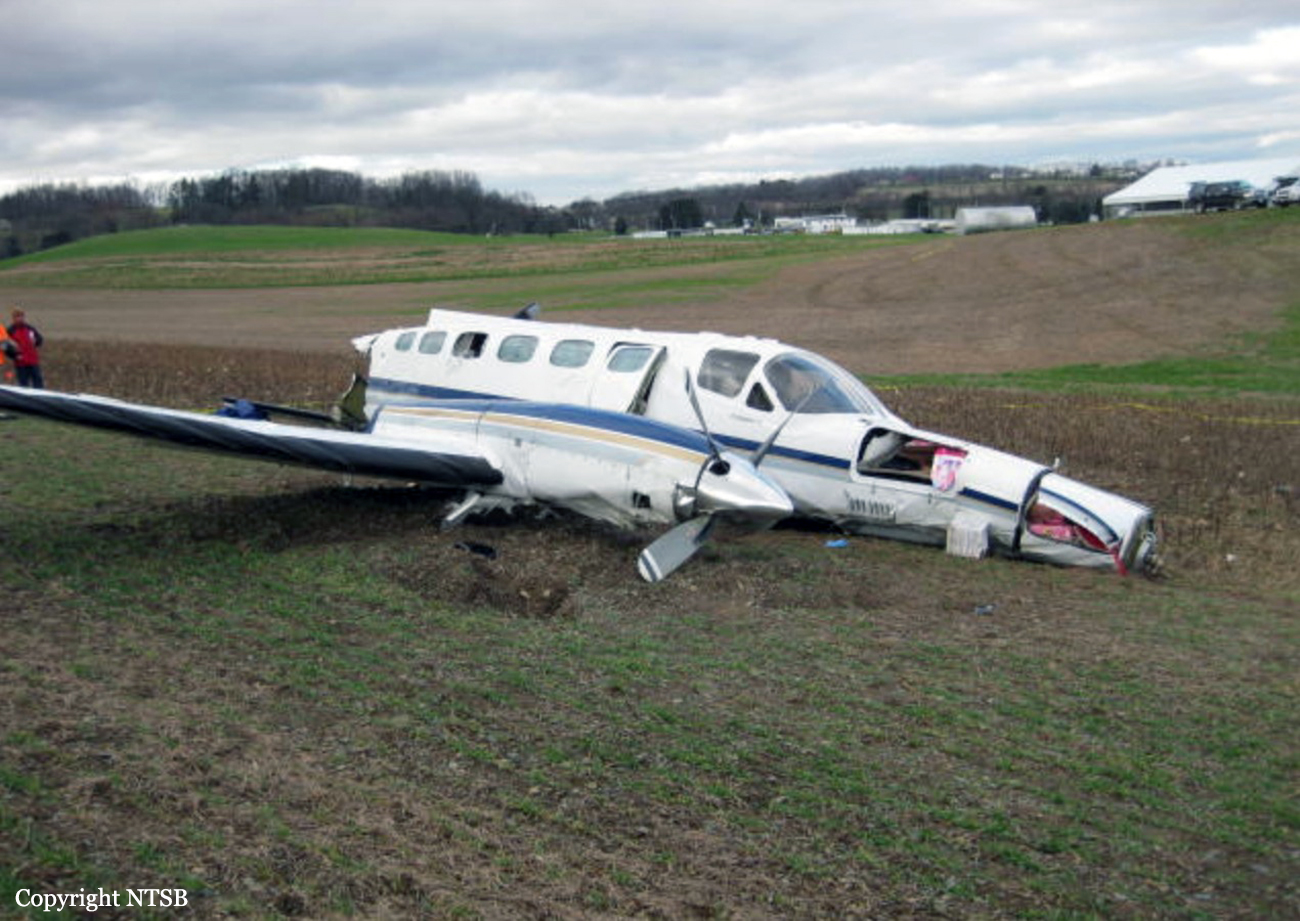
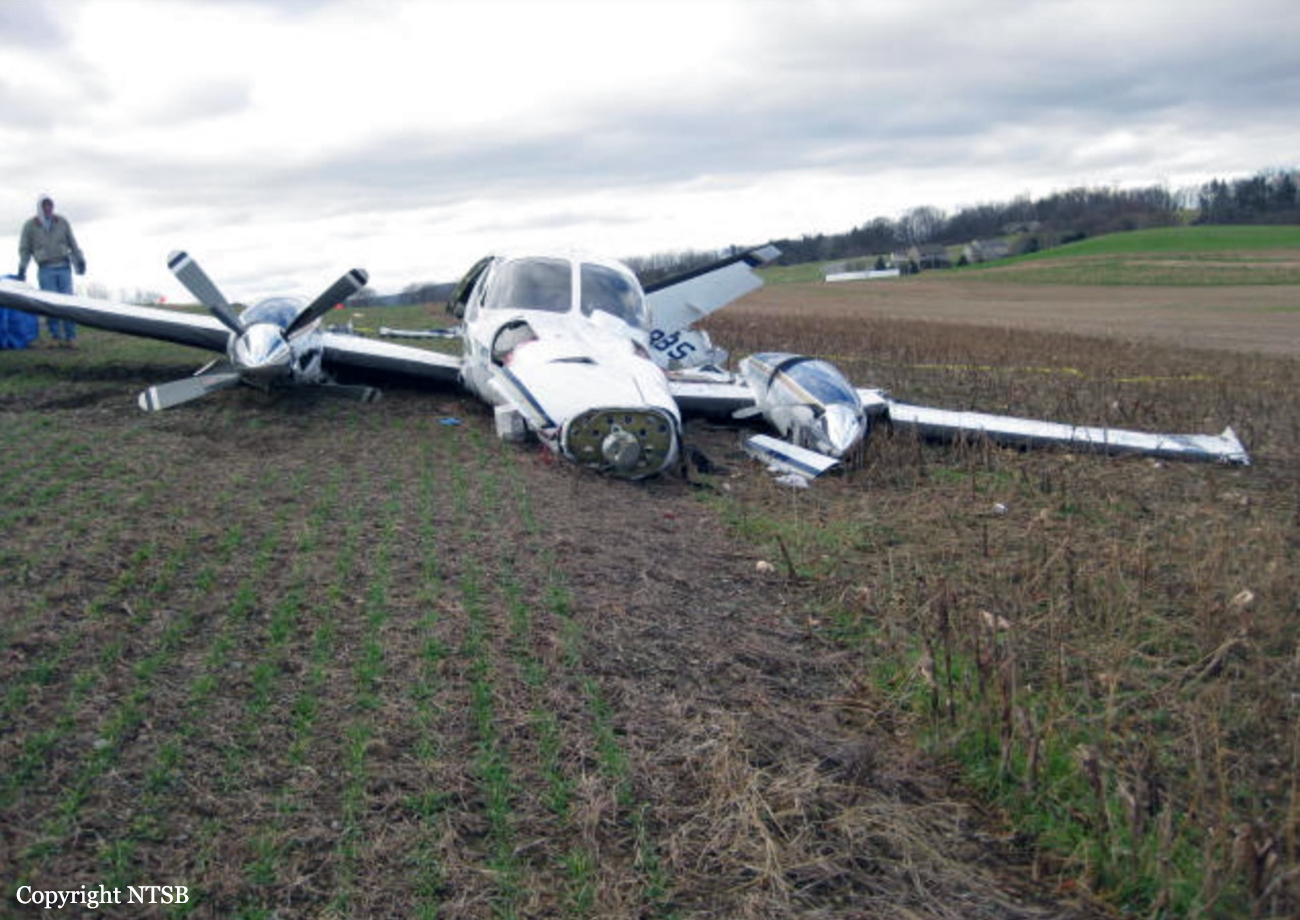
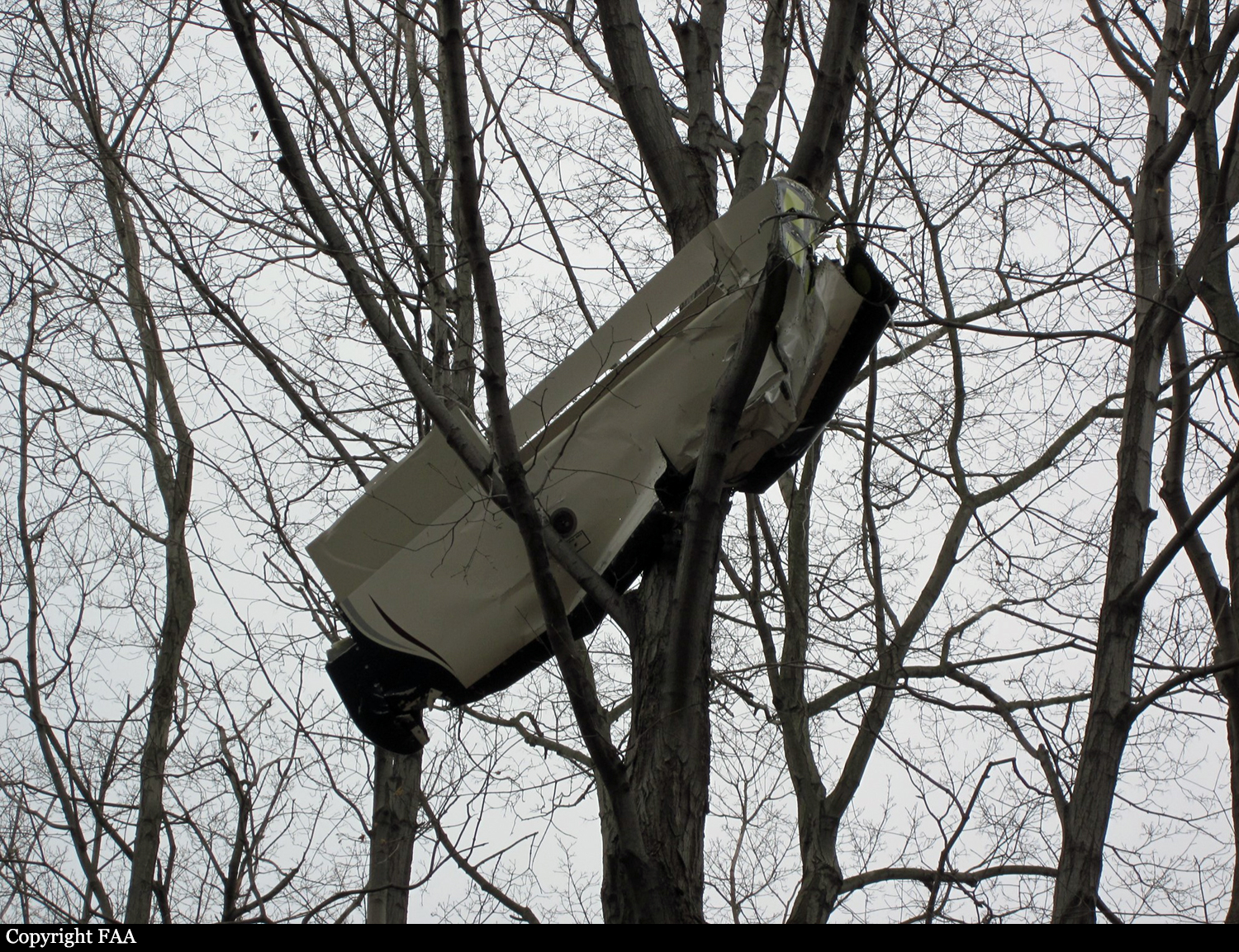
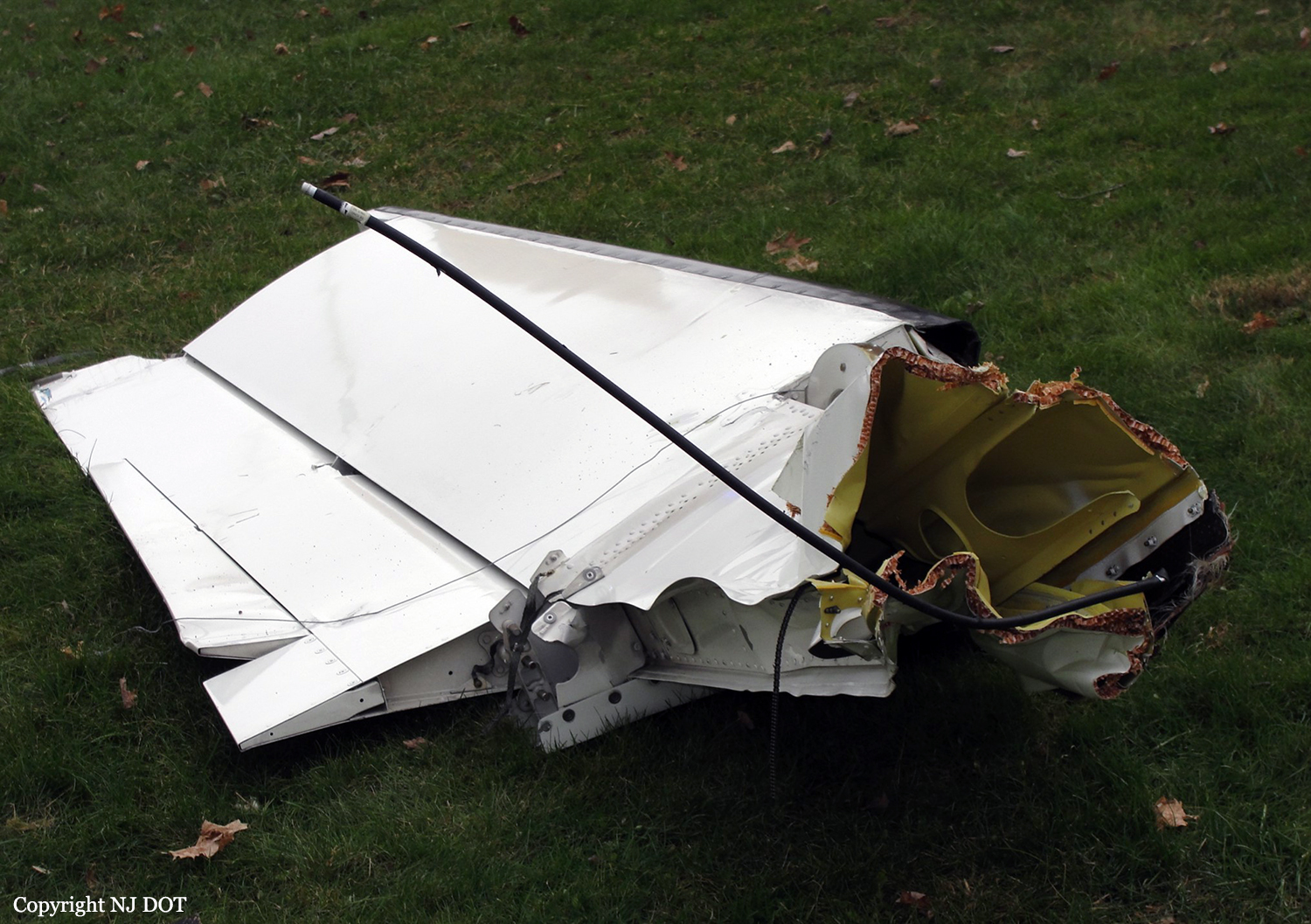
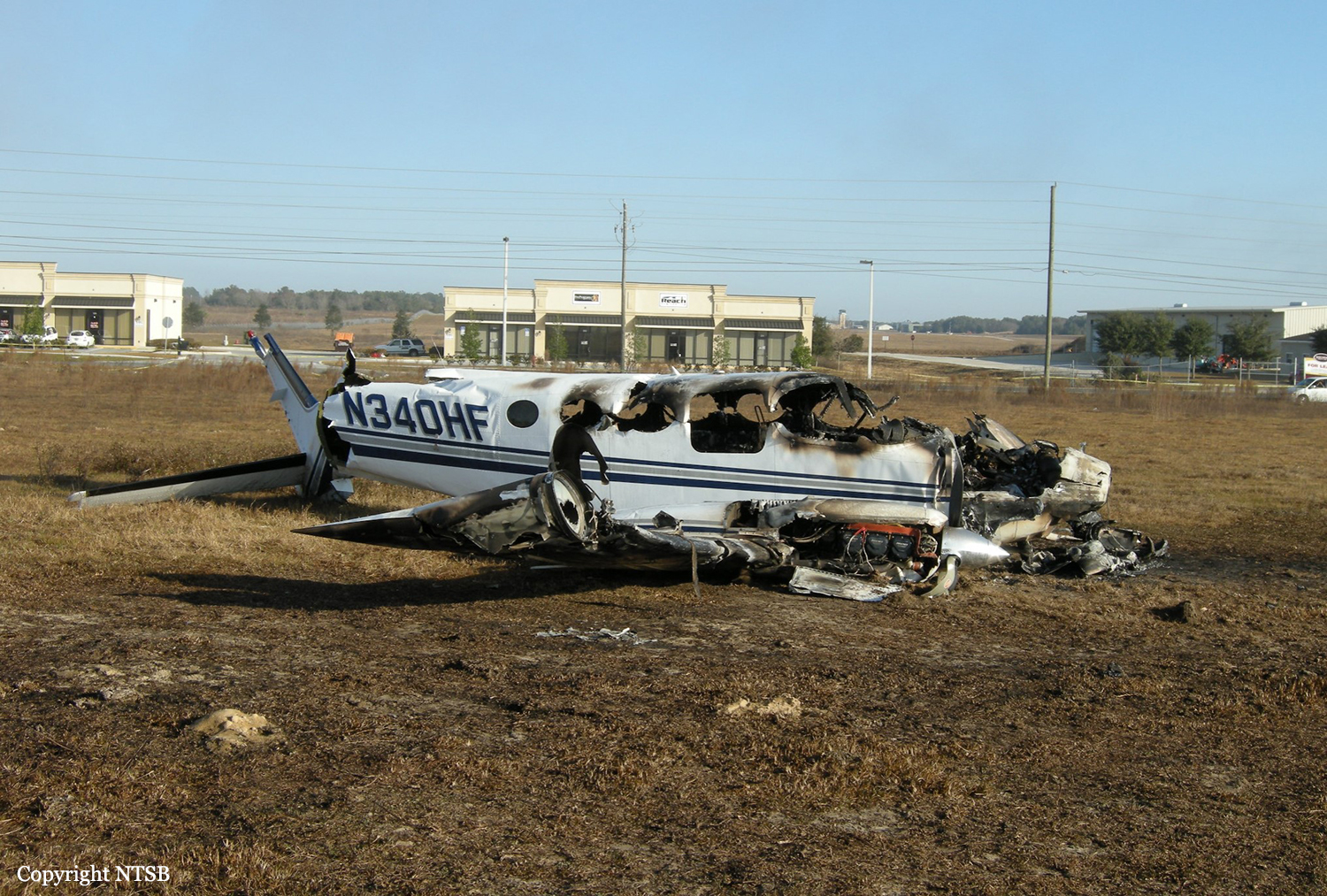
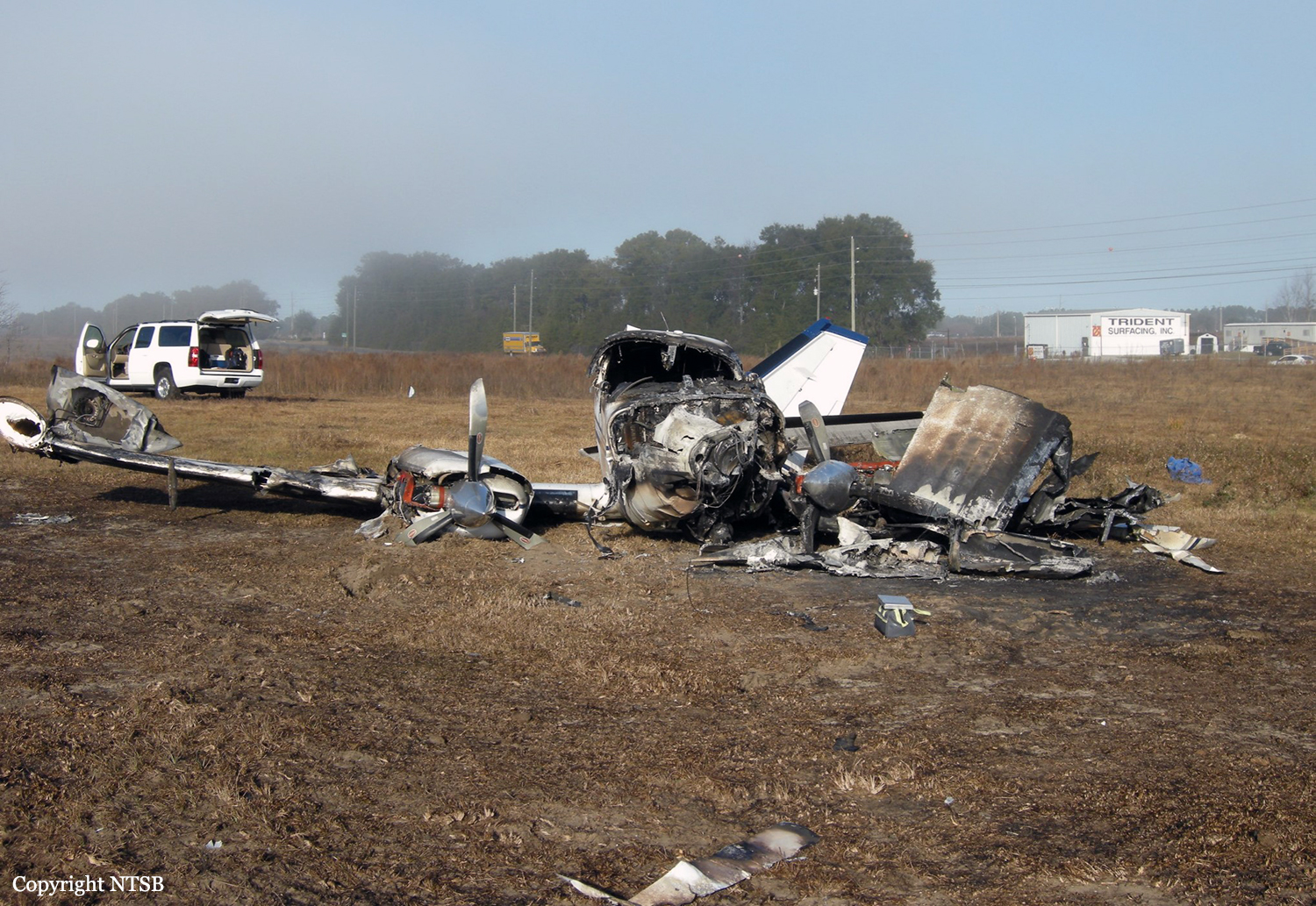
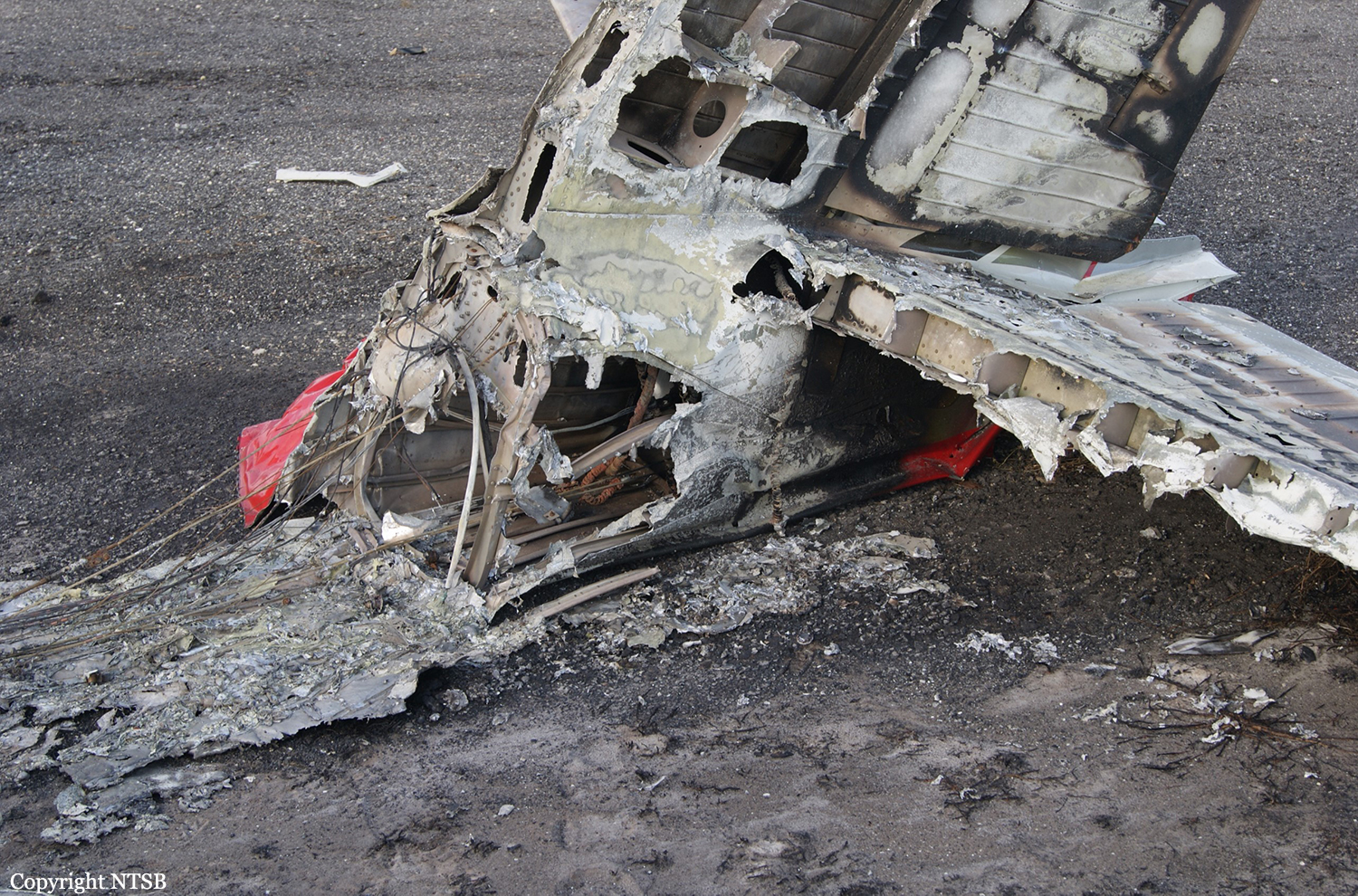
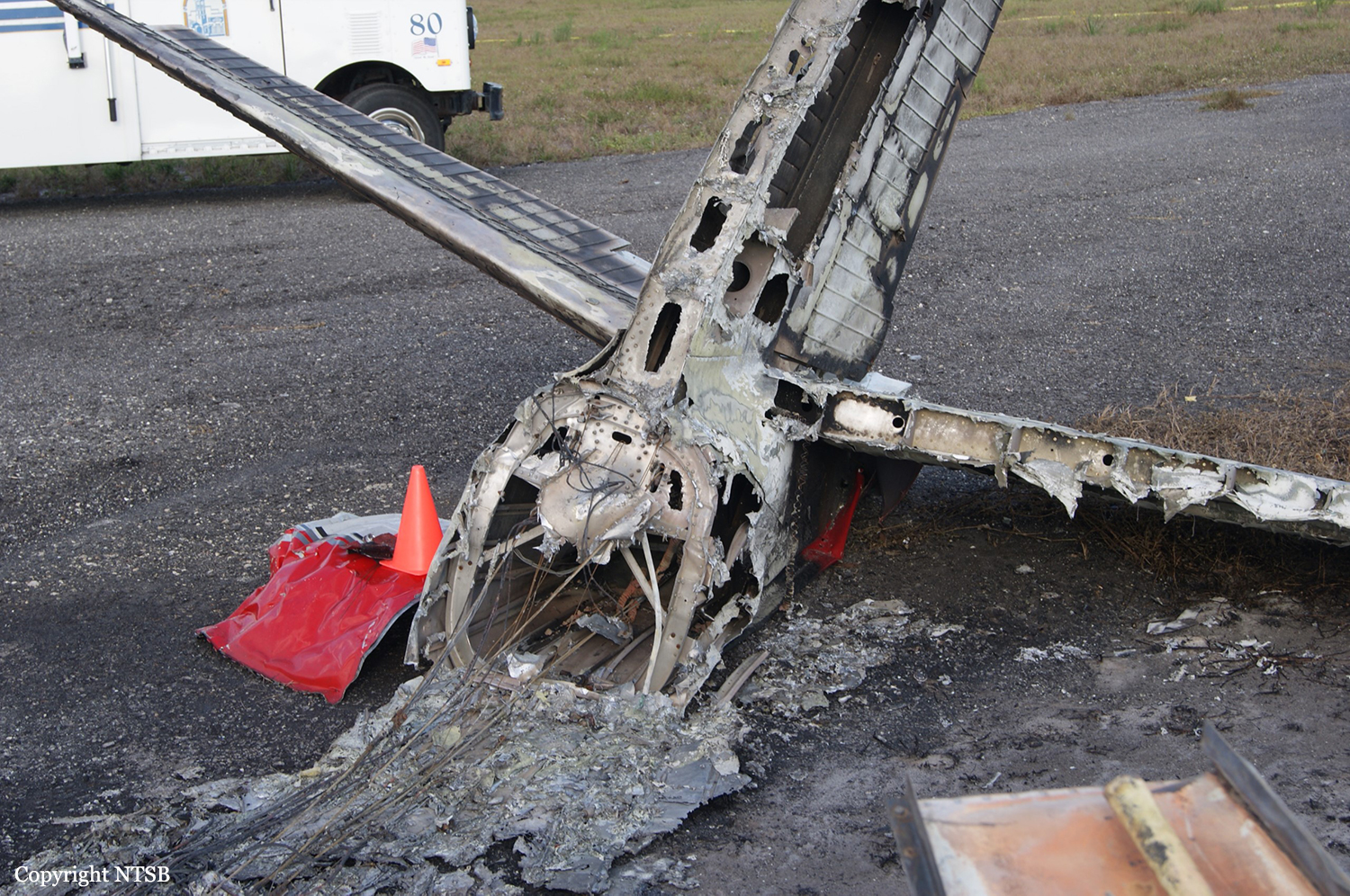
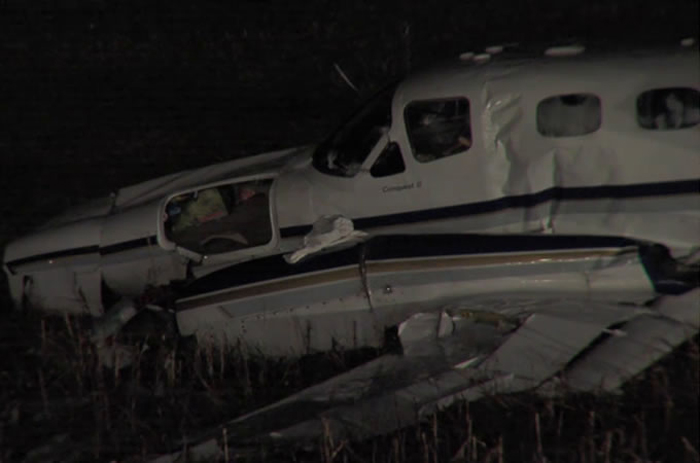
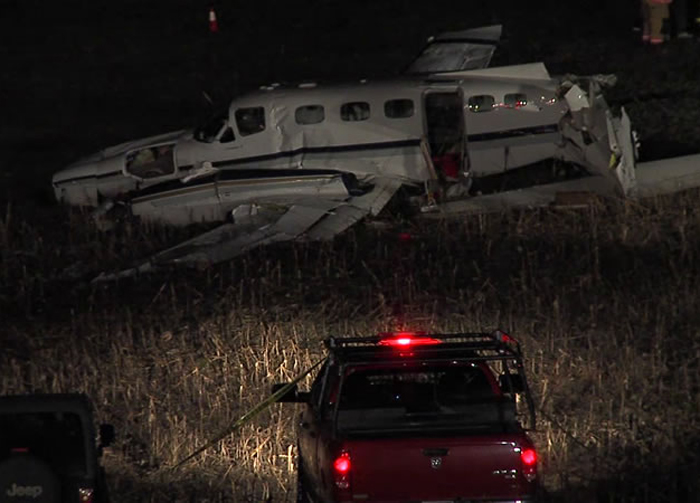
Crash of a Cessna 340A in Ocala: 1 killed

Date & Time: Jan 27, 2012 at 1227 LT
Type of aircraft:
Registration:
N340HF
Flight Type:
Survivors:
Yes
Schedule:
Macon - Ocala
MSN:
340A-0624
YOM:
1978
Location:
Crew on board:
1
Crew fatalities:
Pax on board:
1
Pax fatalities:
Other fatalities:
Total fatalities:
1
Captain / Total flying hours:
1048
Aircraft flight hours:
5057
Circumstances:
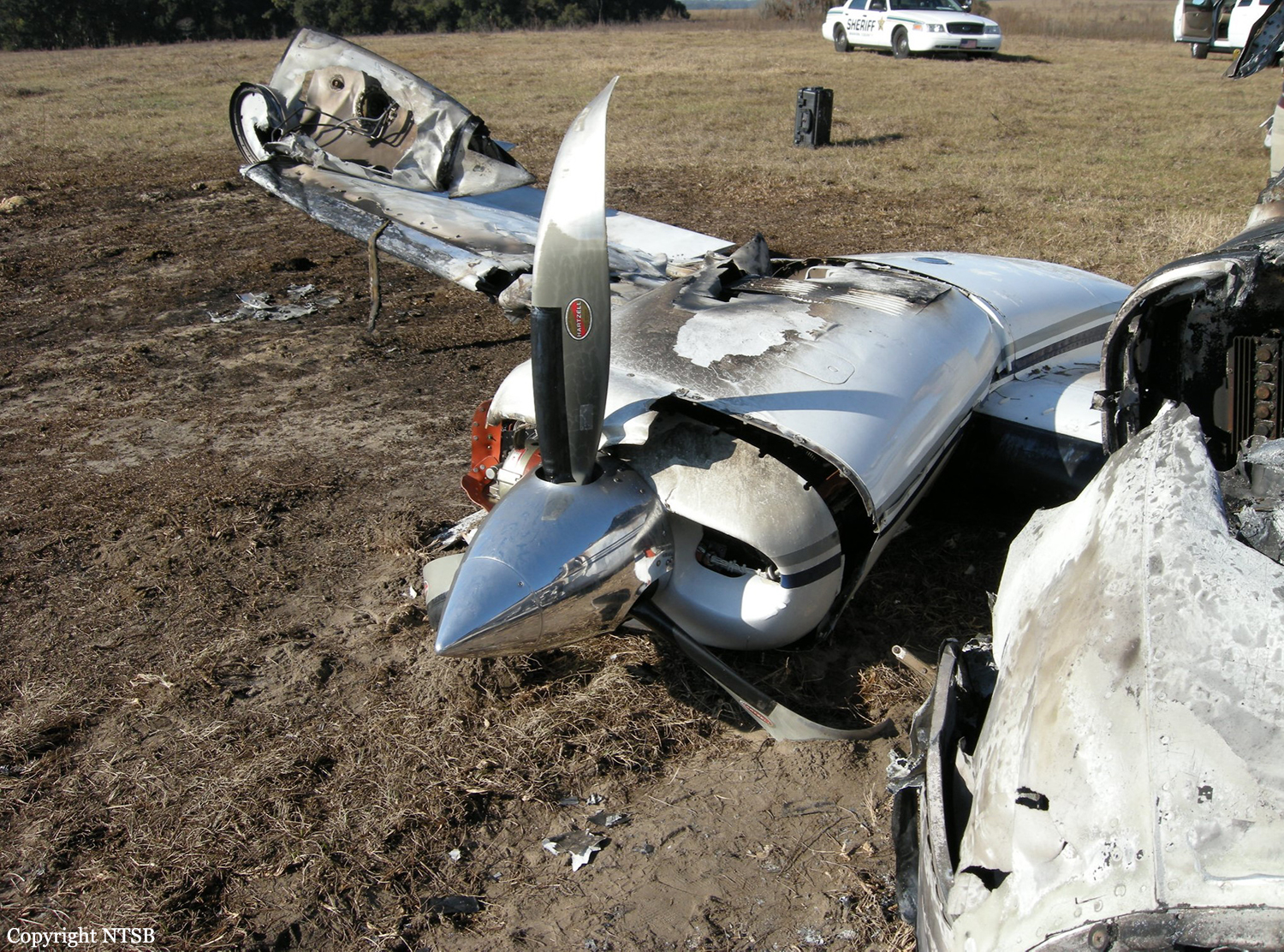
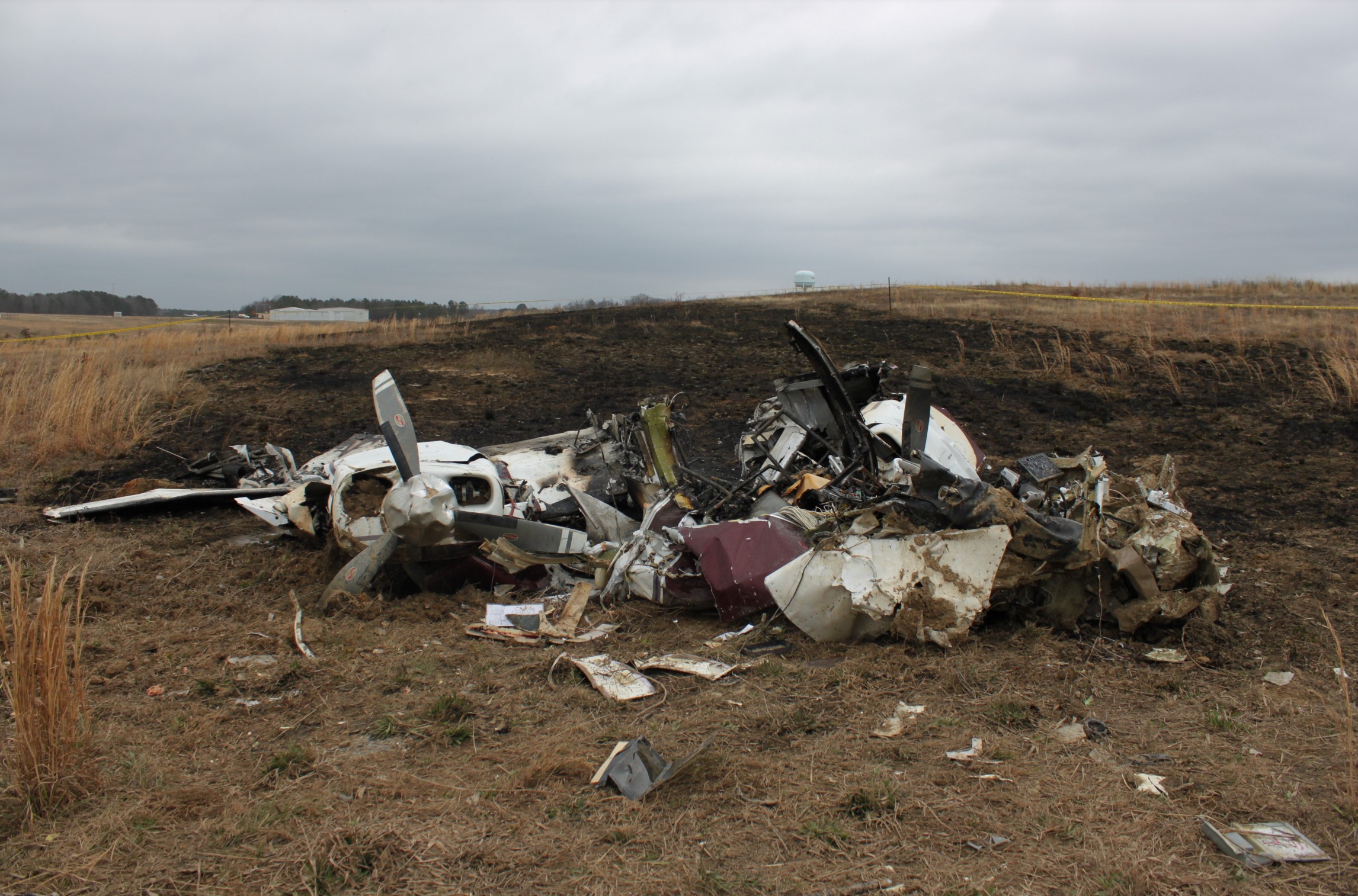
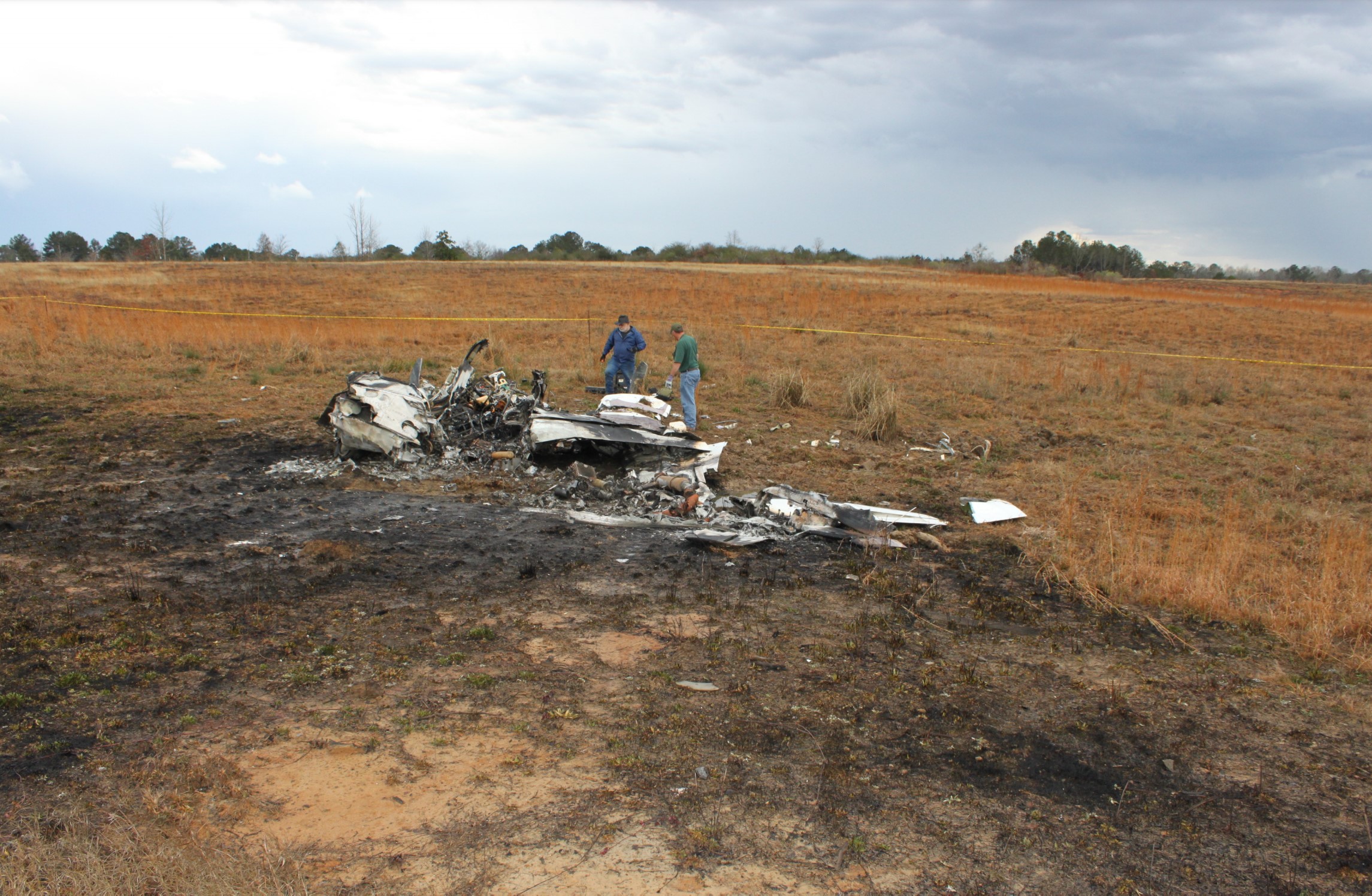
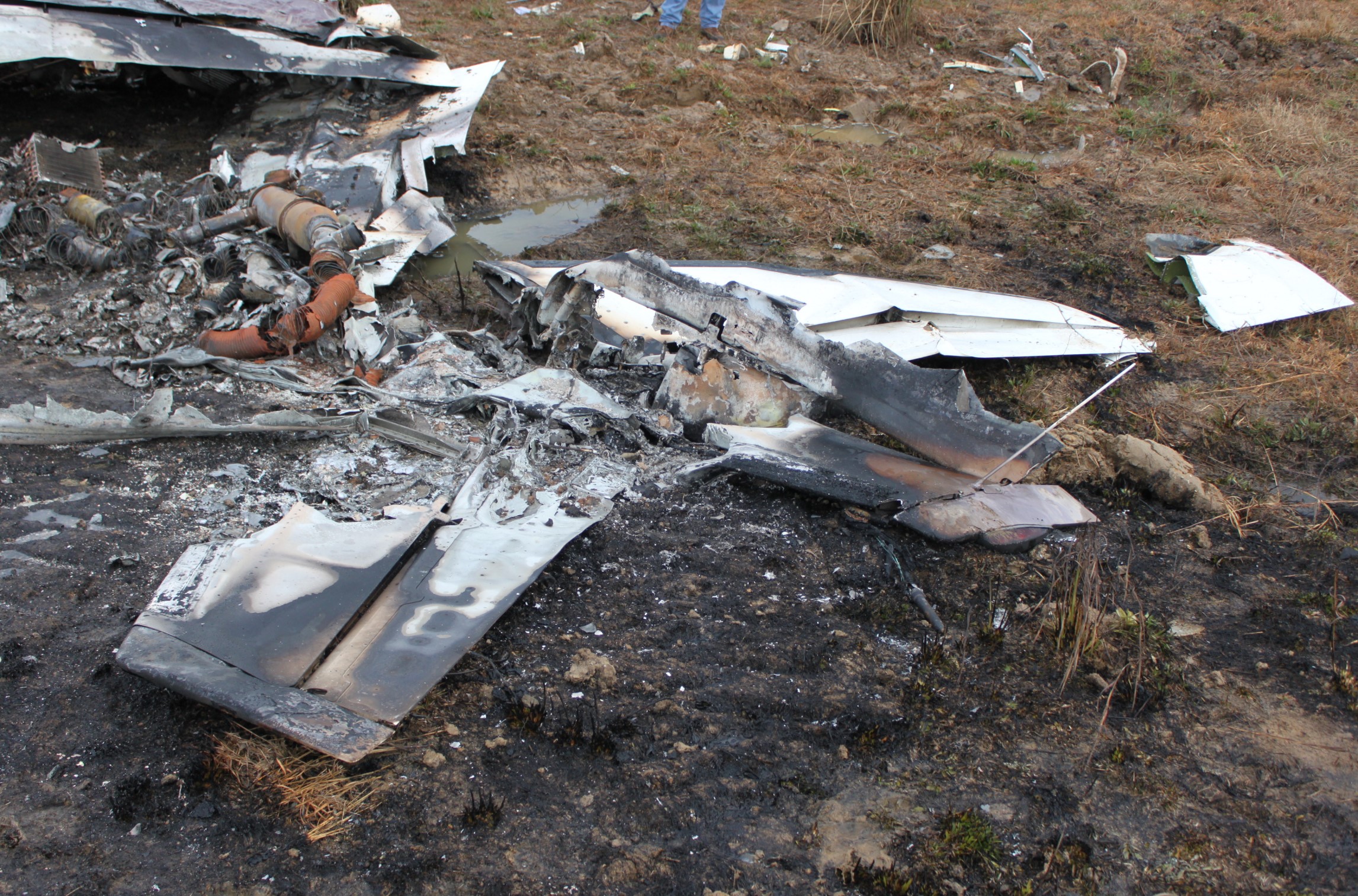
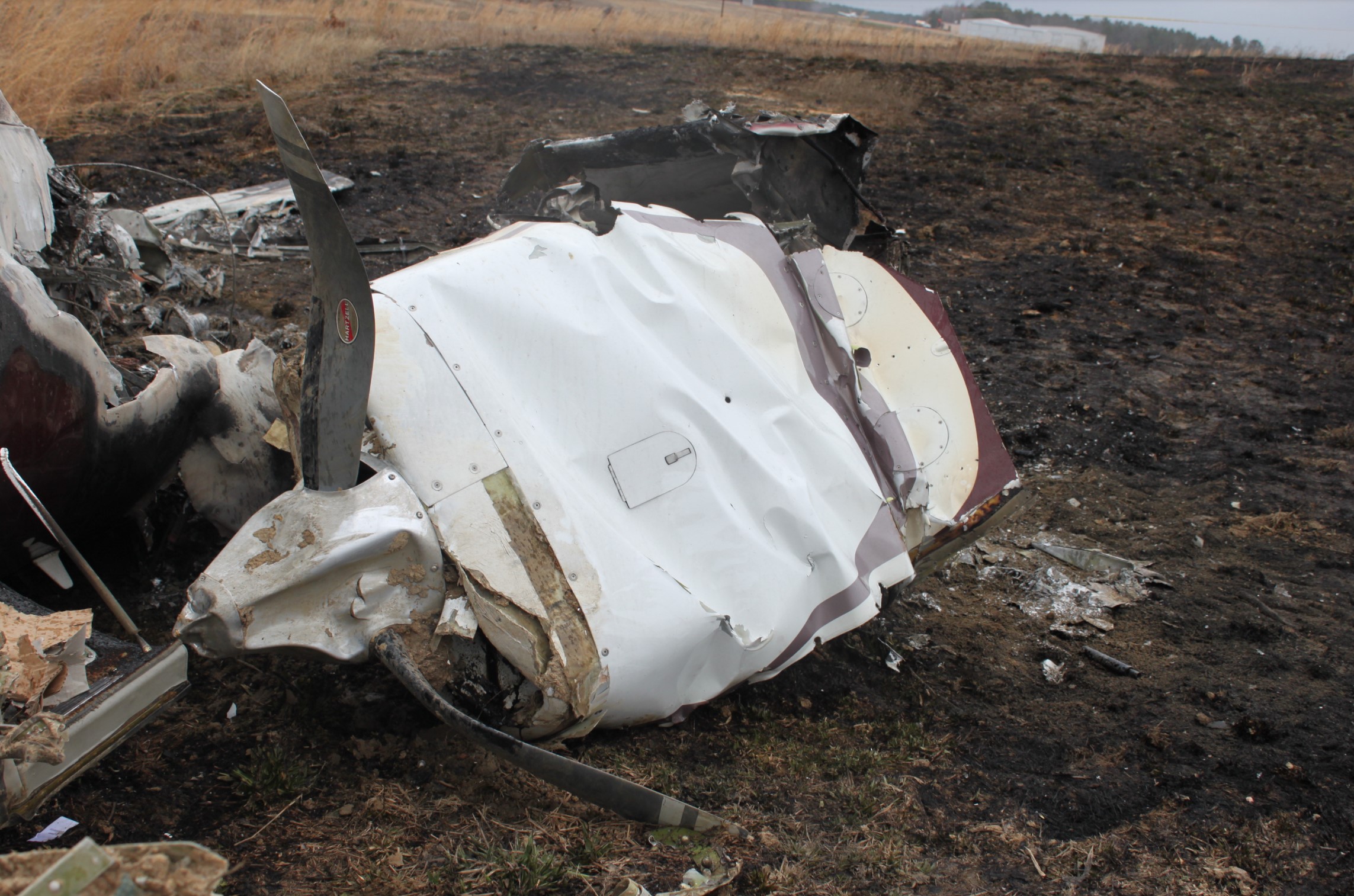
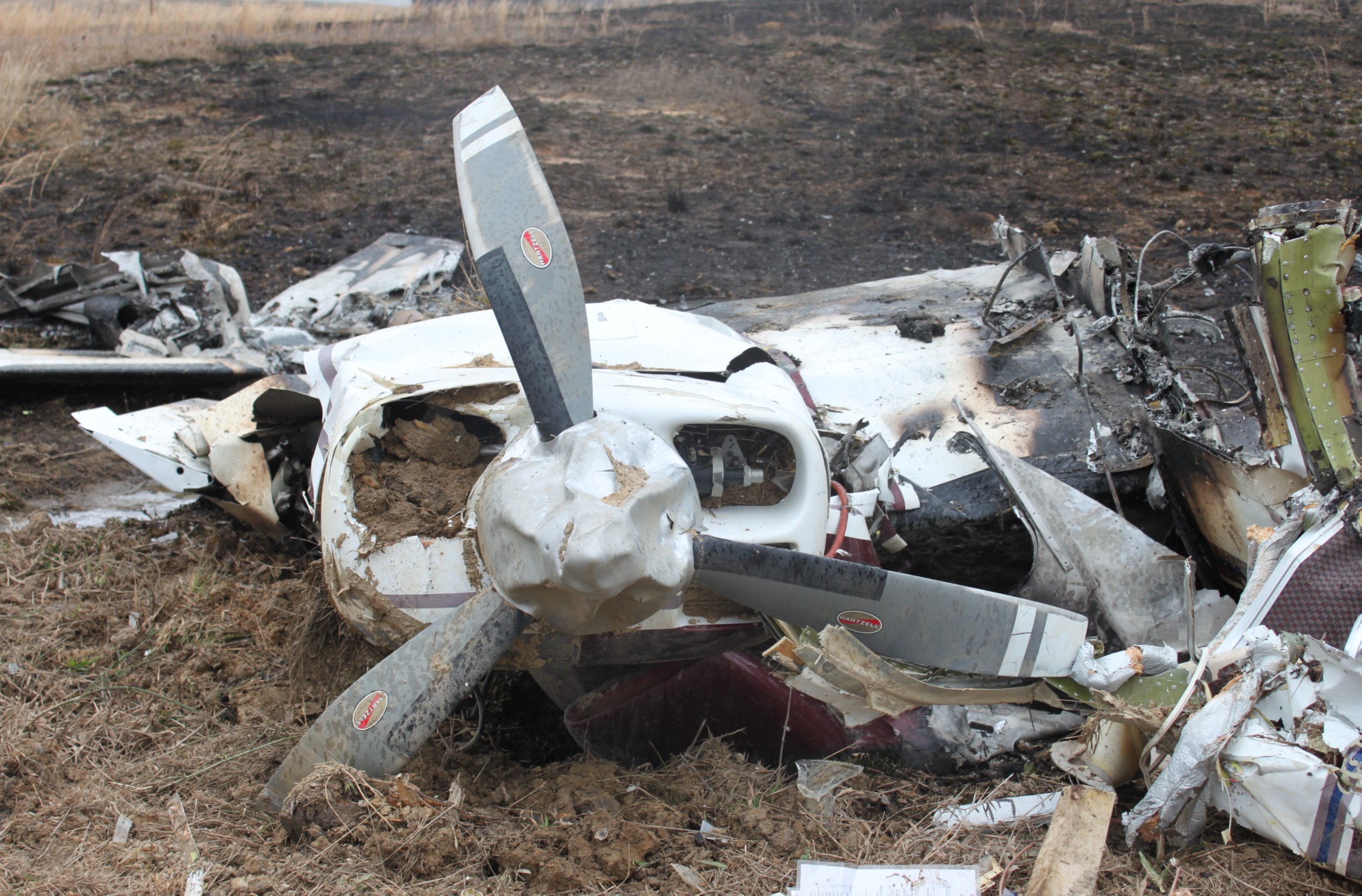
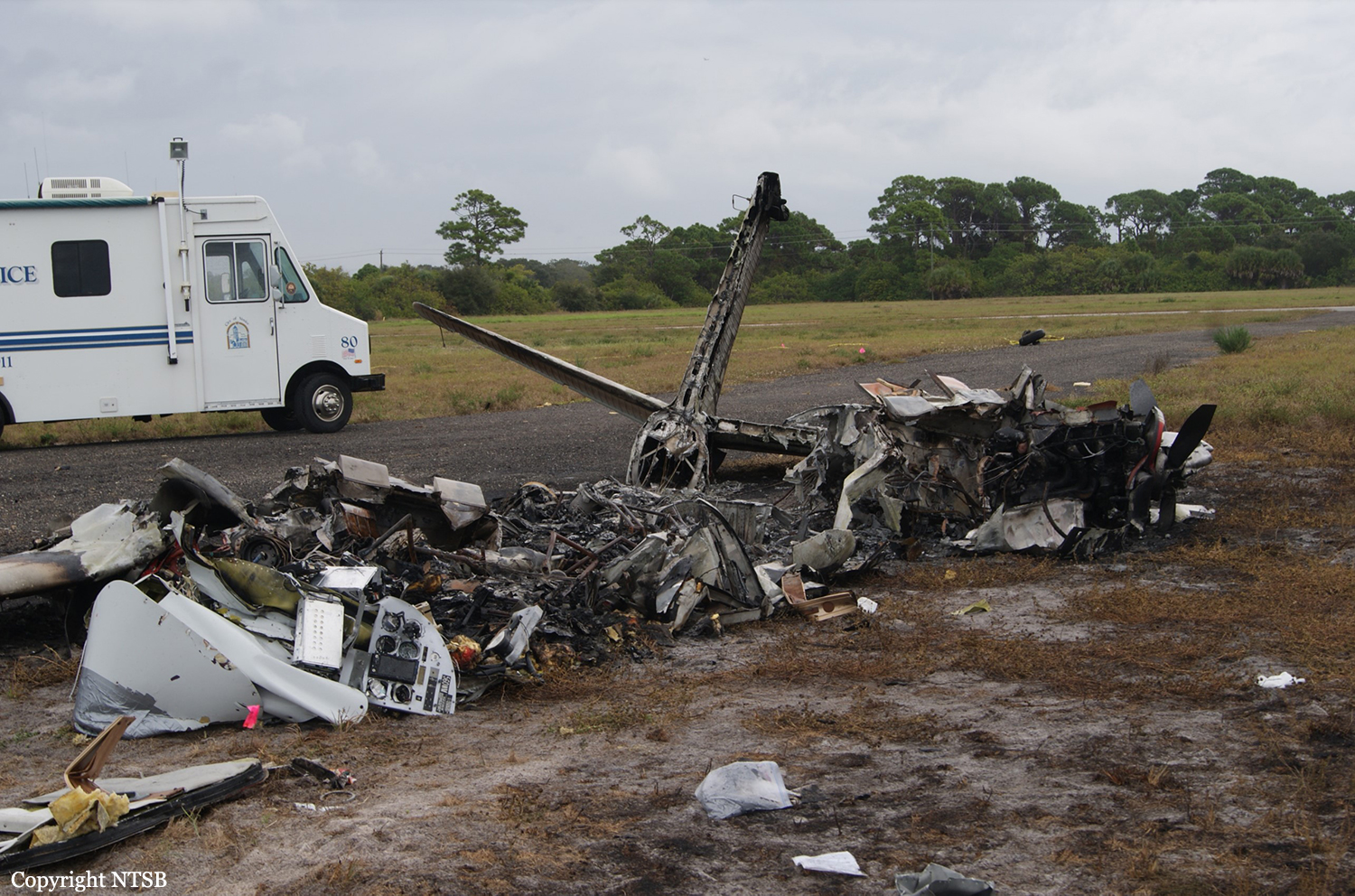
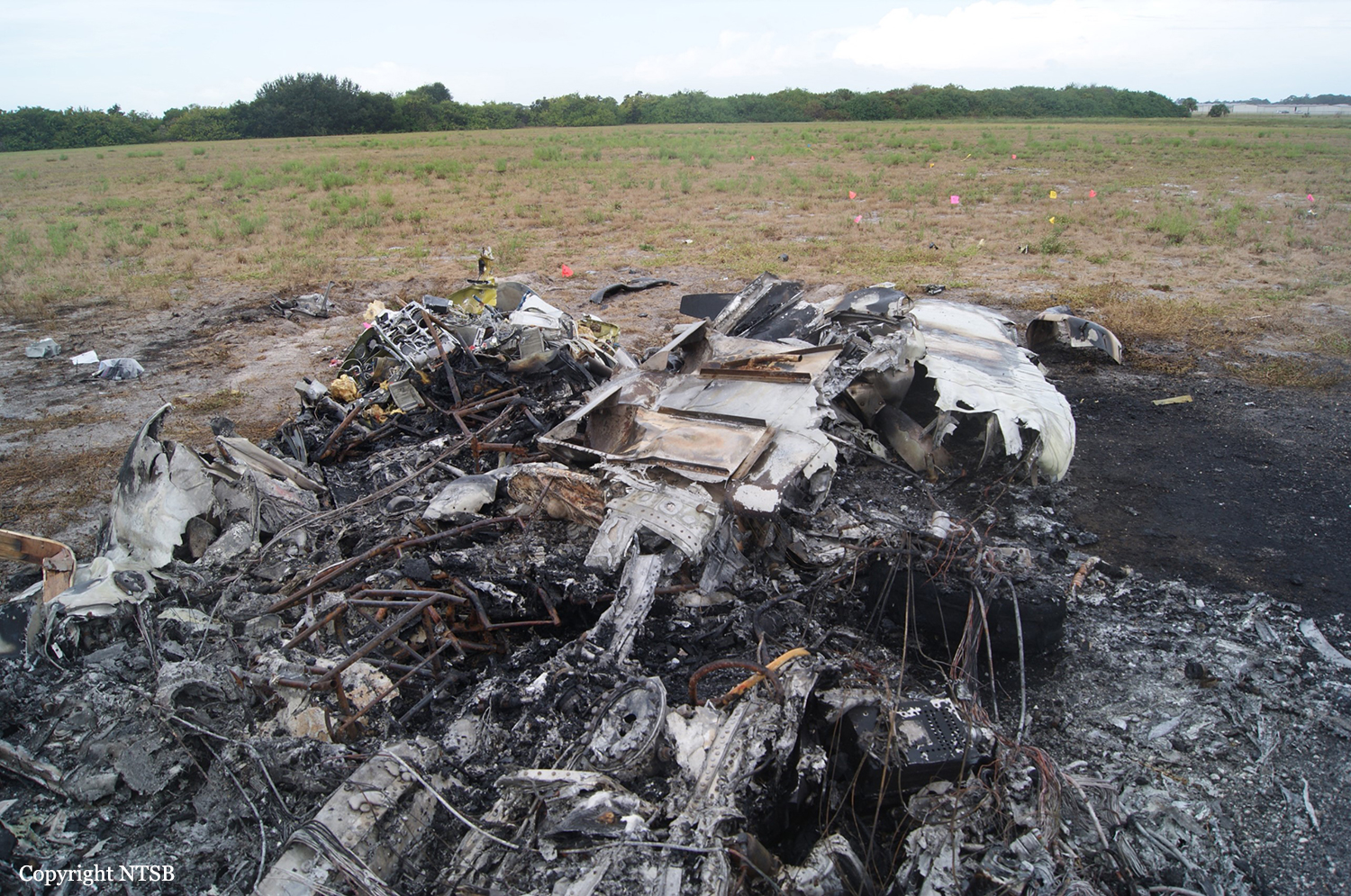
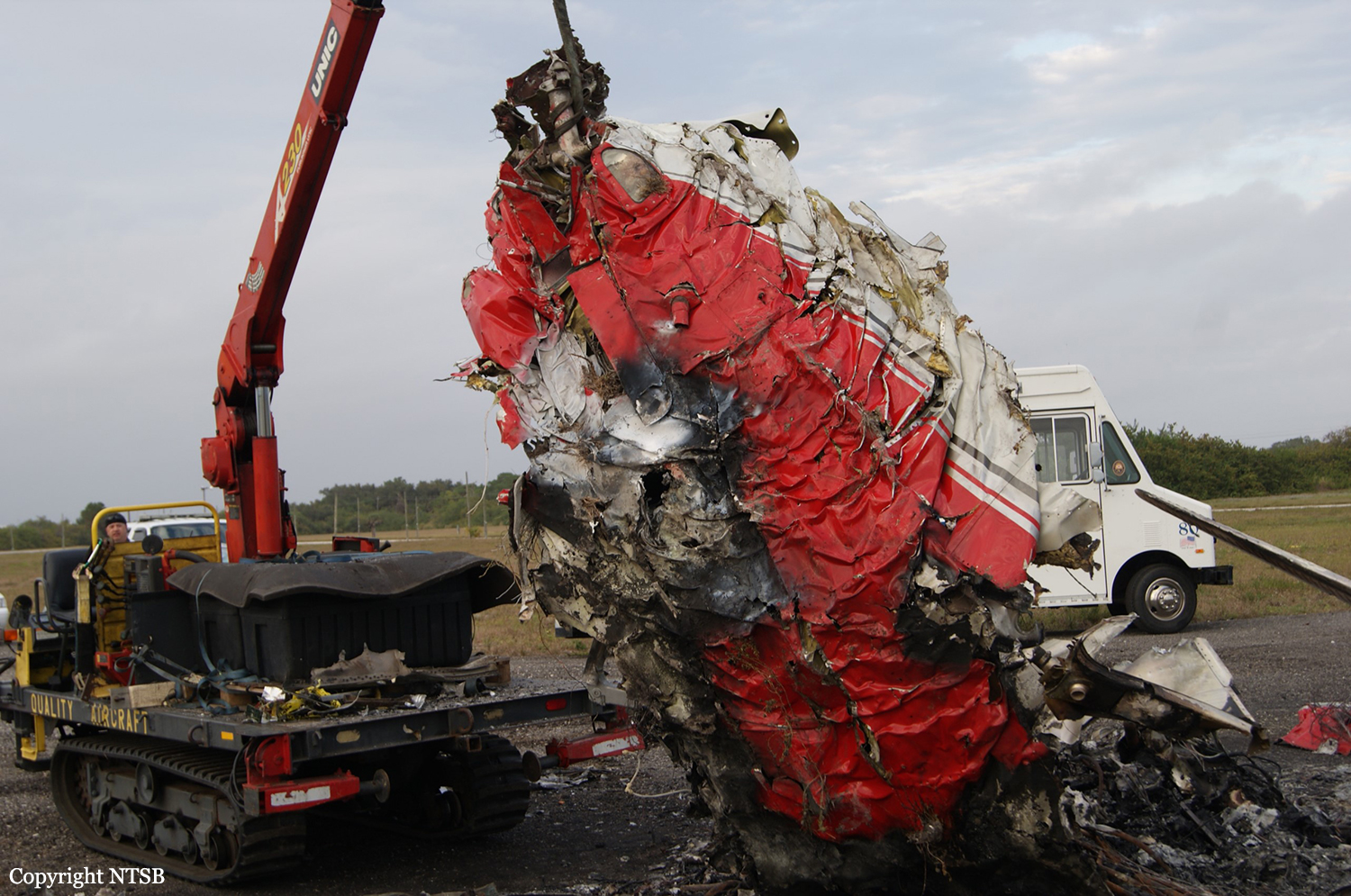
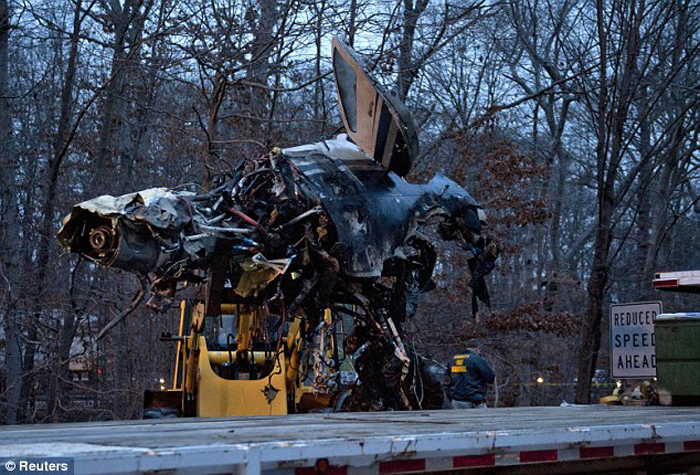
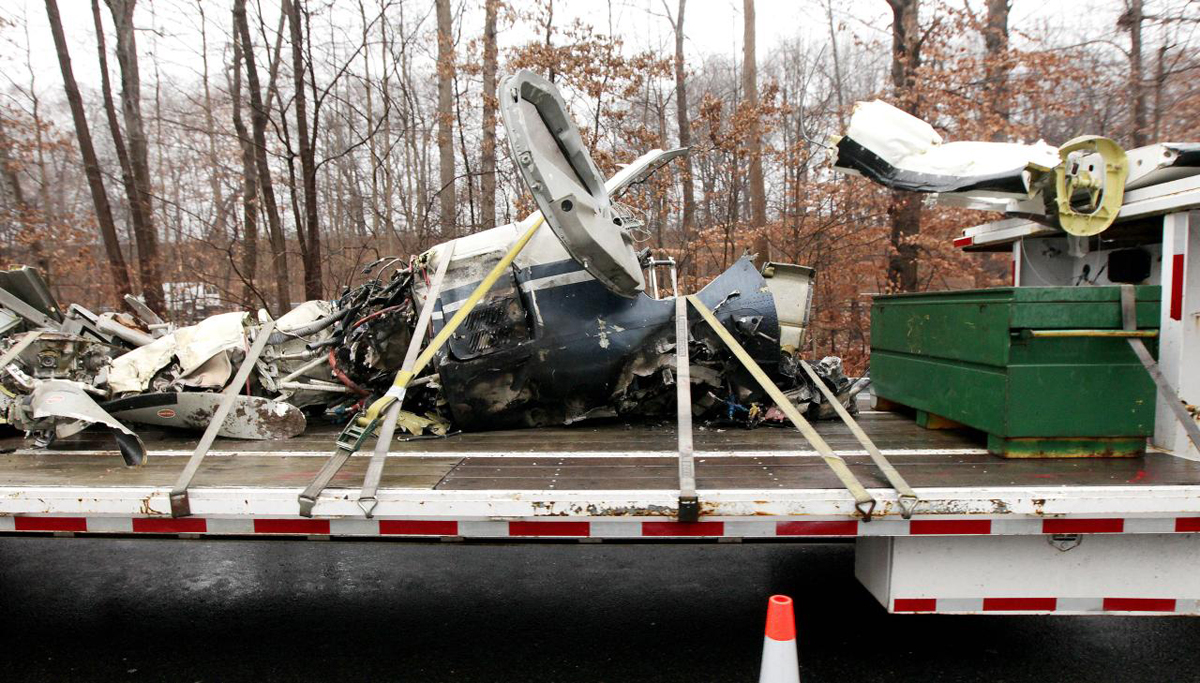
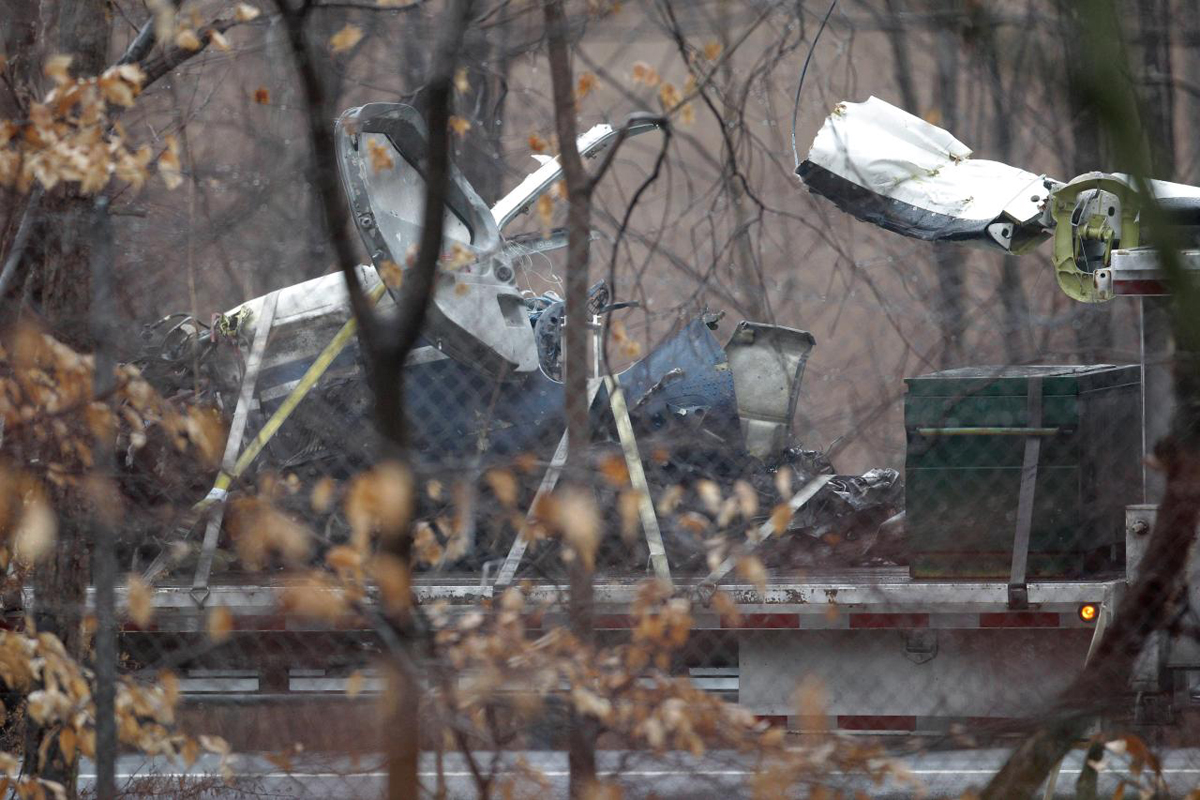
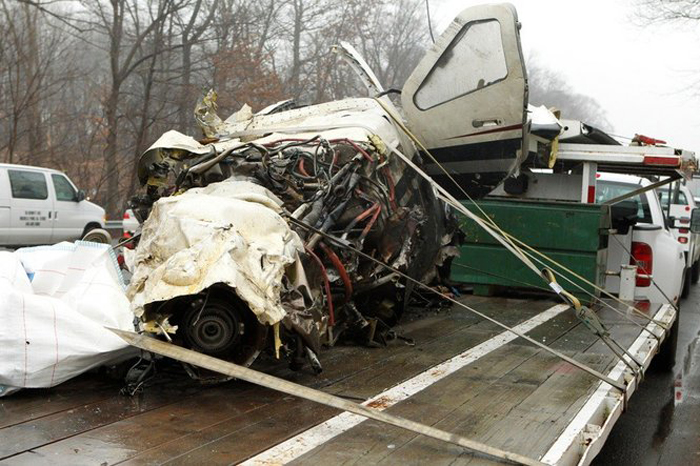
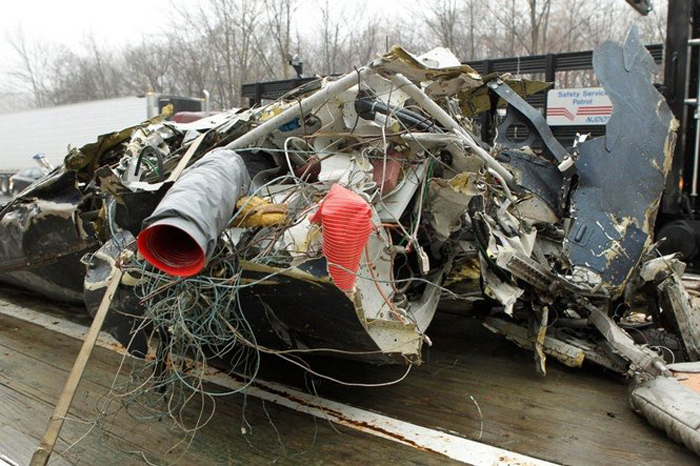
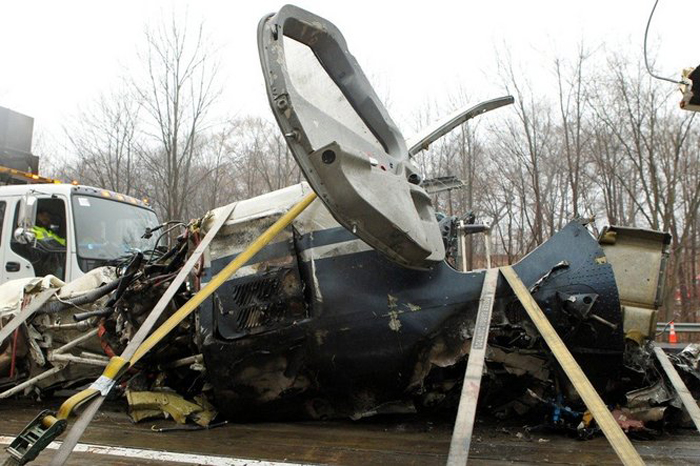
The pilot entered the left downwind leg of the traffic pattern to land to the north. A surface wind from the west prevailed with gusts to 15 knots. Radar data revealed that the airplane was on final approach, about 1.16 miles from the runway and about 210 feet above the ground. The airplane then crashed in a pasture south of the airport, in a slight left-wing-low attitude, and came to rest upright. The cockpit and cabin were consumed in a postcrash fire. The pilot's wife, who was in the aft cabin and survived the accident, recalled that it was choppy and that they descended quickly. She recalled hearing two distinct warning horns in the cockpit prior to the crash. The airplane was equipped with two aural warning systems in the cockpit: a landing gear warning horn and a stall warning horn. The pilot likely allowed the airspeed to decay while aligning the airplane on final approach and allowed the airplane to descend below a normal glide path. Examination of the wreckage revealed that the landing gear were in transit toward the retracted position at impact, indicating that the pilot was attempting to execute a go-around before the accident. The pilot made no distress calls to air traffic controllers before the crash. The pilot did not possess a current flight review at the time of the accident. Examination of the wreckage, including a test run of both engines, revealed no evidence of a pre-existing mechanical malfunction or failure that would have precluded normal operation of the airplane.
Probable cause:
The pilot's failure to maintain adequate airspeed and altitude on final approach, resulting in an impact with terrain short of the airport.
Final Report:
Crash of a Piper PA-61P Aerostar (Ted Smith 601P) in Philadelphia

Date & Time: Jan 16, 2012 at 1242 LT
Operator:
Registration:
N700PS
Flight Phase:
Flight Type:
Survivors:
No
Schedule:
Philadelphia – Meridian
MSN:
61-0427-157
YOM:
1977
Crew on board:
1
Crew fatalities:
Pax on board:
0
Pax fatalities:
Other fatalities:
Total fatalities:
1
Captain / Total flying hours:
6200
Aircraft flight hours:
2857
Circumstances:
On the day of the accident, a mechanic taxied the airplane onto the runway and performed a full power check of both engines, exercised both propellers, and checked each magneto drop with no discrepancies reported. Following the engine run, the mechanic taxied the airplane to the fuel ramp where the fuselage fuel tank was filled; after fueling, the fuselage tank had 41.5 gallons of usable fuel. The mechanic then taxied the airplane to the ramp where the engines were secured and the fuel selector switches were placed to the off position. The mechanic reported that, at that time, the left fuel tank had 4 to 5 gallons of fuel, while the right fuel tank had about 2 to 3 gallons of fuel; the unusable fuel amount for each wing tank is 3 gallons. The pilot taxied the airplane to the approach end of runway 18 and was heard to apply takeoff power. A pilot-rated witness noted that, at the point of rotation, the airplane pitched up fairly quickly to about 20 degrees and rolled left to about 10 to 15 degrees of bank. The airplane continued rolling left to an inverted position and impacted the ground in a 40 degree nose-low attitude. A postcrash fire consumed most of the cockpit, cabin, both wings, and aft fuselage, including the vertical stabilizer, rudder, and fuselage fuel tank. Postaccident inspection of the flight controls, which were extensively damaged by impact and fire, revealed no evidence of preimpact failure or malfunction. Although the flap actuators were noted to be asymmetrically extended and no witness marks were noted to confirm the flap position, a restrictor is located at each cylinder’s downline port by design to prevent a rapid asymmetric condition. Therefore, it is likely that the flap actuators changed positions following impact and loss of hydraulic system pressure and did not contribute to the left roll that preceded the accident. Examination of the engines and propellers revealed no evidence of preimpact failure or malfunction that would have precluded normal operation. Postaccident examination of the fuselage fuel sump revealed the left fuel selector was in the crossfeed position, while the right fuel selector was likely positioned to the on position. (The as-found positions of the fuel selector knobs were unreliable due to postaccident damage.) The starting engines checklist indicates that the pilot is to move both fuel selectors from the on position to the crossfeed position, and back to the on position while listening for valve actuation/movement. The before takeoff checklist indicates that the pilot is to verify that the selectors are in the on position. Although the left engine servo fuel injector did not meet flow tests during the postaccident investigation, this was attributed to postaccident heat damage. Calculations to determine engine rpm based on ground scars revealed that the left engine was operating just above idle, and the right engine was operating about 1,315 rpm, which is consistent with a left engine loss of power and the pilot reducing power on the right engine during the in-flight loss of control. Examination of both propellers determined that neither was feathered at impact. Although the as-found position of the left fuel selector knob could be considered unreliable because of impact damage during the accident sequence, given that right wing fuel tank had no usable fuel, it is unlikely that the experienced pilot would have moved the left fuel selector to the crossfeed position in response to the engine power loss. It is more likely that the pilot failed to return the left fuel selector to the on position during the starting engines checklist and also failed to verify its position during the before takeoff checklist; thus, the left engine was being fed only from the right fuel tank, which had very little fuel. There was likely enough fuel in the right tank and lines for the pilot to taxi and takeoff before the left engine failed, causing the airplane to turn to the left, from which the pilot did not recover.
Probable cause:
The pilot’s failure to maintain directional control during takeoff following loss of power to the left engine due to fuel starvation. Contributing to the loss of control was the pilot’s failure to feather the left propeller following the loss of left engine power.
Final Report:
Crash of a Rockwell Aero Commander 500B in Bartlesville

Date & Time: Jan 13, 2012 at 1930 LT
Operator:
Registration:
N524HW
Flight Type:
Survivors:
Yes
Schedule:
Kansas City - Cushing
MSN:
500-1533-191
YOM:
1965
Flight number:
CTL327
Crew on board:
1
Crew fatalities:
Pax on board:
0
Pax fatalities:
Other fatalities:
Total fatalities:
0
Captain / Total flying hours:
8487
Captain / Total hours on type:
3477.00
Circumstances:
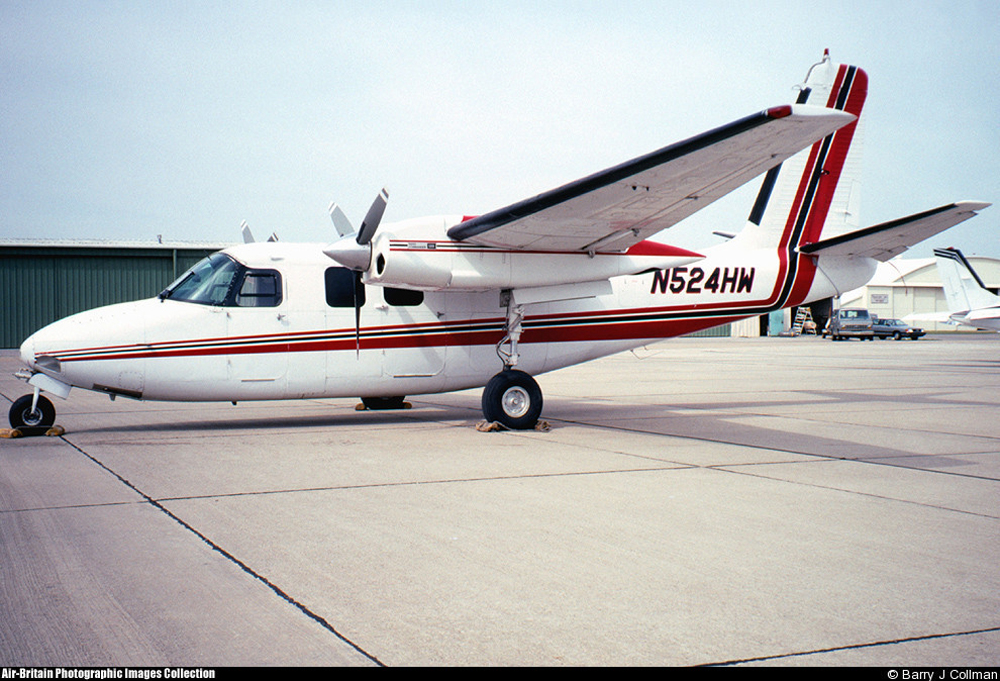
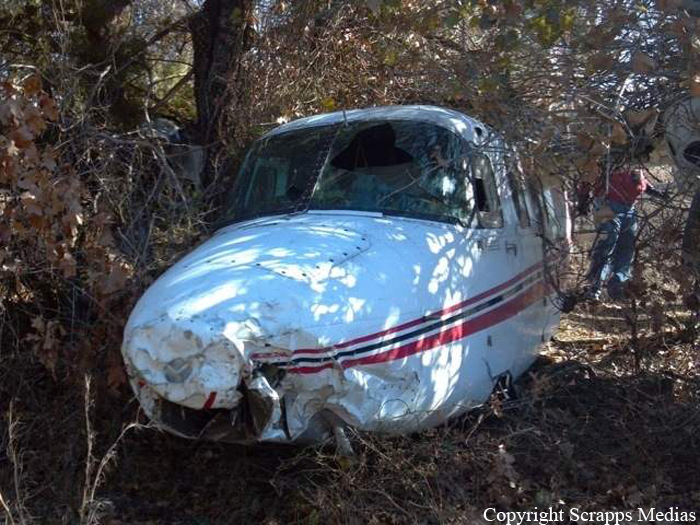
The pilot was en route on a positioning flight when the airplane’s right engine surged and experienced a partial loss of power. He adjusted the power and fuel mixture controls; however, a few seconds later, the engine surged again. The pilot noted that the fuel flow gauge was below 90 pounds, so he turned the right fuel pump on. The pilot then felt a surge on the left engine, so he performed the same actions he as did for the right engine. He believed that he had some sort of fuel starvation problem. The pilot then turned to an alternate airport, at which time both engines lost total power. The airplane impacted trees and terrain about 1.5 miles from the airport. The left side fuel tank was breached during the accident; however, there was no indication of a fuel leak, and about a gallon of fuel was recovered from the airplane during the wreckage retrieval. The company’s route coordinator reported that prior to the accident flight, the pilot checked the fuel gauge and said the airplane had 120 gallons of fuel. A review of the airplane’s flight history revealed that, following the flight immediately before the accident flight, the airplane was left with approximately 50 gallons of fuel on board; there was no record of the airplane having been refueled after that flight. Another company pilot reported the airplane fuel gauge had a unique trait in that, after the airplane’s electrical power has been turned off, the gauge will rise 40 to 60 gallons before returning to zero. When the master switch was turned to the battery position during an examination of another airplane belonging to the operator, the fuel gauge indicated approximately 100 gallons of fuel; however, when the master switch was turned to the off position, the fuel quantity on the gauge rose to 120 gallons, before dropping off scale, past empty. Additionally, the fuel cap was removed and fuel could be seen in the tank, but there was no way to visually verify the quantity of fuel in the tank.
Probable cause:
The total loss of engine power due to fuel exhaustion and the pilot’s inadequate preflight inspection, which did not correctly identify the airplane’s fuel quantity before departure.
Final Report:
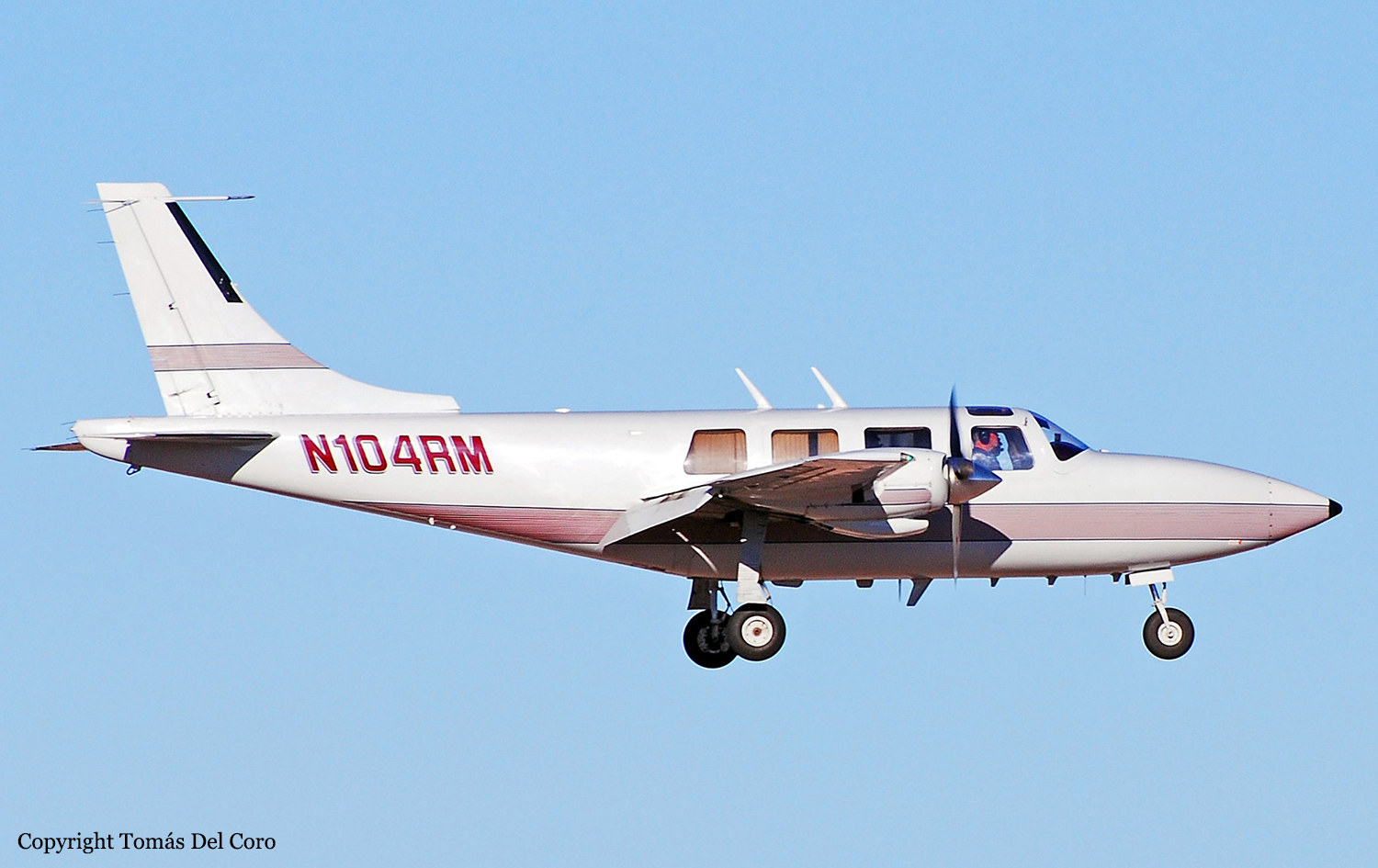
Crash of a Piper PA-61 Aerostar (Ted Smith 601P) in North Las Vegas

Date & Time: Jan 5, 2012 at 1539 LT
Registration:
N104RM
Flight Type:
Survivors:
Yes
Schedule:
North Las Vegas - North Las Vegas
MSN:
61-0756-8063375
YOM:
1980
Crew on board:
1
Crew fatalities:
Pax on board:
0
Pax fatalities:
Other fatalities:
Total fatalities:
0
Captain / Total flying hours:
3900
Captain / Total hours on type:
1700.00
Aircraft flight hours:
4480
Circumstances:
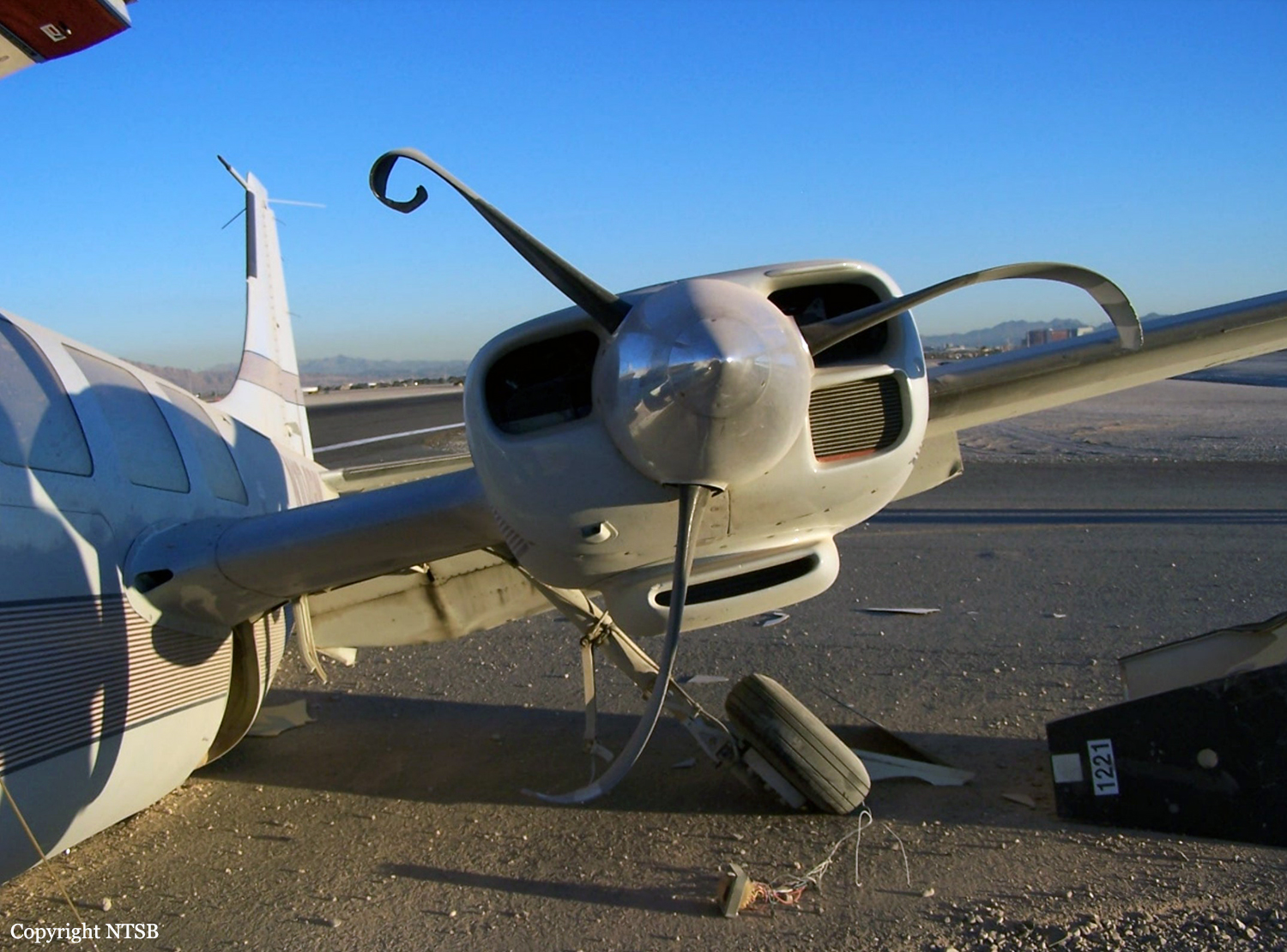
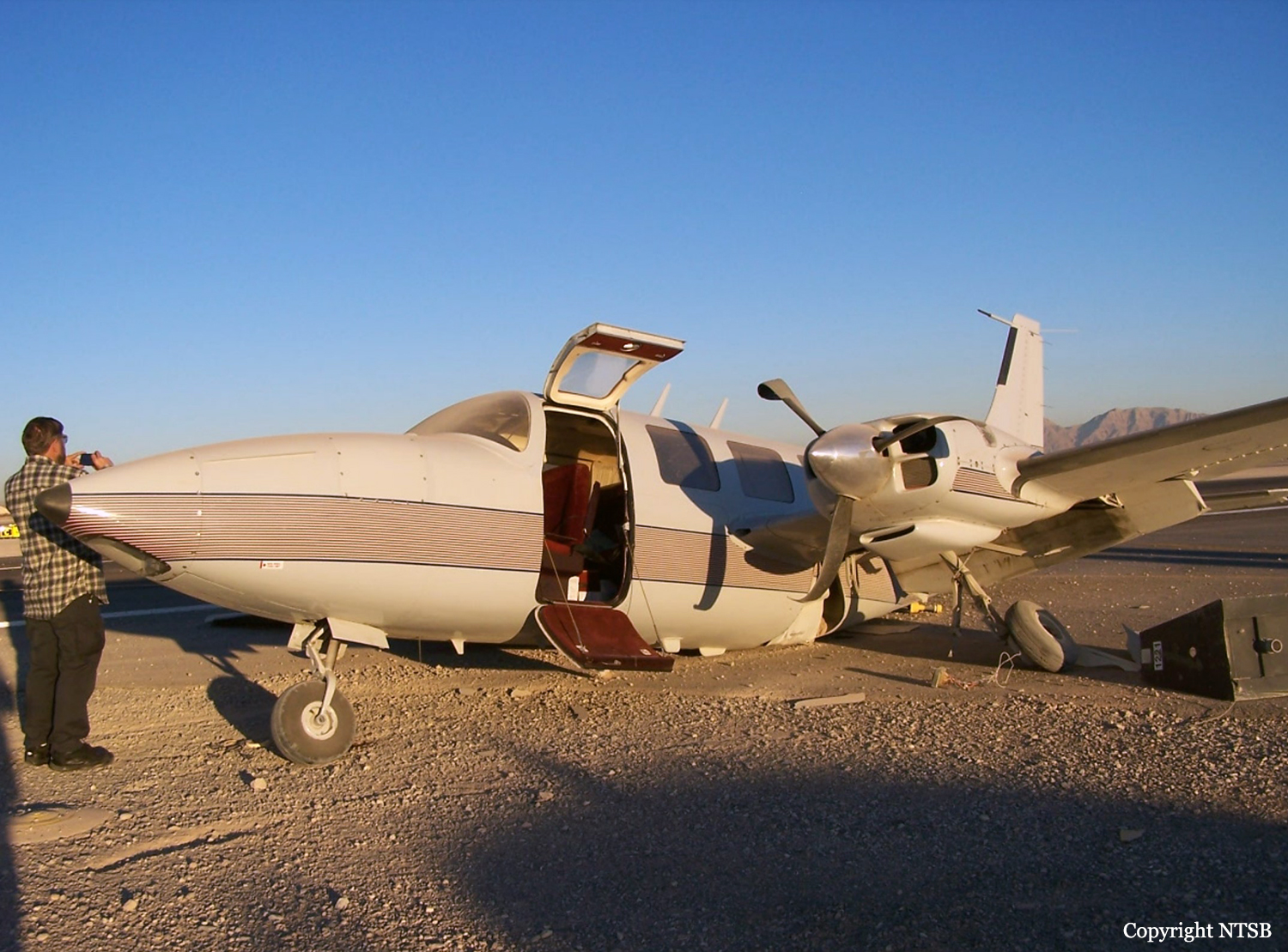
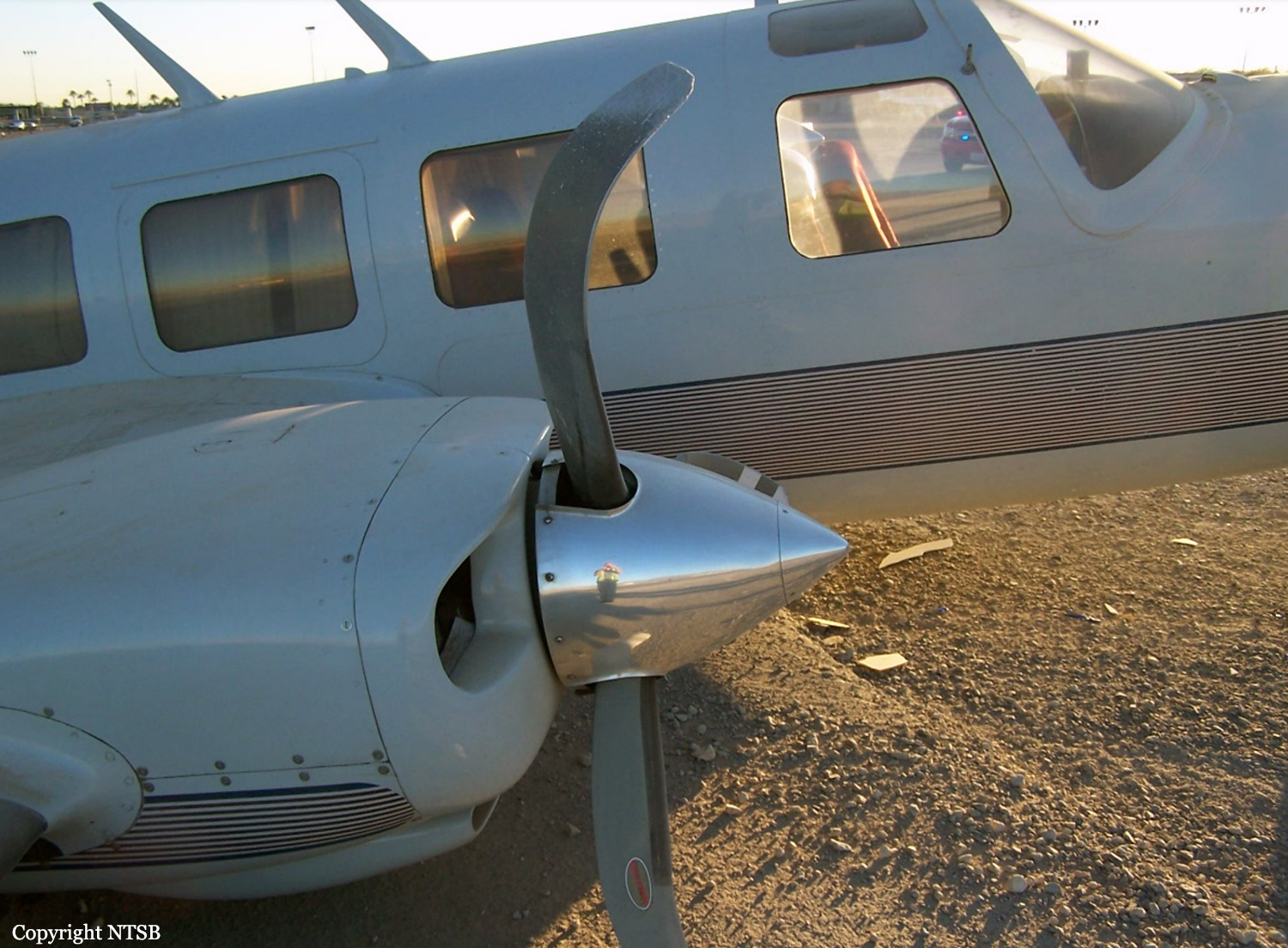
The pilot reported that, immediately after touchdown, the airplane began “wavering” and moments later veered to the left. He attempted to regain directional control with the application of “full right rudder” and the airplane subsequently departed the right side of the runway. A witness reported that the airplane’s touchdown was “firm” but not abnormal. As the airplane approached the left side of the runway, it yawed right and skidded down the runway while facing right. As the airplane began moving to the right side of the runway, the witness heard the right engine increase to near full power. The airplane spun to the left, coming to rest facing the opposite direction from its approach to landing. Another witness reported seeing the propellers contact the ground. The pilot attributed the loss of directional control to a main landing gear malfunction. Post accident examination of the airplane revealed that the left propeller assembly was feathered and that the right propeller blades were bent forward, indicative of the right engine impacting terrain under high power. Both throttle levers were found in the aft/closed position, and both propeller control levers were in the full-forward position. The propeller control levers exhibited little friction and could be moved with pressure from one finger. The evidence suggested that the pilot inadvertently feathered the left propeller assembly during the accident sequence. The pilot did not report any pre accident malfunctions or failures with the airplane’s engines or propeller assemblies that would have precluded normal operation.
Probable cause:
The pilot's failure to maintain directional control of the airplane during the landing roll.
Final Report:
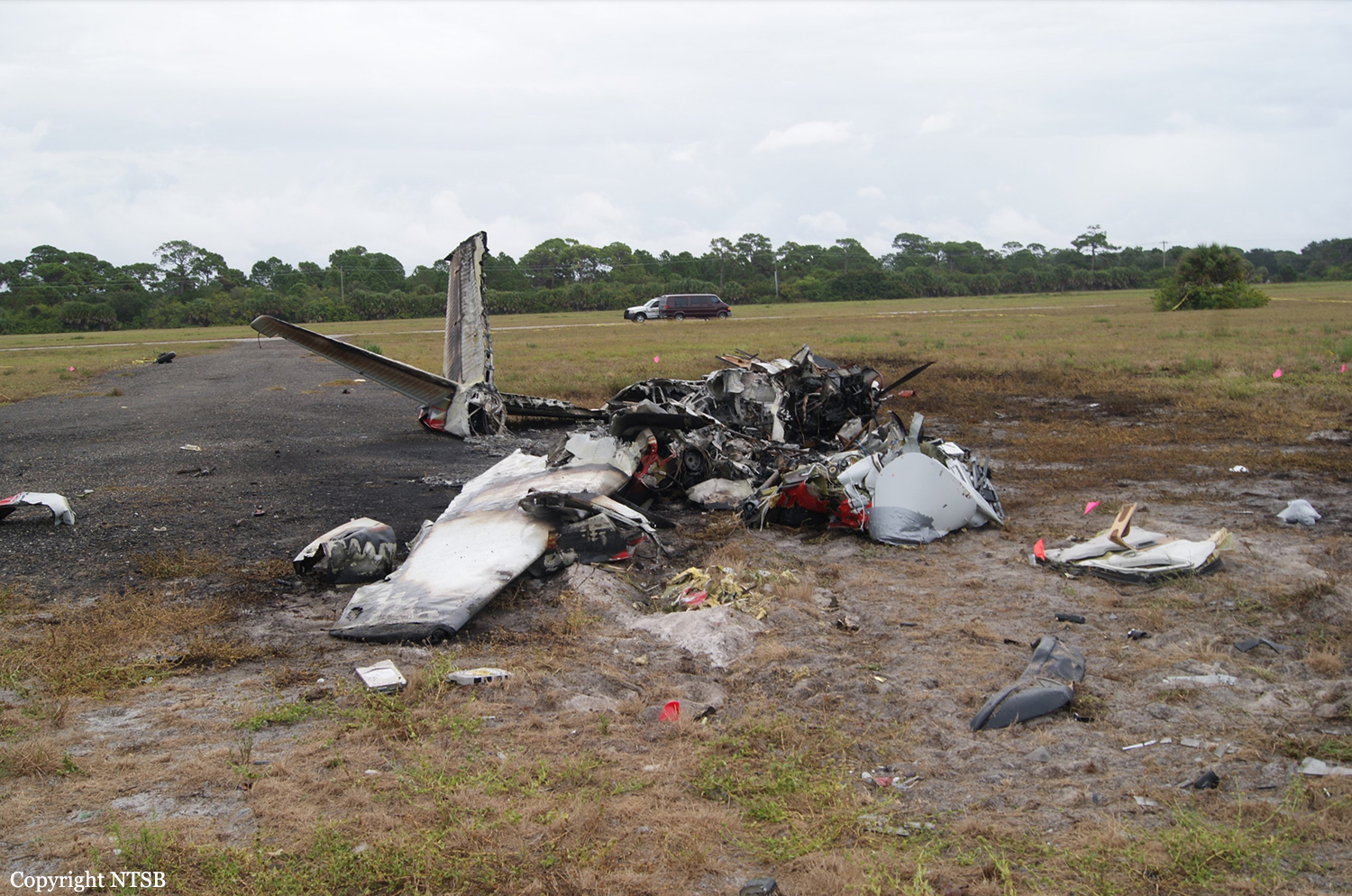
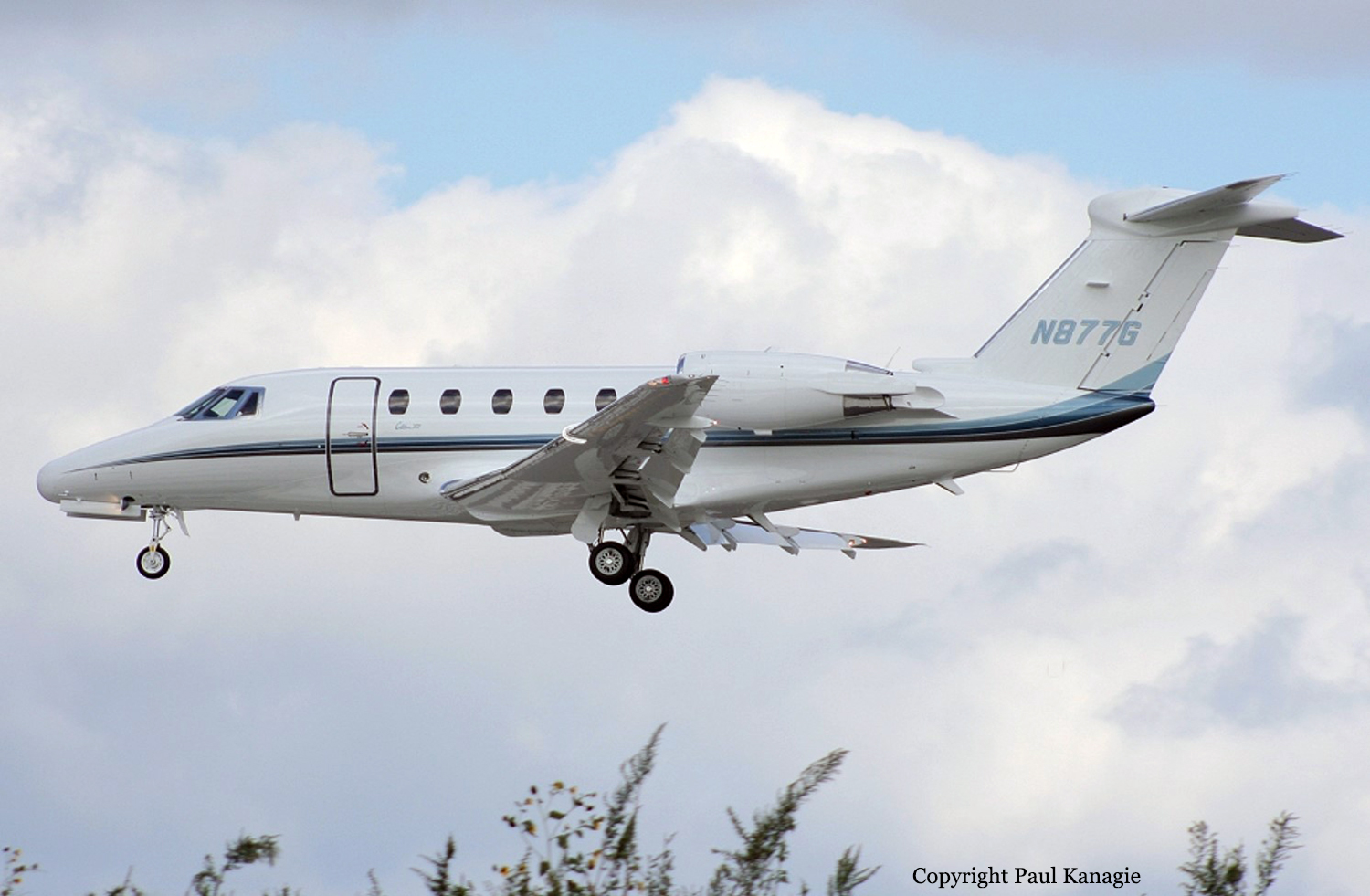
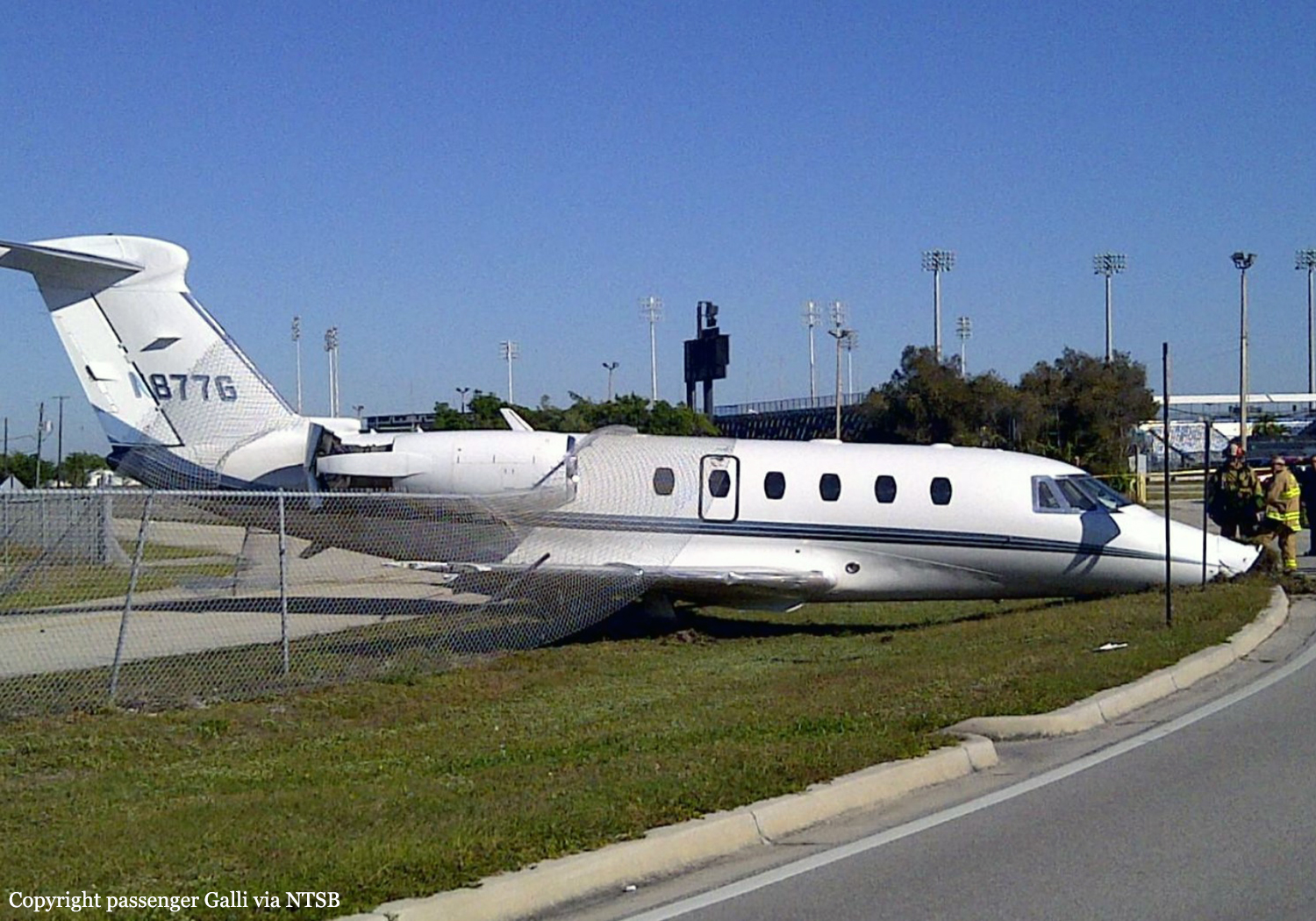
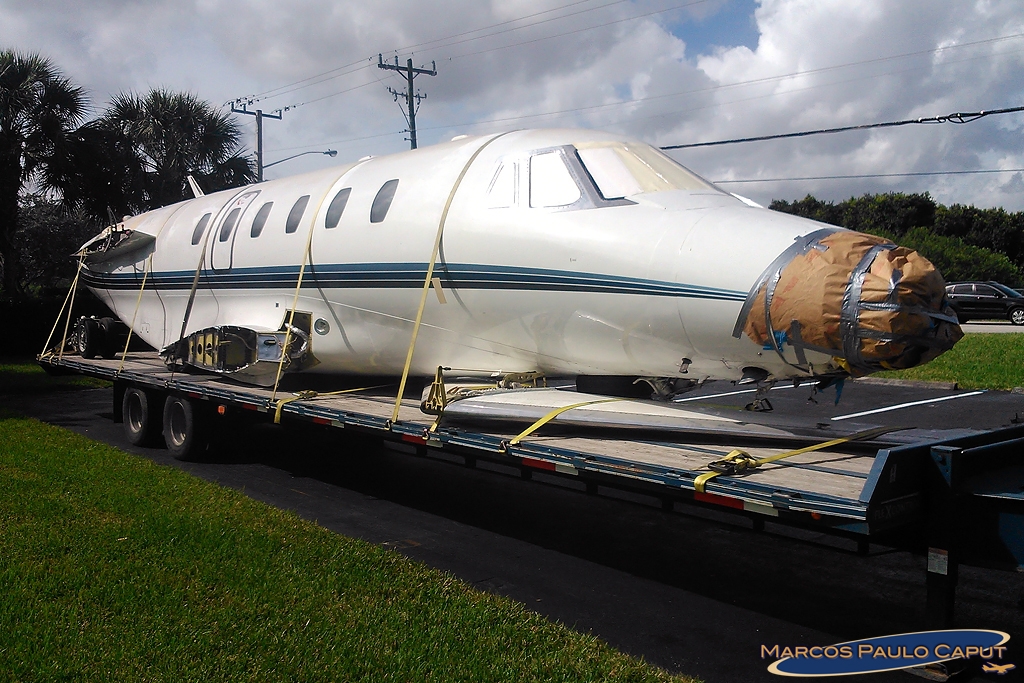
Crash of a Cessna 650 Citation VII in Fort Lauderdale

Date & Time: Dec 28, 2011 at 0951 LT
Type of aircraft:
Registration:
N877G
Flight Phase:
Flight Type:
Survivors:
Yes
Schedule:
Lauderdale – Teterboro
MSN:
650-7063
YOM:
1995
Crew on board:
2
Crew fatalities:
Pax on board:
6
Pax fatalities:
Other fatalities:
Total fatalities:
0
Captain / Total flying hours:
14950
Captain / Total hours on type:
190.00
Copilot / Total flying hours:
19000
Copilot / Total hours on type:
100
Aircraft flight hours:
5616
Aircraft flight cycles:
4490
Circumstances:
The crew stated that the preflight examination, takeoff checks, takeoff roll, and rotation from runway 26 were "normal." However, once airborne, and with the landing gear down and the flaps at 20 degrees, the airplane began a roll to the right. The captain used differential thrust and rudder to keep the airplane from rolling over, and as he kept adjusting both. He noted that as the airspeed increased, the airplane tended to roll more; as the airspeed decreased, the roll would decrease. The captain also recalled thinking that the airplane might have had an asymmetrical flap misconfiguration. Both pilots stated that there were no lights or warnings. As the airplane continued a right turn, runway 13 came into view. The captain completed a landing to the right of that runway, landing long and in the grass with a 9-knot, left quartering tailwind. The airplane then paralleled the runway and ran into an airport perimeter fence beyond the runway's end. The cockpit voice recorder revealed that the crew initially used challenge and reply checklists and that after completing the takeoff checklist, engine power increased. About 7 seconds after the first officer called "V1," the captain stated an expletive, and the first officer announced "positive rate." During the next 50 seconds, the captain repeated numerous expletives, an automated voice issued numerous "bank angle" warnings, and the first officer asked what he could do, to which the captain later told him to declare an emergency. There were no calls by either pilot for an emergency checklist nor were there callouts of any emergency memory items. Each of the airplane's wings incorporated four hydraulically-actuated spoiler segments. The outboard segment, the roll control spoiler, normally extends in conjunction with its wing aileron after the aileron has traveled more than about 3 degrees, and extends up to 50 degrees at full control wheel rotation. When the airplane was subsequently examined in a hangar, hydraulic power was applied to the airplane via a ground hydraulic power unit, and the right roll spoiler elevated to 7.9 degrees above the flush wing level. Multiple left/right midrange turns of the yoke, with the hydraulic ground power unit both on and off, resulted in the roll spoiler being extended normally, but still returning to a resting position of 7.8 to 7.9 degrees above the flush position. When the yoke was turned full right and left, whether the aileron boost was on or off, both wings' roll spoilers extended to their full positions per specifications; however, once the full deflection testing was completed, the right roll spoiler returned to 6.1 degrees above the flush position. A final yoke turn resulted in the roll spoiler being elevated to 5.5 degrees. The right wing roll spoiler actuator was subsequently examined at the airplane manufacturer, and the roll spoiler was found to jam. The roll spoiler actuator was disassembled, but no specific reason(s) for the jamming were found. The roll spoiler parts were also examined and no indications of why the actuator may have jammed were found. According to the flight manual, if any of the spoiler segments should float, moving the spoiler hold down switch to "Spoiler Hold Down" locks all spoiler panels down. The roll control spoilers may then be used in the roll mode by turning on the auxiliary hydraulic pump. Also, an "Aileron/Spoiler Disconnect" T-handle is available to release the tie between the ailerons and the roll control spoilers in the event of a jam in either system. When used, the pilot's yoke controls only the ailerons, and the copilot's yoke controls only the roll control spoilers. Although the jamming of the right spoiler initiated the event, the crew's proper application of emergency procedures should have negated the adverse effects. Memory items for an uncommanded roll include moving the spoiler hold-down switch to the "on" position, which was not done; the spoiler hold-down switch was found in the "off" position. (The captain thought that he may have had an asymmetrical flap configuration; however, if an asymmetry had been the initiating event, the flap system would have been automatically disabled and the flap segments would have been mechanically locked in their positions.) The aileron/spoiler disconnect T-handle was found pulled up, which the crew indicated had occurred when the first officer's shoe hit it as he evacuated the airplane. While pulling the aileron/spoiler disconnect T-handle would have been appropriate for a different emergency procedure to release the tie between the ailerons and the roll control spoilers in the event of a jam in either system, it would have actually hindered the captain's attempts to control the airplane in this case because it would have disconnected the left roll spoiler from the captain's yoke, making it more difficult to counter the effects of the displaced right roll spoiler. Although the crew indicated that the t-handle was pulled during the first officer's exit of the airplane, its position, safety cover, and means of activation make this unlikely. In addition, precertification testing of the airplane showed that even with the right roll spoiler fully deployed, as long as the pilot had the use of the left roll spoiler in conjunction with that aileron, the airplane should have been easily controlled.
Probable cause:
The crew's failure to use proper emergency procedures during an uncommanded right roll after takeoff, which led to a forced landing with a quartering tailwind. Contributing to the accident was a faulty right roll spoiler actuator, which allowed the right roll spoiler to deploy but not close completely.
Final Report:
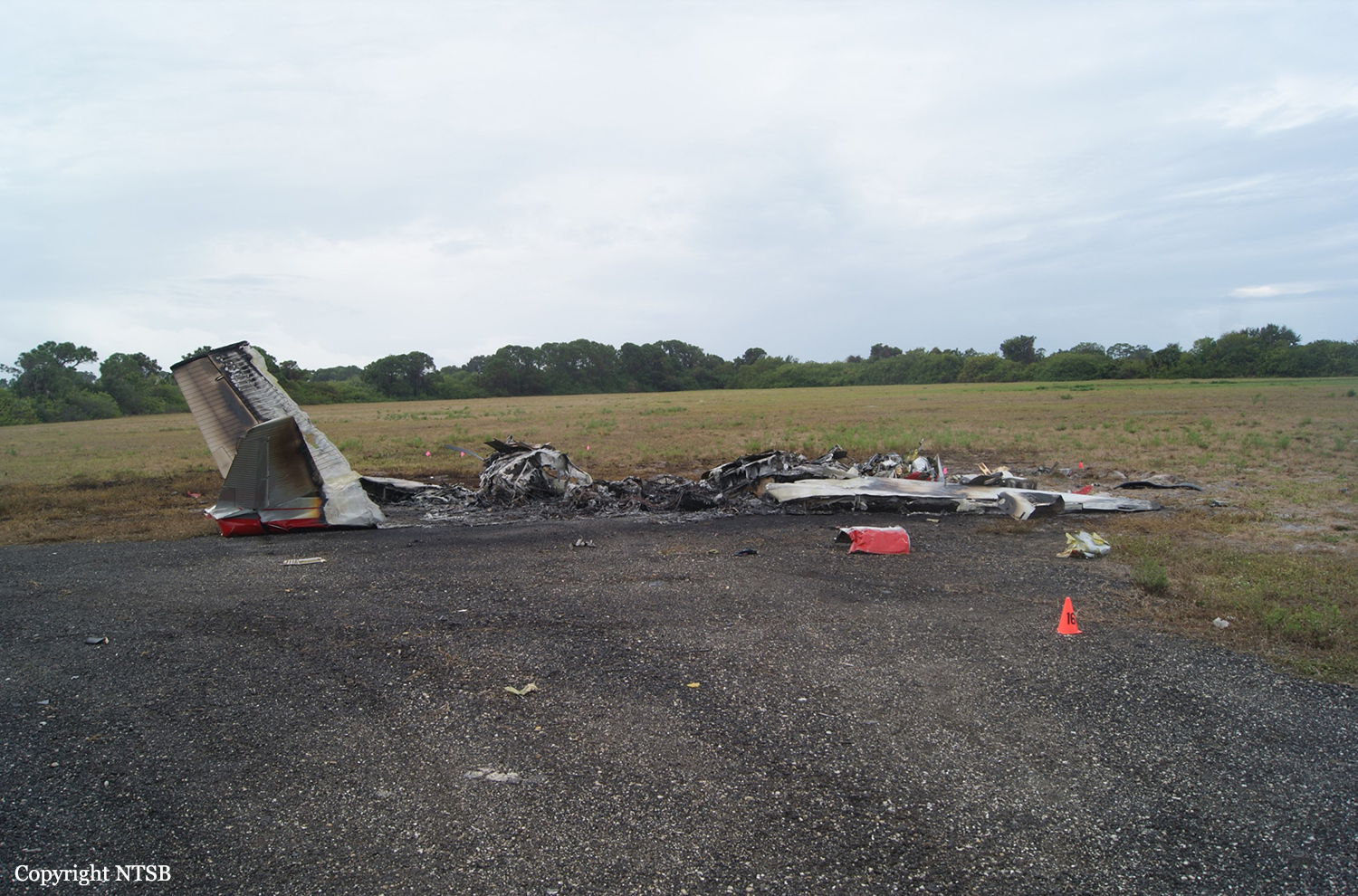
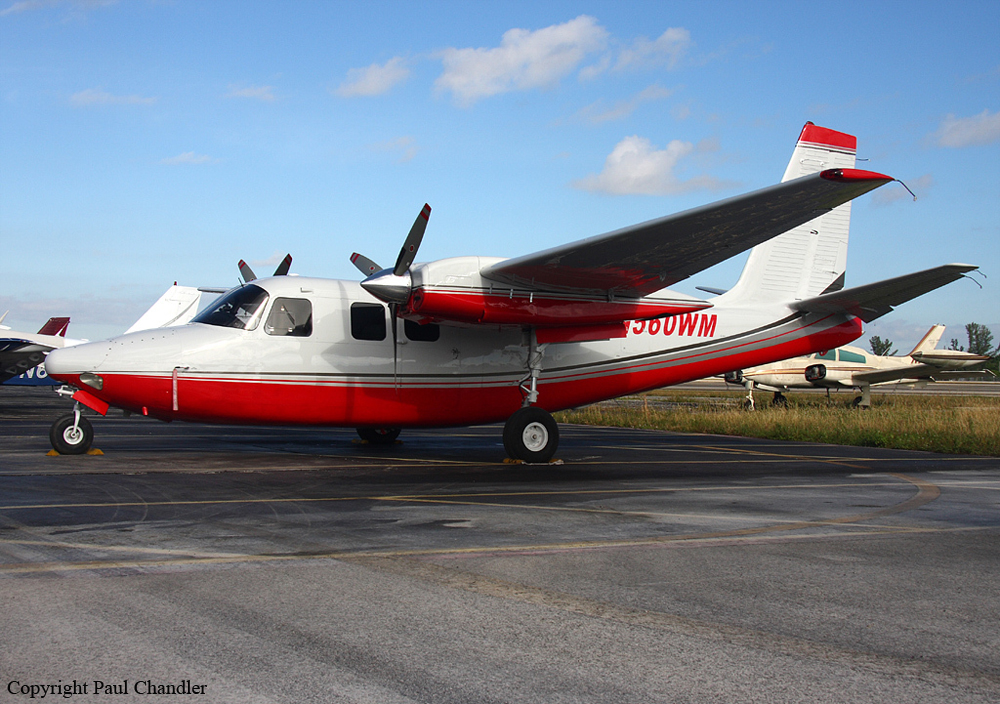
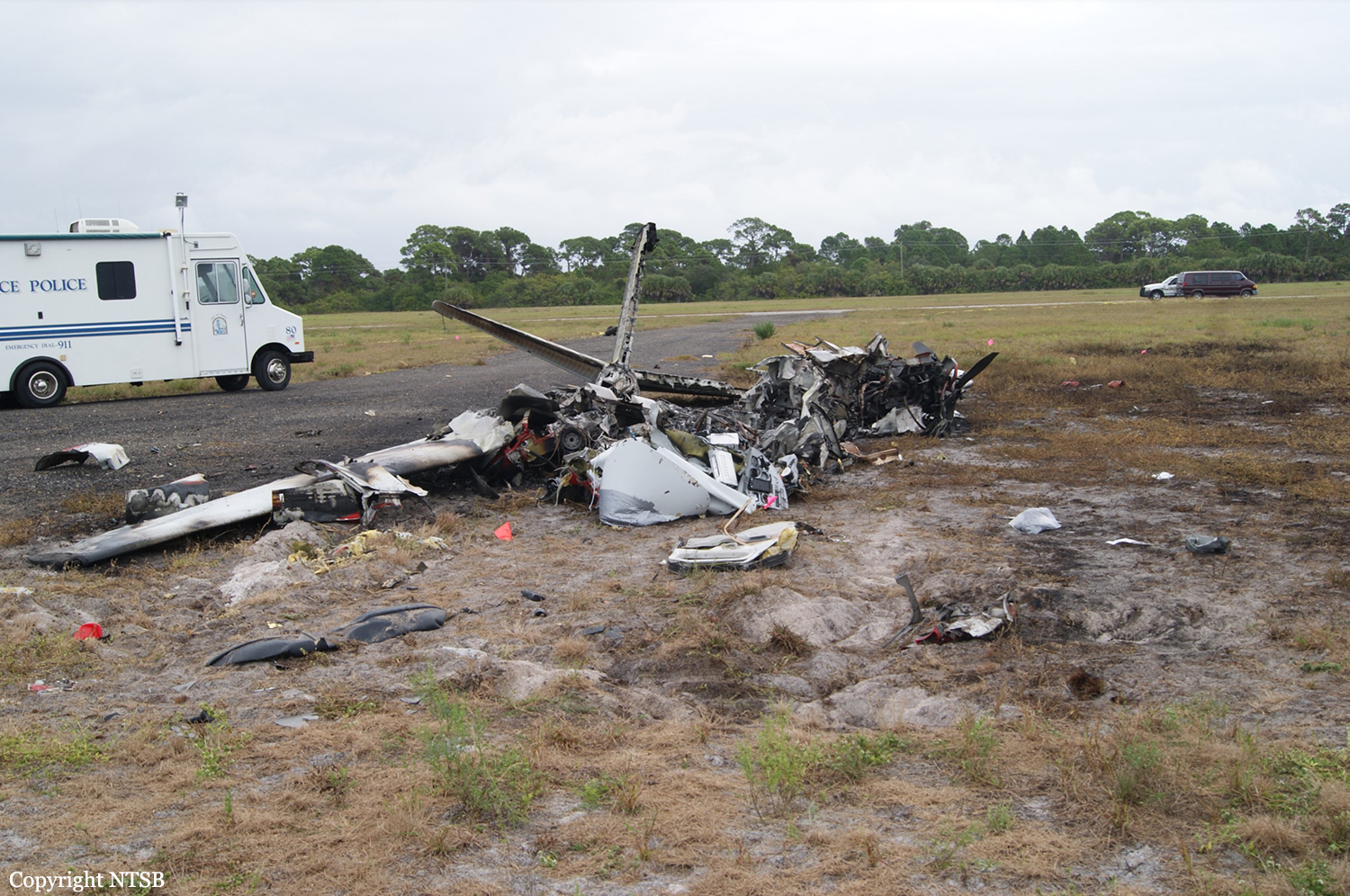
Crash of a Rockwell Aero Commander 560F in Venice: 1 killed

Date & Time: Dec 26, 2011 at 1406 LT
Operator:
Registration:
N560WM
Flight Type:
Survivors:
No
Schedule:
Venice - LaFayette
MSN:
560-1305-58
YOM:
1964
Location:
Crew on board:
1
Crew fatalities:
Pax on board:
0
Pax fatalities:
Other fatalities:
Total fatalities:
1
Captain / Total flying hours:
6000
Captain / Total hours on type:
1500.00
Aircraft flight hours:
5826
Circumstances:
The airplane departed and was climbing to an assigned altitude when the pilot informed an air traffic controller of a loss of engine power on the left engine. The pilot received radar vectors back to the departure airport and reported the airport in sight. There was no further communication with the controller. Review of radar data revealed that the airplane was about 825 feet from and 200 feet above the landing runway threshold. Seventeen seconds later, the airplane was at 100 feet above ground level and left of the intended landing runway. The last radar return was 5 seconds later, and the airplane was at 200 feet above ground level. A witness observed the airplane in the vicinity of landing runway. The airplane pitched straight up, stalled, spun to the left three times before it collided with the ground and caught fire. Postcrash examination of the airframe and flight controls revealed no anomalies. The left engine was disassembled and all connecting rods were intact except for the No.2 connecting rod. Metallugical examination of the connecting rod revealed that the bearing failed, most likely due to a progressive delamination of the bearing. Review of the airplane flight manual revealed a minimum of 300 feet of altitude is required to recover from power-off stalls with 7500 pounds at both forward and aft center of gravity. The stall speed with the landing gear and flaps up with 0 degree angle of bank is 83 miles per hour or 72 knots. The stall speed with the landing gear extended and the flaps down is 73 miles per hours or 63 knots.
Probable cause:
The pilot’s failure to maintain adequate airspeed during a single-engine approach, which resulted in an aerodynamic stall. Contributing to the accident was the total loss of power in the left engine due to a failed No. 2 connecting rod bearing.
Final Report:
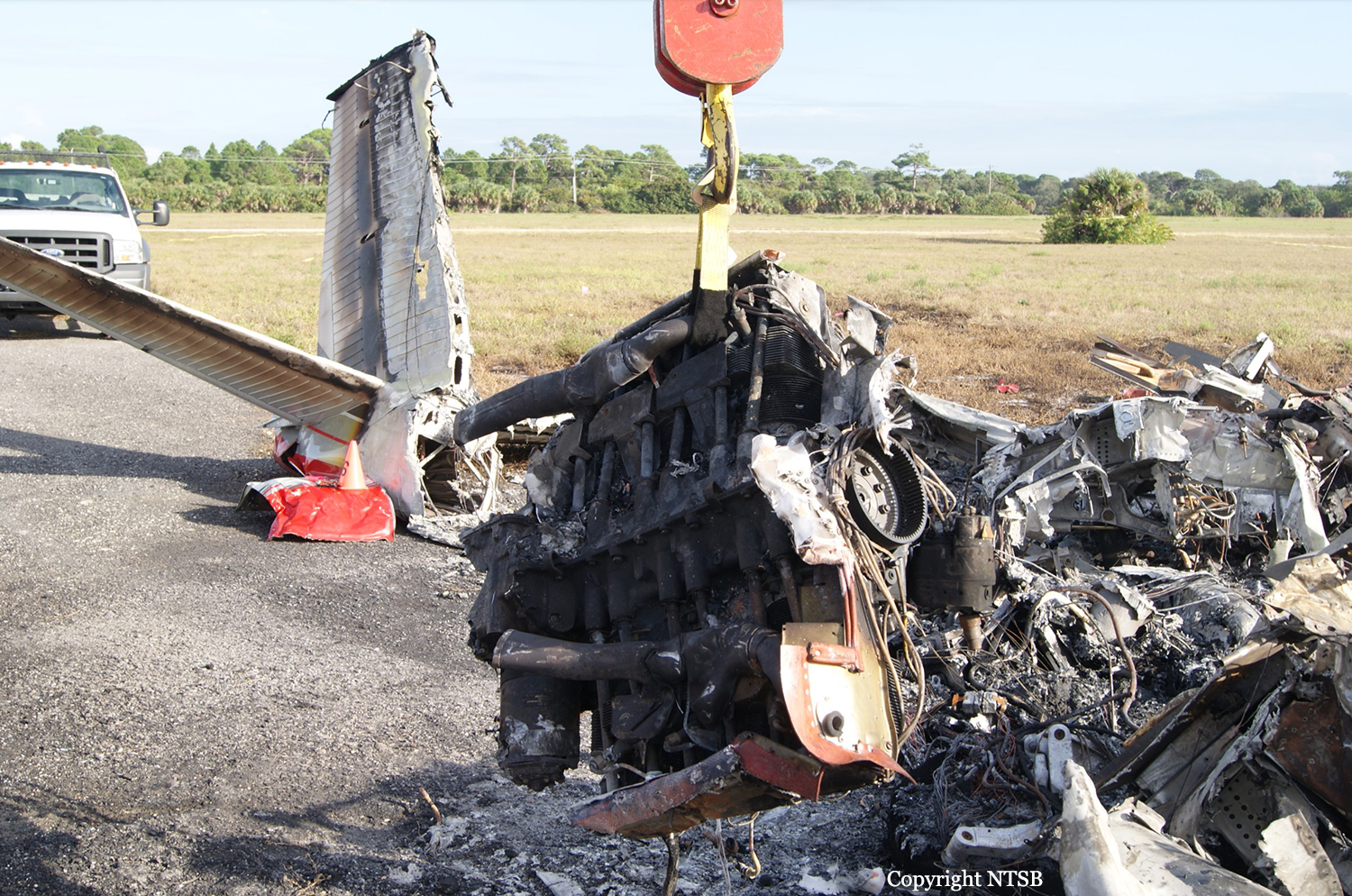
Crash of a Cessna 441 Conquest in York: 1 killed

Date & Time: Dec 22, 2011 at 1725 LT
Type of aircraft:
Operator:
Registration:
N48BS
Flight Type:
Survivors:
No
Schedule:
Long Beach - York
MSN:
441-0125
YOM:
1980
Crew on board:
1
Crew fatalities:
Pax on board:
0
Pax fatalities:
Other fatalities:
Total fatalities:
1
Captain / Total flying hours:
1409
Captain / Total hours on type:
502.00
Aircraft flight hours:
5995
Circumstances:
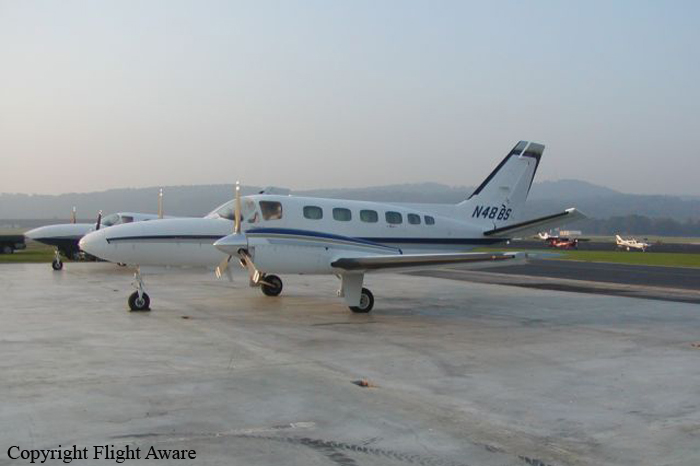
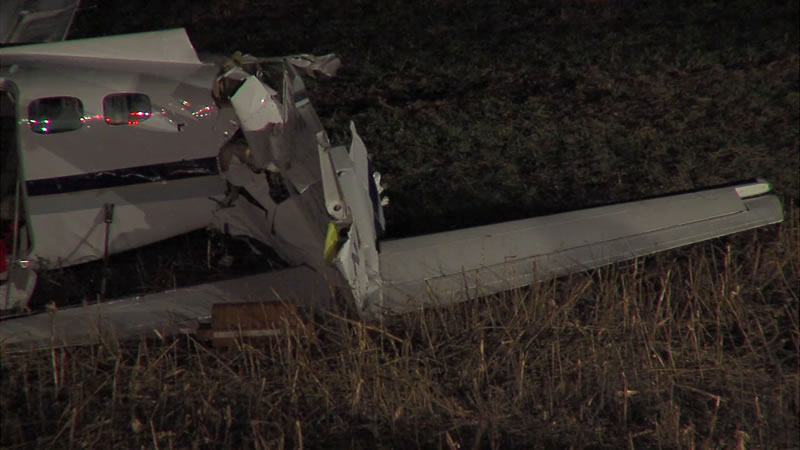
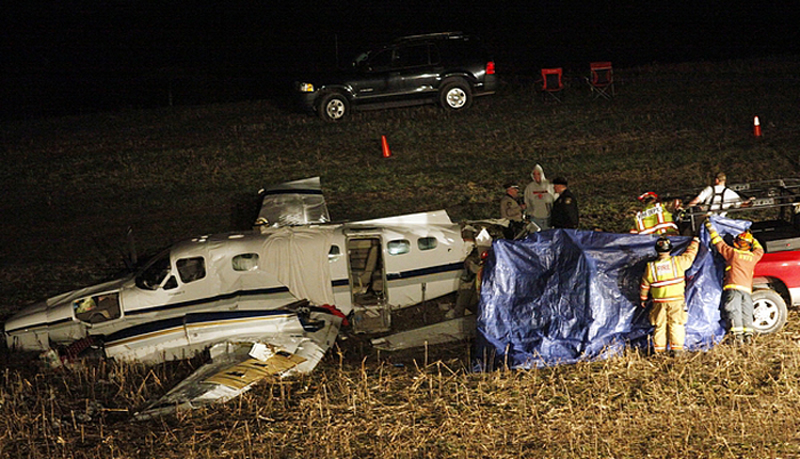
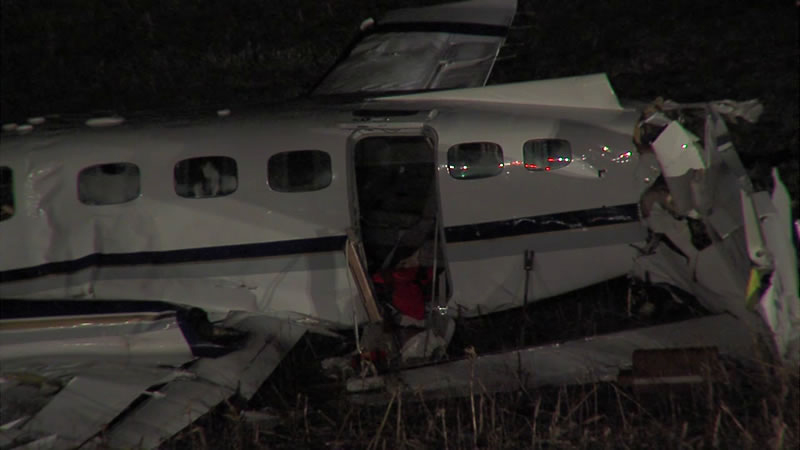
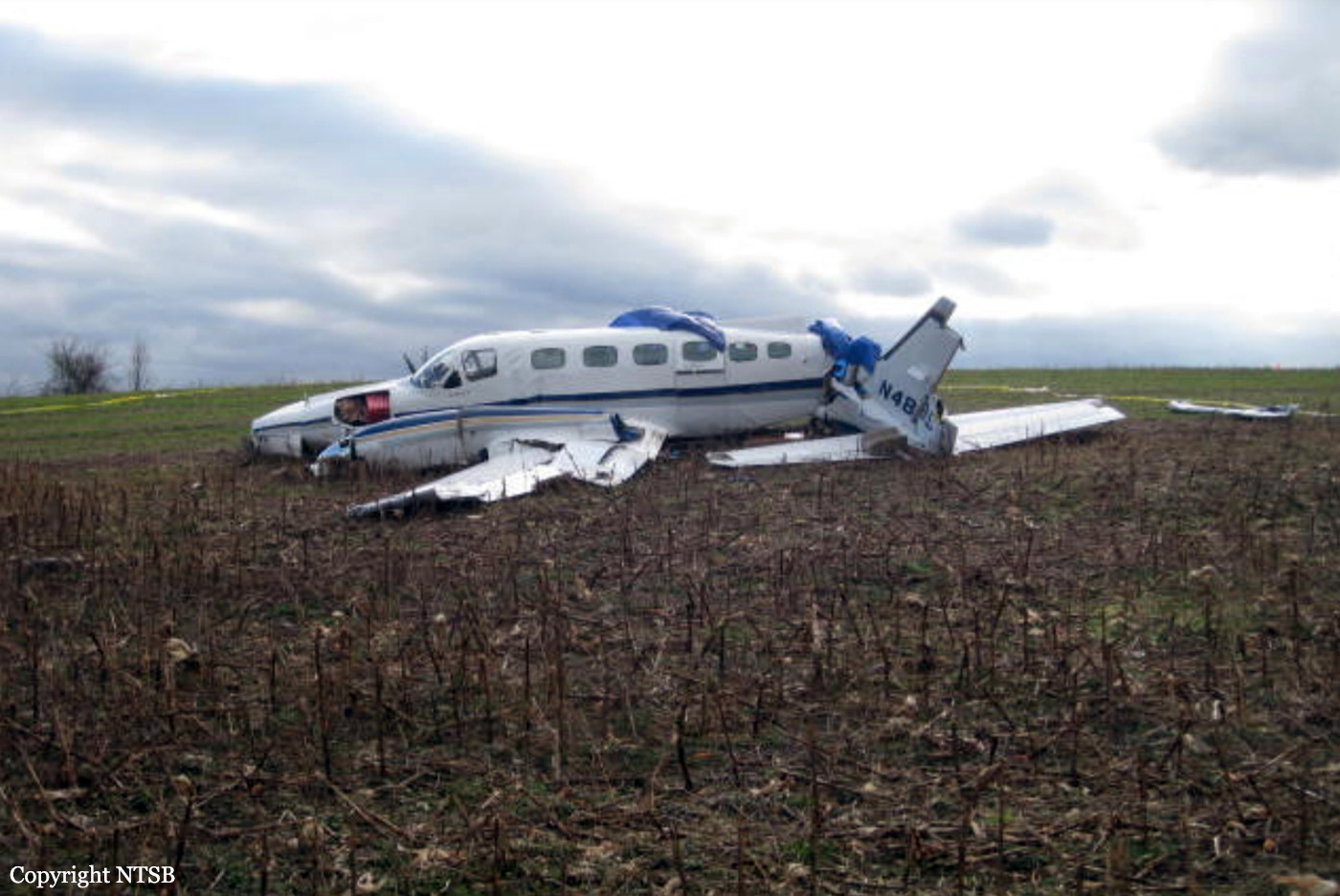
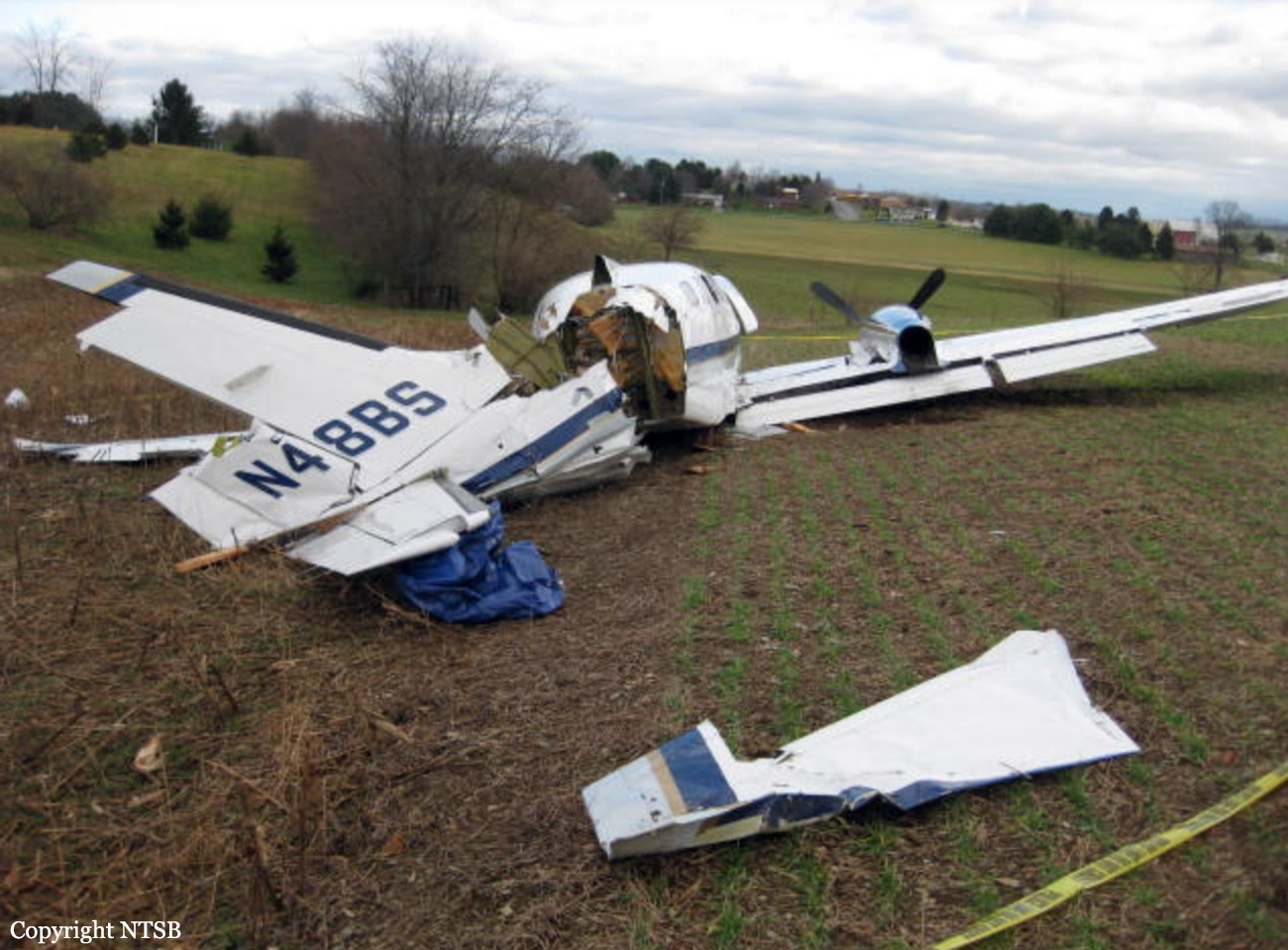
Toward the end of a 6 hour, 20 minute flight, during a night visual approach, the pilot flew the airplane to a left traffic pattern downwind leg. At some point, he lowered the landing gear and set the flaps to 30 degrees. He turned the airplane to a left base leg, and after doing so, was heard on the common traffic frequency stating that he had an "engine out." The airplane then passed through the final leg course, the pilot called "base to final," and the airplane commenced a right turn while maintaining altitude. The angle of bank was then observed to increase to where the airplane's wings became vertical, then inverted, and the airplane rolled into a near-vertical descent, hitting the ground upright in a right spin. Subsequent examination of the airplane and engines revealed that the right engine was not powered at impact, and the propeller from that engine was not in feather. No mechanical anomalies could be found with the engine that could have resulted in its failure. The right fuel tank was breeched; however, fuel calculations, confirmed by some fuel found in the right fuel tank as well as fuel found in the engine fuel filter housing, indicated that fuel exhaustion did not occur. Unknown is why the pilot did not continue through a left turn descent onto the final approach leg toward airport, which would also have been a turn toward the operating engine. The pilot had a communication device capable of voice calls, texting, e-mail and alarms, among other functions. E-mails were sent by the device until 0323, and an alarm sounded at 0920. It is unknown if or how much pilot fatigue might have influenced the outcome.
Probable cause:
The pilot's failure to maintain minimum control airspeed after a loss of power to the right engine, which resulted in an uncontrollable roll into an inadvertent stall/spin. Contributing to the accident was the failure of the airplane's right engine for reasons that could not be determined because no preexisting mechanical anomalies were found, and the pilot's subsequent turn toward that inoperative engine while maintaining altitude.
Final Report:
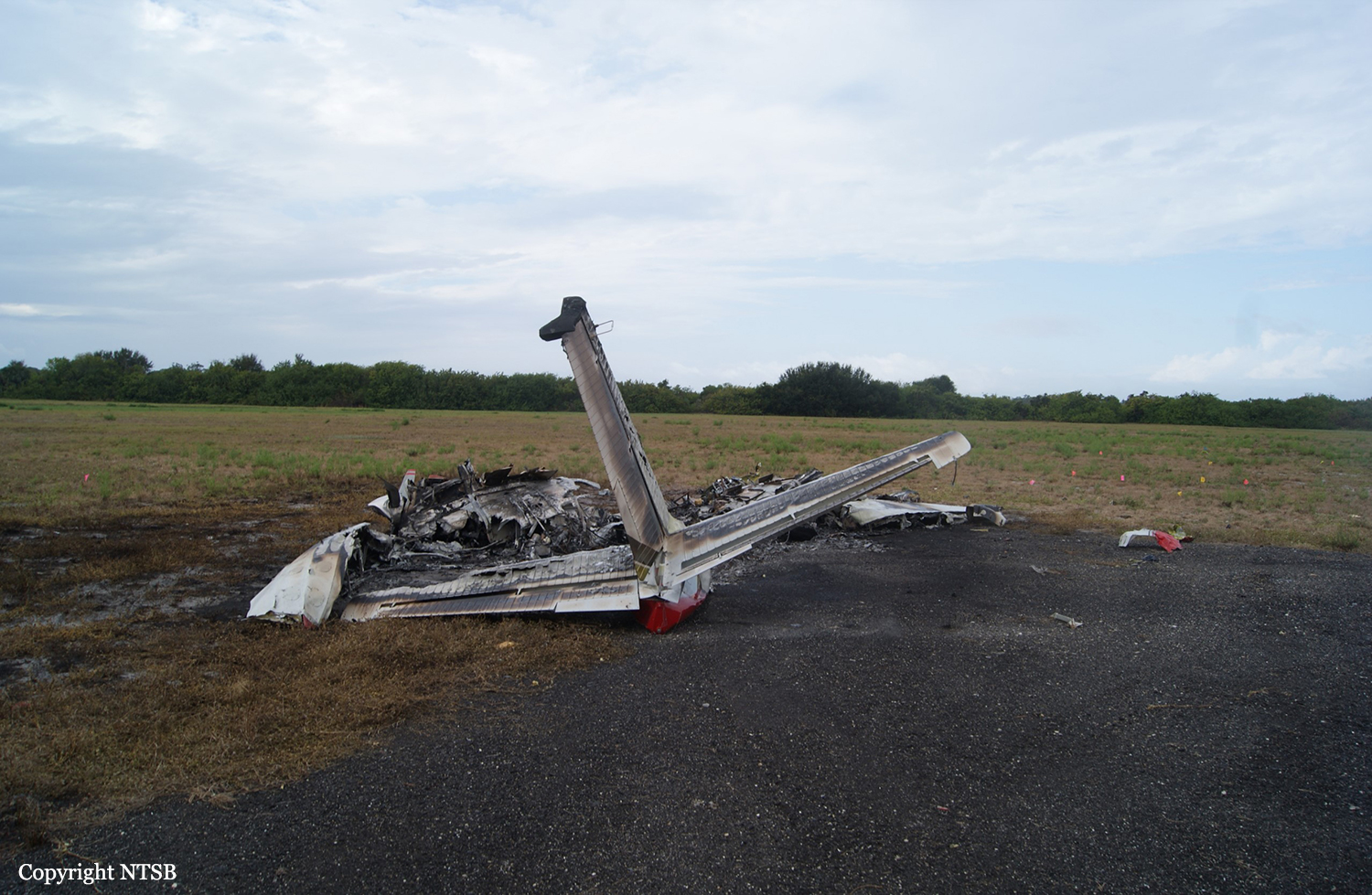
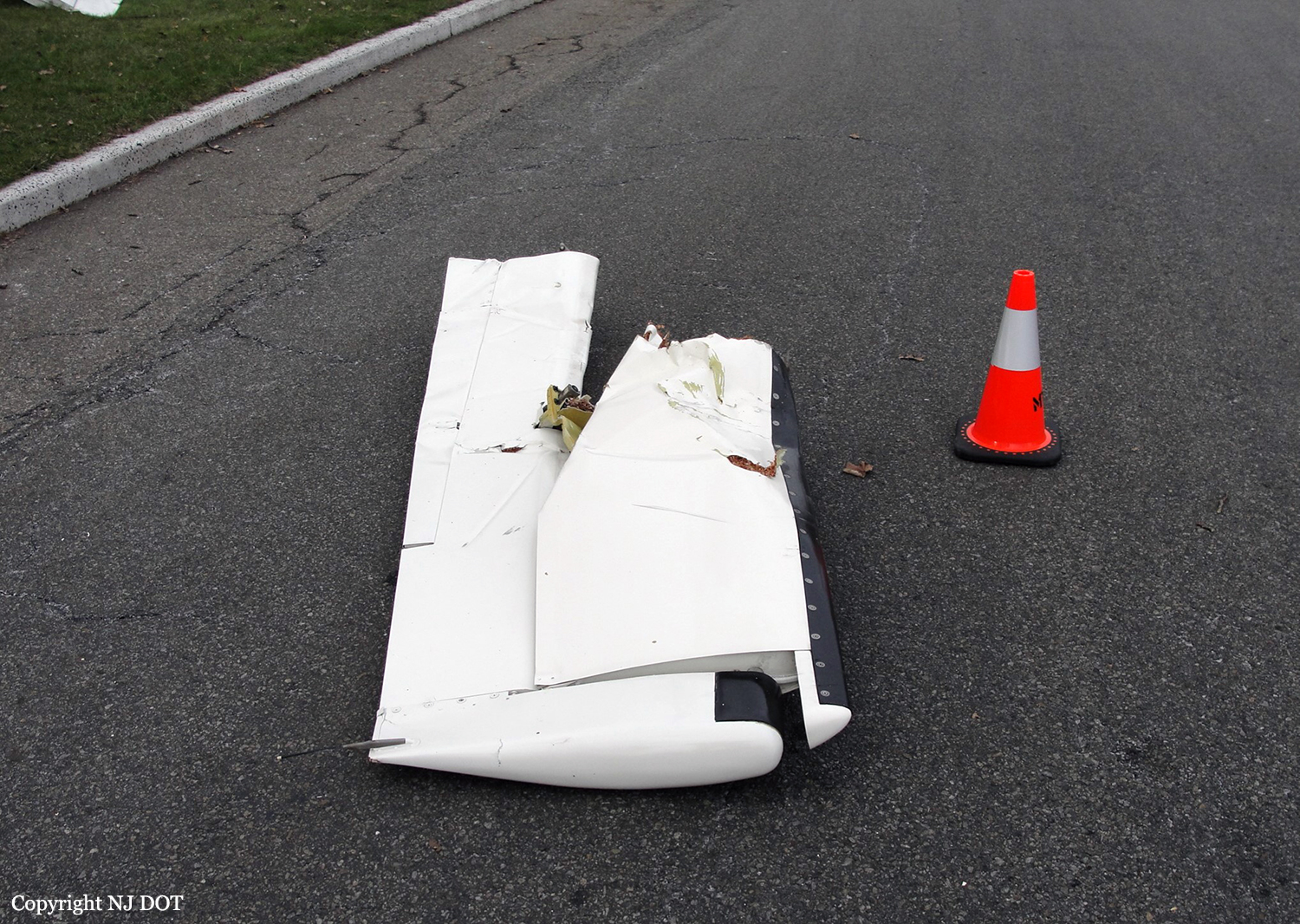
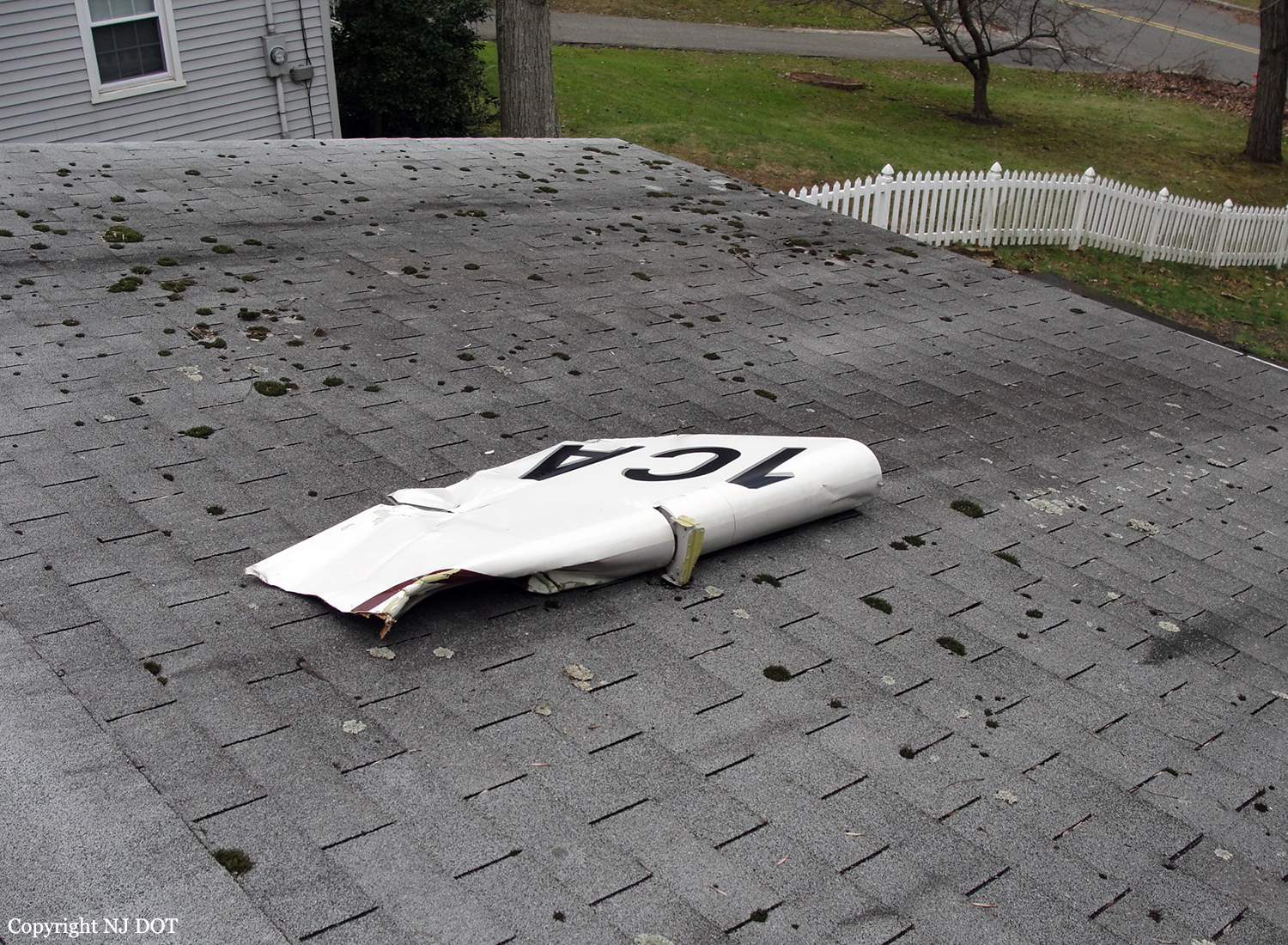
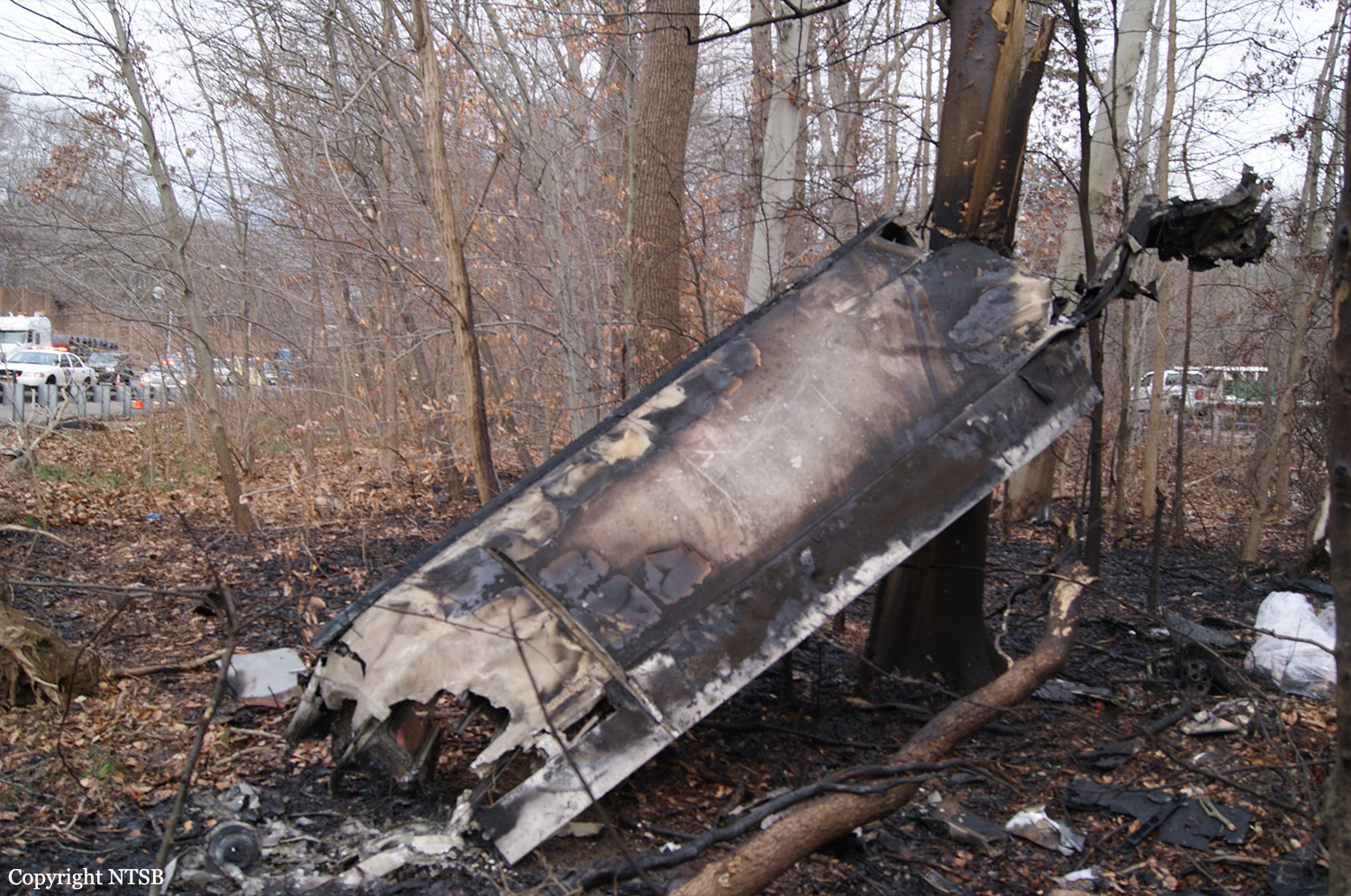
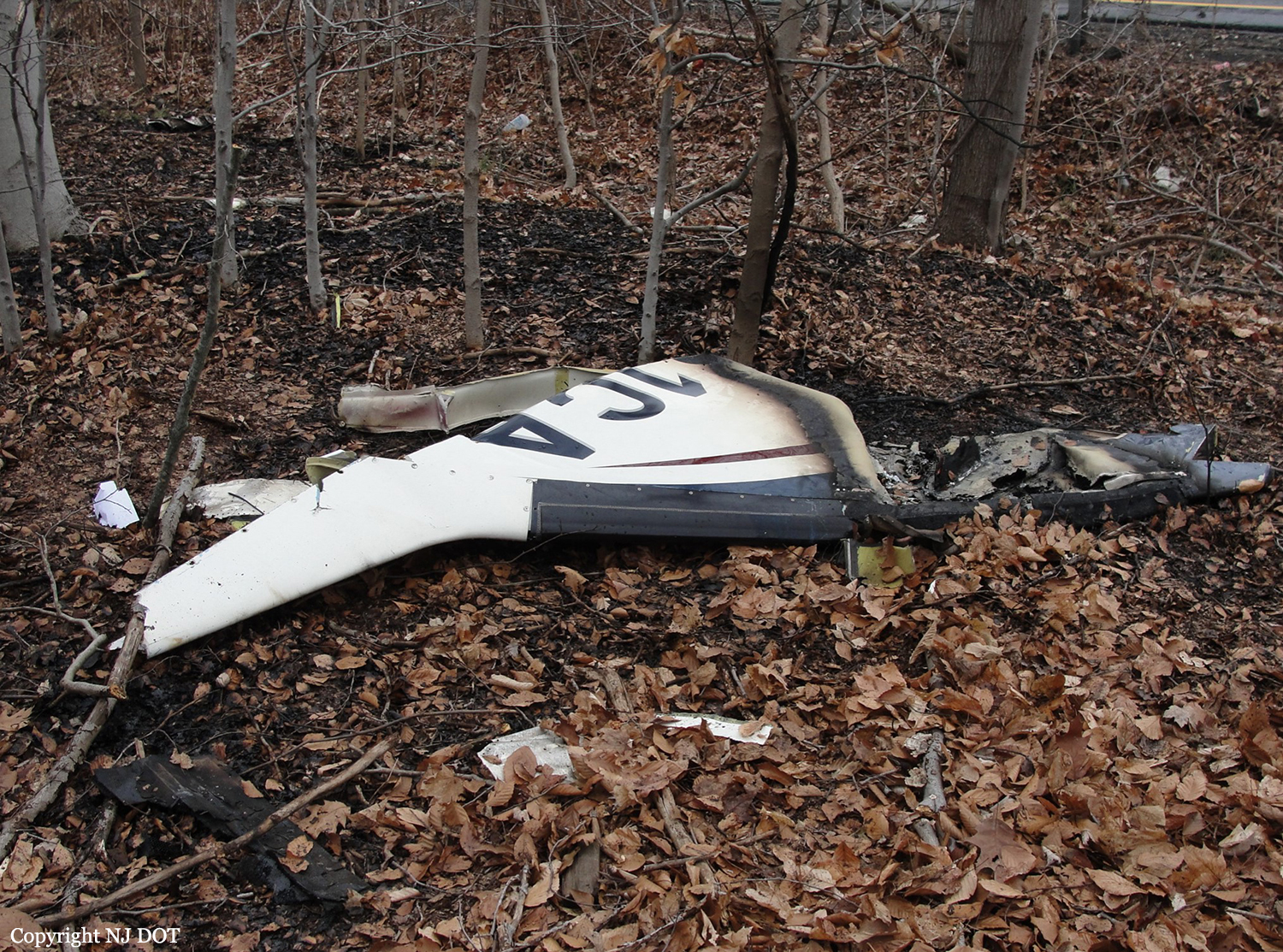
Crash of a Socata TBM-700 in Morristown: 5 killed

Date & Time: Dec 20, 2011 at 1005 LT
Type of aircraft:
Operator:
Registration:
N731CA
Flight Phase:
Flight Type:
Survivors:
No
Site:
Schedule:
Teterboro - Atlanta
MSN:
332
YOM:
2005
Crew on board:
1
Crew fatalities:
Pax on board:
4
Pax fatalities:
Other fatalities:
Total fatalities:
5
Captain / Total flying hours:
1400
Aircraft flight hours:
702
Circumstances:
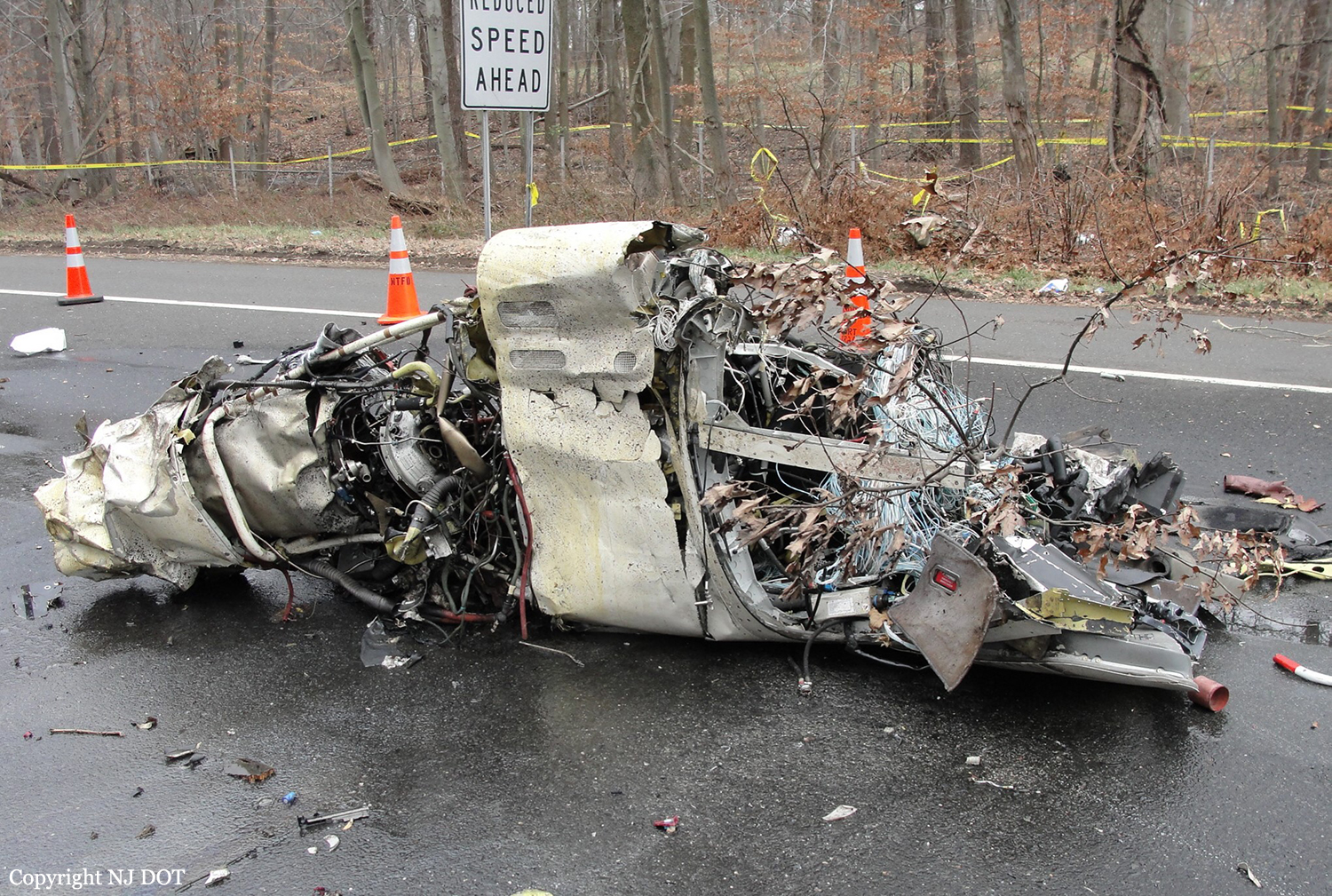
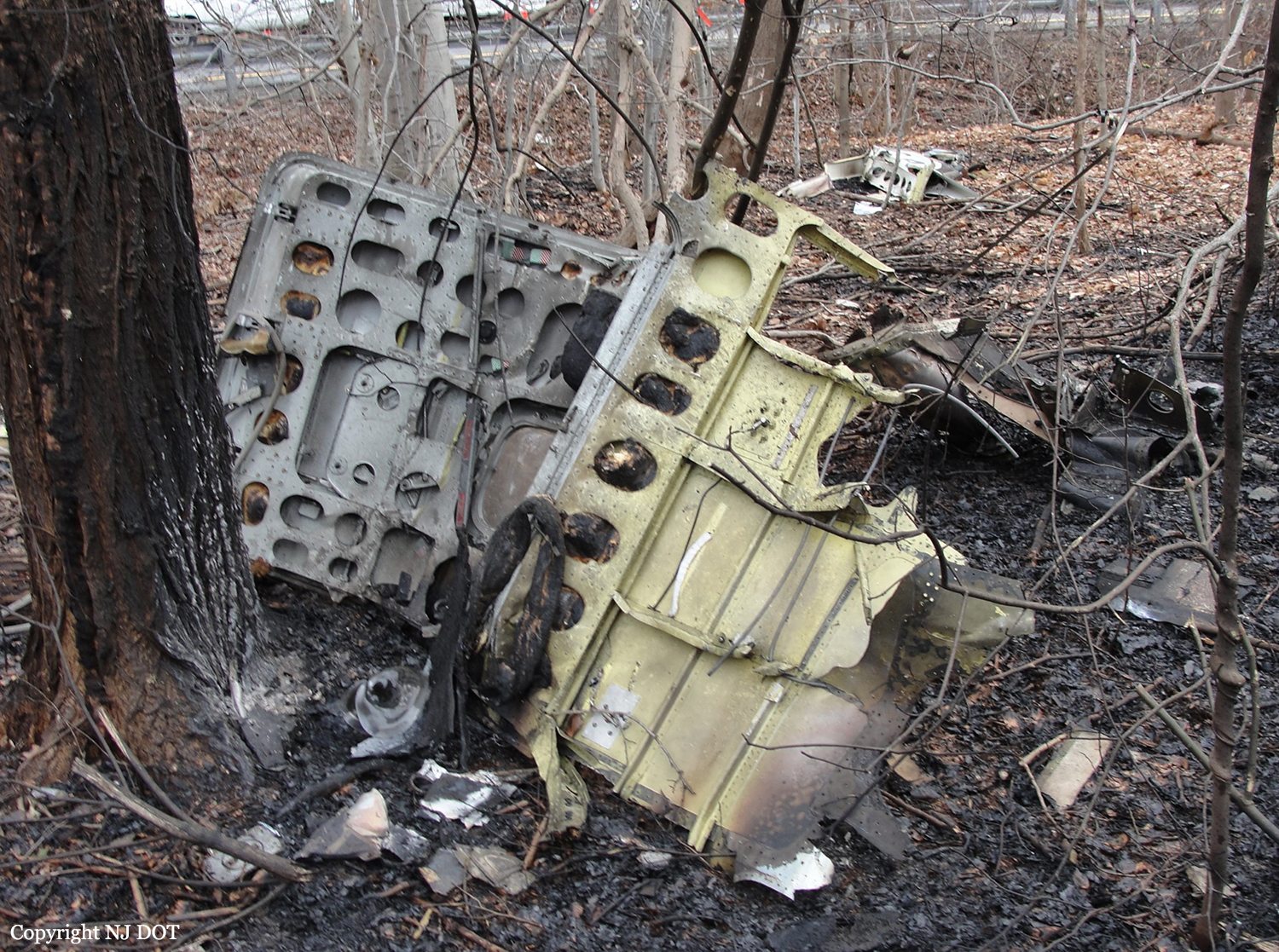
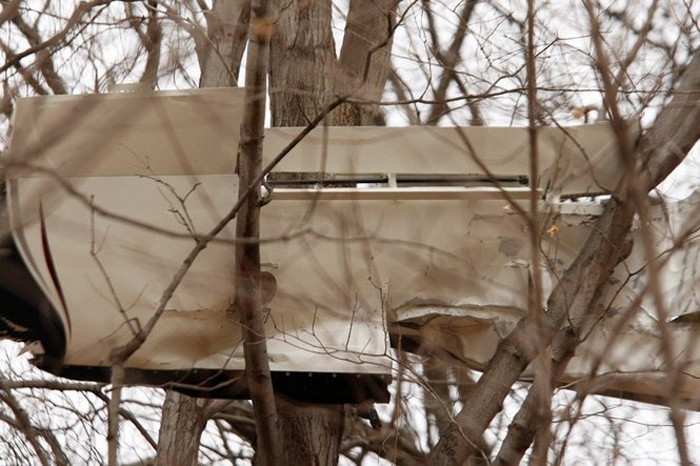
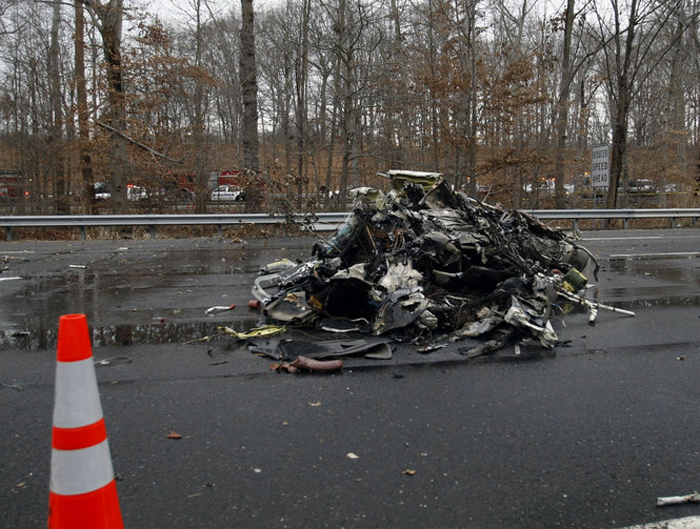
Although the pilot filed an instrument flight rules flight plan through the Direct User Access Terminal System (DUATS), no evidence of a weather briefing was found. The flight departed in visual meteorological conditions and entered instrument meteorological conditions while climbing through 12,800 feet. The air traffic controller advised the pilot of moderate rime icing from 15,000 feet through 17,000 feet, with light rime ice at 14,000 feet. The controller asked the pilot to advise him if the icing worsened, and the pilot responded that he would let them know and that it was no problem for him. The controller informed the pilot that he was coordinating for a higher altitude. The pilot confirmed that, while at 16,800 feet, "…light icing has been present for a little while and a higher altitude would be great." About 15 seconds later, the pilot stated that he was getting a little rattle and requested a higher altitude as soon as possible. About 25 seconds after that, the flight was cleared to flight level 200, and the pilot acknowledged. About one minute later, the airplane reached a peak altitude of 17,800 feet before turning sharply to the left and entering a descent. While descending through 17,400 feet, the pilot stated, "and N731CA's declaring…" No subsequent transmissions were received from the flight. The airplane impacted the paved surfaces and a wooded median on an interstate highway. A postaccident fire resulted. The outboard section of the right wing and several sections of the empennage, including the horizontal stabilizer, elevator, and rudder, were found about 1/4 mile southwest of the fuselage, in a residential area. Witnesses reported seeing pieces of the airplane separating during flight and the airplane in a rapid descent. Examination of the wreckage revealed that the outboard section of the right wing separated in flight, at a relatively low altitude, and then struck and severed portions of the empennage. There was no evidence of a preexisting mechanical anomaly that would have precluded normal operation of the airframe or engine. An examination of weather information revealed that numerous pilots reported icing conditions in the general area before and after the accident. At least three flight crews considered the icing "severe." Although severe icing was not forecasted, an Airmen's Meteorological Information (AIRMET) advisory included moderate icing at altitudes at which the accident pilot was flying. The pilot operating handbook warned that the airplane was not certificated for flight in severe icing conditions and that, if encountered, the pilot must exit severe icing immediately by changing altitude or routing. Although the pilot was coordinating for a higher altitude with the air traffic controller at the time of the icing encounter, it is likely that he either did not know the severity of the icing or he was reluctant to exercise his command authority in order to immediately exit the icing conditions.
Probable cause:
The airplane’s encounter with unforecasted severe icing conditions that were characterized by high ice accretion rates and the pilot's failure to use his command authority to depart the icing conditions in an expeditious manner, which resulted in a loss of airplane control.
Final Report:
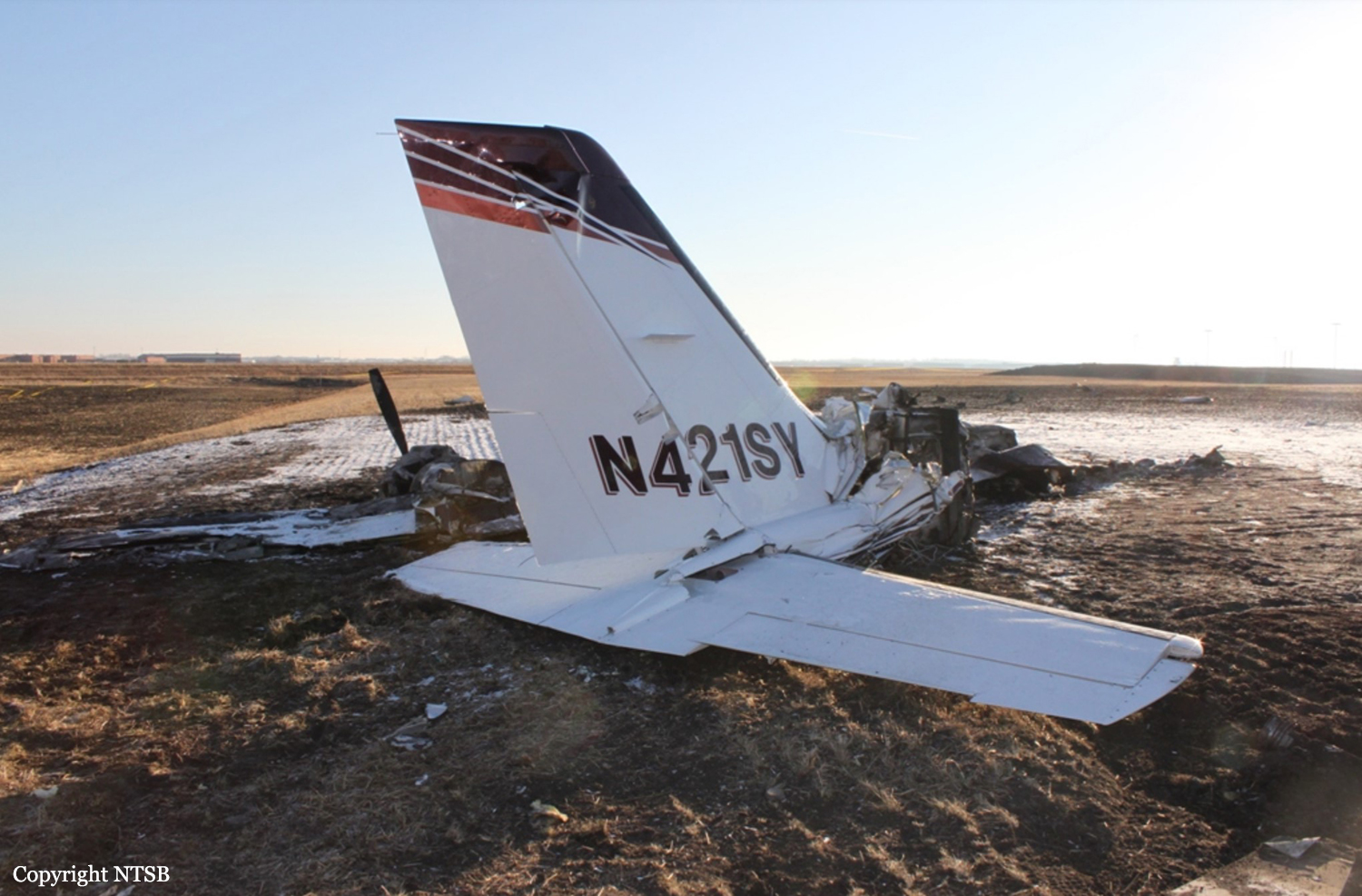
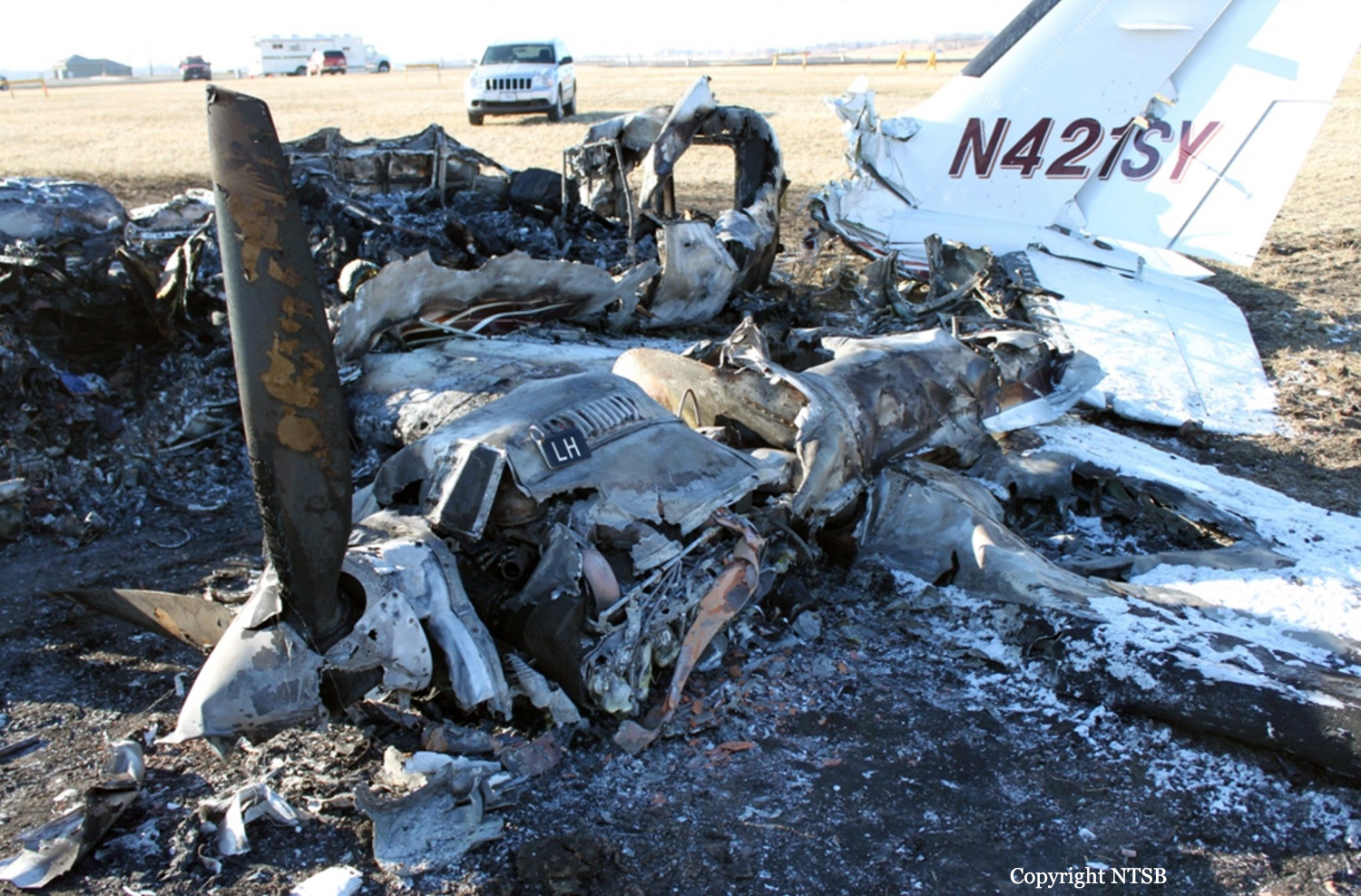
Crash of a Cessna 421C Golden Eagle III in Sioux Falls: 4 killed

Date & Time: Dec 9, 2011 at 1424 LT
Operator:
Registration:
N421SY
Flight Phase:
Survivors:
No
Schedule:
Sioux Falls - Rapid City
MSN:
421C-0051
YOM:
1976
Crew on board:
1
Crew fatalities:
Pax on board:
3
Pax fatalities:
Other fatalities:
Total fatalities:
4
Captain / Total flying hours:
3848
Captain / Total hours on type:
357.00
Aircraft flight hours:
4882
Circumstances:
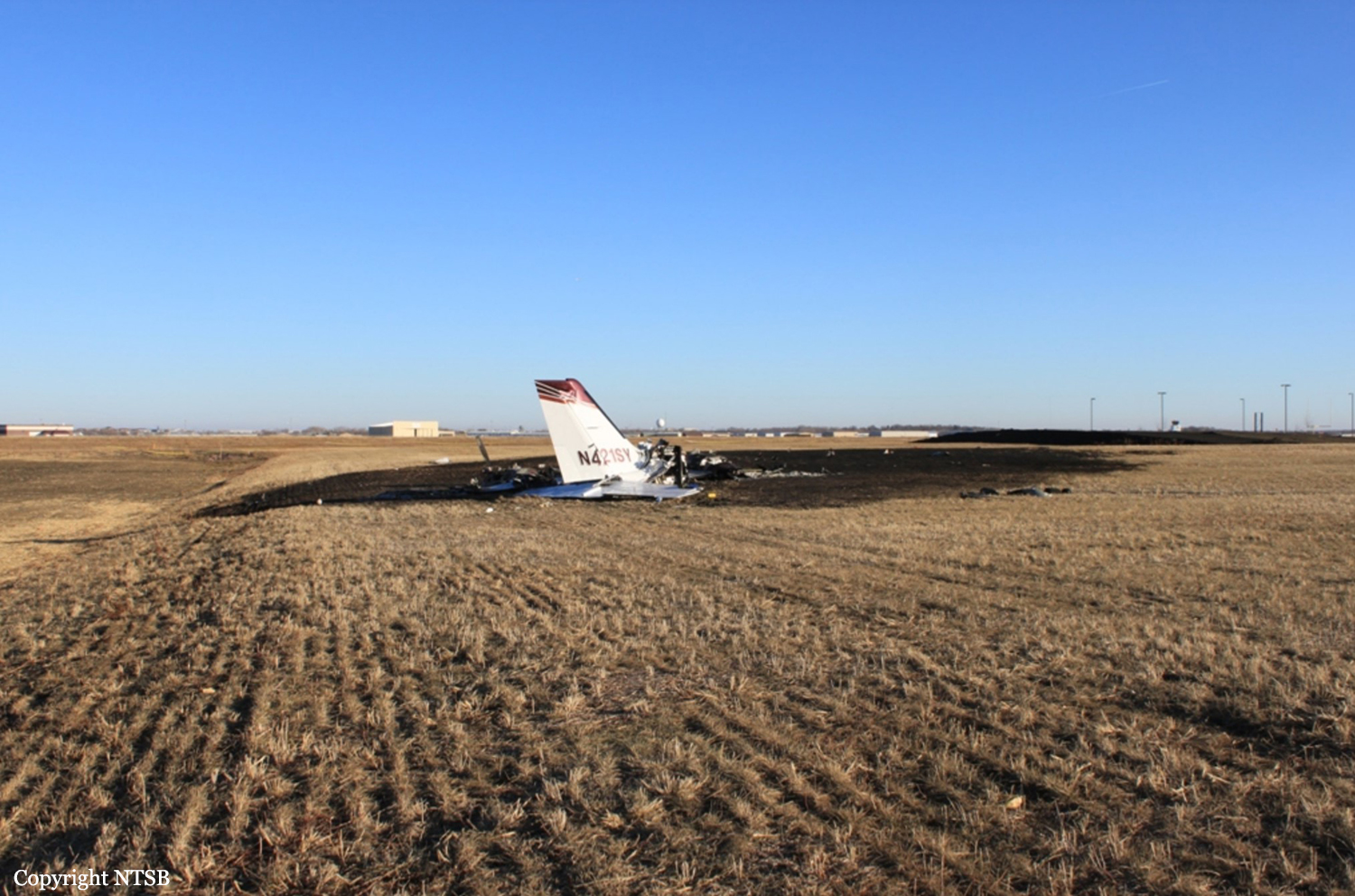
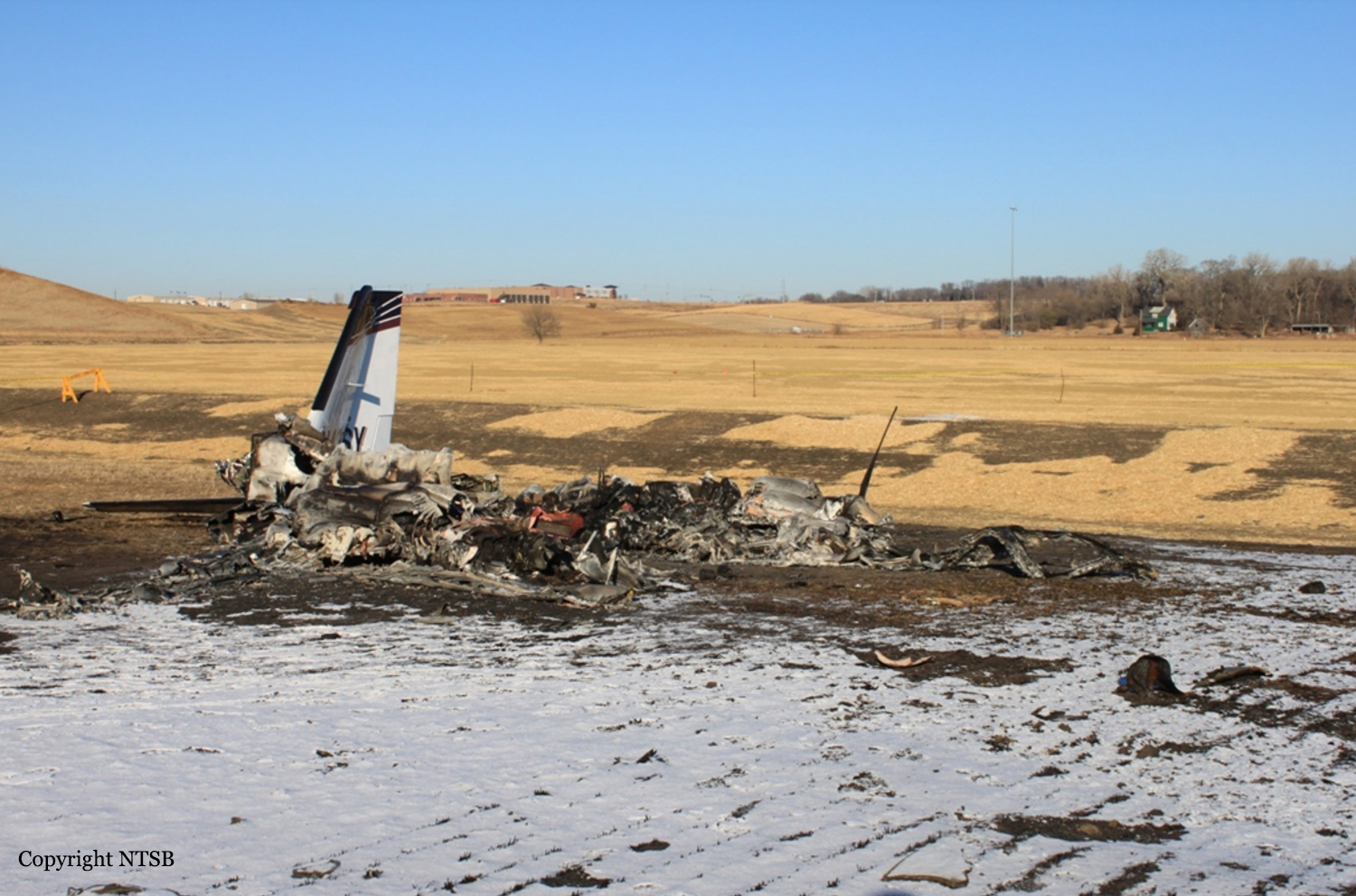
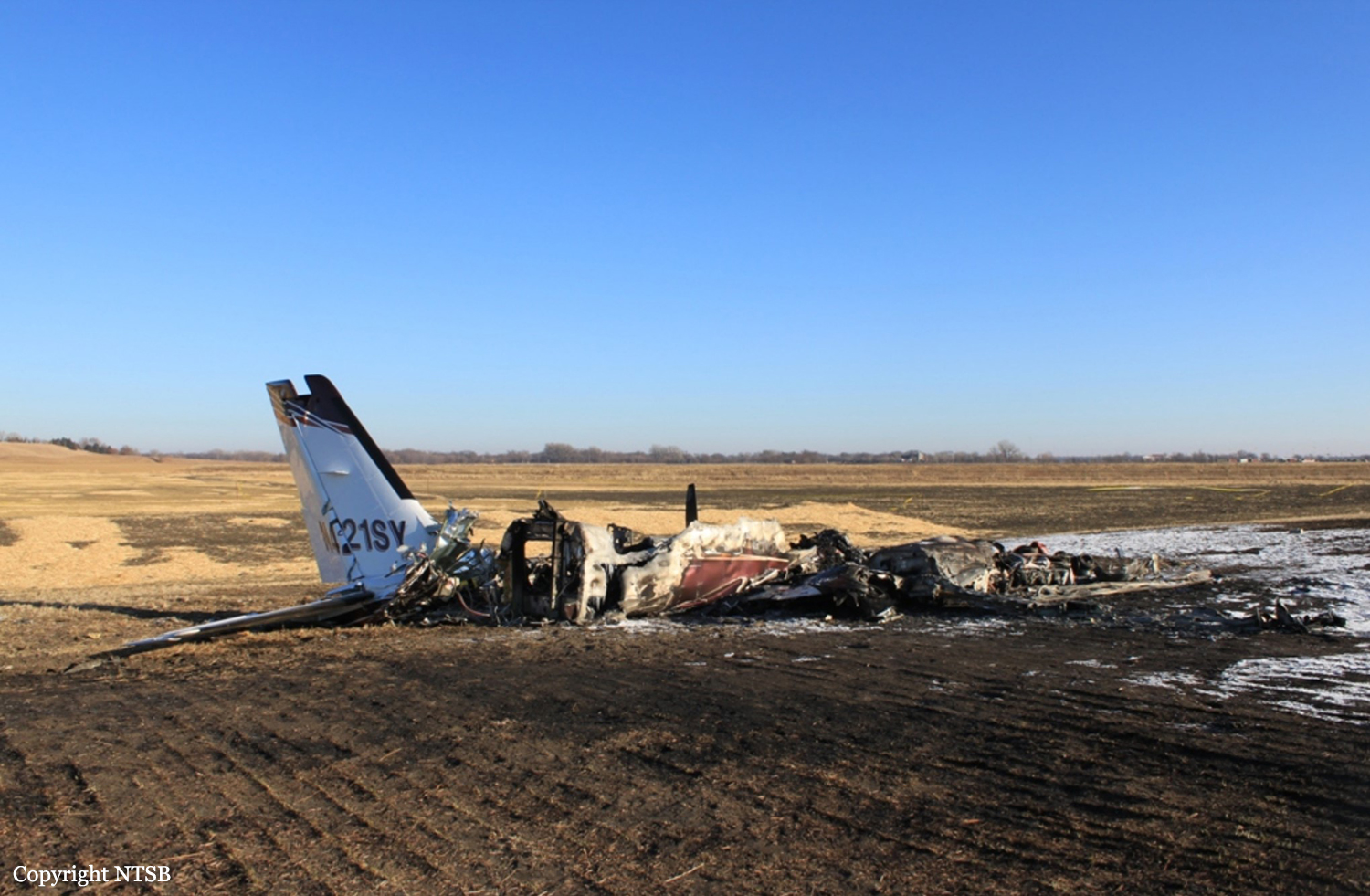
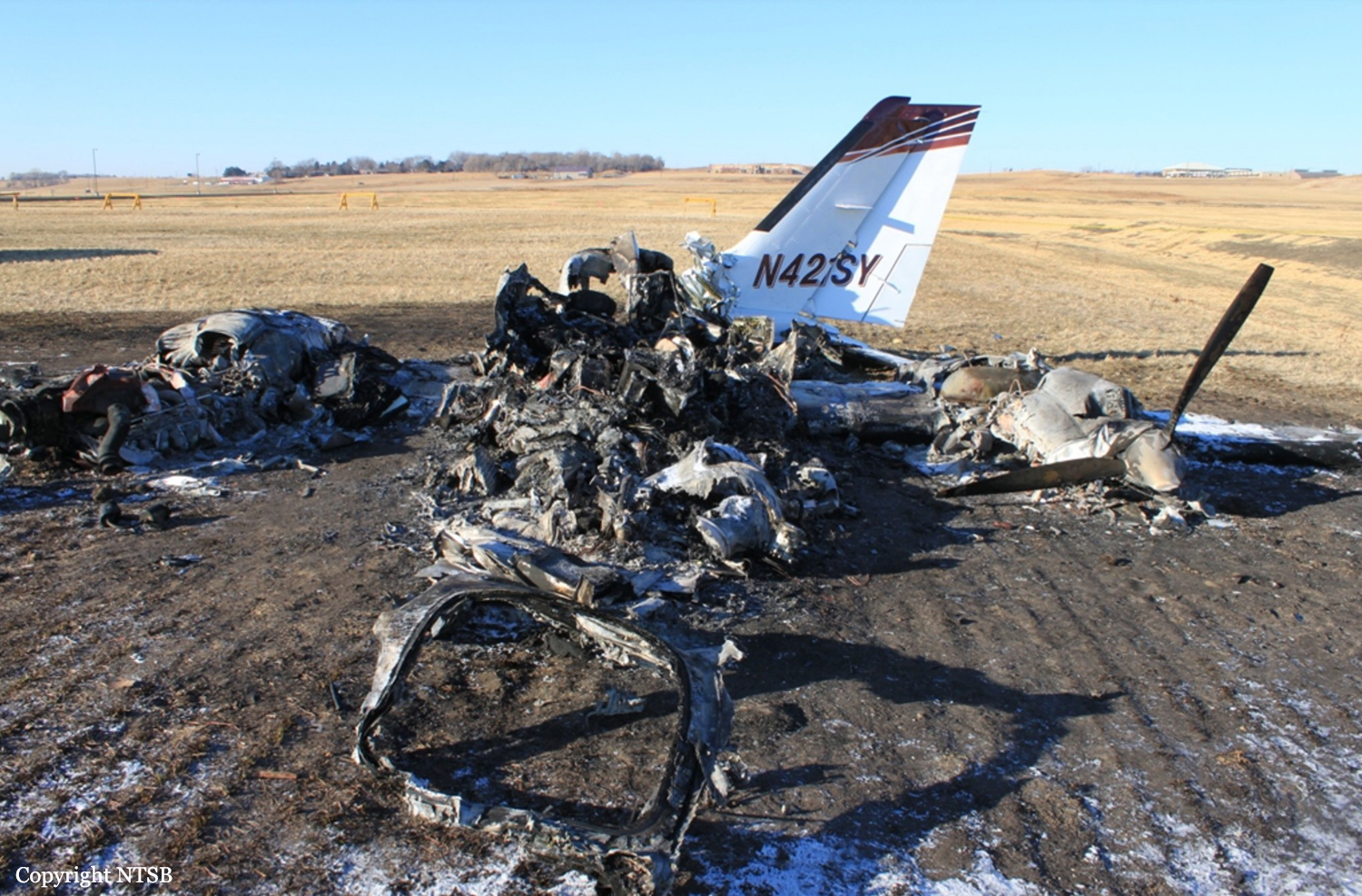
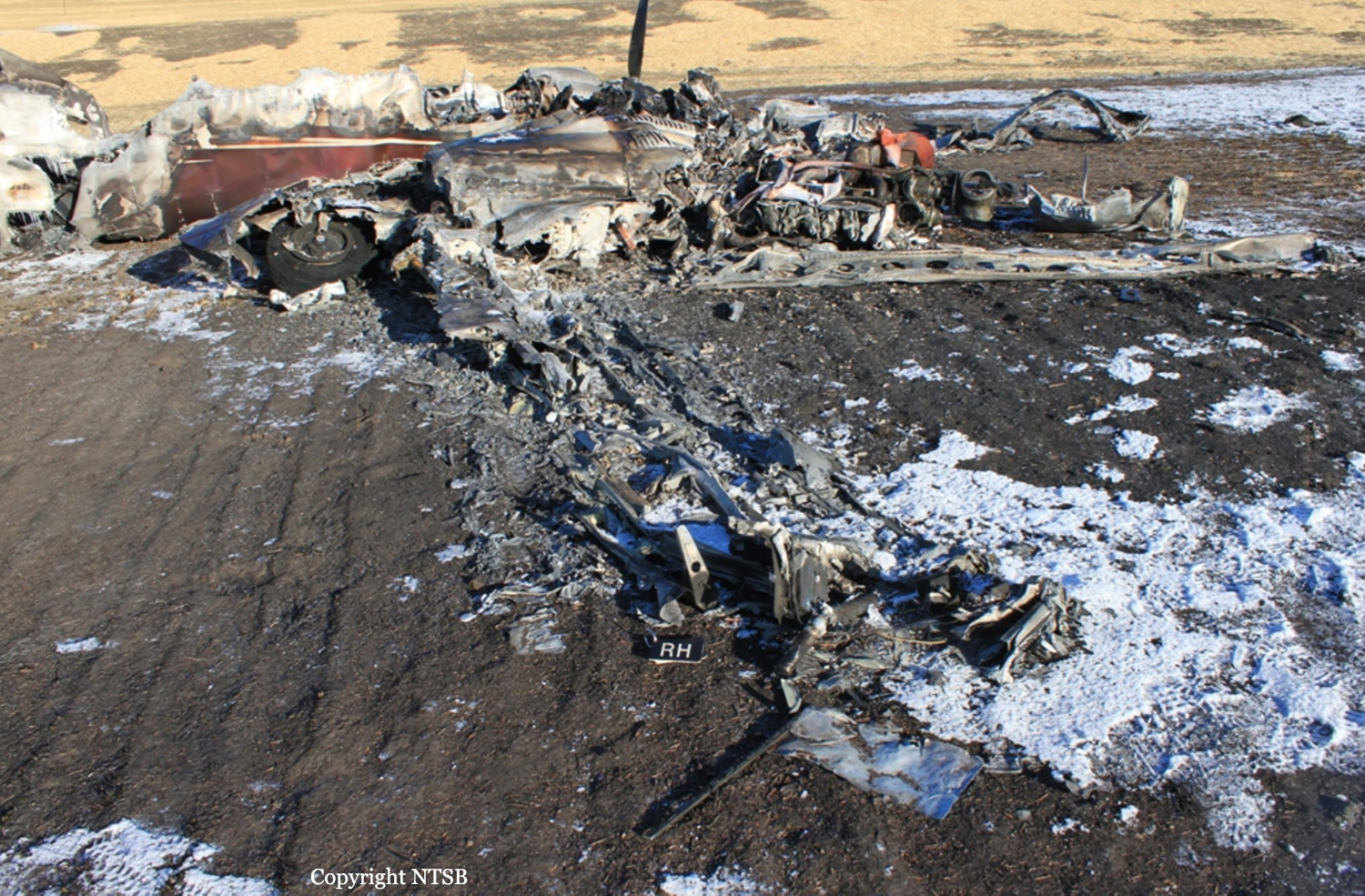
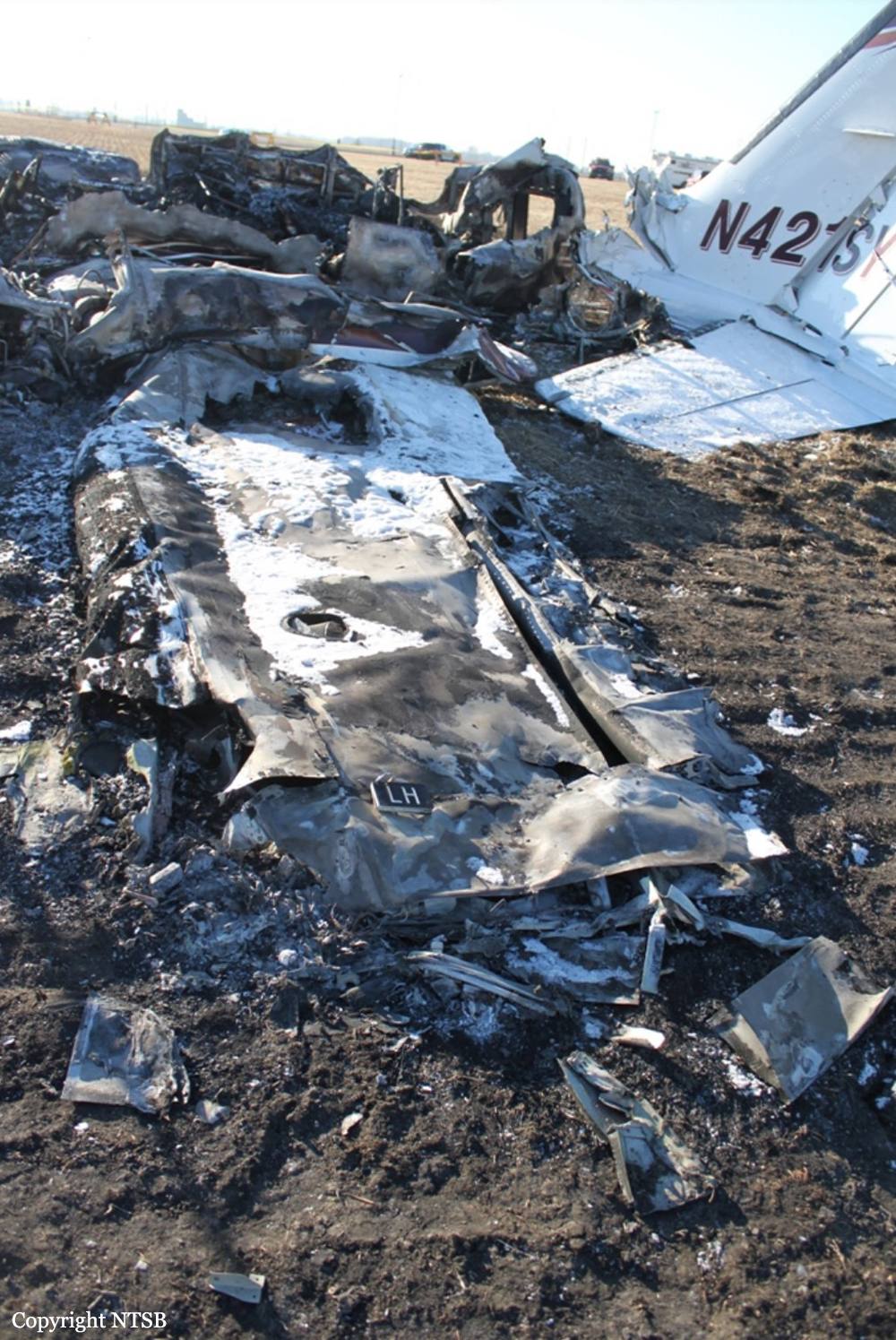
Shortly after the airplane lifted off, the tower controller informed the pilot that a plume of smoke was visible behind the airplane. No communications were received from the pilot after he acknowledged the takeoff clearance. Witnesses reported that white smoke appeared to be trailing from the area of the left engine during takeoff. The witnesses subsequently observed flames at the inboard side of the left engine. The airplane began a left turn. As the airplane continued the turn, the flames and trail of white smoke were no longer visible. When the airplane reached a southerly heading, the nose dropped abruptly, and the airplane descended to the ground. Witnesses stated that they heard an increase in engine sound before impact. A postimpact fire ensued. The accident site was located about 3/4 mile from the airport. A postaccident examination determined that the left engine fuel selector and fuel valve were in the OFF position, consistent with the pilot shutting down that engine after takeoff. However, the left engine propeller was not feathered. Extensive damage to the right engine propeller assembly was consistent with that engine producing power at the time of impact. The landing gear and wing flaps were extended at the time of impact. Teardown examinations of both engines did not reveal any anomalies consistent with a loss of engine power. The left engine oil cap was observed to be unsecured at the accident site; however, postaccident comparison of the left and right engine oil caps revealed disproportionate distortion of the left oil cap, likely due to the postimpact fire. As a result, no determination was made regarding the security of left engine oil cap before the accident. Emergency procedures outlined in the pilot’s operating handbook (POH) noted that when securing an engine, the propeller should be feathered. Performance data provided in the POH for single-engine operations were predicated on the propeller of the inoperative engine being feathered, and the wing flaps and landing gear retracted. Thus, the pilot did not follow the emergency procedures outlined in the POH for single-engine operation.
Probable cause:
The pilot’s failure to maintain adequate airspeed after shutting down one engine, which resulted in an inadvertent aerodynamic stall and impact with terrain. Contributing to the accident was the pilot’s failure to follow the guidance contained in the pilot’s operating handbook, which advised feathering the propeller of the secured engine and retracting the flaps and landing gear.
Final Report:
Crash of a Beechcraft F90 King Air in Midland

Date & Time: Dec 2, 2011 at 0810 LT
Type of aircraft:
Registration:
N90QL
Flight Type:
Survivors:
Yes
Site:
Schedule:
Wharton - Midland
MSN:
LA-2
YOM:
1979
Location:
Crew on board:
1
Crew fatalities:
Pax on board:
0
Pax fatalities:
Other fatalities:
Total fatalities:
0
Captain / Total flying hours:
4600
Captain / Total hours on type:
25.00
Aircraft flight hours:
8253
Circumstances:
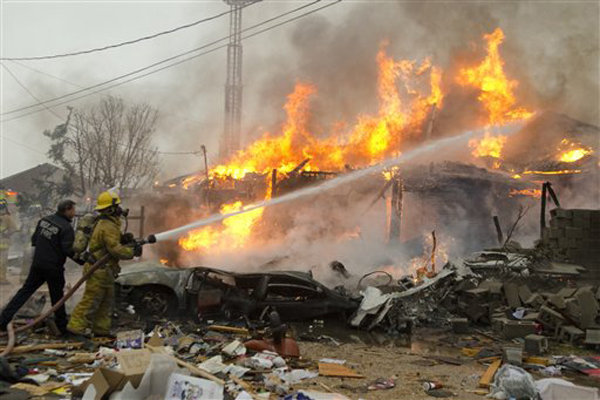
The aircraft collided with terrain while on an instrument approach to the Midland Airpark (MDD), near Midland, Texas. The commercial pilot, who was the sole occupant, sustained serious injuries. The airplane was registered to and operated by Quality Lease Air Services LLC., under the provisions of 14 Code of Federal Regulations Part 91 as a positioning flight. Instrument meteorological conditions prevailed and an instrument flight rules (IFR) flight plan had been filed for the cross-country flight. The flight originated from the Wharton Regional Airport (ARM), Wharton, Texas, about 0626. The pilot obtained a weather briefing for the flight to MDD. The briefing forecasted light freezing drizzle for the proposed time and route of flight. While on approach to MDD, the airplane was experiencing an accumulation of moderate to severe icing and the pilot stated that he had all the deicing equipment on. According to the pilot, the autopilot was flying the airplane to a navigational fix called JIBEM. He switched the autopilot to heading mode and flew to the final approach fix called WAVOK. He deployed the deice boots twice before approaching WAVOK. An Airport Traffic Control Tower (ATCT) controller informed the pilot, that according to radar, he appeared to be flying to JIBEM. The pilot responded that he was correcting back and there was something wrong with the GPS. The controller canceled the airplane's approach clearance and the controller issued the pilot a turning and climbing clearance to fly for another approach. The pilot stated that his copilot's window iced up at that point. The pilot was vectored for and was cleared for another approach attempt. The pilot said that his window was "halfway iced up." About two minutes after being cleared for the second approach, the controller advised the pilot that the airplane appeared to be "about a half mile south of the course." The pilot responded, "Yep ya uh I got it." The pilot was given heading and climb instructions in case of a missed approach and was subsequently cleared to change to an advisory frequency. The pilot responded with, "Good day." The pilot had configured the aircraft with approach flaps and extended the landing gear prior to reaching the final approach fix. The pilot stated the aircraft remained in this configuration and he did not retract the gear and flaps. The pilot stated that he descended to 3,300 feet and was just under the cloud deck where he was looking for the runway. The pilot's accident report, in part, said: Everything was flying smooth until I accelerated throttles from about halfway to about three quarters. At this point I lost roll control and the airplane rolled approximately 90 degrees to the left. I disengaged autopilot and began to turn the yoke to the right and holding steady. It was slow to respond and when I thought that I had it leveled off the airplane continued to roll approximately 90 degrees to the right. At this time I was turning the yoke back to the left and pulling back to level it off, but it continued to roll to the left again. I was turning the yoke to the right again as I continued to pull back and the airplane rolled level, and the stall warning horn came on seconds before impact on the ground. The pilot stated he maintained a target airspeed speed of 120 knots on approach and 100 knots while on final approach. He stated he was close to 80 knots when the aircraft was in the 90° right bank. Witnesses in the area observed the airplane flying. A witness stated that the airplane's wings were "rocking." Other witnesses indicated that the airplane banked to the left and then nosed down. The airplane impacted a residential house, approximately 1 mile from the approach end of runway 25, and a post crash fire ensued. The pilot was able to exit the airplane and there were no reported ground injuries.
Probable cause:
The pilot's failure to maintain the recommended airspeed for icing conditions and his subsequent loss of airplane control while flying the airplane under autopilot control in severe
icing conditions, contrary to the airplane's handbook. Contributing to the accident was the pilot's failure to divert from an area of severe icing. Also contributing to the accident was the lack of an advisory for potential hazardous icing conditions over the destination area.
Final Report: