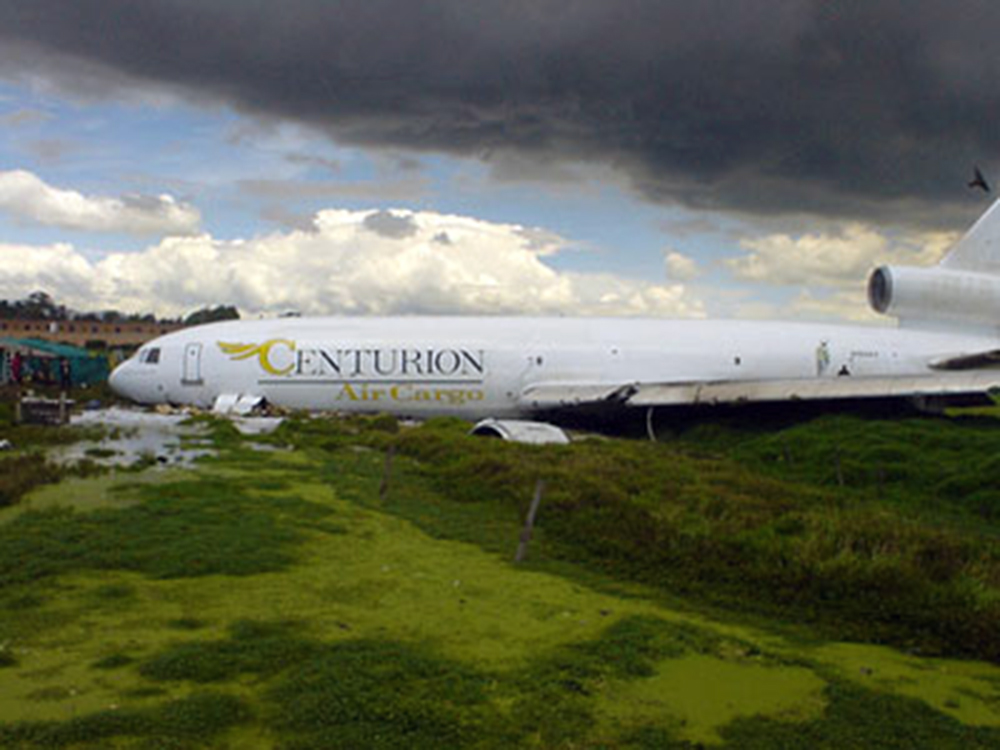
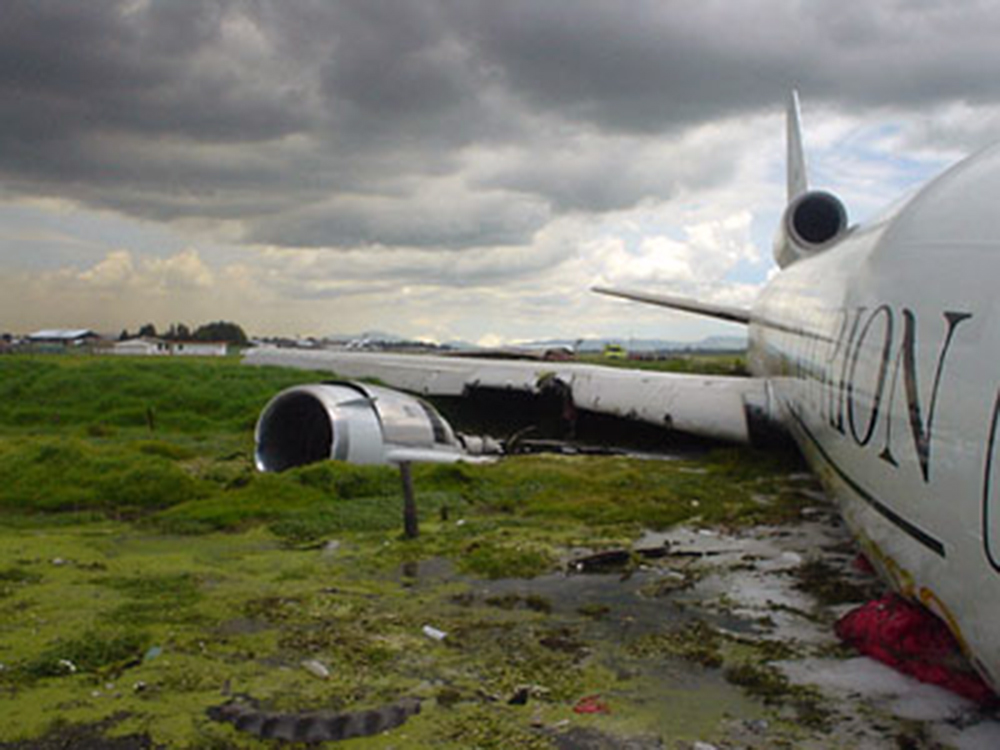
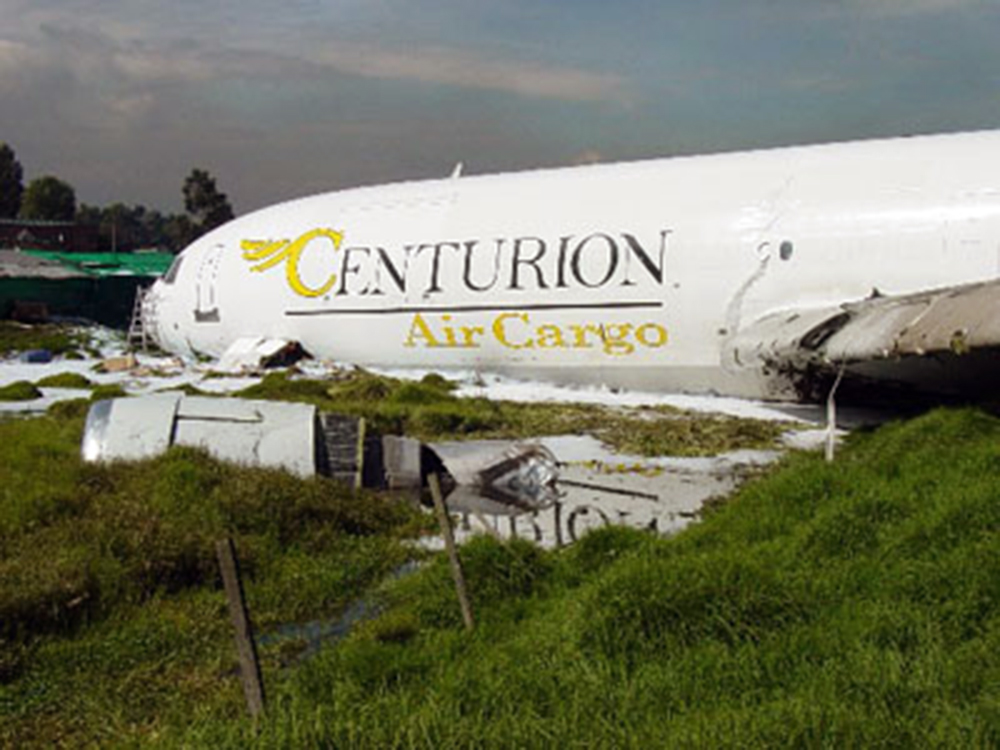
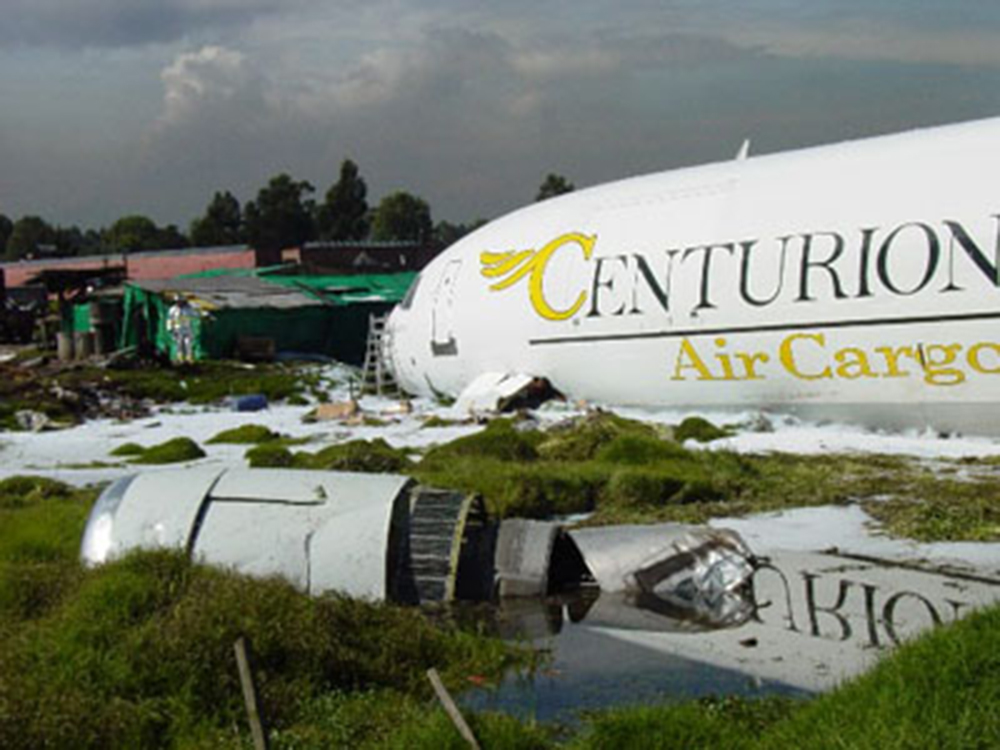
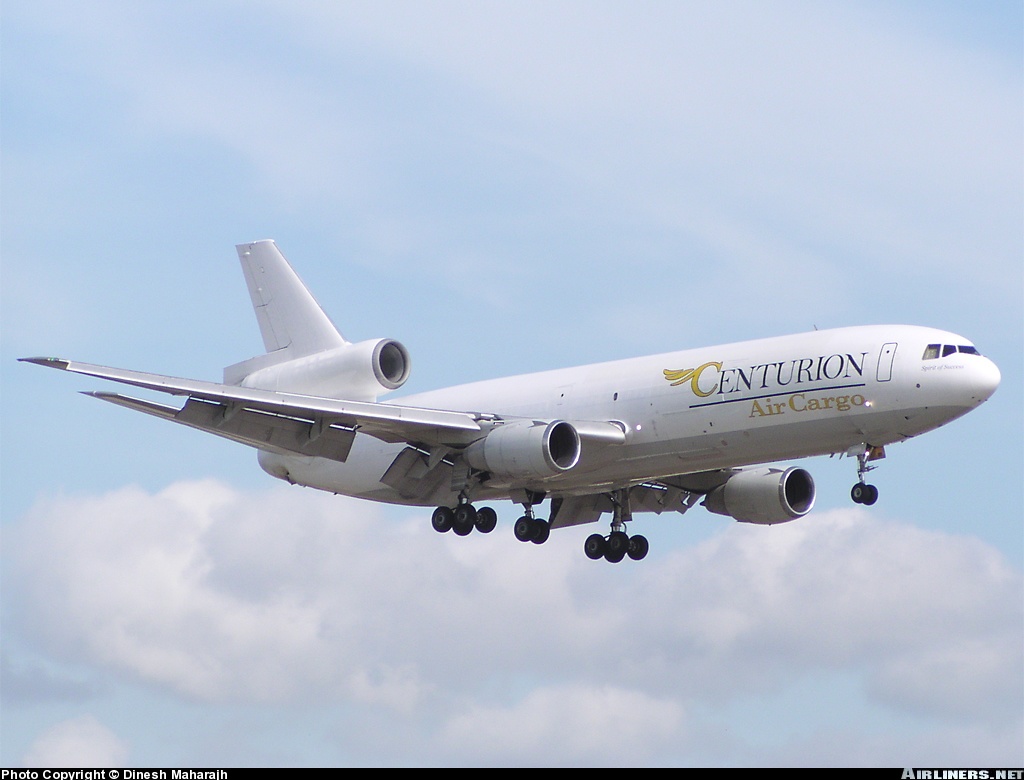
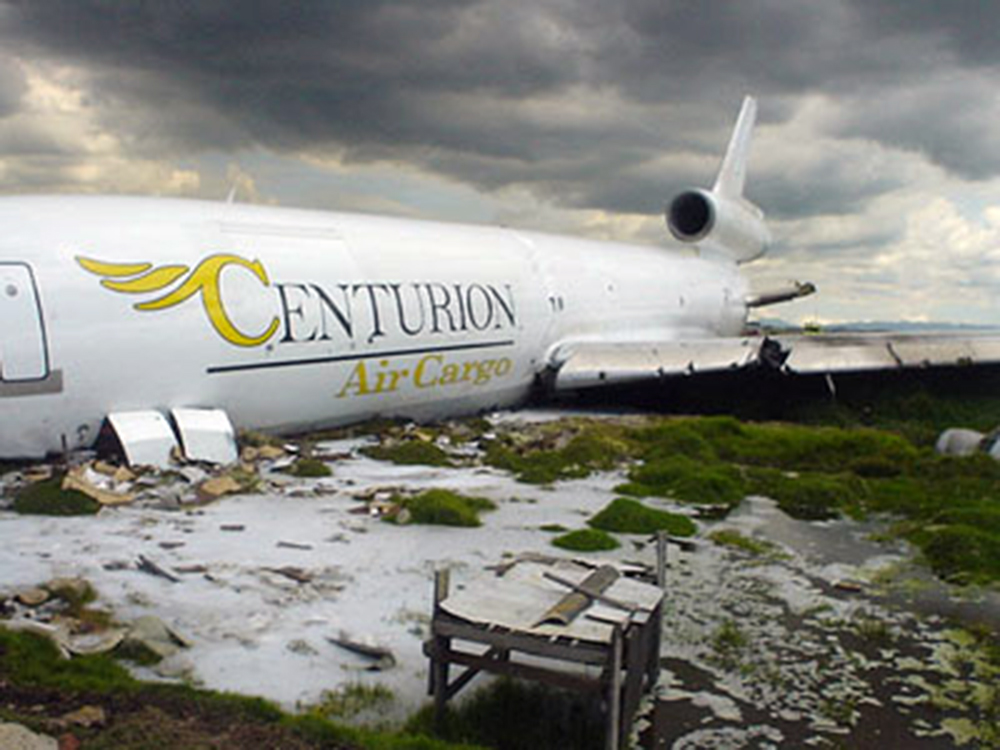
Crash of a Douglas DC-10-30F in Bogotá

Date & Time: Apr 28, 2004 at 0356 LT
Type of aircraft:
Operator:
Registration:
N189AX
Flight Type:
Survivors:
Yes
Schedule:
Miami – Bogotá
MSN:
48277
YOM:
1981
Country:
Crew on board:
3
Crew fatalities:
Pax on board:
0
Pax fatalities:
Other fatalities:
Total fatalities:
0
Aircraft flight hours:
77864
Aircraft flight cycles:
12224
Circumstances:
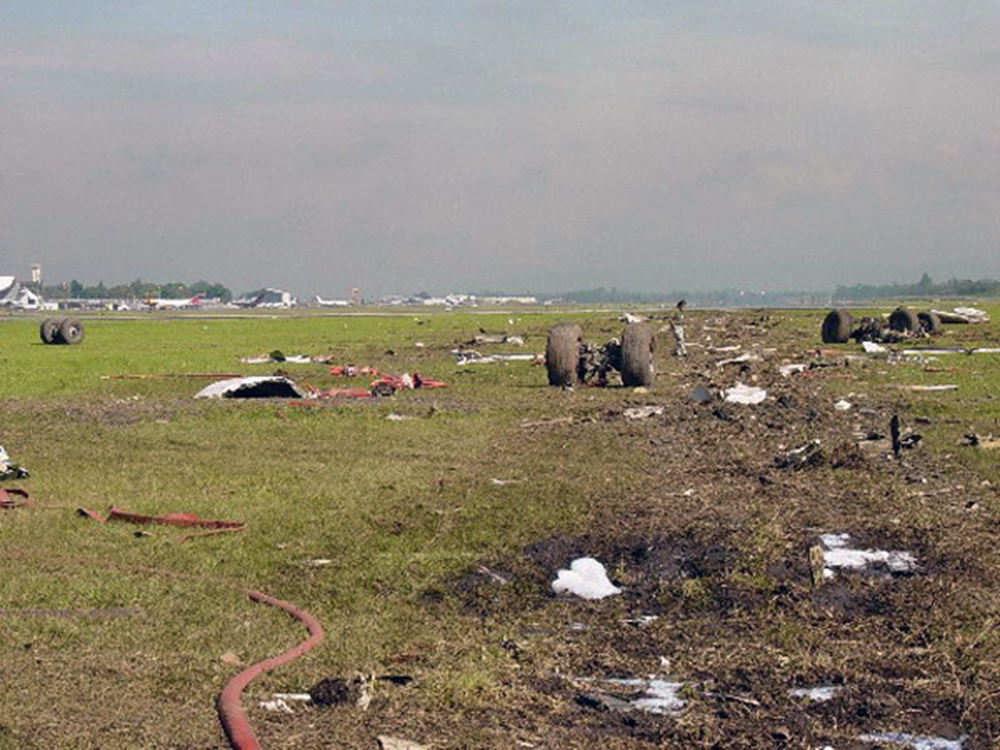
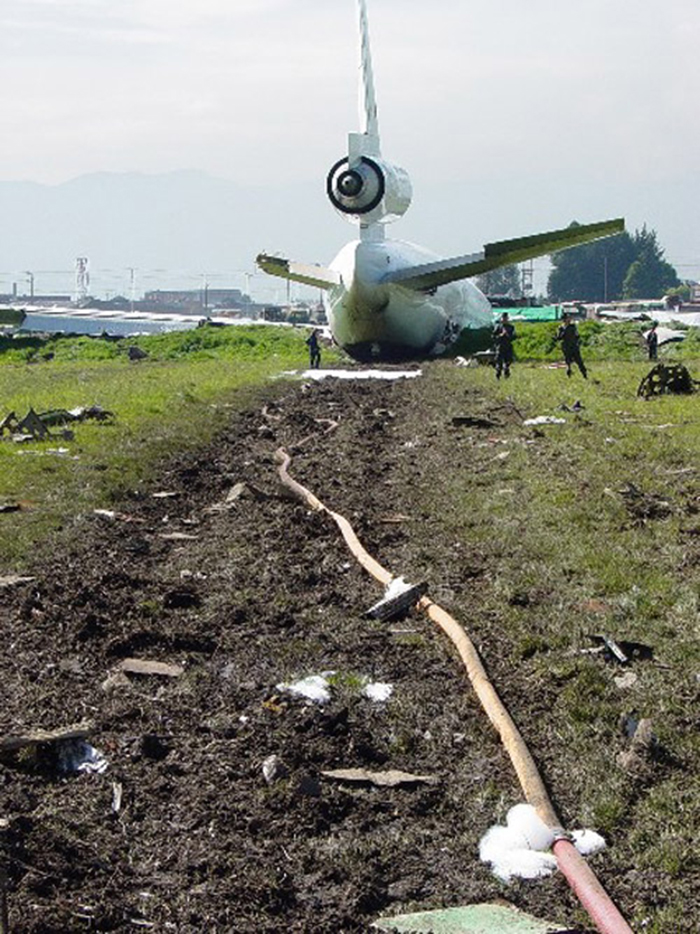
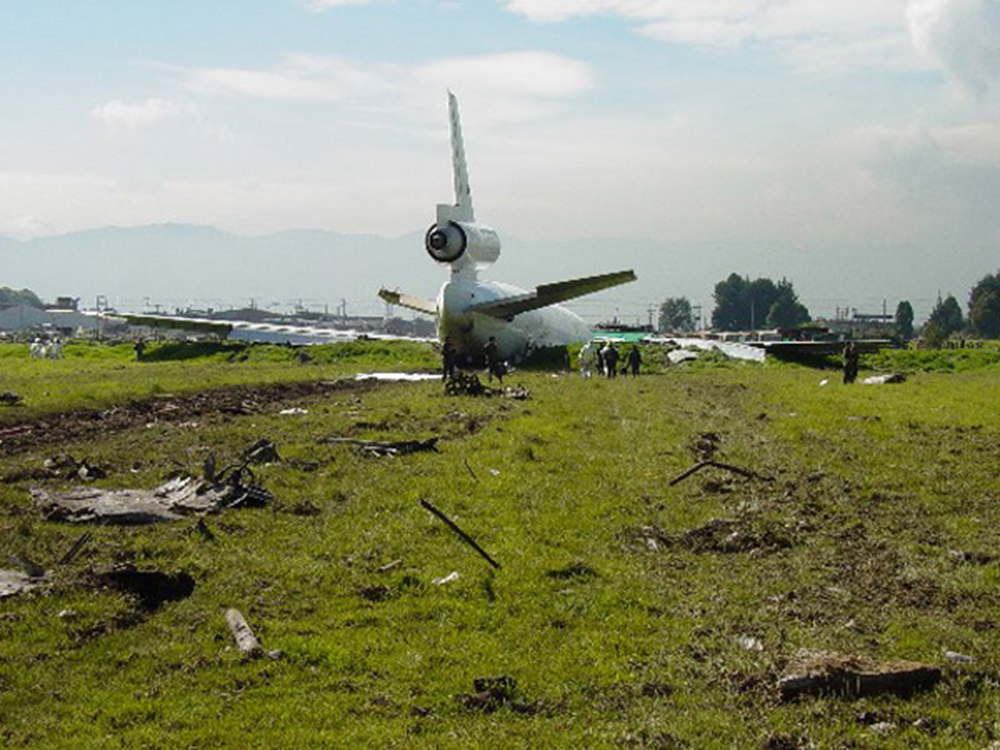
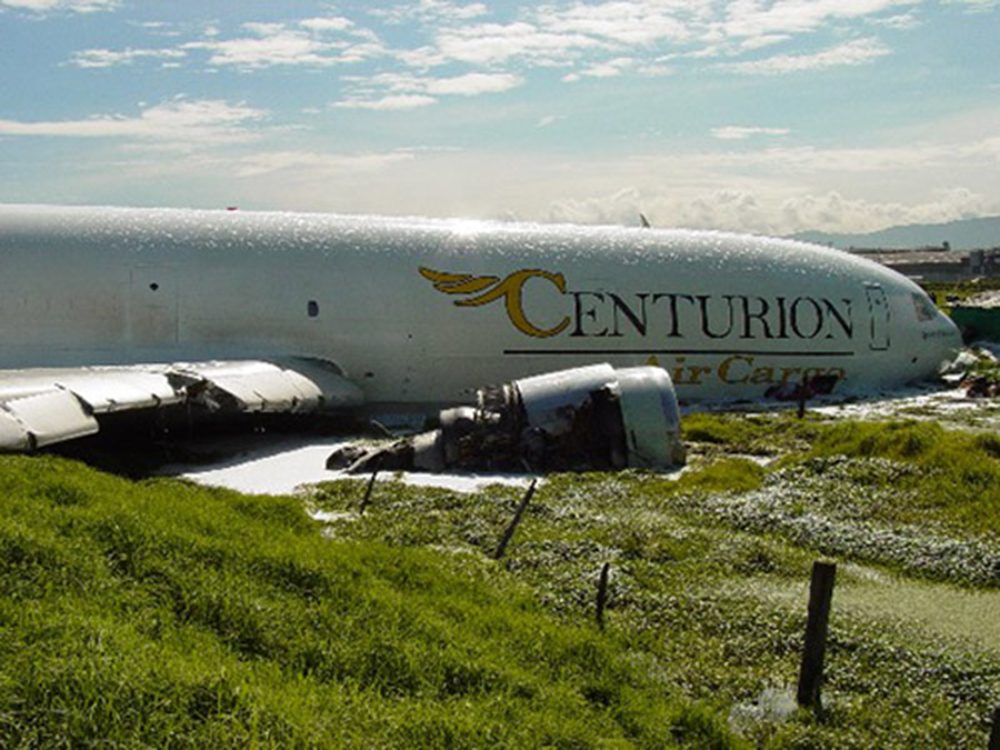
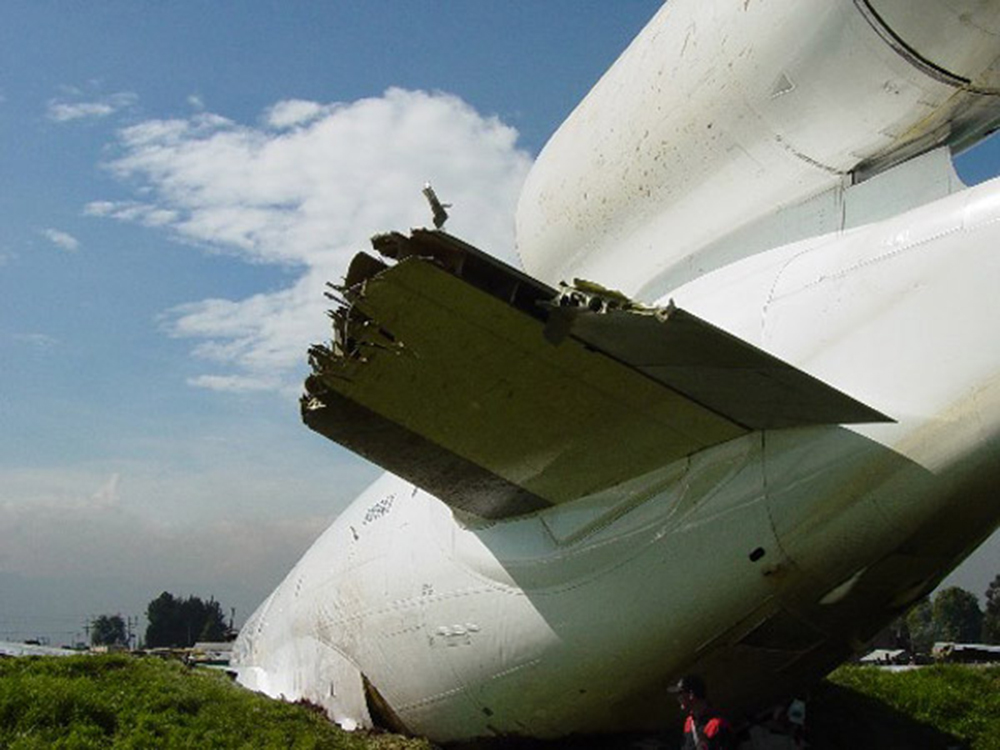
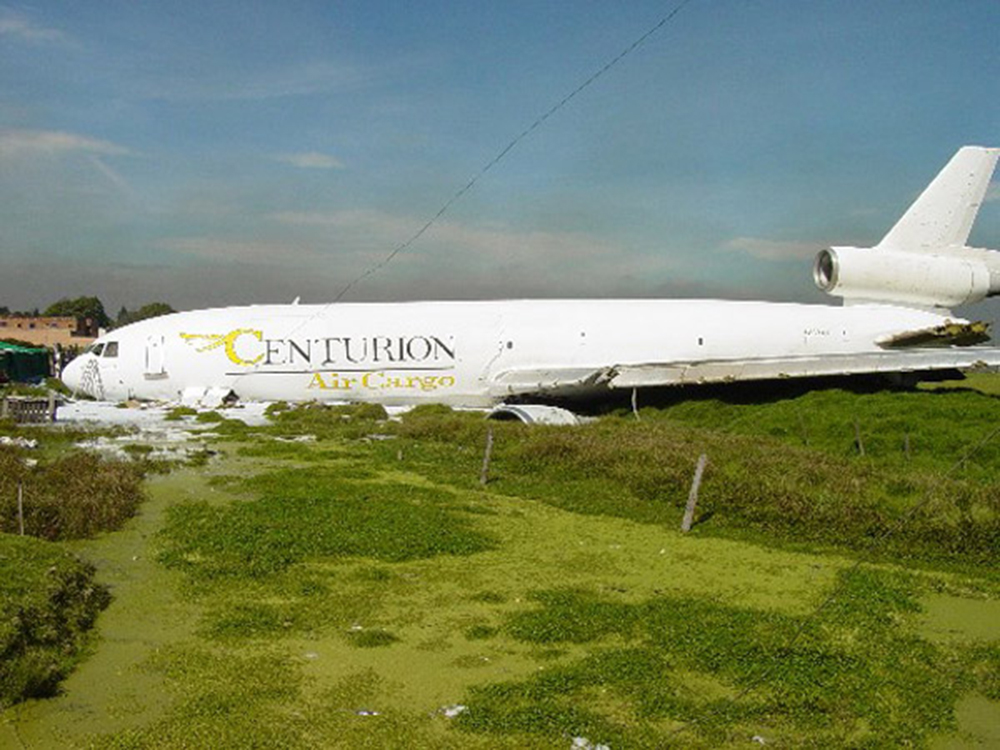
Following an uneventful cargo flight from Miami-Intl Airport on behalf of Lineas Aéreas Suramericanas, the crew started a night approach to Bogotá-El Dorado Airport. On final, the aircraft was unstable and too low when the GPWS alarm sounded five times. The captain increased engine power and elected to gain height, causing the aircraft to continue over the glide. At an excessive speed of 180 knots, the aircraft landed 1,500 feet past the runway 13L threshold (runway 13L is 3,800 metres long). After touchdown, the crew started the braking procedure but unable to stop within the remaining distance, the aircraft overran. It lost its undercarriage, collided with the ILS equipment, lost both engines n°1 and 3 and eventually came to rest few hundred metres further in a grassy area. All three crew members escaped uninjured while the aircraft was damaged beyond repair.
Probable cause:
Departure from runway 13 left the El Dorado airport as a result of a landing with a speed of 180 knots and 1500 feet from the threshold, during which the spoilers were not used and in which there was hydroplaning by the main landing gear making the braking action less than expected. The decision of the crew to continue the approach despite the fact that this was not stabilized in accordance with the criteria described in the manual of operations of the airline. The omission of points in the checklist and call out from the crew that resulted in a lower alert situation facing the parameters of the approach and monitoring the operation of key systems such as the extension of spoilers after the landing. The non-response to the ground proximity warning system that is sounded for at least five times during the final approach in two different modes.
Ground accident of a McDonnell Douglas MD-82 in Trieste

Date & Time: Apr 20, 2004 at 1038 LT
Type of aircraft:
Operator:
Registration:
I-DAWR
Survivors:
Yes
Schedule:
Rome – Trieste
MSN:
49208/1190
YOM:
1985
Flight number:
AZ1357
Country:
Region:
Crew on board:
4
Crew fatalities:
Pax on board:
92
Pax fatalities:
Other fatalities:
Total fatalities:
0
Captain / Total flying hours:
7988
Captain / Total hours on type:
3800.00
Copilot / Total flying hours:
5724
Aircraft flight hours:
41745
Aircraft flight cycles:
34235
Circumstances:
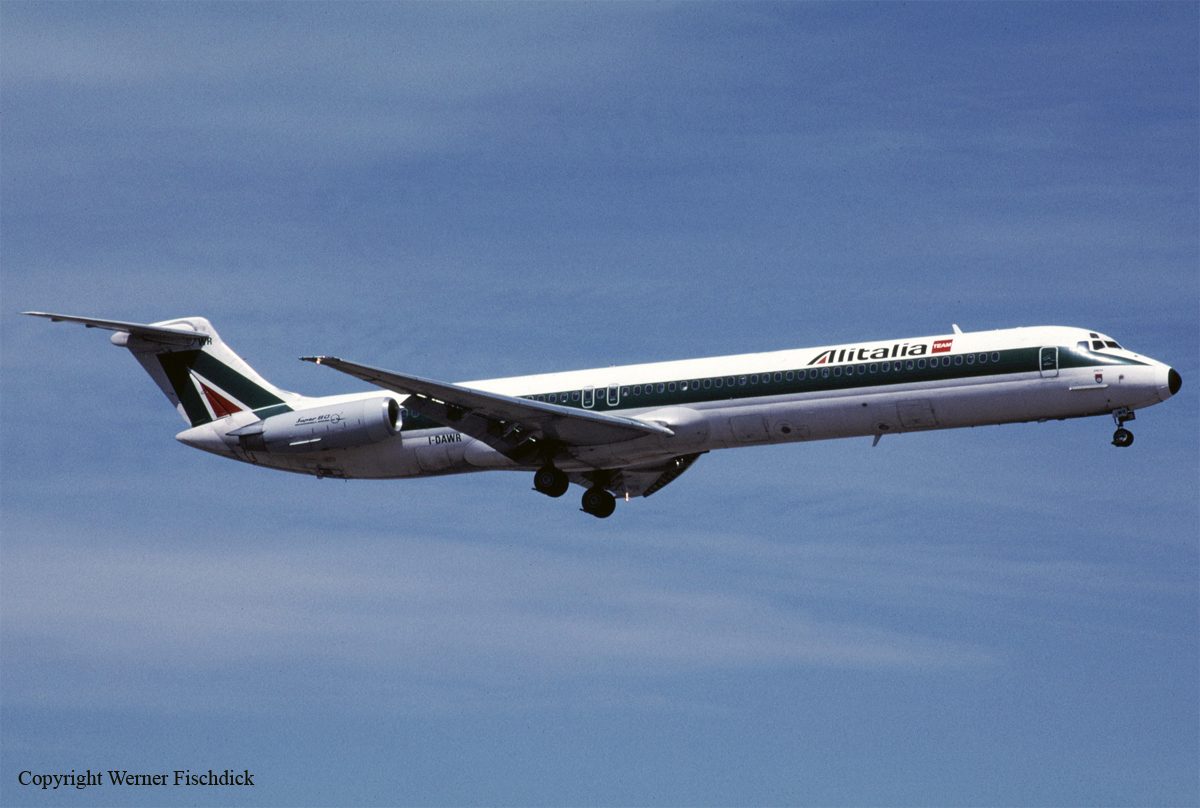
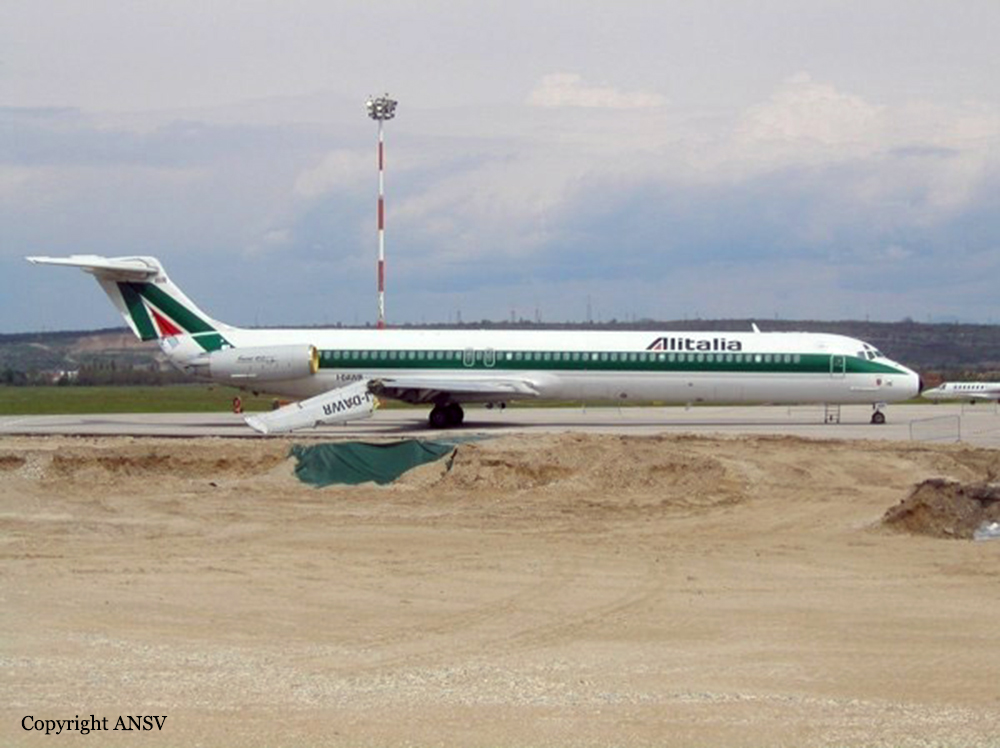
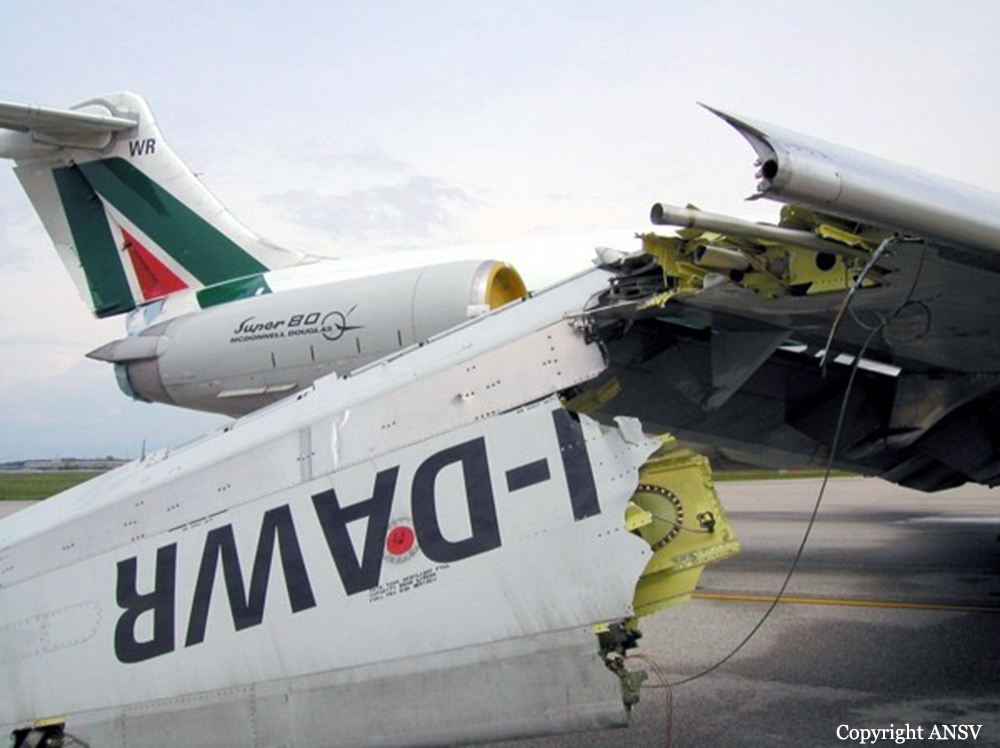
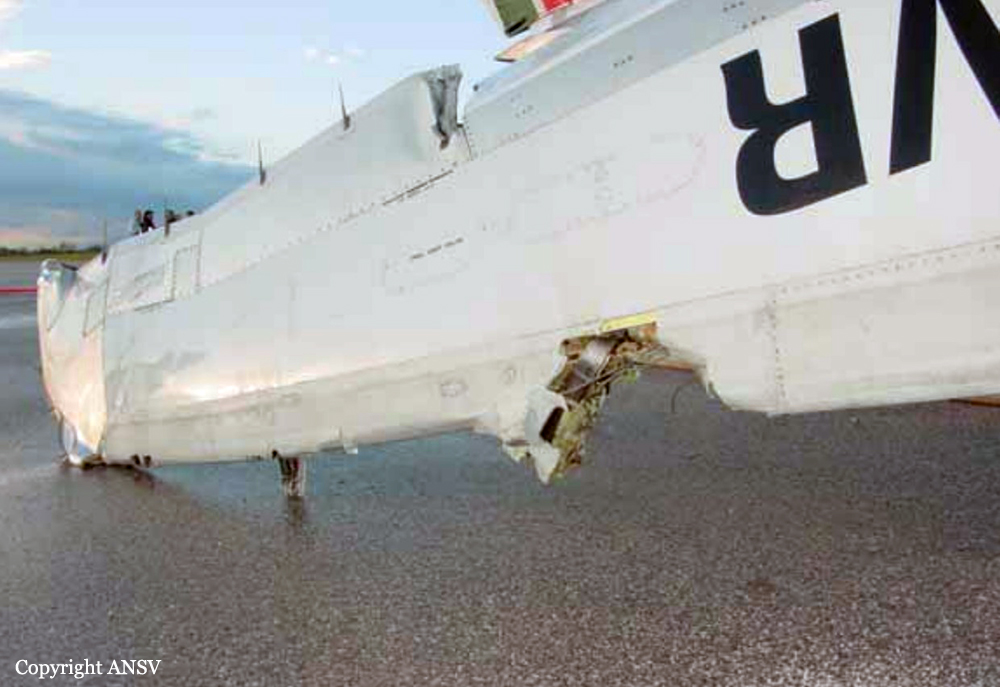
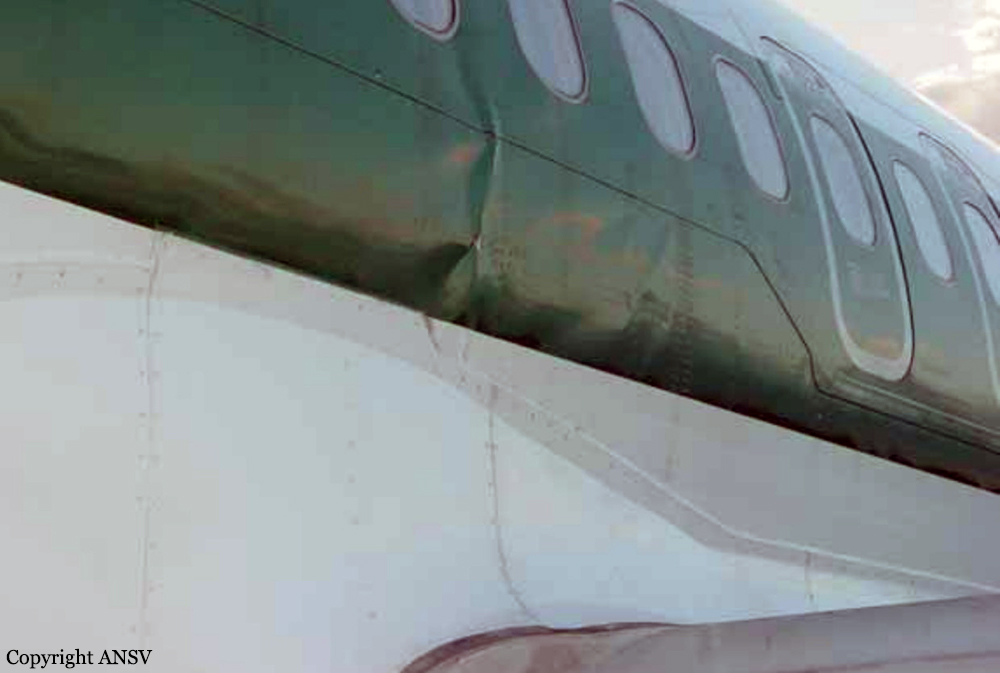
Following an uneventful flight from Rome-Ciampino Airport and a normal landing at Trieste-Ronchi dei Legionari Airport runway 09, the crew vacated the runway and continued via taxiway Bravo to the apron. The copilot was the pilot-in-command and he was facing sun while approaching the ramp. At the last moment, the captain noticed a dump truck on the right side of the taxiway. He took over controls and elected to turn to the left but the aircraft collided with the truck. The outer part of the right wing was torn off for about 3,5 metres and the fuselage was bent. Also, a fuel tank ruptured, causing a spill on the taxiway. The captain immediately stopped the airplane and all 96 occupants evacuated safely. It appeared that construction works were in progress near the taxiway Bravo. A Notam was not issued about this and the tower controller had not informed the crew either.
Probable cause:
The analysis of the technical, operational and organizational context in which the event took place (impact of the end of the right wing of the aircraft, during taxiing, against the rear body of a truck that was parked for work within the protection area of the taxiway that leads from the Bravo connection to the parking area) has allowed to determine the following causes, which are attributable to human and environmental factors.
- Failure to close the Bravo taxiway with the issue of the relative NOTAM of the works in progress.
- Failure of the Torre control to provide the pilots with essential information on the condition of the airport, as provided for by ICAO in ICAO Doc. 4444 PANS-ATM.
- Vertical and horizontal ground signs do not correspond to those specified in ICAO Annex 14.
- Failure to comply with the ENAC circular (APT-11), applicable for the type of work in progress at the airport.
- Insufficient surveillance of the airport area affected by the works by ENAC and the airport management company Aeroporto FVG.
- Lack of an airport Safety Management System .
- Inadequate surveillance of the external space during taxiing by the flight crew, resulting in incorrect assessment of the position of the aircraft with respect to the obstacle.
Final Report:

Crash of a Beechcraft A100 King Air in Chibougamau

Date & Time: Apr 19, 2004 at 1018 LT
Type of aircraft:
Operator:
Registration:
C-FMAI
Survivors:
Yes
Schedule:
Quebec - Chibougamau
MSN:
B-145
YOM:
1973
Country:
Crew on board:
2
Crew fatalities:
Pax on board:
3
Pax fatalities:
Other fatalities:
Total fatalities:
0
Captain / Total flying hours:
11338
Captain / Total hours on type:
2600.00
Copilot / Total flying hours:
1176
Copilot / Total hours on type:
400
Circumstances:
The Beechcraft A100, registration C-FMAI, operated by Myrand Aviation Inc., was on a chartered instrument flight rules flight from QuÈbec/Jean Lesage International Airport, Quebec, to Chibougamau/Chapais Airport, Quebec, with two pilots and three passengers on board. The copilot was at the controls and was flying a non-precision approach for Runway 05. The pilot-in-command took the controls less than one mile from the runway threshold and saw the runway when they were over the threshold. At approximately 1018 eastern daylight time, the wheels touched down approximately 1500 feet from the end of Runway 05. The pilot-in-command realized that the remaining landing distance was insufficient. He told the co-pilot to retract the flaps and applied full power, but did not reveal his intentions. The co-pilot cut power, selected reverse pitch and applied full braking. The aircraft continued rolling through the runway end, sank into the gravel and snow, and stopped abruptly about 500 feet past the runway end. The aircraft was severely damaged. None of the occupants were injured.
Probable cause:
Findings as to Causes and Contributing Factors:
1. The aircraft was positioned over the runway threshold at an altitude that did not allow a landing at the beginning of the runway, and this, combined with a tailwind component and the wet runway surface, resulted in a runway excursion.
2. Failure to follow standard operating procedures and a lack of crew coordination contributed to confusion on landing, which prevented the crew from aborting the landing and executing a missed approach.
3. The pilot-in-command held several management positions within the company and controlled the pilot hiring and dismissal policies. This situation, combined with the level of experience of the co-pilot compared with that of the pilot-in-command, had an impact on crew cohesiveness.
Findings as to Risk:
1. The pilot-in-command of C-FMAI decided to execute an approach for Runway 05 without first ensuring that there would be no possible risk of collision with the other aircraft.
2. The regulatory requirement to conform to or avoid the traffic pattern formed by other aircraft is not explicit as to how the traffic pattern should be avoided, in terms of either altitude or distance, which can result in risks of collision.
3. The regulations do not indicate whether the missed approach segment should be considered part of the traffic pattern; this situation can lead pilots operating in uncontrolled airspace to believe that they are avoiding another aircraft executing an instrument approach when in reality a risk of collision exists.
Final Report:

Crash of a Beechcraft 300 Super King Air in Port Orange

Date & Time: Apr 14, 2004 at 1915 LT
Registration:
N301KS
Flight Type:
Survivors:
Yes
Schedule:
Stuart – Daytona Beach
MSN:
FA-61
YOM:
1985
Crew on board:
1
Crew fatalities:
Pax on board:
1
Pax fatalities:
Other fatalities:
Total fatalities:
0
Captain / Total flying hours:
3495
Captain / Total hours on type:
147.00
Circumstances:
The pilot stated that he initiated a fuel transfer due to a fuel imbalance. To affect the fuel transfer, he said he "began crossfeed right to left." When the airplane was about 5 to 10 miles away from Spruce Creek Airport, the pilot said he began his descent from 12,500, and also executed a left turn to begin setting up to land, when suddenly, both engines ceased operating. When he leveled the wings both engines restarted due to auto-ignition. He said the fuel gages showed 300 to 350 lbs of fuel for the right tank, and 100 to 150 pounds on the left, so he decided to continue his approach to Spruce Creek Airport. As he approached Spruce Creek Airport, he again entered a left bank to prepare for a left base to runway 23, and while established in the left turn, both engines ceased operating a second time. He said he did not think he could reach the runway, and decided to make an landing on a taxiway. When the wings became level after the turn, he said both engines again restarted while in the vicinity of the beginning of the taxiway. As he was about to land, he said a car pulled out onto the taxiway, and stopped on the centerline, so he applied power to avoid the car. He said he climbed straight out, and when he made a climbing left turn, he said the engines ceased operating a third time, and the airplane descended towards a cluster of condos. With no runway or clear area in sight, the pilot said he guided the airplane to a retention pond. Follow-on/detailed examinations of the aircraft, engines, and propellers were conducted by an FAA Inspector, as well as technical representatives from Raytheon Aircraft Company, Pratt & Whitney Canada, and Hartzell Propeller Company, and no pre accident anomalies were noted with the airframe, flight controls, engines/accessories, or propellers. According to the FAA Inspector, and the technical representative from the airplane manufacturer, Raytheon Aircraft Company, the pilot was transferring fuel from the left fuel tank to the right fuel tank, and with the reduced amount of fuel in the left tank, as he performed left turns, the engine ceased operating. The Raytheon Aircraft Company representative stated that the Pilot Operating Handbook specifies the use of crossfeed for those times when the airplane is operating on a single engine.
Probable cause:
The pilot's inadequate management of the airplane's fuel system, which resulted in fuel starvation, a loss of engine power, a forced landing, and damage to the airplane during the landing.
Final Report:

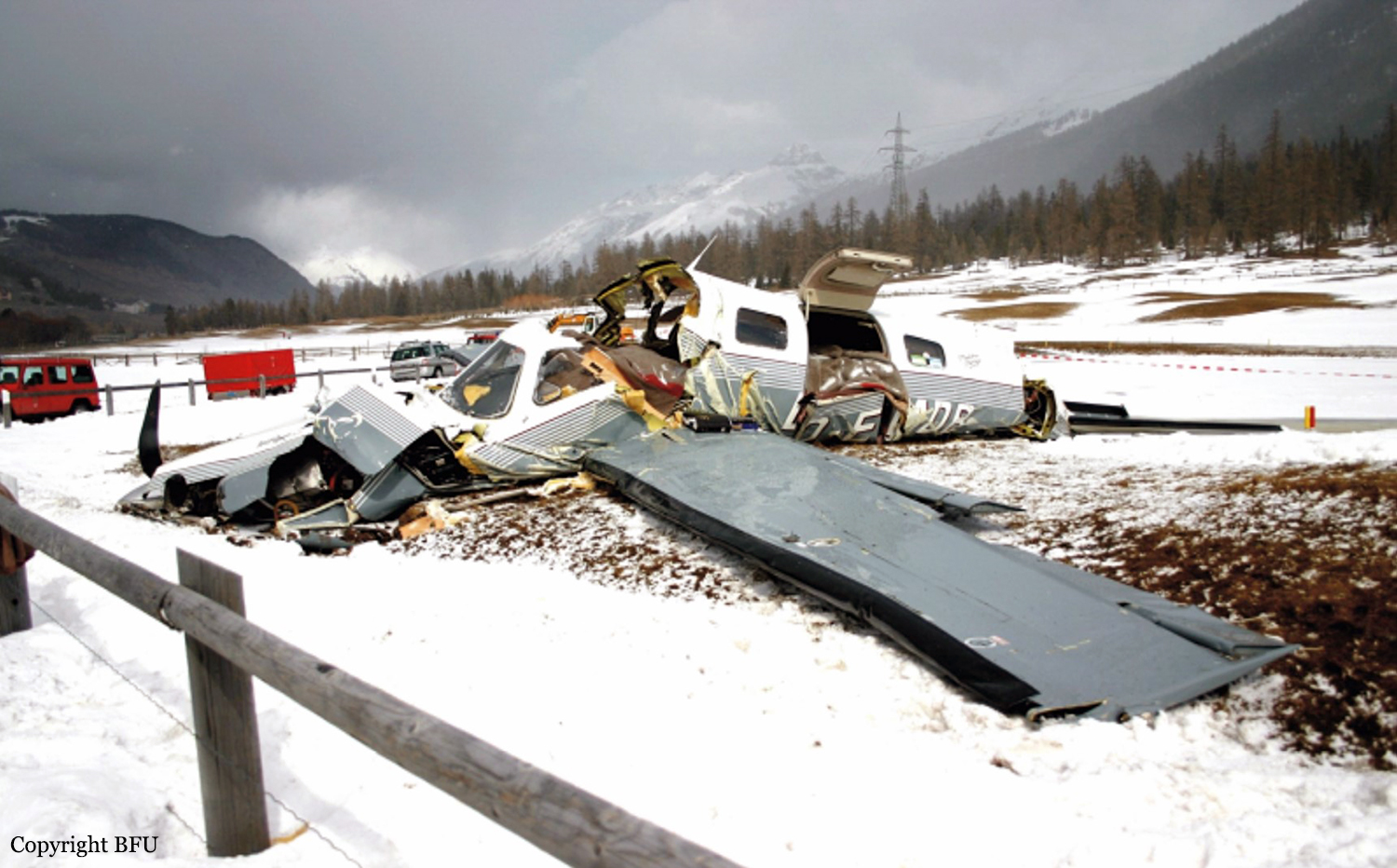
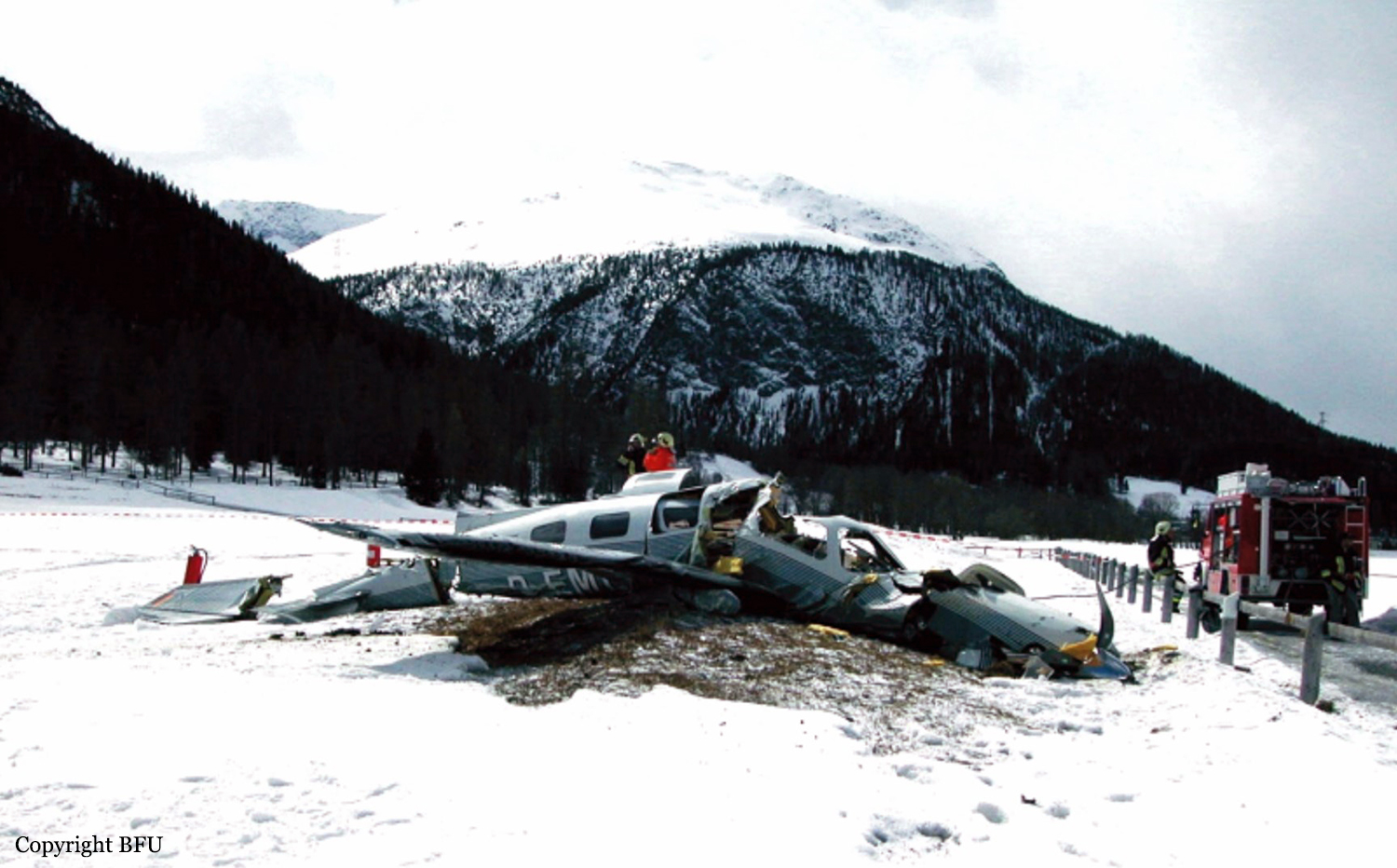
Crash of a Piper PA-46-350P Malibu Mirage in Samedan: 5 killed

Date & Time: Apr 7, 2004 at 1121 LT
Operator:
Registration:
D-EMDB
Flight Type:
Survivors:
No
Schedule:
Egelsbach – Samedan
MSN:
46-22004
YOM:
1988
Country:
Region:
Crew on board:
1
Crew fatalities:
Pax on board:
4
Pax fatalities:
Other fatalities:
Total fatalities:
5
Captain / Total flying hours:
2770
Captain / Total hours on type:
842.00
Aircraft flight hours:
2473
Circumstances:
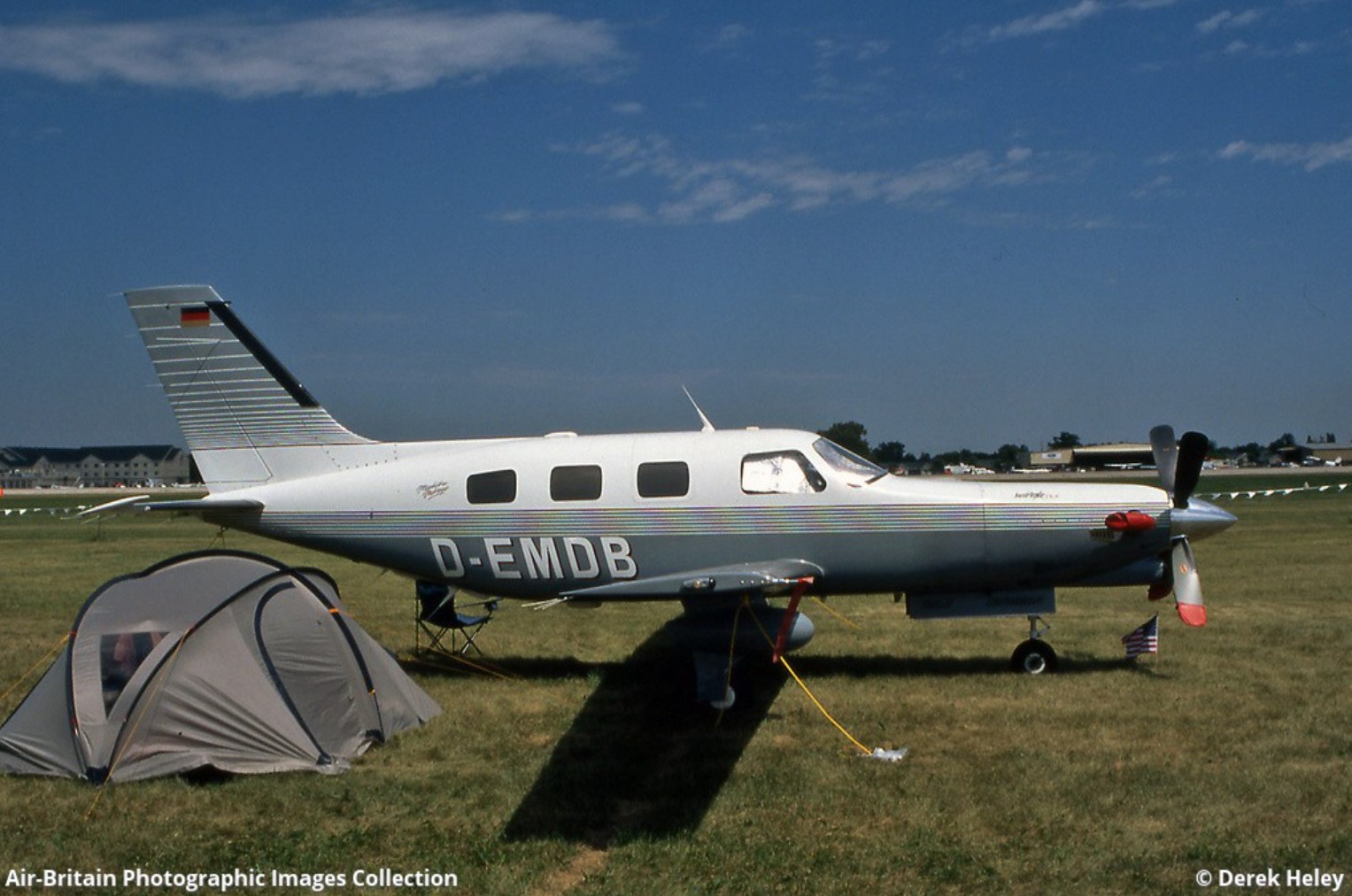
Before the flight involved in the accident, the pilot himself had loaded and prepared the aircraft. According to the statement of the official on duty, neither the pilot nor the passengers were behaving conspicuously. The flight plan envisaged a VFR-IFR-VFR flight from Egelsbach (EDFE), south of Frankfurt, to Samedan (LSZS) in the Engadine. After take-off, the flight was to proceed under VFR (visual flight rules) to the waypoint RID and then to waypoint GERSA under IFR (instrument flight rules). From GERSA it was then planned to continue flying to Samedan under VFR again. The total duration of the flight was indicated in the flight plan as 75 minutes, and the endurance was indicated as 4 hours and 30 minutes. Take-off took place in Egelsbach at 10:09 LT. At 10:37 LT, the pilot contacted Swiss Radar Lower Sector North on frequency 136.150 MHz as follows: “... level two one zero inbound Trasadingen”. He was instructed to continue flying in the direction of GERSA. At 10:45 LT, the pilot contacted Radar Lower Sector South, on frequency 128.050 MHz, and continued flying as far as LUKOM. Based on an instruction from air traffic control, the aircraft left flight level 210 and descended to flight level 170. The pilot was instructed to continue flying direct to Samedan. At 11:10 LT, the pilot changed from instrument flight rules to visual flight rules and signed off from Lower Sector South. He attempted to contact Samedan. Initially, the communication was poor. After several attempts, he made contact at 11:15 LT on the Samedan aerodrome frequency. At 11:18 LT, the pilot reported that he was over the aerodrome and wanted to fly to the east to get below the cloud ceiling. No further radiocommunication took place. Shortly afterwards, witnesses saw the aircraft fall out of the clouds in an uncontrolled attitude. The aircraft crashed into the ground in a flat spin and with practically no forward motion. The aircraft was destroyed and all five occupants were killed.
Probable cause:
The accident is attributable to the fact that during an attempt to get below the clouds for the approach to Samedan, control of the aircraft was lost and it crashed into the ground. Exceeding the maximum permissible mass and the tail-heavy condition of the aircraft may have contributed to the accident.
The following factors were identified:
• On take-off, an endurance of 4½ hours was specified. Recalculation produced an actual take-off mass which was 722 lb over the MTOM.
• At the time of the accident, the mass of the aircraft was still 425 lb above the maximum take-off mass.
• The aircraft was loaded tail-heavy.
• The aircraft impacted the ground in a spin.
• There was partial cloud cover, though somewhat clearer to the east. Cloud conditions were changing relatively quickly.
• Visibility in Samedan below the clouds was good.
Final Report:

Crash of a Piper PA-61p Aerostar (Ted Smith 601P) in Johns Island: 2 killed

Date & Time: Apr 5, 2004 at 1526 LT
Operator:
Registration:
N869CC
Flight Phase:
Flight Type:
Survivors:
No
Schedule:
Johns Island - Charleston
MSN:
61-0235-035
YOM:
1975
Crew on board:
1
Crew fatalities:
Pax on board:
1
Pax fatalities:
Other fatalities:
Total fatalities:
2
Captain / Total flying hours:
2007
Captain / Total hours on type:
35.00
Aircraft flight hours:
3805
Circumstances:
A witness at a nearby maintenance facility stated the pilot telephoned him and told him that, during engine start, one engine sputtered and abruptly stopped. The witness stated the pilot told him he wanted to fly the airplane over to have the problem looked at. A witness, who was an airline transport-rated corporate pilot, observed the airplane on takeoff roll and stated the airplane rotated "really late," using approximately 4,000 feet of runway. He stated the airplane climbed to about 400 or 500 feet, then descended in a left spin into the trees. The airplane collided with the ground and caught fire. Examination of the right engine revealed external fire damage and no evidence of mechanical malfunction. Examination of the left engine revealed external fire damage. Disassembly examination of the left engine revealed the rear side of the No. 5 piston from top to bottom was eroded away with characteristics consistent with detonation. The spark plugs displayed "normal" deposits and wear, except the No. 5 bottom plug was contaminated with a fragment of piston ring material, the No. 5 top plug had a dark sooty appearance, and the nose core of the No. 2 bottom plug was fragmented. Flow bench examination of the left fuel servo revealed no abnormalities. The fuel flow manifold diaphragm was heat-damaged. Flow bench examination of the fuel injector lines and nozzles on a serviceable fuel flow manifold revealed the lines and nozzles were free of obstruction. A review of Emergency Operating Procedures for the Aerostar 601P revealed the following: "Normal procedures do not require operation below the single engine minimum control speed, however, should this condition inadvertently arise and engine failure occur, power on the operating engine should immediately be reduced and the nose lowered to attain a speed above ... the single engine minimum control speed."
Probable cause:
The pilot's failure to maintain airspeed during emergency descent, which resulted in an inadvertent stall/spin and uncontrolled descent into trees and terrain. A factor was the loss of engine power in one engine due to pre-ignition/detonation.
Final Report:

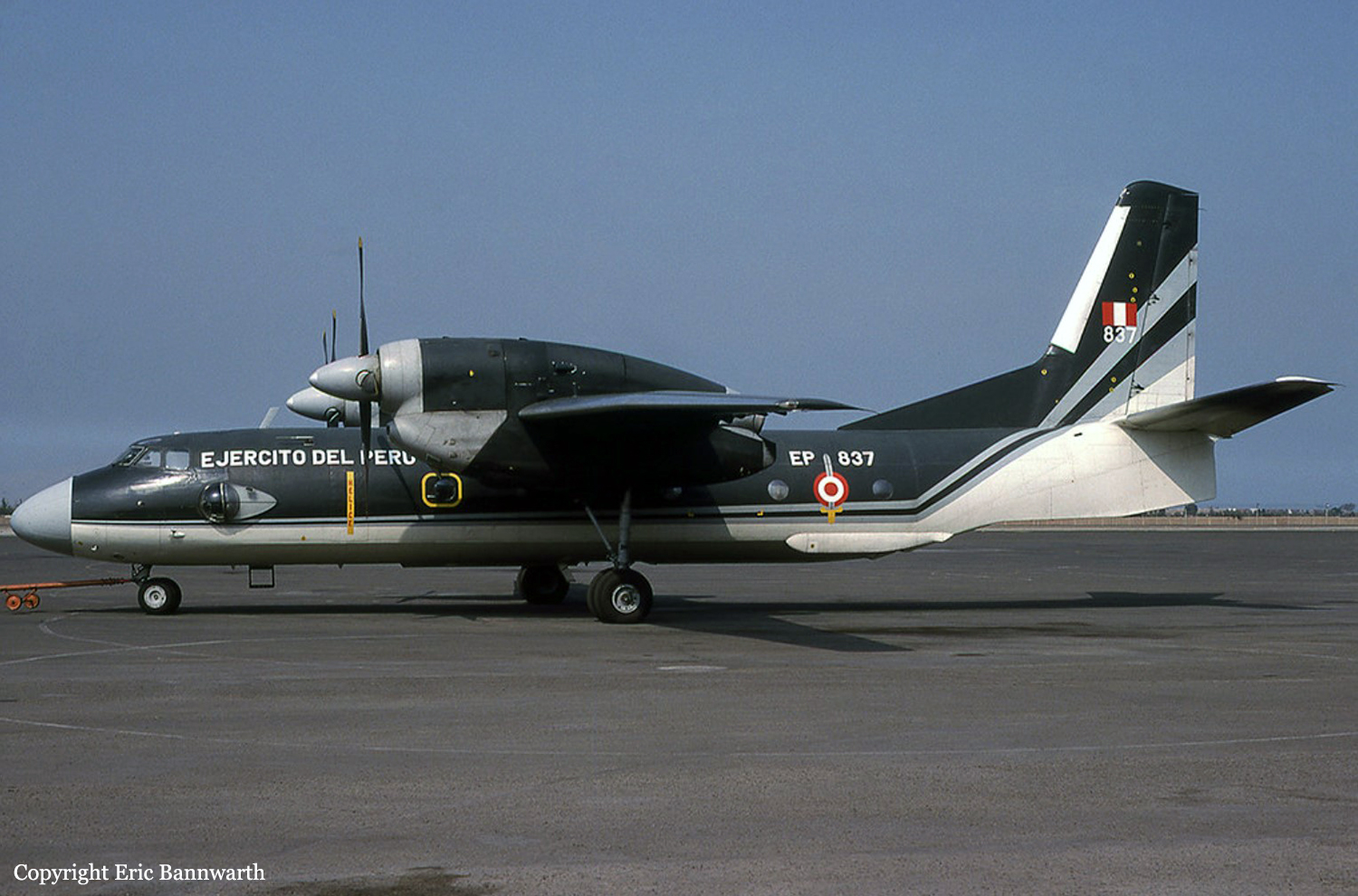
Crash of an Antonov AN-32B in Puerto Esperenza

Date & Time: Apr 4, 2004
Type of aircraft:
Operator:
Registration:
EP-837
Flight Type:
Survivors:
Yes
MSN:
35 06
YOM:
1995
Country:
Crew on board:
0
Crew fatalities:
Pax on board:
0
Pax fatalities:
Other fatalities:
Total fatalities:
0
Circumstances:
For unknown reasons, the aircraft landed hard, causing the undercarriage to be torn off. There were no casualties but the aircraft was damaged beyond repair.

Crash of a Canadair CL-66B Cosmopolitan in Shabunda

Date & Time: Apr 3, 2004
Registration:
3D-ZOE
Flight Type:
Survivors:
Yes
MSN:
CL-66B-6
Region:
Crew on board:
3
Crew fatalities:
Pax on board:
1
Pax fatalities:
Other fatalities:
Total fatalities:
0
Circumstances:
For unknown reasons, the aircraft landed hard at Shabunda Airport. Upon landing, the nose gear collapsed and the airplane came to rest on the runway. Nobody was injured but the airplane was damaged beyond repair.

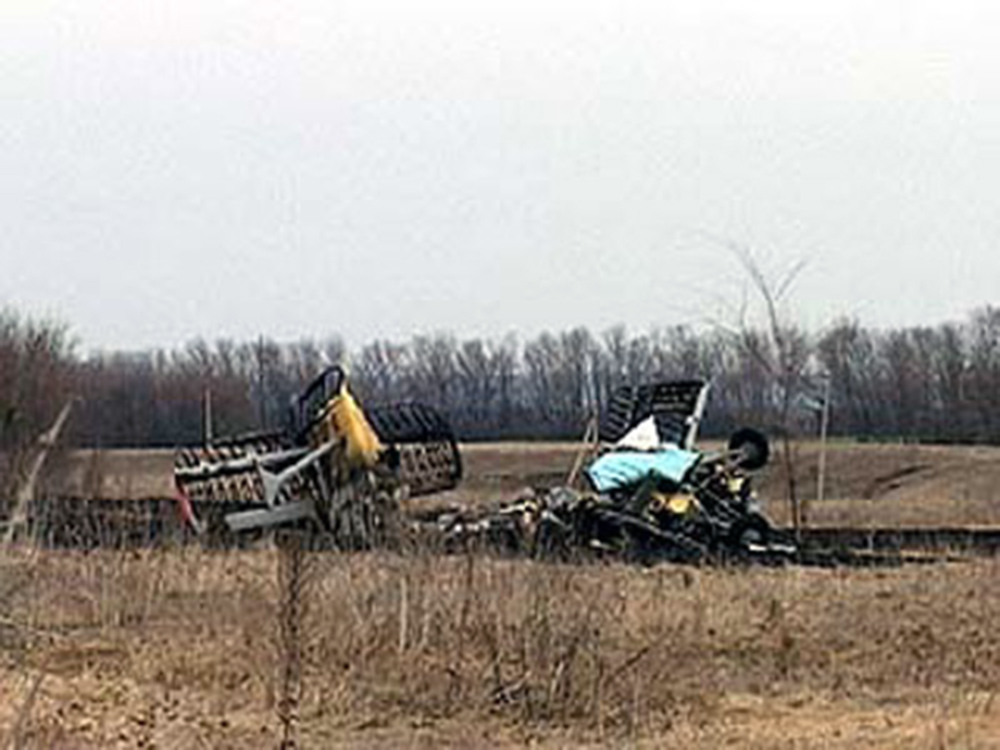
Crash of a PZL-Mielec AN-2R in Pavlovsk: 3 killed

Date & Time: Mar 24, 2004 at 2125 LT
Type of aircraft:
Operator:
Registration:
RA-33596
Survivors:
No
Schedule:
Pavlovsk - Pavlovsk
MSN:
1G230-38
YOM:
1988
Country:
Region:
Crew on board:
2
Crew fatalities:
Pax on board:
1
Pax fatalities:
Other fatalities:
Total fatalities:
3
Circumstances:
The single engine aircraft was dispatched in Pavlovsk with one technician and two pilots for a local crop spraying mission. While on a night approach to Pavlovsk Airfield, the crew failed to realize his altitude was too low. On final, both lower wings collided with trees (10 metres high). The aircraft rolled to the left to an angle of 45° then crashed 390 metres short of runway, bursting into flames. All three occupants were killed.
Probable cause:
It was determined that the crew departed Pavlovsk without prior permission so the flight was considered as illegal. The approach was completed by night to an airport that was not suitable for night operations as it was not equipped with approach and/or runway lights.

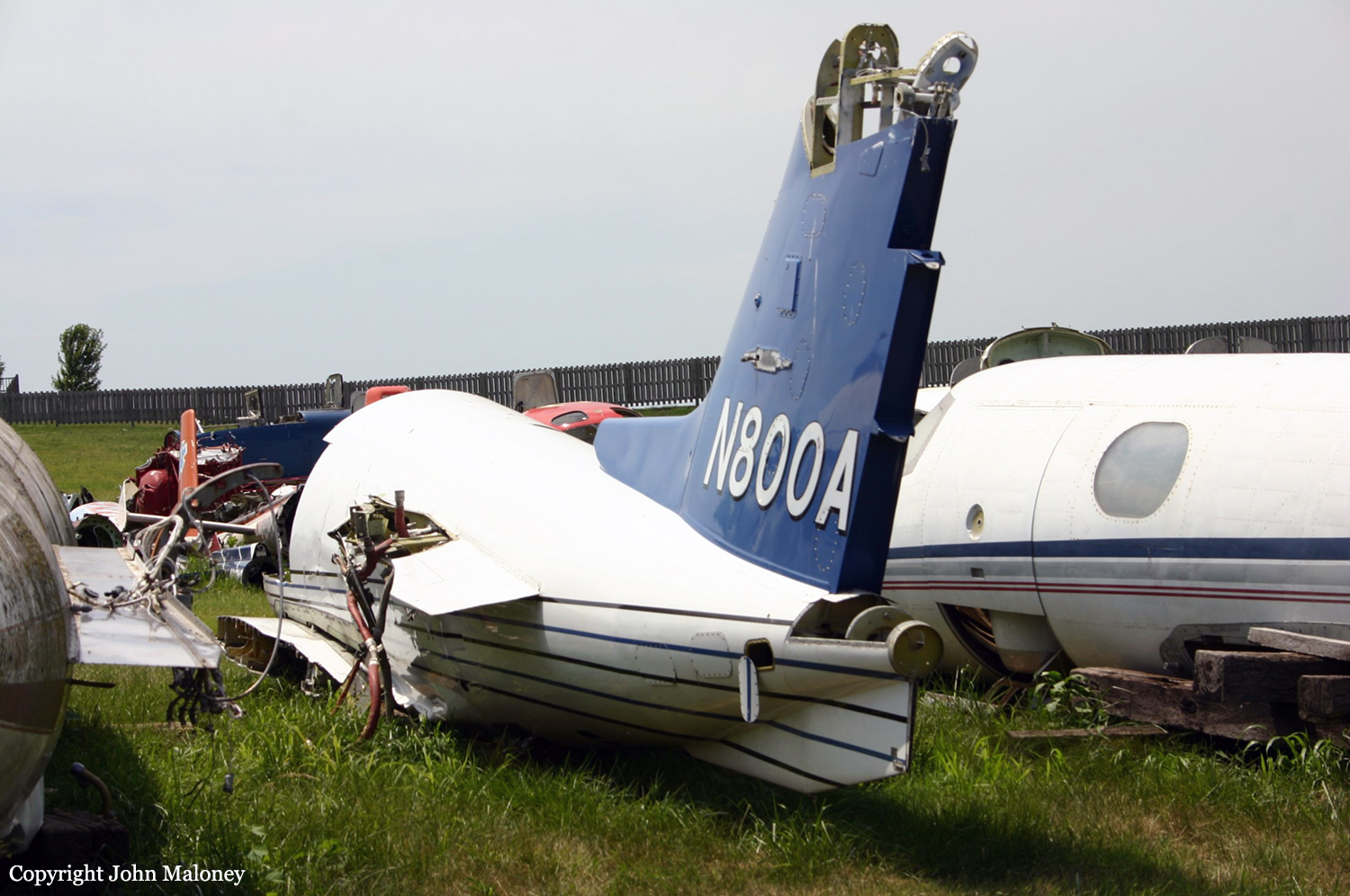
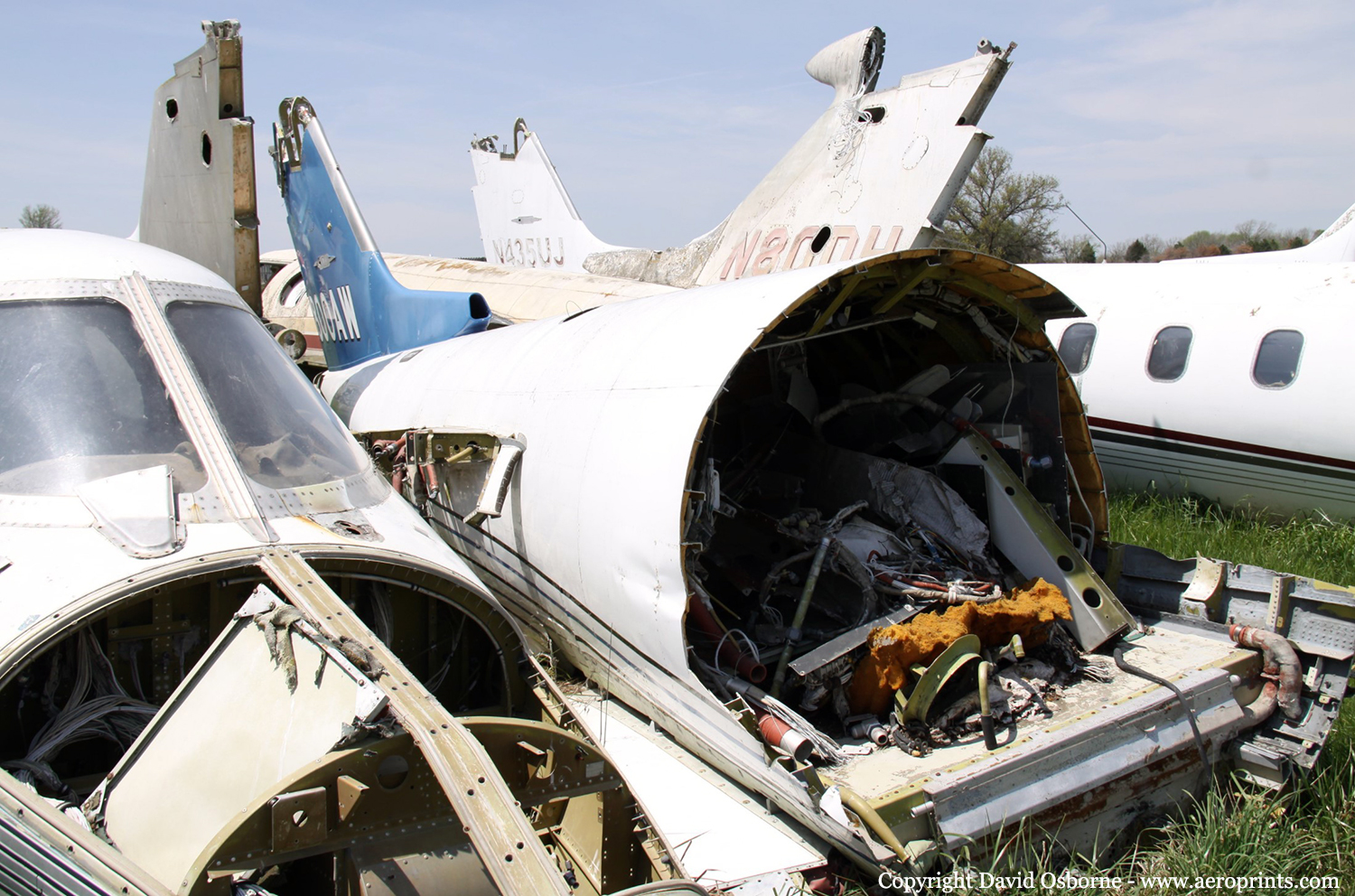
Crash of a Learjet 35A in Utica

Date & Time: Mar 19, 2004 at 0645 LT
Type of aircraft:
Operator:
Registration:
N800AW
Flight Type:
Survivors:
Yes
Schedule:
Columbus - Utica
MSN:
35-149
YOM:
1977
Location:
Crew on board:
2
Crew fatalities:
Pax on board:
0
Pax fatalities:
Other fatalities:
Total fatalities:
0
Captain / Total flying hours:
5903
Captain / Total hours on type:
2036.00
Copilot / Total flying hours:
3956
Copilot / Total hours on type:
504
Aircraft flight hours:
15331
Circumstances:
The copilot was flying an ILS approach at an airspeed of Vref plus 10 knots, and the captain made visual contact with the runway about 350 feet agl. The airplane then drifted high on the glideslope, and the copilot decreased engine power. The sink rate subsequently became too great. By the time the captain called for a go-around, the airspeed had deteriorated, and the stick shaker activated. Although power was applied for the go-around, the airplane impacted the runway in a level attitude before the engines spooled up. The airplane came to rest in snow, about 20 feet off the left side of the runway, near mid-field.
Probable cause:
The copilot's failure to maintain airspeed, and the captain's delayed remedial action, which resulted in an inadvertent stall and the subsequent hard landing.
Final Report: