Crash of a Canadair CL-415 off Les Salles-sur-Verdon: 2 killed

Date & Time: Mar 8, 2004 at 1100 LT
Type of aircraft:
Operator:
Registration:
F-ZBEZ
Flight Type:
Survivors:
Yes
Schedule:
Marseille - Marseille
MSN:
2018
YOM:
1996
Flight number:
Pélican 41
Country:
Region:
Crew on board:
3
Crew fatalities:
Pax on board:
0
Pax fatalities:
Other fatalities:
Total fatalities:
2
Circumstances:
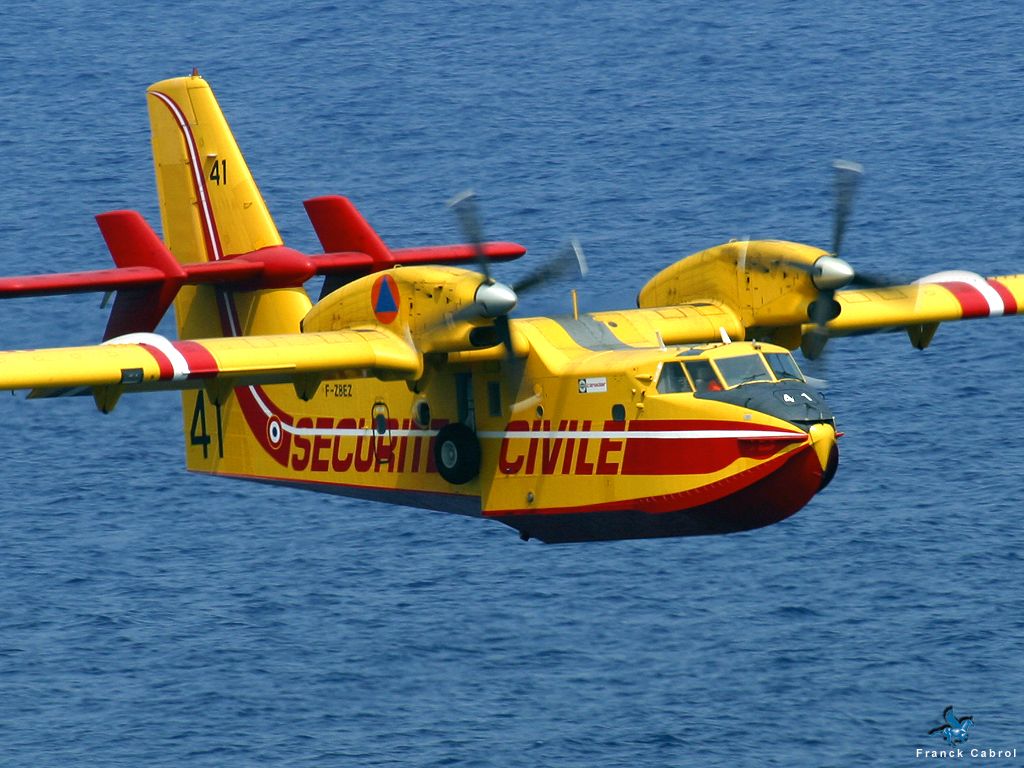
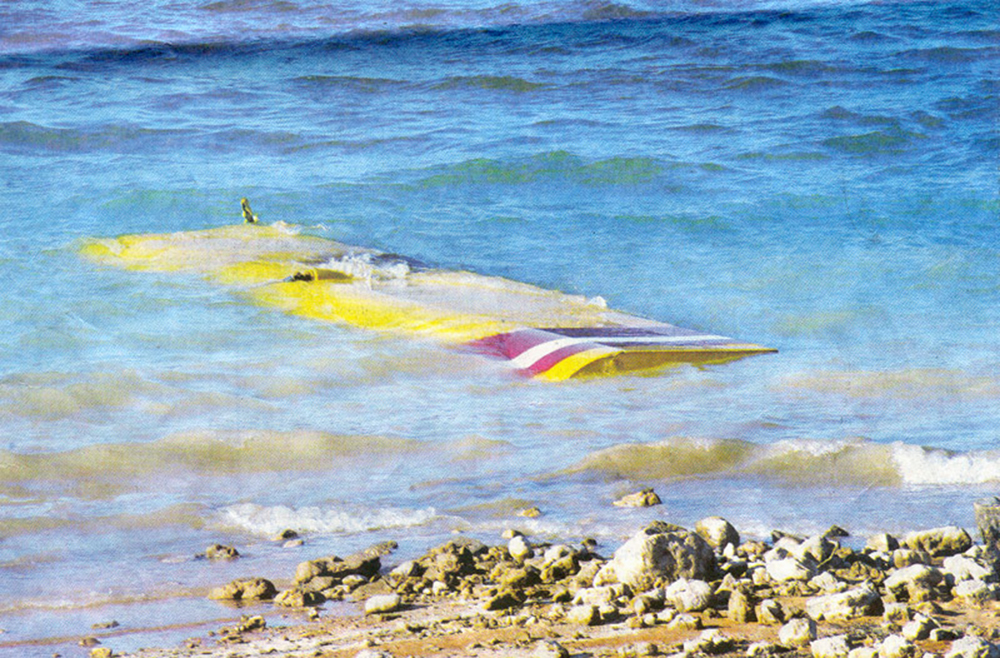
One instructor and two pilots under supervision departed Marseille-Marignane Airport on a training flight. Several scooping manoeuvres were completed on the Sainte-Croix Lake located about 85 km northeast of Marseille. While completing a new scooping procedure, the aircraft approached in a high nose attitude and disintegrated upon landing. The main wreckage sank to a depth of 31 metres off Les Salles-sur-Verdon. One pilot was found alive but seriously injured due to hypothermia (the water temperature was 6° C) while both other occupants, Jean Beauvais and Jean-Pierre Laty, were killed.
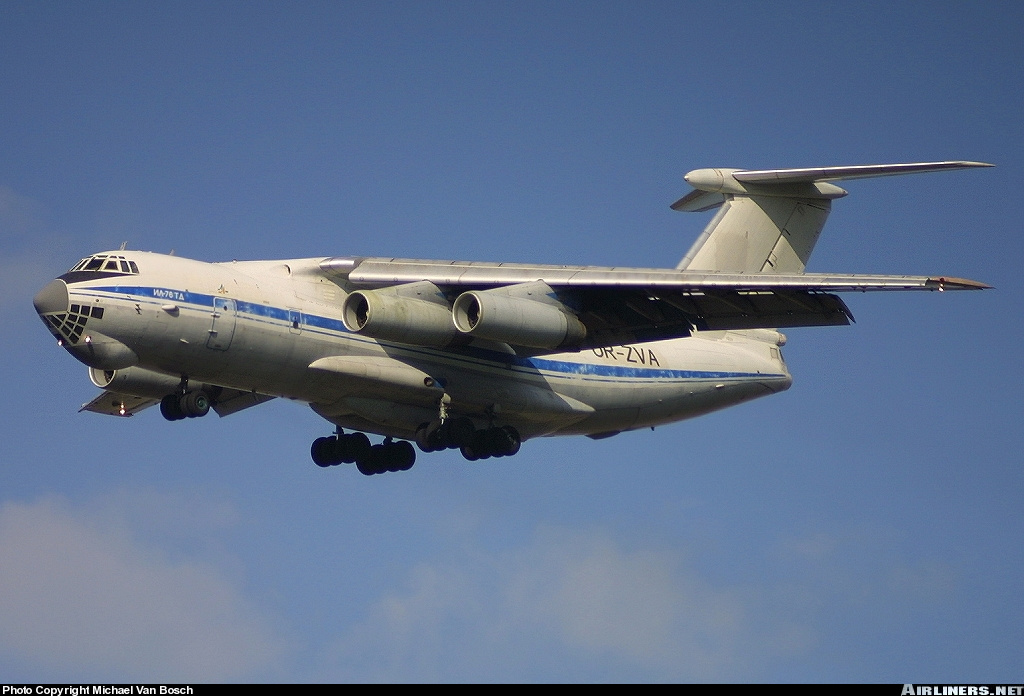
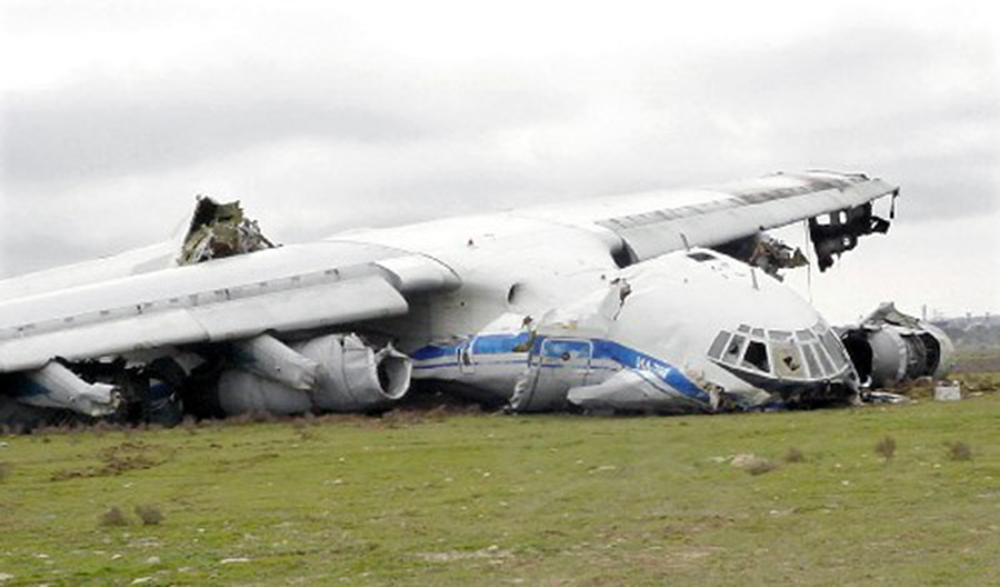
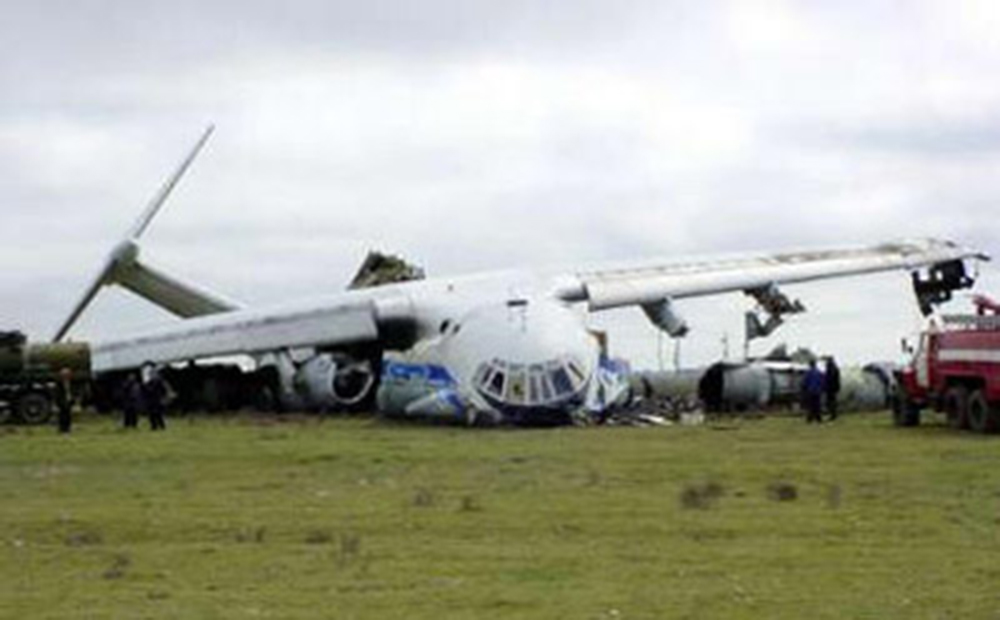
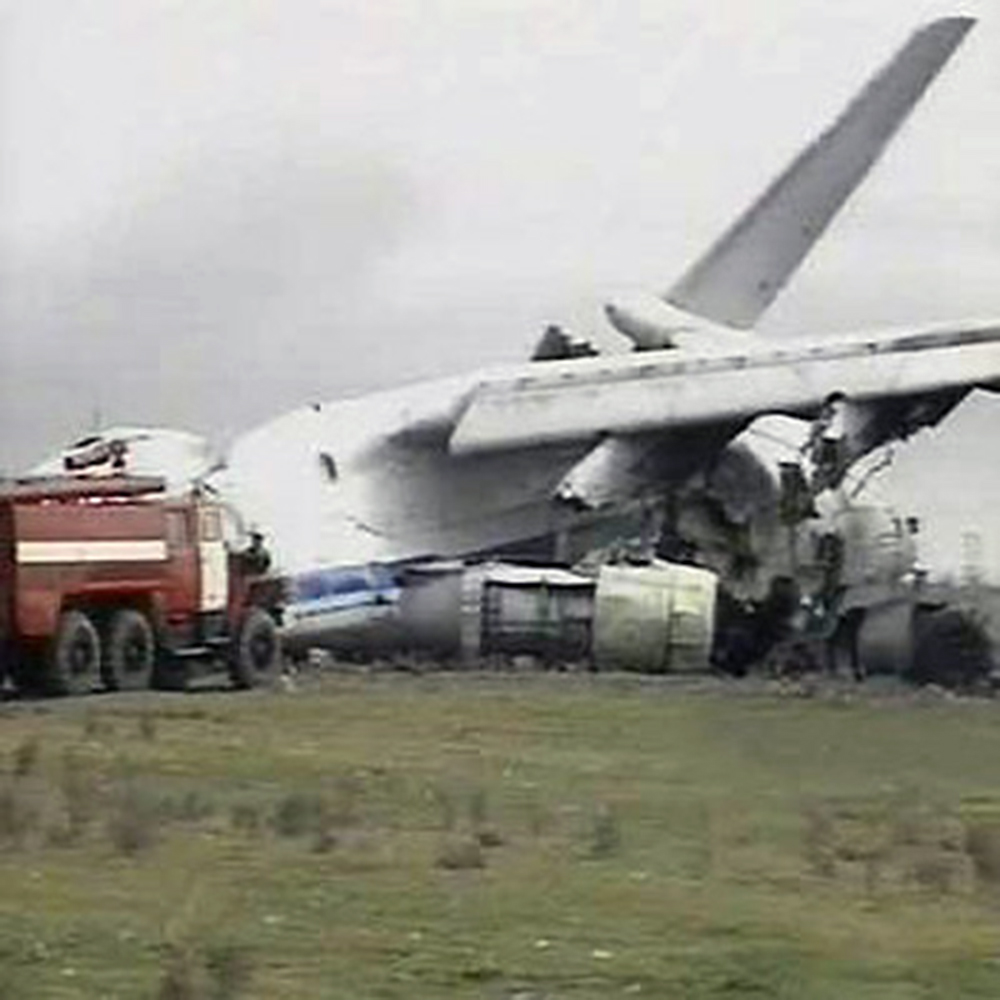
Crash of an Ilyushin II-76MD in Baku: 3 killed

Date & Time: Mar 4, 2004 at 0940 LT
Type of aircraft:
Operator:
Registration:
UR-ZVA
Flight Phase:
Flight Type:
Survivors:
Yes
Schedule:
Ankara – Bakou – Kabul
MSN:
00634 68036
YOM:
1986
Country:
Region:
Crew on board:
7
Crew fatalities:
Pax on board:
0
Pax fatalities:
Other fatalities:
Total fatalities:
3
Circumstances:
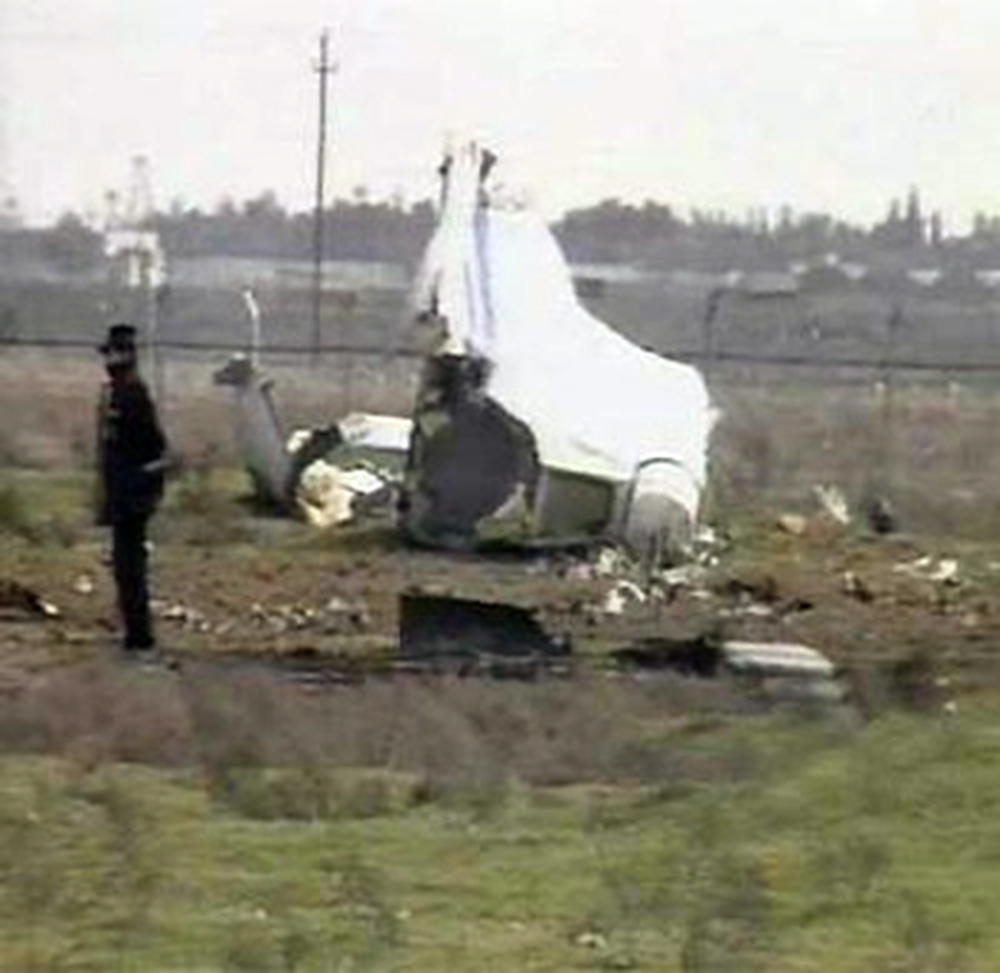
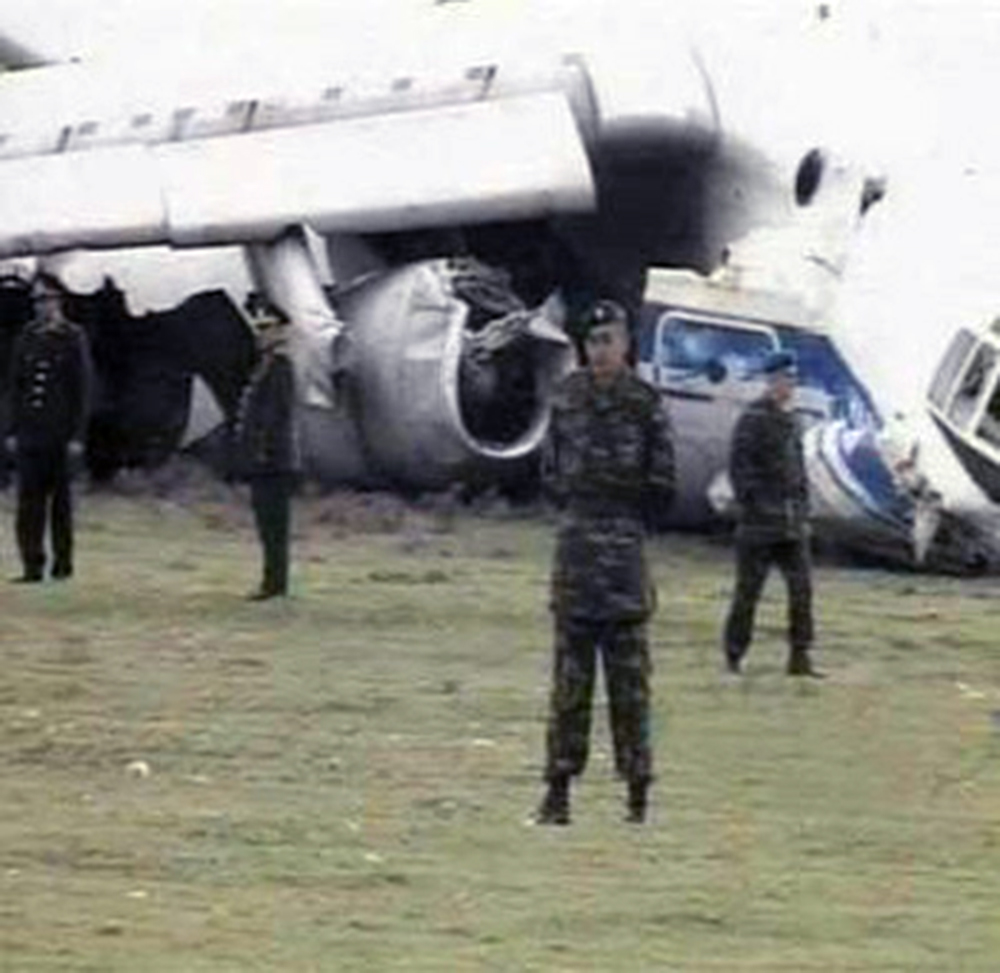
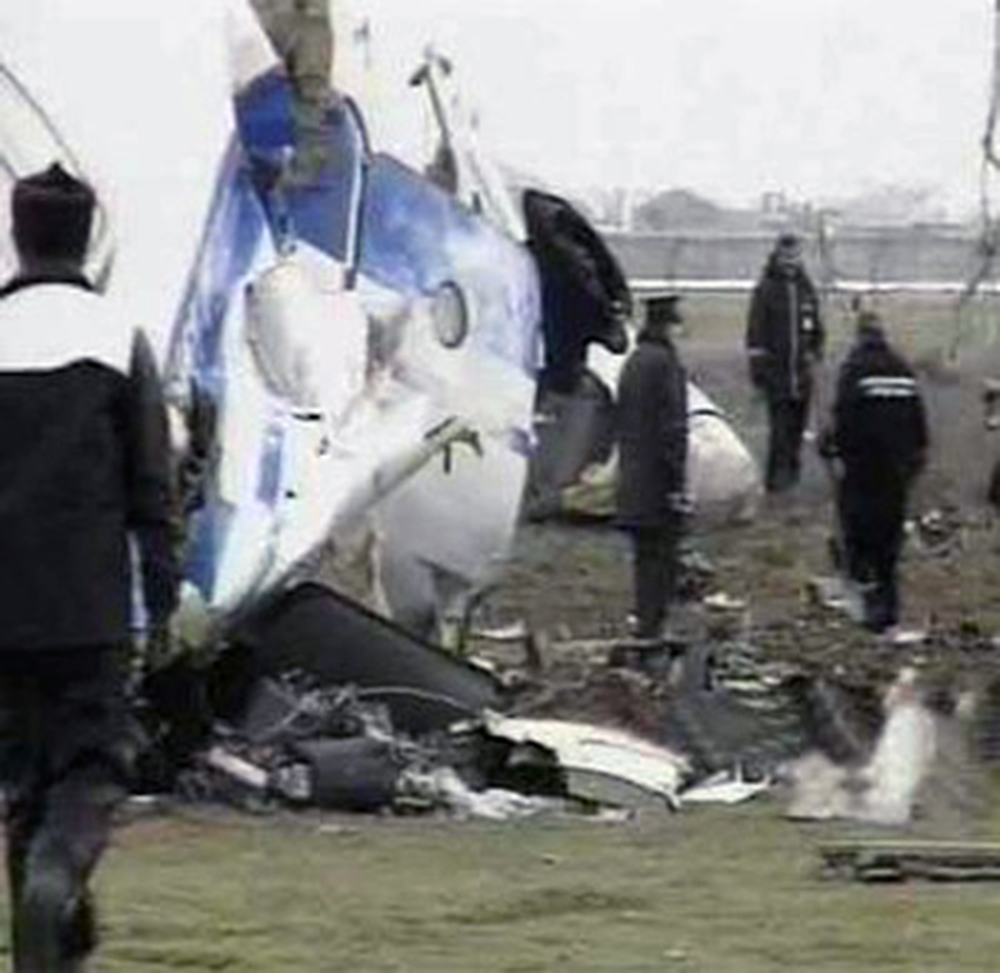
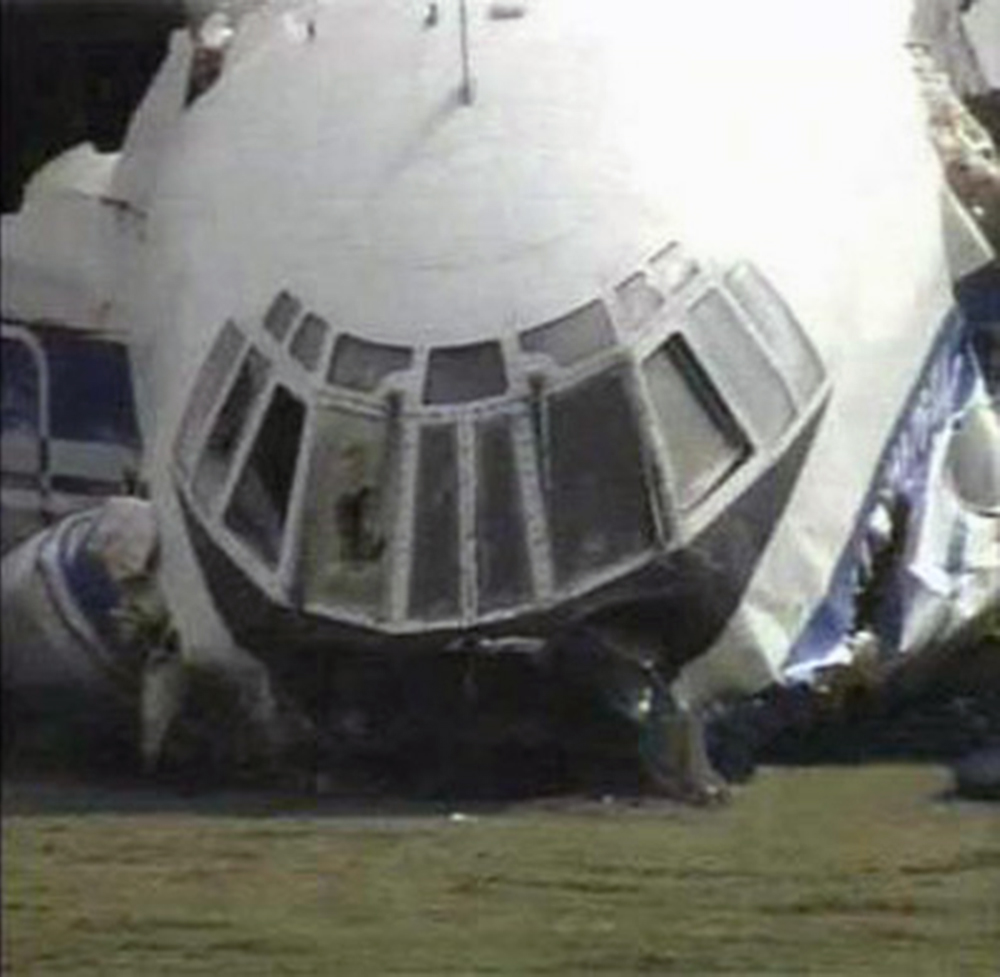
The aircraft departed Ankara, Turkey, on a cargo flight to Kabul, Afghanistan, with an intermediate stop in Baku, Azerbaijan. In Ankara, the airplane was loaded with 39,980 kg of cargo. At Baku Airport, 47 tons of fuel were added, bringing the takeoff weight to 189 tons, and the centre of gravity to 29,3% MAC, which was within the prescribed limits. During the eight-hour stopover the crew decided to rest in the aircraft instead of a hotel. As the aircraft started taxiing to the runway the flight engineer was heard saying that he would select the flaps at 30 degrees and slats at 14 degrees for takeoff. This however was not done. Prior to takeoff the position of the flaps was not verified by any of the crew members. Takeoff was thus commenced with flaps and slats retracted and the stabilizer trimmed at the takeoff position -4 degrees (corresponding to actual takeoff weight, CofG and flaps at 30°). At a speed of 210 km/h the pilot pulled on the control column to lift off the nose gear. At a calculated unstick speed of 265 km/h the angle of attack reached 9 degrees but the plane did not lift off the runway. Accelerating through 290 km/h the angle of attack of the aircraft reached 14,5 degrees, setting off the angle of attack warning on the flight deck. Some 1750 meters down the runway, the aft fuselage struck the runway. Seventy meters further on, at a speed of 300 km/h and an angle of attack of 19,4°, the Ilyushin lifted off the runway. The air traffic controller who witnessed the departure advised the crew to abort the takeoff, but the captain apparently continued. The airplane rolled to the left until the wing contacted the runway. Then the flight engineer noted his error and, without informing the captain, began extending the flaps and slats. Again without informing the captain, the flight engineer brought back the power levers of the four engines to idle. After three seconds he moved them from idle to the 'engine shutdown' position. The captain three times yelled "takeoff" but the engines were already shut down. After flying for 490 meters the aircraft struck the ground and crashed.
Probable cause:
Failure of the flight engineer to extend flaps and slats prior to takeoff. The following contributing factors were identified:
- Poor crew coordination,
- Poor flight preparation,
- Crew fatigue.

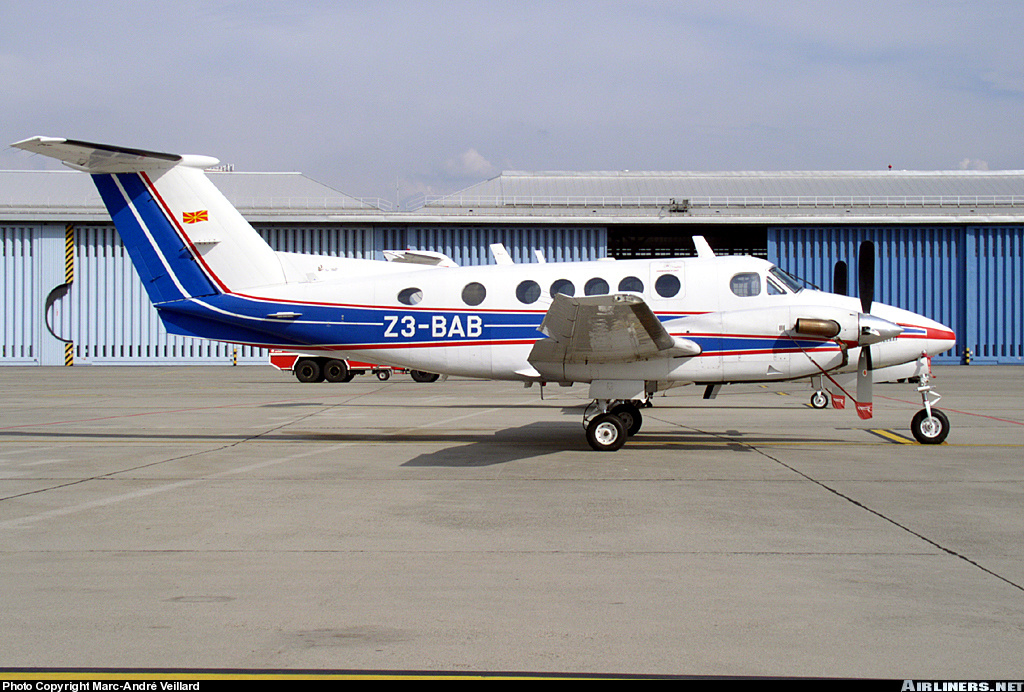
Crash of a Beechcraft 200 Super King Air in Berkovići: 9 killed

Date & Time: Feb 26, 2004 at 0745 LT
Registration:
Z3-BAB
Flight Type:
Survivors:
No
Site:
Schedule:
Skopje – Mostar
MSN:
BB-652
YOM:
1980
Region:
Crew on board:
2
Crew fatalities:
Pax on board:
7
Pax fatalities:
Other fatalities:
Total fatalities:
9
Circumstances:
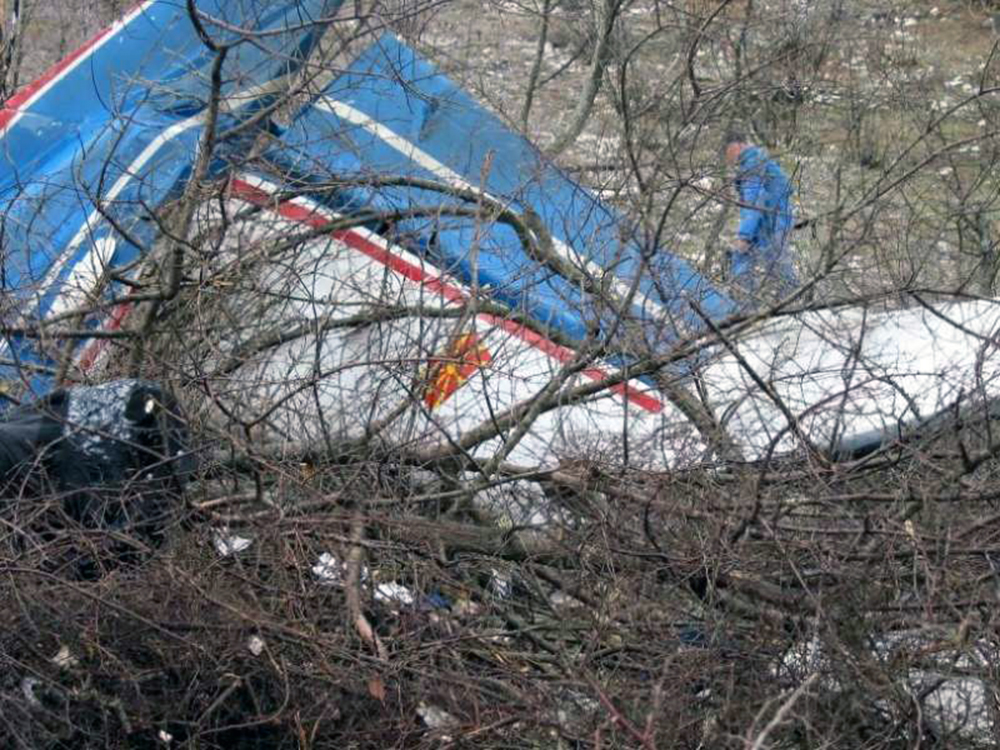
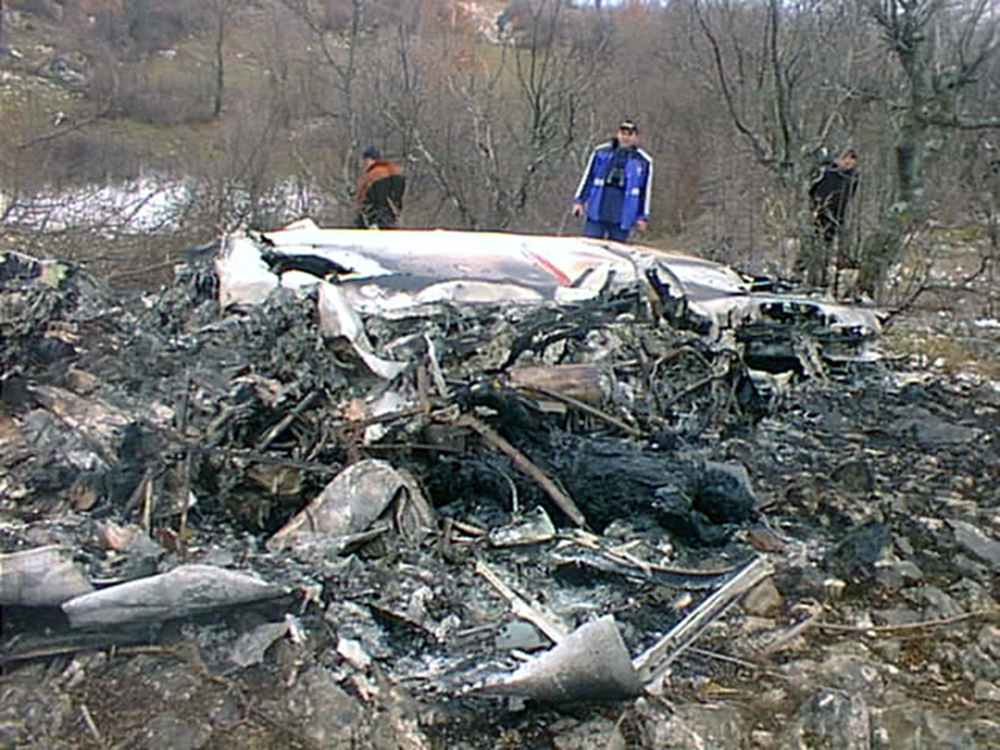
The twin engine aircraft departed Skopje on an official flight to Mostar, carrying two pilots and seven passengers, among them Boris Trajkovski, President of the Republic of Macedonia. He was flying to Mostar with members of his government to take part to an economic conference. On approach by night and limited visibility due to marginal weather conditions, the aircraft struck the slope of a mountain located near Berkovići, about 32 km southeast of the airport. The aircraft was destroyed by impact forces and a post crash fire and all nine occupants were killed.

Probable cause:
The accident was the consequence of a controlled flight into terrain after the crew initiated the approach prematurely. The following contributing factors were identified:
- Poor approach and landing preparation and planning,
- The crew ignored ATC information about the current meteorological situation at Mostar Airport,
- The crew misinterpreted the Final Approach Fix (FAF) with the Intermediate Approach Fix (IAF), causing the aircraft to start the descent prematurely,
- The crew disengaged the autopilot system during the approach while descending in complex meteorological conditions,
- Poor crew resources management,
- Lack of crew communication,
- The crew failed to comply with SOP's,
- Failure of the pilot-in-command to maintain flight level when the aircraft reached the MDA and failure of the second pilot to give adequate assistance.
Final Report:

Crash of a Cessna 500 Citation I near Cagliari: 6 killed

Date & Time: Feb 24, 2004 at 0549 LT
Type of aircraft:
Operator:
Registration:
OE-FAN
Flight Type:
Survivors:
No
Site:
Schedule:
Rome – Cagliari
MSN:
500-0289
YOM:
1976
Flight number:
CIT124
Country:
Region:
Crew on board:
3
Crew fatalities:
Pax on board:
3
Pax fatalities:
Other fatalities:
Total fatalities:
6
Captain / Total flying hours:
5472
Captain / Total hours on type:
2709.00
Copilot / Total flying hours:
2300
Copilot / Total hours on type:
1600
Aircraft flight hours:
6471
Aircraft flight cycles:
5618
Circumstances:
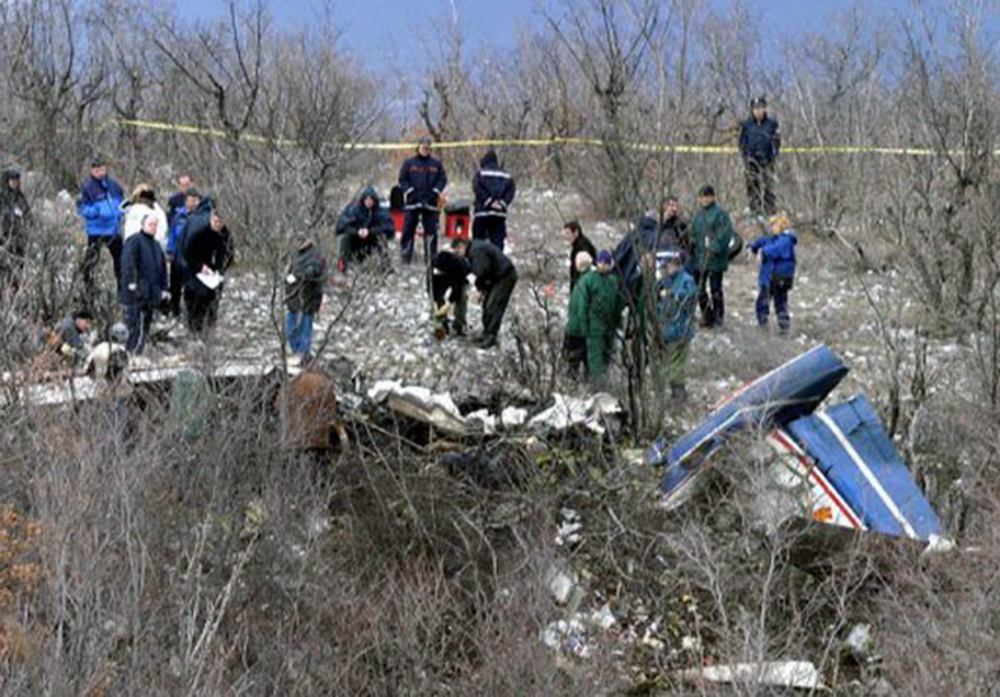
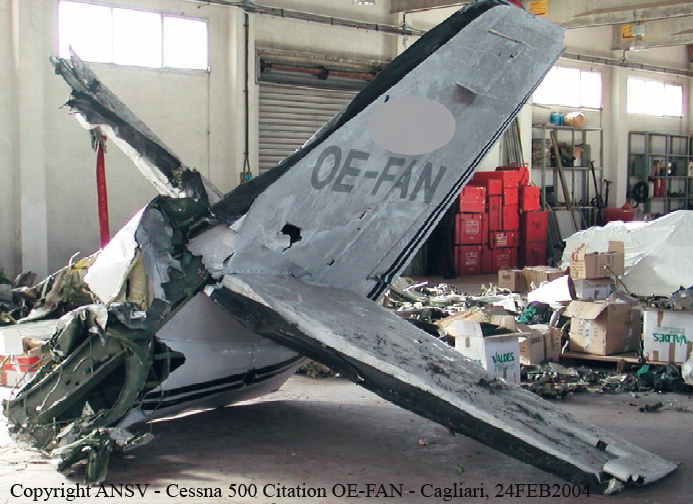
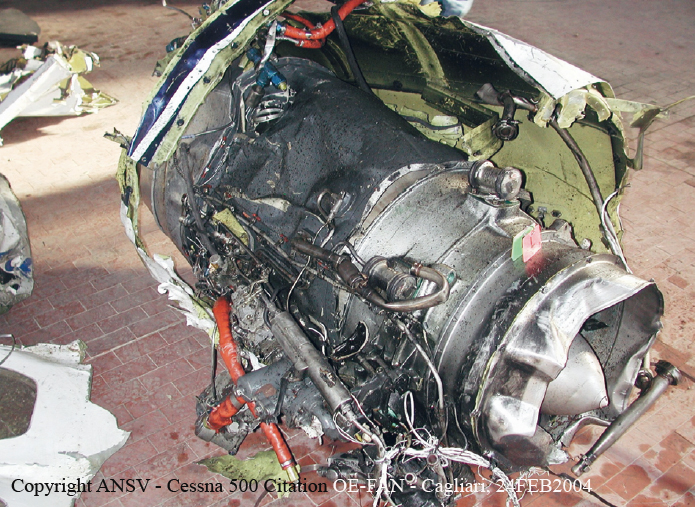
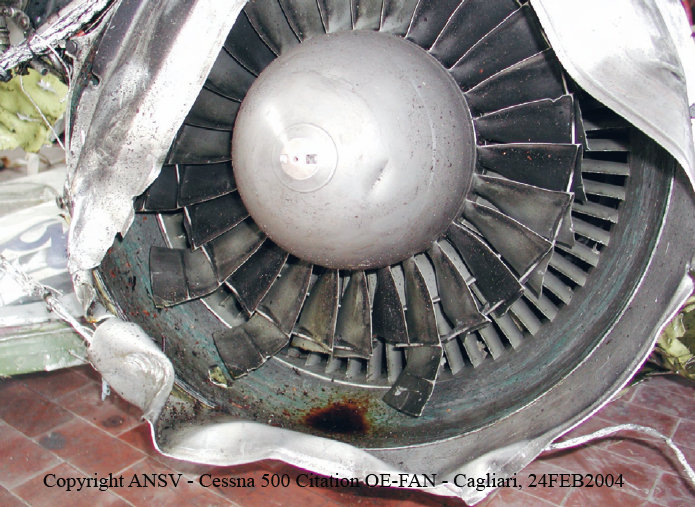
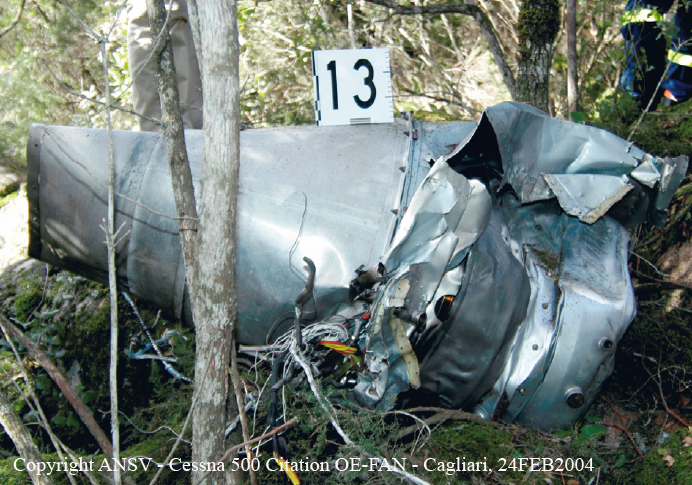
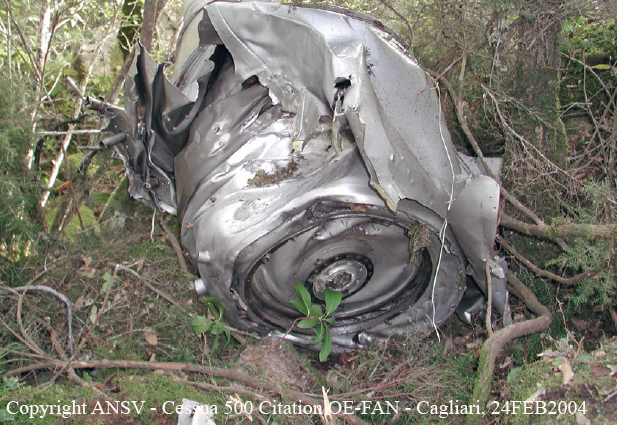
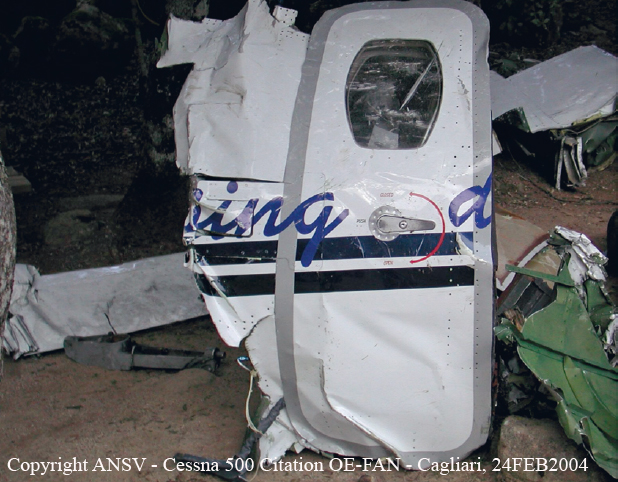
The aircraft departed Rome-Ciampino Airport on an ambulance flight to Cagliari, carrying three pilots, three doctors and a cooler containing a heart for a patient. The descent to Cagliari-Elmas Airport was initiated by night under VFR mode. After the crew was cleared to descend to 2,500 feet, ATC reported runway 32 in use and asked the crew to report on short final. About two minutes later, at an altitude of 3,333 feet, the aircraft struck the slope of Mt Su Baccu Malu located 32 km northeast of Cagliari Airport. The aircraft was totally destroyed by impact forces and all six occupants were killed.

Probable cause:
The accident, classified as CFIT, was caused by the conduct of the flight at a height significantly below the Area Minimum Altitude, insufficient to maintain the separation from the ground during a night visual approach in the absence of adequate visual reference.
possible contributory factors that have been identified:
- The aircraft instrumentation did not include a GPWS or TAWS, whose installation is not required by law;
- The erroneous descent by visual flight references, confusing the Elmas runway lights, given that the crew had no special familiarity with the area of Cagliari, the onset of a perspective illusions phenomena, with specific reference to the so-called "black hole approach";
- The misunderstanding by crew members, of the Cagliari Approach controllers instruction to transfer to Elmas TWR ('CIT 124 continue not below 2500 feet, further descent with Elmas TWR 120.6 bye') which may have created the impression, despite the crew had confirmed that they are able to separate themselves from the obstacles that the descent down was free of obstructions;
- Failure to use published procedures and available instruments in a descent to a closer airport and in an unfamiliar area , under conditions of total darkness;
- The anticipation of the deviation from the airway perhaps caused [the crew] to try to speed up the arrival at destination, which determined overflying areas of higher elevation;
- Read errors of the elevations listed in the maps consulted, facilitated by the non representation of the ground color;
- The extended period of wakefulness without adequate rest, which may have contributed to a reduction in the performance of the crew.
Final Report:

Crash of a Piper PA-46-310P Malibu in Arlington: 2 killed

Date & Time: Feb 23, 2004 at 0849 LT
Registration:
N9103Z
Flight Phase:
Flight Type:
Survivors:
No
Schedule:
Panama City – Tulsa
MSN:
46-08028
YOM:
1986
Crew on board:
1
Crew fatalities:
Pax on board:
1
Pax fatalities:
Other fatalities:
Total fatalities:
2
Captain / Total flying hours:
5021
Captain / Total hours on type:
884.00
Aircraft flight hours:
2155
Circumstances:
The pilot received a preflight briefing from the Gainesville Automated Flight Service Station before departing on the instrument flight. The briefer advised the pilot of the potential for occasional moderate turbulence between 24,000 and 37,000 feet and on the current Convective SIGMET for embedded thunderstorms over southern Mississippi. The flight was in cruise flight at 24, 000 feet when the airplane encountered moderate to severe turbulence and heavy rain. The airplane descended from 24,000 feet to 3,100 feet in a descending right turn in 2 minutes and 10 seconds before radar contact was lost. The airplane was located 8 hours 26 minutes after the accident along a crash debris line that extended between 1.31 miles and 1.53 miles northwest of Arlington, Alabama. Airframe components recovered from the accident site were submitted to the NTSB Materials laboratory for examination. The examinations revealed all failures were consistent with overstress fracturing and there was no evidence of pre-existing conditions or fatigue damage. Examination of the airframe revealed that the airframe design limits were exceeded. The Pilot's Operating Handbook states the maximum structural cruising speed is 173 knots indicated airspeed or 170 knots calibrated airspeed. The co-pilot airspeed indicator at the crash site indicated 180 knots calibrated airspeed. The design maneuvering speed is 135 knots indicated airspeed or 133 knots calibrated airspeed.
Probable cause:
The pilots inadequate in-flight planning/decision and his failure to maintain aircraft control, resulting in an in-flight encounter with a thunderstorm and exceeding the design limits of the aircraft.
Final Report:

Crash of a Learjet 25B in Fort Lauderdale

Date & Time: Feb 20, 2004 at 2157 LT
Type of aircraft:
Operator:
Registration:
N24RZ
Flight Type:
Survivors:
Yes
Schedule:
San Juan – Fort Lauderdale
MSN:
25-159
YOM:
1974
Crew on board:
2
Crew fatalities:
Pax on board:
2
Pax fatalities:
Other fatalities:
Total fatalities:
0
Captain / Total flying hours:
4500
Aircraft flight hours:
4104
Circumstances:
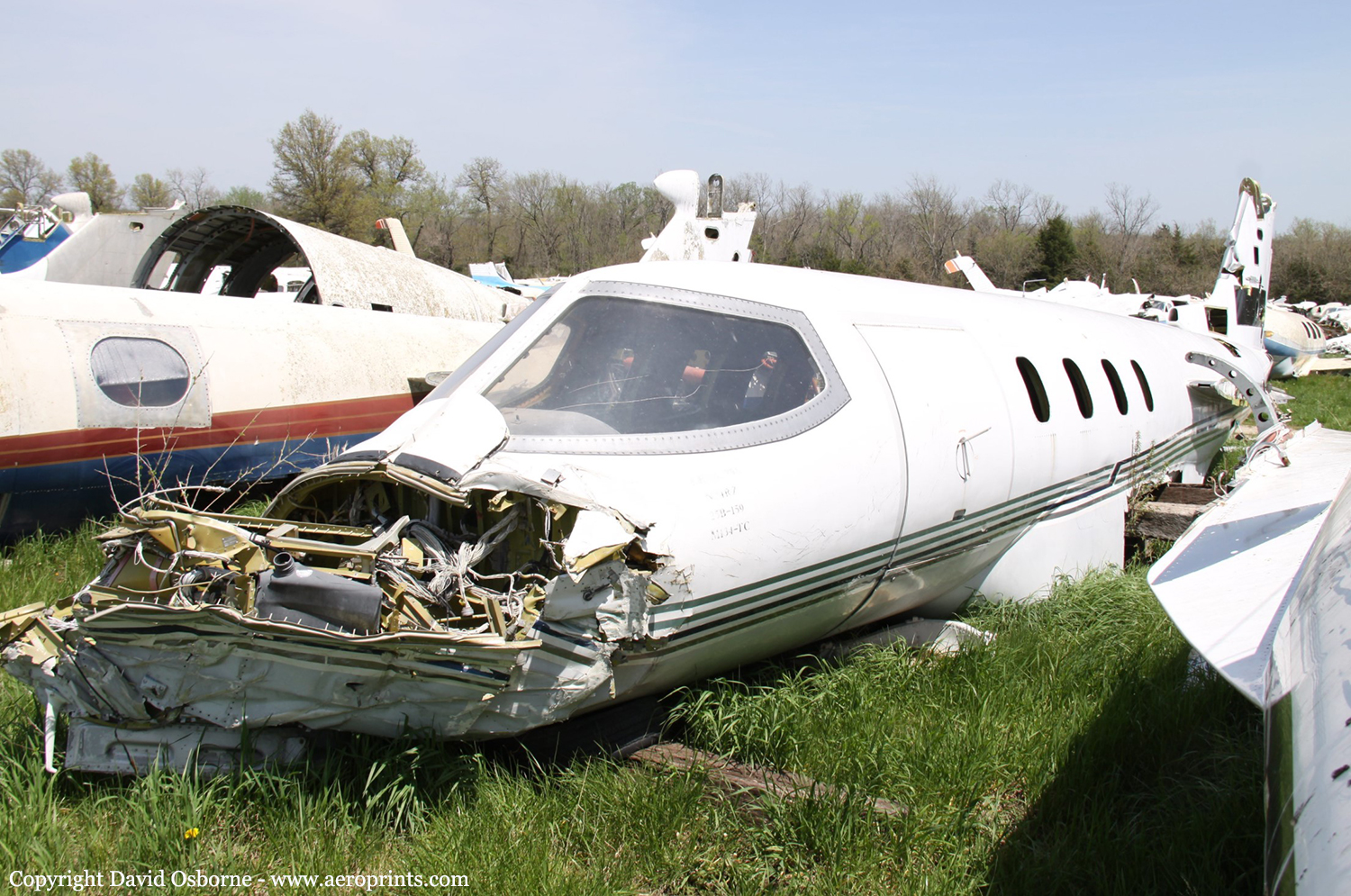
The captain and first officer were conducting a CFR Part 135 on-demand charter flight, returning two passengers to the accident airplane's base airport. The multi-destination flight originated from the accident airport, about 16 hours before the accident. On the final leg of the flight, the flight encountered stronger than anticipated headwinds, and the first officer voiced his concern several times about the airplane's remaining fuel. As the flight approached the destination airport, the captain became concerned about having to fly an extended downwind leg, and told the ATCT specialist the flight was low on fuel. The ATCT specialist then cleared the accident airplane for a priority landing. According to cockpit voice recorder (CVR) data, while the crew was attempting to lower the airplane's wing flaps in preparation for landing, they discovered that the flaps would not extend beyond 8 degrees. After the landing gear was lowered, the captain told the first officer, in part: "The gear doors are stuck down.... no hydraulics." The captain told the first officer: "Okay, so we're gonna do, this is gonna be a ref and twenty...All right, probably not going to have any brakes..." According to a ATCT specialist in the control tower, the airplane touched down about midway on the 6001-foot long, dry runway. It continued to the end of the runway, entered the overrun area, struck a chain link fence, crossed a road, and struck a building. During a postaccident interview, the captain reported that during the landing roll the first officer was unable to deploy the airplane's emergency drag chute. He said that neither he nor the first officer attempted to activate the nitrogen-charged emergency brake system. The accident airplane was not equipped with thrust reversers. A postaccident examination of the accident airplane's hydraulic pressure relief valve and hydraulic pressure regulator assembly revealed numerous indentations and small gouges on the exterior portions of both components, consistent with being repeatedly struck with a tool. When the hydraulic pressure relief valve was tested and disassembled, it was discovered that the valve piston was stuck open. The emergency drag chute release handle has two safety latches that must be depressed simultaneously before the parachute will activate. An inspection of the emergency drag chute system and release handle disclosed no pre accident mechanical anomalies.
Probable cause:
The pilot in command's misjudged distance/speed while landing, and the flightcrew's failure to follow prescribed emergency procedures, which resulted in a runway overrun and subsequent collision with a building. Factors associated with the accident are the flightcrew's inadequate in-flight planning/decision making, which resulted in a low fuel condition; an open hydraulic relief valve, and inadequate maintenance by company maintenance personnel. Additional factors were an inoperative (normal) brake system, an unactivated emergency drag chute, the flightcrew's failure to engage the emergency brake system, and pressure placed on the flightcrew due to conditions/events.
Final Report:

Crash of a Piper PA-31-325 Navajo C/R in Kahului

Date & Time: Feb 18, 2004 at 1352 LT
Type of aircraft:
Registration:
C-GPTE
Flight Type:
Survivors:
Yes
Schedule:
Honolulu – Oakland – Brooks
MSN:
31-7712059
YOM:
1977
Location:
Crew on board:
1
Crew fatalities:
Pax on board:
0
Pax fatalities:
Other fatalities:
Total fatalities:
0
Aircraft flight hours:
7923
Circumstances:
The airplane collided with terrain 200 yards short of the runway during an emergency landing following a loss of engine power. The pilot was on an intermediate leg of a ferry trip. Approximately 300 miles from land, the fuel flow and boost pump lights illuminated. Then, the right engine failed. The pilot flew back to the nearest airport; however, approximately 200 yards from the runway, the airplane stalled and the right wing dropped and collided with the ground. The fuel system had been modified a few months prior to the accident to allow for a ferry fuel tank installation. Post accident examination of the airplane could not find a reason for the power loss.
Probable cause:
The pilot's failure to maintain an adequate airspeed while maneuvering for landing on one engine, which resulted in an inadvertent stall. The loss of power in one engine for undetermined reasons was a factor.
Final Report:

Crash of a Beechcraft B90 King Air in Dodge City: 3 killed

Date & Time: Feb 17, 2004 at 0257 LT
Type of aircraft:
Operator:
Registration:
N777KU
Flight Type:
Survivors:
No
Schedule:
Wichita - Dodge City
MSN:
LJ-377
YOM:
1968
Crew on board:
1
Crew fatalities:
Pax on board:
2
Pax fatalities:
Other fatalities:
Total fatalities:
3
Captain / Total flying hours:
3066
Captain / Total hours on type:
666.00
Aircraft flight hours:
9005
Circumstances:
The emergency medical services (EMS) airplane was destroyed by terrain impact and post impact fire about 7 nautical miles (nm) west of its destination airport, Dodge City Regional Airport (DDC), Dodge City, Kansas. The 14 Code of Federal Regulations Part 91 positioning flight departed the Wichita Mid-Continental Airport (ICT), Wichita, Kansas, about 0215 central standard time and was en route to DDC. Night visual meteorological conditions prevailed when the accident occurred about 0257 central standard time. The flight had been on an instrument flight rules (IFR) flight plan, but the pilot cancelled the IFR flight plan about 34 nm east of DDC and initiated a descent under visual flight rules. Radar track data indicated that the airplane maintained a magnetic course of about 265 degrees during the flight from ICT to DDC. The rate of descent was about 850 to 950 feet per minute. During the descent, the airplane flew past the airport on a 270 degree course. Witnesses in the area reported hearing the engine noise of a low-flying airplane followed by the sound of impact. One of the witnesses described the engine noise as sounding like the engines were at "full throttle." The on-site inspection revealed that the airplane impacted the terrain in a gear-up, wings-level attitude. The inspection of the airplane revealed no anomalies to the airframe or engines. A review of the pilot's 72-hour history before the accident revealed that it had been 14 hours and 32 minutes from the time the pilot reported for duty about 1225 central standard time until the time of the accident. It had been 20 hours 57 minutes from the time the pilot awoke (0600) on the morning before the accident until the time of the accident. No evidence of pilot impairment due to carbon monoxide, drugs, or medical incapacitation was found. The accident occurred during a time of day that was well past the pilot's normal bedtime and also at a time of day when the physiological need to sleep is especially strong. The findings from a Safety Board's human performance analysis indicates that the pilot was likely fatigued. A review of 14 CFR 135.267 indicated that the pilot had adhered to the flight time limitations and rest requirements specified in the regulation.
Probable cause:
The pilot failed to maintain clearance with terrain due to pilot fatigue (lack of sleep).
Final Report:

Crash of a Cessna 414 Chancellor in Linz

Date & Time: Feb 13, 2004 at 0615 LT
Type of aircraft:
Operator:
Registration:
OE-FRW
Flight Phase:
Survivors:
Yes
Schedule:
Linz - Stuttgart
MSN:
414-0825
YOM:
1975
Country:
Region:
Crew on board:
2
Crew fatalities:
Pax on board:
5
Pax fatalities:
Other fatalities:
Total fatalities:
0
Captain / Total flying hours:
2527
Captain / Total hours on type:
830.00
Copilot / Total flying hours:
522
Copilot / Total hours on type:
250
Aircraft flight hours:
4463
Circumstances:
The twin engine aircraft departed Linz-Hörsching Airport on a taxi flight to Stuttgart with five passengers and two pilots on board. During the takeoff roll on runway 27, at a speed of 105 knots, the crew started the rotation. Immediately after liftoff, the aircraft adopted a high nose attitude with an excessive angle of attack. It rolled to the left, causing the left gear door and the left propeller to struck the runway surface, followed shortly later by the right propeller. After the speed dropped, the aircraft stalled and crash landed on the runway. It slid for few dozen metres and came to rest 2,752 metres past the runway threshold. All seven occupants were evacuated, one passenger suffered serious injuries. The aircraft was damaged beyond repair.
Probable cause:
The loss of control immediately after liftoff was the consequence of an aircraft contaminated with ice, resulting in an excessive weight, a loss of lift and a consequent stall. The following factors were identified:
- Poor flight preparation,
- The crew failed to follow the SOP procedures prior to takeoff,
- The aircraft has not been deiced prior to takeoff, increasing the total weight of the aircraft by 231 kilos, 8% above the MTOW,
- This situation caused the CofG to be out of the permissible limits,
- Poor judgment on part of the crew when the undercarriage were lowered.

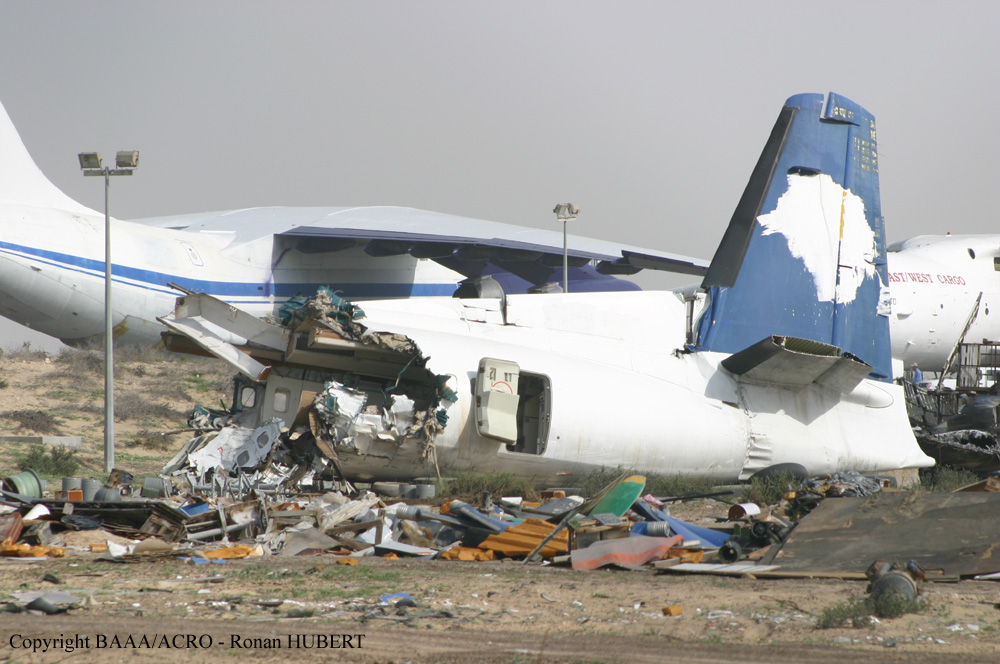
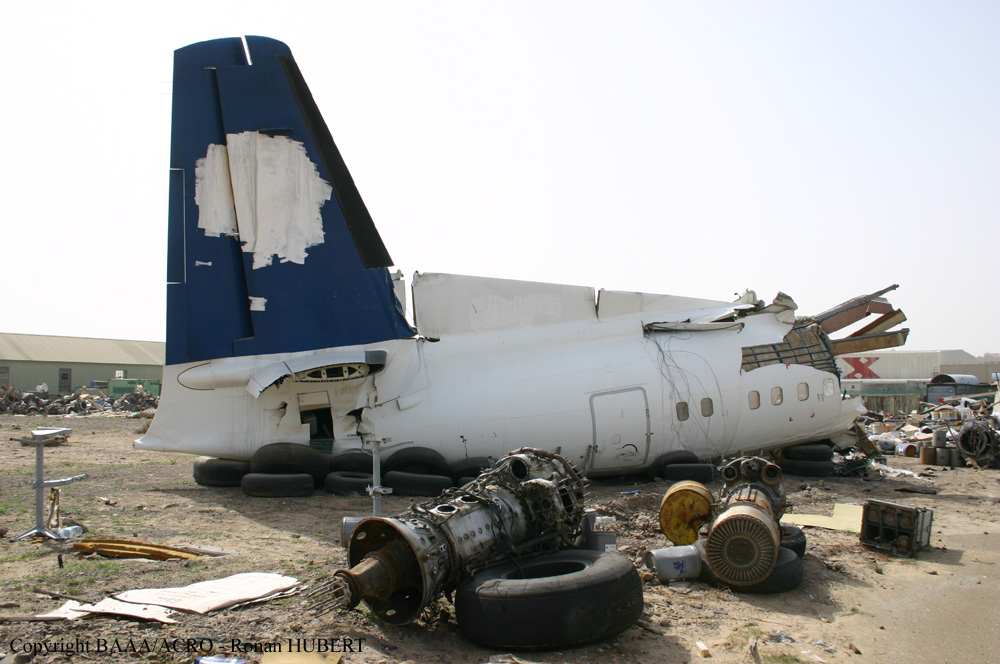
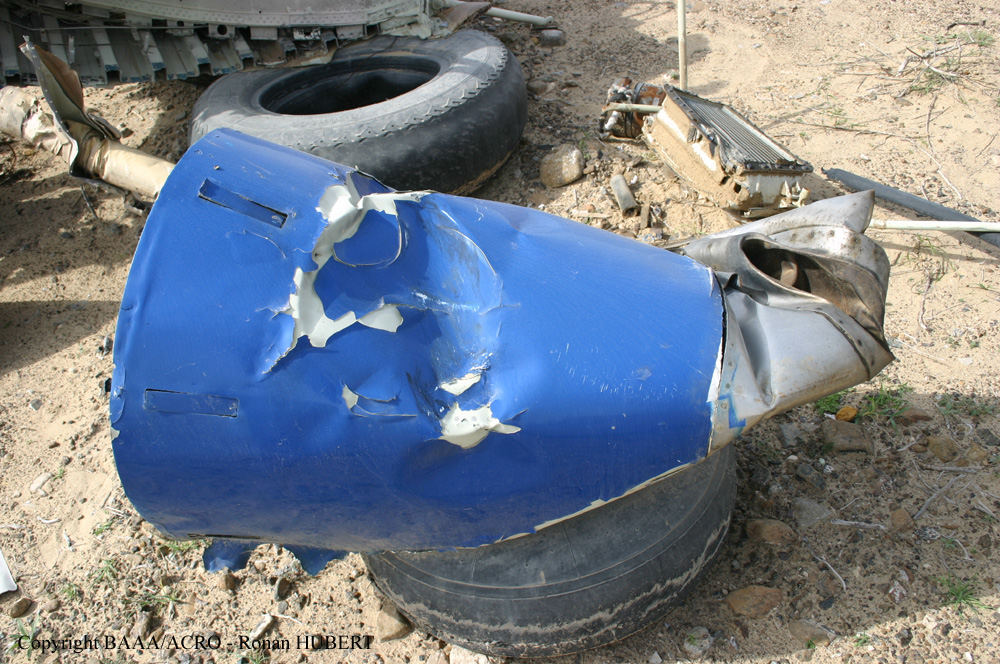
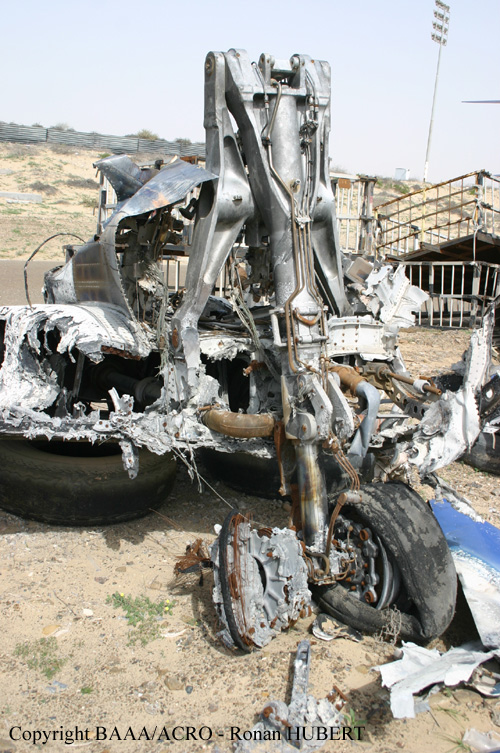
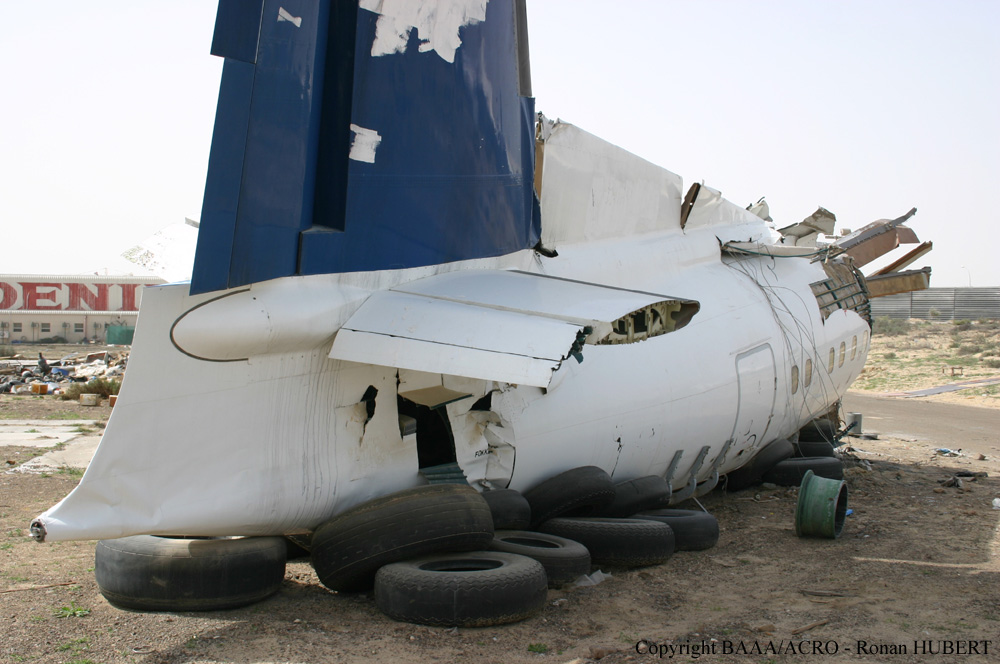
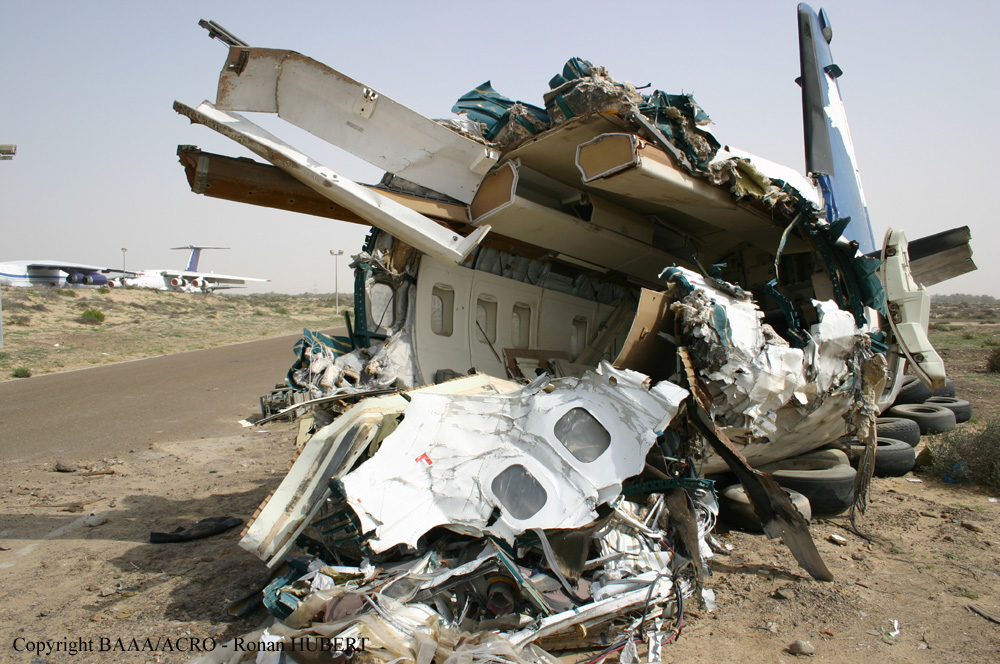
Crash of a Fokker 50 in Sharjah: 43 killed

Date & Time: Feb 10, 2004 at 1138 LT
Type of aircraft:
Operator:
Registration:
EP-LCA
Survivors:
Yes
Schedule:
Kish Island - Sharjah
MSN:
20273
YOM:
1993
Flight number:
IRK1770
Region:
Crew on board:
6
Crew fatalities:
Pax on board:
40
Pax fatalities:
Other fatalities:
Total fatalities:
43
Captain / Total flying hours:
6440
Captain / Total hours on type:
1516.00
Copilot / Total flying hours:
3978
Copilot / Total hours on type:
517
Aircraft flight hours:
20466
Aircraft flight cycles:
19845
Circumstances:
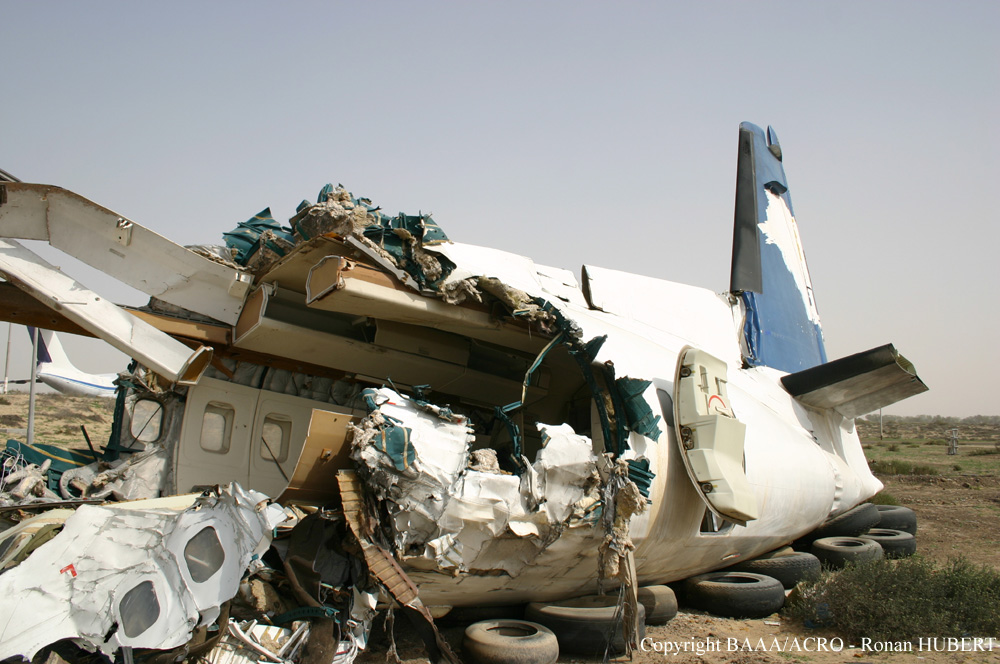
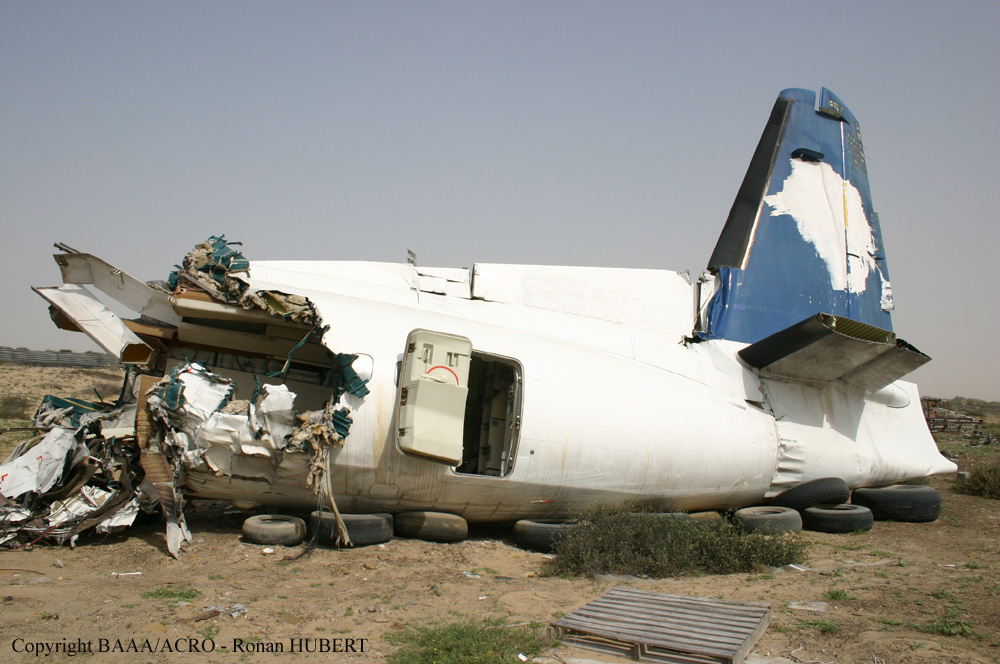
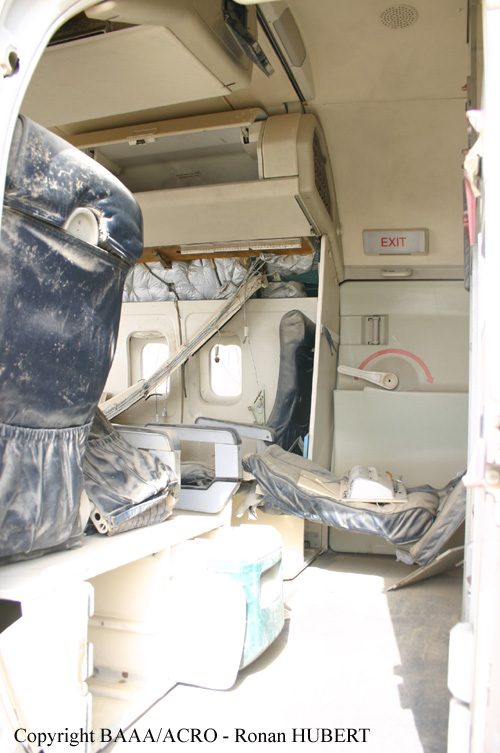
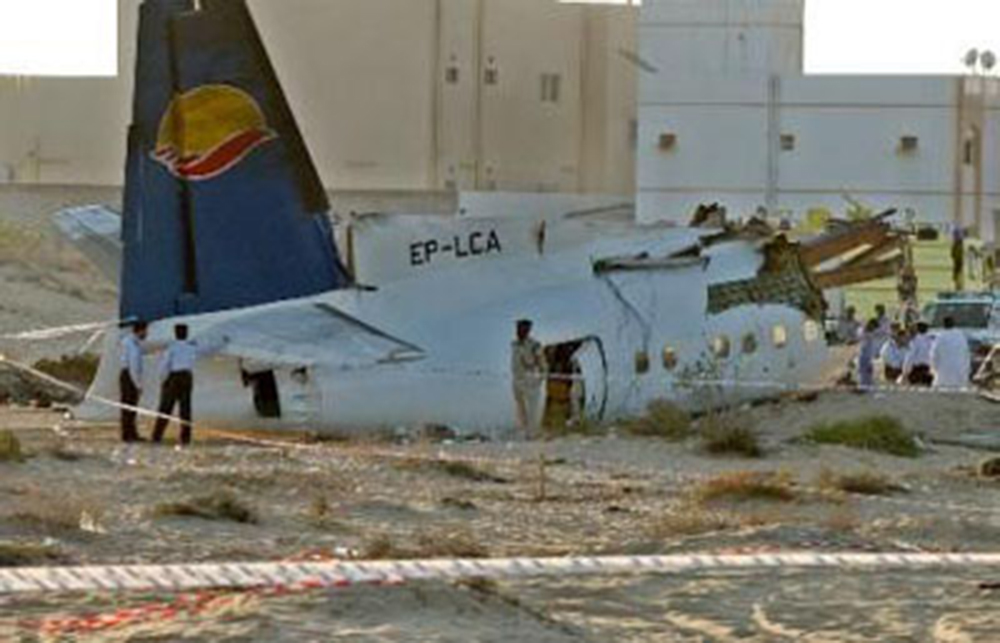
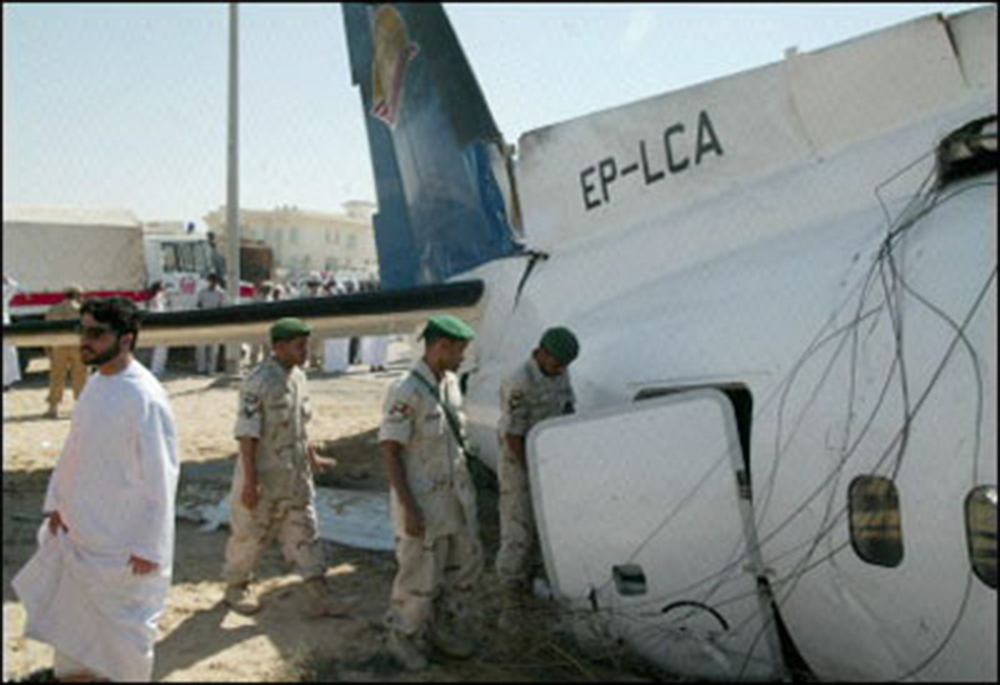
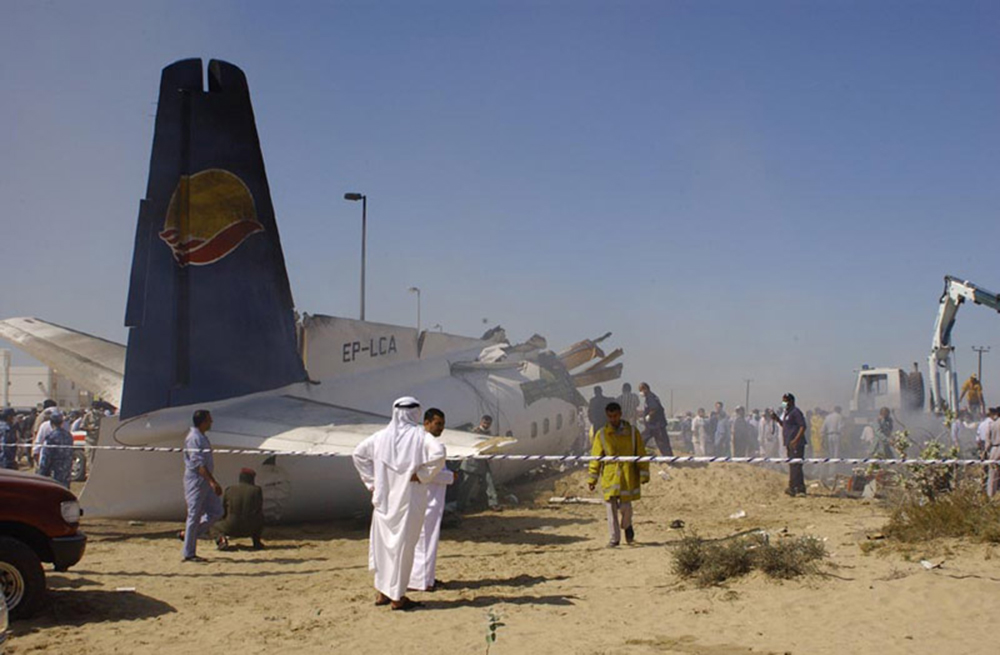
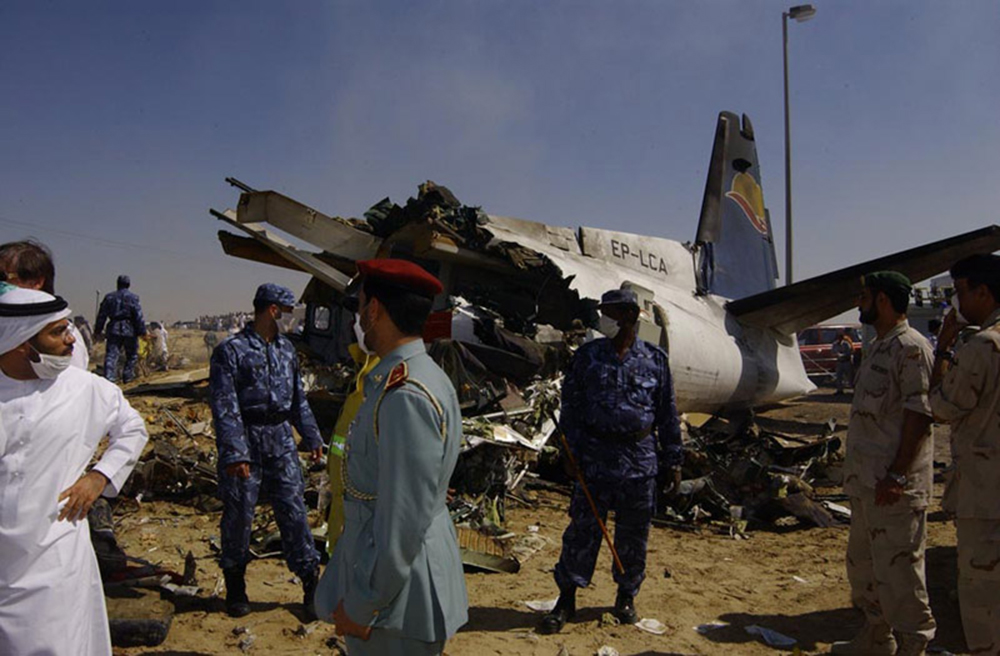
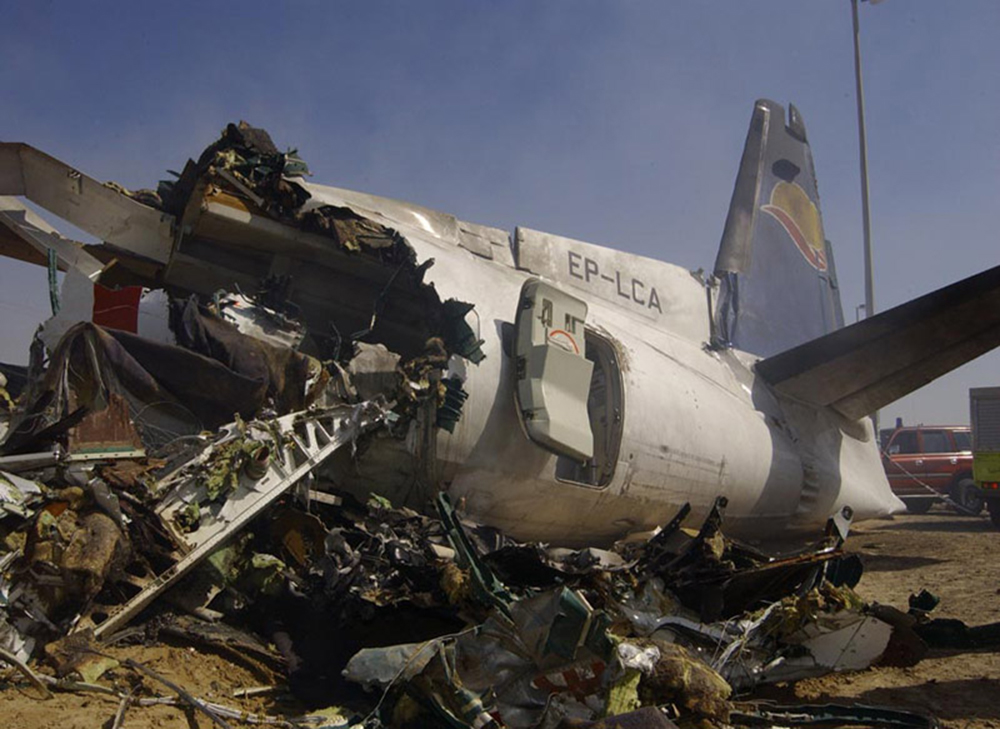
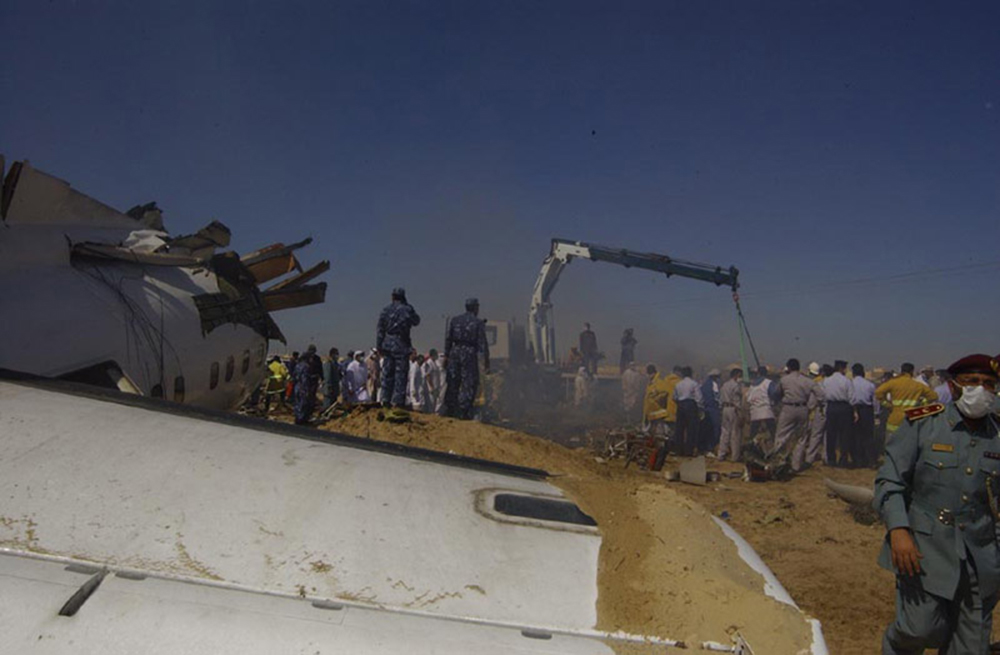
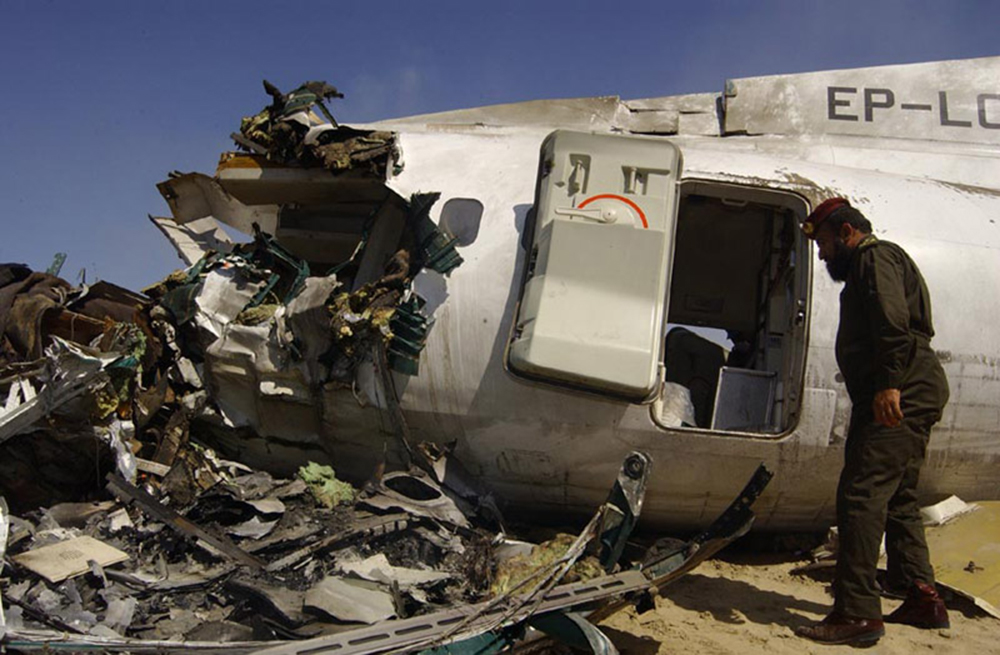
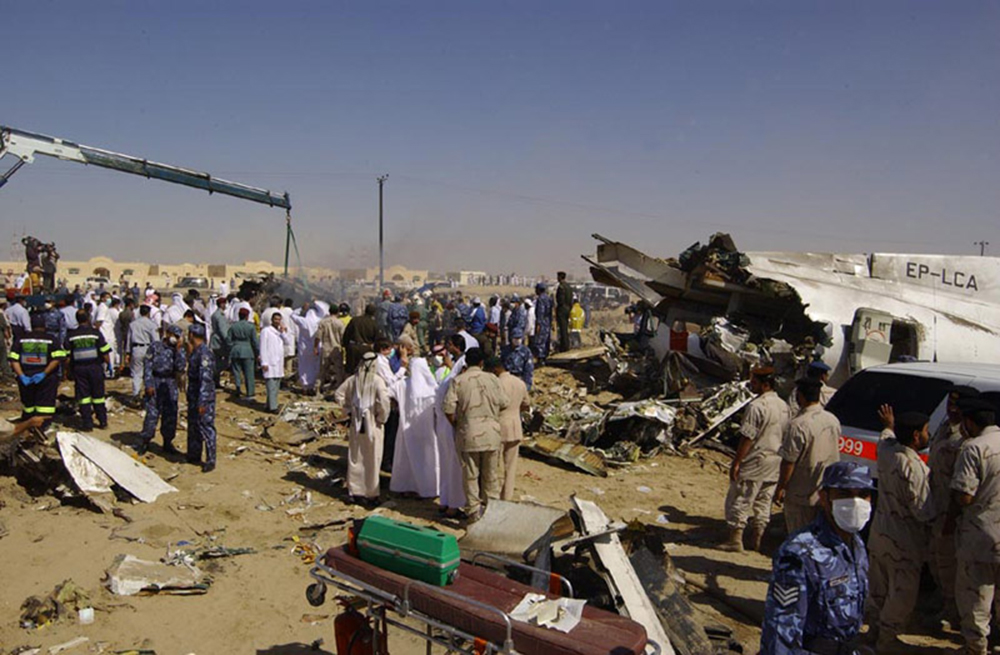
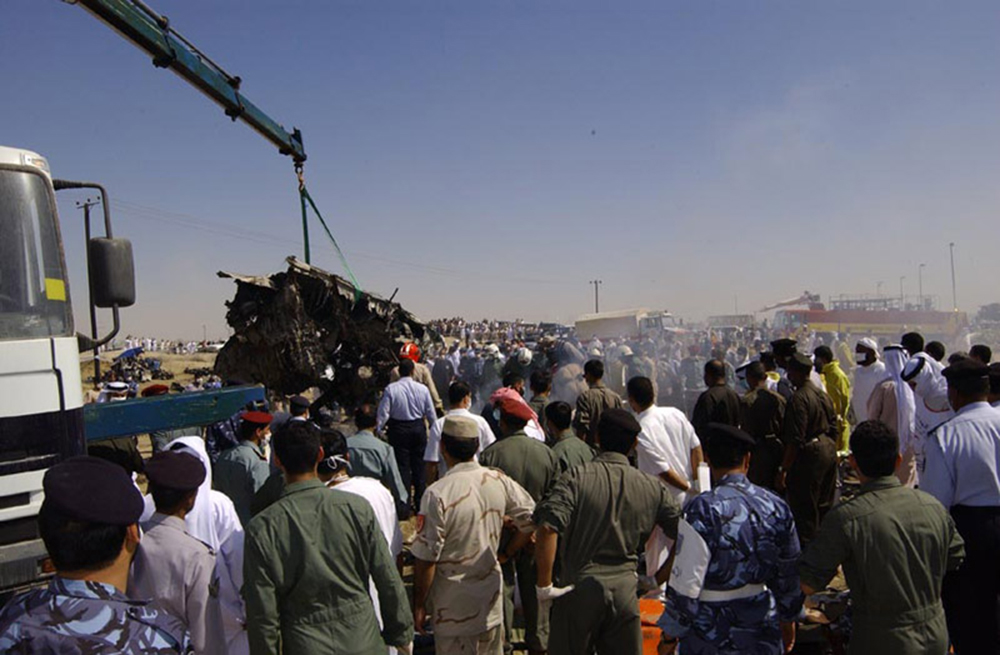
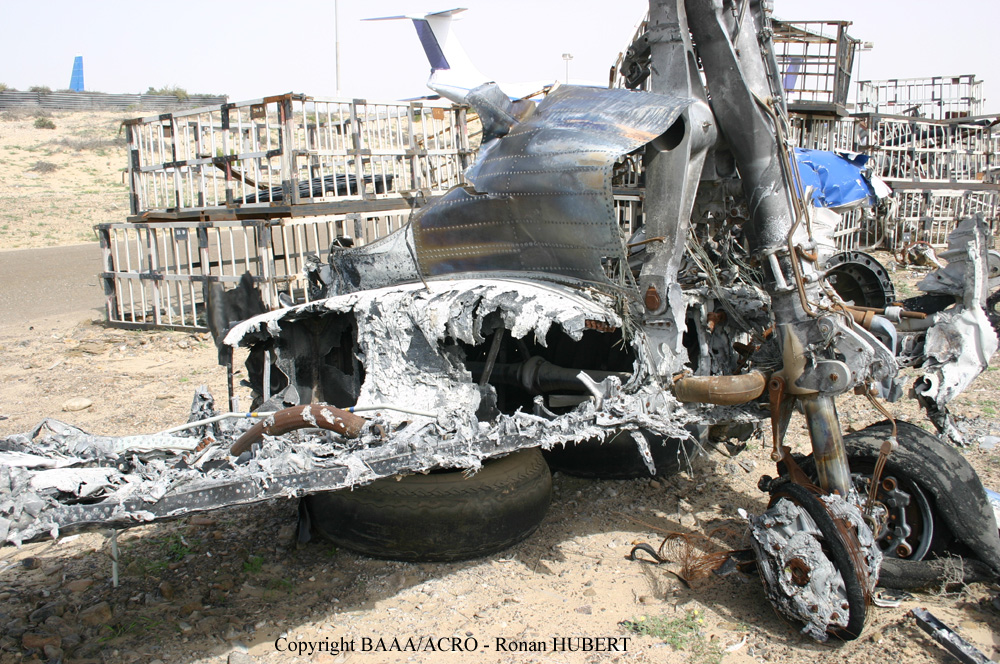
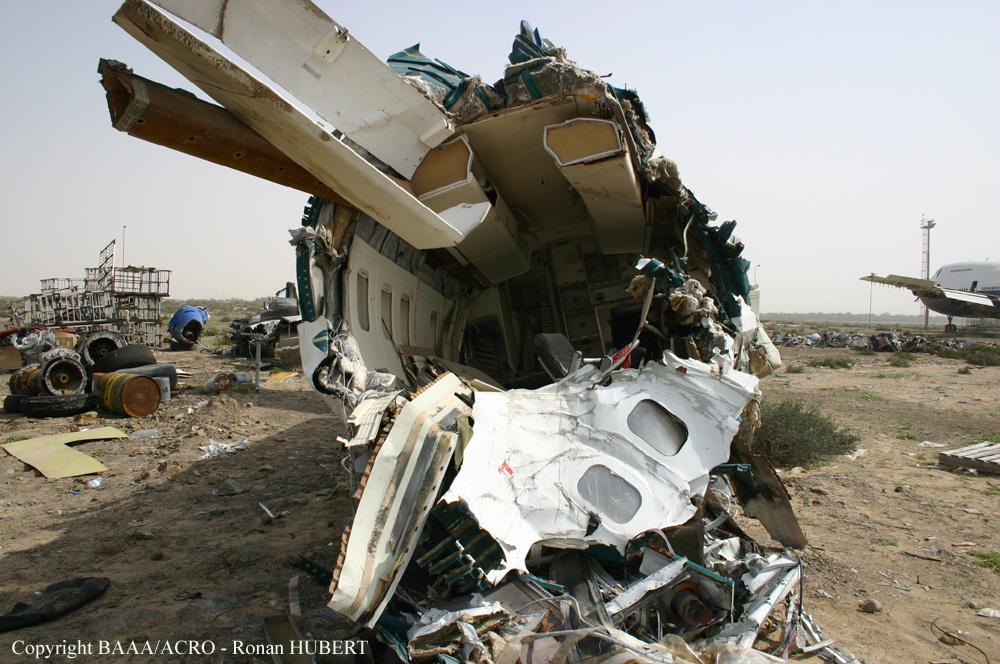
The aircraft was operating as a scheduled flight from Kish Island, Iran to Sharjah, UAE with the captain initially as the pilot flying (PF). During the cruise and just prior to descent, the captain unexpectedly handed over control of the aircraft to the First Officer prior to the approach to Sharjah. The first officer did not accept this willingly and stated that he was not confident of his ability to conduct a VOR/DME approach into Sharjah. This statement was not consistent with his previous experience and could indicate either a cultural or professional issue. The captain insisted the first officer fly the aircraft and encouraged and instructed him during the approach. At 11:24 hours local time, the aircraft contacted Dubai Arrivals and was cleared from 9000 ft to 5000 ft and instructed to expect a VOR/DME approach to runway 12 at Sharjah International Airport. At 11:29 hours the aircraft was further cleared to 2500 ft and cleared for the approach. The aircraft was under its own navigation and the daylight conditions were fine with excellent visibility. At 11:35 hours the aircraft was instructed to contact Sharjah Tower and the pilot reported that the aircraft was established on the VOR final approach for runway 12. The Tower cleared IRK7170 to land and advised that the wind was calm. At that point the aircraft was slightly above the approach profile. The initial speed for the approach was at least 50 kt high at approximately 190 kt with no flap and no landing gear. The aircraft should have been configured with landing gear down and flap 10° during the approach and stabilized at 130 kt prior to the MDA. Approaching the MDA at flight idle setting, the autopilot was disengaged and the first Officer called for flap 10 at 186 kt (limiting speed of 180 kt) and flap 25 was selected by the Captain, a setting uncalled for by the Pilot Flying at 183 kt (limiting speed of 160 kt), and the landing gear was called for and selected at approximately 185 kt (limiting speed of 170 kt). The captain then took control of the aircraft and shortly afterwards the ground range selectors were heard by Cockpit Voice Recorder to be lifted and the power levers moved from the flight idle stop into the ground control range. The left propeller then went to full reverse whilst the right propeller remained in positive pitch within the ground control range. The aircraft descended in an extreme nose low left bank attitude until impact. The aircraft crashed 2.6 nm from the runway onto an unprepared sandy area adjacent to a road and residential buildings. The aircraft broke apart on impact and a fire started immediately. Three passengers suffered injuries while 43 other occupants were killed.

Probable cause:
During the final approach, the power levers were moved by a pilot from the flight idle position into the ground control range, which led to an irreversible loss of flight control. The following contributing factors were identified:
1. By suddenly insisting the First Officer fly the final approach, the pilot in command created an environment, which led to a breakdown of crew resource management processes, the non observance of the operator’s standard operating procedures and a resultant excessive high approach speed.
2. An attempt to rectify this excessive high approach speed most likely resulted in the non compliance with the Standard Operating Procedures and the movement of the power levers below flight idle.
3. The unmodified version of the Skid Control Unit failed to provide adequate protection at the time of the event.
Final Report: