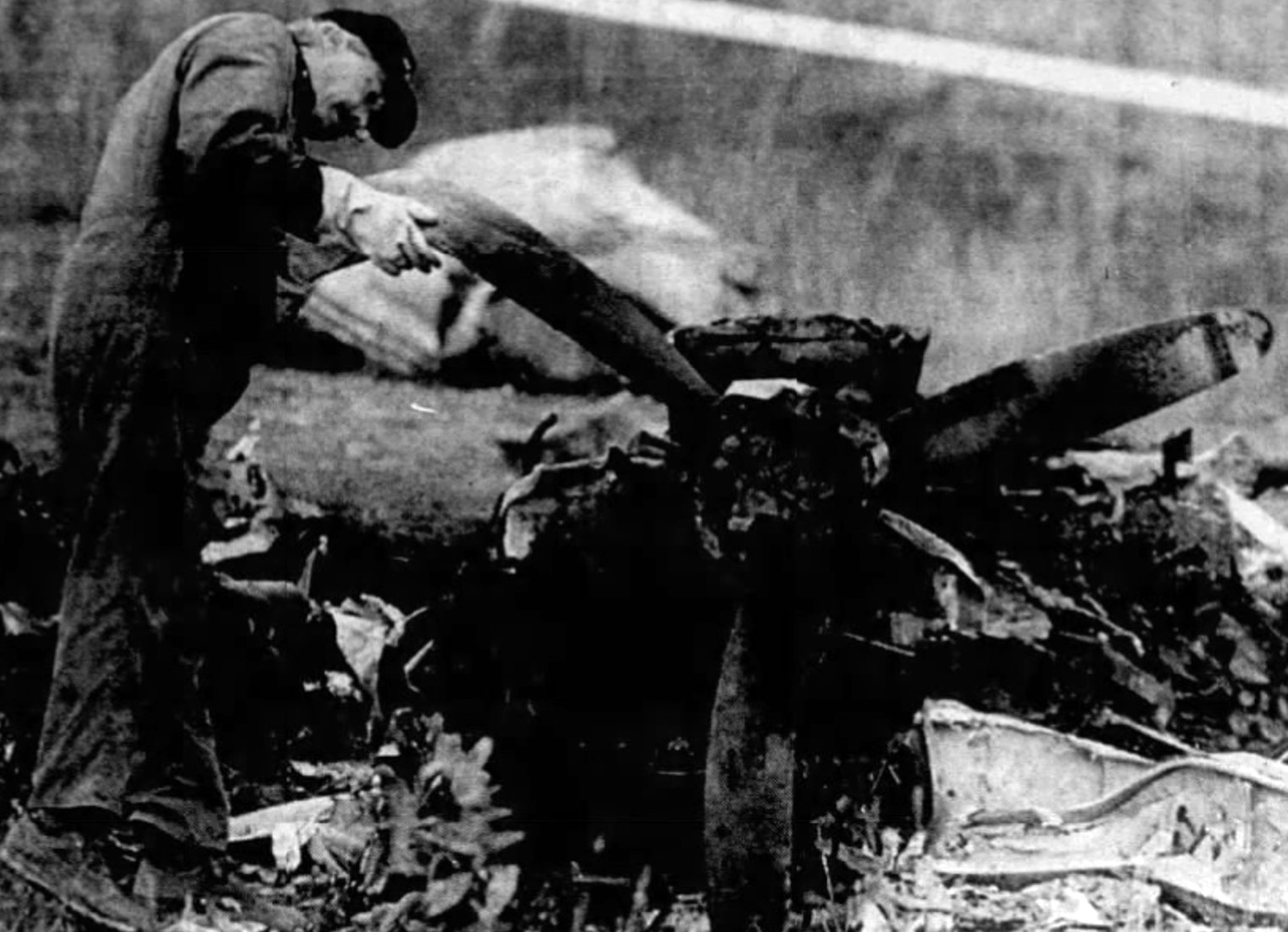
Crash of a Piper PA-31-350 Navajo Chieftain in Brownsville

Date & Time: Jan 9, 1995 at 1622 LT
Registration:
N50WT
Flight Type:
Survivors:
Yes
Schedule:
Cancún – El Paso
MSN:
31-7952018
YOM:
1979
Crew on board:
1
Crew fatalities:
Pax on board:
2
Pax fatalities:
Other fatalities:
Total fatalities:
0
Captain / Total flying hours:
87
Circumstances:
During an international cross country flight the private pilot, certificated single engine land, experienced a dual engine power loss as he was being vectored to the Brownsville Airport. Following the accident the aircraft was examined by a Federal Aviation Administration inspector who found that there was fuel in the left fuel tank and that the fuel selector was in the right tank position. The pilot had reported, prior to loss of engine power, that he had low fuel indications in the right tank and that he needed a vector to Brownsville. The aircraft was landed in rough and uneven terrain, resulting in damage to the structure and wings, approximately 1/2 mile short of the runway.
Probable cause:
The fuel starvation loss of engine power due to the pilot's improper use of the fuel tank selector. Factors were the pilot's qualification and the lack of suitable terrain for landing.
Final Report:

Crash of a Piper PA-31-350 Navajo Chieftain in Ngong Hills: 5 killed

Date & Time: Dec 6, 1994
Operator:
Registration:
5Y-SMR
Flight Phase:
Survivors:
No
Site:
Schedule:
Nairobi - Goma
MSN:
31-8252001
YOM:
1982
Location:
Country:
Region:
Crew on board:
2
Crew fatalities:
Pax on board:
3
Pax fatalities:
Other fatalities:
Total fatalities:
5
Circumstances:
Fifteen minutes after takeoff from Nairobi-Wilson Airport, while flying in marginal weather conditions, the twin engine aircraft struck the slope of a mountain located in the Ngong Hills, about 21 km southwest of Wilson Airport. The aircraft was destroyed upon impact and all five occupants were killed.
Probable cause:
Controlled flight into terrain.

Crash of a Piper PA-31-350 Navajo Chieftain in Papua: 2 killed

Date & Time: Nov 19, 1994
Operator:
Registration:
PK-IWC
Flight Phase:
Flight Type:
Survivors:
No
Site:
Schedule:
Jayapura - Oksibil
Country:
Region:
Crew on board:
2
Crew fatalities:
Pax on board:
0
Pax fatalities:
Other fatalities:
Total fatalities:
2
Circumstances:
The crew departed Jayapura-Sentani Airport on a cargo flight to Oksibil. En route, the twin engine aircraft disappeared, maybe in a mountainous area located north of Oksibil. The wreckage was never found.

Crash of a Piper PA-31-350 Navajo Chieftain in Siwandu

Date & Time: Jul 6, 1994 at 0755 LT
Operator:
Registration:
5H-ZNZ
Flight Type:
Survivors:
Yes
Schedule:
Nairobi - Siwandu
MSN:
31-7852064
YOM:
1978
Country:
Region:
Crew on board:
1
Crew fatalities:
Pax on board:
0
Pax fatalities:
Other fatalities:
Total fatalities:
0
Captain / Total flying hours:
1500
Circumstances:
After landing at Siwandu Airfield, the twin engine airplane collided with a giraffe. The animal was killed and the aircraft was destroyed. The pilot escaped uninjured.
Probable cause:
Collision with a giraffe after landing.

Crash of a Piper PA-31-350 Navajo Chieftain in Stratford: 8 killed

Date & Time: Apr 27, 1994 at 2256 LT
Operator:
Registration:
N990RA
Survivors:
Yes
Schedule:
Atlantic City - Stratford
MSN:
31-7405417
YOM:
1974
Crew on board:
1
Crew fatalities:
Pax on board:
8
Pax fatalities:
Other fatalities:
Total fatalities:
8
Captain / Total flying hours:
3500
Captain / Total hours on type:
527.00
Circumstances:
The captain had ILS glideslope data available during the approach but did not fly the ILS glideslope. The partial obscuration of the airport environment, due to ground fog, contributed to the captain's failure to recognize that the airplane was high on both his approach and landing. The destruction of the airplane and the resulting occupant injuries were a direct result of the collision with the blast fence. FAA interaction and communication with local communities, although persistent, were unsuccessful in gaining support for runway safety area improvements and for the installation of approach lighting for runway 6. The passenger seats had been improperly assembled using unapproved parts, and seat belts had been installed incorrectly.
Probable cause:
The failure of the captain to use the available ILS glideslope, his failure to execute a go-around when conditions were not suitable for landing, and his failure to land the airplane at a point
sufficient to allow for a safe stopping distance; the fatalities were caused by the presence of the non frangible blast fence and the absence of a safety area at the end of the runway.
Final Report:

Crash of a Piper PA-31-350 Navajo Chieftain in Elizabethton: 2 killed

Date & Time: Apr 7, 1994 at 0810 LT
Operator:
Registration:
N64LB
Flight Type:
Survivors:
No
Schedule:
Augusta - Elizabethton
MSN:
31-7852127
YOM:
1978
Crew on board:
1
Crew fatalities:
Pax on board:
1
Pax fatalities:
Other fatalities:
Total fatalities:
2
Captain / Total flying hours:
7800
Aircraft flight hours:
2910
Circumstances:
The ATP and his passenger were en route to pick up a patient for transport to a VA hospital. The destination airport was uncontrolled, and VFR only. The pilot cancelled with ATC and reported the field in sight. The airport was reporting VFR conditions, but rising, mountainous terrain existed to the northeast, and local authorities reported that the top third of the mountain was obscured in clouds during the morning of the accident. After cancelling IFR, no subsequent radio calls were received from the flight, and the flight did not arrive at its destination. The wreckage was found several hours later near the crest of holston mountain, 1/2 mile east of the Holston mountain VOR. An examination of the wreckage indicated the aircraft impacted upsloping, wooded terrain, while at a climb angle of 8°. Disintegration of the wreckage was indicative of a high speed impact. No evidence of mechanical malfunction or failure was found during the examination of the wreckage. Both occupants were killed.
Probable cause:
The pilot's attempted VFR flight into imc conditions, and his failure to maintain a proper altitude over mountainous terrain. Factors were the clouds and obscuration at the accident site.
Final Report:

Crash of a Piper PA-31-350 Navajo Chieftain in Frazier Park: 1 killed

Date & Time: Mar 3, 1994 at 2346 LT
Operator:
Registration:
N78DE
Flight Phase:
Flight Type:
Survivors:
No
Site:
Schedule:
Burbank - Oakland
MSN:
31-7852087
YOM:
1978
Crew on board:
1
Crew fatalities:
Pax on board:
0
Pax fatalities:
Other fatalities:
Total fatalities:
1
Captain / Total flying hours:
3600
Captain / Total hours on type:
135.00
Aircraft flight hours:
9136
Circumstances:
The pilot elected not to use the stored instrument flight plan, and he departed with a special VFR clearance. The flight was being followed by radar. After reaching visual flight conditions, the pilot proceeded toward his intended destination and climbed to 8,500 feet. Minimum safe altitude warning service was available, but not requested by the pilot. A review of radar data indicates that the airplane's track remained almost constant at 300° with a 160-knot ground speed. The last radar hit on the airplane occurred about 0.3 miles from where the airplane cruised into 8,500 foot msl terrain while still tracking along a northwesterly course. The accident occurred in dark, night time conditions.
Probable cause:
The pilot's failure to select a cruise altitude which would ensure adequate terrain clearance. Contributing factors related to the dark, nighttime condition and to the pilot's lack of attentiveness.
Final Report:

Crash of a Piper PA-31-350 Navajo Chieftain in Bathurst: 2 killed

Date & Time: Jan 4, 1994 at 1845 LT
Registration:
C-GNPG
Flight Type:
Survivors:
No
Schedule:
Moncton - Bathurst
MSN:
31-7752119
YOM:
1977
Flight number:
Empress204
Country:
Crew on board:
2
Crew fatalities:
Pax on board:
0
Pax fatalities:
Other fatalities:
Total fatalities:
2
Captain / Total flying hours:
3500
Captain / Total hours on type:
2600.00
Copilot / Total flying hours:
685
Copilot / Total hours on type:
350
Aircraft flight hours:
8162
Circumstances:
At 1805 Atlantic standard time (AST), C-GNPG, a Piper Navajo Chieftain operating as Empress 204, departed Moncton, New Brunswick, on a scheduled courier flight to Bathurst. The aircraft carried a two-pilot crew, and there was no cargo on board. The aircraft proceeded direct to Bathurst at 8,000 feet above sea level (asl) and at 1820 AST was cleared by Moncton Area Control Centre (ACC) for an approach at Bathurst. The co-pilot contacted the Bathurst UNICOM and advised the operator that the crew would be flying the non-directional beacon/distance measuring equipment (NDB/DME) runway 10 approach. During the non-precision instrument approach to runway 10, the aircraft struck trees .75 nautical miles (nm) inside the Bathurst beacon and 3.75 nm from the airport. The accident occurred at approximately 1845 AST, during the hours of darkness in instrument meteorological conditions, at an elevation of 450 feet asl. Both pilots were killed.
Probable cause:
The crew of Empress 204 allowed the aircraft to descend below the minimum descent altitude for the approach.
Final Report:

Crash of a Piper PA-31-350 Navajo Chieftain in Orlando: 1 killed

Date & Time: Nov 12, 1993 at 0629 LT
Registration:
N27687
Flight Phase:
Flight Type:
Survivors:
No
Schedule:
Orlando - Tampa
MSN:
31-7852107
YOM:
1978
Crew on board:
1
Crew fatalities:
Pax on board:
0
Pax fatalities:
Other fatalities:
Total fatalities:
1
Captain / Total flying hours:
2465
Aircraft flight hours:
8393
Circumstances:
Cargo was not weighed and weight and balance calculations were not performed. The airplane was about 321 pounds over gross. While taxiing, a witness reported seeing black smoke trailing the left engine which had been worked on the night before the accident. Two cylinders were worked on and a fuel injector nozzle was cleaned. The climb after takeoff was 'low and slow' during which the airplane rolled left, pitched nose down, and impacted the ground coming to rest adjacent to a house. Examination of each engine revealed no evidence of internal mechanical failure or malfunction. Heat damage precluded testing of the magnetos, turbocharger components, and fuel servos of each engine. Examination of each propeller revealed no evidence of preimpact failure or malfunction. The fuel nozzles from the left engine were examined which revealed that they were blocked in various places due to contaminants. After the accident the faa performed a focused inspection of the operator revealing that the cargo was not being weighed, the chief pilot of the company was in name only, and load manifests were not being kept by the company. The pilot, sole on board, was killed.
Probable cause:
In flight loss of control for failure of the pilot-in-command to maintain vmc shortly after takeoff. Contributing to the accident was partial loss of engine power from the left engine due to partial blockage of several of the fuel injector nozzles. Also contributing to the accident was weight and balance exceeded by the pilot-in-command and inadequate surveillance by the company and by the FAA.
Final Report:

Crash of a Piper PA-31-350 Navajo Chieftain in Launceston: 6 killed

Date & Time: Sep 17, 1993 at 1943 LT
Operator:
Registration:
VH-WGI
Survivors:
Yes
Schedule:
Melbourne - Launceston
MSN:
31-7305075
YOM:
1973
Country:
Region:
Crew on board:
1
Crew fatalities:
Pax on board:
9
Pax fatalities:
Other fatalities:
Total fatalities:
6
Captain / Total flying hours:
701
Captain / Total hours on type:
3.00
Aircraft flight hours:
8712
Circumstances:
Members of a football club had planned to visit Launceston, travelling by light aircraft. Three aircraft were needed to carry the group, with all passengers and pilots contributing to the cost of the aircraft hire. One of the club members, who was a pilot, organised the required aircraft and additional pilots for departure from Moorabbin Airport on the afternoon of 17 September 1993. The operator from whom the aircraft were hired, who also employed the organising pilot as an instructor, arranged for one Piper PA-23 (VH-PAC), a Piper PA-31-310 (VH-NOS) and a Piper PA-31-350 (VH-WGI) to be available for the trip, with the organising pilot to fly VH-WGI. On the day of the flight the pilot of VH-WGI carried out pre-flight inspections, obtained the weather forecasts and submitted flight plans for all three aircraft. The flight plans for the two PA-31 aircraft were for flights operated in accordance with IFR procedures. The PA-23 was to operate in accordance with VFR procedures. The TAF for Launceston predicted 2 octas of stratocumulus cloud, base 2,000 ft and 3 octas of stratocumulus cloud, base 3,500 ft. The flight plan for VH-WGI (see fig. 2) indicated that the aircraft would track Moorabbin Wonthaggi-Bass-Launceston and cruise at an altitude of 9,000 ft. A cruise TAS of 160 kts, total plan flight time of 90 minutes, endurance 155 minutes and Type of Operation 'G' (private category flight) were specified. No alternate aerodrome was nominated and none was required. The estimated time of departure was 1730. The flight plan was submitted to the CAA by facsimile at 1529. Last light at Launceston was 1919. VH-WGI departed Moorabbin at 1817 and climbed to an en-route cruise altitude of 9,000 ft. The pilot was required to report at Wonthaggi but passed this position at 1832 without reporting. Melbourne ATC tried unsuccessfully to contact the pilot because of this missed report. Later, the Melbourne radar controller noticed the aircraft deviating left of track but was unable to make contact. Communications were re-established at 1858 when the pilot called Melbourne FS saying he had experienced a radio problem. By this time the aircraft heading had been corrected to regain track. At 1927 the pilot called Launceston Tower and was cleared for a DME arrival along the inbound track of the Launceston VOR 325 radial. The Launceston ATIS indicated 2 octas of cloud at 800 ft, QNH 1,012 hPa, wind 320° at 5-10 kts, temperature +10° and runway 32 in use. At 1930 the ADC advised the pilot that the 2 octas of cloud were clear of the inbound track, but that there was some lower cloud forming just north of the field, possibly on track. He informed the pilot that there was a chance he might not be visual by the VOR, in which case he would need to perform an ILS approach via the Nile locator beacon. The ADC contacted the airport meteorological observer at 1933, inquiring as to what the 1930 searchlight check of cloud height had revealed. He was told the observation indicated 7 octas of cloud at about 800 ft. At 1935.52 (time in hours, minutes and seconds) the ADC asked the pilot for his DME (distance) and level. The pilot responded that he was at 12 DME and 3,300 ft. The ADC told the pilot that conditions were deteriorating with probably 4 octas at 800 ft at the field. He then told the pilot he would hopefully get a break in the cloud, but then restated that if he was not visual by the VOR to make a missed approach, track to Nile and climb to 3,000 ft. At 1939.45 the pilot was again asked for his DME and level. He indicated that he was at 1,450 ft and 2-3 DME. He then also confirmed that he was still in IMC. There were three other aircraft inbound for Launceston and the ADC made an all-stations broadcast that conditions were deteriorating at Launceston, with 4 octas at 800 ft, and to expect an ILS approach. At 1940.56 the pilot stated that he was overhead the field, but did not have it sighted and was going around. At 1941.07 the pilot reported that he had the airfield in sight and at 1941.16 that he was positioned above the final approach for runway 32. Fifteen seconds later the pilot reported that he was opposite the tower and was advised by the ADC that he was cleared for a visual approach, or a missed approach to Nile as preferred. The pilot indicated he would take the visual approach and was then told to manoeuvre as preferred for runway 32. This was acknowledged at 1941.48. No further communications were received from the pilot. The ADC made a broadcast to two other inbound aircraft at 1942.32, advising that VH-WGI was in the circuit ahead of them, that it had become visual about half a mile south of the VOR, that it was manoeuvring for a visual approach and was just in and out of the base of the cloud. After the pilot of VH-WGI reported over the field, and the aircraft first appeared out of cloud, witnesses observed it track to about the south-east end of the aerodrome at a height of about 500-800 ft. It then turned left to track north-west on the north-east side of the main runway and approximately over the grass runway. The aircraft was seen to be travelling at high speed, and passing through small areas of cloud. North of the main terminal building a left turn was initiated onto a close downwind leg for runway 32. The aircraft appeared to descend while on this leg. As the base turn was started, at a height estimated as 300-500 ft, the aircraft briefly went through cloud. Some of the witnesses reported that the engine noise from the aircraft during the approach was fairly loud, suggestive of a high power setting. Late on a left base leg the aircraft was observed to be in a steep left bank, probably in the order of 60°, at a height of about 200 ft. It then descended rapidly and struck a powerline with the right wing, approximately 28 ft AGL, resulting in an airport electrical power failure at 1943.02. Almost simultaneously the left wing struck bushes. A short distance beyond the powerlines the aircraft struck the ground and slid to a stop. A fierce fire broke out immediately. Airport fire services responded to the accident and the fire was quickly extinguished. Six of the occupants received fatal injuries and the others, including the pilot, were seriously injured.
Probable cause:
The following findings were reported:
1. The actual weather at Launceston at the time of arrival of VH-WGI was significantly worse than forecast.
2. The pilot did not have the required recent experience to conduct either an IFR flight or an ILS approach. The operator's procedures did not detect this deficiency.
3. The pilot's inexperience and limited endorsement training did not adequately prepare him for IFR flight in the conditions encountered.
4. The CAA did not specify adequate endorsement training or minimum endorsement time requirements for aircraft of the class of the PA-31-350, particularly in regard to the endorsement of inexperienced pilots.
5. An absence of significant decision-making training requirements contributed to the poor decision-making action by the pilot who decided to continue with a visual circling approach at Launceston in conditions that were unsuitable for such an approach.
6. As a consequence of continuing the approach, the pilot subjected himself to an overwhelming workload. This was due to a combination of adverse weather conditions, his lack of training and experience in IFR approach procedures on the type, and a misinterpretation of (or non-compliance with) the AIP/DAP-IAL instructions, a combination which appears to have influenced the pilot to fly a close-in, descending circuit at low altitude. The carriage of alcohol-affected passengers may have also added to the level of difficulty.
7. Because of workload, and possibly also due to distractions, the pilot inadvertently allowed the aircraft to enter a rapid descent at a critical stage of the approach, at an altitude from which recovery could not be effected.
Final Report: