Crash of a Piper PA-31-350 Navajo Chieftain in Sioux Lookout: 5 killed

Date & Time: May 1, 1995 at 1330 LT
Operator:
Registration:
C-GYPZ
Flight Phase:
Survivors:
No
Schedule:
Sioux Lookout - Red Lake
MSN:
31-7652168
YOM:
1976
Flight number:
SNY3101
Country:
Crew on board:
1
Crew fatalities:
Pax on board:
4
Pax fatalities:
Other fatalities:
Total fatalities:
5
Captain / Total flying hours:
1250
Captain / Total hours on type:
1000.00
Aircraft flight hours:
6784
Circumstances:
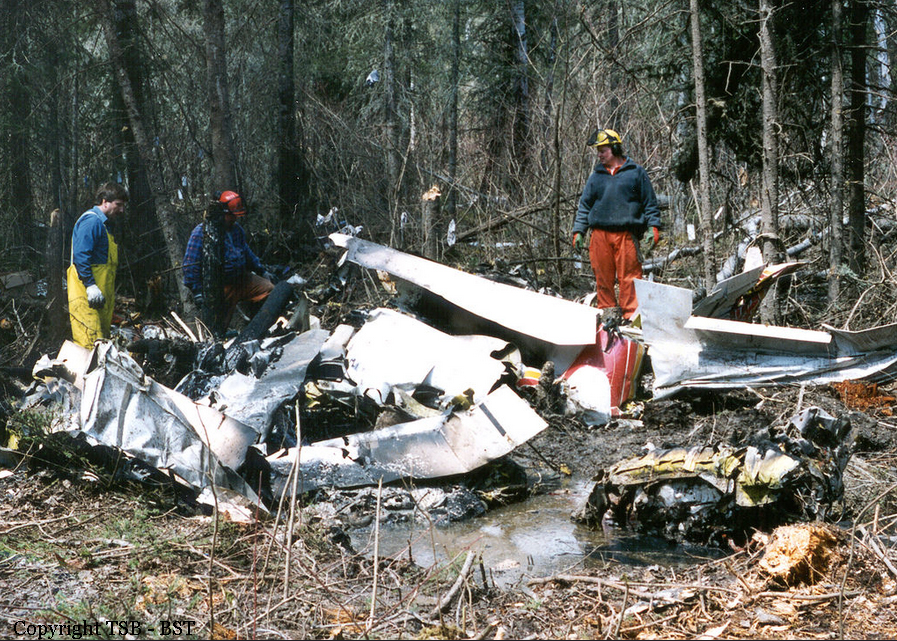
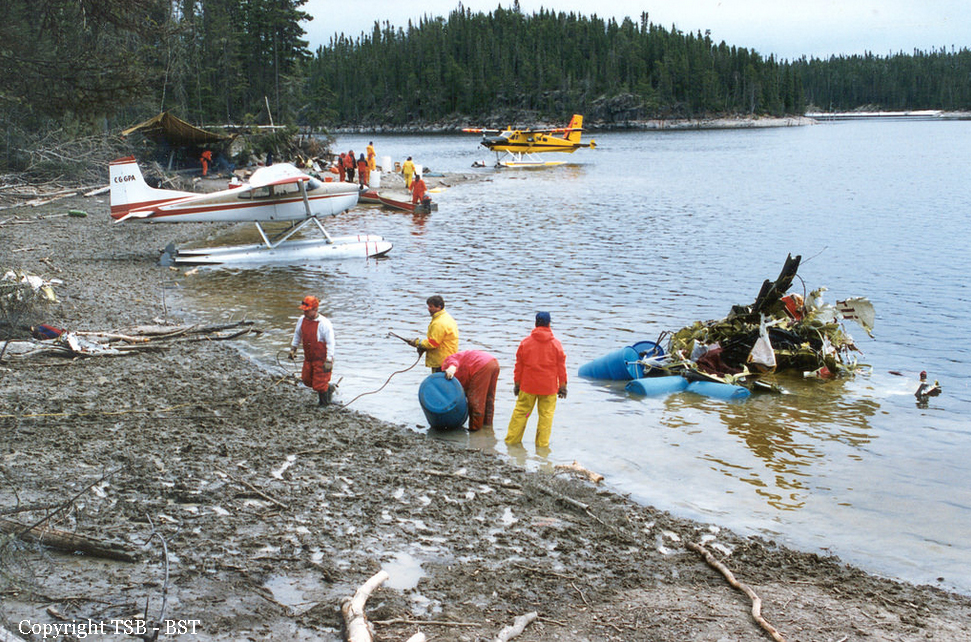
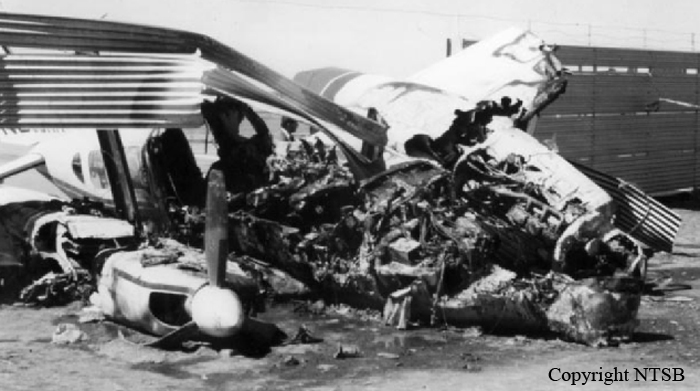
Bearskin flight 362, a Fairchild Swearingen Metro 23, departed Red Lake, Ontario, at 1300 central daylight saving time (CDT), with two pilots and one passenger on board, en route to Sioux Lookout on an instrument flight rules (IFR) flight plan. At approximately 30 nautical miles (nm) north of Sioux Lookout, the flight was cleared by the Winnipeg area control centre (ACC) for an approach to the Sioux Lookout airport. Air Sandy flight 3101, a Piper Navajo PA-31, departed Sioux Lookout at 1323 with one pilot and four passengers on board en route to Red Lake on a visual flight rules (VFR) flight. The pilot of Air Sandy 3101 reported clear of the Sioux Lookout control zone at 1326. No other communication was heard from the Air Sandy flight. At 1315 the Winnipeg ACC controller advised the Sioux Lookout Flight Service specialist that Bearskin 362 was inbound from Red Lake, estimating Sioux Lookout at 1332. At 1327, Bearskin 362 called Sioux Lookout Flight Service Station (FSS) and advised them they had been cleared for an approach and that they were cancelling IFR at 14 nm from the airport. At 1328, as Sioux Lookout FSS was giving an airport advisory to Bearskin 362, the specialist heard an emergency locator transmitter (ELT) emit a signal on the emergency frequencies. Moments later, the pilot of Bearskin 305, a Beechcraft B-99 in the vicinity of Sioux Lookout, advised the specialist that he had just seen a bright flare in the sky and that he was going to investigate. The pilot of Bearskin 305 stated that the flare had fallen to the ground and a fire was burning in a wooded area. A communications search was initiated to locate Bearskin 362, but the aircraft did not respond. A Search and Rescue aircraft from Trenton, Ontario, and an Ontario Ministry of Natural Resources (MNR) helicopter were dispatched to the site. The source of the fire was confirmed to be the Air Sandy aircraft. The MNR helicopter noticed debris and a fuel slick on a nearby lake, Lac Seul. It was later confirmed that Bearskin 362 had crashed into the lake. (See Appendix A.) The two aircraft collided in mid-air at 1328 during the hours of daylight at latitude 50º14'N and longitude 92º07'W, in visual meteorological conditions (VMC). All three persons on board the Bearskin aircraft and all five persons on board the Air Sandy aircraft were fatally injured.
Probable cause:
Neither flight crew saw the other aircraft in time to avoid the collision. Contributing to the occurrence were the inherent limitations of the see-and-avoid concept which preclude the effective separation of aircraft with high closure rates, the fact that neither crew was directly alerted to the presence of the other aircraft by the Flight Service specialist or by onboard electronic equipment, and an apparent lack of pilot understanding of how to optimize avoidance manoeuvring.
Final Report:
Crash of a Piper PA-31-350 Navajo Chieftain in Grand Canyon: 8 killed

Date & Time: Feb 13, 1995 at 1536 LT
Operator:
Registration:
N27245
Flight Phase:
Survivors:
Yes
Schedule:
Grand Canyon - Las Vegas
MSN:
31-7752121
YOM:
1977
Flight number:
6G45
Crew on board:
1
Crew fatalities:
Pax on board:
9
Pax fatalities:
Other fatalities:
Total fatalities:
8
Captain / Total flying hours:
5086
Captain / Total hours on type:
480.00
Aircraft flight hours:
13367
Circumstances:
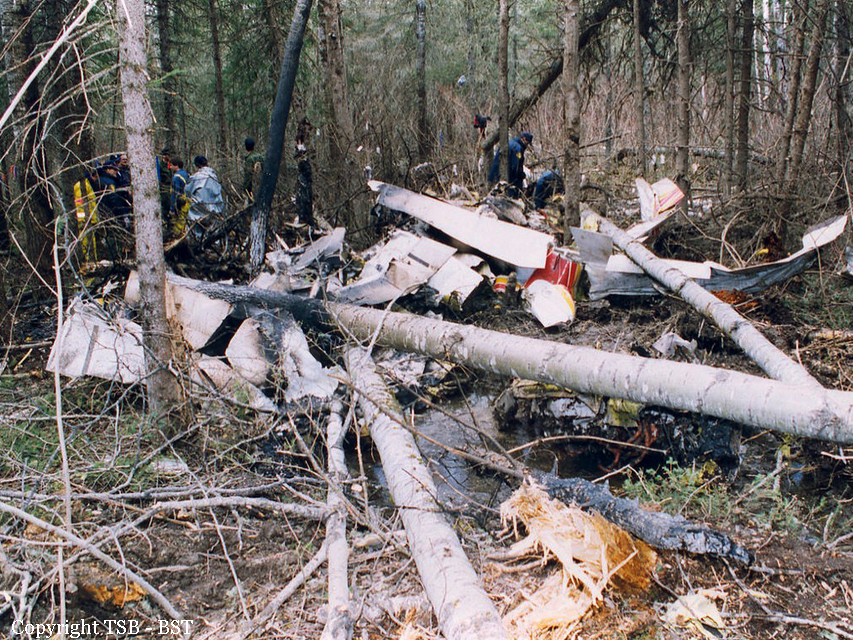
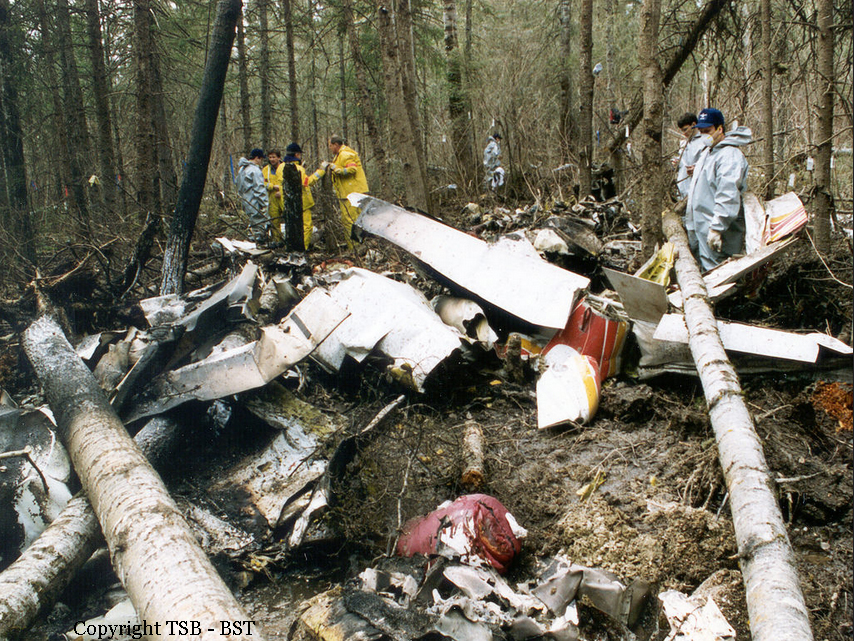
The charter flight was on a return tour trip after landing at the Grand Canyon National Park Airport. No fueling or maintenance was performed on the airplane while it sat on the ground for three hours. Shortly after takeoff from runway 21, the pilot transmitted that he had a problem and was declaring an emergency. He then stated '...I'm single engine right now....' The airplane was observed to be 100-200 feet above the terrain at the time. It continued flying for about 6 minutes, turning onto a crosswind, downwind, and then a right base leg for runway 21 before colliding with trees about 2.5 miles northeast of the airport. The airport is located in terrain that slopes upward from south to north and west to east. Winds were gusting to 29 knots. The density altitude was 6,870 feet. Examination of the suspect left engine did not reveal any evidence of failures or malfunctions. The investigation revealed deficiencies in the Federal Aviation Administration's oversight of the airline's maintenance program, and in the airline's extension of the time-in-service interval of the engines. The airline's AAIP does not require a maximum rated power check of the engines as required by the engine manufacturer's service instruction. In addition, the TBO of the engines had been extended from 1,800 to 2,400 hours.
Probable cause:
A loss of power on one engine for an undetermined reason(s), and the pilot's improper decision to return to the departure airport for landing which necessitated maneuvering over increasingly higher terrain. Factors in the accident were: the high gusting wind, the high density altitude, the rising terrain, and the reduced single-engine performance capability of the airplane under these conditions.
Final Report:

Crash of a Piper PA-31-350 Navajo Chieftain in Brownsville

Date & Time: Jan 9, 1995 at 1622 LT
Registration:
N50WT
Flight Type:
Survivors:
Yes
Schedule:
Cancún – El Paso
MSN:
31-7952018
YOM:
1979
Crew on board:
1
Crew fatalities:
Pax on board:
2
Pax fatalities:
Other fatalities:
Total fatalities:
0
Captain / Total flying hours:
87
Circumstances:
During an international cross country flight the private pilot, certificated single engine land, experienced a dual engine power loss as he was being vectored to the Brownsville Airport. Following the accident the aircraft was examined by a Federal Aviation Administration inspector who found that there was fuel in the left fuel tank and that the fuel selector was in the right tank position. The pilot had reported, prior to loss of engine power, that he had low fuel indications in the right tank and that he needed a vector to Brownsville. The aircraft was landed in rough and uneven terrain, resulting in damage to the structure and wings, approximately 1/2 mile short of the runway.
Probable cause:
The fuel starvation loss of engine power due to the pilot's improper use of the fuel tank selector. Factors were the pilot's qualification and the lack of suitable terrain for landing.
Final Report:

Crash of a Piper PA-31-350 Navajo Chieftain in Ngong Hills: 5 killed

Date & Time: Dec 6, 1994
Operator:
Registration:
5Y-SMR
Flight Phase:
Survivors:
No
Site:
Schedule:
Nairobi - Goma
MSN:
31-8252001
YOM:
1982
Location:
Country:
Region:
Crew on board:
2
Crew fatalities:
Pax on board:
3
Pax fatalities:
Other fatalities:
Total fatalities:
5
Circumstances:
Fifteen minutes after takeoff from Nairobi-Wilson Airport, while flying in marginal weather conditions, the twin engine aircraft struck the slope of a mountain located in the Ngong Hills, about 21 km southwest of Wilson Airport. The aircraft was destroyed upon impact and all five occupants were killed.
Probable cause:
Controlled flight into terrain.

Crash of a Piper PA-31-350 Navajo Chieftain in Papua: 2 killed

Date & Time: Nov 19, 1994
Operator:
Registration:
PK-IWC
Flight Phase:
Flight Type:
Survivors:
No
Site:
Schedule:
Jayapura - Oksibil
Country:
Region:
Crew on board:
2
Crew fatalities:
Pax on board:
0
Pax fatalities:
Other fatalities:
Total fatalities:
2
Circumstances:
The crew departed Jayapura-Sentani Airport on a cargo flight to Oksibil. En route, the twin engine aircraft disappeared, maybe in a mountainous area located north of Oksibil. The wreckage was never found.

Crash of a Piper PA-31-350 Navajo Chieftain in Siwandu

Date & Time: Jul 6, 1994 at 0755 LT
Operator:
Registration:
5H-ZNZ
Flight Type:
Survivors:
Yes
Schedule:
Nairobi - Siwandu
MSN:
31-7852064
YOM:
1978
Country:
Region:
Crew on board:
1
Crew fatalities:
Pax on board:
0
Pax fatalities:
Other fatalities:
Total fatalities:
0
Captain / Total flying hours:
1500
Circumstances:
After landing at Siwandu Airfield, the twin engine airplane collided with a giraffe. The animal was killed and the aircraft was destroyed. The pilot escaped uninjured.
Probable cause:
Collision with a giraffe after landing.

Crash of a Piper PA-31-350 Navajo Chieftain in Stratford: 8 killed

Date & Time: Apr 27, 1994 at 2256 LT
Operator:
Registration:
N990RA
Survivors:
Yes
Schedule:
Atlantic City - Stratford
MSN:
31-7405417
YOM:
1974
Crew on board:
1
Crew fatalities:
Pax on board:
8
Pax fatalities:
Other fatalities:
Total fatalities:
8
Captain / Total flying hours:
3500
Captain / Total hours on type:
527.00
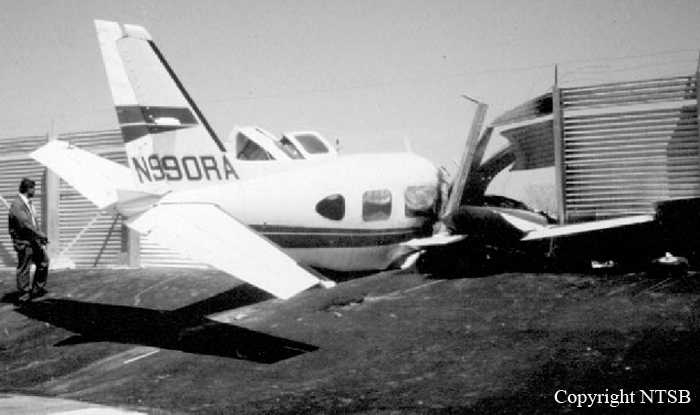
Circumstances:
The captain had ILS glideslope data available during the approach but did not fly the ILS glideslope. The partial obscuration of the airport environment, due to ground fog, contributed to the captain's failure to recognize that the airplane was high on both his approach and landing. The destruction of the airplane and the resulting occupant injuries were a direct result of the collision with the blast fence. FAA interaction and communication with local communities, although persistent, were unsuccessful in gaining support for runway safety area improvements and for the installation of approach lighting for runway 6. The passenger seats had been improperly assembled using unapproved parts, and seat belts had been installed incorrectly.
Probable cause:
The failure of the captain to use the available ILS glideslope, his failure to execute a go-around when conditions were not suitable for landing, and his failure to land the airplane at a point
sufficient to allow for a safe stopping distance; the fatalities were caused by the presence of the non frangible blast fence and the absence of a safety area at the end of the runway.
Final Report:

Crash of a Piper PA-31-350 Navajo Chieftain in Elizabethton: 2 killed

Date & Time: Apr 7, 1994 at 0810 LT
Operator:
Registration:
N64LB
Flight Type:
Survivors:
No
Schedule:
Augusta - Elizabethton
MSN:
31-7852127
YOM:
1978
Crew on board:
1
Crew fatalities:
Pax on board:
1
Pax fatalities:
Other fatalities:
Total fatalities:
2
Captain / Total flying hours:
7800
Aircraft flight hours:
2910
Circumstances:
The ATP and his passenger were en route to pick up a patient for transport to a VA hospital. The destination airport was uncontrolled, and VFR only. The pilot cancelled with ATC and reported the field in sight. The airport was reporting VFR conditions, but rising, mountainous terrain existed to the northeast, and local authorities reported that the top third of the mountain was obscured in clouds during the morning of the accident. After cancelling IFR, no subsequent radio calls were received from the flight, and the flight did not arrive at its destination. The wreckage was found several hours later near the crest of holston mountain, 1/2 mile east of the Holston mountain VOR. An examination of the wreckage indicated the aircraft impacted upsloping, wooded terrain, while at a climb angle of 8°. Disintegration of the wreckage was indicative of a high speed impact. No evidence of mechanical malfunction or failure was found during the examination of the wreckage. Both occupants were killed.
Probable cause:
The pilot's attempted VFR flight into imc conditions, and his failure to maintain a proper altitude over mountainous terrain. Factors were the clouds and obscuration at the accident site.
Final Report:

Crash of a Piper PA-31-350 Navajo Chieftain in Frazier Park: 1 killed

Date & Time: Mar 3, 1994 at 2346 LT
Operator:
Registration:
N78DE
Flight Phase:
Flight Type:
Survivors:
No
Site:
Schedule:
Burbank - Oakland
MSN:
31-7852087
YOM:
1978
Crew on board:
1
Crew fatalities:
Pax on board:
0
Pax fatalities:
Other fatalities:
Total fatalities:
1
Captain / Total flying hours:
3600
Captain / Total hours on type:
135.00
Aircraft flight hours:
9136
Circumstances:
The pilot elected not to use the stored instrument flight plan, and he departed with a special VFR clearance. The flight was being followed by radar. After reaching visual flight conditions, the pilot proceeded toward his intended destination and climbed to 8,500 feet. Minimum safe altitude warning service was available, but not requested by the pilot. A review of radar data indicates that the airplane's track remained almost constant at 300° with a 160-knot ground speed. The last radar hit on the airplane occurred about 0.3 miles from where the airplane cruised into 8,500 foot msl terrain while still tracking along a northwesterly course. The accident occurred in dark, night time conditions.
Probable cause:
The pilot's failure to select a cruise altitude which would ensure adequate terrain clearance. Contributing factors related to the dark, nighttime condition and to the pilot's lack of attentiveness.
Final Report:

Crash of a Piper PA-31-350 Navajo Chieftain in Bathurst: 2 killed

Date & Time: Jan 4, 1994 at 1845 LT
Registration:
C-GNPG
Flight Type:
Survivors:
No
Schedule:
Moncton - Bathurst
MSN:
31-7752119
YOM:
1977
Flight number:
Empress204
Country:
Crew on board:
2
Crew fatalities:
Pax on board:
0
Pax fatalities:
Other fatalities:
Total fatalities:
2
Captain / Total flying hours:
3500
Captain / Total hours on type:
2600.00
Copilot / Total flying hours:
685
Copilot / Total hours on type:
350
Aircraft flight hours:
8162
Circumstances:
At 1805 Atlantic standard time (AST), C-GNPG, a Piper Navajo Chieftain operating as Empress 204, departed Moncton, New Brunswick, on a scheduled courier flight to Bathurst. The aircraft carried a two-pilot crew, and there was no cargo on board. The aircraft proceeded direct to Bathurst at 8,000 feet above sea level (asl) and at 1820 AST was cleared by Moncton Area Control Centre (ACC) for an approach at Bathurst. The co-pilot contacted the Bathurst UNICOM and advised the operator that the crew would be flying the non-directional beacon/distance measuring equipment (NDB/DME) runway 10 approach. During the non-precision instrument approach to runway 10, the aircraft struck trees .75 nautical miles (nm) inside the Bathurst beacon and 3.75 nm from the airport. The accident occurred at approximately 1845 AST, during the hours of darkness in instrument meteorological conditions, at an elevation of 450 feet asl. Both pilots were killed.
Probable cause:
The crew of Empress 204 allowed the aircraft to descend below the minimum descent altitude for the approach.
Final Report: