Crash of a Piper PA-31-350 Navajo Chieftain in Hayden: 1 killed

Date & Time: Oct 28, 1998 at 0858 LT
Operator:
Registration:
N35533
Flight Type:
Survivors:
No
Schedule:
Colorado Springs - Hayden
MSN:
31-8052047
YOM:
1980
Crew on board:
1
Crew fatalities:
Pax on board:
0
Pax fatalities:
Other fatalities:
Total fatalities:
1
Captain / Total flying hours:
1800
Captain / Total hours on type:
375.00
Aircraft flight hours:
12411
Circumstances:
The Part 135 cargo flight was approaching its destination on an IFR flight plan. The pilot had requested the ILS-DME approach to runway 10, but 2 minutes later, he changed his request to the VOR-B approach to runway 28. ARTCC cleared him for the approach to the non-towered airport. The pilot contacted the airport's Unicom, and requested that the ramp personnel be standing by with fuel and oxygen. The airplane was found 5.8 nm from the approach end of runway 28, at 7,900 feet. The approach minimums for the VOR-B was 7,900 feet, which the pilot could descend to at 8.7 nm. The VOR was located 285 degrees at 13.6 nm from the accident site, and the ILS-DME transmitter was located 285 degrees at 5.6 nm from the accident site. The airplane was equipped with a single DME display head, and it had a Nav 1/Nav 2 selector switch.
Probable cause:
The pilot not following instrument procedures and subsequently descended to minimums prematurely. Factors were the mountainous terrain and the falling snow.
Final Report:


Crash of a Piper PA-31-350 Navajo Chieftain in Johannesburg

Date & Time: Oct 21, 1998 at 0310 LT
Operator:
Registration:
ZS-NHM
Flight Phase:
Flight Type:
Survivors:
Yes
Schedule:
Johannesburg - Windhoek
MSN:
31-8052035
YOM:
1980
Country:
Region:
Crew on board:
1
Crew fatalities:
Pax on board:
1
Pax fatalities:
Other fatalities:
Total fatalities:
0
Captain / Total flying hours:
1020
Captain / Total hours on type:
350.00
Circumstances:
The aircraft was loaded with cargo intended for Namibia, early the morning of the accident. The pilot reported that the right-hand engine suffered a loss of power at the point where he rotated the aircraft for take-off. During the attempt to abort the take-off the aircraft skidded over the end of the runway and crashed down an embankment. The pilot and his passenger escaped with minor injuries, but the aircraft was subsequently destroyed by the post impact fire.
Probable cause:
During the investigation it was found that the aircraft was overloaded.
Final Report:

Crash of a Piper PA-31-350 Navajo Chieftain in Ravenna

Date & Time: Oct 8, 1998 at 0255 LT
Operator:
Registration:
N3543A
Flight Type:
Survivors:
Yes
Schedule:
Detroit – Ravenna
MSN:
31-7952242
YOM:
1979
Crew on board:
1
Crew fatalities:
Pax on board:
0
Pax fatalities:
Other fatalities:
Total fatalities:
0
Captain / Total flying hours:
2370
Captain / Total hours on type:
80.00
Aircraft flight hours:
10112
Circumstances:
The pilot departed on a night multiple-leg flight series with full tanks. On approach for the second landing, the green landing gear lights extinguished. The pilot discovered that if the landing gear was extended the circuit breaker would stay in and if the landing gear was retracted the circuit breaker would pop. The circuit breaker controlled the landing gear lights, the engine oil pressure, and both fuel quantity gauges. The pilot continued on four additional flights in that condition. The fourth flight terminated 5 miles from the runway with a double power loss. Examination revealed the fuel tanks were empty. The pilot had flown the airplane 4.3 hours including 6 takeoffs, one missed approach, and a 20 minute ground run prior to departure with both engines running on the final flight.
Probable cause:
The pilot's improper decision to continue to operate the airplane with inoperative equipment which resulted in fuel exhaustion. Factors were the inoperative fuel quantity gauges, and the night conditions.
Final Report:

Crash of a Piper PA-31-350 Navajo Chieftain off Homer

Date & Time: Sep 7, 1998 at 1513 LT
Registration:
N4072A
Flight Phase:
Survivors:
Yes
Schedule:
Homer - Anchorage
MSN:
31-8152016
YOM:
1981
Location:
Crew on board:
1
Crew fatalities:
Pax on board:
0
Pax fatalities:
Other fatalities:
Total fatalities:
0
Captain / Total flying hours:
9070
Captain / Total hours on type:
2000.00
Aircraft flight hours:
4133
Circumstances:
The pilot departed from an intersection 2,100 feet from the approach end of the 6,700 feet long runway. Immediately after takeoff the right engine failed. The pilot told the NTSB investigator-in-charge that he feathered the right propeller, and began a wide right turn away from terrain in an attempt to return to the airport. He stated the airspeed did not reach 90 knots, the airspeed and altitude slowly decayed, and the airplane was ditched into smooth water. After recovery, the cowl flaps were found in the 50% open position. No anomalies were found with the fuel system. The airplane departed with full fuel tanks, at a takeoff weight estimated at 6,606 pounds. The right engine was disassembled and no mechanical anomalies were noted. The best single engine rate of climb airspeed is 106 knots, based on cowl flaps closed, and a five degree bank into the operating engine.
Probable cause:
A total loss of power in the right engine for undetermined reasons.
Final Report:

Crash of a Piper PA-31-350 Navajo Chieftain off Jersey: 1 killed

Date & Time: Jun 12, 1998 at 1842 LT
Operator:
Registration:
CN-TFP
Flight Type:
Survivors:
No
Schedule:
Tangier - Saint Peter
MSN:
31-7552086
YOM:
1975
Region:
Crew on board:
1
Crew fatalities:
Pax on board:
0
Pax fatalities:
Other fatalities:
Total fatalities:
1
Captain / Total flying hours:
9100
Aircraft flight hours:
5253
Circumstances:
The pilot, sole on board, departed Tangier on a delivery flight to Saint Peter-La Villiaze, Guernsey Island, where the aircraft should be taken over by another crew to be ferried to Iceland. While approaching the Channel Islands, the pilot informed ATC about technical problems and elected to divert to Jersey Airport. Shortly later, after both engines stopped due to a fuel exhaustion, the plane lost height and crashed in the sea about 3 nm northwest of Jersey Island. The aircraft was destroyed and the pilot was killed.
Probable cause:
The following causal factors were identified:
- The commander had not made an appropriate allowance for adverse headwind components before or during the flight.
- The aircraft was not carrying sufficient fuel for the intended flight.
- The commander apparently ignored pre-flight and in-flight indications that he should land and refuel in France.
- The commander's chances of survival were adversely affected by not adopting the optimum configuration and heading for ditching.
Final Report:

Crash of a Piper PA-31-350 Navajo Chieftain in La Grande-3

Date & Time: May 14, 1998 at 0947 LT
Operator:
Registration:
C-GUVK
Survivors:
Yes
Schedule:
Montreal – Rouyn – La Grande Rivière
MSN:
31-7405451
YOM:
1974
Country:
Crew on board:
2
Crew fatalities:
Pax on board:
2
Pax fatalities:
Other fatalities:
Total fatalities:
0
Captain / Total flying hours:
1560
Captain / Total hours on type:
60.00
Copilot / Total flying hours:
265
Copilot / Total hours on type:
15
Circumstances:
At 0525 eastern daylight time, a Piper Navajo PA-31, registration C-GUVK, serial number 31-7405451, with two pilots on board, took off from Dorval Airport, Quebec, on a three-day charter flight. Two passengers boarded at Rouyn, Quebec, travelling to La Grande Rivière, Quebec. All flight segments over the three-day period were planned in accordance with instrument flight rules. At La Grande Rivière, the aircraft completed a VOR/DME approach to runway 31, but could not land due to weather. A missed approach was executed, and the aircraft proceeded toward the alternate airport, La Grande 4. About 15 nautical miles north of La Grande 3, the engines misfired. The fuel selector lever was reselected, and the engines operated normally for about five minutes, and then stopped. The pilot-in-command declared an emergency and proceeded toward La Grande 3 Airport for an LOC/DME approach to runway 29. The aircraft broke through the cloud layer at approximately 300 feet above ground level and the pilot set the aircraft down in some trees beside a small lake, four nautical miles southeast of La Grande 3 Airport. The accident occurred at 0957. One of the two passengers sustained minor leg injuries. The other occupants were uninjured. They were rescued by helicopter approximately 45 minutes later. The aircraft sustained substantial damage.
Probable cause:
The crew did not refuel at Rouyn as planned, and did not have sufficient fuel to complete the segment. Contributing to the accident were the following: the crew did not fully understand the flight plan documents and did not calculate fuel consumption en route.
Final Report:

Crash of a Piper PA-31-350 Navajo Chieftain near Novato: 1 killed

Date & Time: Mar 5, 1998 at 1905 LT
Operator:
Registration:
N257NW
Flight Phase:
Flight Type:
Survivors:
No
Site:
Schedule:
Santa Rosa - Oakland
MSN:
31-7952014
YOM:
1979
Flight number:
APC263
Crew on board:
1
Crew fatalities:
Pax on board:
0
Pax fatalities:
Other fatalities:
Total fatalities:
1
Captain / Total flying hours:
4300
Aircraft flight hours:
6881
Circumstances:
The airplane was on a VFR dusk cross-country flight when it collided with the 1,500-foot level of a hill. Radar data showed the aircraft in a descent from 2,000 feet until radar contact was lost about 1,500 feet msl, with a final ground speed of 194 knots. The route taken by the pilot was about 5 miles west of the route that the company pilots routinely flew, but while crossing higher terrain, it was a more direct route to the destination. A company pilot flying a few minutes ahead of the accident flight reported it was necessary to descend to between 1,200 and 1,500 feet msl in order to maintain VFR. A low-pressure system approaching the area from the west had resulted in low stratus, rain, and fog. At the time of the accident, a nearby weather reporting facility reported a 1,300-foot broken ceiling with 5- to 6-mile visibility in light rain and mist. On the evening of the accident, the pilot was scheduled to give a speech as her final examination in an evening college course. She had informed the instructor that she might be late, but had been told that he could not hold the class past its scheduled dismissal time to accommodate her late arrival.
Probable cause:
The pilot's failure to maintain adequate terrain clearance after initiating a descent over mountainous terrain at night and under marginal VFR conditions. The pilot's self-induced pressure to arrive at class with enough time remaining to take the final examination was a factor in the accident.
Final Report:

Crash of a Piper PA-31-350 Navajo Chieftain in Sanikiluaq

Date & Time: Jan 20, 1998
Operator:
Registration:
C-FDNF
Flight Phase:
Survivors:
Yes
Schedule:
Sanikiluaq – Iqaluit
MSN:
31-8252042
YOM:
1982
Country:
Crew on board:
2
Crew fatalities:
Pax on board:
2
Pax fatalities:
Other fatalities:
Total fatalities:
0
Captain / Total flying hours:
2800
Captain / Total hours on type:
1000.00
Circumstances:
The Piper Navajo Chieftain PA-31-350, serial number 31-8252042, was on an instrument flight rules (IFR) flight from Sanikiluaq to Iqaluit, Northwest Territories. Two pilots and two passengers were on board. After checking the runway condition and weather, the pilot commenced his take-off run on runway 27. After take-off, the pilot saw flames coming out of the right engine cowl. The right engine was shut down but the aircraft could not maintain a sufficient rate of climb, and it crashed on flat, snow-covered ground about one mile from the end of the runway. The aircraft sustained substantial damage on landing. After the aircraft came to a stop, the occupants evacuated via the left front door and walked back to the airport terminal for shelter and assistance. There were no injuries. The occurrence happened at night in instrument meteorological conditions.
Probable cause:
A modification to the cabin heating unit inconsistent with the manufacturer's recommendations and aviation regulations caused an engine fire in the right engine cowl during the initial climb. The pilot shut down the engine, but the aircraft could not maintain a positive rate of climb and crashed to the ground.
Final Report:

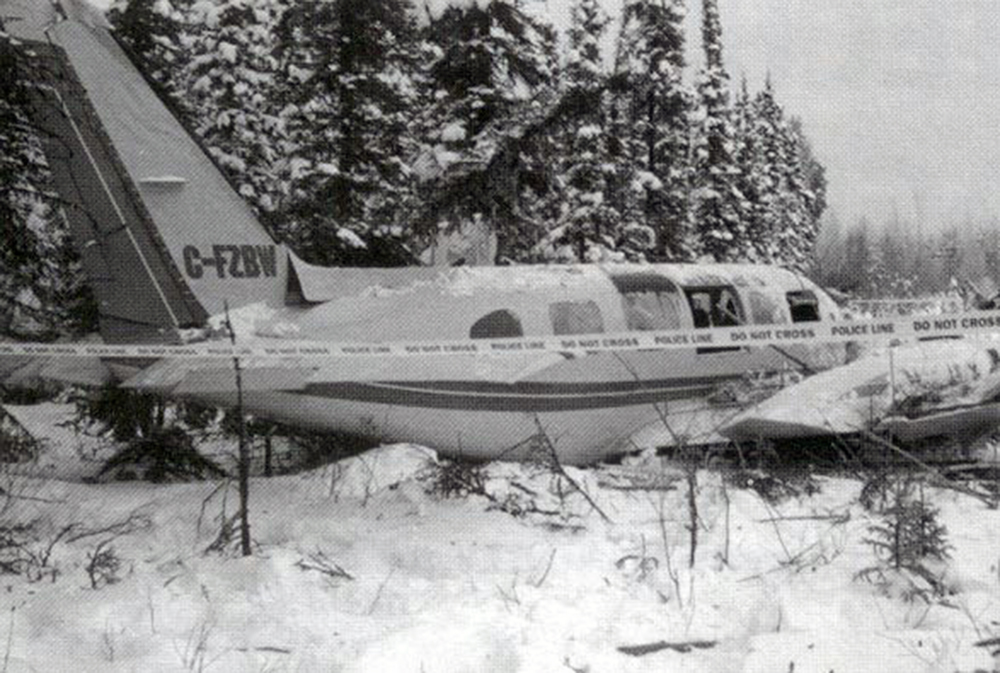
Crash of a Piper PA-31-350 Navajo Chieftain in Rainbow Lake

Date & Time: Jan 15, 1998 at 1935 LT
Registration:
C-FZBW
Flight Phase:
Survivors:
Yes
Schedule:
Rainbow Lake – High Level – Edmonton – Calgary
MSN:
31-8152096
YOM:
1981
Country:
Crew on board:
2
Crew fatalities:
Pax on board:
7
Pax fatalities:
Other fatalities:
Total fatalities:
0
Captain / Total flying hours:
3700
Captain / Total hours on type:
93.00
Copilot / Total flying hours:
632
Copilot / Total hours on type:
277
Circumstances:
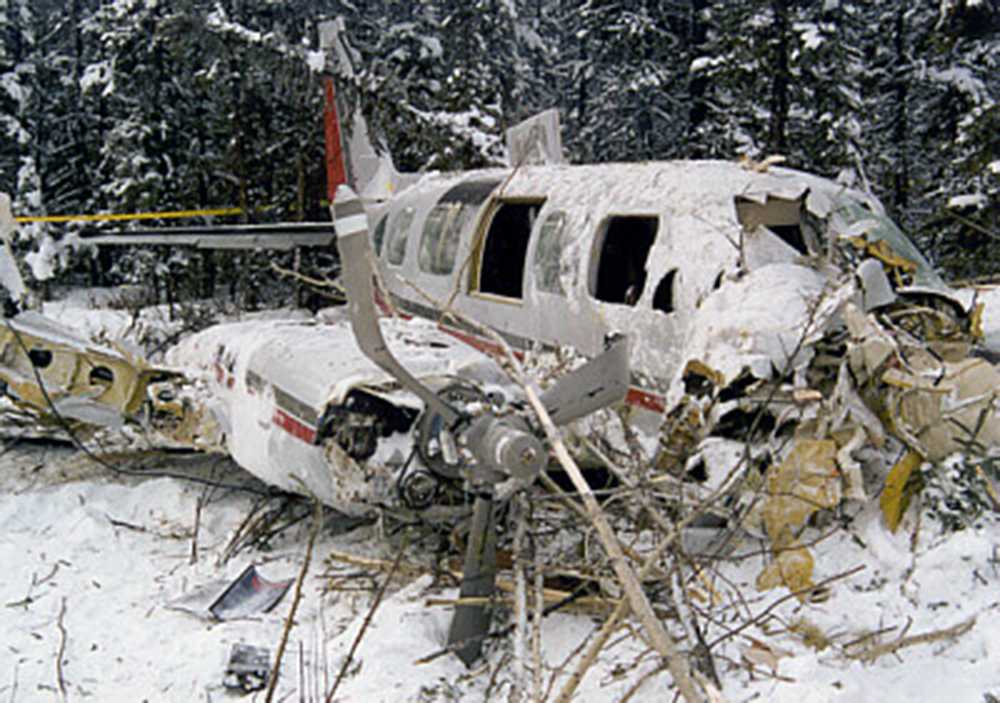
The Airco Aircraft Charters Piper PA-31-350 Chieftain, serial number 31-8152096, had been chartered by Northern Sky Aviation to complete a daily passenger flight from the Edmonton City Centre Airport to High Level, Rainbow Lake, Edmonton, and Calgary, Alberta. The flight from Edmonton to High Level and Rainbow Lake was uneventful. Following a routine landing and turn around, the aircraft departed Rainbow Lake in darkness, at 1935 mountain standard time (MST), on an instrument flight rules (IFR) flight to Edmonton. Shortly after take-off from runway 27, the aircraft collided with trees and terrain approximately 3 000 feet west of the departure end of the runway. The nine occupants sustained minor injuries and the aircraft was substantially damaged. Immediately following the evacuation of the aircraft, a Rainbow Lake passenger initiated the local emergency response by cell phone. Volunteer ground rescue personnel organized a snowmobile search, and a helicopter was dispatched from the airport to conduct an aerial search. The ground search was hampered by darkness, dense forest, cold temperatures, and deep snow. The helicopter pilot located the aircraft wreckage on his first pass over the departure corridor and, following his immediate return to the airport, he lead the ground rescuers to the accident site. Rescuers reached the accident site approximately one and one-half hours after the occurrence and assisted all of the survivors to the Rainbow Lake nursing station.
Probable cause:
The aircraft was inadvertently flown into trees and the ground, in controlled flight and dark ambient conditions, during a night departure because a positive rate of climb was not maintained after take off. Factors contributing to the accident were the pilot’s concentrating on blue line speed rather than maintaining a positive rate of climb, the dark ambient conditions, a departure profile into rising terrain, an overweight aircraft, and crew resource mismanagement.
Final Report:

Crash of a Piper PA-31-350 Navajo Chieftain in Manila

Date & Time: Jan 9, 1998 at 1935 LT
Operator:
Registration:
N4111M
Flight Phase:
Flight Type:
Survivors:
Yes
Schedule:
Manila - Saipan
MSN:
31-8352001
YOM:
1983
Country:
Region:
Crew on board:
2
Crew fatalities:
Pax on board:
0
Pax fatalities:
Other fatalities:
Total fatalities:
0
Circumstances:
On January 9, 1998, at 1935 hours Philippines local time, a Piper PA-31, N4111M, reportedly experienced a loss of engine power and crashed at the Ninoy Aquino International Airport, Manila, Philippines. The aircraft was substantially damage the airline transport rated pilot and copilot were not injured. Visual meteorological conditions existed for the night ferry flight to Saipan in the Marianas, and an instrument flight rules (IFR) flight plan had been filed. The pilot stated that after completing a preflight they had been cleared to taxi to the active runway. The pilot requested a full length takeoff from runway 06. Approximately 75 feet after lifting off from the ground, the pilot requested that the copilot retract the landing gear. The pilot reported that shortly after the landing gear was raised the aircraft yawed sharply to the right. He lowered the nose to regain some of the airspeed that was lost due to the right yaw. He stated that they were losing airspeed and altitude quickly, and asked the copilot to extend the landing gear. The pilot reported that on landing he had the power on until they contacted the runway. The aircraft slid to the left and came to rest after striking a concrete ditch. A test flight of the accident aircraft had been conducted 2 days and on the day before the accident. The purpose of the test flights were to check the propellers that had been overhauled, and to obtain a ferry permit from the Federal Aviation Administration's Designated Airworthiness Representative (DAR). The DAR found the aircraft to be within required specifications. He made the appropriate entry into the aircraft's logbook and issued the ferry authorization.