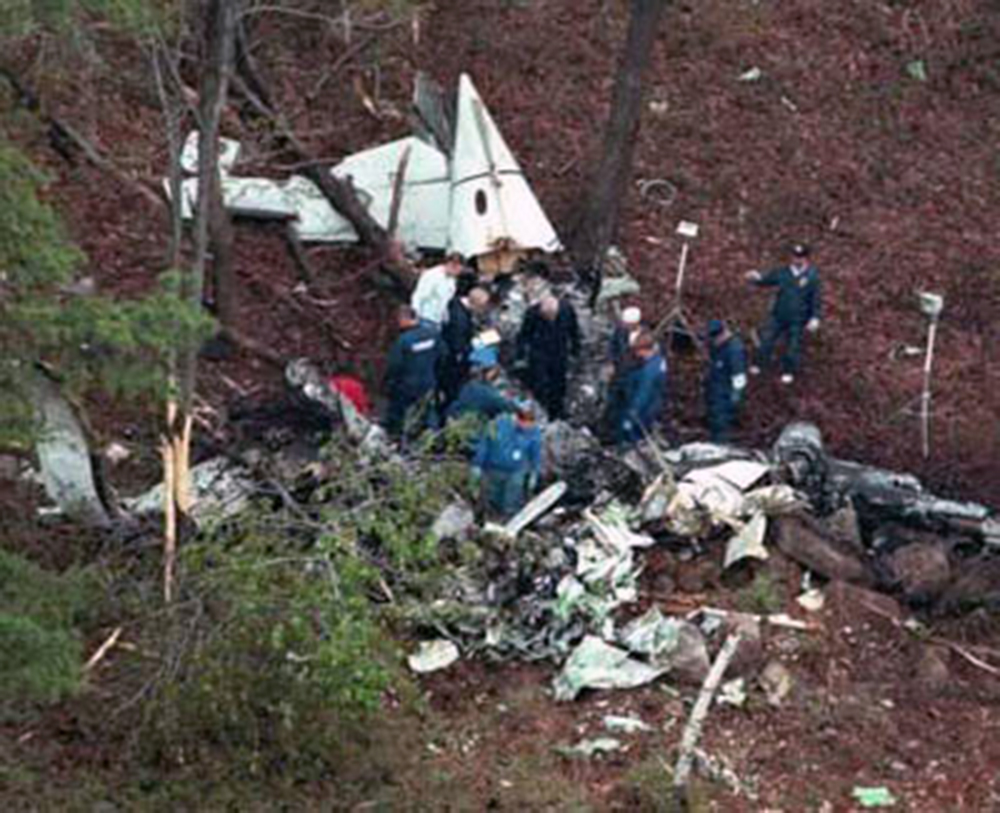
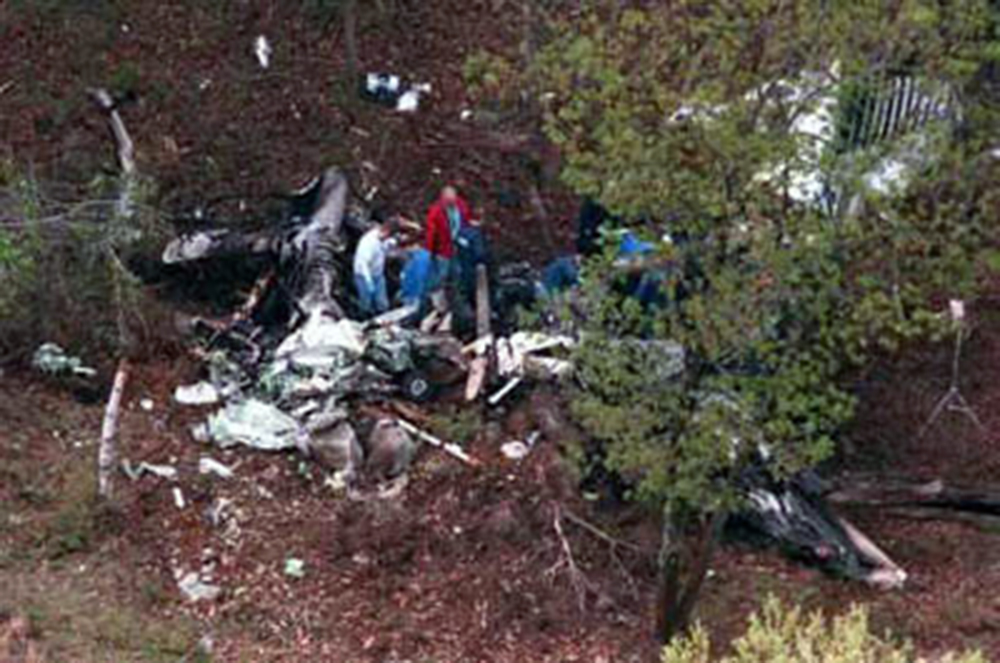
Crash of a Grumman G-159 Gulfstream I in Linneus: 2 killed

Date & Time: Jul 19, 2000 at 0031 LT
Type of aircraft:
Registration:
C-GNAK
Flight Phase:
Flight Type:
Survivors:
No
Schedule:
Moncton - Montreal
MSN:
154
YOM:
1965
Flight number:
AWV9807
Location:
Crew on board:
2
Crew fatalities:
Pax on board:
0
Pax fatalities:
Other fatalities:
Total fatalities:
2
Captain / Total flying hours:
6000
Captain / Total hours on type:
500.00
Copilot / Total flying hours:
600
Copilot / Total hours on type:
300
Aircraft flight hours:
22050
Aircraft flight cycles:
15452
Circumstances:
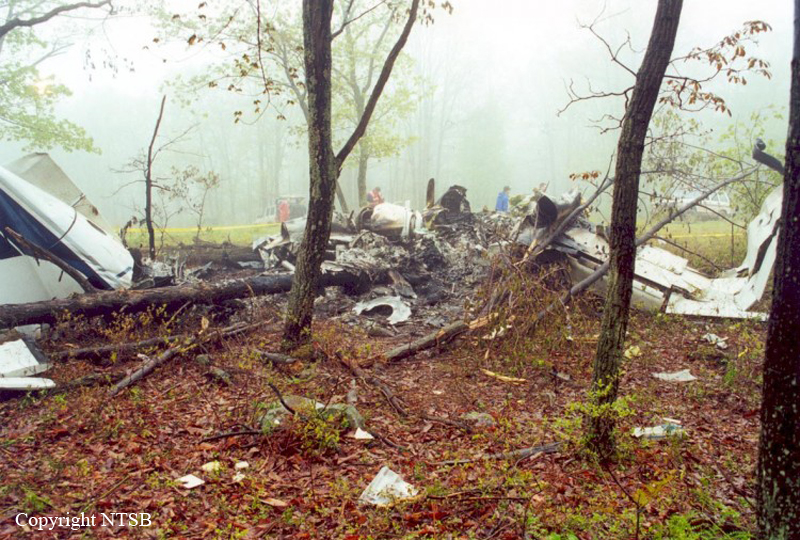
The airplane was in cruise flight at 16,000 feet, in instrument meteorological conditions. About two minutes after the crew ceased cross-feeding due to a fuel imbalance, the left engine experienced a total loss of power. About one minute later, the co-pilot indicated to the pilot-in-command (PIC) that the airplane was losing airspeed, and about 15 seconds later, the co-pilot remarked "keep it up, keep it up." Shortly thereafter, the airplane departed controlled flight and impacted terrain. The airplane was destroyed by fire and impact forces. Examination of the left engine revealed no evidence of any pre-impact failures that would have accounted for an uncommanded in-flight shut-down. A SIGMET for potential severe clear icing was effective for airplane's flight path; however, the flight crew did not report or discuss any weather related problems around the time of the accident. At the time of the accident, the airplane was above its single-engine service ceiling. The PIC had accumulated approximately 6,000 hours of total flight experience, of which, about 500 hours were as PIC in make and model. The co-pilot had approximately 600 hours of total fight experience, of which, 300 hours were in make and model.
Probable cause:
The pilot-in-command's failure to maintain minimum control airspeed, which resulted in a loss of control. Factors in this accident were clouds, and a loss of engine power for undetermined reasons, while in cruise flight above the airplane's single engine service ceiling.
Final Report:

Crash of a Douglas B-26C-25-DT Invader in Grande Prairie

Date & Time: Jun 29, 2000 at 2219 LT
Type of aircraft:
Operator:
Registration:
CF-EZX
Flight Type:
Survivors:
Yes
Schedule:
Loon River - La Biche Lake - Grand Prairie
MSN:
18807
YOM:
1943
Country:
Crew on board:
1
Crew fatalities:
Pax on board:
0
Pax fatalities:
Other fatalities:
Total fatalities:
0
Circumstances:
The pilot, sole on board, departed Loon River Airport on a fire fighting mission to La Biche Lake under callsign Tanker 3. While returning to Grand Prairie Airport, on final approach to runway 25, both engines failed almost simultaneously. The pilot attempted an emergency landing when the aircraft crashed 3 km short of runway. The pilot was injured and the aircraft was damaged beyond repair.
Probable cause:
Double engine failure on final approach due to a fuel exhaustion.

Crash of a Learjet 55 Longhorn in Boca Raton: 3 killed

Date & Time: Jun 23, 2000 at 1141 LT
Type of aircraft:
Operator:
Registration:
N220JC
Flight Phase:
Flight Type:
Survivors:
No
Site:
Schedule:
Boca Raton - Fort Pierce
MSN:
55-050
YOM:
1982
Crew on board:
2
Crew fatalities:
Pax on board:
1
Pax fatalities:
Other fatalities:
Total fatalities:
3
Captain / Total flying hours:
15180
Aircraft flight hours:
8557
Circumstances:
The Learjet departed from an uncontrolled airport about 2 minutes before the accident on a on a VFR climb and was not talking to ATC. The Extra EA-300S departed VFR from a controlled airport and requested and received a frequency change from the control tower 2 minutes after departure. Review of radar data revealed that the Extra climbed to 2,500 feet on a heading of 346 degrees before descending to 2,400 at 1141:25. The Learjet was observed on radar in a right crosswind departure passing through 700 feet on a heading of 242 degrees at 1141:02. At 1141:16, the Learjet was at 1,400 feet heading 269. At 1141:30, the Extra is observed on radar at 2,400 feet, in a right turn heading 360 degrees. The Learjet is observed on radar at 1141:28 in a climbing left turn passing through 2,300 feet. The last radar return on both aircraft was at 1141:30.
Probable cause:
The failure of the pilot's of both airplanes to maintain a visual lookout (while climbing and maneuvering) resulting in an in-flight collision and subsequent collision with residences and terrain.
Final Report:

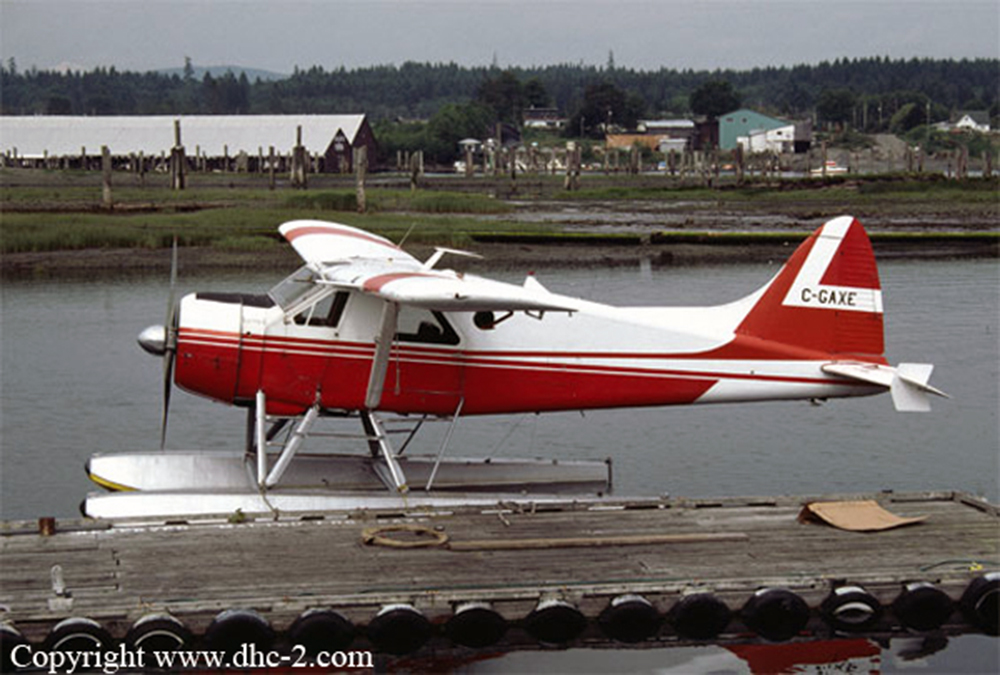
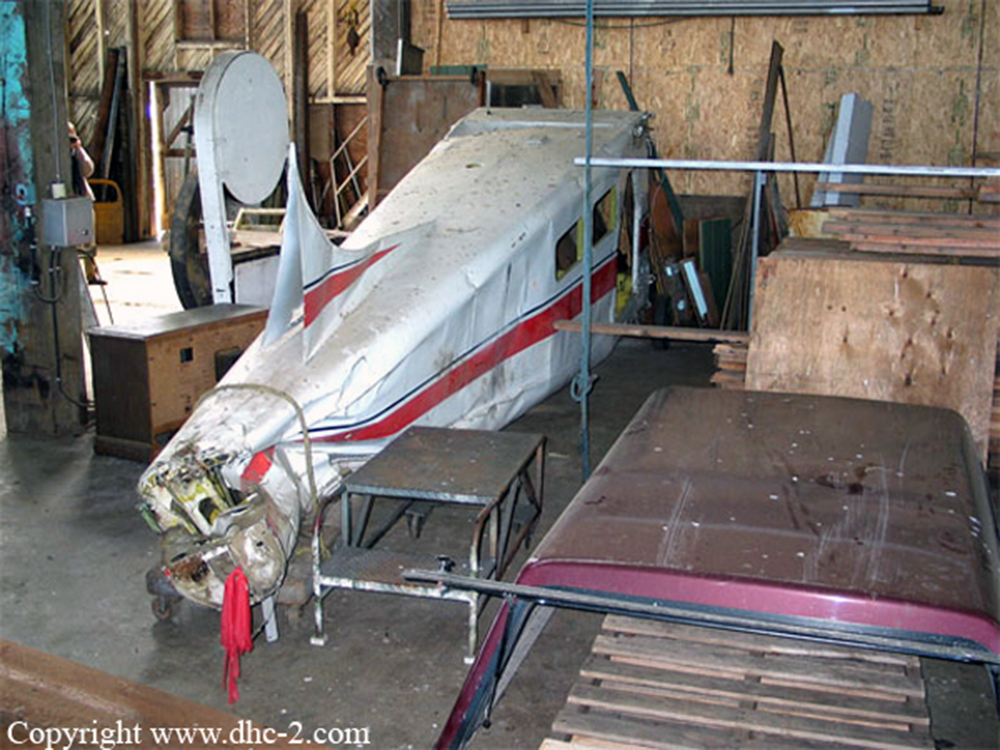
Crash of a De Havilland DHC-2 Beaver in Hotnarko Lake: 3 killed

Date & Time: Jun 19, 2000 at 1630 LT
Type of aircraft:
Registration:
C-GAXE
Flight Phase:
Survivors:
Yes
Schedule:
Hotnarko Lake - Nimpo Lake
MSN:
841
YOM:
1955
Country:
Crew on board:
1
Crew fatalities:
Pax on board:
5
Pax fatalities:
Other fatalities:
Total fatalities:
3
Captain / Total hours on type:
150.00
Circumstances:
The de Havilland DHC-2 (Beaver) floatplane, serial number 841, departed Hotnarko Lake, British Columbia, at about 1630 Pacific daylight time. The pilot and six passengers were on board, with fishing gear and fish. Soon after take-off, the pilot entered a left turn. Before the turn was completed, the aircraft rolled, without command, further left to about 40 degrees of bank and the nose dropped. The aircraft did not respond to initial pilot inputs and continued in a left, diving turn toward the trees at the edge of the lake. The pilot tried to get the aircraft back onto the lake. The aircraft started to recover from the bank and the nose started to come up; however, the aircraft struck the lake surface before a level attitude could be regained. It broke apart on contact with the water and sank soon after. The pilot and four of the passengers managed to free themselves from the wreckage, but only three passengers and the pilot managed to swim to shore. One passenger slipped below the water surface before reaching the shore and drowned. Two passengers remained in the aircraft below the water surface, one secured by his seat belt, and drowned.
Probable cause:
Findings as to Causes and Contributing Factors:
1. When the pilot entered a turn, the combined effects of the increased g-forces, power reduction, the aircraft=s heavy weight, the aft CofG, retraction of the flaps, and the wind conditions resulted in
the aircraft stalling. The aircraft struck the lake surface before the pilot was able to re-establish a level-flight attitude.
2. The aircraft was operating in excess of 385 pounds above the maximum gross takeoff weight, and the CofG was about 2.7 inches aft of the aft limit. This loading configuration aggravated the stall characteristics of the aircraft.
3. The pilot reduced power and raised the flaps before the climb was complete, contrary to the Pilot Operating Handbook, thereby increasing the aircraft's stall speed.
Other Findings:
1. The shoulder harnesses worn by the pilot and the front passenger likely prevented serious head injuries.
2. The centre seat broke from its footings. This may have incapacitated the two passengers inside the aircraft or impeded their escape.
Final Report:

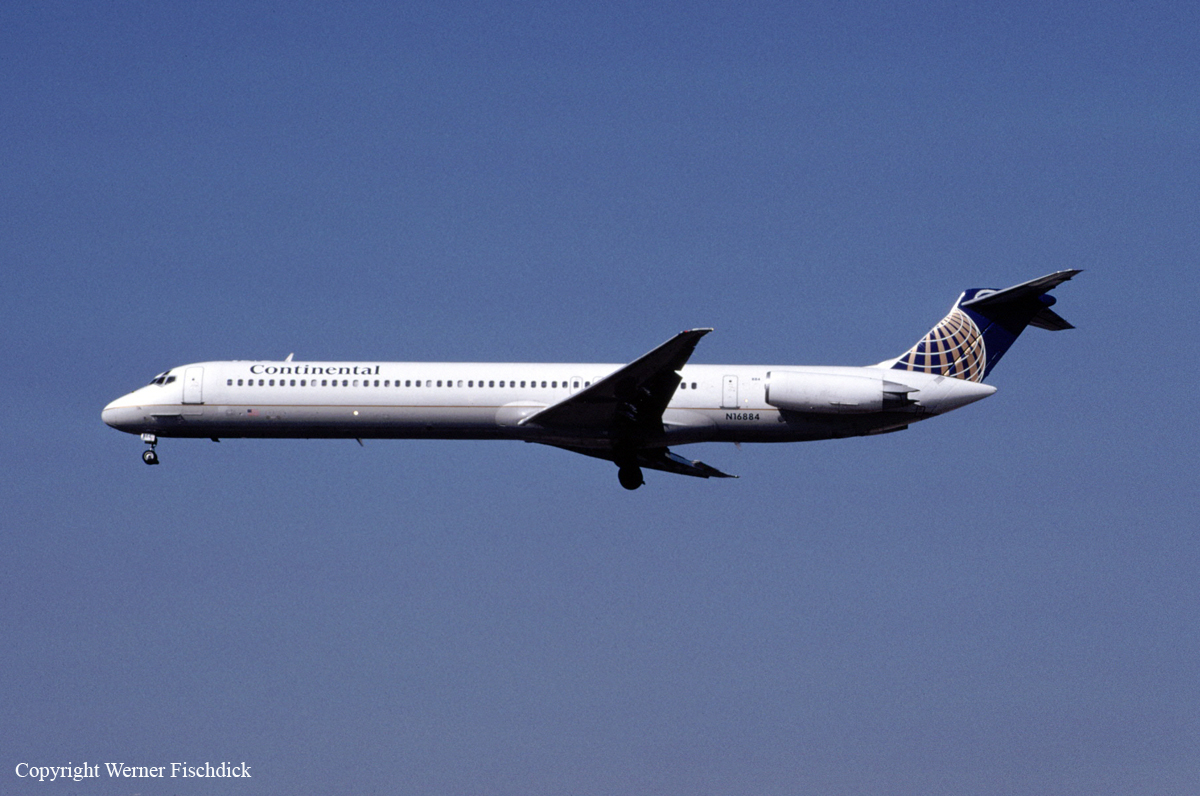
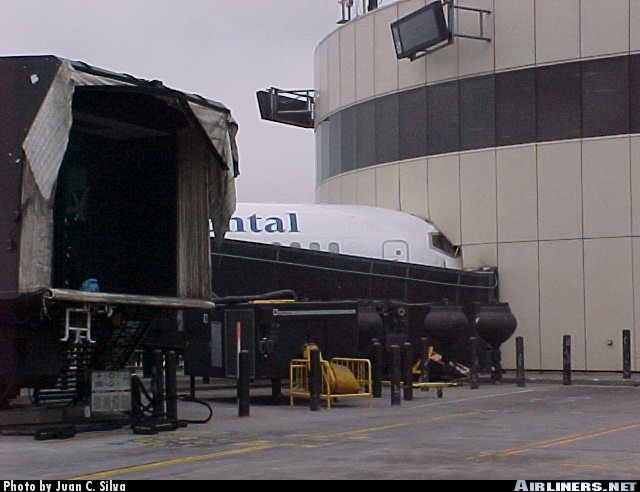
Ground accident of a McDonnell Douglas MD-81 in Newark

Date & Time: Jun 14, 2000 at 1700 LT
Type of aircraft:
Operator:
Registration:
N16884
Flight Phase:
Survivors:
Yes
Schedule:
Newark - Detroit
MSN:
48074
YOM:
1981
Flight number:
CO481
Crew on board:
1
Crew fatalities:
Pax on board:
6
Pax fatalities:
Other fatalities:
Total fatalities:
0
Aircraft flight hours:
45834
Aircraft flight cycles:
36189
Circumstances:
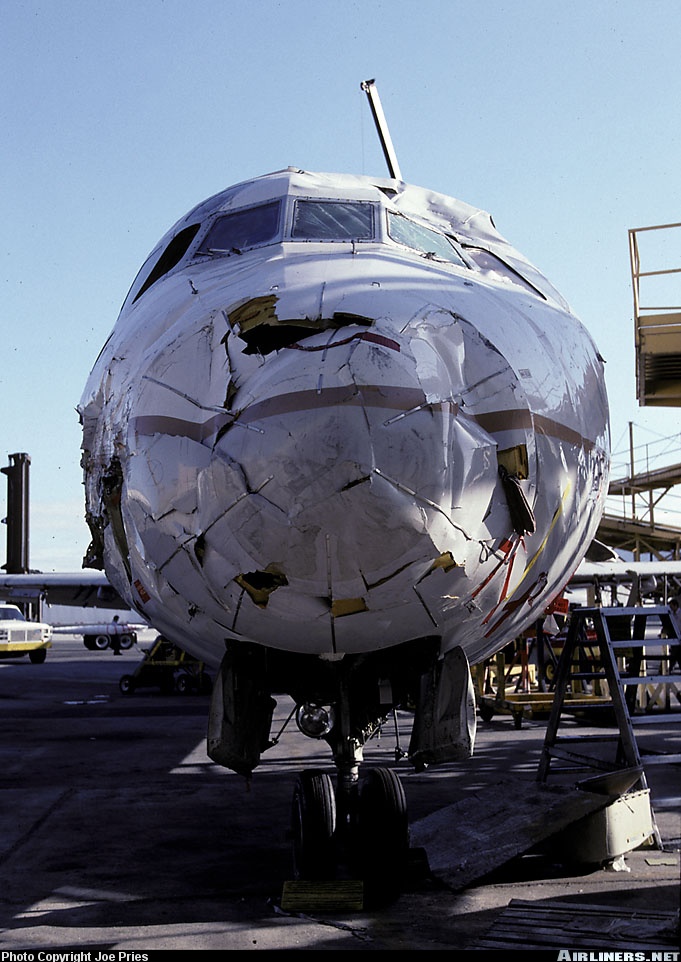
The aircraft was parked at gate C115 awaiting for passengers on a flight (service CO481) from Newark to Detroit-Wayne County Airport. In unclear circumstances, a pilot attempted to make an engine run test while six employees were cleaning the cabin. The aircraft moved forward and collided with the main terminal, suffering major structural damages. There were no injuries among the seven occupants while the aircraft was damaged beyond repair.
Probable cause:
No investigations were conducted by NTSB on this event.

Crash of a Dassault Falcon 20E in Peterborough

Date & Time: Jun 13, 2000 at 2250 LT
Type of aircraft:
Operator:
Registration:
N184GA
Flight Type:
Survivors:
Yes
Schedule:
Louisville – Marion – Detroit – Peterborough
MSN:
266
YOM:
1972
Flight number:
GAE184
Country:
Crew on board:
2
Crew fatalities:
Pax on board:
0
Pax fatalities:
Other fatalities:
Total fatalities:
0
Captain / Total flying hours:
11800
Captain / Total hours on type:
9400.00
Copilot / Total flying hours:
2300
Copilot / Total hours on type:
150
Aircraft flight hours:
15798
Circumstances:
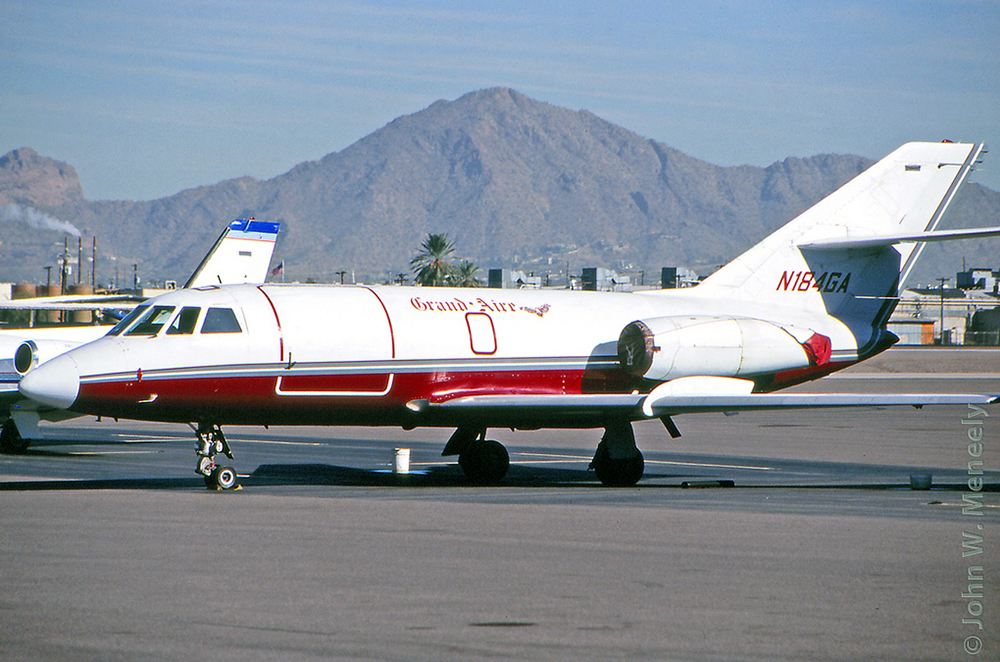
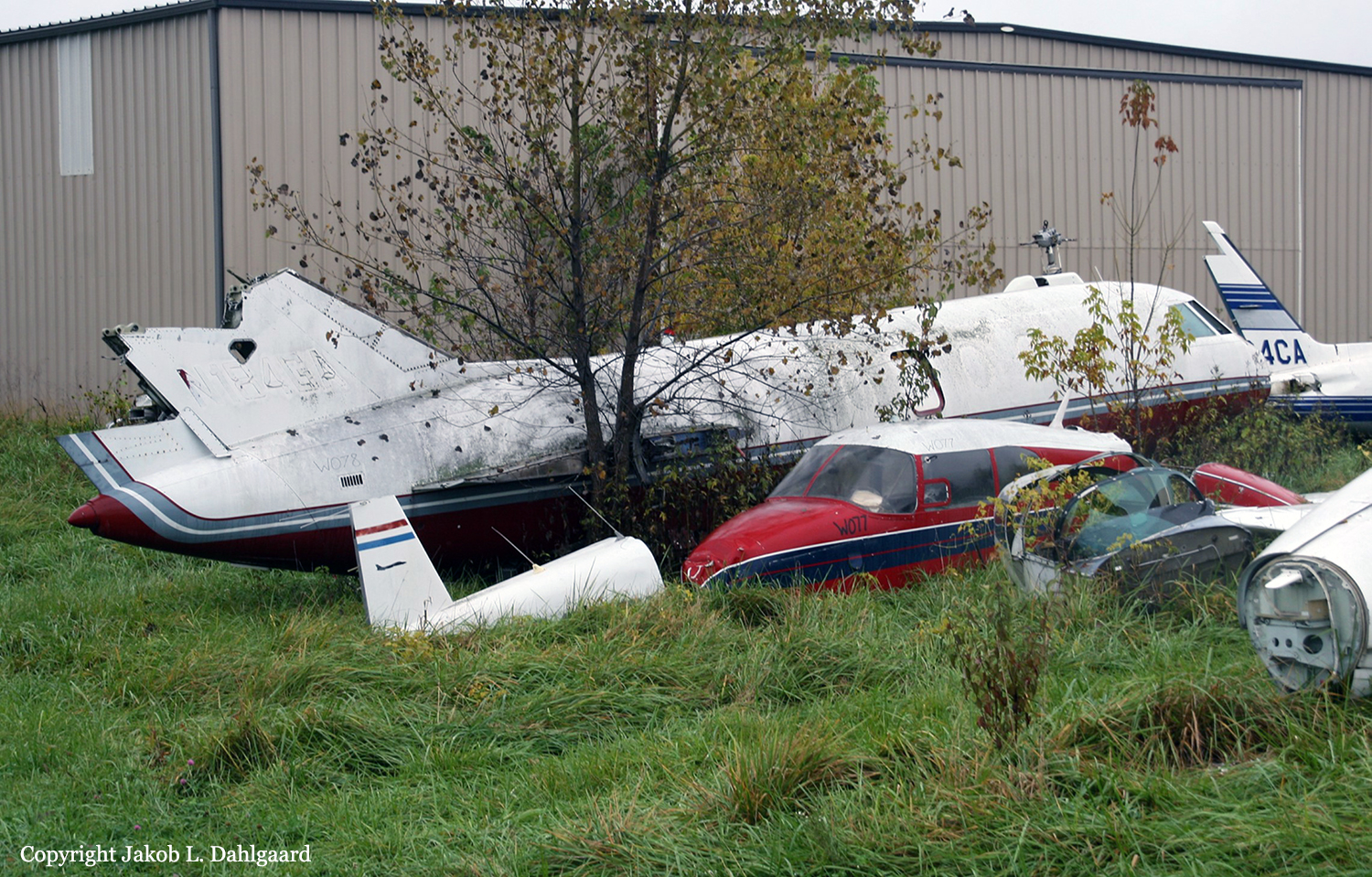
The Dassault-Breguet Falcon 20E aircraft was on an unscheduled charter cargo flight from Detroit Willow Run, Michigan, USA, to Peterborough, Ontario. The flight was being conducted at night and under instrument flight rules in instrument meteorological conditions. Nearing the destination, the flight crew received a clearance to conduct a non-directional beacon runway 09 approach at Peterborough Airport. The flight crew did not acquire the runway environment during this approach and conducted a missed approach procedure. They obtained another clearance for the same approach from Toronto Area Control Centre. During this approach, the flight crew acquired the runway environment and manoeuvred the aircraft for landing on runway 09. The aircraft touched down near the runway midpoint, and the captain, who was the pilot flying, elected to abort the landing. The captain then conducted a left visual circuit to attempt another landing. As the aircraft was turning onto the final leg, the approach became unstabilized, and the flight crew elected to overshoot; however, the aircraft pitched nose-down, banked left, and struck terrain. As it travelled 400 feet through a ploughed farm field, the aircraft struck a tree line and came to rest about 2000 feet before the threshold of runway 09, facing the opposite direction. The aircraft was substantially damaged. No serious injuries occurred.
Probable cause:
Findings as to Causes and Contributing Factors:
1. The captain's attempt to continue the landing during the second approach was contrary to company standard operating procedures and Federal Aviation Regulations, in that the approach was unstable and the aircraft was not in a position to land safely.
2. Following the aborted landing, the flight crew proceeded to conduct a circling approach to runway 09, rather than the missed approach procedure as briefed.
3. The pilot lost situational awareness during the overshoot after the third failed attempt to land, likely when he was subjected to somatogravic illusion.
4. Breakdown in crew coordination after the aborted landing, lack of planning and briefing for the subsequent approach, operating in a dark, instrument meteorological conditions environment with limited visual cues, and inadequate monitoring of flight instruments contributed to the loss of situational awareness.
Final Report:

Crash of a Piper PA-31-350 Navajo Chieftain in Kiowa: 2 killed

Date & Time: Jun 5, 2000 at 1031 LT
Operator:
Registration:
N67BJ
Flight Phase:
Flight Type:
Survivors:
No
Schedule:
Denver - Denver
MSN:
31-7952250
YOM:
1979
Location:
Crew on board:
2
Crew fatalities:
Pax on board:
0
Pax fatalities:
Other fatalities:
Total fatalities:
2
Captain / Total flying hours:
3900
Aircraft flight hours:
11279
Circumstances:
The purpose of the flight was for the instructor pilot to administer second-in-command (SIC) flight training to the commercial pilot in the twin-engine aircraft. According to the training manual, SIC training encompassed 4 hours of normal and emergency flight maneuvers to include stalls in the landing and takeoff configuration and while turning at a 15-30 degree bank. A witness heard the airplane's engines and observed the airplane from her driveway. The witness stated that as "the [engine] noise was getting louder and louder, I spotted it spiraling downward." The witness thought that the airplane was performing aerobatics; however, the airplane was getting too close to the ground. The witness heard a loud thud, and approximately 3 seconds later, she heard a loud boom and saw black smoke billow up. Another witness stated that she observed the airplane "going nose first straight down and spinning...counterclockwise." She thought the airplane was performing aerobatic maneuvers; however, the airplane did not stop descending. The airplane disappeared behind trees and the witness heard a loud explosion and saw smoke. She added that she did not observe what the airplane was doing prior to seeing it in a "downward spiral." Radar data depicted the airplane at 8,400 feet msl for the last 2 minutes and 26 seconds of the flight. The recorded aircraft ground speed during that time period fluctuated between 75 and 59 knots. The final radar returns depicted the airplane as making a 180 degree turn before radar contact was lost. No mayday calls were received from the airplane. The airplane impacted the ground in a near wings level attitude and was consumed by a post-crash fire. No anomalies were noted with the airplane or its engines during a post-accident examination. It is unknown which of the pilots was flying the airplane at the time of the accident.
Probable cause:
The flight instructor's failure to maintain aircraft control while practicing stall maneuvers, which resulted in an inadvertent spin.
Final Report:

Crash of a Cessna 414 Chancellor near Monarch: 3 killed

Date & Time: May 31, 2000 at 1728 LT
Type of aircraft:
Operator:
Registration:
N5113G
Flight Phase:
Survivors:
No
Site:
Schedule:
Great Falls - Billings
MSN:
414-0952
YOM:
1977
Location:
Crew on board:
2
Crew fatalities:
Pax on board:
1
Pax fatalities:
Other fatalities:
Total fatalities:
3
Captain / Total flying hours:
8000
Aircraft flight hours:
7406
Circumstances:
During climbout, the airplane encountered an area of freezing rain resulting in rapid airframe ice accretion and loss of climb capability. The pilot informed ATC that he was unable to maintain altitude and requested and received clearance back to Great Falls, the departure airport. ATC radar showed that the airplane then began a right turn over mountainous terrain extending up to 8,309 feet prior to loss of radar contact (lower and relatively flat terrain, down to less than 5,000 feet, was located to the left of the aircraft's track.) During the last minute of radar contact, the aircraft was in a right turn at a descent rate of about 400 feet per minute; the aircraft passed less than 1/2 mile from the 8,309-foot mountain summit just prior to loss of radar contact, at an altitude of 8,400 to 8,500 feet. The aircraft crashed on the southwest flank of the 8,309-foot mountain about 1/2 mile south of the last recorded radar position. Wreckage and impact signatures at the crash site were indicative of an inverted, steep-angle, relatively low-speed, downhill impact with the terrain. The investigation revealed no evidence of any aircraft mechanical problems.
Probable cause:
The failure of the pilot-in-command to ensure adequate airspeed for flight during a forced descent due to airframe icing, resulting in a stall. Factors included: freezing rain conditions, airframe icing, an improper decision by the pilot-in-command to turn toward mountainous terrain (where a turn toward lower and level terrain was a viable option), mountainous terrain, and insufficient altitude available for stall recovery.
Final Report:

Crash of a Piper PA-46-310P Malibu in Hawthorne: 3 killed

Date & Time: May 28, 2000 at 1159 LT
Operator:
Registration:
N567YV
Flight Phase:
Flight Type:
Survivors:
No
Schedule:
Hawthorne – Las Vegas
MSN:
46-8408016
YOM:
1984
Crew on board:
1
Crew fatalities:
Pax on board:
2
Pax fatalities:
Other fatalities:
Total fatalities:
3
Captain / Total flying hours:
2550
Captain / Total hours on type:
1250.00
Circumstances:
The aircraft collided with the ground in a steep nose down descent angle while maneuvering to return to the runway during the takeoff initial climb from the airport. Pilot and mechanic witnesses on the airport described the engine sounds during the takeoff as abnormal. The takeoff ground roll was over 3,000 feet in length, and the airplane's climb out angle was much shallower than usual. Two other witnesses said the engine sounded "like a radial engine," and both believed that the power output was lower than normal. One mechanic witness said the engine was surging and not developing full power; he believed the symptoms could be associated with a fuel feed problem, a turbocharger surge, or an excessively lean running condition. The ground witnesses located near the impact site said the airplane began a steep left turn between 1/4- and 1/2-mile from the runway's end at a lower than normal altitude. The bank angle was estimated by the witnesses as 45 degrees or greater. The turn continued until the nose suddenly dropped and the airplane entered a spiraling descent to ground impact. The majority of these witnesses stated that they heard "sputtering" or "popping" noises coming from the airplane. Engineering personnel from the manufacturer developed a performance profile for a normal takeoff and climb under the ambient conditions of the accident and at gross weight. The profile was compared to the actual aircraft performance derived from recorded radar data and the witness observations. The ground roll was 1,300 feet longer than it should have been, and the speed/acceleration and climb performance were consistently well below the profile's predictions. Based on the radar data and factoring in the winds, the airplane's estimated indicated airspeed during the final turn was 82 knots; the stall speed at 45 degrees of bank is 82 knots and it increases linearly to 96 knots at 60 degrees of bank. No evidence was found that the pilot flew the airplane from December until the date of the accident. The airplane sat outside during the rainy season with only 10 gallons of fuel in each tank. Comparison of the time the fueling began and the communications transcripts disclosed that the pilot had 17 minutes 41 seconds to refuel the airplane with 120 gallons, reboard the airplane, and start the engine for taxi; the maximum nozzle discharge flow rate of the pump he used is 24 gallons per minute. Review of the communications transcripts found that a time interval of 3 minutes 35 seconds elapsed from the time the pilot asked for a taxi clearance from the fuel facility until he reported ready for takeoff following a taxi distance of at least 2,000 feet. During the 8 seconds following the pilot's acknowledgment of his takeoff clearance, he and the local controller carried on a non pertinent personal exchange. The aircraft was almost completely consumed in the post crash fire; however, extensive investigation of the remains failed to identify a preimpact mechanical malfunction or failure in the engine or airframe systems. The pistons, cylinder interiors, and spark plugs from all six cylinders were clean without combustion deposits. The cockpit fuel selector lever, the intermediate linkages, and the valve itself were found in the OFF position; however, an engineering analysis established that insufficient fuel was available in the lines forward of the selector to start, taxi, and perform a takeoff with the selector in the OFF position.
Probable cause:
A partial loss of power due to water contamination in the fuel system and the pilot's inadequate preflight inspection, which failed to detect the water. The pilot's failure to perform an engine run-up before takeoff is also causal. Additional causes are the pilot's failure to maintain an adequate airspeed margin for the bank angle he initiated during the attempted return to runway maneuver and the resultant encounter with a stall/spin. Factors in the accident include the pilot's failure to detect the power deficiency early in the takeoff roll due to his diverted attention by a non pertinent personal conversation with the local controller, and, the lack of suitable forced landing sites in the takeoff flight path.
Final Report:

Crash of a BAe Jetstream 31 in Wilkes-Barre: 19 killed

Date & Time: May 21, 2000 at 1148 LT
Type of aircraft:
Operator:
Registration:
N16EJ
Survivors:
No
Schedule:
Atlantic City – Wilkes-Barre
MSN:
834
YOM:
1988
Crew on board:
2
Crew fatalities:
Pax on board:
17
Pax fatalities:
Other fatalities:
Total fatalities:
19
Captain / Total flying hours:
8500
Captain / Total hours on type:
1874.00
Copilot / Total flying hours:
1282
Copilot / Total hours on type:
742
Aircraft flight hours:
13972
Aircraft flight cycles:
18503
Circumstances:
On May 21, 2000, about 1128 eastern daylight time (EDT), a British Aerospace Jetstream 3101, N16EJ, operated by East Coast Aviation Services (doing business as Executive Airlines) crashed
about 11 miles south of Wilkes-Barre/Scranton International Airport (AVP), Wilkes-Barre, Pennsylvania. The airplane was destroyed by impact and a post crash fire, and 17 passengers and two flight crewmembers were killed. The flight was being conducted under 14 Code of Federal Regulations (CFR) Part 135 as an on-demand charter flight for Caesar’s Palace Casino in Atlantic City, New Jersey. An instrument flight rules (IFR) flight plan had been filed for the flight from Atlantic City International Airport (ACY) to AVP. The captain checked in for duty about 0800 at Republic Airport (FRG) in Farmingdale, New York, on the day of the accident. The airplane was originally scheduled to depart FRG at 0900 for ACY and to remain in ACY until 1900, when it was scheduled to return to FRG. While the pilots were conducting preflight inspections, they received a telephone call from Executive Airlines’ owner and chief executive officer (CEO) advising them that they had been assigned an additional flight from ACY to AVP with a return flight to ACY later in the day, instead of the scheduled break in ACY. Fuel records at FRG indicated that 90 gallons of fuel were added to the accident airplane’s tanks before departure to ACY. According to Federal Aviation Administration (FAA) air traffic control (ATC) records, the flight departed at 0921 (with 12 passengers on board) and arrived in ACY at 0949. According to passenger statements, the captain was the pilot flying from FRG to ACY. After arrival in ACY, the flight crew checked the weather for AVP and filed an IFR flight plan. Fuel facility records at ACY indicated that no additional fuel was added. The accident flight to AVP, which departed ACY about 1030, had been chartered by Caesar’s Palace. According to ATC records, the flight to AVP was never cleared to fly above 5,000 feet mean sea level (msl). According to ATC transcripts, the pilots first contacted AVP approach controllers at 1057 and were vectored for an instrument landing system (ILS) approach to runway 4. The flight was cleared for approach at 1102:07, and the approach controller advised the pilots that they were 5 nautical miles (nm) from Crystal Lake, which is the initial approach fix (IAF) for the ILS approach to runway 4. The pilots were told to maintain 4,000 feet until established on the localizer. At 1104:16, the approach controller advised that a “previous landing…aircraft picked up the airport at minimums [decision altitude].” The pilots were instructed to contact the AVP local (tower) controller at 1105:09, which they did 3 seconds later. The airplane then descended to about 2,200 feet, flew level at 2,200 feet for about 20 seconds, and began to climb again about 2.2 nm from the runway threshold when a missed approach was executed (see the Airplane Performance section for more information). At 1107:26 the captain reported executing the missed approach but provided no explanation to air traffic controllers. The tower controller informed the North Radar approach controllers of the missed approach and then instructed the accident flight crew to fly runway heading, climb to 4,000 feet, and contact approach control on frequency 124.5 (the procedure published on the approach chart). The pilots reestablished contact with the approach controllers at 1108:04 as they climbed through 3,500 feet to 4,000 feet and requested another ILS approach to runway 4. The flight was vectored for another ILS approach, and at 1110:07 the approach controller advised the pilots of traffic 2 nm miles away at 5,000 feet. The captain responded that they were in the clouds. At 1014:38, the controller directed the pilots to reduce speed to follow a Cessna 172 on approach to the airport, and the captain responded, “ok we’re slowing.” The flight was cleared for a second approach at 1120:45 and advised to maintain 4,000 feet until the airplane was established on the localizer. At 1123:49 the captain transmitted, “for uh one six echo juliet we’d like to declare an emergency.” At 1123:53, the approach controller asked the nature of the problem, and the captain responded, “engine failure.” The approach controller acknowledged the information, informed the pilots that the airplane appeared to be south of the localizer (off course to the right), and asked if they wanted a vector back to the localizer course. The flight crew accepted, and at 1124:10 the controller directed a left turn to heading 010, which the captain acknowledged. At 1124:33, the controller asked for verification that the airplane was turning left. The captain responded, “we’re trying six echo juliet.” At 1124:38, the controller asked if a right turn would be better. The captain asked the controller to “stand by.” At 1125:07, the controller advised the pilots that the minimum vectoring altitude (MVA) in the area was 3,300 feet. At 1125:12, the captain transmitted, “standby for six echo juliet tell them we lost both engines for six echo juliet.” At that time, ATC radar data indicated that the airplane was descending through 3,000 feet. The controller immediately issued the weather conditions in the vicinity of the airport and informed the flight crew about the location of nearby highways. At 1126:17, the captain asked, “how’s the altitude look for where we’re at.” The controller responded that he was not showing an altitude readout from the airplane and issued the visibility (2.5 miles) and altimeter setting. At 1126:43, the captain transmitted, “just give us a vector back to the airport please.” The controller cleared the accident flight to fly heading 340, advised the flight crew that radar contact was lost, and asked the pilots to verify their altitude. The captain responded that they were “level at 2,000.” At 1126:54, the controller again advised the flight crew of the 3,300-foot MVA and suggested a 330° heading to bring the airplane back to the localizer. At 1127:14 the controller asked, “do you have any engines,” and the captain responded that they appeared to have gotten back “the left engine now.” At 1127:23, the controller informed the pilots that he saw them on radar at 2,000 feet and that there was a ridgeline between them and the airport. The captain responded, “that’s us” and “we’re at 2,000 feet over the trees.” The controller instructed the pilots to fly a 360° heading and advised them of high antennas about 2 nm west of their position. At 1127:46, the captain transmitted, “we’re losing both engines.” Two seconds later the controller advised that the Pennsylvania Turnpike was right below the airplane and instructed the flight crew to “let me know if you can get your engines back.” There was no further radio contact with the accident airplane. The ATC supervisor initiated emergency notification procedures. A Pennsylvania State Police helicopter located the wreckage about 1236, and emergency rescue units arrived at the accident site about 1306. The accident occurred in daylight instrument meteorological conditions (IMC). The location of the accident was 41° 9 minutes, 23 seconds north latitude, 75° 45 minutes, 53 seconds west longitude, about 11 miles south of the airport at an elevation of 1,755 feet msl.
Probable cause:
The flight crew’s failure to ensure an adequate fuel supply for the flight, which led to the stoppage of the right engine due to fuel exhaustion and the intermittent stoppage of the left engine due to fuel starvation. Contributing to the accident were the flight crew's failure to monitor the airplane’s fuel state and the flight crew's failure to maintain directional control after the initial engine stoppage.
Final Report: