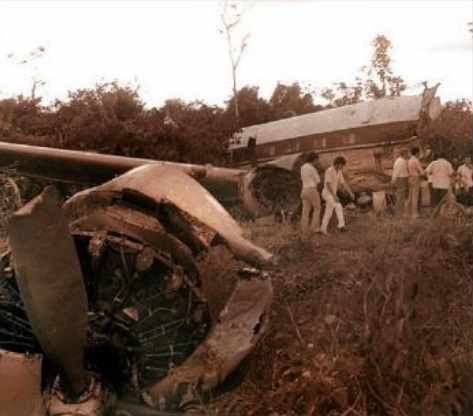
Crash of a Douglas DC-3-313 in Santo Domingo: 2 killed

Date & Time: Jan 30, 1975
Type of aircraft:
Registration:
HI-222
Flight Phase:
Survivors:
Yes
Schedule:
Santo Domingo - Port-au-Prince
MSN:
2189
YOM:
1940
Crew on board:
3
Crew fatalities:
Pax on board:
27
Pax fatalities:
Other fatalities:
Total fatalities:
2
Circumstances:
Shortly after takeoff from runway 17 at Santo Domingo-Las Américas Airport, while in initial climb, the airplane banked right and crashed in a wooded area. A crew member and a passenger were killed while 28 other occupants were injured. The aircraft was destroyed.
Probable cause:
It is believed that the loss of control was caused by the failure of the right engine shortly after liftoff.

Crash of a Yakovlev Yak-40 in Zaporozhie

Date & Time: Jan 28, 1975
Type of aircraft:
Operator:
Registration:
CCCP-87825
Flight Phase:
Survivors:
Yes
Schedule:
Zaporozhie - Ternopol
MSN:
9 24 17 24
YOM:
1972
Country:
Region:
Crew on board:
3
Crew fatalities:
Pax on board:
14
Pax fatalities:
Other fatalities:
Total fatalities:
0
Circumstances:
The airplane was cleared of snow prior to departure but as it was snowing continuously, the aircraft was again covered by snow between the moment it was deiced and the takeoff procedure. During the takeoff roll in poor weather conditions (snowfall and poor visibility), the pilot-in-command started the rotation. The aircraft lifted off and climbed for few meters when the left wing dropped, causing the left main gear to struck the runway surface. The airplane landed back and the crew decided to attempt an emergency braking procedure. Unable to stop within the remaining distance, the aircraft overran and the left wing collided with the building of a meteorological post located 25 metres behind the runway threshold. All 3 crew and 14 passengers escaped unhurt.
Probable cause:
It was determined that the aircraft was contaminated with snow during the takeoff procedure and that the stabs were positioned in a -5,9° angle instead of the prescribed -3,9°.

Crash of a Dornier DO.28A-1 in Vernier: 2 killed

Date & Time: Jan 11, 1975 at 0905 LT
Type of aircraft:
Registration:
EC-BNH
Flight Phase:
Flight Type:
Survivors:
No
Schedule:
Geneva - Sion
MSN:
3030
YOM:
1962
Location:
Country:
Region:
Crew on board:
2
Crew fatalities:
Pax on board:
0
Pax fatalities:
Other fatalities:
Total fatalities:
2
Captain / Total flying hours:
3381
Captain / Total hours on type:
1.00
Copilot / Total flying hours:
2990
Copilot / Total hours on type:
1400
Aircraft flight hours:
2530
Circumstances:
The twin engine airplane departed runway 23 at Geneva-Cointrin Airport at 0903LT. During initial climb in limited visibility due to foggy conditions, the crew encountered technical problems with instruments and the airplane completed several turns at a height between 10 and 40 meters. The crew spotted a building of nine floors and elected to make an evasive manoeuvre when the airplane stalled and crashed on a railway track located in Vernier, about three km from the airport. The accident occurred about two minutes after takeoff. At the time of the accident, the horizontal visibility was 500 meters, the vertical visibility 65 meters with a runway visual range of 750 meters for runway 23.
Probable cause:
Investigations determined that after departure, the pilots were confronted with various technical issues on several instruments. Indeed, the crew had started the flight under instrument flight rules but was forced to continue under VFR mode, which was impossible due to the lack of visibility caused by the presence of fog. The aircraft maintenance did not comply with the published requirements due to corrosion detected on the bearings of the electrical turn indicator that led to the assumption that this instrument was not working at takeoff, and probably for a long time. In addition, the artificial horizon was blocked at the time of impact and investigators believe that this instrument was partially deficient at the time of departure. The pilot-in-command accumulated 3,381 flight hours in total but had only 45 minutes of experience on this type of aircraft. The copilot had a total of 2,990 flying hours including 1,400 on type. Given the presence of fog, the pilot's lack of experience and the malfunctioning of two vital instruments, the crew should not have started the flight, especially since neither pilot had a valid license under IFR mode.
Final Report:

Crash of a Douglas C-54P Skymaster at Davis Monthan AFB

Date & Time: Jan 2, 1975 at 1358 LT
Type of aircraft:
Registration:
N39AP
Flight Phase:
Flight Type:
Survivors:
Yes
Schedule:
Davis-Monthan - Barstow-Daggett
MSN:
10430
YOM:
1944
Crew on board:
3
Crew fatalities:
Pax on board:
0
Pax fatalities:
Other fatalities:
Total fatalities:
0
Captain / Total flying hours:
6409
Captain / Total hours on type:
20.00
Circumstances:
After takeoff from Davis Monthan AFB, the four engine airplane encountered difficulties to gain height. It struck power cables, stalled and crashed in flames. All three occupants were injured while the aircraft was destroyed.
Probable cause:
Inadequate preflight preparation on part of the crew. The following contributing factors were reported:
- Collision with wires,
- Lack of familiarity with aircraft,
- Failed to abort takeoff,
- Gust locks engaged,
- Operational supervisory personnel: inadequate supervision of flight crew,
- Unqualified person operated aircraft,
- Airport conditions,
- Checklist: failed to use,
- Downwind,
- Mechanic acting as copilot,
- 3,060 feet soft dirt strip.
Final Report:

Crash of a Beechcraft A60 Duke in Mammoth Lakes: 5 killed

Date & Time: Jan 2, 1975 at 0835 LT
Type of aircraft:
Operator:
Registration:
N2855W
Flight Phase:
Survivors:
No
Schedule:
Mammoth Lakes – Santa Ana
MSN:
P-229
YOM:
1973
Crew on board:
1
Crew fatalities:
Pax on board:
4
Pax fatalities:
Other fatalities:
Total fatalities:
5
Captain / Total flying hours:
2400
Circumstances:
Shortly after liftoff from Mammoth Lakes-Yosemite Airport, while in initial climb, both propellers oversped. As the airspeed was insufficient, the aircraft stalled and crashed in flames near the airport. The aircraft was totally destroyed and all five occupants were killed.
Probable cause:
Inadequate preflight preparation on part of the pilot. The following contributing factors were reported:
- Propeller and accessories: hydraulic pitch control mechanism,
- Lack of action on part of the pilot,
- Failed to maintain flying speed,
- Propeller oversped due to congealed oil,
- The pilot failed to exercise props checks before takeoff.
Final Report:

Crash of a Lockheed C-130B Hercules in New Orleans: 2 killed

Date & Time: Jan 2, 1975
Type of aircraft:
Operator:
Registration:
58-0721
Flight Phase:
Flight Type:
Survivors:
Yes
MSN:
3516
YOM:
1959
Crew on board:
6
Crew fatalities:
Pax on board:
0
Pax fatalities:
Other fatalities:
Total fatalities:
2
Circumstances:
Shortly after takeoff from New Orleans-Alvin Callender Field NAS, while in initial climb, the engine n°1 failed. Control was lost and the airplane crashed near the airport. Two crew members were killed while four others were injured.
Probable cause:
Failure of the engine n°1 for undetermined reasons.

Crash of a PZL-Mielec AN-2 in Bozoy: 3 killed

Date & Time: Dec 30, 1974 at 1346 LT
Type of aircraft:
Operator:
Registration:
CCCP-40518
Flight Phase:
Survivors:
No
Schedule:
Yuzhnyy - Shalkar
MSN:
1G83-21
YOM:
1967
Location:
Country:
Region:
Crew on board:
2
Crew fatalities:
Pax on board:
1
Pax fatalities:
Other fatalities:
Total fatalities:
3
Aircraft flight hours:
6006
Aircraft flight cycles:
6686
Circumstances:
The crew was engaged in several flights between Shalkar and Yuzhnyy, carrying oil field workers. After takeoff from Yuzhnyy, the crew decided to make a stop in Bozoy but there was no passengers to embark so it was decided to continue quickly. Shortly after takeoff, while flying at a relative low height in limited visibility, the single engine airplane struck a radio mast (160 meters high) located near Bozoy. The airplane embedded in the mast at a height of 85 meters. Few debris fell down and all three occupants were ejected and killed.
Probable cause:
It was determined that the crew precipitated the departure from Bozoy without checking weather conditions and flight conditions. The following contributing factors were reported:
- Poor flight planning,
- Marginal weather conditions with low clouds, patches of fog and limited visibility,
- The passenger was illegally on board,
- The crew failed to communicate with ATC,
- Insufficient altitude,
- Wrong decisions.

Crash of a Lockheed 18-56-23 LodeStar in Tikal: 24 killed

Date & Time: Dec 29, 1974
Type of aircraft:
Operator:
Registration:
TG-HTM
Flight Phase:
Survivors:
No
Site:
Schedule:
Tikal - Guatemala City
MSN:
2582
YOM:
1943
Location:
Country:
Crew on board:
3
Crew fatalities:
Pax on board:
21
Pax fatalities:
Other fatalities:
Total fatalities:
24
Circumstances:
Few minutes after takeoff from Tikal Airport, while climbing, the airplane went out of control and crashed on the slope of a mountain located few km from the airport. The aircraft was destroyed and all 24 occupants were killed, among them 21 Americans returning to Guatemala City.
Probable cause:
The exact cause of the accident was not determined. However, the assumption that control was lost following an in-flight fire was not ruled out.

Crash of a PZL-Mielec AN-2R in Khabarovsk

Date & Time: Dec 27, 1974
Type of aircraft:
Operator:
Registration:
CCCP-09611
Flight Phase:
Survivors:
Yes
MSN:
1G74-32
YOM:
1966
Country:
Region:
Crew on board:
2
Crew fatalities:
Pax on board:
20
Pax fatalities:
Other fatalities:
Total fatalities:
0
Circumstances:
Shortly after takeoff, the single engine airplane encountered difficulties to gain height. It rolled left and right then stalled and crashed near the runway end. All 22 occupants were injured and the aircraft was damaged beyond repair.
Probable cause:
The total weight of the aircraft at the time of the accident was well above MTOW with 20 passengers on board, eight more than the 12 seats certified.

Crash of a Britten-Norman BN-2A Islander in Seattle: 4 killed

Date & Time: Dec 26, 1974 at 1805 LT
Type of aircraft:
Operator:
Registration:
N66HA
Flight Phase:
Survivors:
Yes
Site:
Schedule:
Seattle - Oak Harbor
MSN:
31
YOM:
1968
Flight number:
HG308
Crew on board:
1
Crew fatalities:
Pax on board:
5
Pax fatalities:
Other fatalities:
Total fatalities:
4
Captain / Total flying hours:
2000
Captain / Total hours on type:
342.00
Circumstances:
Shortly after takeoff from Seattle-Tacoma Airport, while climbing in marginal weather conditions, the twin engine airplane went out of control and crashed in a residential area located in Riverton Heights, near the airport. Two passengers were seriously injured while four other occupants including the pilot were killed.
Probable cause:
Diverted attention from operation during initial climb caused the aircraft to crash. The following contributing factors were reported:
- Instruments-misread or failed to read,
- Low ceiling,
- Snow,
- High obstructions,
- Flight and navigation instruments: airspeed, obstructed,
- Foreign materials affecting normal operations,
- Unknown matter in Pitot static system affected the airspeed indicator.
Final Report: