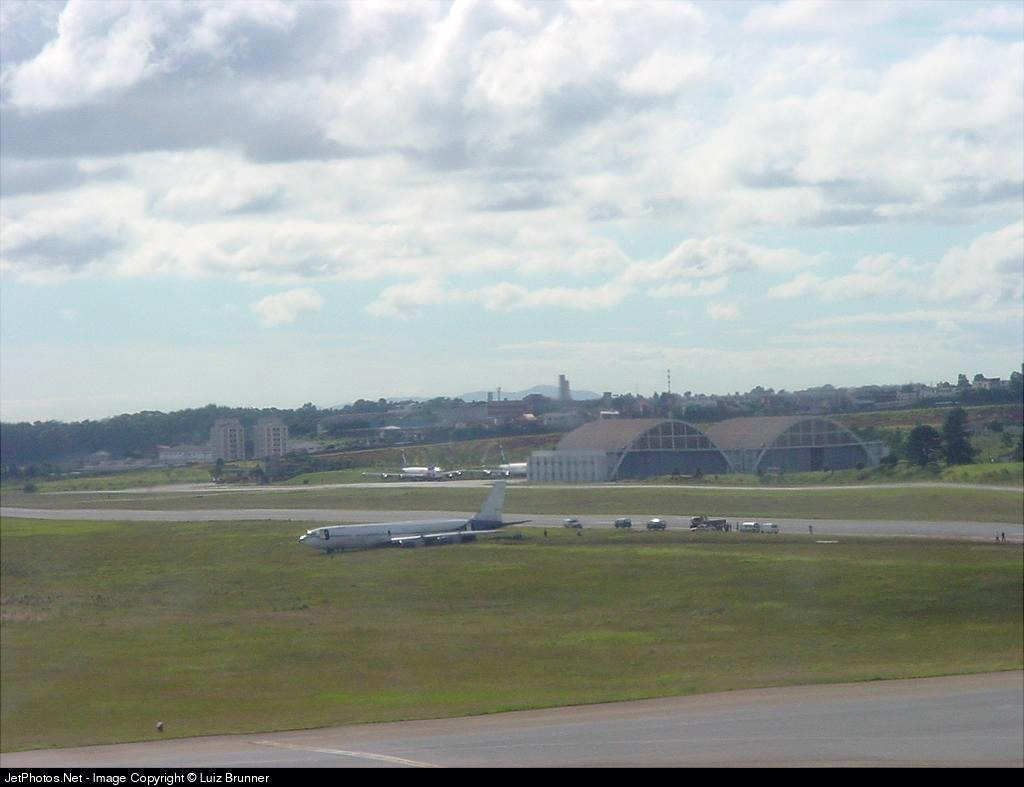
Crash of a Douglas C-47A-80-DL in Donalsonville

Date & Time: Mar 15, 2001 at 2130 LT
Registration:
N842MB
Flight Type:
Survivors:
Yes
Schedule:
Panama City – Albany
MSN:
19741
YOM:
1943
Flight number:
HKN041
Crew on board:
2
Crew fatalities:
Pax on board:
0
Pax fatalities:
Other fatalities:
Total fatalities:
0
Captain / Total flying hours:
6000
Captain / Total hours on type:
700.00
Circumstances:
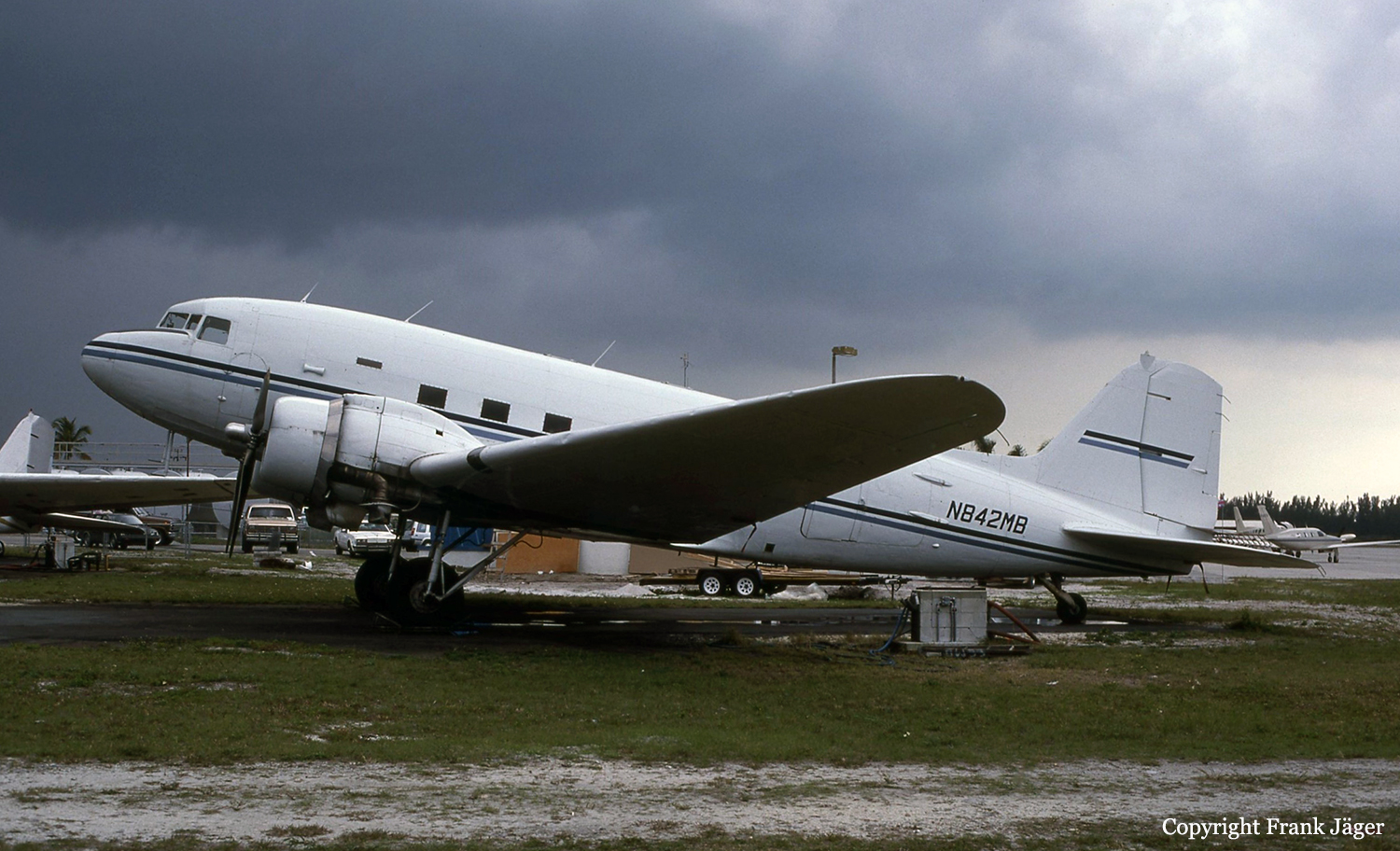
The DC-3 experienced an in-flight engine fire, and made a forced landing at nearby airport, following the separation of the right engine assembly from the airframe. According to the pilot, during cruise flight, at 5000 feet, he heard a loud "bang" and saw a reflection of fire on his left engine nacelle. Fire damage was found on the trailing edge of the right wing and on the landing gear assembly. The engine examination also showed that No. 12 cylinder had separated from the main case. Evidence of oil from the No. 12 cylinder was found across engine and exhaust systems. Further examination revealed Nos. 7, 8 and 9 cylinders also failed and separated, and the engine seized and separated from the airframe.
Probable cause:
The failure and separation of No.12 cylinder from the engine case that resulted in an in-flight oil fed fire; and the subsequent separation of the right engine from airframe.
Final Report:
Crash of a Beechcraft G18S in Lanseria

Date & Time: Mar 14, 2001 at 1240 LT
Type of aircraft:
Operator:
Registration:
ZS-OEP
Flight Type:
Survivors:
Yes
Schedule:
Lanseria - Lanseria
MSN:
BA-474
YOM:
1959
Country:
Region:
Crew on board:
4
Crew fatalities:
Pax on board:
0
Pax fatalities:
Other fatalities:
Total fatalities:
0
Captain / Total flying hours:
19639
Captain / Total hours on type:
24.00
Aircraft flight hours:
671
Circumstances:
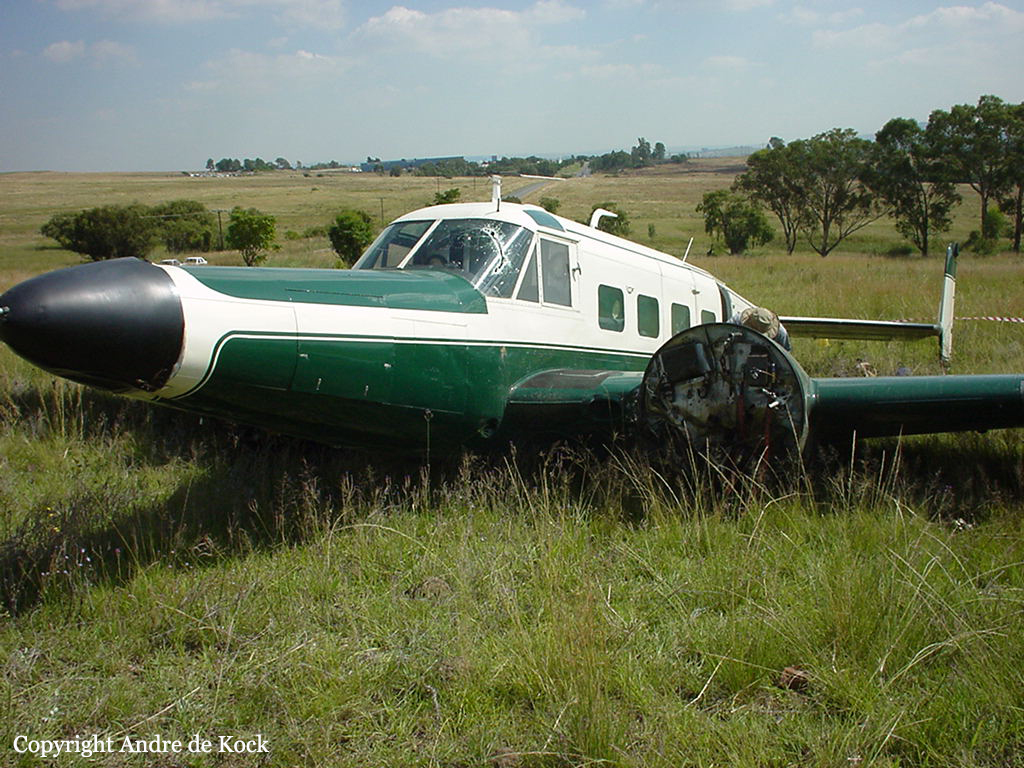
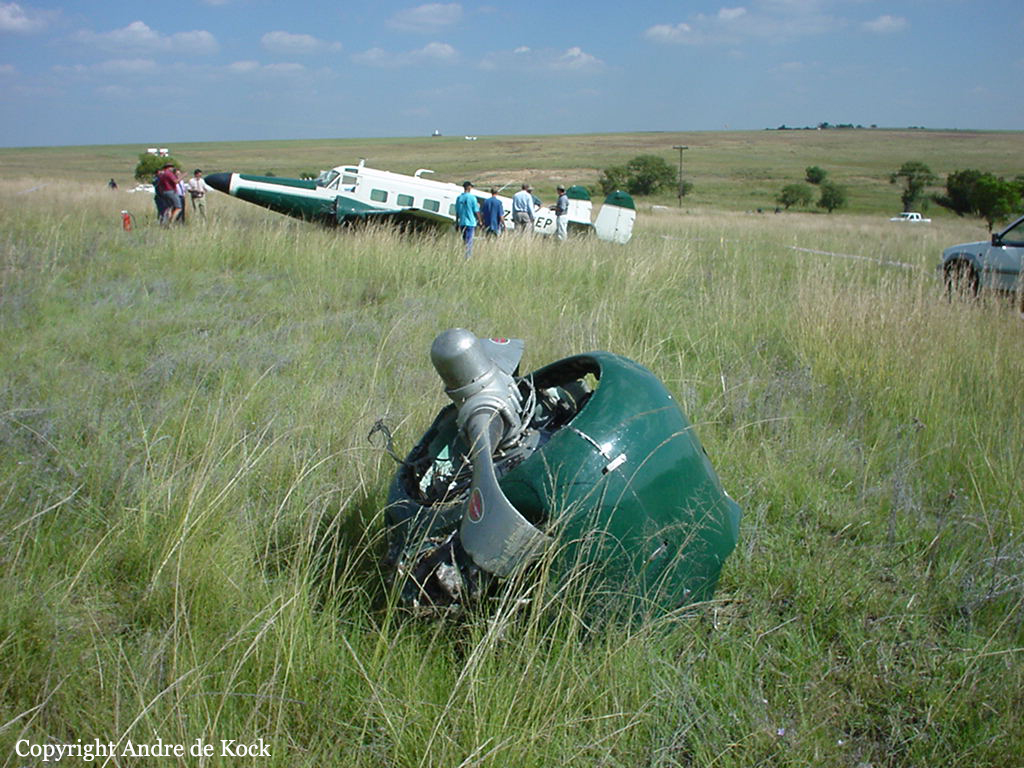
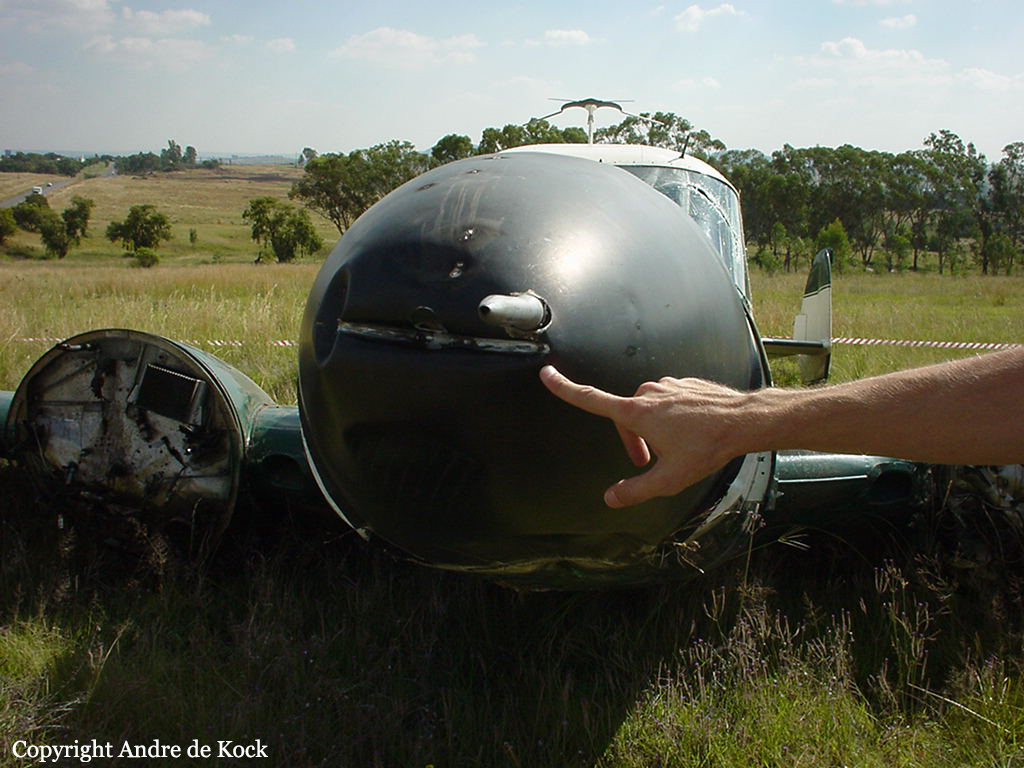
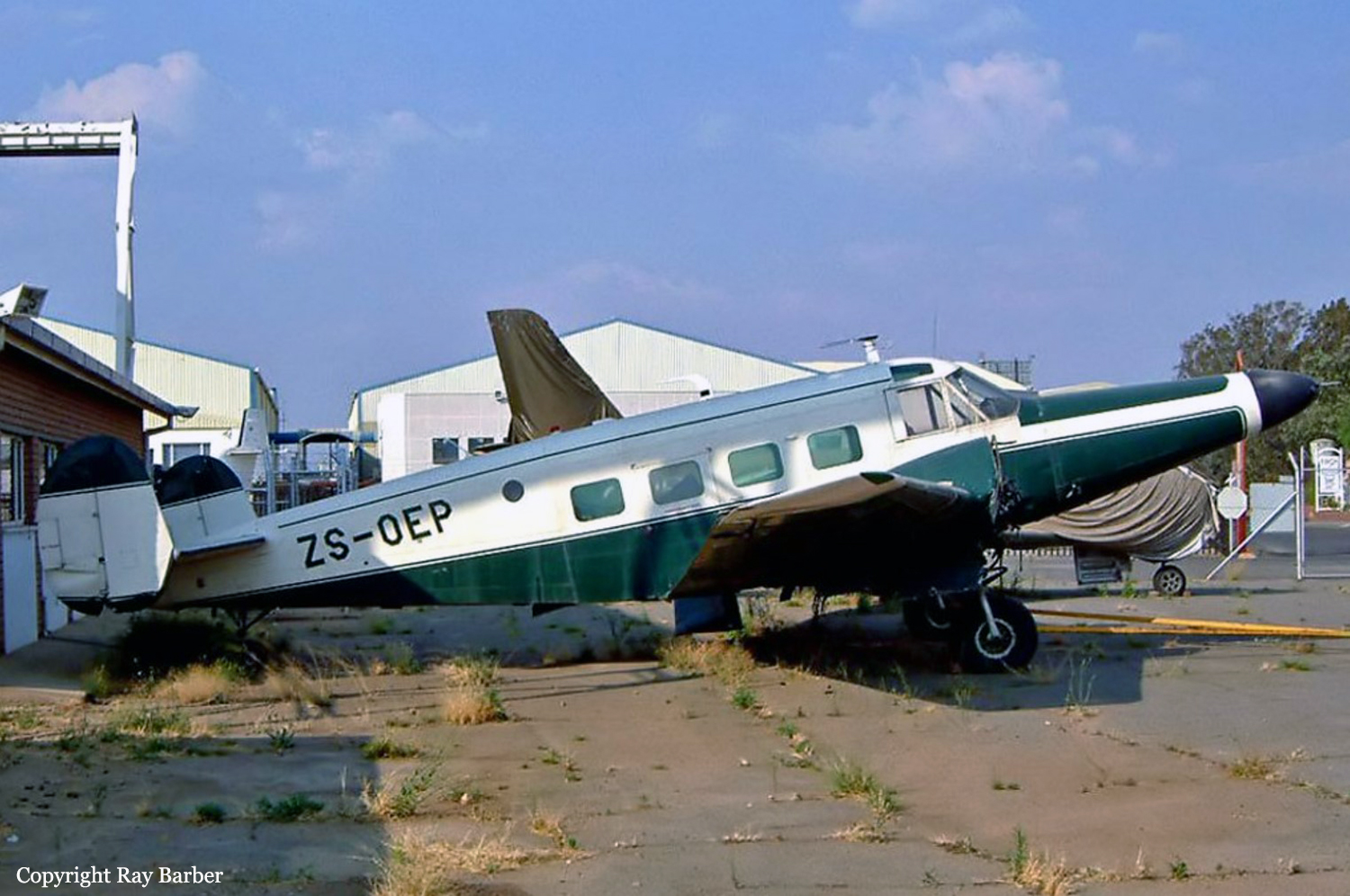
The instructor was accompanied by a trainee pilot and two passengers (also pilots) on a local training flight and was in the process of doing type conversion training when the accident happened. On the third circuit after a touch and go landing on runway 06L, the right-hand engine failed soon after take-off. The aircraft was flown at low altitude in a left-hand circuit in an attempt to land onto runway 17. During this circuit the left-hand engine also failed. The aircraft collided with, and severed, three 11kV electrical conductors and executed a forced landing with the gear retracted to the North of FALA approximately 1 km from threshold of runway 17. The pilot only sustained minor injuries with no one else injured. The initial on-site inspection revealed that both front tanks, which were selected at the fuel tank selector, were empty. The pilot who was undergoing conversion training refueled the aircraft prior to the accident and stated that 70 litres of fuel was uplifted into each "inboard auxiliary" tank and that what he presumed to be the "main" tanks were filled to capacity. The instructor stated that upon his arrival, the pilot who refueled the aircraft told him that he had filled the "mains" and that the "centre aux. tanks" were partially filled. The instructor further stated that the "main" tanks were selected for the duration of the flight. The aircraft is equipped with three fuel tanks in each wing. These tanks are: Front, Rear Auxiliary and Auxiliary tanks. Only one fuel quantity gauge is installed in the aircraft. A seven position selector knob above the fuel quantity gauge determines the tank to which the gauge is connected which then indicates the amount of fuel in that respective tank. The left and right front tanks were selected on the fuel gauge selector knob.
Probable cause:
Poor preflight inspection. Miscommunication between instructor and student pilot resulting in fuel mismanagement and depletion of the front tanks' fuel supply and subsequent engine failure. A contributory factor is that both the instructor and the student were relatively unfamiliar with the aircraft and its systems.

Crash of a Boeing 727-223F in Kolonia

Date & Time: Mar 11, 2001 at 1737 LT
Type of aircraft:
Operator:
Registration:
N701NE
Flight Type:
Survivors:
Yes
Schedule:
Majuro - Kolonia
MSN:
22459
YOM:
1981
Region:
Crew on board:
3
Crew fatalities:
Pax on board:
0
Pax fatalities:
Other fatalities:
Total fatalities:
0
Circumstances:
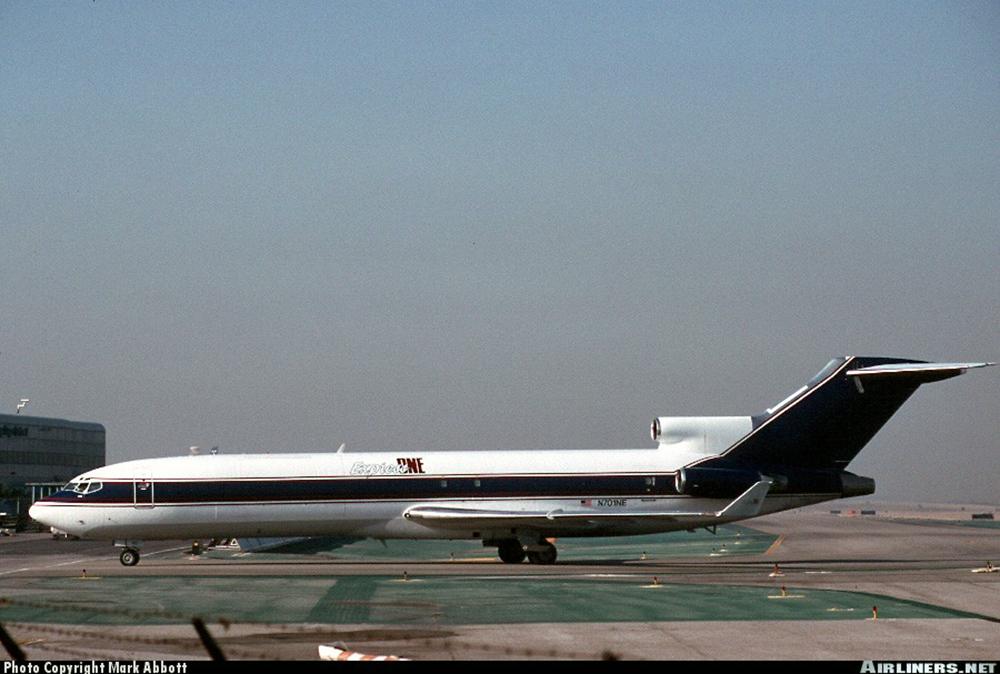
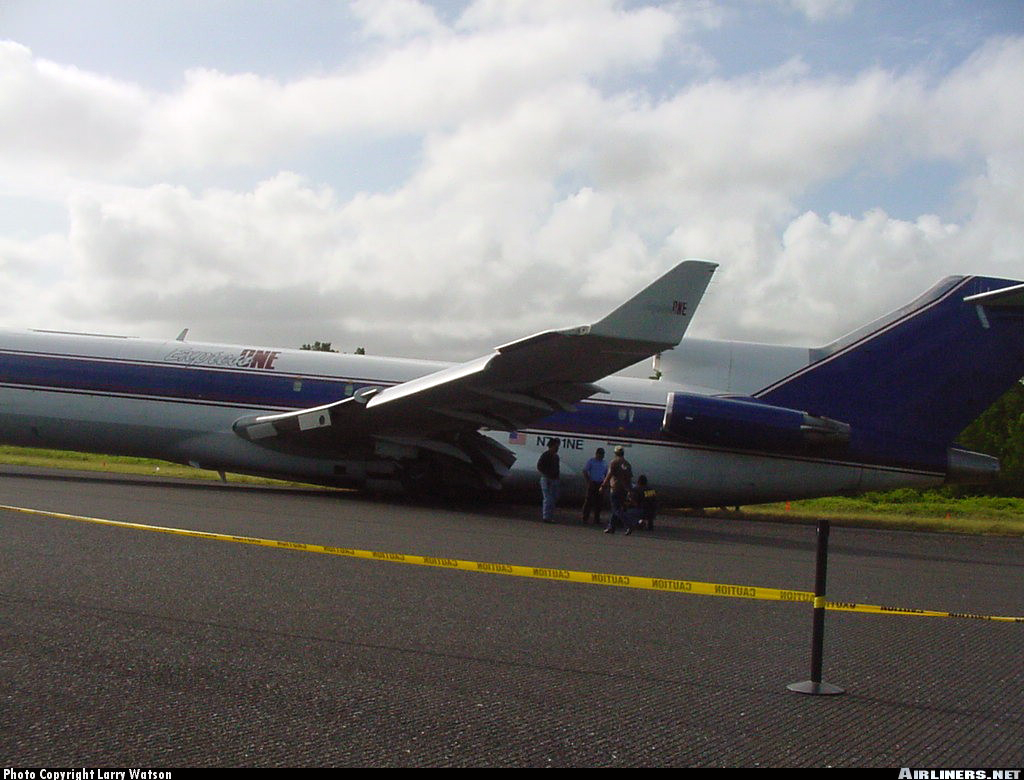
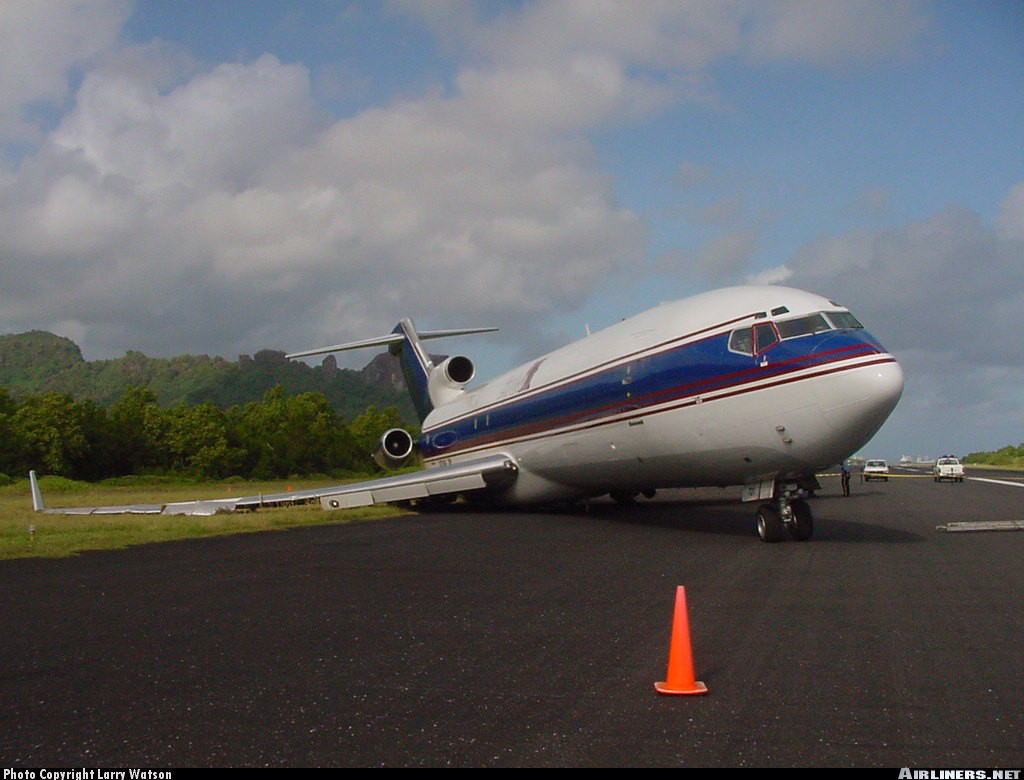
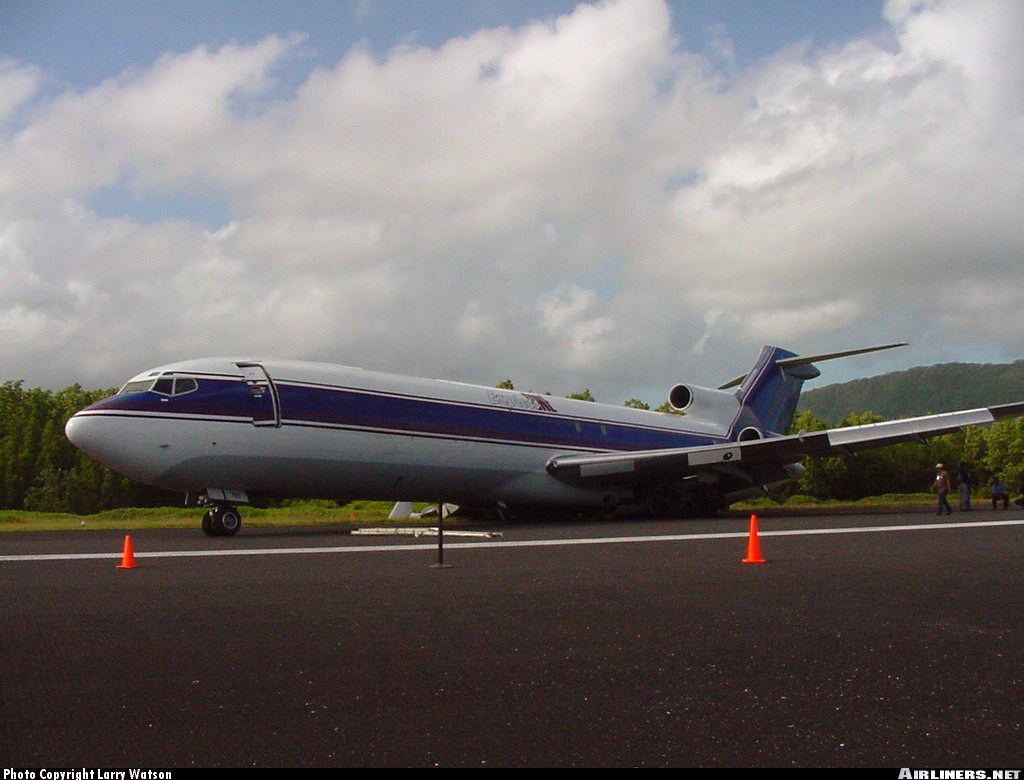
On final approach to Kolonia Airport (Pohnpei Island), the aircraft was too low. It struck the ground just short of runway threshold, causing the right main gear to be torn off and the left main gear to collapse. The aircraft slid on its belly for few dozen metres before coming to rest on the runway. All three crew members escaped uninjured and the aircraft was damaged beyond repair.

Crash of a Boeing 707-331C in São Paulo

Date & Time: Mar 7, 2001 at 0030 LT
Type of aircraft:
Operator:
Registration:
PT-MST
Flight Type:
Survivors:
Yes
Schedule:
Belém – Brasilía – São Paulo
MSN:
18711
YOM:
1964
Flight number:
SKC9101
Country:
Crew on board:
3
Crew fatalities:
Pax on board:
0
Pax fatalities:
Other fatalities:
Total fatalities:
0
Captain / Total flying hours:
4200
Captain / Total hours on type:
2543.00
Copilot / Total flying hours:
3858
Copilot / Total hours on type:
361
Aircraft flight hours:
70422
Aircraft flight cycles:
28047
Circumstances:
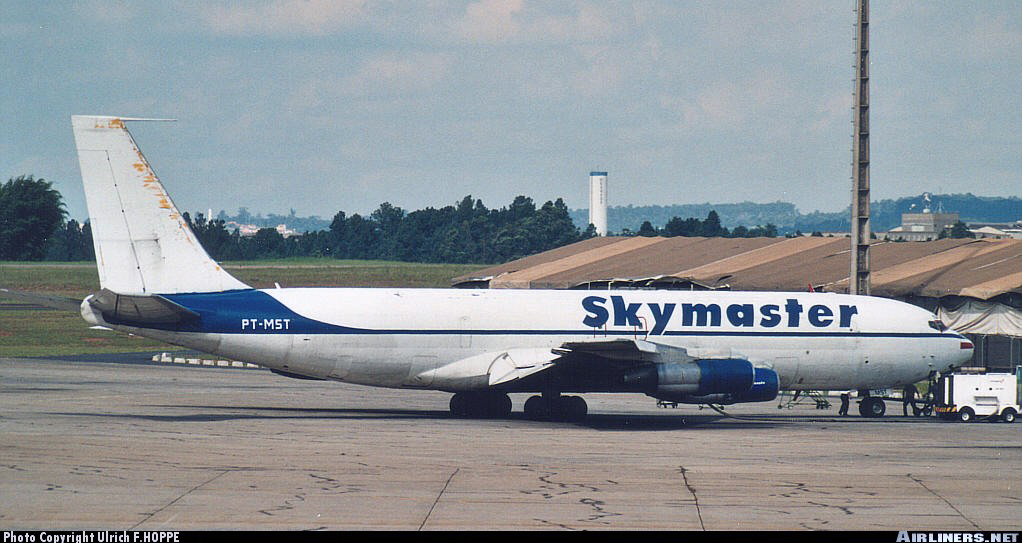
The aircraft was completing a cargo flight from Belém to São Paulo with an intermediate stop in Brasilía, carrying three crew members and a load of various goods such as mail and fish. While descending to São Paulo-Guarulhos Airport in good weather conditions at an altitude of 10,000 feet, the crew encountered technical problems with the trim system. Several manual controls and tests were conducted and the system worked before failing again between 6,000 and 4,700 feet. The captain decided to continue the approach but the aircraft became unstable and nosed down on short final. It landed hard on runway 09R, causing the undercarriage to be torn off. The aircraft slid for about 1,000 metres then veered off runway to the left and came to rest in a grassy area. All three crew members escaped uninjured while the aircraft was damaged beyond repair.
Probable cause:
The exact cause of the technical problems on the trim system could not be determined with certainty. The following contributing factors were identified:
- The decisions of the crew and more particularly of the captain during the last phase of flight were incorrect,
- The crew training program for emergency situation was incomplete,
- Improper use of flaps and slats on final approach made the situation worse,
- The captain did not follow the procedure determined for such an emergency situation and decided to continue the approach maneuver, increasing the risk margin and placing the airplane in critical operating conditions,
- Due to deviations from the published standard operational procedures, such as failure to complete the approach briefing and not following the approach checklist, the coordination among the flight crew was poor, leading to further deviations and putting the crew in a critical situation.
Final Report:

Crash of a Cessna 500 Citation I in Sault Sainte Marie

Date & Time: Feb 26, 2001 at 1030 LT
Type of aircraft:
Operator:
Registration:
N234UM
Flight Type:
Survivors:
Yes
Schedule:
Detroit – Sault Sainte Marie
MSN:
500-0105
YOM:
1973
Crew on board:
2
Crew fatalities:
Pax on board:
2
Pax fatalities:
Other fatalities:
Total fatalities:
0
Captain / Total flying hours:
2770
Captain / Total hours on type:
1410.00
Copilot / Total flying hours:
3142
Copilot / Total hours on type:
300
Aircraft flight hours:
8329
Circumstances:
The captain said that he flew the VOR approach to runway 32. At 2,500 feet, the captain said that they were out of the clouds and initiated a visual straight-in approach. After aligning the airplane with the runway, the captain said he noticed that there was contamination on the runway, "maybe compacted snow or maybe ice with fresh snow over it." The captain briefed that they would perform a go-around if by midfield they were not decelerating adequately. The captain said that they touched down within the first third of the runway. Close to midfield the airplane fishtailed. Past midfield, the captain called a go-around. The first officer said that the captain added power and he retracted the airbrakes. The first officer exclaimed, "There is not enough runway! I braced myself as the aircraft went into the snow." The first officer said that at about 2 miles out from the runway, the unicom called and said that braking action was nil. A Notice to Airman, in effect at the time of the accident for the airport stated, "icy runway, nil braking."
Probable cause:
The pilot exceeding the available runway distance during landing and the pilot's delay in executing a go-around. Factors relating to the accident were, the pilots improper in-flight planning/decision, the pilot disregarding the NOTAMS for the airport, the pilot failing to properly consider the warning given by the Unicom operator regarding the icy runway and nil braking action, the icy runway, and the drop-off/descending embankment.
Final Report:

Crash of a Piper PA-31-350 Navajo Chieftain in Val d'Or

Date & Time: Feb 20, 2001 at 1900 LT
Operator:
Registration:
C-GNIE
Flight Type:
Survivors:
Yes
Schedule:
Rouyn – Val d’Or – Saint-Hubert
MSN:
31-7552047
YOM:
1975
Flight number:
APO1023
Location:
Country:
Crew on board:
1
Crew fatalities:
Pax on board:
0
Pax fatalities:
Other fatalities:
Total fatalities:
0
Captain / Total flying hours:
900
Captain / Total hours on type:
30.00
Circumstances:
A Piper PA-31-350, registration C-GNIE, serial number 31-7552047, was on a scheduled (APO1023) instrument flight rules mail service flight between Rouyn Airport, Quebec, and Val-d'Or Airport, Quebec, at approximately 1845 . After checking for prevailing weather conditions at the destination airport, the pilot decided to make a visual approach on runway 36. The pilot reported by radio at two miles on final approach for runway 36 and then stated that he was going to begin his approach again after momentarily losing visual contact with the runway. This was the last radio contact with the aircraft. No emergency locator transmitter signal was received by the flight service station specialist. Emergency procedures were initiated, and searches were conducted. The aircraft was found by a search and rescue team about three hours after the crash. The aircraft was lying about two miles southeast of the end of runway 36; it was substantially damaged. The pilot suffered serious injuries.
Probable cause:
Findings as to Causes and Contributing Factors:
1. The environmental conditions and loss of visual ground references near Val-d'Or Airport were conducive to spatial disorientation. Because of a lack of instrument flight experience, the pilot probably became disoriented during the overshoot and was unable to regain control of the situation.
2. During the approach, the pilot did not plan to and did not pull up towards the centre of the airport, thereby contributing to spatial disorientation.
3. Although the pilot-in-command received training required by Transport Canada, Aéropro did not ensure that the pilot-in-command completed the required Pilot Proficiency Check (PPC) and was adequately supervised and experienced to conduct a night IFR flight safely as pilot-in-command.
Final Report:

Crash of a Rockwell Gulfstream 695A Jetprop 1000 in Puerto López: 8 killed

Date & Time: Feb 19, 2001
Operator:
Registration:
EJC-114
Flight Type:
Survivors:
No
MSN:
695-96083
YOM:
1985
Country:
Crew on board:
2
Crew fatalities:
Pax on board:
6
Pax fatalities:
Other fatalities:
Total fatalities:
8
Circumstances:
On approach to Puerto López Airport, the twin engine aircraft was too low and crashed in hilly terrain located few km from the airfield. The aircraft was destroyed and all 8 occupants were killed.

Crash of a Piper PA-31-T1040 Cheyenne III in Kousséri: 3 killed

Date & Time: Feb 14, 2001 at 2300 LT
Type of aircraft:
Operator:
Registration:
TJ-AIQ
Survivors:
Yes
Schedule:
Douala – N’Djamena
MSN:
31-8275025
YOM:
1982
Country:
Region:
Crew on board:
2
Crew fatalities:
Pax on board:
2
Pax fatalities:
Other fatalities:
Total fatalities:
3
Circumstances:
The twin engine aircraft departed Douala on a charter flight to N'Djamena, carrying one pilot, one steward and two members of the Chadian Government. While approaching N'Djamena Airport, weather conditions deteriorated and the visibility was limited due to a sand storm. Probably to establish a visual contact with the ground, the pilot reduced his altitude when the aircraft struck a tree and crashed about 3 km from the runway 05 threshold, near Kousséri, Cameroon. The steward was seriously injured while all three other occupants were killed, among them the pilot, a Spanish citizen and both passengers who were Amderamane Dadi, General Secretary of the Presidency, and Ali Ahmed Lanine, Chadian Minister for Economic Promotion and Development.

Crash of a Cessna 421A Golden Eagle in Talladega: 5 killed

Date & Time: Feb 13, 2001 at 1840 LT
Type of aircraft:
Registration:
N5AY
Survivors:
No
Schedule:
Hamilton – Talladega
MSN:
421A-0133
YOM:
1968
Crew on board:
1
Crew fatalities:
Pax on board:
4
Pax fatalities:
Other fatalities:
Total fatalities:
5
Captain / Total flying hours:
2000
Captain / Total hours on type:
29.00
Aircraft flight hours:
4887
Circumstances:
The pilot and passengers were on a instrument flight returning home. When they were within range of the destination airport, the controller cleared the flight for an instrument approach. Moment later the pilot canceled his instrument flight plan and told the controller that he was below the weather. Low clouds, reduced visibility and fog existed at the destination airport at the time of the accident. The airplane collided with a river bank as the pilot maneuvered for the visual approach. The post-crash examination of the airplane failed to disclose a mechanical problem.
Probable cause:
The pilot continued visual flight into instrument weather conditions that resulted in the inflight collision with a river bank. Factors were reduced visibility and dark night.
Final Report:

Crash of a Mitsubishi MU-2B-25 Marquise in Macapá

Date & Time: Feb 10, 2001 at 1230 LT
Type of aircraft:
Operator:
Registration:
PT-LEW
Survivors:
Yes
Schedule:
Belém – Macapá
MSN:
244
YOM:
1972
Location:
Country:
Crew on board:
3
Crew fatalities:
Pax on board:
2
Pax fatalities:
Other fatalities:
Total fatalities:
0
Captain / Total flying hours:
3680
Captain / Total hours on type:
55.00
Copilot / Total flying hours:
4512
Copilot / Total hours on type:
644
Circumstances:
On final approach to Macapá Airport, the left engine exploded and caught fire. The aircraft lost height, descended below the glide and eventually crash landed in a grassy area to the right of the runway and came to rest, bursting into flames. All five occupants escaped uninjured while the aircraft was damaged beyond repair.
Probable cause:
Failure of the second stage of the high pressure compressor disk in the left engine. Investigations were unable to determine the exact cause of the this failure, maybe following fatigue cracks or a construction defect. It was reported that the left engine accumulated 3,000 flying hours since the last compressor overhaul.
Final Report: