Crash of a Boeing KC-135A-BN Stratotanger in Columbus: 2 killed

Date & Time: Mar 8, 1973
Type of aircraft:
Operator:
Registration:
63-7989
Flight Phase:
Flight Type:
Survivors:
Yes
Schedule:
Columbus - Columbus
MSN:
18606/645
YOM:
1963
Crew on board:
5
Crew fatalities:
Pax on board:
0
Pax fatalities:
Other fatalities:
Total fatalities:
2
Circumstances:
The aircraft was engaged in a training mission and was taxing from an unlit ramp towards the runway when it collided with a second USAF KC-135 registered 63-7980. The airplane continued for about 200 yards before coming to rest in flames on a grassy area. Three crew members were injured while two others were killed. The aircraft was partially destroyed by fire.

Crash of a Rockwell Aero Commander 520 in Central Mills

Date & Time: Mar 7, 1973 at 1331 LT
Operator:
Registration:
N7324
Flight Phase:
Survivors:
Yes
Schedule:
Greenville - Montgomery
MSN:
520-94
YOM:
1953
Crew on board:
1
Crew fatalities:
Pax on board:
2
Pax fatalities:
Other fatalities:
Total fatalities:
0
Captain / Total flying hours:
3000
Captain / Total hours on type:
360.00
Circumstances:
En route from Greenville, Mississippi, to Montgomery, Alabama, both engines failed almost simultaneously. The pilot reduced his altitude and attempted an emergency landing when the airplane struck tree tops and crashed in a wooded area located in Central Mills. While both passengers were slightly injured, the pilot was seriously wounded.
Probable cause:
Failure of both engines in flight caused by a fuel exhaustion. The following factors were reported:
- Inadequate preflight preparation,
- Mismanagement of fuel,
- Inadequate maintenance and inspection,
- Fuel system: vents, drains, tank caps,
- Fuel siphoning,
- Fuel exhaustion,
- High obstructions,
- One side of locking arm of the right fuel cap broken off, rust in break,
- Red fuel stains on wing and fuselage.
Final Report:

Crash of a Rockwell Sabreliner 40R in Blaine: 2 killed

Date & Time: Mar 7, 1973 at 0659 LT
Type of aircraft:
Operator:
Registration:
N9503Z
Flight Phase:
Flight Type:
Survivors:
No
Schedule:
Blaine - Hibbing
MSN:
282-10
YOM:
1964
Crew on board:
2
Crew fatalities:
Pax on board:
0
Pax fatalities:
Other fatalities:
Total fatalities:
2
Captain / Total flying hours:
6402
Captain / Total hours on type:
288.00
Circumstances:
Shortly after takeoff from Blaine-Anoka County Airport, while climbing, the airplane went out of control, entered a dive and crashed in a huge explosion in an open field. The aircraft was totally destroyed and both crew members were killed.
Probable cause:
Investigations were unable to determine the exact cause of the accident.
Final Report:

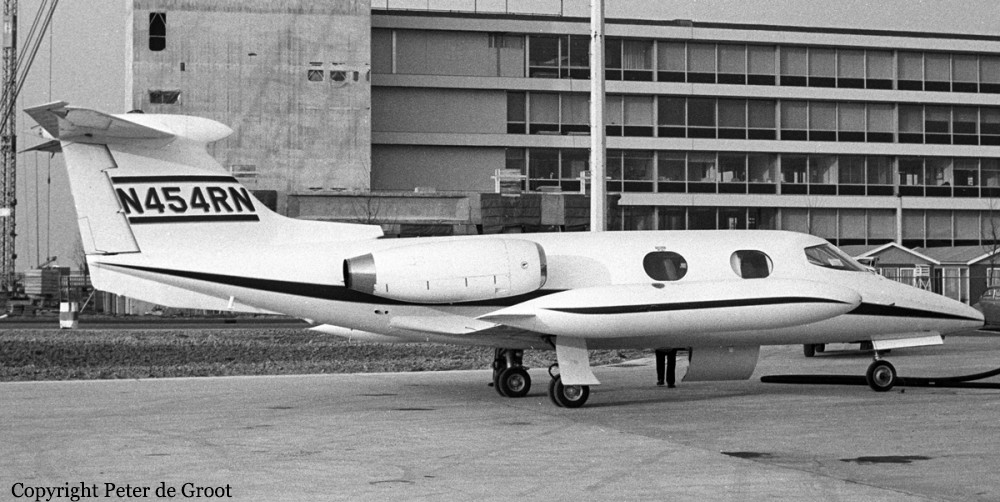
Crash of a Learjet 24 in Atlanta: 7 killed

Date & Time: Feb 26, 1973 at 1012 LT
Type of aircraft:
Registration:
N454RN
Flight Phase:
Survivors:
No
Schedule:
Atlanta - Miami
MSN:
24-121
YOM:
1966
Crew on board:
2
Crew fatalities:
Pax on board:
5
Pax fatalities:
Other fatalities:
Total fatalities:
7
Captain / Total flying hours:
5600
Captain / Total hours on type:
2150.00
Copilot / Total flying hours:
4000
Copilot / Total hours on type:
4
Aircraft flight hours:
4041
Circumstances:
A Gates Learjet 24, N454RN, operated as a corporate flight by Machinery Buyers Corp., crashed following takeoff from runway 20L at DeKalb-Peachtree Airport, Atlanta, Georgia. The aircraft was destroyed by impact and fire. The two crewmembers and five passengers were fatally injured and one person on the ground sustained serious burns. An apartment building was damaged, three parked vehicles were destroyed, and another vehicle was damaged by impact and fire. The pilot had filed an Instrument Flight Rules (IFR) flight plan from Atlanta, Georgia, to Miami, Florida, with a proposed departure time of 09:50 and an en route altitude of Flight Level 410. The flight was cleared for takeoff from runway 20L at 10:10. The weather at the time of the accident was overcast, with ceiling 500 feet, visibility 4 miles in fog and smoke, wind 060° at 4 knots, altimeter setting 30.20 inches. Ground witnesses stated that the airplane had made a normal take-off, but was trailing blue-white or blue-gray smoke when it crossed the airport boundary. The following conversation with the flight was recorded by the airport control tower:
Tower - "Lear 454RN it appeared the left engine laid a pretty good layer of smoke out of the left side there for approximately 300 or 400 feet."
454RN - "We just hit some birds."
Tower - "Roger, you turning to land?"
454RN - "Don't believe we're gonna make it." (Last transmission by the crew.
The aircraft climbed to a height about 250 to 300 feet above the ground before it started to settle in a nose-high attitude. The airplane collided initially with the roof of a three-story apartment building, approximately 2 miles south-southwest of the airport. The wreckage came to rest in a wooded ravine adjacent to a busy highway, 165 feet southwest of the damaged building. The airplane's takeoff path was over a residential area which contained numerous apartment complexes, shopping centers, and busy thoroughfares. A suitable emergency landing site was not available. The airplane's windshield and center post contained bird residue and bird feathers. After the accident, the remains of 15 cowbirds were found within 150 feet of the departure end of runway 20L. Both engines showed distortion and foreign object damage to the compressor rotor assemblies. Foreign material obstructed approximately 75 percent of the cooling air ports of the first-stage turbine nozzles.
Probable cause:
The loss of engine thrust during takeoff due to ingestion of birds by the engines, resulting in loss of control of the airplane. The Federal Aviation Administration and the Airport Authority were aware of the bird hazard at the airport; however, contrary to previous commitments, the airport management did not take positive action to remove the bird hazard from the airport environment.
Final Report:

Crash of a Learjet 24D in Detroit: 2 killed

Date & Time: Feb 21, 1973 at 0956 LT
Type of aircraft:
Registration:
N100SQ
Survivors:
Yes
Schedule:
Saint Joseph - Detroit
MSN:
24-113
YOM:
1966
Crew on board:
2
Crew fatalities:
Pax on board:
1
Pax fatalities:
Other fatalities:
Total fatalities:
2
Captain / Total flying hours:
4998
Captain / Total hours on type:
473.00
Circumstances:
Following an uneventful flight from Saint Joseph, Missouri, the crew started the descent to Detroit-Willow Run Airport. After a wrong approach configuration, the crew misjudged distance and speed during the last segment, causing the aircraft to land too far down the runway. After touchdown, the airplane was unable to stop within the remaining distance and the captain decided to initiate a go-around manoeuvre but this was too late. The airplane overran, struck the localizer antenna then crashed on the ILS building. Both pilots were killed while the passenger was seriously injured.
Probable cause:
Improper operation of flight controls on part of the crew who misjudged distance and speed and delayed in initiating a go-around manoeuvre. The following factors were reported:
- The crew failed to stow spoilers on go-around.
Final Report:

Crash of a Cessna 421B Golden Eagle II in Brookfield: 4 killed

Date & Time: Feb 19, 1973 at 0751 LT
Operator:
Registration:
N1536T
Flight Phase:
Survivors:
No
Site:
Schedule:
Milwaukee - Dayton
MSN:
421B-0306
YOM:
1973
Crew on board:
1
Crew fatalities:
Pax on board:
3
Pax fatalities:
Other fatalities:
Total fatalities:
4
Captain / Total flying hours:
8389
Captain / Total hours on type:
27.00
Circumstances:
After takeoff from Milwaukee-Lawrence J. Timmerman Airport, while climbing, the pilot informed ATC about technical problems with the left engine and was cleared to return for an emergency landing. While trying to join the approach path, he lost control of the airplane that crashed in flames on a road located in Brookfield, about five miles southwest of the airport. The aircraft was destroyed by a post crash fire and all four occupants were killed.
Probable cause:
Engine failure or malfunction during climb to cruise. The following factors were reported:
- Powerplant failure due to fuel injection system obstructed,
- Foreign material affected normal operations,
- The pilot's attention diverted from operation of aircraft,
- The pilot failed to maintain flying speed,
- Low ceiling,
- N°1 cylinder nozzle core on left engine was partially blocked,
- Fuel flow 18 pounds per hour observed spinning.
Final Report:

Crash of a Rockwell Grand Commander 680F in Battle Ground: 3 killed

Date & Time: Feb 17, 1973 at 0859 LT
Registration:
N69HE
Flight Phase:
Survivors:
No
Schedule:
Salem - Seattle
MSN:
680F-932-5
YOM:
1960
Crew on board:
1
Crew fatalities:
Pax on board:
2
Pax fatalities:
Other fatalities:
Total fatalities:
3
Captain / Total flying hours:
2000
Captain / Total hours on type:
9.00
Circumstances:
While in cruising altitude on a flight from Salem to Seattle, the pilot encountered icing conditions and was cleared to divert to Portland. Shortly later, control was lost and the airplane entered a dive. Both wings and elevators separated prior to final impact. All three occupants were killed.
Probable cause:
While cruising in poor weather conditions, the pilot suffered a spatial disorientation. The following factors were reported:
- Exceeded designed stress limits of aircraft,
- Overload failure,
- Lack of familiarity with aircraft and lack of recent experience on instruments,
- Low ceiling, rain, icing conditions,
- Visibility down to zero,
- Both outbound wings and horizontal stabs separated prior to impact.
Final Report:

Crash of a Beechcraft C-45 Expeditor at Davison AAF: 1 killed

Date & Time: Feb 13, 1973
Type of aircraft:
Operator:
Flight Phase:
Flight Type:
Survivors:
No
Schedule:
Davison - Davison
Crew on board:
1
Crew fatalities:
Pax on board:
0
Pax fatalities:
Other fatalities:
Total fatalities:
1
Circumstances:
The pilot was completing a local training flight at Davison AAF when the airplane went out of control and crashed in unknown circumstances in a demolition. The pilot, sole on board, was killed. A45 or C45?

Crash of a Rockwell Aero Commander 500B in Alcoa: 2 killed

Date & Time: Feb 8, 1973 at 1255 LT
Operator:
Registration:
N6166X
Flight Phase:
Flight Type:
Survivors:
No
Schedule:
Knoxville - Knoxville
MSN:
500B-996-27
YOM:
1960
Location:
Crew on board:
1
Crew fatalities:
Pax on board:
1
Pax fatalities:
Other fatalities:
Total fatalities:
2
Captain / Total flying hours:
2871
Captain / Total hours on type:
82.00
Circumstances:
After takeoff from Knoxville-McGee Tyson Airport, while on a local flight, the pilot lost control of the airplane that dove into the ground and crashed in an open field located in Alcoa, south of the airport. The aircraft was destroyed and both occupants were killed. It was determined that the pilot was intoxicated.
Probable cause:
Uncontrolled descent after the pilot failed to maintain flying speed due to physical impairment. The following factors were reported:
- Alcoholic impairment of efficiency and judgment,
- Icing conditions including sleet and freezing rain,
- Stolen aircraft or unauthorized flight,
- Fog,
- Missed visual approach to airport under ravec,
- Blood alcohol 2,52‰,
- Unauthorized use of aircraft,
Final Report:

Crash of a Beechcraft D18S in Paris: 4 killed

Date & Time: Feb 7, 1973 at 2000 LT
Type of aircraft:
Registration:
N80042
Survivors:
No
Schedule:
Bowling Green - Paris
MSN:
A-186
YOM:
1946
Location:
Crew on board:
2
Crew fatalities:
Pax on board:
2
Pax fatalities:
Other fatalities:
Total fatalities:
4
Captain / Total flying hours:
19950
Circumstances:
The crew started the approach to Paris Airport by night and poor weather conditions. On final in heavy rain showers, the pilot-in-command passed below the minimum descent altitude when the twin engine airplane struck trees and crashed in flames. All four occupants were killed.
Probable cause:
Improper IFR operation on part of the pilot-in-command. The following factors were reported:
- Low ceiling, rain and fog,
- Visibility one mile or less,
- Descended below MDA in heavy rain until impact with trees.
Final Report: