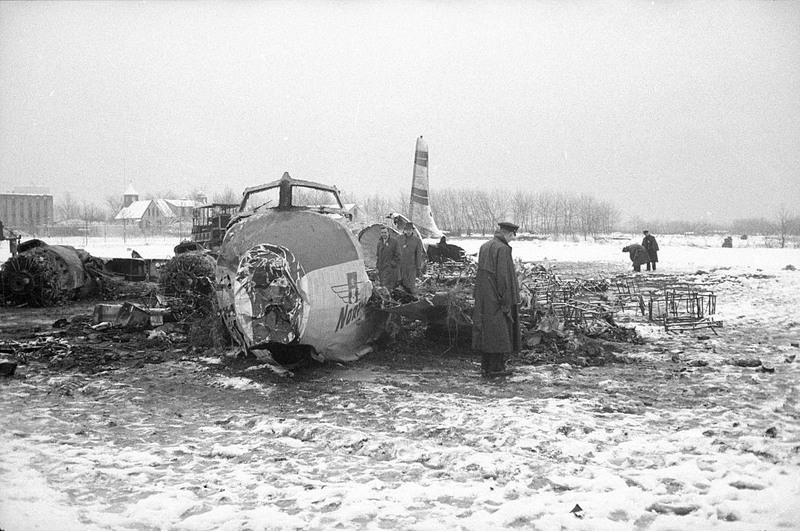
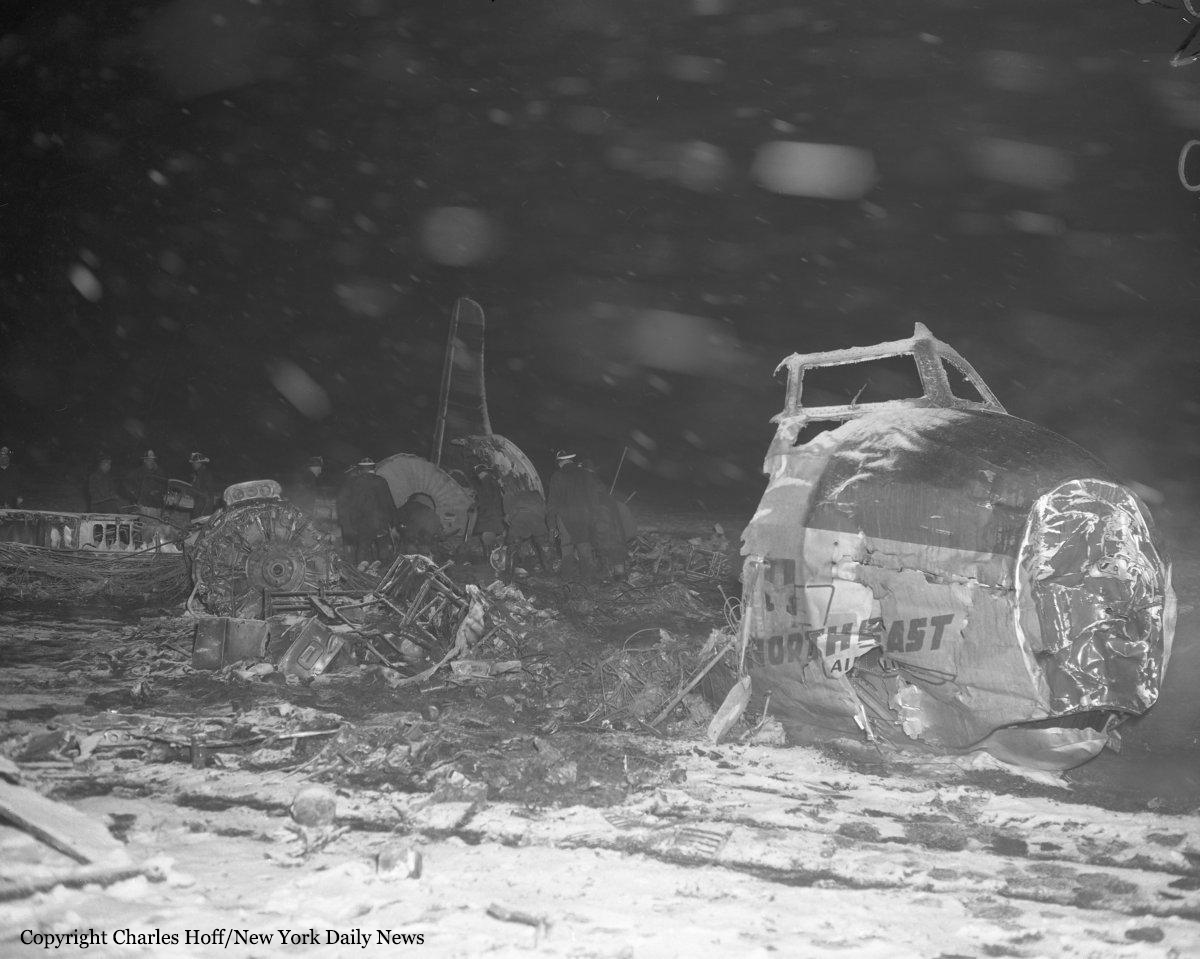
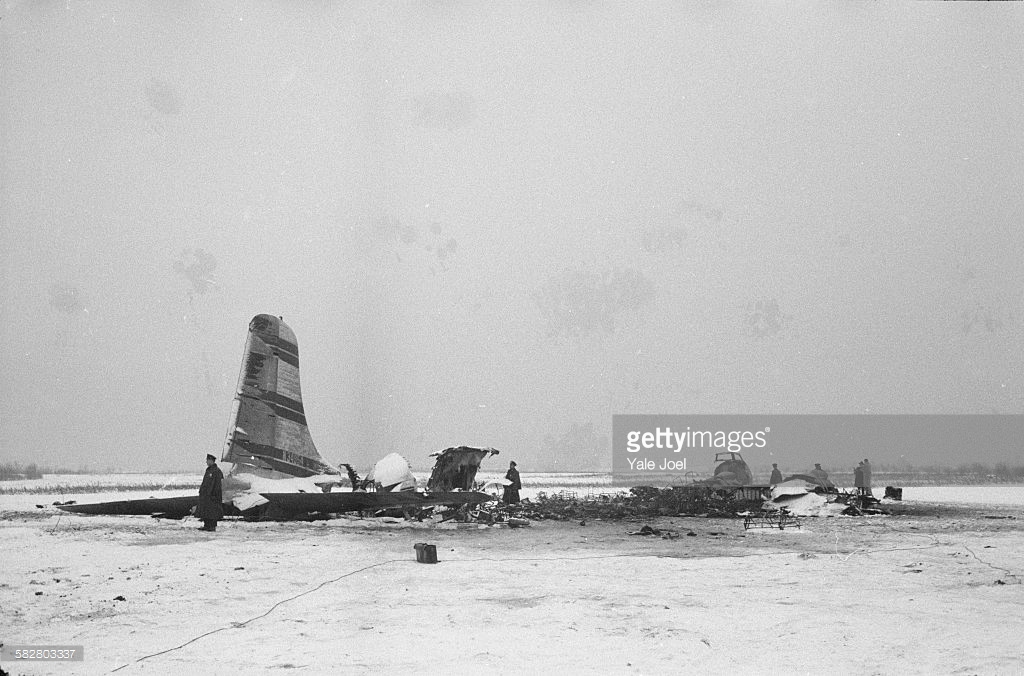
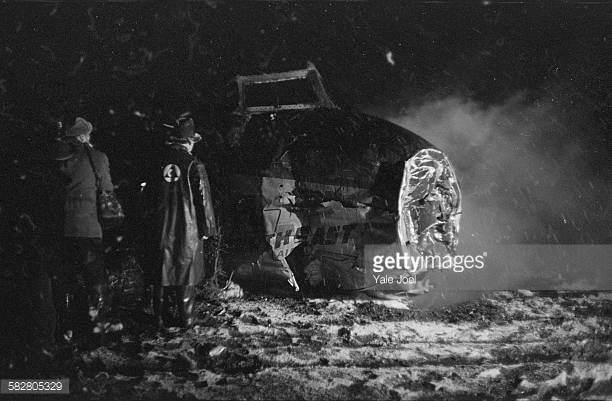
Crash of a Douglas DC-6A in New York: 20 killed

Date & Time: Feb 1, 1957 at 1802 LT
Type of aircraft:
Operator:
Registration:
N34954
Flight Phase:
Survivors:
Yes
Schedule:
New York – Miami
MSN:
44678
YOM:
1955
Flight number:
NE823
Crew on board:
6
Crew fatalities:
Pax on board:
95
Pax fatalities:
Other fatalities:
Total fatalities:
20
Captain / Total flying hours:
16630
Captain / Total hours on type:
85.00
Copilot / Total flying hours:
8943
Copilot / Total hours on type:
17
Aircraft flight hours:
8317
Circumstances:
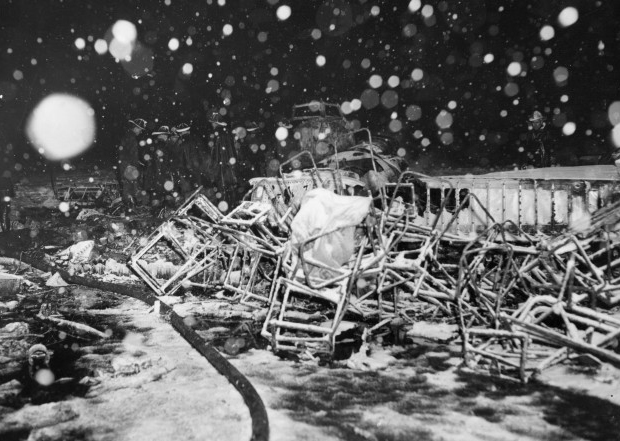
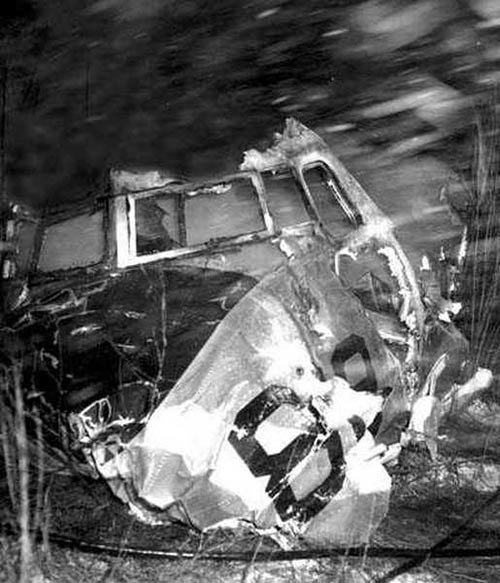
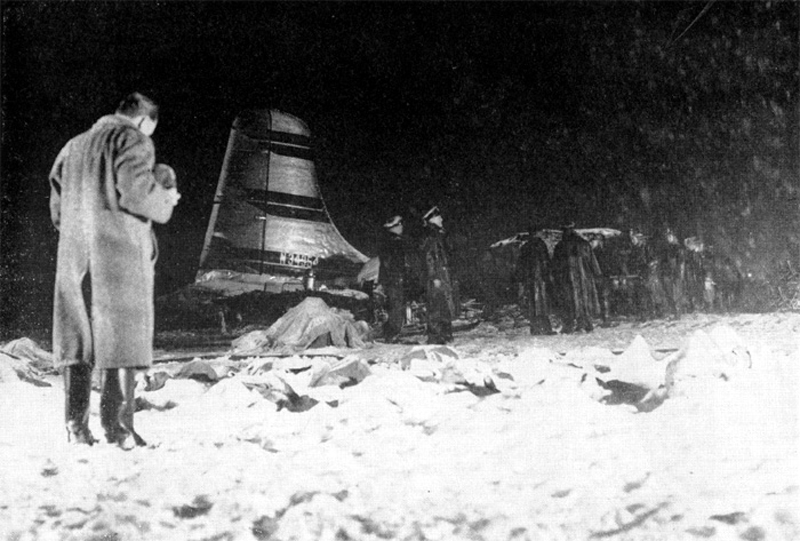
Northeast Airlines Flight 8232 a DC-6A, N34954, was scheduled to originate at La Guardia Field, a nonstop to Miami, Florida, with a departure time of 1445. This aircraft and the same crew operating as Flight 822, had arrived at LaGuardia from Miami at 1250. The crew consisted of Captain Alva V. R. Marsh, First Officer Basil S. Dixwell, Flight Engineer Angelo V. Andon, and Stewardesses Doris Steele, Catherine Virchow, and Emily Gately. A short time before the scheduled departure time the crew and passengers boarded the aircraft. Snow, which had started at LaGuardia at 1202, began to accumulate on the aircraft's horizontal surfaces after its arrival at the LaGuardia ramp position. Snow removal by ground personnel, during preflight, was ineffective because of the continuing snowfall. Accordingly, about 1600 the aircraft was taxied, with all occupants aboard, to a nose hangar on the west side of the airport for snow removal. This was accomplished and at 1745 the crew advised LaGuardia ground control that they were ready to taxi from the nose hangar for the IFR, departure to Miami. Flight 823 was then cleared to runway 4 and was advised that the wind was northeast 10, the altimeter setting 30.12, and a time check of 1747-1/2. Air Route Traffic Control cleared the flight as follows. "Cleared to Bellemead, maintain 7,000 feet." A supplementary climb-out clearance was then given: "After takeoff, a left turn direct Paterson, direct Chatham, cross 081-degree radial of Caldwell 4,000 feet or above, cross Paterson between 5,000 and 6,000 feet and cross the northwest course of Idlewild not above 6,000 feet." Both clearances were repeated and acknowledged. Takeoff clearance was issued at 1800 and a tower controller saw the aircraft airborne at approximately 1801.2 The controller advised the flight to contact LaGuardia radar departure control on 120.4 mcs. This message was acknowledged but the radar controller did not receive a call from the flight; however, he did observe a target on the scope that indicated an aircraft over the runway. The next two sweeps on the scope disclosed the target beyond the end of the runway. A subsequent sweep indicated that the target was turning left. The target then disappeared from the scope. The LaGuardia tower controllers observed a large flash at approximately 1802 in the vicinity of Rikers Island, the approximate center of which is about one mile north of the point where the aircraft left the runway. It was learned at 1819, by telephone, that Northeast Airlines Flight 823 had crashed on Rikers Island. The airplane was destroyed by a post crash fire and 20 passengers were killed.
Probable cause:
The Board determines that the probable cause of the accident was the failure of the captain to (1) properly observe and interpret his flight instruments and (2) maintain control of his aircraft. The following findings were reported:
- The weather at the time of takeoff was above the prescribed company minimums,
- The aircraft, immediately following takeoff, made a left turn of approximately 119 degrees and a descent,
- The pilot and flight crew did not observe or interpret any instrument indication of a left turn or descent,
- The heading indications of both fire-seized course indicators corresponded closely to the impact heading of the aircraft,
- These instruments had been functioning properly until the time of impact,
- There was no failure or malfunction of the powerplants,
- There was no airframe failure or control malfunction,
- There was no electrical power failure or malfunction of instruments prior to ground impact,
- There was no fire prior to ground impact,
- As a result of fuselage deformation the main cabin door jammed, hindering evacuation of passengers,
- The main cabin lighting system became Inoperative during deceleration and the emergency inertia lights did not actuate.
Final Report:
Crash of a Douglas DC-7B in Sunland: 7 killed

Date & Time: Jan 31, 1957 at 1118 LT
Type of aircraft:
Operator:
Registration:
N8210H
Flight Phase:
Flight Type:
Survivors:
No
Site:
Schedule:
Santa Monica - Santa Monica
MSN:
45192
YOM:
1957
Crew on board:
4
Crew fatalities:
Pax on board:
0
Pax fatalities:
Other fatalities:
Total fatalities:
7
Captain / Total flying hours:
11757
Captain / Total hours on type:
598.00
Copilot / Total flying hours:
7115
Copilot / Total hours on type:
287
Aircraft flight hours:
1
Circumstances:
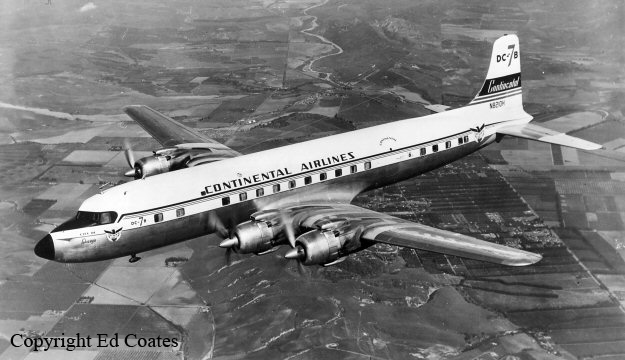
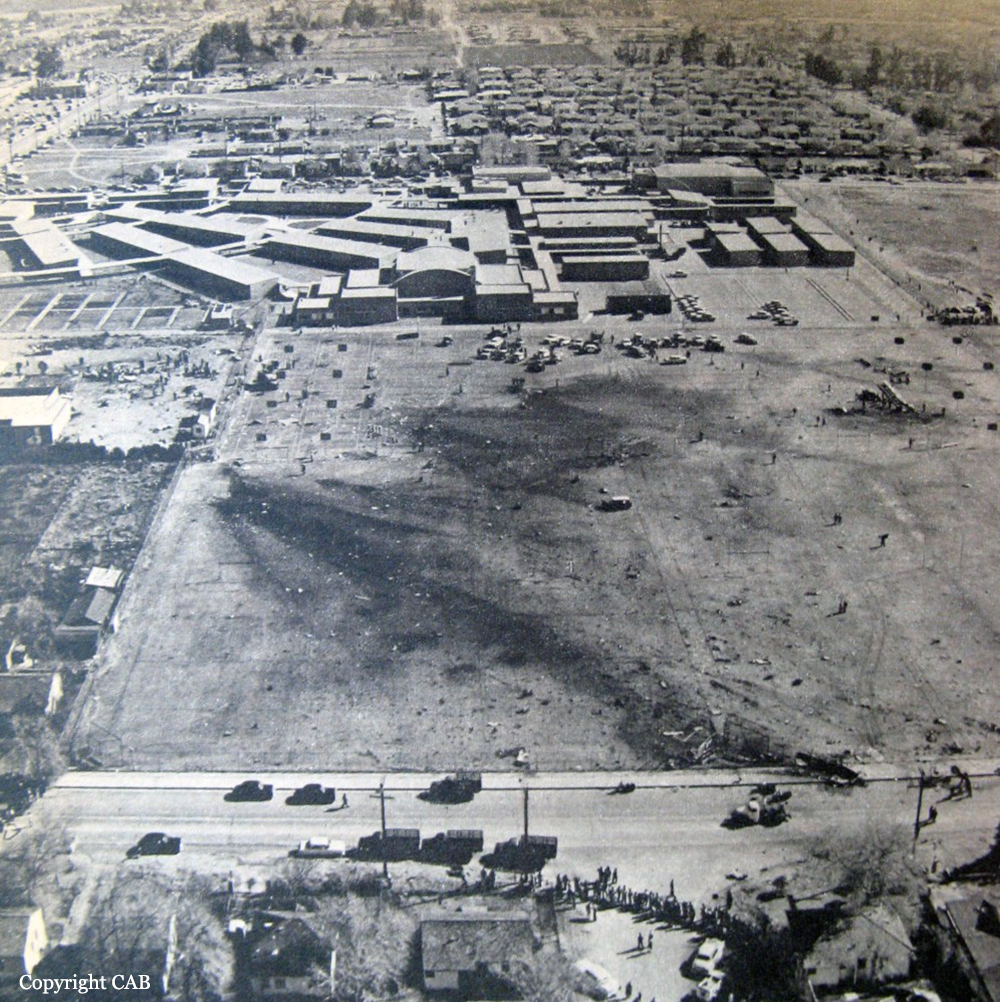
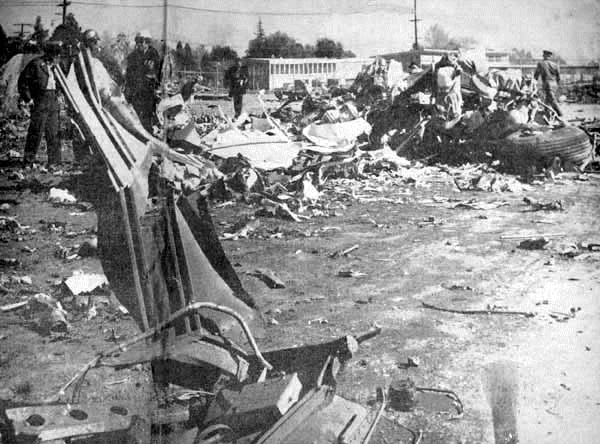
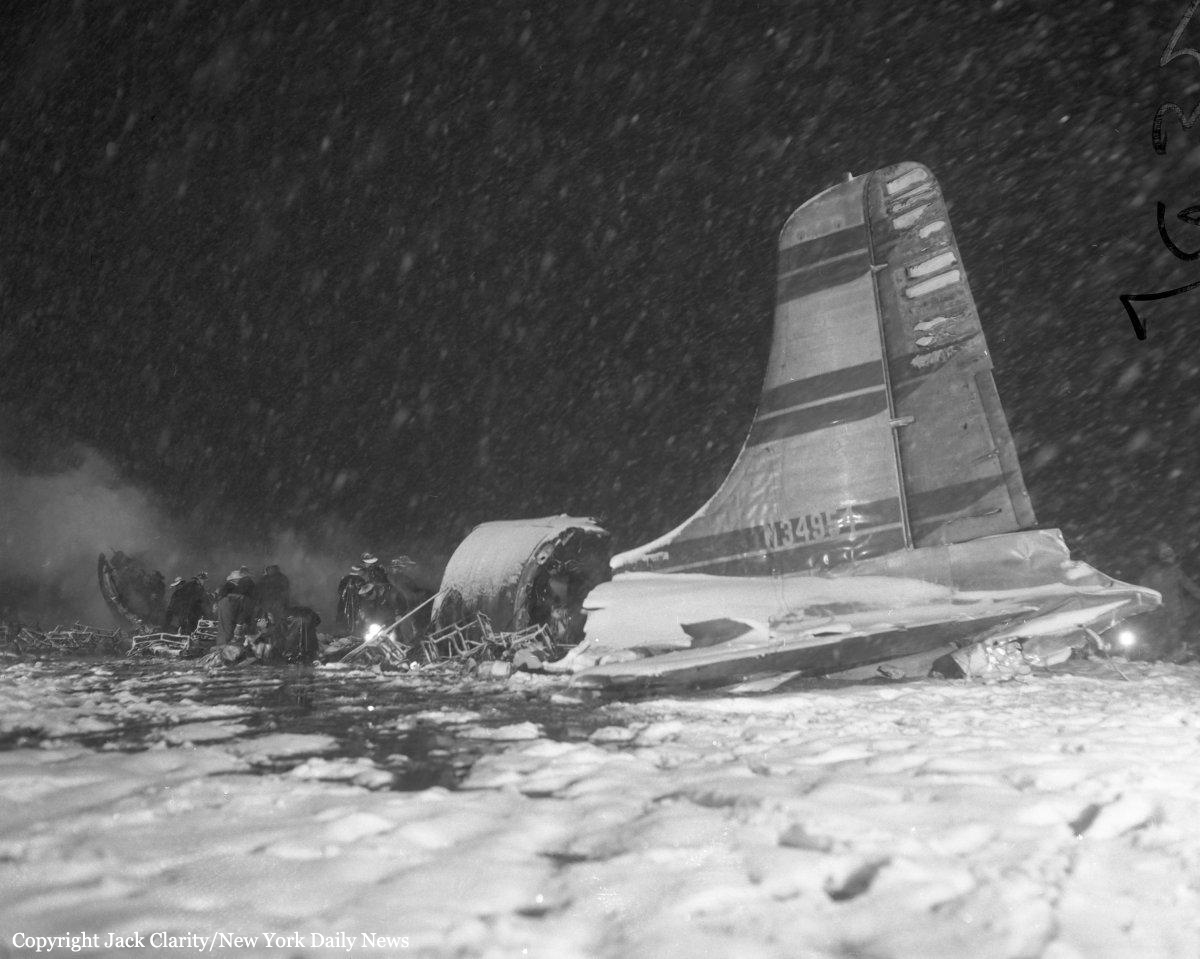
On January 31, at 1015, N8210H took off tram runway 03 of the Santa Monica, California, Airport. The aircraft was a new DC-7B being flown for the first time for the purpose of functionally checking the aircraft and its components in flight following production. The flight crew were Douglas Aircraft employees consisting of Pilot William G. Carr; Copilot Archie R. Twitchell; Flight Engineer Waldo B. Adams; and Radio Operator Roy Nakazawa. The aircraft had been subject to many regular inspections during its manufacture and numerous inspections which were required after production preceding the first flight. Accordingly, it was presumed the DC-7B was in airworthy condition. Preparations for the flight by its crew were routine, Departure was on a local VFR flight plan filed with the operations office of the company. The plan showed six hours of fuel aboard end that the flight duration wee estimated as 2 hours 15 minutes. It also showed the gross takeoff night of N8210H was 88,000, pounds, well under the maximum allowable. The load was properly distributed with respect to center of gravity limitations. According to routine procedure the flight switched to the Douglas company radio frequency after takeoff and made periodic progress reports. At 1030 the crew reported over the Catalina intersection, 9,000 feet, routine, and thereafter, at 1106, over Ontario, 25,000 feet, routine. At 1050 that morning, the Northrop operated F-89J, 52-1870, took off from runway 25 of the Palmdale, California, Airport, accompanied by another F-89J, 53-25 6A. The flight of 52-1870 was one of a series of functional flight checks following the completion of IRAN (inspection and repair as necessary), an overhaul project performed under contract by Northrop Aircraft for the United States Air Force. The specific flight was in accordance with provisions of the contract and its purpose was to check the radar fire control systems of both of the all-weather interceptors. The two-member flight crew of 52-1870 consisted of Pilot Roland E. Owen and Radar Operator Curtiss A. Adams, both employees of Northrop. Preparations for the operation were routine and departure was in accordance with a local VFR flight plan filed with the flight department of the company. The plan indicated the estimated duration of the operation as one hour with sufficient fuel aboard for approximately 1 hour and 45 minutes, considering afterburner time, altitude, and power settings for the mission. The F-89's took off individually, using afterburners, with a separation interval, of 20 seconds. In a wide starboard orbit the pilots utilized radar in a “snake climb” to 25,000 feet. At that altitude, a predetermined scissoring flight pattern was utilized which positioned the F-89's, without ground radar control, for simulated all-weather interceptor attacks on each other, during which the operation of airborne radar equipment could be checked. Radio transmissions, on company frequency, were recorded by ground facilities. These were routine commands between the pilots as they executed the radar check pattern and intercepts. At 1118 activity in the Douglas radio roan was interrupted by an emergency transmission from N 8210H. The voices were recognized by radio personnel familiar with the crew members. Pilot Cart first transmitted, “Uncontrollable," Copilot Twitchell then said, “We‘re a midair collision - midair collision, 10 How (aircraft identification using phonetic How for H) we are going in-uncontrollable - uncontrollable - we are . . . we've had it boy - poor jet too - told you we should take chutes - say goodbye to everybody.” Radio Operator Nakazawa’s voice was recognized and he concluded the tragic message with, "We are spinning In the valley.” This final transmission from the flight is presented because it contained important information relative to the accident investigation. It not only establishes the midair collision but also indicates the DC-7 was rendered uncontrollable. It further indicates that Mr. Twitchell at least recognized the aircraft with which they collided as a jet. Further, the DC-7 spun during its descent to the ground. All four crew members on board the DC-7 were killed plus three people on the ground. Seventy others have been injured. Weather conditions in the area at the time of the accident were reported by the Weather Bureau as clear, visibility 50 miles. Winds aloft at 25,000 were approximately 30 knots from 320 degrees.
Probable cause:
The Board determines that the probable cause of this midair collision was the high rate of near head-on closure at high altitude which, together with physiological limitations, resulted in a minimum avoidance opportunity during which the pilots did not see the other’s aircraft. The following findings were reported:
- The flights were operated in clear weather conditions and in accordance with the provisions of local VFR flight plans,
- Under VFR weather conditions and VFR flight plans collision avoidance rested in visual separation, a pilot responsibility,
- The DC-7 and F-89 collided in flight on approximately west and east headings, respectively. They were at 25,000 feet over a non-congested area between one and two miles northeast of the Hansen Dam Spillway,
- At impact the F-89 was rolled about 30 degrees left, both aircraft were about level in the pitch plane, and the convergence angle was about five degrees from head-on,
- Both aircraft tell out of control and the DC-7 crashed in a populated area,
- From visual range, estimated at 3.5 miles, the closure speed between the two aircraft was 700 knots and over the probable flight paths the tine to collision from visual range was about 15 seconds,
- The nature and purpose of the flights did not prevent all pilots from maintaining a lookout for other aircraft,
- There was no evidence found to indicate that any malfunction or failure of the aircraft or their components was a factor in the accident.
Final Report:

Crash of a De Havilland L-20 Beaver at Fort Devens AFB: 1 killed

Date & Time: Jan 30, 1957
Type of aircraft:
Operator:
Flight Type:
Survivors:
Yes
Schedule:
Fort Devens - Fort Devens
Crew on board:
2
Crew fatalities:
Pax on board:
0
Pax fatalities:
Other fatalities:
Total fatalities:
1
Circumstances:
The crew was performing a local training sortie at Fort Devens AFB consisting of materials dropping on a supply mission. On final, the airplane hit tree tops and crashed in flames 1,5 mile short of runway. The pilot was killed while the second occupant was injured.

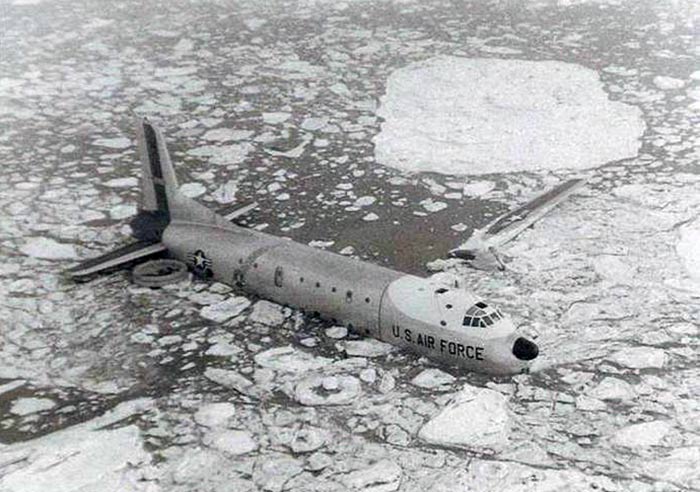
Crash of a Douglas C-124C Globemaster II off Elmendorf AFB

Date & Time: Jan 27, 1957 at 2015 LT
Operator:
Registration:
50-0088
Flight Phase:
Flight Type:
Survivors:
Yes
Schedule:
Elmendorf – McChord
MSN:
43226
YOM:
1950
Crew on board:
11
Crew fatalities:
Pax on board:
1
Pax fatalities:
Other fatalities:
Total fatalities:
0
Circumstances:
Just after liftoff from Elmendorf AFB, while in initial climb, the crew informed ground about an engine failure and elected to return. The captain realized it could not make it so he ditched the aircraft in the icy Cook Inlet. The airplane came to rest and was damaged beyond repair while all 12 occupants were rescued.
Probable cause:
Engine failure after takeoff.

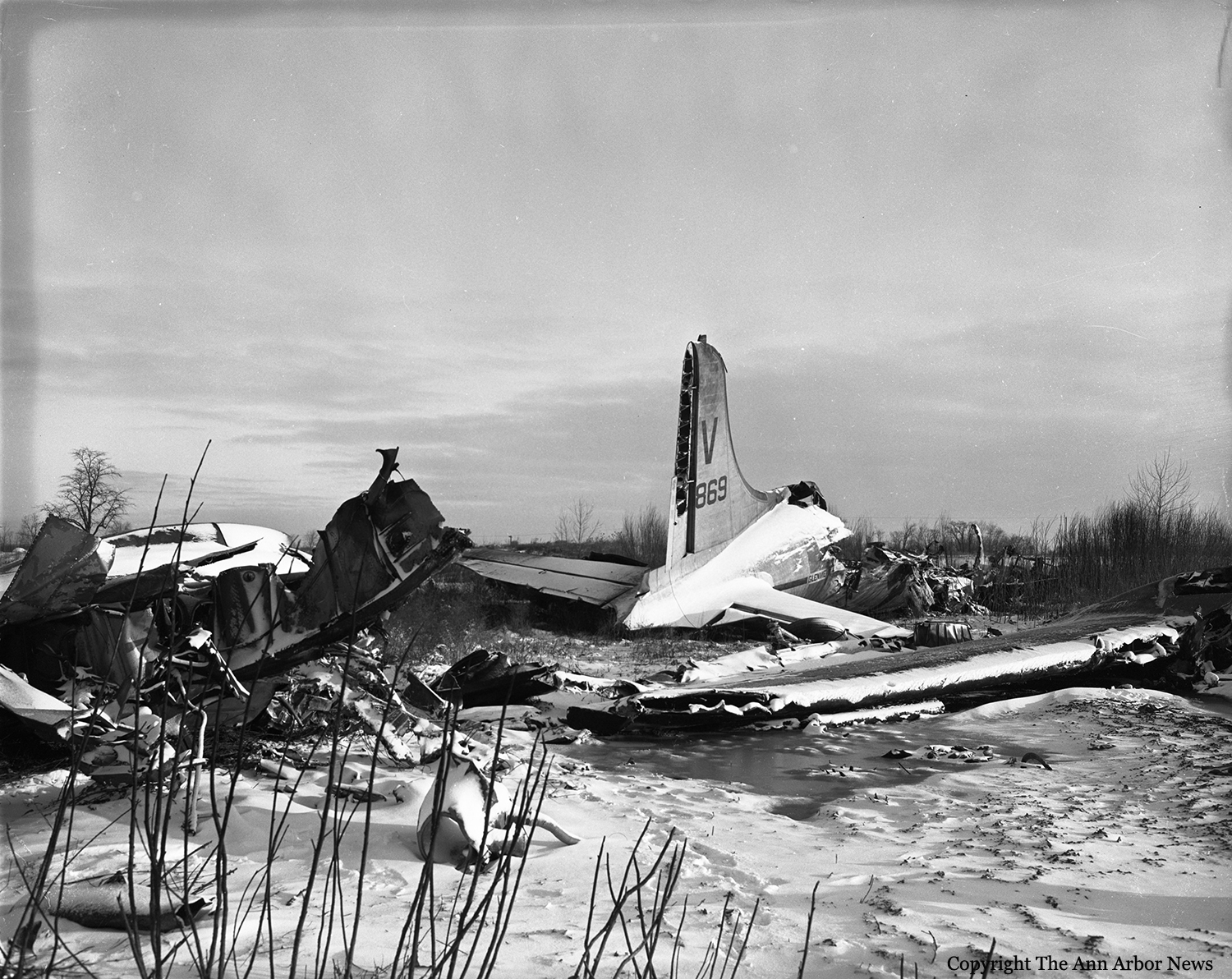
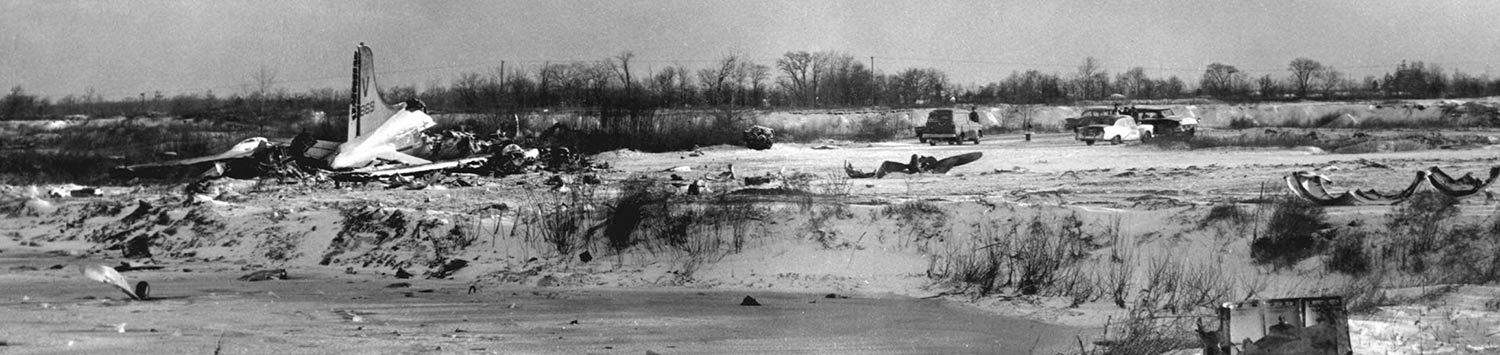
Crash of a Douglas R5D-3 in Detroit: 1 killed

Date & Time: Jan 22, 1957 at 2133 LT
Type of aircraft:
Operator:
Registration:
50869
Flight Type:
Survivors:
Yes
Schedule:
Miramar – Albuquerque – Detroit
MSN:
10546
YOM:
1945
Crew on board:
7
Crew fatalities:
Pax on board:
0
Pax fatalities:
Other fatalities:
Total fatalities:
1
Circumstances:
The aircraft was on its way from Miramar to Detroit, carrying a crew of seven. They made a stop at Albuquerque to carry the body of a USN pilot who was killed in an accident two days earlier. While descending to Willow Run Airport, the pilot briefed his crew about the minimums and confirmed that if runway was not in sight at 800 feet, they will divert to Grosse Isle NAS. The approach was completed in a low visibility due to snow falls and a ceiling at 550 feet when the airplane hit the ground near a pond, lost an engine and crashed in flames in an open field located about two miles short of runway 05. LCDR William E. Sale was killed while six others were injured. The aircraft was destroyed.
Probable cause:
The cause of the accident was attributed to a faulty altimeter reading caused by a frozen moisture drain on the Pitot Static System. As a result, it caused altimeter readings to lag as the plane descended.

Crash of a Boeing KC-97G Stratotanker on Mt Big Shanty: 7 killed

Date & Time: Jan 22, 1957 at 1930 LT
Type of aircraft:
Operator:
Registration:
53-0222
Flight Phase:
Flight Type:
Survivors:
No
Site:
Schedule:
Westover - Griffiss
MSN:
17004
YOM:
1953
Flight number:
Crony 14
Crew on board:
7
Crew fatalities:
Pax on board:
0
Pax fatalities:
Other fatalities:
Total fatalities:
7
Circumstances:
The airplane was on a refueling mission and departed Westover AFB at 1330LT bound for Griffiss AFB, Rome, New York. Following an uneventful mission, the crew started the descent to Griffiss AFB but was instructed to follow a holding pattern because a fighter that was short of fuel must land immediately. Twenty-five minutes later, while cruising in poor weather conditions (freezing rain and snow), the airplane struck the snowy Mt Big Shanty (701 meters high) located about 70 miles northeast of Griffiss AFB, in the Adirondack Mountain Range. Rescuers arrived on scene in the early morning of January 24. All seven crew members have been killed, among them Maj Charles D. Mellinger, pilot, and 1st Lt Fred Defrench, copilot.

Crash of a Douglas DC-3 in New York: 1 killed

Date & Time: Jan 19, 1957
Type of aircraft:
Operator:
Registration:
N33374
Flight Phase:
Survivors:
No
MSN:
4369
YOM:
1942
Crew on board:
1
Crew fatalities:
Pax on board:
0
Pax fatalities:
Other fatalities:
Total fatalities:
1
Circumstances:
Parked at Idlewild Airport, the aircraft was stolen by a technician who was able to takeoff. During initial climb, at an altitude of 150 feet, the airplane stalled and crashed near the runway. The aircraft was destroyed and the 'pilot' was killed.

Crash of a Boeing B-29B-55-BA Superfortress at Bergstrom AFB: 6 killed

Date & Time: Jan 10, 1957
Type of aircraft:
Operator:
Registration:
44-84029
Flight Type:
Survivors:
Yes
Schedule:
Bergstrom - Bergstrom
Crew on board:
9
Crew fatalities:
Pax on board:
0
Pax fatalities:
Other fatalities:
Total fatalities:
6
Circumstances:
The crew was completing a night training mission at Bergstrom AFB. On final approach, the airplane was too low and crashed in flames short of runway. Four crew members were rescued while five others were killed. Few hours later, one of the survivor died from his injuries.
Those killed were:
Lt Ronald Rosetti,
Lt Robert E. Smith,
Sgt Edward Clifford Clemmons,
Sgt Thomas Salazar,
A2c Michael Bryan McIntosh,
Lt Don Anderson Berg.

Crash of a Convair CV-240-0 in Tulsa: 1 killed

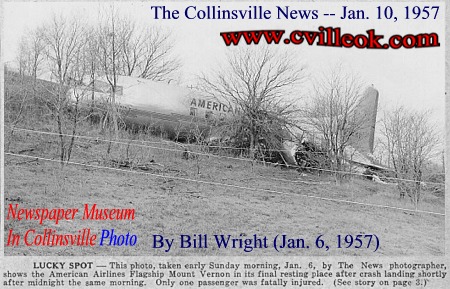
Date & Time: Jan 6, 1957 at 0001 LT
Type of aircraft:
Operator:
Registration:
N94247
Survivors:
Yes
Schedule:
Providence – Chicago – Saint Louis – Springfield – Joplin – Tulsa
MSN:
104
YOM:
1948
Flight number:
AA327
Location:
Crew on board:
3
Crew fatalities:
Pax on board:
7
Pax fatalities:
Other fatalities:
Total fatalities:
1
Captain / Total flying hours:
8655
Captain / Total hours on type:
4100.00
Copilot / Total flying hours:
2170
Copilot / Total hours on type:
924
Aircraft flight hours:
18062
Circumstances:
Flight 327 was scheduled between Providence, Rhode Island, and Tulsa, Oklahoma, with intermediate stops including Chicago, Illinois; and St. Louis, Springfield, and Joplin, Missouri. The flight to Chicago was routine; however, the crew, when securing the cockpit, observed that the fire-warning light for the forward cargo and electrical accessory compartments flickered. This was called to the attention of both the ground crew and the relieving crew (a routine crew change was made) and was written in the aircraft log. Because of necessary repairs to the fire-warning system the flight was delayed 1 hour, 40 minutes and it departed Chicago at 1950. The new crew consisted of Captain Wesley G. Mims, First Officer Paul H. Johnson, and Stewardess Shirley D. Walker. Flight 327 was routine to Joplin and it departed there at 2323 with seven passengers aboard. Leaving Joplin the aircraft weighed 35,940 pounds, which was well under the allowable gross takeoff weight; the load was properly distributed. The flight was cleared by ARTC (Air Route Traffic Control) to the Owasso “H” facility, 2 via airway V-88, to maintain 4,000 feet, and to contact Tulsa approach control on crossing the south course of Chanute low frequency range for further clearance. At approximately 2333, 10 minutes after takeoff from Joplin, ARTC, through the company radio, advised the flight to climb to 4,500 feet, to maintain 4,500 feet, and to report leaving 4,000. This transmission was acknowledged and flight 327 reported leaving 4,000 feet at 2334. Approximately 10 minutes later company radio at Tulsa gave the flight the Tulsa 2328 weather sequence. The company then gave the flight the local altimeter setting as 30.15 and field pressure as 460 feet above zero. This was acknowledged and flight 327 reported it was changing over to Tulsa approach control frequency. At 2347 the flight reported crossing the south leg of Chanute low frequency range and was immediately cleared by approach control direct to Owasso, to descend to and maintain 3,500 feet, and to report when over Owasso. The 2328 Tulsa weather was given the flight as: Measured ceiling 600 feet, overcast; visibility 2-1/2 miles; very light drizzle and fog; wind calm. Liter, the flight reported it was 1-1/2 minutes from Owasso and asked if any delay was expected. Approach control advised no delay was expected since the only local traffic was then making an ILS (Instrument Landing System) approach. Shortly thereafter approach control advised flight 327 that the visibility was then 1-3/4 miles, that the U.S. Weather Bureau was checking the ceiling, and asked if an Owasso approach straight in to runway 17 was to be mad or if an ILS approach was preferred. The flight advised it would make the Owasso approach and at 2357 was cleared accordingly. It was asked to report when over the Owasso facility inbound. At 2400 flight 327 reported over Owasso, inbound, and was cleared to land on runway 17L. Two minutes later a special 2355 weather observation was transmitted to the flight as: Measured 200, overcast; visibility 1-3/4; very light drizzle and fog. This transmission was not acknowledged and nothing further was heard from the flight. Repeated efforts by approach control and other facilities to contact the flight were unsuccessful.
Probable cause:
The Board determines that the probable cause of this accident was the captain's lack of alertness in allowing the first officer to continue an instrument descent to an altitude too low to permit terrain clearance. The following findings were reported:
- This flight was the first time the captain and first officer had flown together,
- The first officer flew the aircraft from Joplin and during the instrument approach,
- The aircraft and its components, including altimeters, functioned in a normal manner throughout the flight and approach,
- The last weather report received by the flight indicated weather conditions were rapidly deteriorating,
- The captain told the first officer he could descend to 700 feet, without specifying mean sea level or above the elevation of the airport,
- The captain allowed the aircraft to be flown below the company’s approved landing minimums for this type approach and to an altitude precluding terrain clearance.
Final Report:

Crash of a Howard Super Ventura in Nashua: 3 killed

Date & Time: Dec 27, 1956
Operator:
Registration:
N345
Flight Phase:
Flight Type:
Survivors:
No
Schedule:
Youngstown - Youngstown
MSN:
5270
YOM:
1943
Crew on board:
3
Crew fatalities:
Pax on board:
0
Pax fatalities:
Other fatalities:
Total fatalities:
3
Circumstances:
The crew departed Youngstown Airport on a local familiarization flight and continued to the east over Pennsylvania. In the region of Nashua, the airplane went out of control, dove into the ground and crashed in a field, killing all three occupants.