Crash of a Boeing KB-29P Superfortress near Talkeetna: 8 killed

Date & Time: Dec 26, 1956
Type of aircraft:
Operator:
Registration:
44-84149
Flight Phase:
Flight Type:
Survivors:
No
Site:
Schedule:
Elmendorf – Eielson
Crew on board:
8
Crew fatalities:
Pax on board:
0
Pax fatalities:
Other fatalities:
Total fatalities:
8
Circumstances:
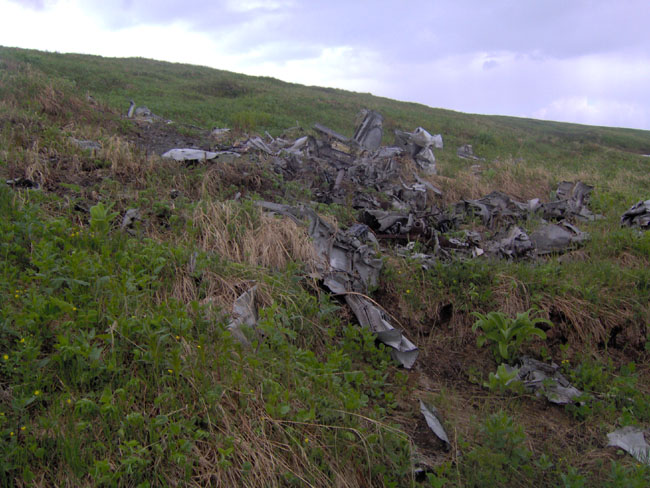
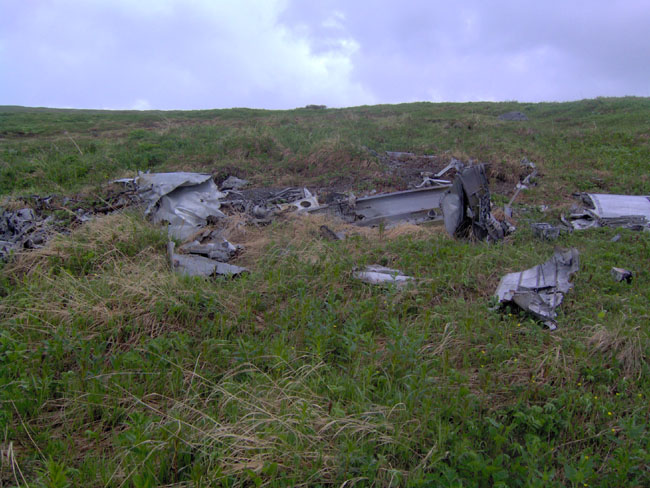
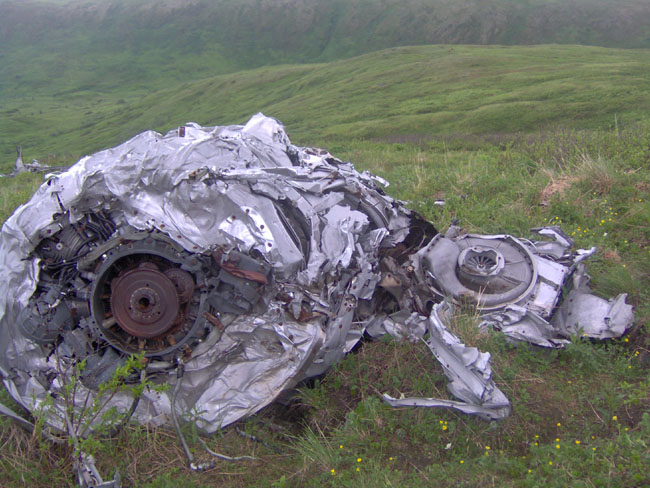
Nineteen minutes after his departure from Elmendorf AFB, while cruising at an altitude of 4,200 feet, the crew contacted ATC when the airplane struck Mt Bald located about 11 miles east of Talkeetna. As the airplane was fully loaded with fuel, a huge explosion occurred on impact. The aircraft was destroyed and all eight crew members were killed.
Crew (508th Air Refueling Squadron):
1st Lt Thomas H. Patton, pilot,
2nd Lt James D. Dellinger, copilot,
1st Lt Lionel E. Reid, navigator,
1st Lt Luther G. Lamm,
M/Sgt Otto D. McAdams,
T/Sgt Thurman C. Rainer,
S/Sgt John B. Pyland,
A2c William P. Hodgson.

Crash of a Lockheed 18-56 LodeStar near Tyrone: 3 killed

Date & Time: Dec 20, 1956 at 1923 LT
Type of aircraft:
Operator:
Registration:
N1245V
Flight Phase:
Survivors:
No
Schedule:
Pittsburgh – New York
MSN:
2470
YOM:
1943
Crew on board:
2
Crew fatalities:
Pax on board:
1
Pax fatalities:
Other fatalities:
Total fatalities:
3
Captain / Total flying hours:
10615
Captain / Total hours on type:
498.00
Copilot / Total flying hours:
2315
Copilot / Total hours on type:
424
Aircraft flight hours:
3715
Circumstances:
N1245V departed Greater Pittsburgh Airport, Pittsburgh, Pennsylvania, at 1850, December 20, 1956, on an IFR flight plan via airways V-35, V-6, V-168, V-30, and V-1 to New York International Airport. Jamaica, New York. The crow consisted of Captain Roy E. Rollo and Copilot Lewis Thomas Williams. Mr. Alden Roach, President of Columbia-Geneva Steel Company, was the only passenger. At the time of takeoff from Pittsburgh, the gross weight of the aircraft was 19,421 pounds (maximum allowable gross load 19,500 pounds) and the weight was properly distributed. The purpose of the flight was to transport Mr. Roach to New York International Airport. The flight reported to Pittsburgh Air Route Traffic Center at 1905 when it was over New Alexandria, Pennsylvania, altitude 7,000 feet. A revised routing clearance to New York International Airport was issued to the flight at 1906 by ARTC to proceed via airways V-35, V-6, V-168, and Blue 18, and to climb to and maintain 9,000 feet. 2 Accordingly, N1245V reported leaving 7,000 and 8,000 feet at 1907 and 1909, respectively. At 1921 the Civil Aeronautics Administration Communications Station at Philipsburg, Pennsylvania, received a call from the flight giving its position as over the Coalport intersection at 1916, estimating Philipsburg at 1930. Philipsburg radio then requested N1245V to change over to the frequency of the New York Air Route Traffic Control Center and this message was acknowledged. This was the last radio contact with the flight. At 1928 Philipsburg radio received a telephone call, from a location 24 miles east of the Coalport intersection and approximately 12 miles south-southwest of the Philipsburg Airport, to the effect that an aircraft, later identified as N1245V, had crashed and was burning in a nearby mountainous wooded area. The Philipsburg 1928 weather sequence was: Ceiling measured 400 feet, overcast; visibility 2 miles; fog; temperature 40; dewpoint 40; wind calm; altimeter 30.04.
Probable cause:
The Board determines that the probable cause of the accident was the loss of control for reasons unknown resulting in a rapid descent during which structural failure occurred. The following findings were reported:
- Meteorological conditions at the aircraft's cruising altitude were conducive to the formation of carburetor or induction system icing,
- During an uncontrolled descent the aircraft failed structurally as a result of airloads in excess of design strength,
- There was no aircraft or engine fire prior to ground impact.
Final Report:

Crash of a Curtiss C-46A-45-CU Commando in Long Beach

Date & Time: Dec 16, 1956
Type of aircraft:
Operator:
Registration:
N2028A
Flight Type:
Survivors:
Yes
MSN:
30380
YOM:
1944
Crew on board:
4
Crew fatalities:
Pax on board:
0
Pax fatalities:
Other fatalities:
Total fatalities:
0
Circumstances:
Following an uneventful cargo flight, the crew started the approach to Long Beach under VFR. On final, the airplane went through a patch of fog. In zero visibility, the airplane descended until it struck the ground and crashed few dozen yards short of runway threshold. All four crew members were slightly injured and the aircraft was damaged beyond repair.

Crash of a Lockheed 18-14 LodeStar near Bartlesville: 8 killed

Date & Time: Dec 12, 1956 at 0850 LT
Type of aircraft:
Operator:
Registration:
N28366
Flight Phase:
Survivors:
No
Schedule:
Bartlesville – Salt Lake City
MSN:
2043
YOM:
1940
Crew on board:
2
Crew fatalities:
Pax on board:
6
Pax fatalities:
Other fatalities:
Total fatalities:
8
Captain / Total flying hours:
8837
Captain / Total hours on type:
700.00
Copilot / Total flying hours:
3000
Copilot / Total hours on type:
500
Circumstances:
The purpose of this flight was to take six passengers, all Phillips' employees. from Bartlesville, Oklahoma, to Salt Lake City, Utah. Company Pilot Joe Mark Bower and company Copilot-Mechanic Robert Ellwood Ulrich were assigned to the flight by the Aviation Department of Phillips. When the aircraft was loaded and prior to leaving the ramp Copilot Ulrich called the company radio station, located on the airport, requested taxiing instructions, and asked for an IFR clearance to Salt Lake City, nonstop. The company radio operator obtained the desired clearance from ARTC through Tulsa, and immediately relayed it to the aircraft. A flight plan previously prepared contained the following information: Proposed time of departure 0805; estimated elapsed time 5 hours, 15 minutes; fuel on board 6 hours. Departure was at 0826. At that time the gross weight of the aircraft was 19,284 pounds (maximum allowable was 19.500 pounds), and the load was properly distributed with respect to allowable center of gravity limitations. About 14 minutes after takeoff, at approximately 0840, Copilot Ulrich called Bartlesville Radio and stated that the flight was having engine trouble, with an oil temperature over 100 degrees, and requested that the IFR flight plan be canceled as they might return. The Bartlesville operator complied and notified Tulsa. At the next contact, about 0845, the copilot again called Bartlesville Radio stating that they could not unfeather the propeller. At that time he asked the Bartlesville operator to determine the condition of the runways at Tulsa (about 40 miles to the south). This information was obtained and immediately relayed to the copilot, whereupon he said. "Going to Tulsa, changing over." Bartlesville's single 4,600-foot runway had patches of snow and ice while all runways at Tulsa Airport were clear. This was the last radio contact with the flight. None of the messages had mentioned which engine was giving trouble; none indicated any anxiety or stress. There is no known record of N 28366 having made radio contact with any ground station or aircraft other than Bartlesville Radio. About the same time as the last radio contact, the Bartlesville radio operator and Phillips' chief pilot saw the aircraft passing south of the Bartlesville Airport heading easterly. They estimated its altitude to be 3,000 feet above the ground. The aircraft continued east for about 4-1/2 miles, until beyond the more congested part of Bartlesville, and then turned to the right about 90 degrees toward Tulsa. A number of persons saw the flight after it turned toward Tulsa. When it had been on this southerly heading for about four miles the aircraft was seen to plunge to earth in a manner described by several witnesses as a spin. Impact with the rolling terrain was on a heading of about 240 degrees, while the wings were about level, and while the nose-down angle was close to vertical. An explosion and intense fire ensued, largely destroying the general structure of the aircraft.
Probable cause:
The Board determines that the probable cause of this accident was loss of flying speed during single-engine flight for reasons undetermined. resulting in a spin to the ground. The following findings were reported:
- There was no indication of unairworthiness in the airframe or its controls, as far as could be learned,
- The No. 2 (right) engine, although not subject to complete examination due to ground fire, exhibited no sins of malfunctioning,
- Neither propeller nor their feathering mechanism showed any evidence of malfunctioning,
- The left engine developed a bearing failure and its propeller was feathered,
- The reason for the bearing failure cannot be isolated,
- Single-engine flight was started for a distance of 40 Miles,
- Early in this flight altitude, speed, and then control were lost, and the aircraft spun to the ground.
Final Report:

Crash of a Boeing RB-52B-20-BO Stratofortress at Castle AFB: 10 killed

Date & Time: Nov 30, 1956 at 2200 LT
Type of aircraft:
Operator:
Registration:
52-8716
Flight Phase:
Flight Type:
Survivors:
No
Schedule:
Castle - Castle
MSN:
16844
YOM:
1952
Crew on board:
10
Crew fatalities:
Pax on board:
0
Pax fatalities:
Other fatalities:
Total fatalities:
10
Circumstances:
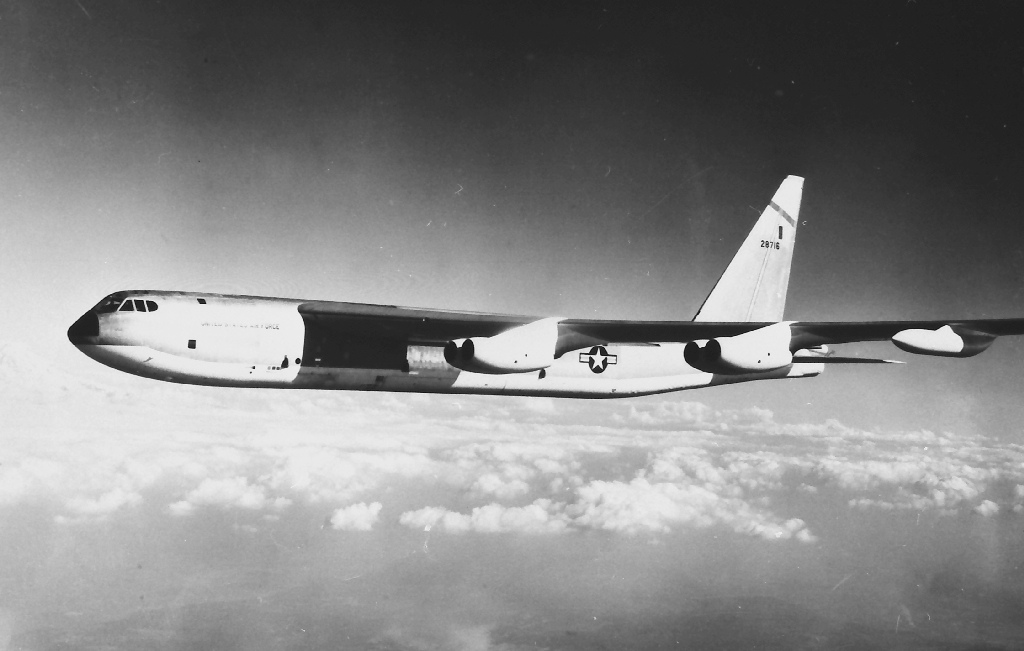
Soon after a night takeoff from Castle AFB, while climbing to a height of 500 feet, the aircraft adopted a 5° nose down attitude. The crew elected to correct this but the aircraft went into a descent and struck the ground 4 miles north of the airbase and exploded on impact, killing all 10 crew members.
Crew:
Cpt John A. Goddard, aircraft commander,
Cpt Richard M. Wikstrom, pilot,
Cpt Leland Fulton Burch, navigator,
Maj Robert Louis Sherman, ECM operator
Cpt Jack Eugene Welch, radar-bombardier,
Maj Bryant Guernsey Gay, electronic counter measure operator,
T/Sgt William J. Maguire, radio operator,
Cpt Nick Sam Koss, radar-bombardier instructor,
Cpt Charles Warren Schweer, ECM instructor,
T/Sgt Gerald Everett Riley, tail gunner.
Probable cause:
No technical issues and no structural failure was found during investigations. It is believed the accident was the consequence of an uncontrolled descent caused either by a wrong maneuver on part of the pilot or due to the fact that they were distracted. Following this accident, it will be recommended that flaps could not be raised below a minimum altitude of 1,000 feet.

Crash of an Aero Commander VL-26B-AD off Potomac Heights: 2 killed

Date & Time: Nov 18, 1956
Operator:
Registration:
55-4643
Flight Phase:
Flight Type:
Survivors:
Yes
MSN:
560-0261
YOM:
1955
Crew on board:
3
Crew fatalities:
Pax on board:
0
Pax fatalities:
Other fatalities:
Total fatalities:
2
Circumstances:
Went out of control and crashed in unknown circumstances into the Potomac River off Potomac Heights, Maryland. A crew member was rescued while both other occupants were killed.

Crash of a Martin 404 in Las Vegas

Date & Time: Nov 15, 1956 at 1504 LT
Type of aircraft:
Operator:
Registration:
N40404
Survivors:
Yes
Schedule:
Kansas City – Topeka – Wichita – Amarillo – Santa Fe – Albuquerque – Las Vegas – Los Angeles
MSN:
14104
YOM:
1951
Flight number:
TW163
Crew on board:
3
Crew fatalities:
Pax on board:
35
Pax fatalities:
Other fatalities:
Total fatalities:
0
Captain / Total flying hours:
9431
Captain / Total hours on type:
639.00
Copilot / Total flying hours:
9926
Copilot / Total hours on type:
105
Aircraft flight hours:
10451
Circumstances:
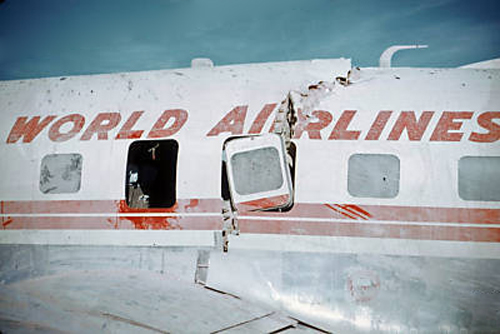
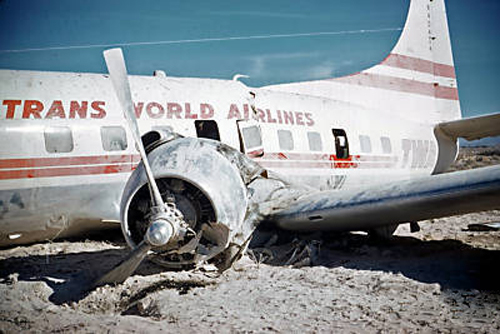
Trans World Airlines Flight 163 is a regularly scheduled domestic operation between Kansas City, Missouri, and Los Angeles, California, with intermediate stops at Topeka and Wichita, Kansas; Amarillo, Texas; Santa Fe and Albuquerque, New Mexico; and Las Vegas, Nevada. A scheduled crew change is made at Albuquerque. There, on November 15, 1956. Captain Arthur G. deFabry, First Officer James P. Rapattoni, and Hostess Anne J. Zeman boarded Flight 163 as its crew to complete the remaining segments. The flight was routine to Las Vegas where it landed at 1440. During the short ground time at Las Vegas the aircraft was serviced and the crew performed routine duties for continuation of the flight to Los Angeles. There was no apparent need for maintenance on the aircraft and none was performed. An Instrument Flight Rules flight plan was prepared and filed because of instrument weather conditions over the latter portion of the flight segment to Los Angeles. Weather conditions at Las Vegas, however, were clear. At 1449 Captain deFabry, seated in the captain’s position, taxied N 40404 from the Las Vegas terminal to runup position beside runway 7 where the required pretakeoff checks were accomplished. The aircraft and equipment responded normally. The flight was issued an instrument clearance by Air Route Traffic Control. At this time, according to the company load manifest, the gross weight of the aircraft was 41.801 pounds, well under the maximum allowable for takeoff, 43,650 pounds. The load was properly distributed with respect to the center of gravity limitations of the aircraft. With Captain deFabry operating the aircraft, Flight 163 took off at 1456. The takeoff was routine and was followed by a climbing left turn to gain altitude and establish a southwesterly course toward Los Angeles. At 1501, when over the northern perimeter of the city, First Officer Rapattoni radioed the Las Vegas tower stating the flight was returning to the airport, engine out. The Las Vegas tower controllers immediately notified all other traffic to remain clear and alerted emergency equipment. Flight 163 was cleared to land, any runway, and informed that the wind was calm. Captain deFabry elected to use runway 7 and First Officer Rapattoni notified the tower. Emergency equipment was then dispatched into position on the taxiway parallel to that runway. N40404 was soon observed on a wide base leg for runway 7 and as it turned onto the final approach. Position and altitude of the flight seemed normal. As the aircraft drew closer its extended gear could be seen and its left propeller was clearly visible, stopped and feathered. As the aircraft passed over the runway threshold its alignment position, and altitude seemed good; however, to nearly all observers excessive speed was apparent. The aircraft floated a considerable distance down the runway before touching it. It then bounced several times, after which an application of power was heard, obviously :m an attempt to go around. The Martin climbed, veered to the left, and its left wing gradually lowered. It seemed to “struggle” to continue flight and its airspeed decreased visibly. Seconds later the aircraft struck the ground, left wing low, just inside the airport boundary. Weather conditions at the time of the accident were clear, visibility 65 miles, and the wind was calm. A large cloud of dust, raised by the accident, hung over the scene and gradually lifted nearly vertically in evidence of the calm wind.
Probable cause:
The Board determines that the probable cause of this accident was that during an emergency situation the captain failed to reduce speed during the latter portion of a single-engine approach; this excessive speed resulted in an overshoot and an attempted go-around which was beyond the performance capability of the aircraft under existing conditions. The following findings were reported:
- The prior segments of the flight, the pretakeoff cheeks, and the takeoff at Las Vegas were normal,
- Shortly after takeoff the left engine No. 2 cylinder exhaust valve push rod failed causing backfiring, loss of power, and engine roughness; these conditions necessitated taking the engine out of operation by feathering its propeller,
- Emergency single-engine operation was established, the McCarran tower was notified, and the flight returned to the airport to land,
- The base leg and final approach to runway 7 were normal with respect; to alignment, position, and altitude,
- The flight crossed the threshold with excessive airspeed and floated 2.749 feet before touching the runway,
- A series of bounces occurred as unsuccessful attempts were made by Captain deFabry to force the aircraft on the runway,
- Believing the aircraft could successfully go around at the speed and in the configuration which existed the captain attempted unsuccessfully to do so,
- Prior to the accident company pilot training with respect to single-engine performance of the Martin 404 in the balked landing situation was inadequate,
- Examination showed there was no malfunction of the right engine, landing gear and flap hydraulic systems, or the ADI system.
Final Report:

Crash of a Convair RB-36H-25-CF Peacemaker in Denver

Date & Time: Nov 15, 1956
Type of aircraft:
Operator:
Registration:
51-13720
Flight Type:
Survivors:
Yes
Schedule:
Lowry - Ellsworth
Crew on board:
4
Crew fatalities:
Pax on board:
17
Pax fatalities:
Other fatalities:
Total fatalities:
0
Circumstances:
Shortly after takeoff from Lowry AFB, while climbing, the aircraft suffered a loss of power on all engines. The captain decided to divert to the nearest Airport, Denver-Stapleton. On final, the airplane stalled and crashed in flames one mile short of runway 17 threshold. All 21 occupants escaped while the aircraft was destroyed by a post crash fire.
Probable cause:
Loss of engine power caused by a fuel starvation.

Crash of a Fairchild C-119G Flying Boxcar near Newburg: 4 killed

Date & Time: Oct 26, 1956 at 1518 LT
Operator:
Registration:
51-8026
Flight Phase:
Flight Type:
Survivors:
No
Site:
Schedule:
Sewart – Harrisburg
MSN:
10769
YOM:
1951
Crew on board:
4
Crew fatalities:
Pax on board:
0
Pax fatalities:
Other fatalities:
Total fatalities:
4
Circumstances:
The crew was performing a flight from Sewart AFB (Smyrna, Tennessee) to Harrisburg-Intl Airport (Olmsted AFB). After passing over Newburg, the crew did not realize his altitude was too low when the airplane struck the slope of a mountain located 7 miles north of the city. The aircraft was destroyed upon impact and all four crew members have been killed.

Crash of a Lockheed 18-50 LodeStar in Tallahassee

Date & Time: Oct 20, 1956
Type of aircraft:
Operator:
Registration:
N33368
Survivors:
Yes
MSN:
2372
YOM:
1943
Crew on board:
0
Crew fatalities:
Pax on board:
0
Pax fatalities:
Other fatalities:
Total fatalities:
0
Circumstances:
The twin engine aircraft landed too far down a wet runway and was unable to stop within the remaining distance, overran and came to rest in a ditch. There were no casualties but the airplane was written off.