Crash of a Lockheed L-749 Constellation near Périllos: 12 killed

Date & Time: Jan 11, 1963
Registration:
F-BAZM
Flight Phase:
Survivors:
No
Site:
Schedule:
Toulouse - Toulouse
MSN:
2545
YOM:
1947
Country:
Region:
Crew on board:
12
Crew fatalities:
Pax on board:
0
Pax fatalities:
Other fatalities:
Total fatalities:
12
Circumstances:
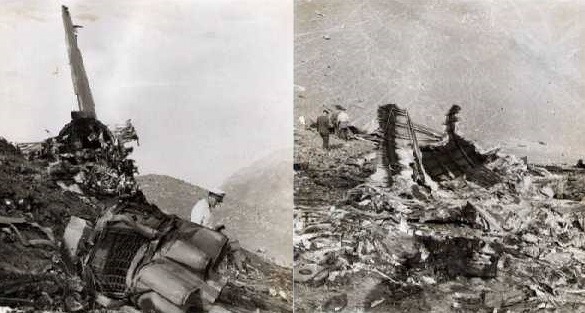
The crew departed Toulouse-Francazal Airbase for a routine flight on behalf of the Escadrille Aérienne de Recherche et de Sauvetage (EARS 99). En route, the four engine aircraft struck the slope of Mt Lapalme located near Périllos, some 26 km north of Perpignan. All 12 occupants were killed.


Crash of a Lockheed P2V-7 Neptune in Kodiak: 7 killed

Date & Time: Jan 10, 1963
Type of aircraft:
Operator:
Registration:
135559
Survivors:
Yes
Site:
Schedule:
Kodiak - Kodiak
MSN:
726-7016
Location:
Crew on board:
12
Crew fatalities:
Pax on board:
0
Pax fatalities:
Other fatalities:
Total fatalities:
7
Circumstances:
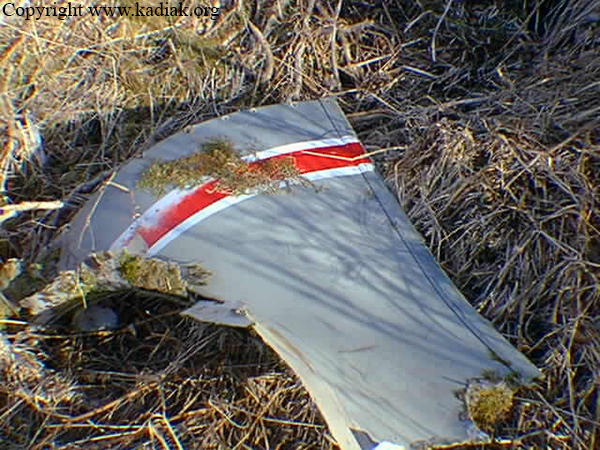
While approaching Kodiak Airport following a maritime patrol flight over the North Pacific, the crew encountered poor weather conditions and low visibility. The airplane struck the north face of the Mt Old Womens located few miles short of runway. Five crew members were rescued while seven others were killed.
Those killed were:
Lt William M. Carter,
John Anthony Cole,
Lt Paul W. Dannell,
Russel S. Feldmann,
Merlin J. Haas,
Lt Richard T. Healy,
Charles A. Treat.

Crash of a Boeing 307B-1 Stratoliner on Monte Renoso: 25 killed

Date & Time: Dec 29, 1962 at 1312 LT
Type of aircraft:
Operator:
Registration:
F-BELZ
Flight Phase:
Survivors:
No
Site:
Schedule:
Bastia – Ajaccio – Nice
MSN:
2001
YOM:
1940
Country:
Region:
Crew on board:
3
Crew fatalities:
Pax on board:
22
Pax fatalities:
Other fatalities:
Total fatalities:
25
Captain / Total flying hours:
9865
Captain / Total hours on type:
3130.00
Copilot / Total flying hours:
7388
Copilot / Total hours on type:
497
Aircraft flight hours:
41150
Circumstances:
The Boeing SA.307 Stratoliner F-BELZ arrived at Bastia (BIA), France from Nice (NCE) at 05:25 UTC. The plane took off again for the return flight via Ajaccio (AJA), Corsica at 11:49 and was cleared for a cruising altitude of FL120, estimating Ajaccio at 12:20 UTC. Last radio contact with the flight was at 12:09 when the flight crew replied to the weather and active runway information from Ajaccio Approach. At 12:12 the flight flew into a sheer rock face of Monte Renoso which is located 45 km from the Ajaccio VOR on the 048 radial. Impact was at an altitude of 2,285 m (7,500 feet) and about 50 m (165 feet) below the summit. The aircraft rebounded after impact and fell about 100 m down the slope of the mountain. All 25 occupants were killed, among them members of the Bastia Basketball team who were flying to Nice for the National Championship. The aircraft was totally destroyed.
Crew:
Roger Mercier, pilot,
Fernand Delime, copilot,
Antoine Blois, mechanic.
Probable cause:
The accident was attributed to a series of errors by the crew who:
- Made insufficient preparation for the flight and committed a serious error in estimating the duration of the flight,
- Failed to observe the cruising altitude entered on the flight plan,
- Failed to check properly the navigation of the aircraft which resulted in a wrong estimation of the position of the aircraft,
- Failed to maintain the safety altitude, and
- Started the descent prematurely, subsequently entering into instrument flight conditions.
The errors of the crew were made possible:
- By a lack of supervision of the flights on the part of the operator; and
- By a lack of correct route instructions for the segment Bastia-Ajaccio. The Board was led to conclude that the crew of F-BEIZ did not have the necessary instructions for the route via the turning point. Even supposing that the instructions supplied to the Board by the operator were issued before the accident, and that they were available to the pilot-in-command, the Board considered that these instructions were inaccurate and dangerous since they did not give the altitude at the turning point and they provided for a flight time between Bastia and Ajaccio which was incompatible with the attainment of safety altitudes.
- By a certain fatigue of the crew. Although the regulations concerning flight time limitations were strictly observed, it is worth mentioning that the flight activity of the crew was fairly strenuous during the three days preceding the accident.
Final Report:

Crash of an Antonov AN-12 in Norilsk: 7 killed

Date & Time: Dec 23, 1962
Type of aircraft:
Operator:
Flight Type:
Survivors:
Yes
Site:
Schedule:
Klin – Norilsk – Tiksi
MSN:
09 014 06
YOM:
1960
Country:
Region:
Crew on board:
8
Crew fatalities:
Pax on board:
0
Pax fatalities:
Other fatalities:
Total fatalities:
7
Circumstances:
On final approach to Norilsk-Nezhdanny Airport on a flight from Klin, an inexperienced air traffic controller allowed the crew to descend to 700 meters although the mountains of the Talnakhskiye gory range reach a height of 740 meters in the approach path. The aircraft collided with a mountain top (633 meters) near the Talnashki River and fell into a gorge. Seven crew members were killed and the sole survivor, the tail gunner, was seriously injured. The aircraft was destroyed.
Probable cause:
Poor assistance on part of the ATC who transmit wrong information to the crew while descending to the airport.

Crash of a Lisunov LI-2 near Olyokminsk: 4 killed

Date & Time: Dec 18, 1962 at 1243 LT
Type of aircraft:
Operator:
Registration:
CCCP-84603
Flight Type:
Survivors:
No
Site:
Schedule:
Yakutsk – Olyokminsk
MSN:
4608
YOM:
23
Country:
Region:
Crew on board:
4
Crew fatalities:
Pax on board:
0
Pax fatalities:
Other fatalities:
Total fatalities:
4
Aircraft flight hours:
11607
Circumstances:
The aircraft was performing a cargo flight from Yakutsk to Olyokminsk, carrying a load of various goods such as 70 kg of mail, 494 kg of garlic, spare parts, a welding machine, a screen and radio equipment for a total weight of 1,476 kg. While descending to Olyokminsk, the crew encountered poor weather conditions and followed visually the wrong river Sinyaya instead of Lena. Doing so, the aircraft descended prematurely and its altitude was insufficient while passing the outer marker. The aircraft struck trees and crashed on the slope of a wooded hill (434 m high) located 25 km short of runway threshold. The wreckage was found a day later and all four crew members were killed.
Probable cause:
Unable to determiner his exact position based on the ETA, the crew erroneously followed the Lena River. As a result of a premature descent, the aircraft collided with trees. ATC, unable to assist the flight by radar in marginal weather conditions, unreasonably gave permission to the crew to perform a straight-in approach, based only on the report of the crew.

Crash of a Boeing 707-441 near Lima: 97 killed

Date & Time: Nov 27, 1962 at 0340 LT
Type of aircraft:
Operator:
Registration:
PP-VJB
Survivors:
No
Site:
Schedule:
Rio de Janeiro – Porto Alegre – Lima – Bogotá – Panama City – Mexico City – Los Angeles
MSN:
17906
YOM:
1960
Flight number:
RG810
Country:
Crew on board:
17
Crew fatalities:
Pax on board:
80
Pax fatalities:
Other fatalities:
Total fatalities:
97
Captain / Total flying hours:
13640
Captain / Total hours on type:
1641.00
Copilot / Total flying hours:
16304
Copilot / Total hours on type:
642
Aircraft flight hours:
6326
Circumstances:
A Boeing 707-441 passenger jet, operated by Varig, was destroyed when it crashed into the side of La Cruz Peak, near Lima, Peru. All 80 passengers and 17 crew members were killed. Flight RG810 departed Rio de Janeiro-Galeão Airport at 03:53 hours UTC on a scheduled flight to Los Angeles (LAX) with en route stops at Lima (LIM), Peru , Bogotá (BOG), Colombia, Panama City (PTY), Panama and Mexico City (MEX), Mexico. At 08:09 the flight reported to Air Traffic Control, Lima, at 36 000 feet, estimating Pisco at 08:13 and Lima-Callao Airport at 08:36 and requested permission to descend. Lima ATC advised of a DC-6, which had departed Lima at 07:35 and was also estimating Pisco at 08:13 when it would be cruising at 13500 feet. After passing Pisco at 08:13, the crew started their descent. At 08:19 hours RG-810 reached 26000 feet. Authorization was granted to continue descending for a straight-in approach to runway 33. At 08:24 it reported to Approach Control ten minutes from the station, at 15 000 feet, still in descent. By 08:30 hours it had reached 12000 feet over Las Palmas. As it was too high for a straight-in approach to runway 33, Approach Control suggested that it make a 360-degree turn over Las Palmas and report again overhead Las Palmas. The aircraft continued descending. It turned slightly right of its 330 degree heading, passing east of Lima Airport, then made a left turn and passed over Lima-Callao Airport. It continued turning until it was headed south, passing west of Las Palmas in order to initiate the outbound procedure from the ILS back course, and then made a 180 degree turn to intercept the ILS back course (327 degrees). However, it kept to the normal intercept course for almost three minutes before starting its turn to the north. Its heading was 333 degrees when it hit La Cruz Peak, about 8 miles east of the approach track of the Morro Solar ILS back course.
Probable cause:
A deviation, for reasons unknown, from the track prescribed for the instrument approach along the ILS back course of Lima-Callao Airport.
Final Report:

Crash of a Curtiss C-46A Commando near Kingston: 2 killed

Date & Time: Nov 26, 1962 at 0350 LT
Type of aircraft:
Operator:
Registration:
HK-354X
Flight Phase:
Flight Type:
Survivors:
Yes
Site:
Schedule:
Fairbanks – Miami – Kingston – Bogotá
Country:
Crew on board:
3
Crew fatalities:
Pax on board:
0
Pax fatalities:
Other fatalities:
Total fatalities:
2
Circumstances:
The Curtiss C-46 operated on a ferry flight from Fairbanks to Bogotá via Miami and Kingston, carrying four spare engines and spare parts. The plane arrived at Kingston on November 25, 17:01 GMT. Following refueling of the aircraft, fuel was observed venting from the right front tank. This caused a delay in departure. At 08:47 GMT the next day, the C-46 lifted off from runway 29 after a long takeoff run and was cleared to climb ahead to 1500 feet. The plane started to turn left on crossing the coastline. Three minutes after takeoff, while still in a shallow climbing left-hand turn, the aircraft flew onto the southern face of Port Henderson Hills at a height of 700 feet. After scraping along rough ground over the brow of the hill, the aircraft fell down a steep precipice and caught fire.
Probable cause:
The aircraft was turned during the climb after takeoff at a height insufficient to clear rising ground. The ability of the pilot to avoid the hill may have been affected by some mechanical or other failure, although the occurrence of such a failure was not established. A contributing factor was that the carriage of one pilot was inadequate for the safe operation of an aircraft of this type.
Final Report:

Crash of a Douglas C-54D-10-DC Skymaster near Suárez: 5 killed

Date & Time: Nov 16, 1962 at 2212 LT
Type of aircraft:
Operator:
Registration:
FAC-693
Flight Phase:
Flight Type:
Survivors:
No
Site:
Schedule:
Bogotá - Bogotá
MSN:
10183
YOM:
1944
Location:
Country:
Crew on board:
5
Crew fatalities:
Pax on board:
0
Pax fatalities:
Other fatalities:
Total fatalities:
5
Circumstances:
The crew departed Bogotá-El Dorado Airport in the evening for a night training mission. En route, the four engine aircraft struck the slope of Mt Guayatama located near Suárez, about 100 km southwest of its departure point. The aircraft was destroyed and all five crew members were killed.

Crash of a Douglas C-54A-1-DC Skymaster on Mt Cerro Gaital: 10 killed

Date & Time: Nov 16, 1962
Type of aircraft:
Operator:
Registration:
TC-46
Flight Phase:
Flight Type:
Survivors:
No
Site:
Schedule:
Managua – Panama City
MSN:
10271
YOM:
1943
Country:
Crew on board:
10
Crew fatalities:
Pax on board:
0
Pax fatalities:
Other fatalities:
Total fatalities:
10
Circumstances:
The four engine airplane was descending to Panama City Airport when it struck the slope of Mt Cerro Gaital located 75 km southwest of Panama City. The aircraft was destroyed and all 10 crew members were killed.