Crash of a Cessna 404 Titan II near Pena Pobre: 1 killed

Date & Time: May 13, 2001 at 1933 LT
Type of aircraft:
Operator:
Registration:
N404BA
Flight Phase:
Flight Type:
Survivors:
No
Site:
Schedule:
Christiansted – San Juan
MSN:
404-0237
YOM:
1978
Country:
Crew on board:
1
Crew fatalities:
Pax on board:
0
Pax fatalities:
Other fatalities:
Total fatalities:
1
Captain / Total flying hours:
1000
Captain / Total hours on type:
103.00
Aircraft flight hours:
12000
Circumstances:
The flight was being handled as a VFR aircraft by air traffic control, was given a discreet transponder code, and was radar contact at an altitude of 4,500 feet. The pilot requested a VFR descent from 4,500 feet, and was cleared to "…descend unrestricted west bound." Radar and radio contact were lost at an altitude of 2,700 feet. The controller tried to re-establish radio contact with the airplane's pilot 10 times before initiating search and rescue efforts. A U.S. Coast Guard helicopter found the wreckage, using the aircraft's emergency locator transmitter. The next day a ground search for the aircraft was halted because of hazardous terrain. Search and rescue personnel had to be airlifted into the crash site to remove the victim. A police helicopter was vectored to the crash site by ATC about an 1 1/2 hours after contact was lost with the flight, and the pilot reported that he could not fly near the crash site because of fog. He reported the ceiling about 2,400 feet. The aircraft impacted in heavily wooded, mountainous terrain at the 2,700-foot level of a 3,524-foot mountain. Toxicology test showed that venlafaxine and desmethylvenlafaxine drugs were found in the pilot's blood, and the levels found were consistent with the recent ingestion of more than 10 times a normal dose of venlafaxine.
Probable cause:
Failure of the pilot-in-command to maintain altitude/clearance, resulting in an in-flight collision with rising terrain.
Final Report:

Crash of a Mitsubishi MU-2B-40 Solitaire in The Woodlands: 2 killed

Date & Time: May 1, 2001 at 1241 LT
Type of aircraft:
Registration:
N16CG
Flight Phase:
Flight Type:
Survivors:
No
Schedule:
Conroe – Alamogordo
MSN:
418
YOM:
1980
Crew on board:
1
Crew fatalities:
Pax on board:
1
Pax fatalities:
Other fatalities:
Total fatalities:
2
Captain / Total flying hours:
2839
Captain / Total hours on type:
1108.00
Aircraft flight hours:
2439
Circumstances:
Visual meteorological conditions prevailed for the planned cross-country flight for which the pilot obtained a weather briefing, filed an IFR flight plan, and received an ATC clearance. Approximately 8 minutes after takeoff, radar indicated the airplane was at 11,200 feet msl, heading 241 degrees, with a ground speed of 180 knots. No distress calls or additional communications with the pilot were recorded, and radar contact was lost. The airplane impacted the ground in an uncontrolled descent. The right wing tip tank separated from the airplane and was found 0.18 nautical miles from the main wreckage. The teardown and examination of both engines disclosed that the type and degree of damage was indicative of engine power section rotation and operation at the time of impact. There were no complete systems intact at the accident site due to the impact sequence and post-impact fire which consumed the aircraft. The landing gear and flaps were found in the retracted position. The portion of the right propeller shaft coupling found at the site was fractured through 360 degrees. Metallurgical examination revealed that the propeller shaft coupling failed in fatigue. The presence of the fatigue cracks indicated the coupler fractured in fatigue in service, and the fatigue cracks were not the result of ground impact. The circumferential fracture intersected the ends of several internal spline teeth. The origin of the fatigue crack could not be determined because of severe corrosion damage on the fracture surface. Fatigue propagation was in the aft direction and from the inside to the outside of the coupling. The engine core rotating components would have bee free to rotate when uncoupled from the propeller shaft. The maintenance records indicated that the failed coupling had accumulated approximately 4,000 hours since new, and 1,250 hours since engine overhaul in 1989. Since 1990, as a result of fatigue fractures, the manufacturer introduced several design changes for the propeller shaft coupling via optional Service Bulletins to be accomplished at the next access or hot section inspection (HSI). Impact and thermal damage of the right propeller precluded a determination of the in-flight blade angles. The calculations by the airplane manufacturer indicated that "the [intact] airplane was capable of continued flight" with the right propeller feathered, and that the "airplane can keep attitude, but cannot climb and cannot maintain altitude" with the right propeller in the flat pitch or wind milling positions, respectively. Metallurgical examination of the component brackets and associated bolts from the right tip tank revealed the separation of the tip tank resulted from a single-event overstress fracture of both the forward and aft tank attachment fittings. Calculations showed that a 3.763 radians per second (35.9 RPM) spin rate would cause the failure of the forward wing fuel tank attachment fitting. There had not been a previous in-flight separation of a wing tip fuel tank on this model airplane.
Probable cause:
The pilot's failure to maintain airplane control following a loss of right engine power, which resulted in impact with terrain in an uncontrolled descent. A contributing factor was the loss of right engine power as a result of the fatigue failure of the propeller shaft coupling.
Final Report:

Crash of a Cessna 208 Caravan I in Nagambie: 1 killed

Date & Time: Apr 29, 2001 at 1312 LT
Type of aircraft:
Operator:
Registration:
VH-MMV
Flight Phase:
Survivors:
Yes
Schedule:
Nagambie - Nagambie
MSN:
208-0003
YOM:
1985
Country:
Region:
Crew on board:
1
Crew fatalities:
Pax on board:
11
Pax fatalities:
Other fatalities:
Total fatalities:
1
Captain / Total flying hours:
4000
Captain / Total hours on type:
700.00
Aircraft flight hours:
8576
Circumstances:
Four parachutists were practising as a team for a skydiving competition. They had completed seven parachute descents prior to the accident flight. Each descent had been video recorded by a cameraman using a helmet-mounted camera. The parachutists used a Cessna Aircraft Company Caravan aircraft. That aircraft was climbed to 14,000 ft with the team of four parachutists, their cameraman, six other parachutists and the pilot. At the drop altitude, the team members carried out their ‘pin check’ in which each parachutist’s equipment was checked to ensure that the release pins for the main and reserve parachutes were correctly positioned. Approaching overhead the drop zone, a roller blind, which covered the exit doorway on the left side of the aircraft, and minimised windblast during the climb, was raised. The cameraman positioned himself on the step outside and to the rear of the exit doorway. The first three members of the team positioned themselves in the exit doorway. The team member nearest to the front of the aircraft faced out and the next two members faced into the aircraft. The team member in the middle grasped the jumpsuits of the adjacent parachutists. The fourth member was inside the aircraft facing the exit. As the team exited the aircraft, the middle parachutist’s reserve parachute’s pilot chute deployed. Due to the bent over position of that parachutist, the action of the ejector spring in the pilot chute pushed the chute upwards and over the horizontal stabiliser of the aircraft, pulling the reserve canopy with it. The parachutist passed below the horizontal stabiliser resulting in the reserve parachute risers and lines tangling around the left elevator and horizontal stabiliser. Eleven seconds later, the empennage separated from the aircraft and the left elevator and the parachutist separated from the empennage. The parachutist descended to the ground with the reserve and main parachutes entangled and landed 800 metres west of the drop zone landing strip. A short section of the elevator was tangled in the parachute lines. The parachutist’s rate of descent was estimated to be 3.6 times greater than that for an average parachutist under canopy. Immediately after the empennage separated, the aircraft entered a steep, nose-down spiral descent. The pilot instructed the remaining parachutists to abandon the aircraft. The last one left the aircraft before it descended through 9,000 ft. The pilot transmitted a mayday call, shutdown the engine and left his seat. On reaching the rear of the cabin, he found that the roller blind had closed, preventing him from leaving the aircraft. After several attempts, the pilot raised the blind sufficiently to allow him to exit the aircraft, and at an altitude of approximately 1,000 ft above ground level, he deployed his parachute and landed safely. The aircraft, minus the empennage, descended almost vertically and crashed on the drop zone landing strip. It was destroyed by impact forces and the post-impact fire. The empennage, in several pieces, landed 600 metres west of the landing strip. A Country Fire Authority fire vehicle arrived at the accident site within two minutes of the accident and extinguished the fire. The parachutist that had been entangled was fatally injured. The injuries sustained when entangled on the horizontal stabiliser made the parachutist incapable of operating the main parachute. The other parachutists and the pilot were uninjured.
Probable cause:
The following factors were identified:
- The parachutist’s reserve parachute deployed prematurely, probably as a result of the parachute container coming into contact with the aircraft doorframe/handrail.
- The reserve parachute risers and lines tangled around the horizontal stabiliser and elevator.
- The reserve canopy partially filled, applying to the aircraft empennage a load that exceeded its design limits.
- The empennage separated from the aircraft and the elevator separated from the empennage, releasing the parachutist and sending the aircraft out of control.
Final Report:

Crash of a Cessna 208B Grand Caravan near Roque Pérez: 10 killed

Date & Time: Apr 28, 2001 at 0517 LT
Type of aircraft:
Registration:
LV-WSC
Flight Phase:
Survivors:
No
Schedule:
San Fernando – Trelew
MSN:
208B-0580
YOM:
1996
Country:
Crew on board:
2
Crew fatalities:
Pax on board:
8
Pax fatalities:
Other fatalities:
Total fatalities:
10
Captain / Total flying hours:
4700
Captain / Total hours on type:
605.00
Aircraft flight hours:
1467
Circumstances:
Owned by the Argentinian company Les Grands Jorasses, the single engine airplane was completing a charter flight from San Fernando to Trelew, carrying eight passengers and two pilots, among them the President of the Techint Group and the managing editor of the La Nación newspaper. After departure from San Fernando Airport, the crew was cleared to climb to 6,000 feet then 8,000 feet and later 10,000 feet. Because he encountered icing conditions, the crew asked ATC to climb to 12,000 feet and was cleared to proceed when control was lost. The aircraft entered a dive and crashed in a farmland. The aircraft was totally destroyed by impact forces and all 10 occupants were killed.
Probable cause:
Impact with the ground following a spiral fall due to a stall probably consecutive to an asymmetric accumulation of ice on the fuselage.
Final Report:

Crash of a PZL-Mielec AN-2R in Nekrasovskaya

Date & Time: Apr 25, 2001 at 1730 LT
Type of aircraft:
Operator:
Registration:
RA-17832
Flight Phase:
Survivors:
Yes
Schedule:
Nekrasovskaya - Nekrasovskaya
MSN:
1G204-33
YOM:
1983
Country:
Region:
Crew on board:
2
Crew fatalities:
Pax on board:
0
Pax fatalities:
Other fatalities:
Total fatalities:
0
Circumstances:
The crew was dispatched at Nekrasovskaya to perform a crop spraying mission for the farm 'Rossia'. While flying at an insufficient height of 5 metres, the copilot saw power cables and elected to gain height to avoid the collision. But the captain took over control and plunged the aircraft to pass below the line. The power cables struck the tail that was partially torn off. The aircraft nosed down and crashed in an open field, bursting into flames. Both pilots were seriously injured and the aircraft was destroyed by fire.
Probable cause:
The accident was the consequence of the combination of the following factors:
- Poor flight preparation on part of the crew who failed to locate various obstacles situated in and around the spraying area,
- The captain took the decision to complete the mission at an insufficient height of five metres while the minimum height was fixed at 20 metres,
- Poor crew coordination.

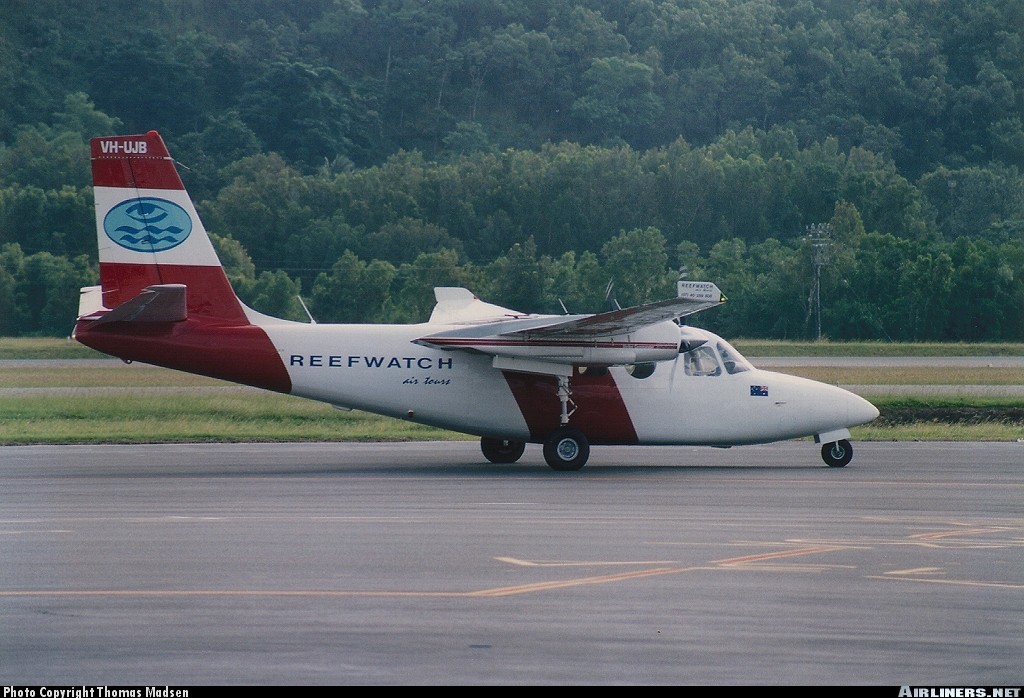
Crash of a Rockwell Shrike Commander 500S on Thornton Peak: 4 killed

Date & Time: Apr 10, 2001 at 0725 LT
Operator:
Registration:
VH-UJB
Flight Phase:
Survivors:
No
Site:
Schedule:
Cairns - Hicks Island
MSN:
500-3152
YOM:
1973
Country:
Region:
Crew on board:
1
Crew fatalities:
Pax on board:
3
Pax fatalities:
Other fatalities:
Total fatalities:
4
Captain / Total flying hours:
9680
Captain / Total hours on type:
2402.00
Circumstances:
The aircraft departed Cairns airport at 0707 Eastern Standard Time (EST) on a charter flight to Hicks Island. The aircraft was being operated under the Instrument Flight Rules (IFR) and the expected flight time was 2 hours. Shortly after takeoff the pilot requested an amended altitude of 4,000 ft. He indicated that he was able to continue flight with visual reference to the ground or water. Air Traffic Services (ATS) issued the amended altitude as requested. The IFR Lowest Safe Altitude for the initial route sector to be flown was 6,000 ft Above Mean Sea Level (AMSL). Data recorded by ATS indicated that approximately 13 minutes after departure, the aircraft disappeared from radar at a position 46NM north of Cairns. At the last known radar position the aircraft was cruising at a ground speed of 180 kts and at an altitude of 4,000 ft AMSL. An extensive search located the wreckage the following afternoon at a location consistent with the last known radar position, on the north-western side of Thornton Peak at an altitude of approximately 4,000 ft (1219 metres) AMSL. The aircraft was destroyed by impact forces and post-impact fire. The pilot and three passengers received fatal injuries. Thornton Peak is the third highest mountain in Queensland and is marked on topographic maps as 4,507 ft (1,374 metres) in elevation. Local residents reported that the mountain was covered by cloud and swept by strong winds for most of the year. The aircraft had been observed by witnesses approximately two minutes prior to impact cruising at high speed, on a constant north-westerly heading, in a wings level attitude and with flaps and landing gear retracted. They stated that the engines appeared to sound normal.
Probable cause:
Radar data recorded by Air Traffic Services and witness reports indicated that the aircraft was flying straight and level and maintaining a constant airspeed. Therefore, it is unlikely that the aircraft was experiencing any instrumentation or engine problems. Why the pilot continued flight into marginal weather conditions at an altitude that was insufficient to ensure terrain clearance, could not be established. The aircraft was flown at an altitude that was insufficient to ensure terrain clearance.
Final Report:

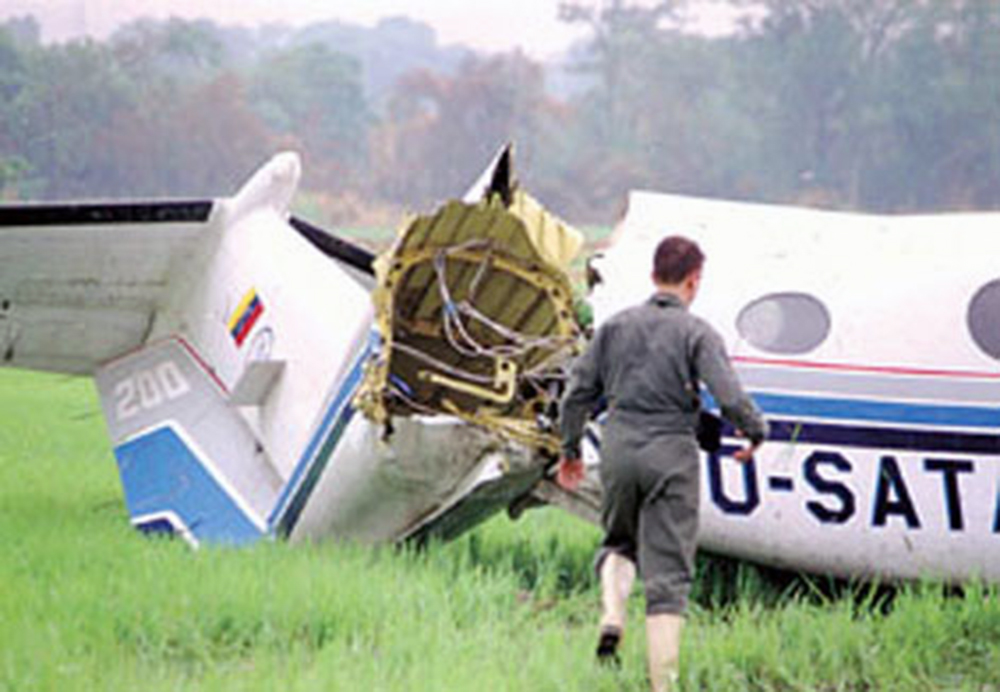
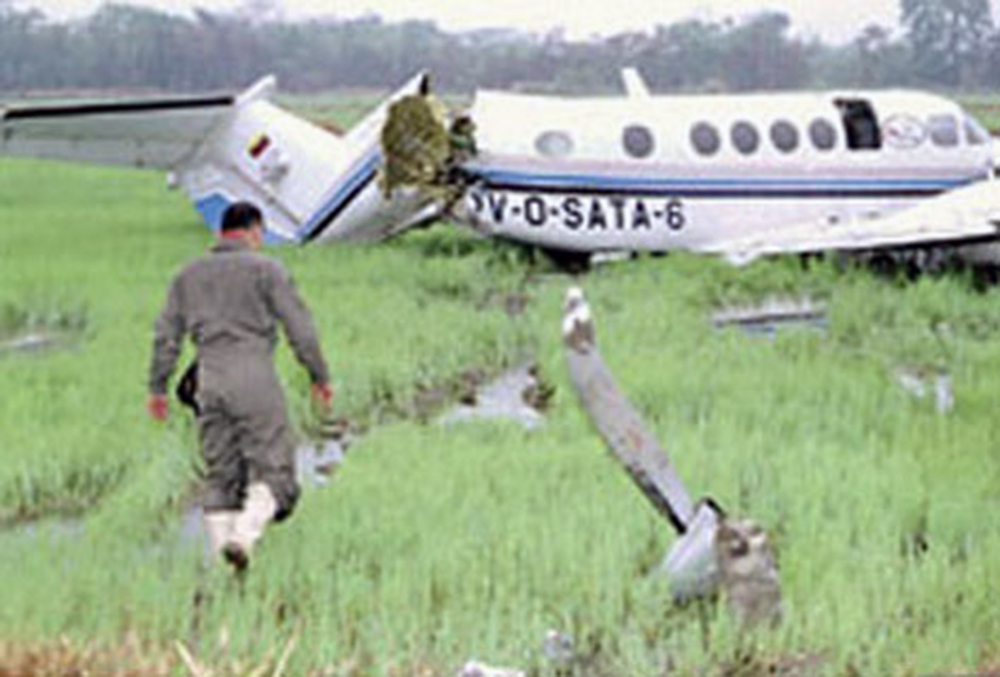
Crash of a Beechcraft 200 Super King Air in Las Majaguas

Date & Time: Apr 5, 2001 at 0815 LT
Registration:
YV-O-SATA-6
Flight Phase:
Survivors:
Yes
Schedule:
La Carlota – Barinas
MSN:
BB-5
YOM:
1974
Country:
Crew on board:
2
Crew fatalities:
Pax on board:
6
Pax fatalities:
Other fatalities:
Total fatalities:
0
Circumstances:
While in cruising altitude on a flight from La Carlota to Barinas, the crew declared an emergency following a loss of power on both engines. The crew attempted an emergency landing in a prairie when the aircraft crash landed and came to rest, broken in two. All eight occupants were rescued, among them a pilot was injured.
Probable cause:
Loss of power on both engines for unknown reasons.

Crash of a Rockwell Shrike Commander 500S off Vestmannaeyjar: 2 killed

Date & Time: Mar 6, 2001 at 0856 LT
Registration:
N272BB
Flight Phase:
Flight Type:
Survivors:
No
Schedule:
Keflavik – Stornoway
MSN:
500-3173
YOM:
1973
Country:
Region:
Crew on board:
2
Crew fatalities:
Pax on board:
0
Pax fatalities:
Other fatalities:
Total fatalities:
2
Captain / Total flying hours:
2456
Captain / Total hours on type:
120.00
Copilot / Total flying hours:
704
Copilot / Total hours on type:
13
Circumstances:
Two private pilots, citizens of the United States, who intended to participate in the “London - Sydney Air Race” set to take place 11 March to 7 April 2001, were operating the private aircraft, N272BB. The flight originated at Cape Cod in the United States and the aircraft was to be flown via Greenland, Iceland and Scotland to London, England, where the air-race was to commence. The aircraft arrived at Narsarsuaq, Greenland, on 4 March 2001 at 01:35 hrs. The next morning the pilots requested fuel and according to a statement by the Narsarsuaq airport personnel, 338 litres of LL100 avgas were put on the main fuel tanks that were filled. No fuel was put on the aircraft internal ferry-tank. The pilots received weather briefing and en-route information before departure and there was no anomalies noted by the airport personnel. The flight was planned at Fl-130 from Narsarsuaq, over the Greenland ice cap, to 62°N 040°W and then at FL110 to the border between the Greenland Soendrestrom Flight Information Region and the Reykjavik Flight Information Region. The takeoff from Narsarsuaq airport was at 14:29 hrs. The flight from Narsarsuaq Airport to Iceland was uneventful and the aircraft landed at Keflavik Airport Iceland at 18:59 hrs. Initially the pilots planned to continue the flight from Iceland that night but after studying the weather forecast they decided to stay overnight. At 19:50 hrs 447 litres of LL100 was put in the aircraft main tanks and the aircraft was then placed in a hangar. In the morning of 6 March 2001 the pilots arrived at Flight Operations Office at Keflavik Airport. The pilots were provided with current weather information and weather maps for the planned route and flight planning preparations for the flight to Stornoway, Scotland and onwards to London, England was completed. The plan was from Keflavik Airport (KEF) VOR, direct to ALDAN reporting point (62° 58' 49'' N 018° 45' 50'' W), direct to 61° N 012° 34' W, direct to 60° N 010° W, and direct to Stornoway. The flight level was 150 and the True Air Speed (TAS) was 145 kts. Prestwick in Scotland was filed as the alternate airport. The instrument flight plan was filed with the Air Traffic Control Centre in Reykjavik. The estimated flying time from KEF-VOR to ALDAN was 0:30 hrs, to 61° N 012° 34' W total 2:00 hrs and 02:30 hrs to 60° N 010° W. The planned time from Keflavik Airport to Stornoway was 4:00 hrs or the estimated time of arrival was at 12:19 hrs. The fuel endurance was given 10 hrs. The aircraft was cleared by ATC in accordance with the submitted instrument flight plan and assigned transponder code was 3575. The aircraft taxied out from the ramp at 08:08 hrs towards runway 11 and the take-off was at 08:19 hrs. After take-off the communication with Keflavik Approach Control was normal. The flight was then changed over to Reykjavik Area Control Centre (OACC) at 08:46 hrs and normal communication was established. The track to Aldan will take the aircraft overhead VM-NDB, 53 NM from KEF VOR, and then to Aldan, 120 NM from KEF VOR. Error was on the ATC slip indicating 30 minutes to Aldan. The controller changed that to 1:01, or estimate for Aldan at 09:20. The last communication with the crew took place at 08:49:50 when the aircraft was climbing slowly through about 14400 feet towards the planned cruising level, FL150. At 09:24:55 hrs Reykjavik OACC called N272BB in order to confirm the position, but there was no answer and repeated calls were in vain. The Shanwick Air Traffic Control Centre was notified at 09:29:15 hrs of the N272BB estimates and again at 09:38:01 hrs that ATC had lost contact with the aircraft. A subsequent replay of the ATC radar data showed that at 08:56 hrs the aircrafts target was lost from radar. The last plotted position was at 63° 32' 04'' N 020° 39' 36'' W, or about 8 NM from the south coast of Iceland. At 12:12 hrs a decision was taken to initiate a search in the area by available ships and fishing vessels in the area. An Icelandic Coast Guard helicopter was launched from Reykjavik into the search area at 12:32 hrs. At 13:49 hrs a debris from the missing aircraft and human remains were subsequently found floating on the ocean in a line spread north-westwards over a distance of about 5 NM from the point the target disappeared from radar. Both female pilots were killed.
Probable cause:
The following findings were identified:
- The aircraft was operated in overweight conditions,
- The flight departed Iceland into unfavourable weather conditions,
- The aircraft was climbing in icing conditions prior to it went out of control,
- The reason for the departure from a normal flight could not be positively determined,
- The aircraft went into an uncontrolled descent, followed by an overstress and possible in-flight break-up during an attempted recovery.
Final Report:

Crash of a Short C-23B Sherpa in Unadilla: 21 killed

Date & Time: Mar 3, 2001 at 0955 LT
Type of aircraft:
Operator:
Registration:
93-1336
Flight Phase:
Flight Type:
Survivors:
No
Schedule:
Hurlburt Field - Oceana
MSN:
3420
YOM:
1985
Flight number:
PAT528
Crew on board:
3
Crew fatalities:
Pax on board:
18
Pax fatalities:
Other fatalities:
Total fatalities:
21
Circumstances:
The Sherpa departed Hurlburt Field AFB, Florida, on flight PAT528 to Oceana NAS, Virginia, carrying 18 passengers and a crew of three. While in cruising altitude over Georgia, the crew encountered poor weather conditions with thunderstorm activity, heavy rain falls, severe turbulences, windshear conditions and wind gusting up to 72 knots. The aircraft became unstable, lost 100 feet in three seconds then adopted a nose up attitude. Within the next 12 seconds, the aircraft suffered a positive aerodynamic acceleration then entered an uncontrolled descent, partially disintegrated in the air and eventually crashed in an open field. All 21 occupants were killed.
Crew (171st Aviation Regiment Lakeland):
CW4 Johnny W. Duce,
CW2 Erik P. Larson,
S/Sgt Robert F. Ward Jr.
Passengers (213rd Red Horse Flight, Virginia Beach):
M/Sgt James Beninati,
S/Sgt Paul J. Blancato,
T/Sgt Ernest Blawas,
S/Sgt Andrew H. Bridges,
M/Sgt Eric G. Bulman,
S/Sgt Paul E. Cramer,
T/Sgt Michael E. East,
S/Sgt Ronald L. Elkin,
S/Sgt James P. Ferguson,
S/Sgt Randy V. Johnson,
SRA Mathrew K. Kidd,
M/Sgt Michael E. Lane,
T/Sgt Edwin B. Richardson,
T/Sgt Dean J. Shelby,
S/Sgt John L. Sincavage,
S/Sgt Gregory T. Skurupey,
S/Sgt Richard L. Summerell,
Maj Frederick V. Watkins III.
Probable cause:
The Collateral Investigation Board found the preponderance of the evidence concluded that the aircraft accident was due to crew error. The board found other factors present but not contributing directly to this aircraft accident. These factors may have influenced the crew's decision making process and aircraft performance. This is normally the case in most aircraft human factor accidents. The board did find the preponderance of the evidence directed the board toward the crew's failure to properly load the aircraft. In particular, the crew's failure to properly manage the weight and balance of the aircraft resulted in an 'out-of-CG' condition that exceeded the aircraft design limits, rendering the aircraft unstable and leading to a violent departure from controlled flight. Once the aircraft departed controlled flight, the rapid onset of significant G-force shifts rendered the crew and passengers incapacitated and unconscious and led to a structural break-up of the aircraft in flight. This ultimately resulted in the aircraft impacting the ground, killing all on board.

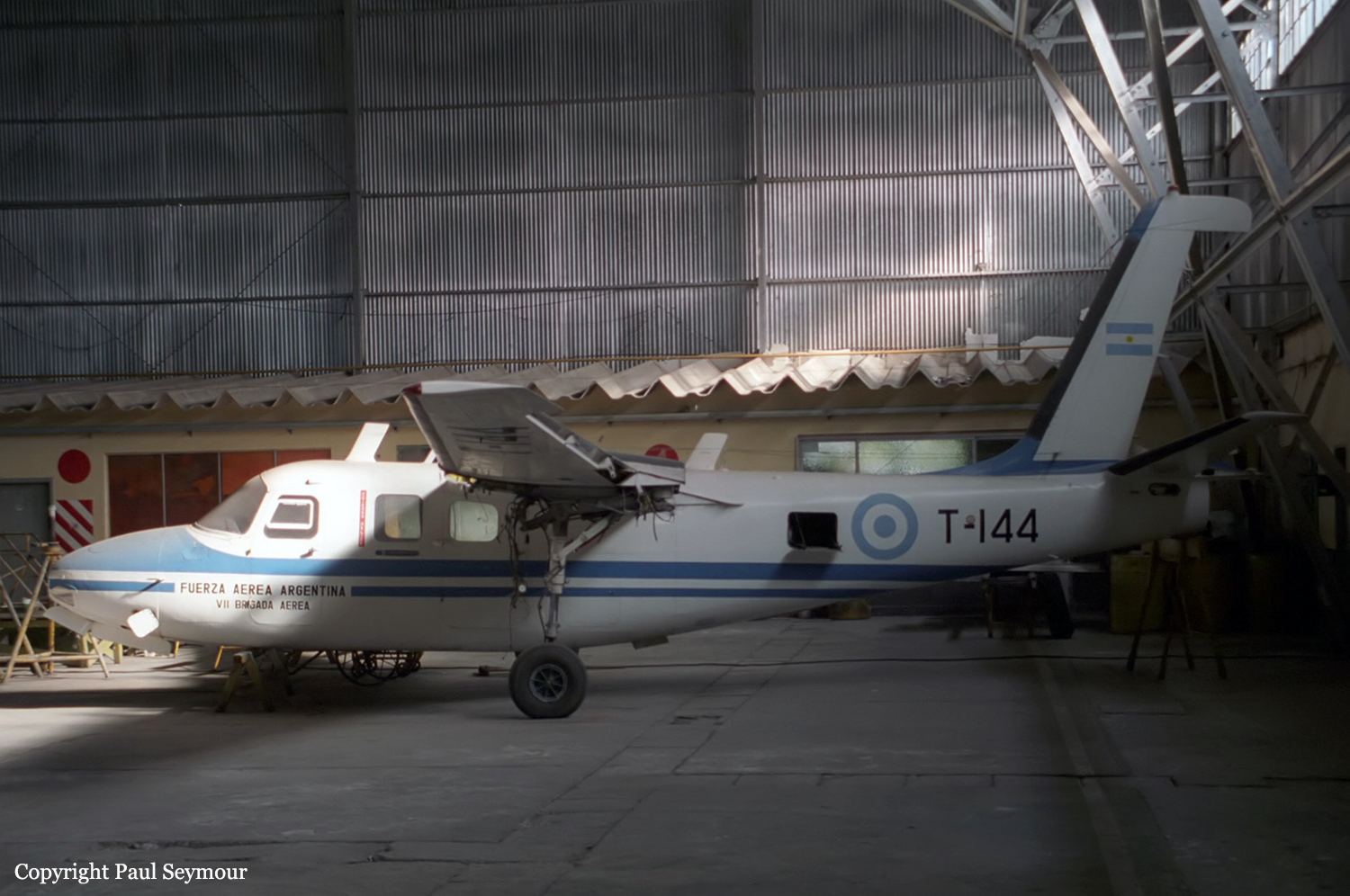
Crash of a Rockwell Shrike Commander 500S near Morón AFB: 2 killed

Date & Time: Feb 7, 2001
Operator:
Registration:
T-144
Flight Phase:
Flight Type:
Survivors:
No
Site:
Schedule:
Morón - Morón
MSN:
500-1771-54
YOM:
1968
Country:
Crew on board:
2
Crew fatalities:
Pax on board:
0
Pax fatalities:
Other fatalities:
Total fatalities:
2
Circumstances:
The crew was completing a local training flight at Morón AFB. In unknown circumstances, the aircraft crashed in the swimming pool of a private residence located in the district of Moreno, west of the airbase. Both pilots (Cpt Reyna and Lt Pesci) were killed while there were no injuries on the ground.