Crash of a Swearingen SA226TC Metro II in Thompson

Date & Time: May 10, 2005 at 1030 LT
Type of aircraft:
Operator:
Registration:
C-FKEX
Survivors:
Yes
Schedule:
York Landing – Thompson
MSN:
TC-332
YOM:
1980
Country:
Crew on board:
2
Crew fatalities:
Pax on board:
15
Pax fatalities:
Other fatalities:
Total fatalities:
0
Circumstances:
erimeter Aviation flight 914, a Metro II with 17 people on board, was on approach at Thompson, MB. The first officer flew the aircraft during the approach, and encountered turbulence and fluctuating airspeed. The captain took control at 200 feet agl. The aircraft was high and left of centreline. The captain added power, continued the approach and landed hard on runway 23 near the intersection with runway 32. After the aircraft arrived at the apron, a fuel leak was noted. The aircraft was inspected and damage was found in the wheel wells, wing leading edge, engine mounts and a wing-fuselage attachment point. No injuries were reported. Reported winds at 1400Z were 010 at 15-20 kts; 1500Z winds were 350 at 9 kts.

Crash of a Swearingen SA227DC Metro 23 in Lockhart River: 15 killed

Date & Time: May 7, 2005 at 1144 LT
Type of aircraft:
Operator:
Registration:
VH-TFU
Survivors:
No
Site:
Schedule:
Bamaga – Lockhart River – Cairns
MSN:
DC-818B
YOM:
1992
Flight number:
HC675
Country:
Region:
Crew on board:
2
Crew fatalities:
Pax on board:
13
Pax fatalities:
Other fatalities:
Total fatalities:
15
Captain / Total flying hours:
6071
Captain / Total hours on type:
3248.00
Copilot / Total flying hours:
655
Copilot / Total hours on type:
150
Aircraft flight hours:
26877
Aircraft flight cycles:
28529
Circumstances:
On 7 May 2005, a Fairchild Aircraft Inc. SA227DC Metro 23 aircraft, registered VH-TFU, with two pilots and 13 passengers, was being operated by Transair on an instrument flight rules (IFR) regular public transport (RPT) service from Bamaga to Cairns, with an intermediate stop at Lockhart River, Queensland. At 1143:39 Eastern Standard Time, the aircraft impacted terrain in the Iron Range National Park on the north-western slope of South Pap, a heavily timbered ridge, approximately 11 km north-west of the Lockhart River aerodrome. At the time of the accident, the crew was conducting an area navigation global navigation satellite system (RNAV (GNSS)) non-precision approach to runway 12. The aircraft was destroyed by the impact forces and an intense, fuel-fed, post-impact fire. There were no survivors. The accident was almost certainly the result of controlled flight into terrain; that is, an airworthy aircraft under the control of the flight crew was flown unintentionally into terrain, probably with no prior awareness by the crew of the aircraft’s proximity to terrain. Weather conditions in the Lockhart River area were poor and necessitated the conduct of an instrument approach procedure for an intended landing at the aerodrome. The cloud base was probably between 500 ft and 1,000 ft above mean sea level and the terrain to the west of the aerodrome, beneath the runway 12 RNAV (GNSS) approach, was probably obscured by cloud. The flight data recorder (FDR) data showed that, during the entire descent and approach, the aircraft engine and flight control system parameters were normal and that the crew were accurately navigating the aircraft along the instrument approach track. The FDR data and wreckage examination showed that the aircraft was configured for the approach, with the landing gear down and flaps extended to the half position. There were no radio broadcasts made by the crew on the air traffic services frequencies or the Lockhart River common traffic advisory frequency indicating that there was a problem with the aircraft or crew.
Probable cause:
Contributing factors relating to occurrence events and individual actions:
- The crew commenced the Lockhart River Runway 12 RNAV (GNSS) approach, even though the crew were aware that the copilot did not have the appropriate endorsement and had limited experience to conduct this type of instrument approach.
- The descent speeds, approach speeds and rate of descent were greater than those specified for the aircraft in the Transair Operations Manual. The speeds and rate of descent also exceeded those appropriate for establishing a stabilised approach.
- During the approach, the aircraft descended below the segment minimum safe altitude for the aircraft's position on the approach.
- The aircraft's high rate of descent, and the descent below the segment minimum safe altitude, were not detected and/or corrected by the crew before the aircraft collided with terrain.
- The accident was almost certainly the result of controlled flight into terrain.

Contributing factors relating to local conditions:
- The crew probably experienced a very high workload during the approach.
- The crew probably lost situational awareness about the aircraft's position along the approach.
- The pilot in command had a previous history of conducting RNAV (GNSS) approaches with crew without appropriate endorsements, and operating the aircraft at speeds higher than those specified in the Transair Operations Manual.
- The Lockhart River Runway 12 RNAV (GNSS) approach probably created higher pilot workload and reduced position situational awareness for the crew compared with most other instrument approaches. This was due to the lack of distance referencing to the missed approach point throughout the approach, and the longer than optimum final approach segment with three altitude limiting steps.
- The copilot had no formal training and limited experience to act effectively as a crew member during a Lockhart River Runway 12 RNAV (GNSS) approach.

Contributing factors relating to Transair processes:
- Transair's flight crew training program had significant limitations, such as superficial or incomplete ground-based instruction during endorsement training, no formal training for new pilots in the operational use of GPS, no structured training on minimising the risk of controlled flight into terrain, and no structured training in crew resource management and operating effectively in a multi-crew environment. (Safety Issue)
- Transair's processes for supervising the standard of flight operations at the Cairns base had significant limitations, such as not using an independent approved check pilot to review operations, reliance on passive measures to detect problems, and no defined processes for selecting and monitoring the performance of the base manager. (Safety Issue)
- Transair's standard operating procedures for conducting instrument approaches had significant limitations, such as not providing clear guidance on approach speeds, not providing guidance for when to select aircraft configuration changes during an approach, no clear criteria for a stabilised approach, and no standardised phraseology for challenging safety-critical decisions and actions by other crew members. (Safety Issue)
- Transair had not installed a terrain awareness and warning system, such as an enhanced ground proximity warning system, in VH-TFU.
- Transair's organisational structure, and the limited responsibilities given to non-management personnel, resulted in high work demands on the chief pilot. It also resulted in a lack of independent evaluation of training and checking, and created disincentives and restricted opportunities within Transair to report safety concerns with management decision making. (Safety Issue)
- Transair did not have a structured process for proactively managing safety related risks associated with its flight operations. (Safety Issue)
- Transair's chief pilot did not demonstrate a high level of commitment to safety. (Safety Issue)

Contributing factors relating to the Civil Aviation Safety Authority processes:
- CASA did not provide sufficient guidance to its inspectors to enable them to effectively and consistently evaluate several key aspects of operator management systems. These aspects included evaluating organisational structure and staff resources, evaluating the suitability of key personnel, evaluating organisational change, and evaluating risk management processes. (Safety Issue)
- CASA did not require operators to conduct structured and/or comprehensive risk assessments, or conduct such assessments itself, when evaluating applications for the initial issue or subsequent variation of an Air Operator's Certificate. (Safety Issue)

Other factors relating to local conditions:
- There was a significant potential for crew resource management problems within the crew in high workload situations, given that there was a high trans-cockpit authority gradient and neither pilot had previously demonstrated a high level of crew resource management skills.
- The pilots' endorsements, clearance to line operations, and route checks did not meet all the relevant regulatory and operations manual requirements to conduct RPT flights on the Metro aircraft.
- Some cockpit displays and annunciators relevant to conducting an instrument approach were in a sub-optimal position in VH-TFU for useability or attracting the attention of both pilots.

Other factors relating to instruments approaches:
- Based on the available evidence, the Lockhart River Runway 12 RNAV (GNSS) approach design resulted in mode 2A ground proximity warning system alerts and warnings when flown on the recommended profile or at the segment minimum safe altitudes. (Safety Issue)
- The Australian convention for waypoint names in RNAV (GNSS) approaches did not maximise the ability to discriminate between waypoint names on the aircraft global positioning system display and/or on the approach chart. (Safety Issue)
- There were several design aspects of the Jeppesen RNAV (GNSS) approach charts that could lead to pilot confusion or reduction in situational awareness. These included limited reference regarding the 'distance to run' to the missed approach point, mismatches in the vertical alignment of the plan-view and profile-view on charts such as that for the Lockhart River runway 12 approach, use of the same font size and type for waypoint names and 'NM' [nautical miles], and not depicting the offset in degrees between the final approach track and the runway centreline. (Safety Issue)
- Jeppesen instrument approach charts depicted coloured contours on the plan-view of approach charts based on the maximum height of terrain relative to the airfield only, rather than also considering terrain that increases the final approach or missed approach procedure gradient to be steeper than the optimum. Jeppesen instrument approach charts did not depict the terrain profile on the profile-view although the segment minimum safe altitudes were depicted. (Safety Issue)
- Airservices Australia's instrument approach charts did not depict the terrain contours on the plan-view. They also did not depict the terrain profile on the profile-view, although the segment minimum safe altitudes were depicted. (Safety Issue)

Other factors relating to Transair processes:
- Transair's flight crew proficiency checking program had significant limitations, such as the frequency of proficiency checks and the lack of appropriate approvals of many of the pilots conducting proficiency checks. (Safety Issue)
- The Transair Operations Manual was distributed to company pilots in a difficult to use electronic format, resulting in pilots minimising use of the manual. (Safety Issue) Other factors relating to regulatory requirements and guidance
- Although CASA released a discussion paper in 2000, and further development had occurred since then, there was no regulatory requirement for initial or recurrent crew resource management training for RPT operators. (Safety Issue)
- There was no regulatory requirement for flight crew undergoing a type rating on a multi-crew aircraft to be trained in procedures for crew incapacitation and crew coordination, including allocation of pilot tasks, crew cooperation and use of checklists. This was required by ICAO Annex 1 to which Australia had notified a difference. (Safety Issue)
- The regulatory requirements concerning crew qualifications during the conduct of instrument approaches in a multi-crew RPT operation was potentially ambiguous as to whether all crew members were required to be qualified to conduct the type of approach being carried out. (Safety Issue)
- CASA's guidance material provided to operators about the structure and content of an operations manual was not as comprehensive as that provided by ICAO in areas such as multi-crew procedures and stabilised approach criteria. (Safety Issue)
- Although CASA released a discussion paper in 2000, and further development and publicity had occurred since then, there was no regulatory requirement for RPT operators to have a safety management system. (Safety Issue)
- There was no regulatory requirement for instrument approach charts to include coloured contours to depict terrain. This was required by a standard in ICAO Annex 4 in certain situations. Australia had not notified a difference to the standard. (Safety Issue)
- There was no regulatory requirement for multi-crew RPT aircraft to be fitted with a serviceable autopilot. (Safety Issue)

Other factors relating to Civil Aviation Safety Authority processes:
- CASA's oversight of Transair, in relation to the approval of Air Operator's Certificate variations and the conduct of surveillance, was sometimes inconsistent with CASA's policies, procedures and guidelines.
- CASA did not have a systematic process for determining the relative risk levels of airline operators. (Safety Issue)
- CASA's process for evaluating an operations manual did not consider the useability of the manual, particularly manuals in electronic format. (Safety Issue)
- CASA's process for accepting an instrument approach did not involve a systematic risk assessment of pilot workload and other potential hazards, including activation of a ground proximity warning system. (Safety Issue) Other key findings An 'other key finding' is defined as any finding, other than that associated with safety factors, considered important to include in an investigation report. Such findings may resolve ambiguity or controversy, describe possible scenarios or safety factors when firm safety factor findings were not able to be made, or note events or conditions which 'saved the day' or played an important role in reducing the risk associated with an occurrence.
- It was very likely that both crew members were using RNAV (GNSS) approach charts produced by Jeppesen.
- The cockpit voice recorder did not function as intended due to an internal fault that had developed sometime before the accident flight and that was not discovered or diagnosed by flight crew or maintenance personnel.
- There was no evidence to indicate that the GPWS did not function as designed.
- There would have been insufficient time for the crew to effectively respond to the GPWS alert and warnings that were probably annunciated during the final 5 seconds prior to impact with terrain.
Final Report:

Crash of a De Havilland DHC-8-103 in Hammerfest

Date & Time: May 1, 2005 at 1436 LT
Operator:
Registration:
LN-WIK
Survivors:
Yes
Schedule:
Tromsø – Hammerfest
MSN:
394
YOM:
1995
Flight number:
WF921
Country:
Region:
Crew on board:
3
Crew fatalities:
Pax on board:
27
Pax fatalities:
Other fatalities:
Total fatalities:
0
Captain / Total flying hours:
12900
Captain / Total hours on type:
5500.00
Copilot / Total flying hours:
2100
Copilot / Total hours on type:
60
Aircraft flight hours:
20462
Aircraft flight cycles:
42997
Circumstances:
Widerøe flight WIF 921 took off from Tromsø airport (ENTC) at time 1401 with an estimated landing time at Hammerfest airport (ENHF) 1442. On board the aircraft, a DHC-8-103 with registration LN-WIK, were a crew of two pilots and one cabin attendant, 26 fare paying passengers and one passive cabin attendant. The crew had taken off from ENHF earlier in the day, when the weather and wind did not cause any problems. During the approach to ENHF the crew was informed about variable and occasional gusty wind from south-east. The wind direction favoured runway 23 and the crew planned the landing accordingly. The copilot was Pilot Flying (PF) and the commander was Pilot Not Flying (PNF). The copilot was newly hired and was flying under supervision. The crew was kept updated on the wind conditions by the AFIS operator, and at times the gusty wind conditions favoured runway 05. The copilot left the control to the commander who continued the approach to runway 05. Just before landing the wind direction veered to the right and increased in strength, resulting in a significant tail wind component. This resulted in a marked increase in the descent rate which the commander tried to stop by advancing to full power. However, the altitude was too low and the airplane touched down hard just inside the runway edge on runway 05. At touch down the right main landing gear leg failed. The airplane slid on the belly, right partly retracted main wheel and wing tip for some 650 m, and stopped just after the second (TWY B) turnoff to the apron. The fire and rescue vehicles were quickly at the scene and sprayed foam on the plane to prevent fire. The cabin attendant calmed the passengers who wanted to get out of the plane quickly due to smoke and burned smell in the cabin. It took 33 seconds from the commander ordered evacuation until this was initiated. The delay was mainly caused by the fact that the order did not get through the cabin’s Public Address (PA) system.
Probable cause:
The investigations show that Widerøe permitted landings in up to the maximum demonstrated crosswind component of 36 kt and in up to 10 kt tail wind during short field operations. AIBN recommends that Widerøe should review the wind limitations and prohibit tail wind component during landings on short runways in conditions with large variations in wind direction and strength. AIBN is issuing 7 safety recommendations.
Final Report:
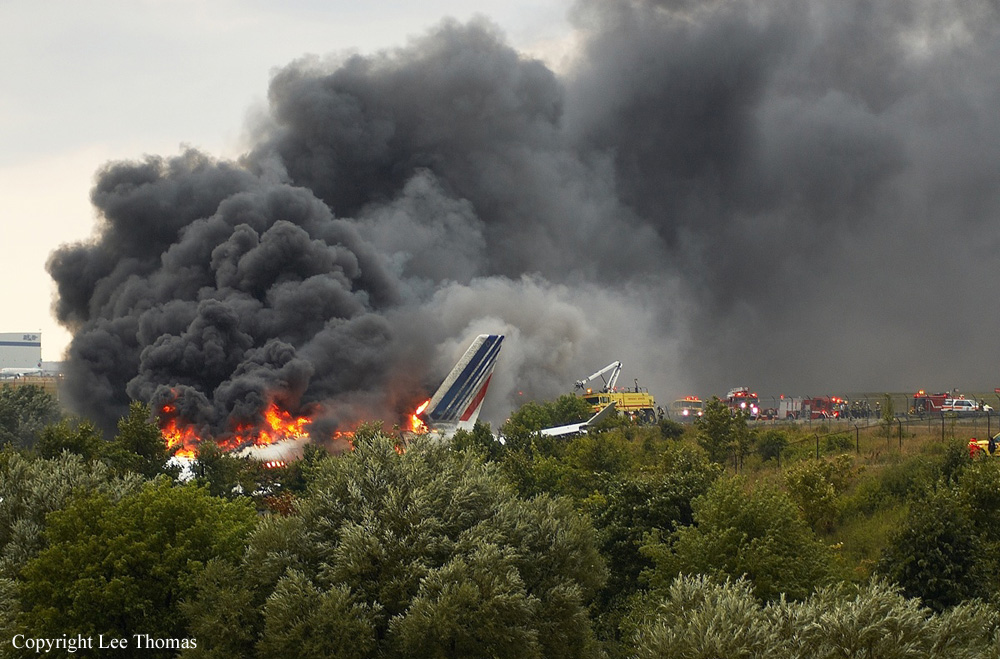
Crash of a Boeing 707-3J9C in Tehran: 3 killed

Date & Time: Apr 20, 2005 at 2205 LT
Type of aircraft:
Operator:
Registration:
EP-SHE
Survivors:
Yes
Schedule:
Kish Island - Tehran
MSN:
21127
YOM:
1976
Flight number:
IRZ171
Country:
Region:
Crew on board:
12
Crew fatalities:
Pax on board:
157
Pax fatalities:
Other fatalities:
Total fatalities:
3
Circumstances:
Following an uneventful flight from Kish Island, the aircraft landed by night on runway 29L at Tehran-Mehrabad Airport. After touchdown, the aircraft encountered technical difficulties and was unable to stop within the remaining distance. It overran, went down an embankment and came to rest in the Kan River canal located about 200 metres from the runway 11R threshold. All undercarriage as well as the engine n°3 were torn off. The aircraft was written off. Three passengers died while 50 others were injured.
Probable cause:
The exact cause of the accident is unknown. Nevertheless, it is believed that the aircraft suffered a gear failure or tyre burst after touchdown.

Crash of a Beechcraft B200 Super King Air in Lima

Date & Time: Apr 18, 2005 at 1715 LT
Operator:
Registration:
OB-1700
Survivors:
Yes
Schedule:
Chagual – Lima
MSN:
BB-214
YOM:
1977
Country:
Crew on board:
2
Crew fatalities:
Pax on board:
10
Pax fatalities:
Other fatalities:
Total fatalities:
0
Captain / Total flying hours:
4279
Copilot / Total flying hours:
4477
Aircraft flight hours:
23723
Circumstances:
En route from Chagual to Lima, at a distance of of 25 miles from Lima-Callao-Jorge Chávez Airport, the fuel pressure dropped and the left engine stopped. The crew continued the descent to Lima when, on final, the right engine failed as well. Both propellers were feathered and the crew attempted an emergency landing in an open field. The aircraft came to rest 3,5 km from the runway threshold. All 12 occupants escaped uninjured while the aircraft was damaged beyond repair.
Probable cause:
Operation with four consecutive flights made by the same crew to Chagual aerodrome (an aerodrome that demands a high alertness and situational awareness due to difficult topographical conditions), a long and exhausting day flying and working together with the multiple functions performed by the technical crew (dispatcher, payer, loader, cabin crew) probably decreased the performance and capacity of the technical crew and safety. Poor planning on the part of the Operations and Sales Management of the Aero Condor Company Charter, by not providing the NOTAM which showed the lack of JET A1 fuel in Trujillo causing programming, operational and logistic difficulties.
Final Report:
Crash of a De Havilland DHC-6 Twin Otter 100 near Timika: 17 killed

Date & Time: Apr 12, 2005 at 1058 LT
Operator:
Registration:
PK-LTZ
Flight Phase:
Survivors:
No
Site:
Schedule:
Timika – Enarotali
MSN:
23
YOM:
1966
Country:
Region:
Crew on board:
3
Crew fatalities:
Pax on board:
14
Pax fatalities:
Other fatalities:
Total fatalities:
17
Circumstances:
The twin engine aircraft departed Timika-Moses Kilangin Airport at 1050LT on a 27-minutes flight to Enarotali, carrying 14 passengers and a crew of three. Some eight minutes into the flight, while cruising in poor weather conditions, the aircraft impacted hilly terrain. The wreckage was found two days later. The aircraft disintegrated on impact and all 17 occupants were killed. At the time of the accident, weather conditions were poor with low ceiling and rain falls.
Probable cause:
Controlled flight into terrain.

Crash of a Fokker F28 Fellowship 4000 in Coca

Date & Time: Apr 7, 2005 at 0955 LT
Type of aircraft:
Operator:
Registration:
HC-CDA
Survivors:
Yes
Schedule:
Quito – Coca
MSN:
11230
YOM:
1986
Flight number:
ICD504
Location:
Country:
Crew on board:
5
Crew fatalities:
Pax on board:
60
Pax fatalities:
Other fatalities:
Total fatalities:
0
Aircraft flight hours:
36087
Aircraft flight cycles:
46662
Circumstances:
Following an uneventful flight from Quito, the crew started the approach to Coca Airport runway 15. Too low on final, the aircraft landed 4,5 metres short of runway. Upon impact, the left main gear was torn off. The aircraft rolled for 112 metres then veered off runway to the left, rolled another 263 metres then came to rest against a concrete wall. All 65 occupants were rescued, among them seven passengers were injured. The aircraft was damaged beyond repair.
Probable cause:
It was determined that the crew thought the Coca runway was short. To be able to stop the plane on the runway without excessive use of the brakes, the crew decided to land as early as possible. Doing so, the aircraft landed 4,5 metres short of runway. The published procedure request a minimum altitude of 50 feet over the threshold and the AFM showed a landing distance of 930 metres needed at maximum landing weight considering 42° of flaps, speed brakes out, lift dumpers armed, antiskid operative. Wrong approach procedure on part of the crew.

Crash of an Ilyushin II-18D-40 in Caracas

Date & Time: Mar 28, 2005 at 1615 LT
Type of aircraft:
Operator:
Registration:
CU-T1539
Flight Phase:
Survivors:
Yes
Schedule:
Caracas – Havana
MSN:
296 4017 102
YOM:
1983
Flight number:
CRN4311
Country:
Crew on board:
10
Crew fatalities:
Pax on board:
87
Pax fatalities:
Other fatalities:
Total fatalities:
0
Circumstances:
During the takeoff roll on runway 09, the captain decided to reject takeoff for unknown reasons. Unable to stop within the remaining distance, the four engine aircraft overran, lost its undercarriage and came to rest on the top of a hill with the n°1 engine torn off. All 97 occupants were rescued, among them 16 were injured, some seriously.

Crash of a Let L-410UVP-E in El Embrujo: 9 killed

Date & Time: Mar 26, 2005 at 0951 LT
Type of aircraft:
Operator:
Registration:
HK-4146
Flight Phase:
Survivors:
Yes
Schedule:
El Embrujo – San Andrés
MSN:
90 24 26
YOM:
1990
Flight number:
YH9955
Country:
Crew on board:
2
Crew fatalities:
Pax on board:
12
Pax fatalities:
Other fatalities:
Total fatalities:
9
Captain / Total flying hours:
6038
Captain / Total hours on type:
145.00
Copilot / Total flying hours:
868
Copilot / Total hours on type:
653
Aircraft flight hours:
6901
Circumstances:
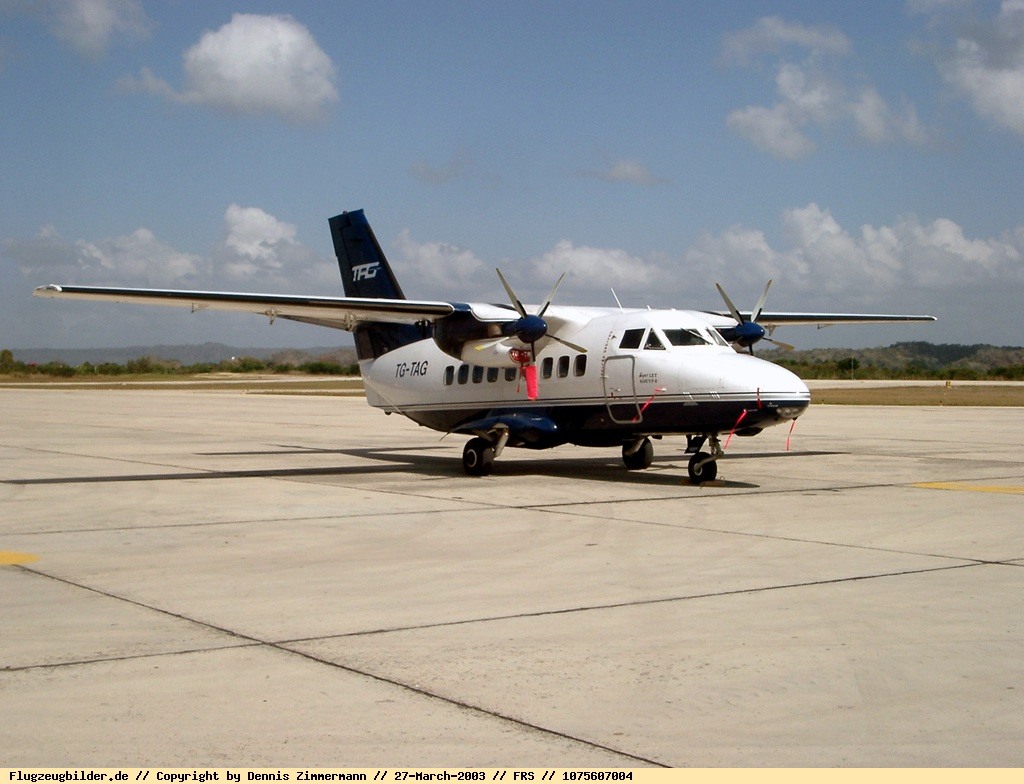
The crew already completed four round trips the same morning on the same routing. During the takeoff roll from runway 35 at El Embrujo Airport, around V1 speed, the left engine speed. The crew continued the takeoff procedure while the speed dropped. Shortly after rotation, the aircraft rolled to the right to an angle of 135° then entered an uncontrolled descent and crashed in a wooded area located 117 metres past the runway end. Both pilots and seven passengers were killed while five others passengers were injured.
Probable cause:
The non-observance of the procedures described for an engine failure after V1, especially those relating to the maintenance of safe takeoff speed of 84 knots, the retraction of the flaps, automatic operation of the landing gear lever and the use of contingency power. The erroneous operation of the fuel-flow-control lever (FCL) of engine number one, the move from the open to the closed position during the chain of events, which left the plane and the inappropriate use of the fuel-flow-control lever (FCL) of engine number two, to bring it to the MAX NG position in an attempt to obtain performance of the engine. Maintaining an attitude of the plane on take-off after nr. 2 engine failure with the consequent reduction of speed and then maintaining the aircraft in a climbing attitude, after an engine shutdown, which came at stall speed and the subsequent lack of control of the aircraft. The failure of the engine for undetermined reasons during the takeoff roll, after V1, which forced the crew to perform a series of emergency procedures to deal with the fault and continue with the initial climb. The absence or failure of resource management among flight crew members during the sequence of events. The unmeasurable reduction in the situational awareness of the crew as a result of the financial situation of the company and the divorce in which the Captain of the aircraft was involved.
Final Report:
Crash of a Cessna 208B Grand Caravan off Belize City

Date & Time: Mar 9, 2005 at 1720 LT
Type of aircraft:

Operator:
Registration:
V3-HFW
Flight Phase:
Survivors:
Yes
Schedule:
Belize City – San Pedro
MSN:
208B-0791
YOM:
1999
Flight number:
9N2110
Country:
Crew on board:
1
Crew fatalities:
Pax on board:
13
Pax fatalities:
Other fatalities:
Total fatalities:
0
Circumstances:
Shortly after takeoff from Belize City-Sir Barry Bowen Municipal Airport, while in initial climb, the single engine aircraft went out of control and crashed in the sea, coming to rest upside down in shallow water. All 14 occupants were rescued while the aircraft was damaged beyond repair.
Probable cause:
Loss of control during initial climb due to windshear after weather conditions suddenly changed as a thunderstorm was approaching the airport.