Crash of a Beechcraft C99 Airliner in Lansing

Date & Time: Aug 15, 2023 at 0805 LT
Type of aircraft:
Operator:
Registration:
N261SW
Flight Phase:
Flight Type:
Survivors:
Yes
Schedule:
Lansing – Pellston
MSN:
U-202
YOM:
1983
Flight number:
AMF1304
Crew on board:
1
Crew fatalities:
Pax on board:
0
Pax fatalities:
Other fatalities:
Total fatalities:
0
Captain / Total flying hours:
1218
Captain / Total hours on type:
26.00
Aircraft flight hours:
27642
Circumstances:
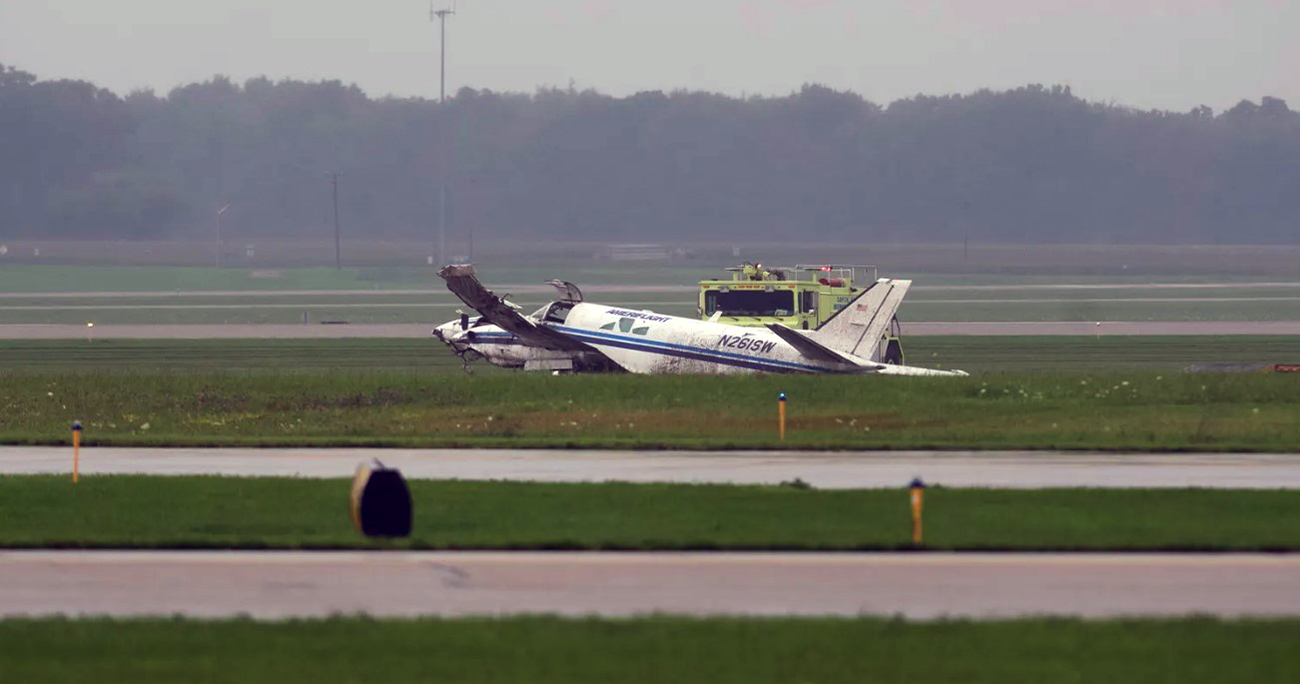
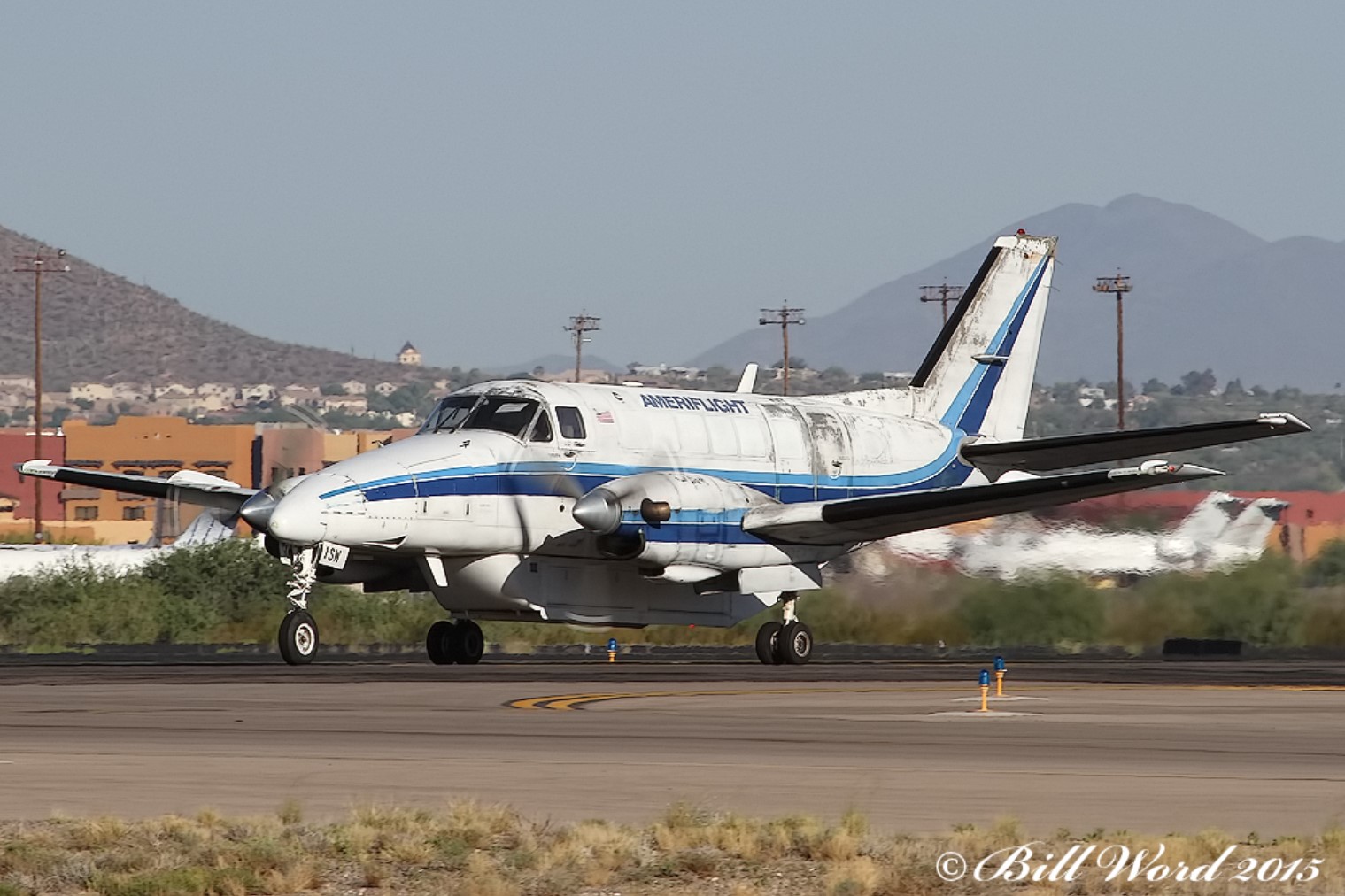
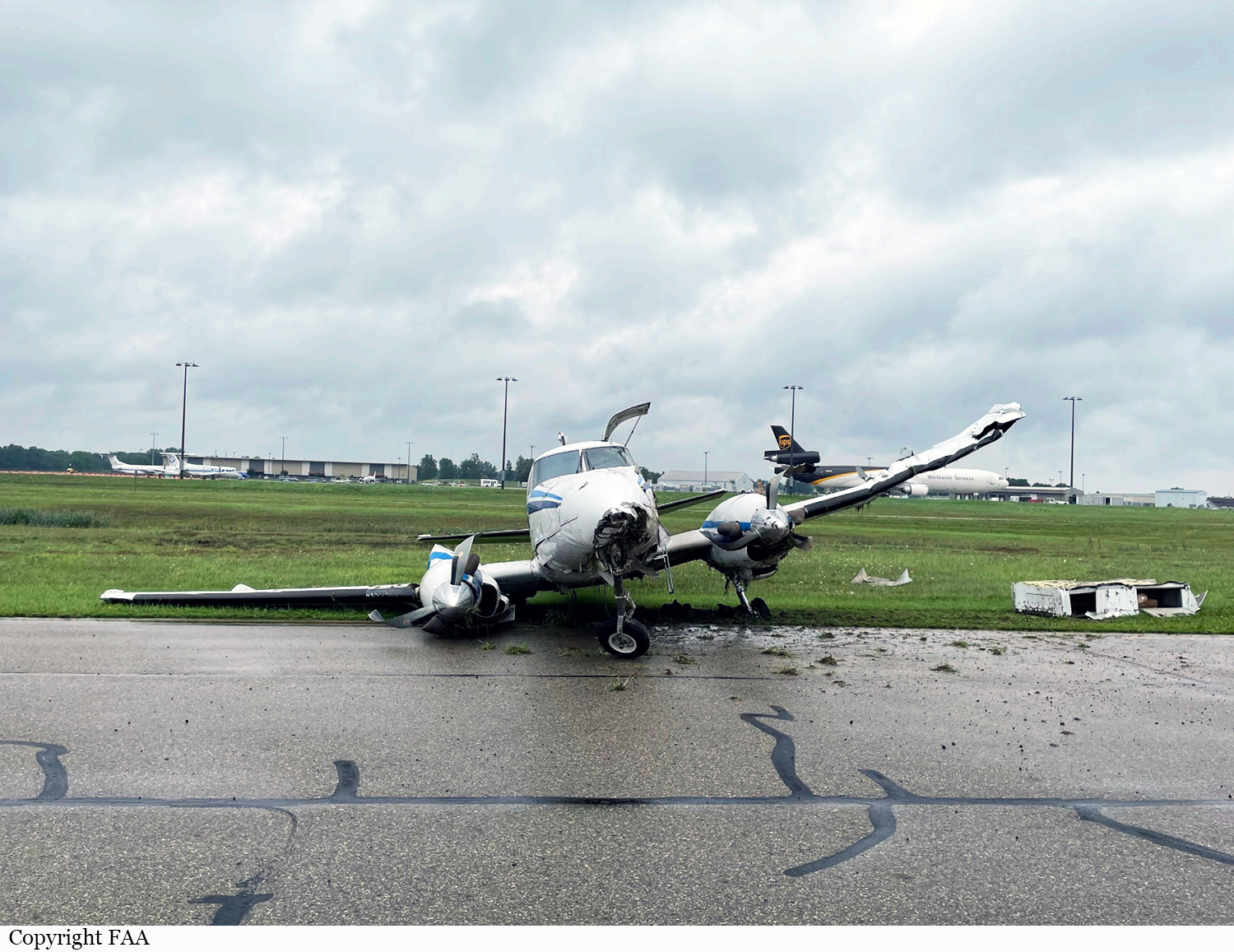
The pilot reported that after a normal start and taxi, the airplane was cleared for takeoff. During the takeoff roll, the airplane drifted right and the pilot corrected with the left rudder. When the airplane reached 100 knots, he rotated the airplane, and about 30 feet in altitude, the airplane experienced a roll to the right. The pilot tried to correct the roll with left rudder but was unable to provide sufficient left rudder. At this point, the airplane had drifted to the right of the runway and over the adjacent parallel taxiway. He was able to regain partial control by reducing engine power and banking the airplane to the left. The pilot attempted to land on the taxiway but was unable to judge his height above ground due to the low visibility, and subsequently impacted terrain to the right of the taxiway. Both wings and the fuselage sustained substantial damage. Prior to exiting the airplane, the pilot noted that the rudder trim was set to the full nose-right position. The pilot reported no preaccident mechanical malfunctions or failures with the airplane that would have precluded normal operation. Prior to the accident, maintenance was completed that consisted of an “Event II & Routine” inspection. The inspection procedure required the rudder trim system to be lubricated, a trim tab free play inspection, and an operational check prior to returning the airplane to service. Review of the maintenance procedures revealed there was no guidance on returning the rudder trim control system back to a neutral position at completion of the inspection.
Probable cause:
The pilot’s failure to properly set the rudder trim position which resulted in a loss of directional control during takeoff. Contributing was the pilot’s inadequate checklist procedures prior to takeoff.
Final Report:
Crash of a Rockwell Shrike Commander 500S off Key West

Date & Time: Aug 13, 2023 at 1020 LT
Operator:
Registration:
N62WE
Flight Phase:
Flight Type:
Survivors:
Yes
Schedule:
Orlando - Key West
MSN:
500-3317
YOM:
1978
Crew on board:
1
Crew fatalities:
Pax on board:
0
Pax fatalities:
Other fatalities:
Total fatalities:
0
Captain / Total flying hours:
975
Captain / Total hours on type:
338.00
Aircraft flight hours:
3997
Circumstances:
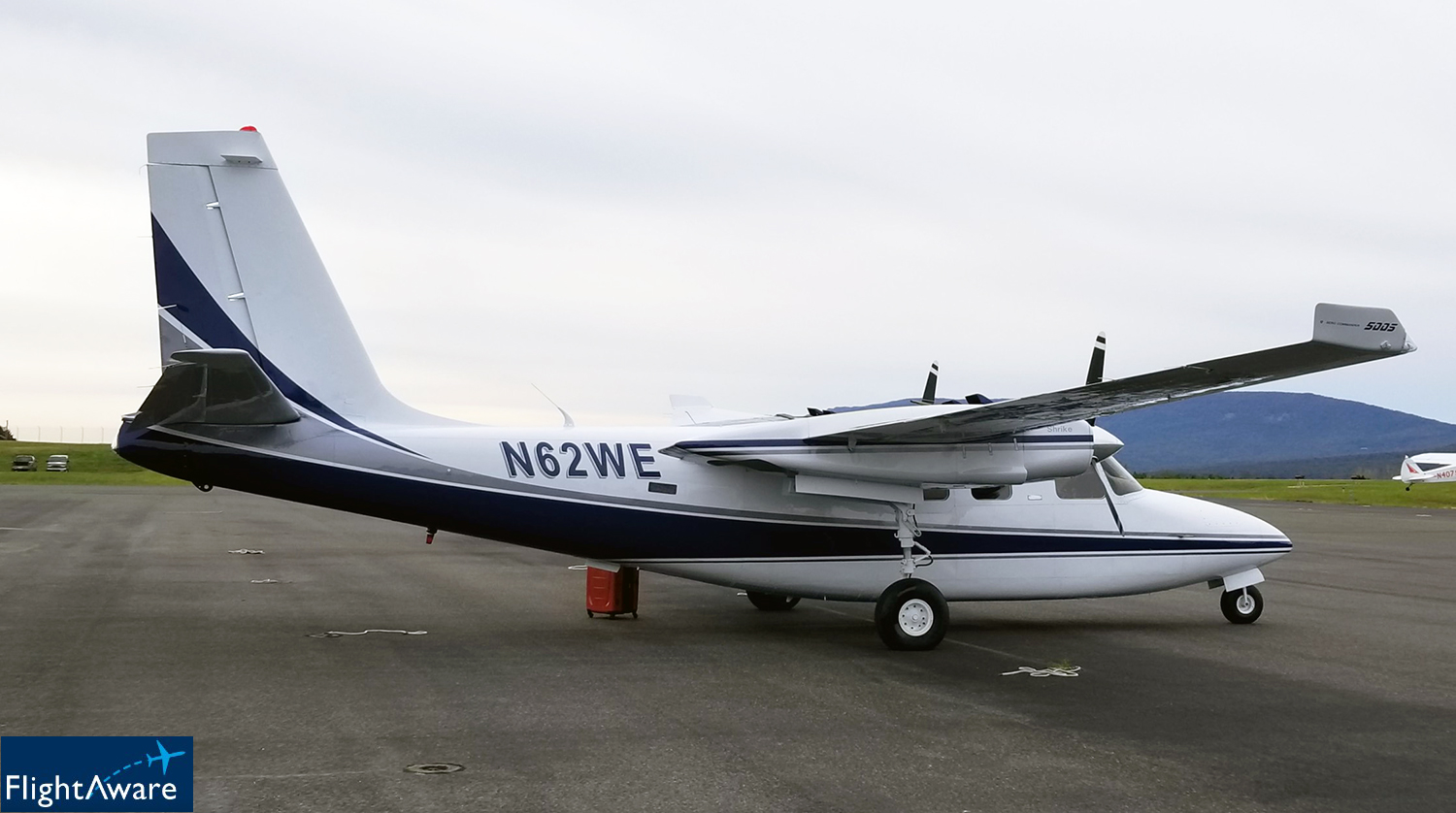
The pilot was enroute to the destination airport and overflying the Gulf of Mexico when about 15 nautical miles from the airport and at an altitude of 3,000 ft, the right engine suddenly lost power. The pilot described that about that time, the fuel totalizers indicated that 48 gallons of fuel were onboard, and his fuel quantity gauge indicated similarly. He then contacted air traffic control and declared an emergency. Shortly thereafter, the left engine also suddenly lost power. The pilot attempted to troubleshoot the issue and restart both engines but was unsuccessful. He subsequently ditched the airplane and was rescued from the water without injury. The airplane was not recovered and could not be examined after the accident, therefore the reason for the loss of engine power could not be determined.
Probable cause:
A total loss of engine power for reasons that could not be determined.
Final Report:

Crash of a Piper PA-31P Pressurized Navajo in Mosby: 1 killed

Date & Time: Jul 20, 2023 at 0934 LT
Type of aircraft:
Registration:
N200RA
Flight Phase:
Flight Type:
Survivors:
No
Schedule:
Mosby - Kingman
MSN:
31-7400198
YOM:
1974
Crew on board:
1
Crew fatalities:
Pax on board:
0
Pax fatalities:
Other fatalities:
Total fatalities:
1
Captain / Total flying hours:
23550
Aircraft flight hours:
1192
Circumstances:
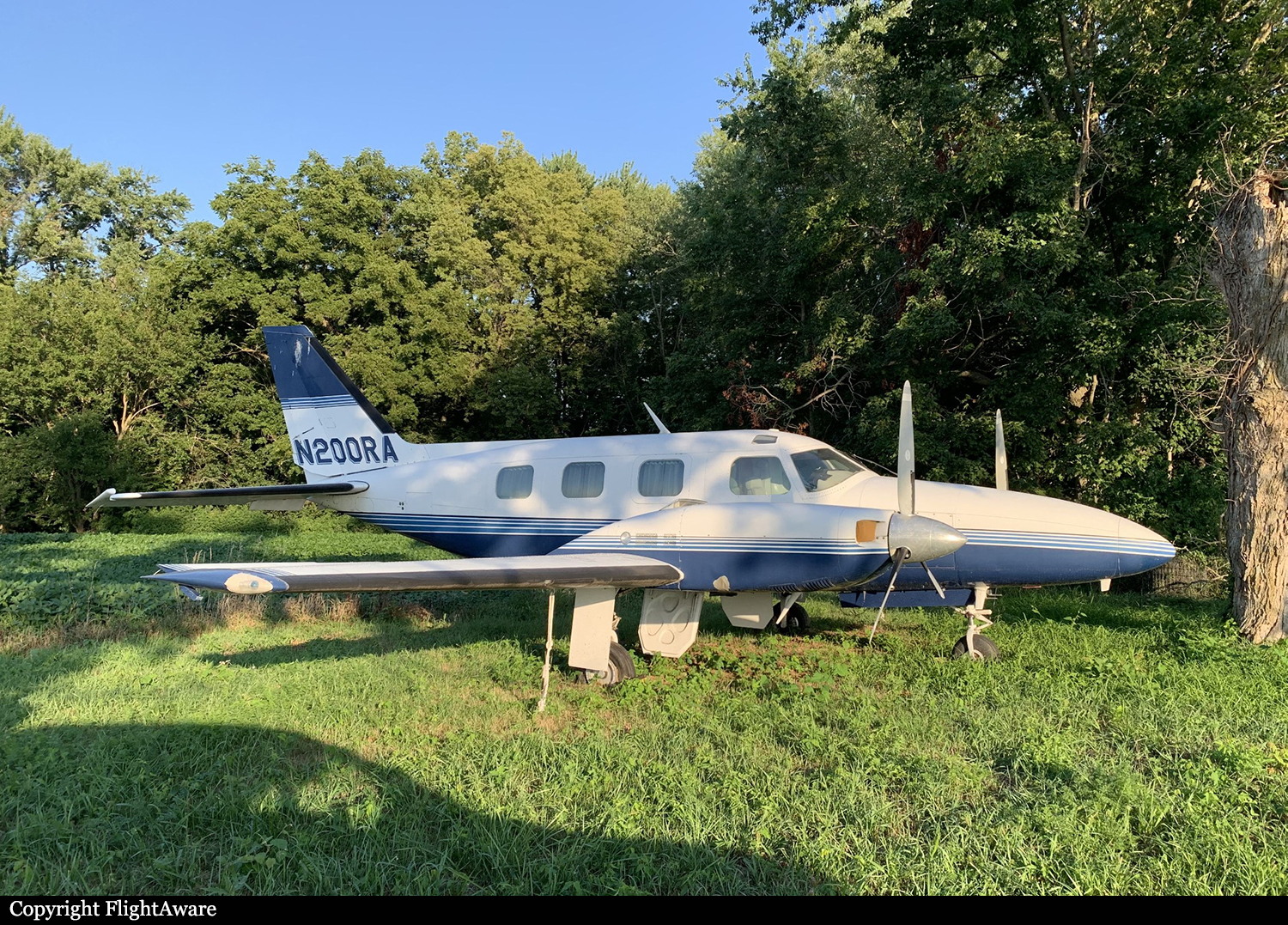
The pilot was flying the airplane on an FAA Special Flight Permit to another location to complete maintenance and an overdue annual inspection. The airplane had been abandoned, with its most recent flight being 8 years before, and chained to a tree in an agricultural field adjacent to the airport from August 2021 until December 2022 when it was purchased by the current owner. Before the accident flight, an attempt was made to top off the airplane’s fuel tanks. However, fuel started to leak from multiple locations and only three fuel tanks were able to be fueled. The pilot asked the mechanic about the leaks; the mechanic stated that the filler necks were leaking, and the lineman had attempted to top off the fuel tanks instead of the previously agreed upon lower level. The pilot then completed a brief preflight inspection before starting the airplane. During engine start, the pilot requested the mechanic’s assistance three times to ask about various issues that the mechanic talked him through. The pilot then taxied to the runway and departed without performing an engine run-up. Multiple cellphone video recordings of the takeoff sequence showed the airplane veer to the right and attempt to rotate before settling back to the runway. The recordings then showed the airplane become airborne near the end of the runway end and initially yaw to the right before it entered a shallow climb. The witnesses observed the airplane barely clear a line of trees past the departure end of the runway and make a left turn before it disappeared behind trees. Analysis of the video recordings showed that rotation was at a ground speed of about 70.8 knots, corresponding to an estimated air speed of about 74.8 knots, which was significantly below the recommended rotation speed of 85 knots. A witness north of the airport heard a loud airplane that appeared from behind trees and headed toward his residence. He observed the airplane strike two static wires on a power transmission line before it impacted the canopy of a large tree in his front yard. The airplane continued in a left bank toward a nearby soybean field and impacted the terrain in a nose-low, left bank attitude. The airplane was partially destroyed by a post impact fire and the pilot, sole on board, was killed.
Probable cause:
The pilot’s decision to operate an airplane with known fuel leaks, his failure to conduct an engine run-up before takeoff, his subsequent failure to abort the takeoff, and the mechanic’s inadequate maintenance, which resulted in a partial loss of right engine power during takeoff due to fuel starvation as a result of blocked fuel injector ports.
Final Report:
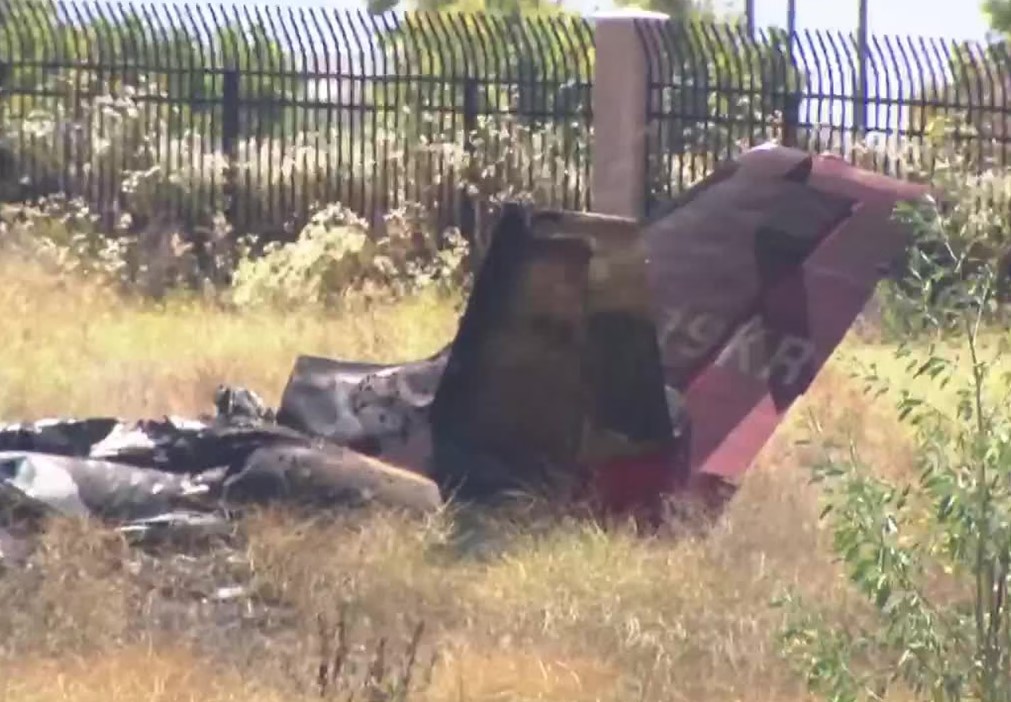
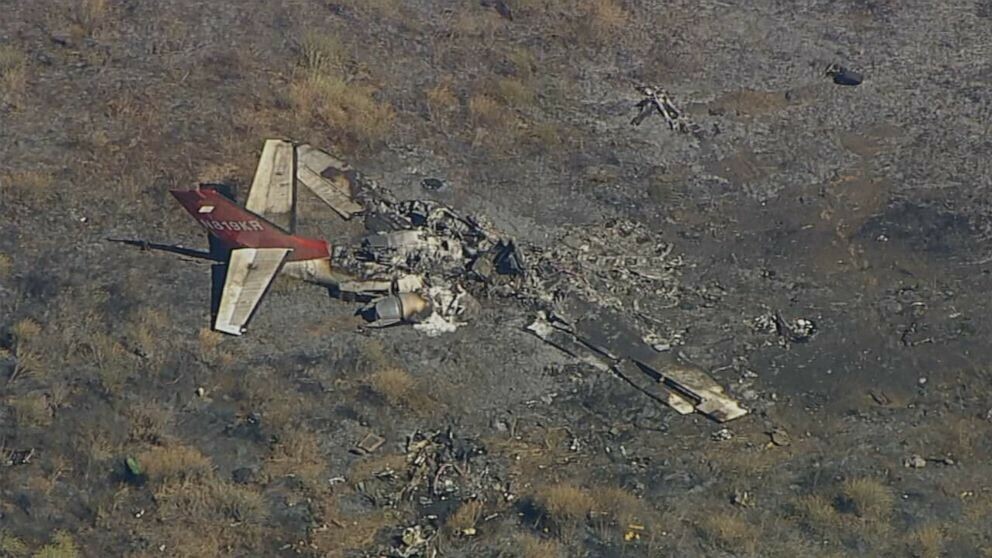
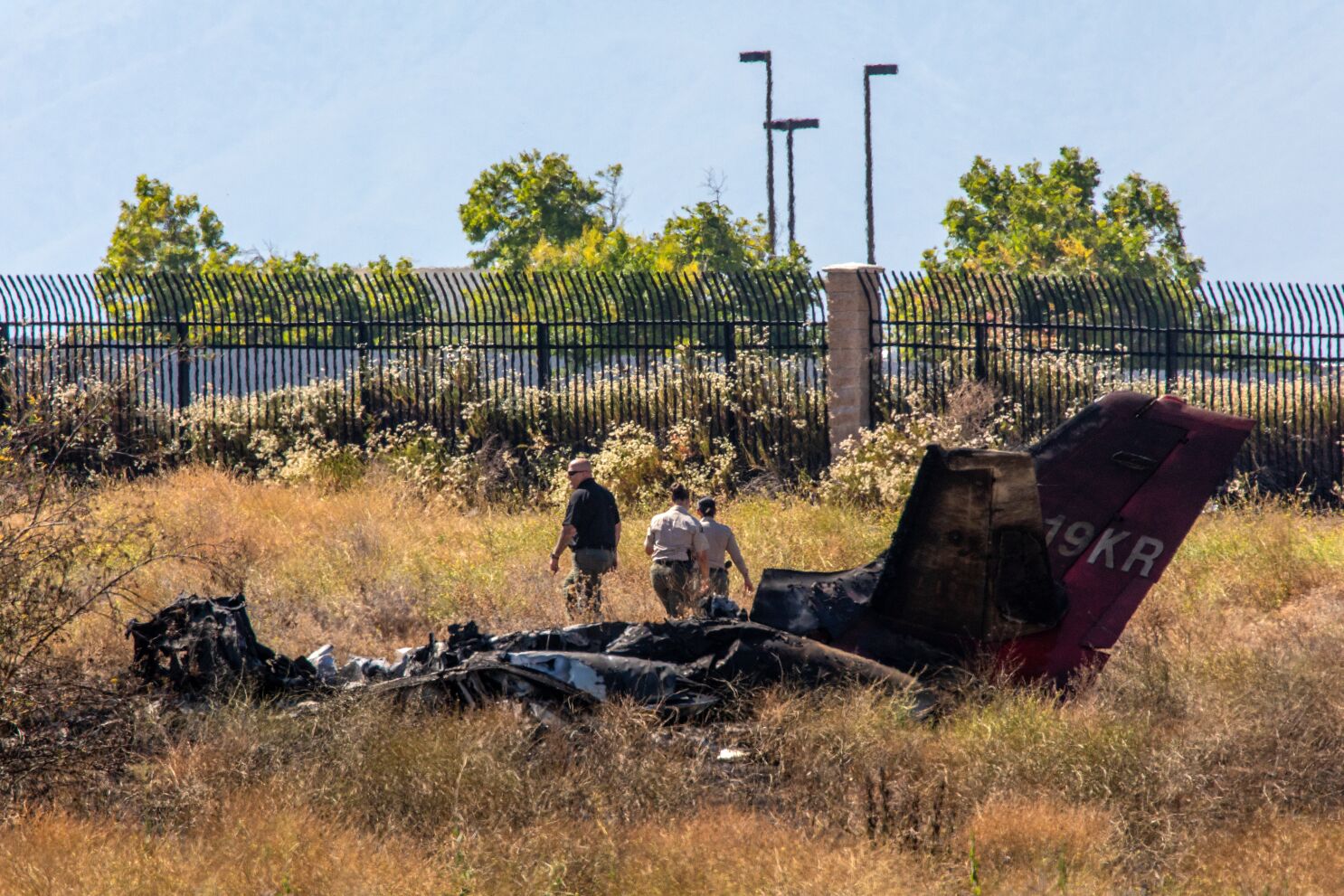
Crash of a Cessna 550 Citation II in Temecula: 6 killed

Date & Time: Jul 8, 2023 at 0414 LT
Type of aircraft:
Registration:
N819KR
Flight Type:
Survivors:
No
Schedule:
Las Vegas - Temecula
MSN:
550-0114
YOM:
1979
Crew on board:
2
Crew fatalities:
Pax on board:
4
Pax fatalities:
Other fatalities:
Total fatalities:
6
Captain / Total flying hours:
950
Copilot / Total flying hours:
1600
Aircraft flight hours:
14569
Circumstances:
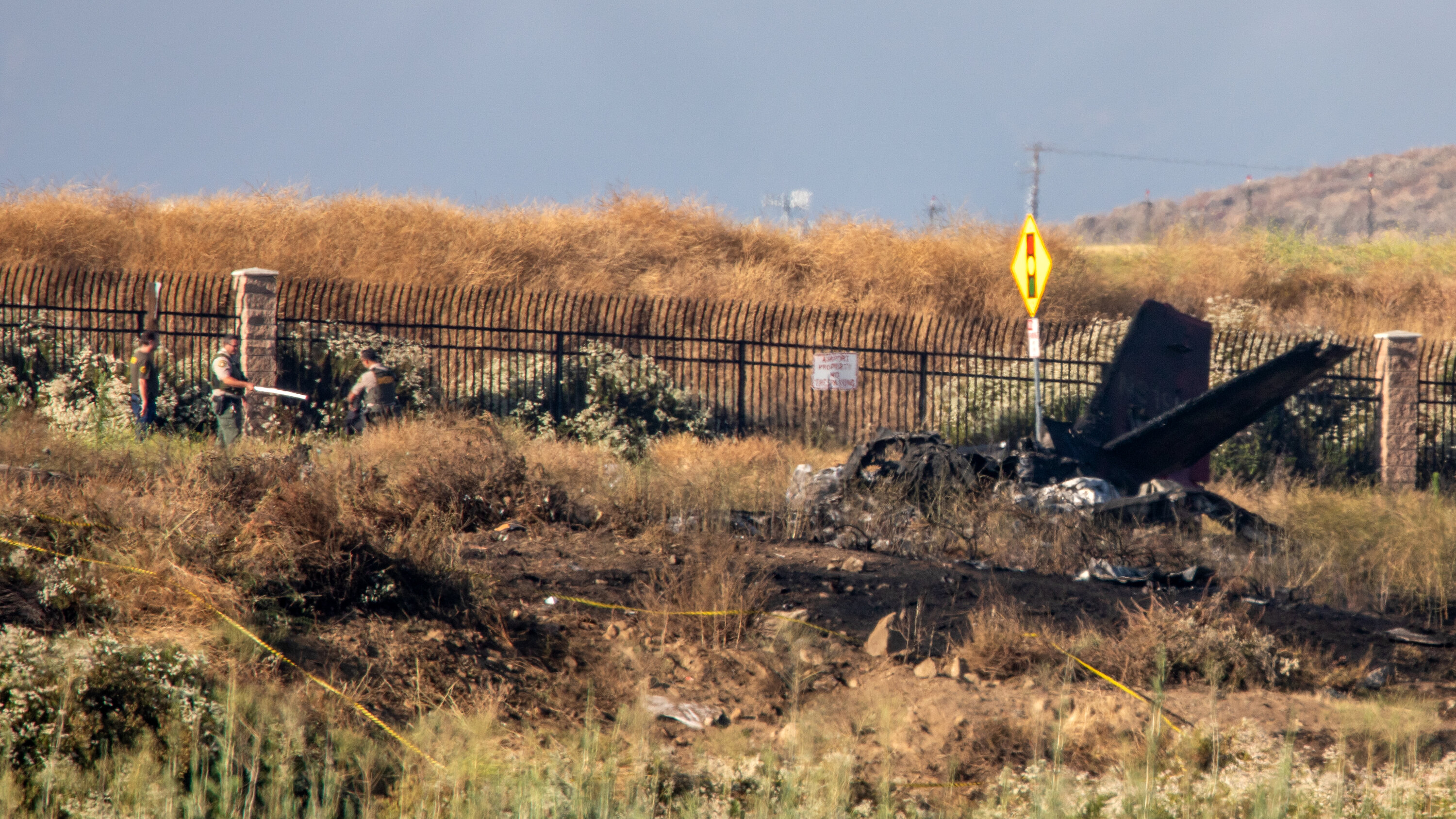
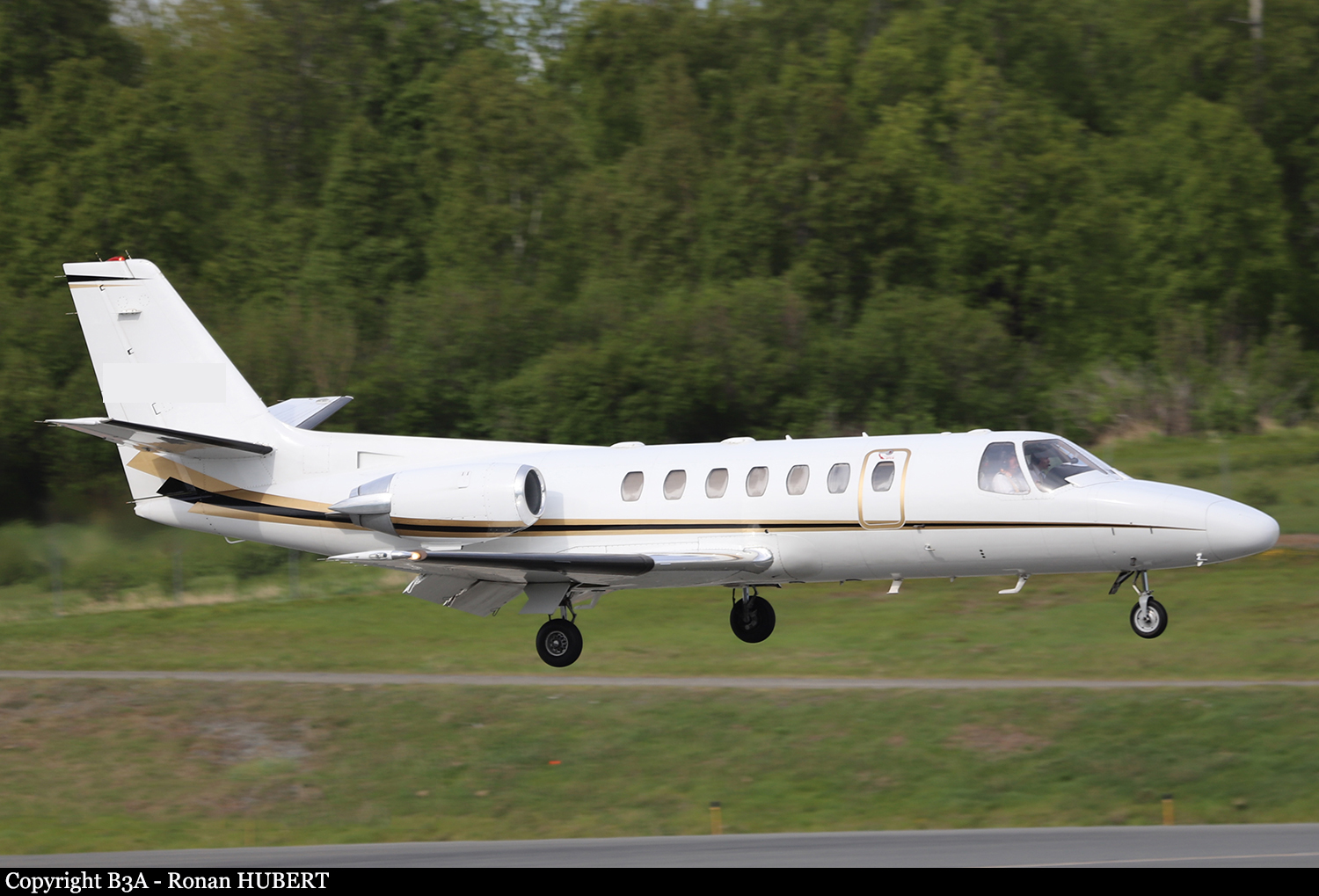
During an early morning night flight, the flight encountered deteriorating weather conditions with a low overcast ceiling and rapidly decreasing visibility at the destination due to fog. A few minutes before the flight’s arrival time at the destination airport, the weather had changed from being clear with 10 statute miles (sm) visibility to 300 ft overcast with 3/4 sm visibility. Additionally, in the next 20 minutes, the visibility further decreased to about 1/2 sm with fog. The airplane was cleared for the RNAV (GPS) Runway 18 instrument approach to the airport. The lowest visibility requirement on the approach was 7/8 of a mile. During the final approach, the pilot executed a missed approach and asked to try another instrument approach. During the second instrument approach, while on final approach, the pilot failed to fly a stabilized approach as the airplane’s descent rate and airspeed were excessive. Subsequently, the airplane descended below the decision altitude of the approach without appropriate visual references and impacted terrain about 810 ft short of the runway threshold. The circumstances of the accident flight were consistent with controlled flight into terrain (CFIT). The postaccident examination of the airplane and engines revealed no evidence of mechanical failures or malfunctions that would have precluded normal operation of the airplane. The pilot had very low levels of ethanol detected in postmortem vitreous fluid and cavity blood. Some or all of this small amount of ethanol may have been from sources other than alcohol consumption. Although it is uncertain whether the pilot had consumed alcohol overnight, the toxicology results indicate that it is unlikely that the pilot’s performance would be significantly affected by ethanol. The copilot’s ethanol levels were high in all tested postmortem specimens. Based on the toxicology results and the circumstances of the event, it is likely that the copilot had consumed alcohol. However, based on the extent of his injuries, the presence of indicators of microbial decomposition, and the relative differences in ethanol levels across specimens, it also is likely that some of the detected ethanol was from sources other than alcohol consumption. The copilot’s blood alcohol level at the time of the crash cannot be reliably determined from available evidence. Overall, alcohol-related impairment may have limited the copilot’s ability to make a positive contribution to flight safety (such as by helping to monitor the approach); however, whether the effects of alcohol use by the copilot contributed to the accident outcome could not be determined.
Probable cause:
The flight crew’s decision to descend below the decision altitude of an instrument approach without having the appropriate runway visual reference(s) distinctively identified and with the visibility below the minimum that was prescribed for the approach, which resulted in controlled flight into terrain.
Final Report:

Crash of a Piper PA-61-601P Aerostar (Ted Smith 601) near Burlington: 1 killed

Date & Time: Jul 6, 2023 at 1330 LT
Operator:
Registration:
N100PB
Flight Phase:
Flight Type:
Survivors:
No
MSN:
61-0584-7963257
YOM:
1979
Crew on board:
1
Crew fatalities:
Pax on board:
0
Pax fatalities:
Other fatalities:
Total fatalities:
1
Captain / Total flying hours:
20000
Captain / Total hours on type:
100.00
Circumstances:
The pilot departed the airport about 1330 local time for an unknown destination in visual flight rules conditions. The accident site was located about 12 nautical miles (nm) from the airport; however, the airplane’s flight path and time of the accident are unknown as there was no flight track or recorded data available; there were no witnesses to the accident. Postaccident examination revealed no preimpact anomalies with the airplane or engines that would have precluded normal operation. Weather conditions after the airplane’s departure suggest the airplane may have encountered an area of deteriorating weather and instrument meteorological conditions (IMC) that reduced visibility and obscured terrain. However, as the accident time is unknown, the investigation was unable to determine if the airplane crashed during a time of deteriorating weather. The pilot was also operating the airplane with an inoperative GPS, which could have decreased the pilot’s ability to maintain situational awareness. The accident site signatures were consistent with a loss of control and impact with terrain. An autopsy was conducted on the pilot; however, due to the condition of the remains, it could not be determined if an impairing condition or natural disease contributed to the accident. An unknown quantity of ethanol detected by toxicological testing may have been from postmortem production; however, the limited results also do not exclude the possibility of ethanol consumption or related impairment.
Probable cause:
The pilot’s visual flight rules flight into instrument meteorological conditions, which resulted in a loss of control in flight and subsequent impact with terrain.
Final Report:

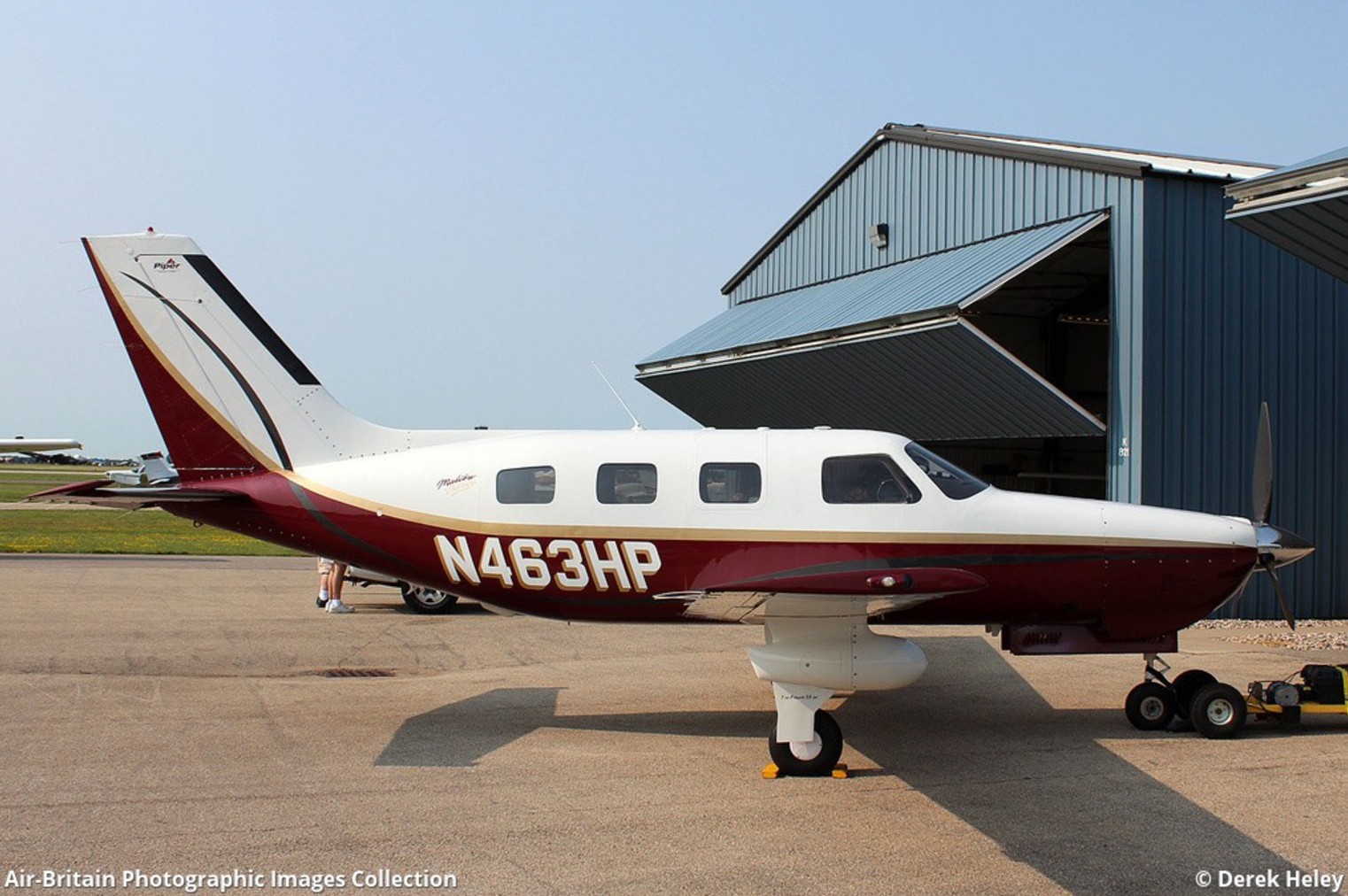
Crash of a Piper PA-46-350P Malibu Mirage in College Station

Date & Time: Jun 18, 2023 at 0843 LT
Operator:
Registration:
N463HP
Flight Phase:
Flight Type:
Survivors:
Yes
Schedule:
College Station – Anderson
MSN:
46-36335
YOM:
2002
Crew on board:
1
Crew fatalities:
Pax on board:
0
Pax fatalities:
Other fatalities:
Total fatalities:
0
Circumstances:
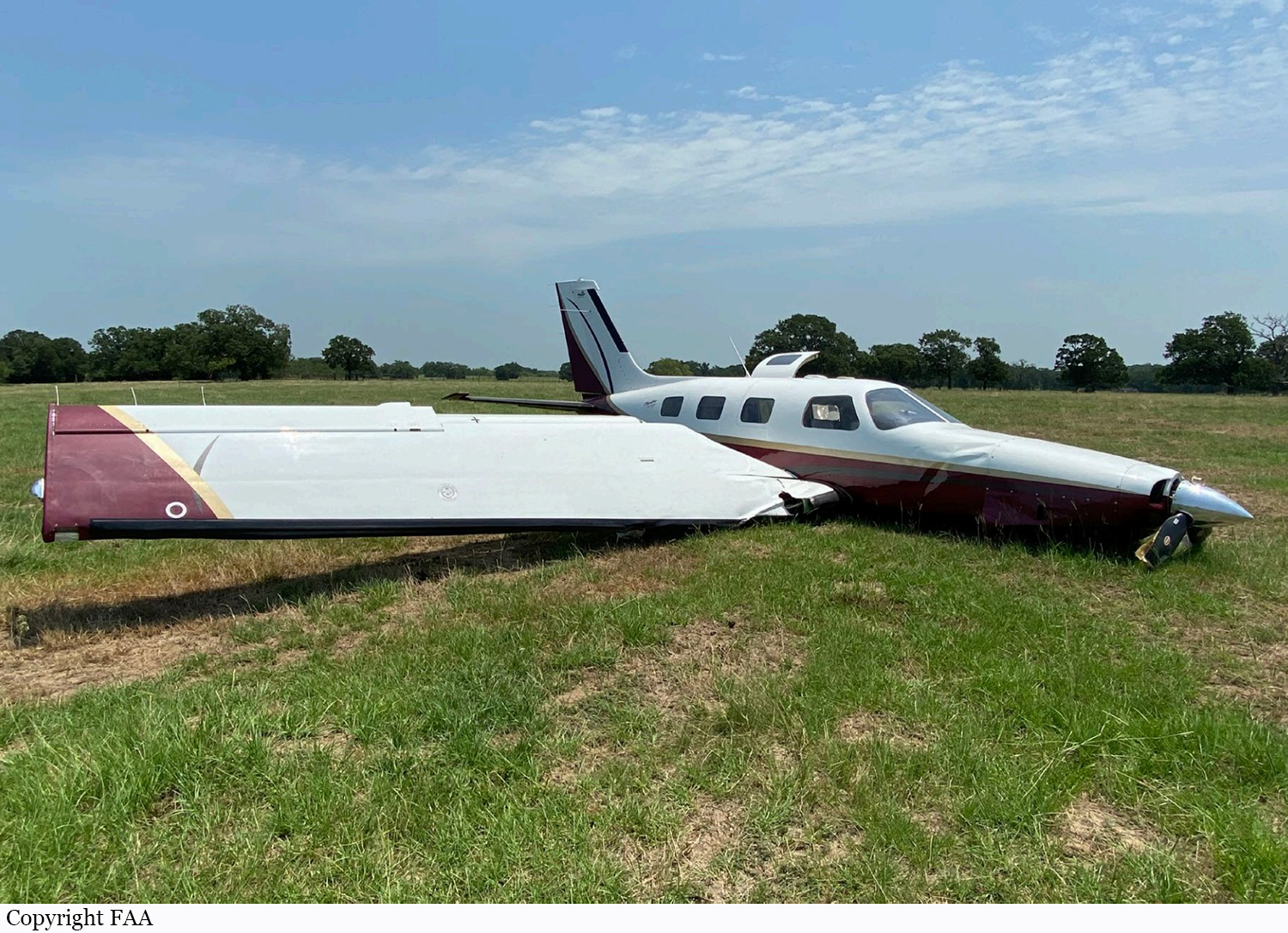
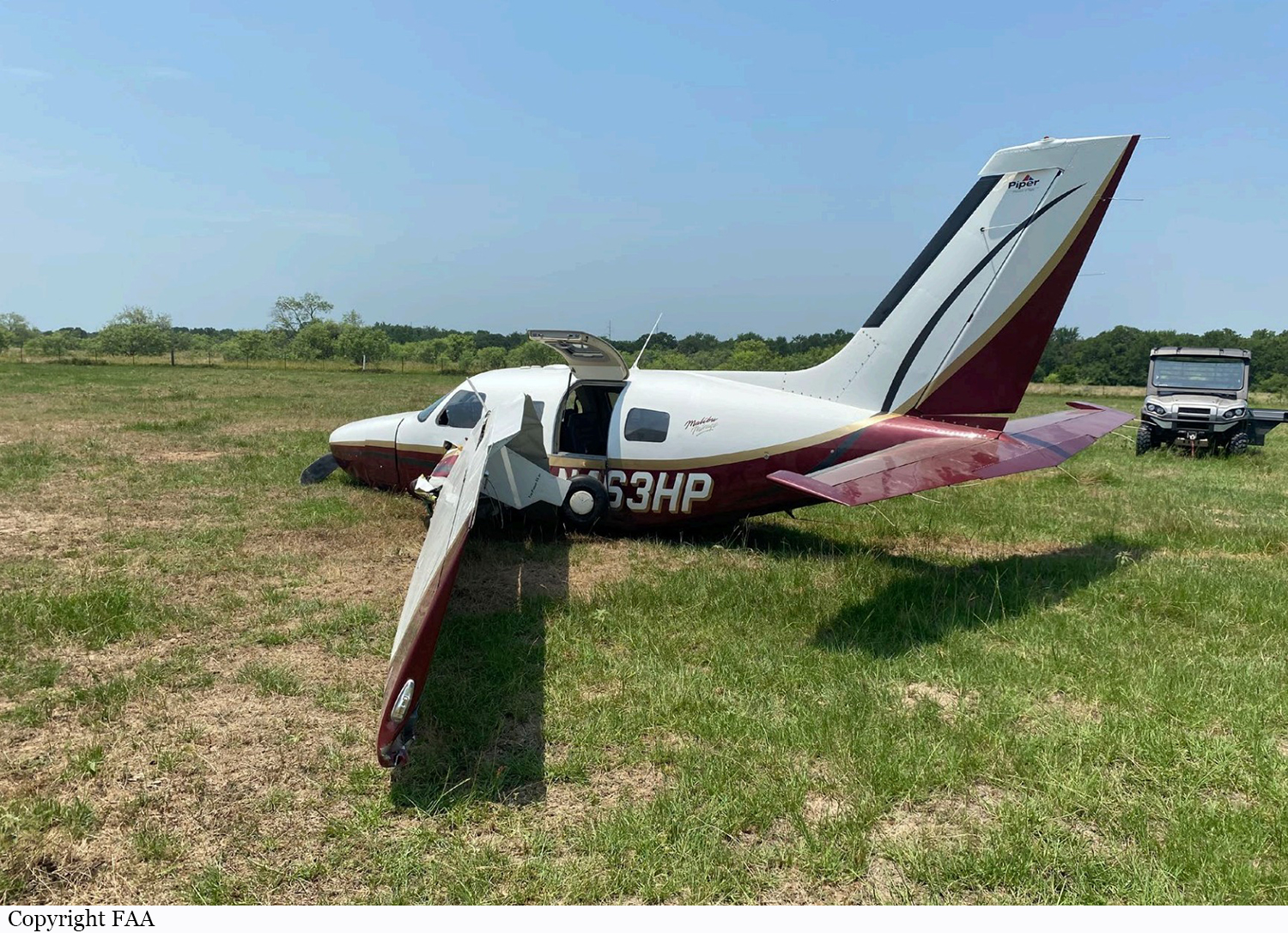
While climbing the airplane to cruise altitude after takeoff, the pilot observed an increase in engine oil temperature above the normal range and requested to return to the departure airport. While receiving vectors for an instrument approach, the pilot saw smoke in the cabin and the engine lost total power. Unable to glide to any runway, the pilot selected a field for the forced landing, during which the airplane sustained substantial damage to the wings and fuselage. Postaccident examination revealed that about 2 quarts of oil remained in the engine, and the recovered oil displayed evidence of metal contamination. There was evidence of an oil leak in the engine compartment and along the lower fuselage. There was evidence of a crankcase fracture near the oil dip stick port; however, a laboratory examination determined the fracture to be consistent with overload and likely due to impact-related damage. The engine exhibited no evidence of any loose or disconnected oil lines. The oil filter was removed, and the filter material was found to be saturated with metallic particles. The oil suction screen plug, located on the oil sump, was not secured with safety wire as required per the manufacturer’s maintenance manual. There was no evidence that the plug or required safety wire was damaged by other objects. The oil suction screen plug was found to be loose, with engine oil observed below the oil suction screen plug. The crush washer behind the oil screen plug was intact and exhibited no damage. Laboratory analysis of the metallic debris recovered from the oil suction screen was consistent with connecting rod material as well as steel from fittings, fasteners, and brackets. The metallic debris found in the recovered oil, oil filter, and oil suction screen was likely due to mechanical damage associated with oil starvation. Eleven days before the accident flight, the pilot observed decreased engine manifold pressure and a partial loss of engine power. He diverted to an airport, where he had the turbocharger replaced by an aviation mechanic. In addition to replacing the turbocharger, the mechanic also drained and replaced the engine oil, which included removal and reinstallation of the oil suction screen plug. The loss of engine power was likely due to a loss of oil during the flight that led to oil starvation within the engine. The loose oil suction screen plug, the absence of safety wire on the plug, and the evidence of an oil leak beneath the plug were consistent with the mechanic’s failure to properly secure the oil suction screen plug during recent maintenance.
Probable cause:
The mechanic’s failure to properly secure the oil suction screen plug during recent maintenance, which resulted in an oil leak and subsequent loss of engine power due to oil starvation.
Final Report:

Ground accident of a Cessna 340A in Bend

Date & Time: Jun 8, 2023 at 1400 LT
Type of aircraft:
Operator:
Registration:
N340SW
Flight Phase:
Flight Type:
Survivors:
Yes
Schedule:
Bend - Bend
MSN:
340A-0531
YOM:
1978
Location:
Crew on board:
1
Crew fatalities:
Pax on board:
1
Pax fatalities:
Other fatalities:
Total fatalities:
0
Captain / Total flying hours:
3300
Captain / Total hours on type:
2200.00
Aircraft flight hours:
3230
Circumstances:
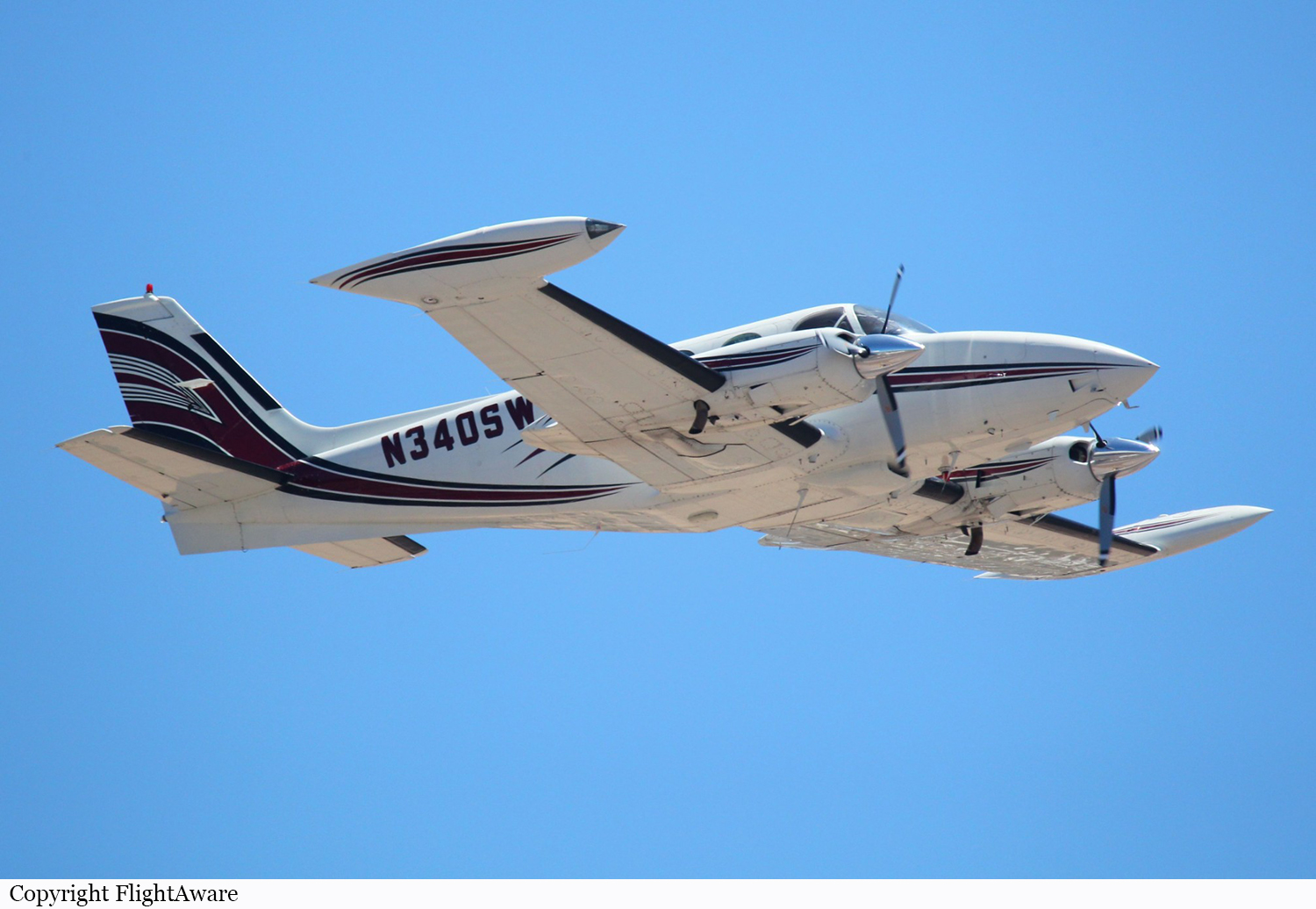
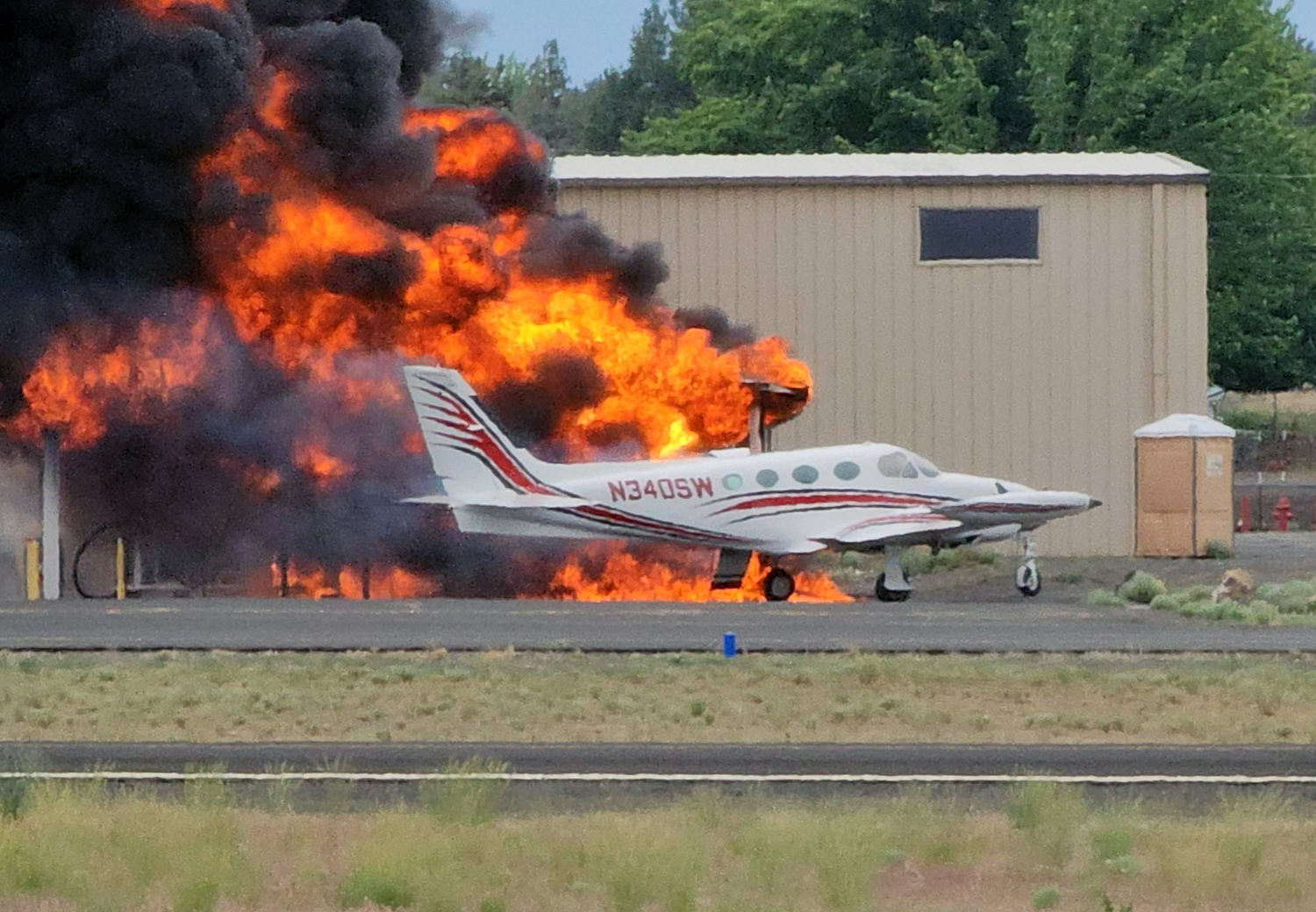
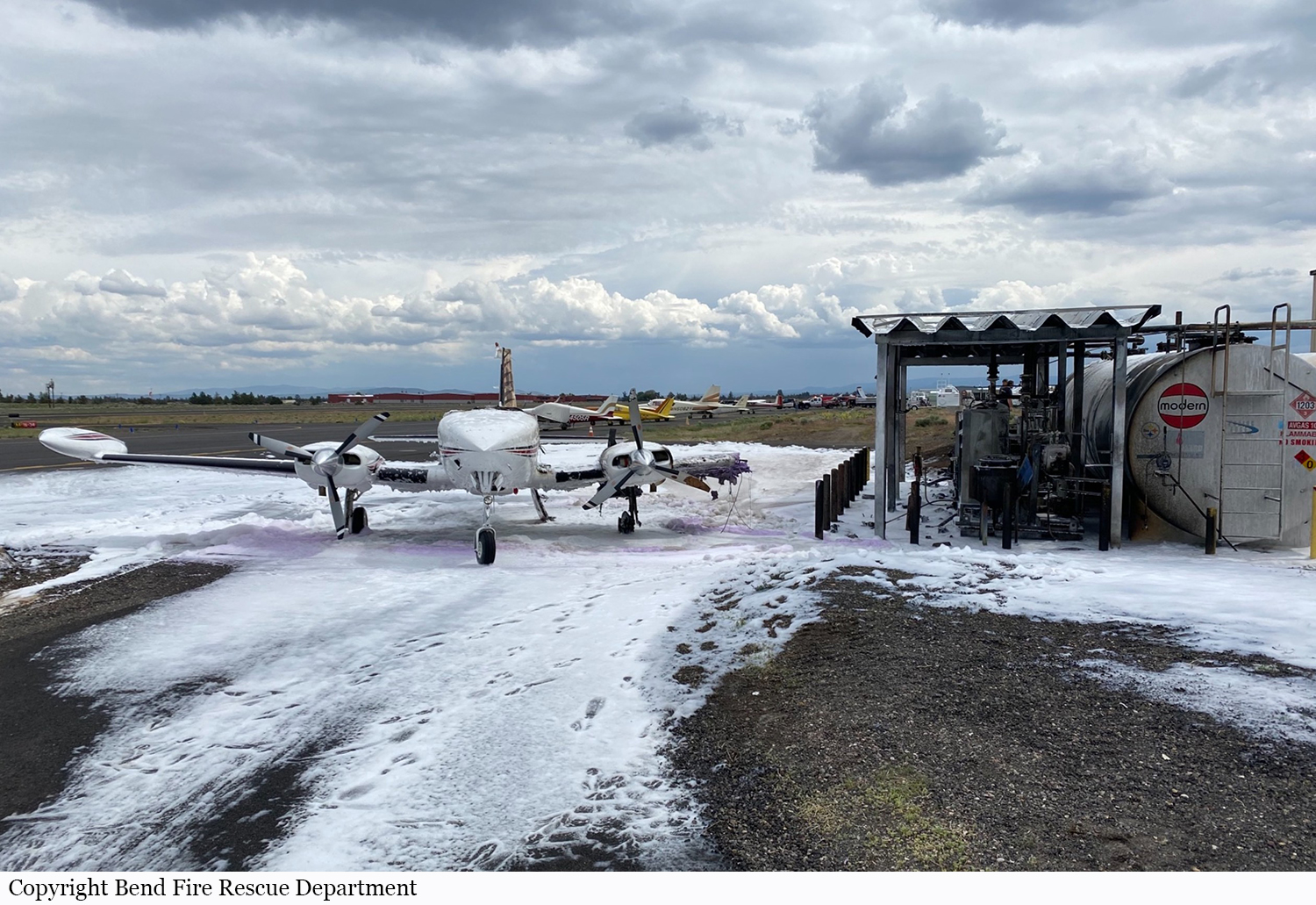
The pilot reported that while taxiing, after using a self-serve fuel station, the airplane’s left wing-tip fuel tank struck a post at the fuel station and a fire ignited. The pilot shut down the airplane’s engines and disembarked the airplane with his passenger. The left wing and fuselage were substantially damaged. The pilot reported that there were no preaccident mechanical malfunctions or failures that would have precluded normal operation.
Probable cause:
The pilot’s failure to maintain clearance from the fuel station, resulting in a ground collision and fire.
Final Report:

Crash of a Dassault Falcon 10 in Panama City

Date & Time: Jun 6, 2023 at 2017 LT
Type of aircraft:
Operator:
Registration:
N87RT
Flight Type:
Survivors:
Yes
Schedule:
Cobb County – Panama City
MSN:
106
YOM:
1977
Crew on board:
2
Crew fatalities:
Pax on board:
3
Pax fatalities:
Other fatalities:
Total fatalities:
0
Captain / Total flying hours:
29000
Captain / Total hours on type:
86.00
Copilot / Total flying hours:
441
Copilot / Total hours on type:
33
Aircraft flight hours:
10014
Circumstances:
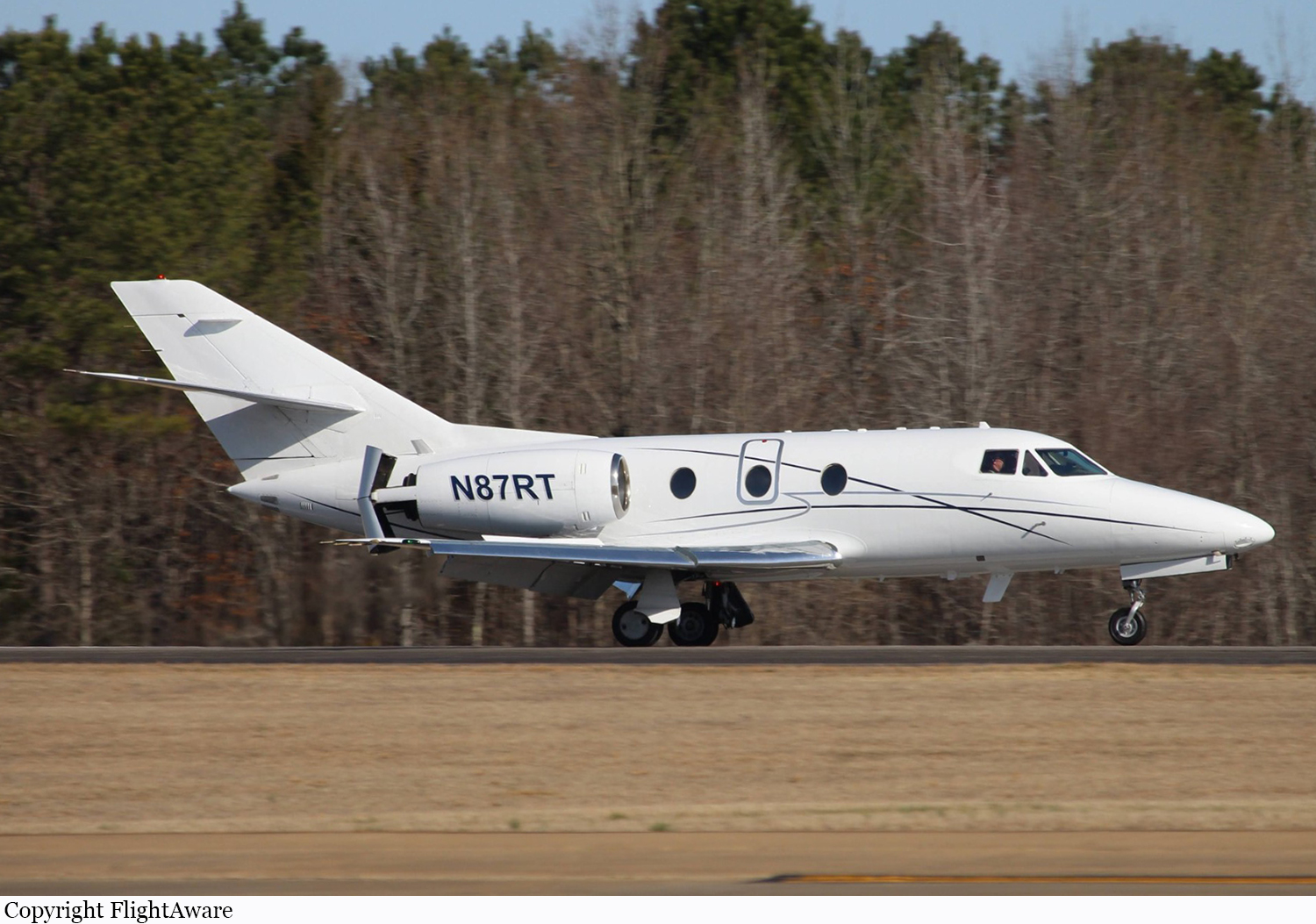
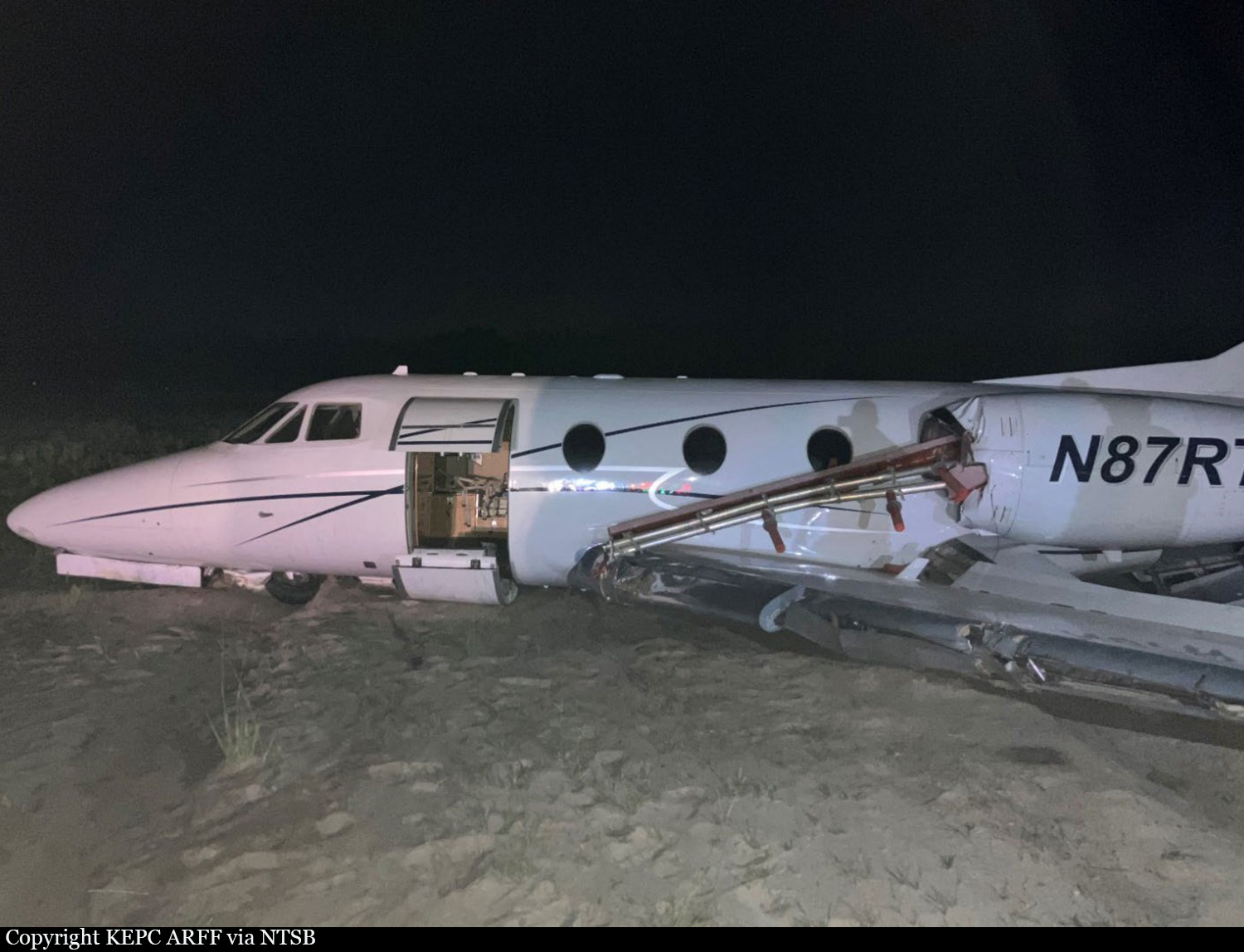
Upon arriving at the destination airport, the business jet touched down about 2,500 ft beyond the threshold of the 10,000-ft-long runway. The pilot extended the airplane’s flight spoilers and attempted to activate the thrust reversers, but the airplane did not decelerate as expected and a warning horn sounded. The pilots then attempted to apply normal followed by emergency braking, both of which were ineffective in slowing the airplane. The airplane subsequently overran the runway and struck several approach lighting stanchions, coming to rest after the landing gear collapsed. The airplane’s occupants were uninjured, but the airplane was substantially damaged during the accident sequence. Following the accident, the captain noticed he had forgotten to move the thrust reverser emergency stow switches to their normal operating position after completing a preflight check. The warning horn heard during the landing was an indication of the stowed thrust reverser switches. The ineffective braking likely occurred because of the engines’ increased thrust output due to the attempted application of the thrust reversers with the switches in the stowed position. A postaccident examination of the wreckage confirmed that there was no evidence of any preimpact mechanical malfunctions or failures that would have precluded normal operation of the airplane. The airplane checklist found in the cockpit was marked “For Training Purposes Only” and for an airplane that was not equipped with thrust reversers.
Probable cause:
The flight crew’s failure to appropriately configure the airplane for landing, which resulted in a failed attempt to utilize the thrust reversers during landing and the inability to stop the airplane using its brakes due to increased forward thrust. Contributing to the accident was the flight crew’s failure to utilize the appropriate checklist for the thrust reverser equipped airplane.
Final Report:

Crash of a Cessna 560 Citation V near Staunton: 4 killed

Date & Time: Jun 4, 2023 at 1523 LT
Type of aircraft:
Operator:
Registration:
N611VG
Flight Phase:
Flight Type:
Survivors:
No
Site:
Schedule:
Elizabethton - Ronkonkoma
MSN:
560-0091
YOM:
1990
Crew on board:
1
Crew fatalities:
Pax on board:
3
Pax fatalities:
Other fatalities:
Total fatalities:
4
Captain / Total flying hours:
34500
Captain / Total hours on type:
850.00
Circumstances:
The pilot and three passengers departed on a cross-country flight. Shortly after the airplane climbed through 26,600 ft, the pilot stopped responding to air traffic control instructions. According to ADS-B data, the airplane continued climbing to 34,000 ft, then flew at that altitude along its flight plan waypoints, turning southwest to overfly the intended destination about 1 hour later. The airplane continued flying for about another hour along a relatively constant track and altitude before entering a spiraling descent and impacting terrain. United States Air Force (USAF) pilots intercepted the airplane about 2 minutes before it began the spiraling descent. They observed no breaches of the airplane structure or doors, no smoke in the cockpit or passenger cabin, and no oxygen masks deployed in the cabin. One occupant was observed slumped over in the pilot seat and no movement or other occupants were observed in the cabin. Based on the lack of response to air traffic control communications, ADS-B data showing the airplane following its flight plan waypoints at the altitude last assigned by air traffic control, and the USAF pilot observations, it is likely that the pilot of the accident airplane became incapacitated during the climb to cruise altitude. It is also likely the airplane trajectory was then directed by the autopilot until a point at which it was no longer able to maintain control. The pilot had medical conditions, including high blood pressure and high cholesterol, that represented some increased risk of an impairing or incapacitating cardiovascular event. In addition, the pilot had prior prescriptions for medications that could be impairing if used too recently before flight. However, there was no evidence of the pilot being at exceptionally high incapacitation risk, or of using medications inappropriately. Based on the accident circumstances, it is likely that all the airplane occupants were incapacitated due to a common environmental condition, such as loss of cabin pressurization. Maintenance records indicated that, at the time of the accident flight, five items were overdue for inspection, including the co-pilot oxygen mask. About 4 weeks before the accident flight, maintenance personnel noted 26 discrepancies that the owner declined to address, including several related to the pressurization and environmental control system. Furthermore, 2 days before the accident flight, maintenance personnel noted that the pilot-side oxygen mask was not installed, and the supplementary oxygen was at its minimum serviceable level. At that level, oxygen would not have been available to the airplane occupants and passenger oxygen masks would not have deployed in the event of a loss of pressurization. No evidence was found to indicate that the oxygen system was serviced or that the pilot-side oxygen mask was reinstalled before the accident flight. Altitude-related hypoxia, although not verifiable from forensic medical evidence, likely explains the incapacitation of the airplane occupants. According to the FAA Pilot’s Handbook of Aeronautical Knowledge, impairing effects from hypoxia are often vague and are experienced differently by different individuals; they include confusion, disorientation, diminished judgment and reactions, worsened motor coordination, difficulty communicating and performing simple tasks, a false sense of well-being, diminished consciousness, and, if conditions aren’t remedied or mitigated, death. Between 30,000 and 35,000 ft, the time of useful consciousness for a pilot to take protective action against hypoxia, including donning an oxygen mask and descending, is about 1/2 to 2 minutes. These times depend on multiple variables, including medical factors, with substantial variation among individuals. The times are decreased by about half when depressurization is rapid. However, gradual depressurization can be as dangerous or more dangerous than rapid depressurization because of its potential to insidiously impair a pilot’s ability to recognize and respond to the developing emergency until the pilot is no longer effectively able to do so. Cognitive impairment from hypoxia makes it harder for affected individuals to recognize their own impairment. Based on the available information, it is likely that the airplane occupants became hypoxic due to a lack of oxygen during the flight and became incapacitated. However, the reason for the loss of pressurization, and whether it was rapid or progressed over time, could not be determined.
Probable cause:
Pilot incapacitation due to loss of cabin pressure for undetermined reasons. Contributing to the accident was the pilot’s and owner/operator’s decision to operate the airplane without supplemental oxygen.
Final Report:

Crash of a Piper PA-31-325 Navajo C in Tupelo: 2 killed

Date & Time: Jun 3, 2023 at 0816 LT
Type of aircraft:
Registration:
N4077W
Flight Phase:
Flight Type:
Survivors:
No
Schedule:
Tupelo – Tupelo
MSN:
31-8112031
YOM:
1981
Crew on board:
1
Crew fatalities:
Pax on board:
1
Pax fatalities:
Other fatalities:
Total fatalities:
2
Captain / Total flying hours:
3619
Captain / Total hours on type:
2833.00
Circumstances:
The pilot and pilot-rated passenger were departing on an instrument flight rules flight in the multi-engine airplane. ADS-B information showed that, just after takeoff, the airplane entered a climbing right turn, reaching a peak altitude about 300 ft above ground level and a highest ground speed about 102 knots (kts). The airplane continued in a descending, tightening right turn as its speed decreased. Analysis of the ADS-B data indicated that the airplane’s bank angle was initially about 42° with a load factor of 1.36g. As the turn continued, the bank angle increased to about 46° with a load factor of 1.44g. Under these conditions, the airplane’s stall
speed would have been about 77 kts calibrated airspeed. The airplane’s last calculated true airspeed was about 81 kts. The airplane impacted terrain adjacent to the airport and was consumed by a postimpact fire. Examination of the engines revealed no evidence of preimpact mechanical malfunctions; however, the scope of the examinations was limited due to postimpact fire damage. A sound spectrum study conducted from surveillance video of the airplane indicated that at least one of the airplane’s engines was operating around 2,550 rpm throughout the takeoff and right turn; however, the study was unable to distinguish whether the recorded sound was from one engine or both engines operating at the same rpm. Examination of the flight control system did not reveal any anomalies. During the postaccident examination of the airplane, an aileron balance cable was found separated from a swaged terminal end with a portion of the cable not located. Metallurgical examination of the separation revealed that it was consistent with being cut, most likely during recovery of the wreckage or the accident sequence. Toxicological testing revealed the presence of ethanol and n-propanol in specimens from the pilot. Although the presence of ethanol in the tested specimens means that the possibility of alcohol consumption could not be excluded, at least some of the detected ethanol was likely the result of postmortem production. Toxicological testing of the passenger revealed the potentially sedating antihistamine, cetirizine, in muscle and liver tissue; however, whether the passenger was experiencing any impairing effects from the use of cetirizine could not be determined. Based on the available information, it is likely that the pilot exceeded the airplane’s critical angle of attack while maneuvering immediately after takeoff, which resulted in a loss of control and impact with terrain; however, the circumstances that resulted in the pilot’s decision to conduct the steep right turn at low altitude could not be determined.
Probable cause:
The pilot's exceedance of the airplane's critical angle of attack while maneuvering after takeoff for reasons that could not be determined, which resulted in an aerodynamic stall and subsequent loss of control.
Final Report: