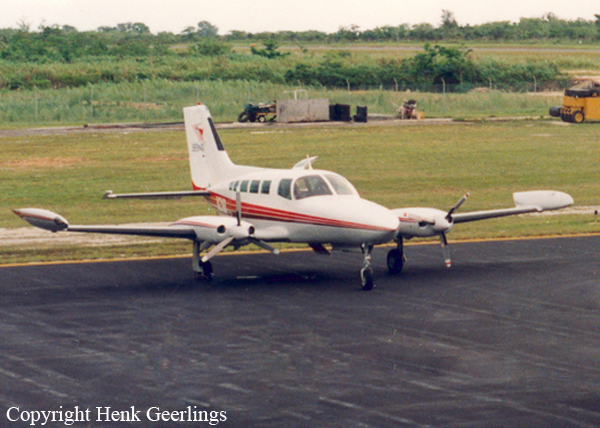
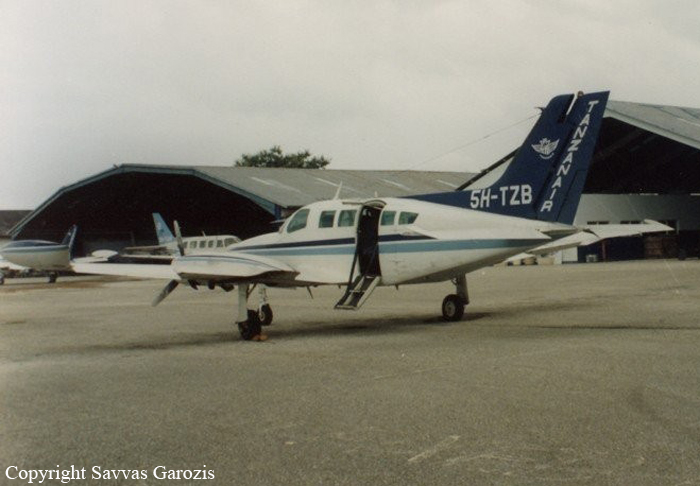
Crash of a Cessna 402B near Estacada: 1 killed

Date & Time: Feb 16, 1996 at 0746 LT
Type of aircraft:
Registration:
N5198J
Flight Phase:
Flight Type:
Survivors:
No
Site:
Schedule:
Troutdale - Redmond
MSN:
402B-0885
YOM:
1975
Flight number:
WCC1420
Location:
Crew on board:
1
Crew fatalities:
Pax on board:
0
Pax fatalities:
Other fatalities:
Total fatalities:
1
Captain / Total flying hours:
4600
Captain / Total hours on type:
1600.00
Aircraft flight hours:
10024
Circumstances:
Shortly after reaching a cruising altitude of 9,500 feet, the aircraft's course was observed on radar to change from southeasterly to southwesterly. Its average ground speed decreased from 170 knots to 108 knots during this track change. The pilot called ATC with his call sign, and about five seconds later, an unintelligible, one-second-long transmission was heard. At that same time, radar information showed the aircraft at 8,800 feet. Radar and radio contact were lost shortly thereafter. Three days later, wreckage was found where the aircraft had crashed. The crash site was 1,820 feet above sea level and 1/2 mile south-southwest of its last observed radar position; the aircraft's average descent angle from the 8,800-foot-altitude position to the crash site was about 51 degrees. The aircraft was extensively damaged during impact. No damage was noted on tall trees that surrounded the accident site. Also, no preimpact mechanical malfunction or failure of the aircraft or engines was found, and no pre-accident impairment of the pilot was found.
Probable cause:
Loss of aircraft control for undetermined reason(s).
Final Report:

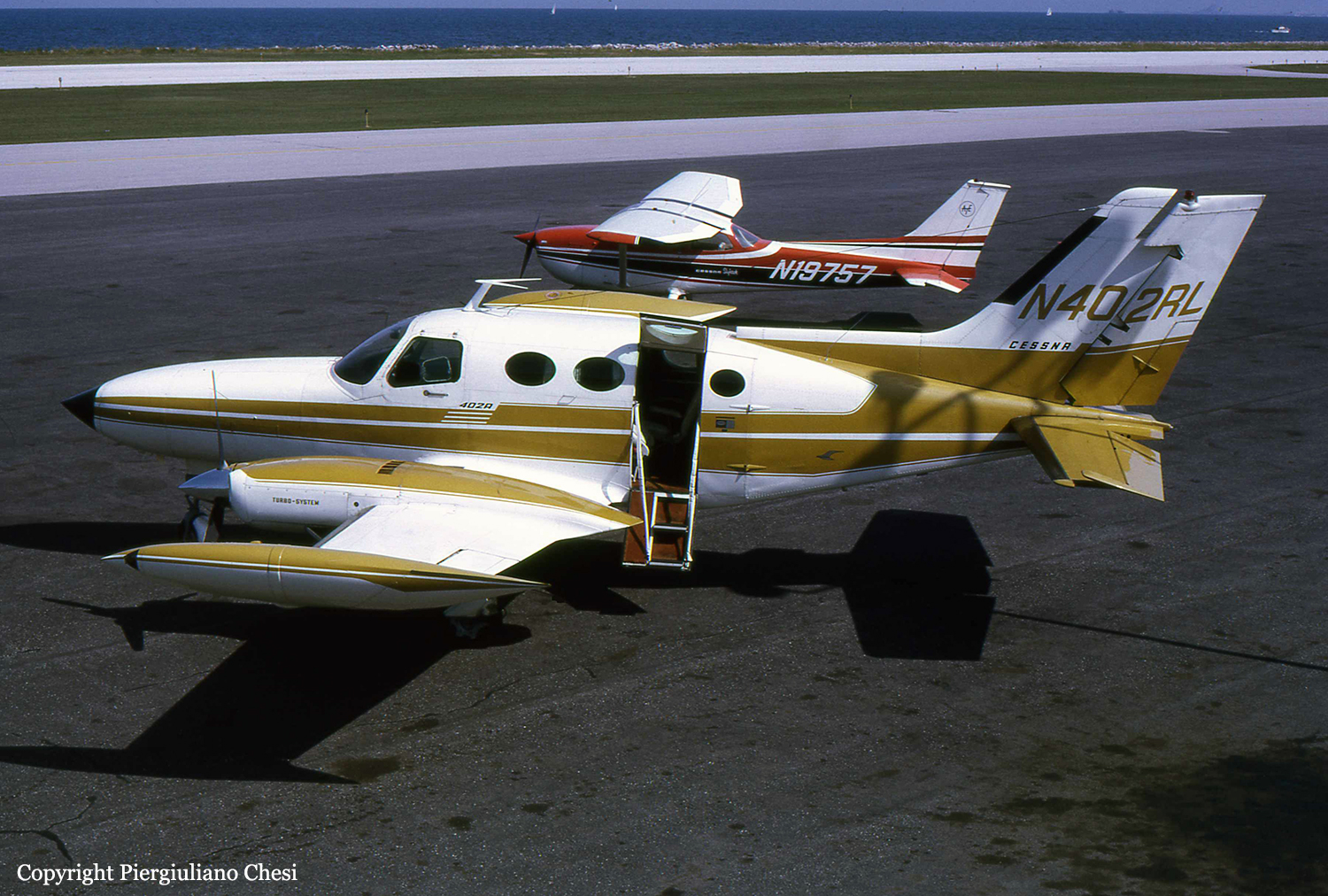
Crash of a Cessna 402B in Kamuela: 1 killed

Date & Time: Jan 29, 1996 at 0435 LT
Type of aircraft:
Registration:
N999CR
Flight Phase:
Flight Type:
Survivors:
Yes
Schedule:
Kamuela - Honolulu
MSN:
402B-0616
YOM:
1974
Location:
Crew on board:
2
Crew fatalities:
Pax on board:
1
Pax fatalities:
Other fatalities:
Total fatalities:
1
Captain / Total flying hours:
3434
Captain / Total hours on type:
1250.00
Aircraft flight hours:
19764
Circumstances:
The aircraft departed at night from runway 4R on a flight to transport mail. The pilot-in-command (PIC) was in the left seat, a pilot-rated cargo loader was in the right seat, and another cargo loader was aboard the aircraft, but was not in a seat. During takeoff, the aircraft entered a turn and flew into gradually rising terrain. The initial impact point was about 15 feet higher than the runway elevation and about 0.3 miles abeam the departure end of the runway. Investigation revealed that the company allowed pilot-rated cargo loaders to fly the aircraft from the right seat during positioning and ferry flight segments (to build multiengine flight time) as part of their compensation. There was evidence that at the time of the accident, the aircraft was being piloted on this flight from the copilot's position. The right side of the instrument panel was equipped with only EGT gauges (no flight instruments on the copilot's side). There were cloud layers in the vicinity, no moon illumination, and no visible ground lighting in the direction of flight. No preimpact mechanical malfunction or failure was identified during the investigation. Except at the pilot and copilot positions, the airplane had no other seat and/or restraint system. The operator stated that the pilot was not authorized to carry company personnel or passengers without the required seating.
Probable cause:
Failure of the copilot (pilot-rated cargo loader, who was flying the aircraft) to establish and maintain a positive rate of climb after taking off at night; and inadequate supervision by the pilot-in-command (PIC), by failing to ensure that proper altitude was obtained and maintained during the departure. Factors relating to the accident were: darkness; the lack of visual cues; and the resultant visual illusion, which the copilot failed to recognize during the night departure. Also, the lack of a restraint system (seat belt and/or shoulder harness) for the passenger was a possible related factor.
Final Report:

Crash of a Cessna 402B in Papua New Guinea

Date & Time: Dec 31, 1995
Type of aircraft:
Registration:
VH-JOG
Survivors:
Yes
MSN:
402B-0895
YOM:
1975
Region:
Crew on board:
0
Crew fatalities:
Pax on board:
0
Pax fatalities:
Other fatalities:
Total fatalities:
0
Circumstances:
For unknown reasons, the aircraft belly landed and was damaged beyond repair. There were no casualties.

Crash of a Cessna 402A in Avon Park: 2 killed

Date & Time: Dec 5, 1995 at 0632 LT
Type of aircraft:
Registration:
N402RL
Flight Phase:
Flight Type:
Survivors:
No
Schedule:
Avon Park – Moss Town – Port-au-Prince
MSN:
402A-0051
YOM:
1969
Crew on board:
1
Crew fatalities:
Pax on board:
1
Pax fatalities:
Other fatalities:
Total fatalities:
2
Captain / Total flying hours:
2700
Captain / Total hours on type:
104.00
Aircraft flight hours:
11512
Circumstances:
After takeoff at dawn on a foggy morning, the airplane collided with electrical transmission wires about one mile from the end of the runway, on an extended line about 50 degrees left of the extended runway centerline. The left wing tip fuel tank (left main) was partially severed from the airplane, breaching the tank. Additionally, the top of the vertical stabilizer and rudder were severed, and a portion of the windscreen was separated. A suggestion was made by the operator that the autopilot trim may have been improperly set, precipitating a nose pitch down upon engagement of the autopilot during the climb. The airplane continued to fly for about 20 minutes, then impacted in a steep right wing down attitude into a densely wooded area that was surrounded by open terrain. The ensuing fire precluded any determination of engine malfunction, systems' discrepancies, or wire strike damage to the left propeller. No determination of pilot incapacitation was possible because of the post impact fire. Based upon the ground witness statement, the left engine was probably inoperative following the wire strike. The impact attitude was inconsistent with a decreasing speed loss of control with the left engine inoperative. However, the flight control trim settings, left main fuel tank selected, and throttle quadrant settings all may have been indicative of pilot incapacitation that precluded proper emergency procedure response. Additionally, the airplane impacted into a densely wooded area surrounded by flatter terrain absent of tall obstacles.
Probable cause:
The failure of the pilot to maintain the proper climb rate and direction of flight following takeoff, resulting in a collision with obstacles. The reason for the loss of control and subsequent unusual attitude ground impact was not determined.
Final Report:

Crash of a Cessna 402C near Wabush

Date & Time: Oct 22, 1995 at 1907 LT
Type of aircraft:
Registration:
N67850
Flight Phase:
Flight Type:
Survivors:
Yes
Site:
Schedule:
Auburn – Montreal – Schefferville
MSN:
402C-0410
YOM:
1980
Country:
Crew on board:
1
Crew fatalities:
Pax on board:
4
Pax fatalities:
Other fatalities:
Total fatalities:
0
Circumstances:
The Cessna 402, with five persons on board, took off from Auburn, Indiana, USA, around 0630 local time (1130 Coordinated Universal Time (UTC)) for Schefferville, Quebec, with stops en route. Their final leg was from Montreal International (Dorval) to Schefferville, with Wabush, Newfoundland, as the alternate, and they took off at 1523 EDT (1923 UTC). The flights were conducted in accordance with instrument flight rules (IFR). While in cruising flight and west of Wabush, the pilot requested the weather conditions for Schefferville and Wabush. Because of poor conditions in Schefferville, the pilot decided to fly to his alternate, Wabush. During the ILS approach for runway 01, the aircraft was too high to complete the approach, and the pilot requested and received clearance to execute another one. During the missed approach, the pilot proceeded an unknown distance outbound and turned back toward the airport. During the inbound leg, the aircraft contacted trees on the side of a mountain, at an indicated altitude of 2,460 feet asl, and decelerated over a distance of about 900 feet. The aircraft came to rest 23 nautical miles north of the airport, on the extended centre line of runway 01, on a heading of 186 degrees magnetic. The aircraft crashed probably at just after 1907 ADT (2207 UTC) during the hours of darkness. All five occupants were injured.
Probable cause:
The pilot did not follow the missed approach procedure as published, particularly with regard to minimum altitudes, and the aircraft crashed on the side of a mountain.
Final Report:

Crash of a Cessna 402B in Marsh Harbour: 5 killed

Date & Time: Sep 13, 1995 at 2030 LT
Type of aircraft:
Registration:
N69303
Survivors:
Yes
Schedule:
Bimini - Mores Cay
MSN:
402B-0423
YOM:
1973
Country:
Crew on board:
1
Crew fatalities:
Pax on board:
8
Pax fatalities:
Other fatalities:
Total fatalities:
5
Circumstances:
On September 13, 1995, about 2030 eastern daylight time N69303, a Cessna 402B, registered to and operated by Bimini Air Charter Inc. crashed near Marsh Harbour, Bahamas while on a 14 CFR Part 129 on-demand, international, passenger flight. Visual meteorological conditions prevailed at the time and no flight plan was filed. The airplane was destroyed. The pilot and four passengers were fatally injured, and four passengers were seriously injured. the flight originated from Bimini, Bahamas, about 1935 the same day. The intended destination was Mores Cay, but one of the survivors stated the pilot could not find the island and diverted to Marsh Harbour.

Crash of a Cessna 402A in Miami

Date & Time: Jun 23, 1995 at 1054 LT
Type of aircraft:
Operator:
Registration:
N7884J
Flight Type:
Survivors:
Yes
Schedule:
Marsh Harbor - Miami
MSN:
402A-0103
YOM:
1969
Crew on board:
1
Crew fatalities:
Pax on board:
0
Pax fatalities:
Other fatalities:
Total fatalities:
0
Captain / Total flying hours:
9800
Captain / Total hours on type:
7800.00
Aircraft flight hours:
4980
Circumstances:
The aircraft crashed on a visual approach to runway 09 left at Miami International Airport, Miami, Florida. Visual meteorological conditions prevailed and an IFR flight plan was filed. The airplane was destroyed. The airline transport pilot sustained serious injuries. The flight originated from Marsh Harbor, Bahamas, about 1 hour 14 minutes before the accident. Witnesses stated they observed the airplane descending to the right of the final approach path for runway 09 left with the landing gear down and an engine was heard sputtering. The wings of the airplane were observed to be rocking back and forth. The airplane rolled right 90 degrees. The nose pitched up, the airplane rolled over inverted, the nose pitched down, the airplane collided with a parking lot and slid in between a front end loader and a dump truck coming to a complete stop. Transcripts of recorded transmissions between Miami Air Traffic Control Tower (ATCT), N7884J, and review of Miami ATCT continuous data recording radar revealed there were no airplanes in the vicinity of N7884J at the time of the accident.
Probable cause:
The pilot-in-command's failure to maintain airspeed (VMC) after loss of power of one engine while on final approach, resulting in an in-flight loss of control and subsequent in-flight collision with terrain. Contributing to the accident was a total loss of engine power of the right engine due to fuel exhaustion.
Final Report:

Crash of a Cessna 402B II off Buenos Aires: 6 killed

Date & Time: Jun 2, 1995 at 1900 LT
Type of aircraft:
Operator:
Registration:
LV-MIU
Survivors:
Yes
Schedule:
Buenos Aires - Paraná
MSN:
402B-1332
YOM:
1978
Country:
Crew on board:
2
Crew fatalities:
Pax on board:
5
Pax fatalities:
Other fatalities:
Total fatalities:
6
Circumstances:
After takeoff from Buenos Aires-Aeroparque-Jorge Newbury Airport runway 13, while climbing, the crew declared an emergency following an engine failure and was cleared to return. While completing a 180 turn, the crew lost control of the aircraft that crashed in the sea about 2,700 metres short of runway 31, three minutes after departure. A passenger survived while six other occupants were killed, all members of the corporate of LAER.
Probable cause:
Engine failure for unknown reasons.

Crash of a Cessna 402B in the Pacific Ocean: 1 killed

Date & Time: Apr 18, 1995
Type of aircraft:
Registration:
N2NB
Flight Phase:
Flight Type:
Survivors:
No
Schedule:
Kolonia – Tarawa
MSN:
402B-0410
YOM:
1973
Country:
Region:
Crew on board:
1
Crew fatalities:
Pax on board:
0
Pax fatalities:
Other fatalities:
Total fatalities:
1
Circumstances:
The pilot, sole on board, departed Kolonia Airport on a 5 hours and 45 minutes flight to Tarawa Island, Gilbert Islands. En route, radar and contact were lost with the airplane that crashed in the Pacific Ocean. SAR operations were initiated but abandoned after few days as no trace of the aircraft nor the pilot was found.

Crash of a Cessna 402B in Tabora

Date & Time: Feb 27, 1995 at 0745 LT
Type of aircraft:
Operator:
Registration:
5H-TZB
Flight Phase:
Survivors:
Yes
MSN:
402B-0444
YOM:
1973
Country:
Region:
Crew on board:
1
Crew fatalities:
Pax on board:
5
Pax fatalities:
Other fatalities:
Total fatalities:
0
Circumstances:
Shortly after takeoff from Tabora Airfield, while in initial climb, the twin engine aircraft encountered difficulties to gain height, stalled and crashed 130 metres past the runway end. All six occupants were injured.