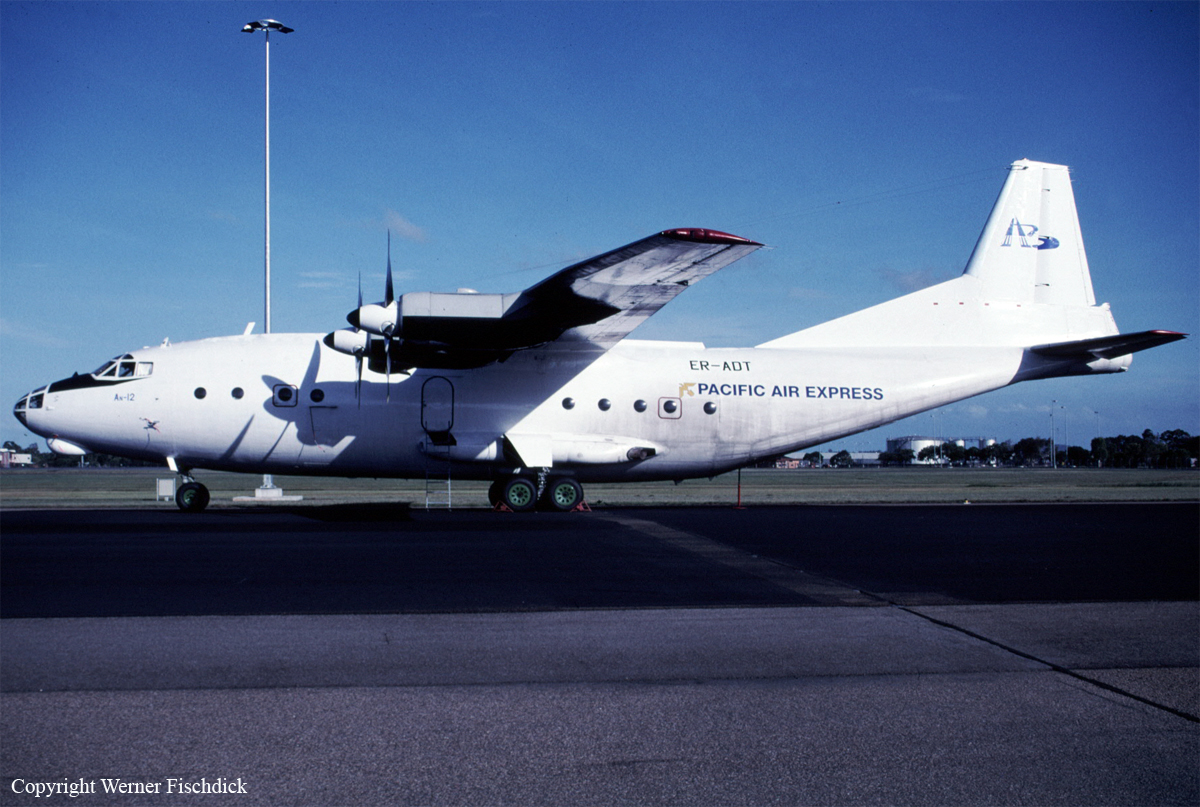
Crash of an Antonov AN-12BP in Honiara

Date & Time: Oct 16, 2001
Type of aircraft:
Operator:
Registration:
ER-ADT
Flight Type:
Survivors:
Yes
Schedule:
Brisbane - Honiara
MSN:
2 3 406 05
YOM:
1962
Region:
Crew on board:
6
Crew fatalities:
Pax on board:
0
Pax fatalities:
Other fatalities:
Total fatalities:
0
Circumstances:
Following an uneventful cargo flight from Brisbane, the crew started the approach to Honiara-Henderson Airport. On final approach, the four engine airplane was too low when the right main gear struck the sea and was torn off. The crew increased engine power, continued the approach and completed the landing on runway 24. After touchdown, the aircraft went out of control, veered off runway at high speed and came to rest. All six occupants escaped uninjured while the aircraft was damaged beyond repair.

Crash of a Piper PA-31-350 Navajo Chieftain in Fort Liard: 3 killed

Date & Time: Oct 15, 2001 at 2233 LT
Operator:
Registration:
C-GIPB
Survivors:
Yes
Schedule:
Yellowknife – Fort Liard
MSN:
31-7852170
YOM:
1978
Country:
Crew on board:
1
Crew fatalities:
Pax on board:
5
Pax fatalities:
Other fatalities:
Total fatalities:
3
Captain / Total flying hours:
1157
Captain / Total hours on type:
77.00
Aircraft flight hours:
11520
Circumstances:
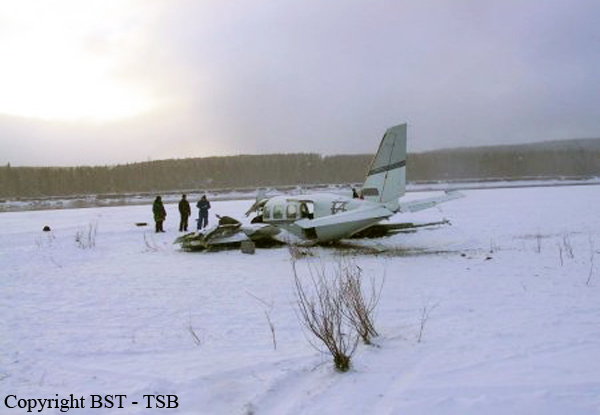
A Piper PA-31 Navajo Chieftain, C-GIPB, serial number 31-7852170, departed Yellowknife, Northwest Territories, at 2043 mountain daylight time on a night instrument flight rules (IFR) charter flight to Fort Liard. One pilot and five passengers were on board. On arrival at Fort Liard, in conditions of moderate to heavy snow, the pilot initiated a non-directional beacon approach with a circling procedure for Runway 02. At about 2233, the aircraft struck a gravel bar on the west shoreline of the Liard River, 1.3 nautical miles short of the threshold of Runway 02, and 0.3 nautical mile to the left of the runway centreline. The aircraft sustained substantial damage, but no fire ensued. Three passengers were fatally injured, and the pilot and two passengers were seriously injured. The emergency locator transmitter activated and was received by the search and rescue satellite system, and two Canadian Forces aircraft were dispatched to conduct a search. The wreckage was electronically located the following morning, and a civilian helicopter arrived at the accident site approximately 10 hours after the occurrence.
Probable cause:
Findings as to Causes and Contributing Factors:
1. For undetermined reasons, the pilot did not maintain adequate altitude during a night circling approach in IMC and the aircraft struck the ground.
2. The pilot and front seat passenger were not wearing available shoulder harnesses, as required by regulation, which likely contributed to the severity of their injuries.
Findings as to Risk:
1. The aircraft was not fitted with, and was not required to be fitted with, a GPWS or a radio altimeter.
2. The pilot used an unauthorized remote altimeter setting that would have resulted in the cockpit altimeters reading approximately 200 feet higher than the actual altitude.
3. The pilot did not meet the night recency requirements necessary to carry passengers, as specified in CAR 401.05 (2).
4. Risk management responsibilities had been placed almost entirely on the pilot.
5. While the company had taken the voluntary initiative to appoint a safety officer, and appeared to have a safety program in place, the program may not have been directed at the needs.
Other Findings:
1. Approximately 28 hours of flight time that the pilot had logged as multi-engine dual would not have qualified as flight experience for the issue of a higher license.
2. CAR do not define 'flight familiarization', 'flight experience', or 'dual', and therefore do not address flight time 'quality'.
3. Opportunities for local community searchers to identify and access the accident site earlier were hampered by initial inaccurate SARSAT location information, by the time required to locate SAR aircraft to the Fort Liard area, and by darkness and poor weather conditions.
4. The decreased time required to alert the SAR system and the higher degree of accuracy permitted by the utilization of a 406 MHz ELT, particularly one interfaced with the onboard GPS, would have likely permitted rescuers to access the site in a more timely manner.
5. 703 Air Taxi operations continue to have a much higher accident rate than 704 Commuter and 705 Airline operations.
Final Report:

Crash of a Rockwell Grand Commander 690 in Temecula

Date & Time: Oct 13, 2001 at 2220 LT
Registration:
N690JM
Flight Type:
Survivors:
Yes
Schedule:
Flagstaff – Temecula
MSN:
690-11072
YOM:
1973
Crew on board:
2
Crew fatalities:
Pax on board:
0
Pax fatalities:
Other fatalities:
Total fatalities:
0
Captain / Total flying hours:
12880
Captain / Total hours on type:
4205.00
Aircraft flight hours:
4844
Circumstances:
The airplane collided with an airport boundary fence during an aborted landing. The pilot made a normal approach following the visual approach slope indicator (VASI) with gear down and full flaps and touched down just past the numbers and began to decelerate. The pilot selected reverse thrust with both engines. As he added power to decelerate, the airplane suddenly veered to the left and off the runway when the right engine did not go into reverse thrust. He deselected reverse thrust and aligned the airplane with the runway. He was approaching the end of the runway at high speed and elected to attempt a takeoff. The airplane went off the end of the runway onto smooth grass. The pilot rotated the airplane, but the airplane collided with an airport boundary fence and came to rest in a field. In a post accident examination, when the power levers were placed in the full reverse position, the left fuel control measured 4°, while the right measured 0°. The left pitch control measured 10°, while the right measured 0°; the controls should have read 0°. A controls engineer determined that during landing, there would be a 10° propeller pitch control (PPC) angle mismatch, which would be about 2.5° of BETA angle. With matched levers, there would be asymmetric reverse thrust with the left engine lower in torque. This would result in the airplane turning towards the left if both propellers had gone into reverse pitch.
Probable cause:
A misrigging of the engine controls that resulted in an asymmetric reverse thrust condition.
Final Report:

Crash of a Swearingen SA226TC Metro II in Shamattawa: 2 killed

Date & Time: Oct 11, 2001 at 2333 LT
Type of aircraft:
Operator:
Registration:
C-GYPA
Flight Type:
Survivors:
Yes
Schedule:
Gods Lake Narrows – Shamattawa
MSN:
TC-250
YOM:
1978
Flight number:
PAG962
Country:
Crew on board:
2
Crew fatalities:
Pax on board:
1
Pax fatalities:
Other fatalities:
Total fatalities:
2
Captain / Total flying hours:
3100
Captain / Total hours on type:
1100.00
Copilot / Total flying hours:
1200
Copilot / Total hours on type:
900
Circumstances:
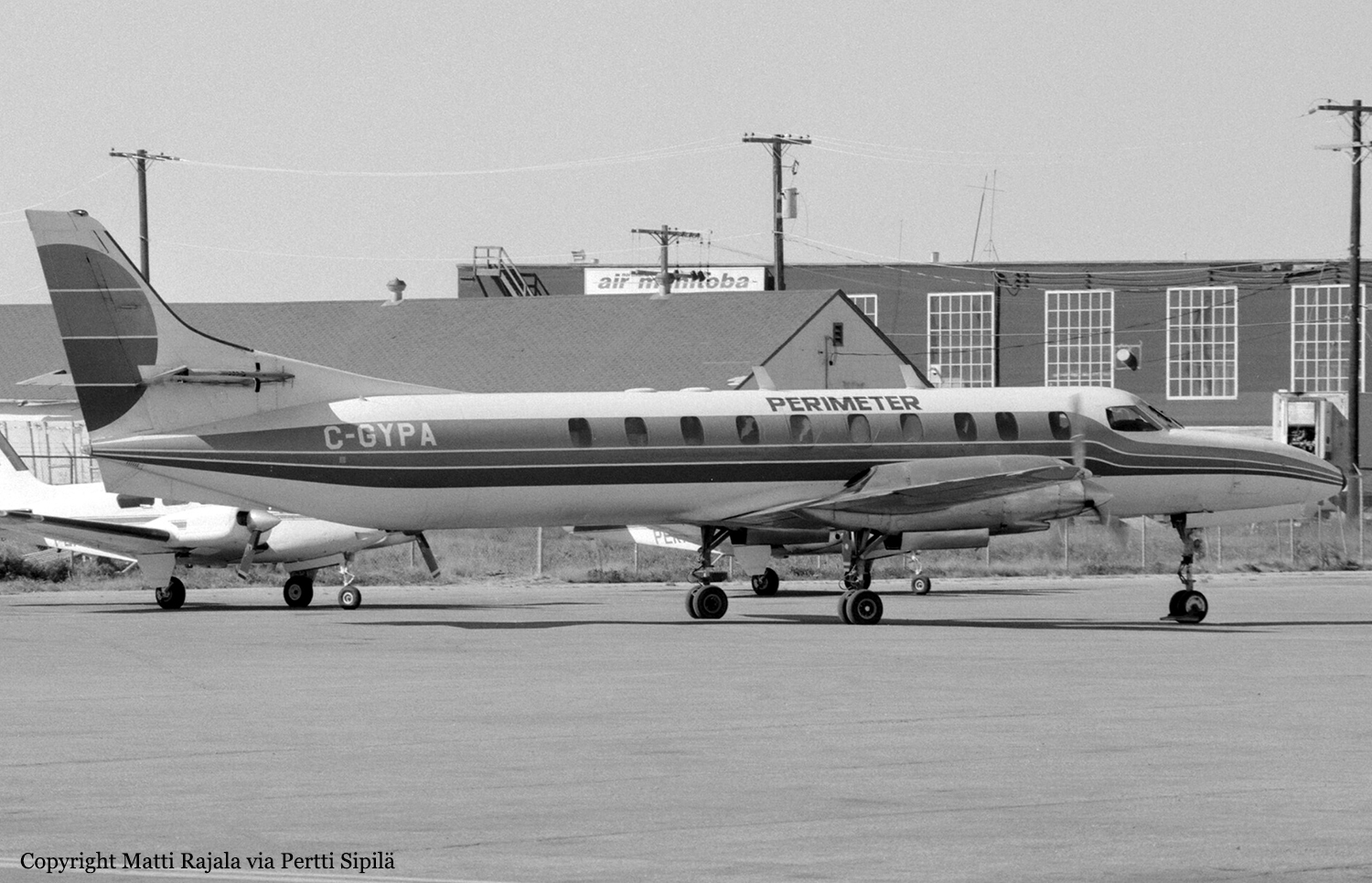
Perimeter Airlines Flight PAG962, a Fairchild SA226TC (Metroliner), with two pilots and a flight nurse on board, departed Gods Lake Narrows, Manitoba, at approximately 2300 central daylight time, on a MEDEVAC flight to Shamattawa. Approaching Shamattawa, the crew began a descent to the 100 nautical mile minimum safe altitude of 2300 feet above sea level (asl) and, when clear of an overcast cloud layer at about 3000 feet asl, attempted a night, visual approach to Runway 01. The aircraft was too high and too fast on final approach and the crew elected to carry out a missed approach. Approximately 30 seconds after the power was increased, at 2333, the aircraft flew into trees slightly to the left of the runway centreline and about 2600 feet from the departure end of Runway 01. The aircraft was equipped with a cockpit voice recorder (CVR) that indicated the crew were in control of the aircraft; they did not express any concern prior to impact. The aircraft broke apart along a wreckage trail of about 850 feet. Only the cabin aft of the cockpit retained some structural integrity. The captain and first officer were fatally injured on impact. The flight nurse was seriously injured but was able to exit the wreckage of the cabin. A post-crash fire was confined to the wings which had separated from the cabin and cockpit wreckage.
Probable cause:
Findings as to Causes and Contributing Factors:
1. The aircraft was flown into terrain during an overshoot because the required climb angle was not set and maintained to ensure a positive rate of climb.
2. During the go-around, conditions were present for somatogravic illusion, which most likely led to the captain losing situational awareness.
3. The first officer did not monitor the aircraft instruments during a critical stage of flight; it is possible that he was affected by somatogravic illusion and/or distracted by the non-directional
beacon to the extent that he lost situational awareness.
Other Findings:
1. The absence of approach aids likely decreased the crew=s ability to fly an approach from which a landing could be executed safely.
2. The company standard operating procedures (SOPs) did not define how positive rate is to be determined.
Final Report:

Crash of a Cessna 208 Caravan I in Dillingham: 10 killed

Date & Time: Oct 10, 2001 at 0926 LT
Type of aircraft:
Operator:
Registration:
N9530F
Flight Phase:
Survivors:
No
Schedule:
Dillingham – King Salmon
MSN:
208-0088
YOM:
1986
Flight number:
KS350
Crew on board:
1
Crew fatalities:
Pax on board:
9
Pax fatalities:
Other fatalities:
Total fatalities:
10
Captain / Total flying hours:
3100
Captain / Total hours on type:
869.00
Aircraft flight hours:
10080
Circumstances:
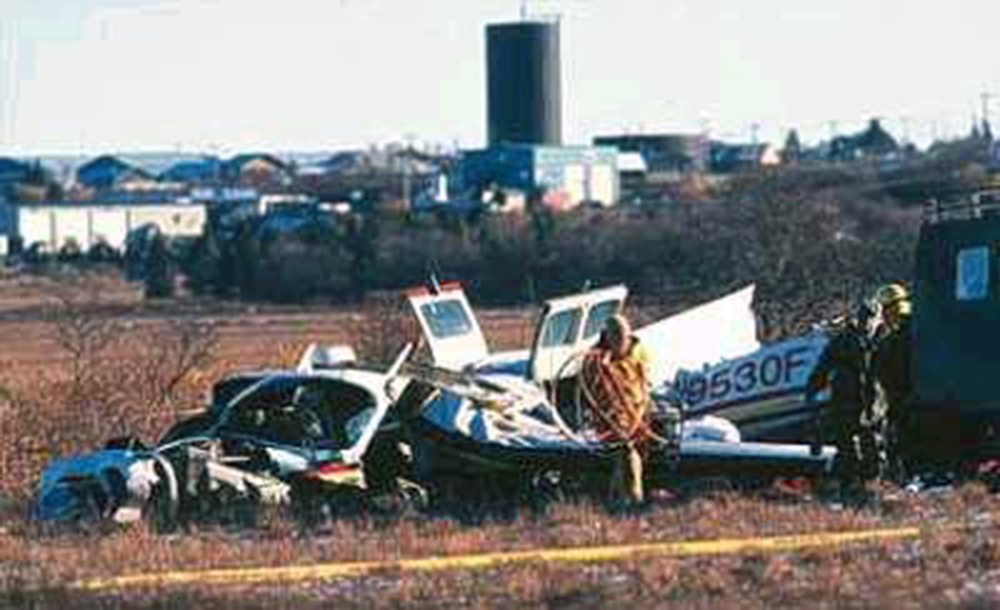
The airplane was parked outside on the ramp the night before the accident and was subjected to rain, snow, and temperatures that dropped below 32 degrees F. Other pilots whose airplanes were also parked outside overnight stated that about 1/4 to 1/2 inch of snow/frost covered a layer of ice on their airplanes the morning of the accident. Because of these conditions, ramp personnel deiced the accident airplane with a heated mixture of glycol and water. The PenAir ramp supervisor who conducted the deicing stated that he believed the upper surface of the wing was clear of ice but that he did not physically touch the wing to check for the presence of ice. Investigators were unable to determine whether the accident pilot visually or physically checked the wing and tail surfaces for contamination after the accident airplane was deiced. However, the airplane's high-wing configuration would have hindered the pilot's ability to see residual clear ice on the surface of the wing after the deicing procedures. Company records indicate that the certificated commercial pilot completed his initial CE-208 flight training 2 months before the accident and had accumulated a total of 74 hours in this make and model of airplane. The airplane, with the pilot and nine passengers onboard, crashed shortly after takeoff from runway 01. A witness observed that the airplane's flight appeared to be normal until the airplane suddenly pitched up, rolled 90 degrees to the left, and yawed to the left. The airplane then descended nose-down until it disappeared from view. Data from the engine monitoring system revealed that the maximum altitude obtained during the accident flight was about 651 feet mean sea level. The airplane crashed in a level attitude. Investigators found no evidence of pre-impact failures in the structure, flight control systems, or instruments. Further, examination of the engine and propeller revealed no pre-impact failures and that the engine was running when the airplane hit the ground.
Probable cause:
An in-flight loss of control resulting from upper surface ice contamination that the pilot-in-command failed to detect during his preflight inspection of the airplane. Contributing to the accident was the lack of a preflight inspection requirement for CE-208 pilots to examine at close range the upper surface of the wing for ice contamination when ground icing conditions exist.
Final Report:

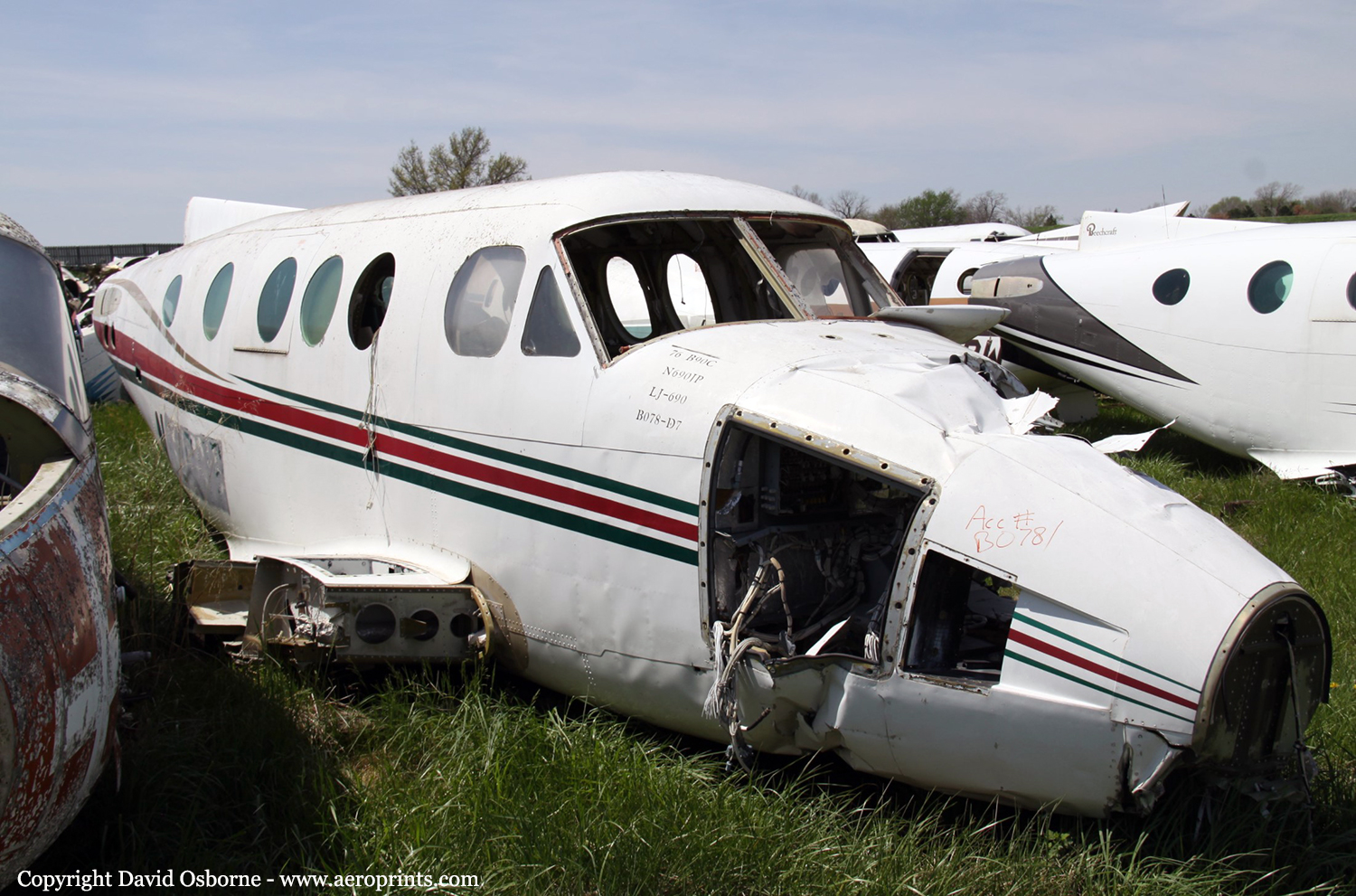
Crash of a Beechcraft C90 King Air in Dallas

Date & Time: Oct 9, 2001 at 1322 LT
Type of aircraft:
Registration:
N690JP
Survivors:
Yes
Schedule:
Taos - Dallas
MSN:
LJ-690
YOM:
1976
Crew on board:
1
Crew fatalities:
Pax on board:
0
Pax fatalities:
Other fatalities:
Total fatalities:
0
Captain / Total flying hours:
7000
Captain / Total hours on type:
100.00
Aircraft flight hours:
2356
Circumstances:
The commercial pilot flew the airplane on a cross-country flight of at least 2 hours and 47 minutes before dropping of his passengers, and flew back for 2 hours and 7 minutes without refueling. The pilot reported that as the airplane turned onto final approach, the right engine began to surge. He reduced the power on the right engine and increased power on the left, but the airplane started to roll right so he elected to reduce the power on the left engine and land in an alley. Prior to impacting wires, the pilot retracted the landing gear and brought the condition levers to "cut-off." A witness observed the airplane prior to impact and noted that the "motor wasn't on." The airplane impacted power lines, a tree, a natural gas meter, two residences, and a fence. The fuel tanks were compromised during the impact sequence, and the fire department sprayed the area with fire retardant foam. A test of the water runoff revealed "negative results for petroleum risk." Examination of both engines' fuel lines between their respective firewalls and fuel heaters, and fuel pumps and fuel control units revealed that they were void of fuel.
Probable cause:
The pilot's failure to refuel the airplane, which resulted in fuel exhaustion and subsequent loss of dual engine power while on approach.
Final Report:

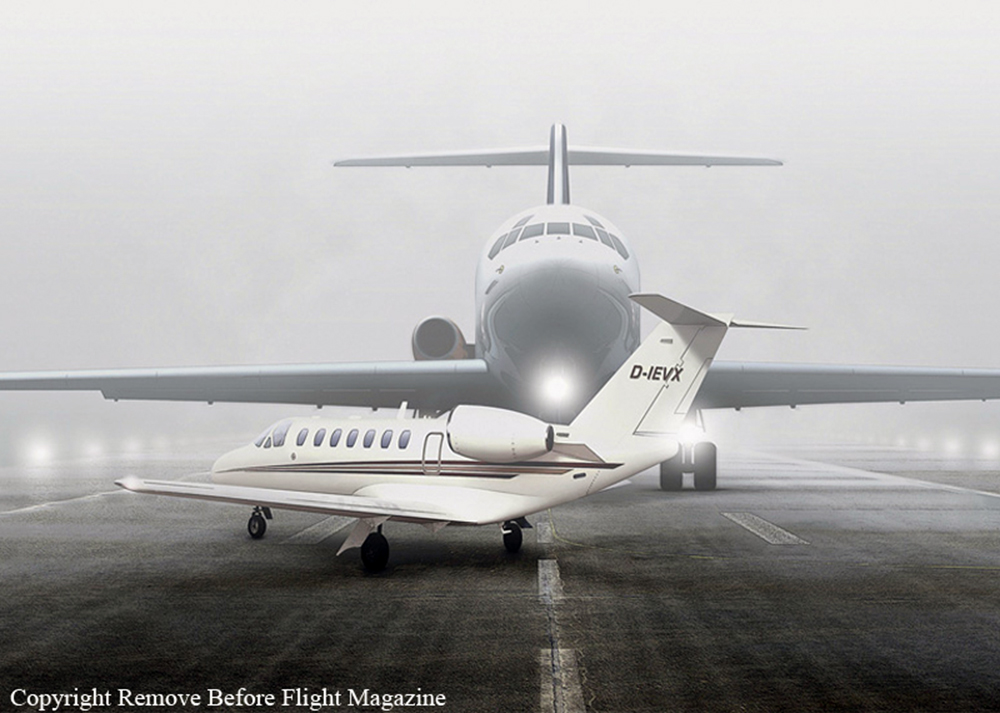
Crash of a Cessna 525A CitationJet Cj2 in Milan: 4 killed

Date & Time: Oct 8, 2001 at 0810 LT
Operator:
Registration:
D-IEVX
Flight Phase:
Survivors:
No
Schedule:
Cologne - Milan - Paris
MSN:
525A-0036
YOM:
2001
Country:
Region:
Crew on board:
2
Crew fatalities:
Pax on board:
2
Pax fatalities:
Other fatalities:
Total fatalities:
4
Captain / Total flying hours:
5000
Captain / Total hours on type:
2400.00
Copilot / Total flying hours:
12000
Copilot / Total hours on type:
2000
Aircraft flight hours:
28
Aircraft flight cycles:
20
Circumstances:
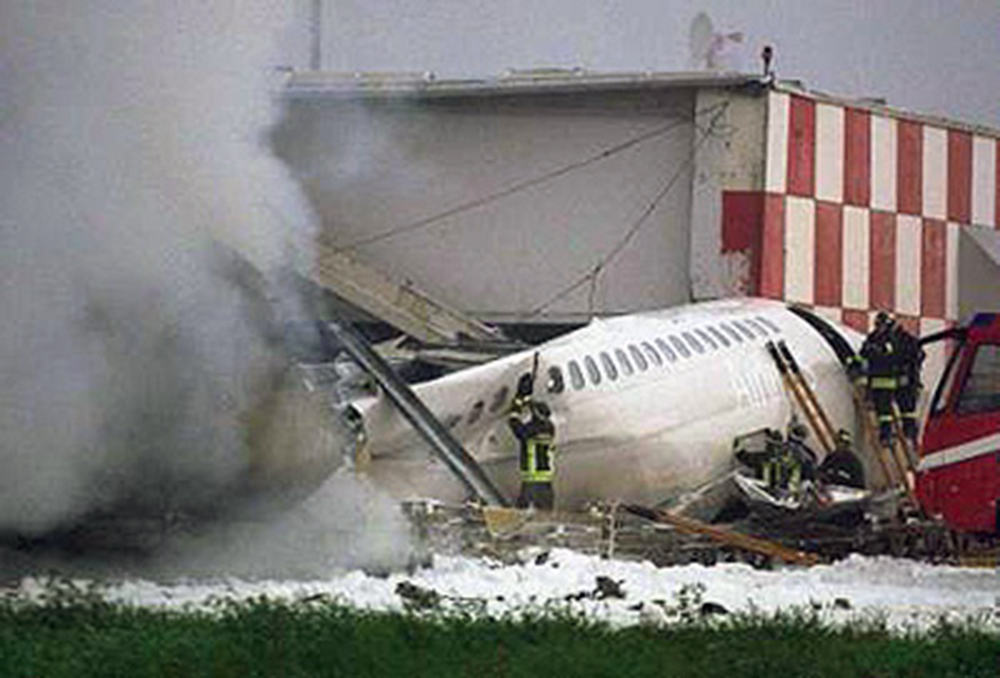
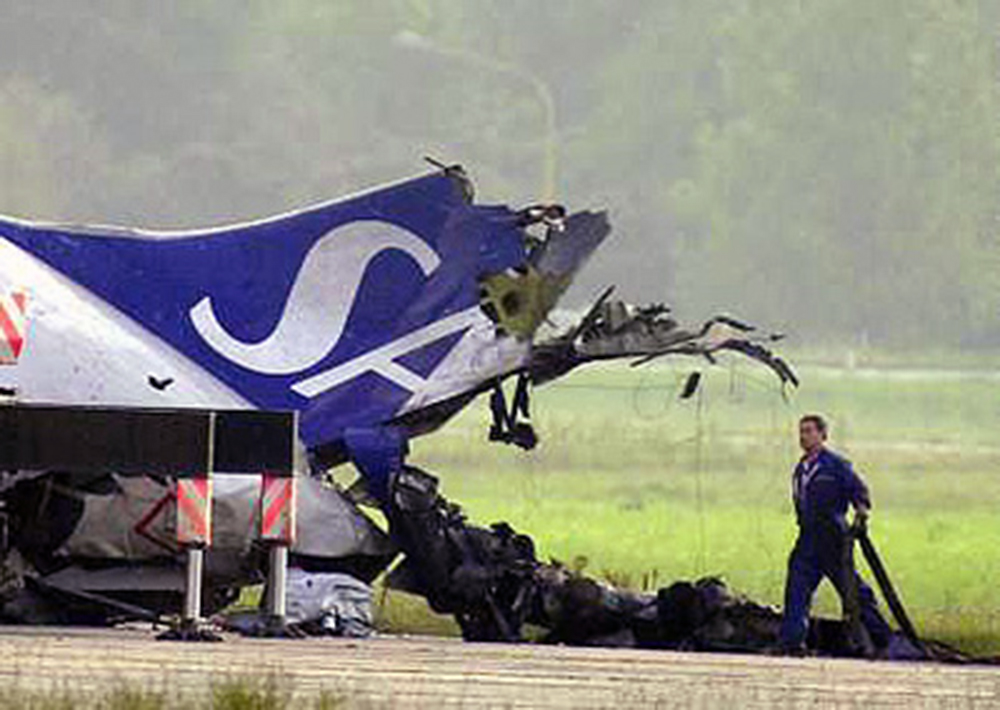
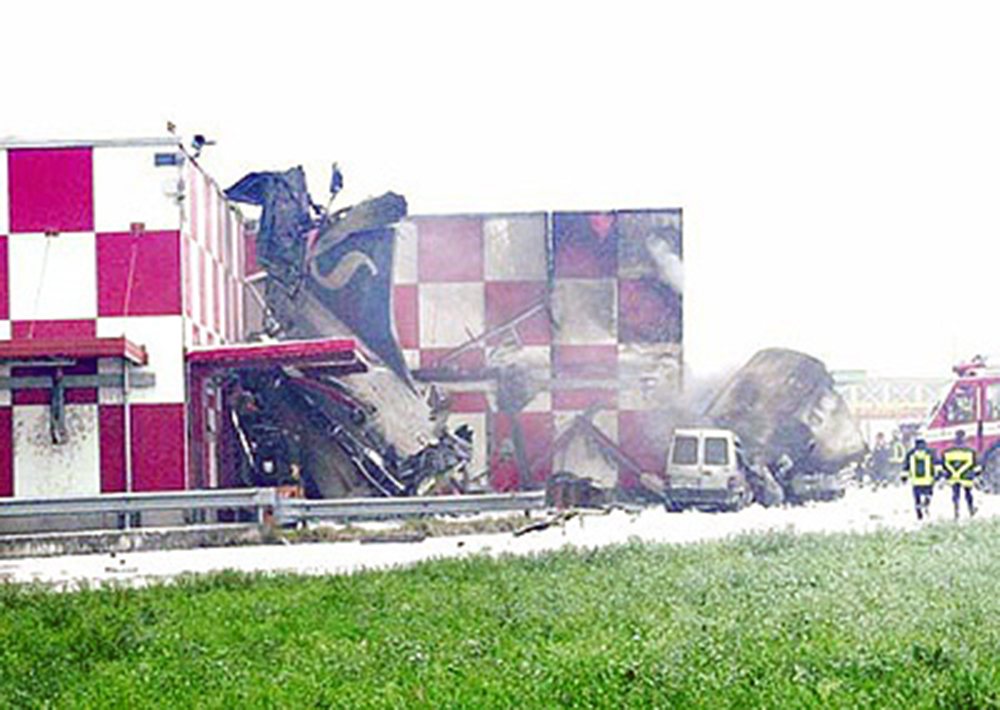
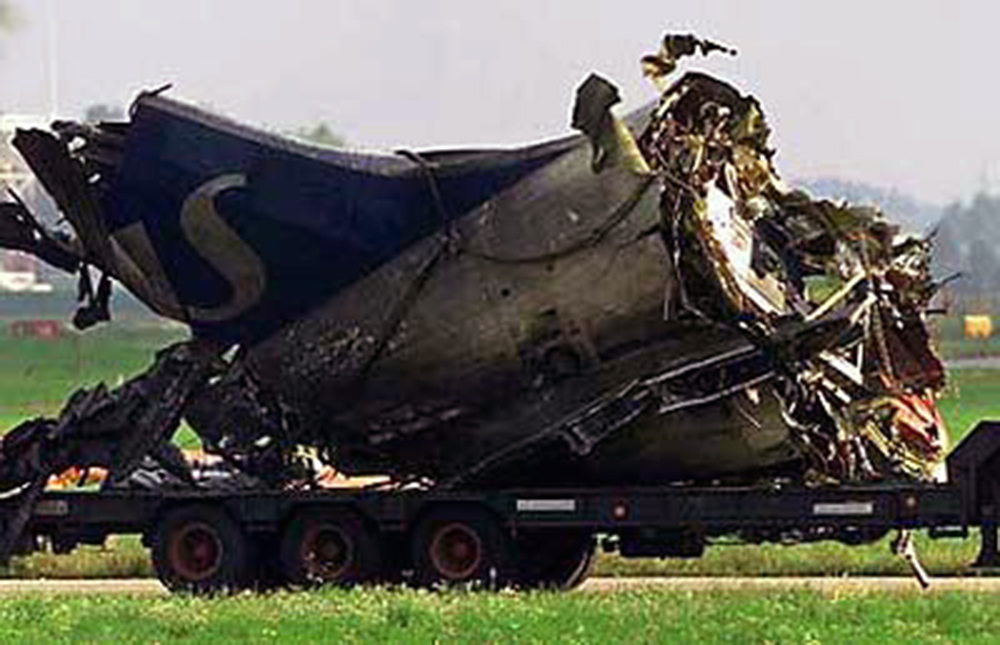
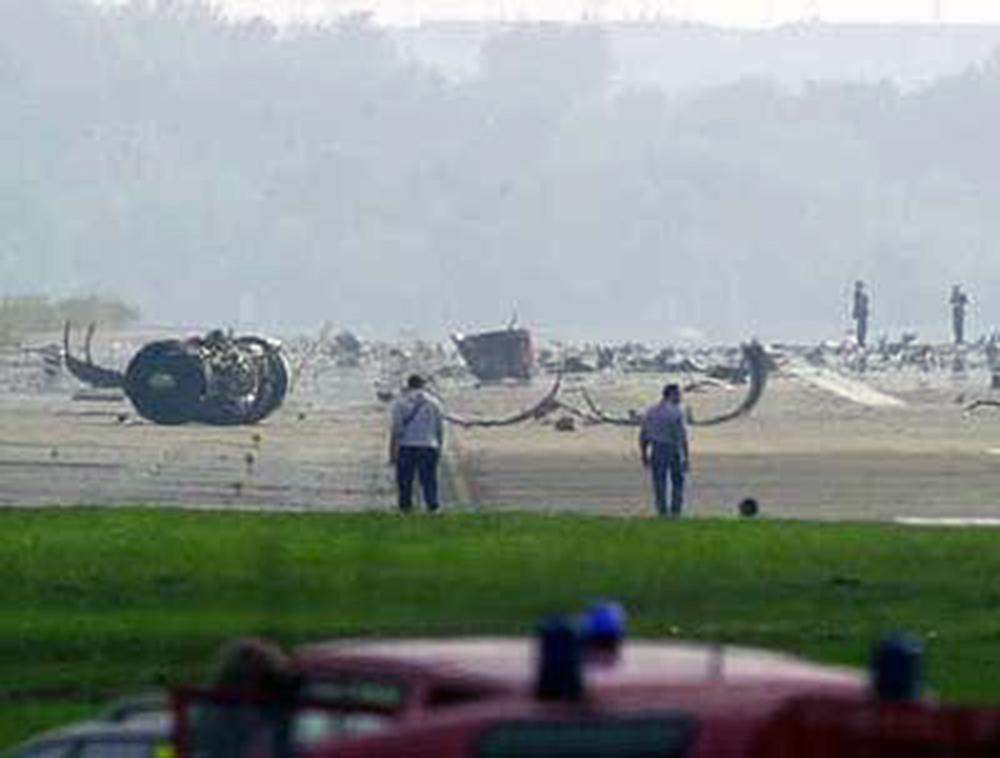
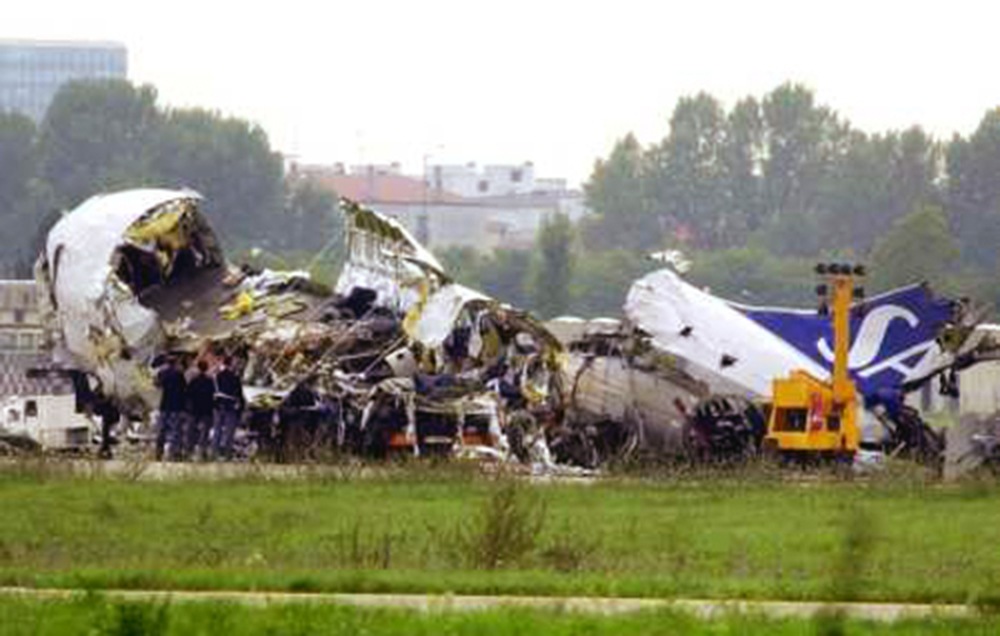
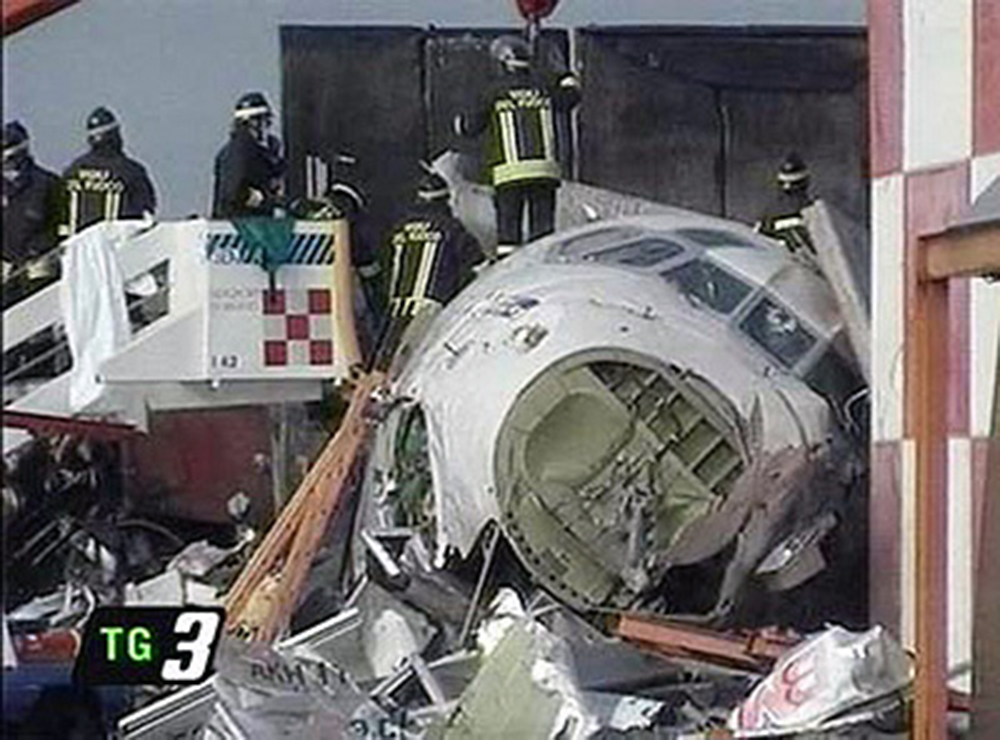
A brand new Cessna 525A CitationJet 2, D-IEVX, arrived at Milan-Linate following a flight from Köln. The Cessna was to carry out a return flight to Paris-Le Bourget, carrying two pilots, a Cessna sales manager and a prospective customer. The plane arrived at 06:59 and was taxied to the General aviation apron, also known as 'West apron'. It was a foggy morning at Milan and one of the passenger flights parked on the North apron was SAS MD-87 "Lage Viking" which was being prepared for flight SK686 to Copenhagen, scheduled to depart at 07:35. At 07:41, the pilot of the MD-87 contacted Linate Ground Control for his engine start clearance, as the boarding of 104 passengers had been completed. The Ground controller cleared the pilot to start engines and advised that the slot time for takeoff of the flight was at 08:16. Thirteen minutes later flight 686 was cleared to taxi to runway 36R: "Scandinavian 686 taxi to the holding position Cat III, QNH 1013 and please call me back entering the main taxiway." A few minutes later, the Cessna pilot requested permission to start the engines. The ground controller then gave start-up clearance. The ground controller then requested flight 686 to contact the Tower controller. From this moment on the crew of the MD-87 and the crew of the Cessna were tuned on two different radio frequencies. At 08:05 the pilots of the Cessna received taxi clearance: "Delta Victor Xray taxi north via Romeo 5, QNH 1013, call me back at the stop bar of the ... main runway extension." The pilot acknowledged by saying: "Roger via Romeo 5 and ... 1013, and call you back before reaching main runway." The Cessna started to taxi from the General Aviation parking position, following the yellow taxi line. After reaching the position where the yellow taxi line splits into two diverging directions, the pilot erroneously took the taxi line to right and entered taxiway R6. At 08:09 the Ground controller cleared the Cessna to continue its taxi on the North apron. At the same time the Tower controller cleared the MD-87 for takeoff: "...Scandinavian 686 Linate, clear for take off 36, the wind is calm report rolling, when airborne squawk ident." The pilot advanced the throttles and acknowledged the clearance: "Clear for takeoff 36 at when...airborne squawk ident and we are rolling, Scandinavian 686." When the MD-87 was speeding down the runway, the Cessna crossed the runway holding sign and entered the active runway 18L/36R. At 08.10:21 the nose landing gear of the MD-87 had left the ground and main gears were extending the shock absorbers but the main wheels were still on the ground at an airspeed of 146 knots (270,5 km/h). At that moment the MD-87 crew probably saw a glimpse of the Cessna through the fog and reacted with additional large nose-up elevator. At that moment the MD-87 collided with the CitationJet. The right wing of the MD-87 sustained damage at the leading edge and the right hand main landing gear leg broke off. It damaged the right flap and struck the no. 2 engine which then separated from the pylon. The pilot of the MD-87 gradually advanced the throttles and then the aircraft was airborne for a total of 12 seconds, reaching an estimated height of about 35 feet (11 meters). The left hand engine suffered a noticeable thrust reduction as a result of debris ingestion, which became insufficient to sustain flight. The airspeed had increased up to 166 knots (307,6 km/h), but the MD-87 descended abruptly making contact with the runway with the left hand maingear, the truncated right hand maingear leg and the tip of the right hand wing. Prior to touch down the pilot reduced engine thrust and after ground contact the engine reverse levers were activated and deployed (on the left hand engine only). Maximum available reverse thrust was selected and the brakes applied. The plane skidded past the grass overrun area, across a service road, crashing sideways into a baggage handling building, which partly collapsed. This building was located 20 m/67 feet to the right of the runway, and 460 m/1500 feet from the runway end. Both pilots were German citizens while both passengers were respectively Mr. Stefano Romanello, representative for Cessna Aircraft in Europe and Mr. Luca Fossati, President of the Star food group.
Probable cause:
After analysis of evidence available and information gathered, it can be assumed that the immediate cause for the accident has been the runway incursion in the active runway by the Cessna. The obvious consideration is that the human factor related action of the Cessna crew - during low visibility conditions - must be weighted against the scenario that allowed the course of events that led to the fatal collision; equally it can be stated that the system in place at Milano Linate airport was not geared to trap misunderstandings, let alone inadequate procedures, blatant human errors and faulty airport layout.
The following list highlights immediate and systemic causes that led to the accident:
- The visibility was low, between 50 and 100 meters;
- The traffic volume was high;
- The lack of adequate visual aids;
- The Cessna crew used the wrong taxiway and entered the runway without specific clearance;
- The failure to check the Cessna crew qualification;
- The nature of the flight might have exerted a certain pressure on the Cessna crew to commence the flight despite the prevailing weather conditions;
- The Cessna crew was not aided properly with correct publications (AIP Italy - Jeppesen), lights (red bar lights and taxiway lights), markings (in deformity with standard format and unpublished, S4) and signs (non existing, TWY R6) to enhance their situational awareness;
- Official documentation failing to report the presence of unpublished markings (S4, S5, etc) that were unknown to air traffic controllers, thus preventing the ATC controller from interpreting the unambiguous information from the Cessna crew, a position report mentioning S4;
- Operational procedures allowing high traffic volume (high number of ground movements) in weather conditions as were current the day of the accident (reduced visibility) and in the absence of technical aids;
- Radio communications were not performed using standard phraseology (read back) or were not consistently adhered to (resulting in untraced misunderstandings in relevant radio communications);
- Radio communications were performed in Italian and English language;
- Air Traffic Control (ATC) personnel did not realize that Cessna was on taxiway R6;
- The ground controller issued a taxi clearance towards Main apron although the reported position S4 did not have any meaning to him;
- Instructions, training and the prevailing environmental situation prevented the ATC personnel from having full control over the aircraft movements on ground.
Furthermore:
- The aerodrome standard did not comply with ICAO Annex 14; required markings, lights and signs did either not exist (TWY R6) or were in dismal order and were hard to recognize especially under low visibility conditions (R5-R6), other markings were unknown to operators (S4);
- No functional Safety Management System was in operation;
- The competence maintenance and requirements for recent experience for ATC personnel did not fully comply with ICAO Annex 1;
- The LVO implementation by ENAV (DOP 2/97) did not conform with the requirements provided in the corresponding and referenced ICAO DOC 4976.
The combined effect of these factors, contemporaneously present on the 8th of October 2001 at Milano Linate, have neutralized any possible error corrective action and therefore allowed the accident.
Final Report:

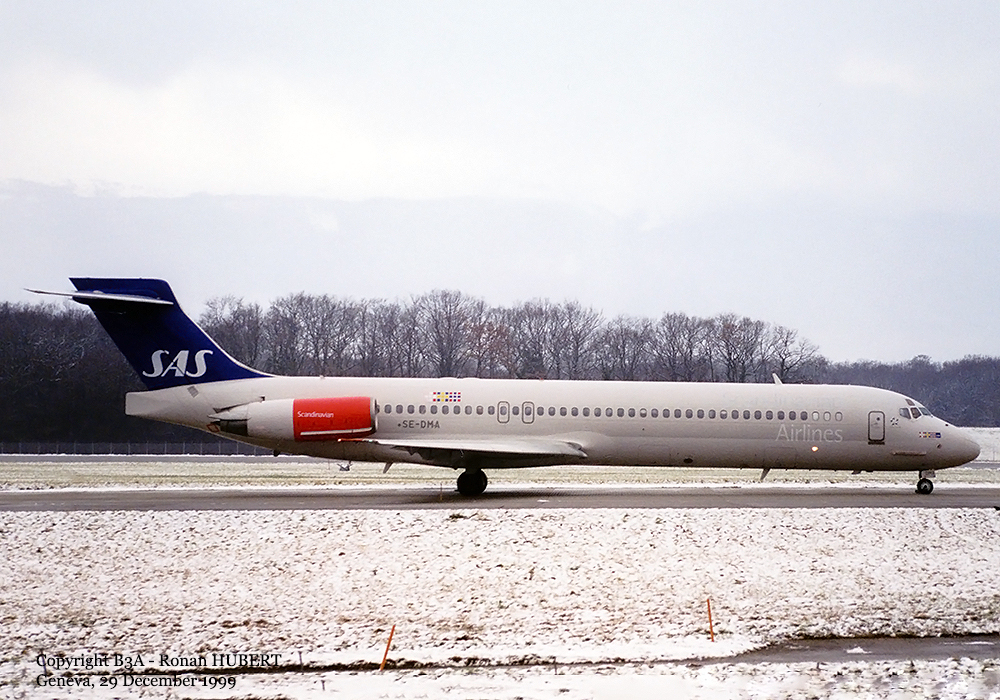
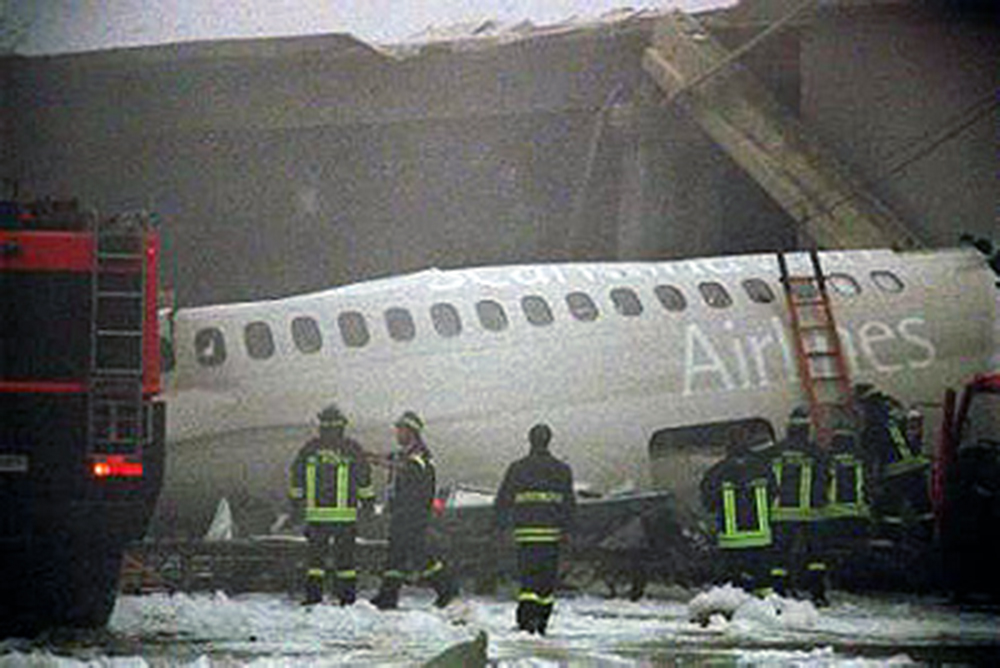
Crash of a McDonnell Douglas MD-87 in Milan: 114 killed

Date & Time: Oct 8, 2001 at 0810 LT
Type of aircraft:
Operator:
Registration:
SE-DMA
Flight Phase:
Survivors:
No
Schedule:
Milan - Copenhagen
MSN:
53009
YOM:
1991
Flight number:
SK686
Country:
Region:
Crew on board:
6
Crew fatalities:
Pax on board:
104
Pax fatalities:
Other fatalities:
Total fatalities:
110
Captain / Total flying hours:
5842
Captain / Total hours on type:
232.00
Copilot / Total flying hours:
4355
Copilot / Total hours on type:
1978
Aircraft flight hours:
25573
Aircraft flight cycles:
16562
Circumstances:
A brand new Cessna 525A CitationJet 2, D-IEVX, arrived at Milan-Linate following a flight from Köln. The Cessna was to carry out a return flight to Paris-Le Bourget, carrying two pilots, a Cessna sales manager and a prospective customer. The plane arrived at 06:59 and was taxied to the General aviation apron, also known as 'West apron'. It was a foggy morning at Milan and one of the passenger flights parked on the North apron was SAS MD-87 "Lage Viking" which was being prepared for flight SK686 to Copenhagen, scheduled to depart at 07:35. At 07:41, the pilot of the MD-87 contacted Linate Ground Control for his engine start clearance, as the boarding of 104 passengers had been completed. The Ground controller cleared the pilot to start engines and advised that the slot time for takeoff of the flight was at 08:16. Thirteen minutes later flight 686 was cleared to taxi to runway 36R: "Scandinavian 686 taxi to the holding position Cat III, QNH 1013 and please call me back entering the main taxiway." A few minutes later, the Cessna pilot requested permission to start the engines. The ground controller then gave start-up clearance. The ground controller then requested flight 686 to contact the Tower controller. From this moment on the crew of the MD-87 and the crew of the Cessna were tuned on two different radio frequencies. At 08:05 the pilots of the Cessna received taxi clearance: "Delta Victor Xray taxi north via Romeo 5, QNH 1013, call me back at the stop bar of the ... main runway extension." The pilot acknowledged by saying: "Roger via Romeo 5 and ... 1013, and call you back before reaching main runway." The Cessna started to taxi from the General Aviation parking position, following the yellow taxi line. After reaching the position where the yellow taxi line splits into two diverging directions, the pilot erroneously took the taxi line to right and entered taxiway R6. At 08:09 the Ground controller cleared the Cessna to continue its taxi on the North apron. At the same time the Tower controller cleared the MD-87 for takeoff: "...Scandinavian 686 Linate, clear for take off 36, the wind is calm report rolling, when airborne squawk ident." The pilot advanced the throttles and acknowledged the clearance: "Clear for takeoff 36 at when...airborne squawk ident and we are rolling, Scandinavian 686." When the MD-87 was speeding down the runway, the Cessna crossed the runway holding sign and entered the active runway 18L/36R. At 08.10:21 the nose landing gear of the MD-87 had left the ground and main gears were extending the shock absorbers but the main wheels were still on the ground at an airspeed of 146 knots (270,5 km/h). At that moment the MD-87 crew probably saw a glimpse of the Cessna through the fog and reacted with additional large nose-up elevator. At that moment the MD-87 collided with the CitationJet. The right wing of the MD-87 sustained damage at the leading edge and the right hand main landing gear leg broke off. It damaged the right flap and struck the no. 2 engine which then separated from the pylon. The pilot of the MD-87 gradually advanced the throttles and then the aircraft was airborne for a total of 12 seconds, reaching an estimated height of about 35 feet (11 meters). The left hand engine suffered a noticeable thrust reduction as a result of debris ingestion, which became insufficient to sustain flight. The airspeed had increased up to 166 knots (307,6 km/h), but the MD-87 descended abruptly making contact with the runway with the left hand maingear, the truncated right hand maingear leg and the tip of the right hand wing. Prior to touch down the pilot reduced engine thrust and after ground contact the engine reverse levers were activated and deployed (on the left hand engine only). Maximum available reverse thrust was selected and the brakes applied. The plane skidded past the grass overrun area, across a service road, crashing sideways into a baggage handling building, which partly collapsed. This building was located 20 m/67 feet to the right of the runway, and 460 m/1500 feet from the runway end.
Probable cause:
After analysis of evidence available and information gathered, it can be assumed that the immediate cause for the accident has been the runway incursion in the active runway by the Cessna. The obvious consideration is that the human factor related action of the Cessna crew - during low visibility conditions - must be weighted against the scenario that allowed the course of events that led to the fatal collision; equally it can be stated that the system in place at Milano Linate airport was not geared to trap misunderstandings, let alone inadequate procedures, blatant human errors and faulty airport layout.
The following list highlights immediate and systemic causes that led to the accident:
- The visibility was low, between 50 and 100 meters;
- The traffic volume was high;
- The lack of adequate visual aids;
- The Cessna crew used the wrong taxiway and entered the runway without specific clearance;
- The failure to check the Cessna crew qualification;
- The nature of the flight might have exerted a certain pressure on the Cessna crew to commence the flight despite the prevailing weather conditions;
- The Cessna crew was not aided properly with correct publications (AIP Italy - Jeppesen), lights (red bar lights and taxiway lights), markings (in deformity with standard format and unpublished, S4) and signs (non existing, TWY R6) to enhance their situational awareness;
- Official documentation failing to report the presence of unpublished markings (S4, S5, etc) that were unknown to air traffic controllers, thus preventing the ATC controller from interpreting the unambiguous information from the Cessna crew, a position report mentioning S4;
- Operational procedures allowing high traffic volume (high number of ground movements) in weather conditions as were current the day of the accident (reduced visibility) and in the absence of technical aids;
- Radio communications were not performed using standard phraseology (read back) or were not consistently adhered to (resulting in untraced misunderstandings in relevant radio communications);
- Radio communications were performed in Italian and English language;
- Air Traffic Control (ATC) personnel did not realize that Cessna was on taxiway R6;
- The ground controller issued a taxi clearance towards Main apron although the reported position S4 did not have any meaning to him;
- Instructions, training and the prevailing environmental situation prevented the ATC personnel from having full control over the aircraft movements on ground.
Furthermore:
- The aerodrome standard did not comply with ICAO Annex 14; required markings, lights and signs did either not exist (TWY R6) or were in dismal order and were hard to recognize especially under low visibility conditions (R5-R6), other markings were unknown to operators (S4);
- No functional Safety Management System was in operation;
- The competence maintenance and requirements for recent experience for ATC personnel did not fully comply with ICAO Annex 1;
- The LVO implementation by ENAV (DOP 2/97) did not conform with the requirements provided in the corresponding and referenced ICAO DOC 4976.
The combined effect of these factors, contemporaneously present on the 8th of October 2001 at Milano Linate, have neutralized any possible error corrective action and therefore allowed the accident.

Final Report:

Crash of a Cessna 414 Chancellor in Marshfield: 3 killed

Date & Time: Sep 29, 2001 at 1700 LT
Type of aircraft:
Operator:
Registration:
N414NG
Flight Type:
Survivors:
No
Schedule:
Wisconsin Rapids - Poplar Bluff
MSN:
414-0496
YOM:
1974
Crew on board:
1
Crew fatalities:
Pax on board:
2
Pax fatalities:
Other fatalities:
Total fatalities:
3
Circumstances:
The airplane was destroyed after an attempted landing following a reported partial power loss of the left engine while en route. The flight did not divert to the closest airport located about 27 nautical miles to the southwest while at an altitude of about 15,900 feet. This airport was a controlled field equipped with airport rescue and fire fighting (ARFF), and its longest runway was 9,005 feet. The flight diverted to the departure airport located about 93 nautical miles to the north. This airport was an uncontrolled field not equipped with ARFF, and its longest runway was 5,000 feet. No emergency was declared. The airplane was reported by a witness to be too high and too fast to land on runway 34 at the airport. The winds were from 140 degrees at 6 knots. The wreckage distribution was consistent with an impact resulting from a Vmc (minimum control speed with the critical engine inoperative) roll to the left. The pilot received a checkout from the right seat in the accident airplane by the airplane owner. The checkout was about 20 minutes in duration and did not include any single-engine flight maneuvers or emergency procedures. The owner did not hold a certified flight instructor certificate. The pilot had stopped flying for 12 years and just began giving flight instruction and flying in single-engine airplanes about a year prior to the accident. The pilot's recent multiengine flight experience was limited to a couple of non-revenue flights within the past year while seated in the right seat of a King Air. The King Air was used for commercial charter work which would involve one or two landings per flight. One landing was made on the day prior to the accident. The accident pilot asked the King Air pilot to accompany him along on the accident flight; the King Air pilot declined. A multiengine commercial rated pilot-rated passenger, who the accident pilot knew, was seated in the right front seat. Examination of the airplane's supplemental type certificate (STC) revealed that the airplane had undergone numerous inspections by different maintenance personnel. The left engine's variable absolute pressure controller had safety wire around its control arm, which precluded its normal operation and a pressure relief valve that was not called for in the STC drawings. At the time of issuance, Federal Regulation's did not require STC instructions for continued airworthiness. Reliance on the airplane and engine maintenance manuals would not have provided enough information for continued airworthiness in accordance with the STC and could have yielded a setting exceeding those for which the STC parts were originally certificated to and thus increasing Vmc speed. Examination of the left engine revealed a cylinder head separation on the number six cylinder assembly, which had accumulated an estimated time since installation of 240 hours. Visual inspection of the assembly revealed the presence of some undecipherable characters in its parts numbering. A cylinder head separation from another airplane was also examined. This cylinder assembly accumulated about 270 hours since installation. Both cylinder assembly examinations revealed the presence of additional material on the cylinder barrel threads and fatigue fracture on the cylinder head.

Probable cause:
The pilot's failure to maintain adequate airspeed (Vmc) which resulted in a loss of control. Contributing factors were the improper in-flight planning/decision not to land at a closer airport and the lack of recent experience in multiengine airplanes by the pilot-in-command, the cylinder head separation, the inadequate manufacturing process, and the lack of continued airworthiness instructions relating to the Riley Super-8 STC.
Final Report:

Crash of a Douglas DC-6BF in Nuiqsut

Date & Time: Sep 25, 2001 at 1609 LT
Type of aircraft:
Operator:
Registration:
N867TA
Flight Type:
Survivors:
Yes
Schedule:
Deadhorse - Nuiqsut
MSN:
45202
YOM:
1957
Flight number:
NAC690
Location:
Crew on board:
3
Crew fatalities:
Pax on board:
0
Pax fatalities:
Other fatalities:
Total fatalities:
0
Captain / Total flying hours:
22000
Captain / Total hours on type:
14000.00
Copilot / Total flying hours:
6100
Copilot / Total hours on type:
3000
Aircraft flight hours:
7754
Circumstances:
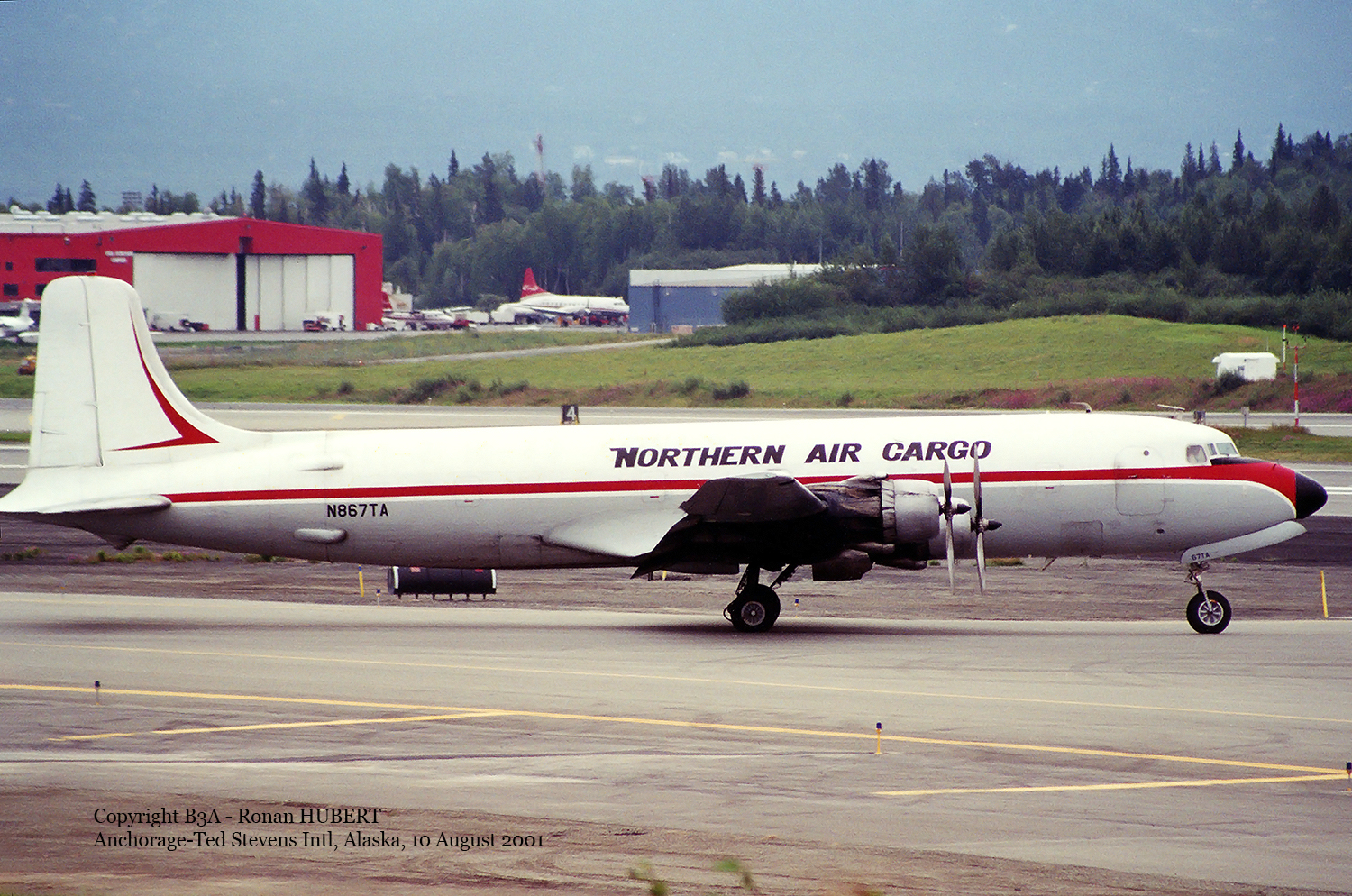
The crew was conducting a GPS instrument approach in a Douglas DC-6B airplane under IFR conditions. Both pilots were certificated and type-rated in the Douglas DC-6B airplane. The first pilot, seated in the right seat, was one of the company's senior check airman, and possessed a right seat dependency endorsement. The second pilot, seated in the left seat, had less experience in the DC-6B airplane. It had been previously agreed that the second pilot would fly the leg of the flight on which the accident occurred. The first pilot reported that light snow showers were present, with visibility reported at 4 miles. During final approach as the airplane passed over the airstrip threshold, a higher than normal sink rate was encountered. He said that the initial touchdown was "firm," but was thought to be within acceptable tolerances. Just after touchdown, the left wing broke free from the airplane at the wing to fuselage attach point. The airplane veered to the left, continued off the left side of the 5,000 feet long by 75 feet runway, down an embankment, and came to rest in an area of wet, tundra covered terrain. A postcrash fire heavily damaging the center section of the fuselage. The cockpit voice recorder (CVR) revealed that as the airplane progressed along the approach, the first pilot says: "You're only one mile from it....Take it on down ah three." As the airplane passes over the runway threshold, the first pilot says: "Keep that, keep that (expletive) power off.... Just push forward on the nose." The sound of impact is heard 4 seconds later. The minimum descent altitude (MDA) for the approach is 400 feet msl (383 feet agl). A contract weather observer reported lower ceilings, with about 1 mile visibility, over the approach end of the runway at the same time as the accident.
Probable cause:
The flightcrew's continued use of an unstabilized GPS approach. Factors associated with the accident were low ceilings, and the inadequate coordination between the crew.
Final Report: