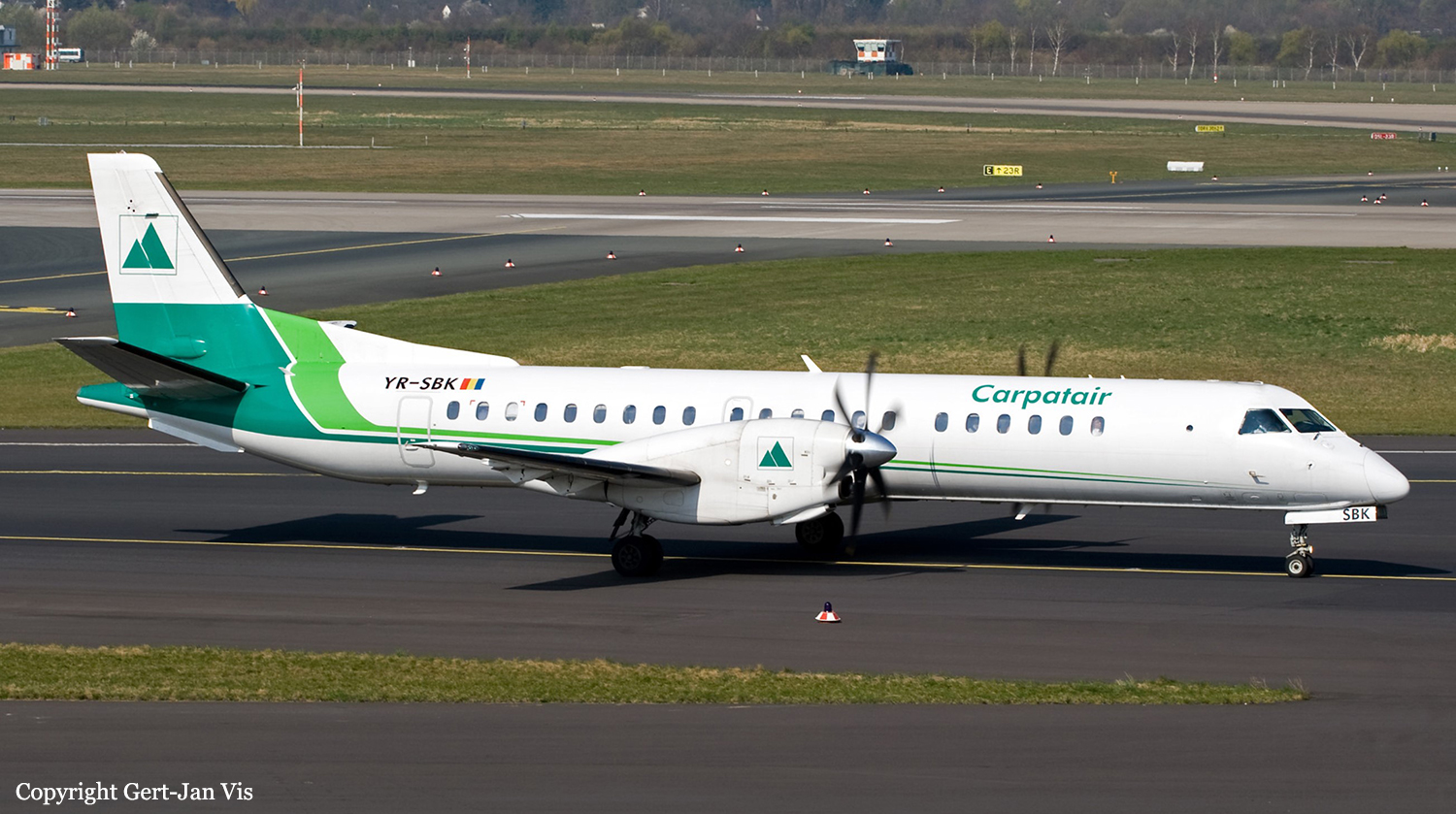
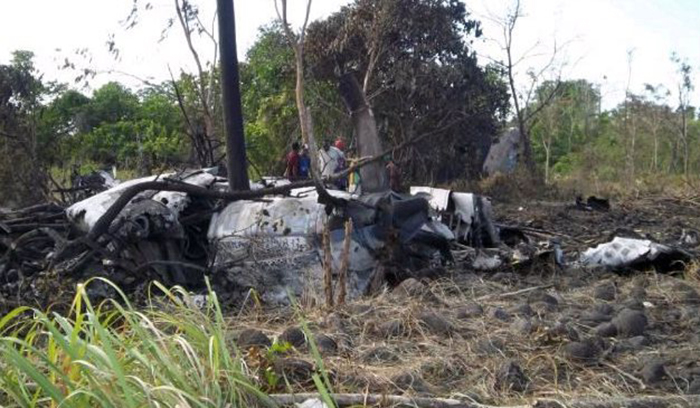
Crash of a Saab 2000 in Craiova

Date & Time: Feb 13, 2012 at 1108 LT
Type of aircraft:
Operator:
Registration:
YR-SBK
Flight Phase:
Survivors:
Yes
Schedule:
Craiova – Timişoara
MSN:
33
YOM:
1996
Flight number:
KRP2385
Location:
Country:
Region:
Crew on board:
4
Crew fatalities:
Pax on board:
51
Pax fatalities:
Other fatalities:
Total fatalities:
0
Captain / Total flying hours:
6623
Copilot / Total flying hours:
700
Circumstances:
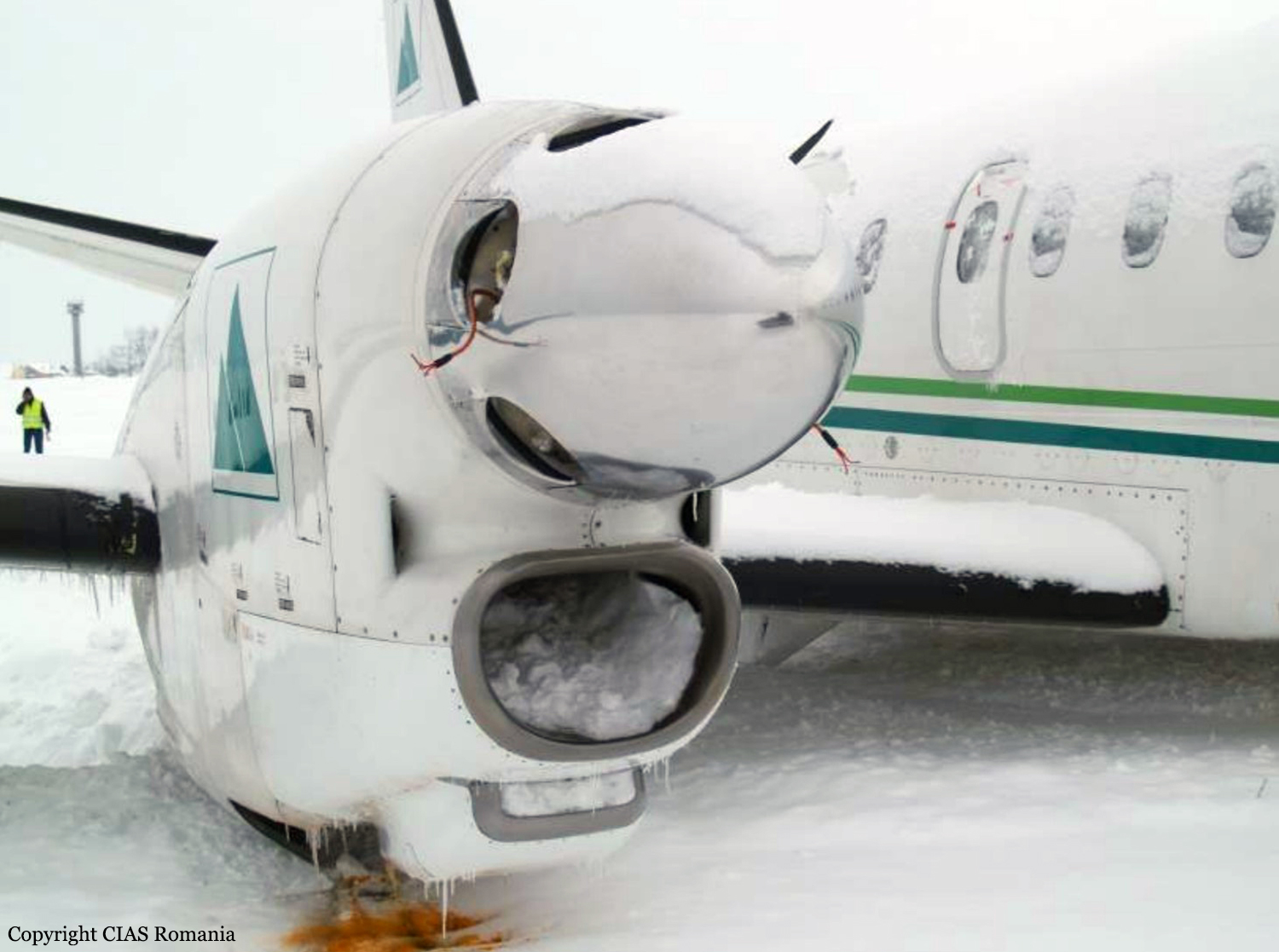
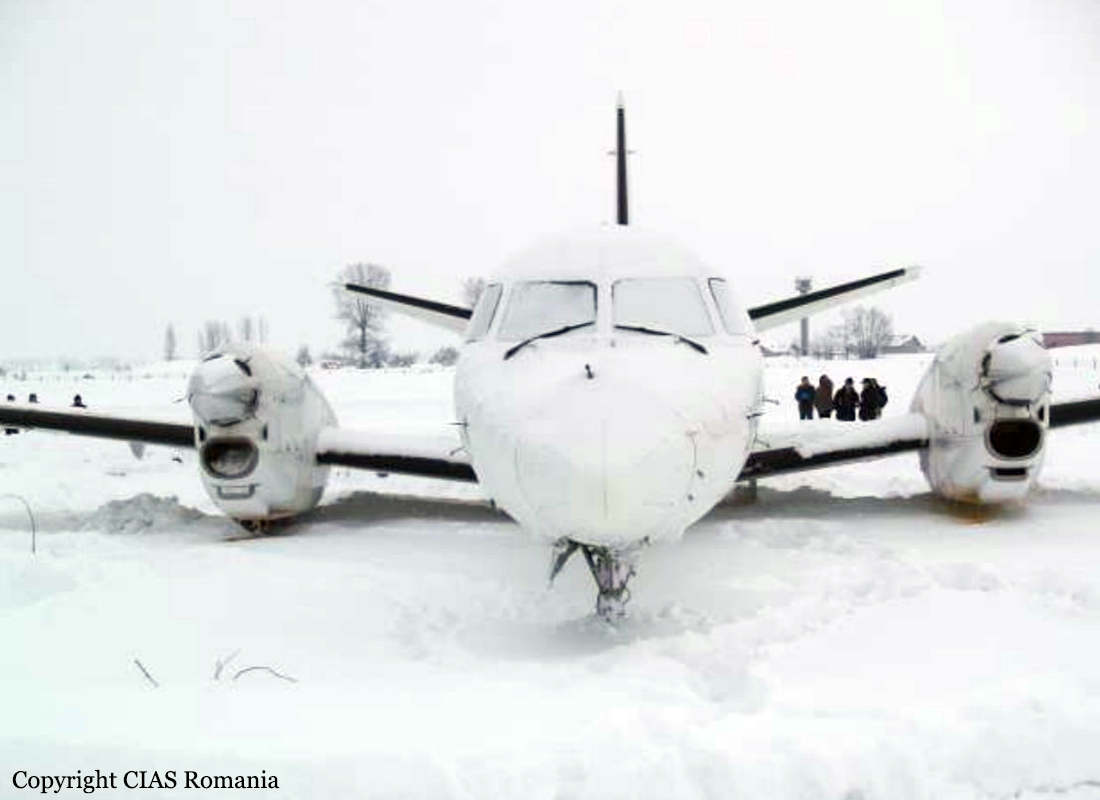
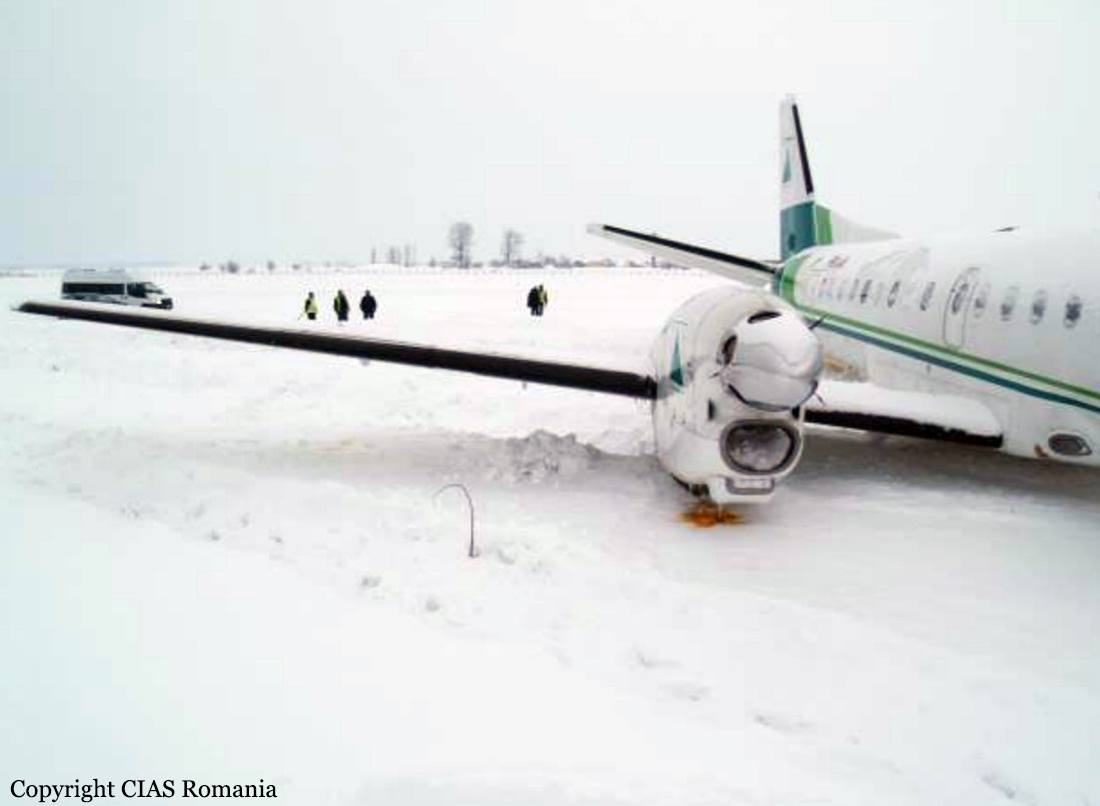
The crew started the takeoff procedure from runway 09 at Craiova Airport in a visibility of 500 metres due to freezing fog. During the course, the aircraft deviated to the right, causing the right engine to struck a snow berm (one meter high). The right propeller was torn off then aircraft rolled for few metres before coming to rest in snow. All 55 occupants evacuated safely while the aircraft was damaged beyond repair.
Probable cause:
It was determined that the runway has not been properly cleared of snow prior to takeoff. This caused the lights ont both edges to be not visible to the crew. The crew failed to assess the takeoff conditions, the runway conditions and weather conditions.
The following contributing factors were identified:
- The takeoff conditions exceeded the training level of the crew,
- Change of takeoff procedure without prior training.
Final Report:

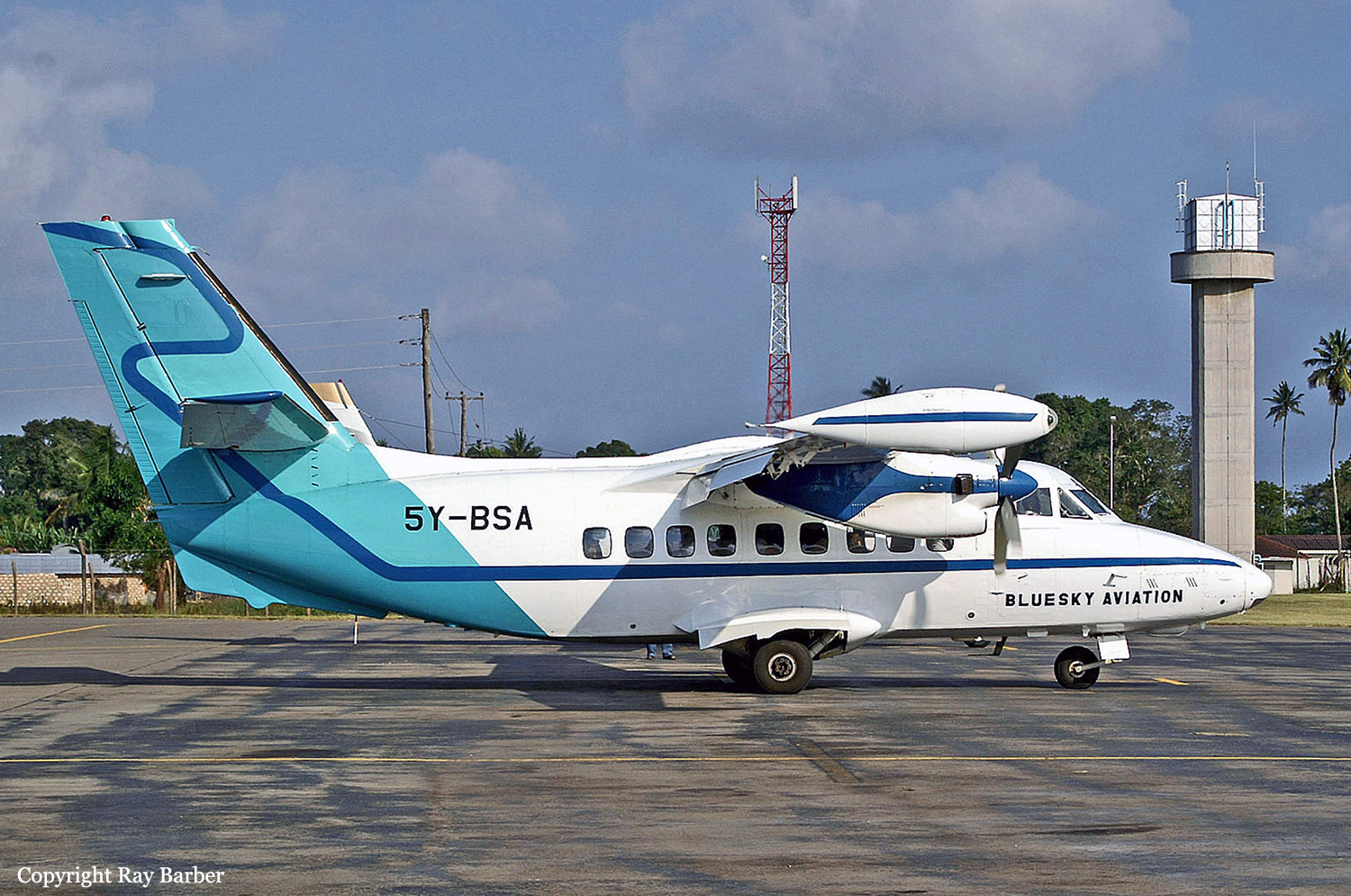
Crash of a Let L-410UVP-E9 in Kichwa Tembo

Date & Time: Jan 12, 2012 at 1955 LT
Type of aircraft:
Operator:
Registration:
5Y-BSA
Flight Phase:
Survivors:
Yes
Schedule:
Kichwa Tembo – Musiara
MSN:
89 23 23
YOM:
1989
Country:
Region:
Crew on board:
2
Crew fatalities:
Pax on board:
4
Pax fatalities:
Other fatalities:
Total fatalities:
0
Circumstances:
The twin engine aircraft was returning to Mombasa with a scheduled stop in Musiara to pickup 15 additional passengers. On departure from Kichwa Tembo, there were four passengers and two pilots on board. During the takeoff roll from runway 08, the aircraft hit a bump half way down the runway and bounced. The aircraft hit a second bump shortly later and as the crew heard the stall alarm, he decided to reject takeoff. Unable to stop within the remaining distance, the aircraft overran, lost its nose gear and came to rest 300 metres further. All six occupants escaped uninjured while the aircraft was damaged beyond repair.

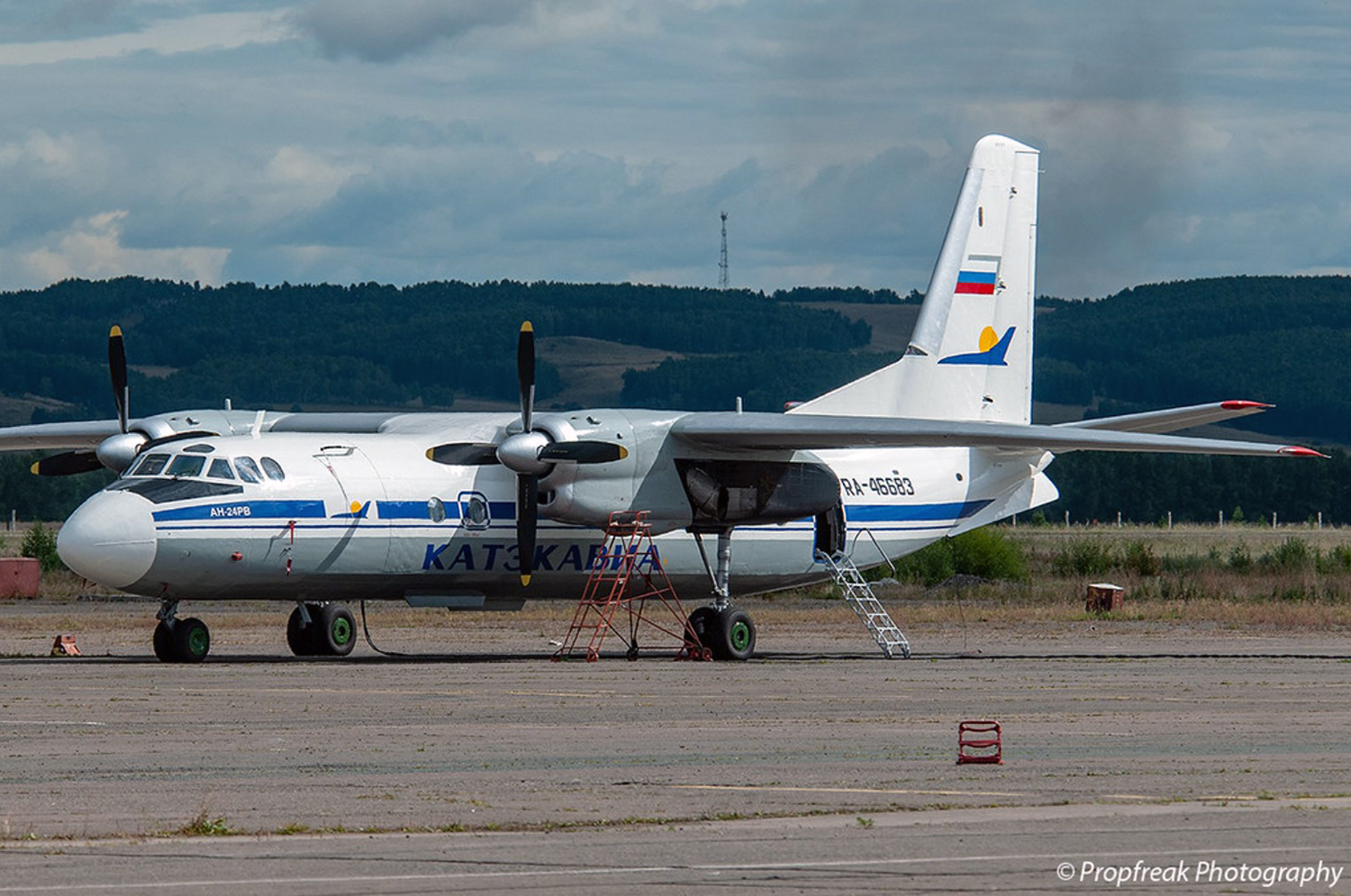
Crash of an Antonov AN-24RV in Chita

Date & Time: Dec 31, 2011
Type of aircraft:
Operator:
Registration:
RA-46683
Survivors:
Yes
MSN:
4 73 097 06
YOM:
1974
Country:
Region:
Crew on board:
0
Crew fatalities:
Pax on board:
0
Pax fatalities:
Other fatalities:
Total fatalities:
0
Circumstances:
The aircraft was damaged beyond repair following a hard landing at Chita Airport. The mishap occurred between 30 March 2011 and 29 December 2011 when it was cancelled from the Russian registry. There were no injuries.

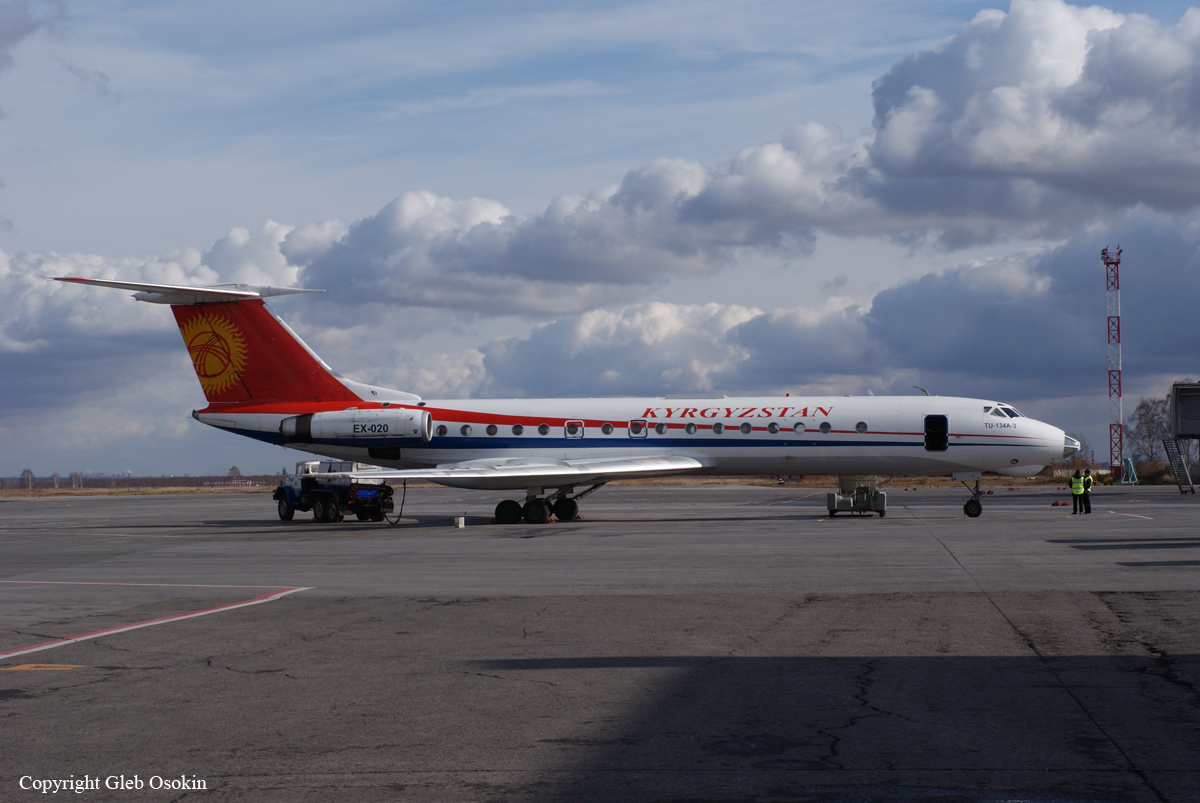
Crash of a Tupolev TU-134A-3 in Osh

Date & Time: Dec 28, 2011 at 1246 LT
Type of aircraft:
Operator:
Registration:
EX-020
Survivors:
Yes
Schedule:
Bichkek - Osh
MSN:
61042
YOM:
1979
Flight number:
QH003
Location:
Country:
Region:
Crew on board:
6
Crew fatalities:
Pax on board:
82
Pax fatalities:
Other fatalities:
Total fatalities:
0
Aircraft flight hours:
41313
Aircraft flight cycles:
25326
Circumstances:
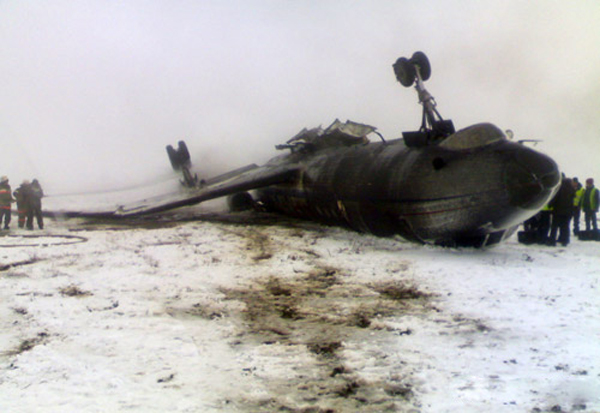
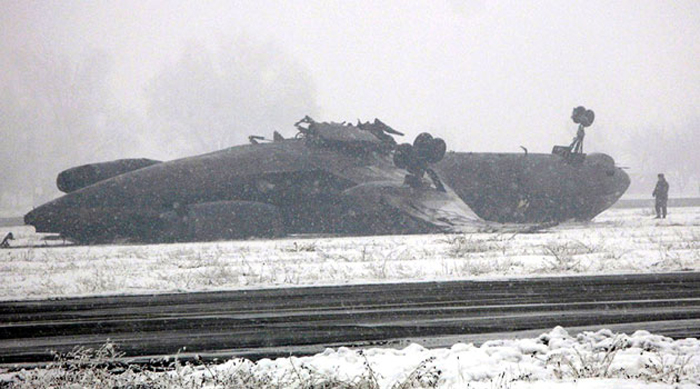
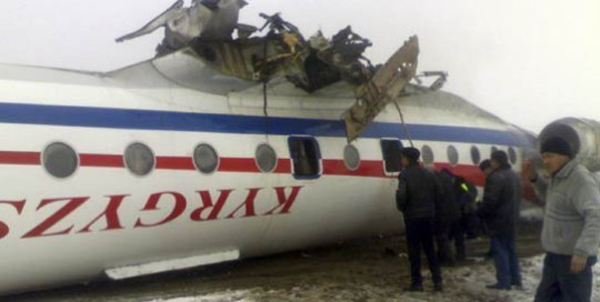
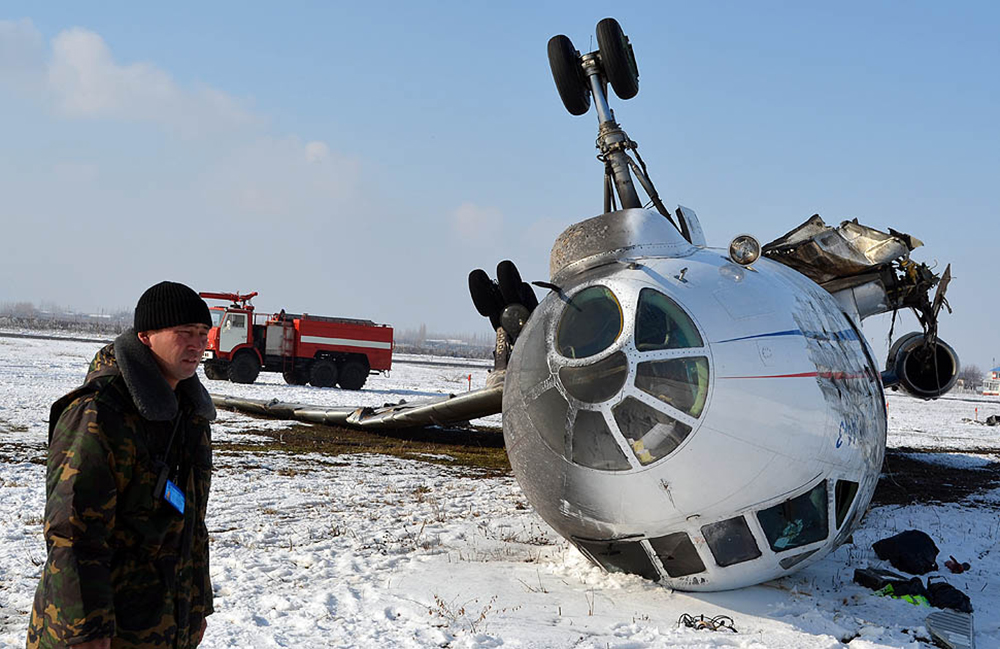
Following an uneventful flight from Bishkek, the crew started the descent to Osh Airport. The approach was completed in reduced visibility due to foggy conditions. Not properly aligned with runway 12, the aircraft landed hard. It did not bounce but lost its right main gear due to excessive aerodynamic forces (2,5 g). Out of control, the aircraft veered off runway and came to rest upside down, bursting into flames. The aircraft was partially destroyed by fire. All 88 occupants were evacuated, among them 31 were injured, some seriously. At the time of the accident, the visibility was reduced to 300 metres horizontal and 200 metres vertical. RVR for runway 12 was 550 metres.
Probable cause:
On Apr 22nd 2013 a letter of Kyrgyzstan's Transport Prosecutor to Kyrgyzstan's Parliament of April 2012 became known indicating that the airport had been approved to operate in Category I weather minima without being properly equipped and should never have been approved to operate in these conditions, as a result of the investigation the aerodrome has been limited to operate according to visual flight rules only. The aircraft was not properly equipped to conduct the flight lacking a GPWS as well as passenger oxygen, the crew was not qualified to conduct the flight and the oversight by the airline's dispatch and chief pilot was insufficient, the Transport Prosecutor mentioned that the responsibles to oversee flight operation could not answer even the most basic questions. Kyrgyzstan's Civil Aviation Authority failed to oversee the operation of the airline as well. While on approach to Osh the crew was informed about weather conditions permitting an approach, the data transmitted however were incorrect and the actual weather did not even permit an approach. Instead of being established on the approach 10.5km/5.6nm before touchdown the aircraft was established on the extended centerline only about 4.02km/2.17nm before touchdown, however was above the glidepath. A steep dive to reach the runway resulted in a touch down at a high rate of descent and vertical forces beyond the design limit of the aircraft (more than 2.5G), as result of the high impact forces the aircraft did not even bounce but just started to disintegrate, reaching 58 degrees of right roll 270 meters past the runway threshold, between 270 and 550 meters past the threshold the tail fin separated, the aircraft was completely upside down 600 meters past the threshold and came to a stop about 1000 meters past the threshold of the runway. The main door was jammed, the occupants escaped through other doors and the overwing exits. No serious injury occurred, 6 people needed hospital treatment with minor injuries.

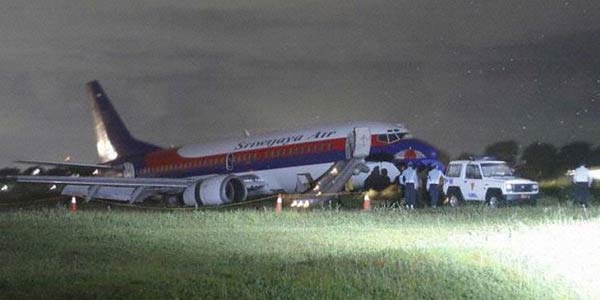
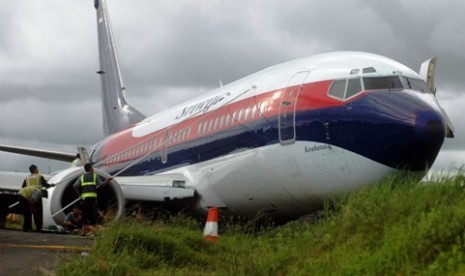
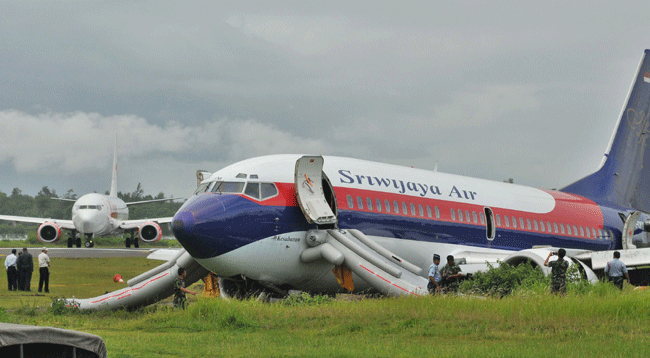
Crash of a Boeing 737-36M in Yogyakarta

Date & Time: Dec 20, 2011 at 1713 LT
Type of aircraft:
Operator:
Registration:
PK-CKM
Survivors:
Yes
Schedule:
Jakarta - Yogyakarta
MSN:
28333/2810
YOM:
1996
Flight number:
SJY230
Country:
Region:
Crew on board:
6
Crew fatalities:
Pax on board:
131
Pax fatalities:
Other fatalities:
Total fatalities:
0
Captain / Total flying hours:
29801
Copilot / Total flying hours:
562
Aircraft flight hours:
31281
Aircraft flight cycles:
21591
Circumstances:
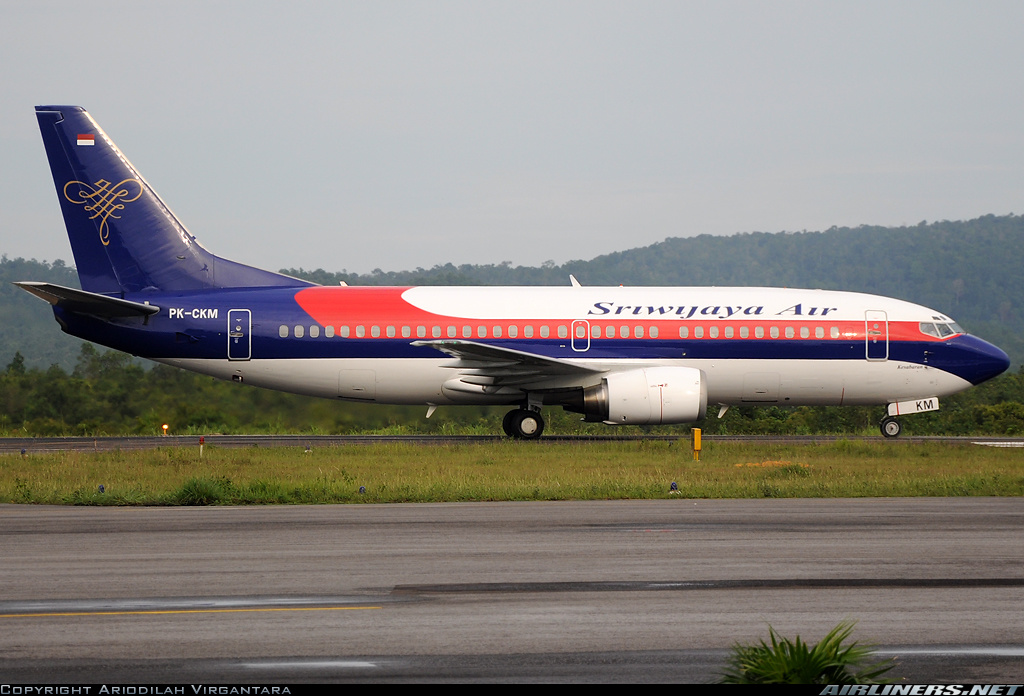
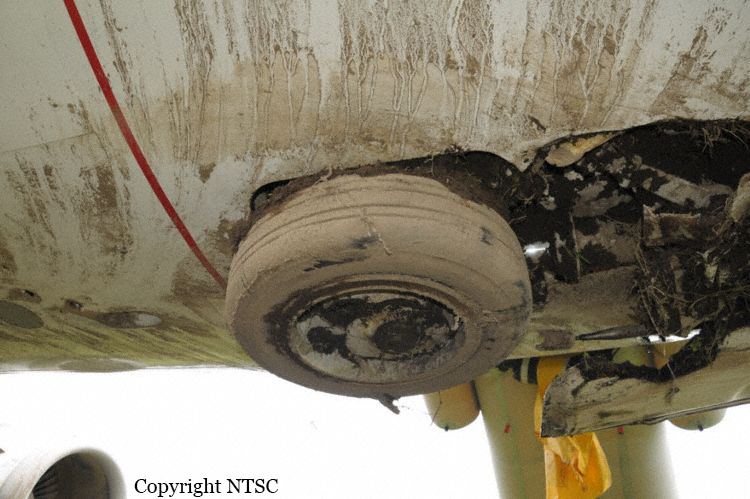
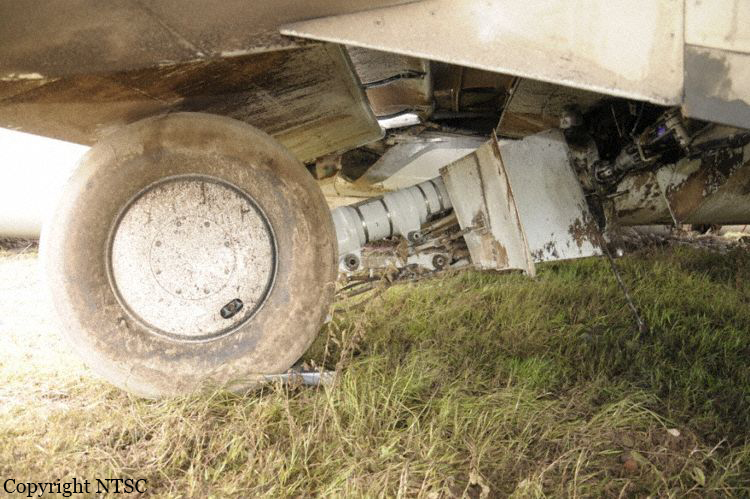
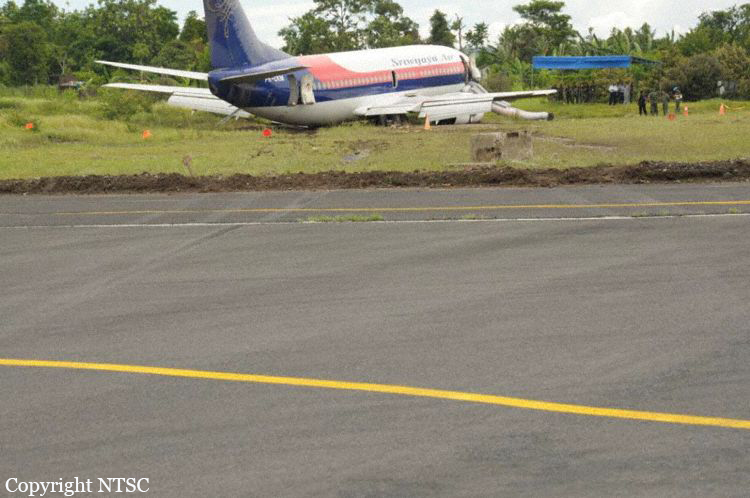
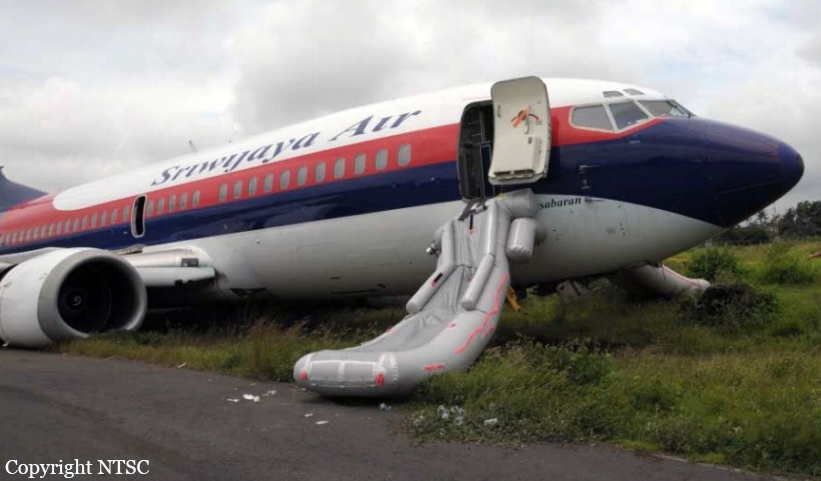
On 20 December 2011, a Boeing 737-300 aircraft, registered PK-CKM, was being operated by PT. Sriwijaya Air on a schedule passenger flight SJ230 from Soekarno Hatta International Airport (WIII) Jakarta to Adisutjipto International Airport (WARJ), Yogyakarta. There were 141 persons on board; two pilots, four cabin crews and 135 passengers consisted124 adult, 7 children and 4 infant. The aircraft departed from Jakarta at 14.00 LT (07.00 UTC), the pilot in command was the pilot flying and the co-pilot was the pilot monitoring. At 08.10 UTC the aircraft made holding at 8 NM from JOG VOR due to bad weather. After the second holding and the weather was deteriorated, the airport authority closed the airport for takeoff and landing. The pilot requested divert to Juanda Airport (WARR), Surabaya and landed at 08.40 UTC. After refuelling and received the information about weather improvement in Yogyakarta then the aircraft departed, at 09.20 UTC, in this sequence of flight the PIC acted as PF, with 137 persons on board consisted of two pilots, four cabin crews and 131 passengers consisted 120 adult, 7 children and 4 infant. The aircraft was on the fifth sequence from seven aircraft approaching Adisucipto airport Yogyakarta. Passing JOG VOR it was seen on radar screen that the aircraft speed was read 203 Kts at 2700 ft. Approach Controller instructed to reduce the speed. At about 1200 ft, the pilot had the runway insight and disengaged the autopilot and auto throttle. The pilot made correction to the approach profile by roll up to 25 degrees and rate of descend up to 2040 ft per minute. The GPWS warning of ‘pull up’ and sink ‘rate were’ activated. Aircraft touched down at speed 156 Kts of 138 Kts target landing speed. During landing roll, the auto-brake and spoiler activated automatically. The thrust reverse were deployed and the N1 were recorded on the FDR increase and decrease to idle before increased to 80% prior to aircraft stop. The PIC noticed that the aircraft would not be able to stop in the runway and decided to turn the aircraft to the left. The aircraft stopped at 75 meter from the end of runway 09 and 54 meter on the left side of the centre line. Most of the passenger evacuated through left and right forward escape slides. All passengers were evacuated safely. The passenger on the stretcher case was evacuated by the airport rescue. 6 passengers reported minor injured while all crew and the remaining passengers were not injured. The aircraft suffered major damage on the right main and nose wheel.
Probable cause:
Findings:
1. The aircraft was airworthy prior the accident. There was no evidence that the aircraft had malfunction during the flight.
2. The crew had valid license and medical certificate. There was no evidence of crew incapacitation.
3. In this flight Pilot in Command acted as Pilot Flying and Second In command acted as Pilot Monitoring.
4. The flight crew did not conduct approach crew briefing.
5. There was no checklist reading.
6. The PIC as Pilot Flying did not have the instrument approach procedure immediately available to review during approach.
7. During the approach, the PIC course indicator was set at 091 and the SIC was at 084.
8. The rate of descend recorded vary and up to 1920 ft per minute and below 500 ft AGL the rate of descend recorded up to 2040 ft per minute.
9. The approach did not meet the stabilize approach criteria as stated in the FCOM.
10. There were several GPWS warning of ‘sink rate’ and ‘pull up’ activated during approach.
11. The aircraft touched down at speed 156 Kt before bounced, instead of 138 Kt target landing speed.
12. The flap extended to 40 after the aircraft touch down.
13. The FDR recorded reduction in N1 during thrust reverser activation after landing.
14. The CRM was not well implemented.
Factors:
Unsuccessful to recognize the two critical elements, namely fixation and complacency affected pilot decision to land the aircraft while the approach was not meet the criteria of stabilized approach.
Final Report:

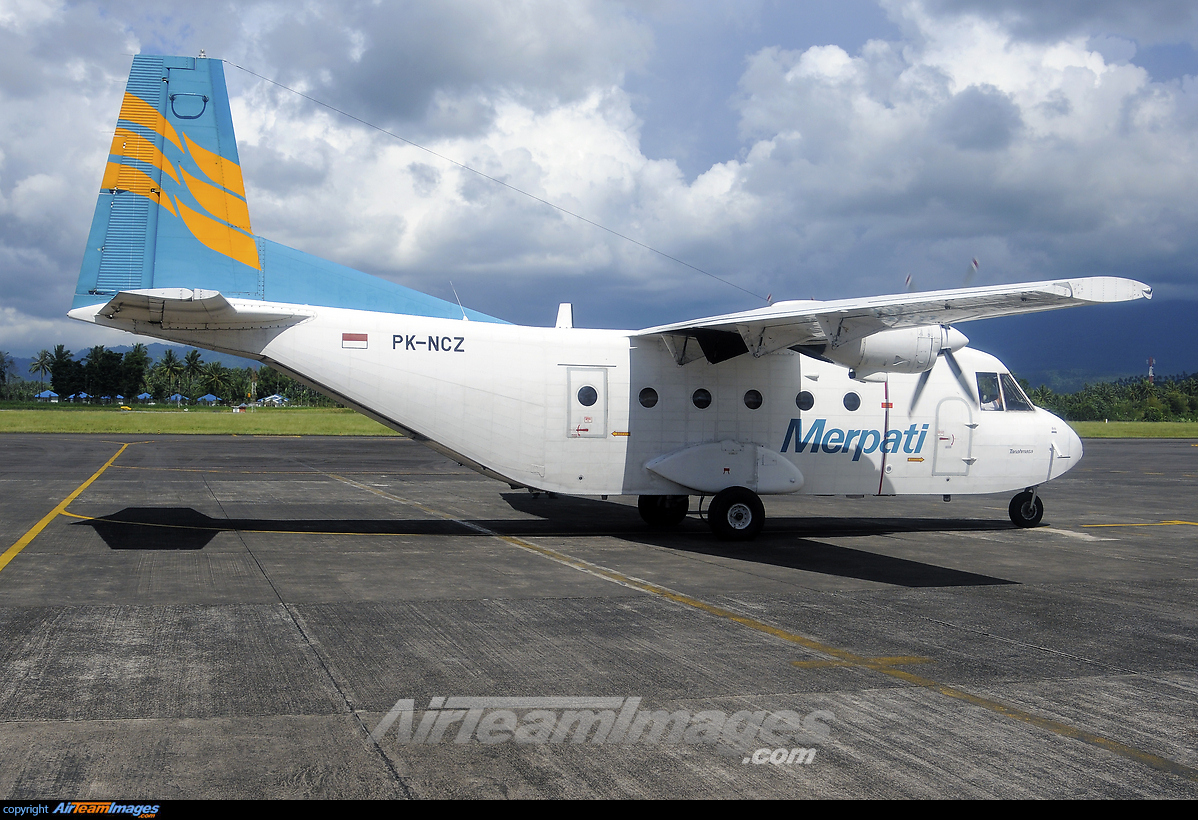
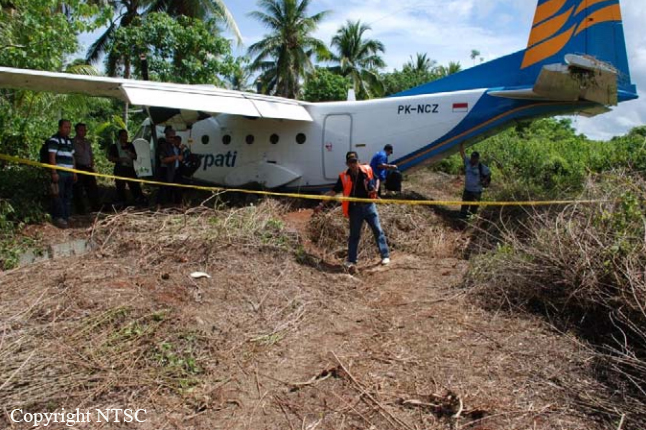
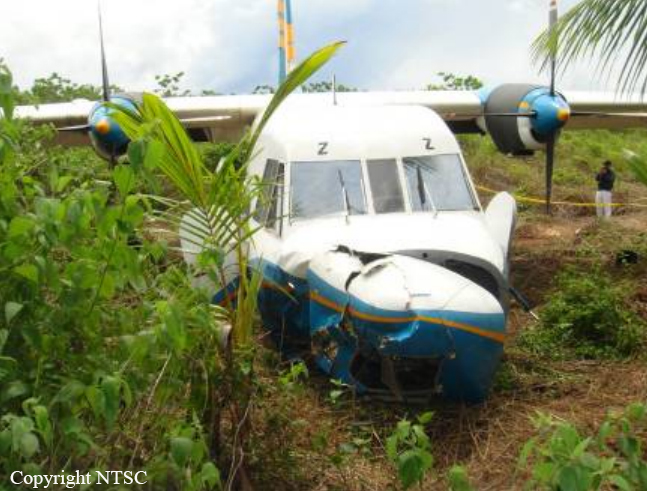
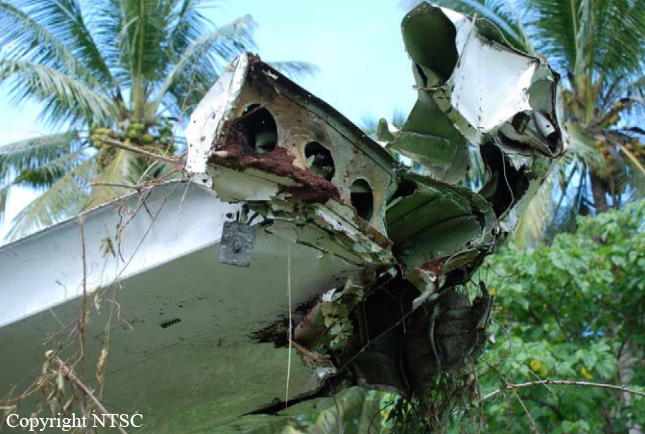
Crash of a Casa 212 Aviocar 200 in Larat

Date & Time: Dec 3, 2011 at 1308 LT
Type of aircraft:
Operator:
Registration:
PK-NCZ
Survivors:
Yes
Schedule:
Langur - Larat
MSN:
274/79N
YOM:
1986
Flight number:
MNA9933
Location:
Country:
Region:
Crew on board:
4
Crew fatalities:
Pax on board:
19
Pax fatalities:
Other fatalities:
Total fatalities:
0
Captain / Total flying hours:
7500
Captain / Total hours on type:
5500.00
Copilot / Total flying hours:
343
Copilot / Total hours on type:
72
Aircraft flight hours:
26935
Aircraft flight cycles:
30064
Circumstances:
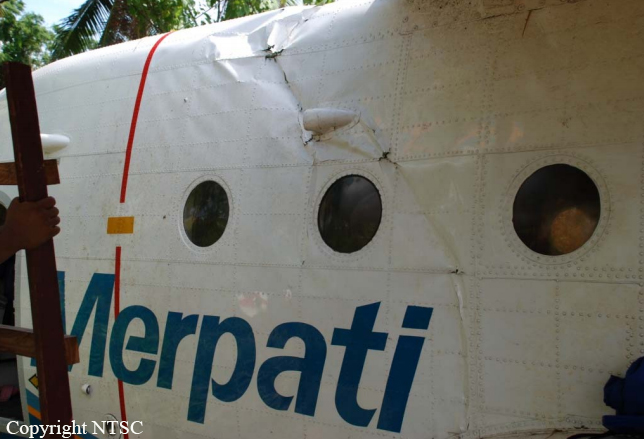
The Casa 212-200 aircraft registered PK-NCZ operated by PT. Merpati Nusantara Airlines on a scheduled flight from Langur to Larat, touched down at 224 meters from runway 09, was bouncing twice to the left of runway centre line, out of the runway and stopped at 607 meters from runway 09 touch down area as final position, and 15 meters to the left of runway edge. The Pilot Flying was First Officer, and after second bouncing, PIC took over, and he tried to bring the aircraft to the centre line of the runway without success. The aircraft continued rolled to the shoulder away from the runway and stopped at the final position. This is the second landing at Larat runway on the same day. There were 15 passengers, 3 children, one baby, Pilot In Command, two First Officers, one First Officer was Pilot Flying from Langur to Larat, one engineer on board. One passenger was serious injured, another one passenger minor injured.
Final Report:

Crash of a Cessna 207A Stationair 7 II in Kwigillingok

Date & Time: Nov 7, 2011 at 1830 LT
Operator:
Registration:
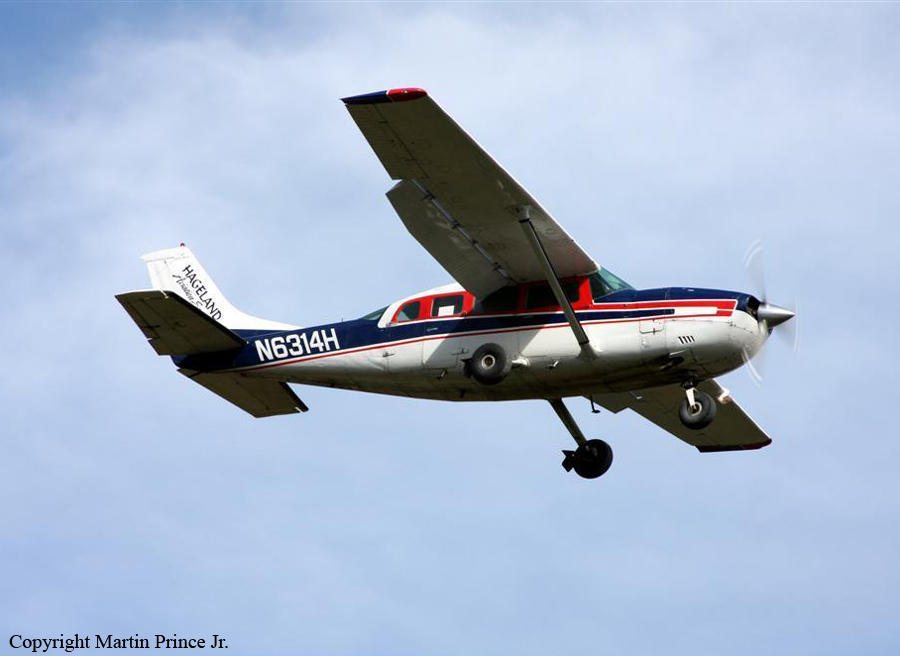
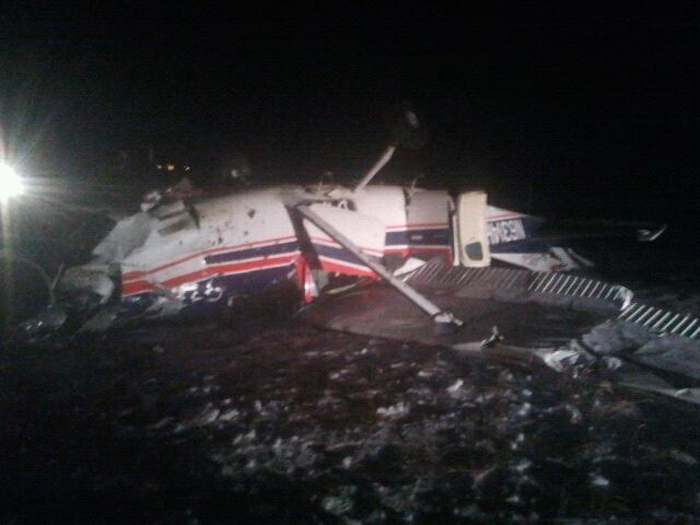
N6314H
Flight Phase:
Survivors:
Yes
Schedule:
Kwigillingok – Bethel
MSN:
207-0478
YOM:
1978
Crew on board:
1
Crew fatalities:
Pax on board:
5
Pax fatalities:
Other fatalities:
Total fatalities:
0
Captain / Total flying hours:
1833
Captain / Total hours on type:
349.00
Circumstances:
The pilot departed on a scheduled commuter flight at night from an unlit, rough and uneven snow-covered runway with five passengers and baggage. During the takeoff roll, the airplane bounced twice and became airborne, but it failed to climb. As the airplane neared the departure end of the runway, it began to veer to the left, and the pilot applied full right aileron, but the airplane continued to the left as it passed over the runway threshold. The airplane subsequently settled into an area of snow and tundra-covered terrain about 100 yards south of the runway threshold and nosed over. Official sunset on the day of the accident was 48 minutes before the accident, and the end of civil twilight was one minute before the accident. The Federal Aviation Administration's (FAA) Airport/Facility Directory, Alaska Supplement listing for the airport, includes the following notation: "Airport Remarks - Unattended. Night operations prohibited, except rotary wing aircraft. Runway condition not monitored, recommend visual inspection prior to using. Safety areas eroded and soft. Windsock unreliable." A postaccident examination of the airplane and engine revealed no mechanical anomalies that would have precluded normal operation. Given the lack of mechanical deficiencies with the airplane's engine or flight controls, it is likely the pilot failed to maintain control during the takeoff roll and initial climb after takeoff.
Probable cause:
The pilot's failure to abort the takeoff when he realized the airplane could not attain sufficient takeoff and climb performance and his improper decision to depart from an airport where night operations were prohibited.
Final Report:

Crash of a Boeing 767-35DER in Warsaw

Date & Time: Nov 1, 2011 at 1439 LT
Type of aircraft:
Operator:
Registration:
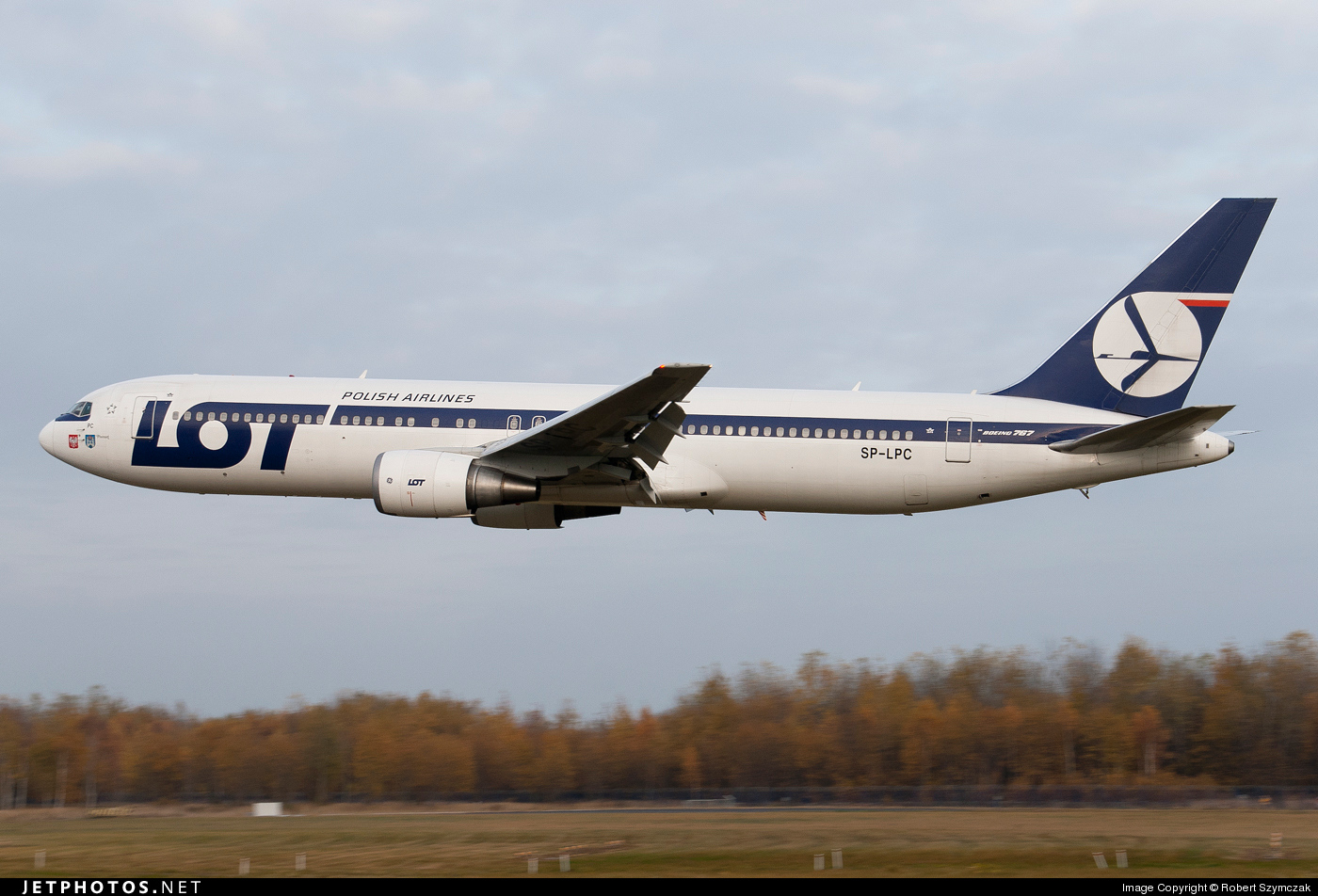
SP-LPC
Survivors:
Yes
Schedule:
Newark - Warsaw
MSN:
28656/659
YOM:
1997
Flight number:
LOT016
Country:
Region:
Crew on board:
10
Crew fatalities:
Pax on board:
221
Pax fatalities:
Other fatalities:
Total fatalities:
0
Captain / Total flying hours:
15980
Captain / Total hours on type:
13307.00
Copilot / Total flying hours:
9431
Copilot / Total hours on type:
1981
Aircraft flight hours:
85429
Aircraft flight cycles:
8002
Circumstances:
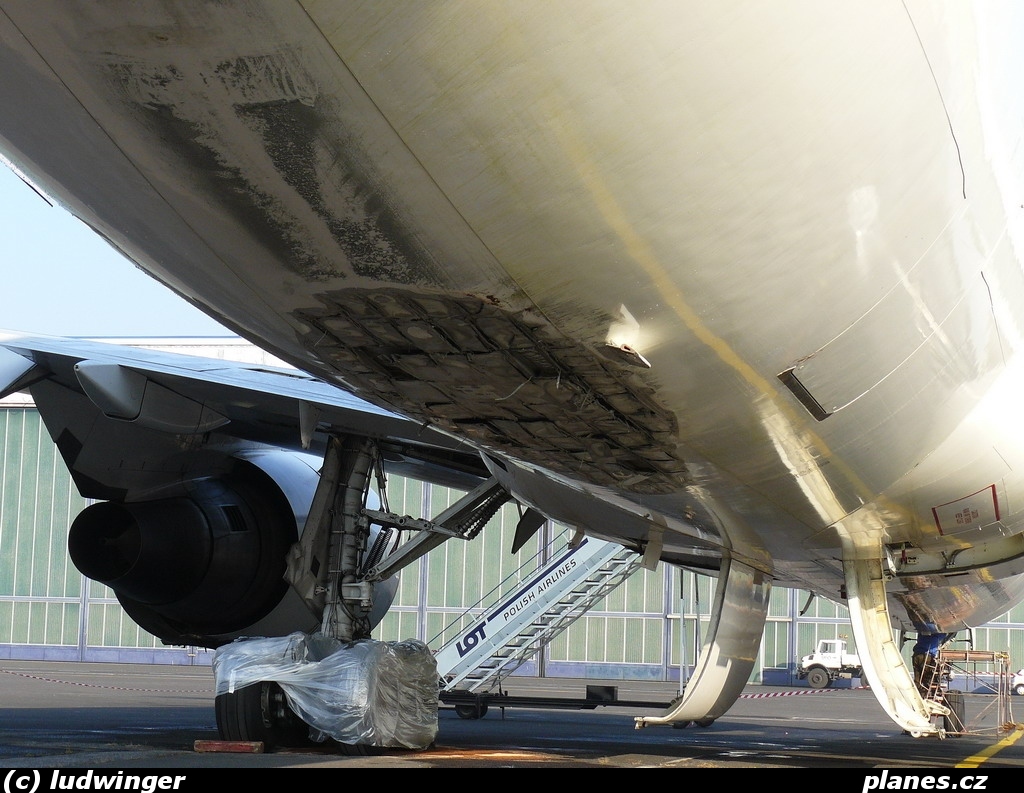
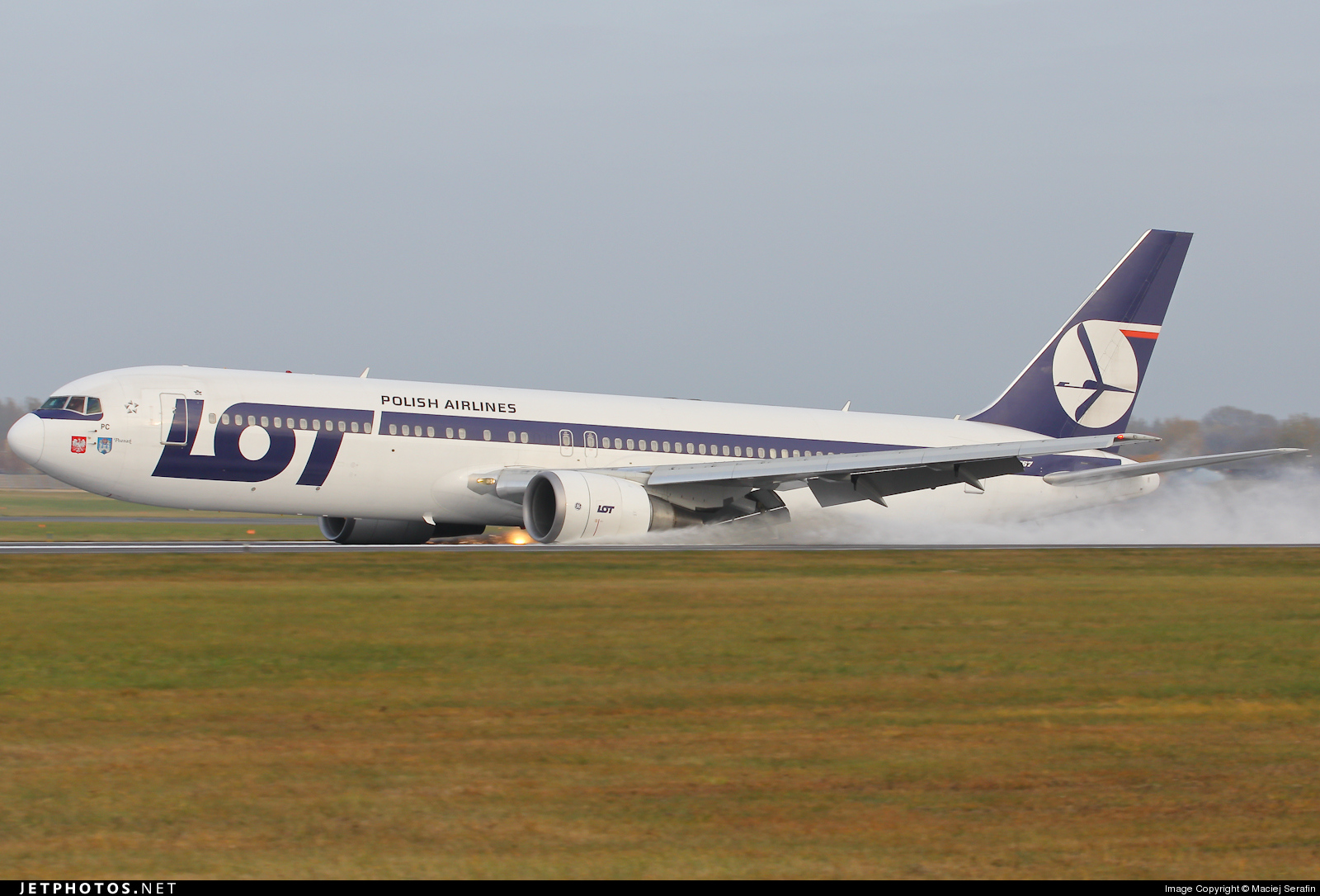
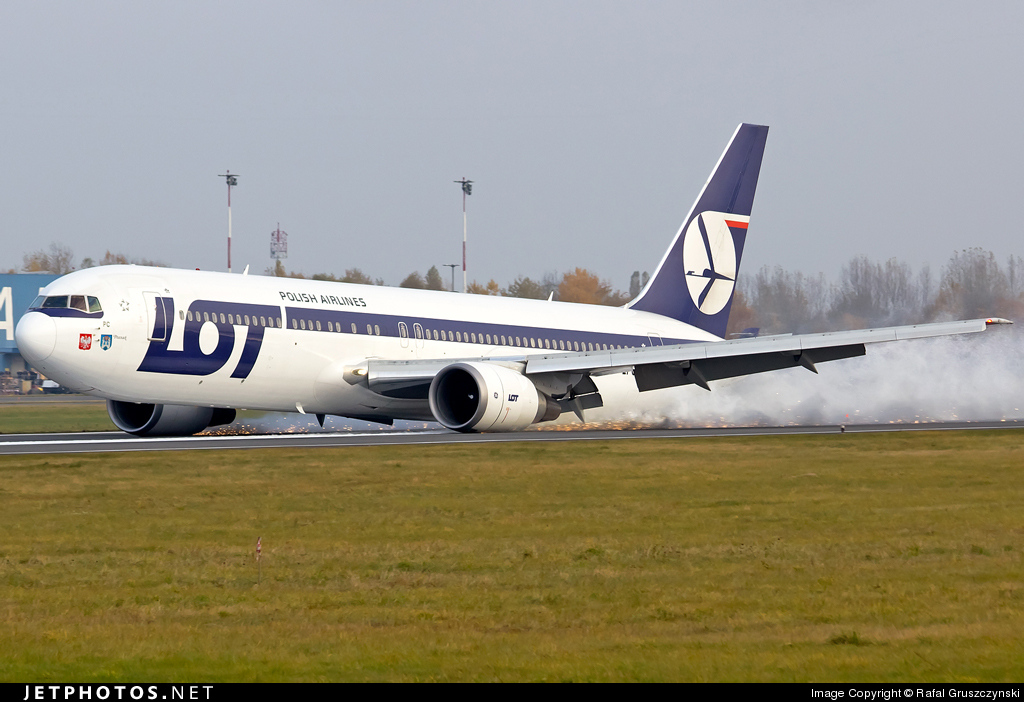
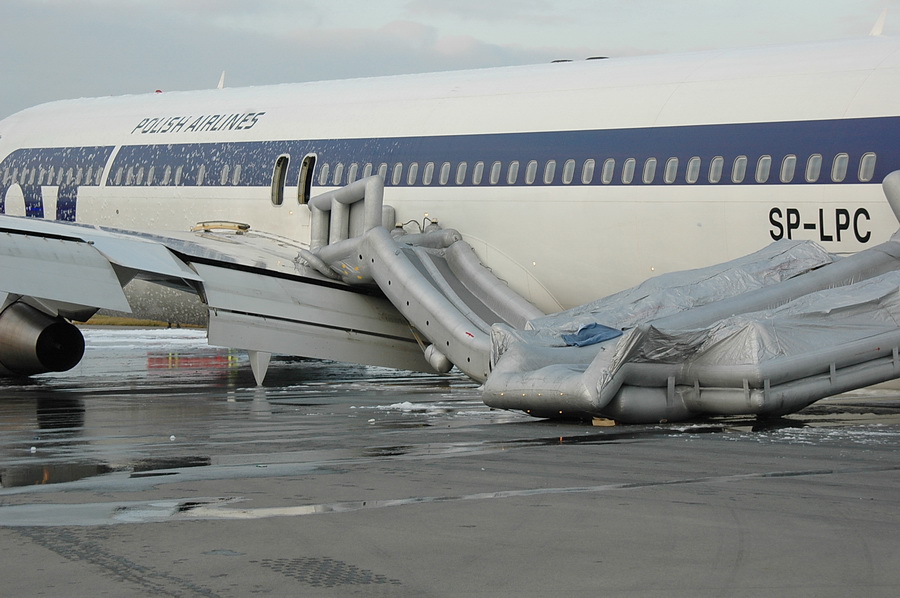
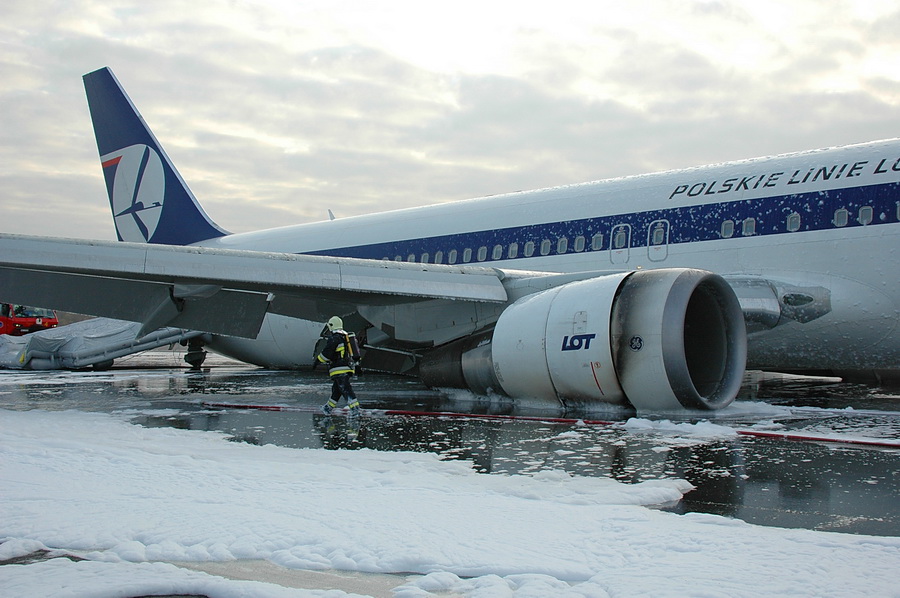
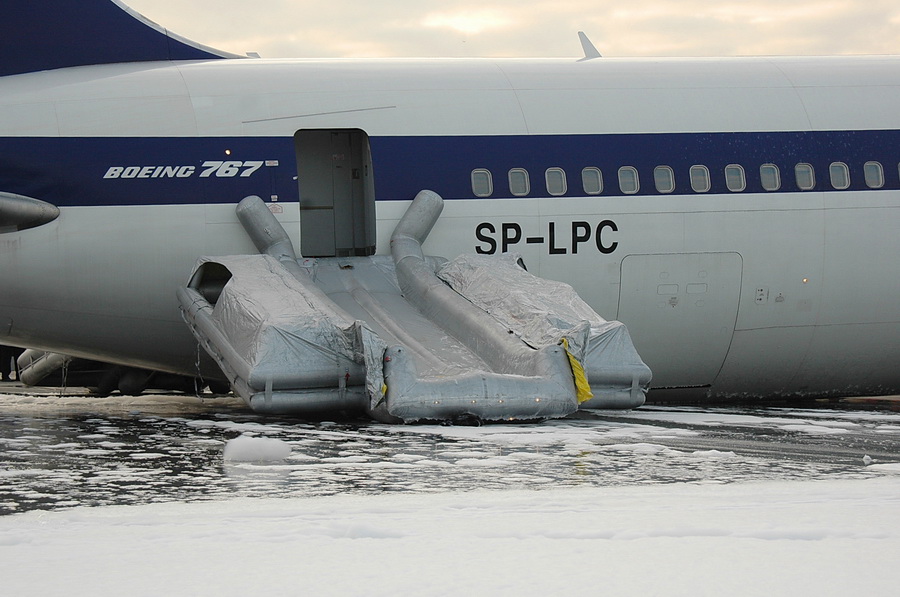
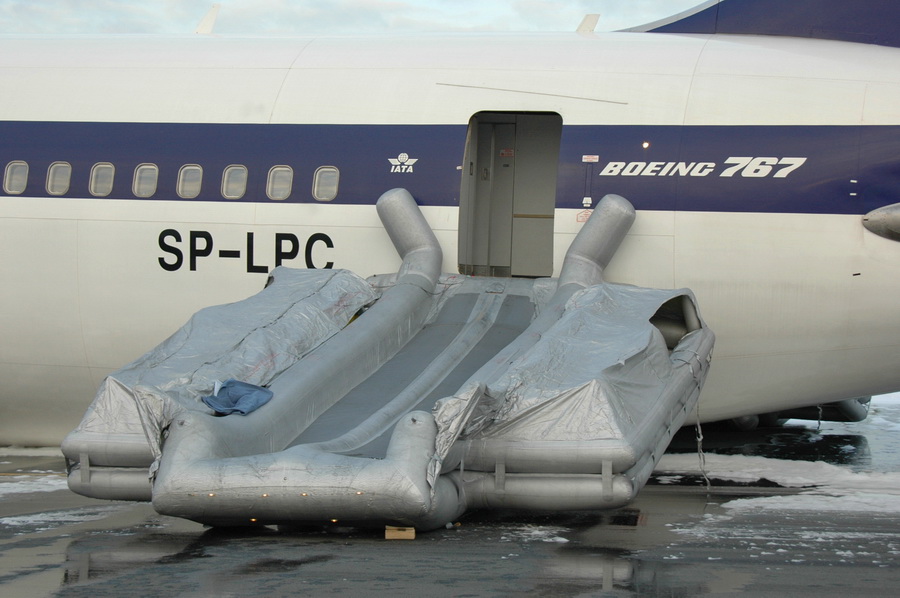
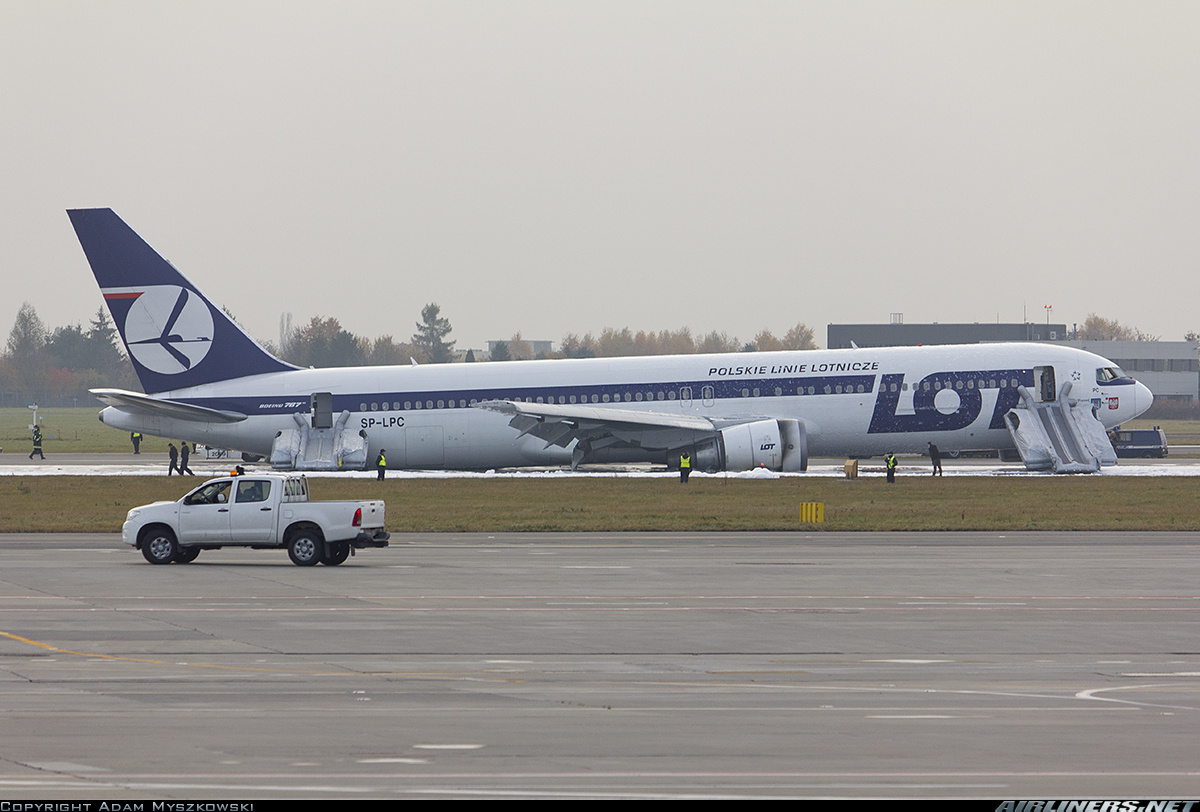
On November 1, 2011 a passenger LO 16 flight of B767-300ER airplane, registration marks SP-LPC, was scheduled from KEWR to EPWA. The Pre-Departure Check of the airplane was carried out by a ground engineer from a contracted service organization in accordance with Operator’s requirements. The ground engineer was responsible for conducting PRE-DEPARTURE CHECK and ETOPS CHECK. The above procedures did not include cockpit check. The ground engineer did not find any failures or irregularities and did not notice anything unusual. The flight crew arrived at Newark Liberty Airport at a time specified by Operator and in accordance with its operating procedures. When commencing the flight duty period the crew members were rested, refreshed, in a good psychophysical condition. They did not report overload by air operations. Upon arrival at the aircraft stand each flight crew member performed his duties as provided for in the operating procedures of the airline. CPT conducted Exterior Walk Around while FO conducted cockpit check. FO checked on-board equipment and the cockpit preparation for the flight. According to the flight crew statement no failures or irregularities were found. The crew deemed the airplane fully operational for the flight to Warsaw. The ground engineer from the contracted maintenance organization was not present in the cockpit during the flight crew preparation. During the flight CPT was PF and FO was PM. At 03:58:11 hrs the crew started the engines. The take-off took place at 04:19:08 hrs. After the take-off, during the retraction of landing gear and flaps the hydraulic fluid from the center hydraulic system (C system) flew out, which consequently led to pressure drop in this system. The pressure drop in the C system was signaled on the hydraulic panel – SYS PRESS and on EICAS - C HYD SYS PRESS and recorded by on-board flight data recorders. After completion HYDRAULIC SYSTEM PRESSURE (C only) procedure contained in QRH and consultation with the Operator's MCC, the flight crew decided to continue the flight to Warsaw. The flight proceeded without significant distortions. Landing in Warsaw was to be carried out with the alternate landing gear extension system. This situation was well known to pilots due to numerous exercises carried out in a flight simulator. Taking advantage of the available time, the CPT and FO developed a plan for landing in accordance with the procedure contained in QRH and discussed an anticipated sequence of events. At 12:17 hrs, during approach to landing on EPWA aerodrome the flight crew performed the procedure of the lading gear extension using the alternate landing gear extension system. However, after the anticipated time the landing gear was not extended. The crew checked the correctness of execution of the procedure against QRH and again attempted to extend the landing gear. After failure of the second attempt to extend the landing gear with the alternate system the approach to landing was abandoned. At 12:22 hrs the crew reported to ATC inability to extend the landing gear and requested the Operator’s MCC assistance. Around 12:25 hrs the flight crew declared EMERGENCY. The airplane was directed to a holding zone. The Operator’s Operations Centre enabled the crew to communicate with experts. FO executed expert recommendations and checked the alternate landing gear extension switch and circuit breakers on P-11 and P6-1 panels. After that FO reported to Operations Centre and to CPT that the circuit breakers had been checked. FO also cycled (pulled and reset) the ALT EXT MOTOR circuit breaker as indicated by an expert. However, the landing gear was not extended. In the meantime pilots of two F-16s of the Polish Air Force inspected SP-LPC from the air and informed the crew that the landing gear was still in the retracted position but the tail skid was extended. After that information the crew attempted to extend the landing gear in a gravitational way, but it also ended in failure. After a series of unsuccessful attempts to extend the landing gear and due to low fuel quantity, the crew decided to carry out an emergency gear up landing. CC1 was instructed by Captain to prepare the cabin and passengers for emergency landing. During the preparation the passengers were calm, they carried out the crew instructions, there was no panic. Prior to the landing firefighters distributed foam over RWY 33 at a distance of about 3000 m. External services arrived at the airport (PSP and emergency ambulances). The plane touched down on RWY 33 of EPWA aerodrome (Figure 7) at 13:39 hrs. At the time of touchdown about 1600 kg of fuel (1939 liters at a density of 0.825 kg/l) was in its tanks, the engines were running and their recorded speeds were N1ACTL = 57%, N1ACTR = 38%. The plane was moving on RWY 33 along its centre line and stopped 42 m after the intersection with RWY 29. When the aircraft was moving, sparks were coming out of the right engine, and they were suppressed by the applied foam; then the engine caught fire. When the airplane came to rest, the crew evacuated the passengers and LSP extinguished the fire. During the evacuation none of the passengers or crew suffered any injuries. During the landing the aircraft sustained substantial damage, which caused its withdrawal from service.
Probable cause:
Causes of the accident:
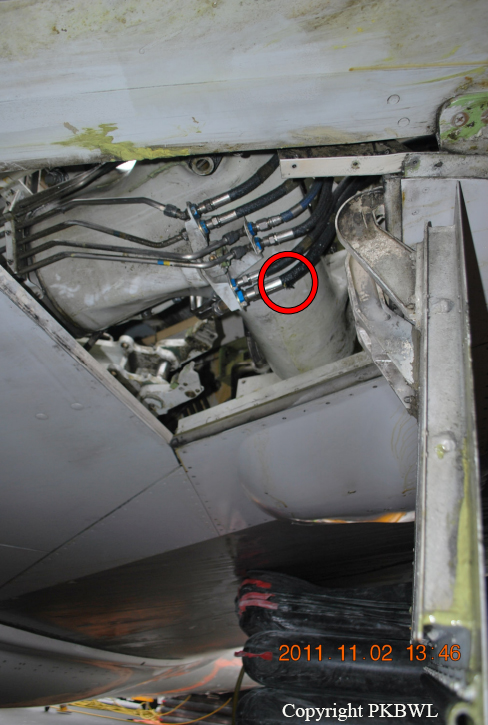
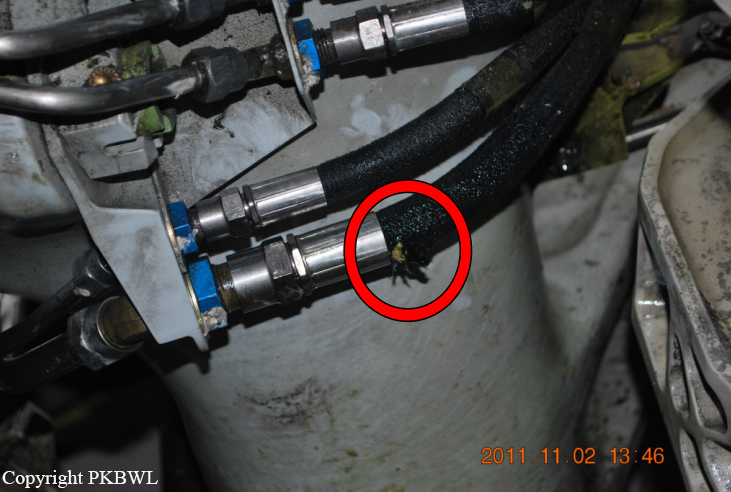
1. Failure of the hydraulic hose connecting the hydraulic system on the right leg of the main landing gear with the center hydraulic system, which initiated the occurrence.
2. Open C829 BAT BUS DISTR circuit breaker in the power supply circuit of the alternate landing gear extension system in the situation when the center hydraulic system was inoperative.
3. The crew’s failure to detect the open C829 circuit breaker during approach to landing, after detecting that the landing gear could not be extended with the alternate system.
Factors contributing to the occurrence were as follow:
1. Lack of guards protecting the circuit breakers on P6-1 panel against inadvertent mechanical opening; from 863 production line the guards have been mounted in the manufacturing process (SP-LPC was 659 production line).
2. C829 location on panel P6-1 (extremely low position), impeding observation of its setting and favoring its inadvertent mechanical opening.
3. Lack of effective procedures at the Operator’s Operations Centre, which impeded specialist support for the crew.
4. Operator’s failure to incorporate Service Bulletin 767-32-0162.
Final Report:

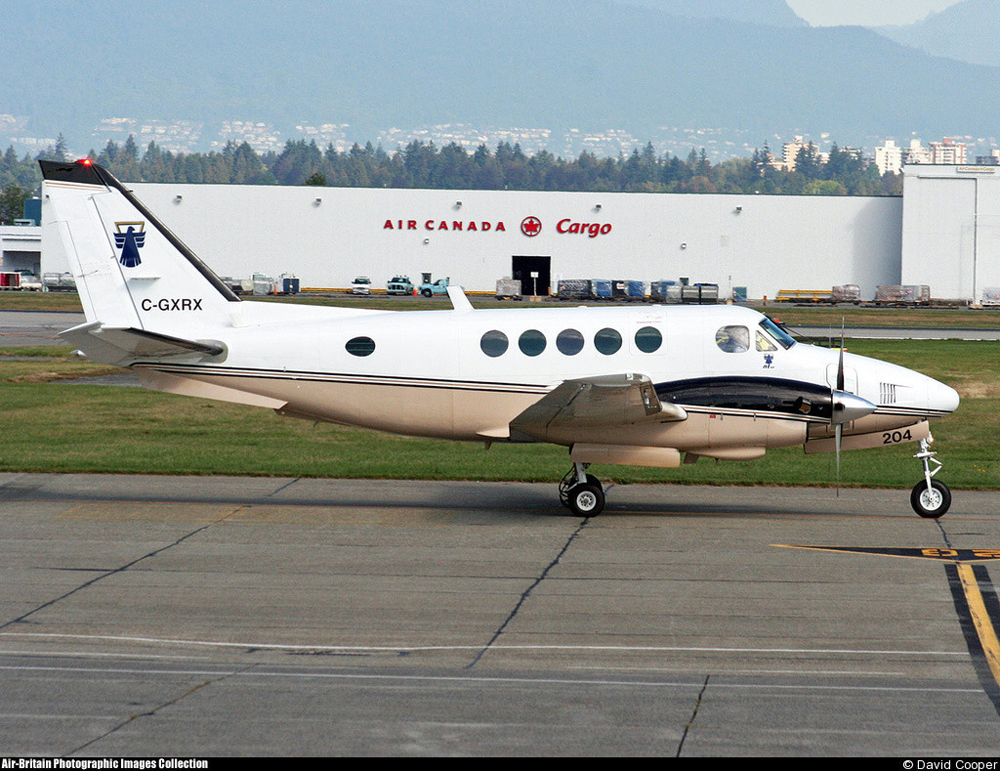
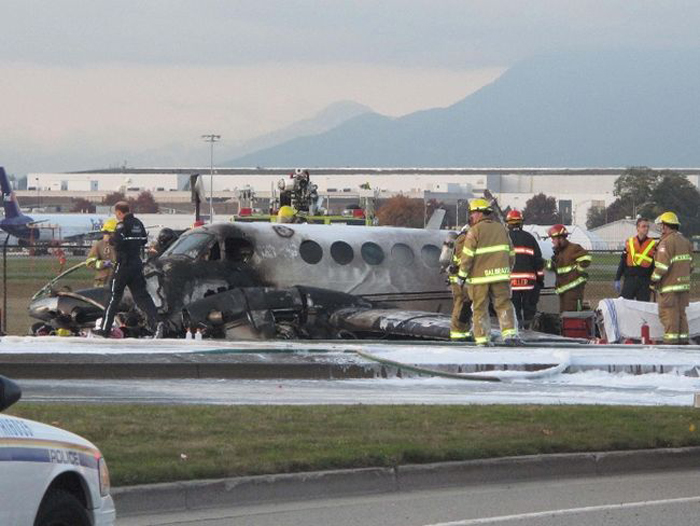
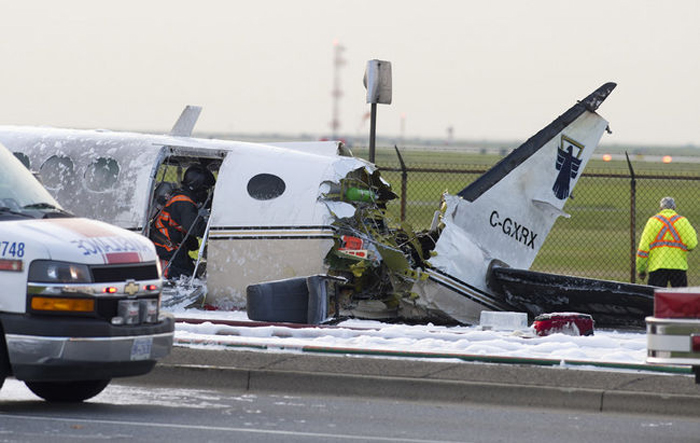
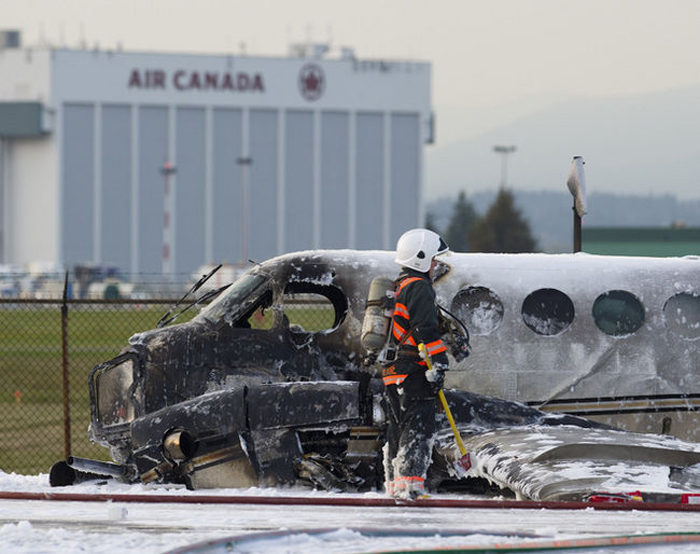
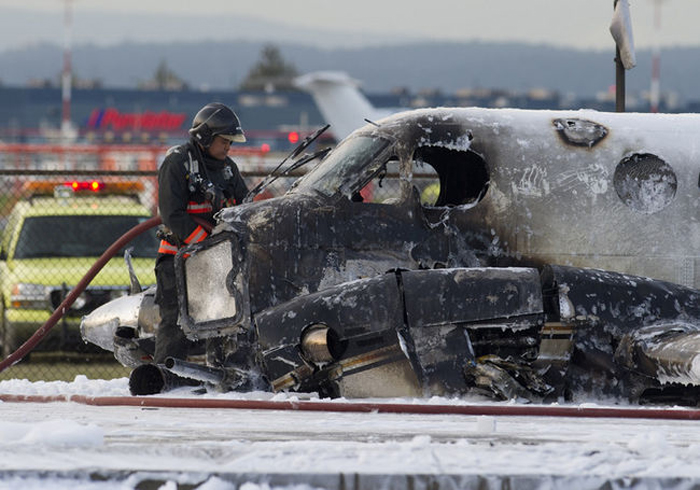
Crash of a Beechcraft A100 King Air in Vancouver: 2 killed

Date & Time: Oct 27, 2011 at 1612 LT
Type of aircraft:
Operator:
Registration:
C-GXRX
Survivors:
Yes
Schedule:
Vancouver - Kelowna
MSN:
B-36
YOM:
1970
Flight number:
NTA204
Country:
Crew on board:
2
Crew fatalities:
Pax on board:
7
Pax fatalities:
Other fatalities:
Total fatalities:
2
Captain / Total flying hours:
13876
Captain / Total hours on type:
978.00
Copilot / Total flying hours:
1316
Copilot / Total hours on type:
85
Aircraft flight hours:
26993
Circumstances:
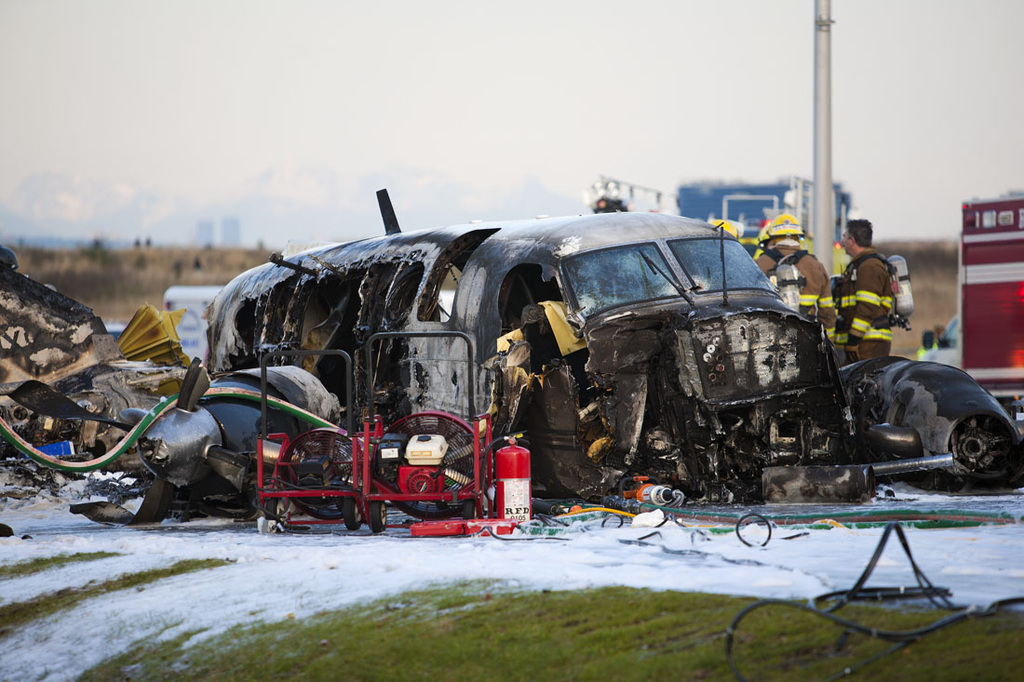
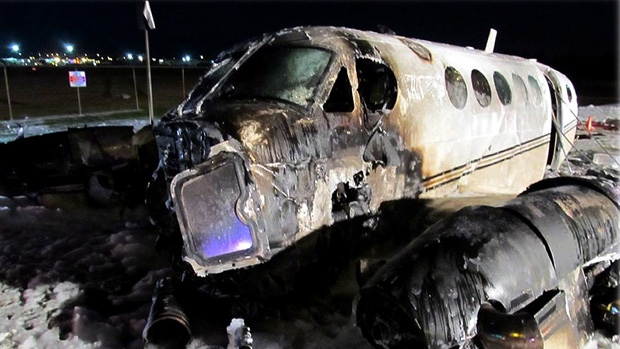
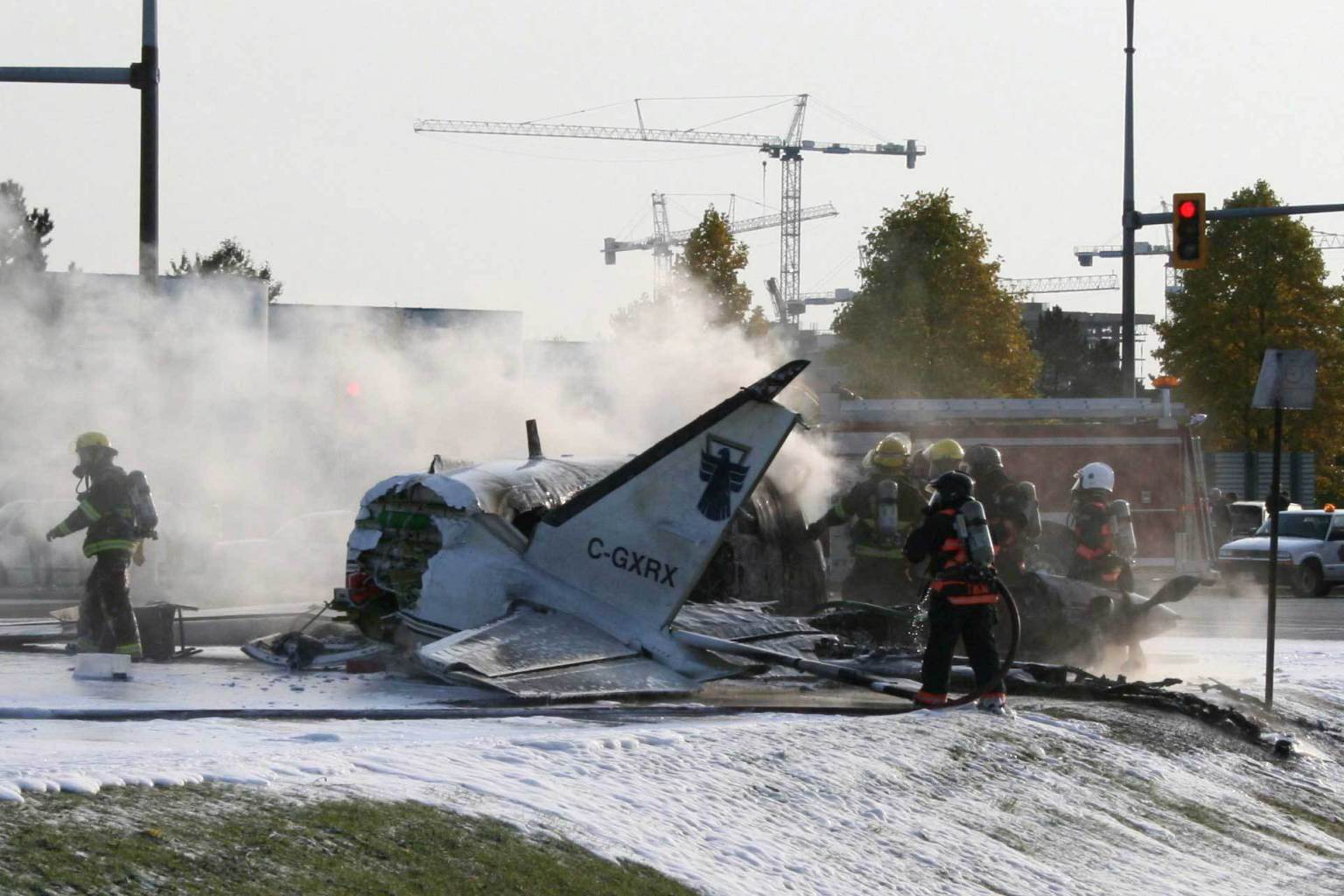
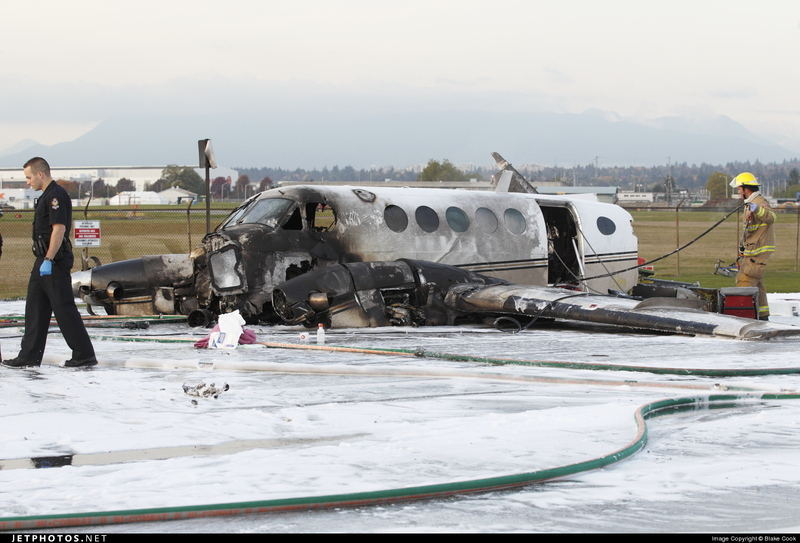
The Northern Thunderbird Air Incorporated Beechcraft King Air 100 (serial number B-36, registration C‑GXRX) departed Vancouver International Airport for Kelowna, British Columbia, with 7 passengers and 2 pilots on board. About 15 minutes after take-off, the flight diverted back to Vancouver because of an oil leak. No emergency was declared. At 1611 Pacific Daylight Time, when the aircraft was about 300 feet above ground level and about 0.5 statute miles from the runway, it suddenly banked left and pitched nose-down. The aircraft collided with the ground and caught fire before coming to rest on a roadway just outside of the airport fence. Passersby helped to evacuate 6 passengers; fire and rescue personnel rescued the remaining passenger and the pilots. The aircraft was destroyed, and all of the passengers were seriously injured. Both pilots succumbed to their injuries in hospital. The aircraft’s emergency locator transmitter had been removed.
Probable cause:
Findings as to causes and contributing factors:
During routine aircraft maintenance, it is likely that the left-engine oil-reservoir cap was left unsecured.
There was no complete preflight inspection of the aircraft, resulting in the unsecured engine oil-reservoir cap not being detected, and the left engine venting significant oil during operation.
A non-mandatory modification, designed to limit oil loss when the engine oil cap is left unsecure, had not been made to the engines.
Oil that leaked from the left engine while the aircraft was repositioned was pointed out to the crew, who did not determine its source before the flight departure.
On final approach, the aircraft slowed to below VREF speed. When power was applied, likely only to the right engine, the aircraft speed was below that required to maintain directional control, and it yawed and rolled left, and pitched down.
A partially effective recovery was likely initiated by reducing the right engine’s power; however, there was insufficient altitude to complete the recovery, and the aircraft collided with the ground.
Impact damage compromised the fuel system. Ignition sources resulting from metal friction, and possibly from the aircraft’s electrical system, started fires.
The damaged electrical system remained powered by the battery, resulting in arcing that may have ignited fires, including in the cockpit area.
Impact-related injuries sustained by the pilots and most of the passengers limited their ability to extricate themselves from the aircraft.
Findings as to risk:
Multi-engine−aircraft flight manuals and training programs do not include cautions and minimum control speeds for use of asymmetrical thrust in situations when an engine is at low power or the propeller is not feathered. There is a risk that pilots will not anticipate aircraft behavior when using asymmetrical thrust near or below unpublished critical speeds, and will lose control of the aircraft.
The company’s standard operating procedures lacked clear directions for how the aircraft was to be configured for the last 500 feet, or what to do if an approach is still unstable when 500 feet is reached, specifically in an abnormal situation. There is a demonstrated risk of accidents occurring as a result of unstabilized approaches below 500 feet above ground level.
Without isolation of the aircraft batteries following aircraft damage, there is a risk that an energized battery may ignite fires by electrical arcing.
Erroneous data used for weight-and-balance calculations can cause crews to inadvertently fly aircraft outside of the allowable center-of-gravity envelope.
Final Report:

Crash of a De Havilland DHC-8-100 near Madang: 28 killed

Date & Time: Oct 13, 2011 at 1717 LT
Operator:
Registration:
P2-MCJ
Survivors:
Yes
Schedule:
Port Moresby - Lae - Madang
MSN:
125
YOM:
1988
Flight number:
CG1600
Location:
Region:
Crew on board:
4
Crew fatalities:
Pax on board:
28
Pax fatalities:
Other fatalities:
Total fatalities:
28
Captain / Total flying hours:
18200
Captain / Total hours on type:
500.00
Copilot / Total flying hours:
2725
Copilot / Total hours on type:
391
Aircraft flight hours:
38421
Aircraft flight cycles:
48093
Circumstances:
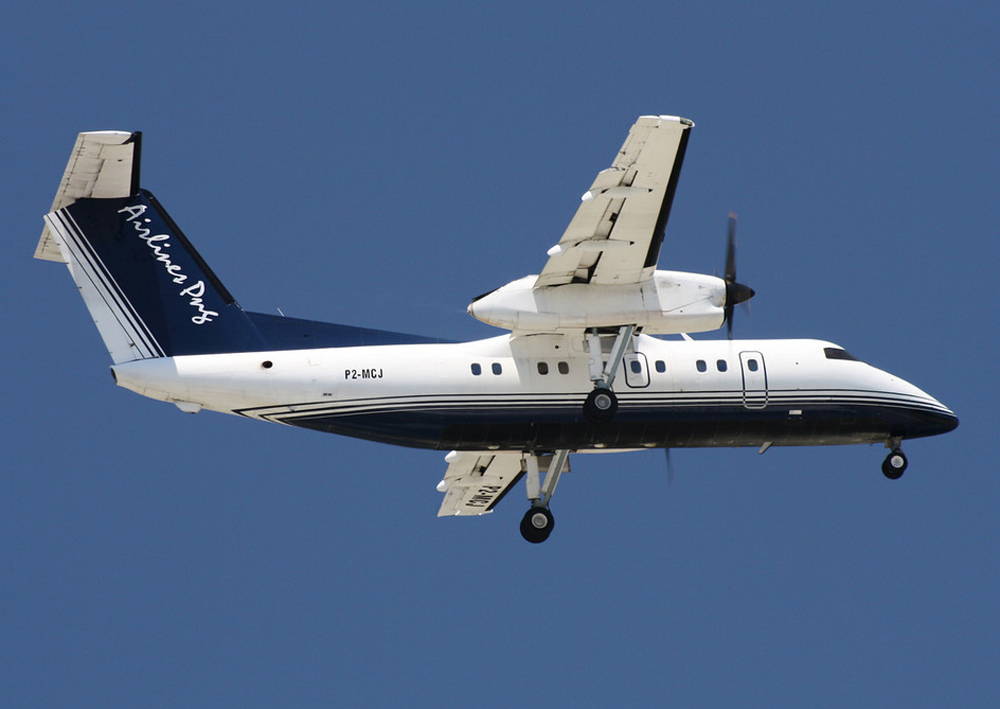
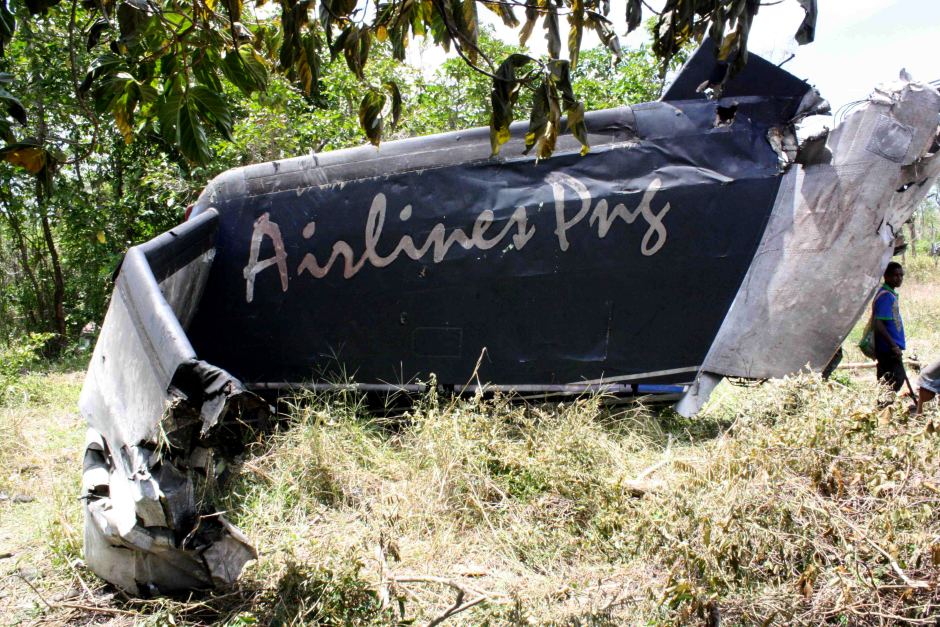
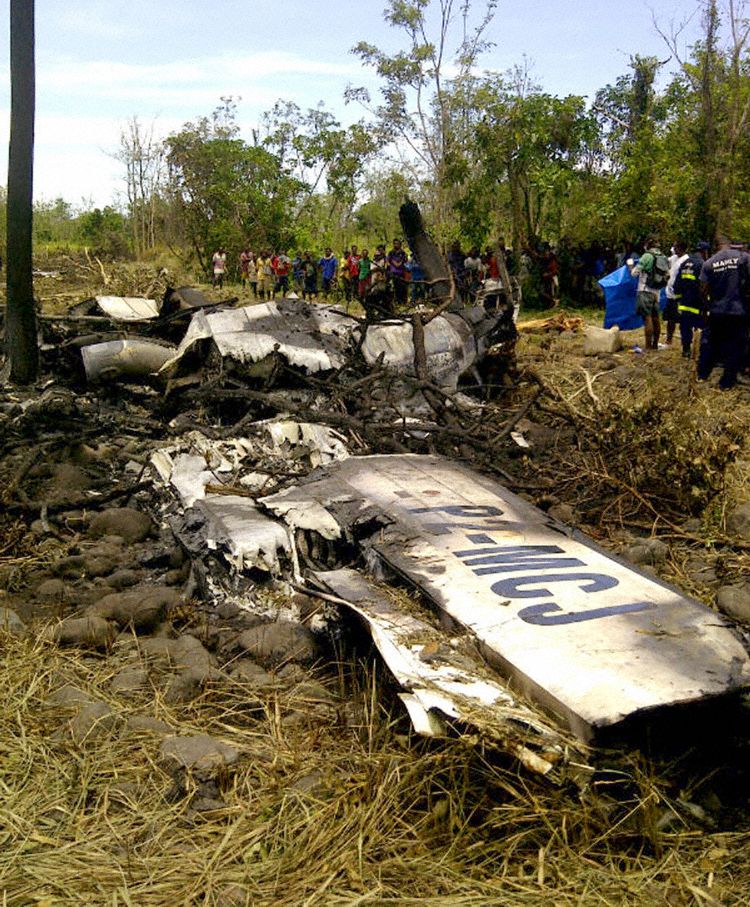
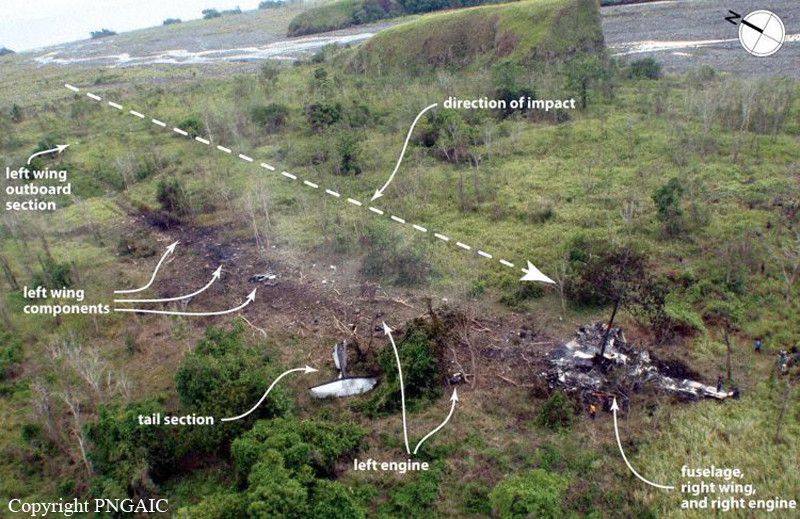
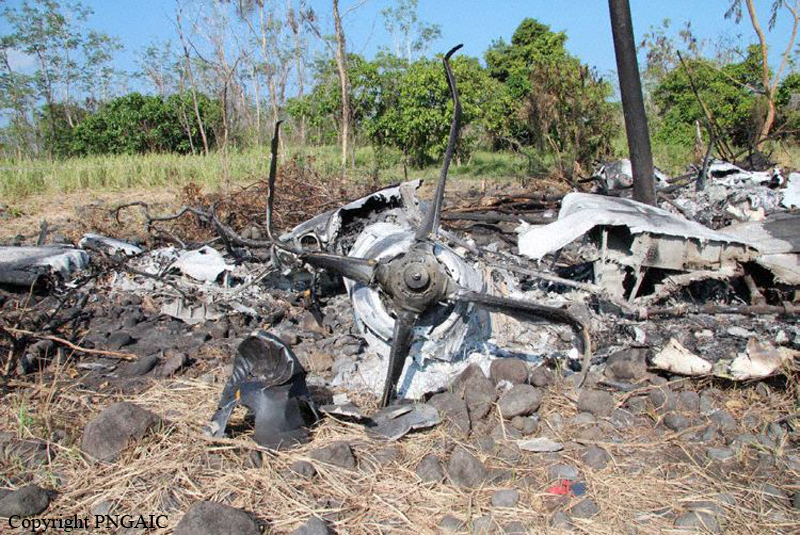
On the afternoon of 13 October 2011, an Airlines PNG Bombardier DHC-8-103, registered P2-MCJ (MCJ), was conducting a regular public transport flight from Nadzab, Morobe Province, to Madang, Madang Province under the Instrument Flight Rules (IFR). On board the aircraft were two flight crew, a flight attendant, and 29 passengers. Earlier in the afternoon, the same crew had flown MCJ from Port Moresby to Nadzab. The autopilot could not be used because the yaw damper was unserviceable so the aircraft had to be hand-flown by the pilots. At Nadzab, the aircraft was refuelled with sufficient fuel for the flight to Madang and a planned subsequent flight from Madang to Port Moresby. MCJ departed Nadzab at 1647 LMT with the Pilot-in-Command as the handling pilot. The aircraft climbed to 16,000 ft with an estimated arrival time at Madang of 1717. Once in the cruise, the flight crew diverted right of the flight planned track to avoid thunderstorms and cloud. The Pilot-in-Command reported that communications between Madang Tower and an aircraft in the vicinity of Madang indicated a storm was approaching the aerodrome. He recalled that he had intended to descend below the cloud in order to be able to see across the sea to Madang and had been concentrating on manoeuvring the aircraft to remain clear of thunderstorms and cloud, so he had been looking mainly outside the cockpit. Because of the storm in the vicinity of the airport, he said there had been „some urgency‟ to descend beneath the cloud base to position for a right base for runway 07 at Madang, the anticipated approach. On this route, the descent to Madang was steep (because of the need to remain above the Finisterre Ranges until close to Madang) and, although the aircraft was descending steeply, the propellers were at their cruise setting of 900 revolutions per minute (RPM). Neither pilot noticed the airspeed increasing towards the maximum operating speed (VMO); the Pilot-in-Command reported afterwards that he had been „distracted‟ by the weather. When the aircraft reached VMO as it passed through 10,500 ft, with a rate of descent between 3,500 and 4,200 ft per minute, and the propellers set at 900 RPM, the VMO overspeed warning sounded. The Pilot-in-command reported that he had been about to ask the First Officer to increase the propeller speed to 1,050 RPM to slow the aircraft when this occurred. He raised the nose of the aircraft in response to the warning and this reduced the rate of descent to about 2,000 ft per minute, however, the VMO overspeed warning continued. The First Officer recalled the Pilot-in-Command moved the power levers back „quite quickly‟. Shortly after the power levers had been moved back, both propellers oversped simultaneously, exceeding their maximum permitted speed of 1,200 RPM by over 60 % and seriously damaging the left hand engine and rendering both engines unusable. Villagers on the ground reported hearing a loud „bang‟ as the aircraft passed overhead. The noise in the cockpit was deafening, rendering communication between the pilots extremely difficult, and internal damage to the engines caused smoke to enter the cockpit and cabin through the bleed air and air conditioning systems. The emergency caught both pilots by surprise. There was confusion and shock on the flight deck, a situation compounded by the extremely loud noise from the overspeeding propellers. About four seconds after the double propeller overspeed began, the beta warning horn started to sound intermittently, although the pilots stated afterwards they did not hear it. The left propeller RPM reduced to 900 RPM (in the governing range) after about 10 seconds. It remained in the governing range for about 5 seconds before overspeeding again for about 15 seconds, then returned to the governing range. During this second overspeed of the left propeller, the left engine high speed compressor increased above 110 % NH, becoming severely damaged in the process. About 3 seconds after the left propeller began overspeeding for the second time, the right propeller went into uncommanded feather due to a propeller control unit (PCU) beta switch malfunction, while the right engine was still running at flight idle (75% NH). Nine seconds after the double propeller overspeed event began, the Pilot-in-command shouted to the First Officer „what have we done?‟ The First Officer replied there had been a double propeller overspeed. The Pilot-in-command then shouted a second and third time „what have we done?‟. The First Officer repeated that there was a double propeller overspeed and said that the right engine had shut down. The Pilot-in-Command shouted that he could not hear the First Officer, who – just as the left propeller began governing again and the overspeed noise subsided – repeated that the right engine had shut down and asked if the left engine was still working. The Pilot-in-command replied that it was not working. Both pilots then agreed that they had „nothing‟. At this point, about 40 seconds after the propeller overspeed event began, the left propeller was windmilling and the left engine was no longer producing any power because of the damage caused to it by the overspeed. The right engine was operating at flight idle, although the propeller could not be unfeathered and therefore could not produce any thrust. On the order of the Pilot-in-Command, the First Officer made a mayday call to Madang Tower and gave the aircraft's GPS position; he remained in a radio exchange with Madang Tower for 63 seconds. The flight crew did not conduct emergency checklists and procedures. Instead, their attention turned to where they were going to make a forced landing. The aircraft descended at a high rate of descent, with the windmilling left propeller creating extra drag. The asymmetry between the windmilling left propeller and the feathered right propeller made the aircraft difficult to control. The average rate of descent between the onset of the emergency and arrival at the crash site was 2,500 ft per minute and at one point exceeded 6,000 ft per minute, and the VMO overspeed warning sounded again. During his long radio exchange with Madang Tower, the First Officer had said that they would ditch the aircraft, although, after a brief discussion, the Pilot-in-command subsequently decided to make a forced landing in the mouth of the Guabe River. The First Officer asked the Pilot-in-command if he should shut both engines down and the Pilot-in-command replied that he should shut „everything‟ down. Approximately 800 feet above ground level and 72 seconds before impact, the left propeller was feathered and both engines were shut down. The Pilot-in-Command reported afterwards that he ultimately decided to land beside the river instead of in the river bed because the river bed contained large boulders. The area chosen beside the river bed also contained boulders beneath the vegetation, but they were not readily visible from the air. He recalled afterwards that he overshot the area he had originally been aiming for. The aircraft impacted terrain at 114 knots with the flaps and the landing gear retracted. The Flight Attendant, who was facing the rear of the aircraft, reported that the tail impacted first. During the impact sequence, the left wing and tail became detached. The wreckage came to rest 300 metres from the initial impact point and was consumed by a fuel-fed fire. The front of the aircraft fractured behind the cockpit and rotated through 180 degrees, so that it was inverted when it came to rest. Of the 32 occupants of the aircraft only the two pilots, the flight attendant, and one passenger survived by escaping from the wreckage before it was destroyed by fire.
Probable cause:
From the evidence available, the following findings are made with respect to the double propeller overspeed 35 km south south east of Madang on 13 October 2011 involving a Bombardier Inc. DHC-8-103 aircraft, registered P2-MCJ. They should not be read as apportioning blame or liability to any organisation or individual.
Contributing safety factors:
- The Pilot-in-Command moved the power levers rearwards below the flight idle gate shortly after the VMO overspeed warning sounded. This means that the release triggers were lifted during the throttle movement.
- The power levers were moved further behind the flight idle gate leading to ground beta operation in flight, loss of propeller speed control, double propeller overspeed, and loss of usable forward thrust, necessitating an off-field landing.
- A significant number of DHC-8-100, -200, and -300 series aircraft worldwide did not have a means of preventing movement of the power levers below the flight idle gate in flight, or a means to prevent such movement resulting in a loss of propeller speed control.
Other safety factors:
- Prior to the VMO overspeed warning, the Pilot-in-Command allowed the rate of descent to increase to 4,200 ft per minute and the airspeed to increase to VMO.
- The beta warning horn malfunctioned and did not sound immediately when one or both of the flight idle gate release triggers were lifted. When the beta warning horn did sound, it did so intermittently and only after the double propeller overspeed had commenced. The sound of the beta warning horn was masked by the noise of the propeller overspeeds.
- There was an uncommanded feathering of the right propeller after the overspeed commenced due to a malfunction within the propeller control beta backup system during the initial stages of the propeller overspeed.
- The right propeller control unit (PCU) fitted to MCJ was last overhauled at an approved overhaul facility which had a quality escape issue involving incorrect application of beta switch reassembly procedures, after a service bulletin modification. The quality escape led to an uncommanded feather incident in an aircraft in the United States due to a beta switch which stuck closed.
- Due to the quality escape, numerous PCU‟s were recalled by the overhaul facility for rectification. The right PCU fitted to MCJ was identified as one of the units that may have been affected by the quality escape and would have been subject to recall had it still been in service.
The FDR data indicated that the right PCU fitted to MCJ had an uncommanded feather, most likely due to a beta switch stuck in the closed position, induced by the propeller overspeed. It was not possible to confirm if the overhaul facility quality escape issue contributed to the beta switch sticking closed, because the PCU was destroyed by the post-impact fire.
- The landing gear and flaps remained retracted during the off-field landing. This led to a higher landing speed than could have been achieved if the gear and flaps had been extended, and increased the impact forces on the airframe and its occupants.
- No DHC-8 emergency procedures or checklists were used by the flight crew after the emergency began.
- The left propeller was not feathered by the flight crew after the engine failed.
- The investigation identified several occurrences where a DHC-8 pilot inadvertently moved one or both power levers behind the flight idle gate in flight, leading to a loss of propeller speed control. Collectively, those events indicated a systemic design issue with the integration of the propeller control system and the aircraft.
Other key findings:
- The flaps and landing gear were available for use after the propeller overspeeds and the engine damage had occurred.
- There was no regulatory requirement to fit the beta lockout system to any DHC-8 aircraft outside the USA at the time of the accident.
- The autopilot could not be used during the accident flight.
- The operator's checking and training system did not require the flight crew to have demonstrated the propeller overspeed emergency procedure in the simulator.
- After the accident, the aircraft manufacturer identified a problem in the beta warning horn system that may have led to failures not being identified during regular and periodic tests of the system.
Final Report: