Crash of a Learjet 25B in Houston: 2 killed

Date & Time: Jan 13, 1998 at 0810 LT
Type of aircraft:
Registration:
N627WS
Flight Type:
Survivors:
No
Schedule:
Houston - Fargo
MSN:
25-170
YOM:
1974
Crew on board:
2
Crew fatalities:
Pax on board:
0
Pax fatalities:
Other fatalities:
Total fatalities:
2
Captain / Total flying hours:
8777
Captain / Total hours on type:
2512.00
Aircraft flight hours:
8943
Circumstances:
The flight crew was positioning the airplane in preparation for a revenue flight when it crashed 2 nautical miles (nm) short of the runway during a second instrument landing system approach in instrument meteorological conditions. Except for the final 48 seconds of the 25- minute flight, the captain was the flying pilot, and the first officer was the nonflying pilot. When the airplane was about 0.5 nm inside the outer marker on the first approach, the compass warning flag on the captain's course deviation indicator appeared, indicating that the heading display was unreliable. The airplane deviated from the localizer centerline to the left but continued to descend. After about 1 minute, during which time the airplane's track continued to diverge from the localizer centerline, the flight crew executed a missed approach. The flight crew then unsuccessfully attempted to clear the compass flag by resetting circuit breakers. The captain directed the first officer to request a second approach. Contrary to company crew coordination procedures, the flight crew did not conduct an approach briefing or make altitude callouts for either approach. Although accurate heading information was available to the captain on his radio magnetic indicator, he experienced difficulty tracking the localizer course as the airplane proceeded past the outer marker on the second approach. The captain transferred control to the first officer when the airplane was 1.9 nm inside the outer marker. The airplane then began to deviate below the glideslope. The descent continued through the published decision height of 200 feet above ground level, and the airplane struck 80-foot-tall trees. Post accident testing revealed that the first officer's instruments were displaying a false full fly-down glideslope indication because of a failed amplifier in the navigation receiver. The glideslope deficiency was discovered 2 months before the accident by another flight crew. An FAA repair station attempted to resolve the problem and misdiagnosed it as "sticking" needles in the cockpit instruments. The operator was immediately advised of the problem. The operator's minimum equipment list for the airplane required that the problem be repaired within 10 days, but the operator improperly deferred maintenance on it for 60 days and allowed the unairworthy airplane to be flown by the accident flight crew. The airplane was not equipped with, nor was it required to be equipped with, a ground proximity warning system, which would have sounded 40 seconds before impact.
Probable cause:
The flight crew's continued descent of the airplane below the glideslope and through the published decision height without visual contact with the runway environment. Also, when the captain encountered difficulty tracking the localizer course, his improper decision to continue the approach by transferring control to the first officer instead of executing a missed approach contributed to the cause.
In addition, the following were factors to the accident:
(1) American Corporate Aviation's failure to provide an airworthy airplane to the flight crew following maintenance, resulting in a false glideslope indication to the first officer;
(2) the flight crew's failure to follow company crew coordination procedures, which called for approach briefings and altitude callouts; and
(3) the lack of an FAA requirement for a ground proximity warning system on the airplane.
Final Report:


Crash of a Rockwell Aero Commander 500B in Ennis: 2 killed

Date & Time: Jan 10, 1998 at 1427 LT
Registration:
N556BW
Flight Type:
Survivors:
Yes
Schedule:
Lancaster - Laredo
MSN:
500-1625-215
YOM:
1966
Location:
Crew on board:
2
Crew fatalities:
Pax on board:
1
Pax fatalities:
Other fatalities:
Total fatalities:
2
Captain / Total flying hours:
1550
Aircraft flight hours:
8081
Circumstances:
After departing on an IFR flight in VFR conditions, the flight had been cleared to climb from 3,000 to 4,000 feet, when the right engine lost power. The pilots diverted toward an uncontrolled airport, secured the right engine, & cancelled their IFR clearance. They made an approach to land on runway 15, then attempted a single engine go-around. During the go-around, the airplane yawed/rolled to the right in what the passenger believed was a VMC roll. It then struck power lines & crashed in a right wing low attitude. Investigation revealed that both pilots held multi-engine ratings. The owner said the pilot (PIC) had flown the airplane for a short time on 12/21/98; however, no other record was found to verify that either the pilot or copilot had flight experience in this make/model of airplane. Examination of the wreckage revealed evidence that the flaps were retracted, the landing gear was in transit, the left propeller was operating with power, & the right propeller was feathered. The airplane had a history of fuel flow fluctuations in the right engine. The diaphragm (P/N 364446) in the right engine distributor valve assembly was found ruptured. It was an old style diaphragm, which was colored black. Bendix Service Bulletin RS-76, issued 11/15/80, called for replacement of the black diaphragm with a red fluorosilicone diaphragm (P/N 245088) at overhaul. The engine was overhauled in June 1992. During maintenance in December 1997, both fuel system injectors & nozzles were tested; however, the distributor valve assembles were not tested. Calculations showed the airplane was loaded 116.3 lbs over the maximum allowable gross weight & 1.3 inches forward of the allowable CG range.
Probable cause:
failure of the flight crew to maintain minimum control speed (VMC) during go-around from a single-engine approach, which resulted in loss of control and collision with power lines and the ground. Related factors were: a ruptured diaphragm in the distributor valve (flow divider) of the right engine's fuel injector system, which resulted in loss of power in the right engine; inadequate maintenance; a failure to comply with Bendix Service Bulletin RS-76; the airplane's excessive gross weight and forward center-of-gravity (CG); and both pilots' lack of experience in this make and model of airplane.
Final Report:

Crash of a Cessna 208B Super Cargomaster in Maiden: 1 killed

Date & Time: Jan 9, 1998 at 1704 LT
Type of aircraft:
Operator:
Registration:
N913FE
Flight Phase:
Flight Type:
Survivors:
No
Schedule:
Maiden - Greensboro
MSN:
208B-0013
YOM:
1987
Crew on board:
1
Crew fatalities:
Pax on board:
0
Pax fatalities:
Other fatalities:
Total fatalities:
1
Captain / Total flying hours:
4030
Captain / Total hours on type:
860.00
Aircraft flight hours:
6183
Circumstances:
The pilot was reported to be in a hurry as he positioned two aircraft and picked up the accident aircraft for his final positioning leg. He told company personnel he had a birthday party to go to and his family confirmed this. The pilot reported to company personnel that he was departing on runway 3 and that he would report in on his arrival at the destination. No further contacts with the flight were made and the wreckage of the aircraft was discovered off the end of the departure runway about 40 minutes after his reported takeoff. Examination showed the aircraft had run off the left side of the runway about 800 feet from the end and then crossed over the runway and entered into the woods at the departure end of the runway. Post crash examination showed no evidence of pre crash failure or malfunction of the aircraft structure, flight controls, or engine. The onboard engine computer showed the engine was producing normal engine power and the aircraft was traveling at 98 knots when electrical power was lost as it collided with trees. The aircraft's control lock was found tangled in the instrument panel near the left control yoke where it is normally installed and the lock had multiple abnormal bends, including a 90 degree bend in the last 1/2 inch of the lock where it engages the control column. Removal of the control lock and checking the flight controls for freedom is on the normal pilots checklist. The pilot was also found to not be wearing his shoulder harness.
Probable cause:
The pilot's failure to remove the control lock prior to takeoff and his failure to abort the takeoff when he was unable to initiate a climb, resulting in the aircraft over running the runway and colliding with trees on the departure end of the runway. Contributing to the accident was the pilot's self-induced pressure to arrive at his destination to attend a family affair.
Final Report:

Crash of a Cessna 500 Citation I in Pittsburgh

Date & Time: Jan 6, 1998 at 1548 LT
Type of aircraft:
Operator:
Registration:
N1DK
Survivors:
Yes
Schedule:
Statesville - Akron - Pittsburgh
MSN:
500-0175
YOM:
1974
Crew on board:
2
Crew fatalities:
Pax on board:
1
Pax fatalities:
Other fatalities:
Total fatalities:
0
Captain / Total flying hours:
3745
Captain / Total hours on type:
1260.00
Copilot / Total flying hours:
946
Copilot / Total hours on type:
150
Aircraft flight hours:
7124
Circumstances:
The pilot initiated an ILS approach with rain and fog. Approach flaps were maintained until the runway was sighted, and then landing flaps were set. The airplane landed long, overran the runway, struck the ILS localizer antenna on the departure end of the runway, and came to rest at the edge of a mobile home park. The airplane and two mobile homes were destroyed by fire. Vref had been computed at 110 Kts. The PIC reported a speed on final of 130 Kts, while the SIC said it was 140 Kts. Radar data revealed a 160 knots ground speed from the outer marker until 1.8 miles from touchdown. The airplane passed the control tower, airborne, with 2,500 feet of runway remaining on the 6,500 foot long runway. Performance data revealed that the airplane would require about 2,509 feet on a dry runway, and 5,520 feet on a wet runway. The airplane was not equipped with thrust reversers or anti-skid brakes. The PIC was the company president, and the SIC was a recent hire who had flown with the PIC three previous times. The PIC was qualified for single-pilot operations in the airplane, and had been trained to fly stabilized approaches.
Probable cause:
The failure of the pilot to make a go-around when he failed to achieve a normal touchdown due to excessive speed, and which resulted in an overrun. Factors were the reduced visibility due to fog, and the wet runway.
Final Report:

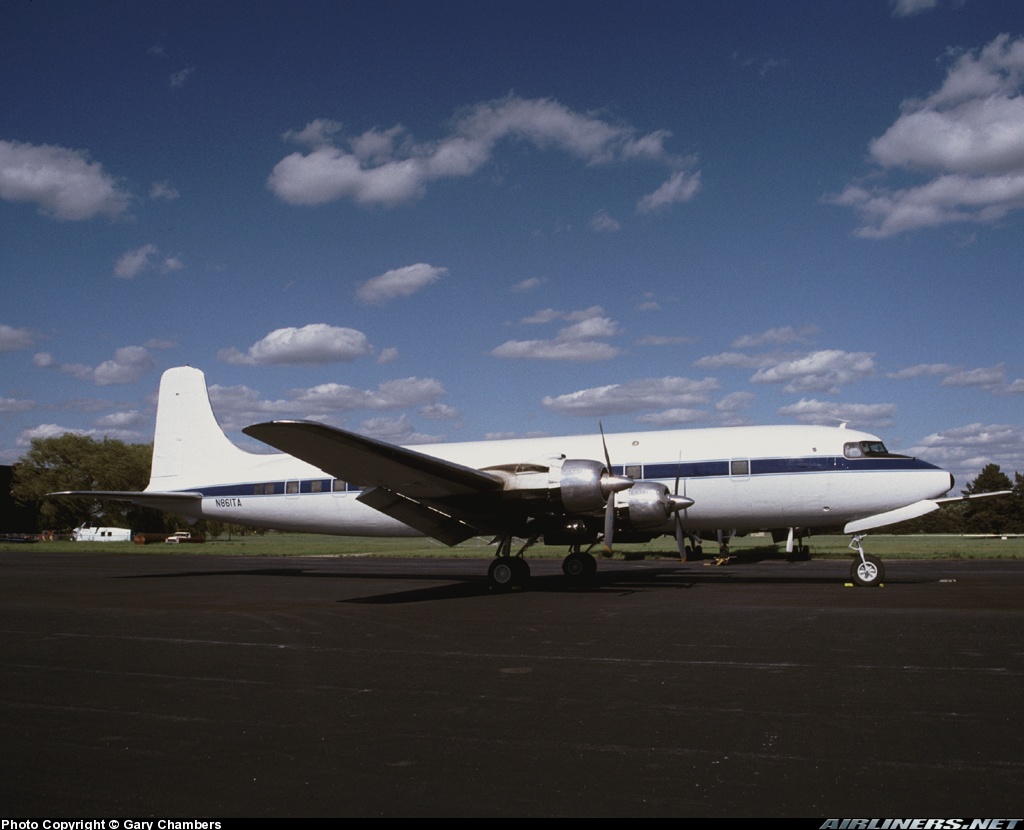
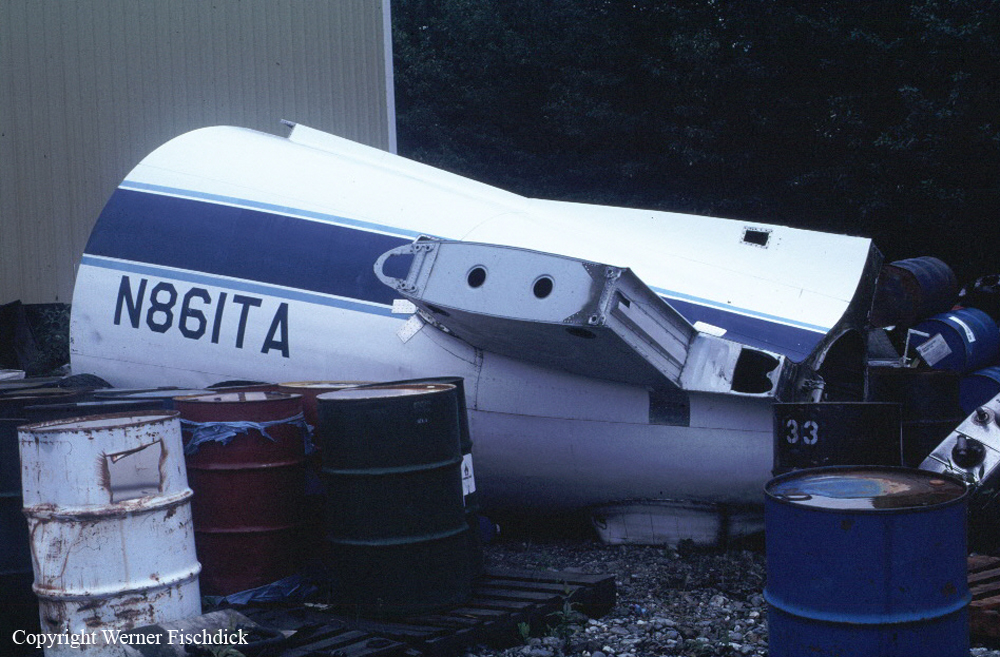
Crash of a Douglas DC-6B in Nixon Fork Mine

Date & Time: Jan 2, 1998 at 1526 LT
Type of aircraft:
Operator:
Registration:
N861TA
Flight Phase:
Flight Type:
Survivors:
Yes
Schedule:
Nixon Fork Mine - Palmer
MSN:
43522
YOM:
1952
Crew on board:
3
Crew fatalities:
Pax on board:
0
Pax fatalities:
Other fatalities:
Total fatalities:
0
Captain / Total flying hours:
27000
Captain / Total hours on type:
16000.00
Aircraft flight hours:
46626
Circumstances:
During the takeoff roll, while passing 45 knots indicated airspeed, ice formed between the inner and outer panes of the airplane's windshield, obscuring the crew's vision. The flight crew aborted the takeoff, the airplane drifted off the left side of the snow covered runway, and caught fire. The crew reported the airplane and windshield were cold soaked and the temperature was -10 degrees Fahrenheit. The windshield anti-ice system blows air from a combustion heater between the windshield glass panes. The air source for the heater, once the airplane has forward airspeed, is two leading edge wing scoops. The crew told the NTSB investigator that the taxi time was too short for the windshield to warm up, and that during the taxi, snow was circulated around the airplane and into the wing scoops.
Probable cause:
The ingestion of snow into the windshield anti-ice system, and the resulting obscured windshield which made runway alignment not possible. Factors associated with this accident were the cold windshield, the reduced performance of the windshield anti-ice because of the short taxi by the crew, and the insufficient information on the system provided by the manufacturer.
Final Report:

Crash of a Cessna 402B in Watertown: 1 killed

Date & Time: Dec 30, 1997 at 1817 LT
Type of aircraft:
Registration:
N5087Q
Flight Phase:
Flight Type:
Survivors:
No
Schedule:
Watertown – Marshall
MSN:
402B-0565
YOM:
1974
Crew on board:
1
Crew fatalities:
Pax on board:
0
Pax fatalities:
Other fatalities:
Total fatalities:
1
Circumstances:
The pilot landed at Watertown, loaded and off-loaded cargo, and departed without getting out of the airplane. A witness reported seeing the airplane over the runway at an altitude of about 50 feet agl. The airplane was described to be bouncing and buffeting. Another witness reported the weather as overcast with occasional snow flakes. The airplane then descended, impacted the terrain and exploded. Post accident inspection revealed a 1/2 to 3/4 inch thick ridge of rime ice along the leading edge of the left horizontal stabilizer. Pieces of arc shaped ice were located along the wreckage path. Inspection of the wreckage failed to reveal any preimpact failure/malfunction of the engine or airframe which would have prevented flight.
Probable cause:
The pilot's failure to perform an aircraft preflight and to remove the ice which had accumulated on the airframe. A factor involved in the accident was the icing weather conditions which existed and the ice which accumulated on the airplane.
Final Report:

Crash of a Mitsubishi MU-2B-30 in DuPage: 2 killed

Date & Time: Dec 30, 1997 at 1705 LT
Type of aircraft:
Registration:
N999WB
Flight Phase:
Flight Type:
Survivors:
No
Schedule:
DuPage - DuPage
MSN:
530
YOM:
1971
Location:
Crew on board:
2
Crew fatalities:
Pax on board:
0
Pax fatalities:
Other fatalities:
Total fatalities:
2
Captain / Total flying hours:
1175
Captain / Total hours on type:
250.00
Copilot / Total flying hours:
4094
Copilot / Total hours on type:
10
Aircraft flight hours:
6275
Circumstances:
The airplane departed runway 1L and radar data indicated the airplane maintained about a 110 knot ground speed for 37 seconds as it climbed to 1,400 feet msl (642 feet agl) with a 008 degree heading. The last radar 14 seconds later indicated the airplane's heading was 342 degrees and had a 130 knot ground speed. The winds were 290/11. Witnesses reported seeing the airplane flying low and slow, and then it made a turn like a "barrel roll" to the left before impacting the ground. Examination of the engines and airframe revealed no pre-existent anomalies. The left and right propellers exhibited leading edge damage and chordwise abrasions. The pilot had a total of about 1,175 flight hours with about 250 hours in the type and model aircraft. The copilot had 4,094 total hours, but had 10 hours of turbine time and no flight time in the type and model of aircraft. The pilot had indicated he was practicing simulated single engine failures. The gear was fully retracted. The trim settings were set for a right engine out situation. The flap selector was set to "UP" flaps, but the flaps were found in transit at approximately 2 degrees of flaps. The Airplane Flight Manual indicated that during "Engine Failure in Takeoff-Gear Fully Retracted" stated that the required airspeed before selecting flaps to 5 degrees was 140 KCAS. The Pilot's Operating Handbook stated the flaps take approximately 31 seconds to retract from 20 to 0 flaps, or 21 seconds to retract from 5 to 0 flaps.
Probable cause:
The pilot in command failed to maintain control of the aircraft. A factor was the lack of experience of the pilot and copilot in the type and model of aircraft. An additional factor was the pilot did not follow the proper procedure when the flaps were raised before 140 knots was attained during a simulated single engine failure.
Final Report:

Crash of a Cessna 414 Chancellor in Guyton: 2 killed

Date & Time: Dec 29, 1997 at 0845 LT
Type of aircraft:
Registration:
N414MT
Flight Phase:
Flight Type:
Survivors:
No
Schedule:
Orlando – White Sulphur
MSN:
414-0205
YOM:
1971
Location:
Crew on board:
1
Crew fatalities:
Pax on board:
1
Pax fatalities:
Other fatalities:
Total fatalities:
2
Captain / Total flying hours:
3996
Captain / Total hours on type:
1545.00
Aircraft flight hours:
3872
Circumstances:
About 26 minutes after takeoff while at 21500 feet, the pilot requested a non existent route. Seven minutes later, the passenger stated the pilot was light headed and fading then he had passed out. The passenger had once held a student pilot certificate and about 5 years earlier she had accrued 73 hours of flight time in Cessna 150/152 aircraft. The air traffic controller, and other pilots on the radio frequency tried to assist the passenger. The passenger was advised to provide oxygen for herself and the pilot, but she was unable. The airplane climbed to 34,200 feet where the airplane departed controlled flight, recovered, then departed controlled flight several more times before beginning a nose low descent. Witnesses reported hearing the airplane orbiting several times while flying above a cloud layer then observed the airplane orbiting beneath the clouds. While in a descending right wing low attitude, the airplane impacted the ground and came to rest submerged in a pond. Examination of the flight controls, engines, and propellers revealed no evidence of preimpact failure or malfunction. A discrepancy with the regulating valve was noted. Two small holes were noted in the cabin door seal. The left wing pressurization duct had been replaced about 8 years earlier but the right wing pressurization duct, had not been replaced. The ducts are on-condition components. There was no preimpact failure or malfunction noted with the barometric pressure switch, the cabin altitude annunciator bulbs, the safety valve, solenoid valve, or differential pressure/cabin altitude gauge. Testing for carbon monoxide for both was negative.
Probable cause:
Inadequate maintenance of the cabin pressurization system, which resulted in inadequate pressurization and incapacitation of the pilot due to the hypoxia. Also causal was the pilot's failure to adequately monitor the cabin pressurization system.
Final Report:

Crash of a Cessna 421C Golden Eagle III in Elkins

Date & Time: Dec 28, 1997 at 1340 LT
Registration:
N1348T
Flight Phase:
Survivors:
Yes
Schedule:
Elkins - Orlando
MSN:
421C-1059
YOM:
1981
Crew on board:
2
Crew fatalities:
Pax on board:
5
Pax fatalities:
Other fatalities:
Total fatalities:
0
Captain / Total flying hours:
3100
Captain / Total hours on type:
60.00
Aircraft flight hours:
3593
Circumstances:
The pilot/owner and a flight instructor had flown in to pick-up passengers. The owner was not multiengine rated and was receiving instruction from the instructor. The airplane was fueled and two adults and three children were boarded about 1 hour later. The owner was the flying pilot in the left seat. The owner stated that the 4,500 foot long runway was covered with 2 1/2 to 3 inches of snow and slush. He further stated that during the takeoff roll, 'The snow was so bad we could not get off the ground...' The pilot estimated that he aborted the takeoff at 100 mph, the braking action was zero, and the airplane went off the end of the runway. According to a witness, the five passengers arrived with 'lots of heavy bags.' After the accident, the baggage was removed before it could be weighed. An estimated airplane takeoff weight of 7,856 pounds was computed without baggage, based upon weights from the airplane weight and balance form, the police report, and FAA records. According to the Pilot's Operating Handbook, the maximum takeoff weight was published at 7,560 pounds.
Probable cause:
The flight instructor's failure to identify an unsafe runway condition and his delay in aborting the takeoff. Contributing was the aircraft's maximum takeoff weight exceeded, and a snow covered runway.
Final Report:

Crash of a Beechcraft A100 King Air in Colorado Springs: 2 killed

Date & Time: Dec 21, 1997 at 0626 LT
Type of aircraft:
Operator:
Registration:
N100BE
Survivors:
Yes
Schedule:
Eden Prairie - Colorado Springs
MSN:
BB-221
YOM:
1976
Crew on board:
1
Crew fatalities:
Pax on board:
2
Pax fatalities:
Other fatalities:
Total fatalities:
2
Captain / Total flying hours:
3400
Captain / Total hours on type:
65.00
Aircraft flight hours:
8651
Circumstances:
The pilot was cleared for an ILS DME approach to runway 17L. During the final stage of the approach, the aircraft entered fog and disappeared from view of the control tower personnel. Radar and radio communications were lost also. After searching for 31 minutes, the aircraft was found by airport operations personnel over half way down the runway and 600 feet east of the runway. There was no evidence the aircraft touched down on the runway. The aircraft was configured with the landing gear up and the flaps deployed. Missed approach procedures require the flaps and landing gear to be retracted after initiating the procedure. The decision
height for the approach is 6,384 feet msl (200 feet above ground level) and the required RVR for a 14 CFR Part 135 flight to commence and approach is 2400 (1/2 mile). When on the glide slope, the decision height is 0.4 miles from the runway touchdown zone. Examination of the airplane did not disclose evidence of mechanical malfunction.
Probable cause:
Failure of the pilot to follow IFR Procedures and maintain the minimum descent altitude (MDA). A related factor was fog.
Final Report: