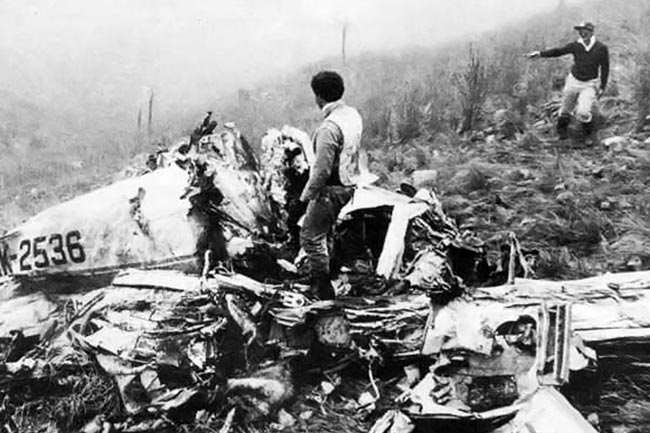
Crash of a De Havilland DHC-6 Twin Otter 300 near Quetame: 22 killed

Date & Time: Nov 29, 1982
Operator:

Registration:
HK-2536
Flight Phase:
Survivors:
No
Site:
Schedule:
San José del Guaviare - Bogotá
MSN:
713
YOM:
1980
Flight number:
VX189
Country:
Crew on board:
2
Crew fatalities:
Pax on board:
20
Pax fatalities:
Other fatalities:
Total fatalities:
22
Circumstances:
While cruising under VFR mode in poor weather conditions, the aircraft struck the slope of a mountain located near Quetame. The aircraft was destroyed upon impact and all 22 occupants were killed.
Probable cause:
Controlled flight into terrain after the crew decided to continue under VFR mode into adverse weather conditions (IMC). En route navigation errors on part of the crew and inadequate training procedures were considered as contributing factors.

Crash of an Antonov AN-26 near Bibala: 15 killed

Date & Time: Nov 29, 1982
Type of aircraft:
Operator:
Registration:
D2-TAB
Flight Phase:
Survivors:
No
Site:
Location:
Country:
Region:
Crew on board:
6
Crew fatalities:
Pax on board:
9
Pax fatalities:
Other fatalities:
Total fatalities:
15
Circumstances:
Following an uneventful flight at FL140, the crew initiated the descent to Lubango Airport in poor visibility due to heavy rain falls. At an altitude of 7,400 feet, the airplane struck the slope of a mountain located near Bibala. The wreckage was found about 22 km northwest of Lubango Airport, some 20 meters below the summit. The aircraft was destroyed and all 15 occupants were killed.
Probable cause:
For unknown reasons, the crew started the approach prematurely, causing the aircraft to descend below the minimum safe altitude. Poor visibility due to heavy rain falls was a contributing factor.

Crash of an Embraer C-95 Bandeirante in Rio de Janeiro: 3 killed

Date & Time: Nov 16, 1982 at 1310 LT
Type of aircraft:
Operator:
Registration:
2182
Flight Phase:
Flight Type:
Survivors:
No
Site:
Schedule:
Rio de Janeiro – São Paulo
MSN:
110-109
YOM:
1976
Country:
Crew on board:
2
Crew fatalities:
Pax on board:
1
Pax fatalities:
Other fatalities:
Total fatalities:
3
Circumstances:
Less than two minutes after takeoff from Rio de Janeiro-Santos Dumont Airport runway 20R, while in initial climb, the twin engine airplane hit the Sugarloaf Mountain located about 3,8 km south of the airport. All three occupants were killed.

Crash of a Piper PA-31-350 Navajo Chieftain near Brevard: 1 killed

Date & Time: Nov 12, 1982 at 0514 LT
Registration:
N59771
Flight Phase:
Flight Type:
Survivors:
No
Site:
Schedule:
Columbus - Asheville
MSN:
31-7652401
YOM:
1976
Crew on board:
1
Crew fatalities:
Pax on board:
0
Pax fatalities:
Other fatalities:
Total fatalities:
1
Captain / Total flying hours:
3300
Captain / Total hours on type:
900.00
Aircraft flight hours:
5131
Circumstances:
After a missed approach at Asheville the flight was cleared to the Greenville-Spartanburg Airport at Greer, SC. Enroute to Greer radar contact was lost. In response to a query from Atlanta artcc the pilot verified his position as being on the 235° radial of Spartanburg VOR and 11.9 miles southwest. He was then cleared to descend to 2,700 feet and execute an ILS approach. The aircraft impacted a mountain at the 3,200 feet level. The wreckage was found on the 235° radial of the Sugarloaf mountain vortac and at 24 miles. Review of the aircraft's logbook revealed that mechanical irregularities reported were not corrected for long periods of time. No corrective action was listed for an "outer marker inop aural and visual (needs to be fixed now, since ADF is also inoperative) and 'light in #2 VOR head out'. The marker beacon was described as inoperative on three dates beginning 22 August 1981 and the ADF was described as inoperative on seven dates beginning 8 May 1981. No corrective action was listed for any entry about the marker beacon or ADF. The pilot, sole on board, was killed.
Probable cause:
Occurrence #1: in flight collision with terrain/water
Phase of operation: descent - normal
Findings
1. (f) comm/nav equipment - inoperative
2. (f) maintenance - not performed - company maintenance personnel
3. (f) operation with known deficiencies in equipment - attempted - pilot in command
4. (f) company-induced pressure - company/operator management
5. (f) light condition - dark night
6. (f) weather condition - low ceiling
7. (f) missed approach - performed - pilot in command
8. (c) ifr procedure - improper - pilot in command
9. (c) flight/navigation instrument(s) - improper use of - pilot in command
10. (f) company-induced pressure - company/operator management
11. (f) excessive workload (task overload) - pilot in command
Final Report:

Crash of a Britten-Norman BN-2A Islander in Serra de Monchique

Date & Time: Nov 6, 1982
Type of aircraft:
Operator:
Registration:
CS-AJO
Flight Phase:
Survivors:
Yes
Site:
Schedule:
Cascais – Portimão
MSN:
125
YOM:
1970
Country:
Region:
Crew on board:
1
Crew fatalities:
Pax on board:
3
Pax fatalities:
Other fatalities:
Total fatalities:
0
Circumstances:
En route from Cascais to Portimão, the pilot encountered poor weather conditions when the airplane lost height and crashed on a hill located in Serra de Monchique. All four occupants were rescued.

Crash of a PZL-Mielec AN-2 near Kyzyl: 14 killed

Date & Time: Nov 1, 1982 at 1245 LT
Type of aircraft:
Operator:
Registration:
CCCP-50547
Flight Phase:
Flight Type:
Survivors:
No
Site:
Schedule:
Kyzyl – Toora-Khem
MSN:
1G89-24
YOM:
1967
Country:
Region:
Crew on board:
2
Crew fatalities:
Pax on board:
12
Pax fatalities:
Other fatalities:
Total fatalities:
14
Aircraft flight hours:
13890
Circumstances:
The aircraft was chartered by a local hospital in Kyzyl to transfer to Toora-Khem 12 passengers (two patients, four accompanists and a medical team of six crew) and two pilots. After takeoff, the crew was cleared to climb to an altitude of 2,300 meters bound to the north. At 1245LT, the crew reported his position over the mountains and informed ATC about the next point of report. Shortly later, the crew decided to modify his route and to follow a shorter route when weather conditions worsened with poor visibility due to snow falls. While cruising at an altitude of 2,330 meters, the single engine airplane struck a rocky wall of 2,466 meters high. As the airplane failed to arrive at destination, SAR operations were initiated but the wreckage was found five days later, on November 6, about 76 km north of Kyzyl. The aircraft disintegrated on impact and all 14 occupants were killed.
Probable cause:
The decision of the crew to modify his route without permission and to continue in IMC conditions at an insufficient altitude, resulting in a control flight into terrain.

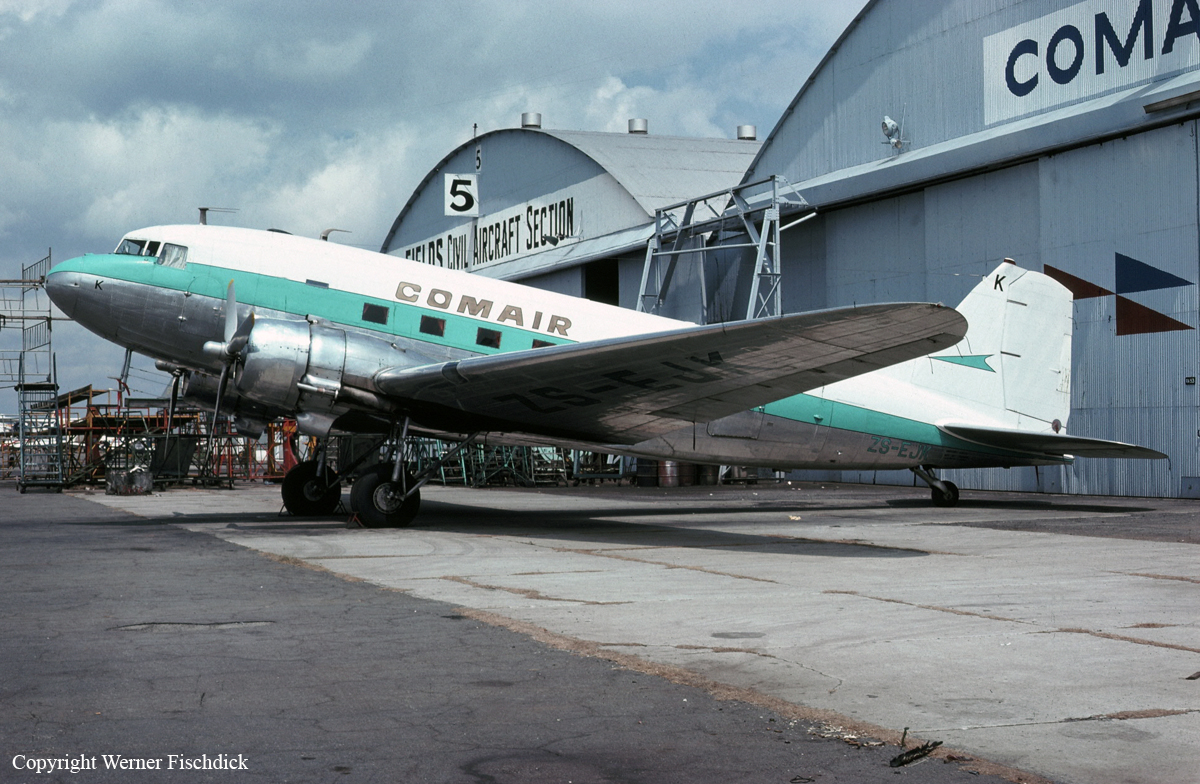
Crash of a Douglas C-47A-75-DL in Graskop

Date & Time: Oct 9, 1982
Operator:
Registration:
ZS-EJK
Flight Phase:
Survivors:
Yes
Site:
Schedule:
Johannesburg – Skukuza
MSN:
19484
YOM:
1944
Country:
Region:
Crew on board:
3
Crew fatalities:
Pax on board:
27
Pax fatalities:
Other fatalities:
Total fatalities:
0
Circumstances:
En route on a charter flight from Johannesburg to Skukuza under IFR mode, the crew was unable to receive the NDB signal. Due to poor visibility, the crew decided to divert to Hoedspruit Airport and started the descent when the airplane stuck a hill and crashed. All 30 occupants were injured and the aircraft was destroyed.
Probable cause:
It is believed that there was a malfunction of the ADF as the crew thought he was approaching Hoedspruit Airport while the aircraft was 67 km southwest of this city.

Crash of a Rockwell Aero Commander 520 near Agoura Hills: 3 killed

Date & Time: Sep 26, 1982 at 1308 LT
Operator:
Registration:
N2622B
Flight Phase:
Survivors:
No
Site:
Schedule:
Hawthorne - San Luis Obispo
MSN:
520-134
YOM:
1954
Crew on board:
1
Crew fatalities:
Pax on board:
2
Pax fatalities:
Other fatalities:
Total fatalities:
3
Aircraft flight hours:
5198
Circumstances:
During departure, the pilot climbed in IFR conditions to 6,000 feet. After leveling, a frequency change was made and he was cleared to 8,000 feet, which he acknowledged. About 2 minutes later, the controller radioed to the pilot that he was about 4 miles north of the airway, but there was no reply from the pilot. Shortly after that radar contact was lost and the plane crashed in mountainous terrain. Several residents in the area reported hearing extremely loud engine noises followed by complete silence. An investigation revealed that both wings had separated outboard of their respective engine nacelle assemblies. An examination of the fractures revealed the wings had separated from positive overload. The leading edges of both wings had ballooned upward, indicative of extreme airspeed. The empennage had separated in a yaw and from right torsional overload. Parts of the aircraft were found within a 1 mile arc, north of the main impact area. The pilot's recent instrument experience could not be verified. All three occupants were killed. Turbulence was forecasted below 8,000 feet.
Probable cause:
Occurrence #1: loss of control - in flight
Phase of operation: climb - to cruise
Findings
1. (f) weather condition - clouds
2. (f) weather condition - turbulence in clouds
3. (c) aircraft handling - not maintained - pilot in command
4. (c) spatial disorientation - pilot in command
----------
Occurrence #2: airframe/component/system failure/malfunction
Phase of operation: descent - uncontrolled
Findings
5. Wing,spar - overload
6. (c) design stress limits of aircraft - exceeded - pilot in command
7. Wing - separation
8. Stabilizer - overload
9. Stabilizer - separation
----------
Occurrence #3: in flight collision with terrain/water
Phase of operation: descent - uncontrolled
Final Report:

Crash of a De Havilland DHC-4 Caribou in Kampung Atap: 7 killed

Date & Time: Sep 24, 1982 at 1510 LT
Type of aircraft:
Operator:
Registration:
M21-17
Flight Phase:
Flight Type:
Survivors:
No
Site:
Schedule:
Taiping - Kuala Lumpur
MSN:
306
YOM:
1973
Flight number:
Misty 116B
Country:
Region:
Crew on board:
7
Crew fatalities:
Pax on board:
0
Pax fatalities:
Other fatalities:
Total fatalities:
7
Circumstances:
The twin engine airplane was completing a flight from Taiping to Kuala Lumpur under call sign 'Misty 116B'. En route, while cruising over the Cameron Mountain Range, the aircraft crashed in unknown circumstances in a wooded and isolated area. The wreckage was found a day later and all seven occupants were killed.

Crash of a De Havilland DHC-3 Otter in Two Bridge Lake: 5 killed

Date & Time: Sep 18, 1982
Type of aircraft:
Registration:
C-FDJA
Flight Phase:
Survivors:
No
Site:
Schedule:
Tyee Lake - Tatlatui Lake
MSN:
459
YOM:
1965
Country:
Crew on board:
1
Crew fatalities:
Pax on board:
4
Pax fatalities:
Other fatalities:
Total fatalities:
5
Circumstances:
The single engine airplane was conducting a taxi flight from Tyee Lake near Smithers and Tatlatui Lake, carrying four passengers and a pilot bound for a hunting camp. About 10 minutes after takeoff, the single engine airplane entered a valley when the pilot saw obstacles and initiated to leave the area. While performing a steep turn, the aircraft stalled and crashed in a dense wooded area, bursting into flames. The wreckage was found off track about 25 km northeast of Smithers. All five occupants were killed.