Crash of an Antonov AN-12 near Debre Zeit AFB: 26 killed

Date & Time: Feb 16, 1984
Type of aircraft:
Operator:
Registration:
1509
Flight Type:
Survivors:
Yes
Country:
Region:
Crew on board:
5
Crew fatalities:
Pax on board:
33
Pax fatalities:
Other fatalities:
Total fatalities:
26
Circumstances:
On approach to Debre Zeit-Harar Meda AFB, the four engine exploded and crashed few km short of runway threshold, bursting into flames. 12 occupants were rescued while 26 others were killed.
Probable cause:
It was determined that an Ethiopian Air Force Lieutenant elected to hijack the airplane to Somalia and detonated a grenade while the airplane was approaching the airbase.


Crash of a Cessna 414A Chancellor in Mena: 2 killed

Date & Time: Feb 15, 1984 at 1656 LT
Type of aircraft:
Operator:
Registration:
N6815Z
Flight Type:
Survivors:
No
Schedule:
Addison - Mena
MSN:
414A-0648
YOM:
1981
Location:
Crew on board:
1
Crew fatalities:
Pax on board:
1
Pax fatalities:
Other fatalities:
Total fatalities:
2
Captain / Total flying hours:
10100
Aircraft flight hours:
411
Circumstances:
The aircraft was cleared for Mena NDB approach and to maintain 5,000 feet msl until established on the approach. Aircraft descended to 4,800 feet msl on approximately ground track of 040° to 030° after NDB passage. Aircraft then turned to a ground track of 116°. After 12 seconds the aircraft turned to a ground track of 350° during which the ground speed decreased to 93 knots. The aircraft descended to 4,600 feet msl with ground speed increasing to 140 knots. N68152 reported 'we've broken below - will cancel in just a moment.' Radar contact was lost with the aircraft descending to 3,000 feet msl on a heading of 304°. The wreckage was found 6 miles northwest of the airport at an elevation of 2,000 feet msl. The outbound approach heading is 080° with procedure turn heading of 125° and 305°. Reported winds aloft at 5,000 feet msl, 4,000 feet msl and 3,000 feet msl were 191° at 34 knots, 169° at 30 knots and 151° at 32 knots respectively. Both occupants were killed.
Probable cause:
Occurrence #1: in flight collision with object
Phase of operation: approach - faf/outer marker to threshold (IFR)
Findings
1. (f) compensation for wind conditions - not performed - pilot in command
2. (f) minimum descent altitude - not attained - pilot in command
3. (c) ifr procedure - not followed - pilot in command
4. (f) terrain condition - mountainous/hilly
5. (f) weather condition - low ceiling
6. (f) object - tree(s)
Final Report:

Crash of a PA-31P Pressurized Navajo in Presidio

Date & Time: Feb 15, 1984 at 1240 LT
Type of aircraft:
Registration:
N3PN
Flight Type:
Survivors:
Yes
MSN:
31-70
YOM:
1968
Crew on board:
1
Crew fatalities:
Pax on board:
5
Pax fatalities:
Other fatalities:
Total fatalities:
0
Captain / Total flying hours:
3207
Captain / Total hours on type:
500.00
Aircraft flight hours:
2014
Circumstances:
During a cross country flight the pilot could not locate a refueling stop and landed 100 miles away. No refueling was accomplished and he decided to go on to his destination with the fuel remaining. Enroute his right engine coughed and he realized he was running out of fuel. After switching to crossfeed normal engine operation was restored. Even though he was only about 3 miles from his destination he decided to land on a 4,000 feet dirt agricultural airstrip which he saw directly below him. He forced the aircraft down and landed downwind at high speed about midway down the runway. The aircraft did not stop on the runway and overran into a dirt bank and a fence. The landing gear was knocked off and the aircraft became airborne for 700 more feet before impacting and tumbling. The aircraft came to rest inverted about 825 feet past the dirt bank. A fire developed in the left wing and consumed most of the area in the vicinity of the left fuel tank outboard of the left engine. The pilot stated that there were no malfunctions of the aircraft or systems.
Probable cause:
Occurrence #1: loss of engine power (partial) - nonmechanical
Phase of operation: cruise - normal
Findings
1. (f) fluid,fuel - starvation
2. (c) preflight planning/preparation - inadequate - pilot in command
3. (c) became lost/disoriented - inadvertent - pilot in command
4. (c) in-flight planning/decision - improper - pilot in command
5. (c) refueling - not performed - pilot in command
----------
Occurrence #2: forced landing
Phase of operation: landing - flare/touchdown
Findings
6. (c) precautionary landing - performed - pilot in command
----------
Occurrence #3: overrun
Phase of operation: landing - roll
Findings
7. (f) weather condition - tailwind
8. (c) planned approach - improper - pilot in command
9. (c) airspeed - excessive - pilot in command
10. (c) proper touchdown point - not attained - pilot in command
11. (c) wrong runway - selected - pilot in command
----------
Occurrence #4: nose over
Phase of operation: landing - roll
Findings
12. (f) terrain condition - dirt bank/rising embankment
Final Report:

Crash of a PZL-Mielec AN-2 in Nelkan

Date & Time: Feb 11, 1984
Type of aircraft:
Operator:
Registration:
CCCP-35002
Flight Phase:
Flight Type:
Survivors:
Yes
Schedule:
Nelkan - Odola
MSN:
1G109-08
YOM:
1969
Country:
Region:
Crew on board:
2
Crew fatalities:
Pax on board:
0
Pax fatalities:
Other fatalities:
Total fatalities:
0
Aircraft flight hours:
6203
Circumstances:
The crew departed Nelkan Airport on a cargo flight to Odola. Shortly after takeoff, the single engine airplane encountered difficulties to gain height. It struck tree tops then stalled and crashed on a hilly terrain (250 meters high). Both pilots were injured and the aircraft was destroyed.
Probable cause:
It was determined that the total weight of the aircraft at the time of the accident was 661 kilos above MTOW.

Crash of a Boeing 737-2M2 in Huambo

Date & Time: Feb 9, 1984
Type of aircraft:
Operator:
Registration:
D2-TBV
Survivors:
Yes
Schedule:
Huambo - Luanda
MSN:
22626
YOM:
1981
Country:
Region:
Crew on board:
6
Crew fatalities:
Pax on board:
136
Pax fatalities:
Other fatalities:
Total fatalities:
0
Circumstances:
After takeoff from Huambo-Albano Machado Airport, while climbing, an explosion occurred in the rear of the cabin. The pilot declared an emergency and was cleared to return. Due to the partial failure of the hydraulic system, the crew was unable to lower the flaps and the aircraft landed at high speed. After touchdown, the aircraft was unable to stop within the remaining distance, overran and lost its undercarriage and both engines before coming to rest 180 meters further. All 142 occupants were evacuated and 15 of them were injured. The aircraft was destroyed.
Probable cause:
It was determined that a bomb exploded in the rear of the cabin during initial climb. It was placed on board by UNITA rebels.

Crash of a Learjet 24 on Catalina Island: 6 killed

Date & Time: Jan 30, 1984 at 1330 LT
Type of aircraft:
Operator:
Registration:
N44GA
Flight Type:
Survivors:
No
Schedule:
Santa Rosa - Catalina
MSN:
24-129
YOM:
1966
Crew on board:
2
Crew fatalities:
Pax on board:
4
Pax fatalities:
Other fatalities:
Total fatalities:
6
Captain / Total flying hours:
8000
Captain / Total hours on type:
1100.00
Aircraft flight hours:
3306
Circumstances:
The aircraft departed on a sales demo flight to Monterey, CA with potential buyers aboard. En route, the destination was changed to Avalon, CA. Unicom advised the crew of the wind direction and speed on downwind. Witnesses reported the aircraft was slightly high on final, but said the pilot corrected the angle of descent. The aircraft touched down approximately 500 feet down the runway, which was crowned (sloped upward for approximately the 1st 2,000 feet, then leveled off). The crew could not see the end of the runway at touchdown. The thrust reversers were deployed approximately 1,000 feet after touchdown. Witnesses heard the engine sound increase, then decrease, then increase again as the aircraft went off the runway and over a 90 feet bluff. Fire erupted immediately. Within 3 minutes, airport personnel arrived with firefighting equipment, but they were not trained as firefighters and did not try to stop the fire for fear of an explosion. No evidence of a mechanical failure/malfunction was found. Found left flap extended, left spoiler retracted and locked, tire marks on runway. Estimated gross weight: 11,500 lbs. Computed landing distance over a 50 feet obstacle: 3,100 feet. The aircraft was destroyed and all six occupants were killed.
Probable cause:
Occurrence #1: overrun
Phase of operation: landing - roll
Findings
1. (c) reason for occurrence undetermined
2. (f) improper - pilot in command
3. (f) self-induced pressure - pilot in command
4. (f) pressure induced by others - other person
5. (f) airport facilities, runway/landing area condition - uphill
6. (f) airport facilities, runway/landing area condition - rough/uneven
----------
Occurrence #2: on ground/water encounter with terrain/water
Phase of operation: landing
Findings
7. (f) terrain condition - mountainous/hilly
8. (f) terrain condition - downhill
9. (f) airport fire/rescue service - inadequate
Final Report:

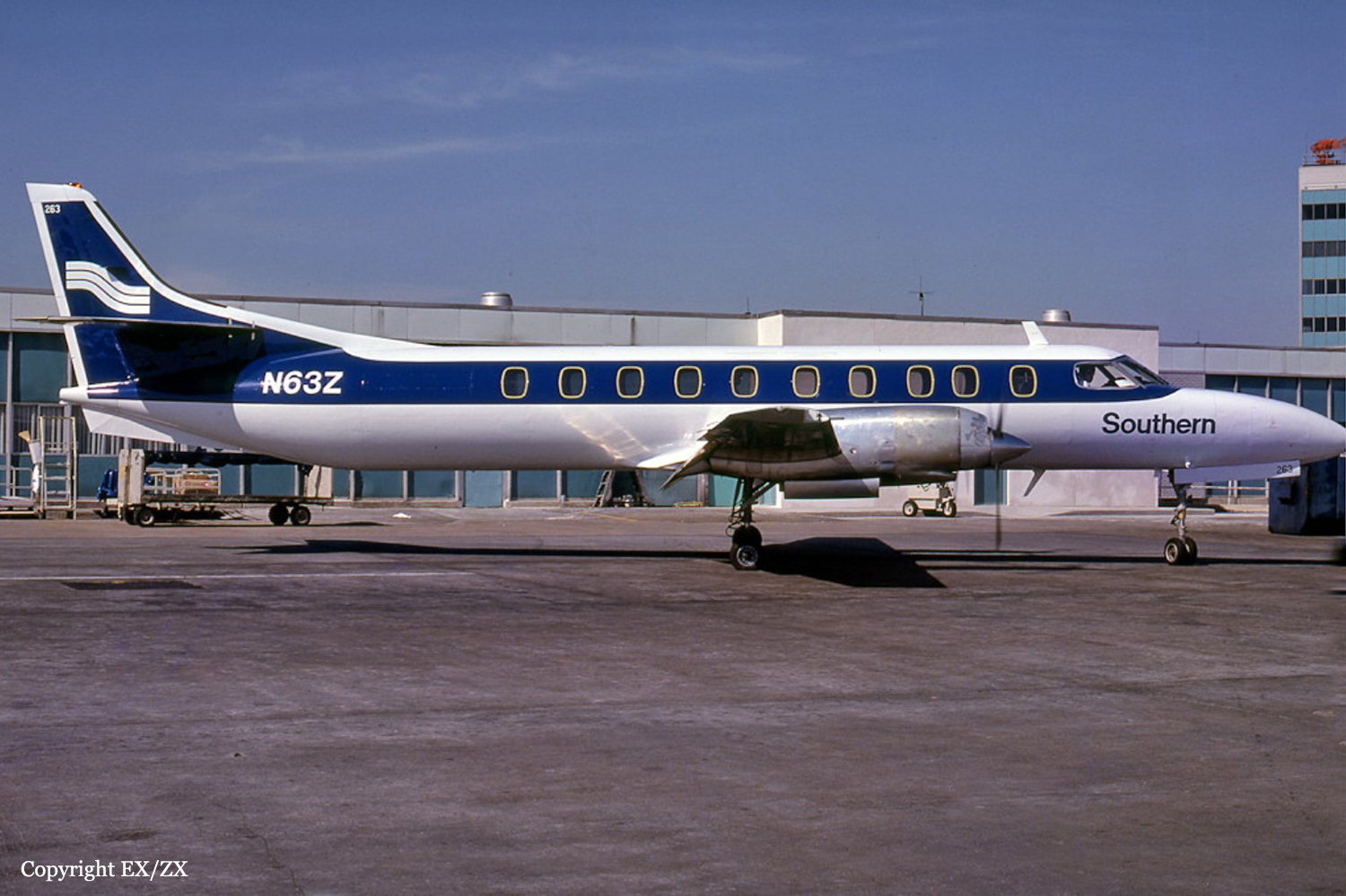
Crash of a Swearingen SA226TC Metro II in Terre Haute: 3 killed

Date & Time: Jan 30, 1984 at 0630 LT
Type of aircraft:
Operator:
Registration:
N63Z
Flight Phase:
Flight Type:
Survivors:
No
Schedule:
Terre Haute - Evansville
MSN:
TC-240
YOM:
1977
Crew on board:
2
Crew fatalities:
Pax on board:
1
Pax fatalities:
Other fatalities:
Total fatalities:
3
Captain / Total flying hours:
19189
Captain / Total hours on type:
1501.00
Aircraft flight hours:
10607
Circumstances:
After taking off from runway 23, the aircraft crashed ssw of the airport about 6,300 feet from the departure end of the runway and about 1,800 feet to the left of the runway centerline. Impact occurred while the aircraft was in a steep descent. The wreckage path was scattered along a heading of 035° from the initial impact point. The aircraft was demolished by impact and fire and no preimpact part failure or malfunction was found that would have caused the accident. All three occupants were killed.
Probable cause:
Occurrence #1: loss of control - in flight
Phase of operation: takeoff
Findings
1. (c) reason for occurrence undetermined
2. Light condition - dawn
3. Weather condition - rain
4. Weather condition - fog
----------
Occurrence #2: in flight collision with terrain/water
Phase of operation: takeoff
Final Report:

Crash of an Antonov AN-24RV in Izhevsk: 4 killed

Date & Time: Jan 28, 1984 at 1850 LT
Type of aircraft:
Operator:
Registration:
CCCP-47310
Survivors:
Yes
Schedule:
Kuybyshev - Izhevsk
MSN:
5 73 104 01
YOM:
1975
Flight number:
SU923
Country:
Region:
Crew on board:
4
Crew fatalities:
Pax on board:
49
Pax fatalities:
Other fatalities:
Total fatalities:
4
Aircraft flight hours:
17032
Aircraft flight cycles:
11166
Circumstances:
On final approach to Izhevsk Airport, the aircraft became unstable and the captain decided to make a go-around. Few minutes later, on a second attempt to land, the aircraft rolled left and right than banked right, causing the right wing to struck the ground. At a speed of 180 km/h, the aircraft cartwheeled and crashed in a field near the runway threshold. The copilot and three passengers were killed while all 49 other occupants were injured, some of them seriously.
Probable cause:
It was determined that the loss of control on final approach was the consequence of the failure of the elevator control system following a complete disconnection of the control wiring. This was the result of improper installation and negligences during the last maintenance overhaul conducted at factory #403 at Izhevsk.

Crash of a Mitsubishi MU-2B-20 Marquise in Ames

Date & Time: Jan 24, 1984 at 1055 LT
Type of aircraft:
Operator:
Registration:
N123AX
Survivors:
Yes
Schedule:
Chattanooga - Ames
MSN:
220
YOM:
1972
Location:
Crew on board:
1
Crew fatalities:
Pax on board:
3
Pax fatalities:
Other fatalities:
Total fatalities:
0
Captain / Total flying hours:
10785
Captain / Total hours on type:
327.00
Circumstances:
The aircraft landed in a crosswind on a snow and ice covered runway. During landing, directional control was lost and the aircraft collided with a snowbank. The pilot stated he attempted to use propeller reversing for braking and the aircraft started to slide to the left. All four occupants escaped uninjured while the aircraft was damaged beyond repair.
Probable cause:
Occurrence #1: loss of control - on ground/water
Phase of operation: landing - roll
Findings
1. (f) terrain condition - icy
2. (c) wrong runway - selected - pilot in command
3. (f) terrain condition - snow covered
4. (c) airspeed - improper - pilot in command
5. (f) weather condition - crosswind
6. (c) directional control - not maintained - pilot in command
7. (c) ground loop/swerve - not corrected - pilot in command
----------
Occurrence #2: on ground/water encounter with terrain/water
Phase of operation: landing - roll
Findings
8. (f) terrain condition - snowbank
9. Landing gear - overload
Final Report:

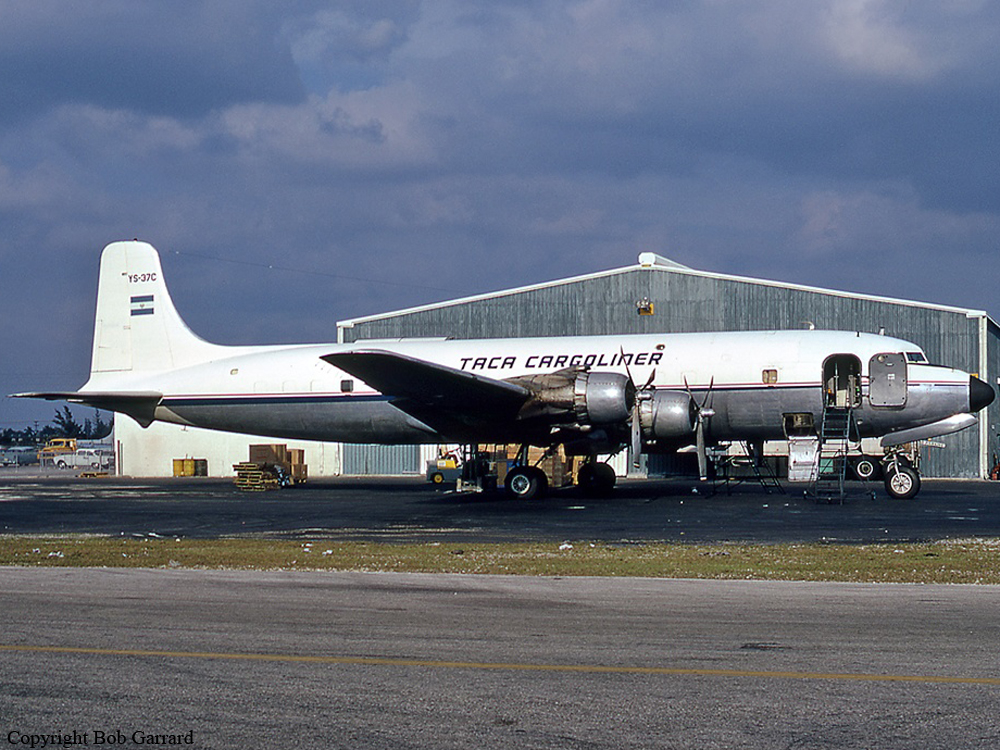
Ground explosion of a Douglas DC-6BF in San Miguel: 1 killed

Date & Time: Jan 20, 1984
Type of aircraft:
Registration:
YS-37C
Survivors:
Yes
MSN:
44255
YOM:
1954
Country:
Crew on board:
0
Crew fatalities:
Pax on board:
0
Pax fatalities:
Other fatalities:
Total fatalities:
1
Circumstances:
After touchdown at San Miguel Airport, the four engine airplane rolled onto a mine, exploded and came to rest. A passenger was killed and few others were injured. The aircraft was damaged beyond repair.