Crash of a Pacific Aerospace PAC 750XL in Kudjip

Date & Time: Feb 9, 2023 at 1250 LT
Operator:
Registration:
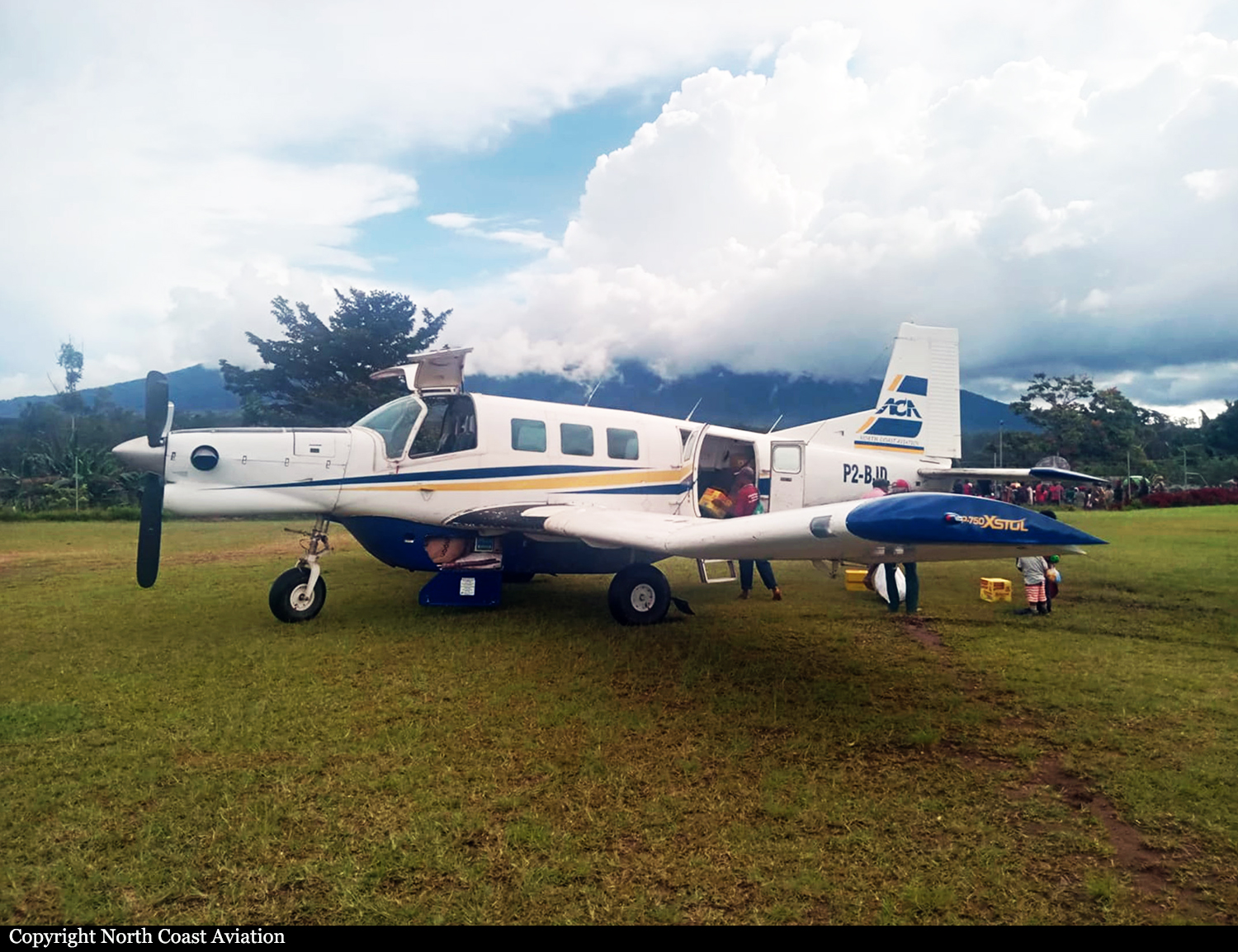
P2-BJD
Flight Phase:
Survivors:
Yes
Schedule:
Giramben - Simbai
MSN:
124
YOM:
2005
Location:
Region:
Crew on board:
1
Crew fatalities:
Pax on board:
3
Pax fatalities:
Other fatalities:
Total fatalities:
0
Captain / Total flying hours:
3582
Captain / Total hours on type:
1885.00
Aircraft flight hours:
13811
Aircraft flight cycles:
17220
Circumstances:
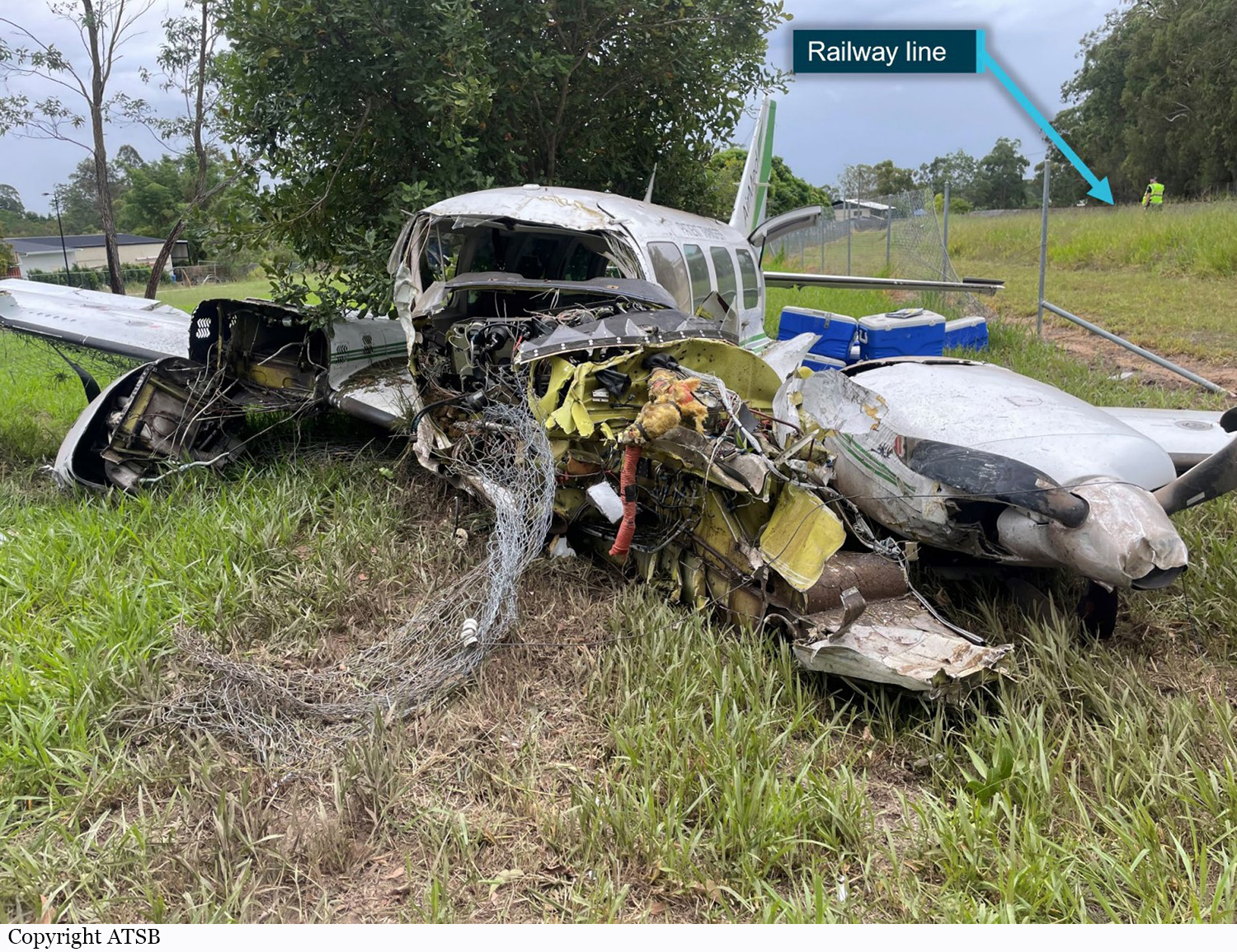
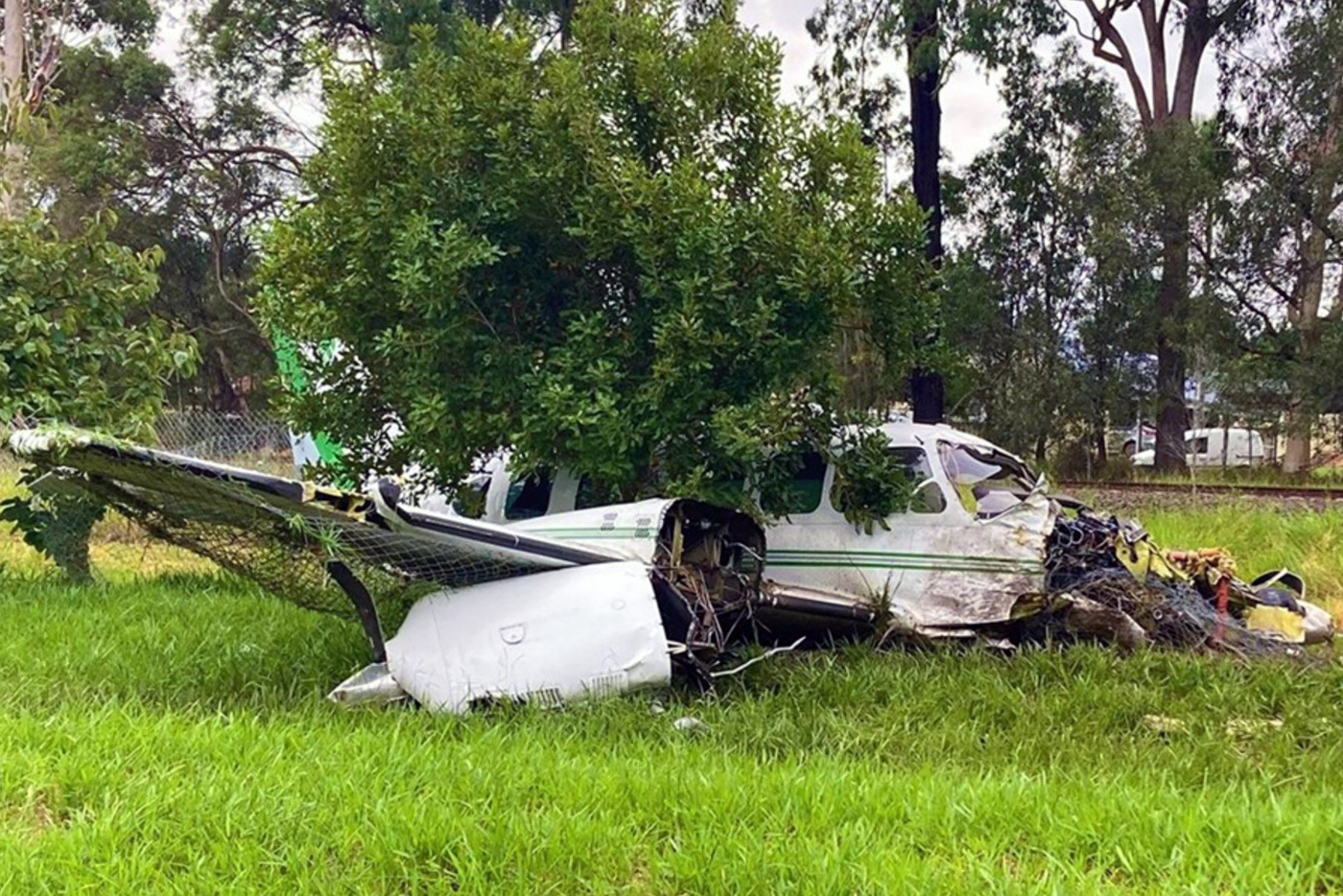
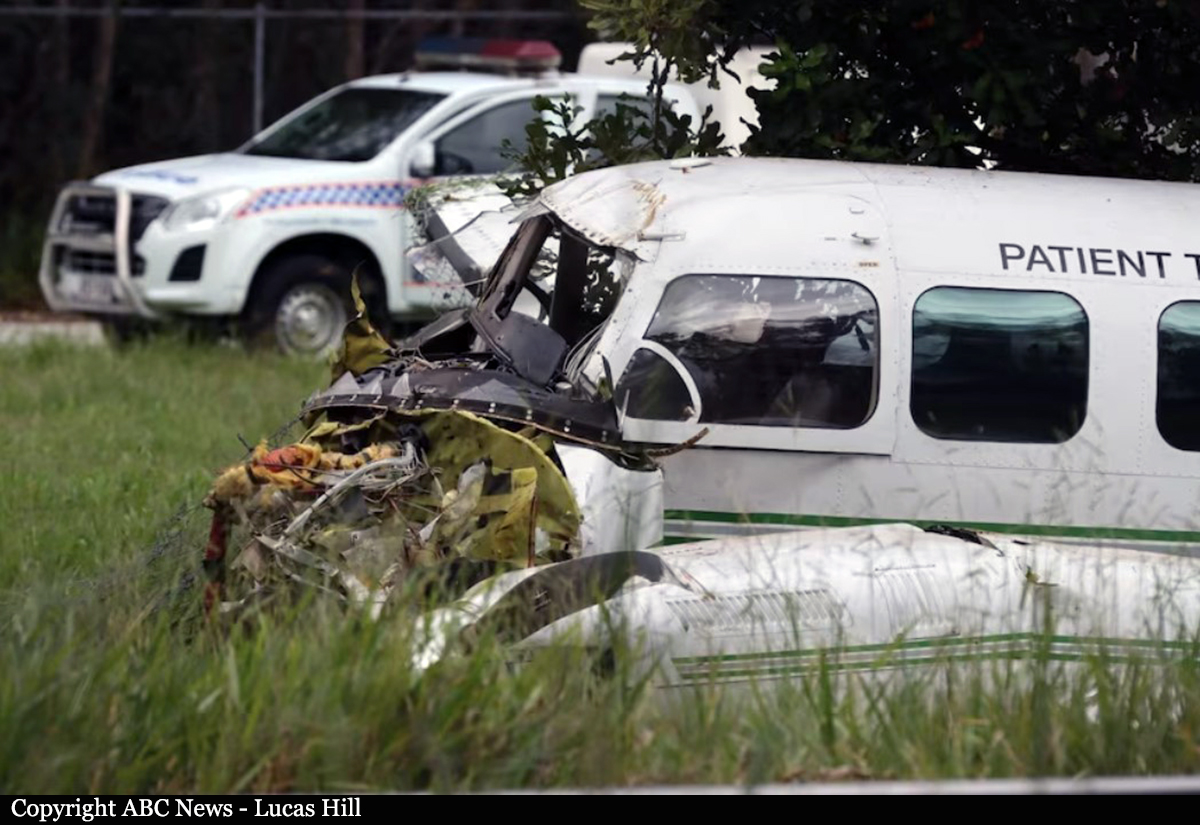
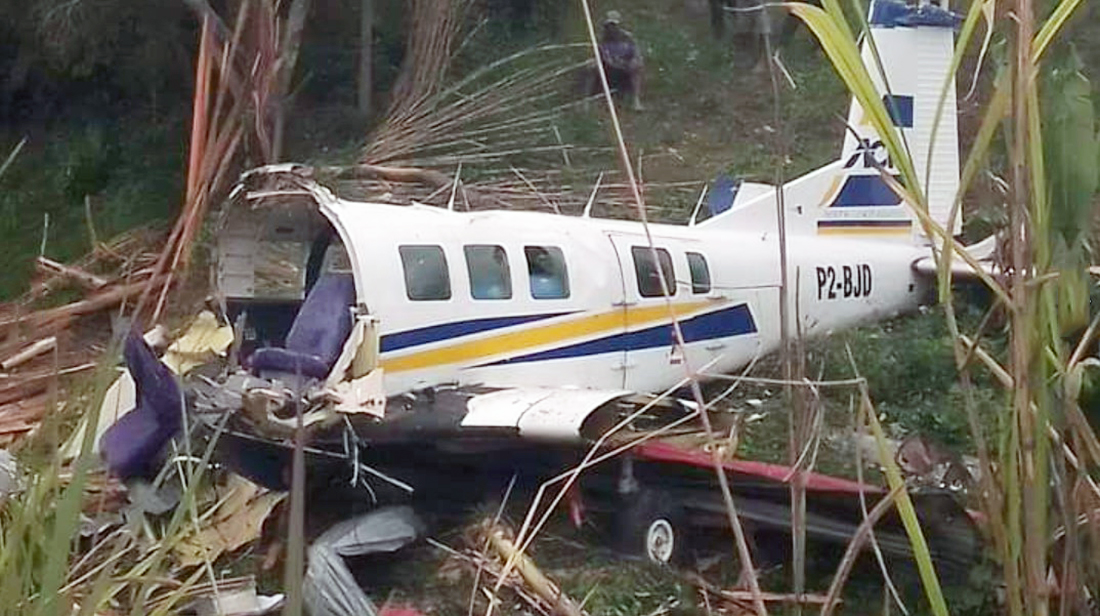
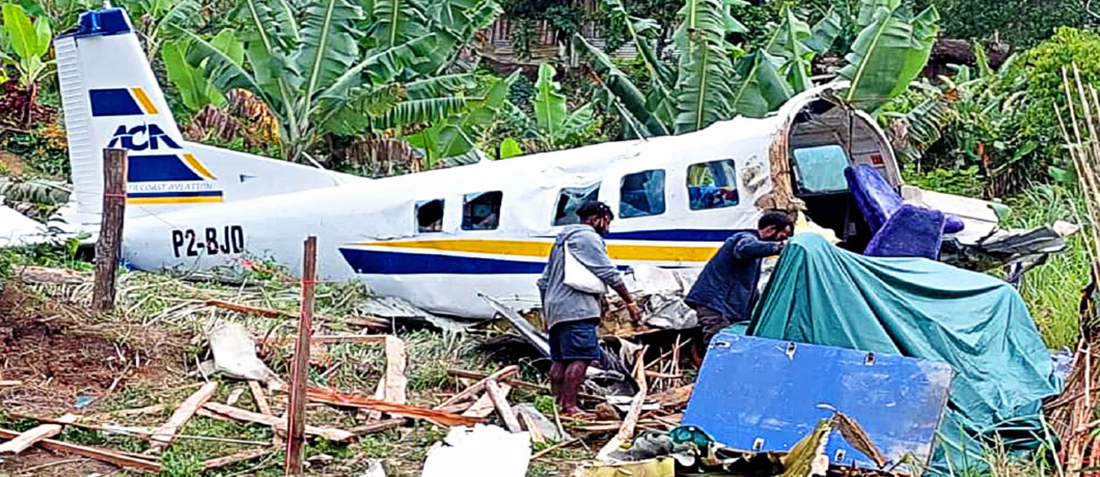
The flight was planned to depart Giramben at 12:40, and track North for Simbai Airstrip, Madang Province at 9,000 ft AMSL. According to the pilot, the aircraft was loaded by NCA ground handlers following his instructions. The manifest was completed by one of the ground handler, who stated that the aircraft was loaded by the other ground handlers while he was completing the manifest in the vehicle, due to no proper shed for him to work from. The pilot also stated that at the time the loading was completed, and the passengers had boarded the aircraft, he observed that the winds were variable, blowing directly from the North and from the East as well. Recorded data showed that the aircraft commenced taxiing at 12:44. During the take-off roll, at the expected airborne point, about 500 m down the runway, as the aircraft accelerated with the airspeed approaching 60 knots, the right wheel hit a soft spot on the strip which dramatically reduced the momentum and speed of the aircraft, as described by the pilot. Eyewitnesses reported seeing the aircraft getting airborne briefly and got back on the ground again. The pilot recalled that by the time the aircraft got back on the ground he realized that he had passed the nominated committal point, which was identified during onsite activities to be about 540 m from the threshold of runway 16. The pilot opted to continue with the take-off roll, with full power hoping that the aircraft would regain speed on the remaining part of the strip to get airborne again. The pilot recalled reaching the end of the runway and getting airborne again with an airspeed of 50 kts airborne again, however, the right wheel got caught on the barbed wire of the perimeter fence that ran across to the runway, and subsequently impacted terrain. The pilot stated that he had lost consciousness at the time of the initial impact and therefore, had no recollection from thereon. The investigation found that the aircraft got airborne about 19 m past the end of runway 16. However, the aircraft’s main landing gears got caught on the perimeter fencing wire, subsequently impacting ground about 100 m from the end of the runway, then continued with the momentum and came to rest, in a local village garden about 160 m from the end of the runway. The aircraft was destroyed by impact forces. The pilot and passengers were rescued by the locals and taken to Nazarene General Hospital, Jiwaka Province, for treatment. The pilot, male adult and infant passengers sustained serious injuries, and the female passenger sustained minor injuries.
Probable cause:
The following factors were identified:
- The pilot did not complete a trim sheet for the flight.
- The manifest was completed by a ground handler who was not present at the time the cargo was being loaded by other ground handlers. The manifest was not signed by the ground handler who completed it, nor was it authorized by the pilot before departure.
- Pilot’s lack of supervision of the aircraft’s loading process to ensure cargo is loaded correctly and in accordance with the prescribed limitations and to prevent calculation errors. As a result, it was likely that the aircraft was overweight when it departed.
- Wet strip surface conditions that caused significant resistance during the take-off roll and impeded the aircraft’s ability to reach its required lift off airspeed.
- Pilot’s decision to continue the take-off roll after passing the committal.
- Training deficiencies of ground handlers and the pilot.
- The lack of adequate Quality Assurance systems oversight on the operator’s operating standard procedures.
Final Report:
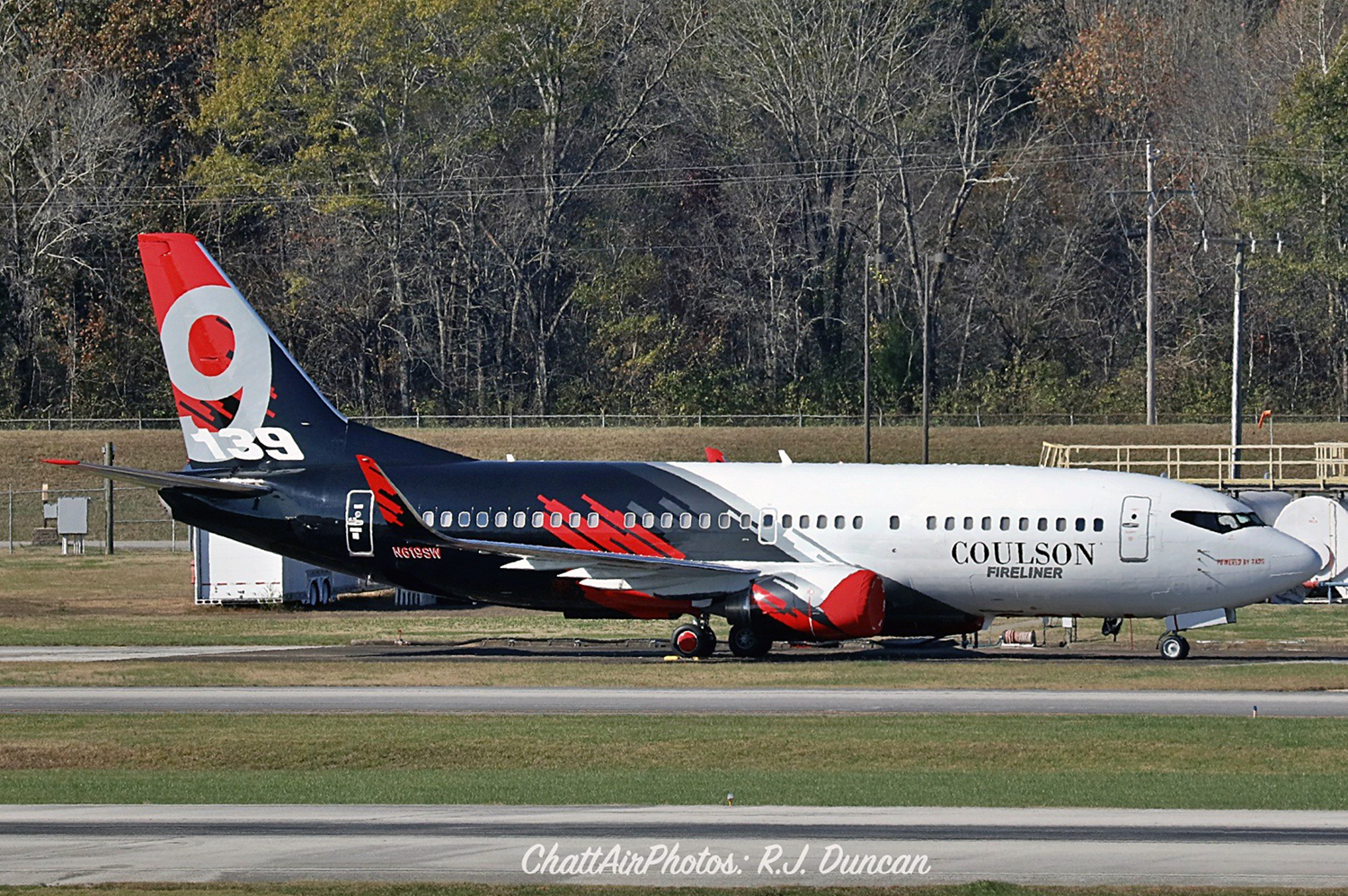
Crash of a Boeing 737-3H4 in the Fitzgerald River National Park

Date & Time: Feb 6, 2023 at 1614 LT
Type of aircraft:
Operator:
Registration:
N619SW
Flight Phase:
Flight Type:
Survivors:
Yes
Schedule:
Busselton - Busselton
MSN:
28035/2762
YOM:
1995
Flight number:
Bomber 139
Country:
Region:
Crew on board:
2
Crew fatalities:
Pax on board:
0
Pax fatalities:
Other fatalities:
Total fatalities:
0
Captain / Total flying hours:
8233
Captain / Total hours on type:
1399.00
Copilot / Total flying hours:
5852
Copilot / Total hours on type:
128
Aircraft flight hours:
69187
Circumstances:
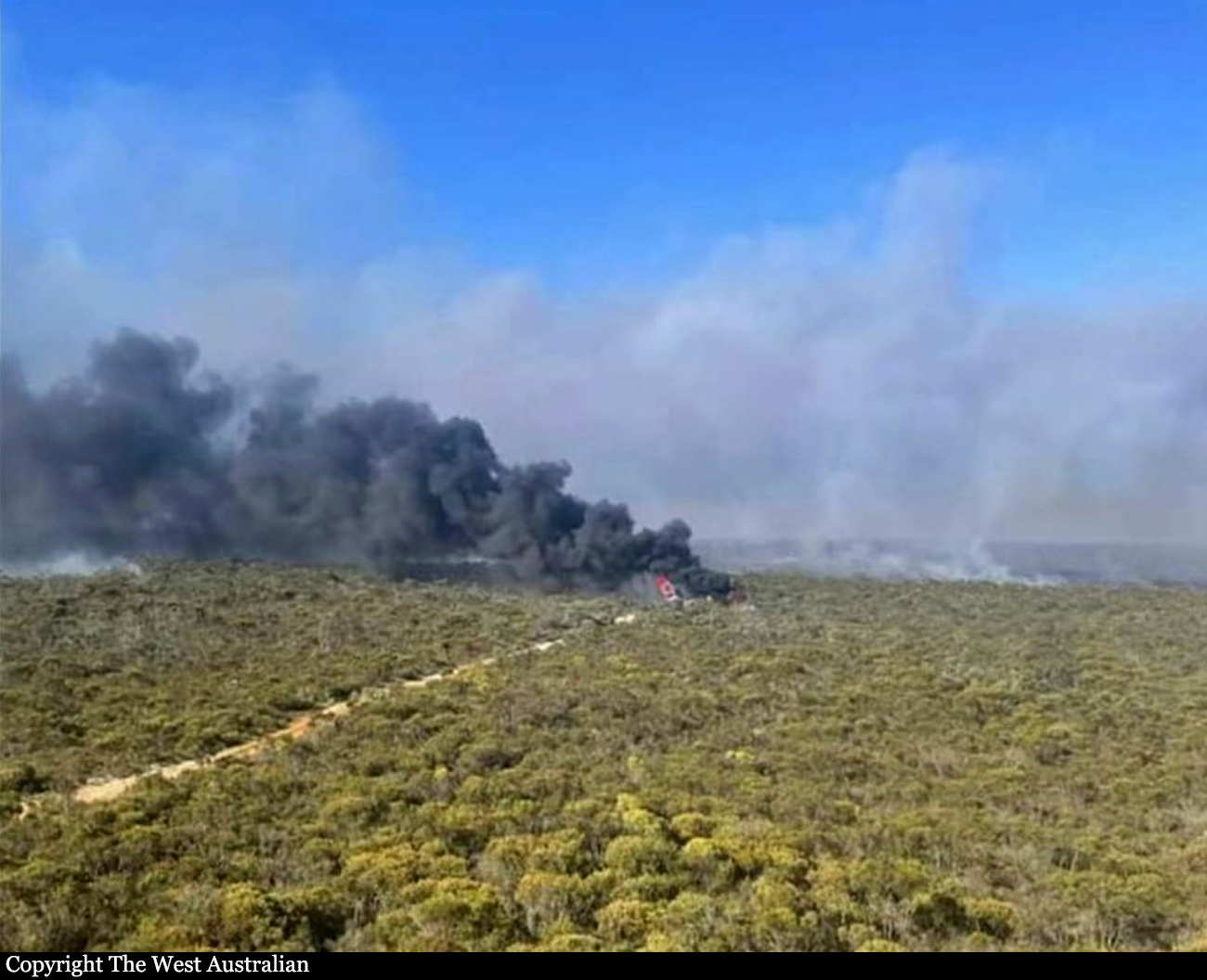
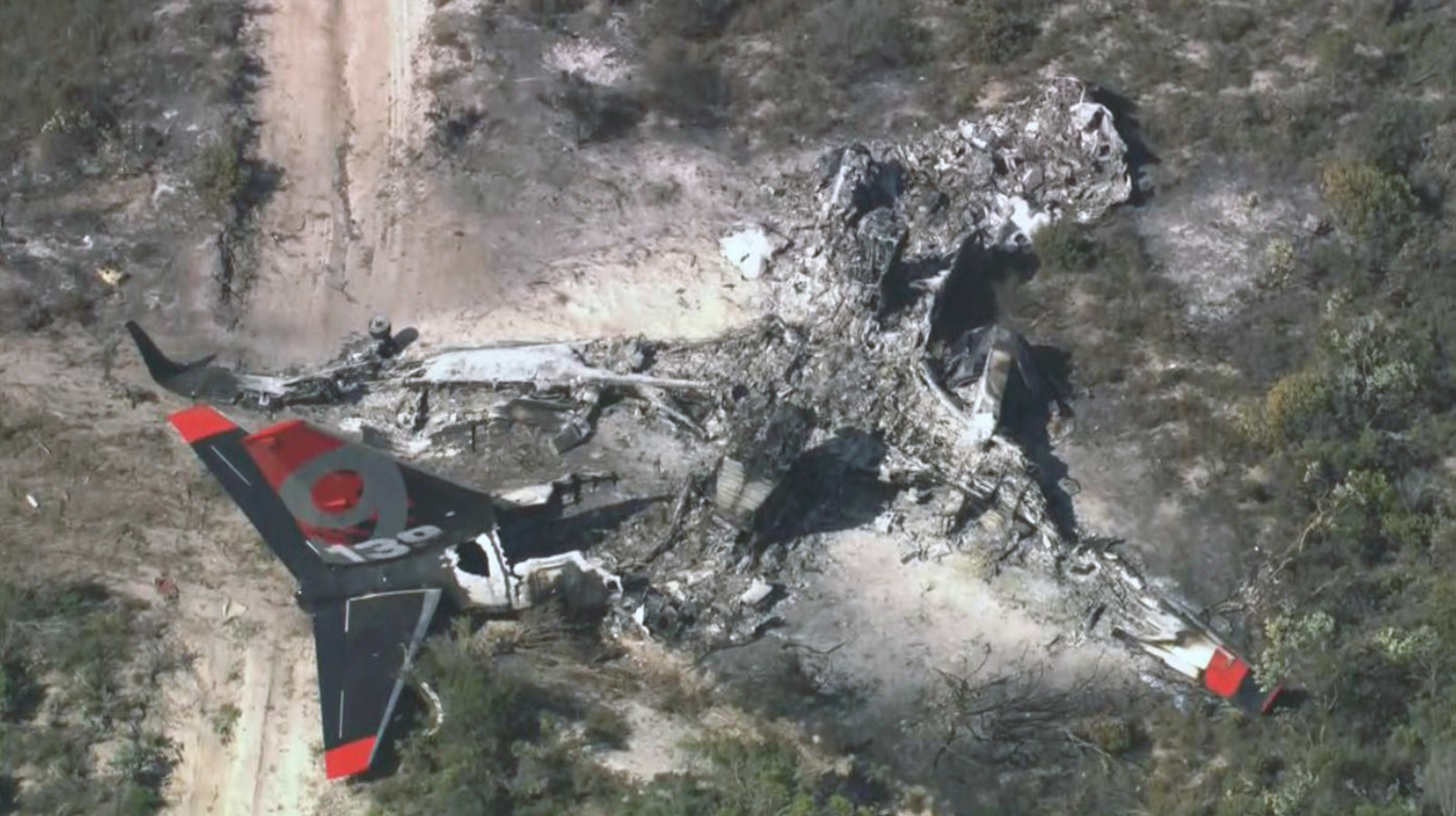
The air tanker, callsign Bomber 139, departed from Busselton Airport, Western Australia (WA) on a firefighting task to Fitzgerald River National Park, WA. There were 2 pilots on board, the aircraft captain in the left seat as the pilot flying and a copilot in the right seat as the pilot monitoring. At about 1614, during the go-around from a second partial retardant drop, the aircraft impacted a ridgeline at an elevation of about 222 ft and subsequently crashed, bursting into flames. The pilots suffered minor injuries and the aircraft was destroyed by a post crash fire.
Probable cause:
The ATSB found that the accident drop was conducted at a low height and airspeed downhill, which required the use of idle thrust and a high descent rate. The delay in the engines reaching go-around thrust at the end of the drop resulted in the aircraft’s height and airspeed (energy state) decaying as it approached rising terrain, which was not expected or detected by the pilot flying. Consequently, the aircraft’s airspeed and thrust were insufficient to climb above a ridgeline in the exit path, which resulted in a controlled flight into terrain. The operator’s practice of recalculating, and lowering, their target drop speed after a partial load drop also contributed to the low energy state of the aircraft leading up to the collision with terrain.
The ATSB also found that the operator and tasking agency had not published a minimum drop height, which resulted in the copilot, who did not believe there was a minimum drop height, not making any announcements about the low energy state prior to the collision. The ATSB found the operator’s pilot monitoring duties were reactive to the development of a low energy state and did
not include call-outs either before or at the minimum target parameters to reduce the risk of a low energy state developing.
The ATSB benchmarked the WA, New South Wales and National Aerial Firefighting Centre standards against the United States Forest Service and United States National Wildfire Coordinating Group standards and found inconsistencies between the Australian agencies’ standards but not among the United States agencies’ standards. This was likely a result of each Australian state participating in the LAT program independently producing their own standards.
Final Report:
Crash of a Britten-Norman BN-2A-21 Islander on Moa Island

Date & Time: Oct 3, 2022 at 1338 LT
Type of aircraft:
Operator:
Registration:
VH-WQA
Flight Phase:
Survivors:
Yes
Schedule:
Saibai Island - Horn Island
MSN:
494
YOM:
1975
Country:
Region:
Crew on board:
1
Crew fatalities:
Pax on board:
6
Pax fatalities:
Other fatalities:
Total fatalities:
0
Captain / Total flying hours:
2400
Captain / Total hours on type:
250.00
Aircraft flight hours:
14081
Circumstances:
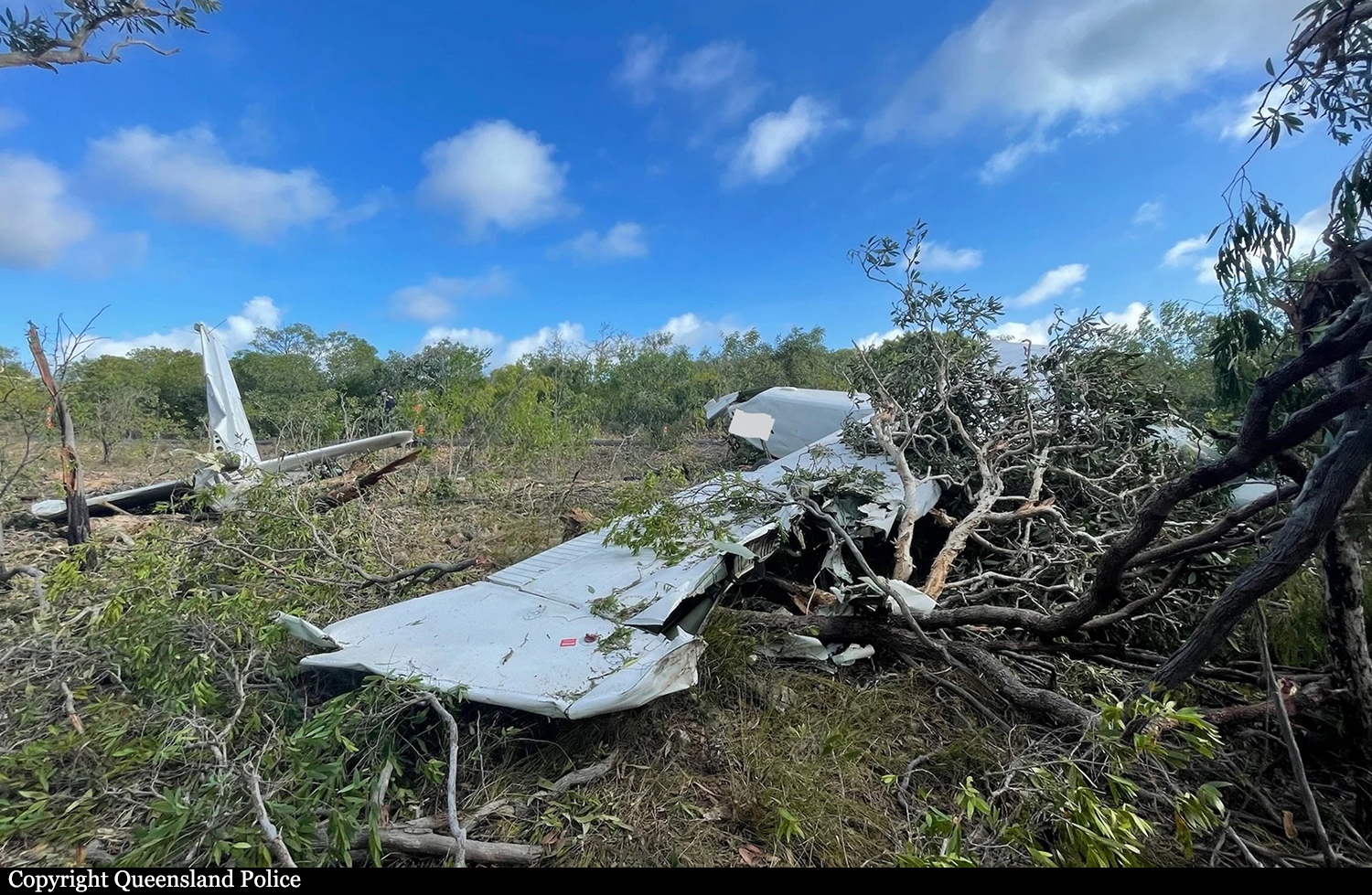
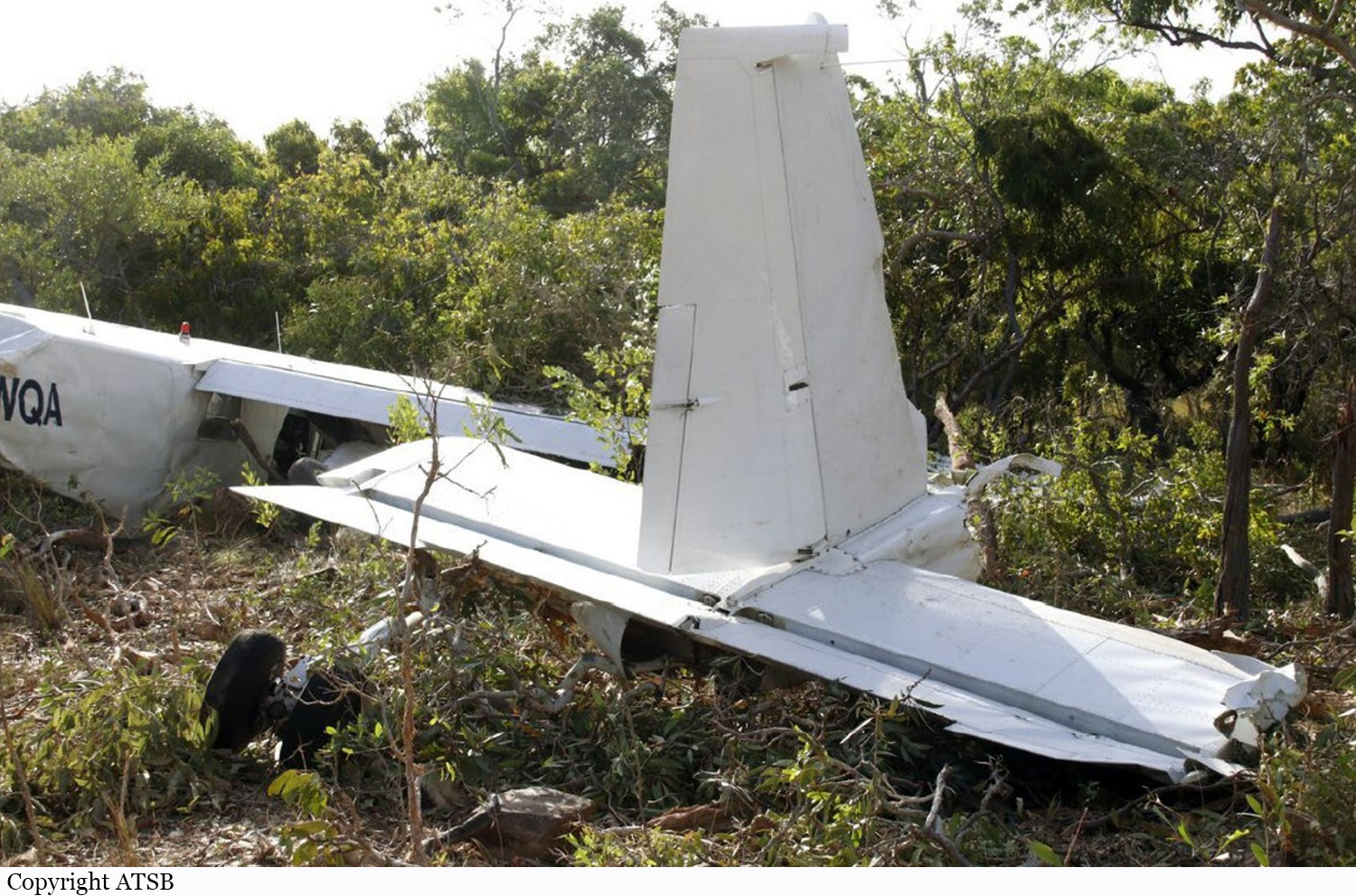
On the afternoon of 3 October 2022, a Pilatus Britten-Norman Islander BN2A-21, registered VHWQA and operated by Torres Strait Air, was conducting a non-scheduled passenger air transport flight from Saibai Island Airport, Queensland (QLD) to Horn Island Airport, QLD. There was 1 pilot and 6 passengers (students) on board. About 19 km NE of Moa Island both engines began to surge. The pilot diverted towards Kubin Airport on Moa Island. As the aircraft passed to the south of the township of Saint Pauls, the pilot determined there was insufficient altitude remaining to reach the airport. As a result, the pilot conducted a forced landing on a road 7 km ENE of Kubin Airport. There were no reported injuries to the pilot or the passengers. The aircraft was substantially damaged.
Probable cause:
The ATSB found that the dual engine speed fluctuations and associated power loss was probably the result of fuel starvation. The mechanism was not conclusively determined, however it was identified that the pilot did not operate the aircraft's fuel system in accordance with the aircraft flight manual, and that the configuration and location of the aircraft’s fuel controls and tank quantity gauges were probably not conducive to rapid and accurate interpretation. The aircraft manufacturer released a service letter in June 2022 that detailed an optional modification to centralize the fuel system controls and gauges, however this modification was not fitted to VH-WQA. The ATSB considered that these factors increased the risk of inadvertent fuel tank selection.
Final Report:

Crash of a Pacific Aerospace PAC 750XL in Tekin

Date & Time: Jan 26, 2022 at 0943 LT
Operator:
Registration:
P2-BWC
Survivors:
Yes
Schedule:
Kiunga – Oksapmin
MSN:
136
YOM:
2007
Region:
Crew on board:
1
Crew fatalities:
Pax on board:
6
Pax fatalities:
Other fatalities:
Total fatalities:
0
Captain / Total flying hours:
14129
Captain / Total hours on type:
3625.00
Aircraft flight hours:
6752
Aircraft flight cycles:
13861
Circumstances:
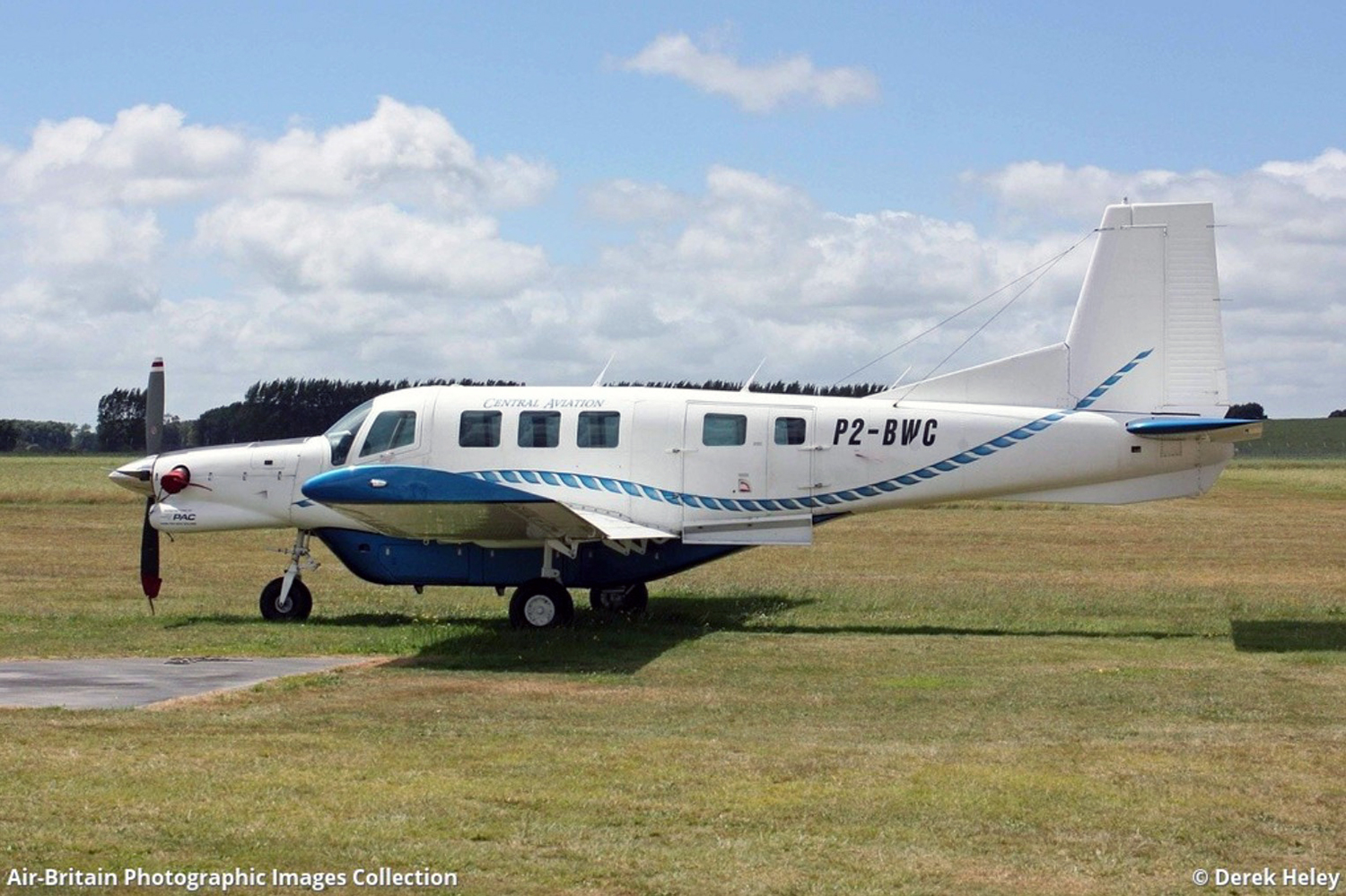
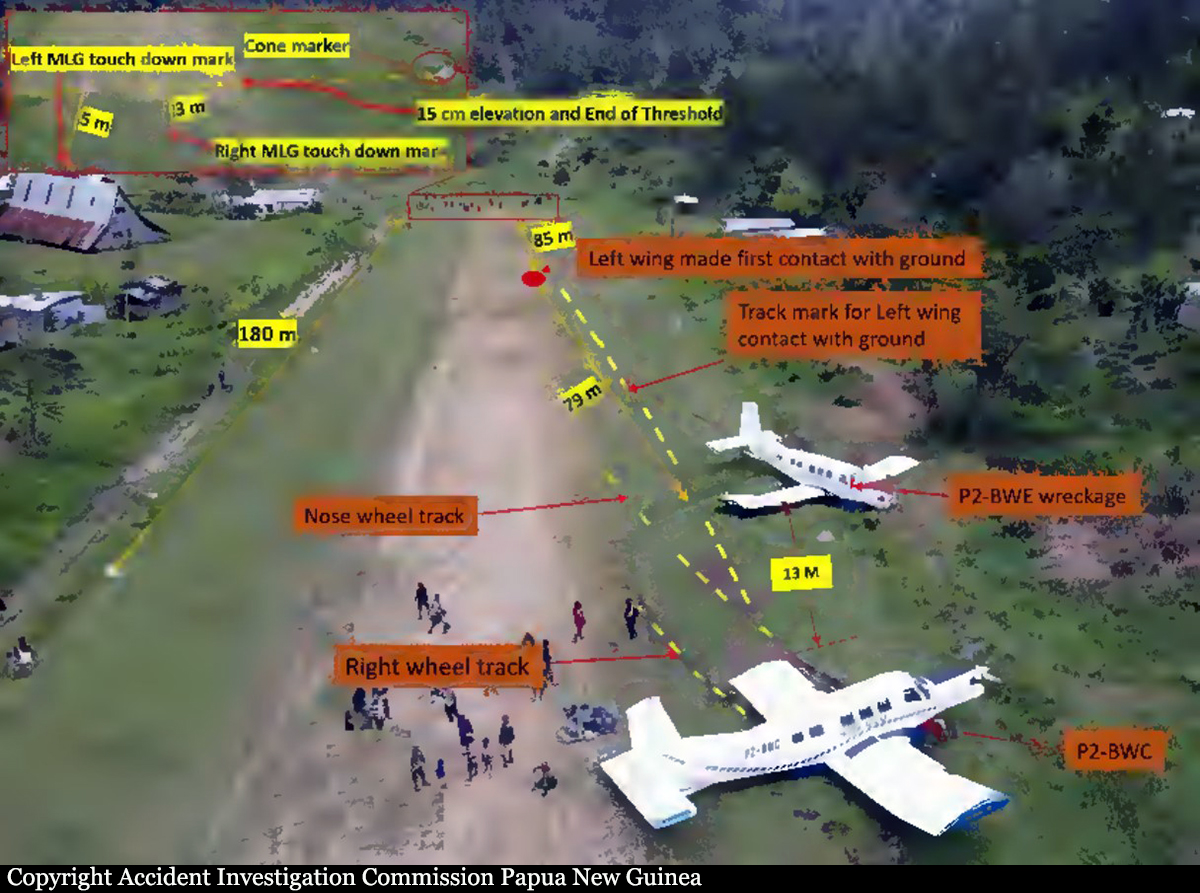
The airplane was on a VFR charter flight from Kiunga Airport, Western Province to Tekin Airstrip, Sandaun Province, Papua New Guinea. During the landing roll aircraft sustained a left main landing gear assembly collapse and subsequent runway excursion. There were seven persons onboard: one pilot and six passengers. At 09:06, P2-BWC departed Kiunga Airport and arrived at Tekin circuit area at 09:40. The pilot established the aircraft on the final approach profile, he configured the aircraft for landing by fully extending the flaps and maintained an airspeed of about 80 knots (kts). The pilot also stated that he experienced a downdraft prior to touch down. The aircraft landed at 09:43 with an airspeed of 75 knots as recalled by the pilot. The aircraft touched down about 3m short of the airstrip edge boundary. The investigation determined that due to reduced damping effect of the oleo and/or the tyre of the left main landing gear, the landing gear attachment bolts sustained significant impact stress from the landing impact force and snapped, causing the gear assembly to collapse and separate from the aircraft. Subsequently, the left wing abruptly dropped, and the aircraft began veering to the left, towards the eastern edge of the airstrip. The aircraft continued veering to the left and subsequently the left wingtip struck the outer edge of the extended right-hand flap of P2-BWE, a wreckage of the same aircraft type owned and operated by NASL that was involved in a similar accident on 18 January 2022, causing P2-BWC to abruptly veer further left and skid across the airstrip boundary as the nose-wheel and right main wheel bogged into the ground. The pilot immediately shut down the engine and evacuated the passengers with the assistance of one of the Operator’s personnel who was also a passenger on board. There were no reported injuries and the aircraft sustained significant damage.
Probable cause:
During the landing at Tekin Airstrip, the pilot encountered downdraft and touchdown about 4 metres short of the designated landing threshold. Due to less damping effect on the oleo or the tyre, the landing impact force could have transferred up through the structure and concurrently causing the left main landing gear to collapse. Subsequently, the left wing abruptly dropped and began veering to the left, towards the eastern edge of the airstrip. The aircraft continued veering to the left and subsequently the left wingtip struck the outer edge of the extended right-side flap of P2-BWE, causing it to abruptly veer further left and skid across the airstrip boundary as the nose-wheel and right main wheel bogged into the ground.
Final Report:

Crash of a Pacific Aerospace PAC 750XL in Tekin

Date & Time: Jan 18, 2022 at 0926 LT
Operator:
Registration:
P2-BWE
Survivors:
Yes
Schedule:
Kiunga – Oksapmin
MSN:
161
YOM:
2009
Region:
Crew on board:
1
Crew fatalities:
Pax on board:
7
Pax fatalities:
Other fatalities:
Total fatalities:
0
Captain / Total flying hours:
9305
Captain / Total hours on type:
332.00
Aircraft flight hours:
7549
Aircraft flight cycles:
11178
Circumstances:
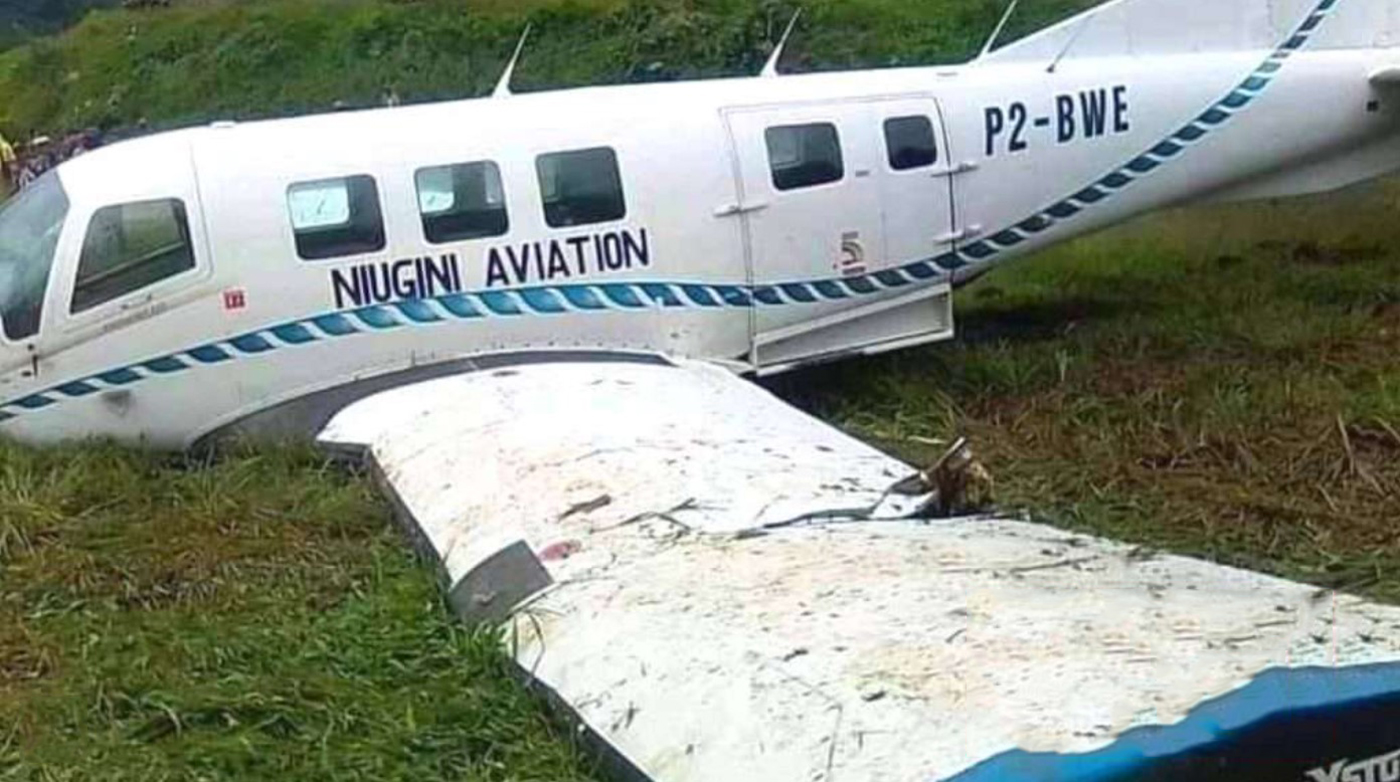
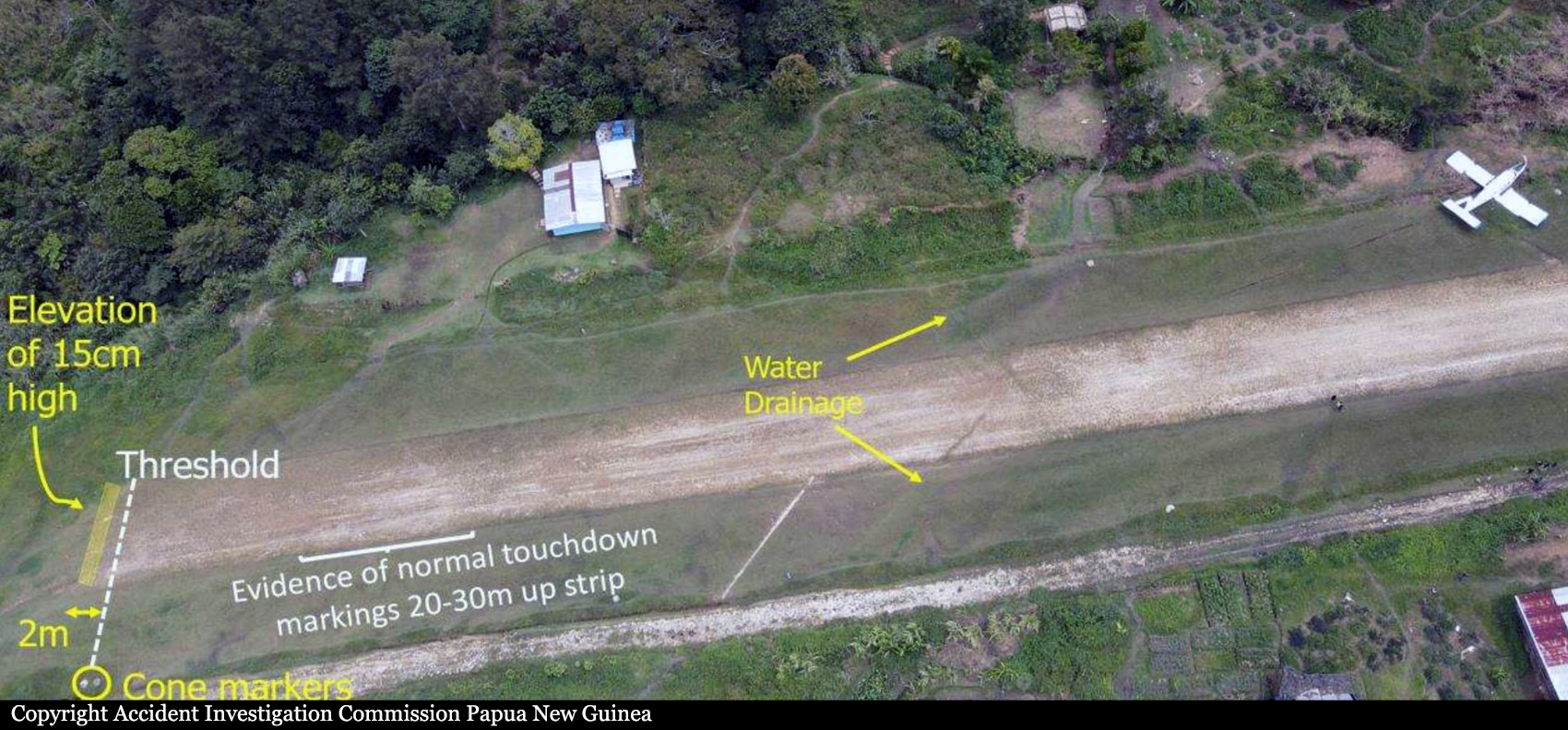
The airplane was conducting a single pilot VFR charter flight from Kiunga Airport, Western Province to Tekin Airstrip, Sandaun Province, Papua New Guinea when during the landing roll, the aircraft sustained a left Main Landing Gear (MLG) assembly collapse and subsequent runway excursion. There were eight persons onboard: one pilot and seven passengers. At 08:43, P2-BWE departed Kiunga Airport and arrived at Tekin Airstrip circuit at 09:18. The pilot then tracked towards the Northwest of the airstrip and made a left base turn for approach. The pilot stated that he established the aircraft on final approach with an airspeed of 120 kts. He subsequently configured the aircraft for landing; propeller pitch set to full fine, power set to maintain nominated approach speed, and full flap. The pilot indicated that he reduced airspeed while on approach and maintained an airspeed between 85 and 90 kts. As he flared the aircraft to land, the airspeed was between 75 to 80 kts. The touchdown speed, as he recalled, was 75 kts. The aircraft touched down two metres short of the designated landing threshold of runway18, which had an elevation of 15cm. Reviewing the flight records of the pilot, and from his interview, the AIC deduced that the pilot was not adequately familiar with Tekin Airstrip. The aircraft sustained substantial damaged. All the passengers and pilot evacuated the aircraft without injuries.
Probable cause:
The investigation identified that during touchdown, the aircraft’s main landing gear tyre hit the 15cm elevation at the edge of runway18, resulting in the left MLG assembly weakening. The investigation determined that due to less damping effect on the oleo or the tyre, the landing impact force could have transferred up through the structure and concurrently causing the left MLG assembly to collapse. Following the collapse of the left MLG assembly, the left-wing assembly dropped and hit the ground, the flap detached and began to drag on the surface of the strip creating markings. The aircraft immediately began veering left, towards the edge (boundary) of the airstrip and impacted the drainage ditch adjacent to the runway where it came to rest.
Final Report:
Crash of a Cessna 402C in Papa Lealea

Date & Time: Jul 26, 2020 at 1246 LT
Type of aircraft:
Operator:
Registration:
VH-TSI
Flight Phase:
Flight Type:
Survivors:
Yes
Schedule:
Papa Lealea - Mareeba
MSN:
402C-0492
YOM:
1981
Region:
Crew on board:
1
Crew fatalities:
Pax on board:
0
Pax fatalities:
Other fatalities:
Total fatalities:
0
Circumstances:
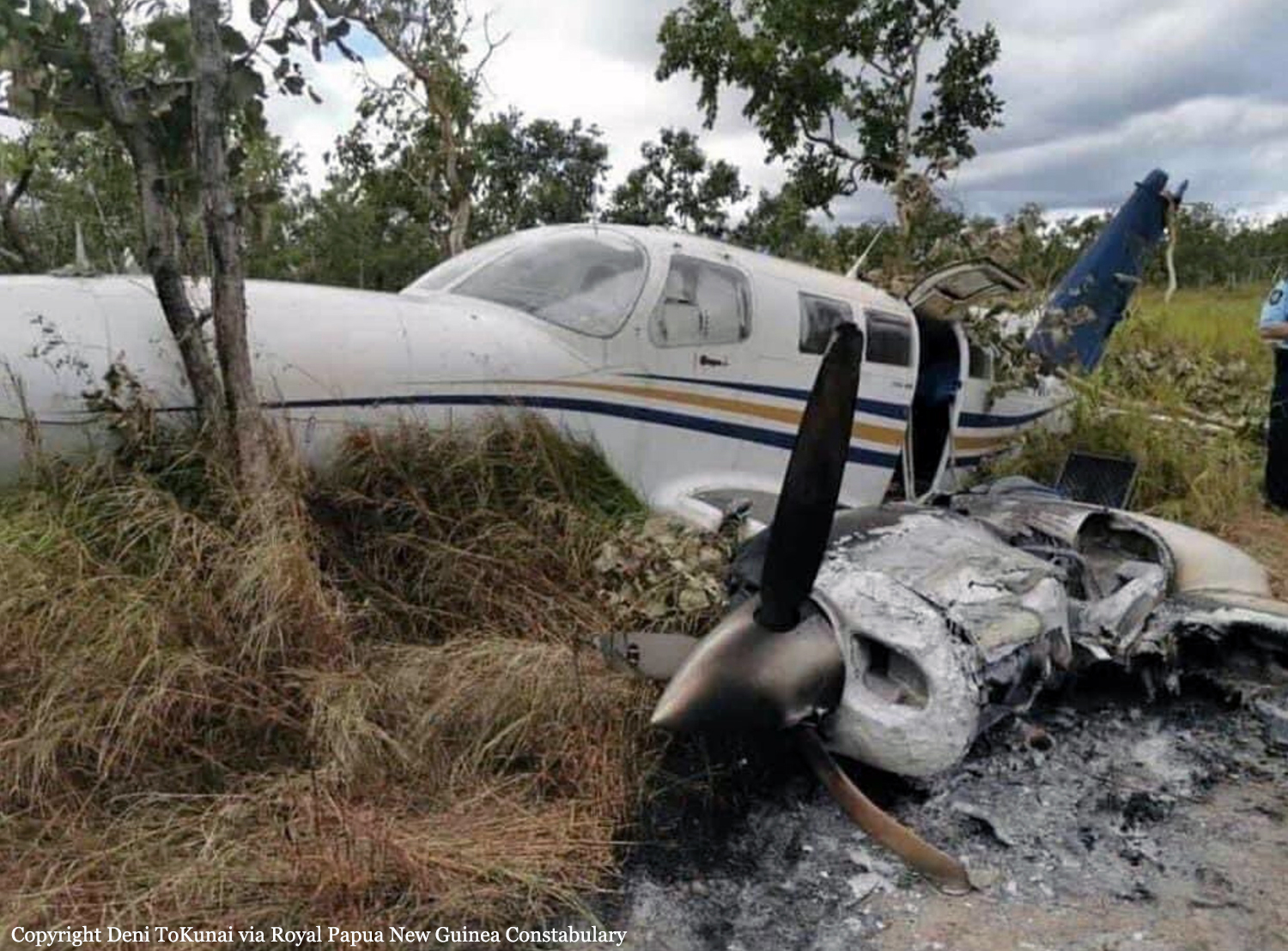
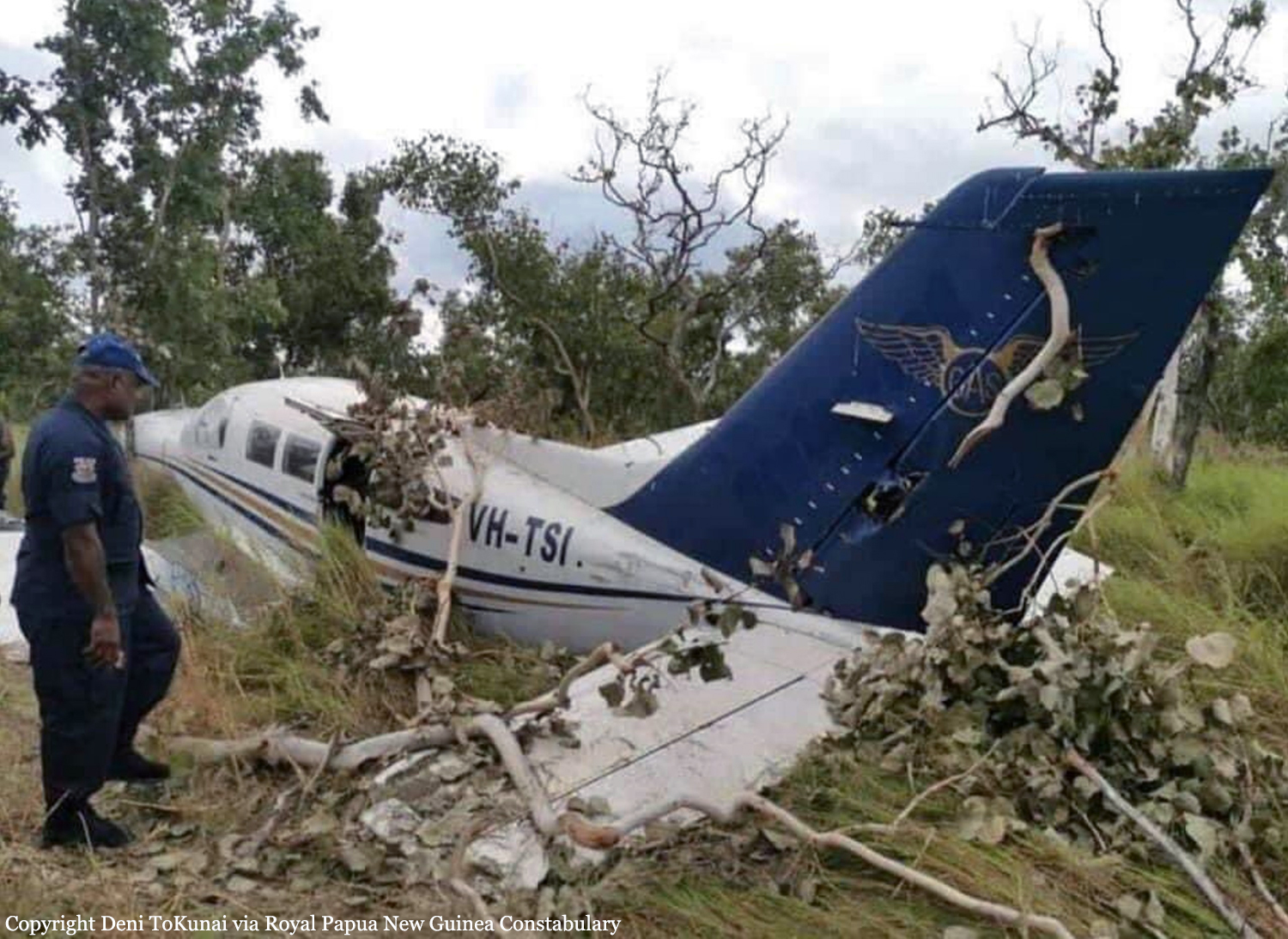
On 26 July 2020, at 12:46 local time (02:46 UTC), a Cessna 402C aircraft, registered VH-TSI collided with trees during an aborted take-off at an uncommissioned field near Papa-Lealea, about 16 nm North-West of Port Moresby, Papua New Guinea. The pilot, during interview with the AIC, stated that he departed at 09:30 that day from Mareeba Airport, Queensland Australia and tracked towards the North North-East with a planned track set slightly left of Jacksons International Airport, Port Moresby, National Capital District, Papua New Guinea. As the aircraft neared the Southern shoreline (within the Caution Bay area), he diverted left and began tracking towards the North West along the coast in order to avoid flying over villages in the area. He subsequently crossed over land before turning back to approach the intended landing field. As the aircraft approached to land, the outboard section of the left wing was clipped by a tree and separated from the aircraft. According to the pilot, he continued on with the approach and landed on the field at about 12:20. The pilot reported that he had flown to and within Papua New Guinea in the past and was familiar with the area and airspace. He confirmed that after departing Mareeba, he switched off the transponder. After shutting down the aircraft, the aircraft was refuelled with jerrycans full of fuel (AvGas) and loaded with cargo by persons waiting on the ground. The pilot reported that he estimated that a distance of 800 m would be required for the take-off. According to the pilot, at about 12:40, he lined up and commenced his take-off roll from the Southern end of the field. As the aircraft lifted off, he noticed that the airspeed indicator (ASI) was not working. He also observed that the aircraft was not achieving a positive rate of climb. He subsequently pulled the throttles back and manoeuvred the aircraft back towards the ground. The aircraft touched down with a speed that the pilot described as higher than normal, with about 400 m of usable field remaining. The aircraft continued off the end of the field and into the bushes clipping trees along the way until it came to rest. The pilot informed the AIC that he was the sole occupant of the aircraft, and sustained minor injuries as a result of the occurrence. The aircraft was substantially damaged. The investigation confirmed that the fire to the left wing and engine was a post-accident event and was deliberate. The pilot was later arrested and a load of 500 kilos of cocaine distributed in 28 bales was found at the scene.
Probable cause:
The investigation determined that the separation of the outboard section of the left wing, clipped by a tree during the approach to land phase, affected the ability of the left wing to produce lift. The investigation could not conclusively determine the actual weight and balance of the aircraft as it was not possible to determine the quantity and quality of fuel on board, nor the weight and distribution of the cargo that was on board. The evidence gathered during the investigation did not allow the AIC to discard overweight, balance or centre of gravity issues due to improper loading or restrain of the cargo as factors contributing to the inability of the aircraft to obtain a positive rate of climb during take-off. The evidence of tire marks found by the investigators on the uncommissioned field indicated that the aircraft touched down about 400 m before the end of the field, distance that was not enough for the aircraft to come to a stop, continuing its landing roll into the bushes and impacting trees until it got to its final position. The investigation determined that the aircraft was not airworthy at the time of the accident and was unserviceable for the conduct of the flight. The investigation also determined that there was no proper document control to conduct timely scheduled maintenance and that there was no record of a certificate of airworthiness (CoA) at the time of the accident.
Final Report:
Crash of a PAC Cresco 08-600 near Carterton: 1 killed

Date & Time: Apr 24, 2020 at 0710 LT
Type of aircraft:
Operator:
Registration:
ZK-LTK
Flight Phase:
Survivors:
No
Site:
MSN:
30
YOM:
2002
Country:
Region:
Crew on board:
1
Crew fatalities:
Pax on board:
0
Pax fatalities:
Other fatalities:
Total fatalities:
1
Captain / Total flying hours:
15000
Captain / Total hours on type:
8700.00
Circumstances:
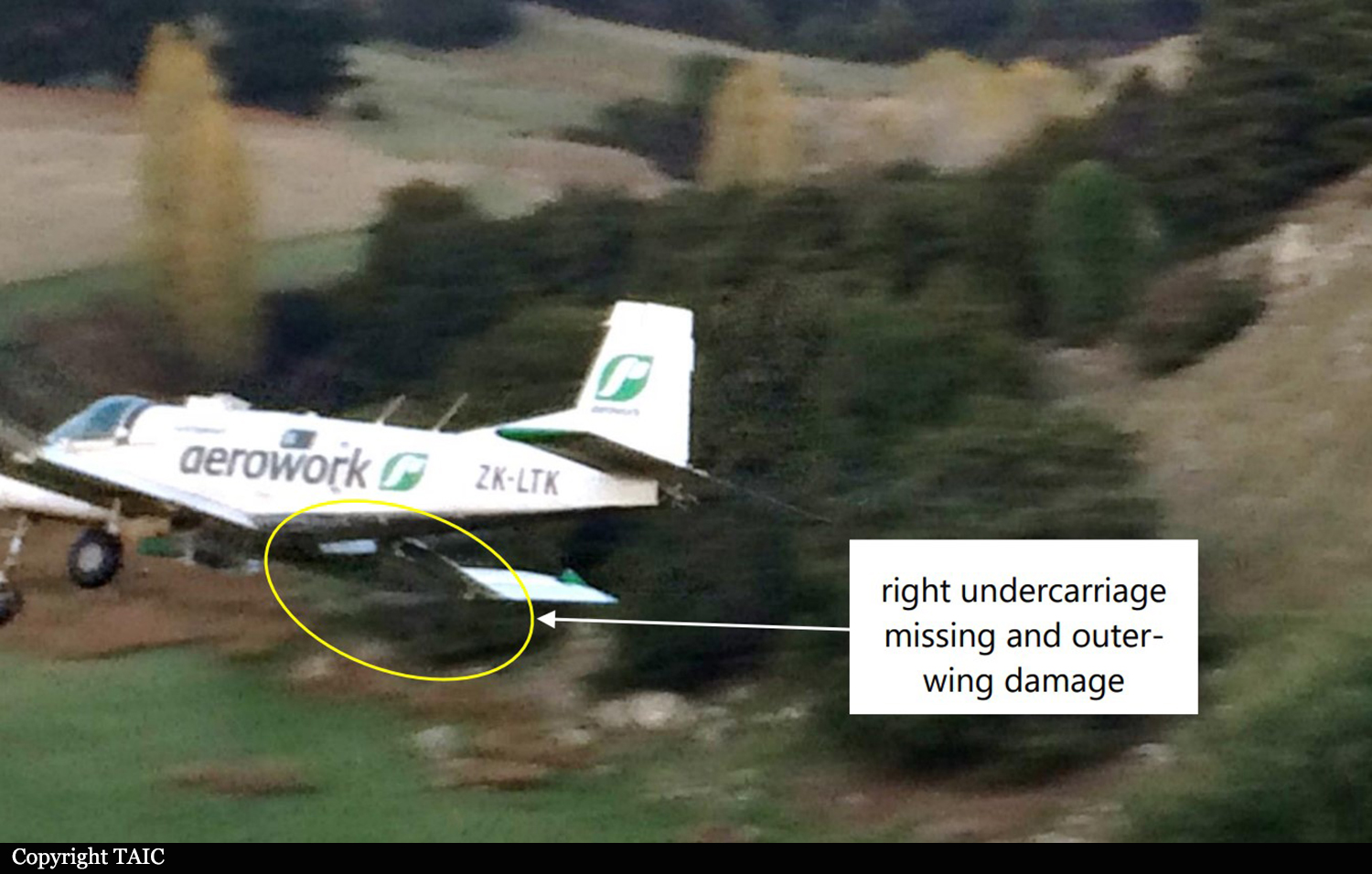
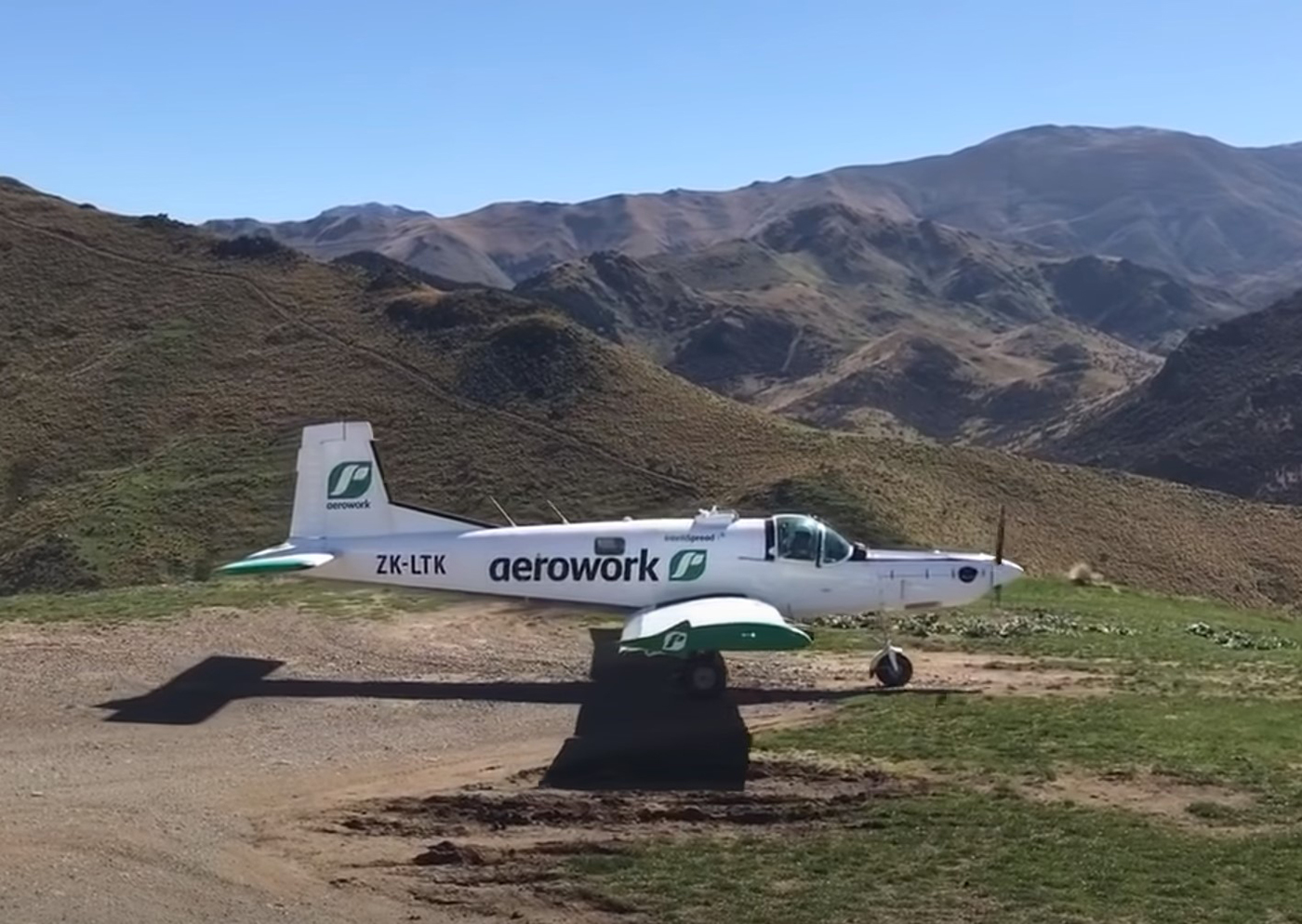
On 24 April 2020 the pilot of a Pacific Aerospace Cresco 08-600 aircraft, registered ZK-LTK (the aeroplane), was conducting agricultural flight operations spreading superphosphate fertilizer on a farm in the Kourarau Hill area, near Masterton. The airstrip was a typical topdressing airstrip, with a downward slope and a left bend of about 5 degrees partway down the strip, in the direction of take-off. The ground at the end of the airstrip dropped sharply away to a valley that ran perpendicular to the direction of the airstrip. On the commencement of the third topdressing flight, witnesses reported, the aeroplane accelerated normally from the loading point. However, the aeroplane did not follow the direction of the airstrip around to the left, as it had done during the previous two flights. Instead, the aeroplane continued in a straight line from the load point and subsequently struck uneven terrain off to the right of the airstrip. The impact with the uneven terrain caused the right main undercarriage assembly to fracture off and damage the right wing and flap. The aeroplane descended into the valley, striking a tree with the right-hand wing, then continued across the valley floor and impacted the far side of the valley, coming to rest inverted. The aeroplane was destroyed by the impacts and a post-crash fire. The sole pilot occupant did not survive the accident sequence.
Probable cause:
The following findings were identified:
- The pilot did not make the necessary left turn during the take-off roll to align with the strip centreline, so the aeroplane continued the take-off roll in a straight line.
- The right-rear undercarriage struck uneven ground with sufficient force to break the undercarriage mounting brackets and dislodge the undercarriage assembly from the aeroplane.
- The right main undercarriage subsequently struck the right flap, resulting in a partial dislocation of the flap. This very likely resulted in the aeroplane becoming uncontrollable.
- The pilot was about as likely as not to have been incapacitated early in the take-off roll.
Final Report:

Crash of a Cessna 404 Titan in Lockhart River: 5 killed

Date & Time: Mar 11, 2020 at 0919 LT
Type of aircraft:
Registration:
VH-OZO
Survivors:
No
Schedule:
Cairns – Lockhart River
MSN:
404-0653
YOM:
1980
Country:
Region:
Crew on board:
1
Crew fatalities:
Pax on board:
4
Pax fatalities:
Other fatalities:
Total fatalities:
5
Captain / Total flying hours:
3220
Captain / Total hours on type:
399.00
Circumstances:
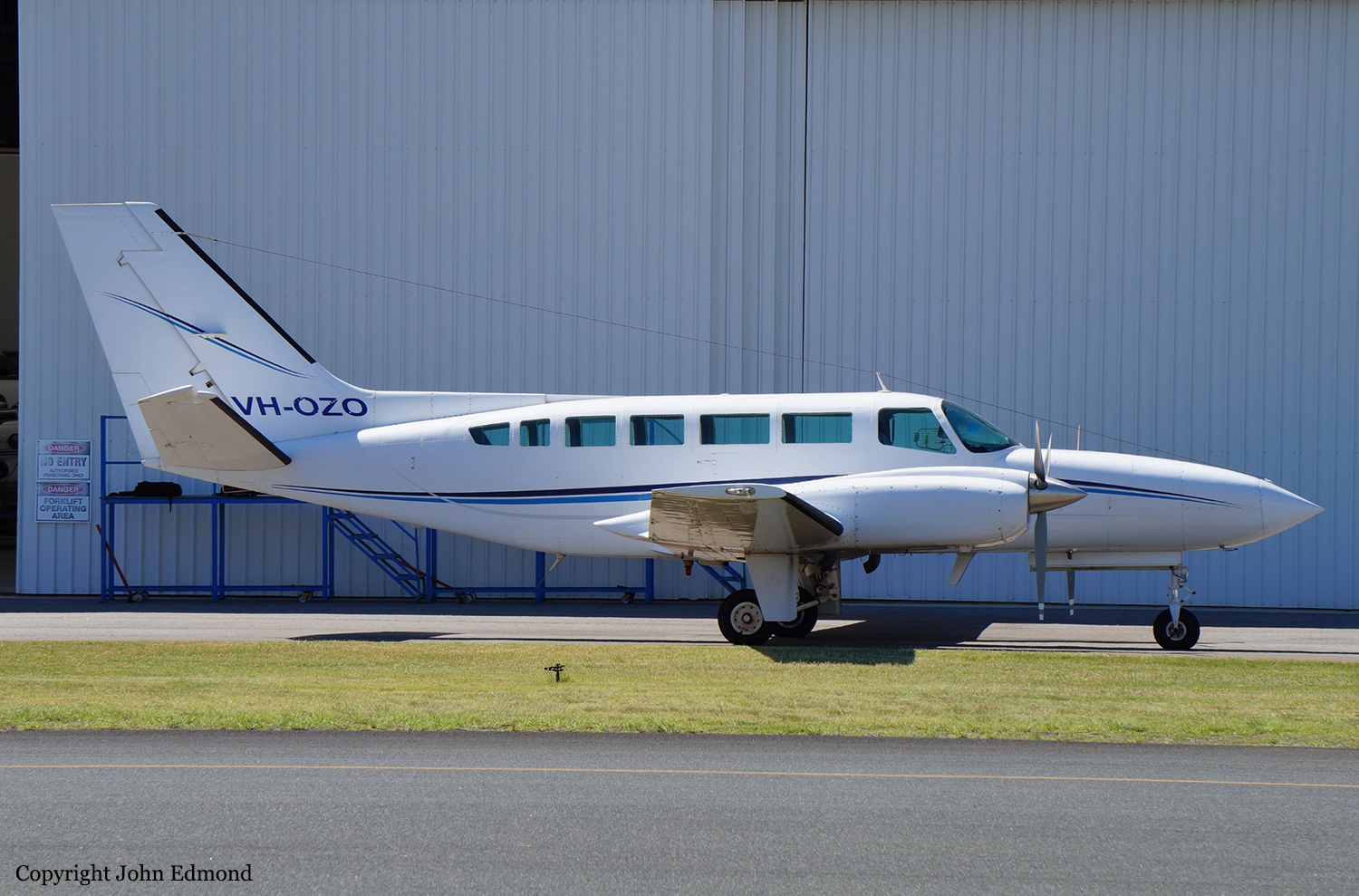
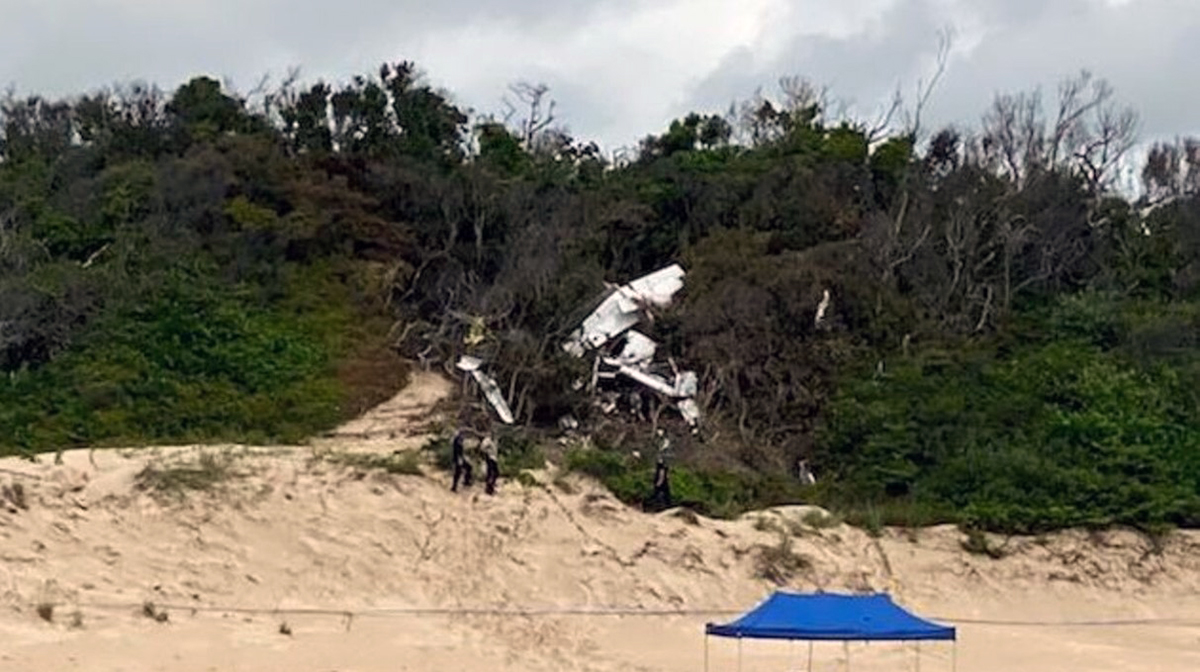
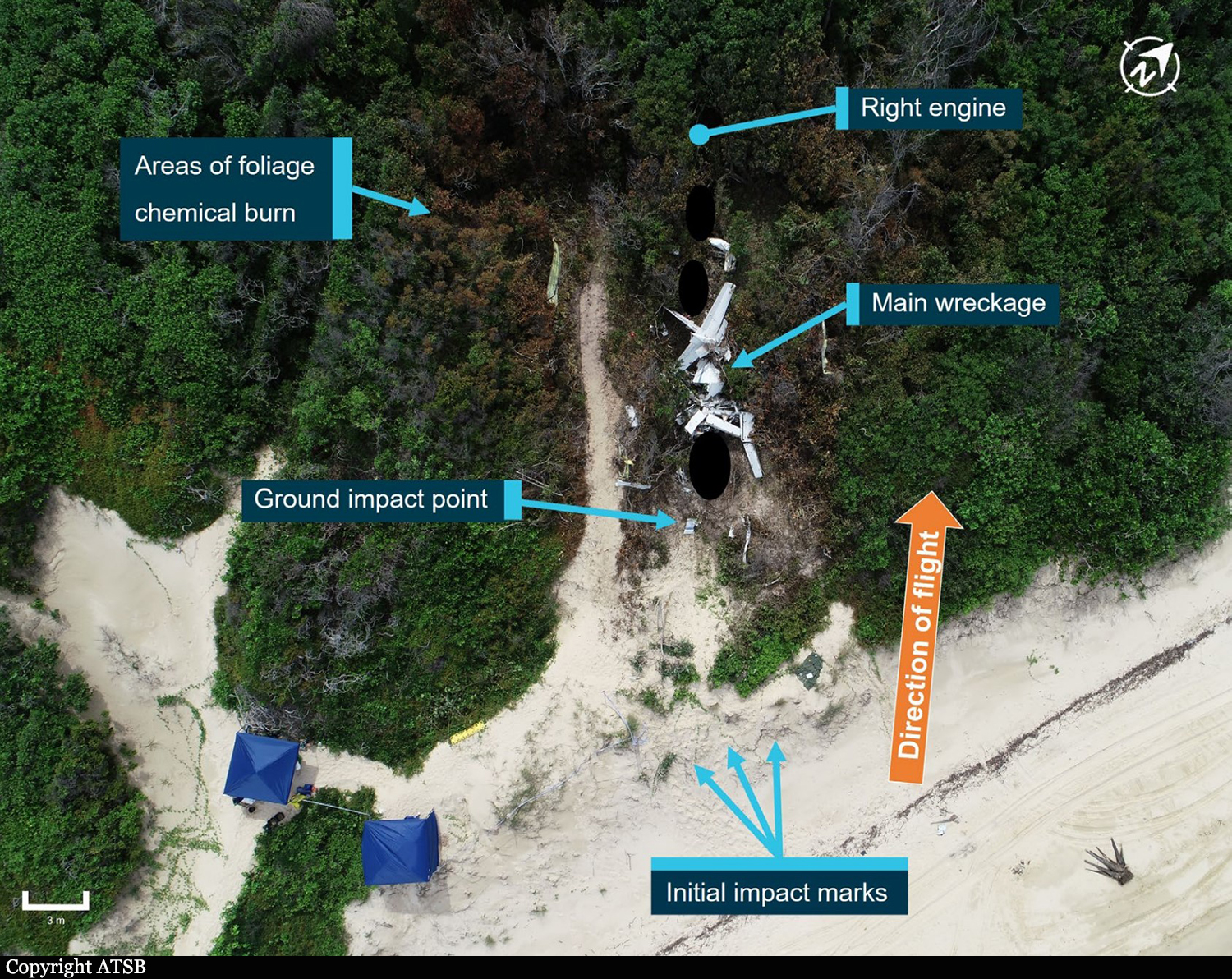
On 11 March 2020, a Cessna 404 aircraft, registered VH-OZO, was being operated by Air Connect Australia to conduct a passenger charter flight from Cairns to Lockhart River, Queensland. On board were the pilot and 4 passengers, and the flight was being conducted under the instrument flight rules (IFR). Consistent with the forecast, there were areas of cloud and rain that significantly reduced visibility at Lockhart River Airport. On descent, the pilot obtained the latest weather information from the airport’s automated weather information system (AWIS) and soon after commenced an area navigation (RNAV) global satellite system (GNSS) instrument approach to runway 30. The pilot conducted the first approach consistent with the recommended (3°) constant descent profile, and the aircraft kept descending through the minimum descent altitude (MDA) of 730 ft and passed the missed approach point (MAPt). At about 400 ft, the pilot commenced a missed approach. After conducting the missed approach, the pilot immediately commenced a second RNAV GNSS approach to runway 30. During this approach, the pilot commenced descent from 3,500 ft about 2.7 NM prior to the intermediate fix (or 12.7 NM prior to the MAPt). The descent was flown at about a normal 3° flight path, although about 1,000 ft below the recommended descent profile. While continuing on this descent profile, the aircraft descended below the MDA. It then kept descending until it collided with terrain 6.4 km (3.5 NM) short of the runway. The pilot and 4 passengers were fatally injured, and the aircraft was destroyed.
Probable cause:
The accident was the consequence of a controlled flight into terrain.
The following contributing factors were identified:
• While the pilot was operating in the vicinity of Lockhart River Airport, there were areas of cloud and rain that significantly reduced visibility and increased the risk of controlled flight into terrain.
In particular, the aircraft probably entered areas of significantly reduced visibility during the second approach.
• After an area navigation (RNAV) global satellite system (GNSS) approach to runway 30 and missed approach, the pilot immediately conducted another approach to the same runway that was on a similar gradient to the recommended descent profile but displaced about 1,000 ft below that profile. While continuing on this descent profile, the aircraft descended below a segment minimum safe altitude and the minimum descent altitude, then kept descending until the collision with terrain about 6 km before the runway threshold.
• Although the exact reasons for the aircraft being significantly below the recommended descent profile and the continued descent below the minimum descent altitude could not be determined, it was evident that the pilot did not effectively monitor the aircraft’s altitude and descent rate for an extended period.
• When passing the final approach fix (FAF), the aircraft’s lateral position was at about full-scale deflection on the course deviation indicator (CDI), and it then exceeded full-scale deflection for
an extended period. In accordance with the operator’s stabilized approach procedures, a missed approach should have been conducted if the aircraft exceeded half full-scale deflection at the FAF, however a missed approach was not conducted.
• The pilot was probably experiencing a very high workload during periods of the second approach. In addition to the normal high workload associated with a single pilot hand flying an approach in instrument meteorological conditions, the pilot’s workload was elevated due to conducting an immediate entry into the second approach, conducting the approach in a different manner to their normal method, the need to correct lateral tracking deviations throughout the approach, and higher than appropriate speeds in the final approach segment.
• The aircraft was not fitted with a terrain avoidance and warning system (TAWS). Such a system would have provided visual and aural alerts to the pilot of the approaching terrain for an extended period, reducing the risk of controlled flight into terrain.
• Although the aircraft was fitted with a GPS/navigational system suitable for an area navigation (RNAV) global satellite system (GNSS) approach and other non-precision approaches, it was not fitted with a system that provided vertical guidance information, which would have explicitly indicated that the aircraft was well below the recommended descent profile. Although the operator had specified a flight profile for a straight-in approaches and stabilized approach criteria in its operations manual, and encouraged the use of stabilized approaches, there were limitations with the design of these procedures. In addition, there were limitations with other risk controls for minimizing the risk of controlled flight into terrain (CFIT), including no procedures or guidance for the use of the terrain awareness function on the aircraft’s GNS 430W GPS/navigational units and limited monitoring of the conduct of line operations.

Other factors that increased risk:
• Although an applicable height of 1,000 ft for stabilized approach criteria in instrument meteorological conditions has been widely recommended by organizations such as the International Civil Aviation Organization for over 20 years, the Civil Aviation Safety Authority had not provided formal guidance information to Australian operators regarding the content of stabilized approach criteria. (Safety issue)
• The Australian requirements for installing a terrain avoidance and warning system (TAWS) were less than those of other comparable countries for some types of small aeroplanes conducting air transport operations, and the requirements were not consistent with International Civil Aviation Organization (ICAO) standards and recommended practices. More specifically, although there was a TAWS requirement in Australia for turbine-engine aeroplanes carrying 10 or more passengers under the instrument flight rules:
- There was no requirement for piston-engine aeroplanes to be fitted with a TAWS, even though this was an ICAO standard for such aeroplanes authorized to carry 10 or more passengers, and this standard had been adopted as a requirement in many comparable countries.
- There was no requirement for turbine-engine aeroplanes authorized to carry 6–9 passengers to be fitted with a TAWS, even though this had been an ICAO recommended practice since 2007, and this recommended practice had been adopted as a requirement in many comparable countries. (Safety Issue)

Other findings:
• The forecast weather at Lockhart River for the time of the aircraft’s arrival required the pilot to plan for 60 minutes holding or diversion to an alternate aerodrome. The aircraft had sufficient fuel for that purpose; and the aircraft had sufficient fuel to conduct the flight from Cairns to Lockhart River and return, with additional fuel for holding on both sectors if required.
• There was no evidence of any organizational or commercial pressure to conduct the flight to Lockhart River or to complete the flight once to commenced.
• Based on the available evidence, it is very unlikely that the pilot was incapacitated or impaired during the flight.
• There was no evidence of any aircraft system or mechanical anomalies that would have directly influenced the accident. However, as a consequence of extensive aircraft damage, it was not possible to be conclusive about the aircraft’s serviceability.
• The aircraft was fitted with Garmin GNS 430W GPS/navigational units that could be configured to provide visual (but not aural) terrain alerts. However, it could not be determined whether the
terrain awareness function was selected on during the accident flight.
Final Report:
Crash of a Lockheed EC-130Q Hercules near Peak View: 3 killed

Date & Time: Jan 23, 2020 at 1315 LT
Type of aircraft:
Operator:
Registration:
N134CG
Flight Phase:
Flight Type:
Survivors:
No
Schedule:
Richmond - Richmond
MSN:
4904
YOM:
1981
Flight number:
Bomber 134
Country:
Region:
Crew on board:
3
Crew fatalities:
Pax on board:
0
Pax fatalities:
Other fatalities:
Total fatalities:
3
Captain / Total flying hours:
4010
Captain / Total hours on type:
3010.00
Copilot / Total flying hours:
1744
Copilot / Total hours on type:
1364
Aircraft flight hours:
11888
Circumstances:
At about 1205, while B137 was overhead the Adaminaby fire-ground, and about the same time the SAD logged the birddog rejection, B134 departed Richmond as initial attack. On board were the PIC, the copilot and flight engineer. In response to the draft report, the RFS provided excerpts from the state operations controller (SOC) log. An entry was written in the log by the SOC following the accident. The SOC noted having been advised that the birddog had indicated it was ‘not safe to fly’ and that B137 was not returning to the area until the conditions had eased. However, B134 would continue with the PIC to make the ‘decision of safety of bombing operations’. The RFS advised the ATSB that the SOC had the authority to cancel B134’s tasking, but instead allowed it to proceed, with the intention of gathering additional intelligence to assist in determining whether further aerial operations would proceed. The RFS further reported that this indicated an ongoing intelligence gathering and assessment process by the SOC. At about 1235, while returning to Richmond, the PIC of B137 heard the PIC of B134 on the Canberra approach frequency, and contacted them via their designated operating frequency. At that time, B134 was about 112 km north-east of Adaminaby, en route to the fire-ground. In this conversation, the PIC of B137 informed them of the actual conditions and that they would not be returning to Adaminaby. The PIC of B137 reported that they could not recall the specific details of the call, but that the conversation included that they were ‘getting crazy winds’ and ‘you can go take a look’ ’but I am not going back’. It was also noted that the PIC of B134 had asked several questions. It was reported by the majority of the operator’s pilots that, despite receiving information from another pilot, they would have also continued with the tasking under these circumstances, to assess the conditions themselves. At about 1242, the crew of B134 contacted air traffic control to advise them of the coordinates they would be working at, provide an ‘ops normal’ call time, and confirm there was no reported instrument flight rules aircraft in the area. About 5 minutes later, the Richmond ABM also attempted to contact the crew of B134 to confirm ‘ops normal’, firstly by radio, and then by text to the PIC’s mobile phone, but did not receive a response. The automatic dependent surveillance broadcast (ADS-B) data showed that, after arriving at the Adaminaby fire-ground at about 1251, the crew of B134 completed several circuits at about 2,000 ft AGL. At about 1255, the crew advised the Cooma ARO that it was too smoky and windy to complete a retardant drop at that location. The Cooma ARO then provided the crew with the approximate coordinates of the Good Good fire, about 58 km to the east of Adaminaby. The ARO further indicated that they had no specific requirements, but they could look for targets of opportunity, with the objective of conducting structure and property protection near Peak View. At about 1259, the crew of B134 contacted air traffic control to advise that they had been re-tasked to the Good Good fire-ground, and provided updated coordinates. At about the same time, the RFS ground firefighters at the Good Good fire-ground, near Feeney’s Road in Peak View, contacted the Cooma FCC and requested additional assets for property protection. They were advised that a LAT would be passing overhead in about 10 minutes. The firefighters acknowledged the intention of a LAT retardant drop and advised the Cooma FCC they would wait in open country on Feeney’s Road, clear of any properties targeted for protection. At about 1307, B134 arrived overhead the drop area. The drop area was located to the east of a ridgeline, with the fire on the western side of the ridgeline. The aircraft’s recorded track data (SkyTrac) showed that the crew conducted 3 left circuits, at about 1,500 ft, 500 ft and 1,000 ft AGL respectively, prior to commencing the drop circuit. At about 1312, after conducting about 2 circuits, they advised the Cooma ARO of their intention to complete multiple drops on the eastern side of the Good Good fire, and that they would advise the coordinates after the first delivery. At 1315:15, a partial retardant drop was conducted on a heading of about 190°, at about 190 ft AGL (3,600 ft above mean sea level). During the drop, about 1,200 US gallons (4,500 L) of fire retardant was released over a period of about 2 seconds. A ground speed of 144 kt was recorded at the time of the drop. A witness video taken by ground fire-fighters captured the drop and showed the aircraft immediately after the drop in an initial left turn with a positive rate of climb, before it became obscured by smoke. While being intermittently obscured by smoke, the aircraft climbed to about 330 ft AGL (3,770 ft above mean sea level). At about this time, ATSB analysis of the video showed that the aircraft was rolling from about 18° left angle of bank to about a 6° right angle of bank. Following this, the aircraft descended and about 17 seconds after the completion of the partial retardant drop, it was seen at a very low height above the ground, in a slight left bank. Video analysis and accident site examination showed there was no further (emergency) drop of retardant. Throughout this period, the recorded groundspeed increased slightly to a maximum of 151 kt. Shortly after, there was a significant left roll just prior to ground impact. At about 1315:37, the aircraft collided with terrain and a post-impact fuel-fed fire ensued. The 3 crew were fatally injured and the aircraft was destroyed. A review of the Airservices Australia audio recording of the applicable air traffic control frequency found no distress calls were received by controllers prior to the impact.
Probable cause:
The following contributing factors were identified:
- Hazardous weather conditions were forecast and present at the drop site near Peak View, which included strong gusting winds and mountain wave activity, producing turbulence. These
conditions were likely exacerbated by the fire and local terrain.
- The Rural Fire Service continued the B134 tasking to Adaminaby when they learned that no other aircraft would continue to operate due to the environmental conditions. In addition, they relied on the pilot in command to assess the appropriateness of the tasking to Adaminaby without providing them all the available information to make an informed decision on flight safety.
- The pilot in command of B134 accepted the Adaminaby fire-ground tasking, which was in an area of forecast mountain wave activity and severe turbulence. After assessing the conditions as unsuitable, the crew accepted an alternate tasking to continue to the Good Good (Peak View) fire-ground, which was subject to the same weather conditions. The acceptance of these taskings were consistent with company practices.
- Following the partial retardant drop and left turn, the aircraft was very likely subjected to hazardous environmental conditions including low-level windshear and an increased tailwind component, which degraded the aircraft’s climb performance.
- While at a low height and airspeed, it was likely the aircraft aerodynamically stalled, leading to a collision with terrain.
- Coulson Aviation's safety risk management processes did not adequately manage the risks associated with large air tanker operations. There were no operational risk assessments conducted or a risk register maintained. Further, as safety incident reports submitted were mainly related to maintenance issues, operational risks were less likely to be considered or monitored. Overall, this limited their ability to identify and implement mitigations to manage the risks associated with their aerial firefighting operations. (Safety issue)
- Coulson Aviation did not provide a pre-flight risk assessment for their firefighting large air tanker crews. This would provide predefined criteria to ensure consistent and objective decision-making with accepting or rejecting tasks, including factors relating to crew, environment, aircraft and external pressures. (Safety issue)
- The New South Wales Rural Fire Service had limited large air tanker policies and procedures for aerial supervision requirements and no procedures for deployment without aerial supervision.(Safety issue)
- The New South Wales Rural Fire Service did not have a policy or procedures in place to manage task rejections, nor to communicate this information internally or to other pilots working in the same area of operation. (Safety issue)

Other factors that increased risk:
- The B134 crew were very likely not aware that the 'birddog' pilot had declined the tasking to Adaminaby fire-ground, and the smaller fire-control aircraft had ceased operations in the area, due to the hazardous environmental conditions
- In the limited time available, the remainder of the fire-retardant load was not jettisoned prior to the aircraft stalling.
- Coulson Aviation did not include a windshear recovery procedure or scenario in their C-130 Airplane Flight Manual and annual simulator training respectively, to ensure that crews consistently and correctly responded to a windshear encounter with minimal delay. (Safety issue)
- Coulson Aviation fleet of C-130 aircraft were not fitted with a windshear detection system, which increased the risk of a windshear encounter and/or delayed response to a windshear encounter during low level operations. (Safety issue)
- The New South Wales Rural Fire Service procedures allowed operators to determine when pilots were initial attack capable. However, they intended for the pilot in command to be certified by the United States Department of Agriculture Forest Service certification process. (Safety issue)

Other findings:
- The aircraft's cockpit voice recorder did not record the accident flight, which resulted in a valuable source of safety information not being available. This limited the extent to which potential factors contributing to the accident could be identified.
Final Report:
Crash of an Angel Aircraft Corporation Model 44 Angel in Mareeba: 2 killed

Date & Time: Dec 14, 2019 at 1115 LT
Registration:
VH-IAZ
Flight Phase:
Flight Type:
Survivors:
No
Schedule:
Mareeba - Mareeba
MSN:
004
YOM:
2008
Country:
Region:
Crew on board:
1
Crew fatalities:
Pax on board:
1
Pax fatalities:
Other fatalities:
Total fatalities:
2
Captain / Total flying hours:
20000
Captain / Total hours on type:
300.00
Copilot / Total flying hours:
5029
Copilot / Total hours on type:
0
Aircraft flight hours:
1803
Circumstances:
On 14 December 2019, at 1046 Eastern Standard Time, an Angel Aircraft Corporation Model 44 aircraft, registered VH-IAZ, commenced taxiing at Mareeba Airport, Queensland. On board the aircraft were two pilots. The pilot in the left seat (‘the pilot’) owned the aircraft and was undertaking a flight review, which was being conducted by the Grade 1 flight instructor in the right seat (‘the instructor’). The planned flight was to operate in the local area, as a private flight and under visual flight rules. As the aircraft taxied towards the runway intersection, the pilot broadcast on the common traffic advisory frequency (CTAF) that VH-IAZ was taxiing for runway 28. The pilot made another broadcast when entering and backtracking the runway, then at 1058, broadcast that the aircraft had commenced the take-off roll. Witnesses who heard the aircraft during the take-off reported that it sounded like one of the engines was hesitating and misfiring. An aircraft maintainer who observed the aircraft take off, reported seeing black sooty smoke trailing from the right engine. The maintainer then watched the aircraft climb slowly and turn right towards the north. Another witness who heard the aircraft in flight soon afterwards, reported that it sounded normal for that aircraft, which had a distinctive sound because the engines’ exhaust gases pass through the propellers. Once airborne, the pilot broadcast that they were ‘making a low-level right-hand turn and then climbing up to not above 4,500 [feet] for the south-west training area.’ About 2 minutes later, the instructor broadcast that they were just to the west of the airfield in the training area at 2,500 ft and on climb to 4,000 ft, and communicated with a helicopter pilot operating in the area. After 8 minutes in the training area, the pilot broadcast that they were inbound to the aerodrome. At 1112, the aircraft’s final transmission was broadcast by the pilot, advising that they were joining the crosswind circuit leg for runway 28. Witnesses then saw the aircraft touch down on the runway and continue to take off again, consistent with a ‘touch-and-go’ manoeuvre, and heard one engine ‘splutter’ as the aircraft climbed to an estimated 100–150 ft above ground level. At about 1115, the aircraft was observed overhead a banana plantation beyond the end of the runway, banked to the right in a descending turn, before it suddenly rolled right. Witnesses observed the right wing drop to near vertical and the aircraft impacted terrain in a cornfield. Both pilots were fatally injured and the aircraft was destroyed.
Probable cause:
Contributing factors:
• The flight instructor very likely conducted a simulated engine failure after take-off in environmental conditions and a configuration in which the aircraft was unable to maintain altitude with one engine inoperative.
• Having not acted quickly to restore power to the simulated inoperative engine, the pilots did not reduce power and land ahead (in accordance with the Airplane Flight Manual procedure) before the combination of low airspeed and bank angle resulted in a loss of directional control at a height too low to recover.
• The instructor had very limited experience with the aircraft type, and with limited preparation for the flight, was likely unaware of the landing gear and flap retraction time and the extent of their influence on performance with one engine inoperative.

Other factors that increased risk:
• The pilot had not flown for 3 years prior to the accident flight, which likely resulted in a decay in skills at managing tasks such as an engine failure after take-off and in decision-making ability. The absence of flying practice before the flight review probably affected the pilot’s ability to manage the asymmetric low-level flight.
• The aircraft had not been flown for more than 2 years and had not been stored in accordance with the airframe and engine manufacturers’ recommendations. This very likely resulted in some of the right engine cylinders running with excessive fuel to air ratio for complete combustion and may also have reduced the expected service life of both engines’ components.
• The right-side altimeter was probably set to an incorrect barometric pressure, resulting in it over-reading the aircraft’s altitude by about 90 ft.
Final Report: