Crash of a Junkers JU.52/3m in Quito: 3 killed

Date & Time: Apr 2, 1958
Type of aircraft:
Operator:
Registration:
HC-SND
Flight Phase:
Survivors:
Yes
Schedule:
Quito – Esmeraldas
MSN:
5109
YOM:
1935
Location:
Country:
Crew on board:
2
Crew fatalities:
Pax on board:
12
Pax fatalities:
Other fatalities:
Total fatalities:
3
Circumstances:
Shortly after takeoff from Quito-Mariscal Sucre Airport, the crew reported engine trouble and was forced to attempt an emergency landing. The aircraft stalled and crashed few km from the airfield and came to rest. Three passengers were killed while 11 other occupants were injured. The aircraft was destroyed.
Probable cause:
Failure of one or more engine after takeoff.

Crash of a Curtiss C-46D-10-CU Commando off Havana

Date & Time: Mar 30, 1958
Type of aircraft:
Registration:
TI-1019
Flight Phase:
Survivors:
Yes
MSN:
33087
YOM:
1945
Country:
Crew on board:
0
Crew fatalities:
Pax on board:
0
Pax fatalities:
Other fatalities:
Total fatalities:
0
Circumstances:
While conducting a regional flight within Costa Rica, the airplane was hijacked by people who apparently wanted to fly to Florida. Due to fuel exhaustion, the airplane eventually crashed into the Florida Strait, about 56 km off Havana, Cuba. The aircraft was set on fire by hijackers and lost. There were no casualties.

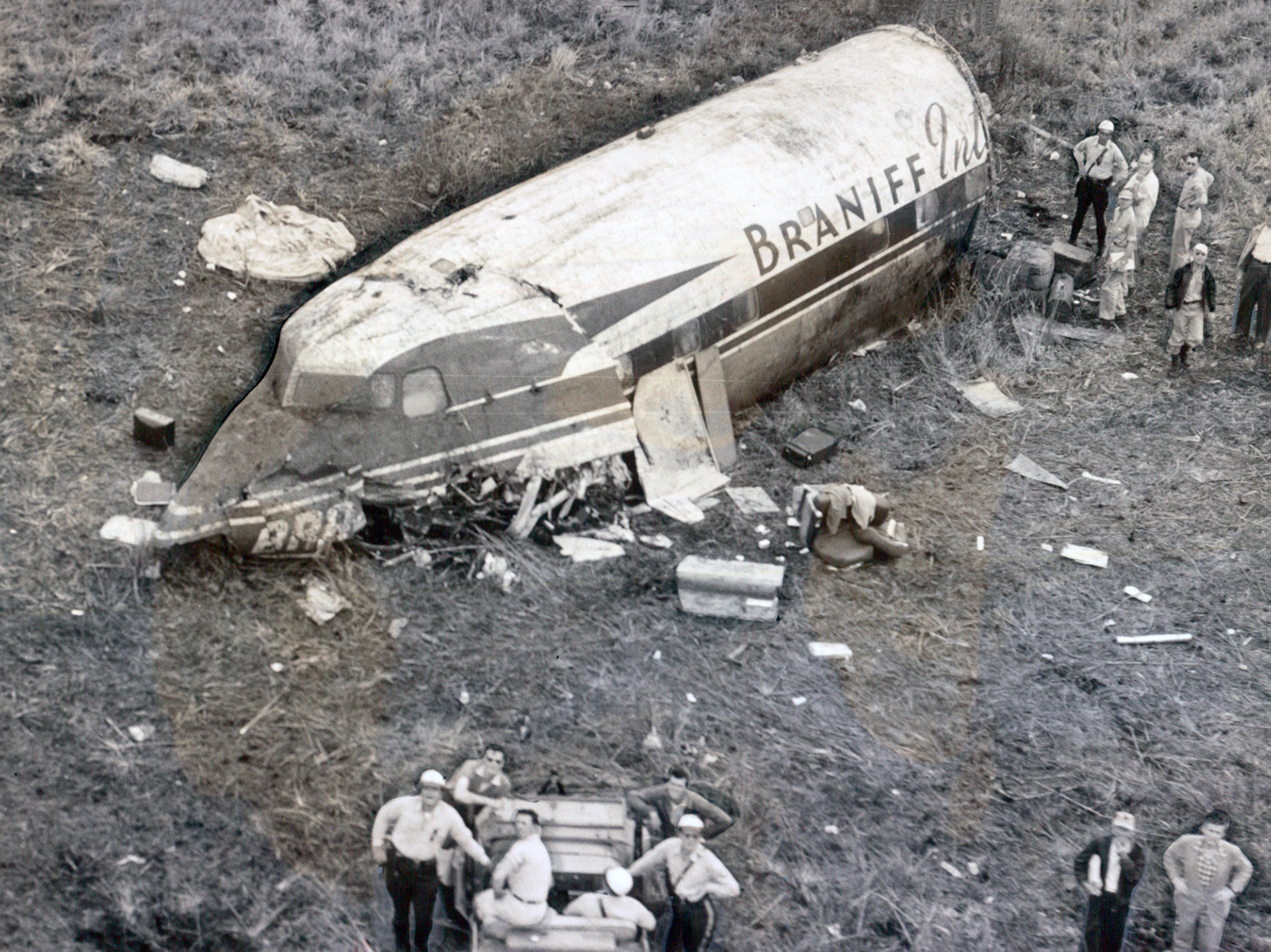
Crash of a Douglas DC-7C in Miami: 9 killed

Date & Time: Mar 25, 1958 at 0006 LT
Type of aircraft:
Operator:
Registration:
N5904
Flight Phase:
Survivors:
Yes
Schedule:
Dallas – Miami – Panama City – Rio de Janeiro
MSN:
45072
YOM:
1957
Flight number:
BN971
Crew on board:
5
Crew fatalities:
Pax on board:
19
Pax fatalities:
Other fatalities:
Total fatalities:
9
Captain / Total flying hours:
20672
Captain / Total hours on type:
241.00
Copilot / Total flying hours:
13250
Copilot / Total hours on type:
257
Aircraft flight hours:
3306
Circumstances:
Braniff International Flight 971 was originally scheduled to depart New York, New York, for Miami, Florida, on March 23, 1958, at 2355 but this leg of the flight was not made owing to shortage of equipment and scheduling difficulties on that date. N 5904 was ferried from Dallas, Texas, to Miami, arriving at 1915 on March 24 for use as Flight 971. The aircraft was serviced and made reedy for the trip to Panama City, Panama, the first scheduled stop on the route to Rio de Janeiro, Brazil. The crew consisted of Captain Thomas D. George, First Officer John C. Winthrop, Jr., Second Officer Charles F. Fink, Steward Alberto Zapatero, and Stewardess Madelon Campion. The flight departed the Miami terminal at 2356, taxied to runway 27R where engine runup was made, after which a normal takeoff was accomplished. Shortly after takeoff, and in accordance with tower clearance, a climbing right turn was started. During the turn the No. 3 engine malfunctioned and a fire developed in that area. The airplane, still in a right turn, started to lose altitude rapidly. While traveling in a north-northeasterly direction it struck in an open marsh containing scattered trees and underbrush. Rescue operations were immediately initiated but were seriously hampered by heavy ground traffic of sightseers attracted to the area. Several of the passengers and crew members were airlifted by U. S. Coast Guard helicopters direct to hospital grounds in Miami and the others were removed to nearby ambulances and taken to hospitals.
Probable cause:
The Board determines that the probable cause of this accident was the failure of the captain to maintain altitude during an emergency return to the airport due to his undue preoccupation with an engine fire following takeoff. The following findings were reported:
- Weather was not a factor in the accident,
- The flight was properly planned and dispatched,
- Smoke from No. 3 engine on the prior flight was reported to the ferry crew by the Miami tower and the crew should have written up this item in the aircraft log,
- Shortly after a routine takeoff No. 11 cylinder of the No. 3 engine failed, resulting in a fire in flight,
- Emergency measures (i.e., propeller feathering, extinguisher, fuel shutoff) were promptly taken by the crew,
- Full power was available from the other three engines and there was no impairment of structure or control of the airplane,
- The captain made a decision to return to the airport and, in attempting to do so, altitude was not maintained and the aircraft struck the ground.
Final Report:

Crash of a Bristol 170 Freighter 21E in Guriat

Date & Time: Mar 25, 1958
Type of aircraft:
Operator:
Registration:
HZ-AAB
Survivors:
Yes
MSN:
12783
YOM:
1946
Country:
Region:
Crew on board:
0
Crew fatalities:
Pax on board:
0
Pax fatalities:
Other fatalities:
Total fatalities:
0
Circumstances:
Upon landing, an undercarriage collapsed. The airplane skidded for several yards and came to a halt. There were no casualties but the airplane was damaged beyond repair.
Probable cause:
Undercarriage collapsed on landing.

Crash of a Douglas C-47A-85-DL near Kathmandu: 20 killed

Date & Time: Mar 24, 1958
Operator:
Registration:
VT-CYN
Survivors:
No
Site:
Schedule:
Shimla-Katmandou
MSN:
19988
YOM:
1944
Country:
Region:
Crew on board:
4
Crew fatalities:
Pax on board:
16
Pax fatalities:
Other fatalities:
Total fatalities:
20
Circumstances:
The crew started the descent to Kathmandu in poor weather conditions when the airplane crashed on a mountainous area located about 20 km from the airport. Following a navigational error on part of the pilots, the airplane followed a wrong approach path to Kathmandu Airport and went into the wrong valley. At the last moment, the pilot-in-command made a sharp turn to avoid the mountain but the aircraft stalled due to an insufficient speed and crashed on a rocky slope. The aircraft was destroyed upon impact and all 20 occupants have been killed.
Probable cause:
Navigation error on part of the flying crew. Lack of visibility caused by poor weather conditions was considered as a contributing factor.

Crash of a Martin 404 in Melbourne

Date & Time: Mar 17, 1958
Type of aircraft:
Operator:
Registration:
N496A
Survivors:
Yes
Schedule:
Tampa – Melbourne
MSN:
14244
YOM:
1952
Crew on board:
3
Crew fatalities:
Pax on board:
7
Pax fatalities:
Other fatalities:
Total fatalities:
0
Circumstances:
On final approach to Melbourne Airport, the aircraft was too low, causing an undercarriage to struck a gravel pile located short of runway threshold. The crew continued the approach and at touchdown, the undercarriage collapsed. The airplane sank on its belly and slid for several yards before coming to rest in flames. All ten occupants were evacuated safely while the aircraft was destroyed by fire.

Crash of a Vickers 628 Viking 1B in Port Said: 8 killed

Date & Time: Mar 7, 1958
Type of aircraft:
Operator:
Registration:
SU-AGN
Survivors:
Yes
Schedule:
Athens – Cairo
MSN:
196
YOM:
1947
Country:
Region:
Crew on board:
4
Crew fatalities:
Pax on board:
22
Pax fatalities:
Other fatalities:
Total fatalities:
8
Circumstances:
While approaching Cairo Intl Airport following an uneventful flight from Athens, the crew was instructed by ATC to divert to Port-Said due to poor weather conditions at destination. The crew continued to Port-Said and on approach, the twin engine airplane went out of control and crashed into the Manzala Lake located few km from the airfield. All four crew members and four passengers were killed while 18 other occupants were injured.

Crash of a Convair CV-240-0 at New Haven

Date & Time: Mar 1, 1958 at 1024 LT
Type of aircraft:
Operator:
Registration:
N94213
Flight Phase:
Survivors:
Yes
Schedule:
Boston – New Haven – Bridgeport – New York
MSN:
23
YOM:
1948
Flight number:
AA535
Crew on board:
3
Crew fatalities:
Pax on board:
5
Pax fatalities:
Other fatalities:
Total fatalities:
0
Captain / Total flying hours:
7453
Captain / Total hours on type:
4660.00
Copilot / Total flying hours:
5300
Copilot / Total hours on type:
3205
Aircraft flight hours:
20857
Circumstances:
This was scheduled passenger flight 535 of March 1 from Boston, Massachusetts, to New York, New York, with stops planned at New Haven and Bridgeport, Connecticut. The crew, consisting of Captain Edward W. Johnson, First Officer Norman A. Paquette, and Stewardess Marian Sullivan, reported to company operations at Boston well ahead of scheduled departure time. Departure from Boston at 0927 was on time and was in accordance with an TFR clearance to cruise at 6,000 feet via airways to New Haven. The flight was routine and on schedule to New Haven. The aircraft was not refueled during the five-minute stop at New Haven, during which time both engines were stopped. The flight departed the terminal with five passengers and 1460 gallons of fuel. Gross weight of the aircraft was well under the maximum allowable and its center of gravity was located within prescribed limits. The wind was calm and runway 14 (4,116 feet), one of two macadam runways, was selected for takeoff. There is no air traffic control tower at New Haven. After completion of the takeoff checklist, the aircraft moved onto the runway and takeoff was initiated from a tan start without delay. This segment of the flight was being flown by First Officer Paquette who occupied the right seat. Captain Johnson, on the left, maintained directional control during the initial acceleration of the aircraft. Before the aircraft reached the intersection of runways 14 and 19, the landing gear was retracted. The aircraft then skidded clown runway 14 near its center and cane to rest 1,050 feet from the far end. Captain Johnson, Stewardess Sullivan, and three passengers left through the right emergency escape hatch over the wing. First Officer Paquette and the two remaining passengers left through the partially opened front entrance door. Fire, around the left engine and the left outboard wing area, caused considerable damage and was extinguished by the local fire department.
Probable cause:
The Board determines that the probable cause of this accident was the improper technique of the captain resulting in the unintentional retraction of the landing gear prior to V 1 speed, which was made possible by a malfunctioning left gear safety switch. A contributing factor was inadequate inspection by the carrier. The following findings were reported:
- The first officer made the takeoff with the captain performing the duties of copilot from his left seat,
- The aircraft operated normally up to 85 knots in the takeoff roll,
- The captain prematurely applied upward pressure on the landing gear selector handle,
- A defective landing gear safety switch allowed the landing gear selector handle to be unlocked during ground operation of the aircraft, and permitted the landing gear to retract,
- Fire did not develop in the left nacelle and fuel tank area until the aircraft skidded to a stop on the runway,
- The company’s inspection of the safety switch was inadequate.
Final Report:

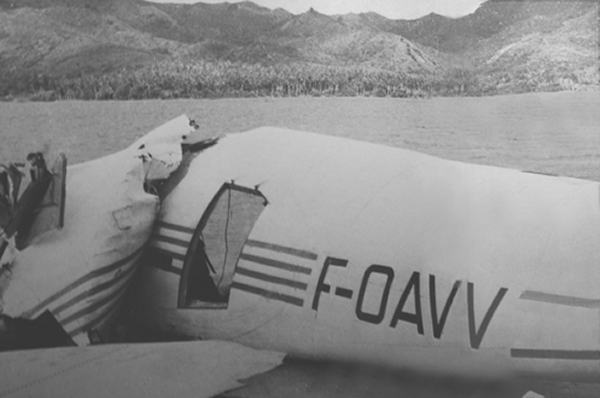
Crash of a Consolidated PBY-5A Catalina off Raiatea: 15 killed

Date & Time: Feb 19, 1958 at 1200 LT
Type of aircraft:
Operator:
Registration:
F-AOVV
Survivors:
Yes
Schedule:
Papeete – Raiatea – Bora Bora
MSN:
296
YOM:
1941
Region:
Crew on board:
3
Crew fatalities:
Pax on board:
23
Pax fatalities:
Other fatalities:
Total fatalities:
15
Captain / Total hours on type:
36.00
Copilot / Total flying hours:
6600
Copilot / Total hours on type:
91
Aircraft flight hours:
2277
Circumstances:
The approach to Raiatea lagoon was performed in good weather conditions with a grey ceiling (altostratus) and several fractocumulus at 400 meters, good visibility. No wind and no waves on the sea gaves a very calm lagoon. While completing a last turn to the right to align to the landing area (seaplane base), the right wing tip struck the water surface. The airplane cartwheeled and crashed into the sea about 1,400 meters short of landing point. Eleven passengers were injured while 15 other occupants, among them all three crew members, were killed. The airplane sank by a depth of 36 meters ten minutes later.
Probable cause:
The combination of an uniformly gray sky (altostratus clouds across the region and some fractocumulus at 400 meters), the absence of wind and the absence of lines on a gray and smooth lagoon created favorable conditions for an illusion and made it difficult to assess the exact height above the water level during the most difficult operation of the flight, the water landing. The evidence indicates that no maneuver was initiated to change the nose down attitude. The pilot did not see the water. Although there was no wind, the windsock had previously stopped in a position that prompted the pilot to land facing the NW which is used once in twenty at Raiatea. In addition, the sun , even through the altrostratus could be annoying; facing the NW, the pilot had the sun three quarter from the rear. Note that during the landing opposite the NW, the lap is necessarily right to avoid overflying the city and land. Vertical visibility of the first pilot during a right turn is poorer. Finally, the slight correction of alignment by the pilot resulted the right wing striking the water at too low altitude.
Final Report:

Crash of a Douglas DC-3 in Hato

Date & Time: Feb 15, 1958
Type of aircraft:
Operator:
Registration:
YV-C-AVS
MSN:
4372
YOM:
1942
Location:
Country:
Crew on board:
0
Crew fatalities:
Pax on board:
0
Pax fatalities:
Other fatalities:
Total fatalities:
0
Circumstances:
The airplane christened 'Coco de Mono' crashed in unknown circumstances in Hato. The occupant's fate remains unknown. The accident occurred sometime in February 1958 (exact date unknown).