Crash of a Douglas DC-4 in Rio de Janeiro: 5 killed

Date & Time: Feb 1, 1958
Type of aircraft:
Operator:
Registration:
PP-LEM
Flight Phase:
Survivors:
Yes
Schedule:
Rio de Janeiro – Fortaleza
MSN:
18336
YOM:
1944
Country:
Crew on board:
5
Crew fatalities:
Pax on board:
68
Pax fatalities:
Other fatalities:
Total fatalities:
5
Circumstances:
During the takeoff roll, the engine number four caught fire and exploded. The captain decided to abandon the takeoff procedure and started an emergency braking manoeuvre. About 100 meters before the runway end, a tire on the left main gear burst. The airplane veered off runway and came to rest in flames. Two crew members and three passengers were killed, 11 passengers were unhurt and 57 others were injured.
Probable cause:
Failure of the engine number four during takeoff.


Crash of a De Havilland DHC-2 Beaver in Santo Pipó: 4 killed

Date & Time: Jan 29, 1958 at 1345 LT
Type of aircraft:
Registration:
LV-FEW
Flight Phase:
Survivors:
Yes
Schedule:
Posadas – Eldorado
MSN:
117
YOM:
1951
Country:
Crew on board:
1
Crew fatalities:
Pax on board:
5
Pax fatalities:
Other fatalities:
Total fatalities:
4
Circumstances:
En route from Posadas to Eldorado, the aircraft suffered an engine failure. The pilot elected to make an emergency landing at Santo Pipó when the airplane hit a telephone pole and crashed. The pilot and three passengers were killed while two other occupants were injured. The aircraft was destroyed.
Probable cause:
Engine failure in flight.

Crash of an Avro 652 Anson V near Radium Hot Springs

Date & Time: Jan 27, 1958
Type of aircraft:
Operator:
Registration:
CF-EFZ
Flight Phase:
Survivors:
Yes
MSN:
MDF-220
Country:
Crew on board:
0
Crew fatalities:
Pax on board:
0
Pax fatalities:
Other fatalities:
Total fatalities:
0
Circumstances:
Crashed in unknown circumstances. There were no casualties.

Crash of an Avro 652 Anson V in Grass River

Date & Time: Jan 17, 1958
Type of aircraft:
Registration:
CF-ETG
Flight Phase:
Survivors:
Yes
MSN:
MDF-276
Country:
Crew on board:
1
Crew fatalities:
Pax on board:
3
Pax fatalities:
Other fatalities:
Total fatalities:
0
Circumstances:
En route, the pilot was forced to attempt an emergency landing for unknown reason. The twin engine aircraft crash landed near Grass River and came to rest. All four occupants were rescued.

Crash of a Lockheed 5C Vega in Tenakee: 1 killed

Date & Time: Jan 15, 1958 at 1600 LT
Type of aircraft:
Operator:
Registration:
N47M
Survivors:
Yes
Schedule:
Juneau – Angoon – Hood Bay – Baranof – Rodgers Point – Tenakee – Juneau
MSN:
99
YOM:
1929
Flight number:
ACA040
Location:
Crew on board:
1
Crew fatalities:
Pax on board:
2
Pax fatalities:
Other fatalities:
Total fatalities:
1
Captain / Total flying hours:
1263
Captain / Total hours on type:
209.00
Aircraft flight hours:
13496
Circumstances:
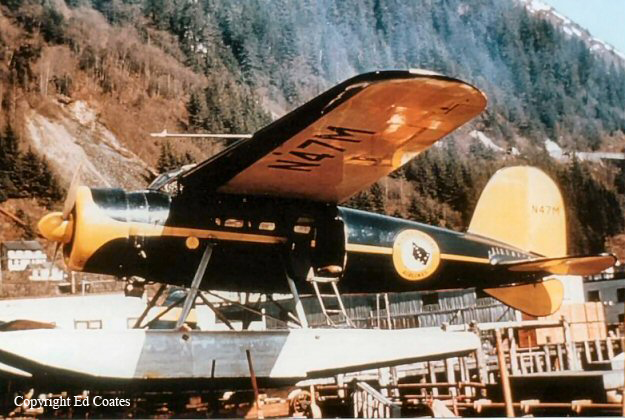
Alaska Coastal Airlines, a scheduled air carrier, is authorized to conduct operations throughout southeastern Alaska. On January 15, 1958, Captain Fred B. Sheldon departed from Juneau to fly Trip 40. Scheduled stops were planned at Angoon, Hood Bay, Baranof, Rodgers Point, Tenakee, and the flight was to terminate at the point of origin, Juneau. Weather reports for the area indicated conditions to be generally good, enabling the flight to be conducted according to visual flight rules. Ceilings were forecast to be 2,000 to 3,000 feet and winds near the surface were anticipated to be moderate and generally southwesterly. At least one mountain pass over the route was reported closed because of clouds. The gross takeoff weight of the aircraft at Juneau was calculated to be 5,237 pounds, approximately 4 pounds less than the maximum allowable. The load was correctly distributed within the center of gravity limitations. Flight 40 departed Juneau at 1301 and was routine to Angoon. After refueling, the flight continued uneventfully to Hood Bay, Baranof, Rodgers Point; arriving at Rodgers Point about 1520. About 1530, after the takeoff from Rodgers Point, a radio operator there advised the station agent at Tenakee (the next intended en route stop) that flight 40 was off the water and would need 20 gallons of fuel when it arrived. At approximately 1557 the agent at Tenakee heard a distress call from flight 40 over the radio. The pilot called “Mayday” and stated he was trying to make it to the flats in Kadashan Bay. The agent then called Flight 40 by radio asking its position. Sheldon’s final message was “ . . . the flats across from Tenakee.” Immediately thereafter the aircraft crashed. Both passengers were injured while the pilot was killed.
Probable cause:
The Board determines that the probable cause of this accident was the poor flight planning by the pilot and his poor judgment in allowing the aircraft to run out of fuel. A contributing factor was the lack of adequate organization and management of the air carrier’s operations to ensure that all flights were planned and conducted with safety. The following findings were reported:
- With one fuel tank out of use, the aircraft did not comply with the requirements of Bulletin 7A under which it was certificated for passenger-carrying service,
- No evidence of mechanical or structural failure was found,
- The pilot did not plan his flight to provide for an adequate fuel reserve at all times,
- The company did not provide adequate supervision or control over flight planning or clearance of flights,
- A longer alternate route had to be followed by the flight because of unfavorable weather,
- The aircraft exhausted its fuel supply and crashed,
- The air carrier’s operations manual was incomplete and was not maintained current as required by regulations,
- The CAA safety inspection program was ineffective in terms of ensuring that the carrier was conducting operations at a level of safety appropriate for the carrier’s operating certificate and associated operating specifications.
Final Report:

Crash of a De Havilland DH.104 Dove 2 in Dungeness

Date & Time: Jan 15, 1958
Type of aircraft:
Operator:
Registration:
G-AOCE
Flight Phase:
Survivors:
Yes
Schedule:
Rotterdam – Southend
MSN:
04044
YOM:
1955
Location:
Region:
Crew on board:
2
Crew fatalities:
Pax on board:
5
Pax fatalities:
Other fatalities:
Total fatalities:
0
Circumstances:
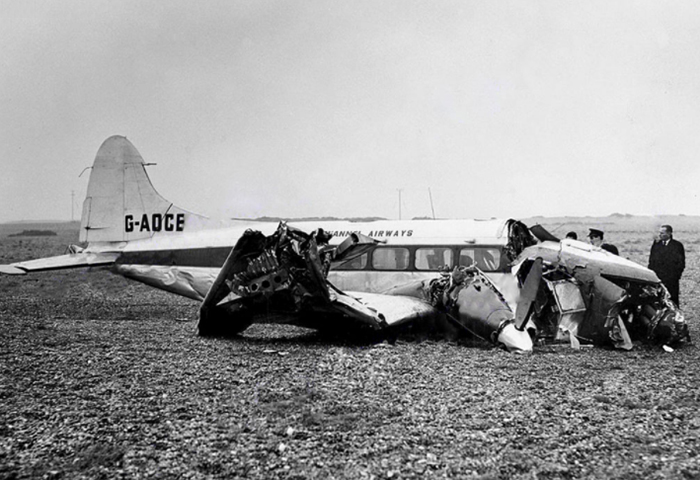
While approaching the British coast on a flight from Rotterdam to Southend, the crew was informed by ATC that a landing at Southend was impossible due to foggy conditions and was rerouted to Lydd Airport. On final, the crew was forced to make a go around because he was unable to locate the runway. Few minutes later, a second attempt to land at Lydd was also abandoned. While flying vertical to the Dungeness beaches, both engines failed. The crew reduced his altitude and completed an emergency landing. The airplane slid for dozen yards before coming to rest. All seven occupants were injured and the aircraft was destroyed.
Probable cause:
Double engine failure caused by a fuel exhaustion.

Crash of an Airspeed AS.10 Oxford I in Barcelona

Date & Time: Jan 9, 1958
Type of aircraft:
Operator:
Registration:
EC-APF
Flight Phase:
Survivors:
Yes
MSN:
3784
Country:
Region:
Crew on board:
2
Crew fatalities:
Pax on board:
2
Pax fatalities:
Other fatalities:
Total fatalities:
0
Circumstances:
During the takeoff roll, a tire burst. The twin engine aircraft went out of control, veered off runway and came to rest in flames. All four occupants were injured and the aircraft was destroyed.
Probable cause:
Loss of control during takeoff following a tire burst.

Crash of a Short S.25 Sandringham II off Buenos Aires: 9 killed

Date & Time: Dec 31, 1957 at 1257 LT
Type of aircraft:
Operator:
Registration:
LV-AAR
Survivors:
Yes
Schedule:
Buenos Aires – Rosario – Corrientes – Formosa – Asunción
MSN:
SH.03C
YOM:
1945
Flight number:
AR706
Country:
Crew on board:
6
Crew fatalities:
Pax on board:
44
Pax fatalities:
Other fatalities:
Total fatalities:
9
Captain / Total flying hours:
9240
Captain / Total hours on type:
1019.00
Copilot / Total flying hours:
1297
Copilot / Total hours on type:
122
Aircraft flight hours:
7905
Circumstances:
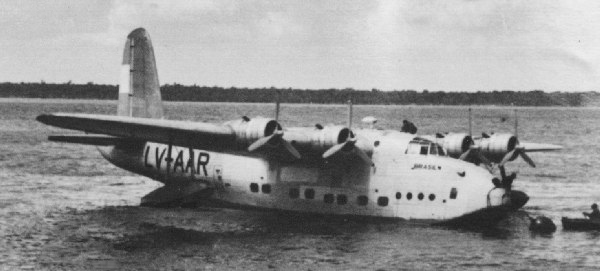
The seaplane left Buenos Aires harbor at 1152LT bound for Asunción with intermediate stops at Rosario, Corrientes and Formosa. Few minutes after takeoff, the captain encountered oscillations and difficulties to control the airplane so he decided to return to Buenos Aires for a safe landing. Unfortunately, it was not possible to land immediately because of the presence of ship in the channel. Following several circuits, the pilot-in-command attempted to land when the airplane crashed into the sea few hundred yards off shore. A crew member and eight passengers were killed while 41 other occupants were injured. The aircraft was destroyed.
Probable cause:
The accident was probably caused by a premature withdrawal of the flaps, a trend exacerbated by abnormal conditions affecting the airworthiness of the seaplane, particularly evident in the approach procedure, and a concurrent cause of inadequate maintenance of the aircraft, and the failure in the process of clearing the elevator control, established by seaplane maintenance manual.
Final Report:

Crash of a Budd RB-1 Conestoga in Colombia

Date & Time: Dec 31, 1957
Type of aircraft:
Operator:
Registration:
HK-344X
Flight Phase:
MSN:
007
YOM:
1944
Country:
Crew on board:
0
Crew fatalities:
Pax on board:
0
Pax fatalities:
Other fatalities:
Total fatalities:
0
Circumstances:
Crashed following an engine explosion in flight. Crew fate and exact date unknown.
Probable cause:
Engine explosion in flight.

Crash of a Caudron C.440 Goéland in Pontoise

Date & Time: Dec 21, 1957
Type of aircraft:
Operator:
Registration:
F-BAPI
Flight Phase:
Survivors:
Yes
MSN:
8910/1106
YOM:
1937
Country:
Region:
Crew on board:
0
Crew fatalities:
Pax on board:
0
Pax fatalities:
Other fatalities:
Total fatalities:
0
Circumstances:
Crashed in unknown circumstances near Pontoise-Cormeilles-en-Vexin Airport. No casualties.