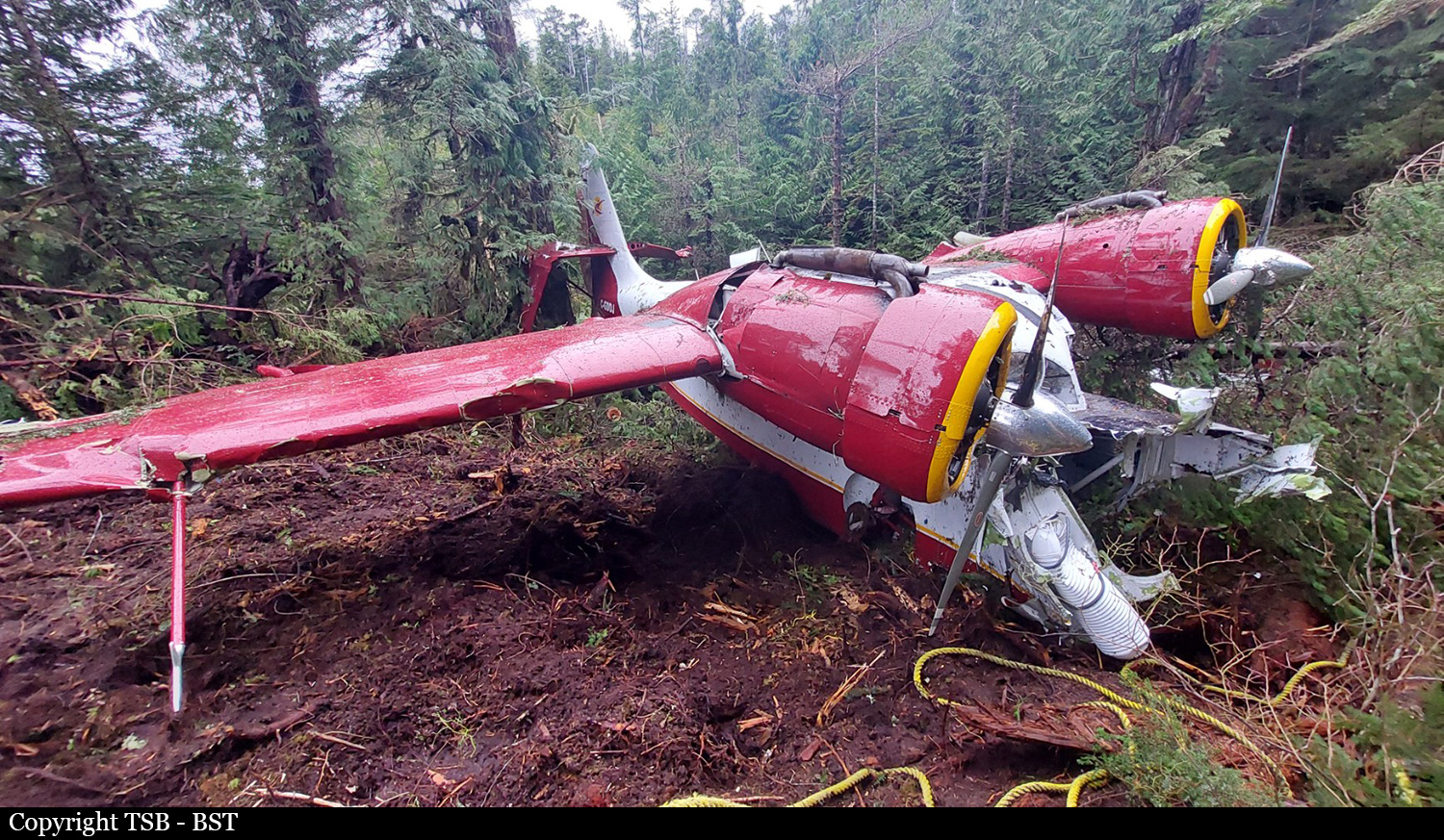
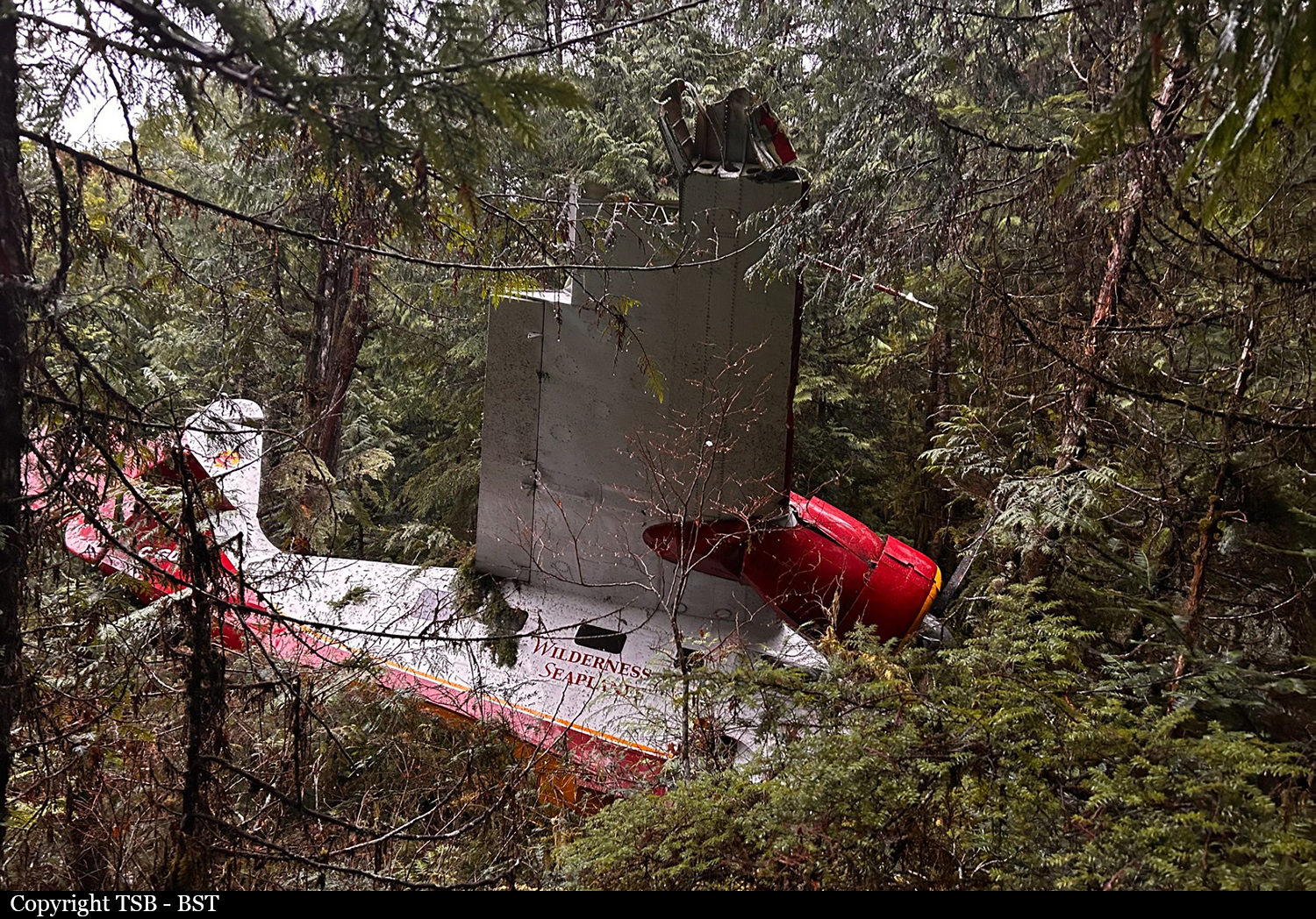
Crash of a De Havilland DHC-2 Beaver in Gold River

Date & Time: Jul 28, 2023 at 1720 LT
Type of aircraft:
Operator:
Registration:
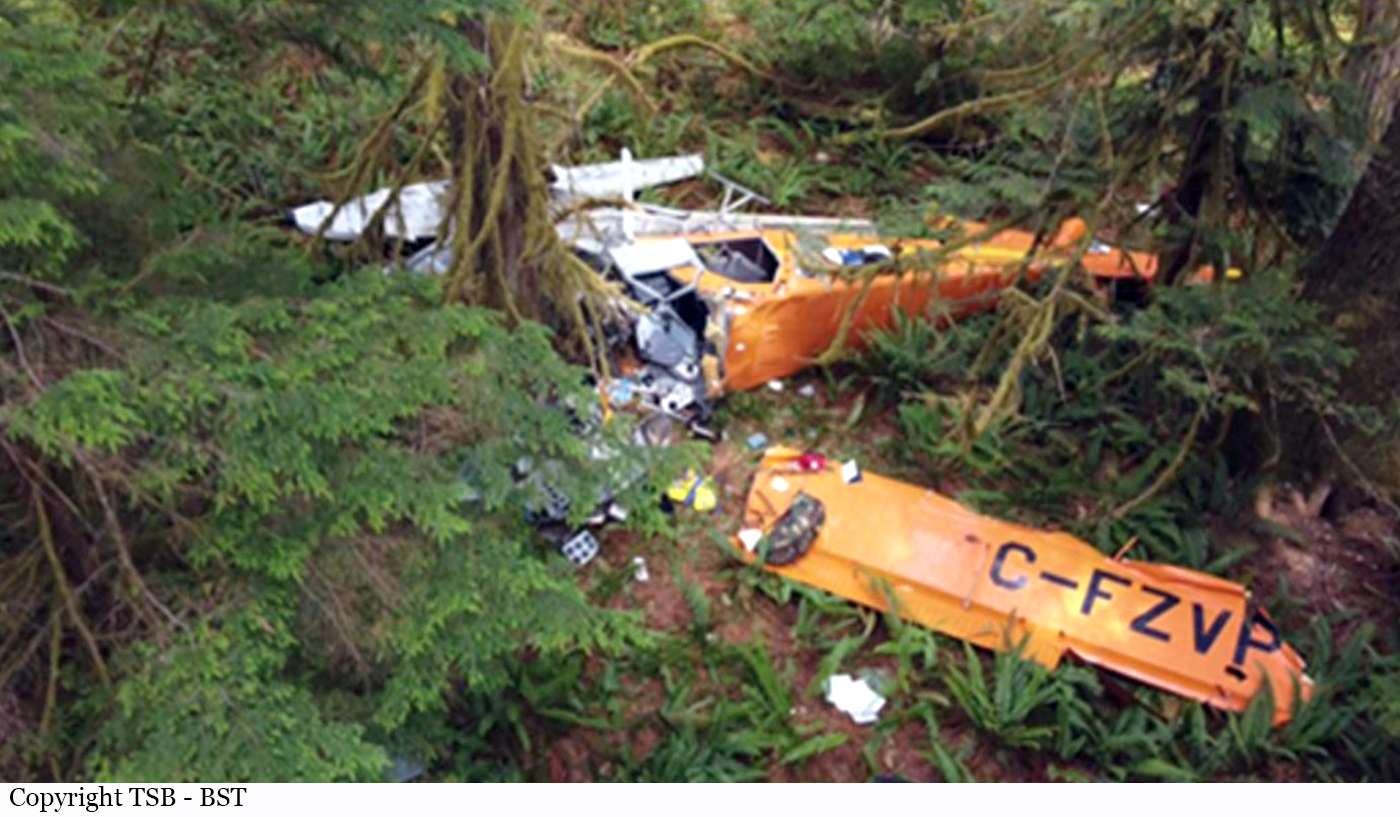
C-FZVP
Flight Type:
Survivors:
Yes
Schedule:
Louie Bay - Gold River
MSN:
1033
YOM:
1957
Country:
Crew on board:
1
Crew fatalities:
Pax on board:
0
Pax fatalities:
Other fatalities:
Total fatalities:
0
Captain / Total flying hours:
10000
Circumstances:
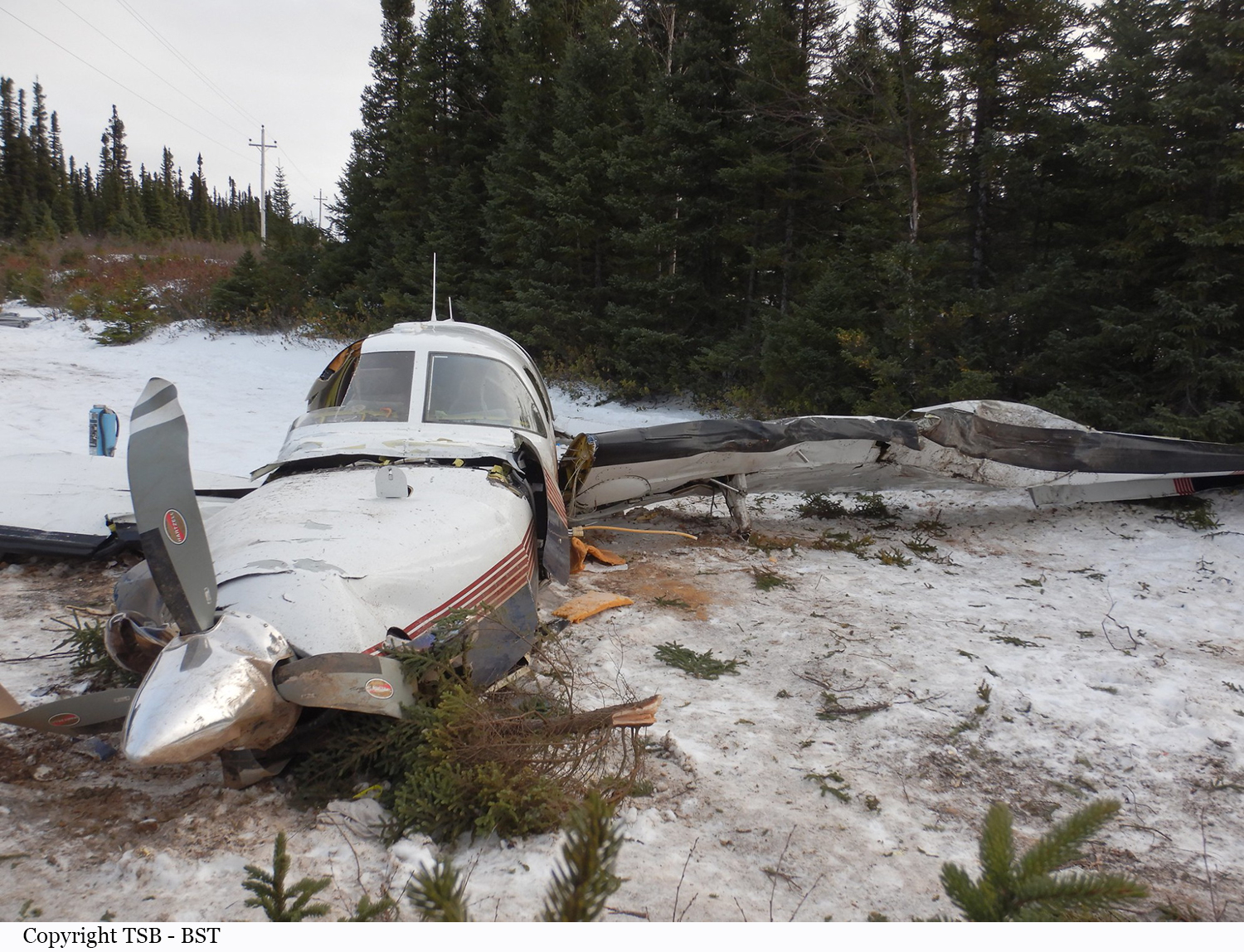
The single engine airplane was conducting a visual flight rules repositioning flight from Louie Bay on Nootka Island, British Columbia (BC), to Gold River Water Aerodrome (CAU6), BC, with only the pilot on board. On arrival at CAU6, the pilot noted a rough sea state in the company’s primary landing area and elected to land in the secondary area, a tree-lined river to the east of the base. The aircraft was observed overflying the company dock to the north and then turning right, aligning with the southwest direction of the river. When descending on the alignment turn to final approach, the aircraft experienced an uncommanded yaw and roll. It
abruptly turned further right, heading west, and continued to descend toward the trees. It was reported that opposite aileron input, to try and arrest the uncommanded yaw and roll, increased the roll rate. At approximately 1720, the aircraft struck the forested area on the west side of the river, coming to rest approximately 75 feet from the river. There was no post-impact fire. The pilot received serious injuries, was extracted by local firefighting personnel, and attended to by local paramedics. He was then airlifted to hospital by a search and rescue helicopter.
Probable cause:
While on the right turn to final, the aircraft experienced an uncommanded yaw and roll. The application of aileron in the opposite direction made the condition worse. This is consistent with an aerodynamic stall.
Final Report:

Crash of a Quest Kodiak 100 near Tofino: 2 killed

Date & Time: Jun 21, 2023 at 1337 LT
Type of aircraft:
Registration:
C-GKTX
Flight Type:
Survivors:
Yes
Site:
Schedule:
Masset - Tofino
MSN:
100-0010
YOM:
2009
Country:
Crew on board:
1
Crew fatalities:
Pax on board:
3
Pax fatalities:
Other fatalities:
Total fatalities:
2
Captain / Total flying hours:
1200
Captain / Total hours on type:
250.00
Circumstances:
At 1121LT on 20 June 2023, the privately registered Quest Kodiak 100 amphibious float-equipped aircraft (registration C-GKTX, serial number 100-0010) departed Masset Airport (CZMT), British Columbia (BC), on an instrument flight rules (IFR) flight to Tofino/Long Beach Airport (CYAZ), BC, with 1 pilot and 3 passengers on board. While enroute, at 1246, the pilot contacted air traffic control to cancel IFR and continued the flight under visual flight rules (VFR). The aircraft continued the flight to the planned final destination, which was a cabin approximately 60 nautical miles northwest of CYAZ. The aircraft followed an inlet (Tahsis Narrows) toward the destination and continued for a straight-in landing on the water, near the cabin. On initial touchdown, both floats touched the surface of the water simultaneously. The aircraft bounced and, as the aircraft approached the surface of the landing area the 2nd time in a level attitude, the left float reportedly made contact with either a boat wake or object. 2 The force of the contact resulted in the aircraft bouncing to a height of approximately 30 feet and banking to the right. The pilot initiated a go-around. At 1337, during the initial climb over land, the aircraft contacted trees and then impacted the terrain. The pilot and 1 passenger were fatally injured, 1 passenger received serious injuries, and 1 passenger received minor injuries. There was a post-impact fire. The aircraft was destroyed. The emergency locator transmitter signal was received by the Joint Rescue Coordination Centre in Victoria, BC. The Canadian Coast Guard, Canadian Armed Forces search and rescue, the RCMP (Royal Canadian Mounted Police), and fire personnel responded.
Probable cause:
It is possible that the accident was the consequence of wind shear and downdrafts.
Final Report:

Crash of a Pilatus PC-12/47E in Whitehorse

Date & Time: Apr 17, 2023 at 1138 LT
Type of aircraft:
Operator:
Registration:
C-GMPX
Flight Type:
Survivors:
Yes
Schedule:
Whitehorse – Yellowknife
MSN:
1017
YOM:
2008
Country:
Crew on board:
1
Crew fatalities:
Pax on board:
0
Pax fatalities:
Other fatalities:
Total fatalities:
0
Captain / Total flying hours:
8700
Captain / Total hours on type:
3000.00
Aircraft flight hours:
11908
Circumstances:
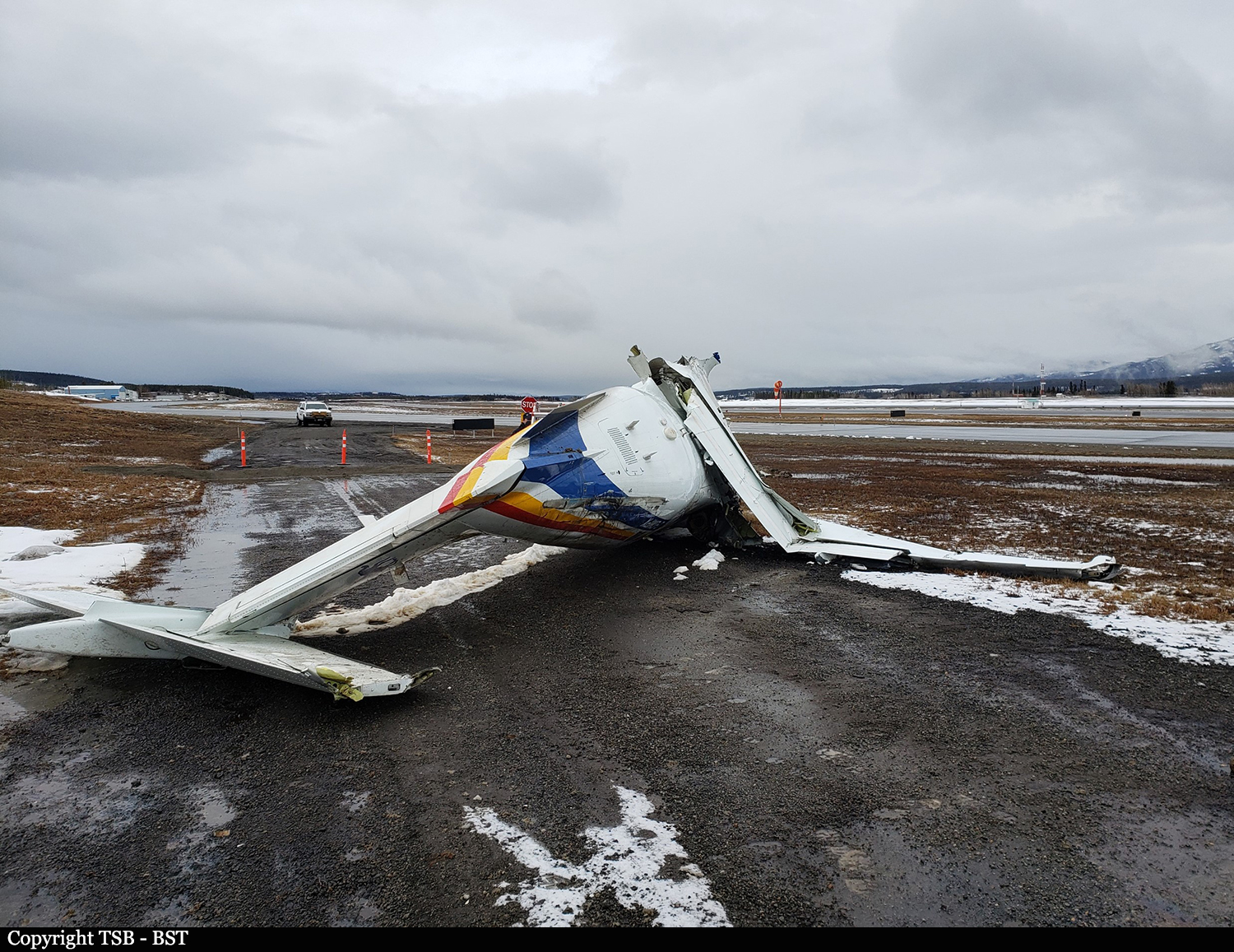
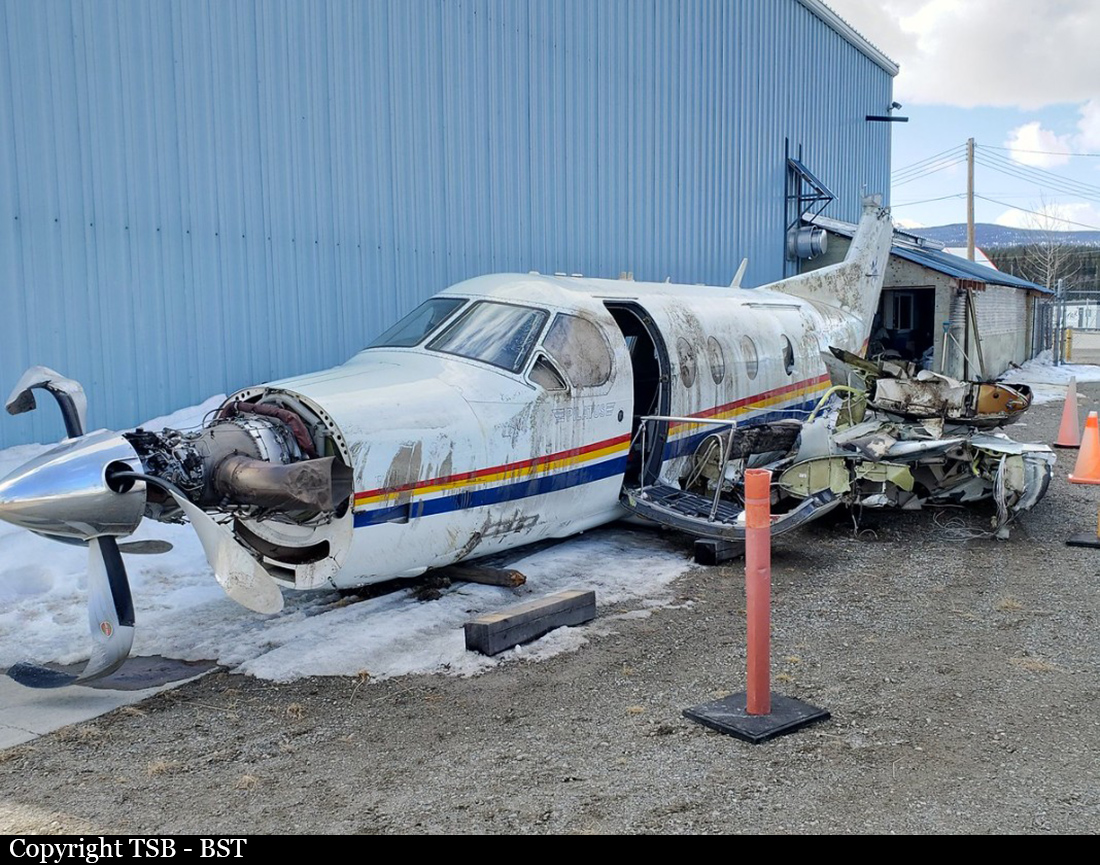
At 1134 Mountain Standard Time on 17 April 2023, the Government of Canada, Royal Canadian Mounted Police Pilatus Aircraft Ltd. PC-12/47E (registration C-GMPX, serial number 1017) departed Whitehorse/Erik Nielsen International Airport (CYXY), Yukon, on an instrument flight rules flight to Yellowknife Airport (CYZF), Northwest Territories. The pilot was the sole occupant. Shortly after the aircraft lifted off from Runway 32L, its stall warning system activated, triggering an aural “STALL” warning and the activation of the stick shaker. The pilot informed the tower controller of the intention to return for landing. At 1138, while the pilot was visually manoeuvring to land on Runway 32L, the aircraft impacted the terrain approximately 520 feet west-southwest of the centre of the displaced threshold, in a right-wing-low attitude. The aircraft subsequently hit a pile of millings with its left wing, rolled onto its left side, and slid approximately 130 feet before coming to rest on an airport service road. The pilot, who was seriously injured, exited the aircraft through the emergency exit with assistance from aircraft rescue and firefighting personnel, who arrived within minutes of the accident. An emergency locator transmitter signal was received by the search and rescue satellite system. The aircraft was destroyed; there was no post-impact fire.
Probable cause:
Findings as to causes and contributing factors. These are conditions, acts or safety deficiencies that were found to have caused or contributed to this occurrence.
1. During the final moments of the flight, the aircraft’s right turn in excess of 45° of bank, while it was operating at a low height above the ground and just above the calculated stall speed, likely resulted in the aircraft entering an aerodynamic stall, with insufficient height to recover before impacting the terrain.
2. The stainless steel belt in the left AOA transmitter experienced a fatigue crack likely attributed to the wet-etch design process. Owing to the fact that the belt is an on condition component, the fatigue cracking went undetected until the belt failed at, or just before, takeoff on the occurrence flight, causing the AOA transmitter to transmit a false stall signal when the aircraft became airborne.
3. While attempting to align the aircraft for landing, the pilot experienced attentional narrowing due to an intense stress reaction in response to a surprise event. As a result, the pilot's attention was focused outside the aircraft, and the pilot unknowingly placed the aircraft in a flight regime that likely resulted in an aerodynamic stall at a very low height above ground.
4. The Royal Canadian Mounted Police's training for stall warning system malfunctions on the PC-12 focused solely on an inadvertent pusher activation. As a result, the occurrence pilot did not fully understand the symptoms of a false stall warning or the options available to mitigate the risks associated with this emergency.
5. The PC-12 pilot operating handbook provided limited guidance with regard to the potential use of the AURAL WARN INHIBIT switch during emergency situations. As a result, the occurrence pilot was unaware that this switch could be used during highworkload situations to quickly eliminate the false aural stall warning that was a distraction for the duration of the flight.
Final Report:

Crash of a Cessna 208B Grand Caravan near Nakina: 2 killed

Date & Time: Feb 28, 2023
Type of aircraft:
Operator:
Registration:
C-GMVB
Flight Phase:
Flight Type:
Survivors:
No
Schedule:
Nakina – Fort Hope
MSN:
208B-0317
YOM:
1992
Location:
Country:
Crew on board:
2
Crew fatalities:
Pax on board:
0
Pax fatalities:
Other fatalities:
Total fatalities:
2
Captain / Total flying hours:
325
Captain / Total hours on type:
103.00
Copilot / Total flying hours:
2570
Copilot / Total hours on type:
662
Aircraft flight hours:
28262
Circumstances:
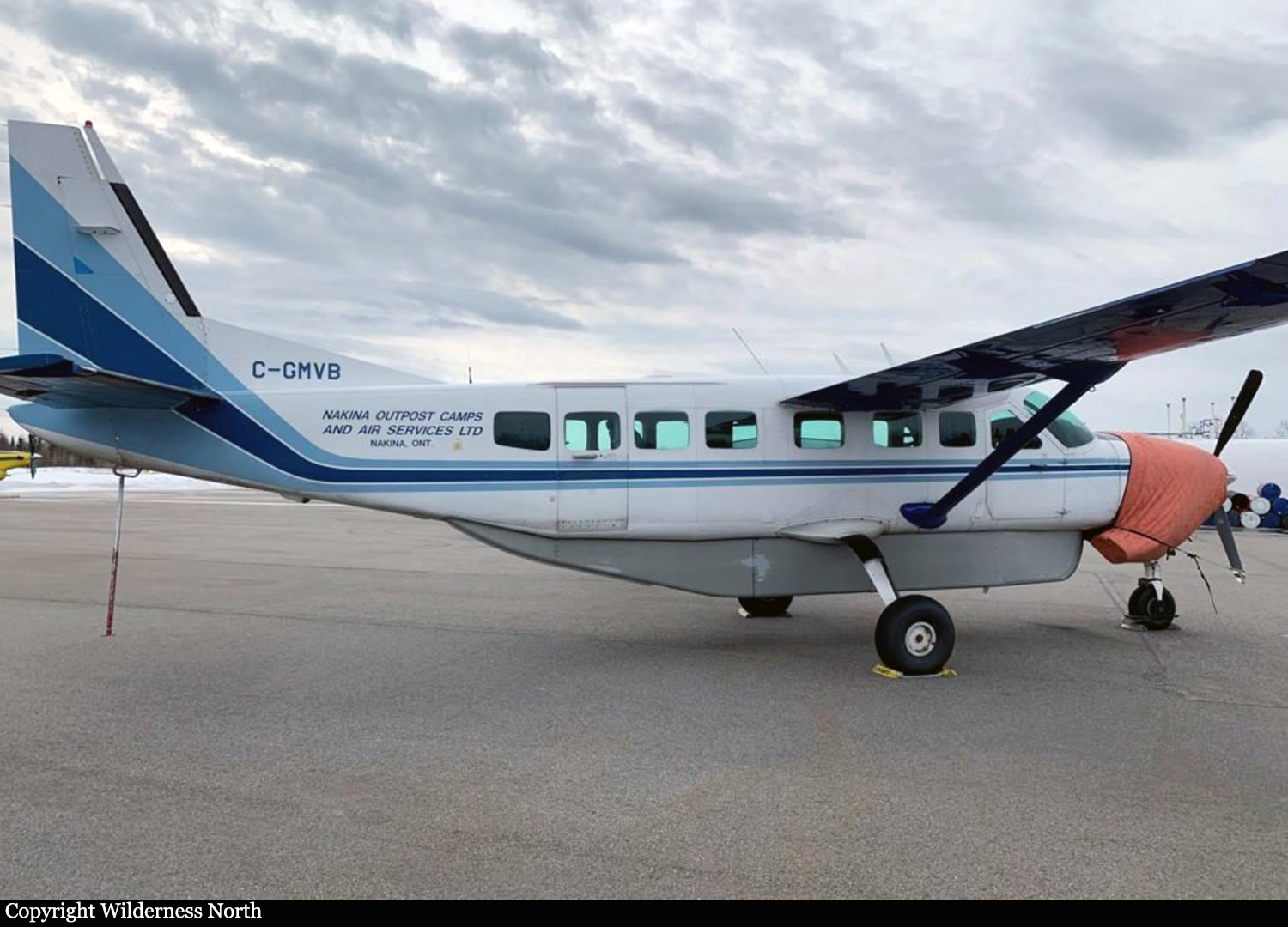
On 28 February 2023, the Cessna 208B Caravan (208B) aircraft (registration C-GMVB) operated by 1401380 Ontario Limited, doing business as Wilderness North Air (WNA), was scheduled for 2 cargo flights from Nakina Airport (CYQN), Ontario, to Fort Hope Airport (CYFH), Ontario. The occurrence pilot, who had recently been promoted to pilot-in-command (PIC) on the 208B aircraft, was scheduled to fly alone in daytime visual flight rules (VFR) conditions. After reviewing the weather information with his colleagues at their morning briefing, he assessed that the weather was satisfactory for the flight and noted that the winds were forecast to be gusty. A pilot who was present at the briefing but was not scheduled for flight duty that day offered to accompany him. For all flights that day, the occurrence pilot would be the PIC and occupy the left seat, and the 2nd pilot went along as an extra crew member without any assigned duties, occupying the right seat. The cargo was loaded onto the aircraft, and the 1st flight of the day departed CYQN at 1020 and landed in CYFH at 1055. After unloading the cargo, they departed CYFH at 1120 and returned to CYQN at 1156. The pilots loaded the aircraft with cargo for their 2nd flight to CYFH. According to the load sheet, there were 3320 pounds of groceries and household goods on board. The pilots refuelled the aircraft and departed from Runway 27 at approximately 1245. A few minutes after departure, it was reported that they made a radio call on the aerodrome traffic frequency, indicating their location and an estimated time of arrival at CYFH of 1330. Approximately 30 minutes after the occurrence flight departed, a 2nd 208B aircraft (registration C-FUYC) operated by WNA departed also from CYQN to CYFH, with cargo for a different customer. The flight crew encountered snow showers en route, and shortly after they arrived at CYFH at 1400, there was a snow squall, which significantly reduced visibility. At that time, 2 customers were waiting at CYFH for their cargo, and it soon became apparent that the occurrence aircraft had not yet arrived. At approximately 1430, WNA personnel at CYQN were informed that the occurrence aircraft had not arrived at 1330 as expected. At 1445, management at WNA notified the Joint Rescue Coordination Centre (JRCC), in Trenton, Ontario, that the aircraft was overdue. WNA began its own aerial search along the flight path using C-FUYC, which departed CYFH at 1510 with 2 crew members on board, flew along the direct route of flight of the missing aircraft, and returned to CYQN at 1546. They refuelled the aircraft and departed on another search flight at 1620, with 2 additional pilots in the back to act as spotters. They searched along the route of flight until 1840 and returned to CYQN. JRCC had initiated its response at 1500, and the first tasked aircraft arrived in the search area at 1700. The search continued over the following 4 days. The occurrence aircraft was found on 04 March 2023, 30.8 nautical miles north-northwest of CYQN along the direct track to CYFH. Both pilots were fatally injured. The aircraft was destroyed by impact forces. There was no post-crash fire. There was no emergency locator transmitter (ELT) on the occurrence aircraft because it had been removed for recertification.
Probable cause:
During the en-route portion of the flight, over a remote area, the pilot lost control of the aircraft for an unknown reason, which resulted in the collision with terrain.
Final Report:
Crash of a Piper PA-46-350P Jetprop DLX in Goose Bay: 1 killed

Date & Time: Dec 14, 2022 at 1002 LT
Registration:
N5EQ
Flight Type:
Survivors:
Yes
Schedule:
Nashua – Goose Bay – Nuuk
MSN:
46-36051
YOM:
1996
Country:
Crew on board:
1
Crew fatalities:
Pax on board:
1
Pax fatalities:
Other fatalities:
Total fatalities:
1
Captain / Total flying hours:
2260
Captain / Total hours on type:
1046.00
Circumstances:
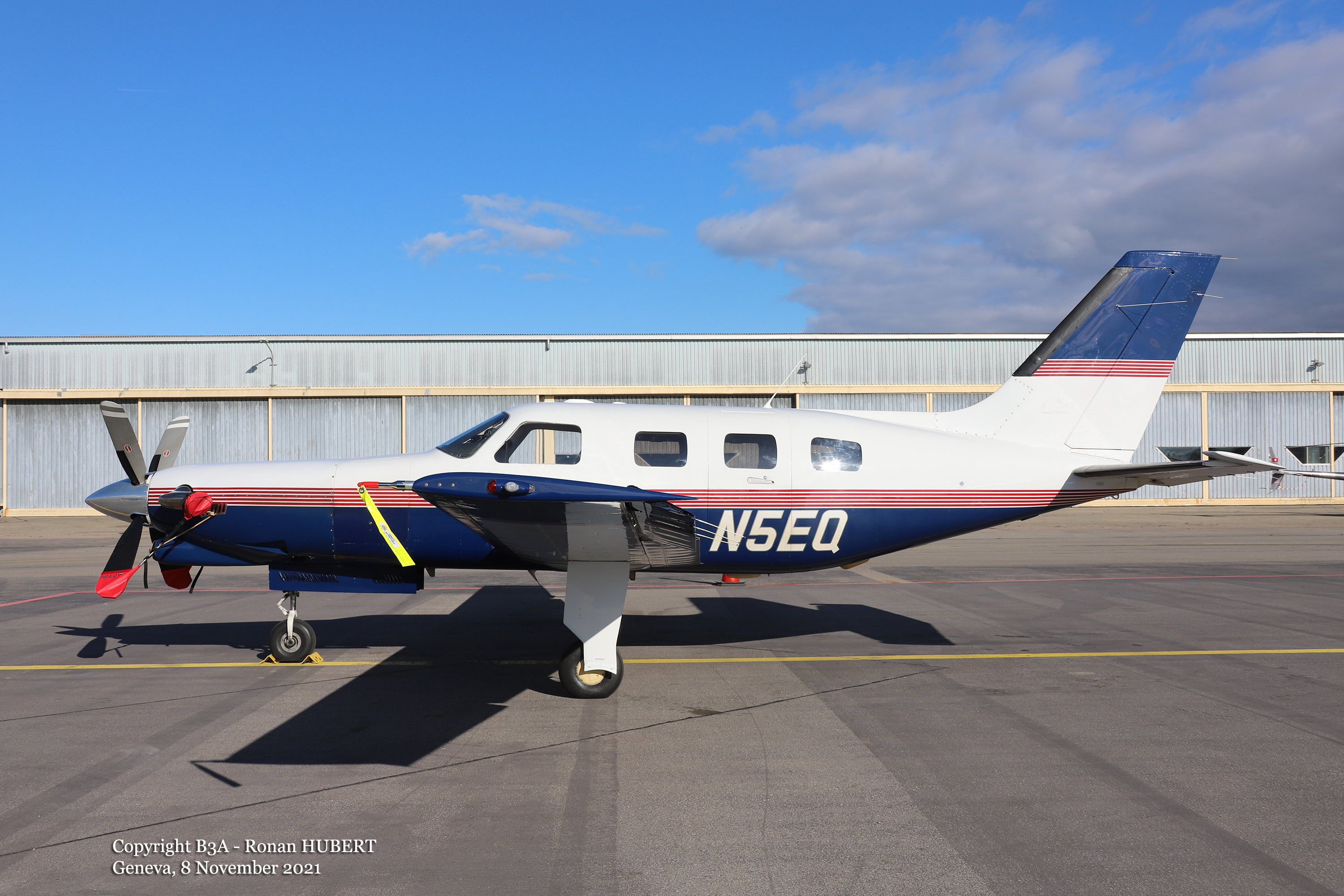
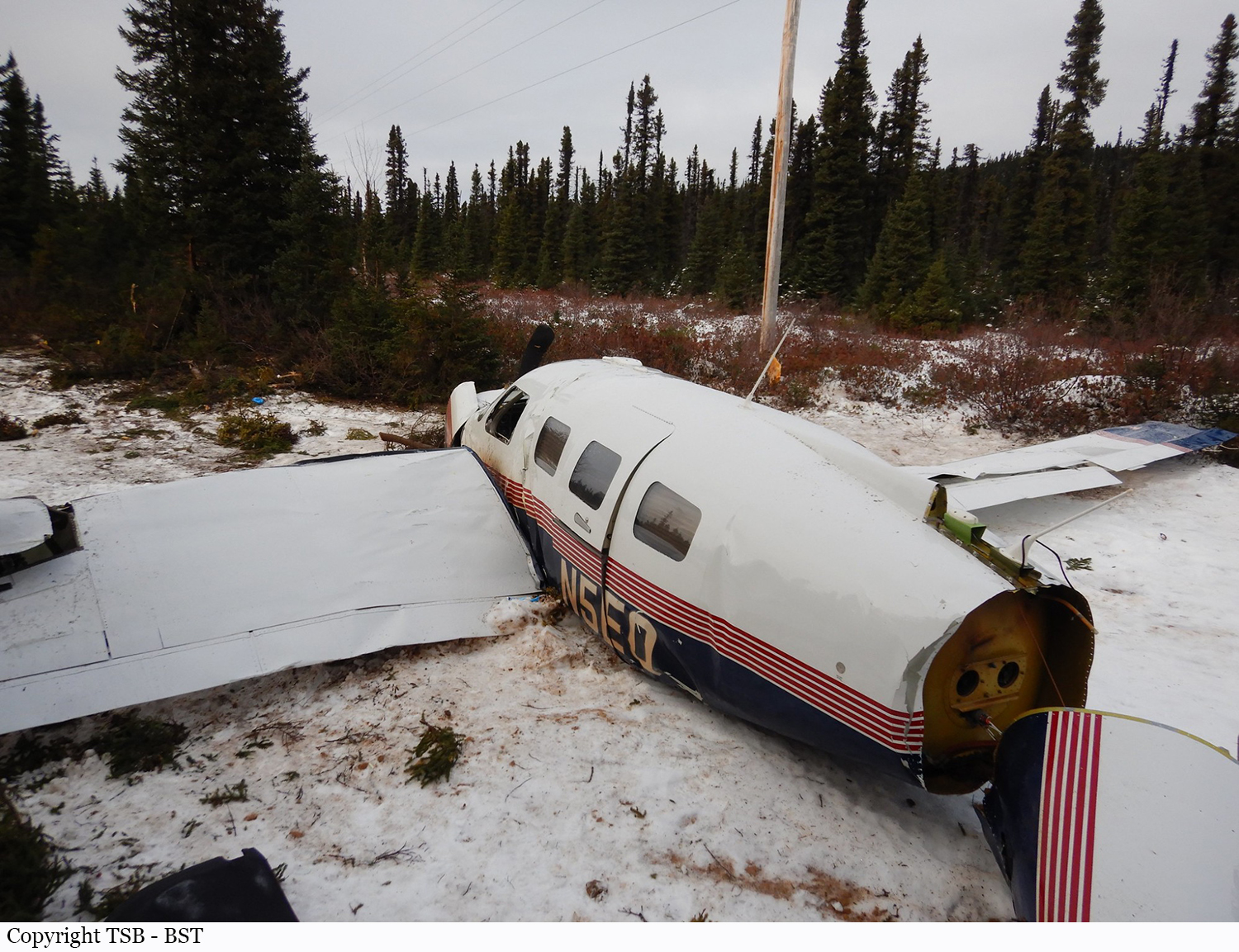
The single engine airplane departed Nashua Airport, New Hampshire, on December 13 on a flight to Nuuk, Greenland, with an intermediate stop in Goose Bay. Due to poor weather conditions at destination, the pilot diverted to Seven Islands Airport, Quebec, where the couple passed the overnight. On the morning of December 14, the airplane departed Seven Islands Airport at 0820LT bound for Goose Bay. At about 0958LT, the aircraft crossed the final approach fix / final approach waypoint FAFKO at 2,800 feet ASL, travelling at a ground speed of 104 knots, and began the final descent. Although the descent remained steady on a 3° profile, the ground speed decreased continuously for about 60 seconds. At 1000:31, the occurrence pilot reported at waypoint SATAK, and the ground speed had increased to above 80 knots. The tower provided the pilot with updated wind information and cleared the aircraft to land on Runway 08. The pilot acknowledged the clearance at 1000:49. Soon after, the ground speed began to decrease at a rate similar to the previous rate. At 1002:47, it had decreased to 51 knots. The aircraft departed controlled flight and impacted terrain when it was about 2.5 NM southwest of the airport along the extended centreline for Runway 08. The 406 MHz emergency locator transmitter activated, and the signal was received by the Joint Rescue Coordination Centre in Halifax, Nova Scotia, at 1006. A helicopter search and rescue mission was launched from Canadian Forces Base 5 Wing Goose Bay at 1036; the helicopter arrived at the accident site 3 minutes later. Medical technicians extricated the 2 occupants, who were both seriously injured. The occupants were airlifted to a waiting ambulance and then transported to the local hospital. The pilot later died of his injuries. The aircraft was destroyed.
Probable cause:
Given the absence of data for the last minute of the occurrence flight, the investigation could not determine the complete sequence of events that led to the loss of control and collision with terrain.
Final Report:
Crash of a De Havilland DHC-3 Otter in Pluto Lake

Date & Time: Oct 13, 2022 at 0929 LT
Type of aircraft:
Operator:
Registration:
C-FDDX
Survivors:
Yes
Schedule:
Mistissini - Pluto Lake
MSN:
165
YOM:
1956
Country:
Crew on board:
1
Crew fatalities:
Pax on board:
0
Pax fatalities:
Other fatalities:
Total fatalities:
0
Captain / Total flying hours:
1938
Captain / Total hours on type:
600.00
Aircraft flight hours:
17489
Circumstances:
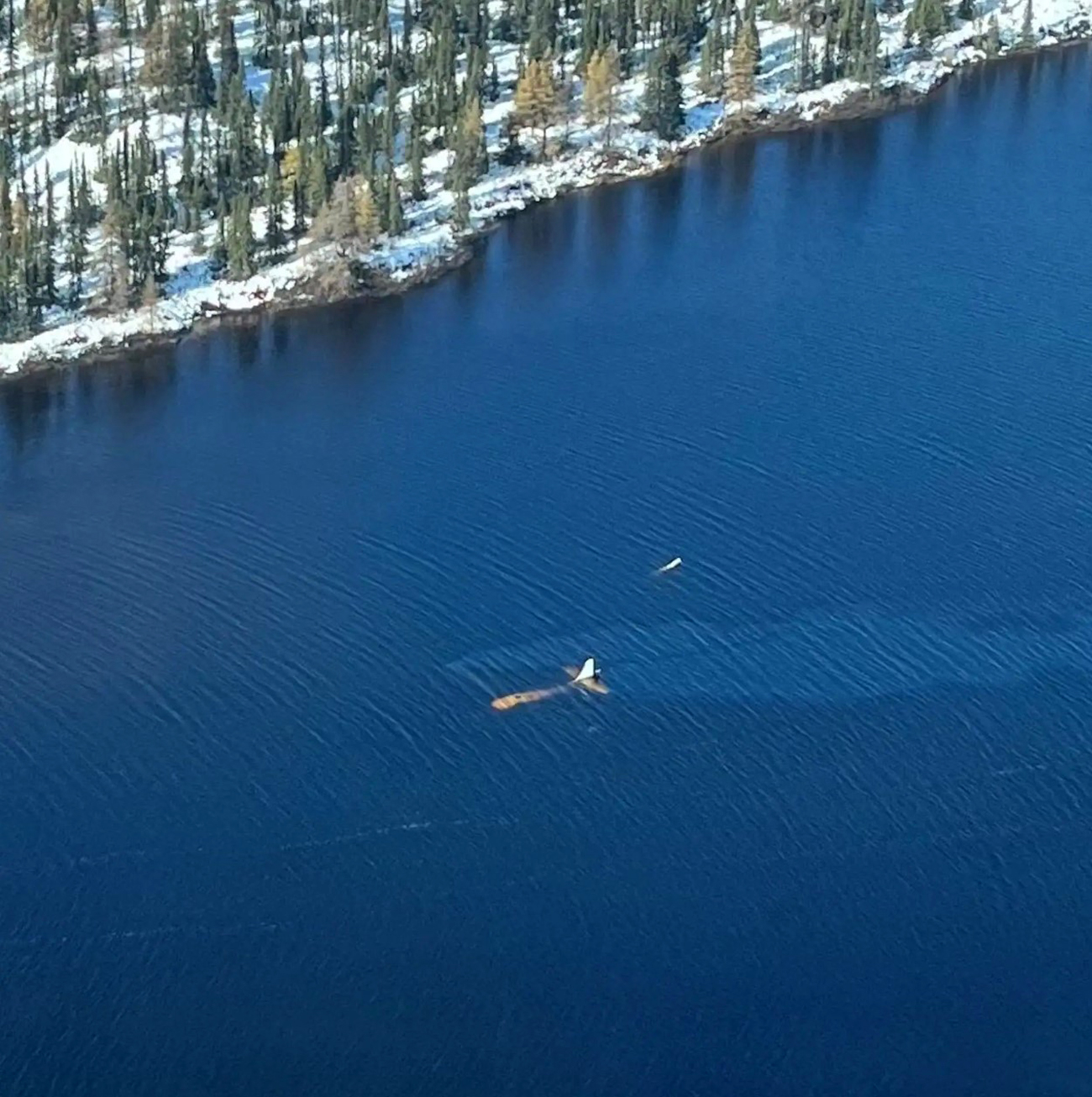
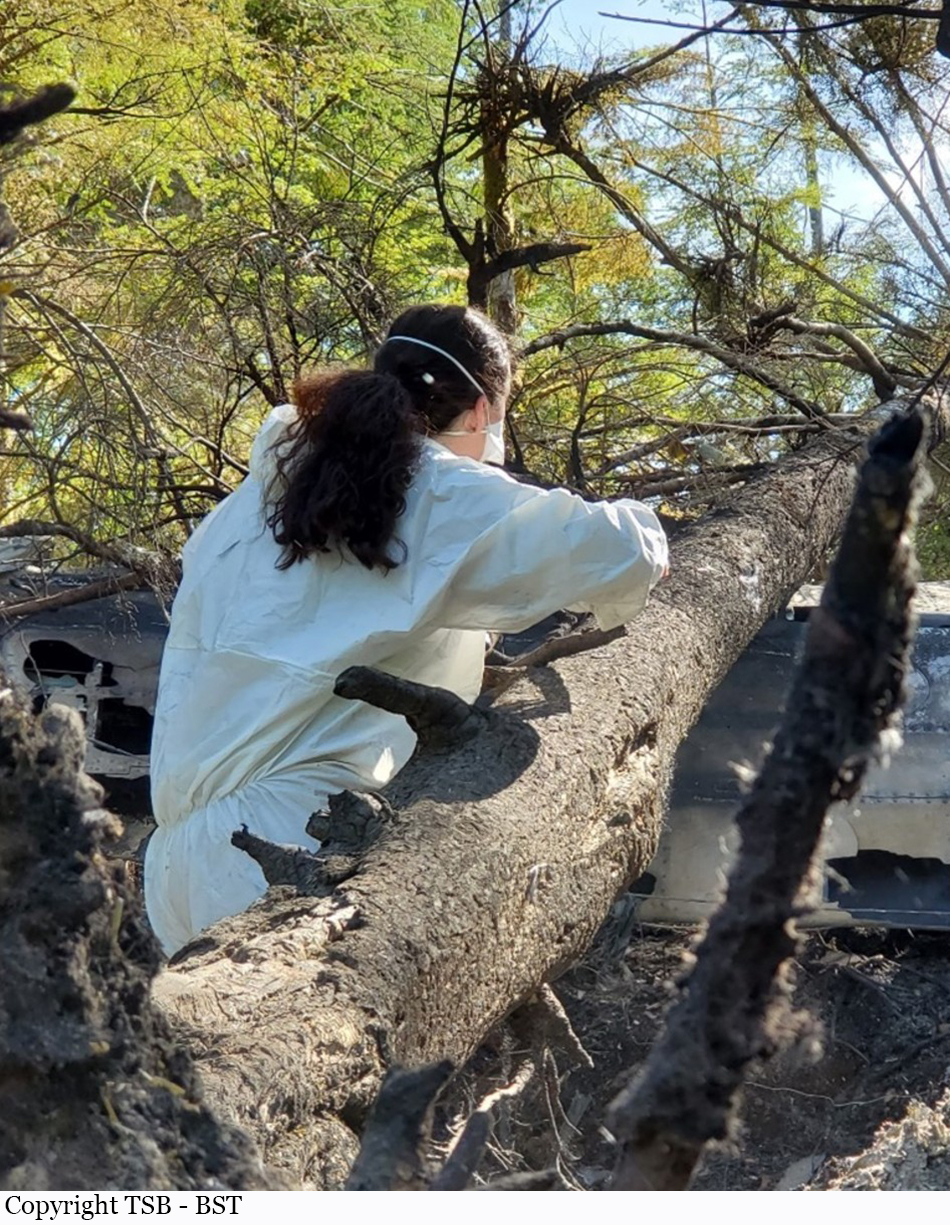
On 12 October 2022, the True North Airways Inc. de Havilland DHC-3 Otter aircraft on floats (registration C-FDDX, serial number 165) was conducting a visual flight rules flight, with 1 pilot on board, from Mistissini Water Aerodrome (CSE6), Quebec, to Pluto Lake, Quebec, where it would deliver cargo and pick up passengers. At approximately 0929 Eastern Daylight Time, while manoeuvring for landing on Pluto Lake, the aircraft collided with the surface of the water. The pilot sustained serious injuries. The passengers, who had been waiting near the lake for the aircraft’s arrival, transported the pilot to a nearby cabin from where he was later taken to hospital by a search and rescue helicopter. The emergency locator transmitter activated. There was significant damage to the aircraft.
Probable cause:
3.1 Findings as to causes and contributing factors
These are conditions, acts or safety deficiencies that were found to have caused or contributed to this occurrence.
Due to the visual cues of the landing area that were visible to the pilot, the close proximity of the landing site where passengers were waiting, and the natural tendency to continue a plan under changing conditions, the pilot continued the approach despite visibility in the local area being below the minimum required for visual flight rules flight.
Owing to the reduced visibility, the pilot’s workload, while he was manoeuvring for landing, was high and his attention was focused predominantly outside the aircraft in order to keep the landing area in sight. As a result, a reduction in airspeed went unnoticed.
During the aircraft’s turn from base to final, the increased wing loading, combined with the reduced airspeed, resulted in a stall at an altitude too low to permit recovery.
The pilot was not wearing the shoulder harness while at the controls and operating the aircraft because he found it uncomfortable and other aircraft he flew were not equipped with one. As a result, during impact with the water, the pilot received serious injuries.

3.2 Findings as to risk
These are conditions, unsafe acts or safety deficiencies that were found not to be a factor in this occurrence but could have adverse consequences in future occurrences.
If aircraft stall warning systems do not provide multiple types of alerts warning the pilot of an impending stall, there is an increased risk that a visual stall warning alone will not be salient enough and go undetected when the pilot’s attention is focused outside the aircraft or during periods of high workload.
If aircraft operators do not ensure that their contact information on file with the Canadian Beacon Registry is accurate, there is a risk that search and rescue operations may be delayed.
If companies do not employ robust flight-following procedures, there is a risk that, after an accident, potentially life-saving search and rescue services will be delayed.

3.3 Other findings
These items could enhance safety, resolve an issue of controversy, or provide a data point for future safety studies.
The occurrence aircraft was carrying dangerous goods on board, even though the operator was not authorized to do so on its DHC-3 Otter aircraft.
For unknown reasons, the pilot encountered difficulty inflating his personal flotation device, and because of his proximity to the shore, he removed it to make it easier to swim.
Final Report:
Crash of a Cessna 208 Caravan I in Lake Seul

Date & Time: Mar 8, 2022 at 1310 LT
Type of aircraft:
Operator:
Registration:
C-GIPR
Flight Phase:
Survivors:
Yes
Schedule:
Sioux Lookout – Springpole Lake
MSN:
208-0343
YOM:
2001
Country:
Crew on board:
1
Crew fatalities:
Pax on board:
1
Pax fatalities:
Other fatalities:
Total fatalities:
0
Captain / Total flying hours:
1315
Captain / Total hours on type:
126.00
Circumstances:
On 08 March 2022, the Bamaji Air Inc. (Bamaji) wheel-equipped Cessna 208 Caravan aircraft (registration C-GIPR, serial number 20800343) was conducting a series of visual flight rules (VFR) flights from Sioux Lookout Airport (CYXL), Ontario. At 1031, after checking the aerodrome forecast (TAF) valid from 0900 to 2000, and the graphic area forecast (GFA) valid from 0600 to 1800, the pilot departed on a flight to an ice runway on Springpole Lake, Ontario, about 78 nautical miles (NM) north-northwest of CYXL. The aircraft returned to CYXL with 2 passengers at 1200. In preparation for a second flight to Springpole Lake, the pilot loaded approximately 900 pounds of freight into the cabin and secured it under a cargo net. The aircraft had 750 pounds of fuel remaining on board, which was sufficient for the planned flight. The pilot and 1 passenger boarded the aircraft. The pilot occupied the left cockpit seat and the passenger occupied the right cockpit seat. Both occupants were wearing the available 5-point-harness safety belt system. At 1250, a snow squall began to move across CYXL, reducing ground visibility. The pilot taxied the aircraft to a position on the apron and waited for the fast-moving snow squall to pass. At 1301, the pilot taxied the aircraft to Runway 34 and took off in visual meteorological conditions. The aircraft climbed to approximately 1800 feet above sea level (ASL), then, once clear of the control zone, it descended to approximately 1600 to 1700 feet ASL, roughly 500 to 600 feet above ground level (AGL), to remain below the overcast ceiling. As the aircraft began to cross Lac Seul, Ontario, the visibility straight ahead and to the west was good. However, when the aircraft was roughly midway across the lake, it encountered turbulence and immediately became enveloped in whiteout conditions generated by a snow squall. The pilot turned his head to inspect the left wing and saw that ice appeared to be accumulating on the leading edge. He turned his attention back to the flight instruments and saw that the altimeter was descending rapidly. He then pulled back on the control column to stop the descent; however, within a few seconds, the aircraft struck the frozen surface of Lac Seul, approximately 17 NM north-northwest of CYXL. The aircraft was substantially damaged. There was no fire. The aircraft occupants received minor injuries. The Artex Model Me406 emergency locator transmitter (ELT) activated on impact and the signal was detected by the Cospas-Sarsat satellite system. The Joint Rescue Coordination Centre in Trenton, Ontario, re-tasked a Royal Canadian Air Force aircraft that was in the area and 3 search and rescue technicians (SAR Techs) parachuted into the site within 1 hour of the accident. The aircraft occupants and the SAR Techs were extracted from the site by a civilian helicopter later that day.
Probable cause:
The accident occurred while the aircraft was crossing a large, frozen, snow-covered lake at low altitude. Other than some small islands and the distant treed shorelines, there were few features to provide visual references. The terrain, coupled with the snow squalls that were passing through the area generated circumstances conducive to the creation of localized whiteout conditions.
Final Report:
Crash of a Beechcraft CT145D Super King Air in Thunder Bay

Date & Time: Jan 31, 2022 at 1222 LT
Operator:
Registration:
C-GEAS
Flight Type:
Survivors:
Yes
Schedule:
Trenton - Thunder Bay
MSN:
FL-17
YOM:
1990
Country:
Crew on board:
3
Crew fatalities:
Pax on board:
0
Pax fatalities:
Other fatalities:
Total fatalities:
0
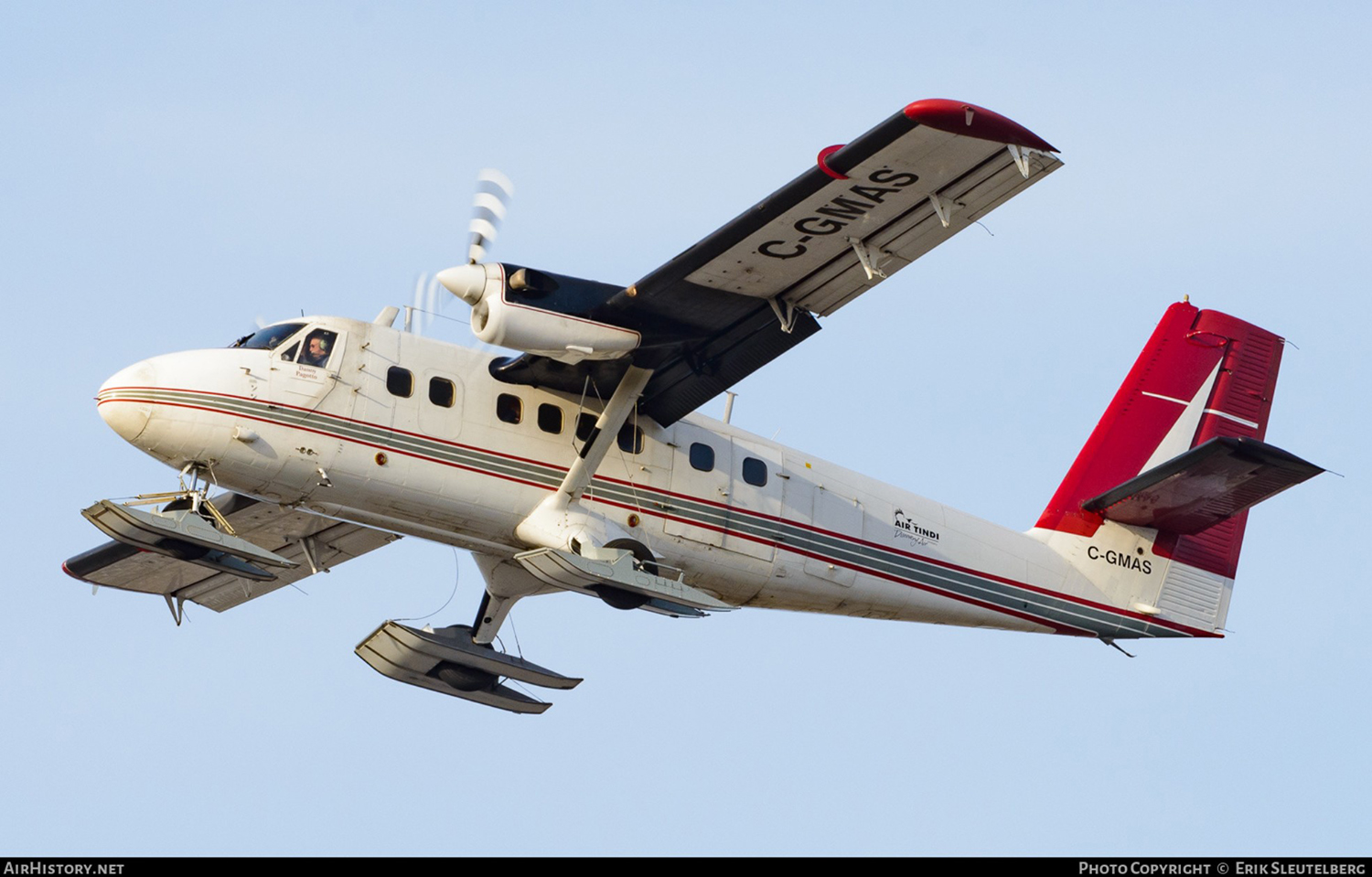
Circumstances:
Owned by Air Tindi, the airplane (coded as CT145D by the RCAF) was operated by the 8 Wing Multi Engine Utility Flight (MEUF). The mission consisted of a multi-day cross country training and familiarization trip with three military aircrew members onboard. The accident happened on the first segment of the mission. The aircraft departed 8 Wing Trenton on an Instrument Flight Rule flight plan, with a destination of Thunder Bay Airport, ON. Following a routine climb out and cruise, the aircraft was cleared for the RNAV Z 25 instrument approach into Thunder Bay. The aircraft was configured for the approach and flown utilizing automation. Approximately two miles back from the runway and with the airport visual, the pilot elected to continue the remainder of the approach manually and disconnected the autopilot. As the aircraft crossed over the runway threshold with a height above ground of approximately 50 feet, the pilot flying moved both power levers to idle with the intent of landing. A left yaw quickly developed followed by a rapid drop of the left wing. The pilot monitoring the approach took control and initiated an overshoot, however the left wing tip contacted the runway surface and the aircraft progressed uncontrolled into the snow-covered infield. Once the aircraft came to rest, the three crew members egressed the aircraft. The aircraft sustained very serious damage and the pilot flying suffered a minor injury, while the other crew members were not injured.
Probable cause:
The investigation determined that the aircraft was documented serviceable prior to the flight and that no issues were evident to the crew before the power levers were brought to idle. Post-accident analysis of the recovered aircraft flight data and componentry determined that a part within the propeller speed governing system failed to function nominally, specifically the beta valve or the beta solenoid. This led to the left-hand propeller windmilling, which was the most likely cause of the accident. Since the beta valve was damaged and internal parts lost during the accident sequence, a definitive determination of its serviceability could not be conducted.
Final Report:
Crash of a Socata TBM-910 in Westlock

Date & Time: Oct 10, 2021 at 1102 LT
Type of aircraft:
Registration:
C-FFYM
Flight Type:
Survivors:
Yes
Schedule:
Vernon – Calgary – Westlock
MSN:
1190
YOM:
2017
Country:
Crew on board:
1
Crew fatalities:
Pax on board:
3
Pax fatalities:
Other fatalities:
Total fatalities:
0
Captain / Total hours on type:
235.00
Aircraft flight hours:
449
Circumstances:
The airplane was conducting an instrument flight rules flight from Vernon Airport, British Columbia, to Westlock Aerodrome, Alberta, with a stop at Calgary/Springbank Airport, Alberta, to pick up passengers, after which 1 pilot and 3 passengers were on board. At 1102:26 Mountain Daylight Time, while the aircraft was landing on Runway 28 at Westlock Aerodrome, the aircraft bounced and the pilot initiated a go-around. During the application of engine power for the go-around, the aircraft rolled to the left, struck the runway inverted, and came to rest on the runway’s south side. The 3 passengers exited the aircraft through the main cabin door with the assistance of persons nearby. One passenger received serious injuries, and the other 2 had minor injuries. The pilot, who was seriously injured, was trapped in the cockpit for approximately 2 hours before first responders could safely rescue him from the wreckage. An emergency locator transmitter signal was received by the search and rescue satellite system. The aircraft was significantly damaged and there was no post-impact fire.
Probable cause:
Findings as to causes and contributing factors:
1. The aircraft joined the final approach well above the optimal 3° descent path and, during the steep approach that followed, the aircraft’s airspeed continually decelerated and resulted in an unstabilized approach.
2. On short final, the pilot reduced the rate of descent by increasing pitch rather than by adding power. As a result, the airspeed continued to decrease and the aircraft entered a stall, resulting in a hard landing and a subsequent bounce.
3. During the attempted rejected landing, the aircraft entered a 25° nose-high attitude and approached a stall condition. This low-speed condition combined with the high power setting resulted in the aircraft entering a rapid roll to the left and striking the runway in an inverted attitude.
4. The passengers did not receive a safety briefing before departure or before landing, and multiple items in the cabin were not secured. As a result, 1 passenger sustained serious injuries due to the deceleration forces and the loose items that were thrown around in the cabin during the accident.
5. The pilot was not wearing the available shoulder harness, and his torso was unrestrained during the impact. As a result, he sustained serious injuries.

Findings as to risk:
1. If pilots do not declare all health issues to Transport Canada Civil Aviation Medical Examiners and pilots’ family physicians do not declare issues assessed to be a risk to aviation safety to Transport Canada, there is an increased risk that pilots will operate with diagnosed medical conditions or medical side effects that could affect flight safety.
2. If an aircraft propeller is rotating and passengers are not supervised during boarding operations, there is a risk that passengers may inadvertently contact the propeller, potentially causing fatal injuries.

Other findings:
1. Following a review of the pilot’s medical history and prescription medication use, the investigation determined that the medication did not contribute to the accident.
Final Report:
Crash of a Rockwell Grand Commander 690B in Thunder Bay: 1 killed

Date & Time: Aug 16, 2021 at 2109 LT
Operator:
Registration:
C-GYLD
Flight Phase:
Flight Type:
Survivors:
No
Schedule:
Thunder Bay – Dryden
MSN:
690-11426
YOM:
1977
Flight number:
BD160
Country:
Crew on board:
1
Crew fatalities:
Pax on board:
0
Pax fatalities:
Other fatalities:
Total fatalities:
1
Captain / Total flying hours:
2662
Captain / Total hours on type:
230.00
Aircraft flight hours:
7620
Circumstances:
The airplane, operated by MAG Aerospace Canada Corp. as flight BD160, was conducting a visual flight rules flight from Thunder Bay Airport, Ontario, to Dryden Regional Airport, Ontario, with only the pilot on board. At 2109 Eastern Daylight Time, the aircraft began a takeoff on Runway 12. Shortly after rotation, the aircraft entered a left bank, continued to roll, and then struck the surface of Runway 07 in an inverted attitude. The pilot was fatally injured. The aircraft was destroyed by the impact and postimpact fire. The emergency locator transmitter activated on impact.
Probable cause:
Findings as to causes and contributing factors:
1. After takeoff from Runway 12 at Thunder Bay Airport, Ontario, as the pilot conducted a rapid, low-level, climbing steep turn, the aircraft entered an accelerated stall that resulted in a loss of control and subsequent collision with the surface of Runway 07 in an inverted attitude.
2. The decision to conduct the rapid, low-level, climbing steep turn was likely influenced by an altered perception of risk from previous similar takeoffs that did not result in any adverse consequences.

Findings as to risk:
1. If air traffic controllers engage in communications that may be perceived by pilots to encourage unusual flight manoeuvres, pilots may perceive this encouragement as a confirmation that the manoeuvres are acceptable to perform, increasing the risk of an accident.
2. If NAV CANADA’s reporting procedures do not contain specific criteria for situations where air traffic services personnel perceive aircraft to be conducting unsafe flight manoeuvres, there is a risk that these manoeuvres will continue and result in an accident.

Other findings
1. Most of the wires that comprised the elevator trim cable failed before the impact as a result of excessive wear; however, this did not contribute to the occurrence because the trim tab remained in the normal take-off position.
Final Report: