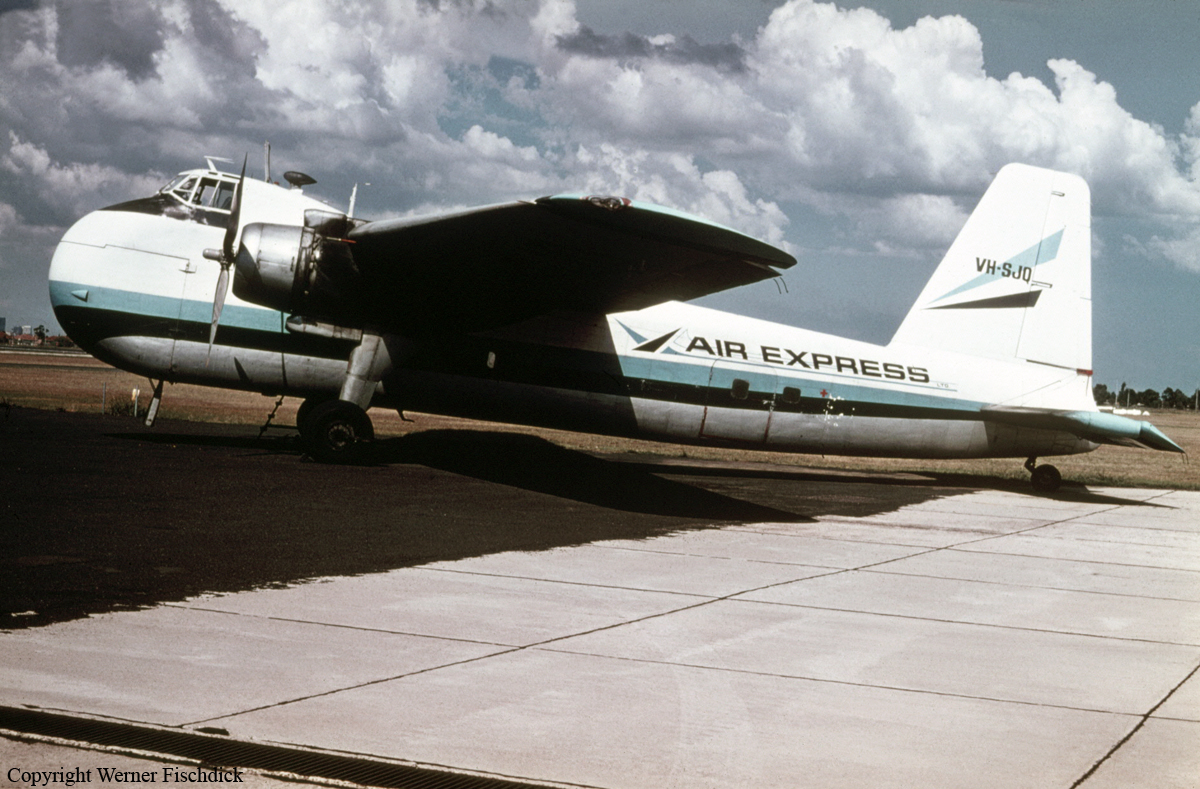
Crash of a Bristol 170 Freighter 21E off Cape Paterson: 2 killed

Date & Time: May 10, 1975 at 0218 LT
Type of aircraft:
Operator:
Registration:
VH-SJQ
Flight Phase:
Flight Type:
Survivors:
No
Schedule:
Melbourne - Launceston
MSN:
12807
YOM:
1946
Country:
Region:
Crew on board:
2
Crew fatalities:
Pax on board:
0
Pax fatalities:
Other fatalities:
Total fatalities:
2
Captain / Total flying hours:
18821
Captain / Total hours on type:
264.00
Aircraft flight hours:
9526
Circumstances:
The flight departed from Essendon Airport at 0050LT. At 0122 hours the flight reported to the Melbourne Flight Service Unit (FSU) that it was then at the Westgate reporting point cruising at 3,500 feet, and its estimated time of arrival at the West Bass reporting point was 0159 hours. At 0145:44 hours VH-SJQ advised the Melbourne FSU 'we have an engine failure on the port side, we have it feathered and are returning to Melbourne'. In response to a request from the FSU the flight advised it was able to maintain height 'at the moment'. At 0148:54 VH-SJQ confirmed that 'the port engine has failed and is feathered' and shortly thereafter advised an estimated time of arrival at the Primegate reporting point en route to Essendon Airport. The Uncertainty Phase of the search and rescue procedures was declared by the Melbourne Air Traffic Control Unit (ATC). At 0151:58 hours the flight advised the Melbourne FSU 'we are making a slow descent to one five zero zero' and, in answer to a query, reported 'we're unable to maintain our height with our rated power'. The Alert Phase of the search and rescue procedures was declared by Melbourne ATC, and a Bristol 170 Mark 31 aircraft en route from Launceston to Essendon Airport was diverted to intercept VH-SJQ and act as an escort. At 0157:46 hours VH-SJQ reported 'four eight DME Wonthaggi', and shortly thereafter, reported 'tracking one eight three on the Wonthaggi VOR'. At 0203:00 hours VH-SJQ transmitted a distress call and reported 'we're passed fifteen hundred feet and still going down'. The position of the aircraft at 0203:57 hours was reported as 'on the one eight six radial Wonthaggi and we are three seven DME'. The Distress phase of the search and rescue procedures was declared by Melbourne ATC and a second northbound aircraft was diverted to intercept VH-SJQ. At 0204:32 hours VH-SJQ reported 'we're down to nine hundred feet at the moment'; at 0207:42 hours, 'at six hundred feet at the moment; at 0212:55 hours, 'two two DME'; at 0213:22 hours, altitude was 200 feet; 0214:31 hours, 'we're down to one hundred feet'; and, at 0215:23 hours, 'this is a final MAYDAY call, we are approximately one eight DME and our altimeters registering zero feet'. Melbourne FSU then transmitted a ditching report of moderate seas with a moderate south-westerly swell; this was acknowledged by VH-SJQ. The escort aircraft then heard further transmissions from VH-SJQ which indicated that both altimeters were reading zero; the crew could see the tops of waves; and DME distances of 16, 15 and 14 were transmitted, the latter being the last transmission heard from the aircraft the time being about 0218 hours. Neither of the escort aircraft sighted VH-SJQ. Post analysis of the meteorological information indicates that the weather in the area of the accident was: surface wind from 280 degrees (True) at 15 knots, scattered cumulus cloud base 2,500 feet, scattered stratus cloud base 1,200 feet, patches of sea fog, visibility 40 kilometres reducing to 4,000 metres in rain showers, temperature 12° Celsius. It is probable that the temperatures at 1,500 feet, 2,500 feet, and 3,500 feet were 9.5°, 7° and 5° Celsius respectively. The conditions were not conducive to the formation of airframe or carburettor icing, and search aircraft in the area did not encounter any such icing.
Probable cause:
Due to lack of evidences, it was not possible to determine the exact cause of the accident. Analysis of the information available indicates that the flight profile flown by VH-SJQ is compatible with the aircraft having been flown at an indicated airspeed of 95 knots, and a power output from the starboard engine of 1250 BHP, i.e. 26 per cent less than the normal maximum power available in the conditions which prevailed. The pilot did not indicate in detail the nature of the difficulties he was experiencing, and as the majority of the aircraft wreckage has not been found it has not been possible to determine why he shut down the port engine; whether or not there was a degradation in the power output of the starboard engine; or whether there was some other factor which might have affected the performance of the aircraft. It might be significant, however, that at 0208:33 hours when a crew inter-communication was inadvertently transmitted from VH-SJQ, it was stated 'cylinder head is about three forty, oil pressure is around about eighty, oil temperature is about ah sixty five'. Such an oil pressure and temperature is normal, but the reported cylinder head temperature is 30 degrees Celsius in excess of the permissible emergency maximum.
Final Report:

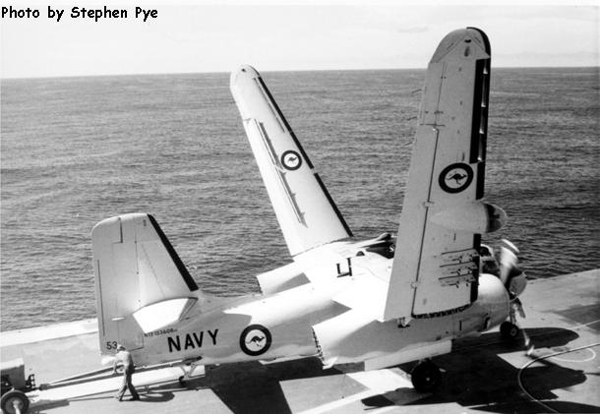
Crash of a Grumman S-2F-3S Tracker off the Jervis Bay

Date & Time: Feb 10, 1975 at 0325 LT
Type of aircraft:
Operator:
Registration:
N12-153608
Flight Type:
Survivors:
Yes
Schedule:
HMAS Melbourne - HMAS Melbourne
MSN:
340C
YOM:
1957
Country:
Region:
Crew on board:
4
Crew fatalities:
Pax on board:
0
Pax fatalities:
Other fatalities:
Total fatalities:
0
Circumstances:
Tracker N12-153608 was catapulted from the carrier at 2200 hours on 9 February 1975 to carry out an anti-submarine warfare close support task. The night was unusually dark with no visible horizon so that approximately three hours of the flight were spent in Instrument Meteorological Conditions (IMC). At 0323 hours the following morning, the aircraft attempted a routine landing using the mirror landing system as an approach aid. In the days preceding the accident, the mirror setting had been changed from an approach slope of 4° to 4.5° but the pilot had not been informed of this. In consequence, the approach was slightly high and fast, the aircraft failed to pick up an arrester wire, an event known as a "bolter", and it subsequently crashed into the sea approximately ten seconds later. All four crew members managed to escape from the sinking aircraft and were rescued uninjured. Accident occurred off the Jervis Bay, in the Tasman Sea.
Source: Phil Thompson
Probable cause:
Applied Report 78 concluded that the most probable cause of the accident was that the pilot was affected by unrecognized disorientation associated with somatogravic illusion and flew the aircraft into the sea. Factors thought to have contributed were:
a. the exceptionally dark night,
b. the pilot's unawareness of the change of settings to the mirror landing aid,
c. the pilot's lack of any previous bolter experience,
d. the need to monitor engine instruments instead of the VGI as the aircraft was rotated.

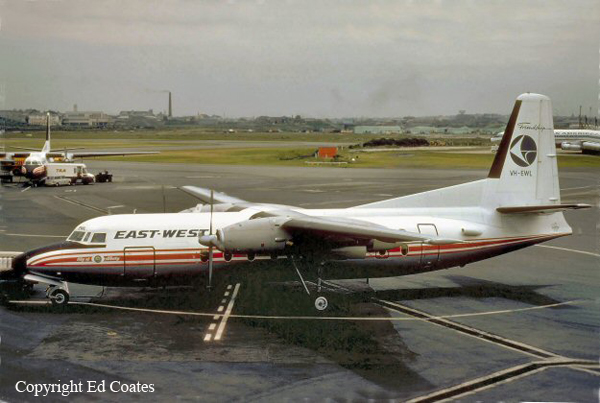
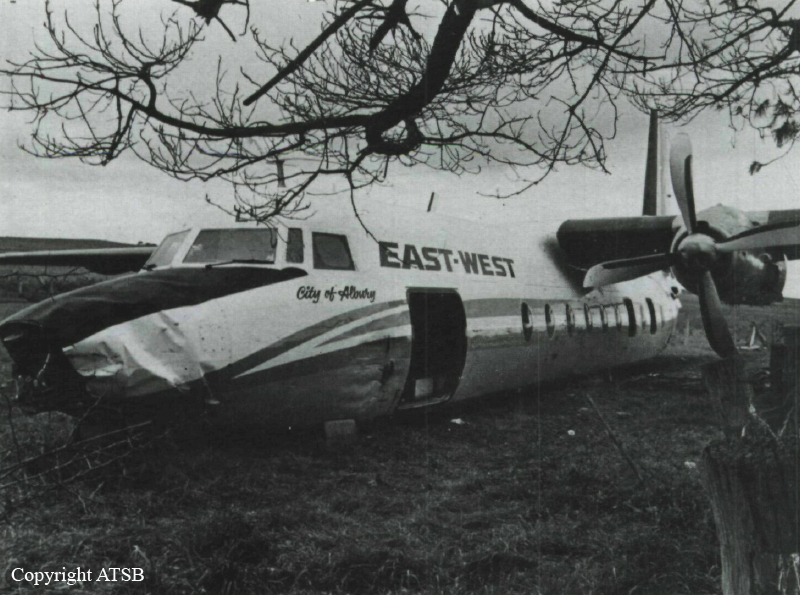
Crash of a Fokker F27 Friendship 100 in Bathurst

Date & Time: May 31, 1974 at 1822 LT
Type of aircraft:
Operator:
Registration:
VH-EWL
Survivors:
Yes
Schedule:
Sydney - Orange - Bathurst
MSN:
10344
YOM:
1967
Flight number:
EW752
Country:
Region:
Crew on board:
4
Crew fatalities:
Pax on board:
30
Pax fatalities:
Other fatalities:
Total fatalities:
0
Captain / Total flying hours:
8067
Captain / Total hours on type:
6000.00
Copilot / Total flying hours:
5420
Copilot / Total hours on type:
514
Aircraft flight hours:
17210
Aircraft flight cycles:
20462
Circumstances:
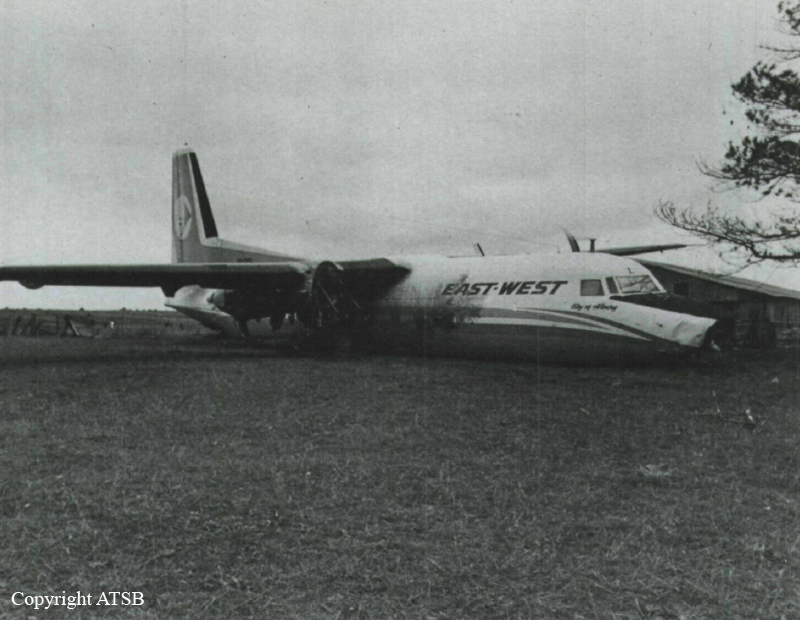
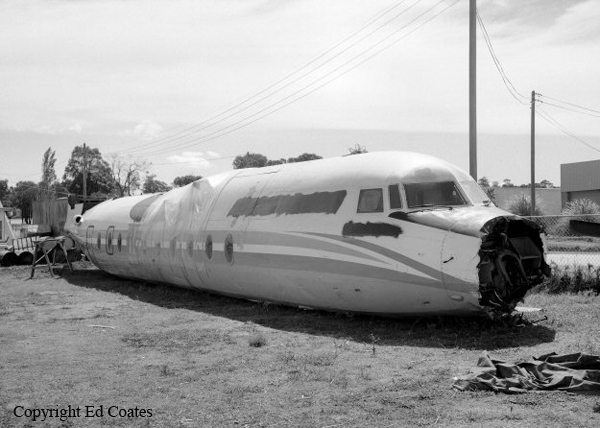
Fokker F-27, registered VH-EWL, was operating as East-West Airlines Flight 752/753 from Sydney (SYD) to Orange, Bathurst and back to Sydney. The flight departed from Sydney at 17:06 hours and proceeded to Orange without incident. The flight then departed from Orange at 18:10 hours and, flown by the First Officer, the aircraft cruised at an altitude of 5250 feet which is the lowest safe altitude for the route. There was no cloud below the aircraft and the visibility was unrestricted. At Bathurst the weather was reported as a five knot wind from the north-east and the altimeter setting was 1021 millibars. The crew commenced the descent from a position about 5.5 km west of the aerodrome, in visual conditions, with the lights of the city of Bathurst and the runway lights clearly visible. Initially, it was intended to overfly the aerodrome and then make a left-hand circuit preparatory to landing on runway 17, but when the captain saw what appeared to be a light rain shower slightly east of the runway 35 threshold, and which might have involved penetration during a left-hand circuit to runway 17, he decided to land on runway 35 instead. At 1817:30 hours the captain called Sydney Flight Service reporting that the aircraft had arrived in the Bathurst circuit area. The aircraft, which was still being flown by the First Officer, was turned some 90 degrees to the right and it joined the left downwind leg of the traffic circuit for a landing on runway 35. The aircraft proceeded downwind a little further than is usual then turned onto base leg of the circuit by which time all cockpit checks had been completed except for setting the engine fuel trims to 'full increase'. The captain states that whilst the aircraft was on the base leg he checked that the water methanol lights were on, and that the fuel trim indicators were at 'full increase'. The aircraft was turned onto final approach for landing, at which time the landing gear was down, 26.5 degrees of wing flap had been extended, it was aligned with the runway centre-line and no drift was evident. Flight conditions were smooth. Light rain was then encountered and the windscreen wipers were switched on to operate at slow speed. The flight path appeared to be normal at an airspeed of 110 knots reducing to 100 knots with the rate of descent stabilised at some 700 ft/min. At about this time the aircraft passed over the Great Western Highway (730 metres south of the runway 35 threshold) and at the normal height of about 300 feet above terrain; two or three noticeable turbulence bumps were then encountered and the aircraft commenced to drift to the left of the runway alignment. The aircraft heading was altered a few degrees to the right and the approach was continued in light to moderate turbulence with the rain intensity increasing to heavy as the aircraft approached the runway threshold; the windscreen wipers were then selected to operate at high speed. At approximately 200-250 feet above terrain and prior to reaching the runway threshold, on the command of the Captain, the First Officer initiated a go-around because the aircraft had drifted too far to the left of the runway centre-line to safely effect a landing. The First Officer placed the power levers in the position for maximum power and he rotated the aircraft, by reference to the flight instruments, to the normal body attitude of 8 to 9 degrees for initial climb. The response of the engines appeared normal to the crew and they believed that full 'wet' power was being developed. Immediately after the engine power increased the captain raised the wing flaps from the setting of 26.5 degrees to 16.5 degrees, and he retracted the landing gear. At the commencement of the go-around the aircraft was still in conditions of turbulence and heavy rain and that, initially, the aircraft maintained its altitude; the indicated airspeed then decayed rapidly to 73 knots at which time the aircraft was estimated to be 80-100 feet above the runway. As the indicated airspeed decreased the First Officer lowered the nose of the aircraft slightly but still maintained a climbing attitude. At about this time the captain took hold of his control wheel but the First Officer continued to fly the aircraft by reference to his flight instruments. The indicated airspeed remained at 73 knots for a few seconds then rapidly increased to about 80-85 knots; it was not fluctuating and the turbulence had ceased. The rear fuselage of the aircraft then impacted the ground heavily just outside the boundary of the flight strip, at a point 1240 metres north of the runway 35 threshold, 48 metres to the right of the runway centre-line. The aircraft slid along on the fuselage for a distance of 625 metres during which the starboard engine was torn out of the wing. Cockpit impact drill was initiated by the flight crew during the ground slide and completed when the aircraft came to rest. The crew and passengers evacuated the aircraft at which time there was little or no rain at their location and there was a light breeze from a southerly direction.
Probable cause:
During the climb performance of the aircraft was adversely affected by an unpredictable encounter with a large change in the horizontal wind component, and an associated downdraft, at a height too low to effect recovery.

Crash of a De Havilland DHC-2 Beaver in Hamilton: 2 killed

Date & Time: Apr 19, 1974 at 1600 LT
Type of aircraft:
Operator:
Registration:
VH-BSY
Flight Phase:
Survivors:
No
Schedule:
Hamilton - Hamilton
MSN:
1563
YOM:
1964
Country:
Region:
Crew on board:
1
Crew fatalities:
Pax on board:
1
Pax fatalities:
Other fatalities:
Total fatalities:
2
Captain / Total flying hours:
2804
Captain / Total hours on type:
1500.00
Circumstances:
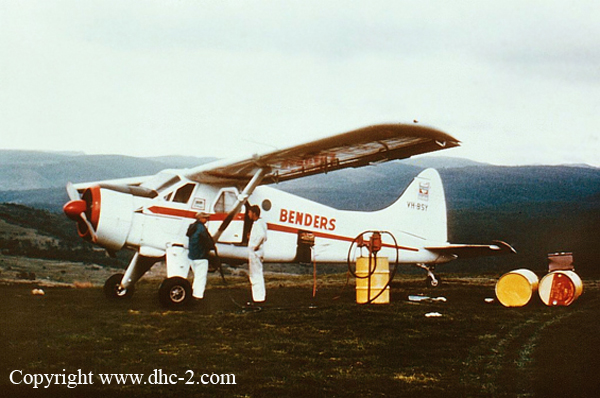
The crew was involved in a local spraying mission in the region of Hamilton, Tasmania. While cruising at an altitude of 500 feet, the pilot-in-command initiated a left turn and descended till 50 feet when the airplane struck power cables. On impact, the left wing was torn off and the aircraft crashed in flames. Both occupants were killed.
Probable cause:
It was determined that a power line was installed few days prior to the accident and apparently, the pilot was not aware of it. The crew has been briefed before flight but the chief pilots failed to inform the crew of the presence of the power line as he was convinced the crew was already aware of its presence.
Final Report:

Crash of a De Havilland DH.104 Dove 6 in Bankstown: 2 killed

Date & Time: Mar 13, 1974 at 1537 LT
Type of aircraft:
Operator:
Registration:
VH-WST
Flight Phase:
Flight Type:
Survivors:
No
Schedule:
Bankstown - Bankstown
MSN:
04509
YOM:
1959
Country:
Region:
Crew on board:
2
Crew fatalities:
Pax on board:
0
Pax fatalities:
Other fatalities:
Total fatalities:
2
Circumstances:
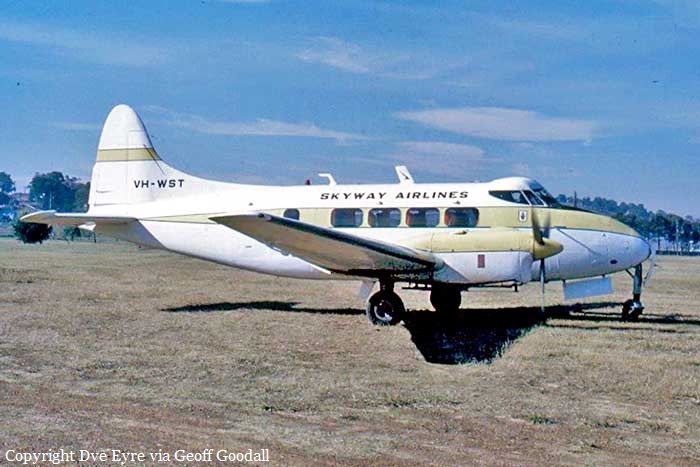
The crew departed Bankstown on a local training flight. While circling near the airport, the Dove collided with a private Piper PA-30-160B Twin Comanche registered VH-WWB that was approaching Bankstown Airport on a flight from Sydney with also two people on board. Following the collision, both aircraft dove into the ground and crashed in a residential area located about 3 NM from the airfield. Both aircraft were destroyed and all four occupants were killed. Fortunately, there were no casualties on the ground. It is believed that the crew of the Dove encountered radio problems before the accident.

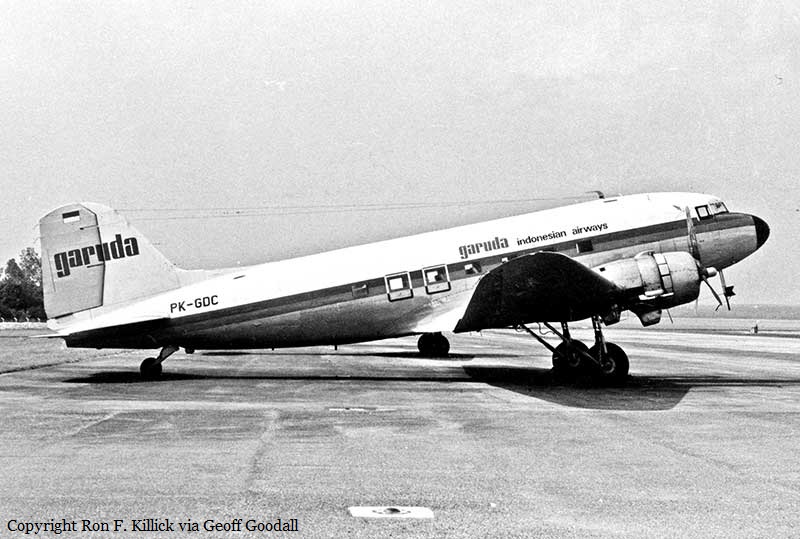
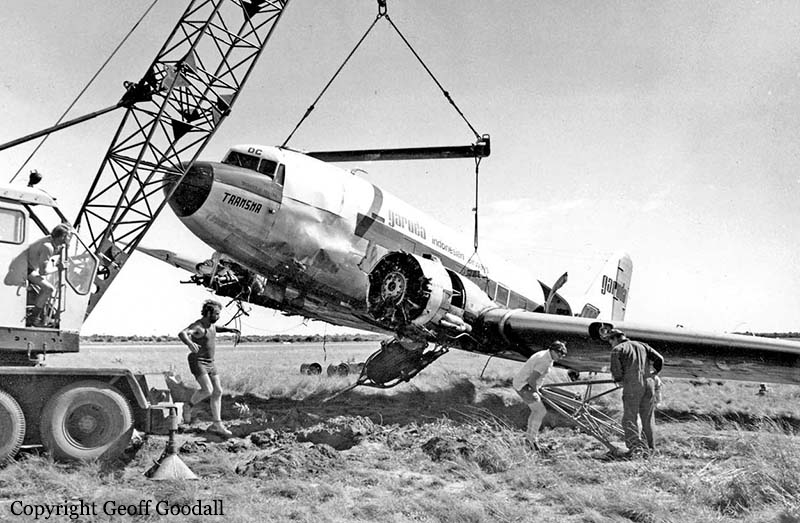
Crash of a Douglas C-47A-85-DL in Broome

Date & Time: Jan 21, 1974
Operator:
Registration:
PK-GDC
Survivors:
Yes
MSN:
20041
YOM:
1944
Country:
Region:
Crew on board:
3
Crew fatalities:
Pax on board:
0
Pax fatalities:
Other fatalities:
Total fatalities:
0
Circumstances:
The crew was completing a positioning flight to Broome to pick up oil rig workers to Portuguese Timor on behalf of the Burma Oil Company. The approach and landing were completed in heavy rain falls due to monsoon. After touchdown, the airplane went out of control, veered off runway and lost its undercarriage and engines before coming to rest. All three crew members escaped uninjured while the aircraft was damaged beyond repair.

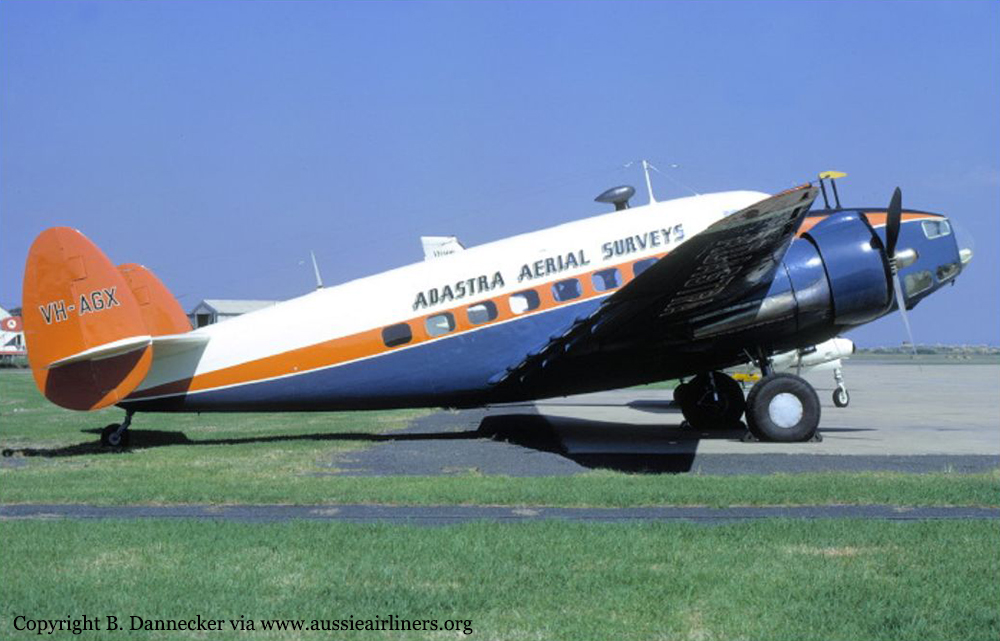
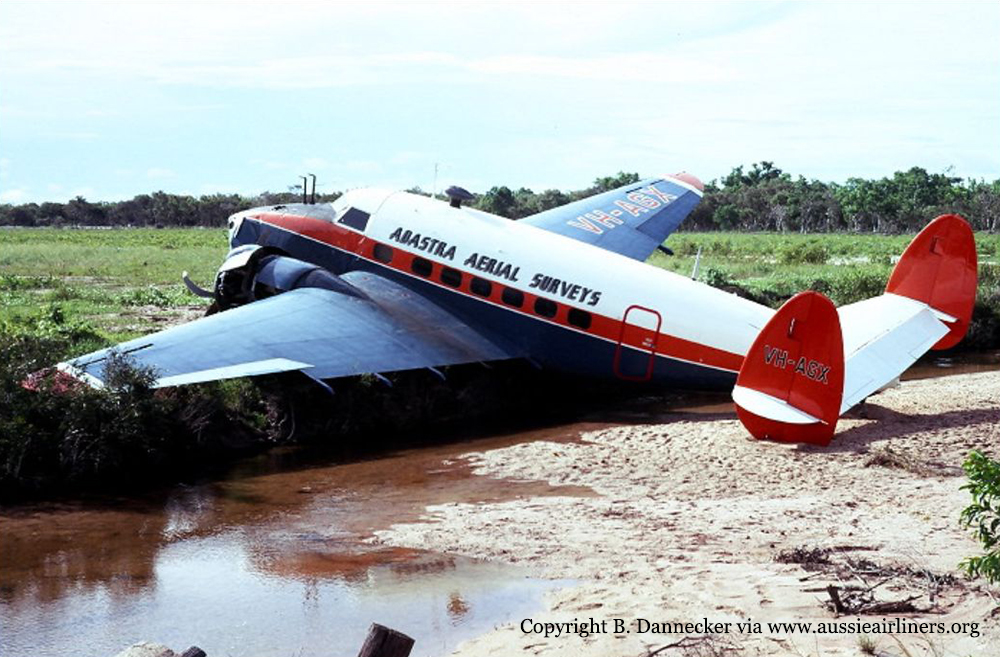
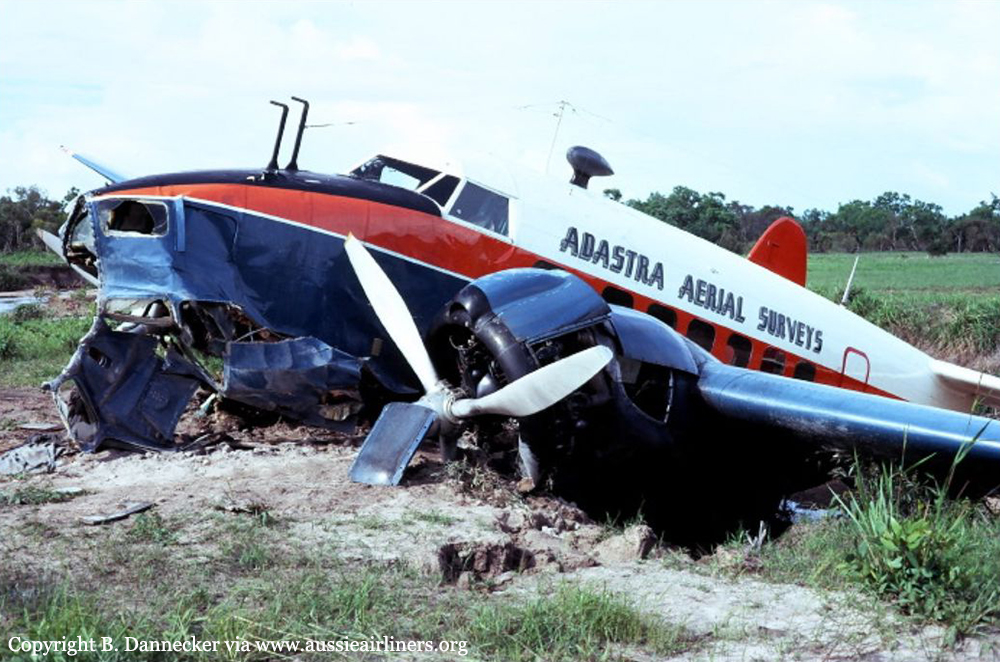
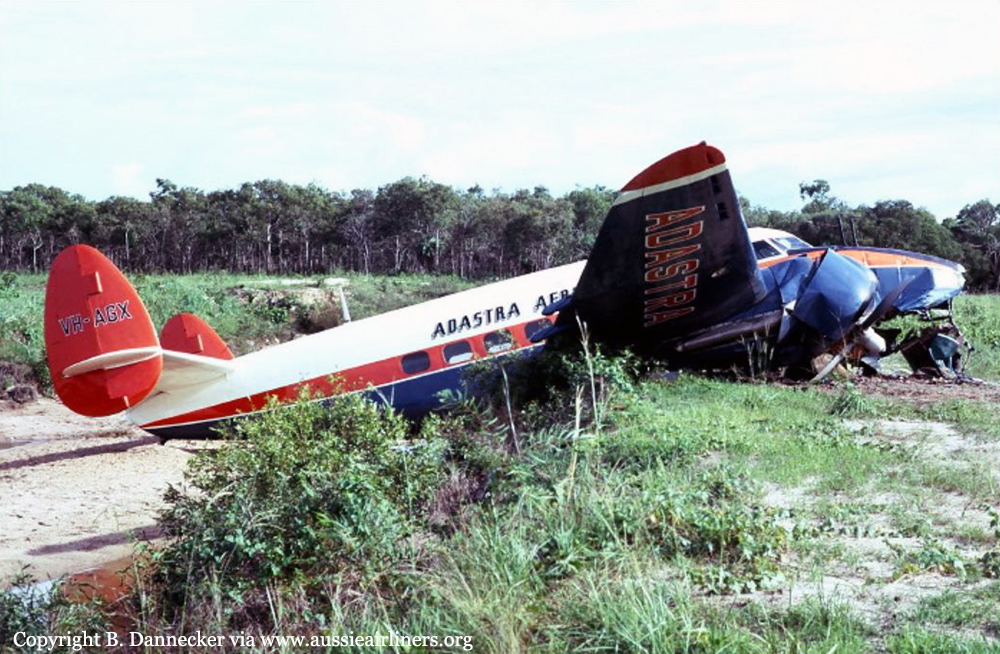
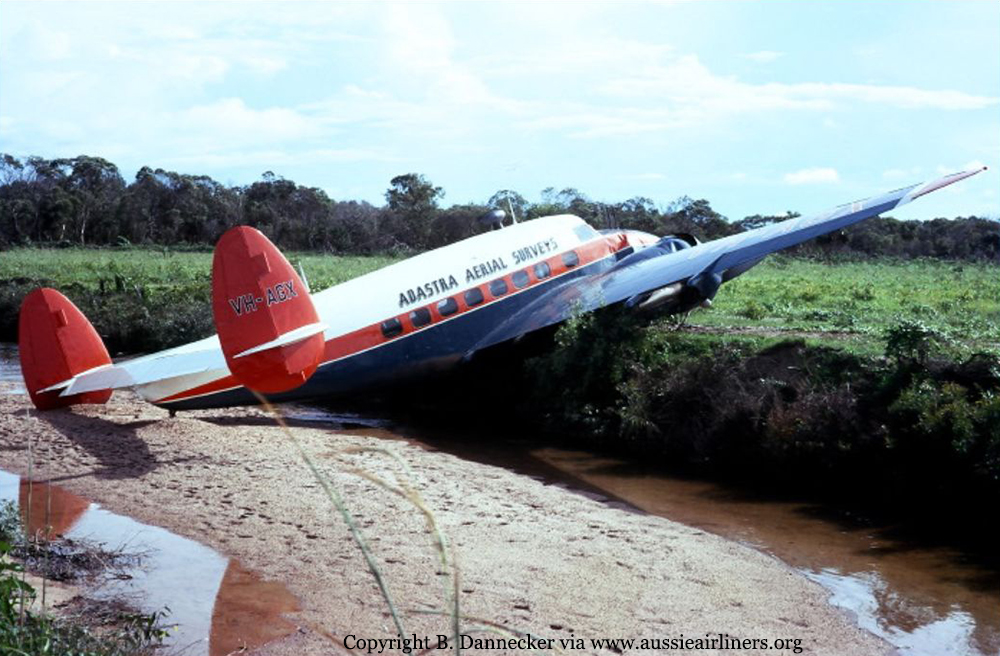
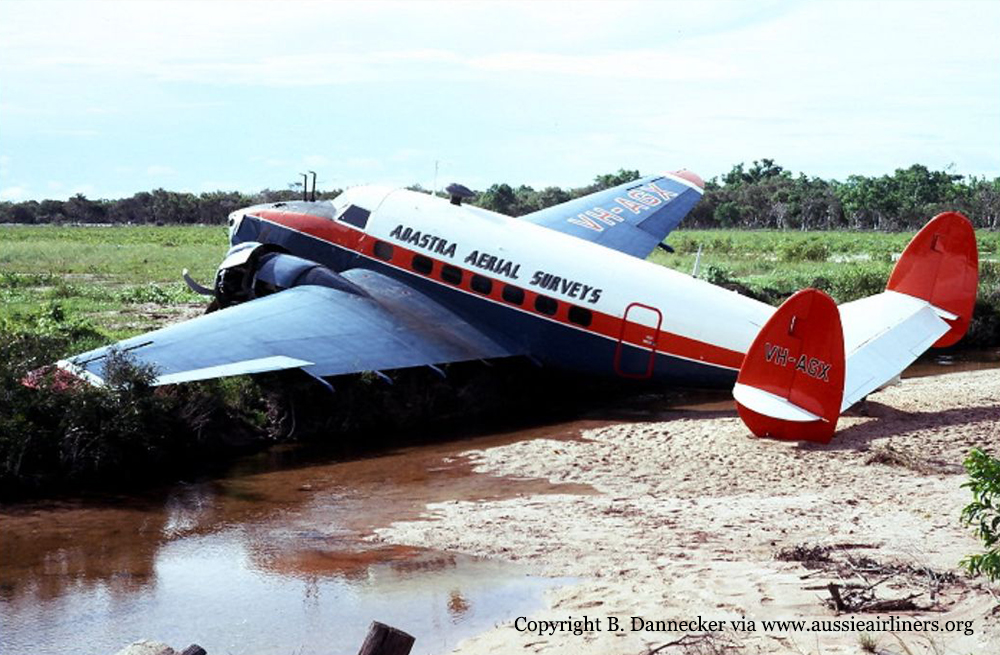
Crash of a Lockheed L-414-08-10 Hudson IV on Horn Island

Date & Time: Dec 22, 1973
Type of aircraft:
Operator:
Registration:
VH-AGX
Flight Phase:
Flight Type:
Survivors:
Yes
MSN:
6051
YOM:
1942
Country:
Region:
Crew on board:
2
Crew fatalities:
Pax on board:
0
Pax fatalities:
Other fatalities:
Total fatalities:
0
Circumstances:
During the takeoff roll, al loss of hydraulic pressure forced the crew to abort. Unable to stop within the remaining distance, the twin engine airplane overran and came to rest against an embankment. Both pilots were injured and the aircraft was damaged beyond repair.
Photos via www.aussieairliners.org

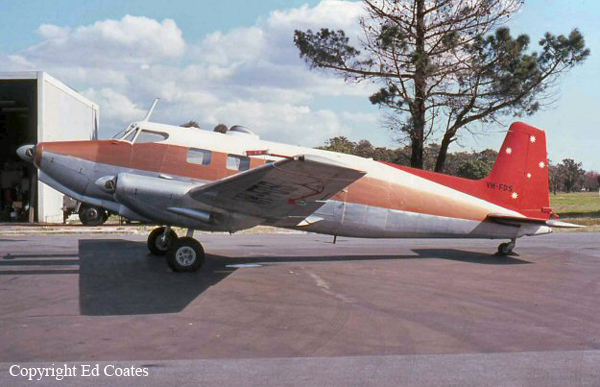
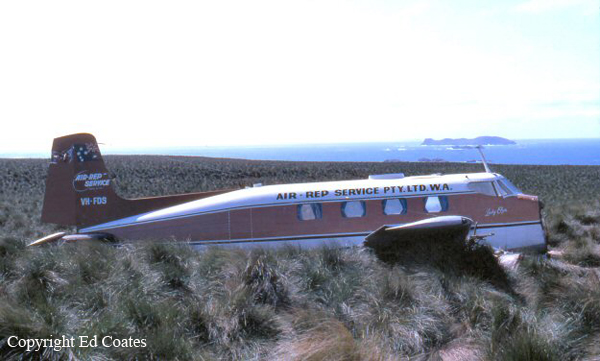
Crash of a De Havilland DHA-3 Drover 3 on Trefoil Island

Date & Time: Jul 30, 1973
Registration:
VH-FDS
Flight Type:
Survivors:
Yes
Schedule:
Smithton - Trefoil Island
MSN:
5007
Country:
Region:
Crew on board:
1
Crew fatalities:
Pax on board:
1
Pax fatalities:
Other fatalities:
Total fatalities:
0
Circumstances:
Upon landing on a grassy runway on Trefoil Island, the airplane went out of control, veered off runway, lost its undercarriage and came to a halt. Both occupants were unhurt while the aircraft was damaged beyond repair.

Crash of a Piper PA-31-310 Navajo in Golden Grove: 8 killed

Date & Time: Jul 13, 1972 at 0748 LT
Type of aircraft:
Registration:
VH-CIZ
Flight Phase:
Survivors:
No
Schedule:
Adelaide - Moomba
MSN:
31-682
YOM:
1970
Country:
Region:
Crew on board:
1
Crew fatalities:
Pax on board:
7
Pax fatalities:
Other fatalities:
Total fatalities:
8
Captain / Total flying hours:
2697
Captain / Total hours on type:
987.00
Aircraft flight hours:
857
Circumstances:
The aircraft departed Adelaide-Parafield Airport on a charter flight to Moomba, carrying seven passengers and a passenger on behalf of Santos Ltd. At the time of the accident, it as owned and operated by Ansett Transport Industries (Operations) Pty Ltd trading as Ansett General Aviation. During initial climb, while flying in clouds at an altitude of 700 feet heading 270°, the twin engine airplane went out of control, entered a left turn and subsequently stuck the ground at high speed in a shallow dive, some 13 miles northeast of Adelaide Airport. The airplane disintegrated on impact and all eight occupants were killed. The accident was not survivable.
Probable cause:
The cause of the accident was that control of the aircraft was lost and recovery was not effected before it struck the ground. The reason for the loss of control and the inability to take effective recovery action has not been determined. Although the aircraft was operating in cloud from a height of about 700 feet after takeoff until it emerged at a height of 300 to 500 feet above the terrain shortly before impact, there is no evidence of any meteorological condition which may have contributed directly to the accident.

Final Report:

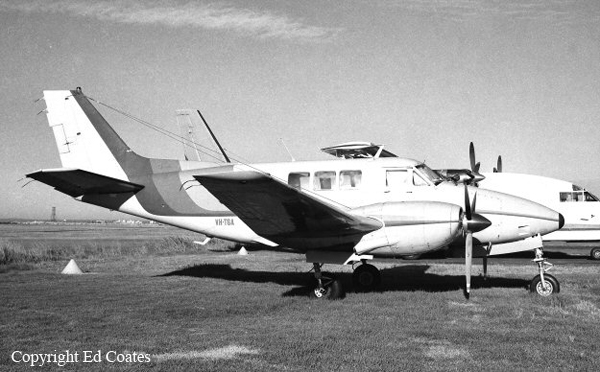
Crash of a Beechcraft 65-80 Queen Air 80 in Alice Springs: 7 killed

Date & Time: Jan 20, 1972 at 0745 LT
Type of aircraft:
Operator:
Registration:
VH-CMI
Flight Phase:
Survivors:
No
Schedule:
Alice Springs - Ayres Rock
MSN:
LD-12
YOM:
1962
Country:
Region:
Crew on board:
1
Crew fatalities:
Pax on board:
6
Pax fatalities:
Other fatalities:
Total fatalities:
7
Captain / Total flying hours:
1558
Captain / Total hours on type:
55.00
Aircraft flight hours:
4017
Circumstances:
At approximately 0745 hours Central Standard Time on 20 January 1972, there was an in-flight fire in a Beech 65-80 Queen Air aircraft, registered VH-CMI, which resulted in the separation of the starboard engine and the starboard outer wing. The aircraft subsequently struck the ground some seven miles south-west of Alice Springs Airport in the Northern Territory. At the time of the accident, the aircraft was engaged in operating a charter flight for the purpose of carrying passengers, mail and freight from Alice Springs to Ayers Rock. The aircraft was destroyed by fire and impact forces and the pilot and the six passengers were killed.
Probable cause:
The probable cause of the accident was that, following an engine failure which resulted in severe vibration and a fire in the outboard rear section of the engine compartment, the integrity of the firewall and its attached exhaust ducting was lost and structure at the rear of the engine nacelle was thereby exposed to fire.
Final Report: