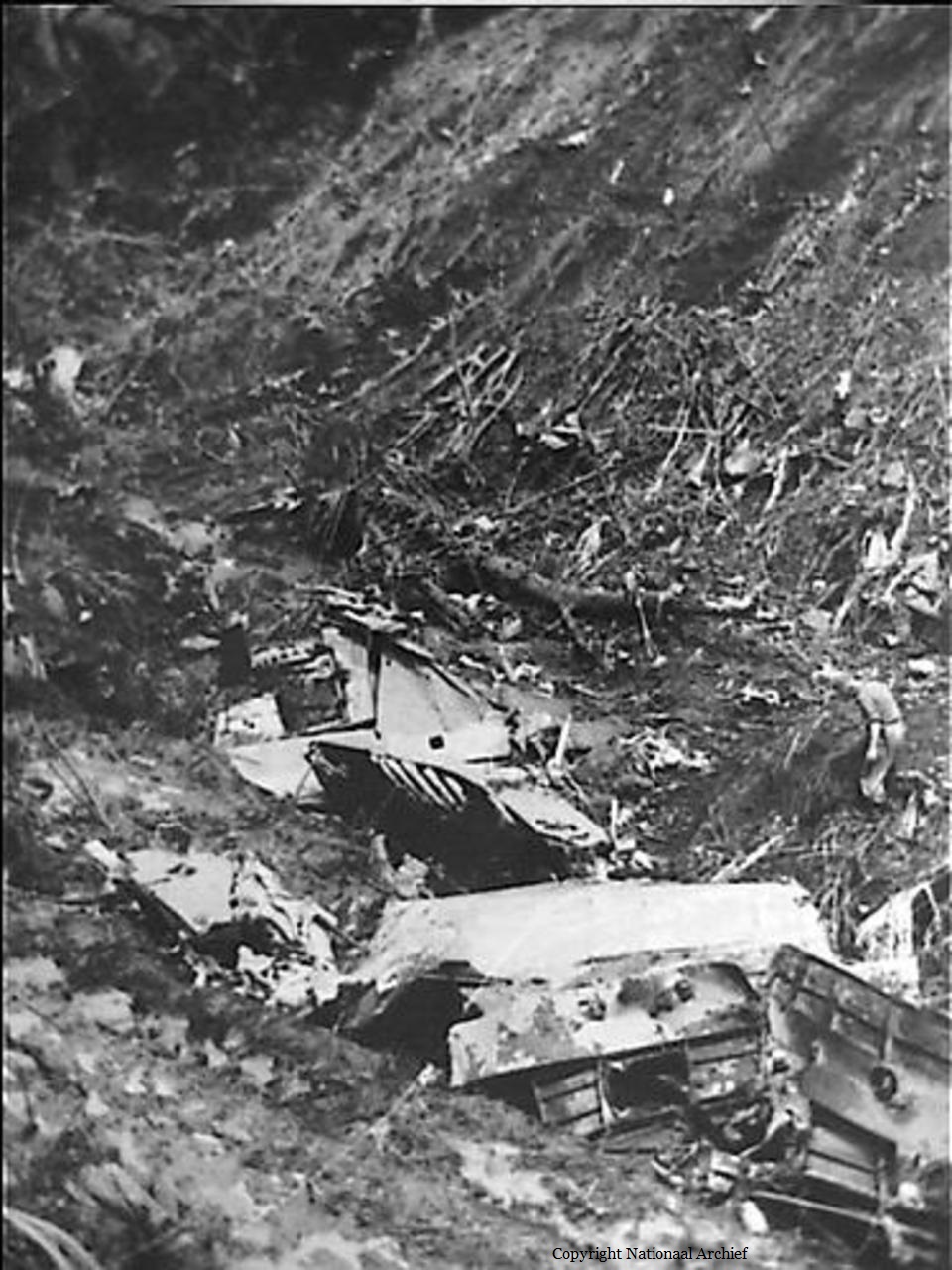
Crash of a Douglas C-47-DL in La Grita

Date & Time: Feb 23, 1948
Operator:
Registration:
YV-AGU
Flight Phase:
Survivors:
Yes
Schedule:
Caracas – Maracaibo – Cúcuta – Bogota
MSN:
4205
YOM:
1941
Country:
Crew on board:
5
Crew fatalities:
Pax on board:
12
Pax fatalities:
Other fatalities:
Total fatalities:
0
Circumstances:
On the leg from Maracaibo to Cúcuta, while starting the descent, the crew encountered technical problems with the engines and elected to make an emergency landing. The aircraft crash landed and was written off. All 17 occupants were injured, nine of them seriously.
Probable cause:
Engine failure.

Crash of a Douglas C-47-DL in Collesalvetti: 7 killed

Date & Time: Feb 20, 1948 at 1340 LT
Operator:
Registration:
I-REGI
Survivors:
Yes
Site:
Schedule:
Florence - Pisa - Rome
MSN:
4312
YOM:
1941
Location:
Country:
Region:
Crew on board:
3
Crew fatalities:
Pax on board:
7
Pax fatalities:
Other fatalities:
Total fatalities:
7
Circumstances:
The aircraft was scheduled to fly from Florence to Rome but few minutes prior to departure, the operator decided to make an unscheduled stop in Pisa Airport to disembark passengers that were blocked in Florence due to a technical failure on the aircraft. Due to low clouds, the crew was forced to fly at low height from Florence to Pisa and apparently, the weather conditions dropped as the aircraft approached Pisa Airport. Descending from the south in poor visibility, the aircraft hit the slope of a mountain and crashed near the village of Collesalvetti, south of the airport. All three crew members and four passengers were killed while three other passengers were seriously injured.
Probable cause:
It is believed the accident was caused by successive errors on part of the crew, causing the aircraft to be too low and off track at the time of the accident. Low visibility caused by poor weather conditions should be considered as a contributory factor.

Crash of a Douglas C-47B-30-DK in Padalarang: 19 killed

Date & Time: Feb 10, 1948 at 1625 LT
Operator:
Registration:
PK-REA
Flight Phase:
Survivors:
No
Schedule:
Bandung – Jakarta – Banjoemans – Semarang
MSN:
16380/33128
YOM:
1945
Flight number:
KL947
Country:
Region:
Crew on board:
4
Crew fatalities:
Pax on board:
15
Pax fatalities:
Other fatalities:
Total fatalities:
19
Circumstances:
Shortly after takeoff from Bandung-Andir Airport, while climbing in stormy weather, the crew informed ground that an engine failed. While trying to return, the pilot lost control of the aircraft that dove into the ground and crashed in a huge explosion into a wooded ravine located near Padalarang, about 10 km northwest of Bandung Airport. The aircraft disintegrated on impact and all 19 occupants were killed, among them 11 soldiers and four members of a music ensemble.
Probable cause:
Engine failure.

Crash of a Douglas C-47B-5-DK near Saluda: 4 killed

Date & Time: Feb 7, 1948
Operator:
Registration:
43-48910
Flight Phase:
Flight Type:
Survivors:
Yes
Site:
Schedule:
Bolling - Greenville
MSN:
14726/26171
YOM:
1944
Crew on board:
2
Crew fatalities:
Pax on board:
8
Pax fatalities:
Other fatalities:
Total fatalities:
4
Circumstances:
Enroute, the aircraft hit the east slope of Mt Page located 2 miles southwest of Saluda, North Carolina. The aircraft was destroyed by impact forces and a post crash fire. Four passengers were killed while six other occupants were injured.

Crash of a Douglas C-47A-25-DK in Beirut

Date & Time: Jan 30, 1948
Operator:
Registration:
LR-AAA
Flight Phase:
Survivors:
Yes
MSN:
13192
YOM:
1944
Country:
Region:
Crew on board:
0
Crew fatalities:
Pax on board:
0
Pax fatalities:
Other fatalities:
Total fatalities:
0
Circumstances:
Damaged beyond repair in a ground accident in Beirut with a Junkers JU.52/3m operated by Compagnie Générale Transsaharienne (CGT). There were no casualties.

Crash of a Douglas C-47B-40-DK in Coalinga: 32 killed

Date & Time: Jan 28, 1948 at 1050 LT
Registration:
NC36480
Flight Phase:
Survivors:
No
Site:
Schedule:
Oakland – Imperial
MSN:
16850/33598
YOM:
1945
Crew on board:
3
Crew fatalities:
Pax on board:
29
Pax fatalities:
Other fatalities:
Total fatalities:
32
Captain / Total flying hours:
2850
Captain / Total hours on type:
2200.00
Copilot / Total flying hours:
4205
Copilot / Total hours on type:
600
Aircraft flight hours:
2868
Circumstances:
The flight departed from its operating base, Burbank, California, for Oakland, California, at 0646, January, 1948. According to company instructions, the crew consisting of Francis Charles Atkinson, captain; Marion Harlow Ewing, first officer; and Mrs. Francis Charles Atkinson, stewardess, were to fly NC79055, which was certificated to carry 32 passengers, however, the crew made a mistake and departed in NC36480. This airplane was certificated to carry only 26 passengers and was 7 hours overdue for a 100-hour inspection at the time of departure from Burbank. Landing at Oakland was accomplished at 0849. The trip had been routine, and somewhere between Burbank and Oakland the pilot apparently realized that he was flying the wrong airplane for he requested his landing instructions from the Oakland tower with the appropriate airplane call numbers, 480. In Oakland, 28 Mexican Nationals and one United States Immigration official were enplaned for a flight to the Imperial County Airport, Imperial County, California. This flight was to be performed under a contract which the company had with the United States Immigration and Naturalization Service. Since NC36480 had accommodations for only 26 passengers, three of the 28 Mexican Nationals who boarded the aircraft were unable to be seated where they could be secured with safety belts. According to the statement of a United States Immigration official who assisted in the loading, three pieces of unsecured luggage were in the aisle at the time of take-off, and it as probable that the three passengers were seated on this luggage after the aircraft taxied from its parking area at the Oakland Airport for take-off. The remainder of the airplane load consisted of 375 gallons of fuel. Total weight was 67 pounds in excess of the maximum allowable. No flight plan was filed for the southbound trip since clear weather conditions prevailed over the route to the Imperial County Airport. Take-off was accomplished at approximately 0930. Before leaving the Oakland tower frequency Captain Atkinson received a message from his company, relayed through the tower, that he was to return directly to Burbank. His acknowledgment of this message was the last communication received from the flight. One hour and 35 minutes after the aircraft had departed from Oakland, it was observed over the vicinity of Coalinga, California, cruising at an estimated altitude of 5,000 feet above the ground. At this time a trail of white vapor or smoke, 150 to 200 feet long, was observed streaming from the left engine of the aircraft. Ten to 15 seconds later flames were seen flowing from the left engine over the wing and back to the empennage. Seconds later the left wing and the left engine dropped free from the rest of the aircraft; and the airplane fell out of control, crashed to the ground, and burst into flames.
Probable cause:
The Board determines that the probable cause of this accident was the failure of the left wing in flight as a result of damage by fire which had its source in a defective left engine driven fuel pump.
The following factors were considered as contributory:
- The aircraft was properly certificated, but had been flown 7 hours beyond its 100-hour inspection period at the time of its take-off from Burbank, and nine hours and 44 minutes beyond its 100-hour inspection period at the time of take-off from Oakland,
- Though the aircraft was certificated to carry a crew of 3 and 26 passengers, a total of 32 persons was carried on this particular flight, and the aircraft was loaded 67 pounds in excess of the maximum allowable,
- The separating gasket in the left engine fuel pump showed signs of being fractured prior to the time of the last flight. The defect was latent in character, and one which might not have been found during the course of a 100-hour inspection,
- Fuel escaping from the left engine driven fuel pump was ignited while the aircraft was in flight. The fire progressed into the wing panel and burned through the main spar of the left wing,
- The left wing, after its main spar burned in two, failed, and the airplane dived into the ground and was destroyed by impact and fire.
Final Report:

Crash of a Douglas C-47B-25-DK near Château Garnier: 11 killed

Date & Time: Jan 27, 1948 at 1530 LT
Operator:
Registration:
44-76443
Flight Phase:
Flight Type:
Survivors:
No
Site:
Schedule:
Frankfurt – Istres – Pisa – Udine
MSN:
16027/32775
YOM:
1945
Country:
Region:
Crew on board:
3
Crew fatalities:
Pax on board:
8
Pax fatalities:
Other fatalities:
Total fatalities:
11
Circumstances:
The aircraft left Istres-Le Tubé AFB at 1237LT bound for Udine with an intermediate stop in Pisa. While flying over the Alps, the crew encountered poor visibility with snowstorm and strong winds. In such conditions, the captain decided to return to Istres but was unable to locate his position with certainty. Few minutes later, while flying northwest of the village of Château Garnier, the aircraft hit the slope of Mt du Cheval Blanc culminating at an altitude of 2,323 meters. The wreckage was spotted by the crew of a USAF B-17 based in Germany two days later. On site, rescuers did not find any survivors and among the passengers were five children aged 5, and women of US soldiers based in Udine. The day after the wreckage was found, the US B-17 crashed in the same region, killing its entire crew of nine.

Crash of a Douglas C-47A-50-DL in Monte da Caparica: 3 killed

Date & Time: Jan 27, 1948
Operator:
Registration:
CS-TDB
Flight Phase:
Flight Type:
Survivors:
No
Schedule:
Lisbon - Lisbon
MSN:
10033
YOM:
1943
Country:
Region:
Crew on board:
3
Crew fatalities:
Pax on board:
0
Pax fatalities:
Other fatalities:
Total fatalities:
3
Circumstances:
The crew was performing a training flight in the vicinity of Lisbon. In flight, the pilot encountered poor weather conditions and lost control of the aircraft that crashed in a huge explosion in Monte da Caparica, south of Lisbon. All three crew members were killed.

Crash of a Douglas C-47-DL near Ward: 3 killed

Date & Time: Jan 21, 1948 at 1630 LT
Operator:
Registration:
NC206
Flight Phase:
Flight Type:
Survivors:
No
Site:
Schedule:
Denver – Grand Junction
MSN:
4776
YOM:
1942
Location:
Crew on board:
2
Crew fatalities:
Pax on board:
1
Pax fatalities:
Other fatalities:
Total fatalities:
3
Captain / Total flying hours:
3662
Captain / Total hours on type:
872.00
Copilot / Total flying hours:
1403
Copilot / Total hours on type:
53
Aircraft flight hours:
4000
Circumstances:
The aircraft departed Denver at 1602 for Grand Junction. The crew, all employees of the Civil Aeronautics Administration, consisted of Fred L. Snavely, pilot; Warren L. Lungstrum, copilot; and Ross C. Brown, observer. Over the route to Grand Junction a check was to be made by these men of the VHF (very high frequency) airway facilities to determine whether they were operating normally. According to the flight plan, the flight was to proceed over Red Airway 6 at an air speed of 150 mph. Though only 2 hours were required for the trip, 8 hours supply of fuel was carried. Information supplied to Copilot Lungstrum at the Denver United States Weather Bureau Office was to the effect that clear weather conditions existed generally over the intended route. Over Fraser, Colorado, located approximately 50 miles west northwest of Denver, however, broken clouds were reported. Since this layer of clouds was only 2,000 feet in depth, with tops at 13,500 feet above sea level, it appeared that a cruising altitude of 14,000 or 15,000 feet would be high enough for the flight. Winds at that altitude were from the northwest at 50 mph. Weather Bureau personnel advised that these winds would result in considerable turbulence. Take-off was accomplished at 1602. Twenty-two minutes later, at 1624, the CAA communication station at Denver received a position report from the flight that it was at an altitude of 14,500 feet, 500 feet over the top of clouds, and 20 miles west of Denver. The flight also reported that they were experiencing severe turbulence. Since the flight plan specified that the trip would be made in accordance with visual flight rules, and since the position report indicated that the aircraft was being flown over the top of clouds, the flight was requested at the termination of their 1624 position to verify whether they were actually proceeding in accordance with visual flight rules. A response in the affirmative was received. About one minute after the 1624 report the CAA communicator at Cheyenne, Wyoming, called NC206 and asked for a check of his station’s radio transmission. NC206 responded, “Read Cheyenne Radio loud and clear.” The communicator then asked for a position report from NC206, and the flight replied, “We are approximately. . . .” The remainder of this message, received shortly after 1625, was garbled and faded. The Cheyenne communicator attempted to contact the flight again but was unable to do so. Since interference to radio transmission could have resulted from the mountain ranges between Cheyenne and the aircraft, and since the Cheyenne communicator had overheard the report of severe turbulence, he presumed that the crew was completely occupied in flying the aircraft, and that either they had not heard the last transmission or were too busy at the time to acknowledge. Accordingly, he placed no significance on the failure of the flight to reply. A request had previously been made by the communication station at Eagle, Colorado, for the flight to check the radio transmission of that station. Since Eagle Radio did not receive any calls from NC206, the station called the flight at 1645. No reply was received. Repeated calls were made by the communicator at Eagle on all available frequencies at three-minute intervals until 1735. Then the station requested information concerning the flight from Grand Junction Radio, but neither Grand Junction Radio nor any other radio station on the route had received a call from NC206 since 1625. At 1825, 23 minutes after the estimated arrival time of NC206 at Grand Junction, an emergency was declared.
Probable cause:
The Board determines that the probable cause of this accident was an excessive loss of altitude resulting from a downdraft in an area of severe turbulence.
Final Report:

Crash of a Douglas C-47A-75-DL in Andrews AFB: 1 killed

Date & Time: Jan 18, 1948
Operator:
Registration:
42-100999
Flight Type:
Survivors:
Yes
MSN:
19462
YOM:
1944
Crew on board:
4
Crew fatalities:
Pax on board:
0
Pax fatalities:
Other fatalities:
Total fatalities:
1
Circumstances:
On final approach to Andrews AFB, the aircraft was too low, hit a building and crashed. A crew member was killed while three others were injured.