Country
Crash of a Casa 212 Aviocar 300M at Thebephatshwa AFB: 3 killed
Date & Time:
Feb 9, 2017
Operator:

Registration:
OC2
Survivors:
No
Schedule:
Thebephatshwa - Gaborone
MSN:
394
YOM:
1993
Crew on board:
3
Crew fatalities:
Pax on board:
0
Pax fatalities:
Other fatalities:
Total fatalities:
3
Circumstances:
Shortly after takeoff from Thebephatshwa AFB, en route to Gaborone, the twin engine aircraft went out of control and crashed 4 km from the airport. All three crew members were killed.
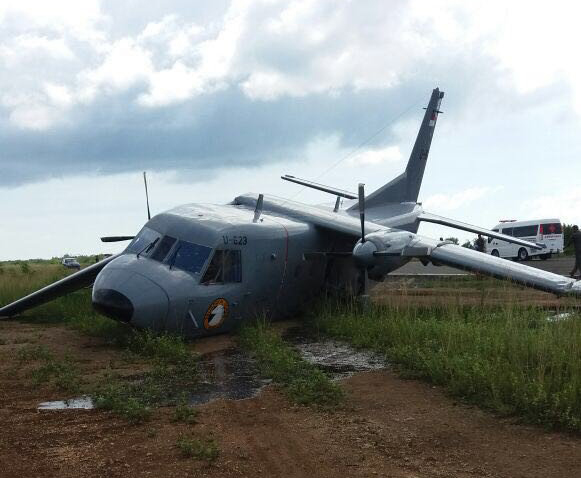
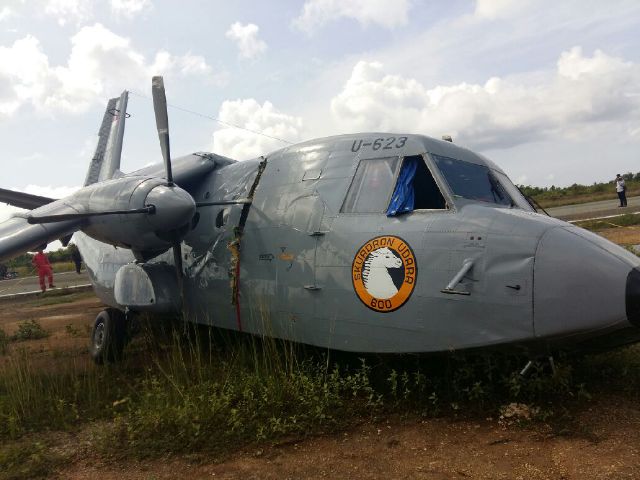
Crash of a Casa NC-212-MP Aviocar 200 in Pitu
Date & Time:
Nov 27, 2016 at 1000 LT
Operator:

Registration:
U-623
Survivors:
Yes
Schedule:
Manado - Pitu
Crew on board:
5
Crew fatalities:
Pax on board:
9
Pax fatalities:
Other fatalities:
Total fatalities:
0
Circumstances:
After landing at Pitu-Leo Wattimena Airport, the twin engine aircraft went out of control and veered off runway to the right. The left main landing gear collapsed and the right wing broke at the root. All 14 occupants evacuated safely while the aircraft was damaged beyond repair.
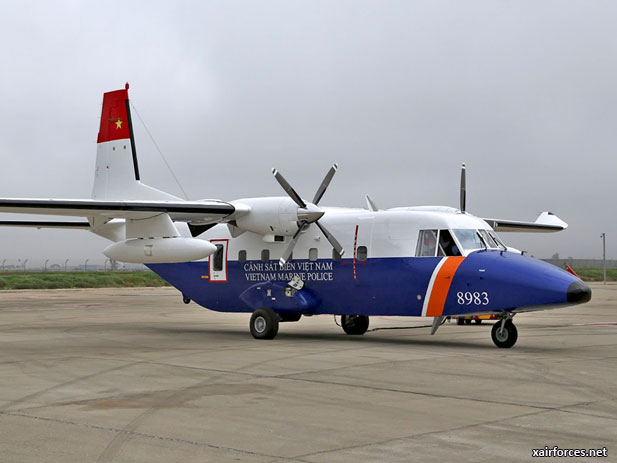
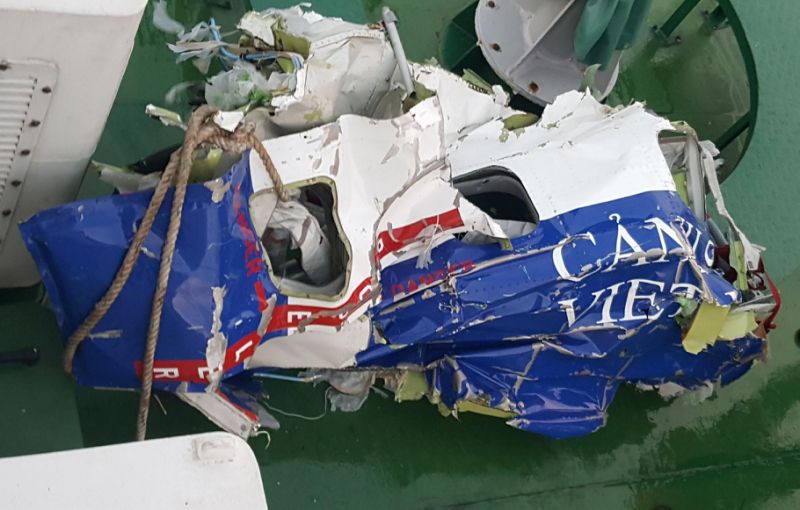
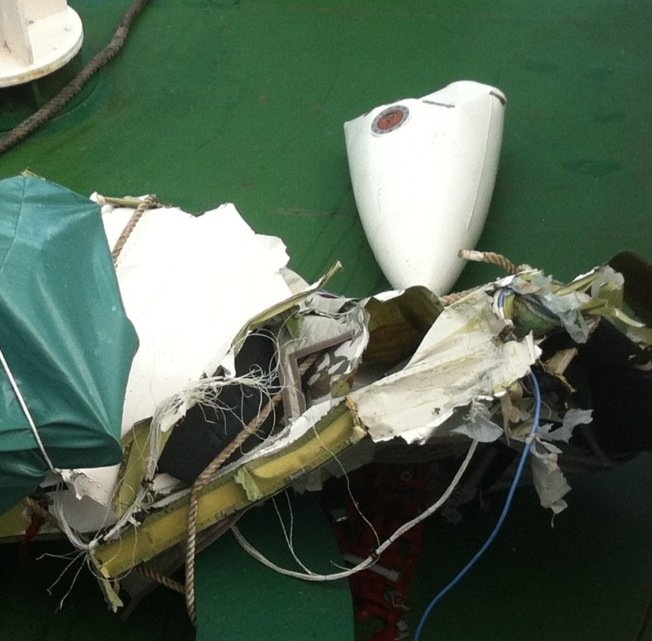
Crash of a Casa 212 Aviocar 400MPA off Bạch Long Vĩ Island: 9 killed
Date & Time:
Jun 16, 2016 at 1305 LT
Operator:

Registration:
8983
Survivors:
No
Schedule:
Hanoi - Hanoi
MSN:
482
YOM:
2012
Crew on board:
3
Crew fatalities:
Pax on board:
6
Pax fatalities:
Other fatalities:
Total fatalities:
9
Circumstances:
The crew departed Hanoi-Gia Lam Airport at 0930LT on a SAR mission after a Vietnam Air Force Sukhoi SU-30 was missing since two days. While cruising over the gulf of Tonkin in good weather conditions, the twin engine aircraft went out of control and crashed in the sea, some 22 km southwest of the Bạch Long Vĩ Island. Some debris were found few hours later, floating on water. All nine occupants were killed.
Crash of a Casa 212 Aviocar 300 in Bloemfontein
Date & Time:
Jan 17, 2013 at 1030 LT
Operator:

Registration:
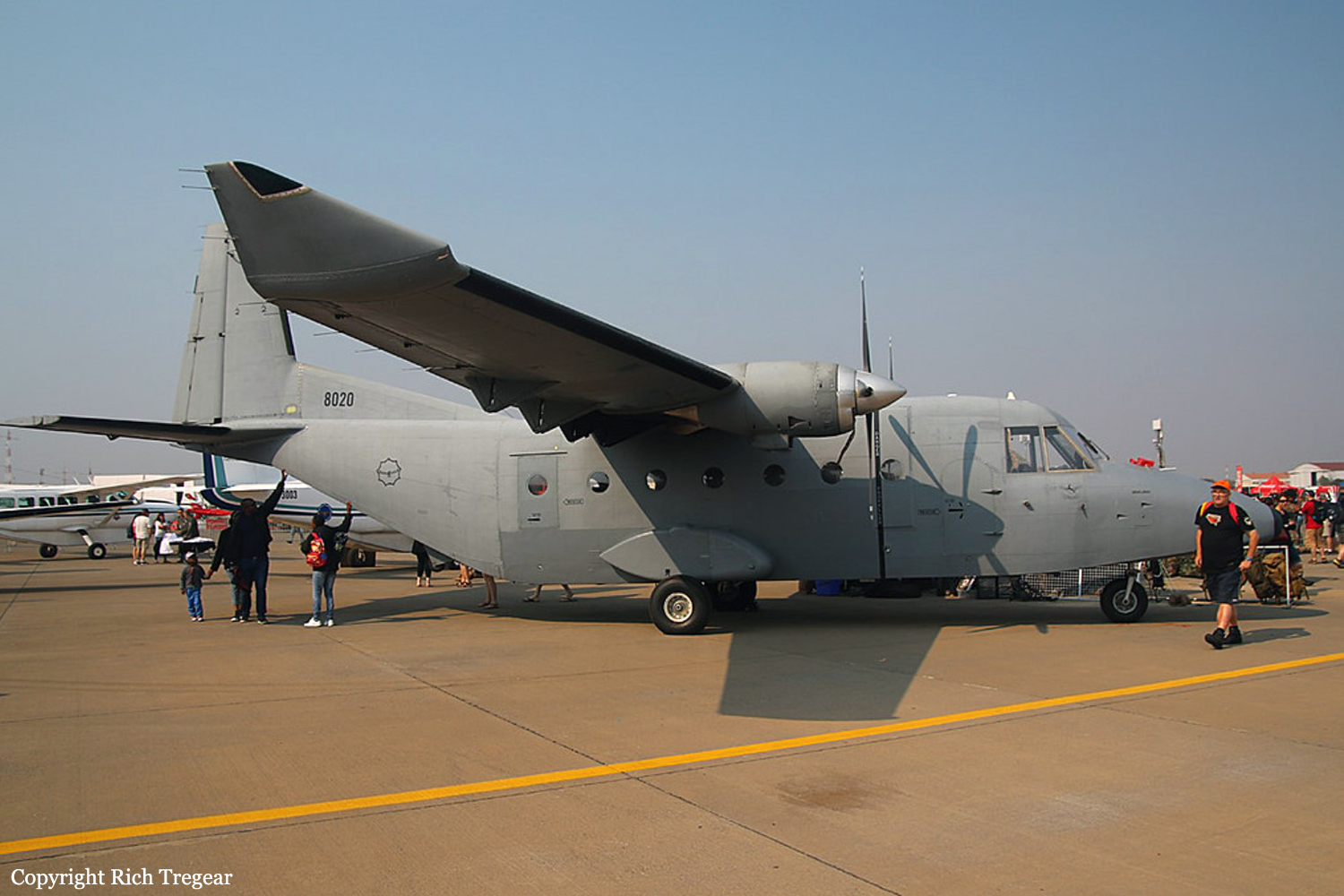
8020
Survivors:
Yes
Schedule:
Bloemfontein - Bloemfontein
MSN:
371
YOM:
1988
Crew on board:
5
Crew fatalities:
Pax on board:
0
Pax fatalities:
Other fatalities:
Total fatalities:
0
Circumstances:
The twin engine aircraft was engaged in a local paratroopers/skydiving mission at Bloemspruit AFB that shares a runway with Bloemfontein-Bram Fischer International Airport. For unknown reasons, the aircraft landed hard on its nose, veered off runway and came to rest with its left wing on the ground. All five crew members escaped uninjured while the aircraft was damaged beyond repair.

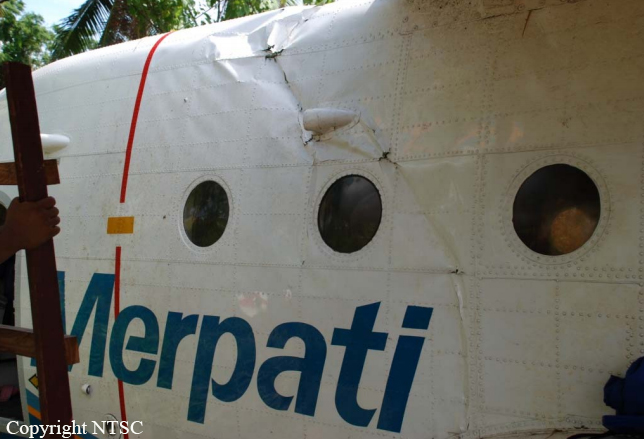
Crash of a Casa 212 Aviocar 200 in Larat
Date & Time:
Dec 3, 2011 at 1308 LT
Operator:

Registration:
PK-NCZ
Survivors:
Yes
Schedule:
Langur - Larat
MSN:
274/79N
YOM:
1986
Flight number:
MNA9933
Crew on board:
4
Crew fatalities:
Pax on board:
19
Pax fatalities:
Other fatalities:
Total fatalities:
0
Captain / Total hours on type:
5500.00
Copilot / Total hours on type:
72
Aircraft flight hours:
26935
Aircraft flight cycles:
30064
Circumstances:
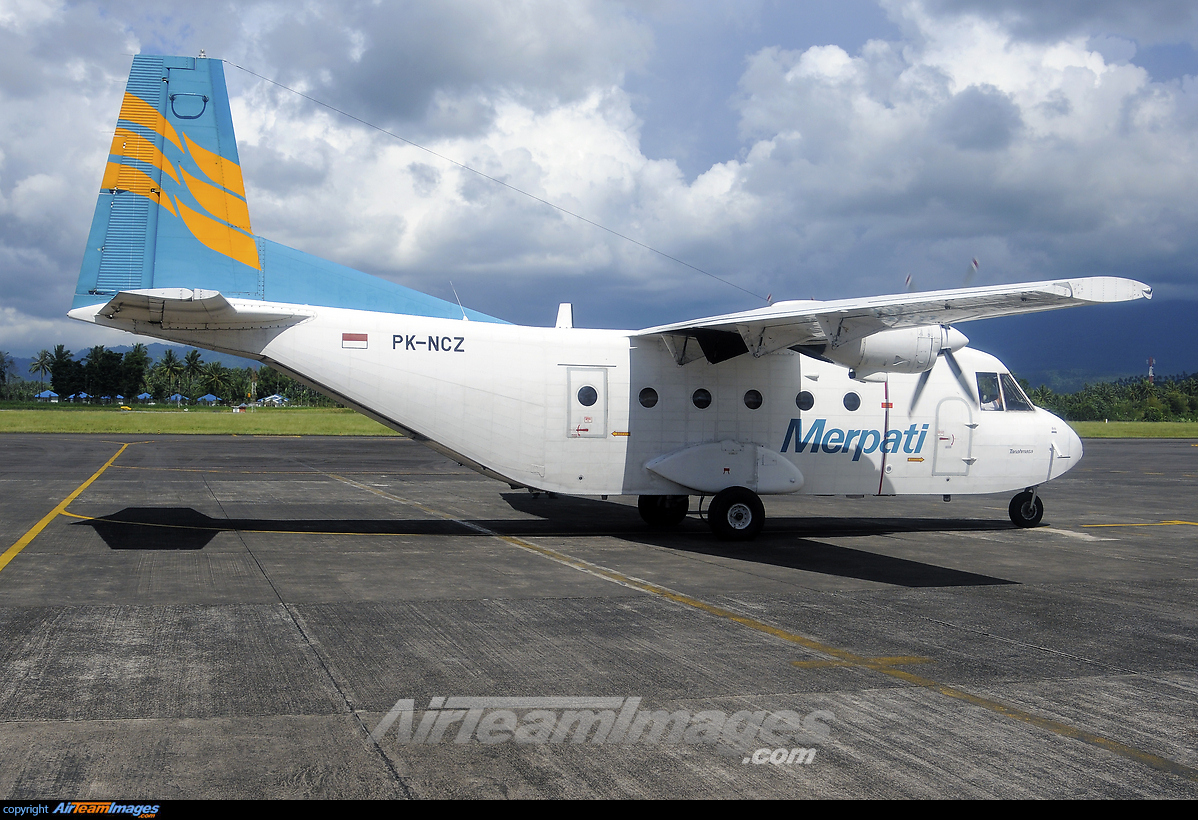
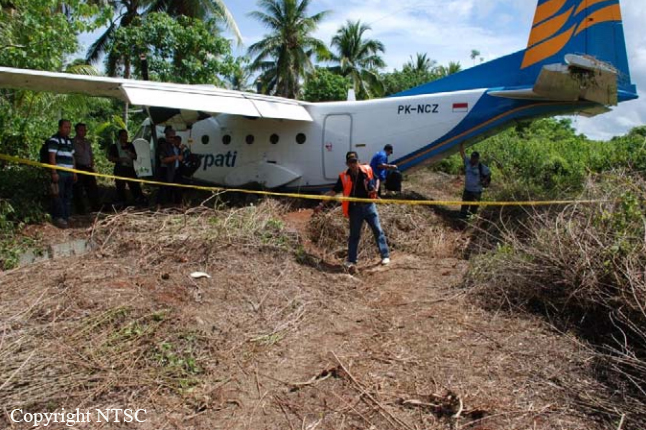
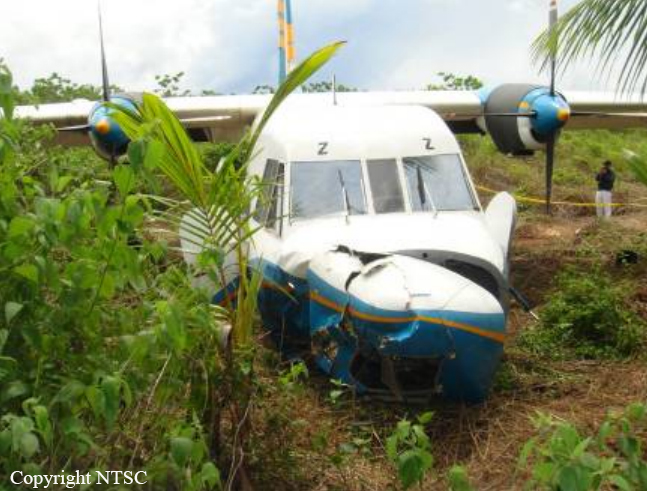
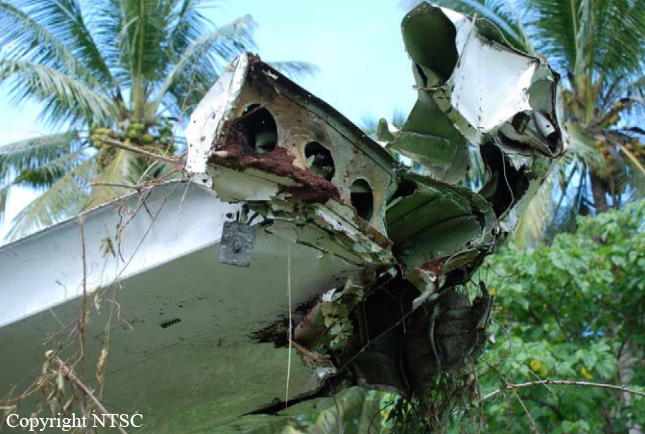
The Casa 212-200 aircraft registered PK-NCZ operated by PT. Merpati Nusantara Airlines on a scheduled flight from Langur to Larat, touched down at 224 meters from runway 09, was bouncing twice to the left of runway centre line, out of the runway and stopped at 607 meters from runway 09 touch down area as final position, and 15 meters to the left of runway edge. The Pilot Flying was First Officer, and after second bouncing, PIC took over, and he tried to bring the aircraft to the centre line of the runway without success. The aircraft continued rolled to the shoulder away from the runway and stopped at the final position. This is the second landing at Larat runway on the same day. There were 15 passengers, 3 children, one baby, Pilot In Command, two First Officers, one First Officer was Pilot Flying from Langur to Larat, one engineer on board. One passenger was serious injured, another one passenger minor injured.
Final Report:
Crash of a Casa 212 Aviocar 200 near Bohorok: 18 killed
Date & Time:
Sep 29, 2011 at 0750 LT
Operator:

Registration:
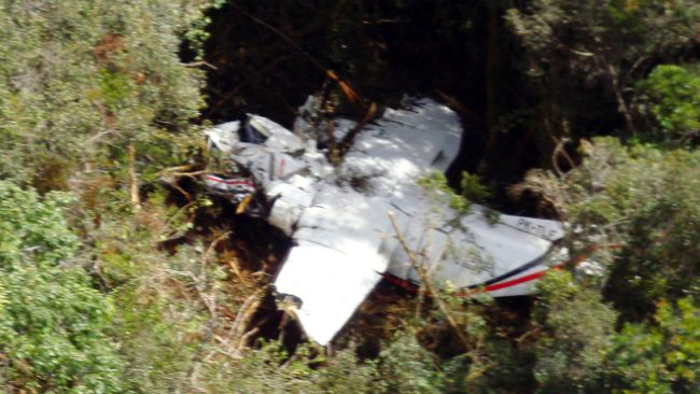
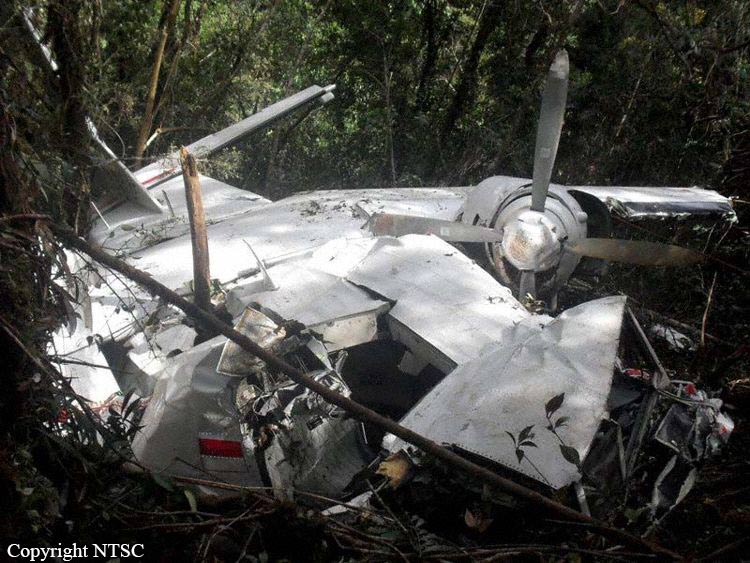
PK-TLF
Survivors:
No
Schedule:
Medan - Kuta Cane
MSN:
88N/283
YOM:
1989
Flight number:
NBA823
Crew on board:
2
Crew fatalities:
Pax on board:
16
Pax fatalities:
Other fatalities:
Total fatalities:
18
Captain / Total hours on type:
3730.00
Copilot / Total hours on type:
1100
Aircraft flight hours:
11329
Aircraft flight cycles:
13626
Circumstances:
On 29 September 2011, a CASA 212-200 aircraft registered PK-TLF was being operated by Nusantara Buana Air as a non-scheduled passenger flight from Polonia International Airport (MES/WIMM), Medan - North Sumatera1 to Alas Leuser Airstrip Kuta Cane, South East Aceh. The flight was conducted under Visual Flight Rules (VFR) The aircraft departed from Medan at 0728 LT (0028 UTC) and scheduled to be arrived at Kuta Cane at 0058 UTC. There were 18 person on board consisted of two pilots and 16 passengers including two children and two infants. The aircraft radar target was last observed on the radar screen at about 0050 UTC, while at position on radial 262˚ and 35 NM from MDN VOR. The aircraft was found impacted to a of 70º slope terrain at 5,055 feet altitude in the Leuser Mountain National Park, direction of 109 and 16 Nm from Kuta Cane on coordinate N 030 24’ 00” E 0980 01’ 00”. All 18 occupants were fatally injured and the aircraft was severely damage.
Probable cause:
Factors:
1. The flight was in VFR however both pilots agreed to fly into the cloud, consequently, the flight crew had lack of situation awareness due to lost of visual references to the ground and no or late recovery action prior to impact due to low visibility.
2. There was lack of good crew coordination due to steep cockpit transition gradient.
3. There was no checklist reading and crew briefing.
1. The flight was in VFR however both pilots agreed to fly into the cloud, consequently, the flight crew had lack of situation awareness due to lost of visual references to the ground and no or late recovery action prior to impact due to low visibility.
2. There was lack of good crew coordination due to steep cockpit transition gradient.
3. There was no checklist reading and crew briefing.
Final Report:

Crash of a Casa 212 Aviocar 300DF off Robinson Crusoe Island: 21 killed
Date & Time:
Sep 2, 2011 at 1748 LT
Operator:

Registration:
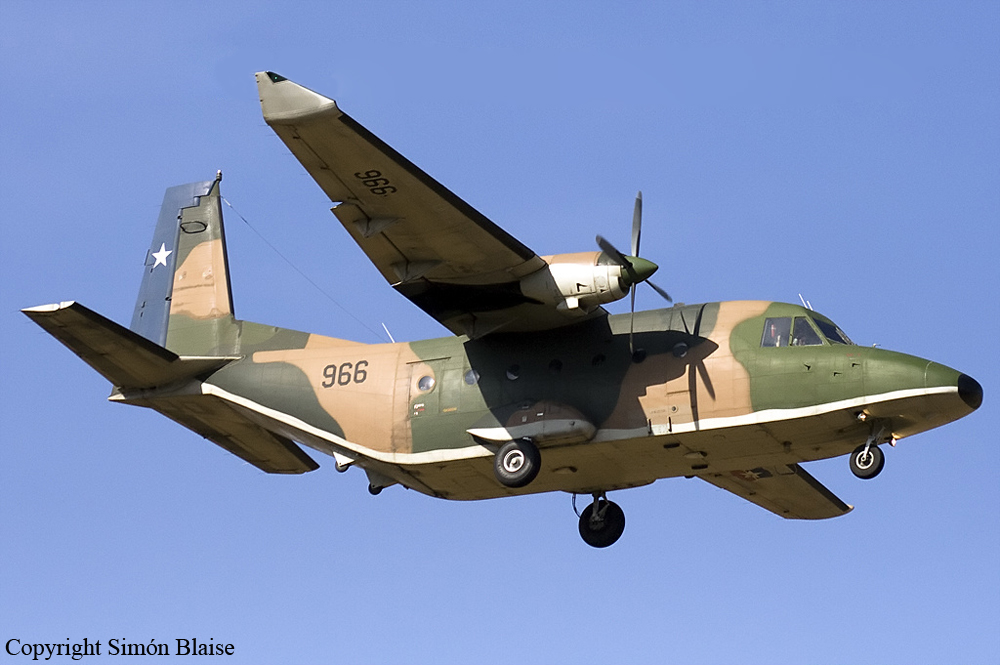
966
Survivors:
No
Schedule:
Santiago - Robinson Crusoe Island
MSN:
443
YOM:
1994
Crew on board:
4
Crew fatalities:
Pax on board:
17
Pax fatalities:
Other fatalities:
Total fatalities:
21
Circumstances:
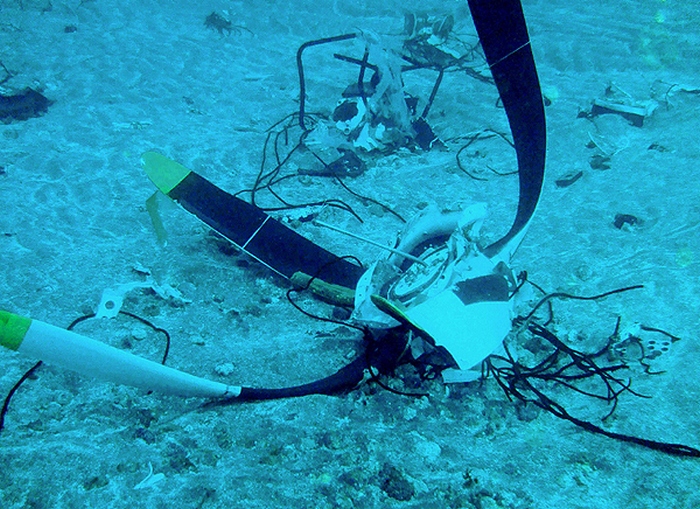
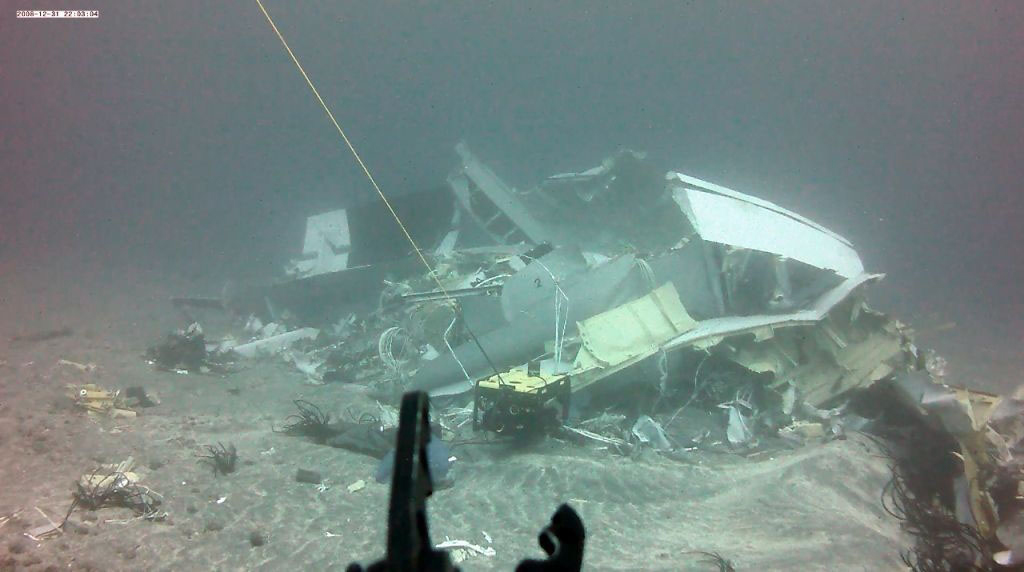
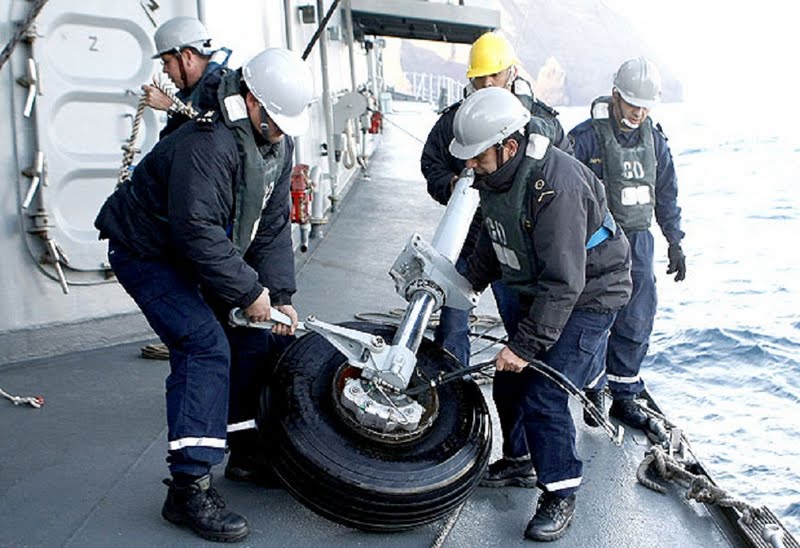
The twin engine aircraft departed Santiago de Chile-Comodoro Arturo Merino Benítez (Pudahuel) Airport on a special flight to Robinson Crusoe Island, carrying 17 passengers and a crew of four. The flight was organized by NGO's in cooperation with the Chilean National Television to see the progress of the reconstruction on the island of Robinson Crusoe following the 2010 earthquake. Among the occupants were members of the National Television and also from the Council of Culture. The famous Chilean television icon Felipe Camiroaga Fernández was among the passengers. Following an almost 3-hour flight, the crew completed a low pass over the runway 14 then started the approach to runway 32 from the sea. At an altitude of about 650 feet, the aircraft entered an uncontrolled descent, rolled to the left to an angle of 90° and impacted the sea. Debris were found floating on water and the main wreckage was later found about one km southeast from the airport. All 21 occupants were killed.
Personnel from the Chilean Air Force:
Lt Carolina Fernández Quinteros,
Lt Juan Pablo Mallea Lagos,
1st Sgt Eduardo Jones San Martín,
1st Cpl Eduardo Estrada Muñoz,
2nd Cpl Flavio Oliva Pino,
2nd Cpl Erwin Núñez Rebolledo,
Cdt Rodrigo Fernández Apablaza,
José Cifuentes Juica.
Council of Culture:
Galia Diaz Riffo,
Romina Irarrázabal Faggiani.
Chilean National Television:
Felipe Camiroaga Fernández,
Roberto Bruce Pruzzo,
Sylvia Slier Munoz,
Caroline Gatica Aburto,
Rodrigo Cabezón de Amesti.
Members of the 'Desafío Levantemos Chile' NGO:
Felipe Cubillos Sigall,
Sebastián Correa Murillo,
Catalina Vela Montero,
Joel Lizama Nahuelhual,
Jorge Palma Calvo,
Joaquín Arnolds Reyes.
Personnel from the Chilean Air Force:
Lt Carolina Fernández Quinteros,
Lt Juan Pablo Mallea Lagos,
1st Sgt Eduardo Jones San Martín,
1st Cpl Eduardo Estrada Muñoz,
2nd Cpl Flavio Oliva Pino,
2nd Cpl Erwin Núñez Rebolledo,
Cdt Rodrigo Fernández Apablaza,
José Cifuentes Juica.
Council of Culture:
Galia Diaz Riffo,
Romina Irarrázabal Faggiani.
Chilean National Television:
Felipe Camiroaga Fernández,
Roberto Bruce Pruzzo,
Sylvia Slier Munoz,
Caroline Gatica Aburto,
Rodrigo Cabezón de Amesti.
Members of the 'Desafío Levantemos Chile' NGO:
Felipe Cubillos Sigall,
Sebastián Correa Murillo,
Catalina Vela Montero,
Joel Lizama Nahuelhual,
Jorge Palma Calvo,
Joaquín Arnolds Reyes.
Probable cause:
The accident was caused by the loss of control of the airplane while performing the tailwind leg through the channel between the islands of Robinson Crusoe and Santa Clara to an estimated height of 650 feet or less, during the circuit approach to Runway 32 in a very low trajectory (with little height difference above the runway), where very adverse airflow conditions were found, including wind shear, which exposed the crew to extreme flight conditions.
Adverse airflow conditions were the results of a combination of different factors, including:
- Very unstable atmosphere, with strong turbulence and possibly eventually powerful down gusts arising from the presence of open cells after a front passed,
- The presence of the two counter-rotating vortexes in the Santa Clara Island downwind wake,
- The presence of strong and gusty crosswinds that were very variable in strength and direction in a very short time.
Adverse airflow conditions were the results of a combination of different factors, including:
- Very unstable atmosphere, with strong turbulence and possibly eventually powerful down gusts arising from the presence of open cells after a front passed,
- The presence of the two counter-rotating vortexes in the Santa Clara Island downwind wake,
- The presence of strong and gusty crosswinds that were very variable in strength and direction in a very short time.
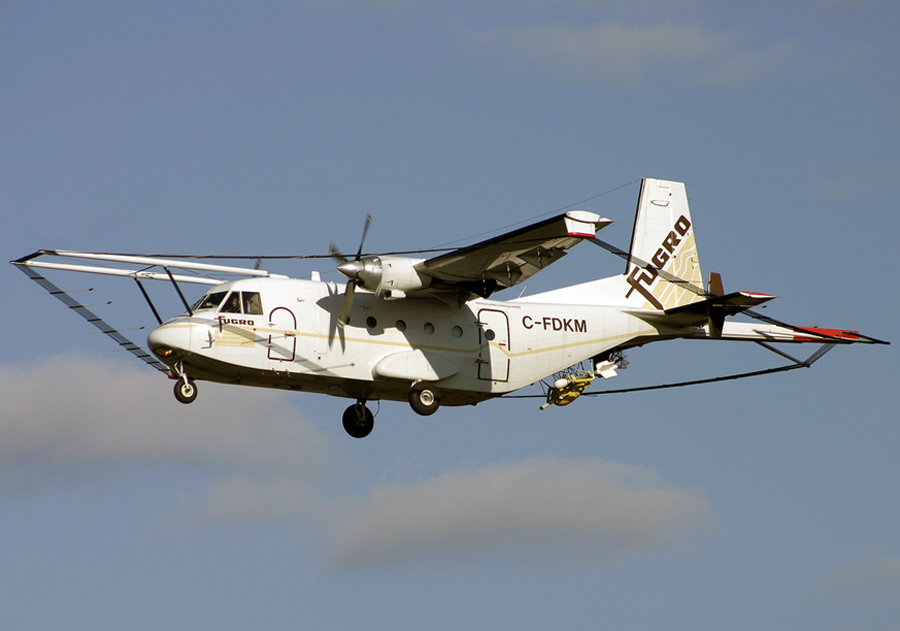
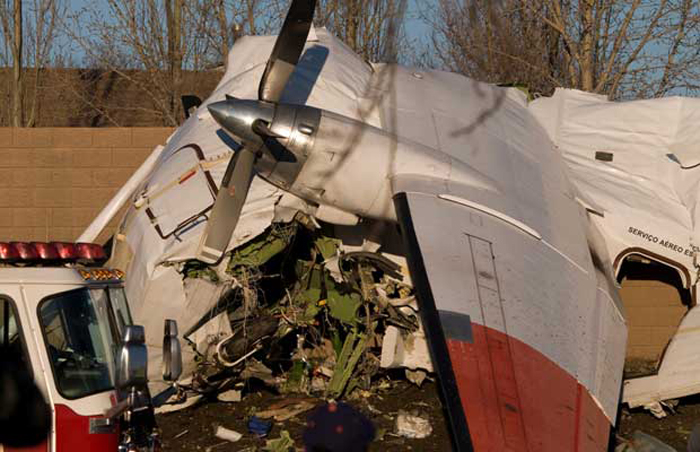
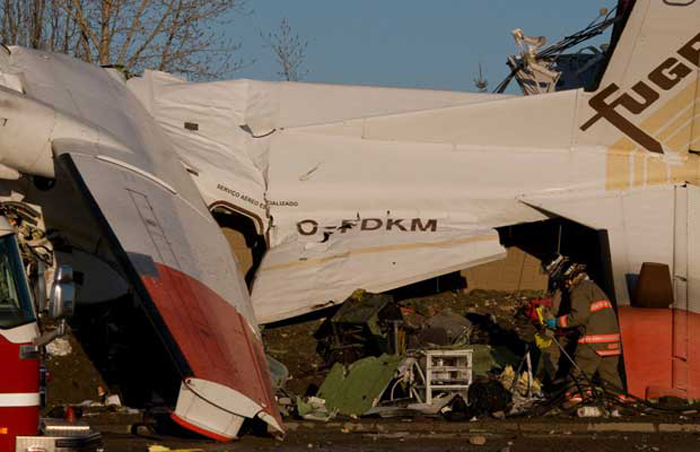
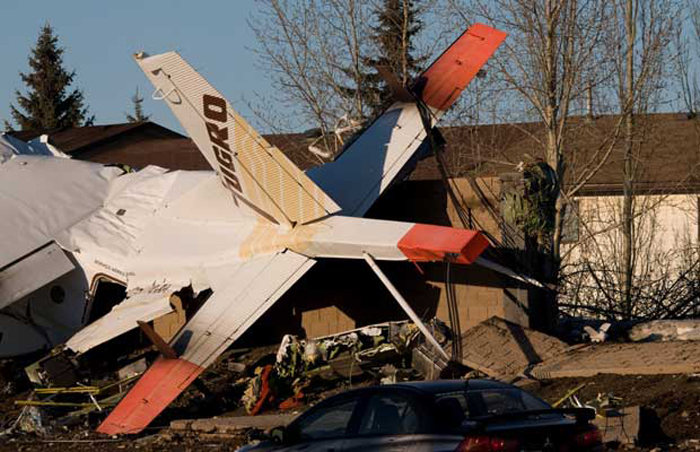
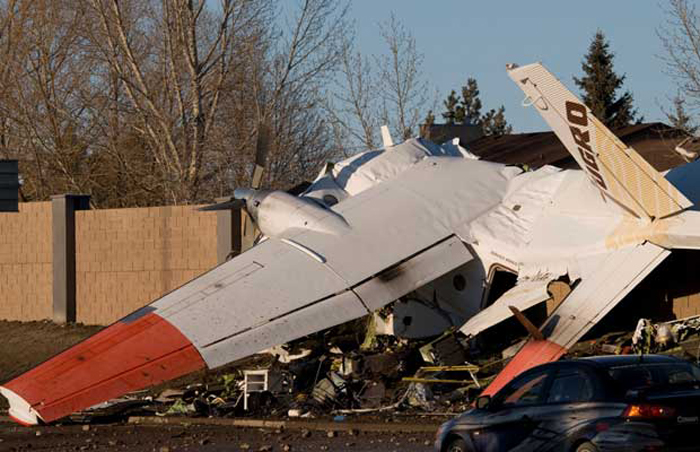
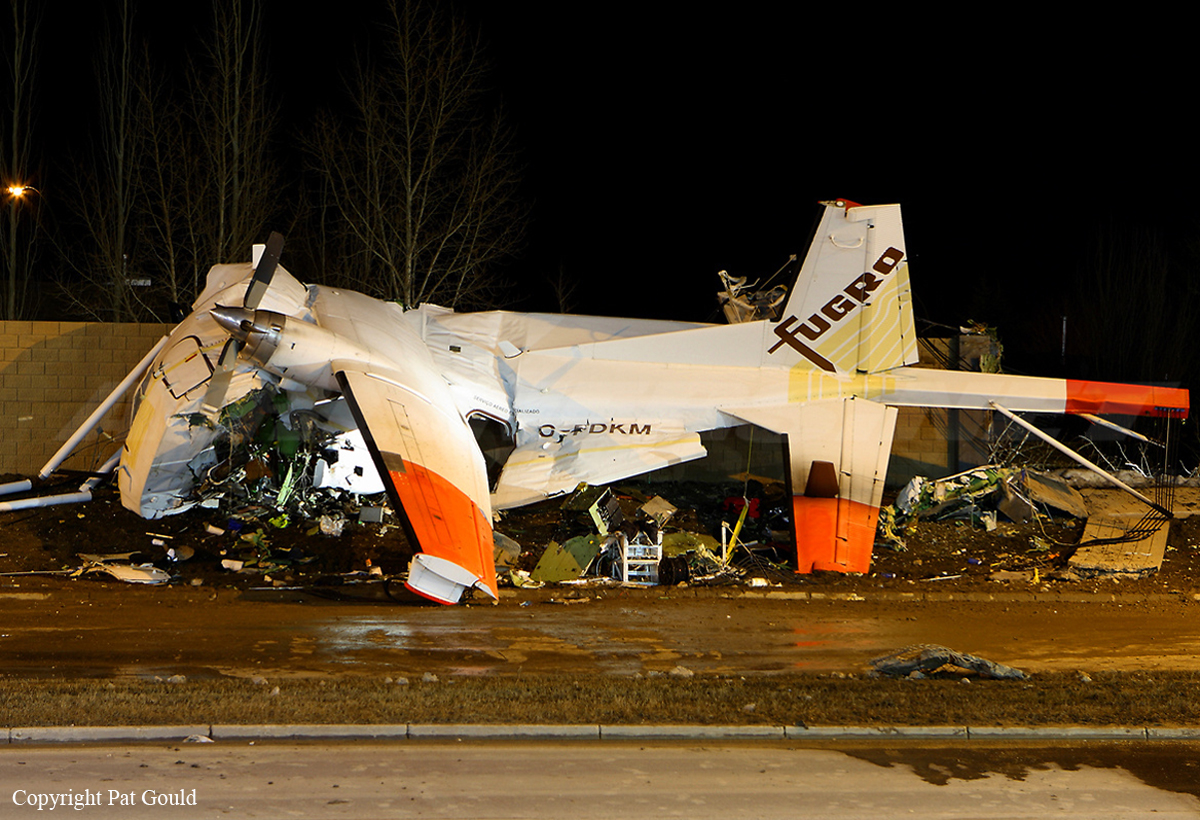
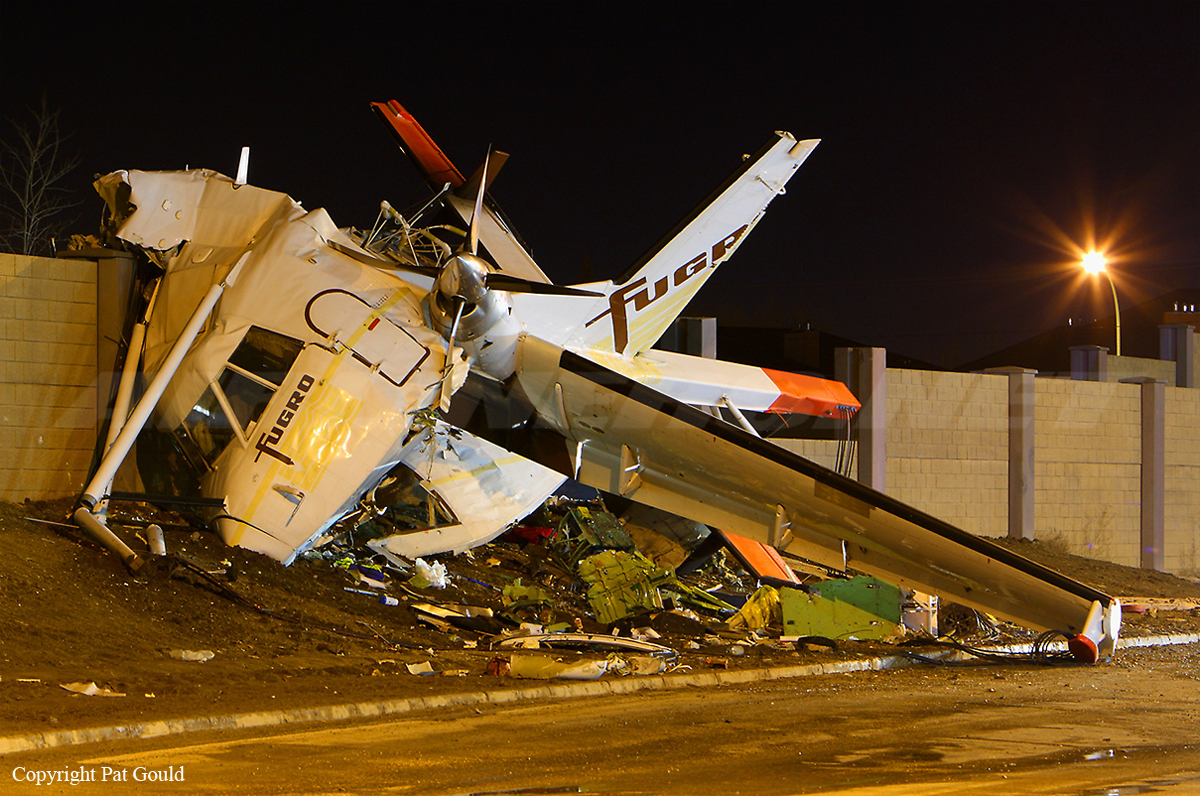
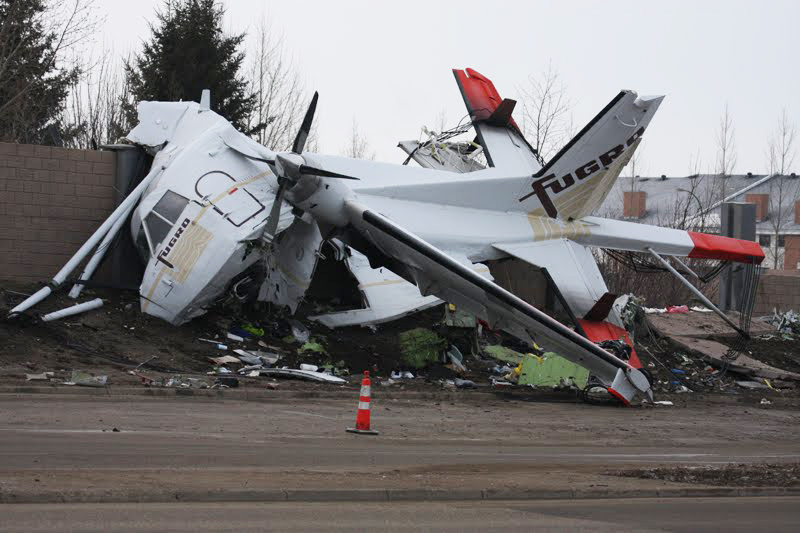
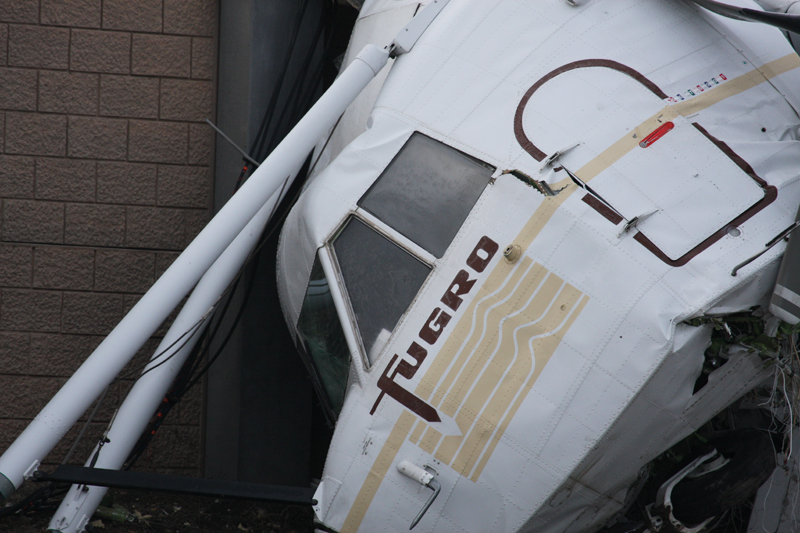
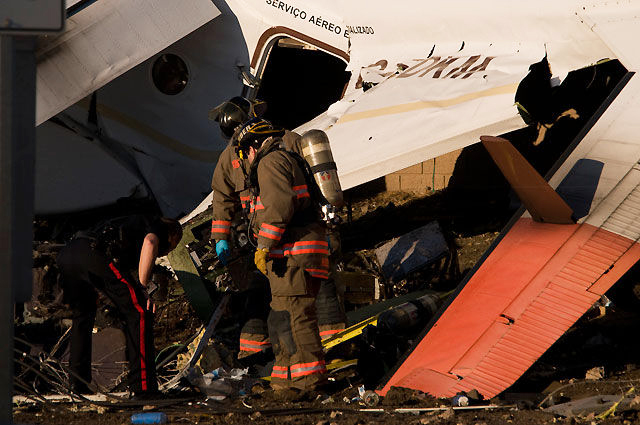
Crash of a Casa 212 Aviocar in Saskatoon: 1 killed
Date & Time:
Apr 1, 2011 at 1830 LT
Operator:

Registration:
C-FDKM
Survivors:
Yes
Schedule:
Saskatoon - Saskatoon
MSN:
196
YOM:
1981
Crew on board:
3
Crew fatalities:
Pax on board:
0
Pax fatalities:
Other fatalities:
Total fatalities:
1
Captain / Total hours on type:
75.00
Copilot / Total hours on type:
1800
Aircraft flight hours:
21292
Circumstances:
At 1503 Central Standard Time, the Construcciones Aeronauticas SA (CASA) C-212-CC40 (registration C-FDKM, serial number 196) operated by Fugro Aviation Canada Ltd., departed from Saskatoon/Diefenbaker International Airport, Saskatchewan, under visual flight rules for a geophysical survey flight to the east of Saskatoon. On board were 2 pilots and a survey equipment operator. At about 1814, the right engine lost power. The crew shut it down, carried out checklist procedures, and commenced an approach for Runway 27. When the flight was 3.5 nautical miles from the runway on final approach, the left engine lost power. The crew carried out a forced landing adjacent to Wanuskewin Road in Saskatoon. The aircraft impacted a concrete roadway noise abatement wall and was destroyed. The survey equipment operator sustained fatal injuries, the first officer sustained serious injuries, and the captain sustained minor injuries. No ELT signal was received.
Probable cause:
Conclusions
Findings as to Causes and Contributing Factors:
1. The right engine lost power when the intermediate spur gear on the torque sensor shaft failed. This resulted in loss of drive to the high-pressure engine-driven pump, fuel starvation, and immediate engine stoppage.
2. The ability of the left-hand No. 2 ejector pump to deliver fuel to the collector tank was compromised by foreign object debris (FOD) in the ejector pump nozzle.
3. When the fuel level in the left collector tank decreased, the left fuel level warning light likely illuminated but was not noticed by the crew.
4. The pilots did not execute the fuel level warning checklist because they did not perceive the illumination of the fuel level left tank warning light. Consequently, the fuel crossfeed valve remained closed and fuel from only the left wing was being supplied to the left engine.
5. The left engine flamed out as a result of depletion of the collector tank and fuel starvation, and the crew had to make a forced landing resulting in an impact with a concrete noise abatement wall.
Findings as to Risk:
1. Depending on the combination of fuel level and bank angle in single-engine uncoordinated flight, the ejector pump system may not have the delivery capacity, when the No. 1 ejector inlet is exposed, to prevent eventual depletion of the collector tank when the engine is operated at full power. Depletion of the collector tank will result in engine power loss.
2. The master caution annunciator does not flash; this leads to a risk that the the crew may not notice the illumination of an annunciator panel segment, in turn increasing the risk of them not taking action to correct the condition which activated the master caution.
3. When cockpit voice and flight data recordings are not available to an investigation, this may preclude the identification and communication of safety deficiencies to advance transportation safety.
4. Because the inlets of the ejector pumps are unscreened, there is a risk that FOD in the fuel tank may become lodged in an ejector nozzle and result in a decrease in the fuel delivery rate to the collector tank.
Other Findings:
1. The crew’s decision not to recover or jettison the birds immediately resulted in operation for an extended period with minimal climb performance.
2. The composition and origin of the FOD, as well as how or when it had been introduced into the fuel tank, could not be determined.
3. The SkyTrac system provided timely position information that would have assisted search and rescue personnel if position data had been required.
4. Saskatoon police, firefighters, and paramedics responded rapidly to the accident and provided effective assistance to the survivors.
Findings as to Causes and Contributing Factors:
1. The right engine lost power when the intermediate spur gear on the torque sensor shaft failed. This resulted in loss of drive to the high-pressure engine-driven pump, fuel starvation, and immediate engine stoppage.
2. The ability of the left-hand No. 2 ejector pump to deliver fuel to the collector tank was compromised by foreign object debris (FOD) in the ejector pump nozzle.
3. When the fuel level in the left collector tank decreased, the left fuel level warning light likely illuminated but was not noticed by the crew.
4. The pilots did not execute the fuel level warning checklist because they did not perceive the illumination of the fuel level left tank warning light. Consequently, the fuel crossfeed valve remained closed and fuel from only the left wing was being supplied to the left engine.
5. The left engine flamed out as a result of depletion of the collector tank and fuel starvation, and the crew had to make a forced landing resulting in an impact with a concrete noise abatement wall.
Findings as to Risk:
1. Depending on the combination of fuel level and bank angle in single-engine uncoordinated flight, the ejector pump system may not have the delivery capacity, when the No. 1 ejector inlet is exposed, to prevent eventual depletion of the collector tank when the engine is operated at full power. Depletion of the collector tank will result in engine power loss.
2. The master caution annunciator does not flash; this leads to a risk that the the crew may not notice the illumination of an annunciator panel segment, in turn increasing the risk of them not taking action to correct the condition which activated the master caution.
3. When cockpit voice and flight data recordings are not available to an investigation, this may preclude the identification and communication of safety deficiencies to advance transportation safety.
4. Because the inlets of the ejector pumps are unscreened, there is a risk that FOD in the fuel tank may become lodged in an ejector nozzle and result in a decrease in the fuel delivery rate to the collector tank.
Other Findings:
1. The crew’s decision not to recover or jettison the birds immediately resulted in operation for an extended period with minimal climb performance.
2. The composition and origin of the FOD, as well as how or when it had been introduced into the fuel tank, could not be determined.
3. The SkyTrac system provided timely position information that would have assisted search and rescue personnel if position data had been required.
4. Saskatoon police, firefighters, and paramedics responded rapidly to the accident and provided effective assistance to the survivors.
Final Report: