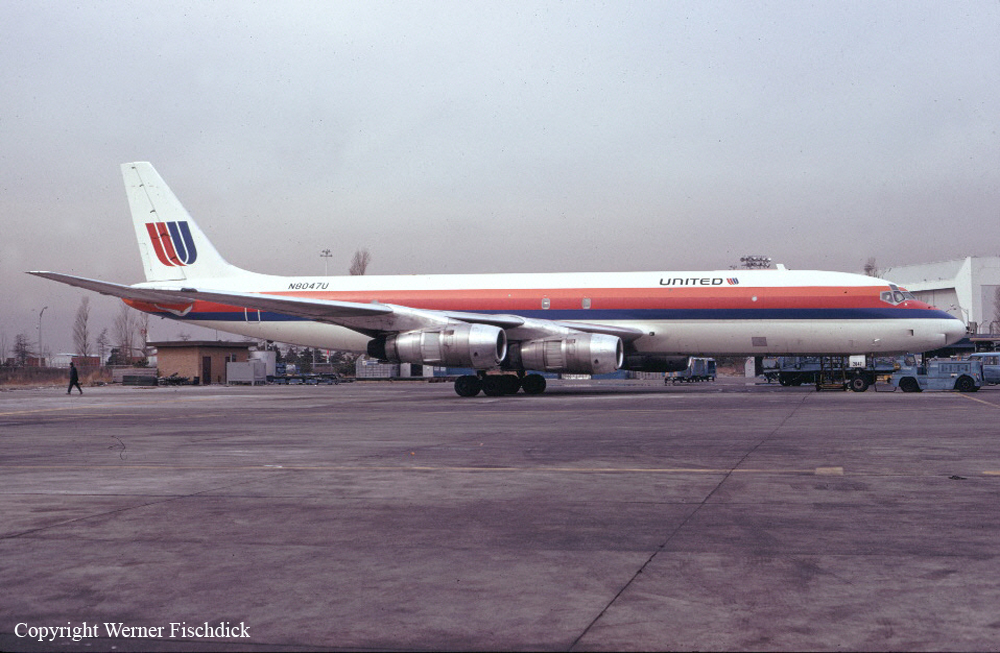
Crash of a Douglas DC-8-54F near Kaysville: 3 killed

Date & Time: Dec 18, 1977 at 0138 LT
Type of aircraft:
Operator:
Registration:
N8047U
Flight Type:
Survivors:
No
Site:
Schedule:
San Francisco – Salt Lake City – Chicago
MSN:
45880/275
YOM:
1966
Flight number:
UA2860
Location:
Crew on board:
3
Crew fatalities:
Pax on board:
0
Pax fatalities:
Other fatalities:
Total fatalities:
3
Captain / Total flying hours:
14954
Captain / Total hours on type:
4148.00
Copilot / Total flying hours:
9905
Copilot / Total hours on type:
366
Aircraft flight hours:
29832
Circumstances:
About 0138:28 m.s.t. on December 18, 1977, a United Airlines, Inc., DC-8F-54 cargo aircraft, operating as Flight 2860, crashed into a mountain in the Wasatch Range near Kaysville, Utah. The three flightcrew members, the only persons aboard the aircraft, were killed, and the aircraft was destroyed. Flight 2860 encountered electrical system problems during its descent and approach to the Salt Lake City Airport. The flight requested a holding clearance which was given by the approach controller and accepted by the flight crew. The flight then requested and received clearance to leave the approach control frequency for a "little minute" to communicate with company maintenance. Flight 2860 was absent from the Approach control frequency for 7 1/2 minutes. During that time, the flight entered an area near hazardous terrain. The approach controller recognized Flight 2860's predicament but was unable to contact the flight. When flight 2860 returned to approach control frequency, the controller told the flight that it was too close to terrain on its right and to make a left turn. After the controller repeated the instructions, the flight began a left turn and about 15 seconds later the controller told the flight to climb immediately to 8,000 feet. Eleven seconds later, the flight reported that it was climbing from 6,000 feet to 8,000 feet. The flight crashed into a 7,665-foot mountain near the 7,200-foot level. The aircraft was destroyed and all three crew members were killed.
Probable cause:
The approach controller's issuance and the flight crew's acceptance of an incomplete and ambiguous holding clearance in combination with the flight crew's failure to adhere to prescribed impairment-of-communications procedures and prescribed holding procedures. The controller's and flight crew's actions are attributed to probable habits of imprecise communication and of imprecise adherence to procedures developed through years of exposure to operations in a radar environment. Contributing to the accident was the failure of the aircraft's No.1 electrical system for unknown reasons.
Final Report:

Crash of a Lockheed P-3B-80-LO Orion on Hierro Island: 13 killed

Date & Time: Dec 11, 1977 at 1120 LT
Type of aircraft:
Operator:
Registration:
153428
Flight Phase:
Survivors:
No
Site:
Schedule:
Lajes - Lajes
MSN:
185-5225
YOM:
1967
Country:
Region:
Crew on board:
4
Crew fatalities:
Pax on board:
9
Pax fatalities:
Other fatalities:
Total fatalities:
13
Circumstances:
The four engine airplane departed Lajes Airport, Azores Islands, at 0836LT on a maritime patrol flight. About two hours later, the crew reported his position and that all went well on board. This was the last radio transmission. At 1120LT, while cruising at an altitude of 2,300 feet in a limited visibility due to foggy conditions, the airplane struck the slope of a mountain (5,200 feet high) at a speed pof 220 knots and crashed. The wreckage was found in a wooded area located near la Frontera, in the center of the island. At the time of the accident, three engines were operating while the engine n°1 was shutdown for loiter.
Probable cause:
The accident was the consequence of a controlled flight into terrain. The following contributing factors were reported:
- The crew consumed alcohol until 2 o'clock in the morning,
- The crew started the mission without sufficient rest time,
- Failure of the authority to implement an effective aircrew surveillance program,
- Crew complacency for non adhering to sound navigation procedures,
- The crew was not properly briefed prior to takeoff and was probably not aware of the presence of Hierro Island,
- Poor visibility due to foggy conditions and rain falls.

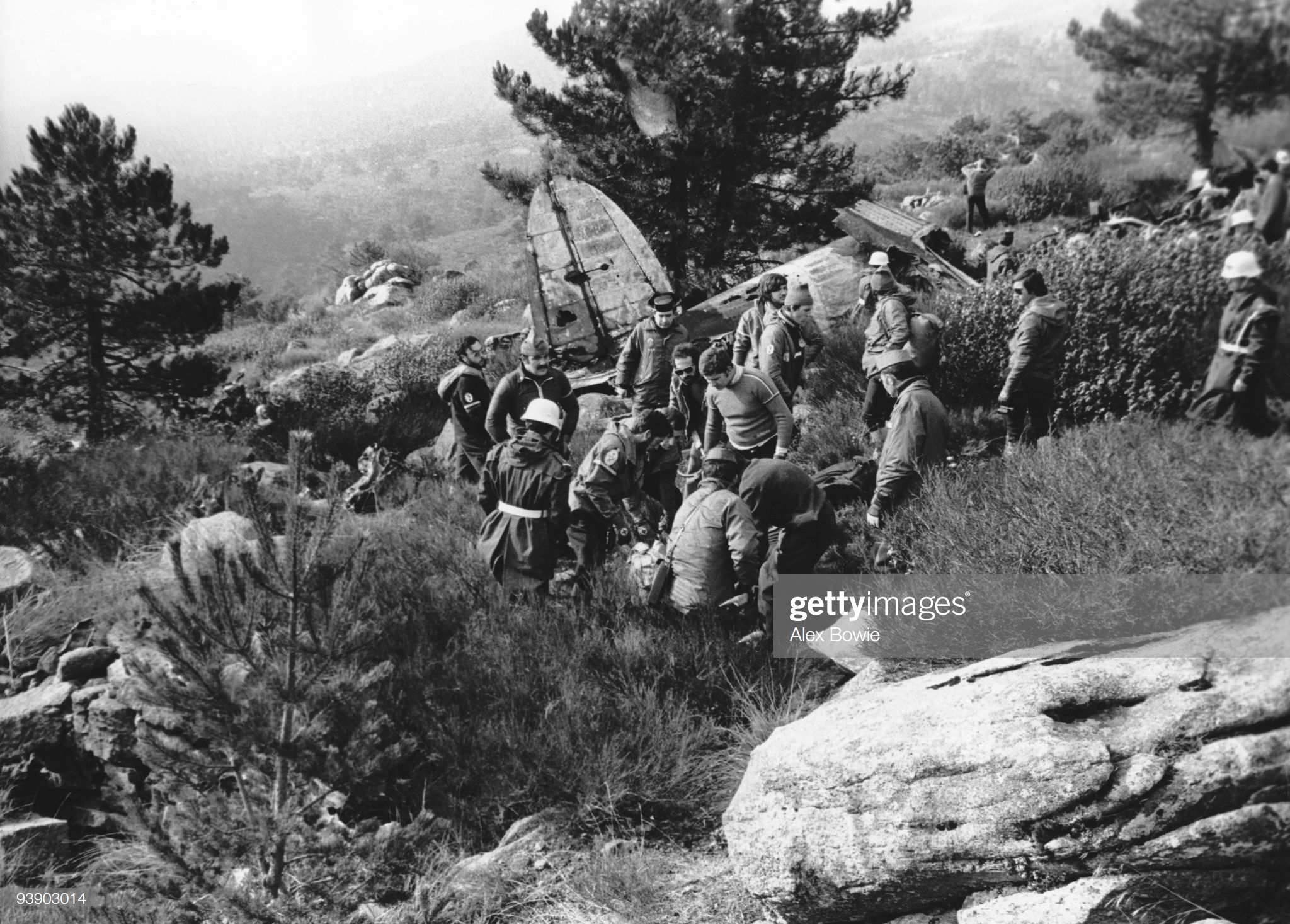
Crash of a Casa 2.111 near Guadarrama: 4 killed

Date & Time: Dec 11, 1977 at 0945 LT
Type of aircraft:
Registration:
G-BFFS
Flight Phase:
Flight Type:
Survivors:
No
Site:
Schedule:
Madrid - Burgos - Bournemouth
MSN:
140
Country:
Region:
Crew on board:
1
Crew fatalities:
Pax on board:
3
Pax fatalities:
Other fatalities:
Total fatalities:
4
Circumstances:
The airplane departed Madrid-Cuatro Vientos Airport in the early morning on a flight to Bournemouth-Hurn, Dorset, with an intermediate stop in Burgos. While flying under VFR mode in adverse weather conditions, the airplane struck the slope of a mountain located near Guadarrama, about 50 km northwest of Cuatro Vientos Airport. The wreckage was found near the Puerto de los Leones Pass and all four occupants were killed.
Crew:
Neil Williams, pilot.
Passengers:
Mrs. Williams,
Joseph Donaghy,
Stephen Parnell.
Probable cause:
Controlled flight into terrain.

Crash of a De Havilland DHC-6 Twin Otter 100 near Narvaez Bay

Date & Time: Dec 1, 1977
Operator:
Registration:
C-GPBO
Survivors:
Yes
Site:
Schedule:
Vancouver - Saturna Island
MSN:
100
YOM:
1968
Country:
Crew on board:
2
Crew fatalities:
Pax on board:
12
Pax fatalities:
Other fatalities:
Total fatalities:
0
Circumstances:
While approaching Saturna Island, the crew encountered marginal weather and a limited visibility. Descending to a height of about 200-300 feet, the twin engine airplane struck tree tops with one of its float. Control was lost and the airplane crashed in flames in a wooded area located near Narvaez Bay. All 14 occupants were rescued while the aircraft was destroyed.
Probable cause:
Controlled flight into terrain.

Crash of a Cessna 414 Chancellor near Aspen: 1 killed

Date & Time: Nov 27, 1977 at 1730 LT
Type of aircraft:
Registration:
N1682T
Flight Phase:
Flight Type:
Survivors:
Yes
Site:
Schedule:
Aspen - Pueblo
MSN:
414-0475
YOM:
1974
Crew on board:
1
Crew fatalities:
Pax on board:
6
Pax fatalities:
Other fatalities:
Total fatalities:
1
Captain / Total flying hours:
1820
Captain / Total hours on type:
220.00
Circumstances:
The pilot initiated the takeoff from a snow covered runway at Aspen-Pitkin County-Sardy Field and with an aircraft covered with ice and snow on wings. At liftoff, the twin engine airplane struck a fence located past the runway end and despite the situation, the pilot continued departure. Few minutes later, at an altitude of 11,800 feet, the pilot encountered downdrafts/updrafts and lost control of the airplane that crashed in a canyon located few miles from the airport. The wreckage was found two days later. A passenger was killed while six other occupants were seriously injured.
Probable cause:
Controlled collision with fence during initial climb then controlled flight into terrain due to inadequate preflight preparation. The following contributing factors were reported:
- Failed to abort takeoff,
- Airframe ice,
- Improper in-flight decisions or planning,
- Snow on runway,
- Icing conditions including sleet, freezing rain,
- Downdrafts, updrafts,
- Ice and snow on wings,
- Hit fence at liftoff,
- Continued departure.
Final Report:

Crash of a Nord 2501 Noratlas near Prémian: 32 killed

Date & Time: Nov 25, 1977 at 0230 LT
Type of aircraft:
Operator:
Registration:
182/F-RABR
Flight Phase:
Flight Type:
Survivors:
No
Site:
Schedule:
Mont-de-Marsan - Hyères
MSN:
182
YOM:
1960
Country:
Region:
Crew on board:
4
Crew fatalities:
Pax on board:
28
Pax fatalities:
Other fatalities:
Total fatalities:
32
Circumstances:
At 1000LT on November 24, the airplane departed Hyères-Le Palyvestre NAS near Toulon on a flight to Mont-de-Marsan Airbase, carrying 28 passengers and a crew of four. The passengers were respectively 23 Marines from the Naval School of Saint-Mandrier, four officers and the Director of the Naval School's house. All four crew members were attached to the Groupe 3/64 Bigorre at Évreux AFB. All of them were invited at Mont-de-Marsan Airbase to assist to the final of a radiophonic tournament they lost on semi-final. At 0100LT on November 25, the airplane departed Mont-de-Marsan Airfield bound to the east. En route, the crew encountered very bad weather conditions with fog and rain falls, reducing the visibility to zero. In such conditions, the crew failed to realize his altitude was too low when the airplane passed over the hamlet of La Sicarderie at a height of 150 meters. Less than 30 seconds later, the airplane struck trees and crashed in flames in a wooded area located in the Somail Mountain Range, about 40 km northwest of Béziers. The aircraft was totally destroyed and all 32 occupants were killed.
Crew (Groupe 3/64 Bigorre from Évreux AFB):
Cpt Philippe Le Goff,
Sgt/C Robert Sonier,
Sgt/C Jean-Claude Bezanger,
Sgt/C Serge Luckel.
Passengers (accompanist officers):
Cpt Raymond Faucher,
Mrs Elisabeth Boissat, Director of the GEM House,
Ens/V Francis Coinsin,
Asp Louis Rimbaud,
M/Pr Luc Kuntz.
Passengers (Marines members of the Bagad du Groupe d’Écoles de Mécaniciens (GEM) de Saint-Mandrier):
M/Mec Pierre Nadal,
2nd M/Mec Joël Quentel,
2nd M/Mec Alain Bouydron,
QM/Mec Philippe Janin,
QM/Mec Philippe Orliac,
QM/Mec Louis Tanguy,
QM/Mec Alain Ducasse,
M/Mec Patrick Mira,
M/Mec François Chotard,
M/Mec Didier Le Goff,
M/Mec Jean-Marie Rambaud,
M/Mec Christian Dreau,
M/Mec Claude Lecoustaouec,
M/Mec Joël Jaffres,
M/Mec Guy Le Doussal,
M/Eq Jean-Marc Mule,
Mat Ben Ah-Mi,
App/Mec Alain Montas,
App/Mec Pascal Le Gall,
App/Mec Dominique Le Goff,
APP/Mec Eric Descarcin,
App/Mec Didier Terrec,
App/Mec Alain Scouarnec.
Probable cause:
The exact cause of the accident could not be determined with certainty but the assumption that the autopilot system failed in flight was not ruled out.

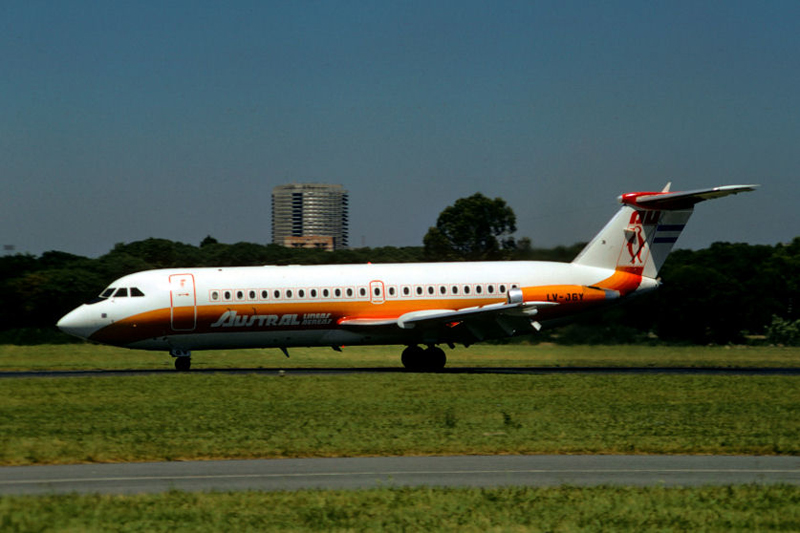
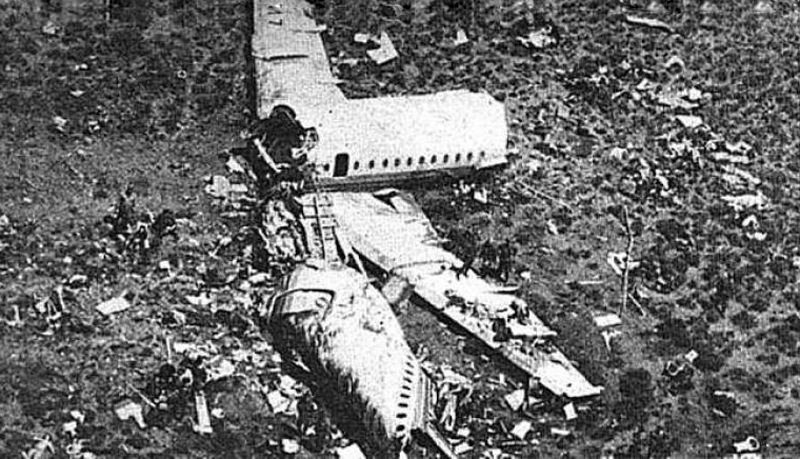
Crash of a BAc 111-420EL near San Carlos de Bariloche: 46 killed

Date & Time: Nov 21, 1977 at 0104 LT
Type of aircraft:
Operator:
Registration:
LV-JGY
Survivors:
Yes
Site:
Schedule:
Buenos Aires - San Carlos de Bariloche
MSN:
155
YOM:
1968
Flight number:
AU009
Country:
Crew on board:
5
Crew fatalities:
Pax on board:
74
Pax fatalities:
Other fatalities:
Total fatalities:
46
Captain / Total flying hours:
11918
Captain / Total hours on type:
3587.00
Copilot / Total flying hours:
12347
Copilot / Total hours on type:
1691
Aircraft flight hours:
21272
Aircraft flight cycles:
22228
Circumstances:
The airplane was completing a charter flight and departed Buenos Aires-Aeroparque-Jorge Newbury Airport at 2253LT bound for San Carlos de Bariloche. While on a night ILS approach to runway 28, the crew encountered technical problems with the ILS reception and the captain decided to initiate a go-around procedure. Few minutes later, the crew started the descent prematurely with a rate of descent of 2,200 feet per minute instead of the required 750 feet per minute. This caused the aircraft to descend below the minimum descent altitude until it collided with ground about 21 km east of the airport. All five crew members and 41 passengers were killed while 33 other occupants were injured. The aircraft was destroyed.
Probable cause:
The accident was caused by the collision of the aircraft with the ground during the final approach to Bariloche runway after an improper and premature descent which was below safety limits. The accident can be attributed to a procedural error by the crew during the final approach in that they abandoned the ILS procedure, an action strongly and unduly influenced by the interruption of the VOR signal and also probably by the state of mind of the pilot-in-command.
Final Report:

Crash of a PZL-Mielec AN-2 on Mt Aag: 7 killed

Date & Time: Nov 5, 1977 at 1208 LT
Type of aircraft:
Operator:
Registration:
CCCP-70453
Flight Phase:
Survivors:
No
Site:
Schedule:
Esso – Milkovo – Petropavlovsk-Kamchatsky
MSN:
1G143-32
YOM:
1972
Flight number:
SU956
Country:
Region:
Crew on board:
2
Crew fatalities:
Pax on board:
5
Pax fatalities:
Other fatalities:
Total fatalities:
7
Circumstances:
The single engine airplane departed Milkovo Airport at 1117LT bound to the south. En route, weather conditions worsened and clouds developed over the Sredinny Mountain Range. At an altitude of 2,400 meters, the airplane entered clouds while descending to Petropavlovsk-Kamchatsky-Galaktyrka Airport. At an altitude of 2,200 meters, strong downdrafts were encountered then the airplane lost height and crashed on the north face of Mt Aag (2,230 meters high) located about 28 km northeast of Galaktyrka Airport. The burned wreckage was spotted a day later in deep snow and it was confirmed that all seven occupants were killed. Two days later, an avalanche dragged the wreckage for almost 700 meters and only the copilot's body was later found.
Probable cause:
The crew descended into clouds without knowing his exact position and without any visual contact with ground (mountains). At the time of the accident, strong atmospheric downdrafts were present as well as strong winds from the west, which was considered as contributing factors.

Crash of a Rockwell Aero Commander 500B near La Mercedes: 4 killed

Date & Time: Nov 4, 1977
Operator:
Registration:
LV-HLE
Flight Phase:
Survivors:
No
Site:
MSN:
500-1127-73
YOM:
1961
Country:
Crew on board:
1
Crew fatalities:
Pax on board:
3
Pax fatalities:
Other fatalities:
Total fatalities:
4
Circumstances:
Crashed in unknown circumstances into a mountain in the region of La Mercedes. All four occupants were killed.

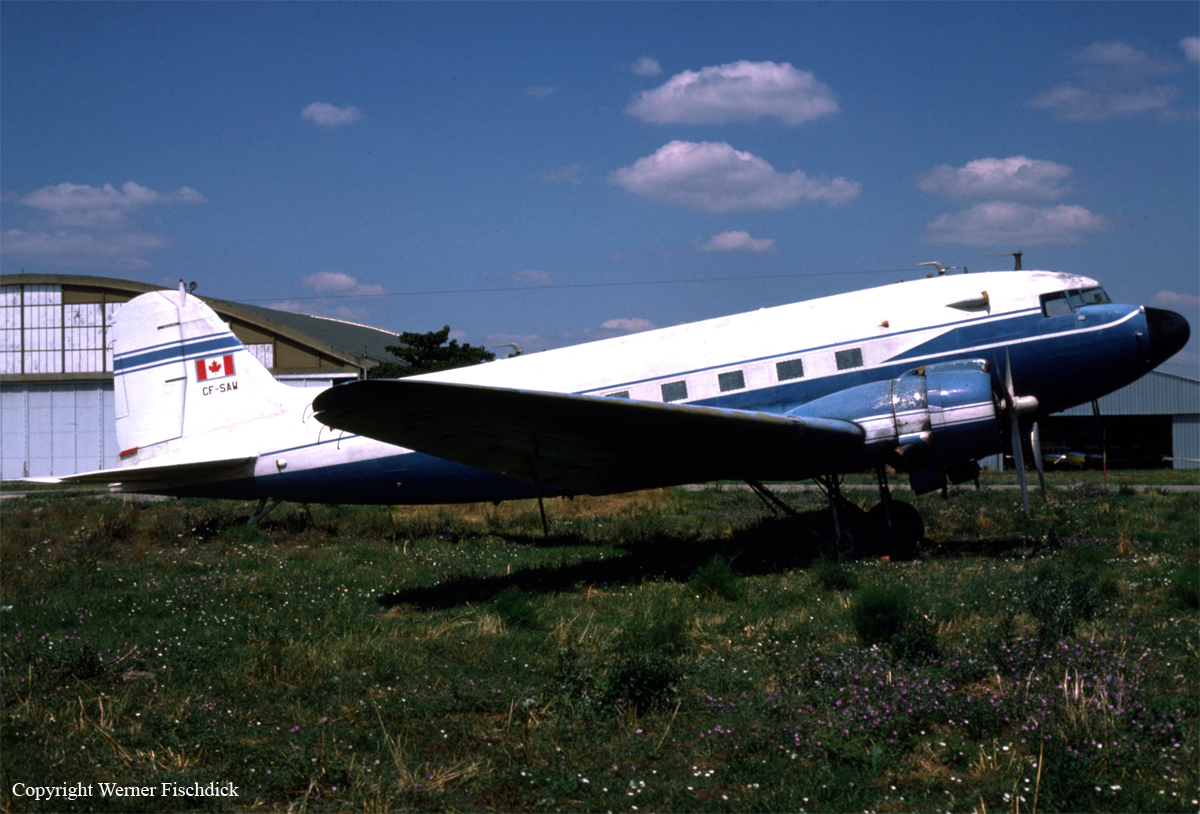
Crash of a Douglas C-47-DL near Manidar: 3 killed

Date & Time: Oct 23, 1977
Operator:
Registration:
C-FSAW
Flight Phase:
Survivors:
No
Site:
MSN:
4644
YOM:
1942
Country:
Region:
Crew on board:
3
Crew fatalities:
Pax on board:
0
Pax fatalities:
Other fatalities:
Total fatalities:
3
Circumstances:
The crew was engaged in a geo-survey mission, searching for uranium. While cruising in a valley, the crew encountered limited visibility with low clouds when, facing a mountain, the pilot-in-command made a 180 turn. The aircraft struck the mountain and crashed. The airplane was destroyed and all three occupants were killed.