Crash of an Antonov AN-26 in Abu Adh Dhuhur: 30 killed

Date & Time: Jan 18, 2015
Type of aircraft:
Operator:
Registration:
YK-AND
Flight Type:
Survivors:
No
Schedule:
Damascus - Abu Adh Dhuhur
MSN:
30 08
YOM:
1975
Country:
Region:
Crew on board:
6
Crew fatalities:
Pax on board:
24
Pax fatalities:
Other fatalities:
Total fatalities:
30
Circumstances:
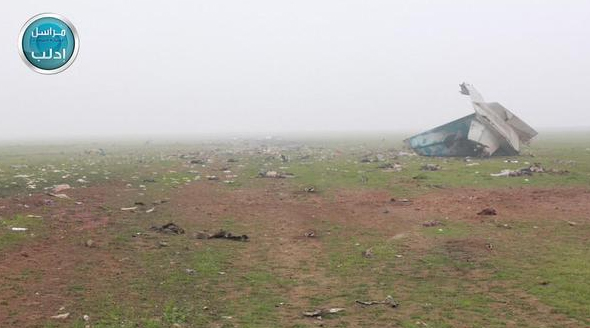
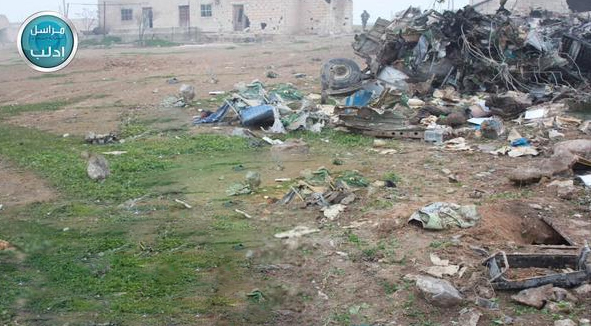
The aircraft was performing a military cargo flight from Damascus, carrying food, potable water and ammunition for the Syrian soldiers fighting against the Islamic State. On final approach to Abu Adh Dhuhur AFB by night and foggy conditions, the aircraft descended too low and collided with high tension cables. It stalled and crashed in an open field located near the airport. All 24 passengers and six crew members were killed and the aircraft was totally destroyed by impact forces.

Crash of a Canadair BD-700-1A11 Global 5000 in Tacloban

Date & Time: Jan 17, 2015 at 1345 LT
Type of aircraft:
Registration:
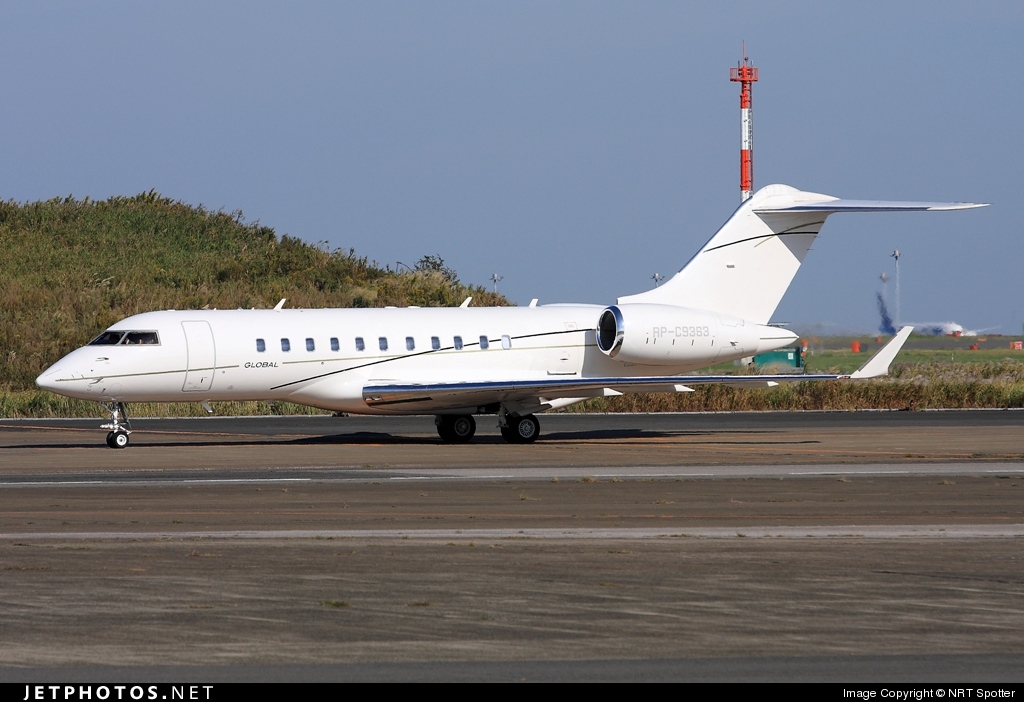
RP-C9363
Flight Phase:
Survivors:
Yes
Schedule:
Tacloban - Manila
MSN:
9363
YOM:
2009
Location:
Country:
Region:
Crew on board:
2
Crew fatalities:
Pax on board:
14
Pax fatalities:
Other fatalities:
Total fatalities:
0
Circumstances:
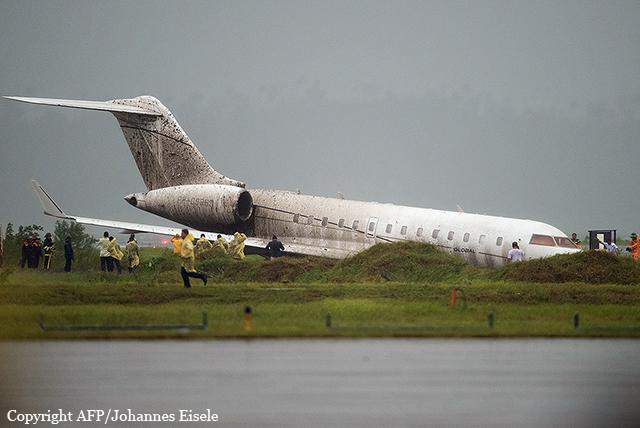
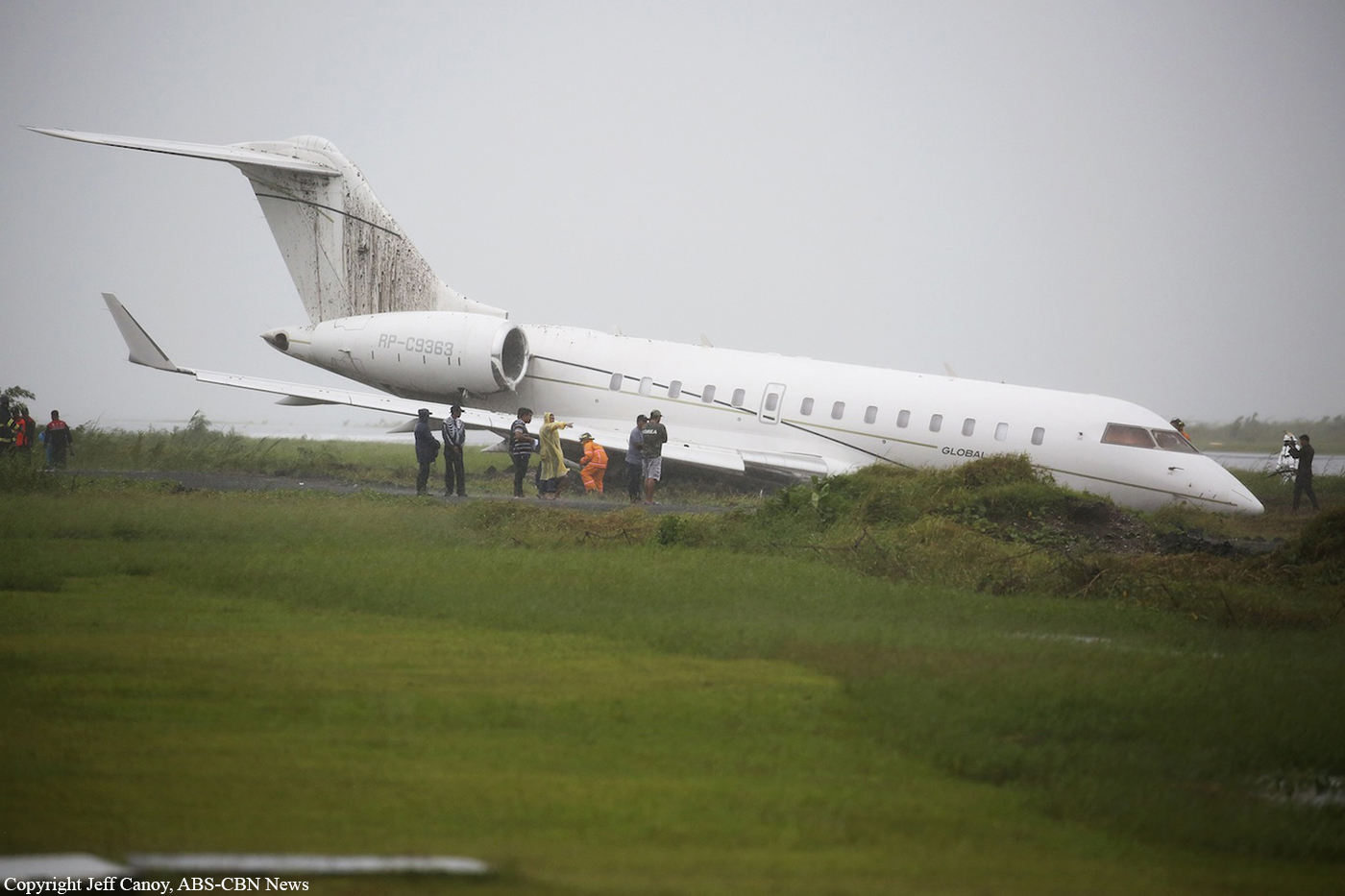
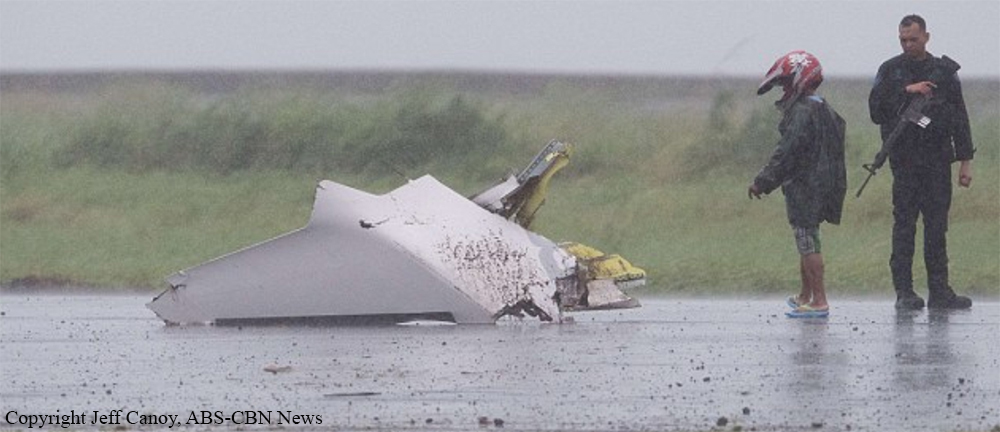
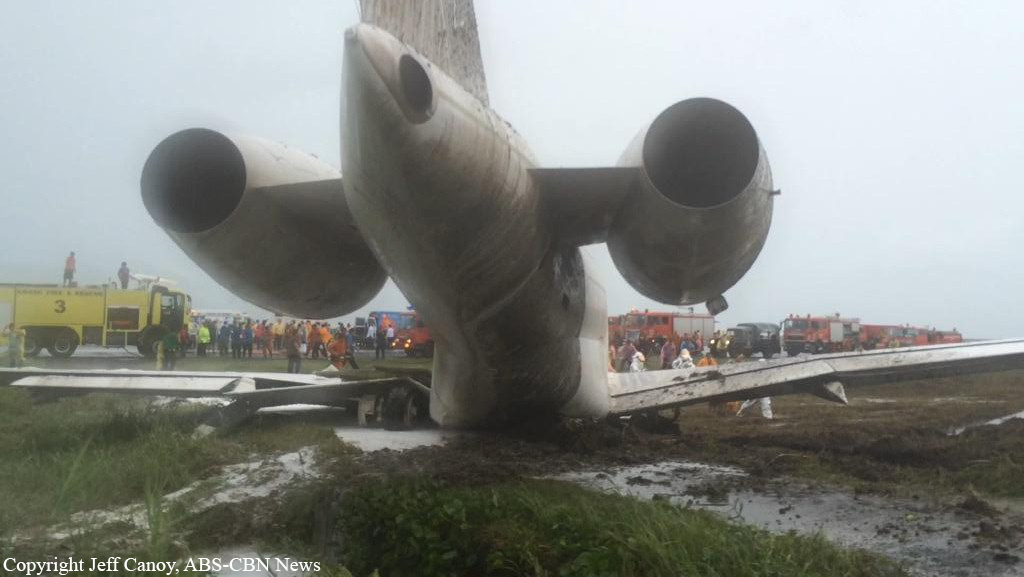
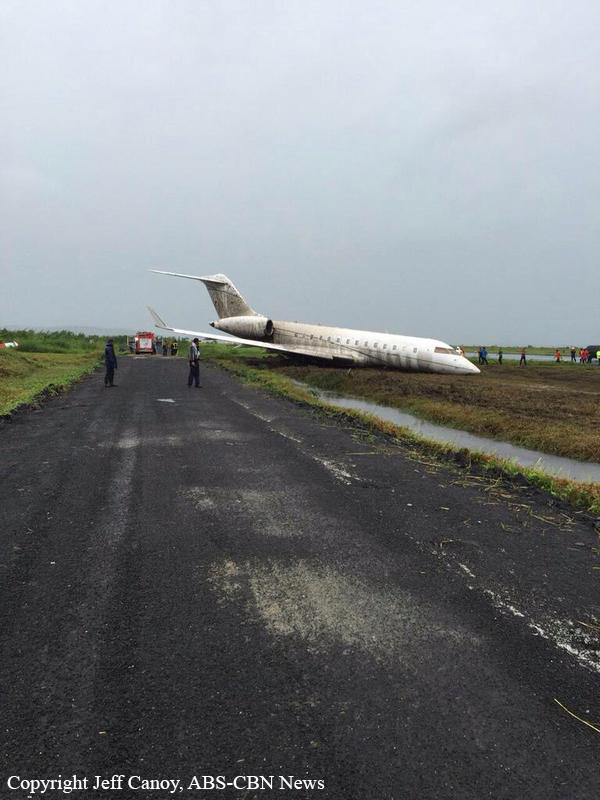
On or about 1000H January 17, 2015, the Holy Father “Pope Francis” visited the typhoon-devastated province of Leyte and utilized an Airbus 320 aircraft for Tacloban airport, and Bombardier Global 5000 RP-C9363 aircraft was part of the Papal entourage with passengers on board. The weather condition was worsening and the visit of the Pope had to cut short due to approaching tropical storm code named “AMANG”, with strong winds of up to 130km/h(80mph) according to PAGASA and moderate rain as signal n°2 was already forecasted at the province of Leyte. At 1304H, the Global 5000 RP-C9363 was given start up clearance by tower controller and subsequently a taxi clearance at 1308H to exit via south taxiway next to the departing Airbus320 PAL8010. At 1306H, the First Airbus 320 PAL8010 aircraft carrying the Papal entourage took-off utilizing RWY 36 with prevailing wind condition of 290̊/18 knots crosswind and temperature of 24°. At 1311H, RP-C 9363 was not allowed to move from present position to proceed to the active runway via south taxiway by the military ground marshaller. At 1322H, the 2nd Airbus 320 PAL8191 took-off with prevailing wind conditions of 290°/23 kts crosswind. The separation time between the Global 5000 to the first and second aircraft were 29 minutes and 13 minutes respectively. At 1335H, finally RP-C9363 Global 5000 was cleared for take-off at runway 36 bound for Ninoy Aquino International Airport (RPLL) with two (2) pilots and 14 passengers on board. The wind condition at that time was 300°/18 kts with gustiness and temperature of 24°. The aircrew performed rolling take-off and the acceleration was normal, the pilot nonflying (NPF) called for air speed alive, 80 knots, V1 and Rotate. Before approaching south taxiway abeam the terminal building, the aircraft started to veer to the left side of the runway centerline. The aircraft continued to roll veering to the left side of the runway and the left hand main landing gear was already out of the runway after the north taxiway. The aircraft underwent runway excursion and sustained substantial damage after simultaneous collision with the concrete bases of runway edge lights and to the concrete culvert before it came to a complete stop at approximately 1500 meters from the take-off point. Immediate evacuation was performed to all passengers. The crash and fire rescue personnel arrived at the area and assisted the passengers and aircrew.
Probable cause:
The Aircraft Accident Investigation and Inquiry Board determined that the probable cause of this accident was:
- Lack of recurrent training of the flight crew:
Routine flights do not prepare a pilot for unusual situations, whether they are unexpected crosswinds or systems/engine anomalies. Pilots should receive regular recurrent training to include abnormal and emergency procedures.
- The existing runway edge light design:
The PIC tried to recover the aircraft back to the runway but apparently the aircraft left main landing gears already hit or bumped the concrete base of runway edge lights. The design of runway strips or shoulder must be free from fixed objects other than frangible visual aids provided for the guidance of aircraft and must not be constructed
with sharp edges; and where the lights will not normally come into contact with aircraft wheels, such as threshold lights, runway end lights and runway edge lights;
- Human Factors:
Due to deteriorating adverse weather conditions and due to the delay of their initial request for take-off clearance plus the sudden change of flight plan affected the Captain’s ability to perform a take-off procedure as recommended in the aircraft flight manual and instead delegated flight control duties to the F/O resulting in the loss of coordination between the light crew.
Final Report:

Crash of a Britten Norman BN-2A-8 Islander in Los Roques

Date & Time: Jan 16, 2015
Type of aircraft:
Operator:
Registration:
YV2238
Survivors:
Yes
Schedule:
Higuerote - Los Roques
MSN:
296
YOM:
1971
Country:
Crew on board:
1
Crew fatalities:
Pax on board:
9
Pax fatalities:
Other fatalities:
Total fatalities:
0
Circumstances:
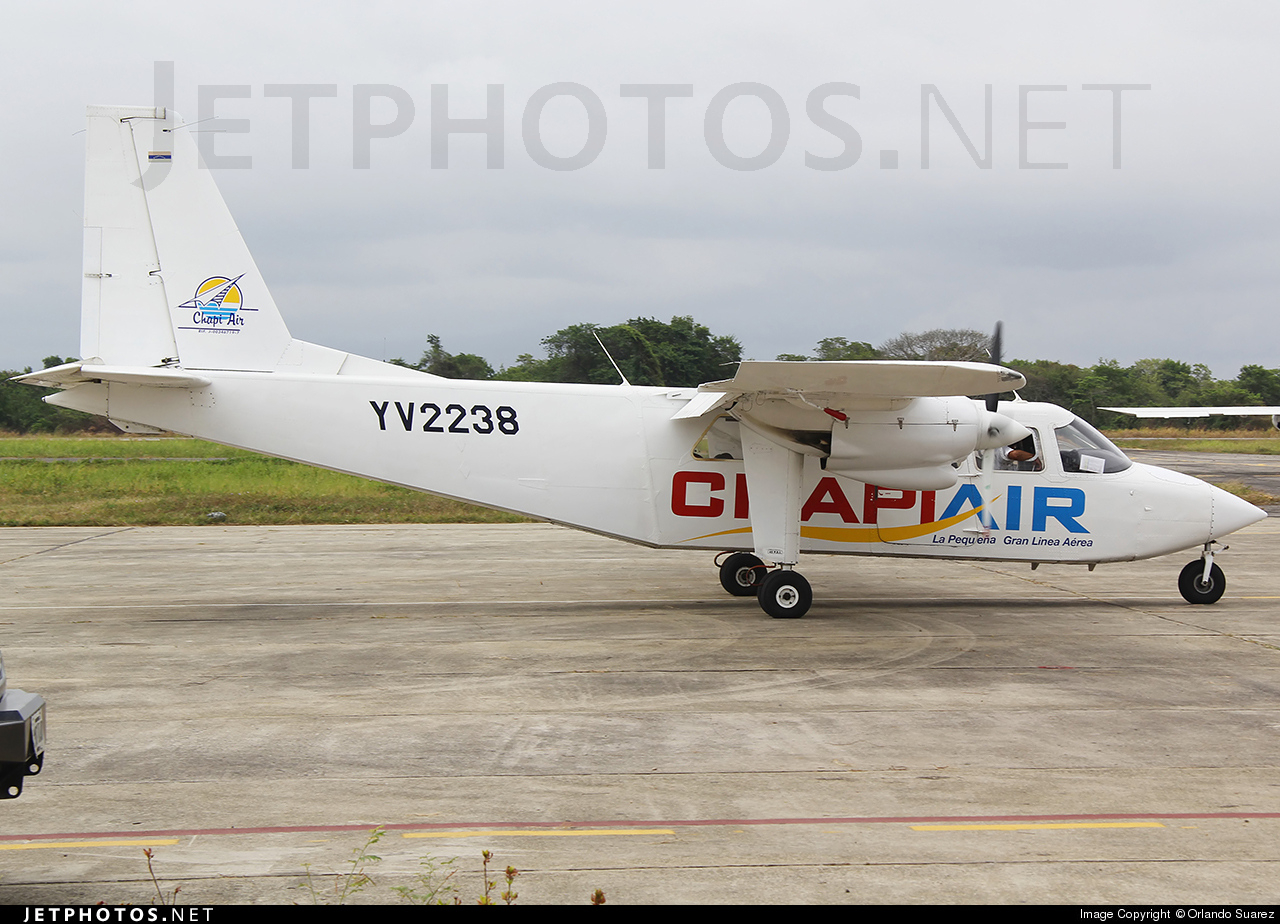
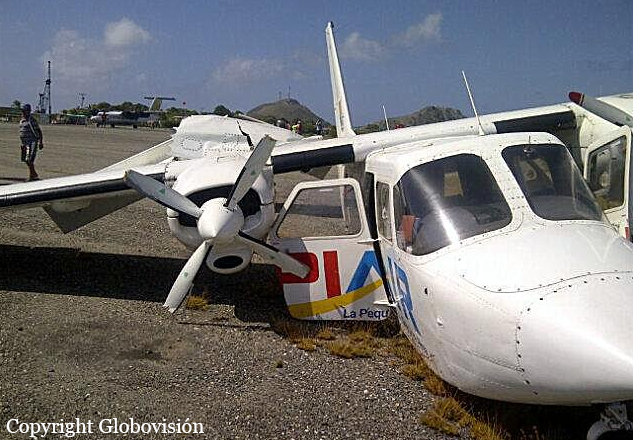
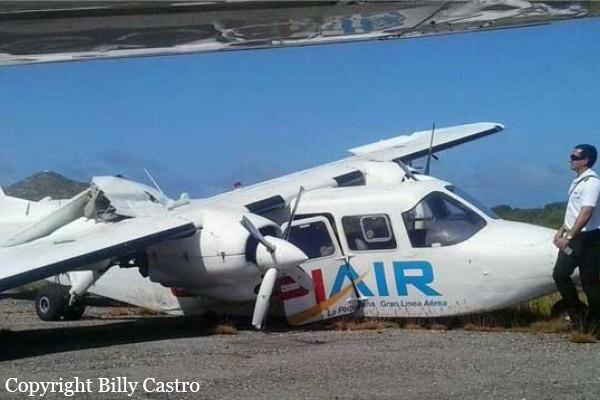
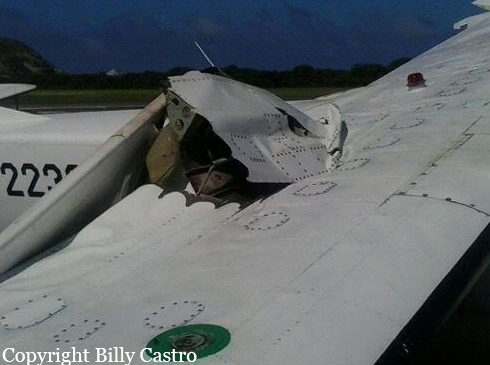
For unknown reasons, the aircraft landed hard on runway 07 at Los Roques Airport. Upon impact, the right main gear collapsed and punctured the right wing. Out of control, the twin engine aircraft cartwheeled and came to rest near the runway shoulder. All 10 occupants escaped uninjured and the aircraft was damaged beyond repair.

Crash of a Piper PA-46-350P Malibu Mirage in Donaueschingen

Date & Time: Jan 15, 2015 at 1900 LT
Operator:
Registration:
D-EMBZ
Flight Type:
Survivors:
Yes
MSN:
46-22148
YOM:
1993
Country:
Region:
Crew on board:
1
Crew fatalities:
Pax on board:
4
Pax fatalities:
Other fatalities:
Total fatalities:
0
Circumstances:
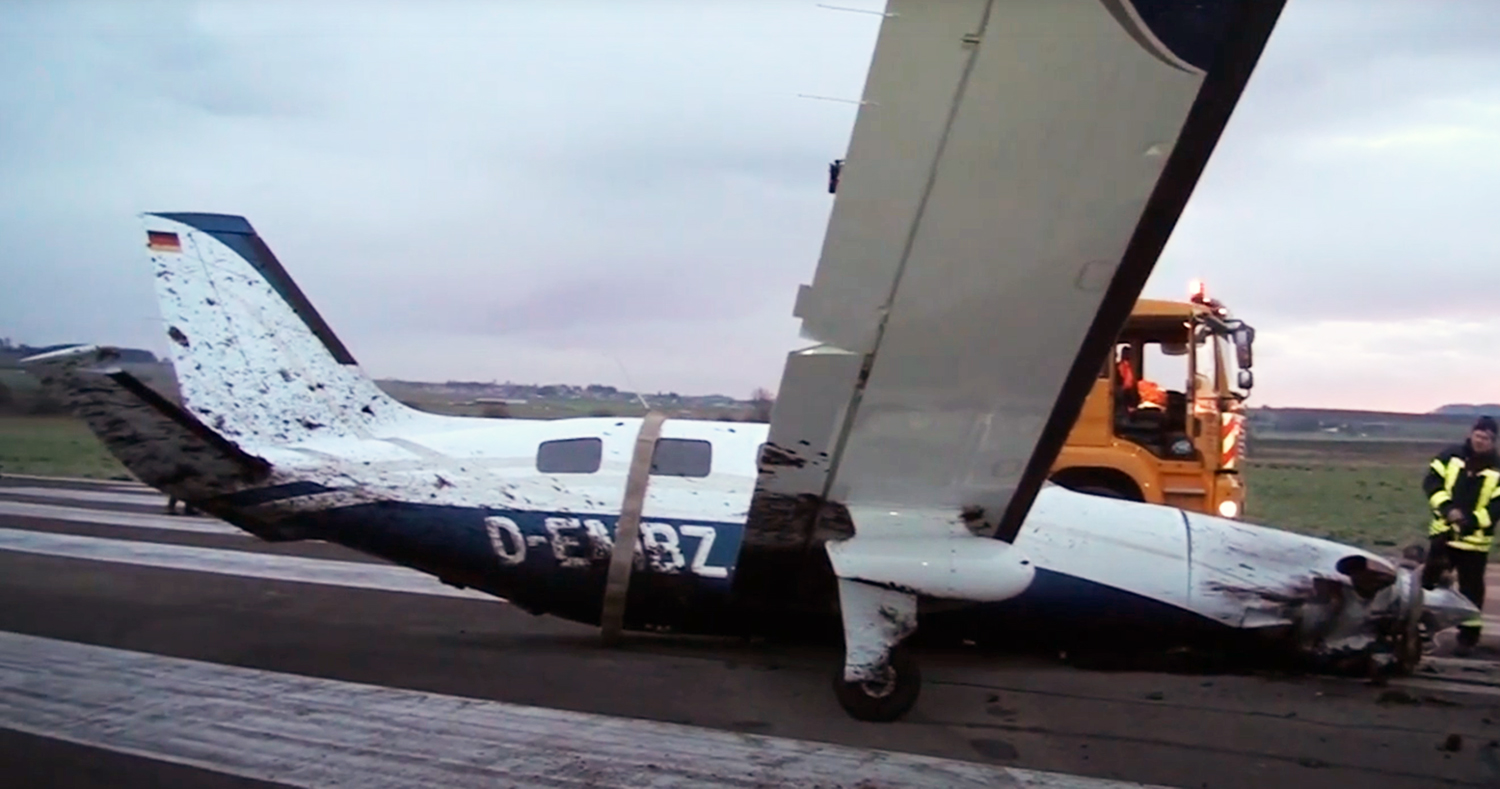
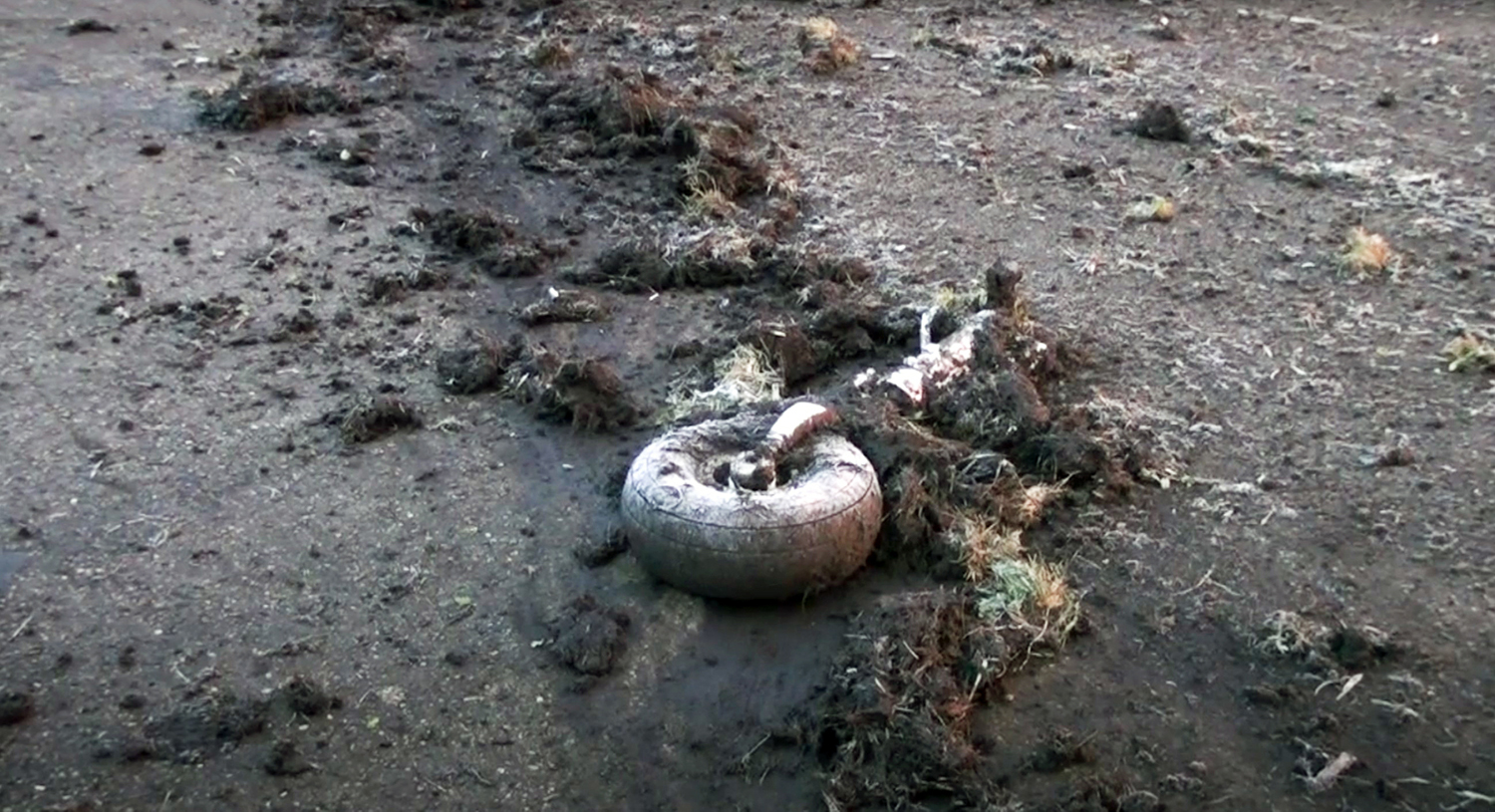
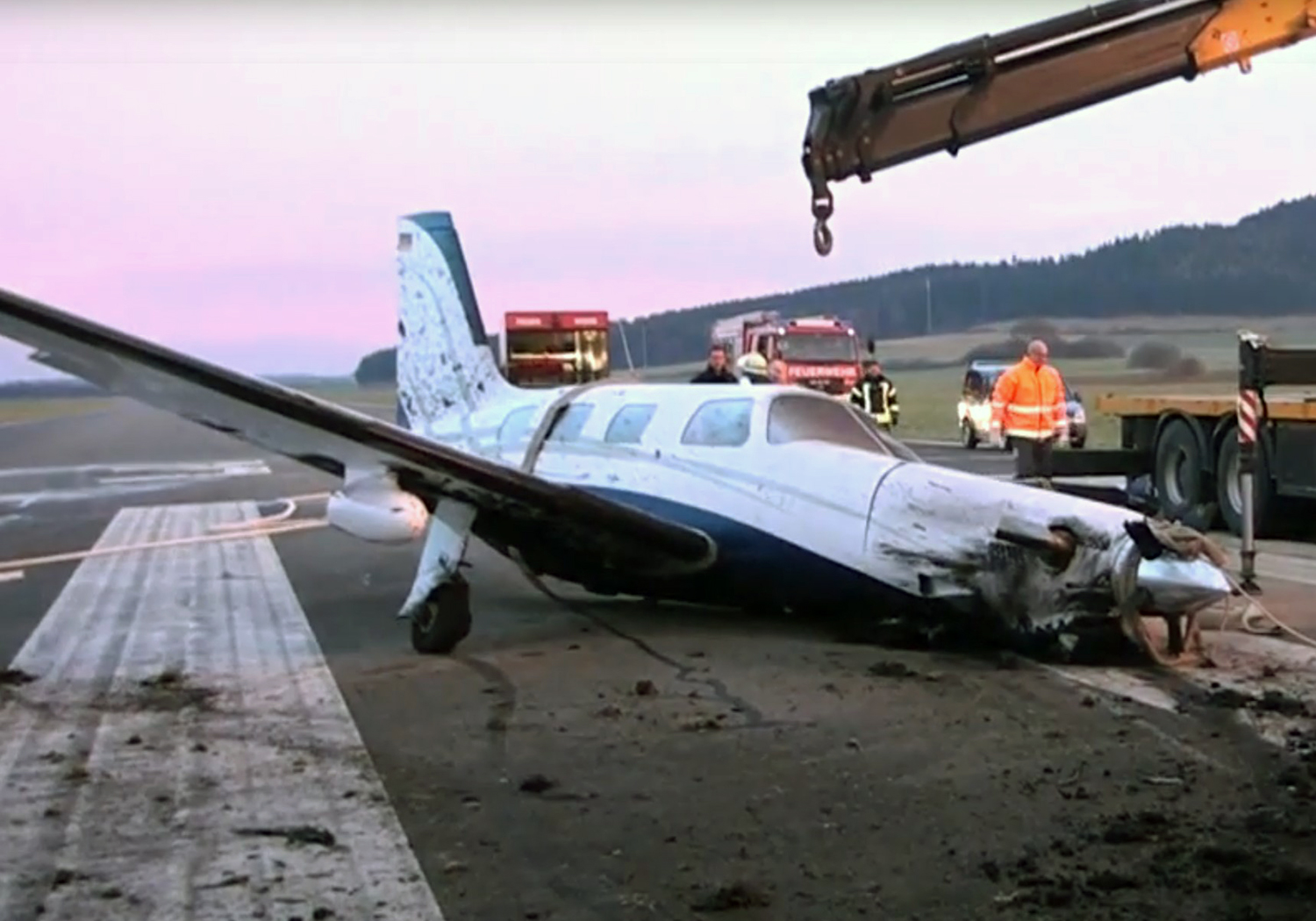
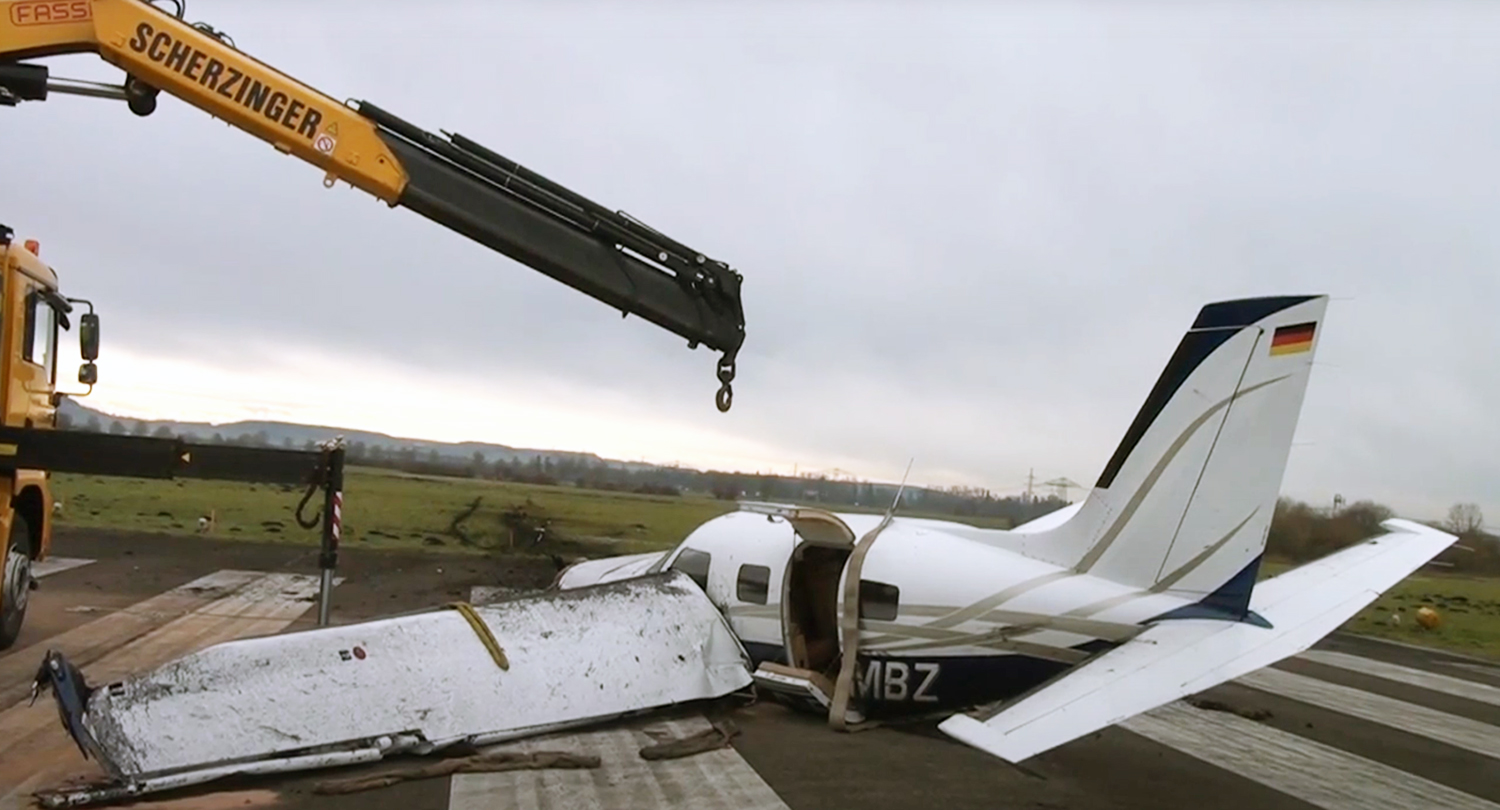
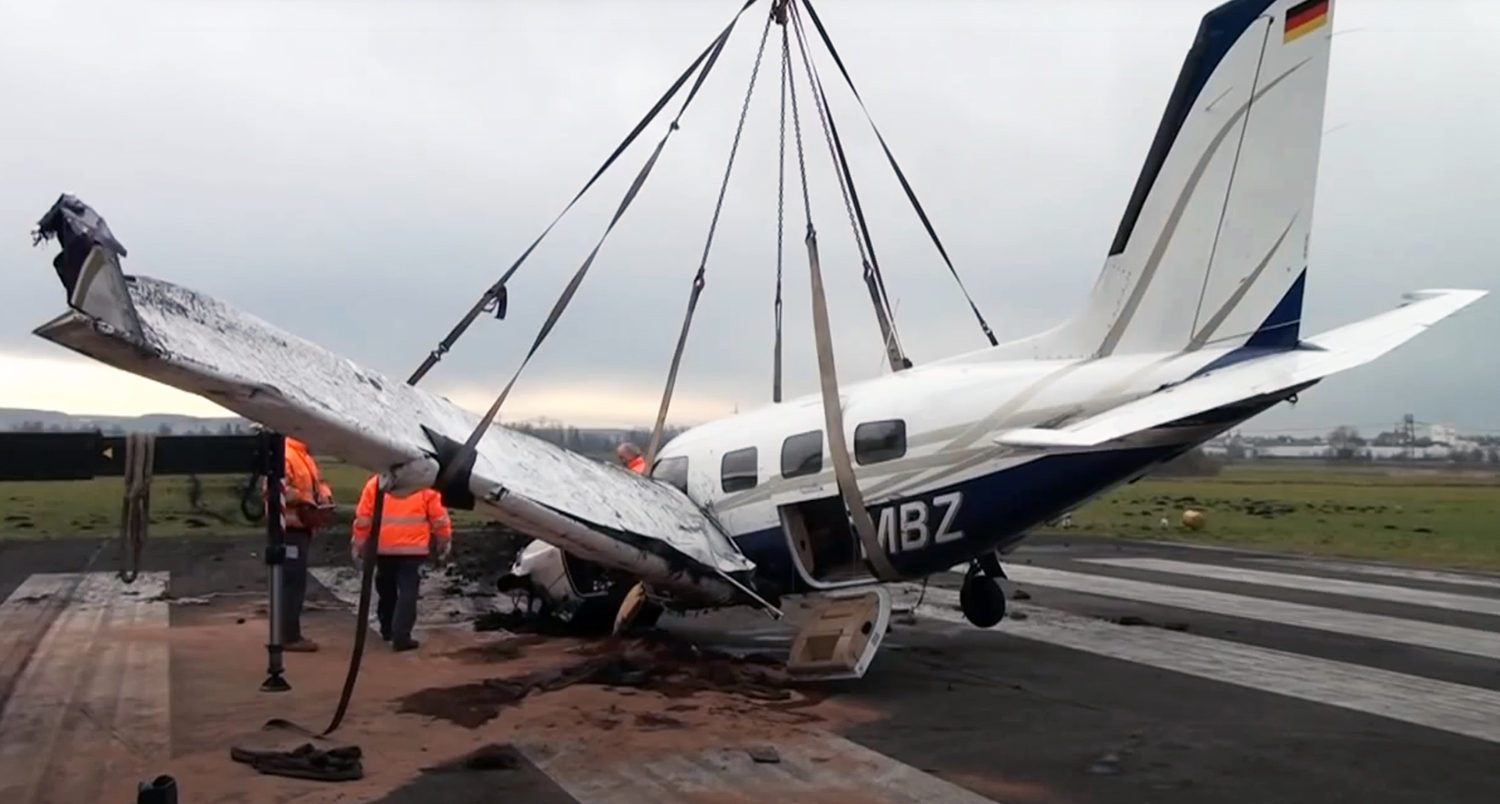
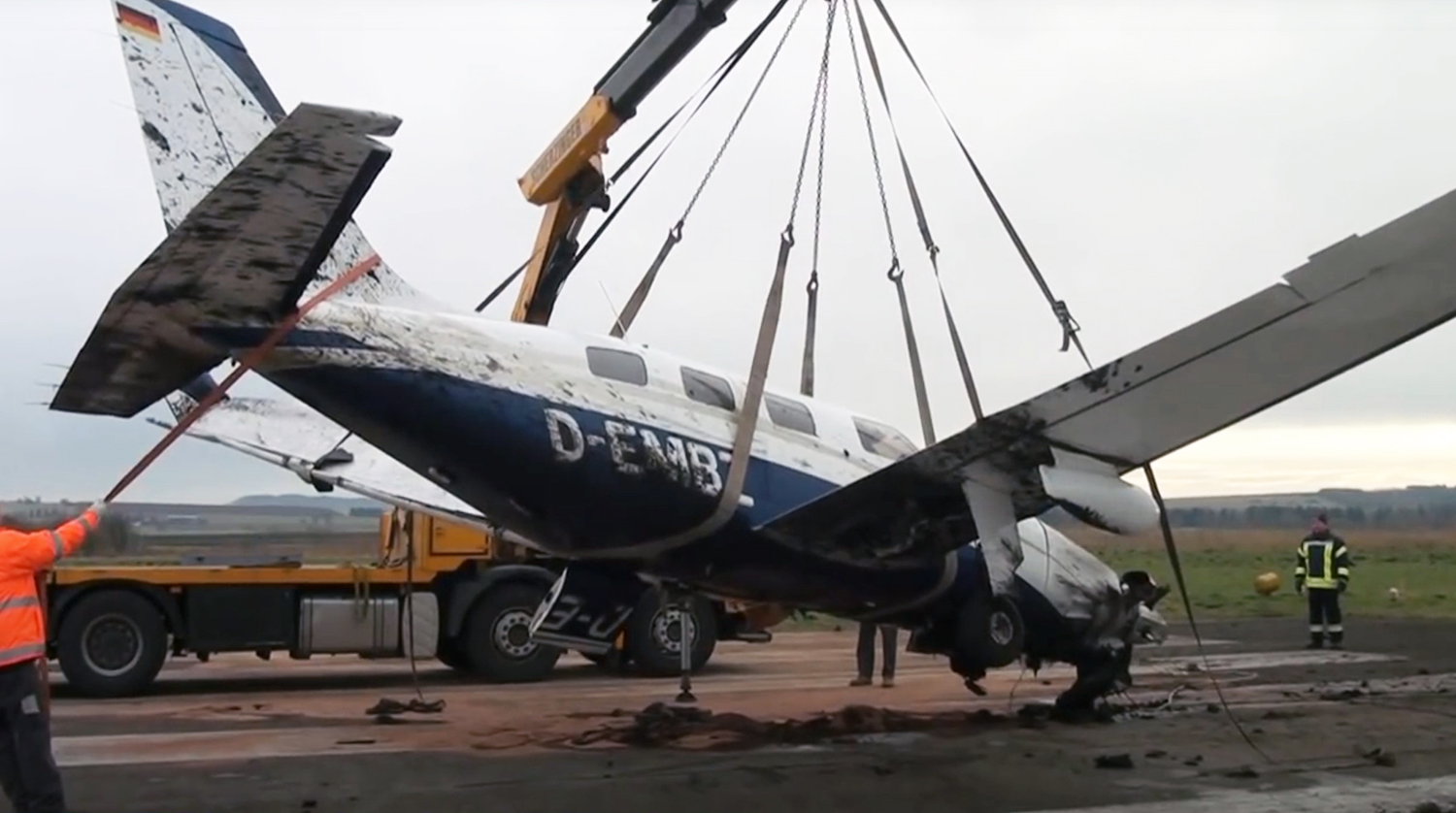
The approach to Donaueschingen-Villingen Airport runway 36 was completed by night. On final, the single engine airplane struck the ground about 50 metres short of runway threshold, collided with runway light equipments and came to rest near the threshold with its left wing partially torn off. All five occupants escaped with minor injuries and the aircraft was destroyed.

Ground accident of a Dornier DO328-110 in Hamburg

Date & Time: Jan 12, 2015
Type of aircraft:
Operator:
Registration:
D-CIRD
Flight Phase:
Flight Type:
Survivors:
Yes
MSN:
3011
YOM:
1994
Country:
Region:
Crew on board:
2
Crew fatalities:
Pax on board:
0
Pax fatalities:
Other fatalities:
Total fatalities:
0
Circumstances:
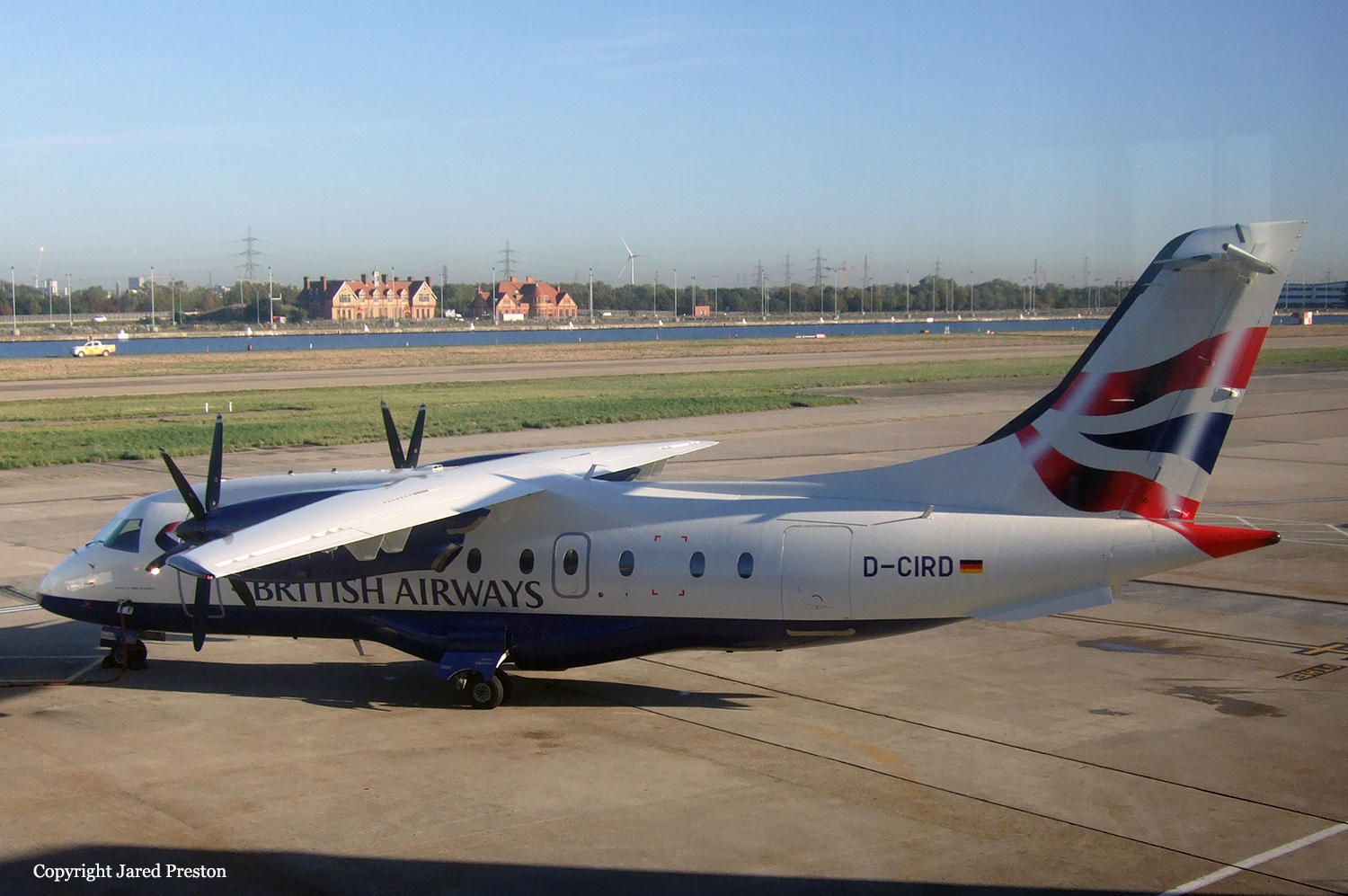
The aircraft was parked on the ramp and subject to engine test run with one or two engineers on board. During the test, the aircraft jumped over the chocks then collided with obstacles and came to rest. There were no injuries while the aircraft was damaged beyond repair. It was operated by Sun-Air of Scandinavia on behalf of British Airways.

Crash of a Boeing 737-43Q in Accra

Date & Time: Jan 10, 2015 at 1105 LT
Type of aircraft:
Operator:
Registration:
ET-AQV
Flight Type:
Survivors:
Yes
Schedule:
Lomé – Accra
MSN:
28493/2838
YOM:
1996
Flight number:
KP4030
Country:
Region:
Crew on board:
3
Crew fatalities:
Pax on board:
0
Pax fatalities:
Other fatalities:
Total fatalities:
0
Circumstances:
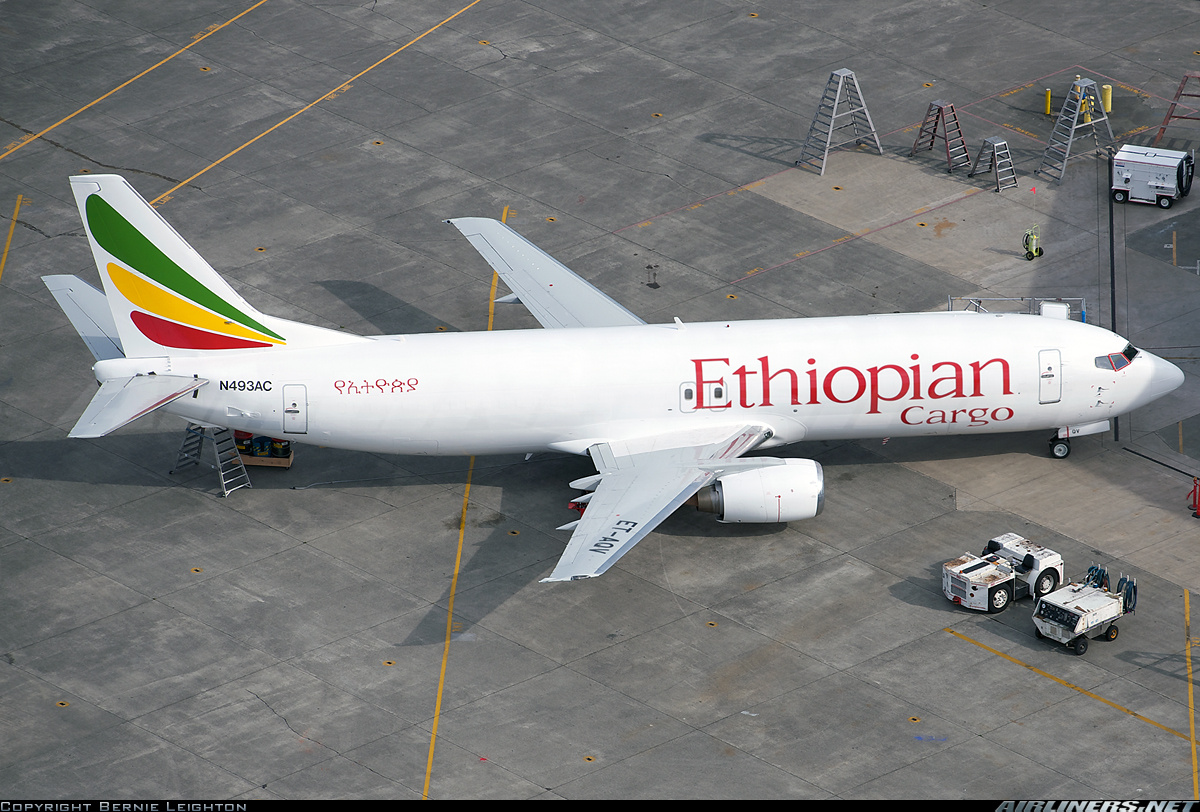
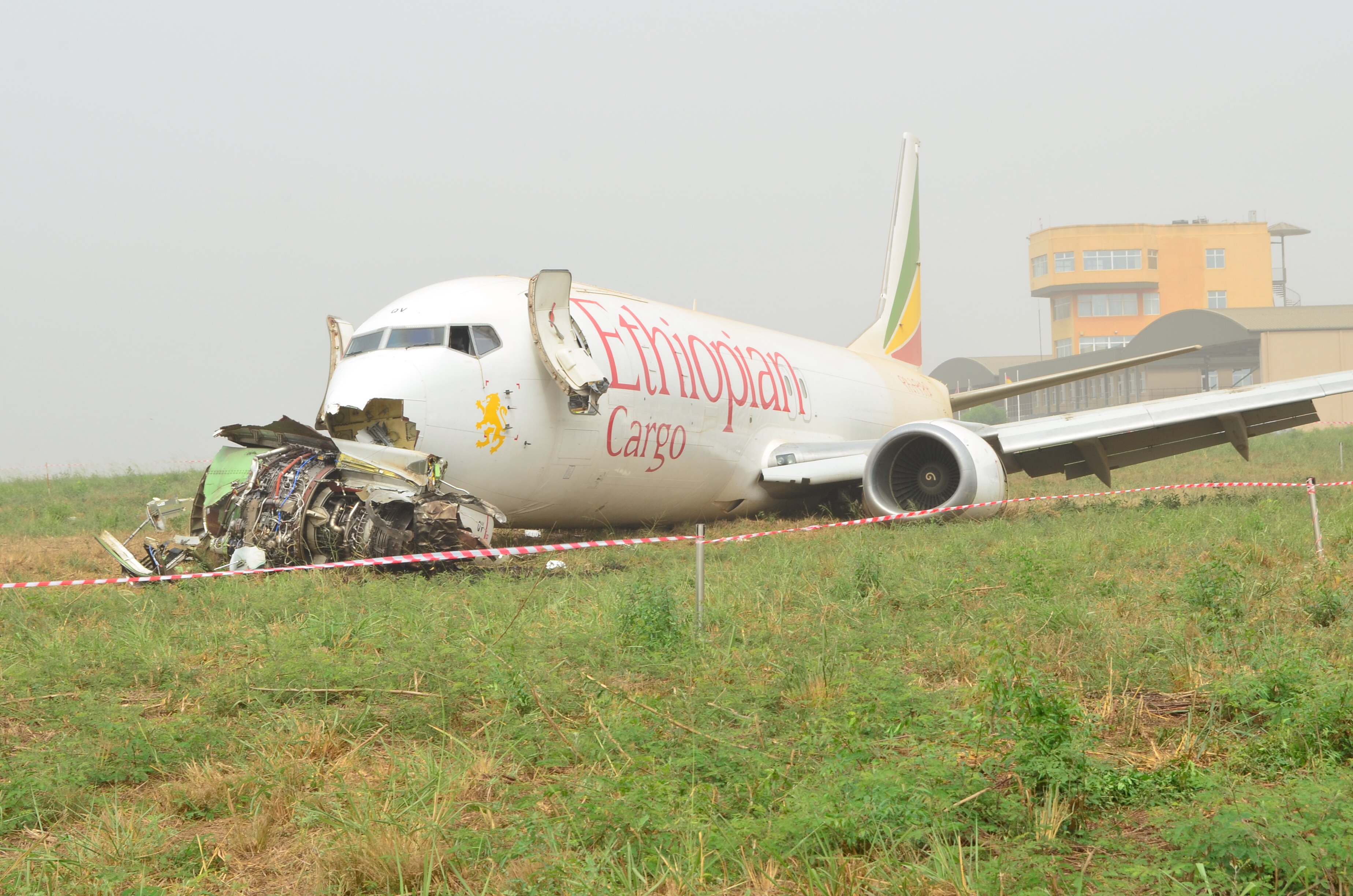
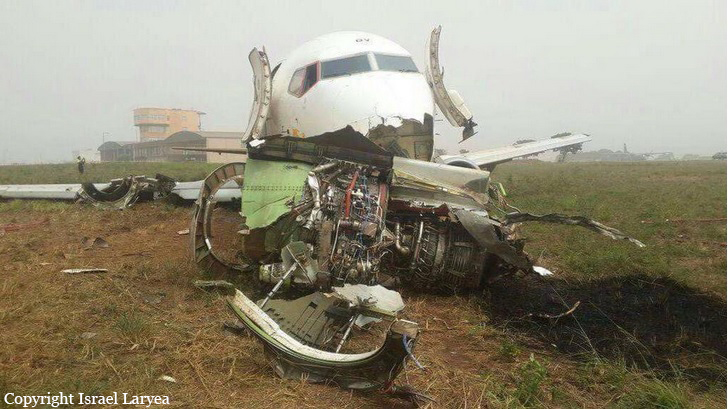
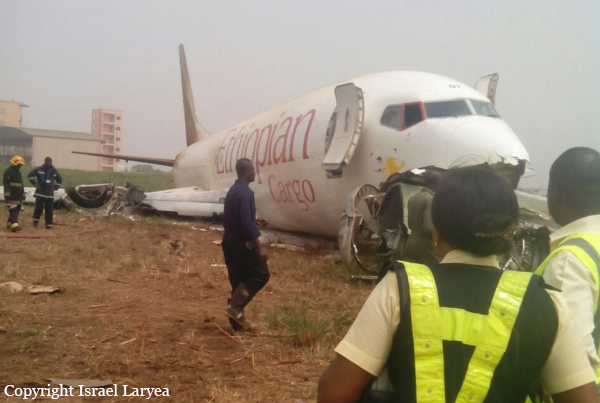
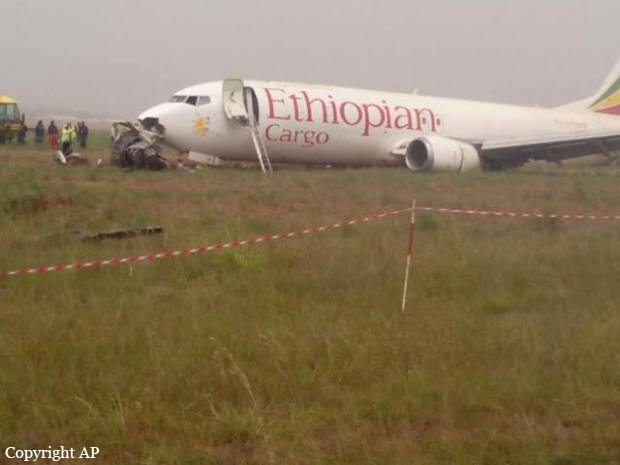
Following an uneventful cargo flight from Lomé, the crew initiated the approach to Accra-Kotoka Airport. The visibility was reduced due to foggy conditions. After touchdown on runway 03, the aircraft became uncontrollable and veered off runway to the right. While contacting soft ground, it lost its undercarriage and its right engine before coming to rest in a grassy area. All three crew crew members escaped with minor injuries and the aircraft was destroyed.

Crash of a Fokker 50 in Nairobi

Date & Time: Jan 4, 2015 at 1102 LT
Type of aircraft:
Operator:
Registration:
5Y-SIB
Flight Type:
Survivors:
Yes
Schedule:
Wajir – Nairobi
MSN:
20167
YOM:
1989
Country:
Region:
Crew on board:
4
Crew fatalities:
Pax on board:
6
Pax fatalities:
Other fatalities:
Total fatalities:
0
Captain / Total flying hours:
17000
Captain / Total hours on type:
1200.00
Copilot / Total flying hours:
4143
Copilot / Total hours on type:
200
Circumstances:
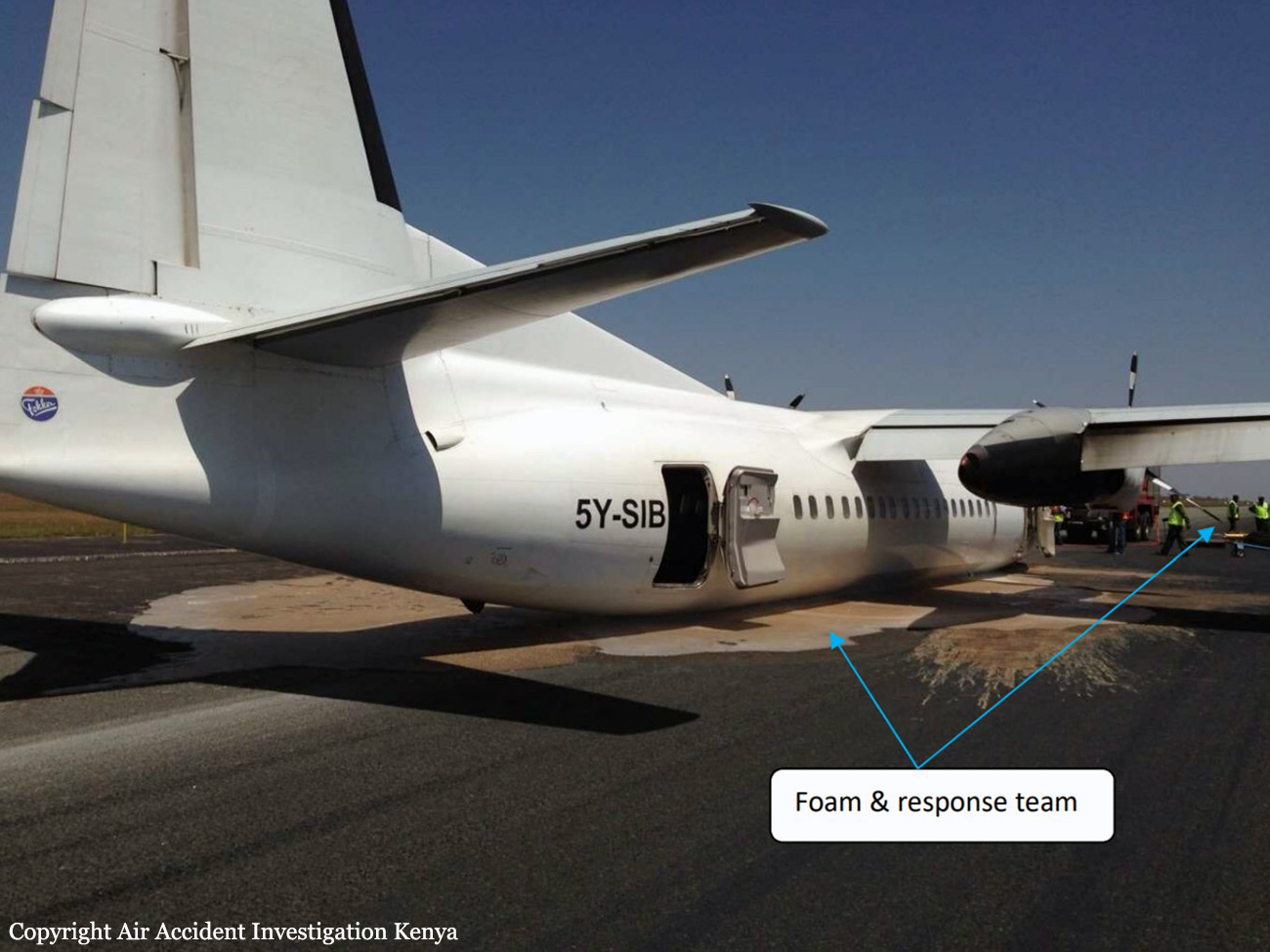
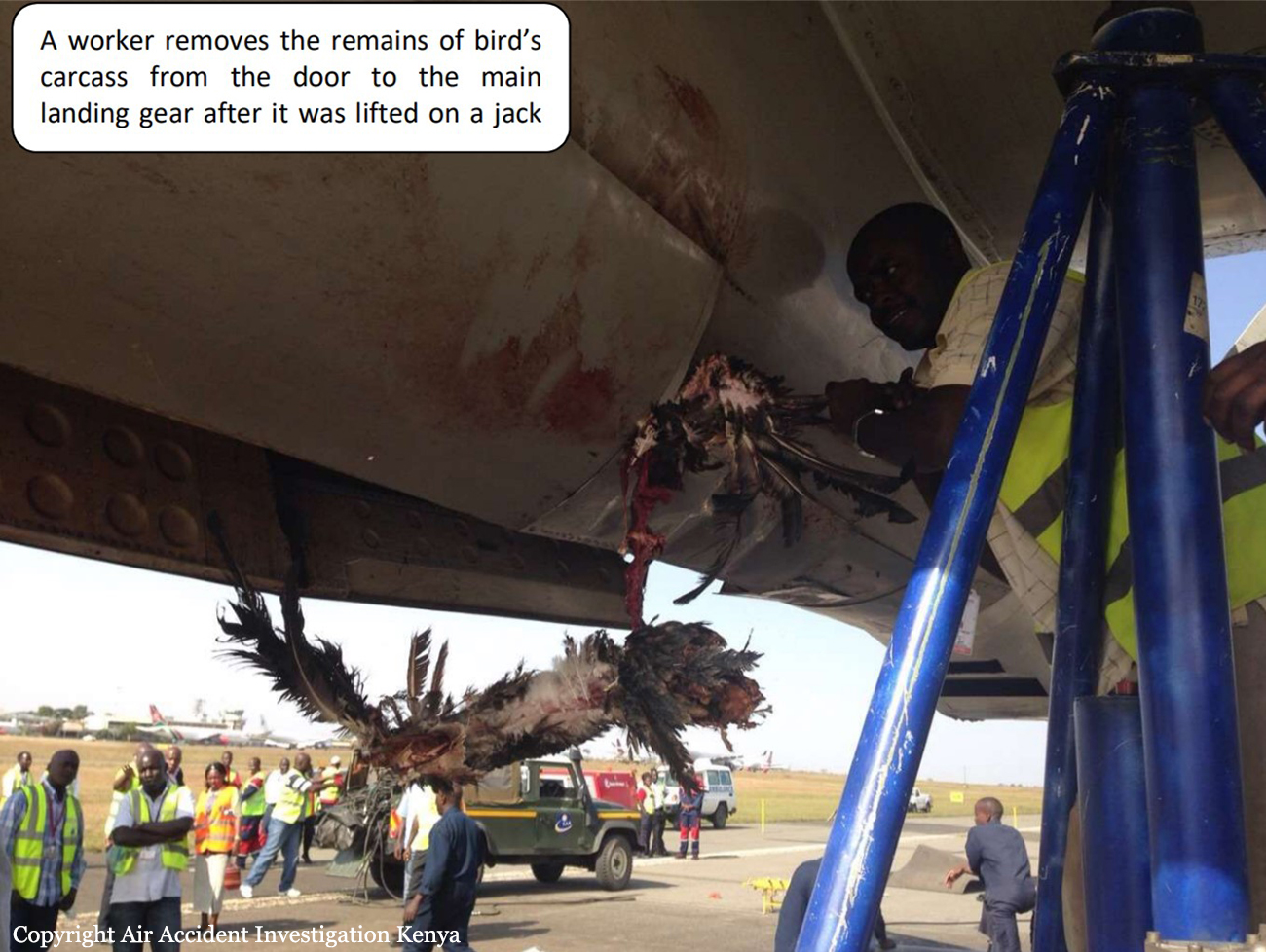
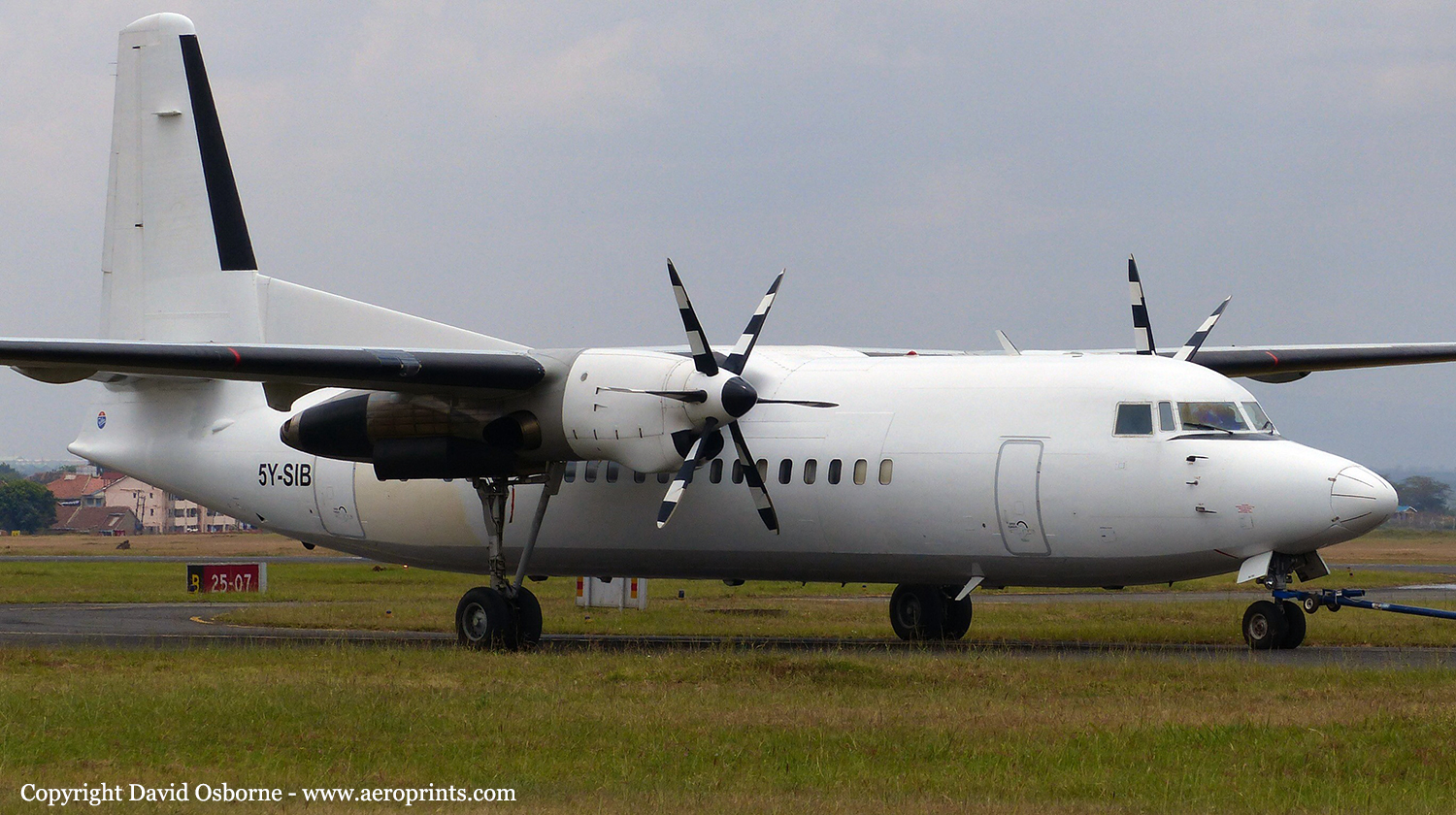
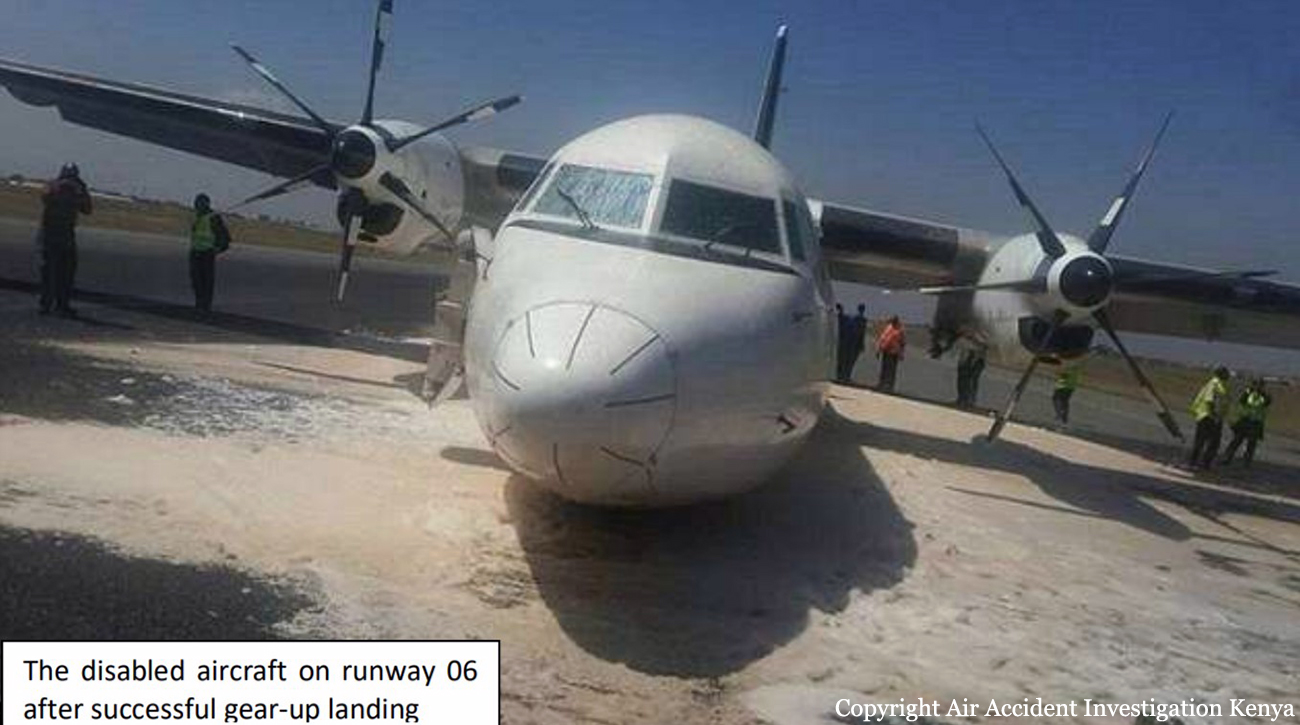
On 4 January 2015, about 0840 local time, a Fokker 27-50 a cargo flight, registration 5Y-SIB, operated by Skyward Express Ltd, experienced a gear-up landing at Jomo Kenyatta International Airport (HKJK). The flight had diverted to HKJK due to a mechanical malfunction of the landing gear. Visual meteorological conditions prevailed and the airplane was on an IFR flight plan. None of the ten persons on board were injured. The airplane was substantially damaged and there was no fire. The flight originated at Wajir (HKWJ) and the original destination was Nairobi-Wilson Airport (HKNW). During the departure from HKWJ, the flight sustained a bird-strike. After taking steps to confirm any aircraft system malfunction the aircraft systems were still operable and the flight crew elected to continue the flight. The flight en route was without any incident. While in the traffic pattern at Wilson, the landing gear was activated to extend and it resulted in an unsafe indication for the left main gear. During the period of about an hour while circling overhead the airport, the flight crew attempted to resolve the anomaly but they were unsuccessful. It prompted the crew to declare an emergency after they had confirmed that the left main landing gear was locked up in the air position and was not lowering. After declaring an emergency, the crew carried out an extensive consultation with the air traffic services and the company ground personnel and elected to divert the flight to Jomo Kenyatta International Airport (HKJK). The crew made a successful gear-up landing at Jomo Kenyatta International Airport (HKJK) runway 06 with no injury to those onboard the flight however the aircraft sustained substantial damage. The aircraft got disabled after landing and blocked both runways for more than four hours as the airport authorities struggled to remove it to pave way for other operations. According to the report obtained from post-accident interview with the flight crew at 0540 the aircraft took-off at Wajir (HKWJ) on runway 15 and immediately after take-off on passing 200ft at a speed of Vref +10 Knots the crew noticed a flock of birds and tried to evade them. While increasing the aircraft rate of climb they felt like a thud (hitting something). After clearing the flock they inspected the instruments and confirmed all aircraft systems were functioning satisfactorily. They then proceeded with their flight as intended. According to the air traffic control (ATC) transcript obtained from Wilson control tower upon entering Wilson aerodrome traffic circuit at 0641:41 the crew requested ATC to join downwind runway 07 and was immediately cleared. After five minutes (0646:50) the crew requested ATC to extend downwind and at 0648:03 the crew confirms to the ATC that they are checking the undercarriage. At 0654:08 the crew confirms to the ATC that they have an emergency on the left main landing gear and they have checked it is locked up in the air position. The crew requested for more time to trouble-shoot the problem and requested ATC to brief their company about the problem. At 0731:07 the crew confirmed to HKNW air traffic service unit that they are ready to do gear-up landing and they would prefer HKJK instead of HKNW. They are then cleared for HKJK to join left base runway 06. 30 seconds later the crew changes their intention to go to HKJK and confirms to HKNW ATC that they would do a gear-up landing at HKNW and requests for more time. At 0749:31 the crew consults with their company through HKNW ATC and agrees to carry out the gear-up landing at HKJK and the flight was cleared to proceed to HKJK. At 0802 the crew made a successful gear-up landing on runway 06 at HKJK.
Probable cause:
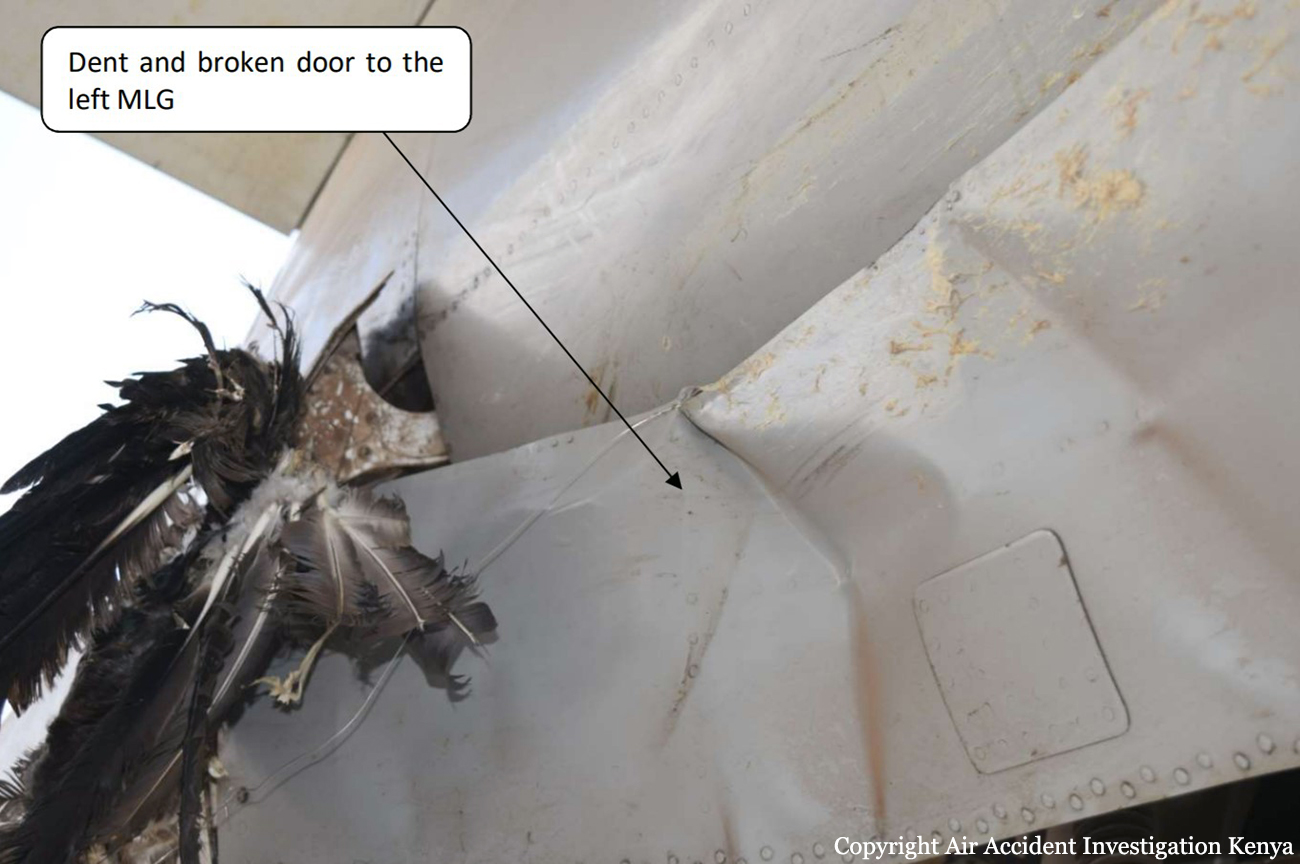
The cause of the accident was the failure of the left Main Landing Gear, MLG to extend during landing due to a bird strike which disabled proper functioning of the mechanical system that controls the opening and closing the door to the left MLG.
Final Report:

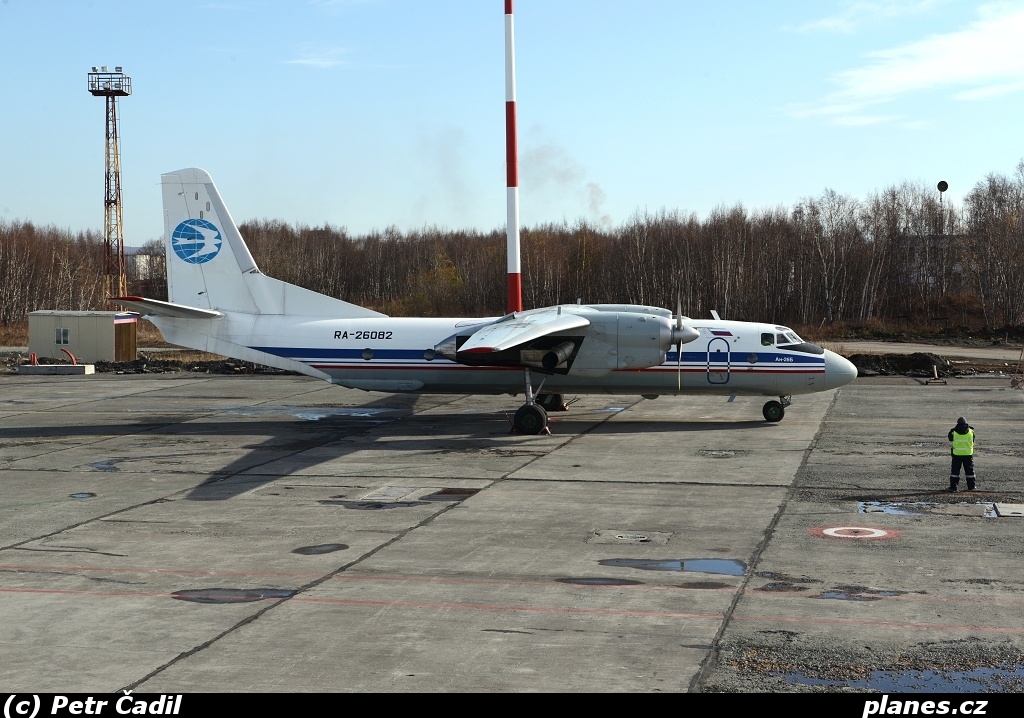
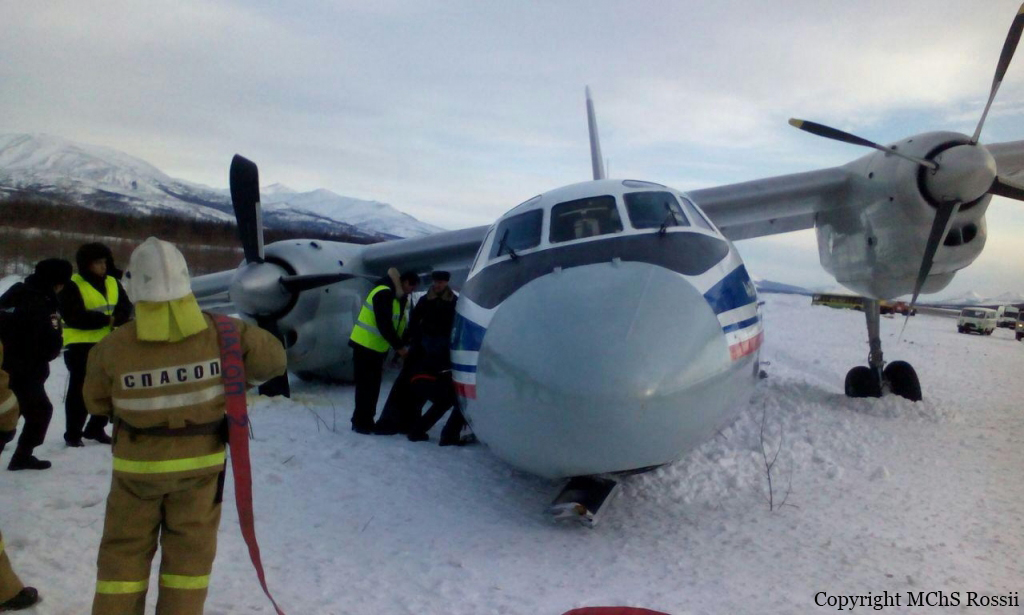
Crash of an Antonov AN-26B in Magadan

Date & Time: Jan 3, 2015 at 1119 LT
Type of aircraft:
Operator:
Registration:
RA-26082
Flight Phase:
Flight Type:
Survivors:
Yes
Schedule:
Petropavlovsk-Kamchatsky – Magadan – Mirny – Nizhnevartovsk
MSN:
117 05
YOM:
1981
Country:
Region:
Crew on board:
8
Crew fatalities:
Pax on board:
0
Pax fatalities:
Other fatalities:
Total fatalities:
0
Captain / Total flying hours:
3783
Captain / Total hours on type:
2240.00
Copilot / Total flying hours:
11986
Copilot / Total hours on type:
94
Aircraft flight hours:
13698
Aircraft flight cycles:
6810
Circumstances:
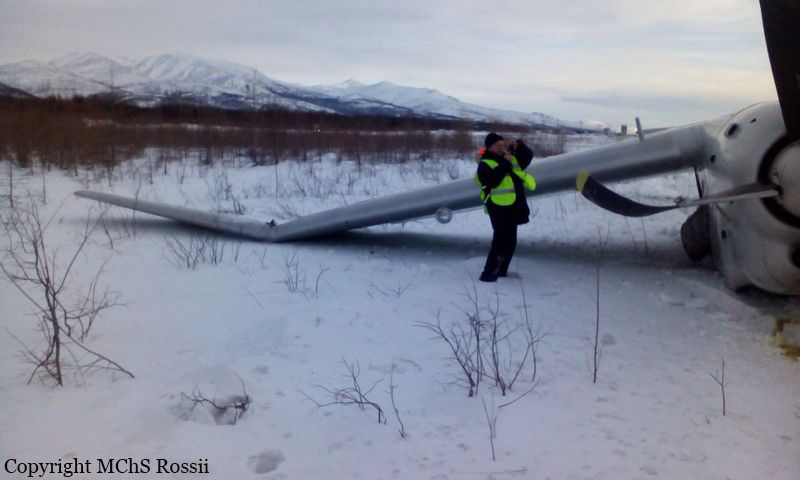
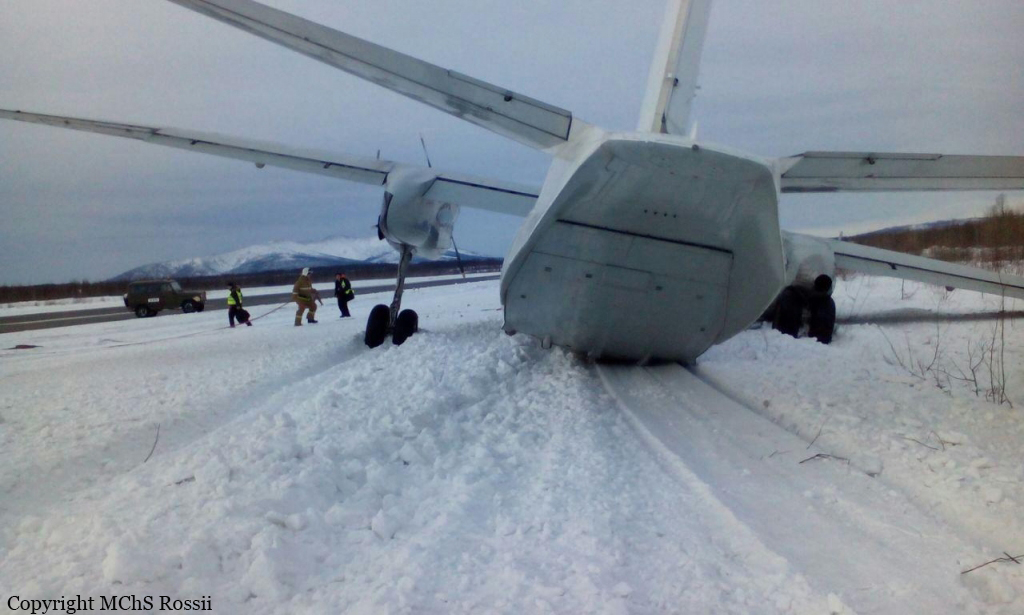
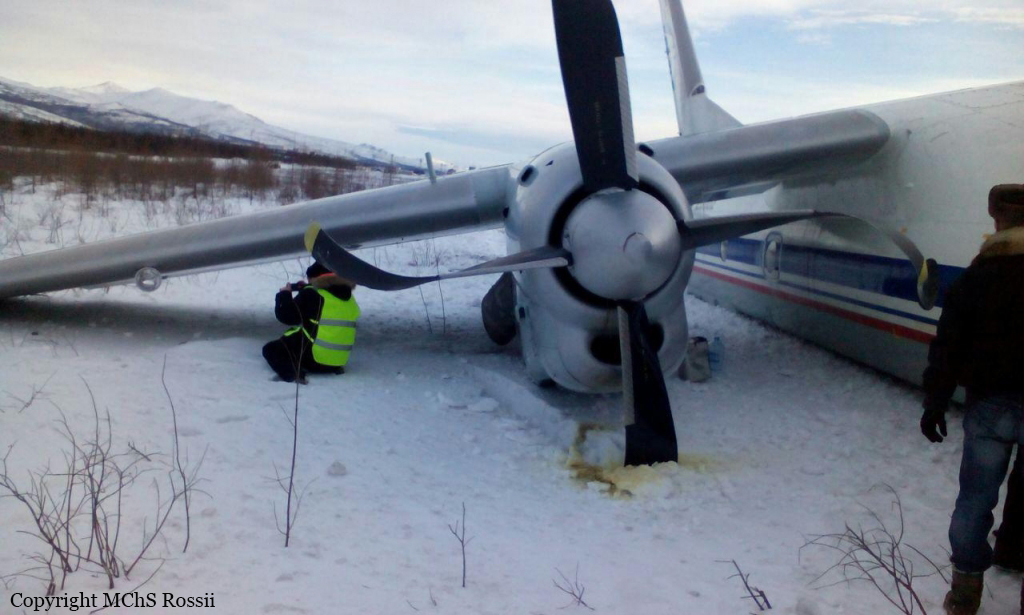
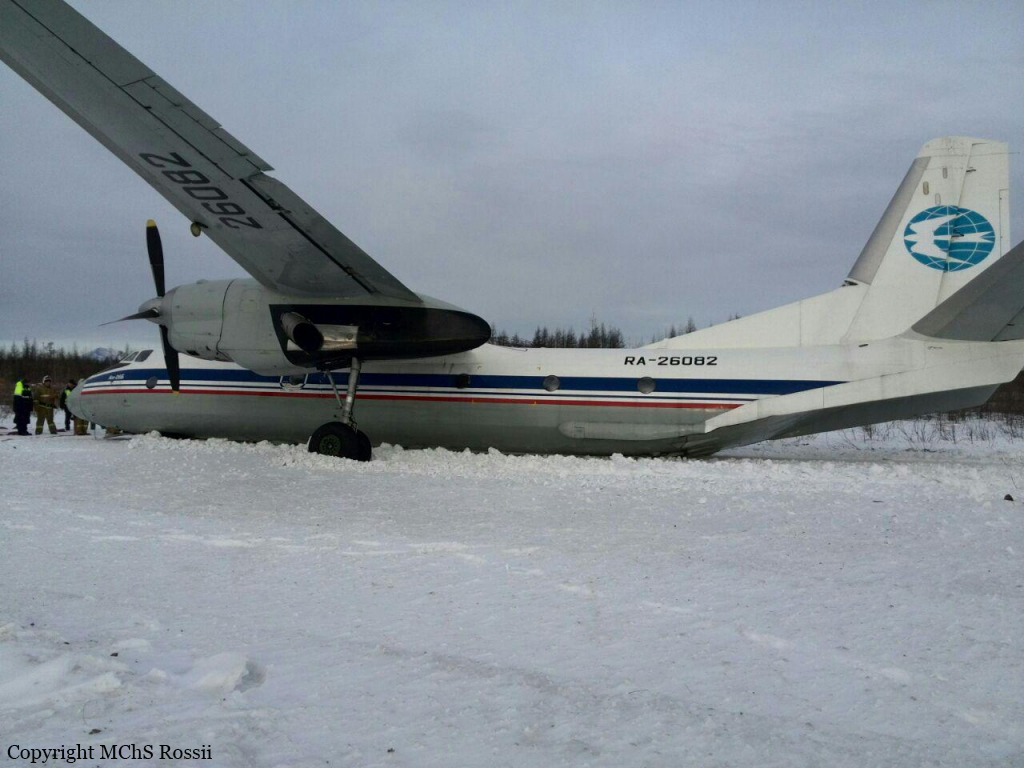
During the take off run, at a speed of 250 km/h, the crew initiated the rotation when the aircraft failed to lift off. The captain decided to abandon the take off and started an emergency braking. The aircraft veered off runway to the right, went through a snow covered terrain, lost its nose and right main gear before coming to rest 490 meters further, with the right wing bent. The aircraft was considered as damaged beyond repair while all eight occupants were unhurt.
Probable cause:
The accident occurred as result of the aircraft departing the side of the runway after the commander rejected takeoff after having been unable to use the elevator because of the yoke's locked position. The roll beyond the edge of the runway was likely caused by the flight engineer while attempting to operate the handle to release the flight controls lock while the aircraft was already accelerating for takeoff. The accident was thus caused by this combination of factors:
- violation of requirements by FCOM to ascertain the flight controls were free and usable before engine start,
- failure by the crew to execute the checklists to check elevator, rudder and ailerons were free to move before takeoff,
- flight crew receives insufficient practice in real flight to maintain skills acquired during simulator training in the management of the aircraft and its systems resulting in negative impact during emergency situations.
Final Report:

Crash of a Saab 340B in Stornoway

Date & Time: Jan 2, 2015 at 0833 LT
Type of aircraft:
Operator:
Registration:
G-LGNL
Flight Phase:
Survivors:
Yes
Schedule:
Stornoway – Glasgow
MSN:
246
YOM:
23
Flight number:
BE6821
Region:
Crew on board:
3
Crew fatalities:
Pax on board:
26
Pax fatalities:
Other fatalities:
Total fatalities:
0
Captain / Total flying hours:
3880
Captain / Total hours on type:
3599.00
Circumstances:
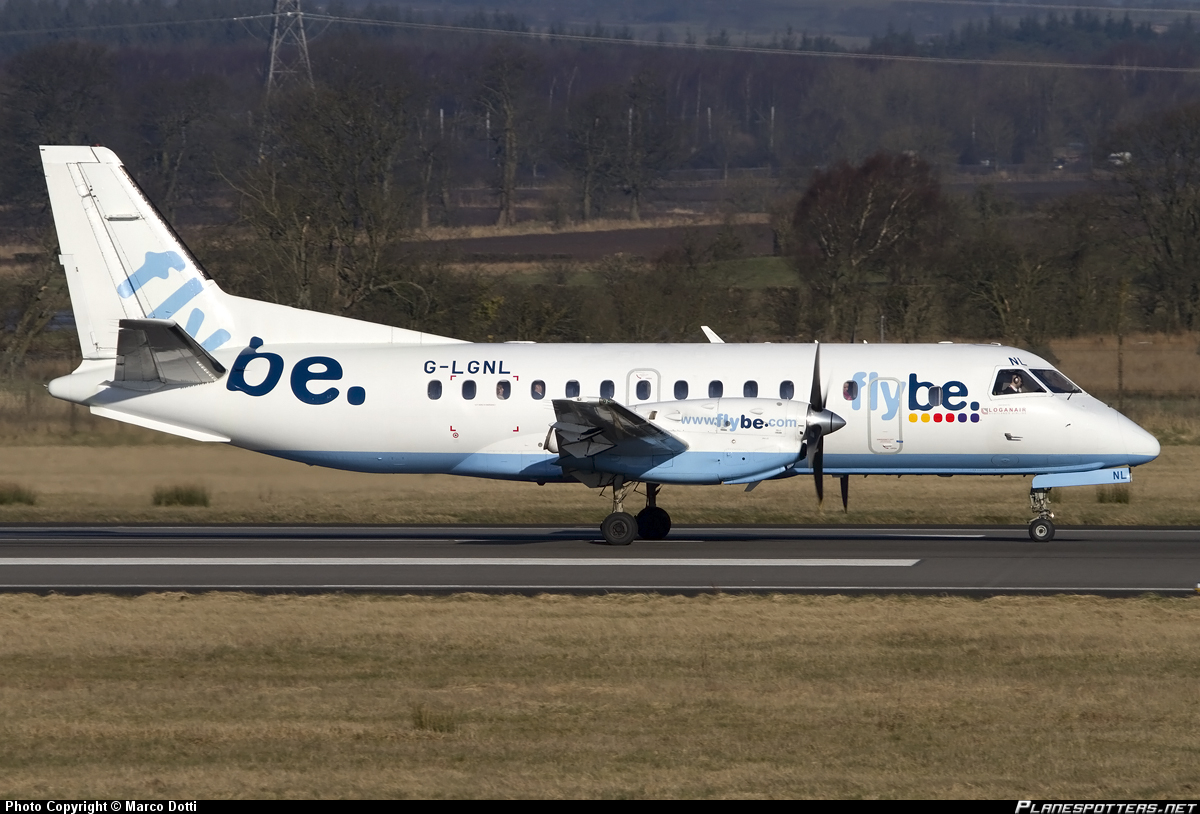
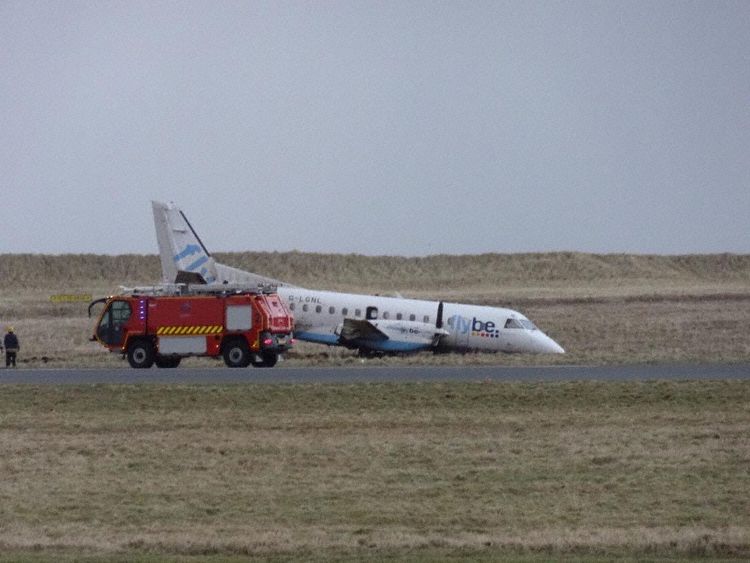
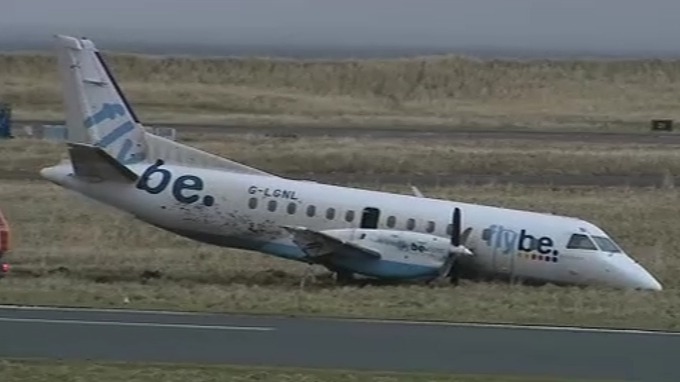
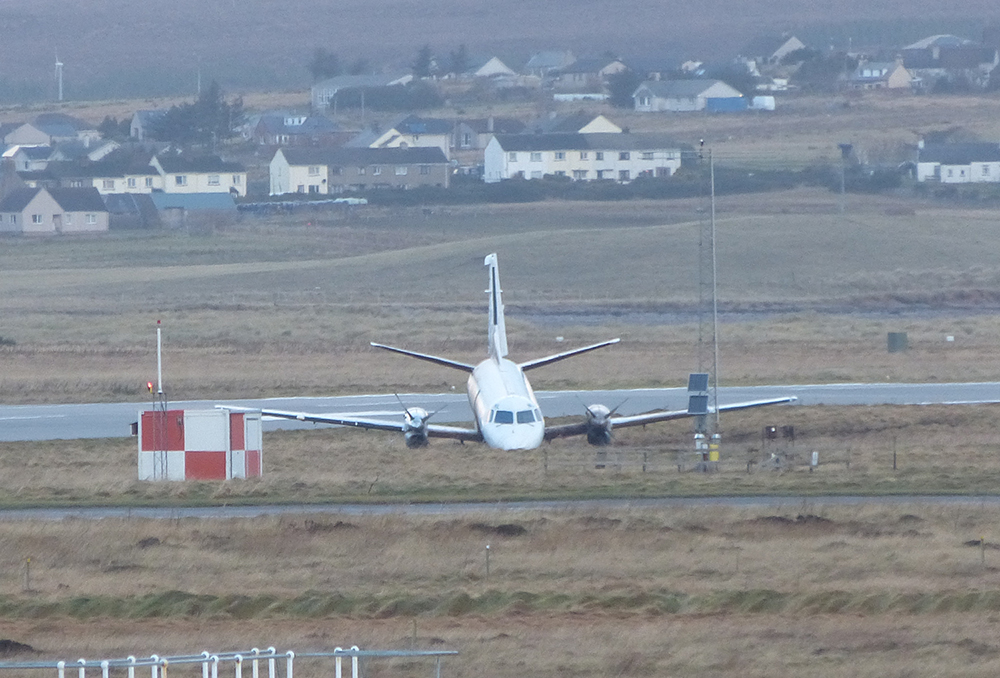
The aircraft had been prepared for a Commercial Air Transport flight from Stornoway Airport to Glasgow Airport with 26 passengers and three crew on board; the commander was the Pilot Flying (PF) and the co-pilot was the Pilot Monitoring (PM). At 0825 hrs the aircraft was taxied towards Holding Point A1 for a departure from Runway 18. At 0832 hrs G-LGNL was cleared to enter the runway from Holding Point A1 and take off, and the ATC controller transmitted that the surface wind was from 270° at 27 kt. The commander commented to the co-pilot that the wind was across the runway and that there was no tailwind. As the aircraft taxied onto the runway, the co-pilot applied almost full right aileron input consistent with a cross-wind from the right, and the commander said to the co-pilot “charlie1, one hundred, strong wind from the right”. The commander advanced the power levers, the co-pilot said “autocoarsen high” and the engine torques increased symmetrically. The commander instructed the co-pilot to “set takeoff power” to which the co-pilot replied “apr armed”. Approximately one second after this call, the engine torques began to increase symmetrically, reaching 100% as the aircraft accelerated through 70 kt. During the early stages of the takeoff, left rudder was applied and the aircraft maintained an approximately constant heading. As the aircraft continued accelerating, the rudder was centralised, after which there was a small heading change to the left, then to the right, then a rapid heading change to the left causing the aircraft to deviate to the left of the runway centreline. The pilot applied right rudder but although the aircraft changed heading to the right in response, it did not alter the aircraft’s track significantly and the aircraft skidded to the left, departing the runway surface onto the grass at an IAS of 80 kt. The power levers remained at full power as the aircraft crossed a disused runway and back onto grass. During this period the nose landing gear collapsed before the aircraft came to a halt approximately 38 m left of the edge of the runway and 250 m from where it first left the paved surface. After the aircraft came to a halt, the captain saw that the propellers were still turning and so called into the cabin for the passengers to remain seated. One of the passengers shouted for someone to open the emergency exit but the cabin crew member instructed the passengers not to do so because the propellers were still turning. The co-pilot observed that the right propeller was still turning so operated the engine fire extinguishers to shut down both engines. When the passenger seated in the emergency exit row on the right of the aircraft saw that the right propeller had stopped, he decided to open the exit. He climbed out onto the wing and helped the remaining passengers leave the aircraft through the same exit, instructing them to slide off the rear of the wing onto the ground. The left propeller was still turning at the time the right over-wing exit was opened and the passenger seated in the left-side emergency exit row decided not to open the left exit. The crash alarm was activated by ATC at 0833 hrs. An aircraft accident was declared and the aerodrome emergency plan was put into action. When the Rescue and Fire Fighting Services (RFFS) arrived at the scene, passengers were still exiting the aircraft and the left propeller was still turning. After leaving the aircraft, the cabin crew member confirmed to the RFFS that all passengers had exited the cabin and had been accounted for outside. The passengers were taken to the fire station and then on to the passenger terminal. There were no injuries.
Probable cause:
During the attempted takeoff, the rudder was central from 40 kt and remained so until approximately 65 kt. Between approximately 52 and 65 kt, the aircraft turned right slightly before it turned left sharply at approximately 65 kt. Given that the rudder was central, this change of direction might have been caused by one, or a combination of the following factors:
a. Differential braking
b. Asymmetric thrust
c. A change in wind speed and direction
d. A nose wheel steering input
Data from the FDR showed that thrust was applied symmetrically throughout the takeoff run, and the manufacturer did not consider that the data for longitudinal acceleration and indicated airspeed supported the use of differential braking.
Final Report:


Crash of a Boeing 737-4H6 in Lahore

Date & Time: Dec 30, 2014 at 1522 LT
Type of aircraft:
Operator:
Registration:
AP-BJN
Survivors:
Yes
Schedule:
Karachi – Lahore
MSN:
26460/2533
YOM:
1993
Flight number:
NL148
Country:
Region:
Crew on board:
6
Crew fatalities:
Pax on board:
166
Pax fatalities:
Other fatalities:
Total fatalities:
0
Circumstances:
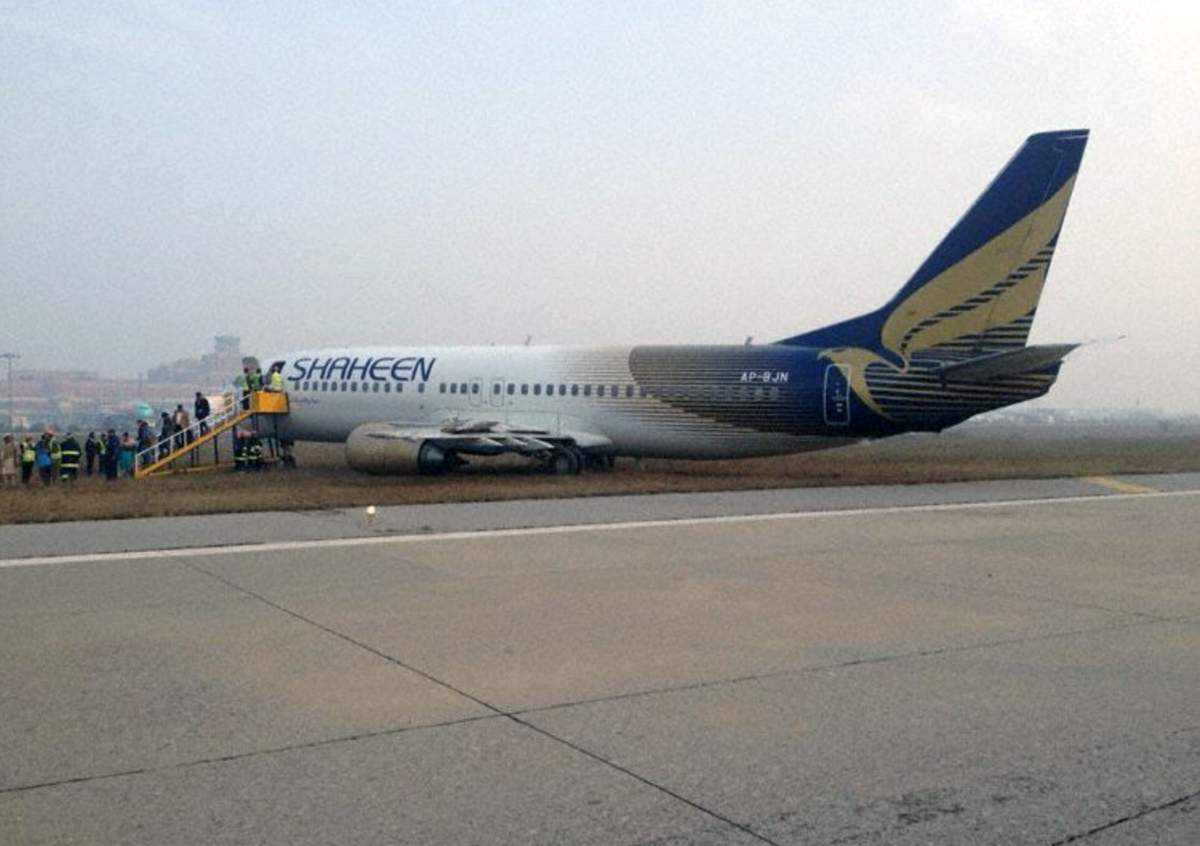
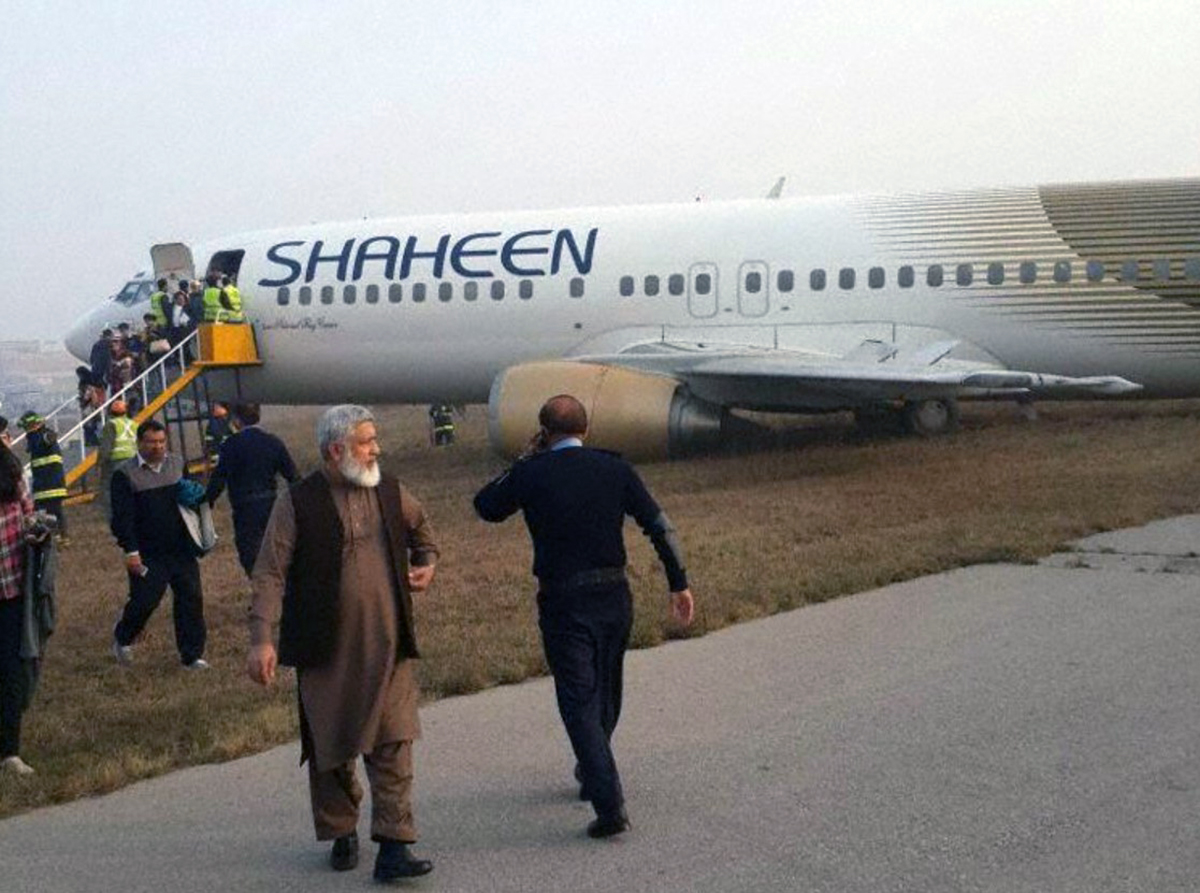
Following an uneventful flight from Karachi, the crew completed the approach and landing on runway 36L at Lahore-Allama Muhammad Iqbal Airport. After touchdown, the crew initiated the braking procedure when the left main gear partially collapsed. Control was lost and the aircraft veered to the right before coming to rest in a grassy area. All 172 occupants evacuated safely and the aircraft was damaged beyond repair.
Probable cause:
It was determined that the left main gear partially collapsed after it suffered a bird strike (rapacious) on approach.