Crash of a De Havilland DHC-6 Twin Otter 200 in Poste-Montagnais

Date & Time: Jan 20, 1992 at 1510 LT
Operator:

Registration:
C-FHNM
Flight Phase:
Flight Type:
Survivors:
Yes
Schedule:
Poste-Montagnais - Seven Islands
MSN:
127
YOM:
1968
Country:
Crew on board:
2
Crew fatalities:
Pax on board:
0
Pax fatalities:
Other fatalities:
Total fatalities:
0
Circumstances:
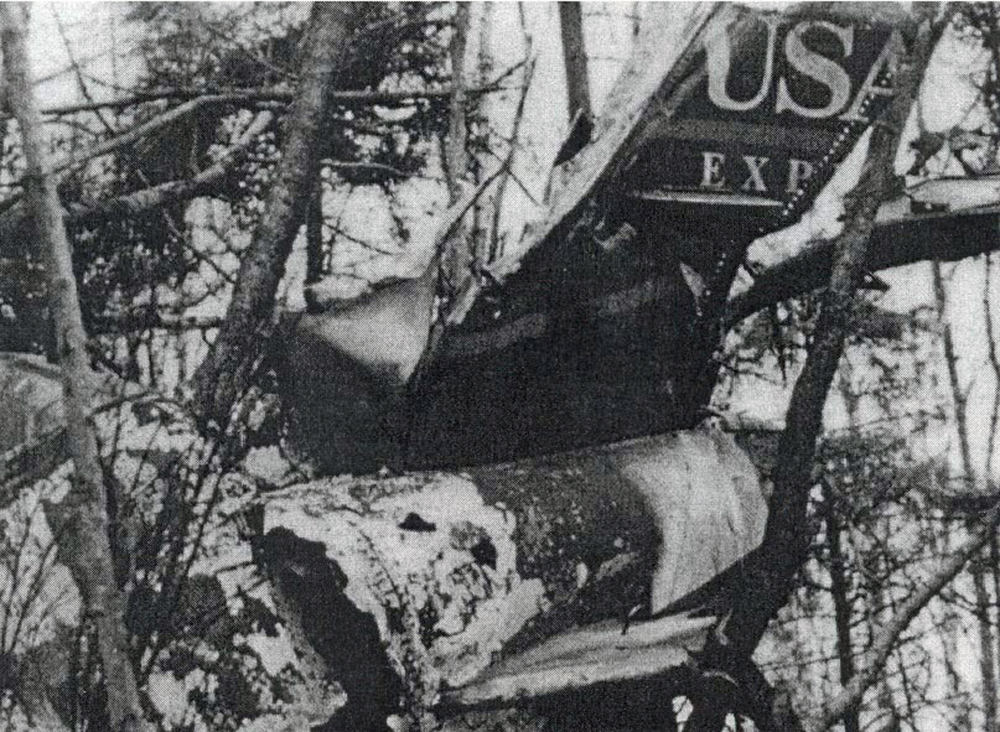
During the takeoff roll on icy runway 18, the aircraft deviated to the left but the crew continued the takeoff procedure. At liftoff, the aircraft struck a 1,2 metre snowdrift and crashed, coming to rest upside down. Both pilots escaped uninjured and the aircraft was damaged beyond repair and later transferred to Norway on static display.

Crash of a Douglas DC-9-31 in Elmira

Date & Time: Jan 18, 1992 at 1028 LT
Type of aircraft:
Operator:
Registration:
N964VJ
Survivors:
Yes
Schedule:
Ithaca - Elmira
MSN:
47373
YOM:
1969
Flight number:
US305
Crew on board:
5
Crew fatalities:
Pax on board:
36
Pax fatalities:
Other fatalities:
Total fatalities:
0
Captain / Total flying hours:
19000
Captain / Total hours on type:
9500.00
Aircraft flight hours:
59251
Circumstances:
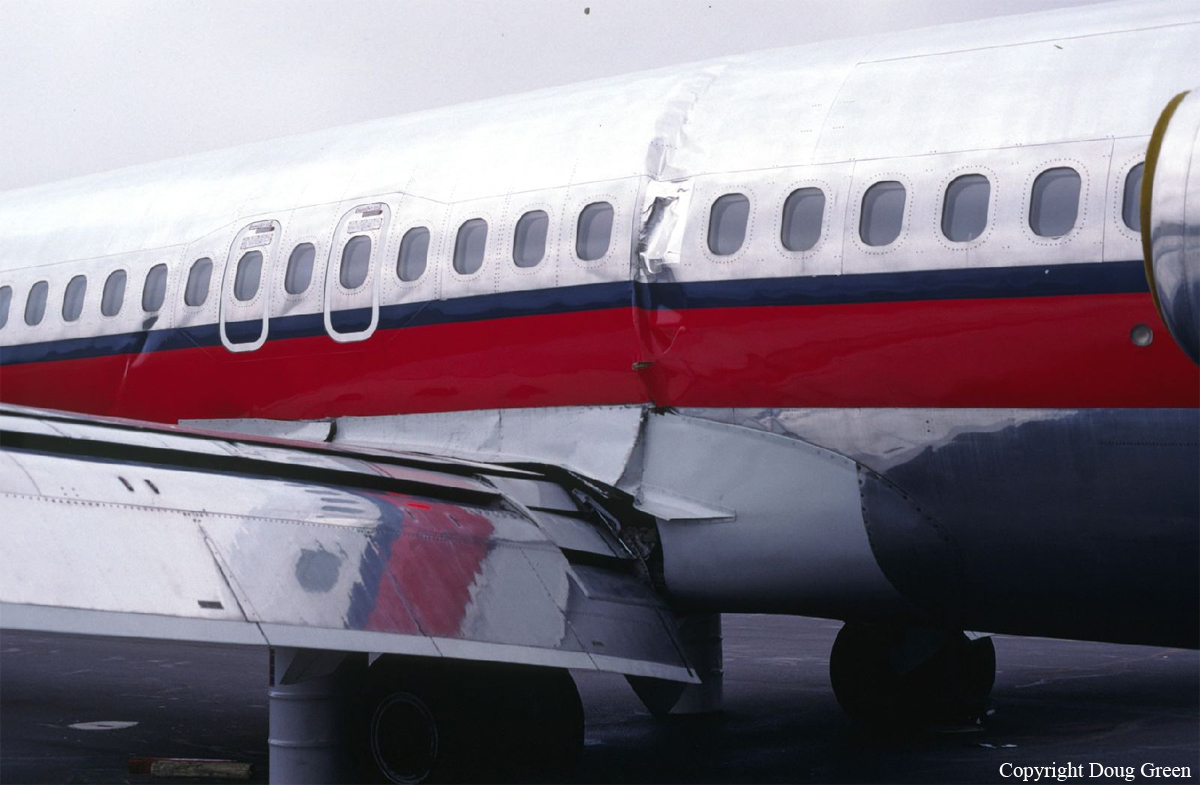
At the time of the accident, gusty winds were forecast for the surface to higher altitudes. The copilot was flying and configured the airplane about four miles out for landing on runway 24. The flightcrew received progressive wind information during the approach; the last report was wind at 310° and 25 knots. The approach speed was v ref + 10. According to the flightcrew, during the landing flare a wind gust occurred, and the airplane lifted in a nose down attitude. The gust stopped and then the airplane descended to the runway and landed hard. The examination of the airplane revealed the fuselage cracked near where the wings were attached and the aft fuselage was bent down about 7°. Two passengers were seriously injured.
Probable cause:
The aircraft encountered a sudden wind gust during landing flare, which resulted in a hard landing.
Final Report:

Crash of a Cessna 402 in Lantana: 1 killed

Date & Time: Jan 11, 1992 at 1147 LT
Type of aircraft:
Operator:
Registration:
N3767C
Flight Type:
Survivors:
No
Schedule:
Lantana - Jacksonville
MSN:
402B-0617
YOM:
1974
Crew on board:
1
Crew fatalities:
Pax on board:
0
Pax fatalities:
Other fatalities:
Total fatalities:
1
Captain / Total flying hours:
10400
Captain / Total hours on type:
300.00
Aircraft flight hours:
5501
Circumstances:
Flight departed and upon reaching a point approx 35 miles north of airport pilot requested return to airport from ATC. Pilot did not declare emergency or report an engine problem. Upon entering traffic pattern at uncontrolled airport pilot stated he would follow a Cessna 152 for landing. On short final aircraft was seen making s turns to maintain spacing behind 152. Pilot then declared he had an engine shutdown and needed to land. 152 was in landing flare and landed. With 152 on runway pilot attempted a go around with full flaps extended, gear down, left engine shutdown, and at a slow airspeed. Aircraft rolled to left upon application of right engine power and nosed down from which it crashed. The number two cylinder of the left engine had suffered separation of the head from the barrel. Pilot logbook did not reflect pilot having current biennial flight review. The pilot, sole on board, was killed.
Probable cause:
The pilot in commands failure to maintain airspeed above single engine minimum control speed resulting in an inflight loss of control and collision with terrain. Contributing to the accident was the pilot in command's failure to declare an emergency and request priority landing and his decision to follow a slower aircraft in the pattern.
Final Report:

Crash of a Beechcraft C-12F Huron in Corumbá

Date & Time: Jan 11, 1992
Type of aircraft:
Operator:
Registration:
85-1269
Flight Type:
Survivors:
Yes
MSN:
BP-60
YOM:
1986
Country:
Crew on board:
0
Crew fatalities:
Pax on board:
0
Pax fatalities:
Other fatalities:
Total fatalities:
0
Circumstances:
After landing at Corumbá Airport, the twin engine was unable to stop within the remaining distance, overran and came to rest in a grove. There were no casualties. Apparently, the crew got lost en route after the navigation system failed. As the aircraft was short of fuel, the crew diverted to Corumbá Airport for an emergency landing.

Crash of a Cessna 401 in Cumaná: 5 killed

Date & Time: Jan 6, 1992
Type of aircraft:
Operator:
Registration:
YV-605C
Survivors:
Yes
Location:
Country:
Crew on board:
1
Crew fatalities:
Pax on board:
5
Pax fatalities:
Other fatalities:
Total fatalities:
5
Circumstances:
On approach to Cumaná-Antonio Jose de Sucre Airport, the twin engine aircraft crashed 8 km short of runway. One passenger was seriously injured while five other occupants were killed, among them German tourists.
Probable cause:
It is believed that both engines failed following a fuel exhaustion on approach.

Crash of a Piper PA-31-350 Navajo Chieftain in Shinyanga

Date & Time: Jan 5, 1992 at 1610 LT
Registration:
5H-IAS
Flight Type:
Survivors:
Yes
Schedule:
Nairobi - Shinyanga
MSN:
31-7852064
YOM:
1978
Country:
Region:
Crew on board:
1
Crew fatalities:
Pax on board:
0
Pax fatalities:
Other fatalities:
Total fatalities:
0
Circumstances:
The pilot, sole on board, was completing a positioning flight from Nairobi to Shinyanga. On approach to Shinyanga-Ibadakuli Airport, he encountered poor visibility when the twin engine aircraft landed on the left side of the runway. It collided with edge marker, lost its nose gear and came to rest with its both propellers damaged. The pilot escaped uninjured and the aircraft was damaged beyond repair.

Crash of a Cessna 421B Golden Eagle II in Steamboat Springs: 3 killed

Date & Time: Jan 4, 1992 at 1606 LT
Operator:
Registration:
N1974G
Flight Phase:
Flight Type:
Survivors:
Yes
Schedule:
Steamboat Springs - Minneapolis
MSN:
421B-0862
YOM:
1974
Crew on board:
1
Crew fatalities:
Pax on board:
8
Pax fatalities:
Other fatalities:
Total fatalities:
3
Captain / Total flying hours:
4000
Aircraft flight hours:
2916
Circumstances:
While initiating a cross country flight, the eight place aircraft with nine persons aboard, impacted terrain shortly after takeoff. Ice had been seen on the wings and horizontal stabilizer, and icing conditions were present. The aircraft was over maximum gross weight by a minimum of 258 pounds, and the pilot held an expired student pilot certificate dated august 17, 1984. A copy of a private pilot certificate designating multiengine land and instrument was found in the pilot's personal belongings. Faa officials concluded that it was not a valid certificate. An application for a medical certificate dated may 30, 1991, indicated the pilot had 4,000 hours of flight time. This figure could not be verified. Just prior to takeoff the pilot was observed brushing snow off the wings. Following the accident granular ice was found on the aerodynamic surfaces. The pilot and two passengers were killed while six other occupants were injured.
Probable cause:
Airframe ice and the pilot's failure to remove it. Factors were: aircraft weight exceeded and lack of pilot certification.
Final Report:

Crash of a Beechcraft 1900C in Saranac Lake: 2 killed

Date & Time: Jan 3, 1992 at 0546 LT
Type of aircraft:
Operator:
Registration:
N55000
Survivors:
Yes
Schedule:
Plattsburgh – Saranac Lake – Albany
MSN:
UC-135
YOM:
1990
Flight number:
US4821
Crew on board:
2
Crew fatalities:
Pax on board:
2
Pax fatalities:
Other fatalities:
Total fatalities:
2
Captain / Total flying hours:
7700
Captain / Total hours on type:
3700.00
Aircraft flight hours:
1675
Circumstances:
On IFR arrival, flight 4821 was cleared to intersection 17 northeast of airport at 6,000 feet, then for ILS runway 23 approach. Radar service was terminated 6.5 east of intersection. Radar data showed that flight crossed and then bracketed localizer. Flight intercepted glide slope from below about 7 miles outside of outer marker and thence deviated above glide slope. About 2 miles outside of marker, flight was at a full fly down deflection when it entered a descent varying from 1,200 to 2,000 fpm. Aircraft struck wooded mountain top 2.0 miles inside of outer marker (3.9 miles from runway) at elevation of 2,280 feet. Minimum altitude at marker was 3,600 feet. Glide slope elevation at point of impact was approximately 2,900 feet. Evidence was found of inadequate electrical ground path between radome and fuselage which, when combined with existing weather conditions, may have produced electrostatic discharge (precipitation static). Although post-accident tests were not conclusive, the safety board believes that the glide slope indications might have been unreliable due to precipitation static interference. Two occupants survived while two others (one pilot and one passenger) were killed.
Probable cause:
Failure of the captain to establish a stabilized approach, his inadequate cross-check of instruments, his descent below specified minimum altitude at the final approach fix, and failure of the copilot to monitor the approach. Factors related to the accident were: weather conditions and possible precipitation static interference, caused by inadequate grounding between the radome and fuselage that could have resulted in unreliable glide slope indications.
Final Report:

Crash of a PZL-Mielec AN-28 in Lyakhsh

Date & Time: Jan 3, 1992
Type of aircraft:
Operator:
Registration:
CCCP-28706
Flight Type:
Survivors:
Yes
Schedule:
Dushanbe - Lyakhsh
MSN:
1AJ006-16
YOM:
1989
Country:
Region:
Crew on board:
2
Crew fatalities:
Pax on board:
11
Pax fatalities:
Other fatalities:
Total fatalities:
0
Circumstances:
The twin engine aircraft was completing a special flight from Dushanbe to Lyakhsh on behalf of the Tajik Civil Aviation Department. For unknown reasons, the crew continued the approach at an insufficient altitude when the unstabilized aircraft struck the ground 210 metres short of runway and 50 metres to the right of its extended centerline. On impact, the undercarriage were torn off and the aircraft came to rest. All 13 occupants escaped uninjured while the aircraft was damaged beyond repair.
Probable cause:
Wrong approach configuration.

Crash of a Piper PA-31P Pressurized Navajo in Mosinee: 1 killed

Date & Time: Jan 2, 1992 at 1305 LT
Type of aircraft:
Operator:
Registration:
N500BH
Survivors:
No
Schedule:
Minneapolis - Mosinee
MSN:
31-7530024
YOM:
1975
Crew on board:
1
Crew fatalities:
Pax on board:
0
Pax fatalities:
Other fatalities:
Total fatalities:
1
Captain / Total flying hours:
8150
Captain / Total hours on type:
1500.00
Aircraft flight hours:
3520
Circumstances:
Pilot was cleared for an ILS approach at his destination, and requested to report altitude of 3,000 feet on the approach. This was the last radio transmission received from the pilot. Aircraft was found in soft field six miles from the airport. Landing gear was up, flaps were down. Fisherman nearby reported hearing the aircraft maneuvering at low altitude. He reported that the engines sounded fine, but the sound was changing in pitch and intensity. He reported that got quiet just a few seconds before he heard the impact. The investigation revealed that there was evidence of a fire in the nose baggage compartment. The cabin heater is located in the nose baggage compartment, and had a recent history of discrepancies. The pilot, sole on board, was killed.
Probable cause:
An inflight fire with the cabin heater as the origin, and unsuitable terrain in which to make a forced landing. A factor related to the accident was the soft terrain.
Final Report: