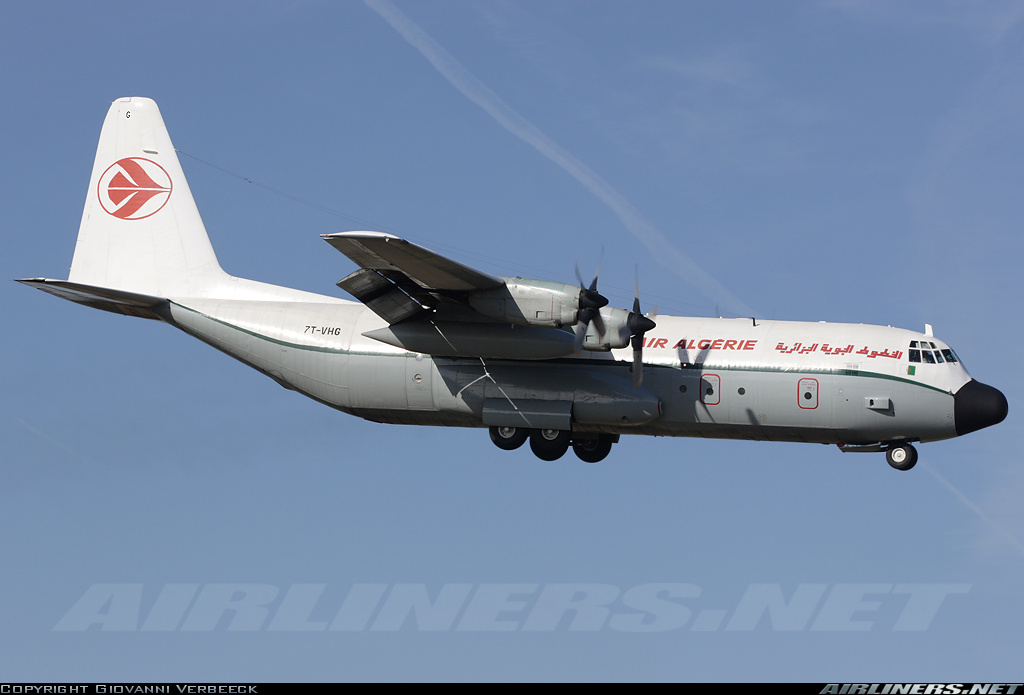
Crash of a Lockheed L-382G-51C Hercules in Piacenza: 3 killed

Date & Time: Aug 13, 2006 at 2015 LT
Type of aircraft:
Operator:
Registration:
7T-VHG
Flight Phase:
Flight Type:
Survivors:
No
Schedule:
Algiers - Frankfurt
MSN:
4880
YOM:
1981
Flight number:
AH2208
Country:
Region:
Crew on board:
3
Crew fatalities:
Pax on board:
0
Pax fatalities:
Other fatalities:
Total fatalities:
3
Captain / Total flying hours:
8200
Copilot / Total flying hours:
22800
Aircraft flight hours:
31889
Aircraft flight cycles:
13173
Circumstances:
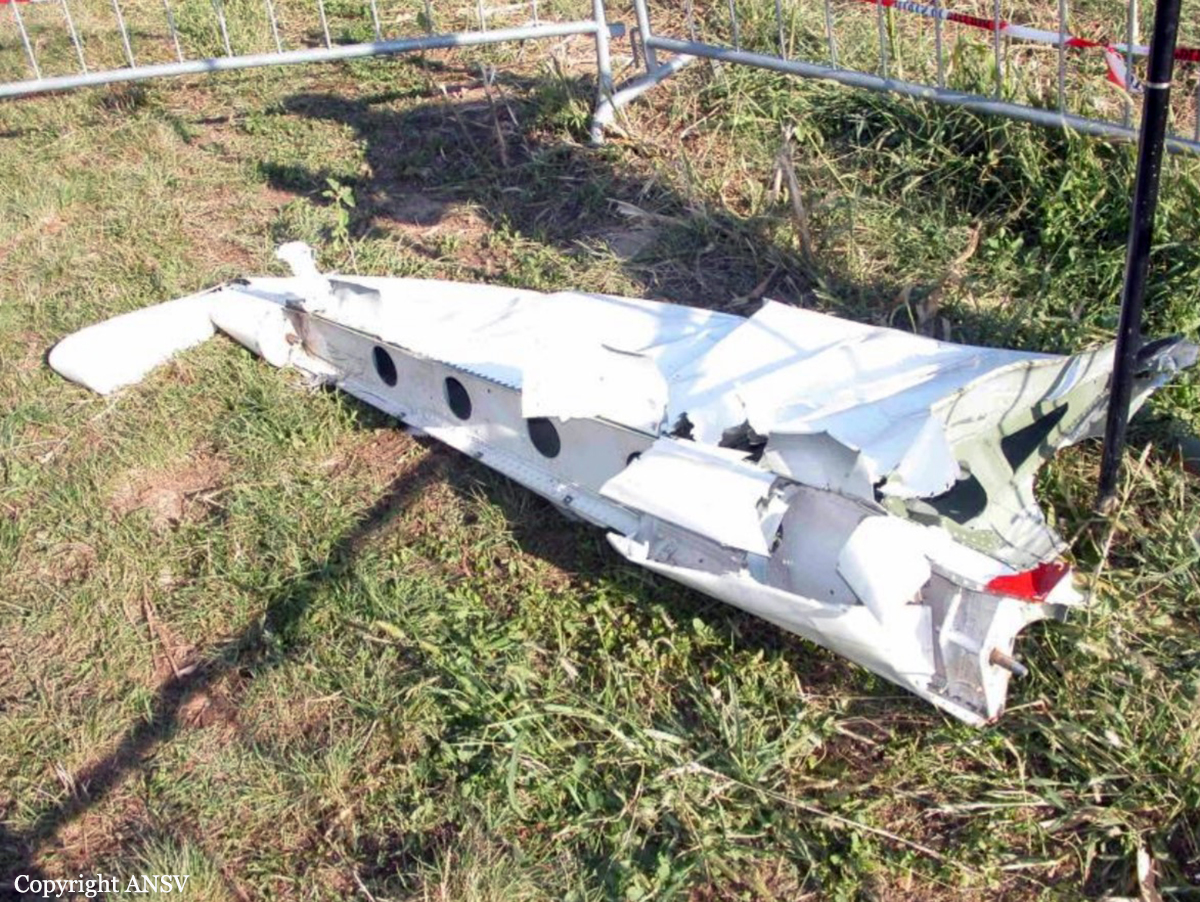
The four engine aircraft departed Algiers-Houari Boumédiène Airport at 1705LT on a cargo flight to Frankfurt with a crew of three on board. While cruising at an altitude of 25,000 feet over north Italy, the copilot informed ATC about the failure of the automatic pilot system. Less than a minute later, the aircraft entered an uncontrolled descent during which the overspeed alarm sounded in the cockpit. In a nose down angle of 45-50° and at a speed of 850/900 km/h, the aircraft crashed in an open field located southwest of Piacenza. The aircraft totally disintegrated on impact and all three crew members were killed. A large crater was found at the point of impact and debris were found till 800 metres around.
Probable cause:
The very high state of fragmentation of the wreck and the substantial absence/utilisation of FDR data made the safety investigation very difficult and therefore could not acquire some indisputable certainties on certain aspects. The indications resulting from the examination of the acquired evidence and from the many technical analyses carried out lead to believe that the accident occurred because of the loss sudden control of the aircraft, induced, reasonably speaking, by a technical problem in the flight control system, which the pilots were unable to counter/manage and which the safety investigation could not detect with absolute certainty.
Final Report:
Crash of a Piper PA-31-310 Navajo on Mt Yerbas Buenas: 2 killed

Date & Time: Aug 11, 2006 at 1135 LT
Type of aircraft:
Registration:
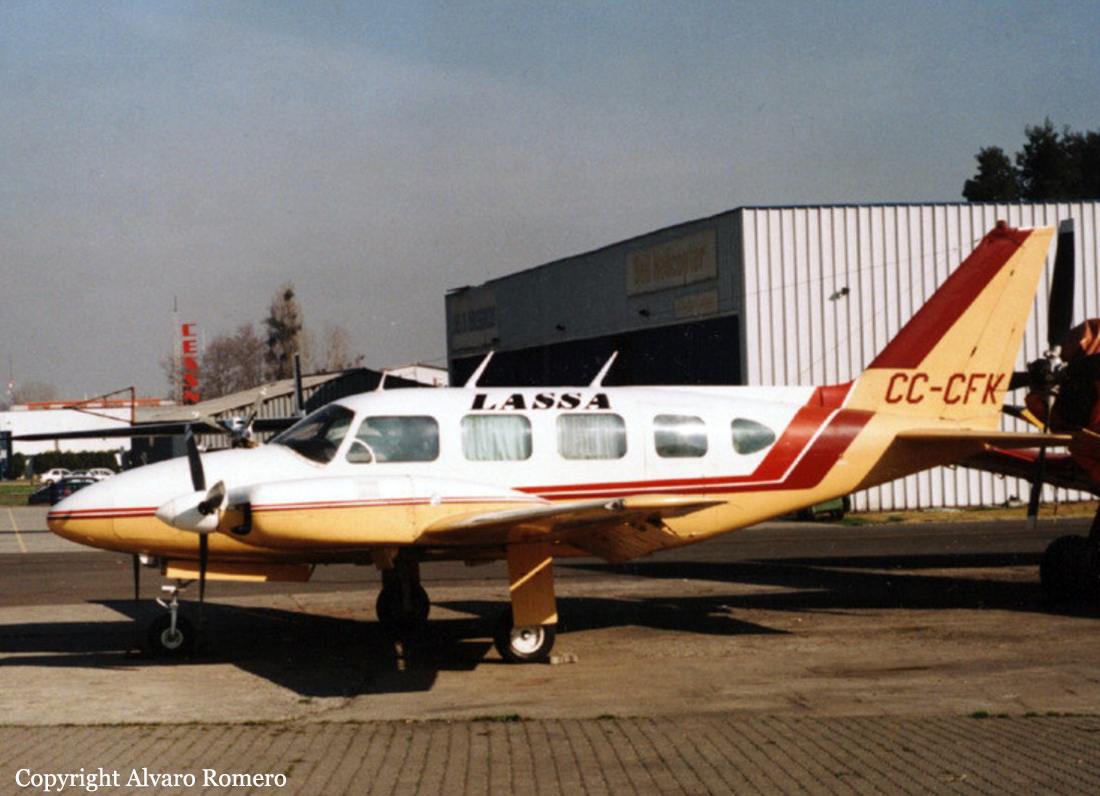
CC-CFK
Flight Phase:
Survivors:
No
Site:
Schedule:
La Serena - La Serena
MSN:
31-607
YOM:
1970
Country:
Crew on board:
1
Crew fatalities:
Pax on board:
1
Pax fatalities:
Other fatalities:
Total fatalities:
2
Captain / Total flying hours:
4519
Circumstances:
The twin engine aircraft departed La Serena-La Florida Airport at 1053LT on a geophysical mission over Domeyko, carrying one passenger and one pilot who were involved in a magnetic prospection mission on behalf of a mining program. Seven minutes after takeoff, the pilot informed ATC about his altitude at 6,500 feet and that he would descend to 500 feet once over the Domeyko area. About half an hour later, the aircraft crashed on the slope of Mt Yerbas Buenas, about 84 km north of La Serena Airport, bursting into flames. The wreckage was found four hours later at an altitude of 1,579 metres. The aircraft was destroyed by a post crash fire and both occupants were killed.
Probable cause:
The accident occurred after the pilot suffered a loss of situational awareness while flying at low altitude, which did not allow him to avoid the collision with the mountain. Such operation conducted in a single pilot configuration was considered as a contributing factor as the workload was high.
Final Report:

Crash of a Let L-410UVP-E near La Venturosa

Date & Time: Aug 4, 2006
Type of aircraft:
Operator:
Registration:
YV-867CP
Flight Phase:
Flight Type:
Survivors:
Yes
MSN:
87 20 10
YOM:
1987
Country:
Crew on board:
0
Crew fatalities:
Pax on board:
0
Pax fatalities:
Other fatalities:
Total fatalities:
0
Circumstances:
The twin engine aircraft departed La Venturosa Airport on an illegal flight to Venezuela. It crashed in unknown circumstances about 145 km west-northwest of Puerto Ayacucho. There were no casualties.

Crash of a Spectrum FJ33 in Spanish Fork: 2 killed

Date & Time: Jul 25, 2006 at 1606 LT
Type of aircraft:
Operator:
Registration:
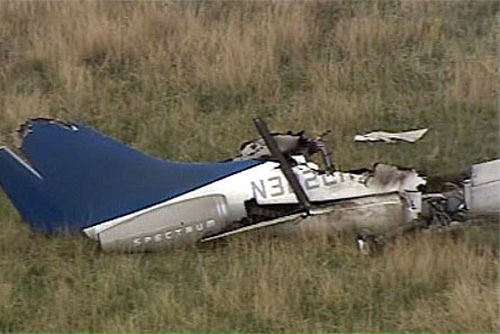
N322LA
Flight Phase:
Flight Type:
Survivors:
No
Schedule:
Spanish Fork - Spanish Fork
MSN:
01
YOM:
2006
Crew on board:
2
Crew fatalities:
Pax on board:
0
Pax fatalities:
Other fatalities:
Total fatalities:
2
Captain / Total flying hours:
2300
Captain / Total hours on type:
22.00
Copilot / Total flying hours:
3100
Copilot / Total hours on type:
16
Aircraft flight hours:
44
Aircraft flight cycles:
47
Circumstances:
The proto-type experimental light jet airplane was departing on a local maintenance test flight. Witnesses reported that the airplane entered a right roll almost immediately after liftoff. The roll continued to about 90 degrees right wing down at which point the right wingtip impacted the ground. During examination of the wreckage, the aileron control system was found connected such that the airplane rolled in the opposite direction to that commanded in the cockpit. The maintenance performed on the airplane before the accident flight included removal of the main landing gear (MLG) in order to stiffen the MLG struts. Interviews with the mechanics who performed the maintenance revealed that during re-installation and system testing of the MLG, it was discovered that the changes to the MLG struts impacted the Vbracket holding the aileron control system's upper torque tube. The V-bracket was removed and a redesigned V-bracket was installed in its place. This work required the disconnection of a portion of the aileron control system, including the removal of the aft upper torque tube bell crank from the torque tube. The mechanic who reinstalled the aft upper torque tube bell crank was under the incorrect assumption that there was only one way to install the bell crank on the torque tube. However, there are actually two positions in which the bell crank could be installed. The incorrect installation is accomplished by rotating the bell crank 180° about the axis of the torque tube and flipping it front to back, and this is the way the bell crank was found installed. With the bell crank installed incorrectly and the rest of the system installed as designed, there is binding in the system. This binding was noticed on the accident airplane during the inspection after initial installation. However, the mechanic did not recognize that the bell crank was improperly installed on the torque tube. Instead of fixing the problem by removing and correctly reinstalling the bell crank, he fixed the problem by disconnecting the necessary tie rods and rotating the upper torque tube so that the arm of the bell crank pointed up and to the left. This action reversed the movement of the ailerons. According to all of the personnel interviewed, there was no maintenance documentation to instruct mechanics how to perform the work since this was a proof-of-concept airplane. None of the mechanics who performed the work could recall if the position of the ailerons in relation to the position of the control stick was checked. Such a position check, if it had been performed by either the mechanics after the maintenance or by the flight crew during the preflight checks, would assuredly have indicated that the system was installed incorrectly.
Probable cause:
Incorrect installation by company maintenance personnel of the aft upper torque tube bell crank resulting in roll control that was opposite to that commanded in the cockpit. Contributing factors were the lack of maintenance documentation detailing the installation of the bell crank, the installing mechanic's incorrect assumption that the bell crank could only be installed in one position, and the failure of maintenance personnel and the flight crew to check the position of the control stick relative to the ailerons after the maintenance and during the preflight checks.
Final Report:

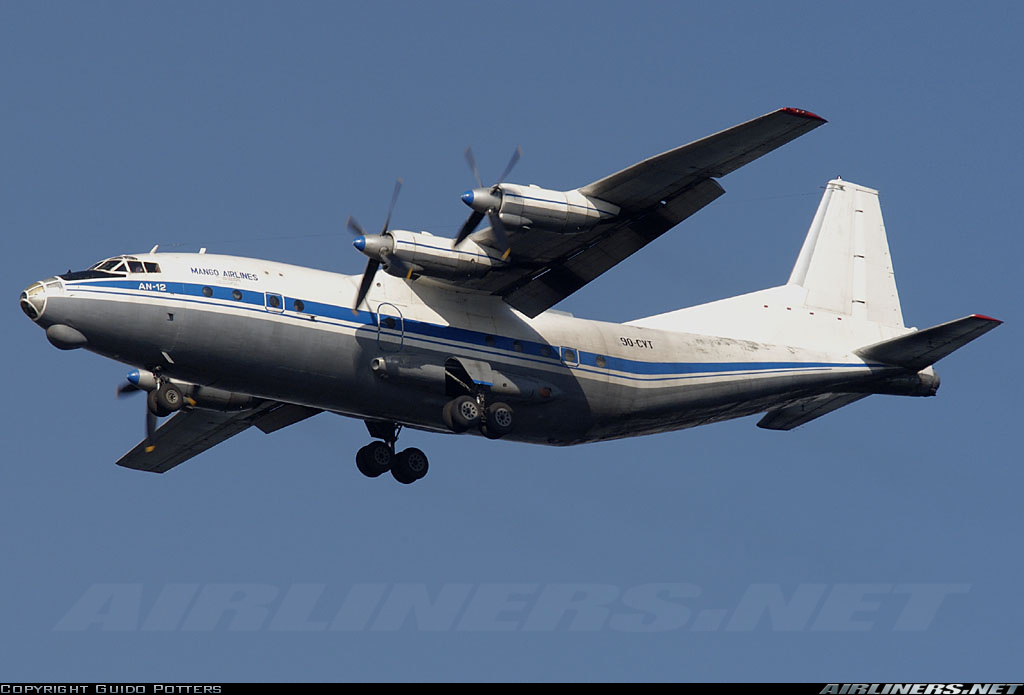
Crash of an Antonov AN-12B near Sake: 6 killed

Date & Time: Jul 7, 2006 at 1540 LT
Type of aircraft:
Operator:
Registration:
9Q-CVT
Flight Phase:
Flight Type:
Survivors:
No
Site:
Schedule:
Goma - Kisangani
MSN:
3 3 415 06
YOM:
1963
Location:
Region:
Crew on board:
6
Crew fatalities:
Pax on board:
0
Pax fatalities:
Other fatalities:
Total fatalities:
6
Circumstances:
Few minutes after takeoff from Goma Airport, en route to Kisangani, the crew informed ATC about engine problem and was cleared to return to Goma for an emergency landing. Shortly later, the aircraft lost height, hit trees and crashed in hilly terrain located near Sake, about 20 km northwest of Goma. The aircraft was destroyed and all 6 occupants were killed.
Probable cause:
Loss of control following an engine failure. According to Antonov Design Bureau, the airworthiness certificate expired on March 30, 2001. Also, the aircraft was operated without valid documentation and the airworthiness certificate was still registered to the old operator with the registration 9U-BHN.

Crash of a PZL-Mielec AN-2P in Tayinsha: 1 killed

Date & Time: Jun 17, 2006 at 0630 LT
Type of aircraft:
Operator:
Registration:
UN-70367
Flight Phase:
Survivors:
Yes
Schedule:
Tayinsha - Tayinsha
MSN:
1G141-21
YOM:
1973
Country:
Region:
Crew on board:
2
Crew fatalities:
Pax on board:
0
Pax fatalities:
Other fatalities:
Total fatalities:
1
Circumstances:
The crew was completing a crop-spraying flight in the region of Tayinsha, North Kazakhstan. While flying at a height of about 10-15 metres, the crew wanted to impress a group of women working in the field, initiated risky manoeuvres and eventually lost control of the aircraft that rolled steeply to the left and crashed upside down. The aircraft was destroyed and both pilots were seriously injured. Few days later, one of them died from his injuries.

Crash of a Shaanxi Y-8 in Yao: 40 killed

Date & Time: Jun 3, 2006 at 1500 LT
Type of aircraft:
Operator:
Flight Phase:
Flight Type:
Survivors:
No
Location:
Country:
Region:
Crew on board:
5
Crew fatalities:
Pax on board:
35
Pax fatalities:
Other fatalities:
Total fatalities:
40
Circumstances:
While cruising at an altitude of 8,000 metres, the crew encountered icing conditions. In unclear circumstances, the aircraft entered an uncontrolled descent, partially disintegrated in the air and eventually crashed in a bamboo forest located near Yao. The aircraft was totally destroyed and all 40 occupants were killed.

Crash of a Cessna T207A Turbo Stationair 7 II in Pemberton: 1 killed

Date & Time: May 18, 2006 at 1506 LT
Operator:
Registration:
C-GGQR
Flight Phase:
Flight Type:
Survivors:
No
Site:
Schedule:
Pemberton – Edmonton
MSN:
207-0499
YOM:
1979
Country:
Crew on board:
1
Crew fatalities:
Pax on board:
0
Pax fatalities:
Other fatalities:
Total fatalities:
1
Captain / Total flying hours:
1500
Circumstances:
The aircraft departed from Pemberton Airport, British Columbia, at about 1500 Pacific daylight time on a visual flight rules flight to Edmonton, Alberta. The aircraft initially climbed out to the east and subsequently turned northeast to follow a mountain pass route. The pilot was alone on this aircraft repositioning flight. The pilot had been conducting air quality surveys for Environment Canada’s Air Quality Research Section in the Pemberton area. The aircraft was operating on a flight permit and was highly modified to accept various types of probes in equipment pods suspended under the wings, a camera hatch type provision in the centre belly area, and carried internal electronic equipment. About 30 minutes after the aircraft took off, the Coastal Fire Service responded to a spot fire and discovered the aircraft wreckage in the fire zone. A post-crash fire consumed most of the airframe, and the pilot was fatally injured. The accident occurred at about 1506 Pacific daylight time.
Probable cause:
Findings as to Causes and Contributing Factors:
1. The pilot entered the valley at an altitude above ground that did not provide sufficient terrain clearance given the aircraft’s performance.
2. The pilot encountered steeply rising terrain, where false horizon and relative scale illusions in the climb are likely. Realizing that the aircraft would not likely be able to out-climb the approaching terrain, he turned to reverse his course.
3. The aircraft’s configuration, relatively high weight, combined with the effects of increased drag from the equipment, density altitude, down-flowing winds, and manoeuvring resulted in the aircraft colliding with terrain during the turn.
Findings as to Risk:
1. A detailed flight plan was not filed and special equipment, such as laser radiation emitting devices and/or hazardous substances were not reported. The absence of flight plan information regarding these devices could delay search and rescue efforts and expose first responders to unknown risks.
2. Transport Canada (TC) does not issue a rating/endorsement for mountain flying training. There are no standards established to ascertain the proficiency of a pilot in this environment. Pilots who complete a mountain flying course may not acquire the required skill sets.
3. There was no emergency locator transmitter (ELT) signal received. The ELT was destroyed in the impact and subsequent fire. Present standards do not require that ELTs resist crash damage.
4. “Flight permits – specific purpose” are issued for aircraft that do not perform as per the original type design but are deemed capable of safe flight. Placards are not required; therefore, pilots and observers approved to board may be unaware of the limitations of the aircraft and the associated risks.
5. The TC approval process allowed the continued operation of this modified aircraft for sustained environmental research missions under a flight permit authority. This circumvented the requirement to meet the latest airworthiness standards and removed the risk mitigation built into the approval process for a modification to a type design.
Other Findings:
1. The fuel system obstruction found during disassembly was a result of the post-crash fire.
2. The aircraft was operated at an increased weight allowance proposed by the design approval representative (DAR). Such operation was to be approved only in accordance with a suitably worded flight permit and instructions contained in the proposed document CN-MSC-011; however, this increased weight allowance was not incorporated to any flight authority issued by TC.
Final Report:

Crash of a Piper PA-60 Aerostar (Ted Smith 600) in Camp Hill: 2 killed

Date & Time: May 10, 2006 at 0921 LT
Operator:
Registration:
N68999
Flight Phase:
Survivors:
No
Schedule:
Cornelia – Pensacola
MSN:
60-8265-023
YOM:
1982
Crew on board:
1
Crew fatalities:
Pax on board:
1
Pax fatalities:
Other fatalities:
Total fatalities:
2
Captain / Total flying hours:
2500
Circumstances:
The pilot obtained a weather briefing from an Automated Flight Service Station (AFSS) and filed an IFR flight plan before departing on an IFR flight from Cornelia, Georgia, to Pensacola, Florida, on May 10, 2006.The flight service specialist provided information on a line of embedded thunderstorm activity along the route from Atlanta to Mobile including SIGMETs and advised that tops were forecasted to be at 41,000 to 50,000 feet. The specialist suggested that the pilot not depart immediately because of the weather, but said that it might be possible to land at an intermediate stop ahead of the weather, possibly in Pensacola or further north in the Crestview area. The pilot filed an IFR flight plan from Cornelia to Pensacola at 16,000 feet. The pilot called the AFSS again and requested an IFR clearance. The specialist responded that the clearance was on request, and that he would work on the void time and placed the pilot on hold. The specialist obtained the clearance from Atlanta Center and returned back to provide the clearance to the pilot. The pilot was not on the telephone line. The pilot departed Cornelia without an IFR clearance and contacted Atlanta Center. The controller informed the pilot on initial contact that he was not on his assigned heading, altitude, correct transponder code, and subsequently handed the pilot off to another controller. The flight was subsequently cleared direct to Panama City, Florida, and the pilot was instructed to climb to 16,000 feet. Atlanta Center broadcasted weather alerts over the radio frequency the pilot was on for Center Weather Advisory 101, SIGMETS 73C, 74C,and AIRMET Sierra between 0903 to 0913 CDT. The National Weather Service Storm Prediction Center, issued Severe Thunderstorm Watch 329 valid from 0635 CDT until 1300 CDT. The National Weather Service Aviation Weather Center issued Convective SIGMET 73C valid from 0855 CDT until 1055 CDT. The SIGMET was for a line of thunderstorms 40 nautical miles wide, and moving from 280 degrees at 35 knots. The tops of the thunderstorms were at 44,000 feet, with 2-inch hail, and possible wind gusts up to 60 knots. These weather alerts included the route of flight for the accident airplane. The controllers did not issue the pilot with severe radar-depicted weather information that was displayed on the controller's radar display. The airplane was observed on radar level at 16,000 feet at 09:19:48 CDT heading southwest. The airplane was observed to began a continuous left turn northwest bound at 15,700 feet at 09:20:38. The pilot called Atlanta center at 09:20:48 CDT and stated, "Aero Star six eight triple nine we're going to make a reverse." and there was no further radio contact with the pilot. The last radar return was at 09:20:59. The airplane was at 15, 600 feet. The wreckage was located on May 11, 2006. Examination of the wreckage revealed the right wing separated 9 feet 2 inches outboard of the wing root. The separated outboard section of the right wing was not recovered. The components were forwarded to the NTSB Laboratory for further examination. Examination of the components revealed the deformation patterns found on the fracture surfaces were consistent with upward bending overstress of the right wing.
Probable cause:
The pilot's continued flight into known thunderstorms resulting in an in-flight break up. A factor in the accident was air traffic controller's failure to issue extreme weather radar echo intensity information displayed on the controller's radar to the pilot.
Final Report:

Crash of a PZL-Mielec AN-2P in Göktepe

Date & Time: May 6, 2006 at 2000 LT
Type of aircraft:
Operator:
Registration:
ER-35538
Flight Phase:
Survivors:
Yes
Site:
Schedule:
Izmir – Adana
MSN:
1G114-50
YOM:
1970
Country:
Region:
Crew on board:
4
Crew fatalities:
Pax on board:
2
Pax fatalities:
Other fatalities:
Total fatalities:
0
Circumstances:
The single engine aircraft was leased by a regional Turkish operator to perform a flight from Izmir to Adana with 4 pilots and 2 engineers from the Moldovan Company. En route, the crew encountered bad weather conditions with limited visibility due to heavy rain falls, and elected to make an emergency landing. The aircraft crash landed in a hilly terrain located near Göktepe. All 6 occupants were slightly injured while the aircraft was damaged beyond repair.