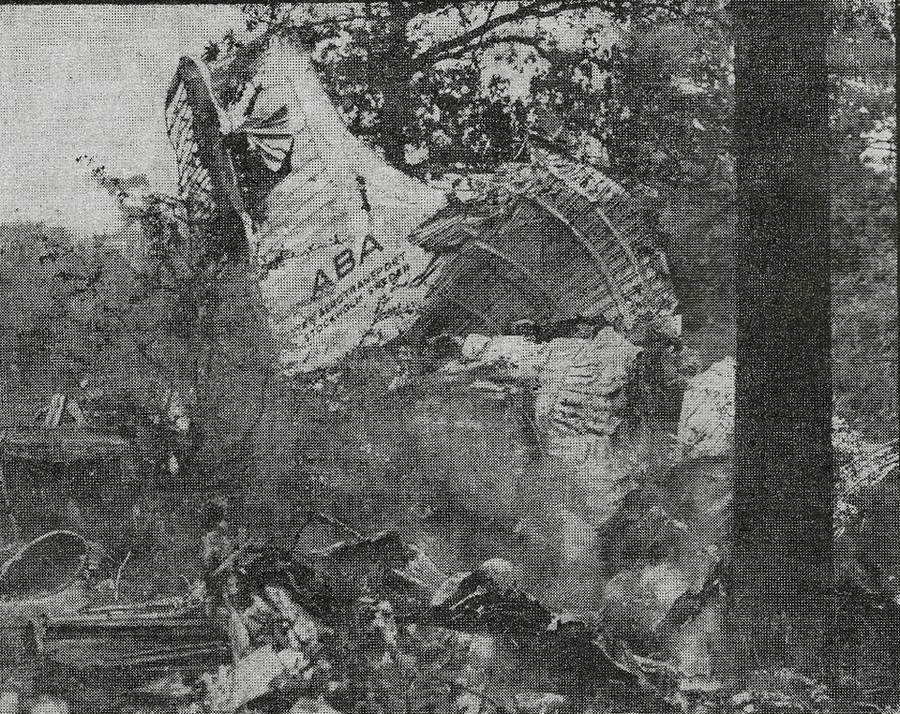
Crash of an Avro 685 York C.1 in RAF Desford

Date & Time: Aug 11, 1948
Type of aircraft:
Operator:
Registration:
MW259
Flight Type:
Survivors:
Yes
MSN:
MW259
YOM:
1946
Region:
Crew on board:
4
Crew fatalities:
Pax on board:
0
Pax fatalities:
Other fatalities:
Total fatalities:
0
Circumstances:
En route, the crew informed ATC that the engine number four failed. He received the permission to divert to RAF Desford to attempt an emergency landing. To lower the risk of fire, the crew decided to shut down the engine number three and feathered the propeller as well. Due to a loss of speed, the aircraft was unable to maintain a safe altitude. During the last segment, the aircraft stalled and hit violently the runway surface. On impact, the aircraft broke in two and came to rest in flames. All four crew members were evacuated safely while the aircraft was destroyed.
Probable cause:
Failure of the engine number four in flight. The exact cause of the failure remains unknown.


Crash of a Douglas C-47A-1-DK Dakota C.3 in Sywell

Date & Time: Jul 30, 1948 at 2100 LT
Operator:
Registration:
G-AGIX
Survivors:
Yes
Schedule:
Edinburgh – Northolt
MSN:
12053
YOM:
1943
Region:
Crew on board:
5
Crew fatalities:
Pax on board:
14
Pax fatalities:
Other fatalities:
Total fatalities:
0
Circumstances:
En route to RAF Northolt, the crew encountered technical problem with the right engine and was forced to shut it down and to feather its propeller. As the aircraft was unable to maintain the prescribed altitude, the crew decided to divert to Sywell. On final approach, the aircraft was misaligned and overflew the runway at low height before colliding with power cables. Out of control, it crashed in a field and came to rest. All 19 occupants were slightly injured while the aircraft was damaged beyond repair.
Probable cause:
The accident was caused by an error of judgement on the part of the pilot whilst attempting a single engine landing in dusk conditions. The malfunctioning of the starboard engine constant speed unit was due to the failure if the filter gauze in fatigue. The subsequent surging and over speeding was due to restriction to free movement of the control valve, occasioned by the passage of pieces of filter wire through the unit.

Crash of an Avro 685 York C.1 in RAF Abingdon

Date & Time: Jul 27, 1948
Type of aircraft:
Operator:
Registration:
MW311
Flight Phase:
Flight Type:
Survivors:
Yes
MSN:
MW311
YOM:
1946
Region:
Crew on board:
0
Crew fatalities:
Pax on board:
0
Pax fatalities:
Other fatalities:
Total fatalities:
0
Circumstances:
During the takeoff roll, the four engine aircraft went out of control, veered off runway, lost its undercarriage and came to rest. There were no casualties but the aircraft was written off.

Crash of a North American B-25 Mitchell in Auchenblae: 6 killed

Date & Time: Jul 21, 1948
Operator:
Registration:
A-21
Flight Phase:
Survivors:
No
Site:
Region:
Crew on board:
6
Crew fatalities:
Pax on board:
0
Pax fatalities:
Other fatalities:
Total fatalities:
6
Circumstances:
The crew was engaged in a maritime patrol flight over the North Sea. While flying over Scotland, the crew encountered poor visibility when the twin engine aircraft hit the slope of a mountain near Auchenblae. All six crew members were killed.

Crash of a Douglas DC-6 in Northwood: 32 killed

Date & Time: Jul 4, 1948 at 1503 LT
Type of aircraft:
Operator:
Registration:
SE-BDA
Survivors:
No
Schedule:
Stockholm – Amsterdam – Northolt
MSN:
43119
YOM:
1948
Region:
Crew on board:
7
Crew fatalities:
Pax on board:
25
Pax fatalities:
Other fatalities:
Total fatalities:
32
Circumstances:
The four engine aircraft christened 'Agnar Viking' was approaching RAF Northolt when the crew encountered low visibility due to poor weather conditions. After being cleared by ATC to descent to 2,500 feet, the crew was unable to locate the airport and decided to return to Amsterdam-Schiphol Airport. Few minutes later, while climbing to an altitude of 3,000 feet, the aircraft collided with a Royal Air Force Avro 685 York C.1 registered MW248. This second aircraft was completing a flight from Malta-Luqa with four passengers and a crew of three. Following the collision, both aircraft went out of control, dove into the ground and crashed in a wooded area located in Northwood, about 4 miles north of RAF Northolt. Both aircraft were destroyed and all 39 people were killed.
Probable cause:
The cause of the loss must in all probability be found in the field of human fallibility on the part of those responsible for the control of the aircraft from the ground or the flight of the aircraft in the air. Investigators found that the separation of 500 feet in force in the Northolt area, provided an inadequate margin of safety and recommended that it should be increased to 1,000 feet for the Metropolitan Control Zone. The report also discussed the standard setting for altimeters (known as QFF) that had been introduced in May 1948 for aircraft above 1,500 feet within control zones, and that any error in setting the barometric pressure of one millibar gave an error of 28 feet.

Crash of an Avro 685 York C.1 in Northwood: 7 killed

Date & Time: Jul 4, 1948 at 1503 LT
Type of aircraft:
Operator:
Registration:
MW248
Flight Type:
Survivors:
No
Schedule:
Luqa - Northolt
MSN:
MW248
YOM:
1946
Region:
Crew on board:
3
Crew fatalities:
Pax on board:
4
Pax fatalities:
Other fatalities:
Total fatalities:
7
Circumstances:
The four engine aircraft left Malta-Luqa Airport bound for RAF Northolt with four passengers and a crew of three on board. While approaching the London area, the crew encountered low visibility due to poor weather conditions. The crew was cleared to descent to 3,000 feet when the aircraft collided with a Scandinavian Airlines System (SAS) DC-6 registered SE-BDA. Inbound from Amsterdam, this second aircraft was carrying 25 passengers and a crew of 7. Following the collision, both aircraft went out of control, dove into the ground and crashed in a wooded area located in Northwood, about 4 miles north of RAF Northolt. Both aircraft were destroyed and all 39 people were killed. Among the passenger of the York was Sir Gerard Edward James, High Commissioner in Malaysia for Her Majesty the Queen of England.
Probable cause:
The cause of the loss must in all probability be found in the field of human fallibility on the part of those responsible for the control of the aircraft from the ground or the flight of the aircraft in the air. Investigators found that the separation of 500 feet in force in the Northolt area, provided an inadequate margin of safety and recommended that it should be increased to 1,000 feet for the Metropolitan Control Zone. The report also discussed the standard setting for altimeters (known as QFF) that had been introduced in May 1948 for aircraft above 1,500 feet within control zones, and that any error in setting the barometric pressure of one millibar gave an error of 28 feet.

Crash of an Avro 694 Lincoln B.2 in Wylye: 4 killed

Date & Time: Jul 2, 1948
Type of aircraft:
Operator:
Registration:
RF560
Flight Phase:
Flight Type:
Survivors:
No
Schedule:
Boscombe-Down - Defford
Location:
Region:
Crew on board:
4
Crew fatalities:
Pax on board:
0
Pax fatalities:
Other fatalities:
Total fatalities:
4
Circumstances:
The crew was performing a test flight from RAF Boscombe Down to RAF Defford on behalf of the A & AEE. Shortly after takeoff, while climbing to a height of 3,500 feet with the propeller of the engine number one feathered and the number two running at low speed, the aircraft stalled, went into a dive and crashed in a field located in Wylye, about 10 miles west of RAF Boscombe Down. All four crew members were killed.
Crew:
S/L A. Toot,
F/Lt A. G. Bradfield,
F/O G. W. Williams,
P. W. Howes.

Crash of an Avro 683 Lancaster I in RAF Lindholme

Date & Time: Jul 1, 1948
Type of aircraft:
Operator:
Registration:
PA442
Flight Type:
Survivors:
Yes
Schedule:
Lindholme - Lindholme
Region:
Crew on board:
4
Crew fatalities:
Pax on board:
0
Pax fatalities:
Other fatalities:
Total fatalities:
0
Circumstances:
The crew was performing a training sortie in RAF Lindholme. On final approach with one engine voluntarily inoperative, the pilot was unable to lower the undercarriage. The crew decided to go around when the aircraft stalled and hit the runway surface, crashing on its belly. There were no injuries but the aircraft was damaged beyond repair.

Crash of an Avro 19 off Port Erin

Date & Time: Jun 11, 1948 at 0905 LT
Type of aircraft:
Operator:
Registration:
G-AGNI
Flight Phase:
Survivors:
Yes
Schedule:
Blackpool – Walney Island – Douglas
MSN:
1214
YOM:
1945
Region:
Crew on board:
2
Crew fatalities:
Pax on board:
7
Pax fatalities:
Other fatalities:
Total fatalities:
0
Circumstances:
The crew was performing a charter flight from Blackpool to Douglas with an intermediate stop in RAF Walney Island, Cumbria. On approach to the Isle of Man, the crew encountered poor weather conditions and continued to the west to Ireland without locating the Douglas-Ronaldsway Airport. Few minutes later, the pilot realized that the fuel reserve was insufficient and decided to ditch the aircraft into the Irish Sea, off Port Erin. The aircraft came to rest few miles off shore and floated for a while, allowing the occupants to take refuge on the wings, awaiting for help. The crew of a boat rescued all nine occupants shortly later and the aircraft sank and was lost.
Probable cause:
The crew was unable to locate the island during the initial approach due to faulty navigation, but the fact that one of the QDM's given by ATC in Ronaldsway was incorrect (though corrected a minute later) was probably a contributory cause of the accident.

Crash of a De Havilland DH.89A Dragon Rapide near Peel: 6 killed

Date & Time: Jun 10, 1948 at 2000 LT
Registration:
G-AIUI
Survivors:
Yes
Schedule:
Birmingham – Douglas
MSN:
6675
YOM:
1946
Region:
Crew on board:
2
Crew fatalities:
Pax on board:
6
Pax fatalities:
Other fatalities:
Total fatalities:
6
Circumstances:
The crew started the descent to Douglas-Ronaldsway Airport in poor weather conditions. Apparently following a navigational error, the aircraft came from the west at a too low altitude when it hit a cliff located near Peel. The wreckage was found few hours later. Both crew members and four passengers were killed while two others were seriously injured. The crew was unable to locate the airport of Douglas and to know his exact position when the accident occurred. The pilot was completing his first flight to Douglas Airport.