Crash of a BAc 111-201AC in Wisley

Date & Time: Mar 18, 1964
Type of aircraft:
Operator:
Registration:
G-ASJB
Flight Type:
Survivors:
Yes
Schedule:
Wisley - Wisley
MSN:
006
YOM:
1964
Location:
Region:
Crew on board:
5
Crew fatalities:
Pax on board:
0
Pax fatalities:
Other fatalities:
Total fatalities:
0
Aircraft flight hours:
17
Aircraft flight cycles:
16
Circumstances:
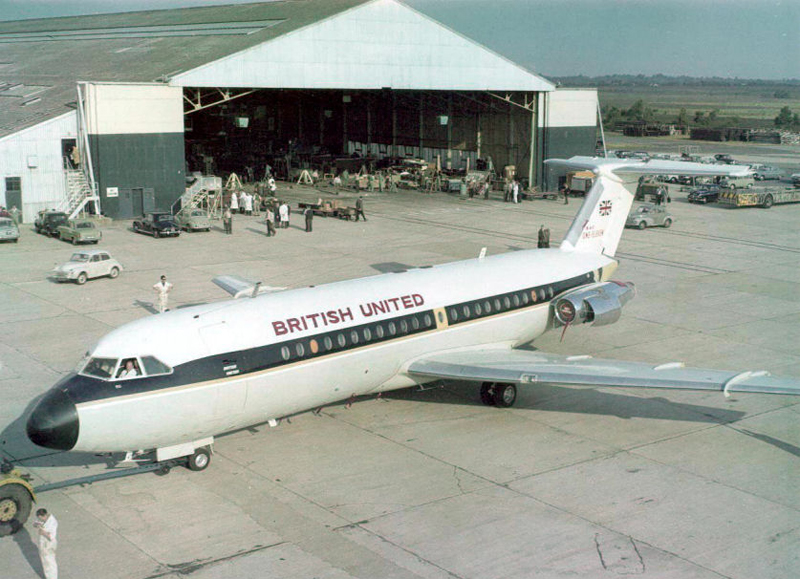
The crew was engaged in a local test flight at Wisley Airport. After a 2,5 hours flight, the instructor gave his seat to the copilot to carry out 2 familiarisation circuits and landings. On final approach, the airplane was slightly below the glide and struck the ground in a slight nose-down attitude, bounced to a height of 20 feet then struck the runway surface a second time. It bounced to a height of 50 feet then the nose gear struck the ground first and collapsed. Out of control the airplane skidded on runway, lost its right main gear and came to rest. All five crew members were uninjured while the airplane was damaged beyond repair.

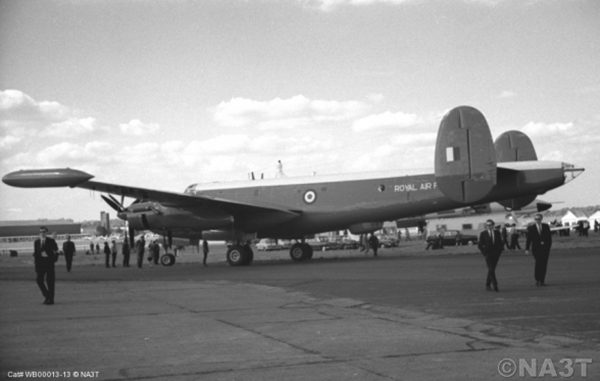
Crash of an Avro 696 Shackleton MR.3 in Inverness

Date & Time: Jan 10, 1964
Type of aircraft:
Operator:
Registration:
XF710
Flight Type:
Survivors:
Yes
Schedule:
Kinloss – Belfast
YOM:
1959
Region:
Crew on board:
5
Crew fatalities:
Pax on board:
0
Pax fatalities:
Other fatalities:
Total fatalities:
0
Circumstances:
Few minutes after takeoff from RAF Kinloss, en route to Belfast, the crew informed ATC that the engin number three oversped and caught fire. Shortly later, the engine detached and the crew was forced to shut down the engine number four. In such conditions, the crew decided to divert to Inverness Airport but out of control, the airplane lost height and crashed in a field located in Culloden Moor, about 4 miles southwest of the airport. People taking part to an open air party were able to evacuate all five crew members who were injured. The aircraft was destroyed.
Crew:
F/Lt J. Gladstone, pilot,
F/O Jim Lee, copilot,
John Mepham, flight engineer,
Jamie Hamilton,
John R. Hudson.
Probable cause:
Engine fire.

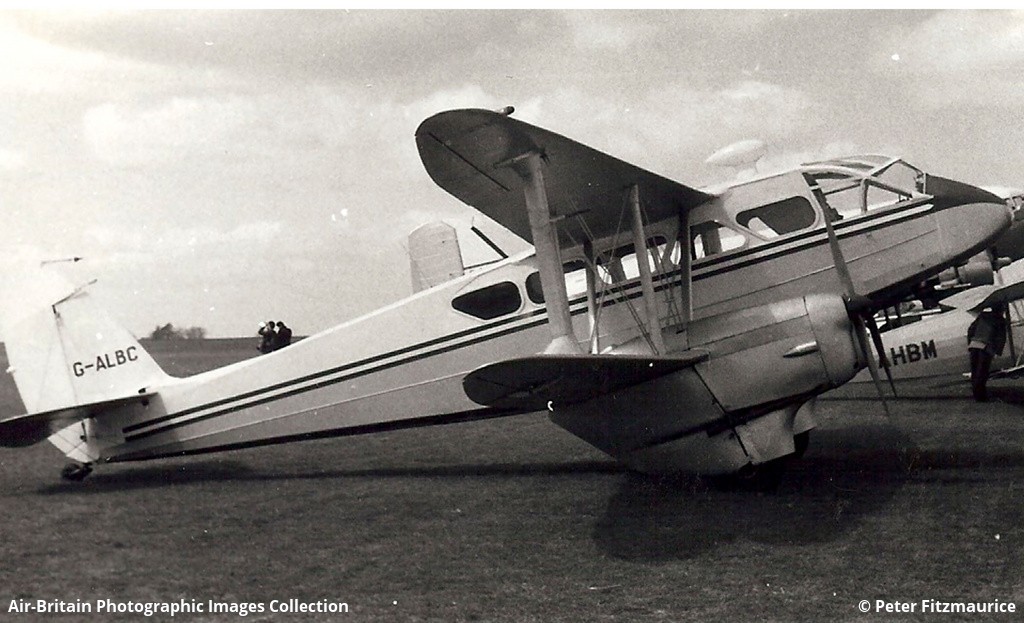
Crash of a De Havilland DH.89A Dragon Rapide near Edale

Date & Time: Dec 30, 1963
Registration:
G-ALBC
Flight Phase:
Flight Type:
Survivors:
Yes
Site:
Schedule:
Middleton Saint George – Birmingham
MSN:
6572
YOM:
1948
Region:
Crew on board:
1
Crew fatalities:
Pax on board:
1
Pax fatalities:
Other fatalities:
Total fatalities:
0
Circumstances:
The aircraft was on a flight from Middleton St. George to Birmingham, and the crew of one pilot and one photographer planned to complete several photographic survey jobs en route. Shortly after sunset, when flying at 2,000 ft. a.m.s.l. at an estimated position five miles west of Sheffield and near high ground rising to 2,000 ft. a.m.s.l., the pilot decided that the fuel remaining was insufficient to reach Birmingham with the existing headwind of 40 knots. He established contact with Manchester Approach Control and was given permission to divert to Manchester Airport on a special VFR clearance "not above 3,500 ft. a.m.s.l. on a QNH of 1013 mbs., clear of all cloud, and in sight of the surface". Shortly after this, when on a north-westerly heading to intercept a QDM of 270°M to the 'ME' (Manchester) beacon, the pilot saw hill tops about four miles ahead and commenced climbing from 2,000 ft. to 3,500 ft. The pilot states that the aircraft entered cloud at 2,500 ft. and that, on reaching 2,700 ft., he noticed that the vertical speed indicator was showing a descent of 2,000 ft./min. He states that he applied full power and eased the nose up but, after this, he remembers nothing further until he regained consciousness lying on the ground, alongside the photographer in front of the wrecked aircraft.
Probable cause:
Examination at the scene of the accident showed that the aircraft had struck the ground, in a normal cruising attitude and at a low engine power setting, at a point 1,990 ft. a.m.s.l. An aftercast of the weather conditions showed that the cloud base over the hills at the time of the accident probably varied between 1,800 and 3,000 ft. a.m.s.l., the wind at 2,000 to 3,000 ft. was 240°/45-50 knots, and horizontal visibility was 1 1/2-3 n.m. with some turbulence over high ground. "Sigmet" warnings broadcast by Preston A.T.C.C, and in force at the time of the accident, gave warning that locally severe turbulence, up to FL 100 over high ground in the Preston FIR had been forecast. From the information available, however, it was not possible to determine whether significant downdrafts existed in the area where the crash occurred.

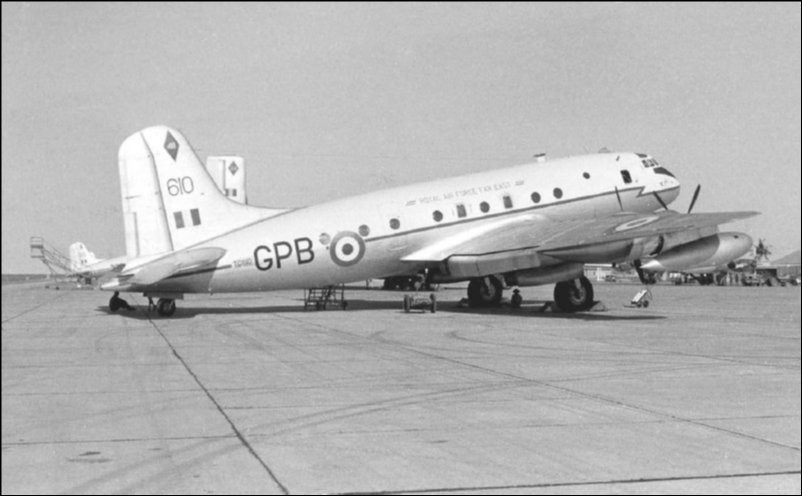
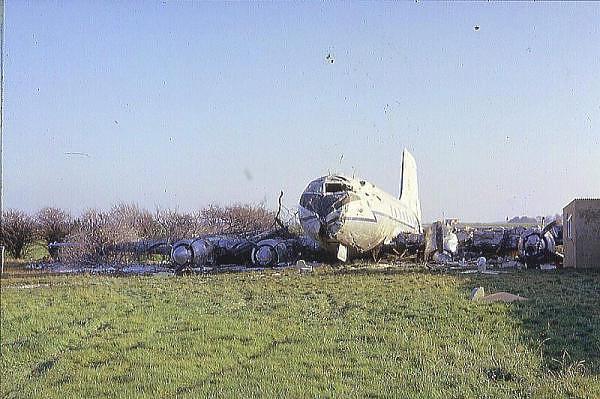
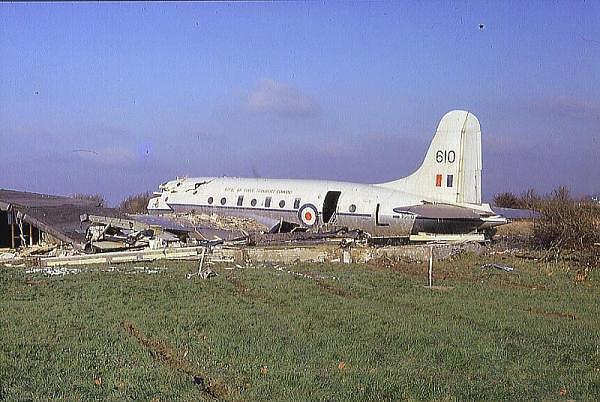
Crash of a Handley Page H.P.67 Hastings at RAF Thorney Island: 1 killed

Date & Time: Dec 17, 1963
Operator:
Registration:
TG610
Flight Type:
Survivors:
Yes
Schedule:
Thorney Island - Thorney Island
MSN:
88
YOM:
1949
Region:
Crew on board:
0
Crew fatalities:
Pax on board:
0
Pax fatalities:
Other fatalities:
Total fatalities:
1
Circumstances:
The crew was completing a local training flight at RAF Thorney Island. After touchdown, the four engine aircraft encountered difficulties to stop within the remaining distance, overran and collided with a building housing the radiotelegraph services of the airbase. None of the crew was injured while one person working in the building was killed.

Crash of a BAc 111-200AB in Chicklade: 7 killed

Date & Time: Oct 22, 1963 at 1040 LT
Type of aircraft:
Operator:
Registration:
G-ASHG
Flight Phase:
Flight Type:
Survivors:
No
Schedule:
Wisley - Wisley
MSN:
001
YOM:
1963
Region:
Crew on board:
7
Crew fatalities:
Pax on board:
0
Pax fatalities:
Other fatalities:
Total fatalities:
7
Captain / Total flying hours:
5385
Captain / Total hours on type:
78.00
Copilot / Total flying hours:
9648
Aircraft flight hours:
81
Aircraft flight cycles:
52
Circumstances:
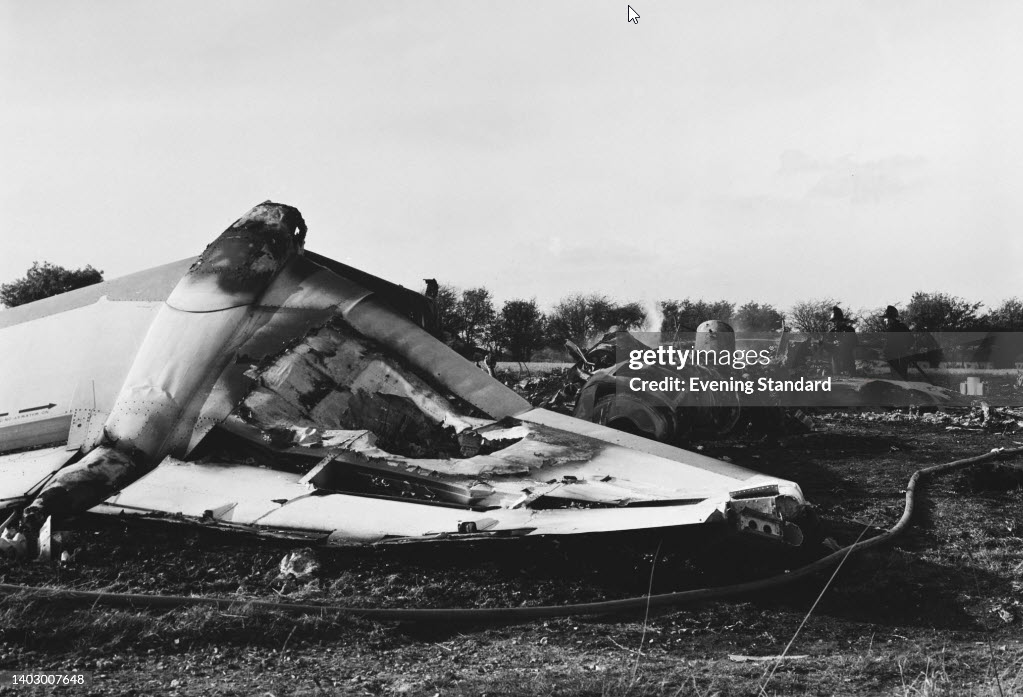
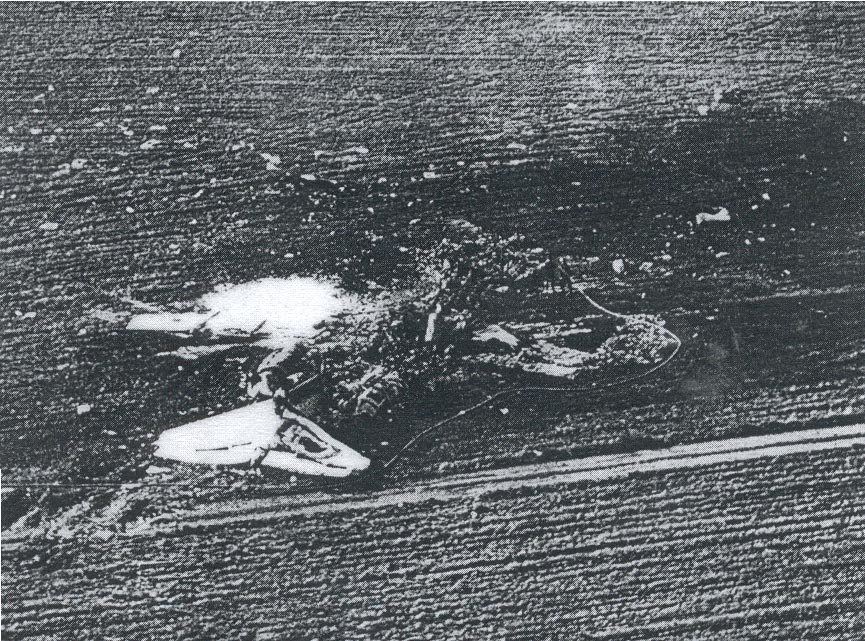
The aircraft took off at 1017 hours GMT from runway 10, at Wisley Aerodrome on its fifty third test flight. It was to carry out stalling tests in all configurations with the centre of gravity at 0.38 SMC (standard mean chord), the furthest aft limit for which the aircraft had then been cleared. Based on the radio-telephony conversations recorded in the Wisley Tower and the flight recorders carried aboard the aircraft, the flight was reconstructed. Following take-off the aircraft climbed in visual meteorological conditions on a westerly heading to 17 000 ft while monitored by Wisley radar. At 1026 the co-pilot reported that they were about to commence tests at flight level 170. By 1035, four stalls had been completed with the undercarriage and flaps up. The co-pilot acknowledged a fix from Wisley at 1036 hours and nothing further was heard from the aircraft. The flaps were then lowered to to investigate the stalling characteristics in this configuration. The stall was initiated about two minutes after the last contact, when the aircraft was between 15 000 and 16 000 ft. Approach to the stall appears to have been normal. When attempting recovery, the elevators responded initially to the control movement but subsequently floated to the fully up position in spite of a large push force on the control column. The aircraft then descended in a substantially horizontal fore and aft attitude at about 180 ft/sec (54 meters per sec). During the descent it banked twice to the right and once to the left and at one stage the engines were opened up to full power. This action resulted in a large nose-up pitch which was followed by a pitch down when power was taken off. The aircraft then assumed the substantially horizontal attitude in which it made impact with the ground. The final portion of the flight was observed by numerous eye witnesses who commented on the low level of engine noise and a sharp report from the aircraft which was heard while it was in the air. The aircraft had approached from the southwest, in a stable stalled condition, and crashed at about 1040 hours in a flat attitude. Following impact, the aircraft moved forward about 70 ft and some 15 ft to the right before coming to rest. It exploded and caught fire. All seven crew members, four engineers and three test pilots, were killed.
Probable cause:
The nose-down pitching moment (elevator neutral) just beyond the stall was insufficient to rotate the aeroplane at the rate required to counteract the increase of incidence due to the g-break. During the fifth stall the angle of incidence reached a value at which the elevator effectiveness was insufficient to effect recovery. During a stalling test the aircraft entered a stable stalled condition recovery from which was impossible.
Final Report:

Crash of a Bristol 170 Freighter 32 in Saint Peter

Date & Time: Sep 24, 1963 at 1123 LT
Type of aircraft:
Registration:
G-AMWA
Flight Phase:
Survivors:
Yes
Schedule:
Saint Peter - Bournemouth
MSN:
13073
YOM:
1953
Region:
Crew on board:
3
Crew fatalities:
Pax on board:
1
Pax fatalities:
Other fatalities:
Total fatalities:
0
Captain / Total flying hours:
8500
Captain / Total hours on type:
5000.00
Copilot / Total flying hours:
7800
Copilot / Total hours on type:
1600
Circumstances:
The aircraft was returning to Bournemouth from Guernsey on a passenger and vehicle service flight. The copilot was flying the aircraft from the left-hand seat, and the pilot-in-command was performing the duties of the copilot. The engines were started at 1112 hours GMT. The brakes operated satisfactorily at this time. Following a normal run-up and check of the engines and the throttles were opened slowly because of a 17 kt crosswind component. The aircraft' reached a speed of 50 kt, and the rpm of the port engine began to rise. The pilot-in-command tried to control it by moving back the propeller control lever. The rpm commenced to surge and, as the aircraft's speed was then about 4 kt less than the single-engine safety speed (84 kt), the pilot-in-command ordered the copilot to abandon the takeoff. According to the testimony of the pilot-in-command following the accident, the brakes had little or no effect, and realizing that the aircraft would overrun the runway, he pulled back both propeller pitch control levers in order to stop the engines. Shortly before reaching the end of the runway the aircraft was turned to the left to avoid the approach lights. The aircraft became airborne for about 33 yd, then passed through the boundary fence of the stopway and struck a bank surmounted by a hedge where its port landing gear collapsed. Thereafter it crossed a hedge-lined road, and the starboard landing gear was deflected rearward. Finally it slid about 60 yd on its belly and stopped near a house. The accident occurred at 1123 hours GMT.
Probable cause:
The pilot-in-command abandoned the take-off due to a malfunction of the port power unit but was unable to bring the aircraft to a stop on the runway remaining.
Final Report:

Crash of a Vickers 651 Valetta C.1 in London-Gatwick

Date & Time: Sep 21, 1963
Type of aircraft:
Operator:
Registration:
G-APKR
Flight Type:
Survivors:
Yes
Schedule:
London - London
MSN:
338
YOM:
1949
Region:
Crew on board:
2
Crew fatalities:
Pax on board:
2
Pax fatalities:
Other fatalities:
Total fatalities:
0
Circumstances:
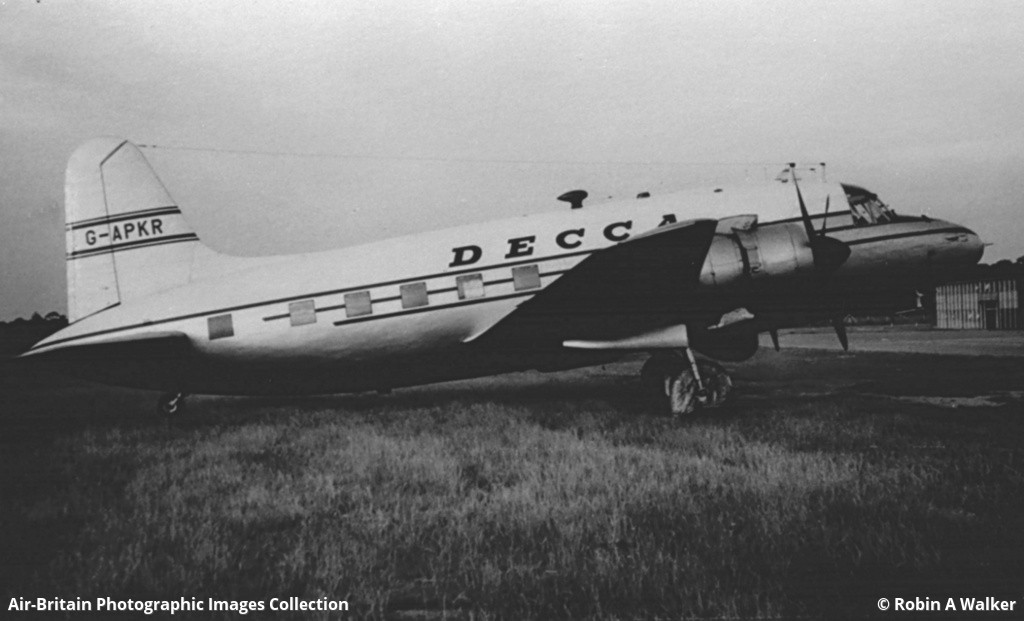
After a flight of some two hours, made for the purpose of testing radio navigation equipment, the aircraft returned to London-Gatwick Airport, U.K.. Before, and during, the flight, undercarriage operation was normal, as was the functioning of the undercarriage light and horn warning system. During the approach, the undercarriage extended normally, and the green lights indicated that it was locked down. Some 50 yards after touch down, the aircraft began to sink on the starboard side and the captain noticed that the starboard green light was no longer showing. There were, however, no reds, and the horn was not sounding. The starboard main undercarriage leg eventually retracted and the aircraft swung off the runway to the right, on to the grass.

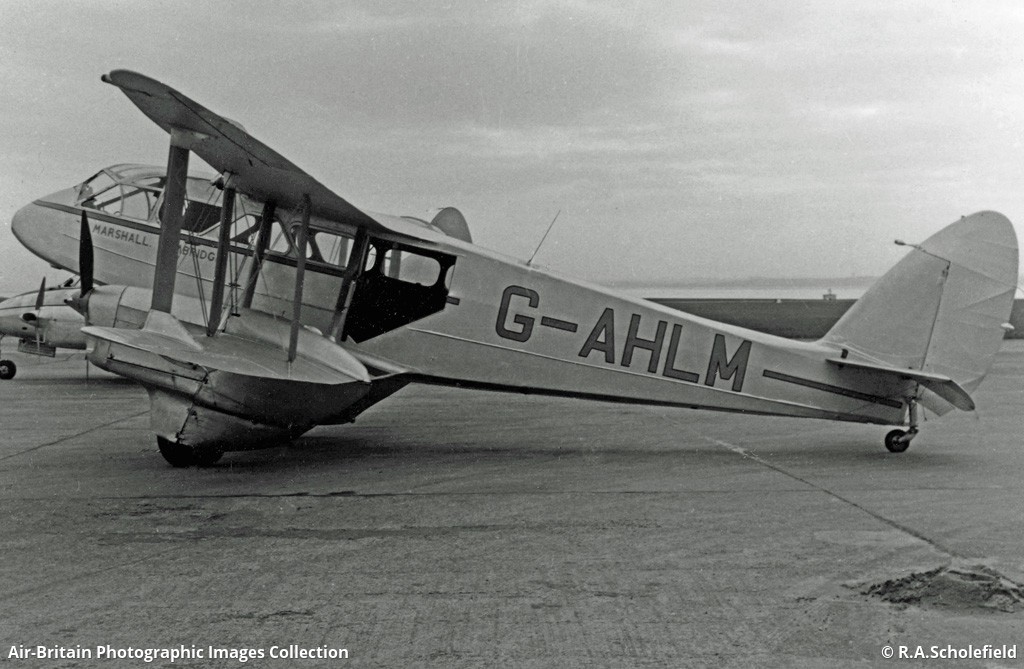
Crash of a De Havilland DH.89A Dragon Rapide in Saint Mary's

Date & Time: Jul 20, 1963
Registration:
G-AHLM
Flight Phase:
Survivors:
Yes
Schedule:
Saint Mary’s – Land’ Ends
MSN:
6708
YOM:
1946
Region:
Crew on board:
1
Crew fatalities:
Pax on board:
7
Pax fatalities:
Other fatalities:
Total fatalities:
0
Circumstances:
The aircraft was engaged on a scheduled service from the Scilly Isles to Plymouth, carrying seven passengers, with one pilot. During the take-off run from a grass strip at St. Mary's Aerodrome, in calm conditions, the aircraft developed a series of bounces and swung sharply to the left and then to the right. It became airborne shortly before crossing the boundary of the useable area of the aerodrome. It then banked to the right and the tip of the lower starboard wing was seen to cut through gorse bushes in the overrun area. A few yards further on the starboard wing struck a large rock and the aircraft cartwheeled and caught fire, coming to rest with the rear part of the fuselage overhanging a cliff. All seven passengers escaped through the emergency hatch in the cabin roof, and the pilot, who was seriously injured, was extricated from the cockpit wreckage by a member of the aerodrome fire service and an airline employee.
Source: https://aviation-safety.net/wikibase/wiki.php?id=28532
Probable cause:
Investigations revealed that the cause was due to a burst mainwheel tyre.

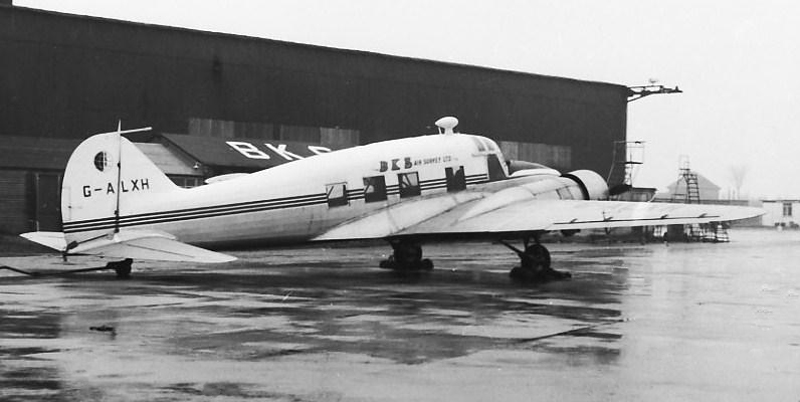
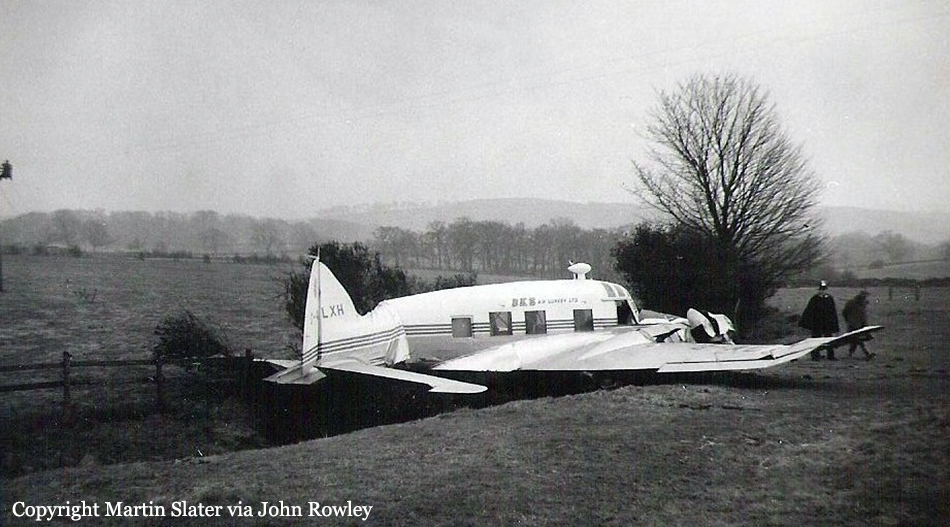
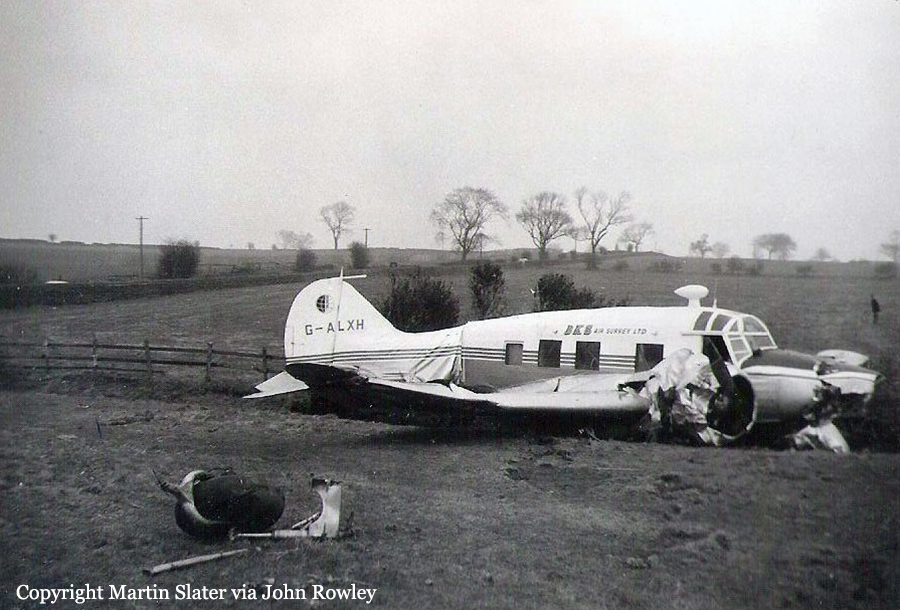
Crash of an Avro 19/2 in Leeds

Date & Time: Apr 9, 1963
Type of aircraft:
Operator:
Registration:
G-ALXH
Flight Phase:
Flight Type:
Survivors:
Yes
Schedule:
Leeds-Bradford - Belfast
MSN:
1731
YOM:
1950
Region:
Crew on board:
3
Crew fatalities:
Pax on board:
0
Pax fatalities:
Other fatalities:
Total fatalities:
0
Circumstances:
Shortly after take-off from Leeds-Bradford Airport, for a positioning flight to Belfast, the cabin filled with smoke which issued from the camera hatch near the starboard wing root. The aircraft was, by this time, about 800 feet above the downwind end of the runway from which it had taken off, and the pilot closed the throttles and began a descending turn to port. At about 400 feet, power was applied for a base leg and short final but, despite full throttle, the airspeed began to fall. Because he found it necessary to apply an increasing amount of left rudder, the pilot concluded that the starboard engine had failed and he decided to make a forced landing in a field outside the airport. During the approach, the aircraft was dived, and turned, in an attempt to avoid HT wires, but it collided with a port and struck the ground heavily. The airplane was damaged beyond repair and all three occupants escaped uninjured.
Source: https://aviation-safety.net/wikibase/wiki.php?id=24985

Crash of a Vickers 648 Varsity T.1 in Gloucester: 2 killed

Date & Time: Mar 27, 1963
Type of aircraft:
Registration:
G-APAZ
Flight Phase:
Flight Type:
Survivors:
No
Site:
Schedule:
Gloucester - Gloucester
MSN:
561
YOM:
1957
Region:
Crew on board:
2
Crew fatalities:
Pax on board:
0
Pax fatalities:
Other fatalities:
Total fatalities:
2
Circumstances:
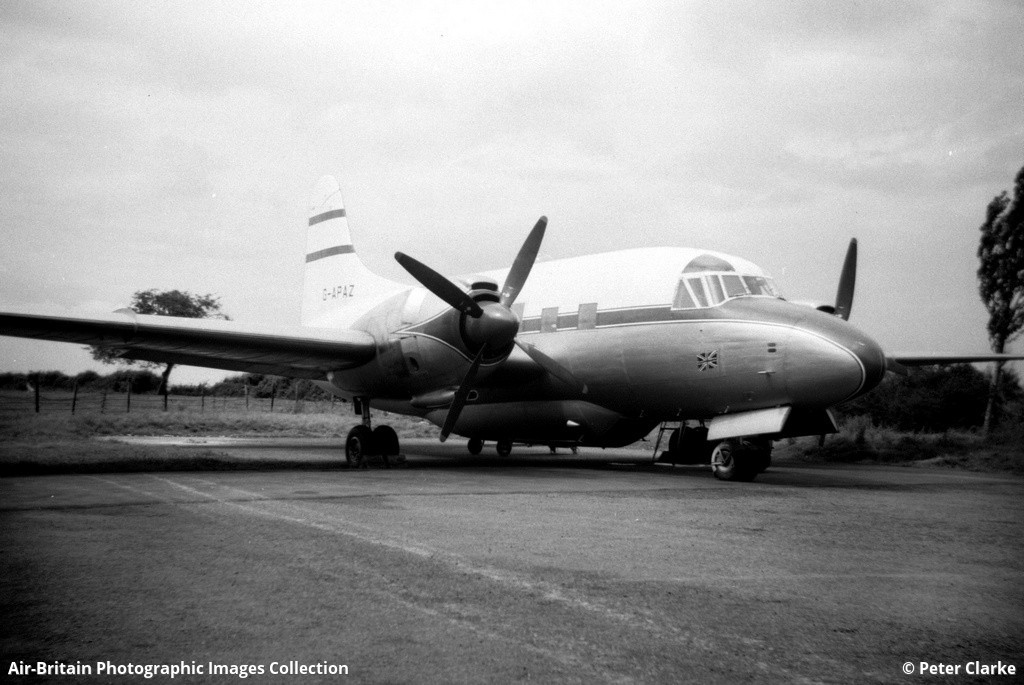
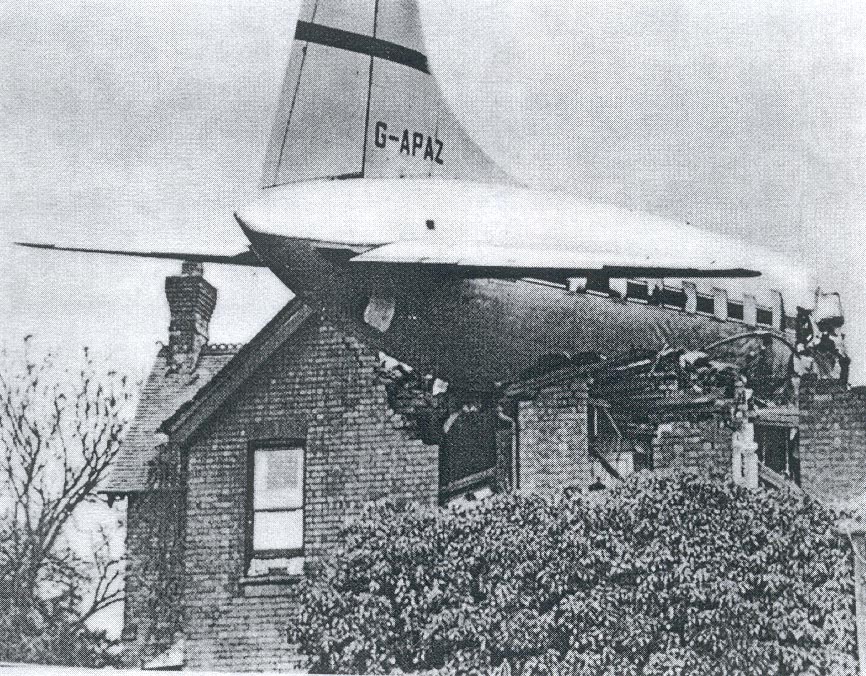
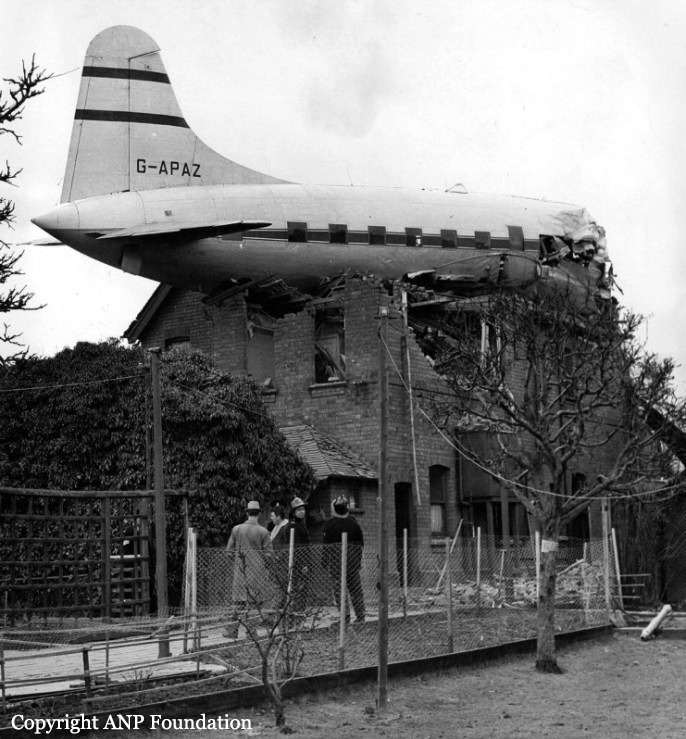
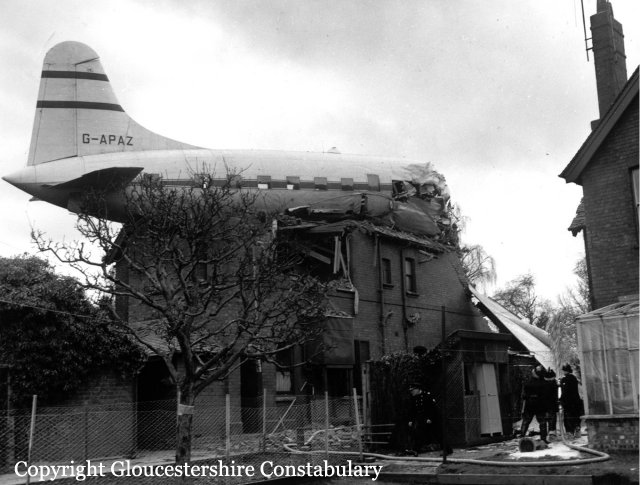
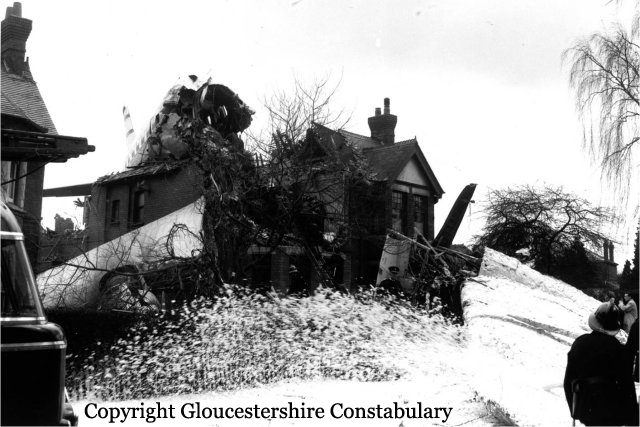
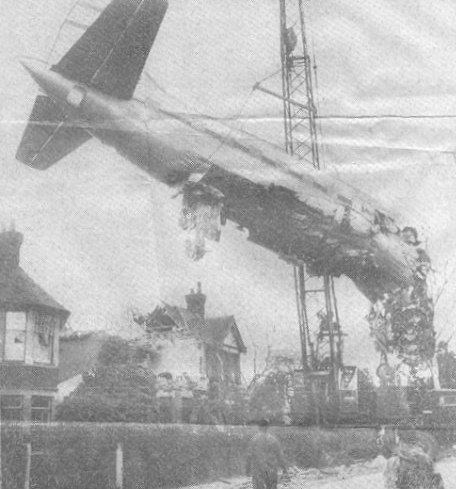
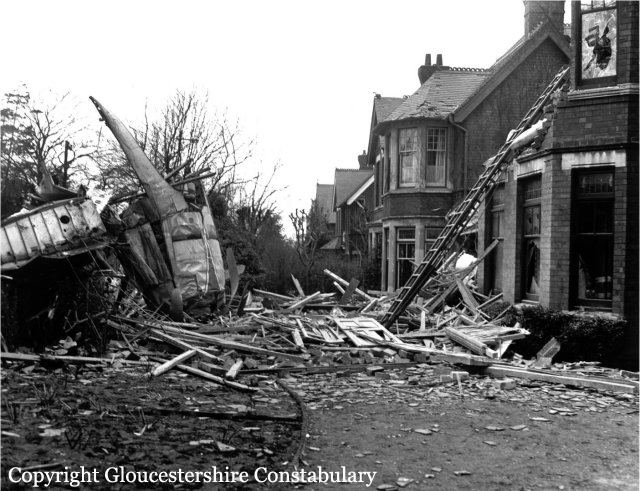
The crew was engaged in a local training flight. Shortly after takeoff from runway 22 at Gloucester-Staverton Airport, while climbing to a height of 600-700 feet, the airplane stalled and crashed on the roof of a house located on Tuffley Avenue. Both pilots were killed while three people leaving in the house were uninjured. The aircraft was destroyed.
Probable cause:
Selection of the starboard engine 'idle-cut-off' switch to CUT-OFF instead of the port to the RUN position, when attempting to re-start the port engine, resulted in a complete loss of power at a low height and the aircraft struck a house in the ensuing crash-landing.