Crash of a Boeing 737-476SF in East Midlands

Date & Time: Apr 29, 2014 at 0228 LT
Type of aircraft:
Operator:
Registration:
EI-STD
Flight Type:
Survivors:
Yes
Schedule:
Paris-Roissy-Charles de Gaulle – East Midlands
MSN:
24433/1881
YOM:
1990
Flight number:
ABR1748
Region:
Crew on board:
2
Crew fatalities:
Pax on board:
0
Pax fatalities:
Other fatalities:
Total fatalities:
0
Captain / Total flying hours:
4279
Captain / Total hours on type:
377.00
Copilot / Total flying hours:
3900
Circumstances:
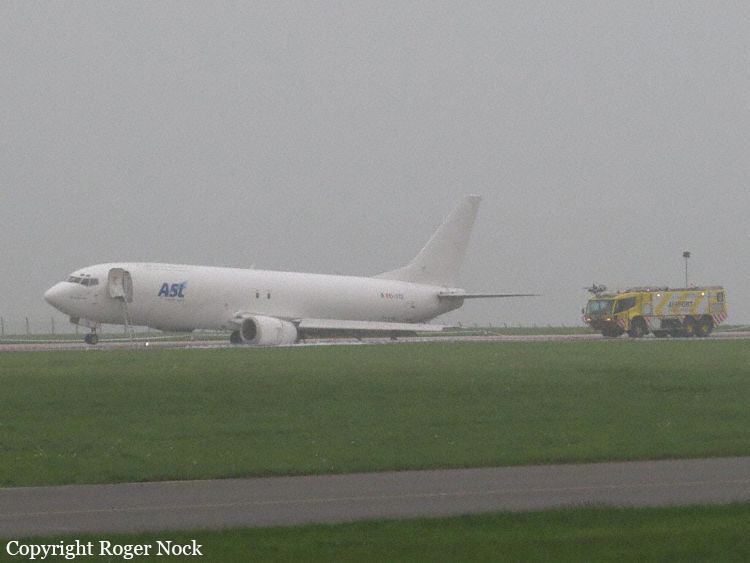
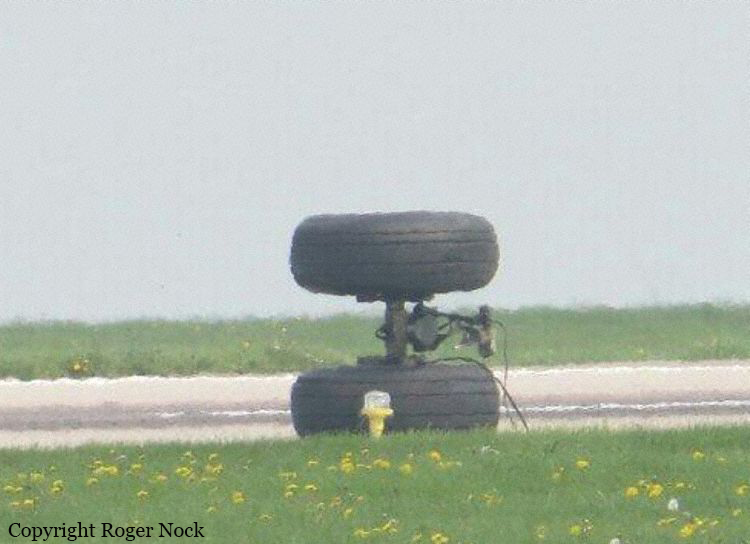
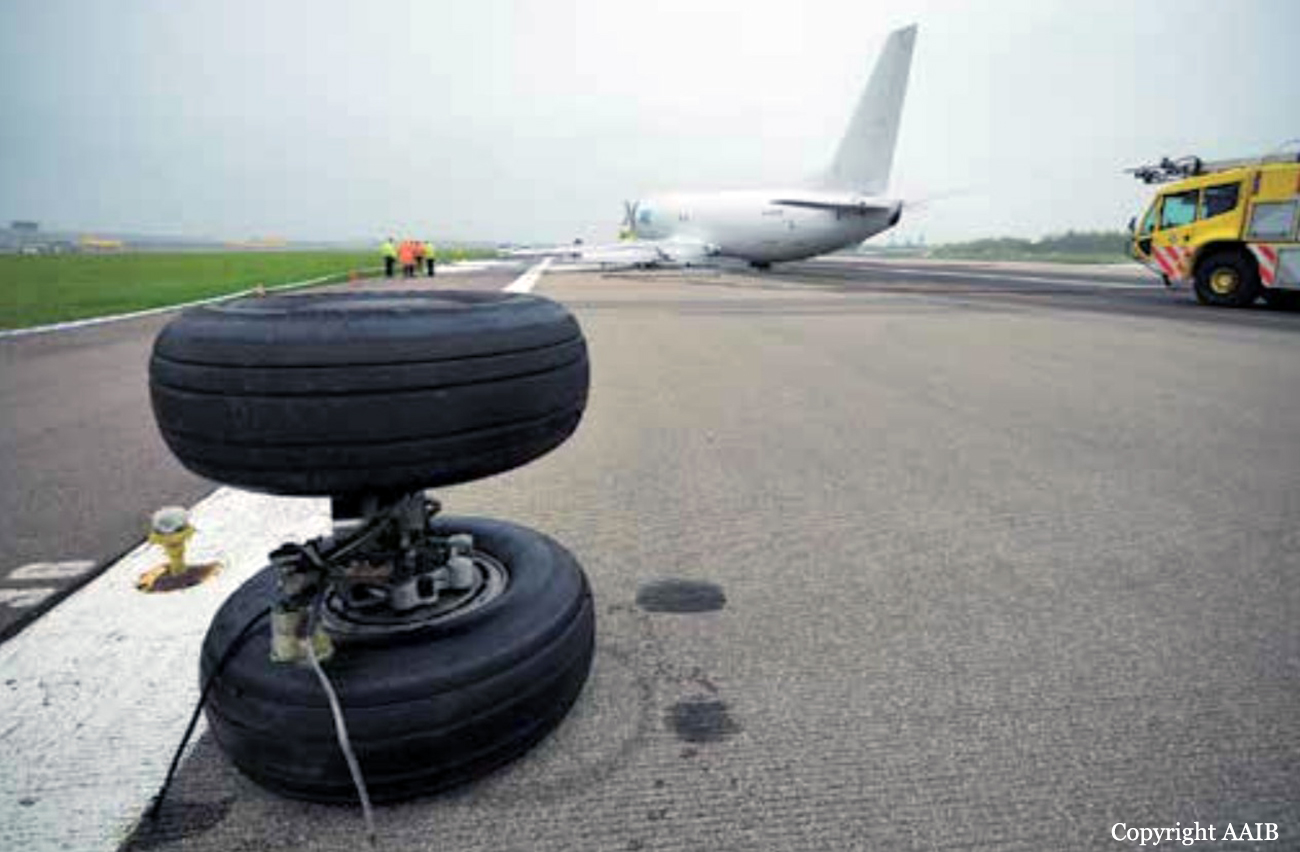
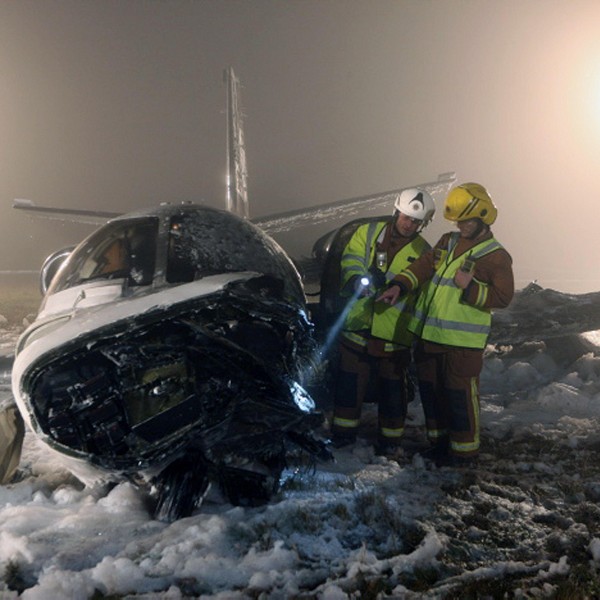
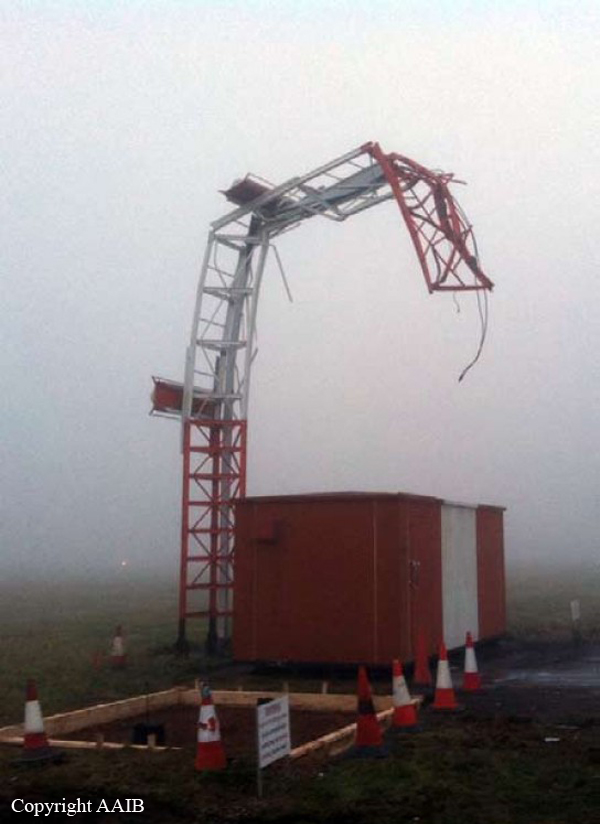
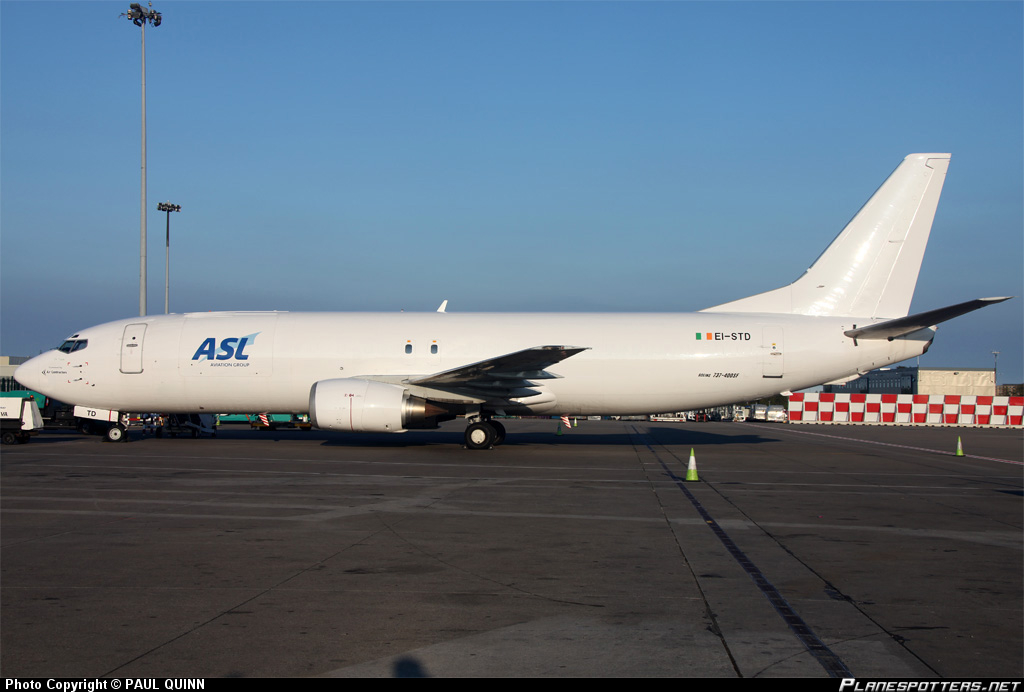
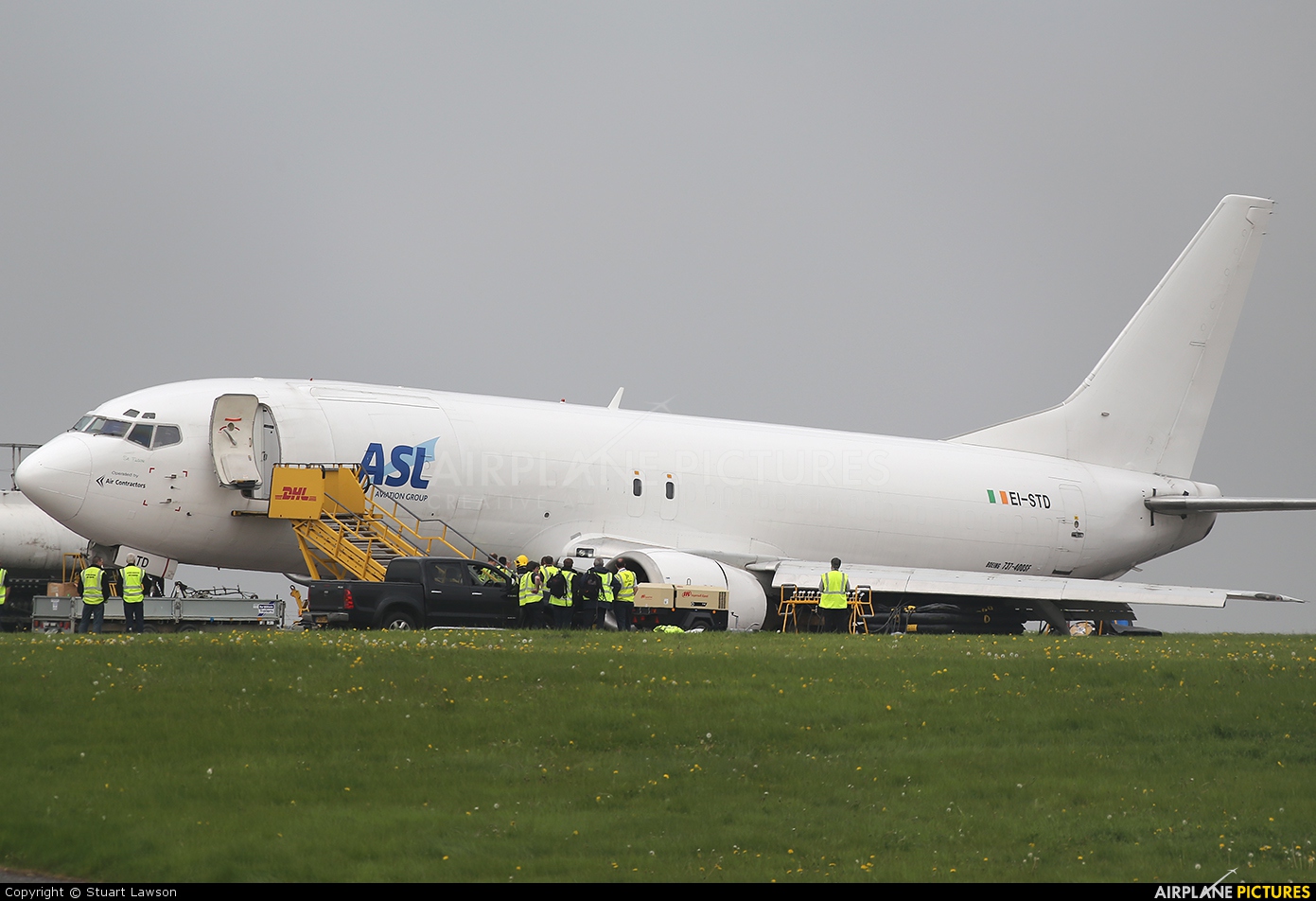
The aircraft was scheduled to operate three commercial air transport (cargo) sectors: from Athens to Bergamo, then to Paris Charles de Gaulle, and finally East Midlands. The aircraft’s flap load relief system was inoperative, which meant that the maximum flap position to be used in flight was 30, rather than 40º. This defect had been deferred in the aircraft’s technical log and it had no effect on the landing of the aircraft. Otherwise, the aircraft was fully serviceable. The co-pilot completed the pre-flight external inspection of the aircraft in good light, and found nothing amiss. The departure from Athens was uneventful, but a combination of factors affecting Bergamo (including poor weather, absence of precision approach aids, and work in progress affecting the available landing distance) led the crew to decide to route directly to Paris, where a normal landing was carried out. The aircraft departed Paris for East Midlands at 0040 hrs, loaded with 10 tonnes of freight, 8 tonnes of fuel (the minimum required was 5.6 tonnes), and with the co-pilot as Pilot Flying. Once established in the cruise, the flight crew obtained the latest ATIS information from East Midlands, which stated that Runway 27 was in use, although there was a slight tailwind, and Low Visibility Procedures (LVPs) were in force. They planned to exchange control at about FL100 in the descent, for the commander to carry out a Category III autoland. However, as they neared their destination, the weather improved, LVPs were cancelled, and the flight crew re-briefed for an autopilot approach, followed by a manual landing, to be carried out by the co-pilot. The landing was to be with Flap 30, Autobrake 2, and idle reverse thrust. The final ATIS transmission which the flight crew noted before landing stated that the wind was 130/05 kt, visibility was 3,000 metres in mist, and the cloud was broken at 600 ft aal. The commander of EI-STD established radio contact with the tower controller, and the aircraft was cleared to land; the surface wind was transmitted as 090/05 kt. The touchdown was unremarkable, and the autobrake functioned normally, while the co-pilot applied idle reverse thrust on the engines. As the aircraft’s speed reduced through approximately 60 kt, the co-pilot handed control to the commander, who then made a brake pedal application to disengage the autobrake system. However, the system remained engaged, so he made a second, more positive, brake application. The aircraft “shuddered” and rolled slightly left-wing-low as the lower part of the left main landing gear detached. The commander used the steering tiller to try to keep the aircraft tracking straight along the runway centreline, but it came to a halt slightly off the centreline, resting on its right main landing gear, the remains of the left main landing gear leg, and the left engine lower cowl. The co-pilot saw some smoke drift past the aircraft as it came to a halt. The co-pilot made a transmission to the tower controller, reporting that the aircraft was in difficulties, after which the co-pilot of another aircraft (which was taxiing from its parking position along the parallel taxiway) made a transmission referring to smoke from the 737’s landing gear. The commander of EI-STD had reached the conclusion that one of the main landing gear legs had failed, but as a result of the other pilot’s transmission, he was also concerned that the aircraft might be on fire. The commander immediately moved both engine start levers to the cut-off positions, shutting down the engines. Three RFFS vehicles had by now arrived at the adjacent taxiway intersection, and their presence there prompted the commander to consider that the aircraft was not on fire (he believed that if it were, the vehicles would have adopted positions closer by and begun to apply fire-fighting media). The RFFS vehicles then moved closer to the aircraft and fire-fighters placed a ladder against door L1, which the co-pilot had opened. Having spoken to fire-fighters while standing in the entrance vestibule, the commander returned to the flight deck and switched off the battery. The flight crew were assisted from the aircraft and fire-fighters applied foam around the landing gear and engine to make the area safe. The commander had taken the Notoc2 with him from the aircraft, and informed fire-fighters of the dangerous goods on board the aircraft.
Probable cause:
The damage to the flap system, fuselage, and MLG equipment was attributable to the detachment of the left MLG axle, wheel and brake assembly. The damage to the MLG outer cylinder, engine and nacelle was as result of the aircraft settling and sliding along the runway. The left MLG axle assembly detached from the inner cylinder due to the momentary increase in bending load during the transition from auto to manual braking. The failure was as a result of stress corrosion cracking and fatigue weakening the high strength steel substrate at a point approximately 75 mm above the axle. It is likely that some degree of heat damage was sustained by the inner cylinder during the overhaul process, as indicated by the presence of chicken wire cracking within the chrome plating over the majority of its surface. However, this was not severe enough to have damaged the steel substrate and therefore may have been coincidental. Although the risk of heat damage occurring during complex landing gear plating and refinishing processes is well understood and therefore mitigated by the manufacturers and overhaul agencies, damage during the most recent refinishing process cannot be discounted. The origin of the failure was an area of intense, but very localized heating, which damaged the chrome protection and changed the metallurgy; ie the formation of martensite within the steel substrate. This resulted in a surface corrosion pit, which, along with the metallurgical change, led to stress corrosion cracking, fatigue propagation and the eventual failure of the inner cylinder under normal loading.
Final Report:
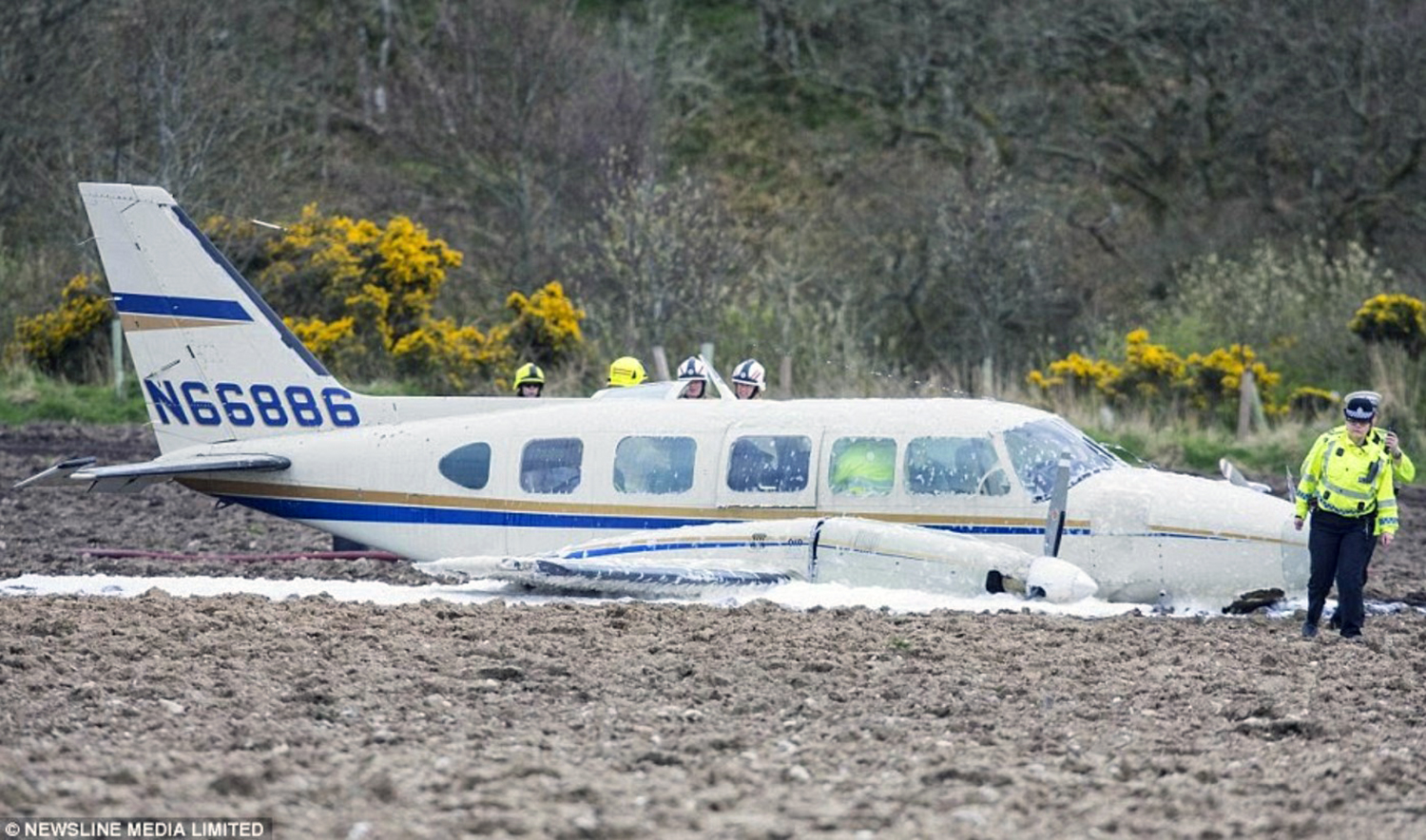
Crash of a Piper PA-31-350 Navajo Chieftain in Stonehaven

Date & Time: Apr 9, 2014 at 1447 LT
Operator:
Registration:
N66886
Flight Phase:
Flight Type:
Survivors:
Yes
Schedule:
Wick – Le Touquet
MSN:
31-7405188
YOM:
1974
Region:
Crew on board:
1
Crew fatalities:
Pax on board:
0
Pax fatalities:
Other fatalities:
Total fatalities:
0
Captain / Total flying hours:
3188
Captain / Total hours on type:
19.00
Circumstances:
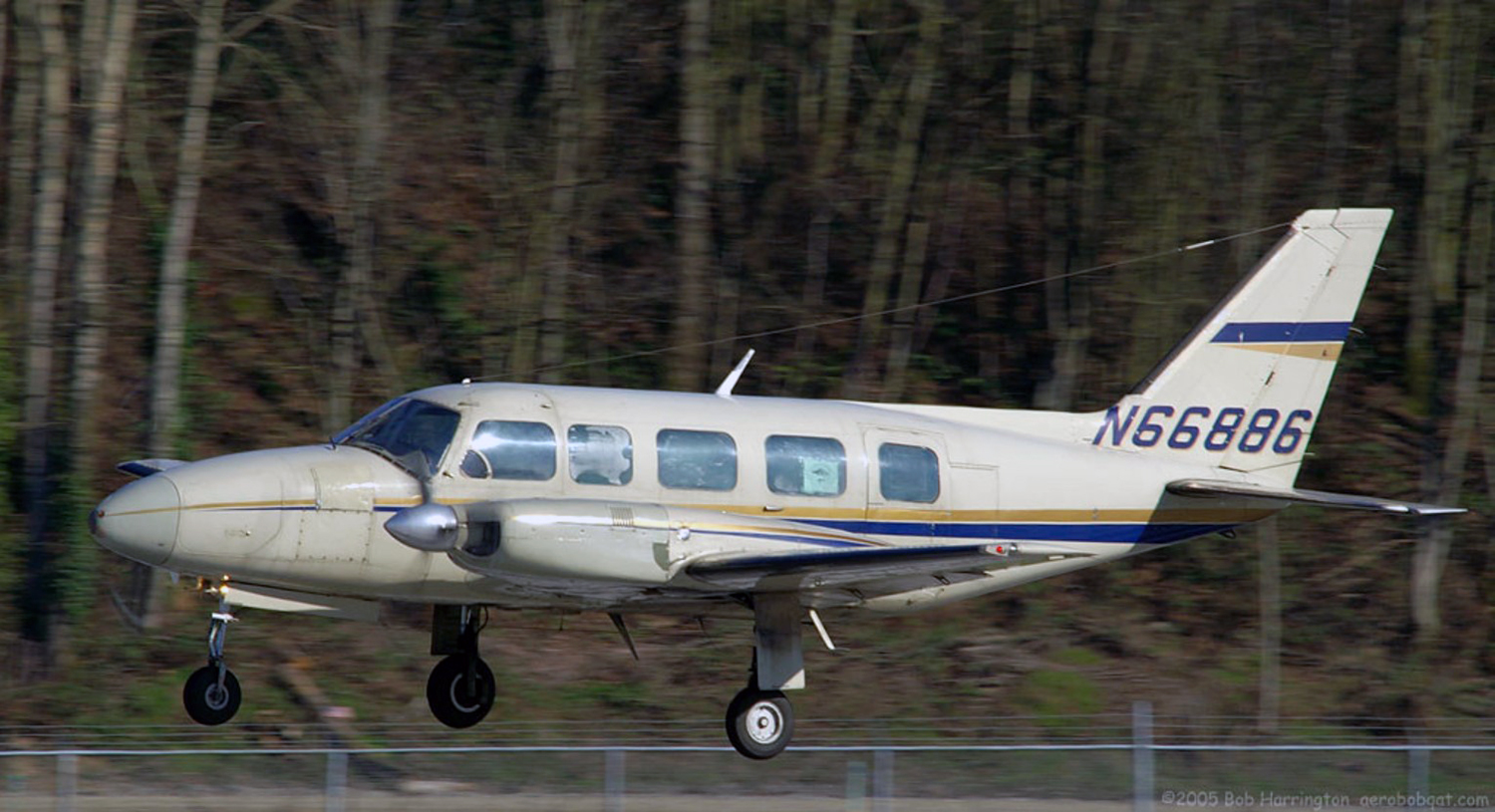
The aircraft was on a ferry flight from Seattle in the USA to Thailand via Canada, Greenland, Iceland, Scotland and across Europe. However the flight crew abandoned the aircraft in Greenland late in December 2013 after experiencing low oil pressure indications on both engines. This may have been due to the use of an incorrect grade of oil for cold weather operations. The aircraft remained in Greenland until 28 February 2014, when a replacement ferry pilot was engaged. Although the engine oil was not changed prior to departing Greenland, the flight continued uneventfully to Wick, in Scotland. Following some maintenance activity on the right engine, the aircraft departed for Le Touquet in France. However, approximately 25 minutes after takeoff, the engines successively lost power and the pilot carried out a forced landing in a ploughed field. Examination of the engines revealed that one piston in each engine had suffered severe heat damage, consistent with combustion gases being forced past the piston and into the crankcase.
Probable cause:
The aircraft began experiencing engine problems, leading to the forced landing, approximately 25 minutes after departing Wick, in Scotland. However, it is possible that these problems may have originated prior to the aircraft arriving in the UK. The low oil pressures in both engines, reported by the crew on the flight leg to Greenland, may have been due to the wrong grade of oil, W100, being used in what would have been very low temperatures experienced in December in Canada and Greenland. Despite supplies of multigrade oil being sent to Greenland, the engine oil was not changed. This was due to the fact that the pilot noted normal engine indications combined with the lack of maintenance facilities. Thus the aircraft continued its journey with the same oil in the engines with which it left Seattle; this was confirmed by the subsequent analysis of the oil. No further oil pressure problems were observed, although it is likely the aircraft would have been operating in warmer temperatures at the end of February in comparison with those in December. The engine manufacturer suggested that engine damage could have occurred as a result of operating the engines at low temperatures with the wrong grade of oil. Whilst this may have been the case, it is surprising that any damage did not progress to the point where it became readily apparent during the subsequent flights, via Iceland, to Wick. In fact the pilot did report rough running of the right-hand engine, but the investigation revealed a problem only with the No 4 cylinder compression, which led to replacement of this cylinder. Since the compressions in all the cylinders were presumably assessed during the diagnosis, it must be concluded that any damage in the No 3 cylinder of the right engine was not, at that stage, significant. Ultimately, it was not possible to establish why pistons in both engines had suffered virtually identical types of damage, although it is likely to have been a ‘common mode’ failure, which could include wrong fuel, incorrect mixture settings (running too lean) and existing damage arising from the use of incorrect oil in cold temperatures. The oil analysis excluded the possibility of the aircraft having been mis-fuelled with Jet A-1 at Wick. No conclusion can be drawn regarding the possibility of one of the pilots having leaned the mixtures to an excessive degree, although this would require that either high cylinder head temperature indications were ignored, or that the temperature gauges (or sensors) on both engines were defective. The engines would have begun to fail when the combustion gases started to ‘blow by’ the pistons, causing progressive damage to the piston crowns, skirts and rings. This would have also caused pressurisation of the crankcases, which in turn would have tended to blow oil out of the crankcase breathers. In the case of the left engine, the pressurisation was such that the dipstick was blown out of its tube, resulting in more oil being lost overboard. This may have accounted for the more severe damage to the left engine, having lost more oil than the right. The detached No 1 cylinder base jet oil nozzle in the left engine may have contributed to a slight reduction in the oil pressure, but is otherwise considered to have played no part in the engine failure.
Final Report:

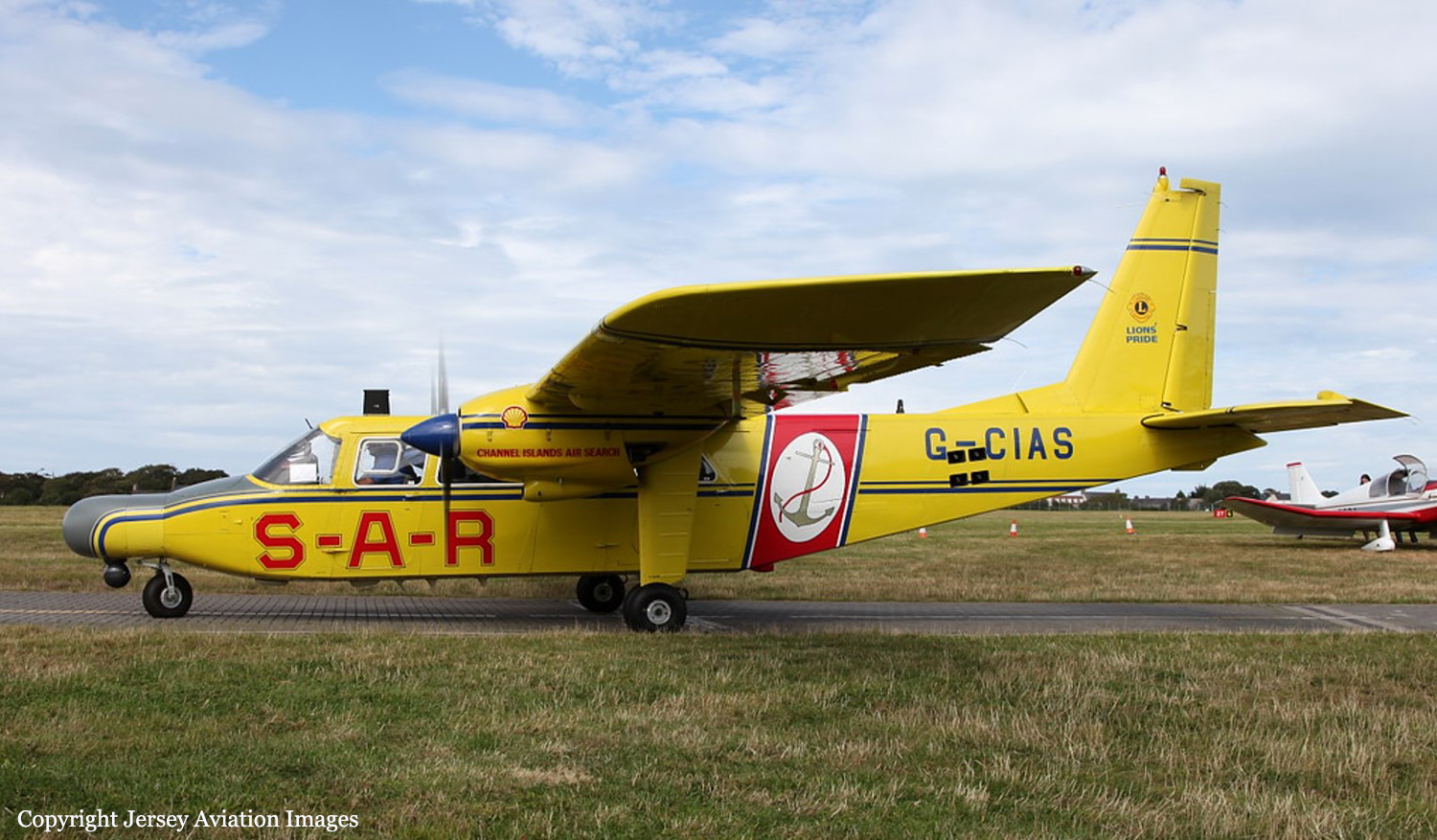
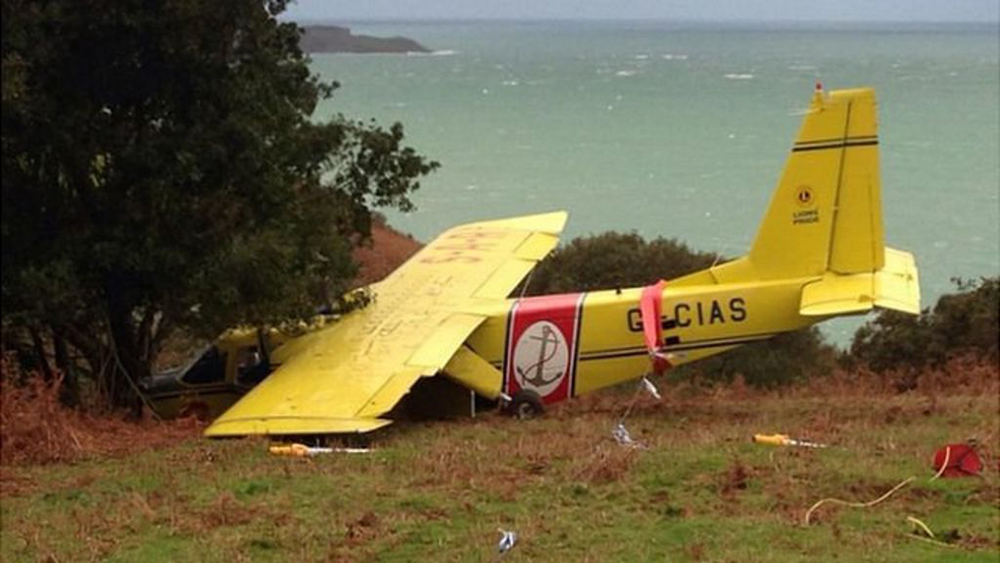
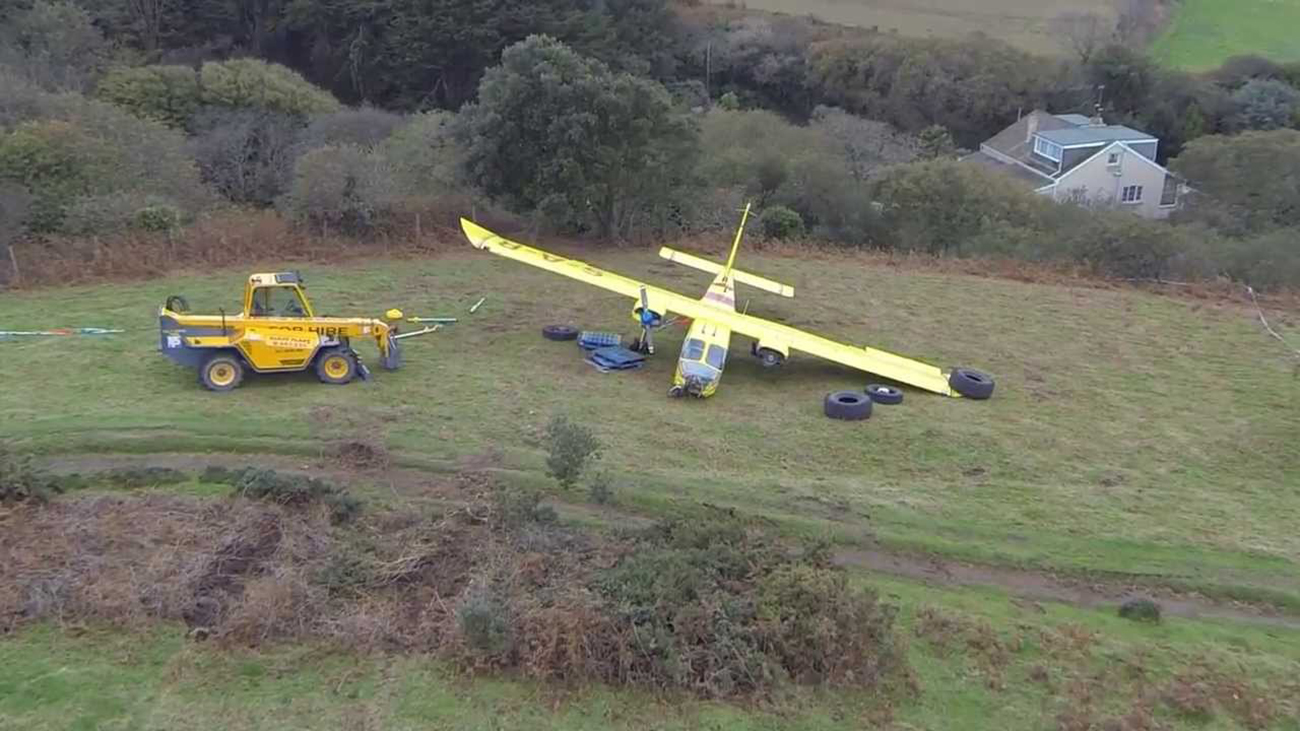
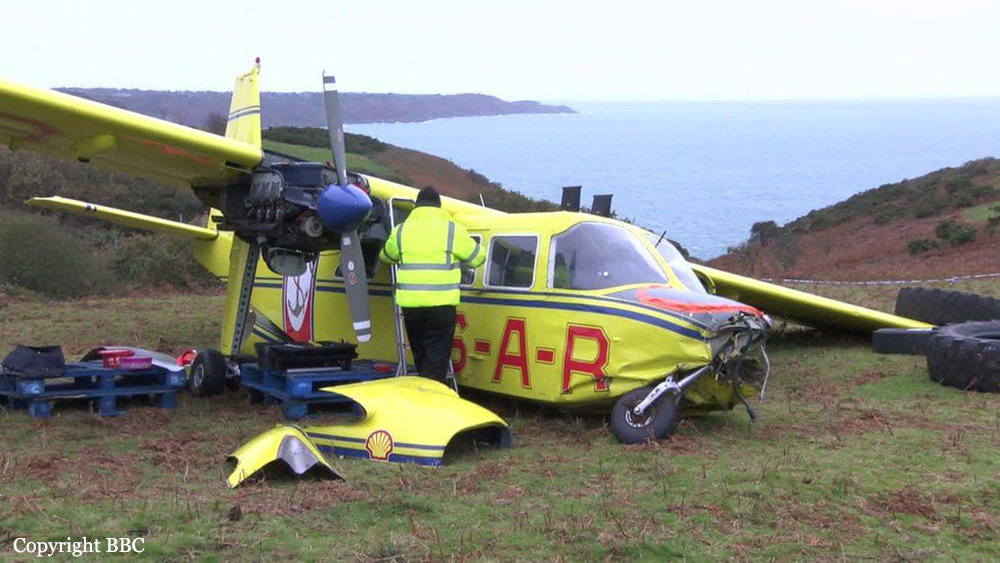
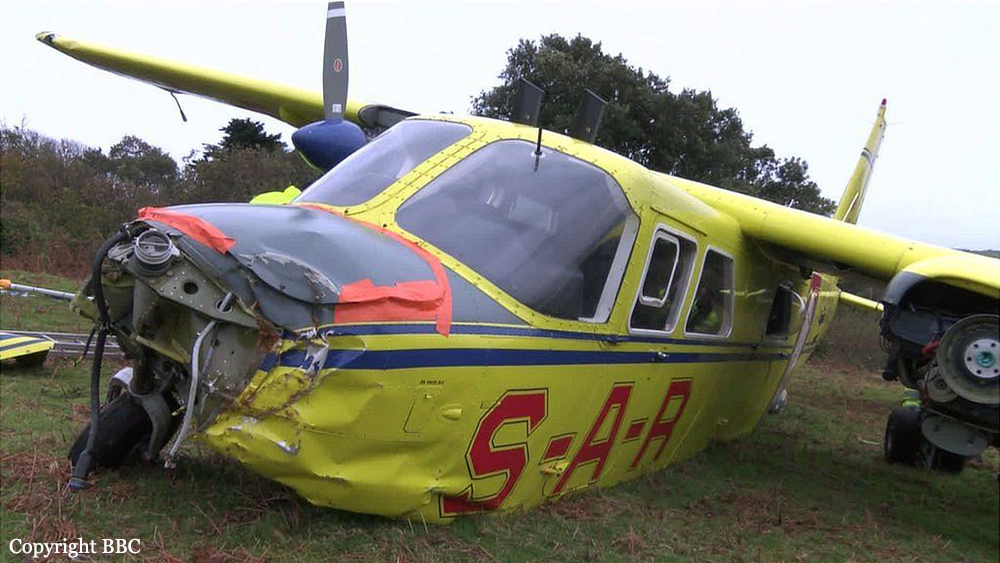
Crash of a Britten Norman BN-2B-21 Islander in Devil's Hole

Date & Time: Nov 3, 2013 at 1020 LT
Type of aircraft:
Operator:
Registration:
G-CIAS
Flight Phase:
Survivors:
Yes
Schedule:
Guernsey - Guernsey
MSN:
2162
YOM:
1982
Region:
Crew on board:
1
Crew fatalities:
Pax on board:
4
Pax fatalities:
Other fatalities:
Total fatalities:
0
Captain / Total flying hours:
25200
Captain / Total hours on type:
60.00
Circumstances:
At approximately 1830 hrs on 3 November 2013 the operator’s duty pilot received a request that the aircraft should be dispatched to carry out a search. The volunteer crew-members were alerted and made their way to the airport. Weather conditions in the Channel Islands were poor, with a southerly wind gusting up to 41 kt, turbulence, rain, cloud below 1,000 ft aal, and visibility of 3 to 6 km. On arrival at the aircraft’s hangar, the crew was established, consisting of a pilot, search director, and three observers. They donned immersion suits and life jackets and prepared for flight. The search director obtained details of the search request, which was to search for two fishermen near Les Écréhous (a group of rocks in the English Channel approximately 5 nm north-east of the north-eastern corner of Jersey). Some evidence suggested the men were in a small dinghy; other information was that they were in the water. The men were reported to be alive and communicating by mobile telephone. One crew-member carried out pre-flight preparations, although he did not check the fuel quantities or carry out a water drain check. When interviewed, he recalled having reported to the pilot that he had not checked the fuel. The aircraft was then pulled out of its hangar and the search director explained the details of the search request to the pilot and other crew-members. Bearing in mind the weather, the fact that it was dark, and the fishermen’s predicament, the pilot recognized the need for “a lot of urgency” about the task. In the context of the operation, he regarded the task as being routine, but the weather not so. The pilot “walked round” the aircraft, though he did not carry out a formal pre-flight inspection; it was the organization’s custom to ensure that the aircraft was ready for flight at all times. The technical log showed that the aircraft was serviceable, with no deferred defects, and that the wing tanks contained 55 USG each side and the tip tanks, 18 USG each side. The search director recalled asking the pilot whether he was content to fly in the prevailing conditions, and that the pilot stated that he was willing to fly. The crew boarded the aircraft. The observer in the front right-hand seat had recently obtained a Private Pilot’s Licence and this influenced the decision for him to be placed next to the pilot. The pilot reported that he carried out a “fairly rapid” start, although the normal pre-departure sequence was interrupted while a problem with switch selections, affecting the functioning of the search equipment in the aircraft’s cabin, was resolved. The pilot obtained clearance from ATC to taxi, enter the runway, and take off when ready. He described that he carried out engine power checks during a brief back-track, checking the magnetos and propeller controls at 2,100 rpm, before carrying out pre-takeoff checks. He did not refer to the written checklists provided in the aircraft but executed a generic set of checks from memory. Following an unremarkable takeoff, in the strong crosswind , the pilot corrected for drift and established a climb towards a cruising altitude of 900 ft. When interviewed, he described the conditions as being “awful” and “ghastly”, with turbulence from the cliffs contributing to occasional activation of the stall warner, even though the speed was “probably 100 plus knots” . At 900 ft, the aircraft was “in the bottom” of the cloud, which was unhelpful for the observers, so the pilot descended the aircraft to cruise at 500 or 600 ft, flying by reference to the artificial horizon, and making constant control inputs to maintain straight and level flight. He stated that, although he would normally have begun checking fuel flow, mixture settings, etc, shortly after establishing in the cruise, he found that the conditions required him to devote his full attention to flying the aircraft. As the aircraft passed north abeam the western end of Jersey, the rain and low cloud continued and the turbulence worsened, The pilot gained sight of red obstacle lights on a television mast on the north side of the island but had few other visual references. The pilot noticed a change in an engine note. He immediately “reached down to put the hot air on” which made little difference; the observer recalled that the pilot checked that the mixtures were fully rich at this time. The right-hand engine rpm then began surging. The pilot made a quick check of the engine instruments, before applying full throttle on both engines, setting both propellers to maximum rpm and beginning a climb. The observer noticed that the fuel pressure gauge for the right-hand engine was “going up and down” but did not mention this to the pilot; the pilot did not see the gauge indication fluctuating. Around this time the pilot switched the electric fuel pumps on. The pilot turned the aircraft towards Jersey and made a MAYDAY call to ATC; the search director made a similar call on the appropriate maritime frequency. These calls were acknowledged, and a life boat, on its way to Les Écréhous, altered course towards the aircraft’s position. Although the pilot was “amazed” at how few lights he could see on the ground, he perceived what he thought was the runway at Jersey Airport, and flew towards it. The aircraft reached approximately 1,100 ft amsl. The right-hand engine then stopped. The pilot carried out the shut-down checks, feathering the propeller as he did so. The aircraft carried on tracking towards Jersey Airport, descending towards the north side of the island. Some moments later, the left-hand engine’s rpm began to fluctuate briefly before it also stopped. The pilot later recalled being “fairly certain” that he “was trying to change tanks” but acknowledged that he could not recall events with certainty. He trimmed the aircraft for a glide, still heading towards the airport at Jersey, but with very limited visual references outside the cockpit. The crew-members prepared the cabin for a ditching or off-airport landing; the observers in the rear-most seats considered how they might deploy the aircraft’s life raft (stored behind their seats) should a ditching occur. The pilot’s next recollection was that the automated decision height voice call-out activated (he had selected it to announce at 200 ft radio height). He switched the landing lights on and maintained a “reasonable speed” in anticipation of landing or ditching. One crew-member recalled the pilot calling “brace, brace, brace”, while another recalled being instructed to tighten seat belts and brace. No brace position had been set out in the operations manual, or rehearsed in training, and the responses of the crew-members to this instruction varied. The pilot glimpsed something green in front of the aircraft, and flared for landing. The aircraft touched down and decelerated, sliding downhill and passing through a hedge. With the aircraft now sliding somewhat sideways, it came to a halt when its nose lodged against a tree, with significant airframe damage. The pilot made various cockpit selections safe and all the occupants vacated the aircraft, with some difficulty. The search director became entangled in his headset lead as he egressed but freed himself. The front seat occupants experienced difficulty because their door could not be opened. They climbed over the search director’s desk and vacated the aircraft via the door adjacent to the search director’s position (the rear-row observers simultaneously opened the pilot’s door from the outside). The pilot and crew made their way to nearby habitation where they were subsequently assessed by an ambulance crew; none were injured. The search director returned to the aircraft with fire-fighters, to ensure that pyrotechnics and the self-inflating life raft on board the aircraft did not pose a hazard. In his very frank account of the flight, the pilot acknowledged that a decision to turn back soon after departure would have been justified by the weather conditions. He added that before the engine power changed, his workload was already very high, on account of the task and conditions.
Probable cause:
The inspection of the aircraft at the accident site, combined with the crew accounts gathered early in the AAIB accident investigation, indicated that no mechanical or electrical defect had been a factor in the accident. The evidence indicated that the fuel supply to the right-hand engine, and then the left-hand engine, had become exhausted in flight and the engines ceased producing power approximately 15 minutes after the aircraft became airborne. The fuel selector was found in the 'tip tank' position. It appears that the tip tanks had been selected on a flight the previous day and the selection had not been changed. At the commencement of the accident flight, each tip tank contained approximately 5-6 USG.
Final Report:

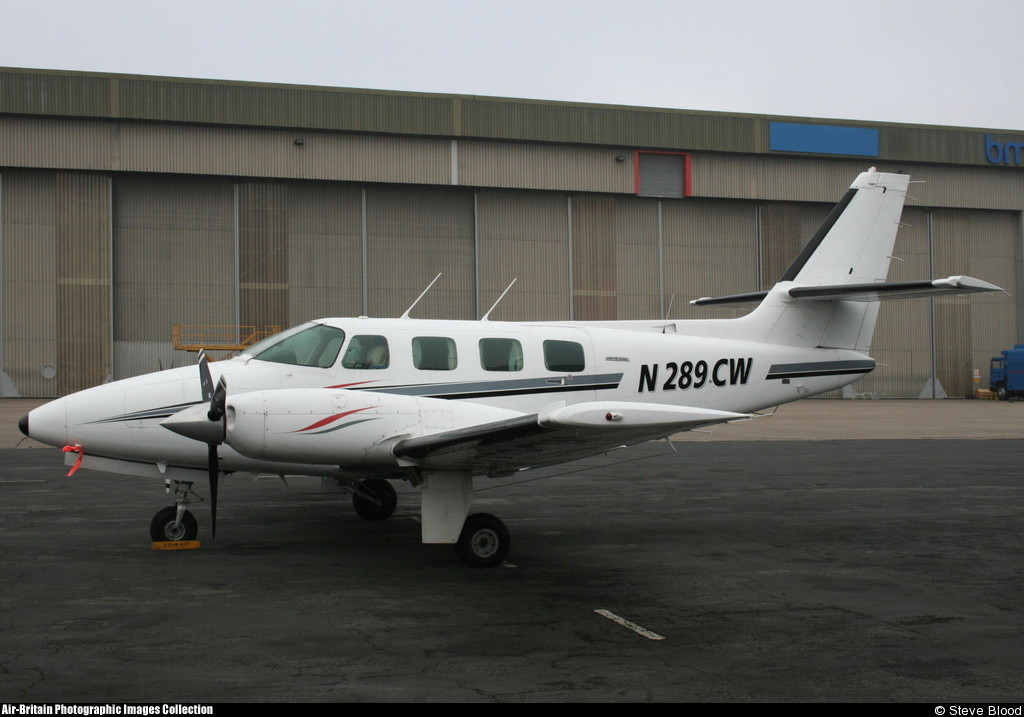
Crash of a Cessna T303 Crusader off Jersey: 2 killed

Date & Time: Sep 4, 2013 at 1013 LT
Type of aircraft:
Operator:
Registration:
N289CW
Flight Type:
Survivors:
No
Schedule:
Dinan - Jersey
MSN:
303-00032
YOM:
1981
Region:
Crew on board:
1
Crew fatalities:
Pax on board:
1
Pax fatalities:
Other fatalities:
Total fatalities:
2
Captain / Total flying hours:
524
Captain / Total hours on type:
319.00
Circumstances:
The aircraft was on a VFR flight from Dinan, France, to Jersey, Channel Islands and had joined the circuit on right base for Runway 09 at Jersey Airport. The aircraft turned onto the runway heading and was slightly left of the runway centreline. It commenced a descent and a left turn, with the descent continuing to 100 ft. The pilot made a short radio transmission during the turn and then the aircraft’s altitude increased rapidly to 600 ft before it descended and disappeared from the radar. The aircraft probably stalled in the final pull-up manoeuvre, leading to loss of control and impact with the sea, fatally injuring those on board, Carl Whiteley and his wife.
Probable cause:
The accident was probably as a result of the pilot’s attempt to recover to normal flight following a stall or significant loss of airspeed at a low height, after a rapid climb manoeuvre having become disoriented during the approach in fog.
Final Report:
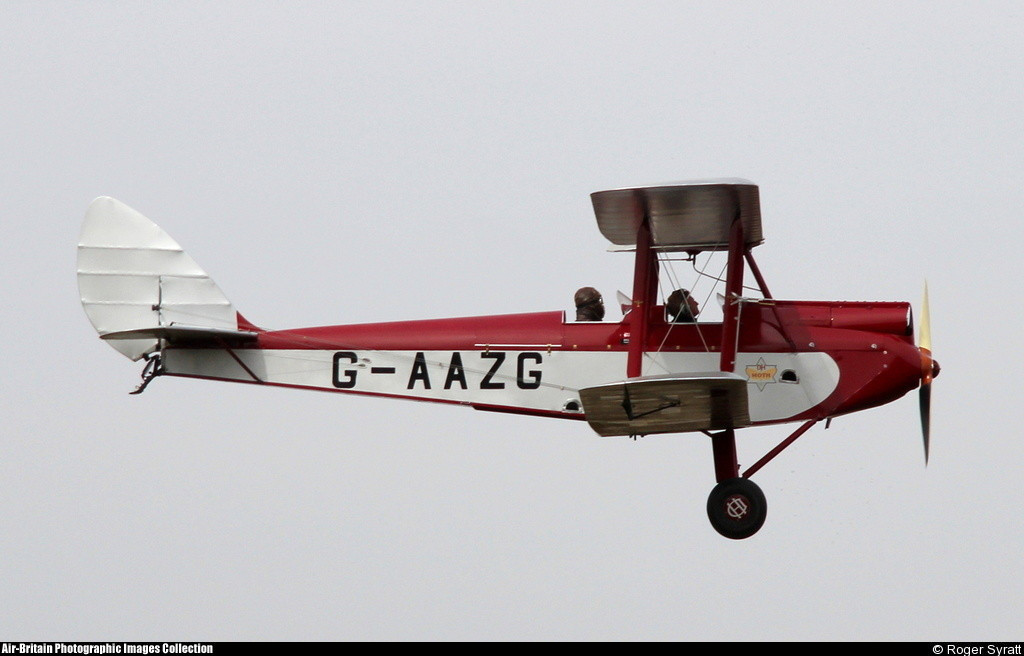
Crash of a De Havilland DH.60G Moth in Canons Ashby

Date & Time: Aug 12, 2013 at 1130 LT
Type of aircraft:
Operator:
Registration:
G-AAZG
Flight Phase:
Flight Type:
Survivors:
Yes
Schedule:
Turweston - Turweston
MSN:
1253
YOM:
1930
Region:
Crew on board:
1
Crew fatalities:
Pax on board:
1
Pax fatalities:
Other fatalities:
Total fatalities:
0
Captain / Total flying hours:
512
Captain / Total hours on type:
15.00
Circumstances:
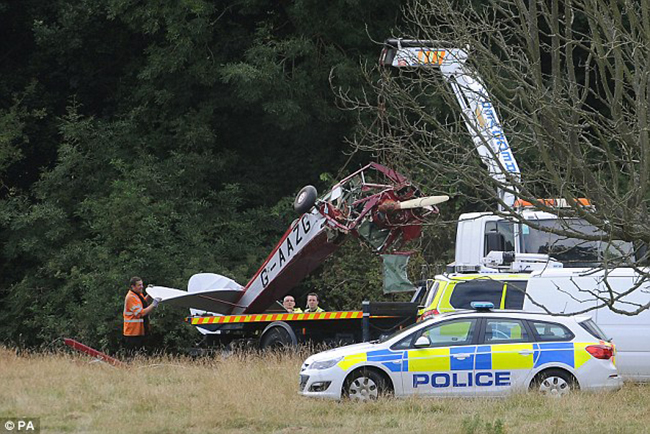
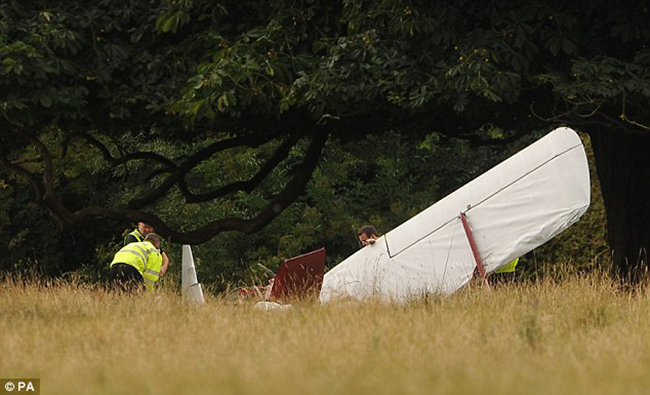
The pilot was carrying out a local flight with a friend. The weather was good (CAVOK), with a westerly wind of about 12 to 15 kt. The passenger occupied the front cockpit and the pilot the rear. The engine started normally and the aircraft departed, climbing to an altitude of 1,200 ft. The pilot carried out two medium banked turns and a gentle wingover manoeuvre before entering another steep turn to the left. When established in the turn, the engine stopped and the aircraft entered a spin to the left. The pilot recovered from the spin but, due to the limited height available, could only pull out of the dive and carry out a forced landing in an isolated grass area, amongst trees and other obstacles. In doing so, the aircraft struck a ridge and furrow, which destroyed the landing gear and much of the forward fuselage. A member of the public witnessed the accident and called the emergency services, who recovered both occupants from the wreckage. The pilot and his passenger had suffered serious injuries and were transferred to hospital. There was no fire.The aircraft had recently been re-weighed. During that process, the fuel tank had been drained and the same fuel was then used to refill the tank. After that, the aircraft had flown some five hours, during which it had been refuelled twice at a licensed aerodrome. The second refuel had taken place prior to positioning the aircraft back to the private site from which the accident flight departed. It was reported that the engine had been consistently reliable. No reason for the engine failure was identified. The pilot considered that he had avoided a serious head injury because he was wearing a protective helmet. Also, he commented that he had since had discussions with others in the historic aircraft community regarding energy absorbing foam in seat pans and its potential for reducing the level of back injuries in the event of an accident.
Probable cause:
Engine failure for undetermined reason.
Final Report:
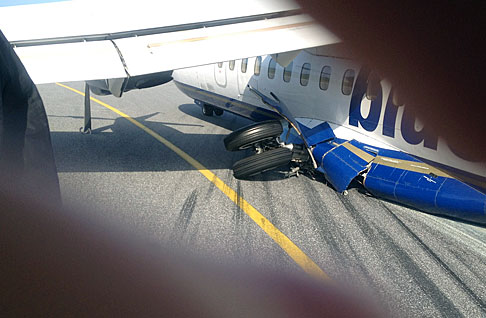
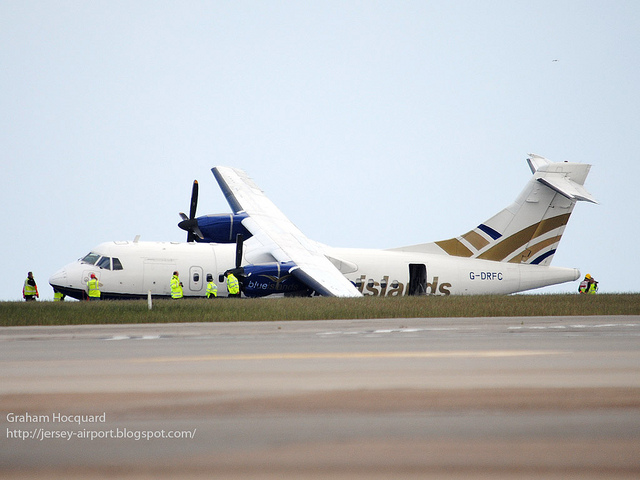
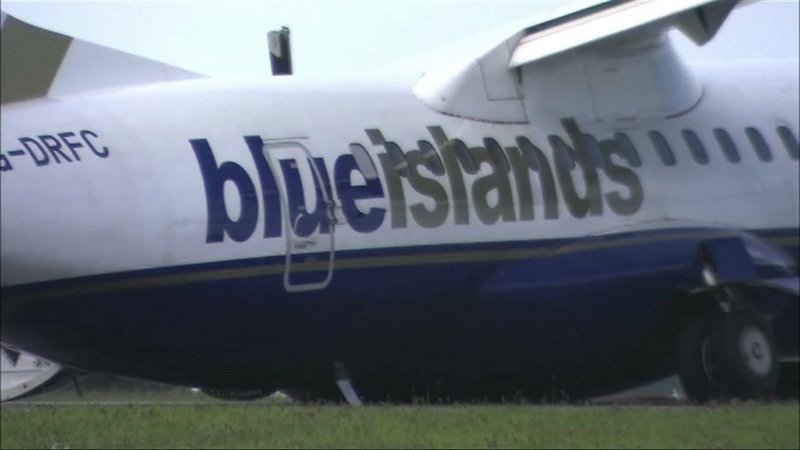
Crash of an ATR42-320 in Jersey

Date & Time: Jun 16, 2012 at 0823 LT
Type of aircraft:
Operator:
Registration:
G-DRFC
Survivors:
Yes
Schedule:
Guernsey - Jersey
MSN:
007
YOM:
1986
Flight number:
BCI308
Region:
Crew on board:
3
Crew fatalities:
Pax on board:
40
Pax fatalities:
Other fatalities:
Total fatalities:
0
Captain / Total flying hours:
6106
Captain / Total hours on type:
1255.00
Circumstances:
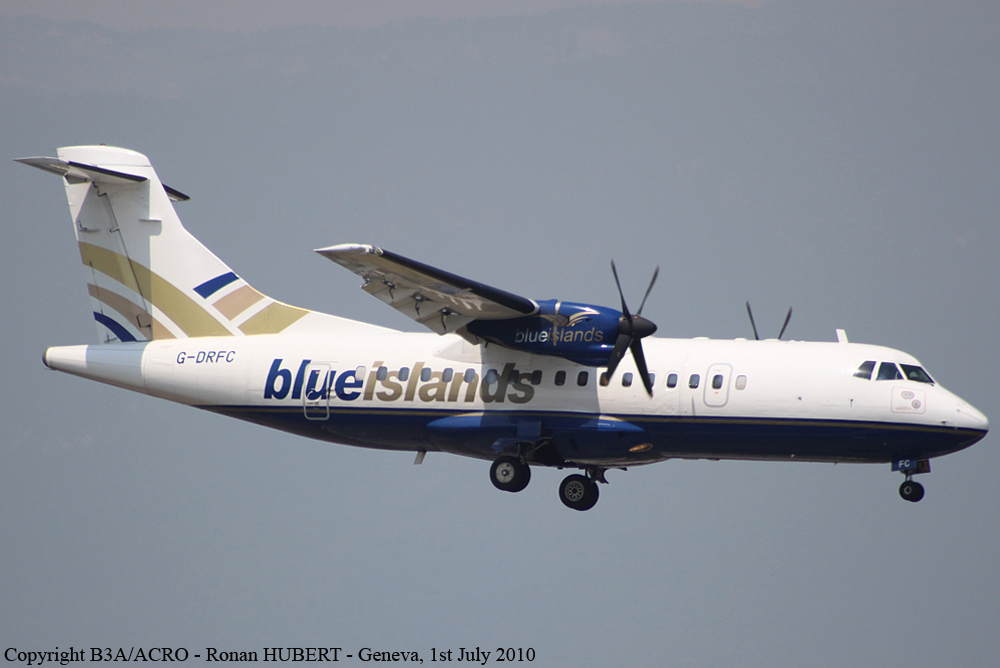
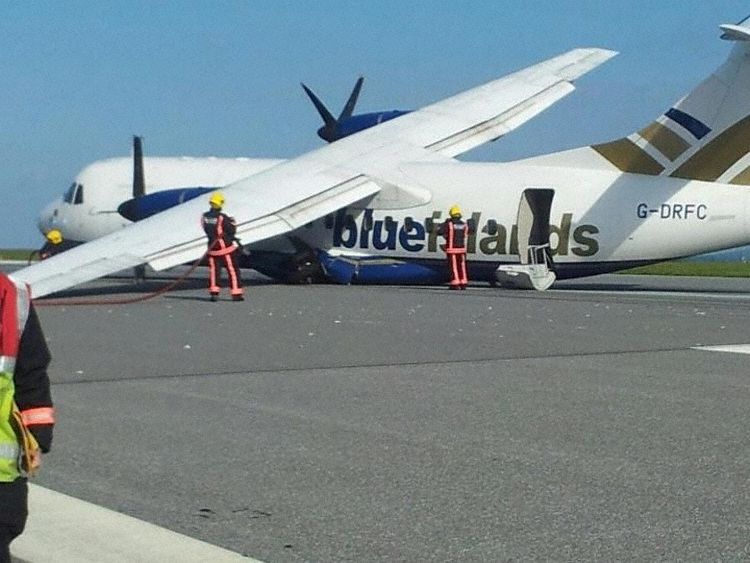
The crew, comprising a commander, co-pilot and cabin crewmember, reported for duty at 0620 hrs at Guernsey Airport. The commander was conducting line training of the co-pilot, a first officer who had recently joined the companyThe first sector was to be from Guernsey to Jersey. No problems were identified during the pre-flight preparation and the aircraft departed on time at 0705 hrs, with the commander acting as handling pilot. The short flight was without incident and the weather for landing was reported as good, with the wind from 210° at 16 kt, FEW cloud at 2,000 ft and visibility in excess of 10 km. The commander elected to carry out a visual approach to Runway 27 at Jersey, using a planned approach speed of 107 kt and flap 30 selected for landing. During the approach, the gear was selected down and the flight crew confirmed the three green ‘gear safe’ indication lights were illuminated, indicating that the gear was locked in the down position. The commander reported that both the approach and touchdown seemed normal, with the crosswind from the left resulting in the left main gear touching first. Just after touchdown both pilots heard a noise and the commander stated the aircraft appeared to settle slightly differently from usual. This made him believe that a tyre had burst. The cabin crew member also heard a noise after touchdown which she too thought was from a tyre bursting. The commander selected ground idle and partial reverse pitch and, as the aircraft decelerated through 70 kt, the co-pilot took over control of the ailerons, as per standard procedures, to allow the commander to take control of the steering tiller. The co-pilot reported that despite applying corrective inputs the aircraft continued rolling to the left. A member of ground operations staff, situated at Holding Point E, reported to the tower controller that the left landing gear leg of the aircraft did not appear to be down properly as it passed him. The aircraft continued to quickly roll to the left until the left wingtip and propeller contacted the runway. The aircraft remained on the runway, rapidly coming to a halt to the left of the centreline, approximately abeam Holding Point D. Both propellers continued to rotate and the commander selected the condition levers to the fuel shutoff position and pulled the fire handles to shut both engines down. The tower controller, seeing the incident, pressed the crash alarm and airfield emergency services were quickly in attendance.
Probable cause:
The recorded data indicates that the rate of descent during the final approach phase was not excessive and remained low through the period of the touchdown. Although the registered vertical acceleration at ground contact was high, this is not consistent with the recorded descent rate and is believed to have been the effect of the close physical proximity of the accelerometer to the location of the fractured side brace. It is reasonable to assume that the release of strain energy during the fracturing process produced an instant shock load recorded as a 3 g spike.The general nature of the failure mechanism precipitating the collapse of the landing gear is clear. A fatigue crack propagated through most of the cross-section of one side of an attachment lug of the left main landing gear side brace upper arm. This continued as a final region of ductile cracking until complete failure occurred. The increased loading, during normal operation, on other elements of the twin lugs, once the initial crack was large or had passed completely through the section, led to overloading in the other section of the forward lug and both sections of the aft lug. This caused rapid onset of three small areas of fatigue damage followed by ductile overload failure of both lugs. The failure rendered the side brace ineffective and the unrestrained main trunnion continued to translate outboard leading to the collapse of the gear. The aluminium was found to be within the specifications to which it was made. The initial fatigue crack emanated from a feature which was inter-granular and high in titanium content, which was probably a TiB2 particle introduced during grain refining. This was surrounded by an area consistent with static loading before propagating a crack in fatigue. Given that there was not a measurable effect on the fatigue life of the material with the feature, and that an area of static overload was evident immediately surrounding the TiB2 particle, it is therefore concluded that at some time during the life of the side brace component it probably suffered a single loading event sufficient to exploit the presence of the origin, initiating a crack that remained undetectable until failure.
Final Report:
Crash of a Piper PA-31-325 Navajo C/R in Welshpool: 2 killed

Date & Time: Jan 18, 2012 at 1117 LT
Type of aircraft:
Operator:
Registration:
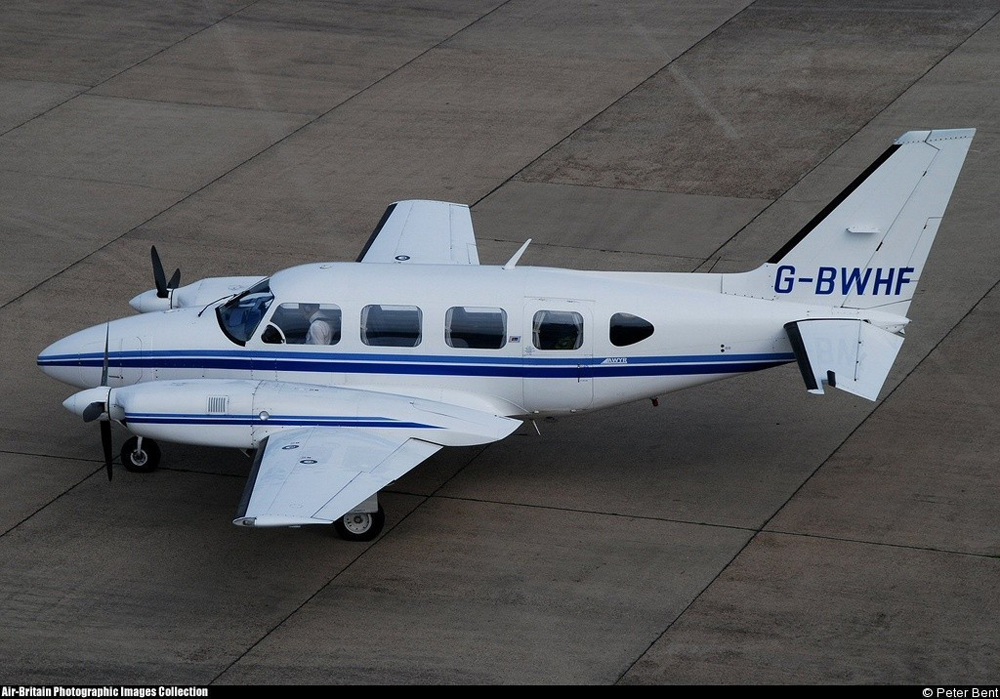
G-BWHF
Flight Type:
Survivors:
No
Schedule:
Welshpool - Welshpool
MSN:
31-7612076
YOM:
1976
Location:
Region:
Crew on board:
2
Crew fatalities:
Pax on board:
0
Pax fatalities:
Other fatalities:
Total fatalities:
2
Captain / Total flying hours:
11164
Captain / Total hours on type:
375.00
Copilot / Total flying hours:
17590
Copilot / Total hours on type:
2177
Circumstances:
The commander had retired from flying Commercial Air Transport operations with an airline in August 2011. He had recently renewed his single pilot Instrument Rating and Multi Engine Piston (Land) planes rating and his intention was to continue flying part-time. He had been invited to fly G‑BWHF, which was privately operated for business purposes, but his last flight in this aircraft was on 10 November 1998. Accordingly, he planned to conduct a re-familiarisation flight. The commander was accompanied by another pilot who was not a flight instructor but had recent experience of flying the aircraft and was familiar with the aerodrome. A webcam recorded the pilots towing the aircraft to the refuelling point, refuelling it and carrying out pre‑flight preparations. There were no witnesses to any briefings which may have taken place. The commander first started the right engine, which initially ran roughly and backfired before running smoothly. The left engine started normally. The second pilot took his place in the front right seat. The aircraft taxied to the holding point of Runway 22, and was heard by witnesses to be running normally. A witness who lived adjacent to the airfield but could not see the aircraft heard the power and propeller checks being carried out, three or four times instead of once per engine as was usual. The engines were heard to increase power and the witness observed the aircraft accelerate along the runway and takeoff at 1105 hrs. It climbed straight ahead and through a small patch of thin stratus cloud, the base of which the witness estimated was approximately 1,000 ft aal. The aircraft remained visible as it passed through the cloud and continued climbing. The witness turned away from the aircraft to continue working but stated that apart from the unusual number of run-up checks, the aircraft appeared and sounded normal. The pilot of a Robinson R22 helicopter which departed Welshpool at 1015 hrs described weather to the south of the aerodrome as drizzle with patches of broken stratus at 600-700 ft aal. He was able to climb the helicopter between the patches of stratus until, at 1,500 ft, he was above the tops of the cloud. Visibility below the cloud was approximately 5-6 km but, above the cloud, it was in excess of 10 km. He noted that the top of Long Mountain was in cloud and his passenger took a photograph of the Long Mountain area The R22 returned to the airfield and joined left hand downwind for Runway 22. As it did so, its pilot heard a transmission from the pilot of the PA-31 stating that he was rejoining for circuits. The R22 pilot transmitted his position in order to alert the PA-31, then continued around the circuit and called final before making his approach to the runway, landing at about 1115 hrs. After passing overhead Welshpool, it made a descending left circuit, becoming established on a left hand, downwind leg for Runway 22. A witness approximately 3.5 nm northeast of the accident site saw the aircraft coming towards him with both propellers turning. It made a turn to the left with the engines apparently at a high power setting and, as it passed over Long Mountain, commenced a descent. He could not recall whether he could still hear the engines as the aircraft descended. He then lost sight of it behind the rising ground of Long Mountain. A search was initiated when the aircraft failed to return to Welshpool. Its wreckage was located in an open field on the west slope of Long Mountain. There were no witnesses to the actual impact with the trees or surface of the field but the sound was heard by a witness in the wood who stated that the engines were audible immediately prior to impact. The accident, which was not survivable, occurred at 1117 hrs. Both pilots were fatally injured.
Probable cause:
The aircraft struck the tops of the trees located on the upper slope of Long Mountain, while descending for a visual approach to land on Runway 22 at Welshpool Airport. The trees were probably not visible to the pilots because of cloud covering the upper slopes.
Final Report:
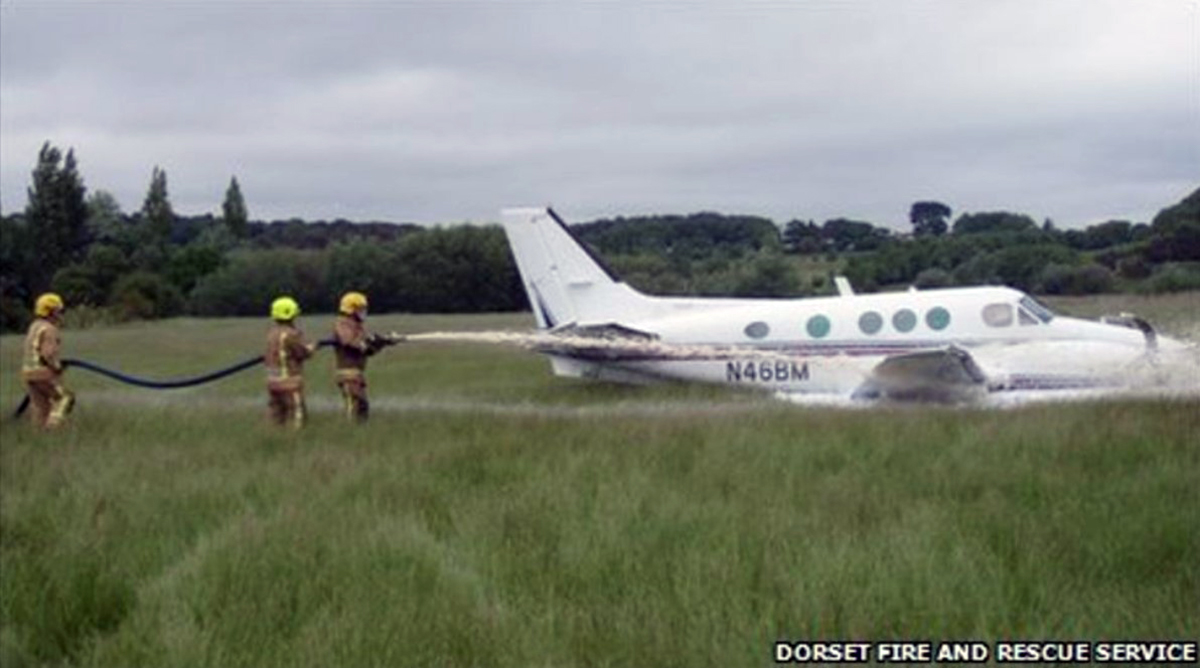
Crash of a Beechcraft E90 King Air in Bournemouth

Date & Time: May 18, 2011 at 1131 LT
Type of aircraft:
Registration:
N46BM
Flight Phase:
Flight Type:
Survivors:
Yes
Schedule:
Bournemouth - Manchester
MSN:
LW-198
YOM:
1976
Region:
Crew on board:
1
Crew fatalities:
Pax on board:
1
Pax fatalities:
Other fatalities:
Total fatalities:
0
Captain / Total flying hours:
800
Captain / Total hours on type:
660.00
Circumstances:
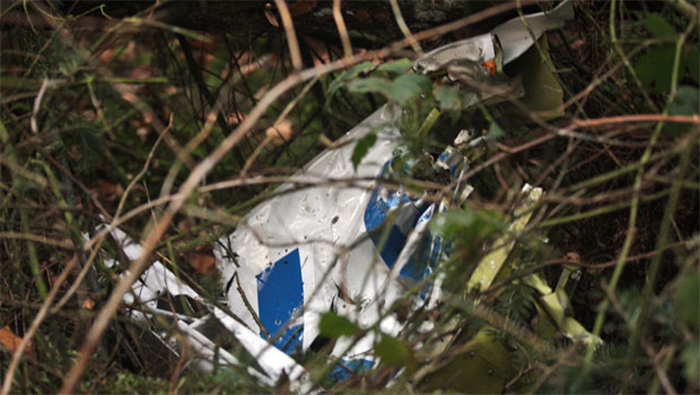
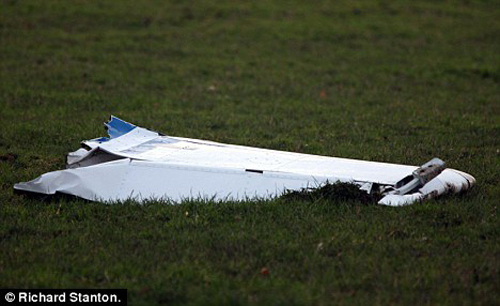
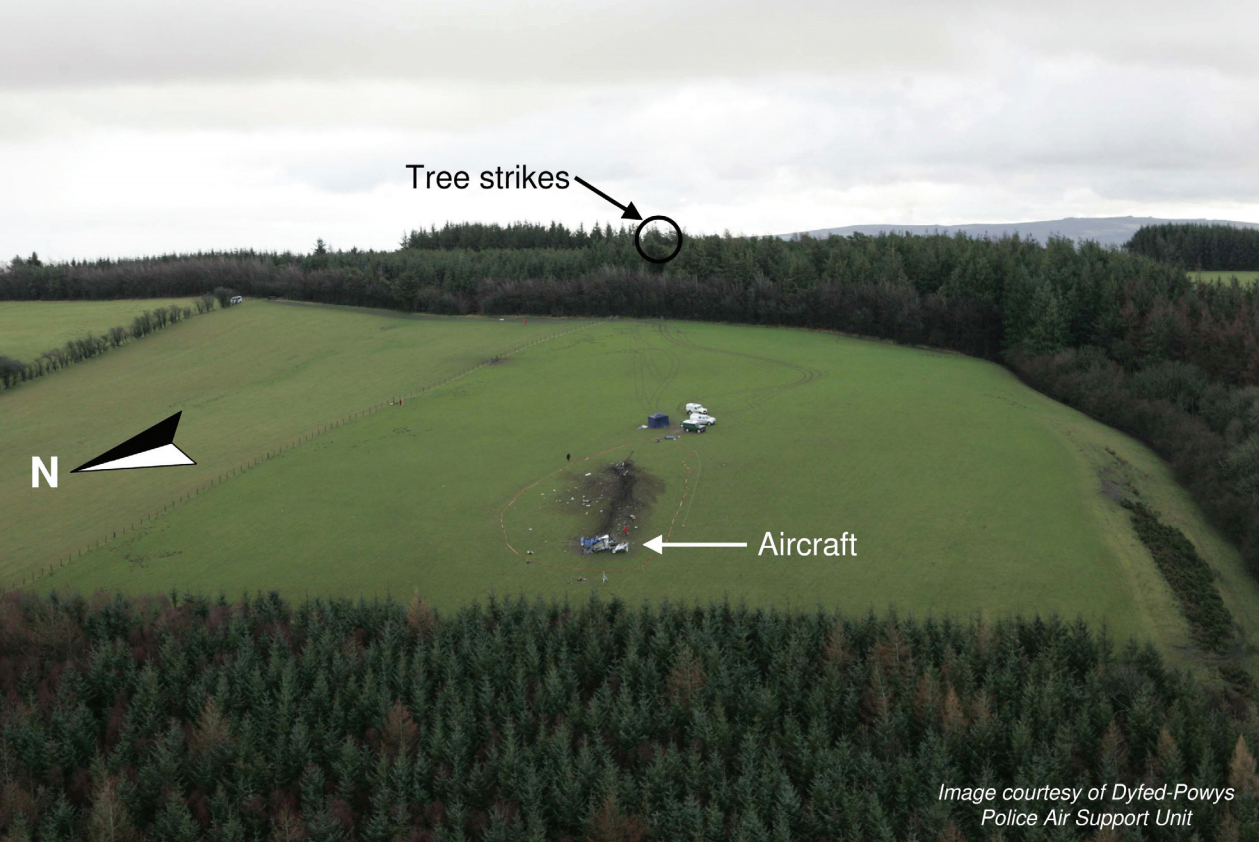
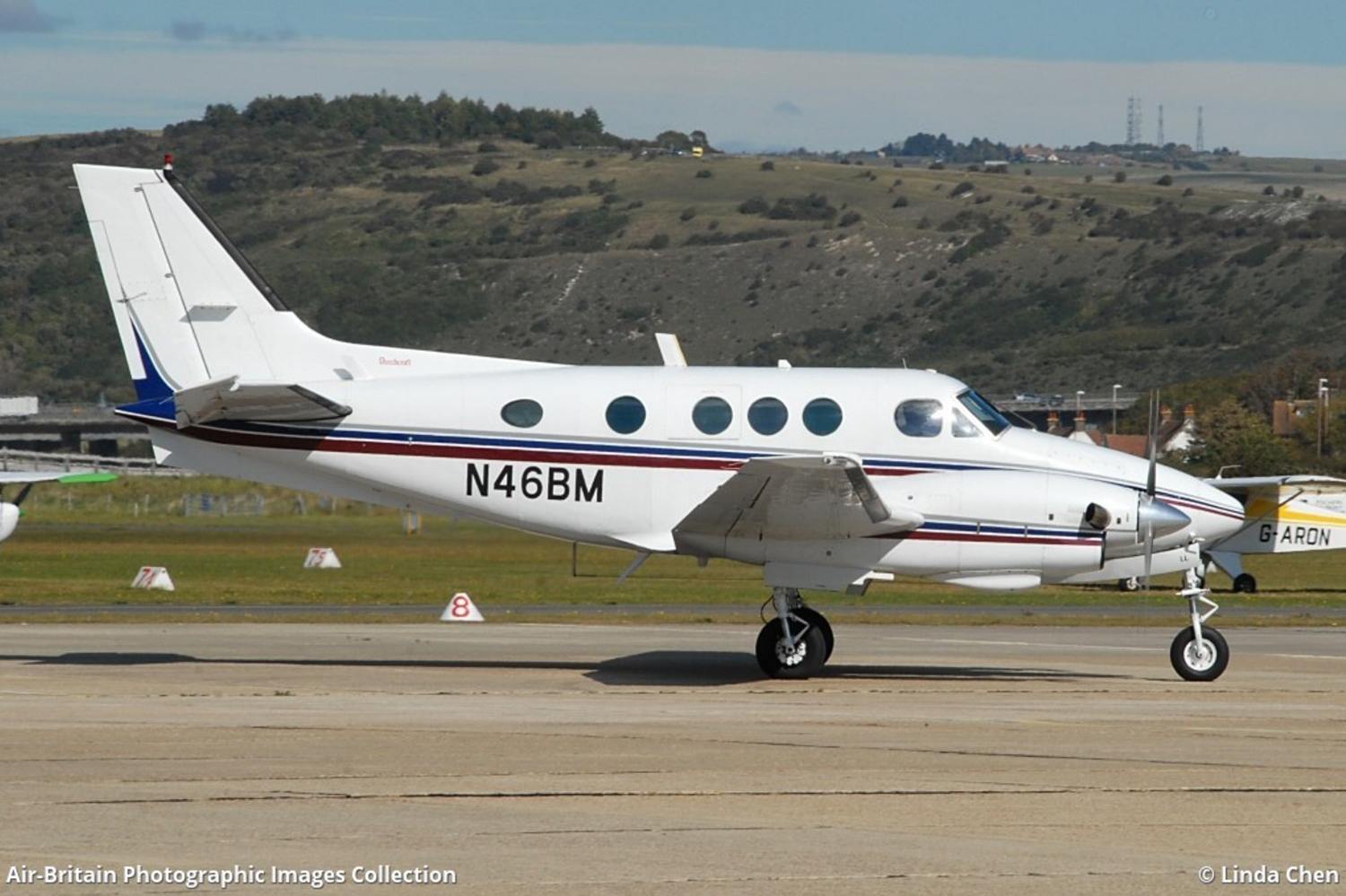
The pilot had planned to fly from Bournemouth Airport to Manchester Airport operating the flight as a single pilot, with a passenger seated in the co-pilot’s seat. He arrived at the airport approximately one hour before the planned departure time of 1130 hrs, completed his pre‑flight activities and went to the aircraft at approximately 1110 hrs. The 1120 hrs ATIS gave the weather at the airport as: surface wind from 230° at 10 kt, visibility 10 km or greater, few clouds at 1,000 ft, broken cloud at 1,200 ft and at 2,000 ft, temperature 16°C, dew point 12°C and QNH 1015 hPa. After starting the engines, the pilot was cleared to taxi to holding point ‘N’ for a departure from Runway 26 and he was given clearance to take off at 1127 hrs. At 1129:45 hrs, approximately 55 seconds after the aircraft became airborne, the aerodrome controller transmitted “four six bravo mike do you have a problem?” because he believed the aircraft was not climbing normally. The pilot replied “november four six bravo going around” and, shortly afterwards, “four six bravo requesting immediate return”. The controller cleared the pilot to use either runway to land back at the airport but received no reply. The pilot carried out a forced landing into a field 1.7 nm west of the Runway 08 threshold at Bournemouth Airport and neither he nor his passenger was hurt.
Probable cause:
The pilot experienced symptoms of symmetrical power loss sufficient to prevent the aircraft from sustaining level flight and made a forced landing into a field. The deficiency in the aircraft’s takeoff performance suggested that its powerplants were not producing sufficient thrust. As fuel contamination was discounted and no fault was found in either engine, it was concluded that, in all probability, the poor performance was not caused by a failure in either powerplant. Maximum rpm was not selected for departure but it was unlikely that this explained the aircraft’s poor performance on the runway or in the air. The pilot insisted that he had set torque to the takeoff limit. There was insufficient evidence to enable the cause of the apparent power loss to be determined.
Final Report:

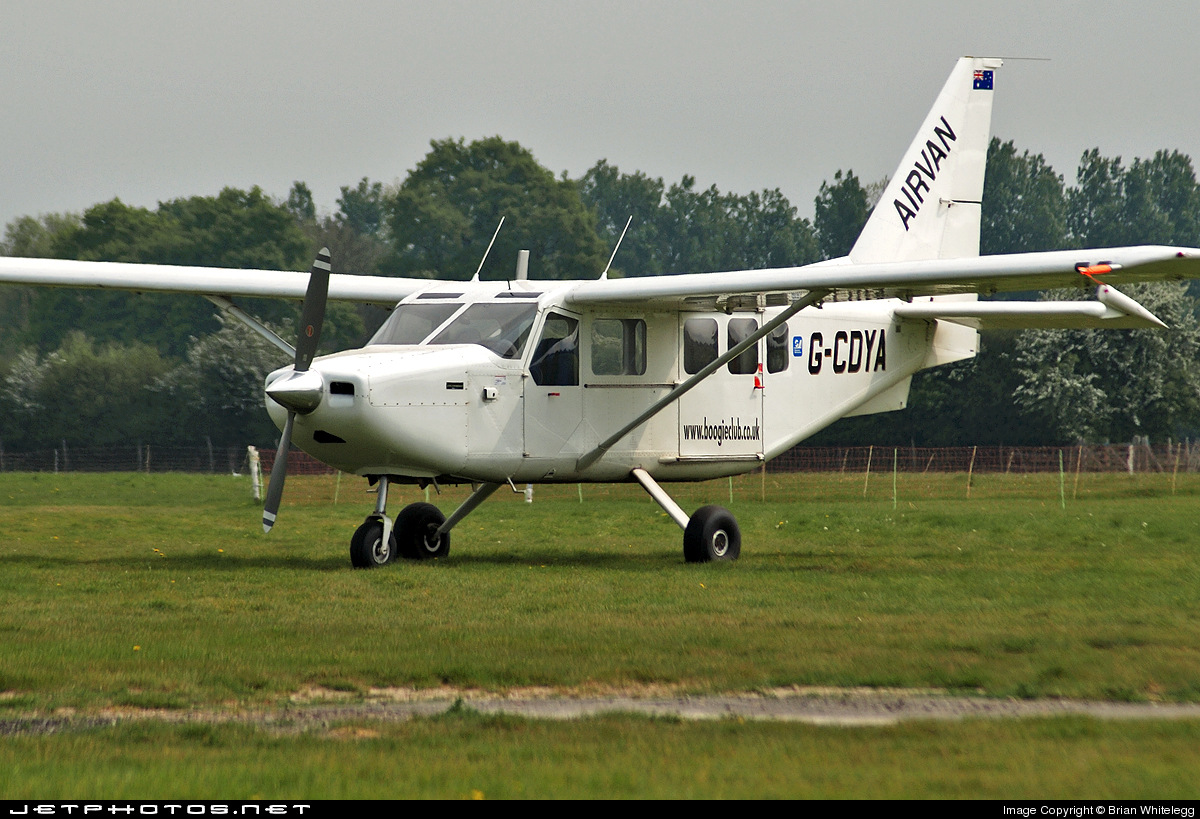
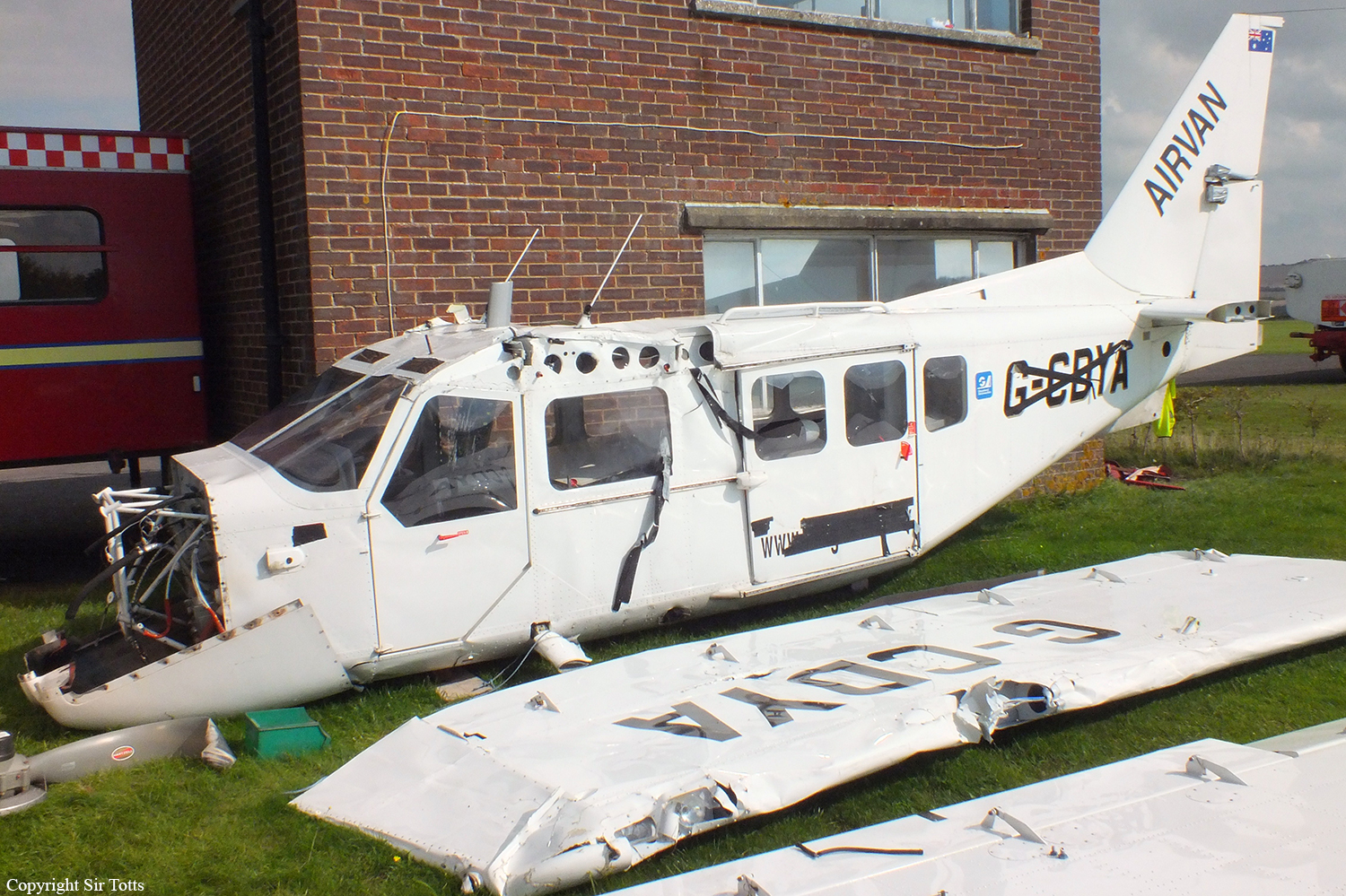
Crash of a Gippsland GA8 Airvan in Swindon

Date & Time: Nov 28, 2010 at 1015 LT
Type of aircraft:
Operator:
Registration:
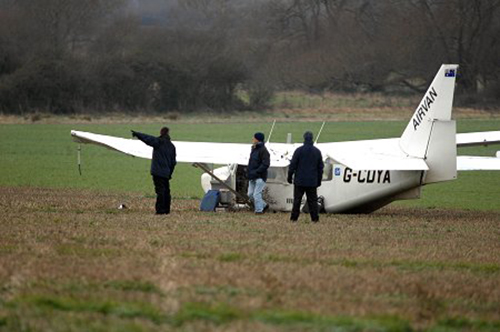
G-CDYA
Flight Phase:
Survivors:
Yes
Schedule:
Swindon - Swindon
MSN:
GA8-05-090
YOM:
2005
Region:
Crew on board:
1
Crew fatalities:
Pax on board:
8
Pax fatalities:
Other fatalities:
Total fatalities:
0
Captain / Total flying hours:
2686
Captain / Total hours on type:
1057.00
Circumstances:
The pilot arrived at the aircraft at approximately 0900 hrs to prepare it for a flight to drop parachutists. The aircraft had been outside overnight and there had been a heavy frost. The pilot removed a cover from the windscreen and began his pre-flight check during which he noticed no ice or frost on the upper surface of the wings. He returned to the operations building to complete his pre-flight planning and went back to the aircraft in time to start the engine at 1000 hrs. There was a very light wind from the north-west across the grass Runway 06L, the temperature was -4°C and the QNH was 1004 mb. While the engine was warming up, eight parachutists boarded the aircraft and sat down in the cabin. There were three parachute instructors, who were connected to three students, and two other parachutists with video cameras, one of whom was the jump supervisor. After the pilot judged that the engine had warmed up, he carried out a power check and the before takeoff checks, during which he selected the flaps to TAKEOFF. All indications appeared normal to the pilot and he taxied onto the runway and selected takeoff power, which was 29 inches of Manifold Air Pressure (MAP)and 2,500 rpm. The acceleration seemed, to the pilot, to be normal but, although VR was 60 kt, he delayed the rotation until 65 kt. At about the time the aircraft rotated, the pilot selected the flaps to FULL. As the aircraft crossed the hedge at the upwind end of the runway, the pilot began a left turn, which was the usual noise abatement manoeuvre to avoid flying over buildings situated on the runway’s extended centreline. During the turn, he realised the aircraft was descending and checked the engine instruments, observing that the MAP, fuel pressure and rpm were indicating correctly. He called “BRACE, BRACE, BRACE” and the aircraft hit the ground immediately afterwards in a left wing low attitude. After crossing a ditch, during which the landing gear detached, the aircraft skidded to a halt in the next field. The pilot was able to exit the aircraft through the door on his left but found that he could not stand up because of an injury to his leg. The sliding door on the rear left side of the cabin was jammed and the parachutists were unable to use it to leave the aircraft and so they exited through the same door as the pilot. One parachutist received a whiplash injury but the rest were unhurt. The pilot was subsequently airlifted to hospital.
Probable cause:
The aircraft was parked outside overnight prior to the accident and the windscreen, which had been covered, was clear of ice and frost when the cover was removed. Four hours after the accident, the windscreen was still clear, which suggested that ice and frost were not actively forming during that period. However, since frost was found on the upper surface of the wing, it was concluded that the frost would have been present prior to and during the takeoff. The maximum engine power was found to be approximately 50 bhp less than the rated value. This was attributed to the state of wear expected of an engine approximately 75% through its normal overhaul life rather than as a result of a failure experienced on this particular takeoff. The distance to lift off, calculated using the manufacturer’s performance information, should have been between 340 m and approximately 368 m and yet the aircraft actually left the ground after approximately 560 m. The extra distance used by the aircraft was probably a combination of two factors: the engine was not producing the power assumed in the performance calculation and the aircraft was rotated approximately three to five knots above VR. It is possible that takeoff performance was reduced due to the effects of frost on the wings but it was not possible to quantify these effects. As the aircraft began its left turn, the flaps were at FULL and yet the flap selector handle and the flaps were found in the TAKEOFF position following the accident. At some point in the turn, therefore, the flaps were raised by one stage. This would have had the effect of increasing the stalling speed by approximately three knots (in the case of an uncontaminated wing). The groundspeed of the aircraft, recorded by the GPS approximately six seconds before impact, was 58 kt. The aircraft was turning into a light wind and so the IAS might have been slightly higher. The stalling speed of the aircraft during the turn, with the flaps in the TAKEOFF position and with an uncontaminated wing, would have been approximately 63 kt. The effect of the frost would have been to increase the stalling speed, in the worst case, to 75 kt. The CAA Safety Sense Leaflet 3 suggests that the maximum reduction of lift might occur with frost that has a surface roughness of course sandpaper, whereas the frost found on G-CDYA was similar to medium sandpaper. Nevertheless, it was clear that the lifting ability of the wing would have been compromised and the stalling speed would have been higher than 63 kt. It seemed probable, therefore, that the aircraft stalled in the turn as a result of frost on the wing. Furthermore, the angle of attack at the stall was probably lower than that required to activate the stall warning horn.
Final Report:
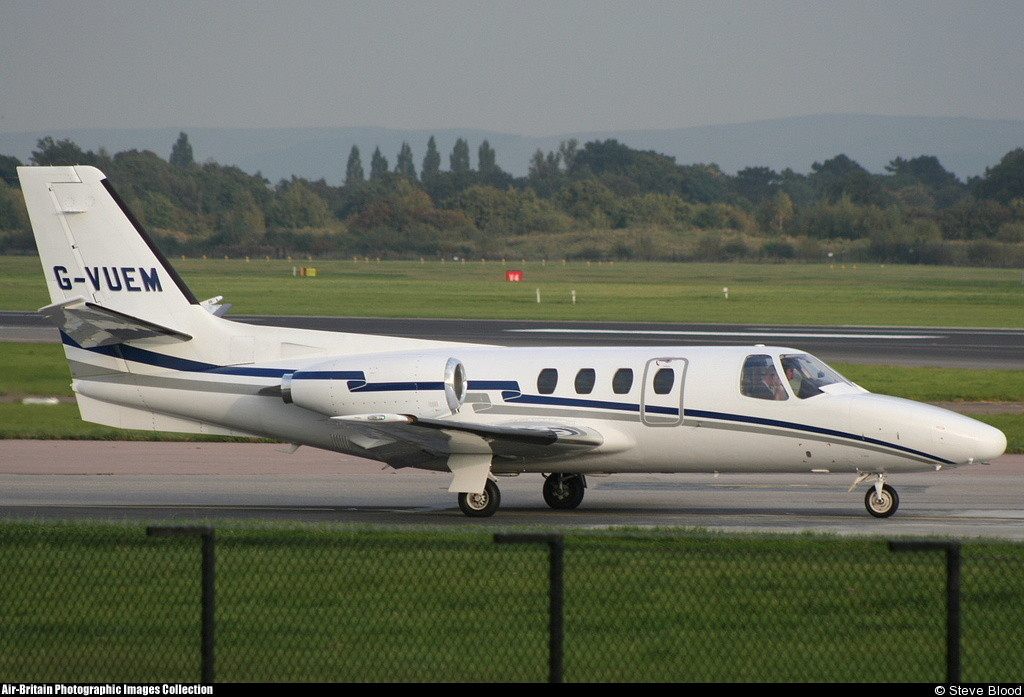
Crash of a Cessna 501 Citation I in Birmingham

Date & Time: Nov 19, 2010 at 1535 LT
Type of aircraft:
Registration:
G-VUEM
Flight Type:
Survivors:
Yes
Schedule:
Belfast - Birmingham
MSN:
501-0178
YOM:
1981
Region:
Crew on board:
2
Crew fatalities:
Pax on board:
0
Pax fatalities:
Other fatalities:
Total fatalities:
0
Captain / Total flying hours:
7200
Captain / Total hours on type:
3000.00
Copilot / Total flying hours:
1785
Copilot / Total hours on type:
735
Circumstances:
The flight crew reported for duty at Liverpool Airport at 0845 hrs. Their original task was to fly to Belfast City Airport, collect a transplant organ, and take it to Cambridge Airport. However, on their arrival at Belfast the transfer was no longer required, so they were given a new task to fly to Belfast Aldergrove Airport and collect an organ to carry to Birmingham Airport. The aircraft departed Belfast Aldergrove at 1450 hrs with the co-pilot as pilot flying. The flight was uneventful and the aircraft was given a radar vector to intercept the ILS for a straight-in approach to Runway 15 at Birmingham. The Runway 15 ILS course is 149°M. The autopilot was engaged and the aircraft was flying on a track of 135°M, 13 nm from the touchdown zone and at a groundspeed of 254 kt, when it crossed the localiser centreline. The aircraft then turned right onto a corrective track but once again passed through the localiser course. Further corrections were made and the aircraft passed through the localiser once more before becoming established at 5 nm. The co-pilot later reported that, because the autopilot was not capturing the localiser, he had disconnected it and flown the approach manually. When the aircraft was at 10 nm, the radar controller broadcast a message advising of the presence of a fog bank on final approach and giving RVRs of 1,400 m at touchdown and in excess of 1,500 m at both the mid-point and stop end. The airfield was sighted by the commander during the approach but not by the co-pilot. A handover to the tower frequency was made at around 8 nm. When the aircraft was at 6 nm, landing clearance was given and acknowledged. The tower controller then advised the aircraft that there was a fog bank over the airfield boundary, together with the information that the touchdown RVR was 1,400 m. The commander responded, saying: “WE’VE GOT ONE END OF THE RUNWAY”. The aircraft was correctly on the localiser and the glideslope at 4 nm. The Decision Altitude (DA) of 503 feet amsl (200 feet aal) for the approach was written on a bug card mounted centrally above the glare shield. Both pilots recollected that the Standard Operating Procedure (SOP) calls of “500 above” and “100 above” DA were made by the commander. However, neither pilot could recall a call of ‘decision’ or ‘go-around’ being made. At between 1.1 nm and 0.9 nm, and 400 feet to 300 feet aal, the aircraft turned slightly to the right, onto a track of 152°M. This track was maintained until the aircraft struck the glideslope antenna to the right of the runway some 30 seconds later (see Figure 3, page 11). The aircraft came to rest in an upright position on the grass with a fire on the left side. The co-pilot evacuated through the main cabin door, which is located on the left side of the fuselage, and suffered flash burns as he passed through the fire. The commander was trapped in the cockpit for a time.
Probable cause:
The co-pilot’s task of flying the approach would have become increasingly demanding as the aircraft descended and it is probable that his attention was fully absorbed by this. This was confirmed by his erroneous perception that the aircraft was in IMC from below 2,000 feet amsl. The co-pilot reported that during the final stages of the approach, when he noticed he had lost the localiser indication, he had asked the commander whether he should go around. The response he reported he heard of “no, go left” was not what he had expected, and may correspond to the time from which no further control inputs were made. The commander could not recall having given any instructions to the co-pilot after the ‘100 feet above’ call. It is likely that the crew commenced the approach with an expectation that it would be completed visually. However, the weather conditions were unusual and the aircraft entered IMC unexpectedly, late in the approach. As an aircraft gets closer to a runway the localiser and glideslope indications become increasingly sensitive and small corrections have a relatively large effect. The task for the flying pilot becomes more demanding and the role of the monitoring pilot has greater significance. A successful outcome relies on effective crew co-ordination, based on clear SOPs. The monitoring of this approach broke down in the latter stages and the crucial ‘decision’ call was missed, which led to the aircraft’s descent below minima.
Final Report: