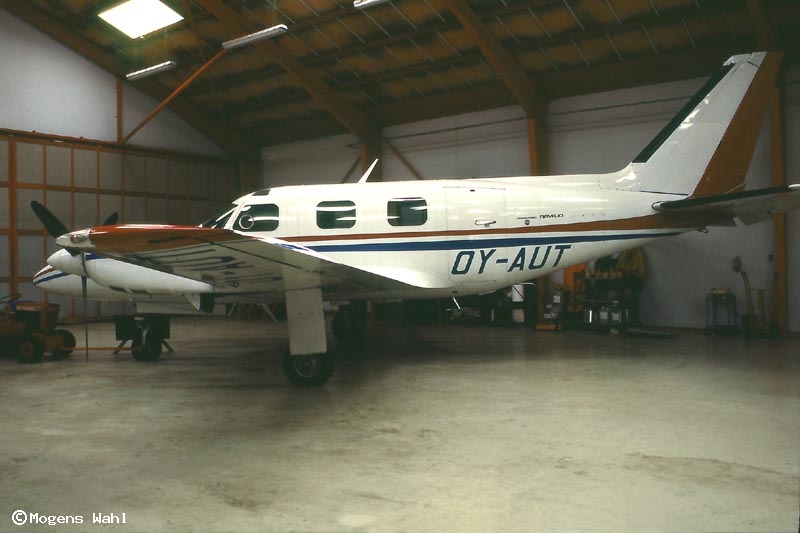
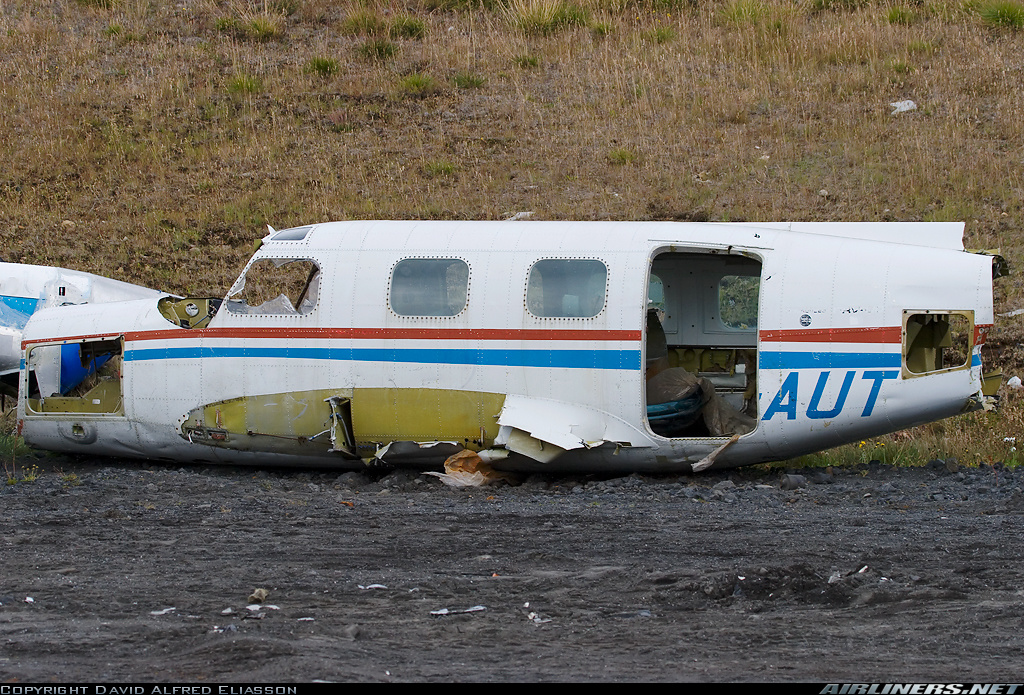
Crash of a Piper PA-31-425 Pressurized Navajo in Reykjavik

Date & Time: Apr 22, 1997
Type of aircraft:
Operator:
Registration:
OY-AUT
Flight Type:
Survivors:
Yes
Schedule:
Reykjavik – Sondreströmfjord
MSN:
31-7400183
YOM:
1974
Country:
Region:
Crew on board:
1
Crew fatalities:
Pax on board:
0
Pax fatalities:
Other fatalities:
Total fatalities:
0
Circumstances:
Few minutes after takeoff from Reykjavik Airport, while cruising over Eyjafjallajökull, the pilote declared an emergency following the failure of the left engine. He was cleared to return to Reykjavik and was vectored for an approach to runway 14. On final, he encountered strong winds when the aircraft banked left then stalled and crashed 200 metres short of runway. The aircraft was damaged beyond repair and the pilot escaped uninjured. At the time of the accident, the wind was gusting from 100°-130° up to 35 knots.
Probable cause:
Engine failure for unknown reasons.

Crash of a Cessna 441 Conquest in Greenland: 8 killed

Date & Time: Sep 12, 1990 at 1745 LT
Type of aircraft:
Operator:
Registration:
OY-CGM
Flight Phase:
Survivors:
No
Schedule:
Söndreströmfjord - Goose Bay
MSN:
441-0229
YOM:
1982
Country:
Region:
Crew on board:
2
Crew fatalities:
Pax on board:
6
Pax fatalities:
Other fatalities:
Total fatalities:
8
Circumstances:
The twin engine aircraft departed Sondreströmfjord on a charter flight to Goose Bay, carrying six sailors and two pilots. Seventeen minutes after takeoff, while cruising at FL220, the aircraft entered an uncontrolled descent and the crew did not send any distress call. At an altitude of 7,000 feet, the aircraft disintegrated and debris scattered on a wide area. The wreckage was found about 148 southwest of Sondreströmfjord and all eight occupants were killed.
Probable cause:
The exact cause of the accident could not be determined with certainty. However, the following findings were reported:
- There was no evidence from the post-mortem examination which suggests a contributory factor in this accident.
- There was no radio transmission from the crew indicating that they were concerned of any problem.
- There was no evidence of fire, engine failure, explosion, structural or mechanical defect prior to the in-flight break-up.
- The evaluation of the ATC tape indicates that an impairment of the crew was present, consistent with, but not confirmatory of hypoxia.

Crash of a Fokker F27 Friendship 100 in Greenland: 2 killed

Date & Time: Apr 20, 1985 at 1932 LT
Type of aircraft:
Operator:
Registration:
YN-BZF
Flight Phase:
Flight Type:
Survivors:
Yes
Schedule:
Keflavik – Sondreströmfjord
MSN:
10118
YOM:
1959
Country:
Region:
Crew on board:
5
Crew fatalities:
Pax on board:
0
Pax fatalities:
Other fatalities:
Total fatalities:
2
Aircraft flight hours:
45111
Aircraft flight cycles:
58384
Circumstances:
The Fokker F-27, registration YN-BZF, was engaged on a delivery flight from North Yemen to Nicaragua. For the purpose of extended range two 200 US gal auxiliary ferry fuel tanks had been installed in the cabin of the aircraft. YN-BZF departed on 11 April 1985 from North Yemen (Sanaa) via Saudi Arabia (Jeddah), Egypt (Cairo) to Greece (Athens). The flight proceeded from Greece on 19 April 1985 via Italy (Genoa) to Scotland (Prestwick). On 20 April 1985 the flight proceeded from Prestwick via Stornoway to Reykjavik (Iceland) where it arrived at 15:48 hours. Since the crew had been unable to retrieve fuel from the auxiliary ferry fuel system during the preceding part of the flight, they checked the system during the stay at Reykjavik, and they found it to be in working order. An additional check was done by experienced Icelandic F-27 engineers. In the opinion of the ground engineers the auxiliary fuel system "was not very professionally looking" and they "got the feeling that the crew was not quite certain of how to operate it". They advised the crew on how to operate the fuel system and do a ground run to see if it worked. After having received weather information and ATC clearance, the crew took off at 17:21 hours, heading for Kangerlussuaq-Søndre Strømfjord Airport. At 18:32 the Pilot-in-Command transmitted a message to Iceland radio, whom he asked to extend his thanks to the Icelandic engineers with the message that the auxiliary ferry fuel system was working correctly. This message was transmitted prior to passage of Kulusuk at 19:35 hours. During the flight from Reykjavík, Iceland to Greenland the crew informed the air traffic control that problems had arisen with retrieving fuel from the auxiliary ferry fuel system. At 19:50, approximately 50 NM west of Kulusuk, the crew radioed to the radar station BIG GUN about fuel problems, as it had been discovered that the auxiliary ferry fuel system did not function after all. Thus encountering a reduction of fuel reserves by approximately 400 US gal together with a ground speed of only 180 knots the crew decided to return for landing at Kulusuk Airport. However, due to deteriorating weather conditions the aerodrome could not be located. The flight diverted hereafter westbound for an emergency landing at a radar station, "SOB STORY", on the icecap. During descent the aircraft collided with the icecap.
Probable cause:
The following findings were reported:
- The crew was properly certified for the flight,
- According to the crew the normal aircraft systems, except for the FDR and the cockpit right front window electrical deicing system, were functioning normally, which was also determined by the on site investigation,
- The auxiliary ferry fuel system was not functioning properly. The cause of this has not been conclusively established,
- The crew did not undertake a satisfactory functional airborne check of the auxiliary ferry fuel system to ensure that it worked prior to the essential appliance of the system for flight, (cause-factor),
- It is the opinion of this department from the evidence available that a deficiency in the procedures applied for operating the auxiliary ferry fuel system may have been a major factor,
- The assistance rendered to the flight of YN-BZF was active and generally professional. However, the AFIS operator erroneously stated the distance from the KK NDB of 3 NM to be 10 NM.,
- Furthermore the bearing from the KK NDB was not stated by the AFIS operator at BGKK on request from the crew of YN-BZF,
- In the opinion of this department the lack of this information does not seem to have had any important bearing on the possibility of locating the aerodrome,
- Weather conditions were a major factor in this accident, at the time of the approach into BGKK, as well as at the accident site, (cause-factor),
- The Search and Rescue operation was anticipated at an early stage and put into effect immediately after the aircraft was considered to have had an accident,
- The conditions offered on the accident site: low visibility approaching darkness, and consequently the inability to evaluate surface conditions, precluded successful rescue in the first attempt.


Crash of a Beechcraft A65-8200 Queen Air near Angmagssalik: 2 killed

Date & Time: Mar 17, 1978 at 2215 LT
Type of aircraft:
Registration:
N8431N
Flight Phase:
Flight Type:
Survivors:
No
Site:
Schedule:
Washington D.C. – Sondreströmfjord – Reykjavik – Liverpool
MSN:
LC-307
YOM:
1969
Country:
Region:
Crew on board:
2
Crew fatalities:
Pax on board:
0
Pax fatalities:
Other fatalities:
Total fatalities:
2
Circumstances:
The crew was completing a ferry flight from Washington DC to Liverpool, UK, with intermediate stops in Sondreströmfjord and Reykjavik. On the leg between Greenland and Iceland, the crew encountered icing conditions and declared an emergency after the right engine failed. He was vectored to Kulusuk Airport which is a VFR Airfield located on the southeast coast of Greenland, near the city of Angmagssalik (Tasiilaq) and open to traffic by day only. An hour later, the crew started the descent but due to a limited visibility caused by night and clouds, he was unable to locate the runway and initiated a go-around. About 45 minutes later, while descending to an altitude of 1,700 feet, the airplane struck the slope of a mountain located near Angmagssalik. The airplane was destroyed upon impact and both pilots were killed.
Probable cause:
Controlled flight into terrain while attempting an approach below weather minimums. At the time of the accident, the aircraft was descending to an altitude of 1,700 feet while the minimum safe altitude for that area was 3,500 feet.
Final Report:

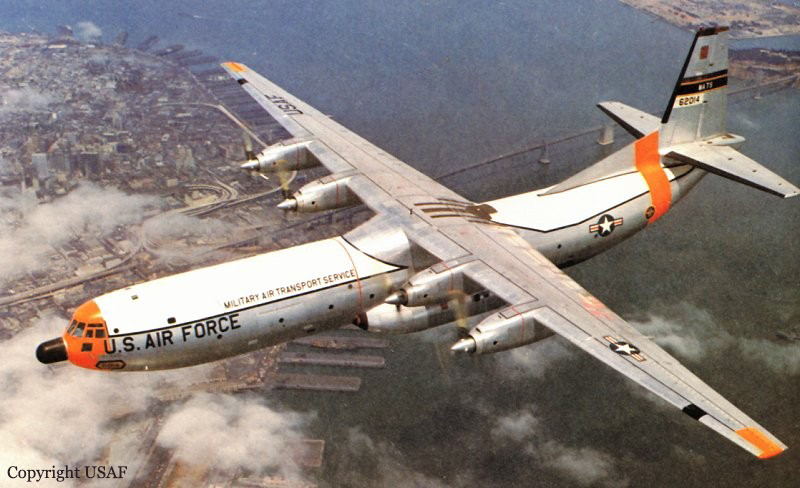
Crash of a Douglas C-133A-30-DL Cargomaster in Goose Bay: 7 killed

Date & Time: Nov 7, 1964 at 1649 LT
Type of aircraft:
Operator:
Registration:
56-2014
Flight Phase:
Flight Type:
Survivors:
No
Schedule:
Dover – Goose Bay – Sondreströmfjord - Thule
MSN:
45251
YOM:
1956
Country:
Crew on board:
7
Crew fatalities:
Pax on board:
0
Pax fatalities:
Other fatalities:
Total fatalities:
7
Circumstances:
The ill-fated aircraft that crashed was a Douglas C-133A Cargomaster s/n 56-2014 from Military Air Transport Service’s 1st Air Transport Squadron, based at Dover Air Force Base in Delaware. It arrived at Goose Bay 01:55 hours local time. After a 15-hour crew rest, they proceeded to depart enroute to Thule Air Base, Greenland with a stop enroute at Sondrestrom Air Base, also in Greenland. They were loaded with meat and other provisions. The first departure attempt was delayed due to a technical issue. The aircraft sat for a period of time without being de-iced before making a second try. At between 120 and 150 feet, the aircraft’s starboard (right) wing suddenly dropped 20 to 30 degrees. The aircraft commander managed to momentarily regain a level attitude. The aircraft then rolled to the left. The port wing dropped even more quickly and was almost vertical. The aircraft commander was unable to do anything. At 16:49 hrs local time, the Cargomaster struck the ground in a left wing down, nose high attitude.
Crew:
1st Lieutenant Guy L. Vassalotti, pilot,
Cpt Charles L. Jenkins, copilot,
Maj Frank X. Hearty, copilot,
1st Lt Douglas H. Brookfield, navigator,
T/Sgt John. A. Kitchens, flight engineer,
T/Sgt Norman H. Baron, flight engineer,
A1c Shelton Toler, loadmaster.
Probable cause:
After an intensive investigation, the accident investigation board determined the primary cause was a power stall. The most probable reason was structural icing of the wing and /or vortex generators that had accumulated ice over the 15-hour layover.

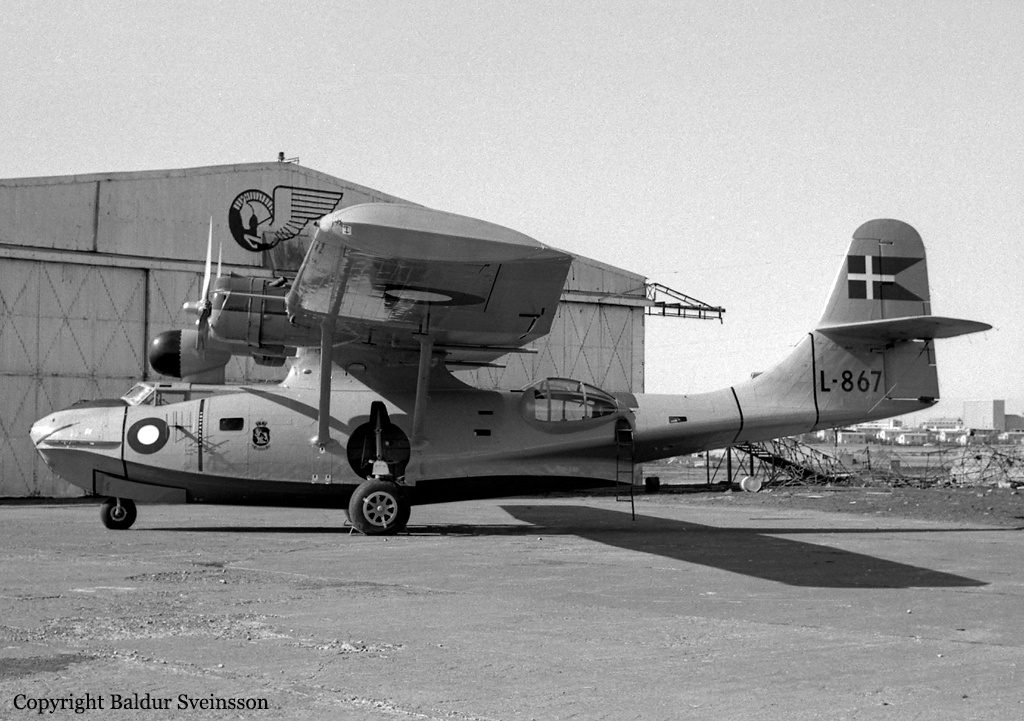
Crash of a Consolidated PBY-6A Catalina off Upernavik

Date & Time: May 3, 1964
Type of aircraft:
Operator:
Registration:
L-867
Flight Phase:
Flight Type:
Survivors:
Yes
Schedule:
Thule – Søndre Strømfjord
Country:
Region:
Crew on board:
9
Crew fatalities:
Pax on board:
5
Pax fatalities:
Other fatalities:
Total fatalities:
0
Circumstances:
The Catalina operated on a trip from Air Station Værløse via Keflavik, Reykjavik, Mestersvig, Station North, Thule, Sonderstrom and back to Værløse. The flyinbg boat departed Værløse, Denmark on 20 April 1964. On 3 May 1964, en route from Thule to Sonderstrom, the airplane suffered an no. 1 engine failure. Due to the Catalina’s single engine performance, the captain decided to make a precautionary landing when they discovered open water about 10 km south west from Upernavik. The crew was later rescued by a USAF SA-16 and brought to Sonderstrom. Two days later the Catalina was damaged beyond repair by the ice which had crushed the it.

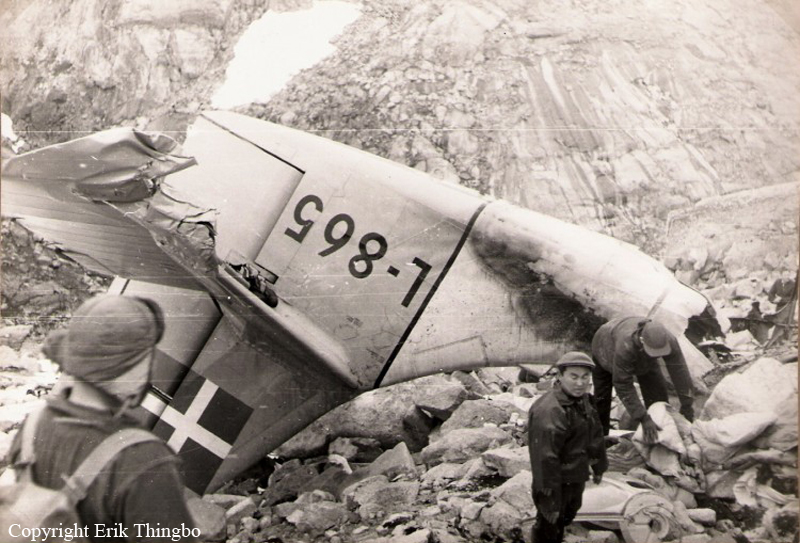
Crash of a Consolidated PBY-5A Catalina near Desolation Cape: 13 killed

Date & Time: Aug 10, 1963 at 1636 LT
Type of aircraft:
Operator:
Registration:
L-865
Flight Phase:
Flight Type:
Survivors:
No
Site:
Schedule:
Narsarsuaq – Søndre Strømfjord
Country:
Region:
Crew on board:
6
Crew fatalities:
Pax on board:
7
Pax fatalities:
Other fatalities:
Total fatalities:
13
Circumstances:
While cruising in bad weather conditions on a flight from Narsarsuaq to Søndre Strømfjord, the seaplane struck the slope of a mountain and was destroyed upon impact. The wreckage was found few hours later in the region of Desolation Cape and all 13 occupants have been killed.

Crash of a Canadian Vickers PBV-1A Canso off Nuuk: 15 killed

Date & Time: May 12, 1962 at 1055 LT
Operator:
Registration:
CF-IHA
Survivors:
Yes
Schedule:
Sondreströmfjord - Nuuk
MSN:
CV-365
YOM:
1944
Country:
Region:
Crew on board:
3
Crew fatalities:
Pax on board:
18
Pax fatalities:
Other fatalities:
Total fatalities:
15
Captain / Total flying hours:
4000
Captain / Total hours on type:
151.00
Copilot / Total flying hours:
1300
Copilot / Total hours on type:
650
Circumstances:
Following an uneventful flight from Sondreströmfjord, the crew started the descent to Nuuk and the landing was made on a water area that had not been patrolled. This was contrary to current safety rules. Both pilots considered the touchdown was normal. However, after a run of a few seconds the aircraft swerved abruptly to starboard assuming an increasingly nose-down attitude. A steadily progressing but very quick deceleration took place. The seaplane plunged into water and came to rest, partially submerged. While all three crew members and three passengers were rescued, 15 passengers were drowned.
Probable cause:
As a result of the technical investigation, it was considered most probable that, because of a mechanical malfunctioning the nose wheel doors were not closed and locked and that there was an aperture of 70 mm when the landing took place. The gaping doors were torn off when the aircraft having landed at rather high speed sank deeply into the water. The extremely great water pressure in the nose wheel well forced the aft bulkhead of the well inwards resulting in severe damage to the front cabin.
Final Report: