Crash of a Cessna 421C Golden Eagle III in Hamburg: 2 killed

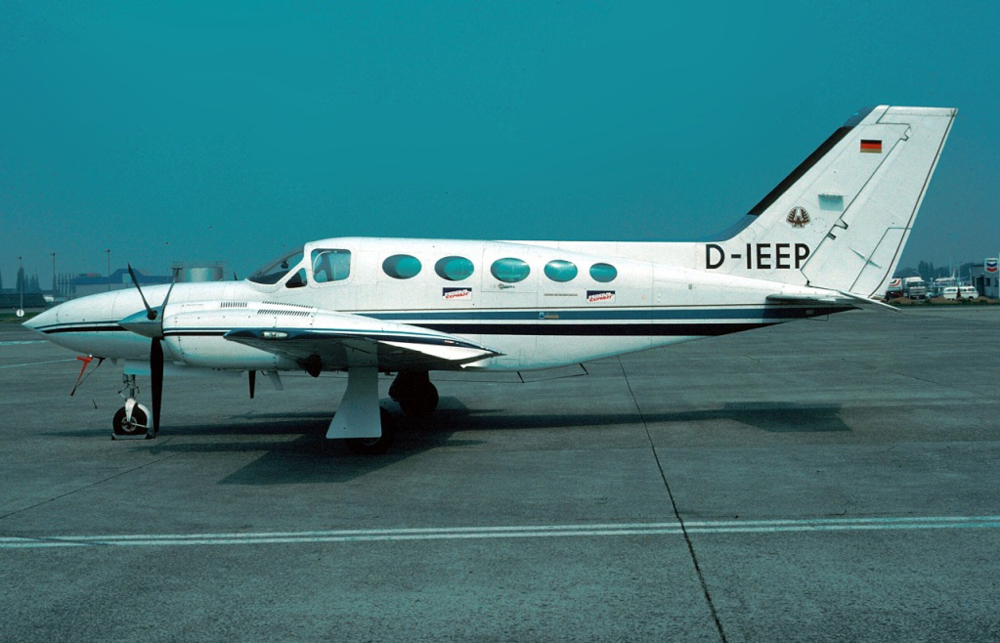
Date & Time: Jan 29, 1986 at 2200 LT
Operator:
Registration:
D-IEEP
Flight Phase:
Flight Type:
Survivors:
No
Schedule:
Hamburg - Brussels
MSN:
421C-1060
YOM:
1981
Country:
Region:
Crew on board:
2
Crew fatalities:
Pax on board:
0
Pax fatalities:
Other fatalities:
Total fatalities:
2
Circumstances:
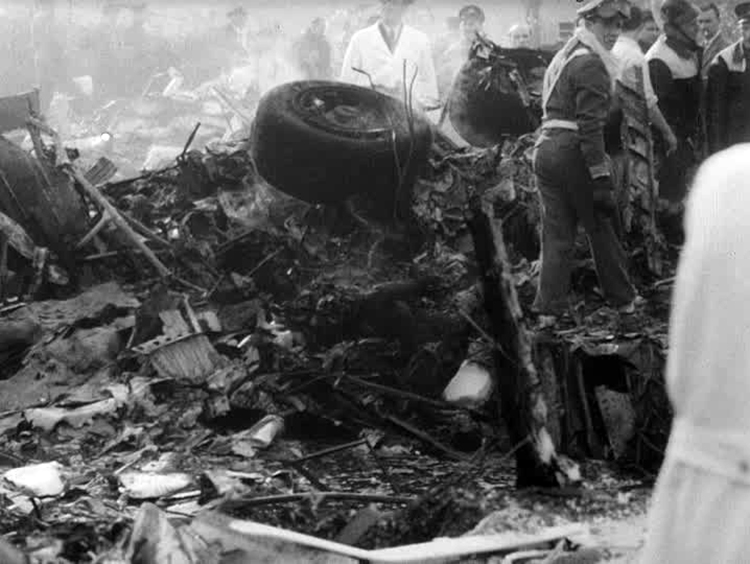
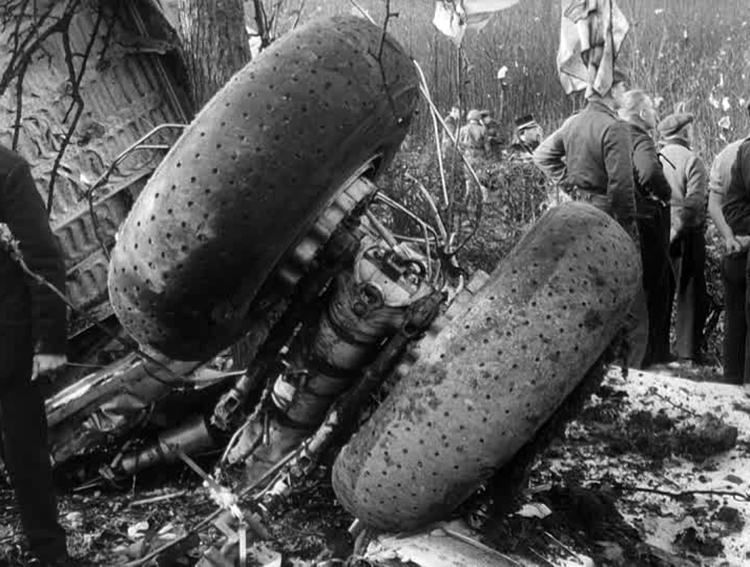
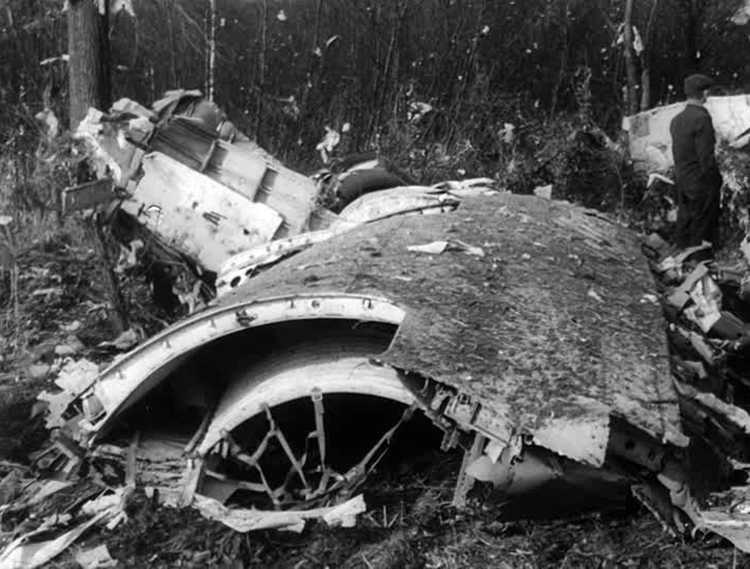
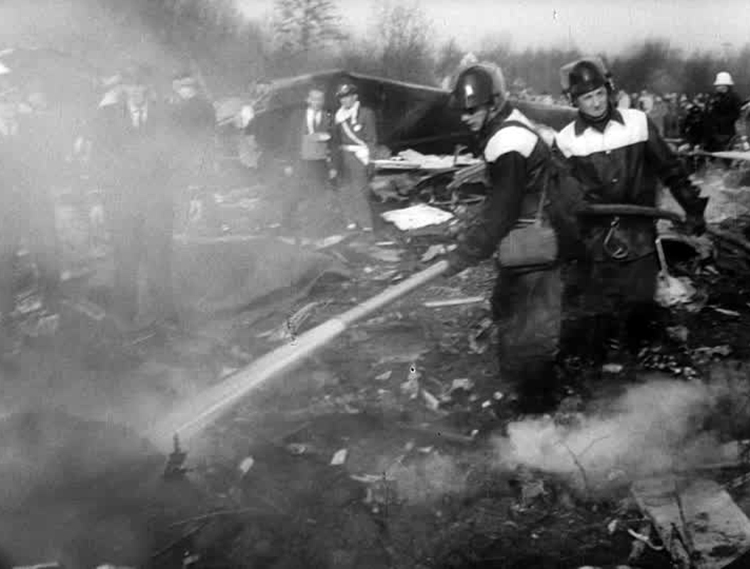
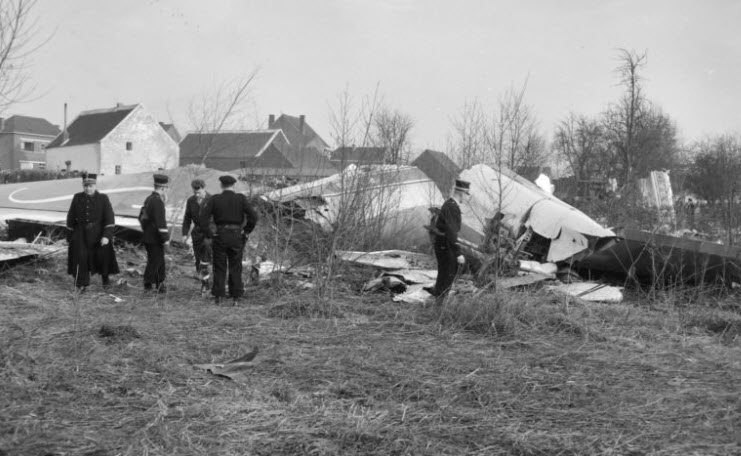
Shortly after takeoff from runway 15, while climbing to a height of about 800 feet, the twin engine entered an uncontrolled descent and crashed in a grassy area located past the runway end. The aircraft was destroyed and both occupants were killed.

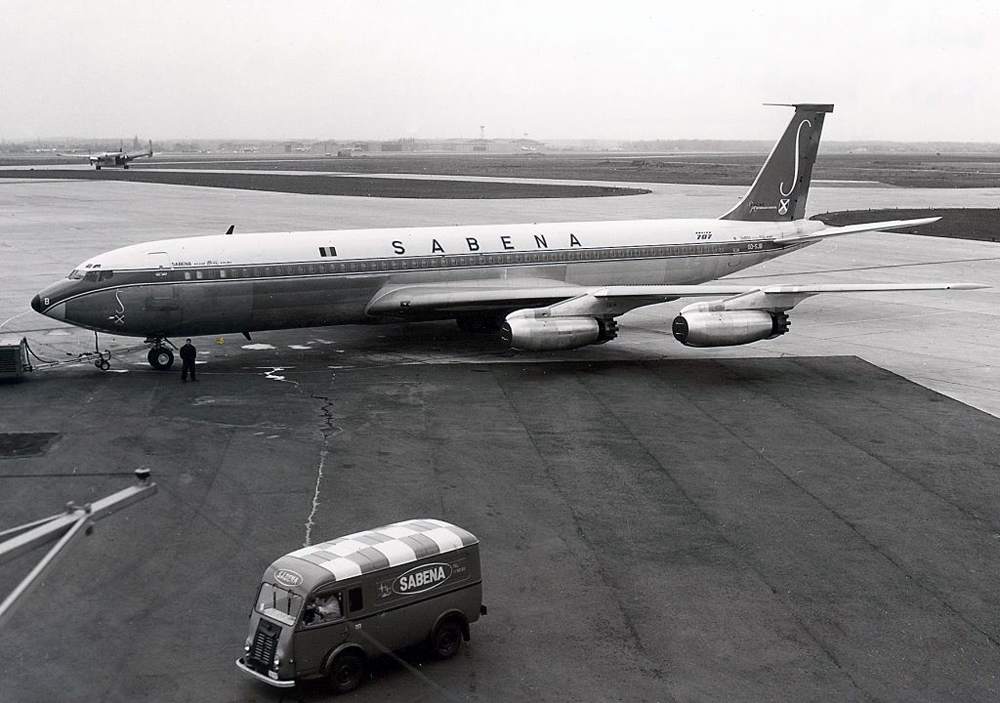
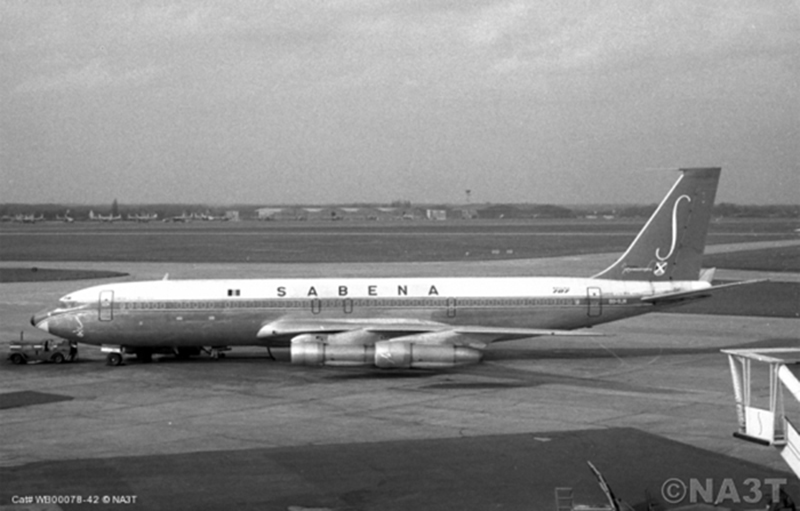
Crash of a Boeing 707-329 in Brussels

Date & Time: Mar 29, 1981 at 0940 LT
Type of aircraft:
Operator:
Registration:
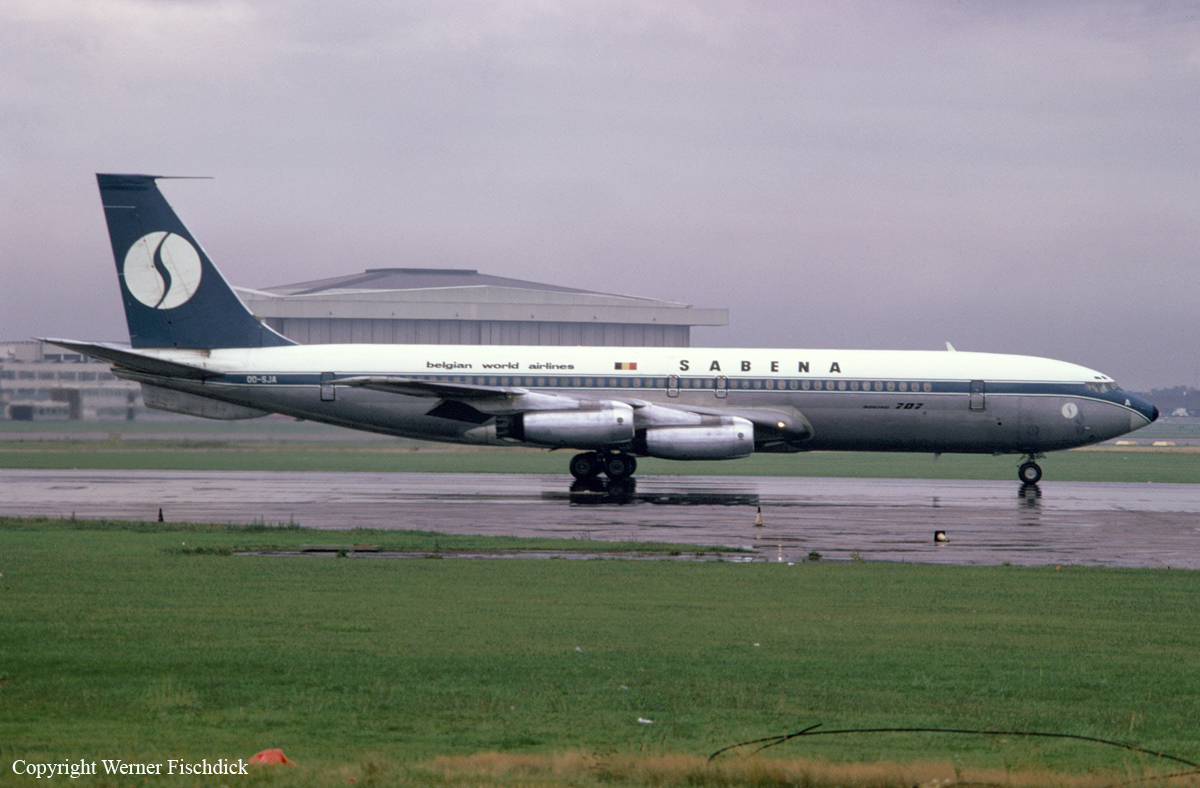
OO-SJA
Survivors:
Yes
Schedule:
Brussels - Tenerife
MSN:
17623/78
YOM:
1959
Flight number:
SLR1915
Country:
Region:
Crew on board:
7
Crew fatalities:
Pax on board:
110
Pax fatalities:
Other fatalities:
Total fatalities:
0
Aircraft flight hours:
64462
Circumstances:
The four engine airplane departed Brussels-Zavantem Airport runway 02 at 0929LT on a charter flight to Tenerife-Sur Reina Sofia with 110 passengers and a crew of seven on board. While climbing to an altitude of 7,000 feet, the engine n°3 exploded and caught fire. The crew declared an emergency and was cleared to return for a landing on runway 25L. After the fire was contained and while completing a last turn on final, the airplane was approaching too fast and overshot so the pilot decided to land on runway 25R. After touchdown, reversers on engine n°1 and 4 were activated and the crew initiated an emergency braking procedure. Nevertheless, the captain considered the remaining distance as insufficient and decided to steer the aircraft to the left of the runway where it came to rest. All 117 occupants were quickly rescued and the aircraft was damaged beyond repair.
Probable cause:
It was determined that the explosion of the engine n°3 was the consequence of the disintegration of a blade located on the 10th stage of the compressor due to fatigue cracks. The following contributing factors were reported:
- Approach completed with one engine inoperative,
- The total weight of the aircraft was above the max allowable weight upon landing,
- The approach speed was too high,
- The crew failed to use the brakes properly.

Crash of a Boeing 707-329 in Tenerife

Date & Time: Feb 15, 1978 at 1313 LT
Type of aircraft:
Operator:
Registration:
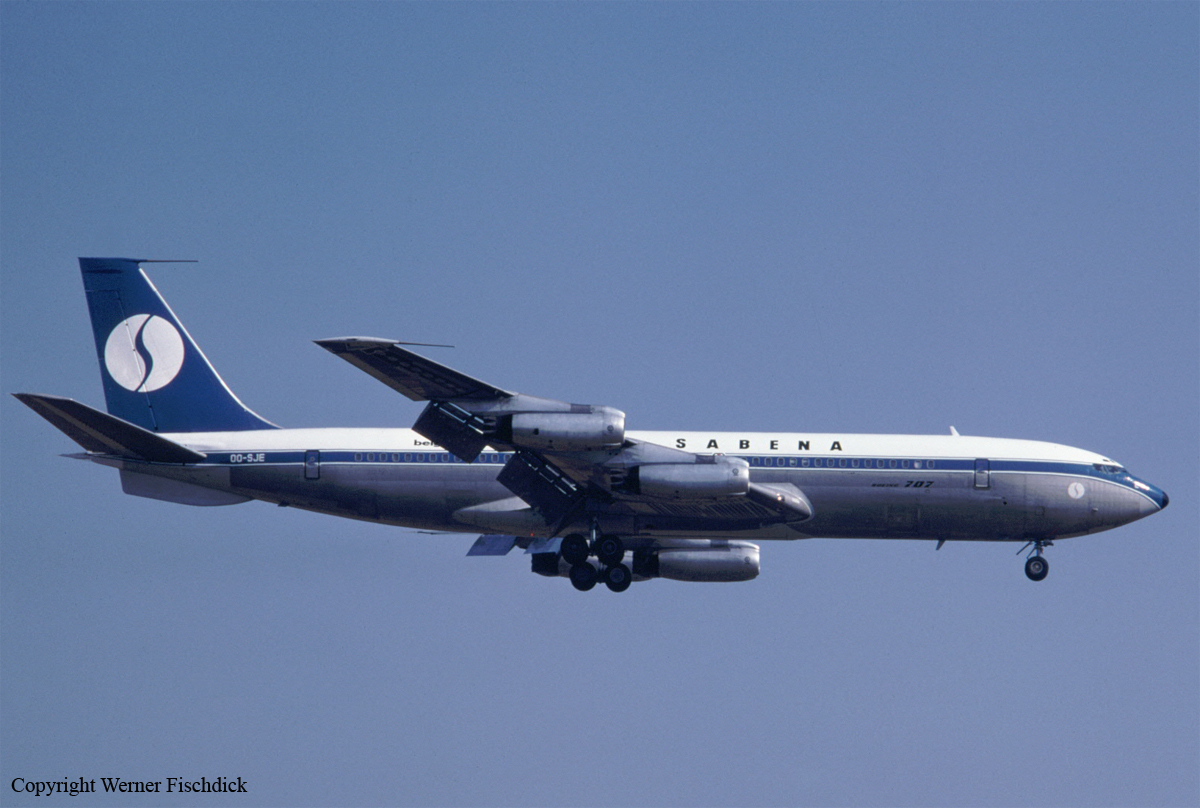
OO-SJE
Survivors:
Yes
Schedule:
Brussels - Tenerife
MSN:
17627
YOM:
1960
Country:
Region:
Crew on board:
9
Crew fatalities:
Pax on board:
189
Pax fatalities:
Other fatalities:
Total fatalities:
0
Aircraft flight hours:
56787
Circumstances:
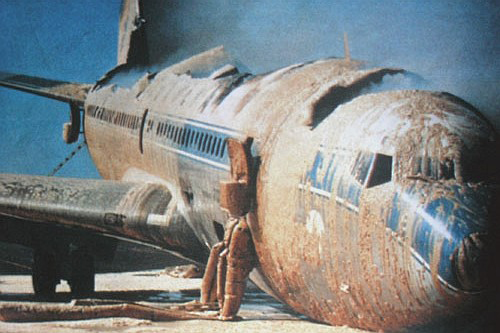
The airplane was completing a charter flight from Brussels to Tenerife, carrying 189 passengers and a crew of nine on behalf of Sebelair. On approach to Tenerife-Norte-Los Rodeos Airport, the crew informed ATC about technical problems as he was unable to lower the nose gear. The landing was completed on runway 12/30 with the nose gear retracted and the airplane slid for a distance of 1,200 meters before coming to rest in flames. All 198 occupants were evacuated, four passengers were slightly injured. The aircraft was destroyed by fire.

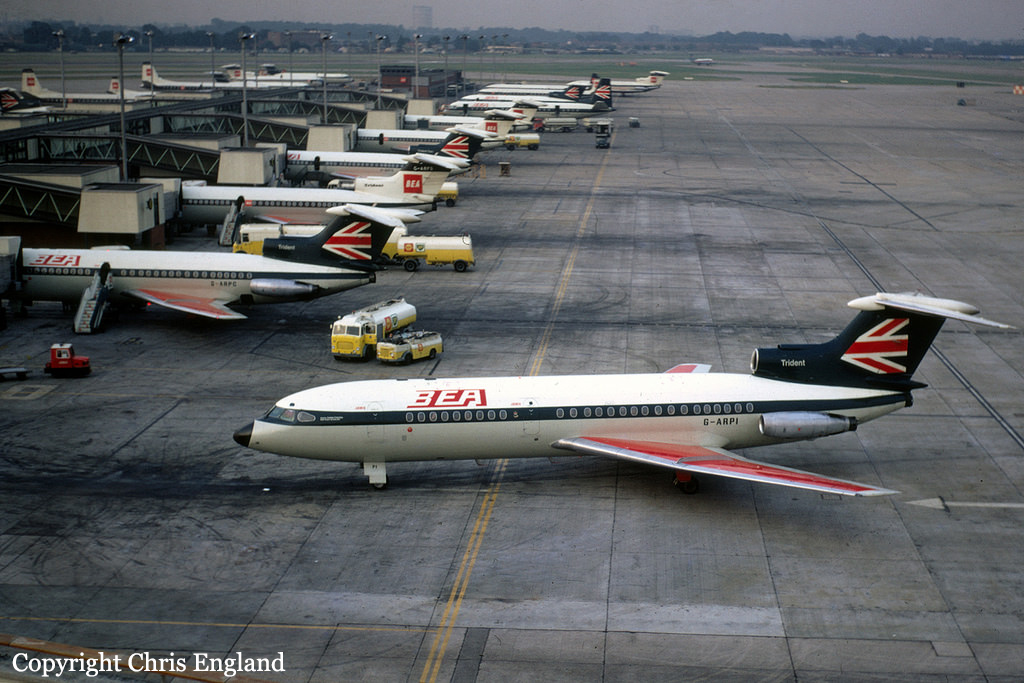
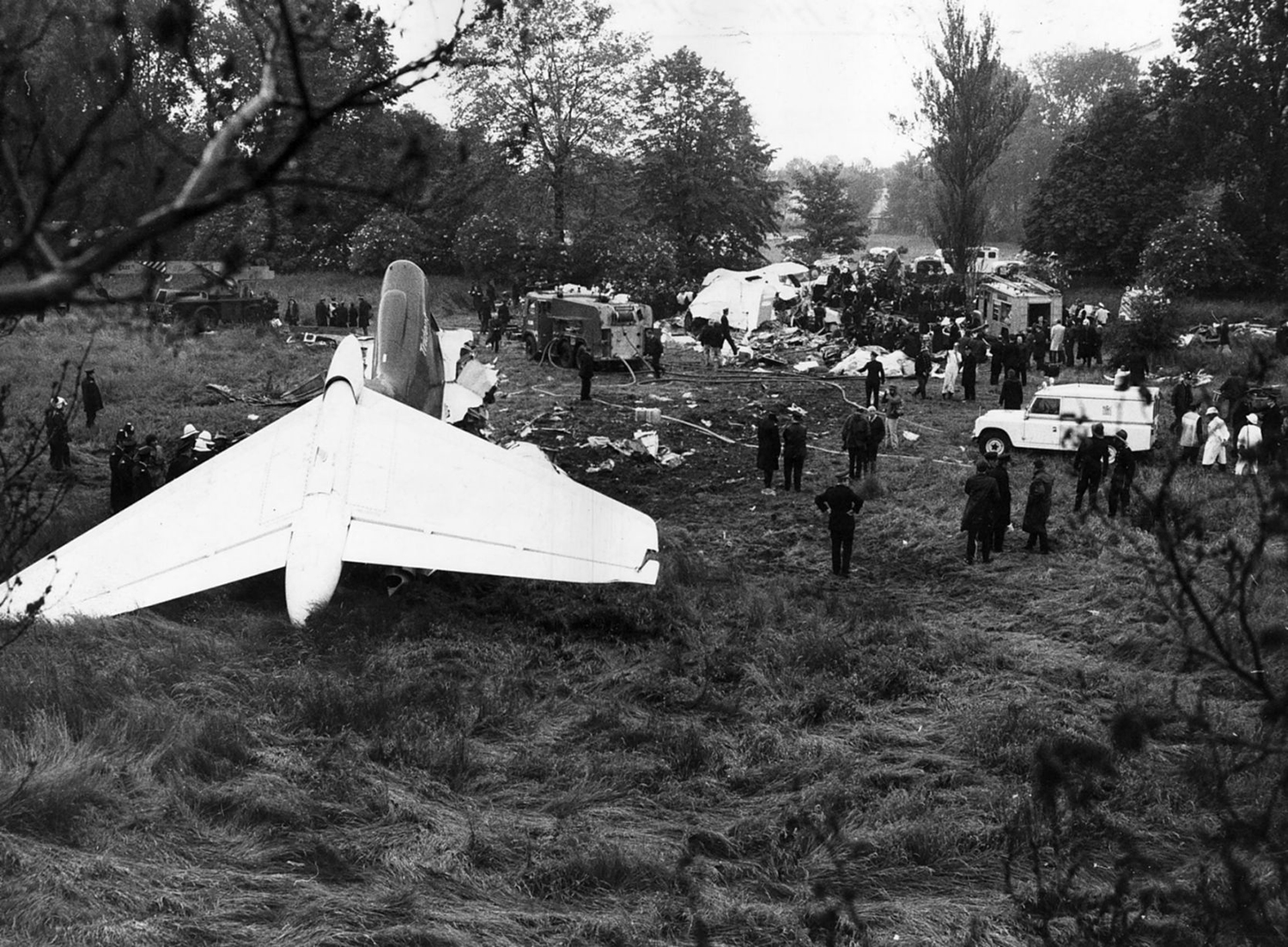
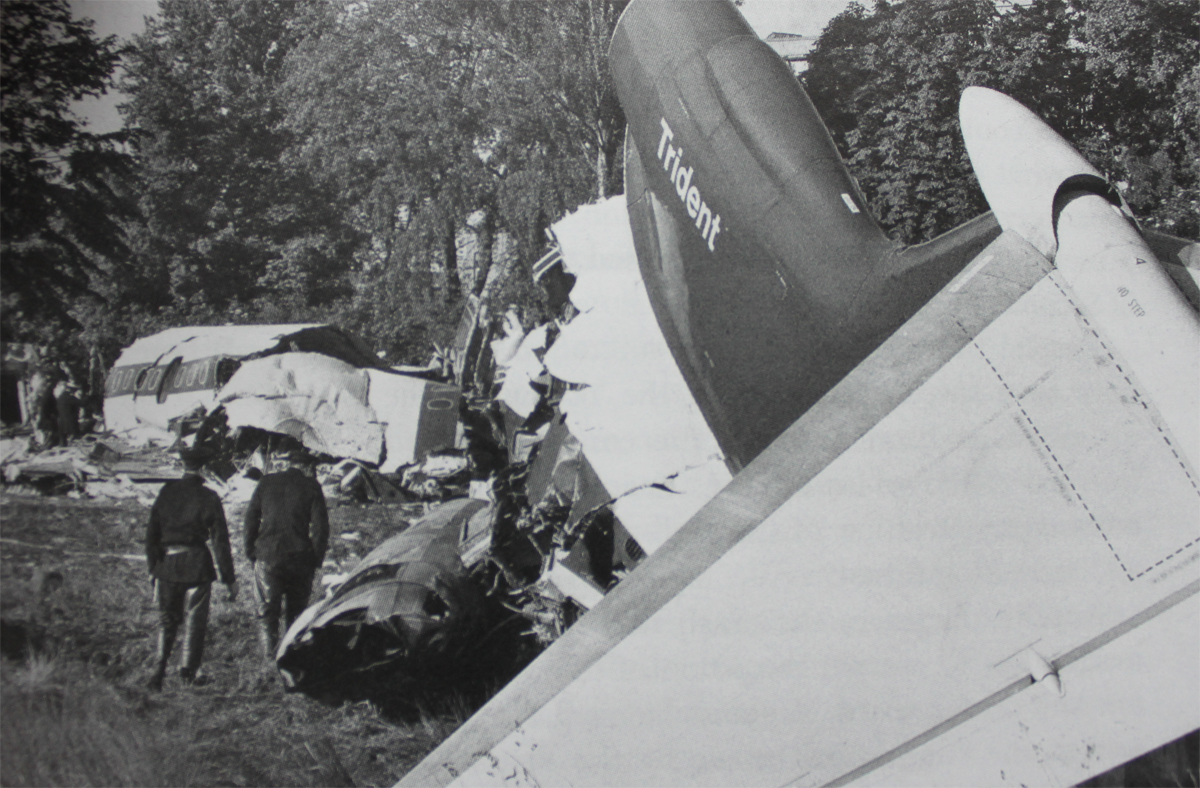
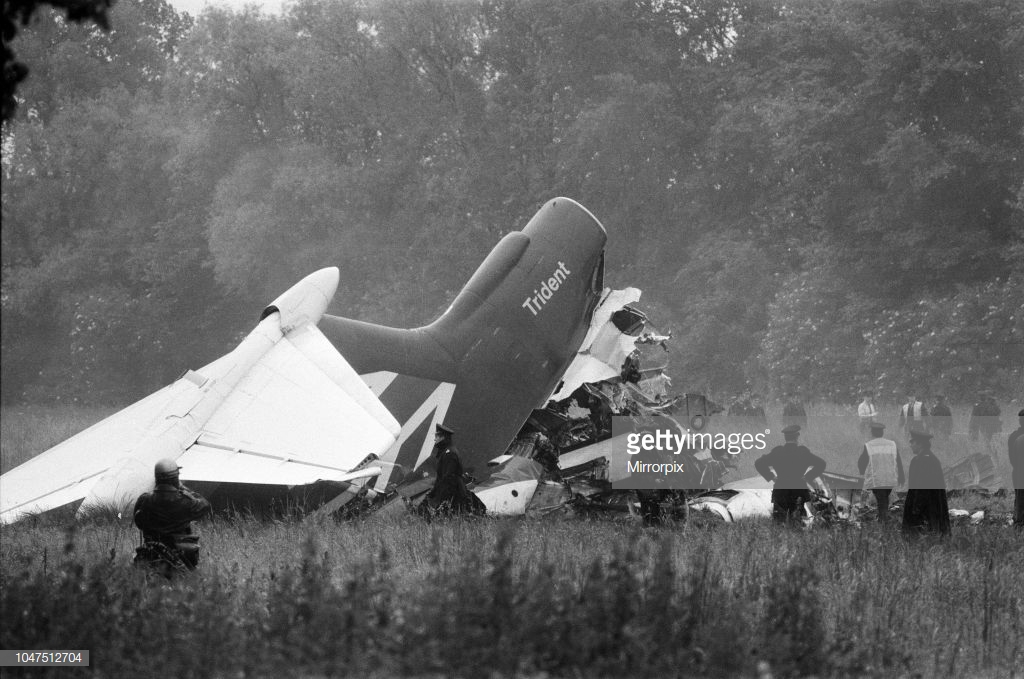
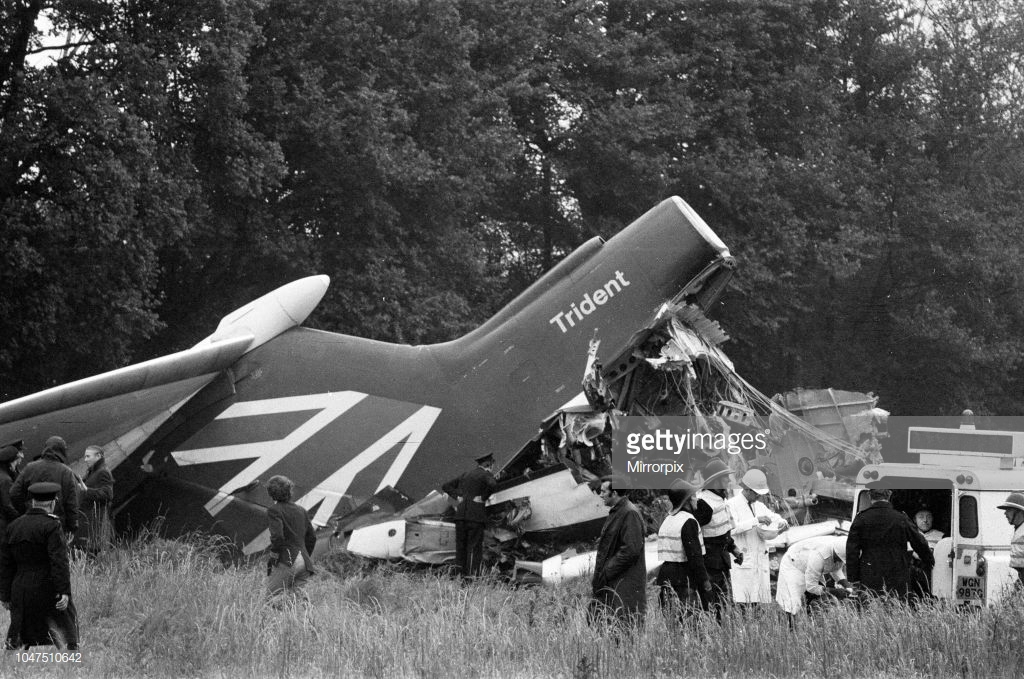
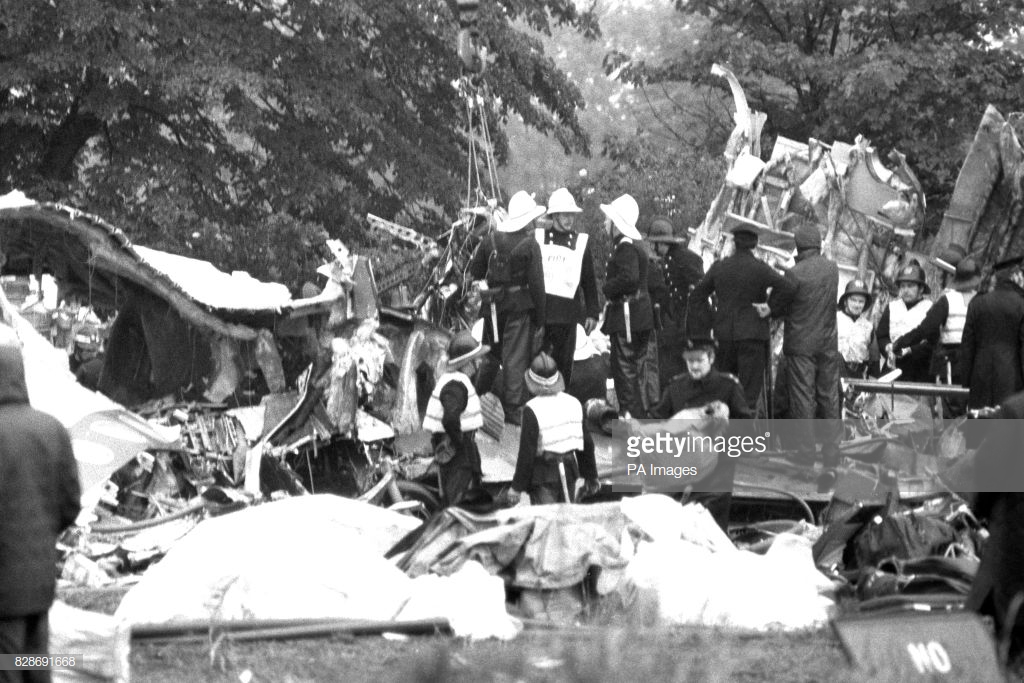
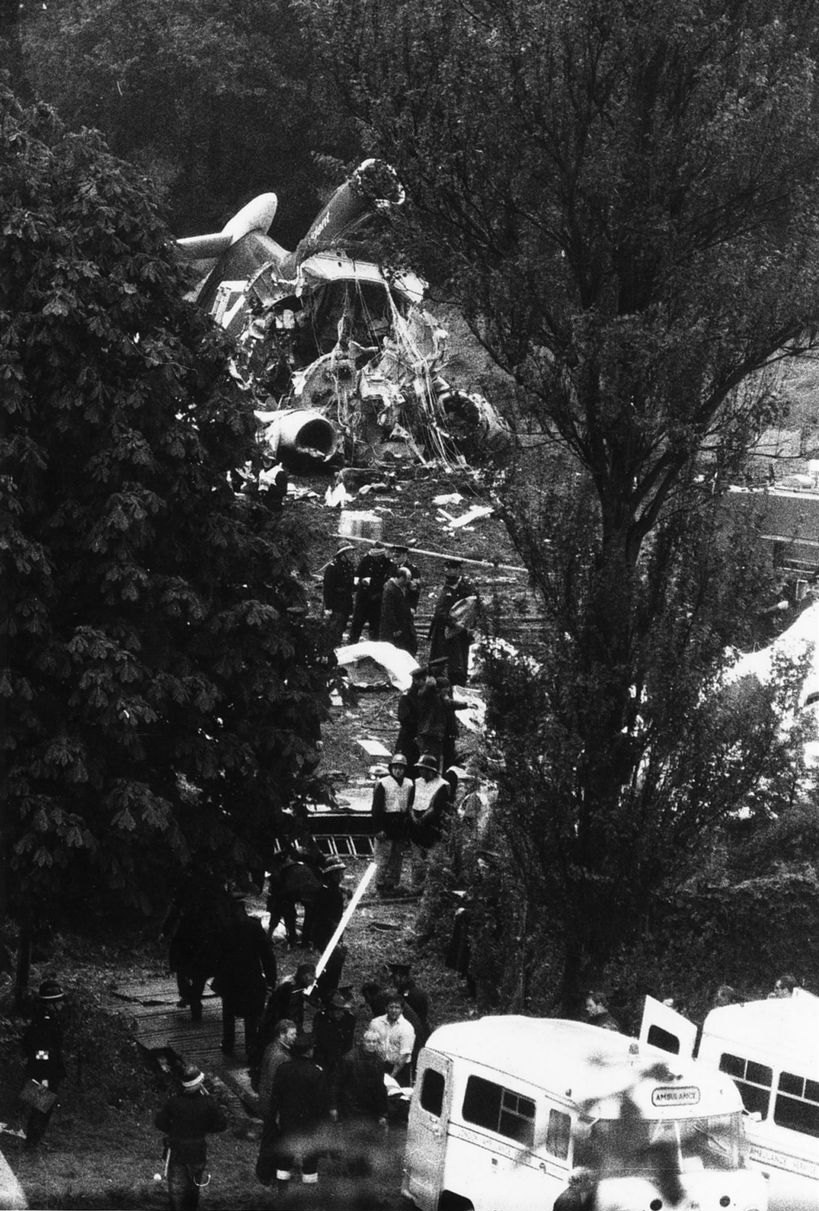
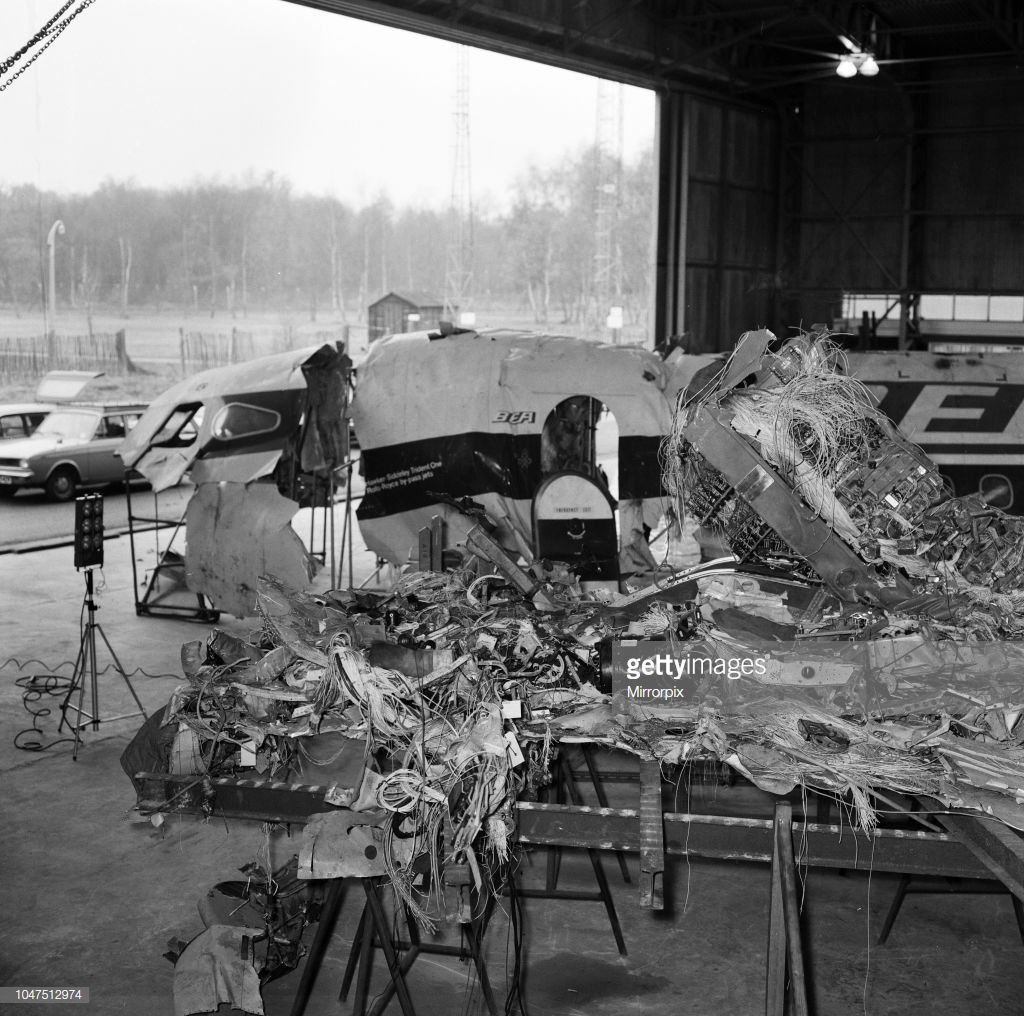
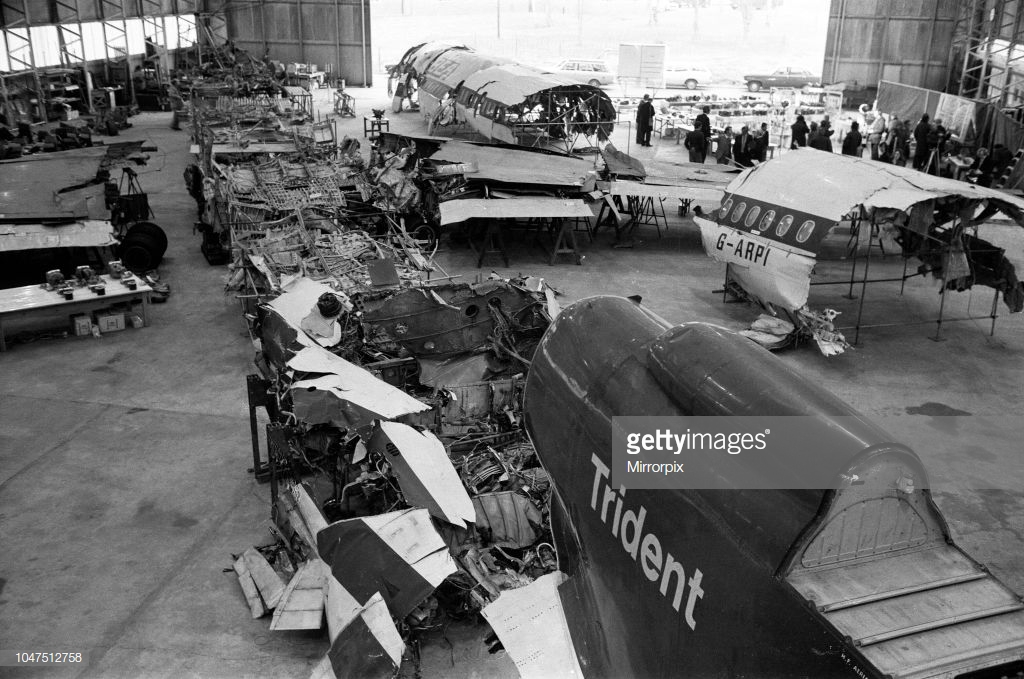
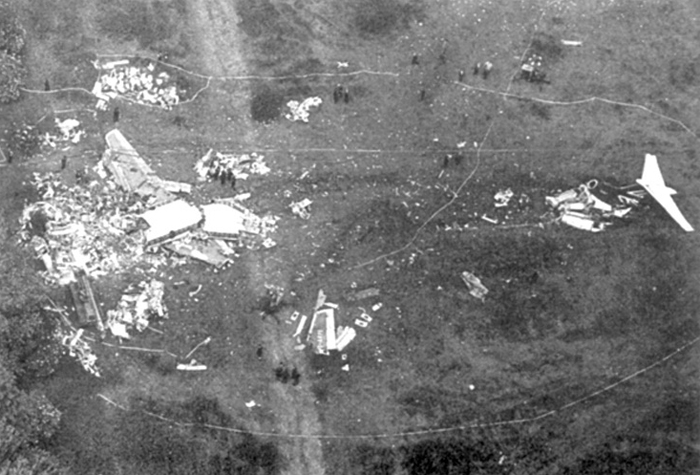
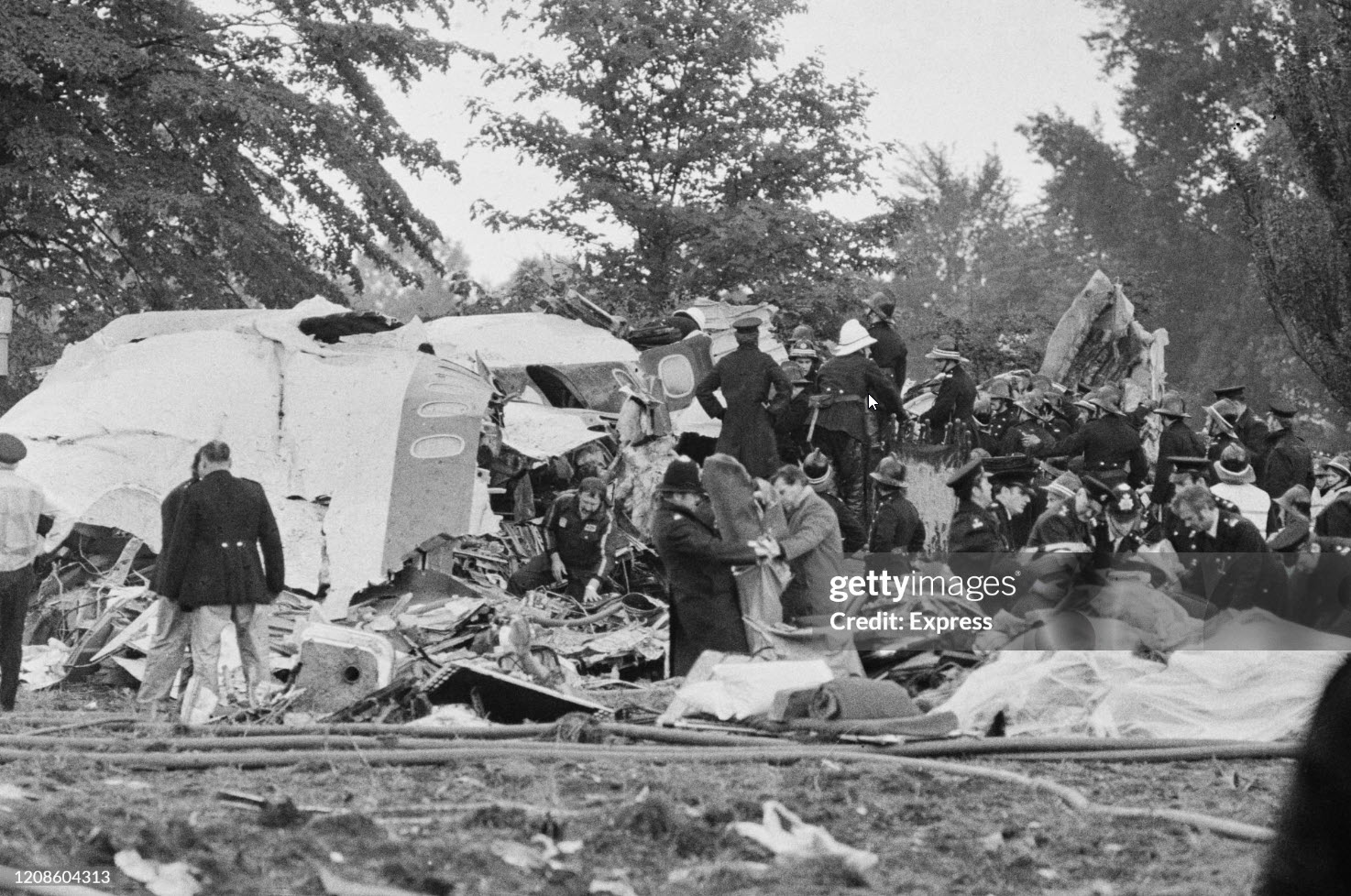
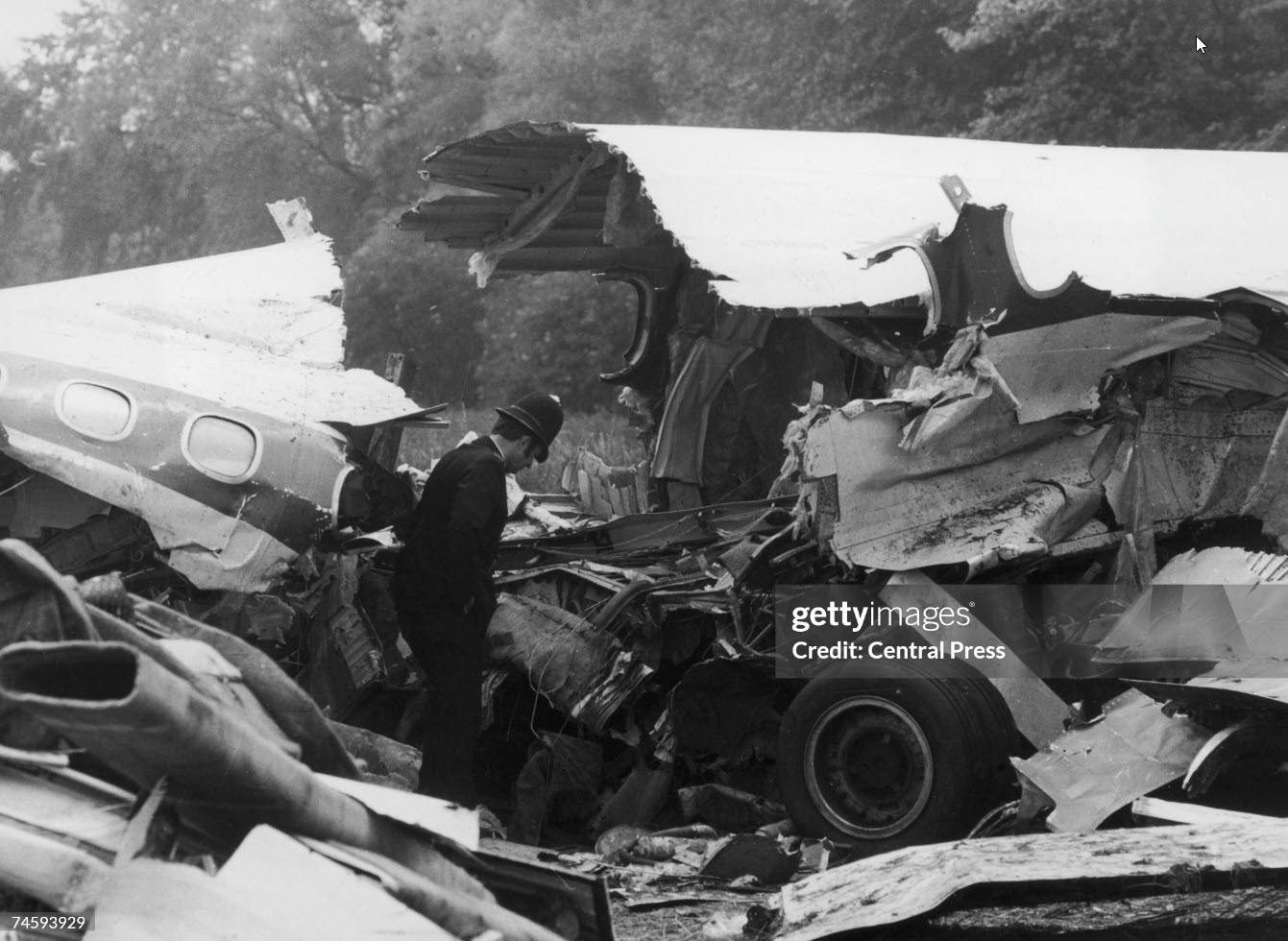
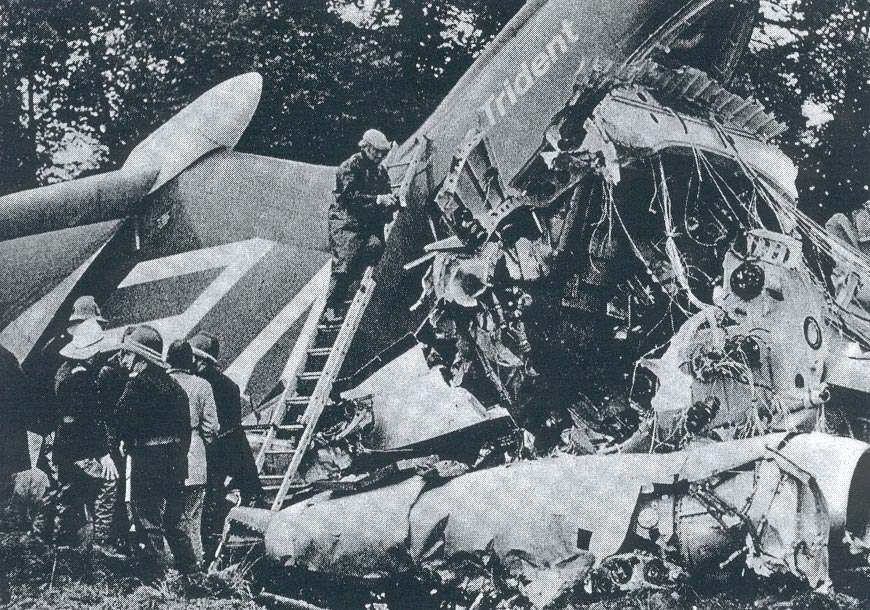
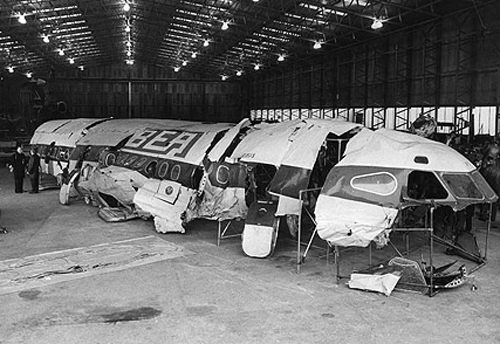
Crash of a Hawker-Siddeley HS.121 Trident 1C in London: 118 killed

Date & Time: Jun 18, 1972 at 1711 LT
Operator:
Registration:
G-ARPI
Flight Phase:
Survivors:
No
Schedule:
London - Brussels
MSN:
2109
YOM:
1964
Flight number:
BE548
Region:
Crew on board:
9
Crew fatalities:
Pax on board:
109
Pax fatalities:
Other fatalities:
Total fatalities:
118
Captain / Total flying hours:
15000
Captain / Total hours on type:
4000.00
Copilot / Total flying hours:
1400
Copilot / Total hours on type:
750
Circumstances:
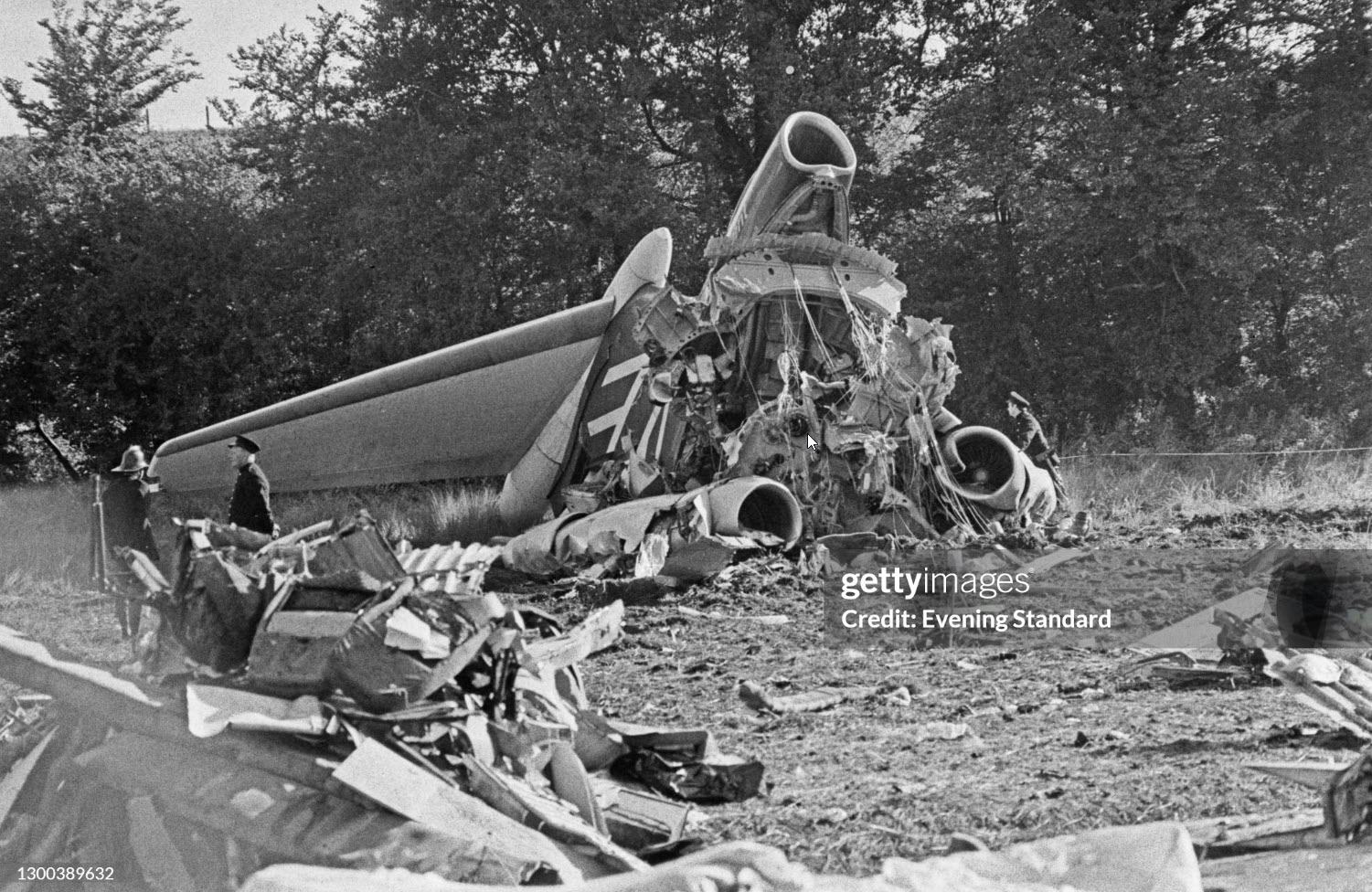
Following a normal takeoff roll on runway 28R, the aircraft rotated 42 seconds after brakes were released and lifted off 2 seconds later at 145 knots IAS. At 63 seconds the autopilot was engaged 355 feet above the runway at 170 knots IAS; the IAS speed lock was selected shortly thereafter. At 74 seconds the aircraft started a 20° banked turn to port towards the Epsom Non-Directional Beacon (NDB). At 83 seconds the captain reported 'Climbing as cleared'. He was then instructed to change frequency and contact London Air Traffic Control Centre. At 93 seconds the noise-abatement procedure was initiated. On the assumption that the captain was the handling pilot, this would involve the second officer selecting the flaps fully up and operating the thrust levers to reduce power to the pre-calculated figure. At 100 seconds the captain called 'Passing 1500' and at 103 seconds the aircraft was cleared to climb to Flight Level 60. This message was acknowledged by the captain at 108 seconds with the terse call 'up to 60'. This was the last message received from the flight. At second 114 when the airspeed was 162 knots and the altitude 1,772 feet, the droop lever was selected up putting the aircraft into the area of the stall as the droop started to move. At second 116 the stick-pusher stall recovery device operated, causing the autopilot automatically to disengage and the nose of the aircraft to pitch down and the stick-push to cease as the incidence decreased. Since the elevator trim would stay at its position on autopilot disengagement which at that speed with the droop up would be - the incidence then increased causing a second stick-push at second 124 and a third at second 127. At second 128 the stall recovery system was manually inhibited by pulling the lever. The aircraft then pitched up rapidly, losing speed and height, entering very soon afterwards the true aerodynamic stall and then a deep stall from which at that height no recovery was possible. Impact was at second 150 in a field next to the A30 motorway. The aircraft was totally destroyed and none of the 118 occupants survived the crash.
Probable cause:
The immediate causes of the accident were these:
- A failure by Captain Key to achieve and maintain adequate speed after noise-abatement procedures,
- Retraction of the droops at some 60 knots below the proper speed causing the aircraft to enter the stall regime and the stick-shaker and pusher to operate,
- Failure by the crew to monitor the speed errors and to observe the movement of the droop lever,
- Failure by the crew to diagnose the reason for the stick-shaker operation and the concomitant warnings,
- The dumping by the crew of the stall recovery system.
The underlying causes were these:
- The abnormal heart condition of Captain Key leading to lack of concentration and impaired judgment sufficient to account for his toleration of the speed errors and to his retraction of, or order to retract, the droops in mistake for the flaps,
- Some distraction, the nature of which is uncertain, possibly due to the presence of Captain Collins as a passenger on the flight deck, which caused S/O Ticehurst's attention to wander from his monitoring duties,
- Lack of training directed at the possibility of 'subtle' pilot incapacitation,
- Lack of experience of S/O Keighley,
- Lack of knowledge in the crew of the possibility or implication of a change of configuration stall,
- Lack of knowledge on the part of the crew that a stick-shaker and push might be experienced almost simultaneously and of the probable cause of such an event,
- Lack of any mechanism to prevent retraction of the droops at too low a speed after flap-retraction.
Final Report:

Ground accident of a Douglas DC-3C in Amsterdam

Date & Time: May 9, 1970
Type of aircraft:
Operator:
Registration:
OO-AUX
Flight Phase:
Survivors:
Yes
Schedule:
Amsterdam - Brussels
MSN:
43088
YOM:
1947
Country:
Region:
Crew on board:
0
Crew fatalities:
Pax on board:
0
Pax fatalities:
Other fatalities:
Total fatalities:
0
Circumstances:
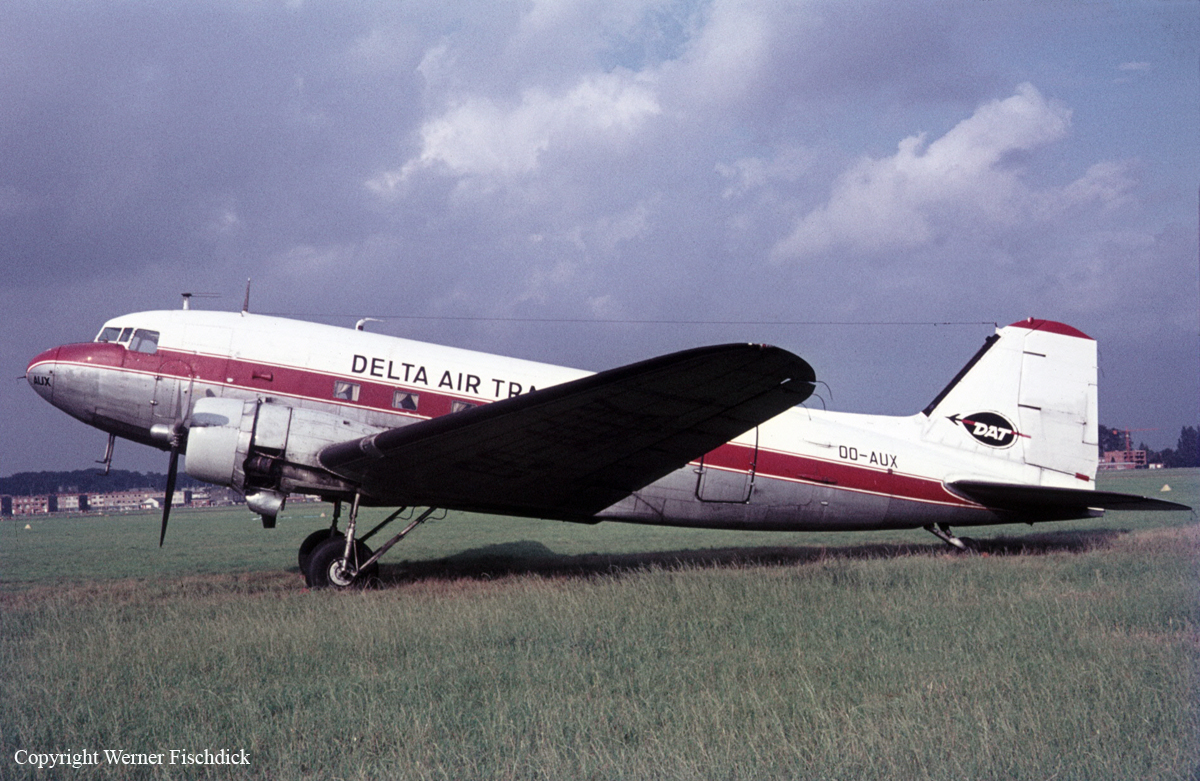
Without clearance, the copilot released the brakes and began to taxi when the right propeller struck a ground power unit. The airplane was immediately stopped. There were no casualties but the airplane was later considered as damaged beyond repair.
Probable cause:
Pilot error.

Crash of a Boeing 707-329C in Lagos: 7 killed

Date & Time: Jul 13, 1968 at 0400 LT
Type of aircraft:
Operator:
Registration:
OO-SJK
Flight Type:
Survivors:
No
Schedule:
Brussels - Lagos
MSN:
19211
YOM:
1966
Flight number:
SN712
Country:
Region:
Crew on board:
5
Crew fatalities:
Pax on board:
2
Pax fatalities:
Other fatalities:
Total fatalities:
7
Circumstances:
Flight SN712 was a non-scheduled international cargo flight from Brussels direct to Lagos on behalf of the Federal Government of Nigeria with 34 994 kg of cargo on board. No passengers were being carried. A flight plan was filed for a flight of 6 hours 9 minutes and the total endurance of the aircraft was stated as 8 hours 20 minutes. The designated alternate was Kano. The aircraft took off from Brussels at 2152 hours GMT on 12 July 1968 and routine radio reports were received during the en route phase of the flight. At 0325 hours R/T contact was made with Lagos approach control. The R/T transmissions with the aircraft have been identified as being almost certainly the voice of the co-pilot indicating that he was doing the R/T rhile the pilot-in-command was flying the aircraft. The aircraft gave an ETA at Lagos of 0355 hours and reported that it was at flight Level (FL) 330. A request was then made for the latest Lagos weather and the reply included the following information: wind: 210°/3 kt; visibility: 16 km; cloud: 5/8 stratocumulus 270 m, 7/8 altostratus 2 400 m, temporary thunderstorms, 118 cumulonimbus 2 000 ft; QNH: 1012 mb; temperature 24°. At 0327 hours the aircraft reported an ETA overhead Ibadan NDB of 0344 hours in response to a request for this information from Lagos. One minute later it reported that the Ibadan NDB did not appear to be operating. At 0336 the aircraft requested descent clearance. It was cleared to Lagos at FL60 and commenced the descent from FL330 at that time. Three minutes later the aircraft reported passing Ibadan and descending through FL275 but since it had reported earlier that the Ibadan NDB seemed not to be radiating it is not known how the position was determined. In reply Lagos approach stated that there was no delay in the approach and that the runway in use was 19. At 0341 hours, when the aircraft was about 50 miles north of. Lagos, it was recleared to 2 200 ft on a QNH of 1012 mb - and told to report field in sight. The flight recorder readout shows that shortly after this interchange the descent was interrupted while the speed decreased to a figure corresponding to the recommended maximum for landing gear extension and this speed was not exceeded for the remainder of the flight. Close study of the flight recording shows subsequent irregularity indicating that the automatic pilot was most probably disengaged at this stage of the flight. Subsequent to the speed reduction the rate of descent was re-established to approximately 2 000 ft/min and at 0350 hours the aircraft passed one mile to the east of Lagos airport whilst on a southerly heading at an altitude of 15 000 ft. The aircraft was heard flying over the airport at this time. The flight recorder indicates that a procedure turn was made to the south of the airport in the vicinity of the city of Lagos and at its conclusion there was a second interruption in the descent following which the airspeed remained below the maximum for 25° of flap. At 0354 hours the aircraft passed over the airport northbound at an altitude of 9 000 ft maintaining the average rate of descent of 2 000 ft/min for a further 2 1/2 minutes. At 0356 hours a procedure turn was commenced at an altitude of about 5 000 ft during which the rate of descent was reduced to 1 500 ft/min. The track of the aircraft between its passage over the airport northbound and the commencement of the final procedure turn is almost coincident with the outbound track of the published VOR approach procedure. At 0357 hours Lagos approach control was informed by the aircraft that it was in the procedure turn and requested to give the wind conditions. In reply control stated that the wind was calm and this was acknowledged. Shortly afterwards approach control instructed the aircraft to report runway in sight and this was also acknowledged. On completion of the procedure turn at an altitude of 1 400 ft (a height above the airport of 1268 ft) the airspeed was reduced from 190 kt to a little less than 160 kt and the rate of descent was reduced to 900 ft/min. The heading was stabilized on 197° M and at 0359 hours the aircraft asked for the runway lights to be put on maximum brightness. Approach control replied that the runway lights were on low intensity non-variable. A transmitter switch was then heard but there was no subsequent message from the aircraft before it crashed about 8 1/2 miles north of the airport approximately on the extended centre line of the runway. All the occupants were killed and the aircraft caught fire immediately and was burnt out. All seven occupants were killed.
Probable cause:
The accident was caused by the aircraft descending below its minimum safe altitude for reasons that have not been determined. The following findings were reported:
- The aircraft made an almost continuous descent from FL275 to the point of impact without an intermediate report being made of either its height or position between "passing IB beacon" and a point "on procedure turn" north of Lagos airport,
- The approach to land was made at night without ILS glide slope or marker beacon guidance,
- There was an absence of instructions regarding the monitoring of the altitude by the pilot not flying the aircraft and the cross checking of altimeters during an approach.
Final Report:
Crash of a Douglas DC-6B in Milan: 4 killed

Date & Time: Feb 18, 1966 at 0304 LT
Type of aircraft:
Operator:
Registration:
OO-ABG
Flight Type:
Survivors:
No
Schedule:
Brusssels - Milan
MSN:
43829/351
YOM:
1953
Country:
Region:
Crew on board:
3
Crew fatalities:
Pax on board:
1
Pax fatalities:
Other fatalities:
Total fatalities:
4
Captain / Total flying hours:
6770
Captain / Total hours on type:
1619.00
Copilot / Total flying hours:
6958
Copilot / Total hours on type:
21
Circumstances:
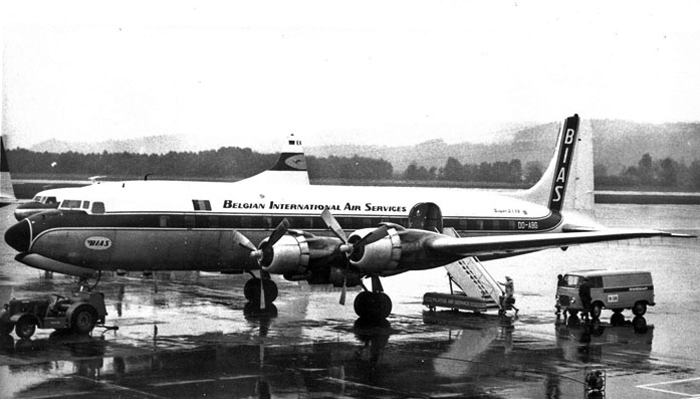
The aircraft had taken off from Brussels at 0010 hours GMT on 18 February 1966 on a cargo flight to Milan-Malpensa, Italy, to transport 214 calves. The flight was routine until the aircraft arrived over the Saronno VOR/NDB at 0148 hours. It was then cleared by Milan ACC to fly directly to the Malpensa radio beacon with a 6 000 ft "clearance limit" and to contact Malpensa APP directly. The aircraft was duly transferred to this latter unit at 0150 hours. At 0153 hours the aircraft was over NDB Malpensa at 6 000 feet and was cleared by Malpensa APP to carry out a STANDARD/ILS (SIA) approach procedure to runway 35R. The aircraft was also provided with complete meteorological data for Malpensa Airport; runway visibility was given as 250 m. The aircraft left the 6 000 ft level at 0153:20 hours outbound on track 1550 as specified in AIP/ITALY MAP/050/1. At 0157:33 hours the pilot reported on approach inbound (352°) at 4 000 feet. At 0159:49 hours the Malpensa airport PAR controller provided the pilot with the current parameters: distance 7 NM/on track/ on the glide path. At 0200:44 hours the pilot reported 2 000 ft at the outer marker. It was cleared by Malpensa APP to land on runway 35R and instructed to report runway in sight. The ground/air/ground communications log indicates that the approach procedure was being carried out correctly and at 0202:50 hours the radar controller informed the pilot that he was over the approach end of the runway. This was the last contact between the aircraft and the control services. The aircraft had actually carried out a night-time final approach phase procedure in extremely critical visibility conditions because of fog, and in such conditions it had crossed the threshold of runway 35R deviating about 8° to the right in relation to the runway centre line; it then continued alongside the runway for about 2 400 m and struck the top of a group of trees beyond which it crashed to the ground approximately 3 000 m from the runway threshold and 435 m from its centre line. The aircraft caught fire following fuel spillage after impact with the ground. All the occupants were killed and the cargo was destroyed.
Probable cause:
The Commission attributed the accident to the following causes:
(1) Failure of the pilot to comply with the Company's "minima";
(2) Subsequent belated decision to execute the missed approach procedure.
Final Report:
Crash of a Fairchild C-119G Flying Boxcar in Augustdorf: 38 killed

Date & Time: Jun 26, 1963 at 1200 LT
Operator:
Registration:
CP-45
Flight Phase:
Flight Type:
Survivors:
Yes
Schedule:
Brussels - Gütersloh
MSN:
246
YOM:
1952
Country:
Region:
Crew on board:
5
Crew fatalities:
Pax on board:
42
Pax fatalities:
Other fatalities:
Total fatalities:
38
Aircraft flight hours:
3172
Circumstances:
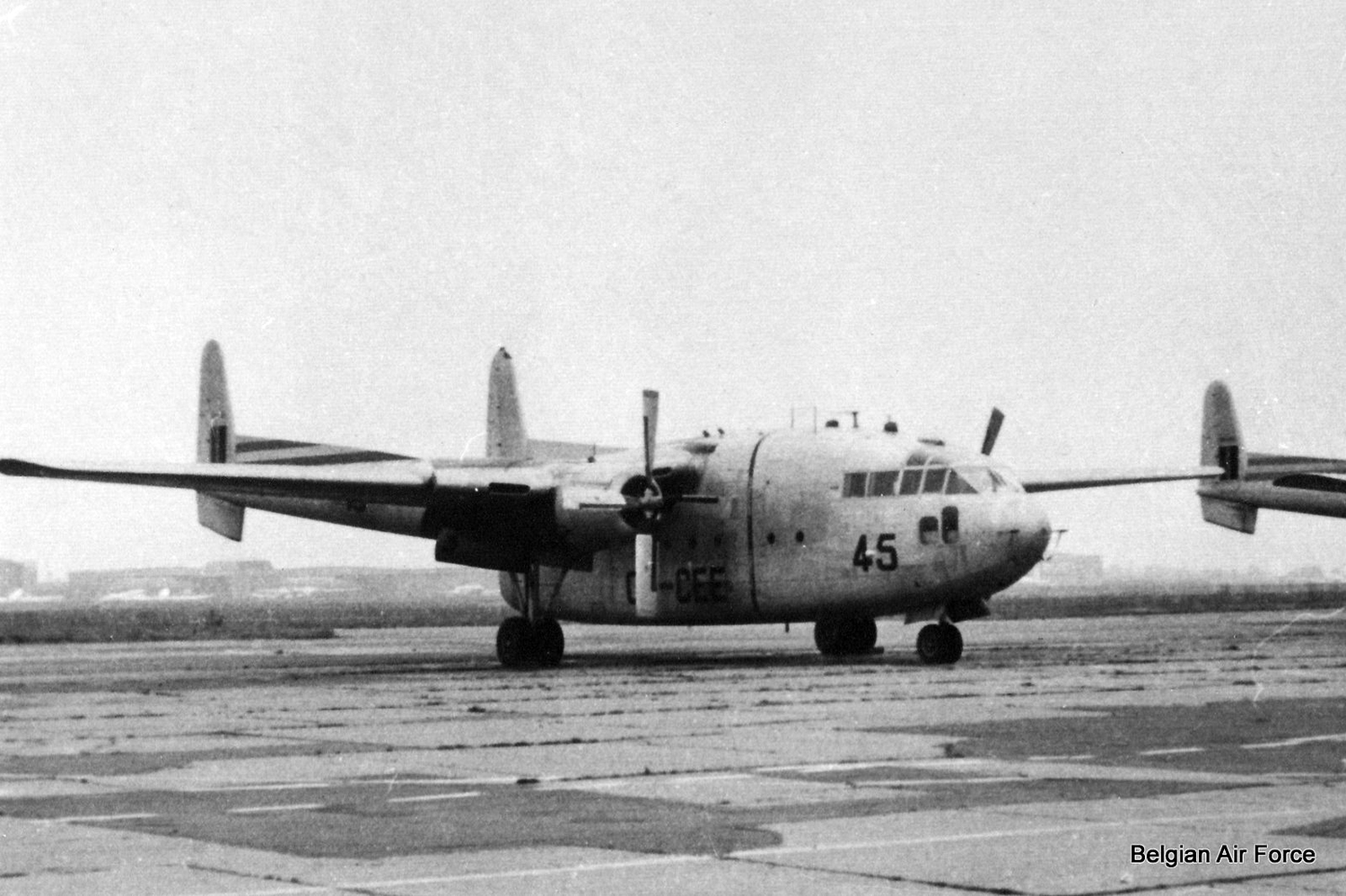
The aircraft departed Brussels-Melsbroek Airport in the morning on a flight to Gütersloh Airbase, Germany. Approaching Augustdorf, the captain decided to reduce his altitude to 2,500 feet to make a reconnaissance of the military training camp of Senne located 7 km south of Augustdorf. At this time, British troops were engaged in local exercices consisting of mortar shell fire. While flying too low, the aircraft was struck by several mortar shell and caught fire. Nine passengers were able to bail out and were later recovered uninjured. Out of control, the airplane went into a dive and crashed in flames, killing all 38 remaining occupants. It was reported few days after this tragic event that the aircraft should never being in this area at this time as it has been previously delimited by the British Troops for scheduled exercices. For unknown reason, the crew failed to follow the minimum safe altitude that was fixed at 10,000 feet over the area that day.

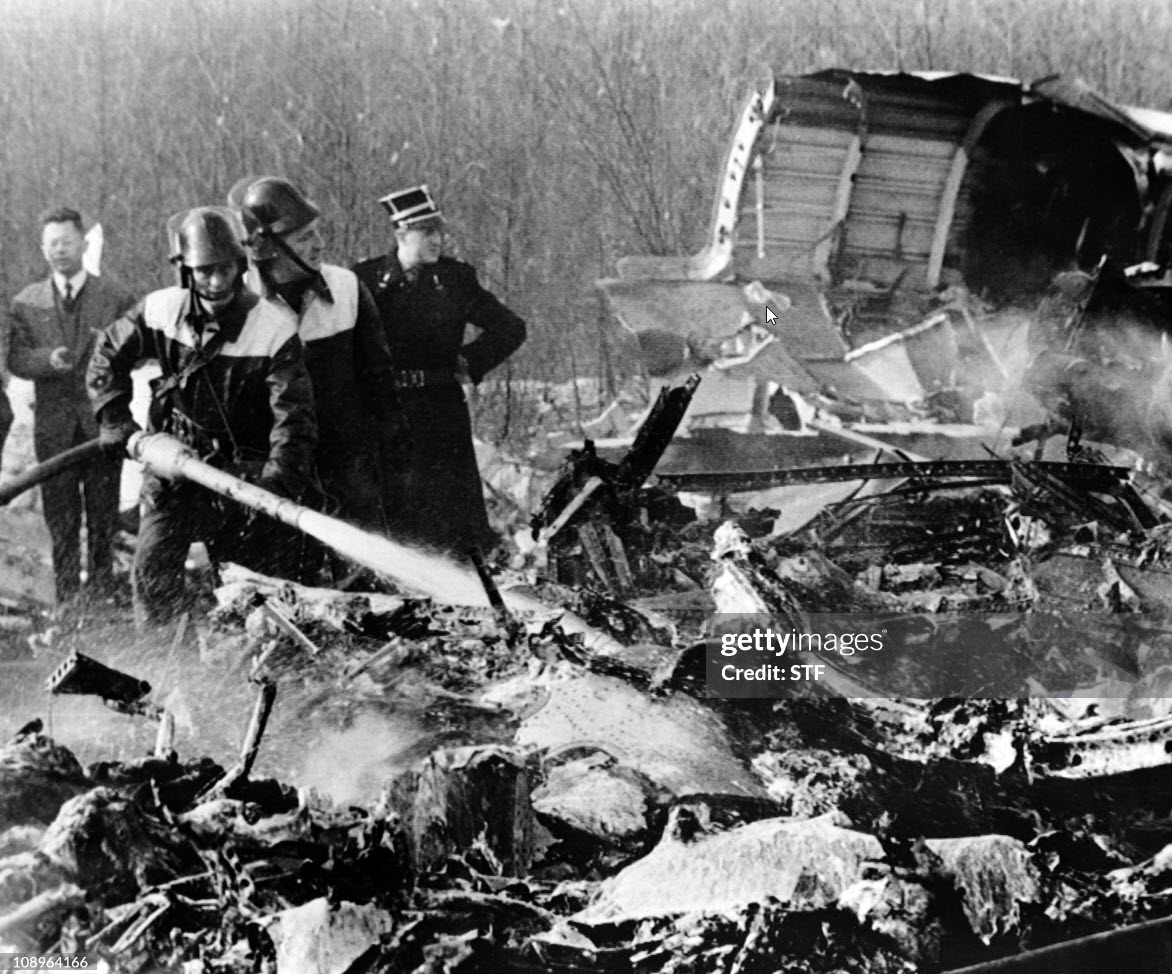
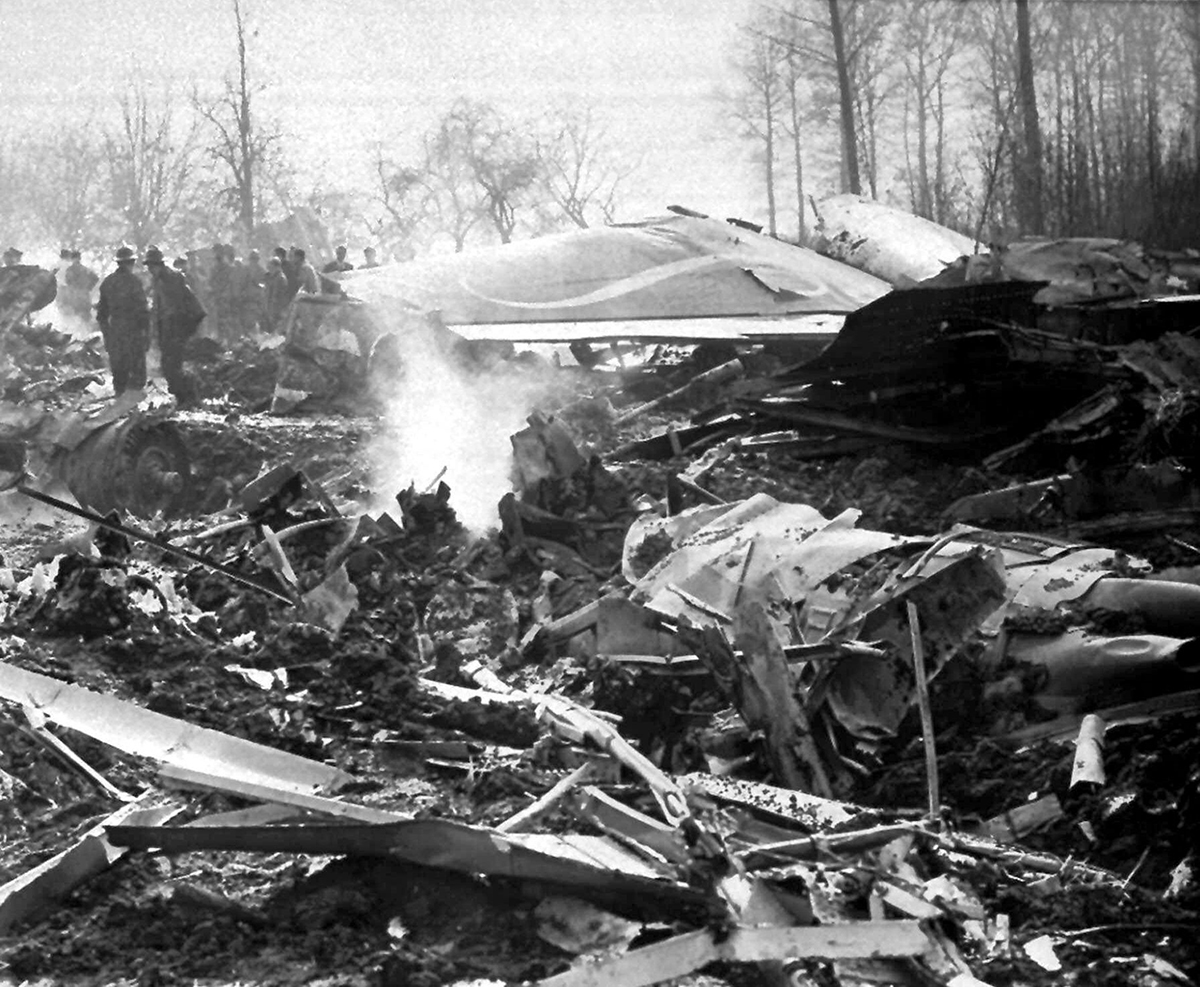
Crash of a Boeing 707-329 in Brussels: 73 killed

Date & Time: Feb 15, 1961 at 1005 LT
Type of aircraft:
Operator:
Registration:
OO-SJB
Survivors:
No
Schedule:
New York – Brussels
MSN:
17624
YOM:
1959
Flight number:
SN548
Country:
Region:
Crew on board:
11
Crew fatalities:
Pax on board:
61
Pax fatalities:
Other fatalities:
Total fatalities:
73
Captain / Total flying hours:
15384
Captain / Total hours on type:
21.00
Copilot / Total flying hours:
16231
Copilot / Total hours on type:
20
Aircraft flight hours:
3038
Circumstances:
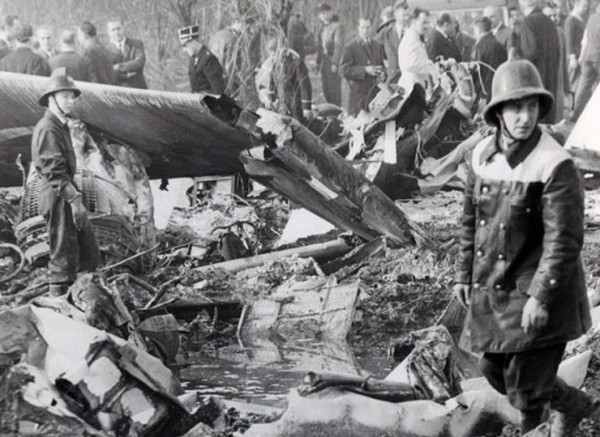
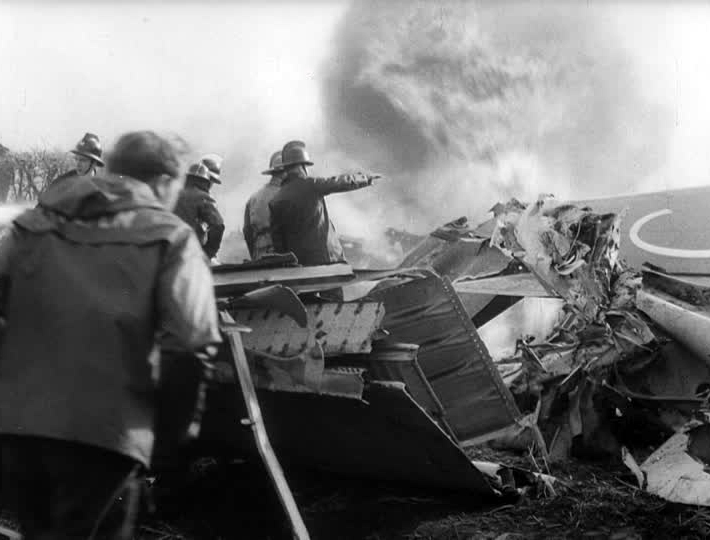
Following an uneventful transatlantic flight from New York, the crew started the approach to runway 20 at Brussels-Zaventem Airport. On short final, while at an altitude of 900 feet, the crew raised the landing gear, increased engine power and made a go around. The plane made three 360° turns to the left and climbed to 1,500 feet. During these turns the bank angle increased more and more until the aircraft was in a near vertical bank. The wings then leveled, followed by an abrupt pitch up. The 707 lost speed, started to spiral rapidly towards the ground nose down, crashed and caught fire. All 72 occupants were killed as well as one farmer working in the field. Among the passengers were 17 members of the US National Hockey Team who were flying to Prague to take part to the World Championship.
Probable cause:
Having carried out all possible reasonable investigations, the Commission concluded that the cause of the accident had to be looked for in the material failure of the flying controls. However, while it was possible to advance certain hypotheses regarding the possible causes, they could not be considered entirely satisfactory. Only the material failure of two systems could lead to a complete explanation, but left the way open to an arbitrary choice because there was not sufficient evidence to corroborate it. The FAA commented that the most plausible hypothesis was a malfunction of the stabilizer adjusting mechanism permitting the stabilizer to run to the 10.5° nose-up position.
Final Report:
Crash of a Douglas DC-6 on Mt Costone dell'Acquasanta: 29 killed

Date & Time: Feb 13, 1955 at 1953 LT
Type of aircraft:
Operator:
Registration:
OO-SDB
Flight Phase:
Survivors:
No
Site:
Schedule:
Brussels – Rome – Athens – Cairo – Elisabethville
MSN:
43063
YOM:
1947
Flight number:
SN503
Country:
Region:
Crew on board:
8
Crew fatalities:
Pax on board:
21
Pax fatalities:
Other fatalities:
Total fatalities:
29
Circumstances:
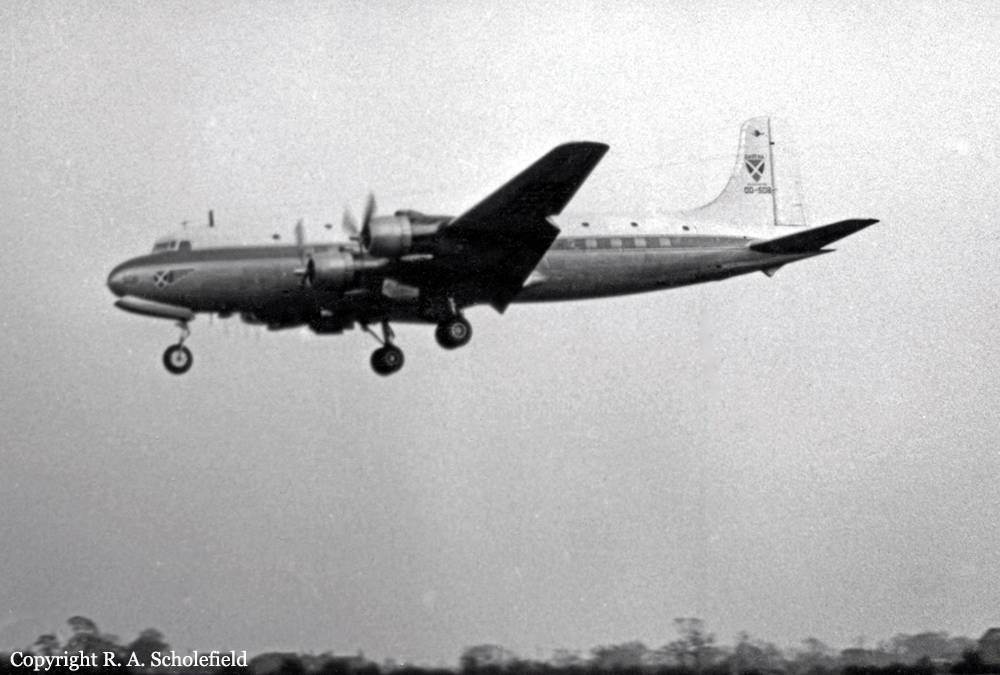
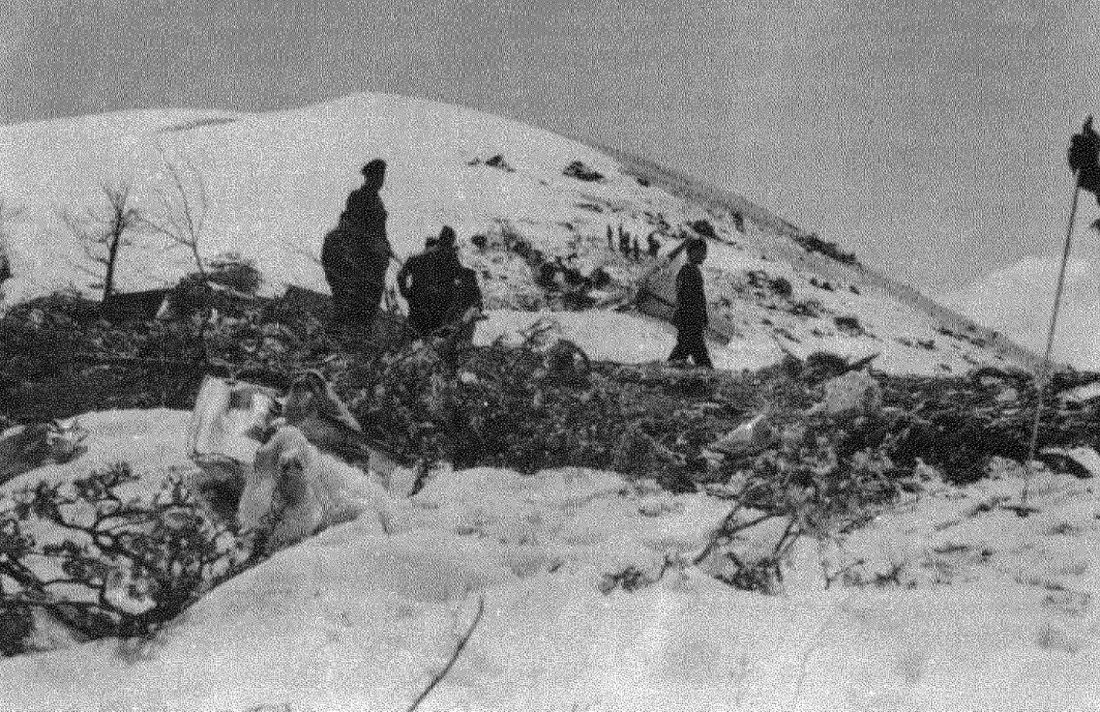
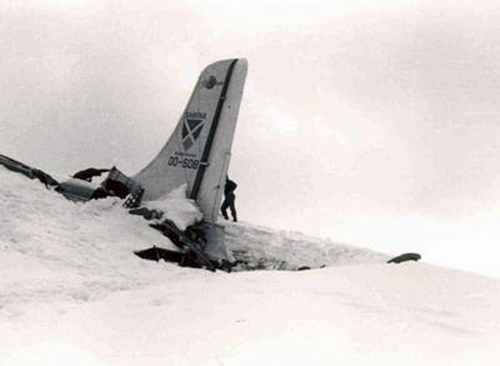
The aircraft departed the Brussels-Haren Airport for Rome at 1717LT on an IFR flight plan. According to radio communications between the aircraft and the area controls at Zurich, Milan and Rome the flight appears to have been normal. The aircraft was in touch with Rome area control at 1929LT and the last message from it was received at 1953LT. At about 1950LT the aircraft after overflying the village of Leonessa and continued on a heading of 163° until it hit the slope of the Mt Costone dell'Acquasanta at an altitude of 1,700 meters after breaking off the tops of trees in a wood in line with the point of impact, near the end of its course. The wreckage was found one week later only and all 29 occupants have been killed, among them the Italian actress Marcella Mariani.
Probable cause:
The probable cause of the accident was that the navigation was conducted without making use of all such radio aids as would have permitted checking, and consequently correcting the drift of the aircraft, whereas the crew actually remained unaware of the drift. In fact, instead of making sure they were over the Viterbo beacon, they merely held that conviction, and therefore the approach procedure to the Rome terminal area (which prescribes overflight of the Viterbo beacon) was erroneously applied. The following contributing causes may be taken into consideration:
- crosswind to the route stronger than forecast,
- weather conditions particularly unfavorable to radio reception in MF,
- None of the messages from the aircraft gave the impression that the crew were in any doubt as to their position,
- The gradual uncontrolled eastward drift may be assumed to have started along the Alpine route, in view of the atmospheric conditions then prevailing, and particularly because of the jet stream previously mentioned,
- The message "passed Viterbo beacon one minute ago" sent by the aircraft at 1951LT was certainly an error, actually, the aircraft struck the surface at 1853 at a point more than 60 km east of Viterbo on a heading of 163°.
Final Report: