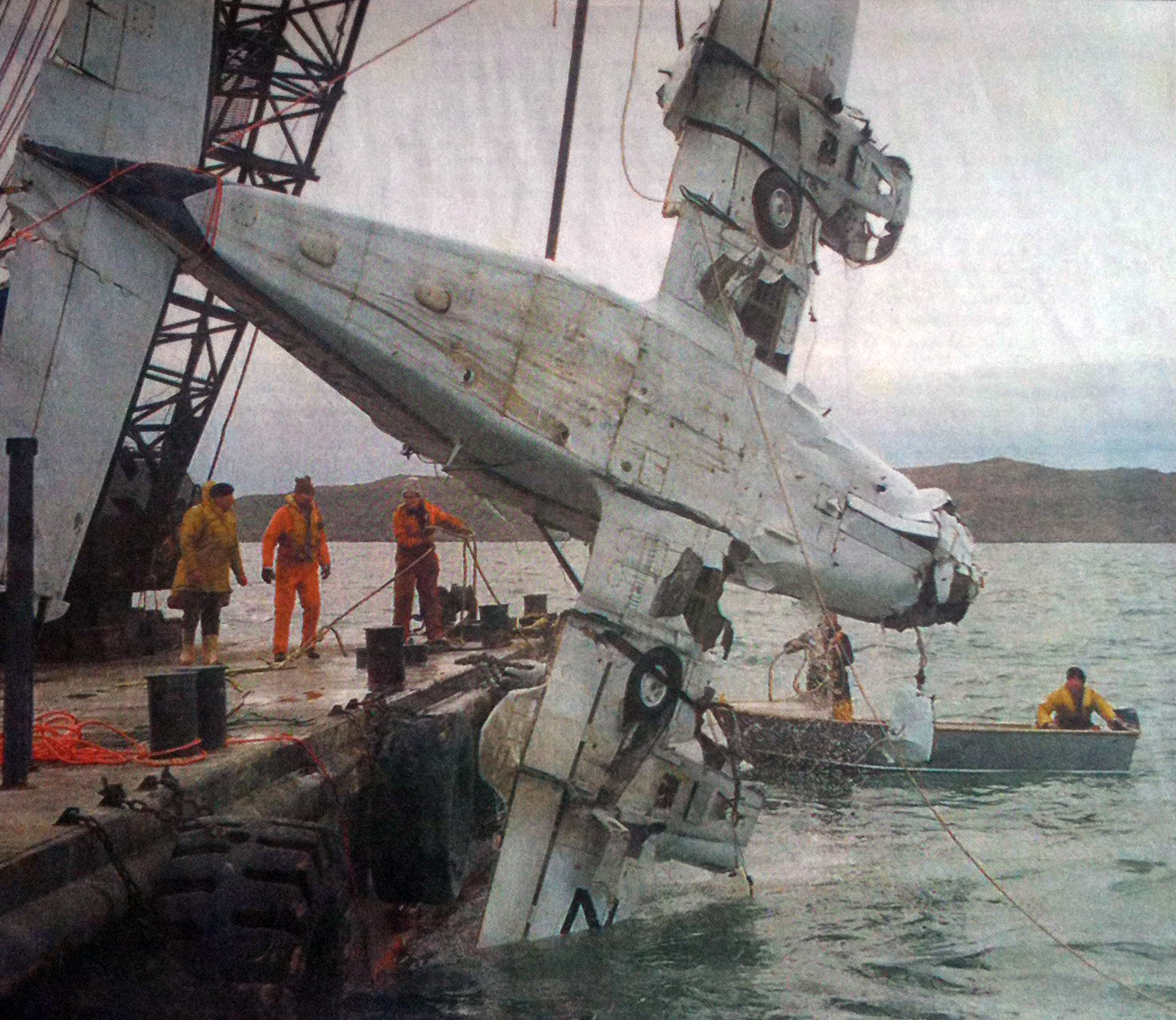
Crash of a Cessna 402B off Pahokee: 3 killed

Date & Time: Dec 8, 1998 at 1902 LT
Type of aircraft:
Operator:
Registration:
N788SP
Flight Type:
Survivors:
No
Schedule:
Fort Lauderdale - Pahokee
MSN:
402B-1312
YOM:
1978
Location:
Crew on board:
3
Crew fatalities:
Pax on board:
0
Pax fatalities:
Other fatalities:
Total fatalities:
3
Captain / Total flying hours:
1440
Captain / Total hours on type:
8.00
Aircraft flight hours:
7940
Circumstances:
The flight departed Fort Lauderdale's Executive Airport (FXE) at about 1833 on a northwesterly heading for the co-located Pahokee VOR/airport (PHK) on the second training session of the day for the 2 front seat occupants. This particular flight had a dual purpose, in that the left seat occupant/new-hire was getting a 'pre-check ride' by the right seat occupant/instructor/PIC, and the instructor was being observed by the air taxi's director of operations in anticipation of an endorsement for an FAA designation as a company check airman. The flight was not in contact with any ATC facility and was squawking a transponder code consistent with non-controlled, VMC flight. At 1902, the Miami ARTCC lost radar contact at the 334 degree radial/12 nmi from the PHK VOR at 1,300 feet agl. Eight days later, the wreckage with its 3 occupants still inside, was located and recovered from the lake bottom. The location roughly corresponds with the radial of the PHK VOR that would have to be tracked while performing the VOR Runway 17 approach. The wreckage was intact except for 2 nacelle doors, the nose cone, and the left propeller, and revealed no engine, airframe, or component failure or malfunction. There was no evidence of a bird strike. Evidence revealed that both engines were developing power and the airplane was wings level in the approach configuration and attitude at water contact.
Probable cause:
The pilot's failure to maintain adequate altitude during the approach.
Final Report:


Crash of a Cessna 402A in Stord: 9 killed

Date & Time: Oct 12, 1998 at 2325 LT
Type of aircraft:
Registration:
OY-BHE
Survivors:
No
Schedule:
Aalborg - Stord
MSN:
402A-0062
YOM:
1979
Country:
Region:
Crew on board:
1
Crew fatalities:
Pax on board:
8
Pax fatalities:
Other fatalities:
Total fatalities:
9
Circumstances:
On final approach to Stord-Sørstokken Airport by night, the twin engine aircraft stalled and crashed in a rocky area located 180 metres short of runway 33. The aircraft was destroyed and all nine occupants were killed, among them eight naval workers.
Probable cause:
It was determined that both engines failed simultaneously on final approach due to fuel exhaustion.

Crash of a Cessna 402B in Arusha

Date & Time: Oct 9, 1998 at 1056 LT
Type of aircraft:
Operator:
Registration:
5H-MPR
Survivors:
Yes
Schedule:
Arusha – Kilimanjaro – Mombasa
MSN:
402B-0113
YOM:
1971
Country:
Region:
Crew on board:
1
Crew fatalities:
Pax on board:
3
Pax fatalities:
Other fatalities:
Total fatalities:
0
Captain / Total flying hours:
7700
Captain / Total hours on type:
252.00
Circumstances:
Prior to departure, the pilot reported to ground mechanics that an unusual noise came from the left main gear. An inspection was conducted but nothing anormal was noted. Nevertheless, the pilot was told to fly directly to Mombasa for further control. After takeoff from runway 09, while climbing, the pilot was contacted by ATC who reported that the left main gear detached and fell away. He was cleared to return for an emergency landing and completed a belly landing few minutes later. The aircraft came to rest on runway and was damaged beyond repair. All four occupants escaped uninjured.
Probable cause:
It was determined that the left main gear had undergone a maintenance check on January 3, 1996 and no anomalies had been detected since. Nevertheless, the runway surface at Arusha Airport was in relative poor condition with the presence of several holes. As a result, it is likely that the landing gear suffered a severe impact during a previous landing.

Crash of a Cessna 402C in Roseau: 11 killed

Date & Time: Aug 23, 1998 at 1740 LT
Type of aircraft:
Operator:
Registration:
N2748J
Survivors:
No
Schedule:
Saint Martin - Marigot
MSN:
402C-0244
YOM:
1980
Flight number:
DCF947
Country:
Crew on board:
1
Crew fatalities:
Pax on board:
10
Pax fatalities:
Other fatalities:
Total fatalities:
11
Circumstances:
On August 23, 1998, at 1740 eastern daylight time a Cessna 402C, N2748J, impacted rising terrain following a go-around from runway 09, at the Melville Hall Airport, Dominica. The airplane was registered to Hartford Holding Corporation, Wilmington, Delaware, and operated by Air Anguilla, Incorporated, St Thomas, Virgin Islands as Cardinal Airlines Flight 947 Dominica. The airplane was operated under the provisions of Title 14 CFR Part 135, and visual flight rules. Visual meteorological conditions prevailed in heavy rain, and a VFR flight plan was filed. The commercial pilot and 10 passengers sustained fatal injuries and the airplane was destroyed. There was no fire. The airplane departed Princess Juliana Airport in St. Maarten, West Indies about 1600.

Crash of a Cessna 402C off Halfmoon Bay: 5 killed

Date & Time: Aug 19, 1998 at 1643 LT
Type of aircraft:
Operator:
Registration:
ZK-VAC
Flight Phase:
Survivors:
Yes
Schedule:
Halfmoon Bay - Invercargill
MSN:
402C-0512
YOM:
1981
Country:
Region:
Crew on board:
1
Crew fatalities:
Pax on board:
9
Pax fatalities:
Other fatalities:
Total fatalities:
5
Captain / Total flying hours:
14564
Captain / Total hours on type:
27.00
Aircraft flight hours:
13472
Circumstances:
Surviving passengers reported that en route from Stewart Island to Invercargill there were symptoms of a righthand engine failure, which was corrected by the pilot's manipulation of floor-mounted fuel tank selectors. Shortly afterwards, both engines stopped. The pilot broadcast a Mayday and advised the passengers that they would be ditching. A successful ditching was carried out approximately 12 NM south of Invercargill. All occupants escaped from the aircraft, however, four persons exited without life jackets. The pilot entered the cabin but was unable to locate more before the aircraft sank. Rescuers reached the scene about an hour after the ditching only to find that all those without life jackets had perished, as had a young boy who was wearing one.
Probable cause:
A TAIC investigation found that there was no evidence of any component malfunction that could cause a double engine failure, although due to seawater damage the pre-impact condition of most fuel quantity system components could not be verified. Both fuel tank selectors were positioned to the lefthand tank, and it is probable that fuel starvation was the cause of the double engine failure. Company procedures for the Cessna 402 lacked a fuel quantity monitoring system to supplement fuel gauge indications. Dipping of the tanks was not a feasible option. Company pilots believed that the aircraft was fitted with low-fuel quantity warning lights, which was not the case. As three pilots believed the gauges indicated sufficient fuel was on board before the preceding round trip to the island, exhaustion may have followed an undetermined fuel indicating system malfunction. The failure of the company to require the use of operational flight logs, and other deficiencies in record keeping, were identified in the TAIC report. The much-publicised misunderstanding about the ditching location was not considered by the TAIC report to have affected the outcome of the rescue, but provides an example of the continued importance of using the phonetic alphabet in radiotelephony. A safety recommendation that operators use a fuel-quantity monitoring system to supplement fuel gauge indications was also made by the TAIC report.
Final Report:

Crash of a Cessna 402B in West Palm Beach

Date & Time: Apr 3, 1998 at 1705 LT
Type of aircraft:
Operator:
Registration:
N400AR
Survivors:
Yes
Schedule:
Marsh Harbour - West Palm Beach
MSN:
402B-0338
YOM:
1972
Crew on board:
1
Crew fatalities:
Pax on board:
8
Pax fatalities:
Other fatalities:
Total fatalities:
0
Captain / Total flying hours:
6120
Captain / Total hours on type:
350.00
Circumstances:
According to the passengers, they departed about 30 or 40 minutes late because of the late arrival of the airplane. When the pilot arrived, he 'seemed to...be in a hurry...there was no safety instructions or any attempt to show us or the kids the operation of the door.' After takeoff, the flight climbed to an altitude of 6,700 feet. The pilot attempted to make radio contact with an unknown station, was unsuccessful in making radio contact, and according to a passenger, 'seemed agitated.' The passengers noticed that the left alternator light was illuminated, and questioned the pilot. The pilot told the passengers, '...it's nothing it always comes on.' About 15 minutes after departure, the flight descended to 3,000 feet and the pilot attempted to make radio contact with someone again. The flight continued at 3,000 feet until the pilot saw a ship in the ocean. He descended to around 1,000 feet over the ship, and was still working with the radio. The flight continued onto the coast. The passengers told EMS personnel that the airplane made an 'abrupt' left turn to line up with the runway, and when the airplane touched down, they felt the right side of the aircraft collapse. After touchdown on runway 27L, the airplane's right main landing gear collapsed, then the left gear collapsed. The airplane slid off the right side of the runway and struck RVR (runway visual range) equipment. According to the pilot's statement he, '...made [a] normal approach to runway 27 left. All system indicated normal. Upon touchdown and roll out all was ok for 3-4 hundred feet- [right] gear collapsed...unable to hold aircraft on runway...nose hit RVR antenna swinging aircraft more right to catch right wing and remove tip tank. Left gear collapsed as aircraft came to rest.' According to the FAA Inspector's statement, it was his opinion, on the day of the accident the aircraft was 'over gross weight on departure from Marsh Harbor...the pilot was experiencing radio problems... and I [FAA Inspector] believe he was flustered and annoyed...in the pattern he made an abrupt left turn to lineup with [runway] 27, and when he touched down on the runway the right gear immediately collapsed due to [side] overload.' In addition, both landing gear trunnions, where the retract mechanisms attached, were broken as if 'overloaded.'
Probable cause:
The pilot allowed the airplane to improperly touchdown on the right main landing gear, resulting in the gear collapsing, and subsequent impact with runway visual range equipment.
Final Report:

Crash of a Cessna 402C in Walker: 1 killed

Date & Time: Jan 17, 1998 at 1230 LT
Type of aircraft:
Operator:
Registration:
N114GP
Flight Phase:
Survivors:
Yes
Site:
Schedule:
Reno - Columbia
MSN:
402C-0085
YOM:
1979
Crew on board:
1
Crew fatalities:
Pax on board:
1
Pax fatalities:
Other fatalities:
Total fatalities:
1
Captain / Total flying hours:
3942
Captain / Total hours on type:
722.00
Aircraft flight hours:
16731
Circumstances:
The aircraft collided with trees and mountainous terrain about 9,500 feet msl. The wreckage was spread across the lee side of a mountain, in a grassy meadow surrounded by high mountainous terrain on all sides. The area, about 100 feet in front of the aircraft, was a rocky embankment which sloped upward approximately 30 degrees. About 100 feet from the tail of the aircraft, the terrain dropped off into a steep cliff, which sloped down about 65 degrees. At the base of the cliff was a valley, which was about 1/4 mile wide. The farthest piece of debris was found 410 feet away from the main wreckage site in a grove of trees. Fifteen tree disturbances were noted in the grove. The first disturbance began near the tops of the trees and continued in a descending path. Much of the airframe exhibited semicircular impressions consistent with the trunk diameters of the disturbed trees at the accident site. Organic material transfer was evident in the impressions. An analysis of the meteorological data showed that a clear or scattered cloud condition was likely in the accident area, and visibility was probably unrestricted. It also showed that an extended north-northwestward/south-southeastward cloud band was located over the Sierra Nevada Mountains about 9 to 10 miles southwest through west of the accident location around the time of the accident. The analysis estimated that the winds aloft at 10,000 to 12,000 feet msl in the mountains were from approximately 270 degrees at 40 to 45 knots. Further, moderate or greater turbulence and strong updrafts and downdrafts were reported along the pilot's route of flight. No mechanical discrepancies were found with the airframe or either engine during the postaccident examination.
Probable cause:
The pilot's encounter with a downdraft while approaching high terrain at an altitude insufficient to ensure adequate terrain or obstacle clearance.
Final Report:

Crash of a Cessna 402B in Watertown: 1 killed

Date & Time: Dec 30, 1997 at 1817 LT
Type of aircraft:
Registration:
N5087Q
Flight Phase:
Flight Type:
Survivors:
No
Schedule:
Watertown – Marshall
MSN:
402B-0565
YOM:
1974
Crew on board:
1
Crew fatalities:
Pax on board:
0
Pax fatalities:
Other fatalities:
Total fatalities:
1
Circumstances:
The pilot landed at Watertown, loaded and off-loaded cargo, and departed without getting out of the airplane. A witness reported seeing the airplane over the runway at an altitude of about 50 feet agl. The airplane was described to be bouncing and buffeting. Another witness reported the weather as overcast with occasional snow flakes. The airplane then descended, impacted the terrain and exploded. Post accident inspection revealed a 1/2 to 3/4 inch thick ridge of rime ice along the leading edge of the left horizontal stabilizer. Pieces of arc shaped ice were located along the wreckage path. Inspection of the wreckage failed to reveal any preimpact failure/malfunction of the engine or airframe which would have prevented flight.
Probable cause:
The pilot's failure to perform an aircraft preflight and to remove the ice which had accumulated on the airframe. A factor involved in the accident was the icing weather conditions which existed and the ice which accumulated on the airplane.
Final Report:

Crash of a Cessna 402B in Spencer

Date & Time: Nov 29, 1997 at 0900 LT
Type of aircraft:
Operator:
Registration:
N22NC
Flight Type:
Survivors:
Yes
Schedule:
Cedar Rapids - Spencer
MSN:
402B-0227
YOM:
1972
Location:
Crew on board:
1
Crew fatalities:
Pax on board:
0
Pax fatalities:
Other fatalities:
Total fatalities:
0
Captain / Total flying hours:
1712
Captain / Total hours on type:
197.00
Aircraft flight hours:
7998
Circumstances:
The pilot made four missed ILS approaches at the airport. He stated that he did not see the approach lights during any of the approaches and did not feel comfortable making a landing. The reported visibility during these approaches was 1/2-statute mile. On the fifth approach the pilot said he had '...mistaken closely inline cars and a road for the MALSR and runway.' He pilot stated the airplane continued to descend after initiating a go-around. He said he saw oncoming traffic in front of him, and turned the airplane to the right. He said he lost altitude and the right wing struck the ground. The pilot's employers operations specification require a 1/4- mile increase in visibility for an ILS approach that does not have an operating approach lighting system. The approach lights were checked by the airport manager and were confirmed to be in working order. An on-scene investigation revealed no pre-accident airframe or engine anomalies that would have prevented normal flight.
Probable cause:
The pilot failure to comply with the prescribed IFR procedure and his not following his company's operations specifications. Low clouds and fog were are contributing factors.
Final Report: