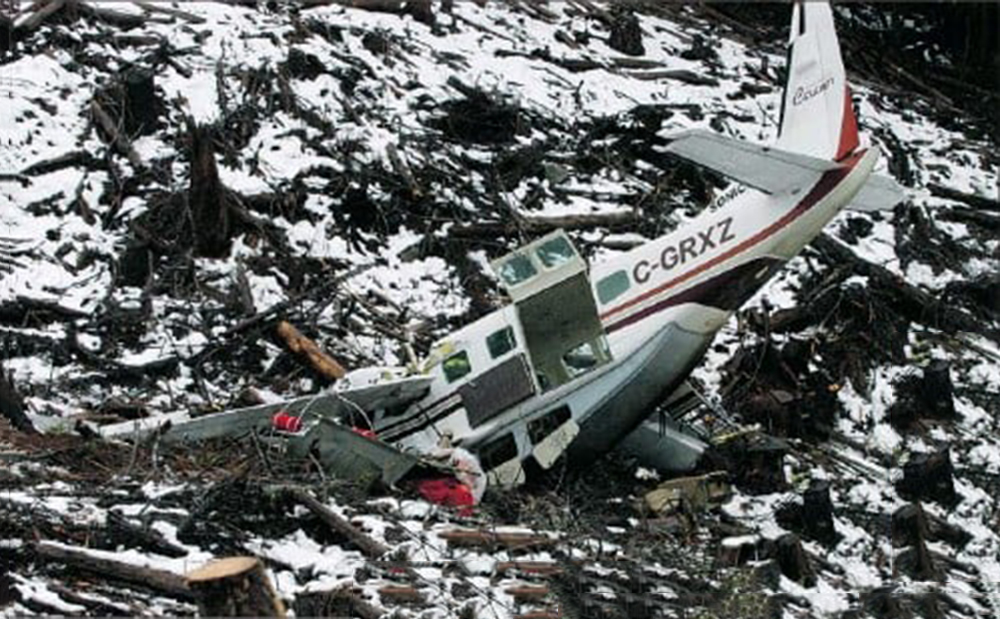
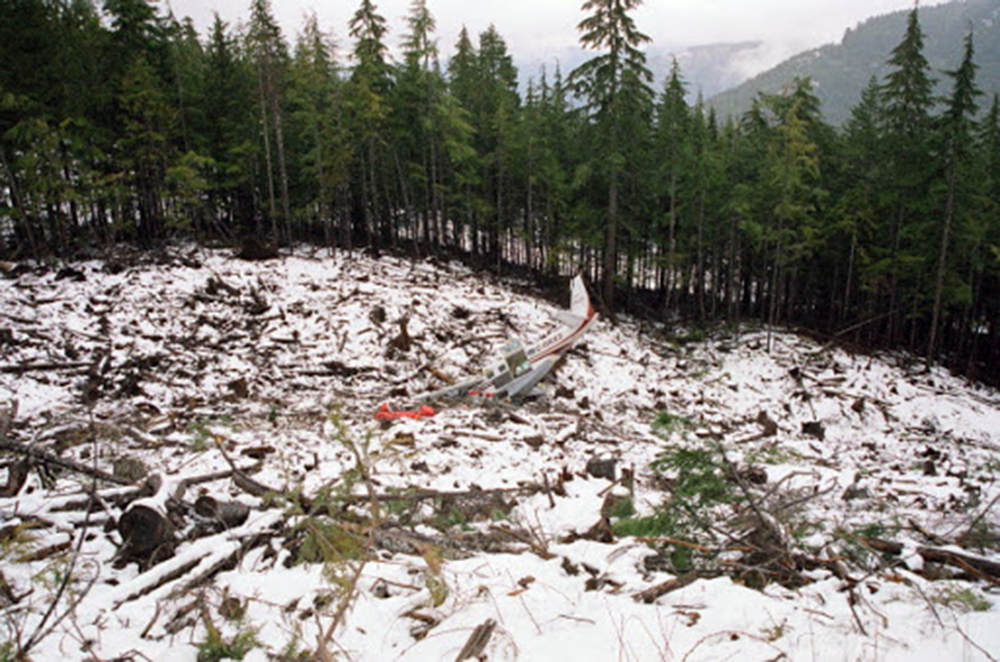
Crash of a Cessna 208B Grand Caravan near Port Alberni: 3 killed

Date & Time: Jan 21, 2006 at 1420 LT
Type of aircraft:
Operator:
Registration:
C-GRXZ
Flight Phase:
Survivors:
Yes
Schedule:
Tofino – Vancouver
MSN:
208B-0469
YOM:
1995
Flight number:
RXX604
Country:
Crew on board:
1
Crew fatalities:
Pax on board:
7
Pax fatalities:
Other fatalities:
Total fatalities:
3
Captain / Total flying hours:
2480
Captain / Total hours on type:
750.00
Circumstances:
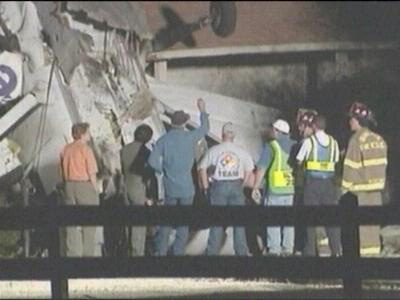
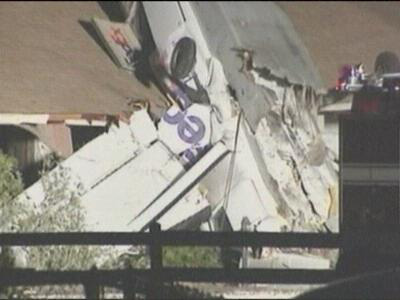
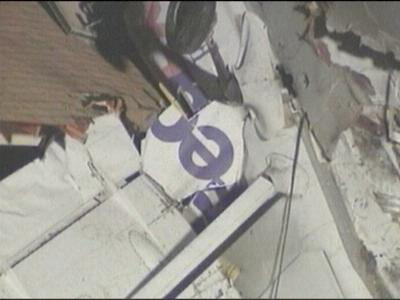
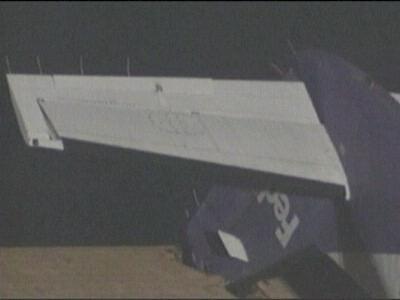
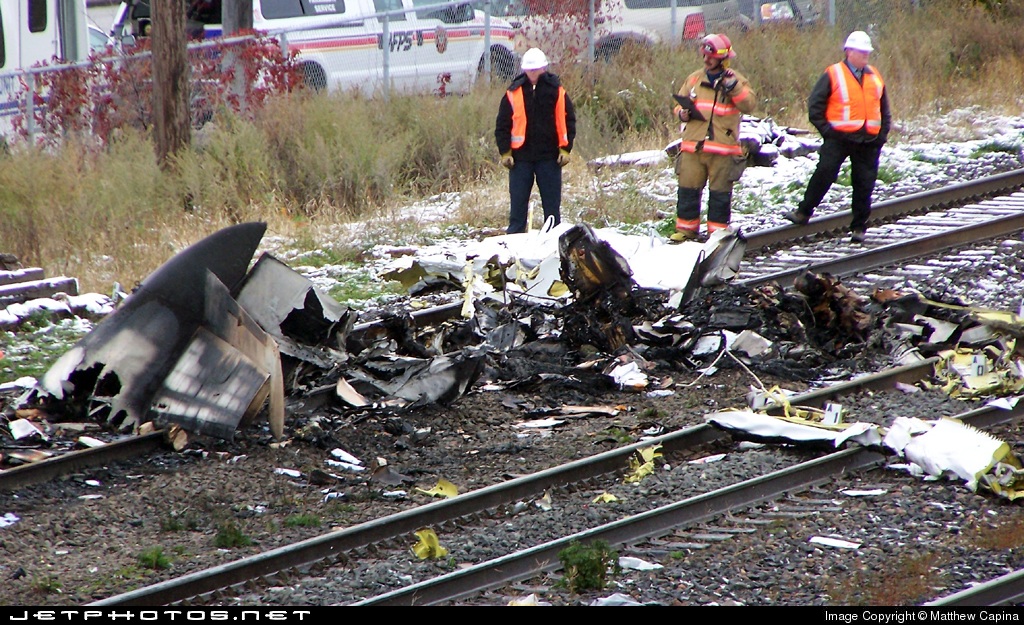
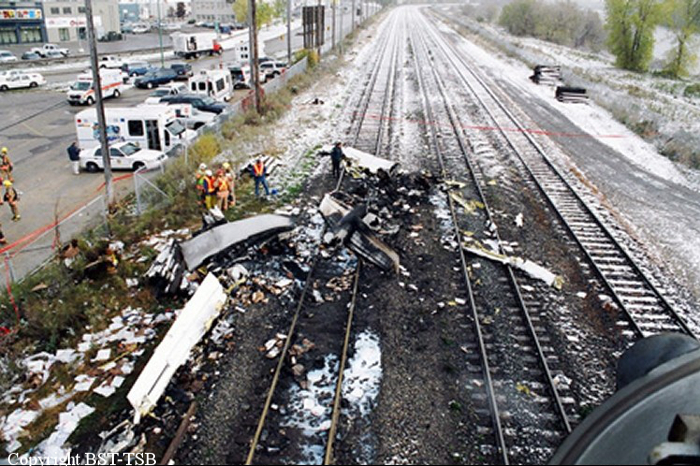
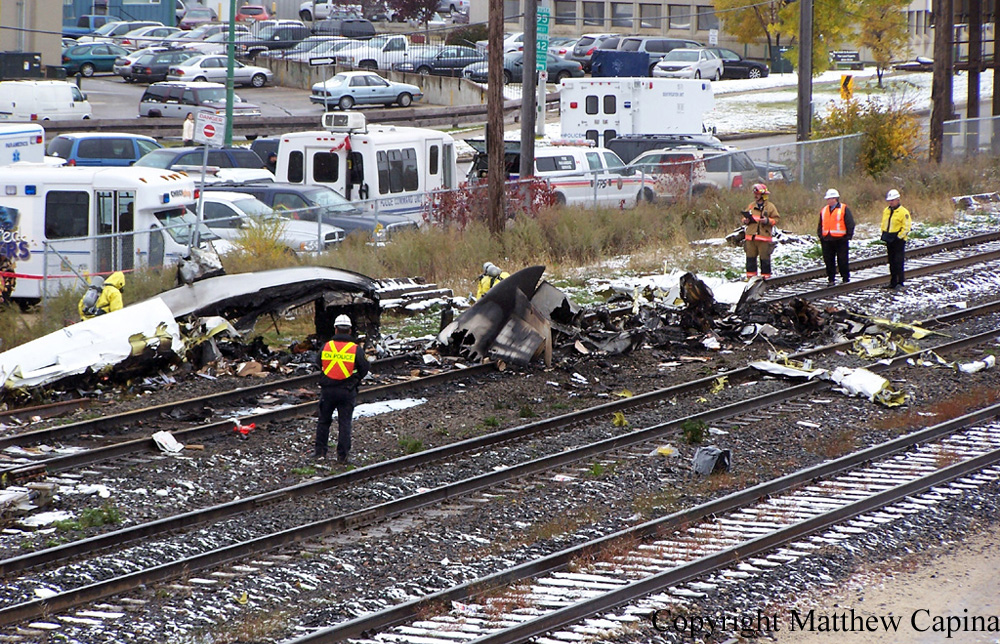
The Cessna 208B aircraft (registration C-GRXZ, serial number 208B0469) was en route at 9000 feet above sea level, from Tofino, British Columbia, to Vancouver International Airport, British Columbia, when the engine failed. The pilot began a glide in the direction of the Port Alberni Regional Airport before attempting an emergency landing on a logging road. The aircraft struck trees during a steep right-hand turn and crashed. The accident occurred at about 1420 Pacific standard time, approximately 11 nm south-southeast of the Port Alberni Regional Airport. Five passengers survived with serious injuries; the pilot and the other two passengers were fatally injured.
Probable cause:
Findings as to Causes and Contributing Factors:
1. The engine lost power when a compressor turbine blade failed as a result of the overstress extension of a fatigue-generated crack. The fracture initiated at a metallurgical anomaly in the parent blade material and progressed, eventually resulting in blade failure due to overstress rupture.
2. The combination of aircraft position at the time of the engine failure, the lack of equipment enabling the pilot to locate and identify high terrain, and the resultant manoeuvring required to avoid entering instrument flight conditions likely prevented the pilot from attempting to glide to the nearest airfield.
Findings as to Risk:
1. Single-engine instrument flight rules (SEIFR) operations in designated mountainous regions have unique obstacle risks in the event of an engine failure. Canadian equipment requirements for such operations do not currently include independent terrain mapping, such as terrain awareness and warning systems (TAWS).
2. Airline operators are not currently required to conduct any additional route evaluation or structuring to ensure that the risk of an off-field landing is minimized during SEIFR operations.
3. Pilots involved in commercial SEIFR operations do not receive training in how to conduct a forced landing under instrument flight conditions; such training would likely improve a pilotís ability to respond to an engine failure when operating in instrument meteorological conditions (IMC).
4. Mean time between failure (MTBF) calculations do not take into account In Flight Shut Downs (IFSDs) not directly attributable to the engine itself; it may be more appropriate to monitor all IFSD events.
5. The design of the Cessna 208B Caravan fuel shutoff valves increases the risk that the valves will open on impact, allowing fuel spillage and increasing the potential for fire.
Other Finding:
1. Sonicblue Airways was not providing downloaded engine parameter data for engine condition trend monitoring (ECTM) evaluation at appropriate intervals.
Final Report:


Crash of a Cessna 208B Super Cargomaster in Portland

Date & Time: Dec 24, 2005 at 0743 LT
Type of aircraft:
Operator:
Registration:
N753FE
Flight Phase:
Flight Type:
Survivors:
Yes
Schedule:
Portland - Medford
MSN:
208B-0248
YOM:
1991
Crew on board:
1
Crew fatalities:
Pax on board:
0
Pax fatalities:
Other fatalities:
Total fatalities:
0
Captain / Total flying hours:
4625
Captain / Total hours on type:
2450.00
Aircraft flight hours:
7375
Circumstances:
The pilot stated that during takeoff, "after becoming airborne, the airplane quit accelerating and a positive climb rate was not established." He pushed the power lever all the way forward, but did not feel a response from the airplane. Witnesses reported that the airplane became airborne, but failed to gain altitude and struck an antenna array and a fence off the departure end of the runway. The airplane continued across a slough, struck an embankment and came to rest about 900 feet from the departure end of the runway on a golf course located adjacent to the airport. Examination of the airplane revealed no pre-mishap airframe anomalies. Examination of the engine revealed that the compressor and power turbines displayed moderate circular rubbing damage to the blades suggesting engine operation at impact, likely in the low to mid power range. Examination of the airframe and engine revealed no anomalies that would have prevented the engine from producing power prior to impact. The reason for the partial loss of engine power was not determined.
Probable cause:
A partial loss of engine power for an undetermined reason during the initial takeoff climb resulting in an in-flight collision with objects.
Final Report:

Crash of a Cessna 208B Grand Caravan in Staroye: 8 killed

Date & Time: Nov 19, 2005 at 2233 LT
Type of aircraft:
Operator:
Registration:
P4-OIN
Flight Phase:
Survivors:
No
Schedule:
Voronezh - Moscow
MSN:
208B-1052
YOM:
2004
Country:
Region:
Crew on board:
2
Crew fatalities:
Pax on board:
6
Pax fatalities:
Other fatalities:
Total fatalities:
8
Circumstances:
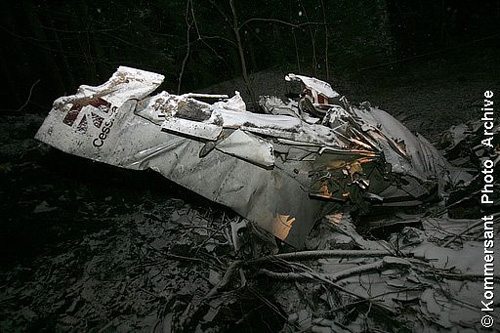
The single engine aircraft departed Voronezh at 2117LT on a special flight to Moscow-Domodedovo Airport with 6 pax and 2 pilots on board, ETA Moscow 2240LT. While approaching Stupino and descending to Domodedovo Airport by night, the crew encountered poor weather conditions with snow falls, poor visibility, icing conditions and turbulences. Passing Stupino at an altitude of 1,500 metres, the aircraft pitched up in an angle of 9° and at a speed of 102 knots, it nosed down 40° then entered an uncontrolled descent until it crashed at a speed of 226 knots in a wooded area located in Staroye, about 10 km from Stupino. The aircraft was destroyed by impact forces and a post crash fire and all 8 occupants were killed.
Probable cause:
Loss of control in icing conditions.

Crash of a Cessna 208B Super Cargomaster in Round Rock

Date & Time: Oct 18, 2005 at 2315 LT
Type of aircraft:
Operator:
Registration:
N978FE
Flight Phase:
Flight Type:
Survivors:
Yes
Site:
Schedule:
Austin - Fort Worth
MSN:
208B-0105
YOM:
1988
Crew on board:
1
Crew fatalities:
Pax on board:
0
Pax fatalities:
Other fatalities:
Total fatalities:
0
Captain / Total flying hours:
6600
Captain / Total hours on type:
2000.00
Aircraft flight hours:
10623
Circumstances:
The airplane was fueled with 65-gallons of jet-A in preparation for the evening's flight. The 6,600-hour pilot stated that no abnormalities were noted during the engine start, and takeoff. However; shortly after departure, and after the pilot had leveled off at 7,000-feet, he reported to air traffic control that he had an engine failure and a total power loss. During the descent, the pilot attempted both an air and battery engine restart, but was not successful. The inspection on the engine was conducted on November 30, 2005. The accessory gearbox had a reddish-brown stain visible beneath the fuel pump/fuel control unit. The accessory gearbox was turned; rotation of the drive splines in the fuel pump (splines for the fuel control unit) was not observed. The fuel pump unit was then removed, the area between the fuel pump and accessory gearbox was stained with a reddish brown color. The fuel pump drive splines were worn. Additionally, the internal splines on the fuel pump drive coupling were worn. The wear on the spline drive and coupling prevented full engagement of the spline drives. Both pieces had evidence of fretting, with a reddish brown material present. The airplane had approximately 130 hours since a maintenance inspection (which included inspection of the fuel pump). The engine had accumulated approximately a total time of 9,852 hours, with 5,574 hours since overhaul.
Probable cause:
The loss of engine power due to the failure of the engine-driven fuel pump. A contributing factor was the inadequate inspection of the engine driven fuel pump.
Final Report:

Crash of a Cessna 208B Super Cargomaster in Winnipeg: 1 killed

Date & Time: Oct 6, 2005 at 0543 LT
Type of aircraft:
Operator:
Registration:
C-FEXS
Flight Phase:
Flight Type:
Survivors:
No
Schedule:
Winnipeg – Thunder Bay
MSN:
208B-0542
YOM:
1996
Flight number:
FDX8060
Country:
Crew on board:
1
Crew fatalities:
Pax on board:
0
Pax fatalities:
Other fatalities:
Total fatalities:
1
Captain / Total flying hours:
4570
Captain / Total hours on type:
1500.00
Aircraft flight hours:
6724
Circumstances:
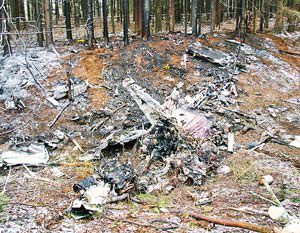
On the day before the occurrence, the accident aircraft arrived in Winnipeg, Manitoba, on a flight from Thunder Bay, Ontario. The aircraft was parked in a heated hangar overnight and was pulled outside at about 0410 central daylight time. The pilot reviewed the weather information and completed planning for the flight, which was estimated to take two hours and six minutes. The aircraft was refuelled and taxied to Apron V at the Winnipeg International Airport, where it was loaded with cargo. After loading was complete, the pilot obtained an instrument flight rules (IFR) clearance for the flight to Thunder Bay, taxied to Runway 36, received take-off clearance, and departed. The aircraft climbed on runway heading for about one minute to an altitude of 1300 feet above sea level (asl), 500 feet above ground level (agl). The flight was cleared to 9000 feet asl direct to Thunder Bay, and the pilot turned on course. The aircraft continued to climb, reaching a maximum altitude of 2400 feet asl about 2.5 minutes after take-off. The aircraft then started a gradual descent averaging about 400 feet per minute (fpm) until it descended below radar coverage. The accident occurred during hours of darkness at 0543. The Winnipeg Fire Paramedic Service were notified and responded from a nearby station.
Probable cause:
Findings as to Causes and Contributing Factors:
1. The aircraft departed at a weight exceeding the maximum take-off weight and the maximum weight for operation in icing conditions.
2. After departure from Winnipeg, the aircraft encountered in-flight icing conditions in which the aircraftís performance deteriorated until the aircraft was unable to maintain altitude.
3. During the attempt to return to the Winnipeg International Airport, the pilot lost control of the aircraft, likely with little or no warning, at an altitude from which recovery was not possible.
Findings as to Risk:
1. Aviation weather forecasts incorporate generic icing forecasts that may not accurately predict the effects of icing conditions on particular aircraft. As a result, specific aircraft types may experience more significant detrimental effects from icing than forecasts indicate.
2. Bulk loading prevented determining the cargo weight in each zone, resulting in a risk that the individual zone weight limits could have been exceeded.
3. The aircraftís centre of gravity (CG) could not be accurately determined, and may have been in the extrapolated shaded warning area on the CG limit chart. Although it was determined that the CG was likely forward of the maximum allowable aft CG, bulk loading increased the risk that the CG could have exceeded the maximum allowable aft CG.
4. The incorrect tare weight on the Toronto cargo container presented a risk that other aircraft carrying cargo from that container could have been inadvertently overloaded.
Other Findings:
1. The pilotís weather information package was incomplete and had to be updated by a telephone briefing.
2. The operatorís pilots were not pressured to avoid using aircraft de-icing facilities or to depart with aircraft unserviceabilities.
3. The aircraft departed Winnipeg without significant contamination of its critical surfaces.
4. The biological material on board the aircraft was disposed of after the accident, with no indication that any of the material had been released into the ground or the atmosphere.
5. The fact that the aircraft was not equipped with flight data recorder or cockpit voice recorder equipment limited the information available for the occurrence investigation and the scope of the investigation.
Final Report:
Crash of a Cessna 208B Grand Caravan in Hierba Buena: 2 killed

Date & Time: Jul 26, 2005 at 0940 LT
Type of aircraft:
Operator:
Registration:
TG-APG
Flight Phase:
Survivors:
No
Site:
Schedule:
Retalhuleu – Cuilco
MSN:
208B-1087
YOM:
2004
Country:
Crew on board:
2
Crew fatalities:
Pax on board:
0
Pax fatalities:
Other fatalities:
Total fatalities:
2
Circumstances:
The crew departed Retalhuleu on a special flight to Cuilco. En route, while proceeding to a mosquito control mission, the single engine airplane crashed in unknown circumstances on Mt Pinopa. Both pilots were killed.

Crash of a Cessna 208B Grand Caravan in Globe

Date & Time: Jul 22, 2005 at 0830 LT
Type of aircraft:
Registration:
N717BT
Flight Phase:
Flight Type:
Survivors:
Yes
Schedule:
Phoenix – Globe – Safford
MSN:
208B-0863
YOM:
2000
Location:
Crew on board:
1
Crew fatalities:
Pax on board:
0
Pax fatalities:
Other fatalities:
Total fatalities:
0
Captain / Total flying hours:
5545
Captain / Total hours on type:
203.00
Aircraft flight hours:
4461
Circumstances:
The airplane impacted a road and scrub brush during a forced landing, which was preceded by a total loss of engine power. According to the pilot, he heard a loud "thunk" during takeoff climb and noted a loss of engine power. He manipulated the power lever from the full forward position to the full aft position ("stop-to-stop") and noted he had no power. Post-accident examination of the Pratt & Whitney Canada PT6A -114A engine revealed that the compressor turbine (CT) vane's outer rim liberated a section of metal that damaged the turbine blades downstream. The area of liberated material from the CT vane outer rim was examined by the manufacturer's metallurgists. The fracture surface of the outer rim showed evidence of fatigue with signs of oxidation in some areas indicating the crack had been in existence for some time. The liberated material impact damaged the CT blades and resulted in a loss of power. Review of the operator's records revealed that the engine was approved for an extension beyond the normally recommended 3,600-hour overhaul period, to 5,100 hours. The engine had accumulated 4,461.3 hours at the time of the accident. In addition, the turbine section (hot section) had a recommended overhaul period of 1,800 hours; however, the operator instead elected to utilize an engine trend monitoring program in accordance with a manufacturer issued service bulletin. Many errors were noted with the operator's manually recorded data utilized for the trend monitoring. However, it is not likely that the engine trend data, even had it been correctly recorded and monitored, would have depicted the fatigue cracking in the CT vane outer rim. As a result, the manufacturer issued a service information letter (SIL) PT6A116 in January 27, 2003 (following a similar investigation), which reminded operators to conduct borescope inspections of the CT vane during routine fuel nozzle maintenance, as the manufacturer's maintenance manual recommended. Review of the maintenance record entries for the accident engine revealed no evidence that a borescope inspection had been conducted in conjunction with the fuel nozzle checks.
Probable cause:
The fatigue failure of the compressor turbine stator vane, the liberation of vane material into the compressor turbine, and the total loss of engine power. Also causal was the operator's failure to inspect the compressor turbine vane during fuel nozzle checks.
Final Report:

Crash of a Cessna 208B Caravan in Fazenda Vera Paz

Date & Time: Mar 29, 2005 at 0724 LT
Type of aircraft:
Operator:
Registration:
PT-MPA
Flight Type:
Survivors:
Yes
Schedule:
Itaituba – Fazenda Vera Paz
MSN:
208B-0627
YOM:
1997
Country:
Crew on board:
1
Crew fatalities:
Pax on board:
0
Pax fatalities:
Other fatalities:
Total fatalities:
0
Captain / Total flying hours:
15000
Captain / Total hours on type:
4200.00
Circumstances:
The single engine airplane departed Itaituba-Mundico Coelho Airport on a cargo flight to Fazenda Vera Paz, a private airstrip located 360 km southwest from Itaituba Airport, carrying one pilot and a load of foods. After touchdown on runway 32, the pilot lost control of the aircraft that veered off runway to the left and came to rest in a drainage ditch, bursting into flames. The pilot escaped uninjured while the aircraft was destroyed by fire.
Probable cause:
Loss of control on landing for unknown reasons. It was not possible to determine whether the heavy rainfall that occurred in the region effectively contributed to the loss of control of the aircraft on the ground. In addition to the narrowing of the runway, the position of the drainage ditch became an obstacle, which prevented the aircraft from decelerating safely, culminating in the collision of the front landing gear against it and the impact of the propeller on the ground.
Final Report:

Crash of a Cessna 208B Grand Caravan off Belize City

Date & Time: Mar 9, 2005 at 1720 LT
Type of aircraft:
Operator:
Registration:
V3-HFW
Flight Phase:
Survivors:
Yes
Schedule:
Belize City – San Pedro
MSN:
208B-0791
YOM:
1999
Flight number:
9N2110
Country:
Crew on board:
1
Crew fatalities:
Pax on board:
13
Pax fatalities:
Other fatalities:
Total fatalities:
0
Circumstances:
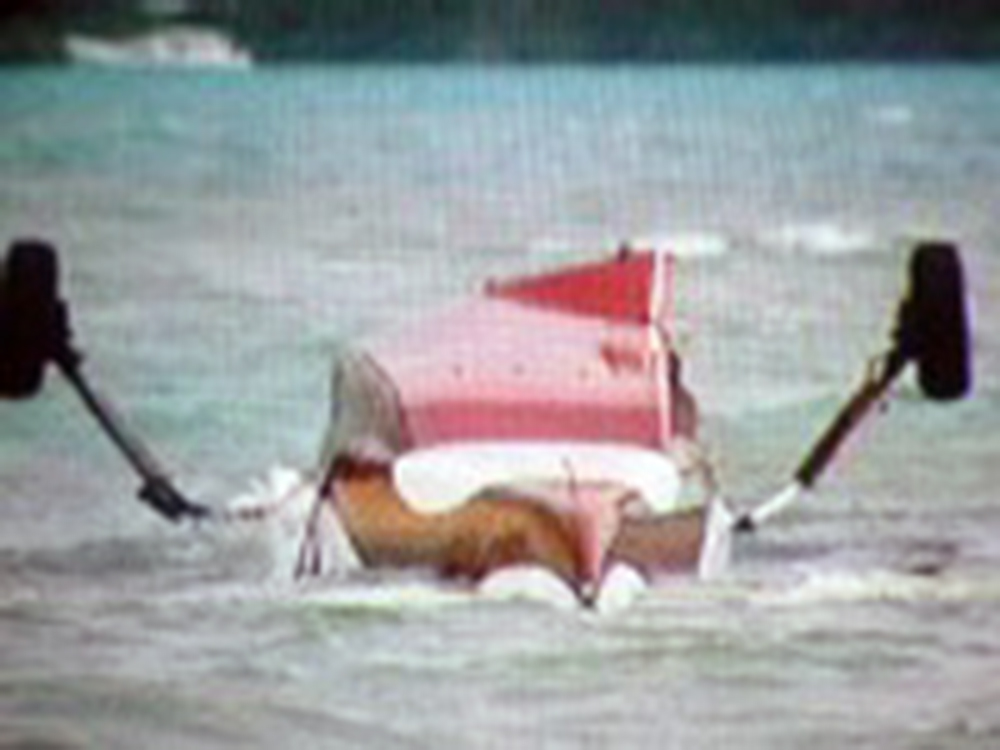
Shortly after takeoff from Belize City-Sir Barry Bowen Municipal Airport, while in initial climb, the single engine aircraft went out of control and crashed in the sea, coming to rest upside down in shallow water. All 14 occupants were rescued while the aircraft was damaged beyond repair.
Probable cause:
Loss of control during initial climb due to windshear after weather conditions suddenly changed as a thunderstorm was approaching the airport.