Crash of a Cessna 208B Grand Caravan in Alliance

Date & Time: Feb 8, 2007 at 0225 LT
Type of aircraft:
Operator:
Registration:
N1116Y
Flight Type:
Survivors:
Yes
Schedule:
Omaha - Alliance
MSN:
208-0368
YOM:
1993
Flight number:
SUB022
Crew on board:
1
Crew fatalities:
Pax on board:
0
Pax fatalities:
Other fatalities:
Total fatalities:
0
Captain / Total flying hours:
3232
Captain / Total hours on type:
226.00
Aircraft flight hours:
7248
Circumstances:
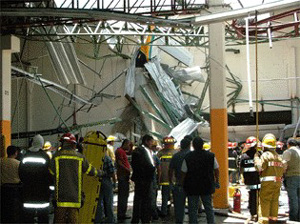
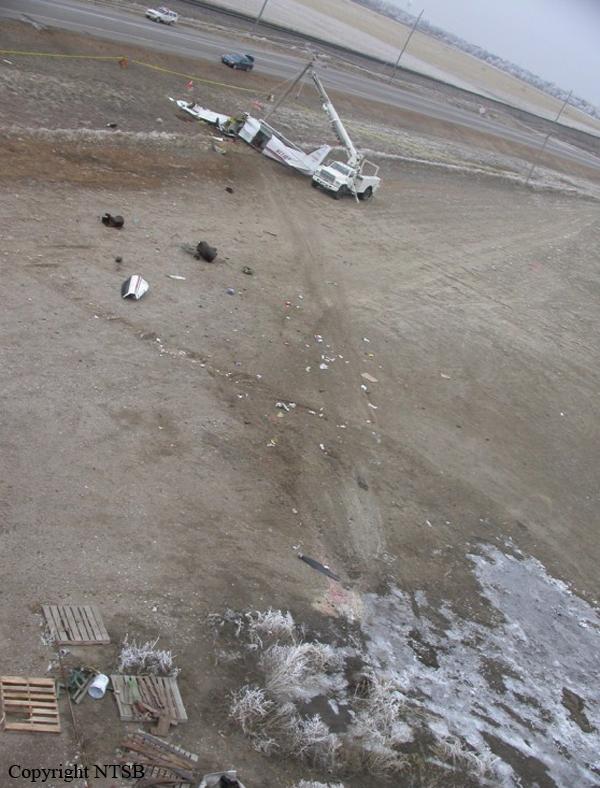
The pilot was dispatched on a nonscheduled cargo flight to an airport other than his usual destination because it had a precision instrument approach, while his usual destination airport did not. The pilot elected to fly to his usual airport, and attempted a non precision instrument approach. The airport had both a VOR and an NDB approach. The NDB approach was noted as being out of service, although there was still a radio signal coming from the navigation aid. The pilot was cleared for the VOR approach, although instrumentation inside the cockpit was found set for the NDB approach, and radar track data disclosed that the flight path was consistent with the NDB approach path, not the VOR's. The airport's reported weather was 1.25 miles visibility, with a 200-foot overcast in mist. The airport's minimum NDB approach altitude is 652 feet above touchdown height. The airplane did not reach the runway, and collided with a pole and a building. Inspection of the airplane disclosed no evidence of any preimpact mechanical malfunctions.
Probable cause:
The pilot's descent below minimum descent altitude while on a non precision approach. A contributing factor was a low ceiling.
Final Report:

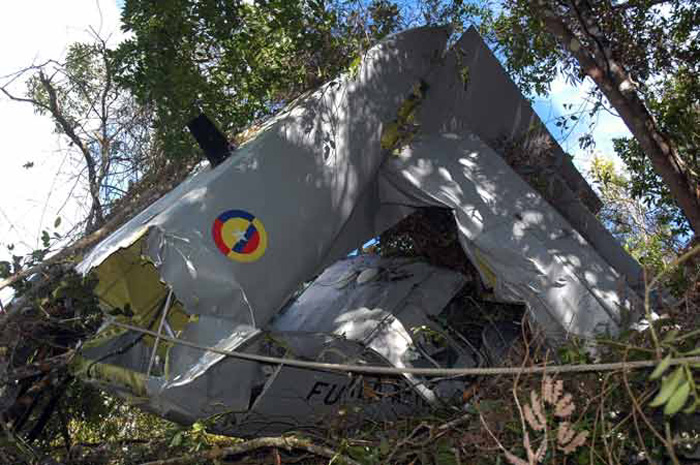
Crash of a Cessna 208B Grand Caravan near Tolemaida AFB: 3 killed

Date & Time: Nov 22, 2006 at 0720 LT
Type of aircraft:
Operator:
Registration:
FAC-5054
Flight Type:
Survivors:
No
Site:
Schedule:
Medellín - Tolemaida AFB
MSN:
208B-0285
YOM:
1991
Country:
Crew on board:
3
Crew fatalities:
Pax on board:
0
Pax fatalities:
Other fatalities:
Total fatalities:
3
Circumstances:
The single engine aircraft was on a routine flight from Medellín to Tolemaida AFB with 3 crew members on board. On approach in poor visibility (mist), the aircraft struck the slope of Mt La Siberia located few km from the airbase and was destroyed. All three occupants were killed.

Crash of a Cessna 208B Grand Caravan in Punta Pájaros

Date & Time: Oct 30, 2006 at 1430 LT
Type of aircraft:
Operator:
Registration:
XA-UBL
Survivors:
Yes
Schedule:
Cancún – Punta Pájaros
MSN:
208B-1042
YOM:
2004
Country:
Crew on board:
2
Crew fatalities:
Pax on board:
12
Pax fatalities:
Other fatalities:
Total fatalities:
0
Circumstances:
On final approach to Punta Pájaros Airport, the crew encountered poor weather conditions (stormy weather). He initiated a go-around and was trying to gain height when the single engine aircraft collided with bushes and crashed in a lagoon. All 14 occupants evacuated with minor injuries while the aircraft was damaged beyond repair. Weather conditions were marginal at the time of the accident.

Crash of a Cessna 208B Grand Caravan in Vilanculos: 1 killed

Date & Time: Jun 30, 2006 at 1900 LT
Type of aircraft:
Operator:
Registration:
ZS-POG
Survivors:
Yes
Schedule:
Polokwane – Vilanculos
MSN:
208B-0396
YOM:
1994
Country:
Region:
Crew on board:
2
Crew fatalities:
Pax on board:
1
Pax fatalities:
Other fatalities:
Total fatalities:
1
Circumstances:
The single engine aircraft departed Polokwane on a charter flight to Madagascar with an intermediate stop in Vilanculos, carrying one passenger and two pilots. On final approach to Vilanculos Airport by night, the airplane collided with two palms and crashed 2 km short of runway. All three occupants were seriously injured and the aircraft was destroyed. Few hours after the crash, one of the pilots died from his injuries.

Crash of a Cessna 208B Grand Caravan on Mt Margherita: 3 killed

Date & Time: Apr 28, 2006 at 0647 LT
Type of aircraft:
Operator:
Registration:
ZS-ADL
Flight Phase:
Flight Type:
Survivors:
No
Site:
Schedule:
Goma - Bunia
MSN:
208B-0381
YOM:
1994
Country:
Region:
Crew on board:
2
Crew fatalities:
Pax on board:
1
Pax fatalities:
Other fatalities:
Total fatalities:
3
Circumstances:
The single engine aircraft departed Goma on a humanitarian flight to Bunia, carrying one passenger, two pilots and a load consisting of 300 kilos of various goods on behalf of the World Food Programme. En route, the crew decided to follow a direct route via GPS instead of the one mentioned on the flight plan. While cruising at an altitude of 12,500 feet in poor weather conditions, the aircraft struck the slope of Mt Margherita (5,109 metres high) located in the Ruwenzori Mountain Range, western Uganda. The wreckage was found two days later and all three occupants were killed.
Probable cause:
Controlled flight into terrain after the crew failed to follow the prescribed route and executed a direct route over the mountains at an unsafe altitude in poor visibility due to weather.

Crash of a Cessna 208B Grand Caravan in Oak Glen: 2 killed

Date & Time: Mar 28, 2006 at 1655 LT
Type of aircraft:
Operator:
Registration:
N208WE
Flight Phase:
Flight Type:
Survivors:
No
Site:
Schedule:
Thermal - Ontario
MSN:
208B-1171
YOM:
2006
Crew on board:
2
Crew fatalities:
Pax on board:
0
Pax fatalities:
Other fatalities:
Total fatalities:
2
Captain / Total flying hours:
2300
Copilot / Total flying hours:
1792
Copilot / Total hours on type:
740
Aircraft flight hours:
52
Circumstances:
The airplane was operated by the manufacturer and was on a sales demonstration itinerary. On the accident flight the airplane was being repositioned following a demonstration and the two pilots included a commercially licensed manufacturer's sales pilot and a private licensed regional sales distributor. One of the two pilots onboard requested, and received, an abbreviated weather briefing prior to departure, the details of which included an airman's meteorological information notice (AIRMET) for occasional moderate rime ice. He then filed an instrument flight rules flight plan for a route passing over mountainous terrain, with a published Minimum En route Altitude (MEA) for the airway that was above the predicted icing level. The flight plan was not activated and the pilots told a TRACON controller who was providing VFR advisories that they intended to continue under visual flight rules through a mountain pass and open their IFR flight plan after reaching the other side of the pass where the MEA was lower. A review of the mode C reported altitudes flown by the pilots and an analysis of the cloud bases and tops revealed that the flight was likely in at least intermittent, if not mostly solid, instrument meteorological conditions as it flew through the pass. As the flight approached the other end of the pass, the controller advised the pilots that the radar showed they were heading into rising terrain. The controller asked, "Do you have the terrain in sight?" One of the pilots responded, "we're maneuvering away from the terrain right now." After that, radar contact was lost. Recorded radar data showed that the airplane made a righthand turn toward rising terrain while continuing to climb to an approximate altitude of 8,800 feet mean sea level (msl). The last minute of radar data showed the airplane at altitudes of 8,000 feet msl, 8,800 feet msl, and 8,600 feet msl. The last radar return was at an altitude of 7,300 feet msl. An aircraft performance study was accomplished using recorded radar data and aerodynamic data provided by Cessna. Based on the radar data and other relevant information, as the aircraft turned toward the rising terrain, the bank angle steadily increased, until a very abrupt change in pitch consistent with a stall occurred, and the airplane departed controlled flight and descended at a very steep nose down attitude into the mountainous terrain. The airplane wreckage was subsequently located at an elevation of 6,073 feet. Nearby ground witnesses first noticed the sound of the airplane, that then suddenly changed to a high pitched increasing rpm. Witnesses then saw the accident airplane coming out of the clouds almost straight nose down. The witnesses described the weather as cold with drizzling rain and reduced visibility due to the clouds. Examination of the wreckage revealed no evidence of mechanical malfunction or failure.
Probable cause:
The pilot's continued flight into instrument meteorological weather conditions and his subsequent failure to maintain an adequate airspeed while maneuvering, that led to a stall/spin.
Final Report:

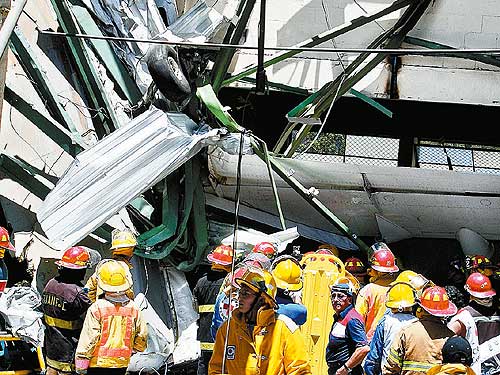
Crash of a Cessna 208B Grand Caravan in Cuenca: 5 killed

Date & Time: Mar 24, 2006 at 1102 LT
Type of aircraft:
Operator:
Registration:
HC-BXD
Flight Phase:
Survivors:
Yes
Site:
Schedule:
Cuenca – Macas
MSN:
208B-0591
YOM:
1997
Country:
Crew on board:
2
Crew fatalities:
Pax on board:
12
Pax fatalities:
Other fatalities:
Total fatalities:
5
Captain / Total flying hours:
11250
Copilot / Total flying hours:
8007
Aircraft flight hours:
5736
Aircraft flight cycles:
10332
Circumstances:
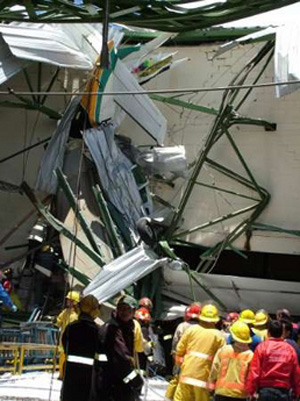
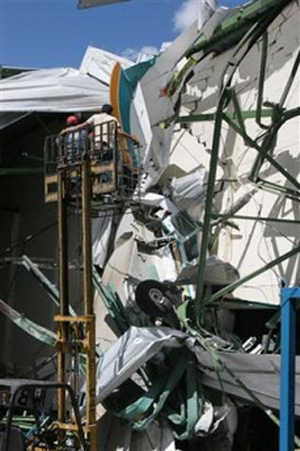
Shortly after takeoff from runway 05 at Cuenca-Mariscal La Mar Airport, while climbing to a height of 300 feet, the engine failed. The airplane lost height, causing the nose wheel to struck the roof of a building. Out of control, the aircraft crashed onto a building occupied by a rubber company. Five passengers were killed while nine other occupants were seriously injured. There were no injuries on the ground. The aircraft was destroyed.
Probable cause:
Investigations revealed that one or more blades located on the turbine compressor failed as a result of deformation due to excessive high temperatures. It was also reported that the company's maintenance failed to follow the engine maintenance program that had not been inspected in accordance with the procedures published by the engine manufacturer. The Hot Section Inspection (HSI) should be performed at 3,600 flight hours but the airplane accumulated 200 additional hours since without the required checks.
Final Report: