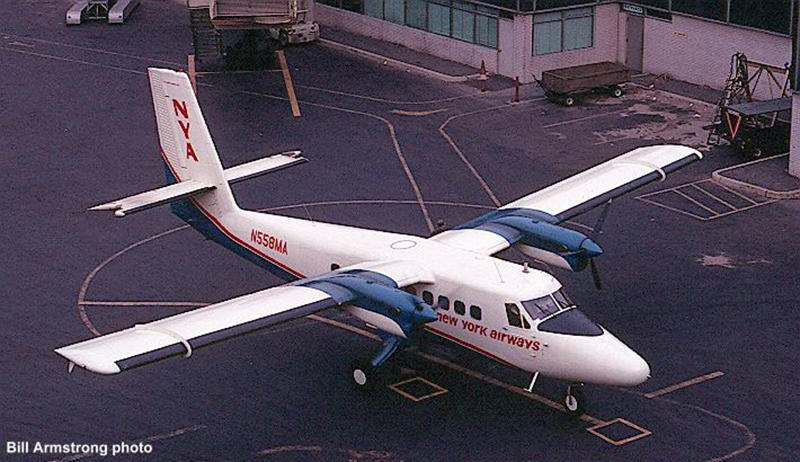
Crash of a De Havilland DHC-6 Twin Otter 200 in New York: 3 killed

Date & Time: Jul 15, 1969 at 0657 LT
Operator:

Registration:
N558MA
Flight Phase:
Survivors:
Yes
Schedule:
New York - Newark
MSN:
175
YOM:
1968
Flight number:
NY901
Crew on board:
3
Crew fatalities:
Pax on board:
11
Pax fatalities:
Other fatalities:
Total fatalities:
3
Captain / Total flying hours:
12110
Captain / Total hours on type:
180.00
Circumstances:
As the crew was 12 minutes behind the schedule, he decided to start the takeoff procedure from an intersection and the departure was precipitated despite ATC warned the crew about the recent takeoff of a Boeing 707 from the same runway. Just after liftoff, while in initial climb, the airplane became unstable then stalled and crashed. Both pilots and a passenger were killed while 11 other occupants were injured, some of them seriously.
Probable cause:
It was determined that the crew lost control of the airplane due to wake turbulences caused by a Boeing 707 that just took off from the same runway. The crew failed to consider the warning from ATC.
Final Report:

Crash of a Beechcraft Queen Air 65 in Albany: 2 killed

Date & Time: Nov 18, 1968 at 1745 LT
Type of aircraft:
Registration:
N1401M
Survivors:
Yes
MSN:
LC-73
YOM:
1961
Location:
Crew on board:
2
Crew fatalities:
Pax on board:
4
Pax fatalities:
Other fatalities:
Total fatalities:
2
Captain / Total flying hours:
8100
Captain / Total hours on type:
350.00
Circumstances:
On final approach to runway 19 at Albany Airport, the crew encountered poor visibility due to low ceiling, rain and fog. On short final, the airplane was too low and crashed into the Mohawk River located about 1,2 mile short of runway threshold. Two passengers were killed while four other occupants were injured.
Probable cause:
The accident was the result of an improper IFR operation on part of the flying crew who descended below the published approach minimums. Limited visibility due to low clouds, rain and fog was considered as a contributing factor.
Final Report:

Crash of a Beechcraft D18S in New York

Date & Time: Aug 10, 1968 at 0023 LT
Type of aircraft:
Operator:
Registration:
N7110N
Flight Phase:
Flight Type:
Survivors:
Yes
MSN:
A-524
YOM:
1950
Crew on board:
1
Crew fatalities:
Pax on board:
0
Pax fatalities:
Other fatalities:
Total fatalities:
0
Captain / Total flying hours:
11200
Captain / Total hours on type:
1015.00
Circumstances:
Just after a night liftoff at New York-JFK Airport, while in initial climb, the twin engine airplane went out of control and crashed. The pilot was slightly injured and the aircraft was destroyed.
Probable cause:
The accident was probably caused by the combination of the following factors:
- Uncontrolled descent caused by vortex turbulences,
- The pilot misjudged the distance on takeoff,
- The pilot failed to use all available runway as the takeoff was attempted from the intersection,
- Congested traffic pattern,
- The local controller warned the pilot about turbulences prior to takeoff.
Final Report:

Crash of a Beechcraft H18 in Norwich

Date & Time: Jan 12, 1968 at 0918 LT
Type of aircraft:
Operator:
Registration:
N909T
Survivors:
Yes
MSN:
BA-722
YOM:
1965
Crew on board:
2
Crew fatalities:
Pax on board:
0
Pax fatalities:
Other fatalities:
Total fatalities:
0
Captain / Total flying hours:
5500
Captain / Total hours on type:
2500.00
Circumstances:
On final approach to Norwich-Lieutenant Eaton Airport, one of the engine failed. The crew increased power on the remaining engine when the airplane stalled and crashed in an open field. Both occupants were quickly rescued while the aircraft was destroyed by a post crash fire.
Probable cause:
Improper operation of powerplant controls. The crew failed to use the anti-icing/deicing equipment while approaching the airport in icing conditions. An engine failed after encountering conditions conducive to carburetor/induction system icing. The captain attempted to restart the right engine on final approach while the copilot has no experience on aircraft. Control was lost.
Final Report:

Crash of a Boeing B-52H-175-BW Stratofortress at Griffiss AFB: 6 killed

Date & Time: Nov 2, 1967 at 0945 LT
Type of aircraft:
Operator:
Registration:
61-0030
Flight Phase:
Flight Type:
Survivors:
Yes
Schedule:
Griffiss - Griffiss
MSN:
464457
YOM:
1960
Crew on board:
8
Crew fatalities:
Pax on board:
0
Pax fatalities:
Other fatalities:
Total fatalities:
6
Circumstances:
Shortly after takeoff from Griffiss AFB, while climbing, the crew encountered technical problems with both engines number 5 & 6 which overheated. They were apparently shut down and the captain decided to return for a safe landing and was vectored for an ILS approach to runway 15. While descending to an altitude of 2,000 feet, the airplane became unstable and went out of control when two of the crew members ejected. The aircraft then crashed few miles from the airbase and was destroyed, killing all six crew members who remained on board.
Crew:
Maj Robert A. Richards, pilot, †
1st Lt William S. Fairhurst, copilot,
1st Lt Sidney W. Glover, radar navigator,
Maj Lloyd D. Lassman, radar navigator, †
Cpt Joe E. Turner, EWO, †
S/Sgt John Nealey Snyder, gunner, †
S/Sgt Willard F. Walker, crew chief, †
Sgt Gordon S. Flick, crew chief. †

Crash of a Beechcraft E18S in Johnson City: 5 killed

Date & Time: May 8, 1967 at 0714 LT
Type of aircraft:
Operator:
Registration:
N501W
Flight Phase:
Flight Type:
Survivors:
No
MSN:
BA-285
YOM:
1957
Crew on board:
1
Crew fatalities:
Pax on board:
4
Pax fatalities:
Other fatalities:
Total fatalities:
5
Captain / Total flying hours:
3527
Captain / Total hours on type:
127.00
Circumstances:
While in cruising altitude, one of the engine failed. The pilot lost control of the airplane that entered a dive, spiralled into the ground and crashed in an open field located near Johnson City. The aircraft was destroyed and all five occupants were killed. The airplane was owned by S. J. Groves.
Probable cause:
Mismanagement of fuel on part of the pilot who was inattentive to fuel supply during flight, causing a fuel starvation. His attention was diverted from operation.
Final Report:

Crash of a Beechcraft King Air A90 in Endicott: 3 killed

Date & Time: Apr 16, 1967 at 2223 LT
Type of aircraft:
Operator:
Registration:
N129GP
Survivors:
Yes
MSN:
LJ-216
YOM:
1967
Crew on board:
2
Crew fatalities:
Pax on board:
3
Pax fatalities:
Other fatalities:
Total fatalities:
3
Captain / Total flying hours:
13389
Captain / Total hours on type:
41.00
Circumstances:
The crew started the descent to Endicott-Tri Cities Airport by night and poor weather conditions consisting of fog, rain falls and low clouds. On approach, the twin engine aircraft was too low, struck tree tops and crashed few miles short of runway threshold. Both pilots and a passenger were killed while two passengers were seriously injured.
Probable cause:
Improper IFR operations on part of the flying crew who was being radar vectored to over Tri-Cities Airport but was not authorized to attempt an instrument approach. Poor weather conditions were considered as a contributing factor.
Final Report:

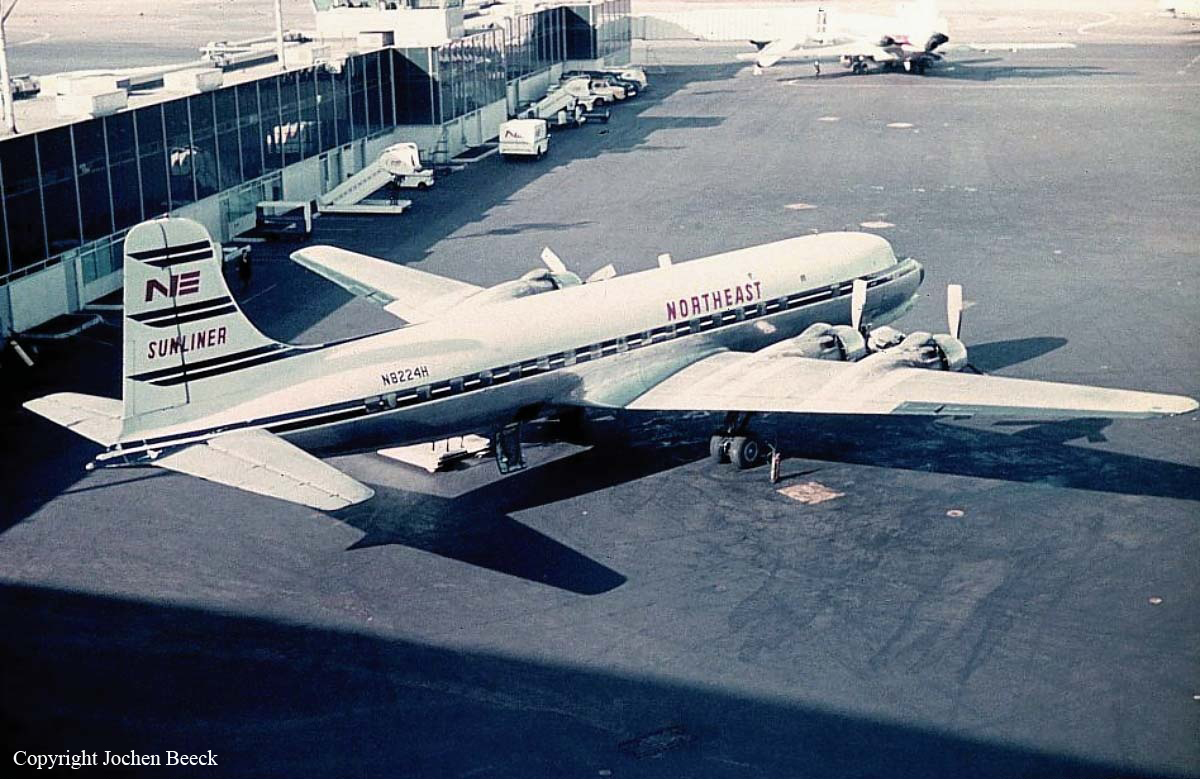
Crash of a Douglas DC-6 in New York

Date & Time: Feb 24, 1967 at 0225 LT
Type of aircraft:
Operator:
Registration:
N8224H
Flight Phase:
Survivors:
Yes
Schedule:
Philadelphia - Boston
MSN:
43741/290
YOM:
1952
Crew on board:
5
Crew fatalities:
Pax on board:
9
Pax fatalities:
Other fatalities:
Total fatalities:
0
Captain / Total flying hours:
6232
Captain / Total hours on type:
3348.00
Circumstances:
While cruising at an altitude of 15,500 feet over Holmdel, New Jersey, the aircraft suffered an explosive decompression of the cabin. A 60 by 125 inches 'panel' detached from the fuselage and struck the engine number three, causing the detachment of its propeller. The crew started an emergency descent and was able to complete an emergency landing at New York Airport. All 14 occupants were evacuated safely while the aircraft was later declared as damaged beyond repair.
Probable cause:
Fatigue fracture of the fuselage and explosive decompression caused by an inadequate maintenance and inspection on part of the ground maintenance personnel. Investigations reported that at the time of the decompression, the cabin was pressurized for 2,500 feet while the aircraft was flying at an altitude of 15,500 feet.
Final Report:

Crash of a Beechcraft Queen Air 65 in Armonk: 3 killed

Date & Time: Jan 25, 1967 at 1800 LT
Type of aircraft:
Operator:
Registration:
N345F
Flight Type:
Survivors:
No
MSN:
LC-61
YOM:
1961
Location:
Crew on board:
2
Crew fatalities:
Pax on board:
1
Pax fatalities:
Other fatalities:
Total fatalities:
3
Captain / Total flying hours:
7423
Captain / Total hours on type:
277.00
Circumstances:
The crew was completing a training mission in the region of New York State. While descending to Westchester County Airport, he encountered poor weather conditions (fog) and decided to follow a holding pattern. Few minutes later, both engines failed simultaneously. The aircraft lost height then crashed in flames in a field located in Armonk, some four miles north of Westchester County. The aircraft was destroyed and all three occupants were killed.
Probable cause:
The crew decided to approach Westchester County Airport in below-minima weather conditions and then to follow a holding pattern instead diverting to the alternate airport. The double engine failure was caused by a fuel exhaustion due to a mismanagement of fuel on part of the crew. Improper in-flight decisions, mismanagement of fuel, miscalculated fuel consumption caused a fuel exhaustion and the engine failure.
Final Report:

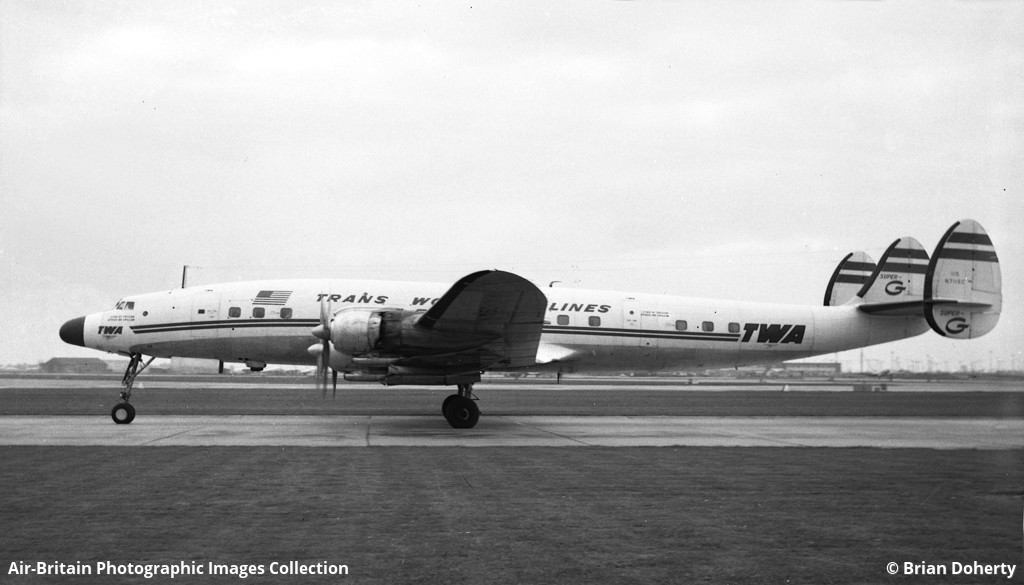
Crash of a Lockheed L-1049G Super Constellation in New York

Date & Time: Jan 26, 1966 at 2000 LT
Operator:
Registration:
N7115C
Flight Phase:
Flight Type:
Survivors:
Yes
MSN:
4596
YOM:
1955
Crew on board:
3
Crew fatalities:
Pax on board:
0
Pax fatalities:
Other fatalities:
Total fatalities:
0
Circumstances:
While rolling on a taxiway, the nose gear collapsed and the airplane sank on its belly and came to rest. All three technicians on board were uninjured while the aircraft christened 'Star of Chillon' was considered as damaged beyond repair.
Probable cause:
The nose gear collapsed during taxiing.
Final Report: