Crash of a Pilatus PC-6/B-H2 Porter in Long Tieng: 1 killed

Date & Time: May 29, 1966
Operator:
Registration:
XW-PCQ
Flight Phase:
Survivors:
No
MSN:
602
YOM:
1965
Country:
Region:
Crew on board:
1
Crew fatalities:
Pax on board:
0
Pax fatalities:
Other fatalities:
Total fatalities:
1
Circumstances:
While cruising at low height, the single engine aircraft crashed in unknown circumstances in Long Tieng, killing the pilot, sole on board.

Crash of a Fairchild C-123B-13-FA Provider near An Khe: 5 killed

Date & Time: May 17, 1966
Type of aircraft:
Operator:
Registration:
55-4534
Flight Phase:
Flight Type:
Survivors:
No
Schedule:
Nha Trang - Nha Trang
MSN:
20195
YOM:
1955
Country:
Region:
Crew on board:
5
Crew fatalities:
Pax on board:
0
Pax fatalities:
Other fatalities:
Total fatalities:
5
Circumstances:
The crew departed Nha Trang Airport for a night time mission to drop flares over friendly positions. While flying at an altitude of 6,500 feet, the airplane was shot down by enemy fire. The crew attempted to divert to the nearest suitable terrain when control was lost. The airplane crashed in flames, killing all five occupants.
Crew:
Cpt Stanley Gilbert Cox,
1st Lt Albert Richard Wilson,
M/Sgt Raymond Charles Jajtner,
A1C William John Moore,
A1C Jerry Mack Wall.
Probable cause:
Shot down by enemy fire.

Crash of a Douglas AC-47D Spooky near Ban Hai: 8 killed

Date & Time: May 15, 1966
Operator:
Registration:
43-49546
Flight Phase:
Survivors:
No
Schedule:
Ubon Ratchathani - Ubon Ratchathani
MSN:
15362/26807
YOM:
1944
Flight number:
Spooky 10
Country:
Region:
Crew on board:
8
Crew fatalities:
Pax on board:
0
Pax fatalities:
Other fatalities:
Total fatalities:
8
Circumstances:
The crew departed Ubon Ratchathani Airbase in Thailand on a reconnaissance mission over Laos under call sign 'Spooky 10'. While cruising at low height, the airplane was shot down by enemy fire and crashed in an isolated area located in the region of Ban Hai. Due to the situation, it was not possible to dispatch rescue teams and the wreckage was eventually found in August 1994 about 16 km southeast of Ban Hai.
Crew:
Maj George William Jensen,
Maj Lavern George Reilly,
Cpt Marshall Landis Tapp,
1st Lt George Winton Thompson,
S/Sgt James Arthur Preston,
Sgt James ellis Williams,
Sgt William Louis Madison,
A1C Kenneth Dewey McKenney.
Probable cause:
Shot down by enemy fire.

Crash of a Rockwell Aero Commander 500B in Brighton: 2 killed

Date & Time: May 14, 1966 at 1817 LT
Operator:
Registration:
N6227X
Flight Phase:
Flight Type:
Survivors:
No
Schedule:
Denver - Denver
Crew on board:
2
Crew fatalities:
Pax on board:
0
Pax fatalities:
Other fatalities:
Total fatalities:
2
Captain / Total flying hours:
11558
Captain / Total hours on type:
1135.00
Circumstances:
The crew departed Denver-Stapleton on a local training mission for practicing stalls, single engine and emergency procedures. While in cruising altitude, the aircraft went out of control, entered a dive and crashed in a huge explosion near Brighton. The airplane was destroyed and both pilots were killed.
Probable cause:
The crew failed to maintain flying speed and exercised poor judgment. The crew also attempted operation with known deficiencies in equipment, the aircraft did not have dual flight controls.
Final Report:

Crash of a Lockheed PV-2 Harpoon in Niassa Province

Date & Time: May 12, 1966
Type of aircraft:
Operator:
Registration:
4610
Flight Phase:
Flight Type:
Survivors:
Yes
MSN:
15-1408
YOM:
1944
Country:
Region:
Crew on board:
0
Crew fatalities:
Pax on board:
0
Pax fatalities:
Other fatalities:
Total fatalities:
0
Circumstances:
The crew encountered an unexpected situation and was forced to attempt an emergency landing in the Niassa Province. There were no injuries but the aircraft was not repairable.

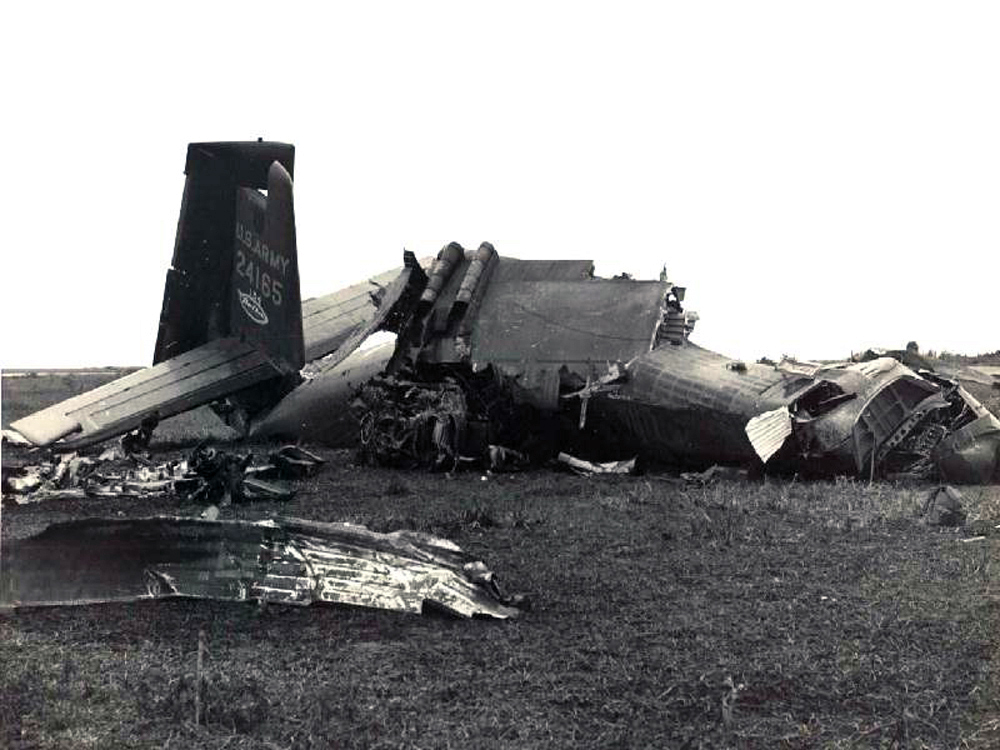
Crash of a De Havilland CV-2B Caribou in Cai Cai: 2 killed

Date & Time: May 10, 1966
Type of aircraft:
Operator:
Registration:
62-4165
Flight Phase:
Flight Type:
Survivors:
Yes
MSN:
103
YOM:
1963
Country:
Region:
Crew on board:
4
Crew fatalities:
Pax on board:
0
Pax fatalities:
Other fatalities:
Total fatalities:
2
Circumstances:
The crew was engaged in a supply mission near the Cai Cai Camp. While dropping a load of rice, a rice bag became stuck outside the airplane. Control was lost and the aircraft crashed in an open field. Two crew members were killed while two others were injured.

Crash of a Lockheed L-749A Constellation near Tomas: 49 killed

Date & Time: Apr 27, 1966 at 0805 LT
Operator:

Registration:
OB-R-771
Flight Phase:
Survivors:
No
Site:
Schedule:
Lima - Cuzco
MSN:
2521
YOM:
1947
Flight number:
LP501
Location:
Country:
Crew on board:
6
Crew fatalities:
Pax on board:
43
Pax fatalities:
Other fatalities:
Total fatalities:
49
Captain / Total flying hours:
14684
Captain / Total hours on type:
1692.00
Copilot / Total flying hours:
963
Copilot / Total hours on type:
875
Aircraft flight hours:
47899
Circumstances:
Flight 501 was a scheduled domestic flight from Lima to Cuzco. It was instructed to take-off from runway 15 and to climb in accordance with No. 2 standard climb procedure, described as follows in the airline's route guide: climb on a heading of 190° until 9 NM southwest of the airport, then on a heading of 120°. The flight took off from Lima-Callao-Jorge Chavez International Airport at 0740LT, 10 minutes after the take-off time indicated on the flight plan. At 0757 hours it contacted Lima radio on the route frequency, 126.9 MCIS, and reported: "Departed Lima- Callao at 1240Z, climbing, estimating Ayacucho at 1337Z. It This was the last message from the aircraft, although Lima and Cuzco repeatedly called the aircraft around 0840 hours. One witness from "Tres Cruces" and two witnesses from the village of San Pedro de Pilas testified that their attention was attracted between 0800 and 0805 hours by an aircraft flying unusually low over San Pedro de Pilas or Tamard; one of the witnesses stated that he had been able to read the "LANSA" inscription on the aircraft. They had heard on several occasions aircraft flying over the area, but these were always seen at much higher altitudes. They all concurred that the aircraft was following the gap between San Pedro de Pilas and Tamard and was flying toward the mountain range below the level of the peaks. The two witnesses from San Pedro de Pilas pointed out positions on the Huamantanga peak where they observed the aircraft evading the mountain by a slight turn to .the left and entering the gap towards the east. They did not see any smoke or signs of fire and one indicated that he was positive that all four engines were operating at the time. The wreckage of the aircraft was located on 28 April on the southeast slopes of Mount Talaula at an elevation of 12 600 ft, 61 NM from Lima-Callao Airport and 29 NM north of the normal route. All 49 occupants have been killed.
Probable cause:
The Commission considered that the probable cause of the accident was pilot error in that he:
a) Incorrectly selected the route to be flown in violation of the provisions established by the Airline for operation of flight 501;
b) Incorrectly calculated the climb performance of the aircraft in relation to its total weight of takeoff. This aircraft type, with a gross takeoff weight of 90,572 lb can't within the 25 minutes of flight after takeoff attain the altitude required to fly over the peaks of the Cordillera which are encountered over the distance that can be covered in the above-indicated time along the route followed by the aircraft. Under such conditions the operation can be performed only by flying the aircraft. Under such conditions the operation can be performed only by flying the aircraft at lower levels between the mountains, in violation of the most elementary principles of flight safety;
c) Erroneously estimated the elevation of the nearby peaks he had to clear along the route. The Commission considered that the critical moment of decision came in the area of the towns of Tamara and Pilas which are separated by a gap running into the Cordillera and joining in the same area another wide gap into which flows the Rio Omas and which leads to the coastal town of Asia. At this point the pilot could still have flown out to the east but this would have entailed continuing on this course, then turning to avoid Mount Huamantanga (12 600 feet), since he was flying below the elevation of the mountain so as to enter the gap and follow it up to the Cordillera even though it would have been flying below the elevation of surrounding peaks. The Tamara and Pilas gap, the entrance to which is in the area of the above mentioned villages, at a rather low elevation, is about 5 nm wide along its entire length up to the Cordillera, rises very steeply until it reaches elevations of more than 14 000 feet, which could not be cleared by the subject aircraft, considering its weight, the climb characteristics of the aircraft, the time to fly the 5nm length of the gap and the altitude of the aircraft when it entered the gap;
d) In view of the flight experience of the pilot in command, who had completed 112 flights on the 501-502 route, one can only surmise that his judgment was affected by insufficient rest and his particular state of mind as a result of his assignment to perform the flight for which he was not rostered. He may have been further influenced in the selection of the direct route by the perfect weather conditions obtaining at the time;
e) Finally, although there was no evidence of any mechanical failure the Commission could not definitely rule out the possibility of some 'undetermined' factor during the two minutes if flight from San Pedro de Pilas to the point of impact inside the gap. If such was the case, this would have only aggravated the situation, since it was considered that after having entered the Tamara-Pilas gap, the aircraft could not have been cleared the peaks along the route nor come back. In view of this circumstance, it was considered that an 'undetermined factor did not necessarily cause the accident.
Final Report:


Crash of a Pilatus PC-6/340-H2 Porter in Castelnuovo di Ceva: 8 killed

Date & Time: Apr 25, 1966 at 1830 LT
Operator:
Registration:
I-CONA
Flight Phase:
Survivors:
No
Site:
Schedule:
Albenga - Aosta
MSN:
537
YOM:
1962
Country:
Region:
Crew on board:
1
Crew fatalities:
Pax on board:
7
Pax fatalities:
Other fatalities:
Total fatalities:
8
Circumstances:
The single engine aircraft departed Albenga Airport at the end of the afternoon on a return flight to Aosta, carrying seven passengers and the pilot, the Italian politician Corrado Gex. While approaching Castelnuovo di Ceva, weather conditions worsened and the visibility was limited due to low clouds. While cruising at low height, the airplane struck trees and crashed onto a hill, killing all eight occupants.

Crash of a PZL-Mielec AN-2R near Labinsk:3 killed

Date & Time: Apr 23, 1966 at 1848 LT
Type of aircraft:
Operator:
Registration:
CCCP-02807
Flight Phase:
Survivors:
No
Schedule:
Labinsk - Labinsk
MSN:
1G54-12
YOM:
1965
Country:
Region:
Crew on board:
2
Crew fatalities:
Pax on board:
1
Pax fatalities:
Other fatalities:
Total fatalities:
3
Aircraft flight hours:
1041
Circumstances:
The crew was engaged in a crop spraying mission for a local sovkhoz located about 12 km east of the city of Labinsk. While cruising at low height, the pilot-in-command made a sharp turn when control was lost. The aircraft banked to a 50-60° angle then crashed in an open field. Both pilots and the sole passenger (an aircraft mechanic) were killed.
Probable cause:
It was determined that the loss of control was caused by the fact that the pilot-in-command attempted to make a sharp turn at low height at an angle of minimum 45° which is prohibited as the procedure allows a max angle of 30°. It is believed the crew was distracted at the time of the loss of control.