Crash of a Beechcraft AT-11 Kansan in Midland

Date & Time: Mar 11, 1944
Type of aircraft:
Operator:
Registration:
41-27495
Flight Type:
Survivors:
Yes
Schedule:
Midland - Midland
MSN:
1340
YOM:
1942
Location:
Crew on board:
3
Crew fatalities:
Pax on board:
0
Pax fatalities:
Other fatalities:
Total fatalities:
0
Circumstances:
Belly landed for unknown reason. No casualties.

Crash of a Douglas C-47A-75-DL in Axford: 2 killed

Date & Time: Mar 11, 1944
Operator:
Registration:
42-100877
Flight Phase:
Flight Type:
Survivors:
Yes
MSN:
19340
Region:
Crew on board:
2
Crew fatalities:
Pax on board:
1
Pax fatalities:
Other fatalities:
Total fatalities:
2
Circumstances:
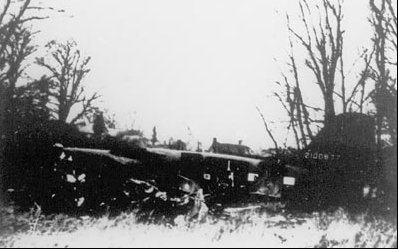
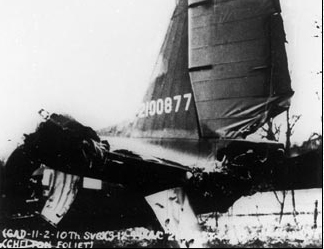
On the morning of Saturday 11th March 1944, during a routine glider tow training mission, a Horsa glider (LG891) became detached from its tow plane and landed in a large ploughed field just north of the small village of Axford. The pilot of the C-47 tow plane, Major Donald Bradley (who was also commanding officer of the 83rd Troop Carrier Squadron), inspected the field and decided that it would be possible to pull the glider out. He flew the short distance back to Ramsbury airfield, the squadron's home station, and picked up a new towrope. During the afternoon of the same day he returned to the field. Flying with him was 1st. Lt. Gaylord Strong, co-pilot; Captain Lee Gillette, 83rd Squadron Flight Surgeon; S/Sgt. Charles Dudenhoef, Crew Chief, and Lieutenant's Kenneth Weber and Robert Frank who were to act as the glider's pilot and co-pilot respectively. After flying low over the field several times Major Bradley landed the plane without difficulty and attached the new towrope. Meanwhile ‘Doc’ Gillette stationed an ambulance at the southern end of the field. The field was only 2,600 feet in length, it had been recently ploughed and chain harrowed and sloped in a southerly direction towards the valley floor. A road and an electric power line ran along its southern boundary and, at the time of take off, there was a 20 mph tail wind! There followed a lengthy discussion between the men present as to the feasibility of pulling the glider out of the field. Despite doubts expressed by others Major Bradley was confident that the task could be easily accomplished. The crew chief was given the option of remaining on the ground, which he chose, and his place in the aircraft was taken by Captain Gillette. All three men then clambered aboard the C-47 aircraft, Major Bradley sat in the left-hand cockpit seat, Lt. Strong on his right and ‘Doc’ Gillette below the Astral Dome. Both the glider pilots had installed themselves in the Horsa and were awaiting the signal to go. The brakes on the C-47 were released and the plane slowly picked up speed. As it became airborne Major Bradley realized that he was not going to clear the power cables and pulled back on the stick, causing the tail wheel to dig into the field. The plane then stalled before pitching into the ground, eventually coming to a rest in the River Kennet. The fuselage had broken in two and was facing in the direction from which it had come. Fortunately there was no fire. The glider pilot, although unable to see the tow aircraft through a cloud of dust, saw the flash of sparks as the C-47 hit the power cables and cut loose, before gliding across the valley to another field for a safe landing. Major Bradley suffered serious head injuries and died one hour later. Lt. Strong was also badly injured and died two days later in Burdrop hospital near Swindon. ‘Doc’ Gillette suffered severe damage to his back and was hospitalized for over a month, but eventually returned to his duties and remained with the group until the end of the war.
Source: http://www.ramsburyatwar.com/crashes/c47axford.htm
Probable cause:
The crash committee, consisting of Major Lucion Powell, Major Albert Bivings and Captain Richard Cathcart, concluded that Major Bradley was fully responsible for the accident. They said that despite his length of flying experience and his familiarity with glider operations, he exercised very poor judgement in trying to take off downwind with a glider in tow from a field of inadequate length with obstructions at the end.


Crash of a Douglas C-47A-80-DL in Stuart: 5 killed

Date & Time: Mar 11, 1944
Operator:
Registration:
43-15181
Flight Phase:
Flight Type:
Survivors:
No
Schedule:
Fort Wayne - Morrison AFB
MSN:
19647
YOM:
1944
Crew on board:
4
Crew fatalities:
Pax on board:
1
Pax fatalities:
Other fatalities:
Total fatalities:
5
Circumstances:
Crew was performing a flight from Fort Wayne, Indiana, to the Morrison AFB located near West Palm Beach. While cruising in poor weather conditions in the region of Stuart, the aircraft went out of control and dove into the ground, killing all five occupants.

Crash of a Noorduyn Norseman near Wrigley

Date & Time: Mar 10, 1944
Type of aircraft:
Operator:
Registration:
43-5144
Flight Phase:
Flight Type:
MSN:
135
YOM:
1943
Country:
Crew on board:
0
Crew fatalities:
Pax on board:
0
Pax fatalities:
Other fatalities:
Total fatalities:
0
Circumstances:
En route, the engine failed, forcing the crew to attempt an emergency landing some 72 km north of Wrigley. The crew fate is unknown while the aircraft was damaged beyond repair.
Probable cause:
Engine failure.

Crash of a Douglas C-39 in Molesworth

Date & Time: Mar 9, 1944
Type of aircraft:
Operator:
Registration:
VH-CCF
Flight Phase:
Flight Type:
Survivors:
Yes
MSN:
2087
YOM:
1939
Country:
Region:
Crew on board:
3
Crew fatalities:
Pax on board:
14
Pax fatalities:
Other fatalities:
Total fatalities:
0
Circumstances:
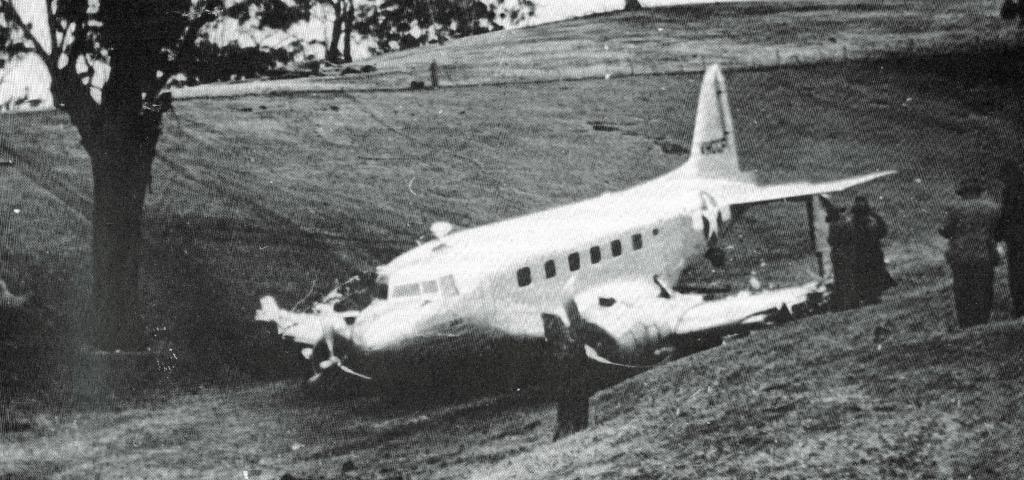
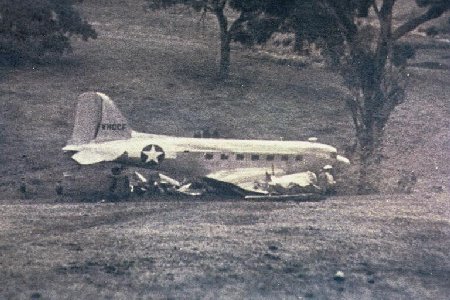
En route, crew encountered icing conditions and both engines did not run properly as the carburetor were iced. Captain decided to make an emergency landing when the aircraft hit trees and crashed in a farm land. All 17 occupants were able to evacuated themselves and nobody was hurt. However, the aircraft was damaged beyond repair.
Probable cause:
Engine dysfunction caused by carburetor icing.

Crash of a Martin B-26B-50-MA Marauder in Theydon Mount: 6 killed

Date & Time: Mar 8, 1944
Type of aircraft:
Operator:
Registration:
42-95925
Flight Phase:
Flight Type:
Region:
Crew on board:
6
Crew fatalities:
Pax on board:
0
Pax fatalities:
Other fatalities:
Total fatalities:
6
Circumstances:
The twin engine bomber registered 42-95925 was carrying a crew of six on behalf of the 344th Bomb Group, 494th Bomb Squadron. While flying over Essex, it collided with another Martin B-26B-50-MA Marauder registered 42-95981 from the same BG and carrying a crew of six as well. The exact circumstances of the collision remains unknown and both aircraft dove into the ground and crashed in an open field located in Theydon Mount. All 12 occupants on both aircraft were killed.
Crew:
Captain Jack W. Miller, pilot,
2nd Lieutenant Linwood G. Brooks, copilot,
1st Lieutenant James A. Hudson, bombardier,
Staff Sergeant Abraham B. Butler Jr, engineer & gunner,
Staff Sergeant George D. McMannamy, radio & gunner,
Staff Sergeant W. J. Summers, armourer & gunner.

Crash of a Douglas C-47A-75-DL near Portadown

Date & Time: Mar 8, 1944
Operator:
Registration:
42-100924
Flight Phase:
Flight Type:
Survivors:
Yes
MSN:
19387
Region:
Crew on board:
0
Crew fatalities:
Pax on board:
0
Pax fatalities:
Other fatalities:
Total fatalities:
0
Circumstances:
En route, the crew was forced to attempt an emergency landing following a dual engine failure. Aircraft crash landed in a prairie located 8 km south of Portadown and was damaged beyond repair. No casualties.
Probable cause:
Double engine failure caused by a fuel exhaustion.

Crash of a Martin B-26B-50-MA Marauder in Theydon Mount: 6 killed

Date & Time: Mar 8, 1944
Type of aircraft:
Operator:
Registration:
42-95981
Flight Phase:
Flight Type:
Survivors:
No
Region:
Crew on board:
6
Crew fatalities:
Pax on board:
0
Pax fatalities:
Other fatalities:
Total fatalities:
6
Circumstances:
The twin engine bomber registered 42-95981 was carrying a crew of six on behalf of the 344th Bomb Group, 494th Bomb Squadron. While flying over Essex, it collided with another Martin B-26B-50-MA Marauder registered 42-95925 from the same BG and carrying a crew of six as well. The exact circumstances of the collision remains unknown and both aircraft dove into the ground and crashed in an open field located in Theydon Mount. All 12 occupants on both aircraft were killed.
Crew:
1st Lieutenant John K. Eckert, pilot,
2nd Lieutenant Thomas W. Worrell, copilot,
1st Lieutenant George E. Bair, bombardier,
Staff Sergeant Alfred R. Border, engineer & gunner,
Staff Sergeant Lewis O.Thompson, radio & gunner.
Staff Sergeant Edward J. Powell, armourer & gunner.