Crash of a Lockheed PV-2D Harpoon in Addison

Date & Time: Apr 28, 1975 at 1534 LT
Type of aircraft:
Registration:
N230Z
Flight Type:
Survivors:
Yes
Schedule:
Addison - Addison
MSN:
15-1603
YOM:
1945
Location:
Crew on board:
2
Crew fatalities:
Pax on board:
0
Pax fatalities:
Other fatalities:
Total fatalities:
0
Captain / Total flying hours:
2178
Captain / Total hours on type:
199.00
Circumstances:
Following a fire control mission, the crew was returning to Addison Airport. On final approach, a malfunction on the left engine forced the crew to feather its propeller when control was lost. The airplane banked left and crashed about 300 yards short of runway threshold. Both pilots were injured while the aircraft was destroyed.
Probable cause:
Stalled on final approach after the crew failed to follow the approved procedures and failed to maintain flying speed. The following contributing factors were reported:
- Poorly planned approach,
- The pilot feathered the left propeller due to low level engine oil, proved to be erroneous.
Final Report:


Crash of a Beechcraft A100 King Air in Hilton Head: 6 killed

Date & Time: Apr 26, 1975 at 2055 LT
Type of aircraft:
Registration:
N700SP
Flight Phase:
Survivors:
Yes
Schedule:
Savannah - Hilton Head - Jackson
MSN:
B-92
YOM:
1972
Crew on board:
1
Crew fatalities:
Pax on board:
8
Pax fatalities:
Other fatalities:
Total fatalities:
6
Captain / Total flying hours:
15657
Captain / Total hours on type:
549.00
Circumstances:
The aircraft was ferried from Savannah, Georgia, to Hilton Head Island, South Carolina, for a corporate flight to Jackson, Mississippi. The aircraft was owned and operated by Stribling-Puckett, Inc. The flight to Hilton Head Island was completed without incident. The pilot of N700SP loaded the passenger baggage; a witness to the loading indicated that the pilot loaded the baggage carefully in the baggage compartment in the aft end of the cabin. At 21:45, the eight passengers boarded the aircraft with one passenger seated in the copilot's seat. The engines were started and the aircraft was taxied to runway 3 for takeoff. The aircraft was taxied onto the 300-foot overrun on the south end of the runway, turned 180° on the runway, and made a "running" takeoff. Two pilots, one inside the terminal and another outside, stated that they did not believe the engines were developing full power during the takeoff. However, there were no unusual sounds, and the engines were operating "smoothly." Both of these pilots believed that the takeoff run was excessively long. The aircraft used about 3,900 feet of pavement to takeoff including most of the 300-foot overrun where the takeoff began. After takeoff, the aircraft was leveled off and was flown straight and level for about 1,200 feet. There it struck the top of a tree which was 40 to 50 feet above the ground. After impact with the trees, the aircraft continued 1,200 to 1,300 feet and struck several other trees before it came to rest right side up. Fire erupted some distance behind the aircraft, but progressed toward the aircraft slowly. The slow progression of the fire allowed the three survivors time to escape through a hole in the left front side of the fuselage. Roger W. Stribling, Jr., Vice President of the Stribling-Puckett, Inc, was killed in the crash. Company President Ben Puckett suffered a broken back in the accident.
Those killed were:
Roger Stribling Jr.,
Max Williams,
Henry Clements,
Clark Boyce Sr.,
Eddie Stanton,
Gordon Ellison.
Probable cause:
The failure of the pilot to maintain a positive rate of climb after a takeoff toward an unlighted area in night, visual meteorological conditions. The failure to maintain a positive rate of climb resulted in a collision with trees in the departure path. An overweight condition of the aircraft may have contributed to the pilot's actions. Investigation showed that the aircraft would have been 436 lbs over the maximum gross takeoff weight, with the center of gravity near the aft limit.
Final Report:

Crash of a Beechcraft U-21A Ute in Fort Stockton: 5 killed

Date & Time: Apr 26, 1975 at 1800 LT
Type of aircraft:
Operator:
Registration:
66-18039
Flight Phase:
Flight Type:
Survivors:
No
Schedule:
Fort Stockton - Ford Hood
MSN:
LM-40
YOM:
1967
Crew on board:
2
Crew fatalities:
Pax on board:
3
Pax fatalities:
Other fatalities:
Total fatalities:
5
Circumstances:
Shortly after takeoff from Fort Stockton Airport, while in initial climb, the airplane bank left then rolled inverted and crashed in flames about half a mile past the runway end. The aircraft was destroyed and all five occupants were killed.
Probable cause:
Loss of control during initial climb following a loss of power on the left engine for undetermined reason.

Crash of a Britten-Norman BN-2A Islander in Tin City

Date & Time: Apr 24, 1975 at 1220 LT
Type of aircraft:
Operator:
Registration:
N591JA
Survivors:
Yes
Schedule:
Nome - Little Diomede Island - Tin City
MSN:
57
YOM:
1969
Location:
Crew on board:
1
Crew fatalities:
Pax on board:
1
Pax fatalities:
Other fatalities:
Total fatalities:
0
Captain / Total flying hours:
1243
Captain / Total hours on type:
284.00
Circumstances:
On final approach to Tin City Airport, the pilot failed to realize his altitude was too low when the airplane struck the ground short of runway threshold and crashed into the snow. The aircraft was damaged beyond repair and both occupants were uninjured. At the time of the accident, weather conditions were marginal with downdrafts and wind gusting to 30 knots.
Probable cause:
Controlled flight into terrain on final approach after the pilot misjudged distance and altitude. The following contributing factors were reported:
- Continued VFR flight into adverse weather conditions,
- Delayed in initiating go-around,
- Downdrafts,
- Snow,
- High obstructions,
- Weather conditions below minimums,
- Hit steep bluff short of runway,
- Downdrafts,
- Wind gusting to 30 knots.
Final Report:

Crash of a Beechcraft C90 King Air in Grand Rapids: 1 killed

Date & Time: Apr 18, 1975 at 0033 LT
Type of aircraft:
Registration:
N4146S
Survivors:
Yes
Schedule:
Blaine - Grand Rapids
MSN:
LJ-646
YOM:
1974
Crew on board:
1
Crew fatalities:
Pax on board:
1
Pax fatalities:
Other fatalities:
Total fatalities:
1
Captain / Total flying hours:
5411
Captain / Total hours on type:
195.00
Circumstances:
On final approach to Grand Rapids-Itasca County by night, the pilot passed below the minimum descent altitude when the twin engine airplane struck tree tops and crashed in flames in a wooded area located about 1-1,5 mile short of runway. The aircraft was destroyed, the passenger was killed and the pilot was seriously injured.
Probable cause:
Improper IFR operation from the pilot who failed to follow the approved procedures. The following contributing factors were reported:
- Low ceiling,
- Fog,
- Weather below minimums,
- The pilot descended below MDA.
Final Report:

Crash of a Swearingen SA226AT Merlin IV/Ain North Carolina: 2 killed

Date & Time: Apr 14, 1975 at 2205 LT
Operator:
Registration:
N960M
Survivors:
No
Schedule:
Flushing - Southern Pines
MSN:
AT-005
YOM:
1972
Crew on board:
2
Crew fatalities:
Pax on board:
0
Pax fatalities:
Other fatalities:
Total fatalities:
2
Captain / Total flying hours:
18000
Captain / Total hours on type:
493.00
Circumstances:
On approach to Southern Pines-Moore County Airport, the captain informed ground he would complete a visual approach to runway 05. On short final, the airplane struck tree tops and crashed half a mile short of runway threshold. The aircraft was destroyed and both crew members were killed. At the time of the accident, the visibility was limited due to the night, low ceiling, raing and localised patches of fog.
Probable cause:
The accident occurred after the pilot-in-command suffered a spatial disorientation. The following contributing factors were reported:
- Low ceiling,
- Rain,
- Fog.
Final Report:

Crash of a Beechcraft E18S near Argos: 1 killed

Date & Time: Apr 1, 1975 at 0130 LT
Type of aircraft:
Operator:
Registration:
N140J
Flight Phase:
Flight Type:
Survivors:
No
Schedule:
Indianapolis - South Bend
MSN:
BA-334
YOM:
1958
Location:
Crew on board:
1
Crew fatalities:
Pax fatalities:
Other fatalities:
Total fatalities:
1
Captain / Total flying hours:
7000
Captain / Total hours on type:
5000.00
Circumstances:
While in cruising altitude on a cargo flight from Indianapolis to South Bend, the pilot contacted ATC and reported a fire in the cabin. He reduced his altitude when few minutes later, the twin engine airplane struck tree tops and crashed in flames in a wooded area located in the region of Argos. The airplane was destroyed and the pilot, sole on board, was killed.
Probable cause:
In-flight fire for undetermined reason. The following findings were reported:
- Fire in cabin, cockpit, baggage compartment,
- High obstructions.
Final Report:

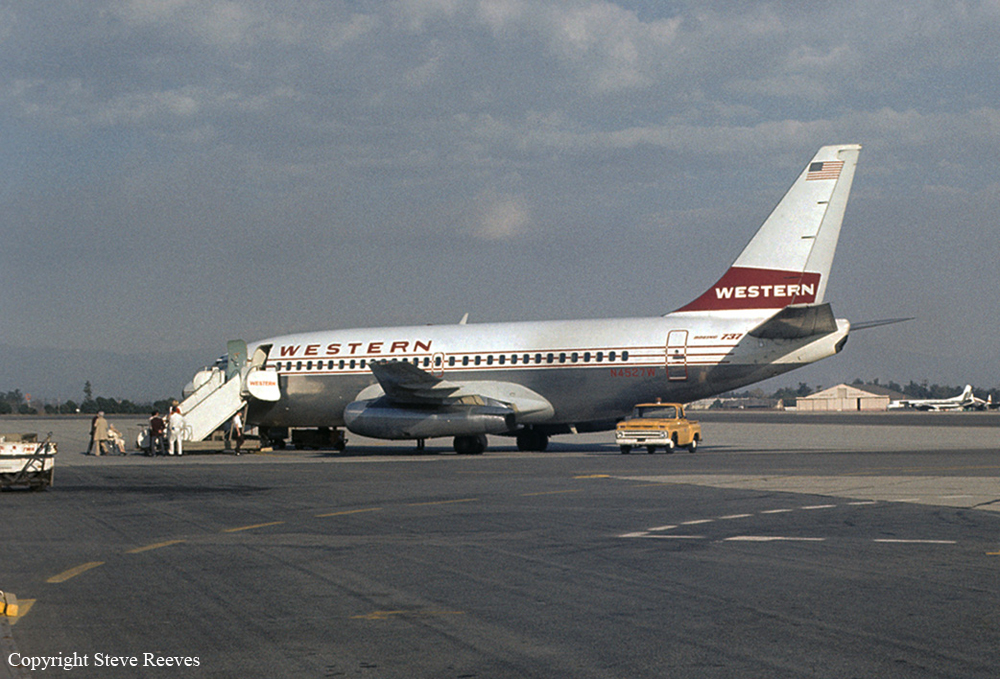
Crash of a Boeing 737-247 in Casper

Date & Time: Mar 31, 1975 at 0743 LT
Type of aircraft:
Operator:
Registration:
N4527W
Survivors:
Yes
Schedule:
Denver - Casper - Minneapolis
MSN:
20131/165
YOM:
1969
Flight number:
WA470
Crew on board:
6
Crew fatalities:
Pax on board:
93
Pax fatalities:
Other fatalities:
Total fatalities:
0
Captain / Total flying hours:
6698
Captain / Total hours on type:
2000.00
Copilot / Total flying hours:
8900
Copilot / Total hours on type:
2000
Aircraft flight hours:
14076
Circumstances:
Western Air Lines flight 470 to Casper and Minneapolis departed Denver at 07:03 in the morning. The airplane, on an IFR flight plan, climbed to its cruising altitude of FL220. At 07:36, following a descent to 12,000 feet, the flight crew contacted Casper approach control and advised that the flight was about 12 miles south of the Evansville Intersection. At that time, the controller cleared the flight to use the localizer back course approach for runway 25, to circle to runway 3, or to land straight in. The weather reported to the crew indicated poor visibility with light snow falling and wind 040° at 9 knots. One minute later, the approach controller advised that "runway 7/25 has been plowed. There's about a 1/4-inch of powder snow on it. Braking action reported, Convair 580, as poor. Runway 3/21 is being plowed at this time." At 07:51, Flight 470 reported at the Henning Intersection and was cleared to contact the Casper Tower. The tower controller cleared the flight to land on runway 25 and gave the wind as 030° at 8 knots. The flight was also advised by the controller that a disabled snow blower was "just west of the intersection runway 21, left side runway 25, on the edge ...." At 07:41:42, the first officer called out "thousand to go to the field." At 07:42:09, the first officer called "approaching minimums," and 12 seconds later, he called "just about at minimums." The aircraft then flew level for a few moments a t the minimum descent altitude (MDA). At 07:42:25, the first officer called the runway in sight directly below the aircraft. At that time airspeed was 150 knots and the flaps were at 25°. The first office then set the flaps at 30° as the captain initiated the final descent. The aircraft crossed the threshold at reference speed +15 knots. The aircraft touched down 2,375 feet from the departure end of the runway, about 6,306 feet from the approach end of the runway. The aircraft went off the departure end of the runway to the right of the centerline. After striking several metal stanchions in the first row of terminal bar lights, which were located 200 feet off the end of the runway, the aircraft struck a shallow irrigation ditch 280 feet off the runway end. The aircraft veered farther to the right and stopped about 800 feet beyond the departure end of the runway.
Probable cause:
The failure of the pilot-in-command to exercise good judgment when he failed to execute a missed approach and continued a non-precision approach to a landing without adequately assessing the aircraft's position relative to the runway threshold. Contributing to the accident were the excessive height and speed at which he crossed the approach end of the runway and the failure of other flight crew members to provide him with required callouts.
Final Report:

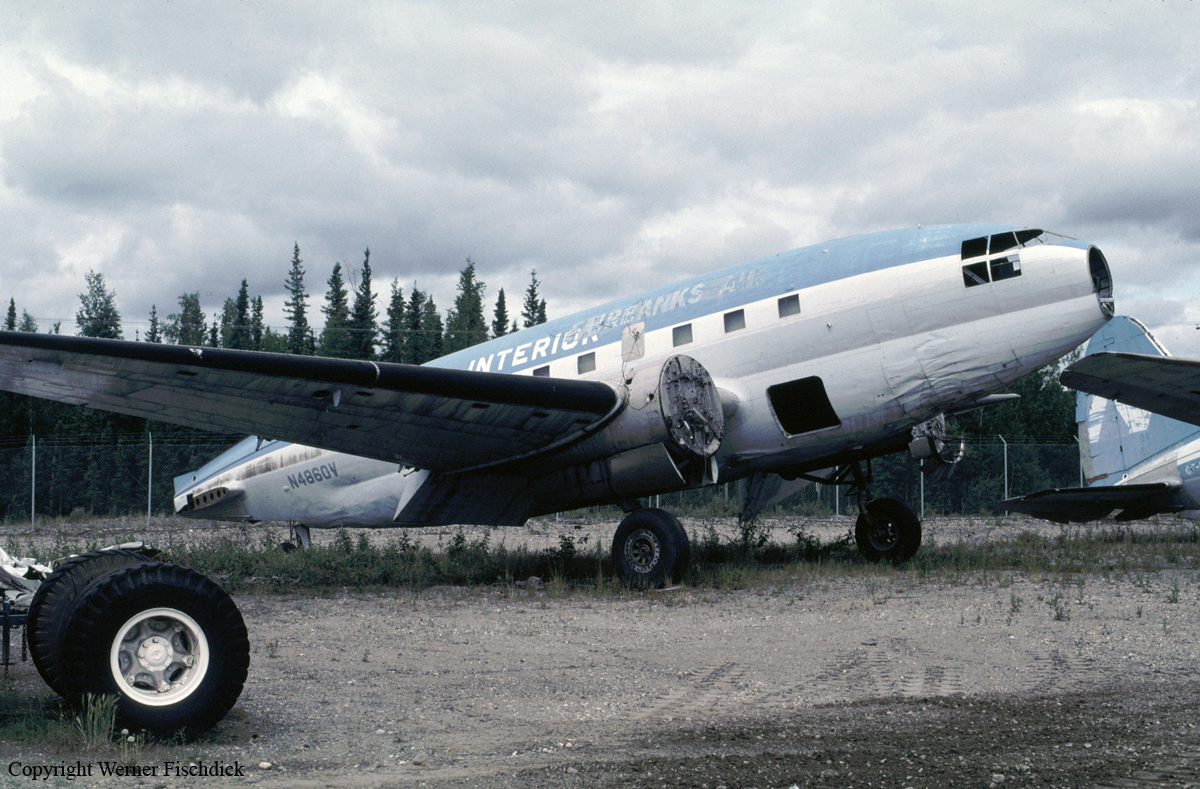
Crash of a Curtiss C-46A-45-CU Commando in Deadhorse

Date & Time: Mar 27, 1975 at 1846 LT
Type of aircraft:
Operator:
Registration:
N4860V
Flight Type:
Survivors:
Yes
Schedule:
Anchorage - Deadhorse
MSN:
30240
YOM:
1944
Crew on board:
2
Crew fatalities:
Pax on board:
0
Pax fatalities:
Other fatalities:
Total fatalities:
0
Captain / Total flying hours:
7403
Captain / Total hours on type:
1500.00
Circumstances:
Following an IFR descent to Deadhorse Airport, the crew cancelled the IFR flight plan and continued under VFR mode. During the last segment, the crew failed to realize his altitude was too low when the right main gear struck the ground short of runway threshold and was torn off. Power was increased and decision was taken to make a go-around but the right engine failed to respond properly. The airplane stalled and belly landed, slid for 460 meters and came to rest. While both pilots were uninjured, the aircraft was damaged beyond repair.
Probable cause:
The pilot-in-command misjudged distance, speed and altitude on final approach. The following contributing factors were reported:
- Downdrafts,
- Unfavorable wind conditions,
- Overload failure,
- Weather briefing by company dispatch,
- Wind gusting to 23 knots.
Final Report: