Crash of a Piper PA-60 Aerostar (Ted Smith 600) in Montgomery

Date & Time: May 29, 1999 at 1724 LT
Registration:
N601JS
Flight Phase:
Flight Type:
Survivors:
Yes
Schedule:
Montgomery – Columbus
MSN:
60-0553-179
YOM:
1978
Crew on board:
1
Crew fatalities:
Pax on board:
5
Pax fatalities:
Other fatalities:
Total fatalities:
0
Captain / Total flying hours:
5000
Captain / Total hours on type:
1000.00
Aircraft flight hours:
2322
Circumstances:
During the takeoff roll and initial climb both engines were producing normal power. As the airplane climbed through 150 feet, the left engine lost power. The pilot reported that he feathered the left propeller. He further stated that following the securing of the left engine, the right engine began to 'power down.' The pilot reported that he was unable to maintain a climb attitude and was forced to land on the airport in a grassy area. The subsequent examination of the cockpit disclosed that the left engine throttle was in the full forward position, and the right throttle lever was in the mid-range position. Both propeller levers were found full forward. The left engine mixture lever was in the full forward position, and the right mixture lever full aft, or lean, position. The functional check of both engines was conducted. Initially the left engine would not start, but after troubleshooting the fuel system, the left fuel boost pump was determined to have been defective. The 'loss of engine power after liftoff' checklist requires that the pilot identify the inoperative engine and to feather the propeller for the inoperative engine.
Probable cause:
The pilot's inadvertent shutdown of the wrong engine that resulted in the total loss of engine power. A factor was the loss of engine power due to fuel starvation when the left fuel boost pump failed.
Final Report:


Crash of a Cessna 421B Golden Eagle II in Jefferson City: 4 killed

Date & Time: May 27, 1999 at 1826 LT
Registration:
N34TM
Survivors:
No
Schedule:
Poplar Bluff – Jefferson City
MSN:
421B-0965
YOM:
1975
Crew on board:
1
Crew fatalities:
Pax on board:
3
Pax fatalities:
Other fatalities:
Total fatalities:
4
Captain / Total flying hours:
1850
Captain / Total hours on type:
850.00
Aircraft flight hours:
5530
Circumstances:
The airplane impacted the ground in a nose low, inverted attitude. The pilot reported, 'Jeff Tower, N34TM, I've just lost power on the right engine, eh, left engine.' The airplane's altitude was approximately 200 to 400 feet when the airplane's wings wobbled back and forth. The airplane's wings banked approximately 90 degrees to the left, and then the airplane nosed over and impacted the ground. White smoke was seen coming from the belly of the airplane for 1 to 2 seconds about 20 seconds prior to it impacting the ground. The terrain was a flat, hard packed field used for growing grass sod. Both the left and right propellers were found 12 to 18 inches under the hard packed soil. Rotational paint transfer patterns from the propeller blades onto the hard packed soil were evident. The left and right propeller blades exhibited chordwise scratching and leading edge polishing. The #2 cylinder piston was broken and the piston pin was still attached to the piston rod. The NTSB Materials Laboratory examination revealed the fracture face of the #2 exhaust valve stem was consistent with a bending fatigue separation. Both #2 and #6 exhaust valve guides showed heavy wear that ovalized the bores. The annual inspection conducted on March 15, 1999, indicated the compression on the left engine was 80/64, 50, 67, 70, 69, and 62.
Probable cause:
The pilot failed to maintain control of the airplane. A factor was the partial loss of power due to the exhaust valve fatigue failure.
Final Report:

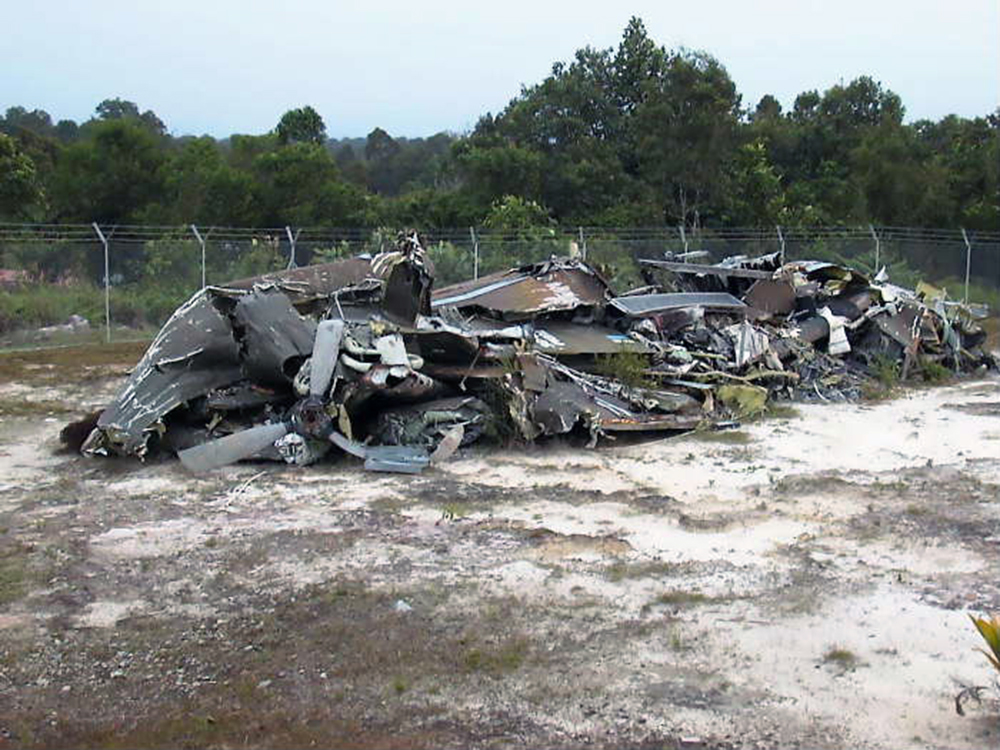
Crash of a De Havilland DHC-4 Caribou in Kuching: 5 killed

Date & Time: May 24, 1999 at 1315 LT
Type of aircraft:
Operator:
Registration:
M21-05
Flight Type:
Survivors:
No
Schedule:
Kuching - Kuching
MSN:
270
YOM:
1969
Location:
Country:
Region:
Crew on board:
5
Crew fatalities:
Pax on board:
0
Pax fatalities:
Other fatalities:
Total fatalities:
5
Circumstances:
The crew was completing a local training flight at Kuching Airport. On final approach, one of the engine failed. The aircraft lost height and crashed in a swampy area near the airport. All five occupants were killed.
Probable cause:
Engine failure for unknown reasons.

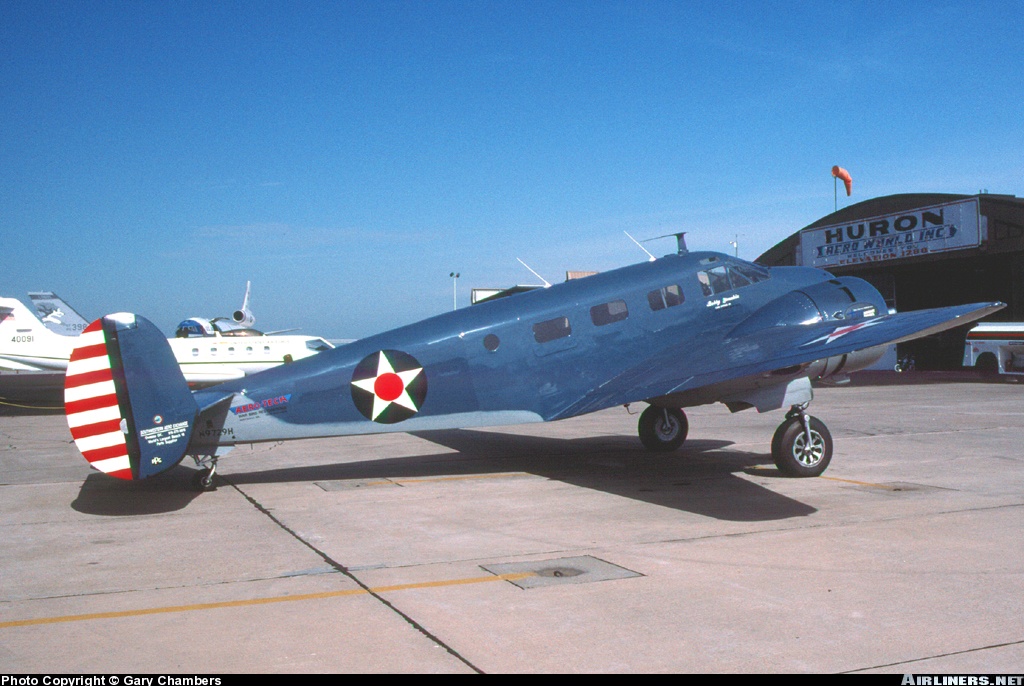
Crash of a Beechcraft C18S Expeditor in Waldron: 1 killed

Date & Time: May 23, 1999 at 1915 LT
Type of aircraft:
Registration:
N9729H
Survivors:
No
Schedule:
Beaumont – Springdale
MSN:
8205
YOM:
1945
Crew on board:
1
Crew fatalities:
Pax on board:
0
Pax fatalities:
Other fatalities:
Total fatalities:
1
Captain / Total flying hours:
6860
Captain / Total hours on type:
860.00
Aircraft flight hours:
4400
Circumstances:
During a cross-country flight, the pilot of the twin-engine airplane reported to air traffic control that he has 'lost an engine.' A witness observed the right engine hanging from its lower mounts as the airplane turned right and headed towards the nearest airport. The airplane impacted trees approximately 1 mile short of the runway threshold. Examination of the right engine propeller revealed that one of its blades was separated about mid-span. The separated tip section of the blade was not recovered. Metallurgical examination of the fracture surface revealed that the blade failed as a result of a fatigue crack that originated from corrosion pits on the camber surface (face) of the blade. The failed blade was examined approximately 6 hours prior to the accident in accordance with an airworthiness directive (AD 81-13-06 R2) that called for inspections of the blade for corrosion and fatigue. However, the inspections called out in the AD were only applicable to the blade fillet and shank regions, well inboard of the fracture location on the failed blade. Overhaul of the propeller in accordance with the propeller manufacturer's manual includes grinding of each blade to 'remove all visual evidence of corrosion.' According to the airplane's owner, the propellers had not been overhauled in the eight years that he had owned the aircraft. The maintenance records were destroyed in the accident, which precluded determination of the date and time of the last propeller overhaul. The accident airplane was being operated under Title 14 CFR Part 91, and therefore, the propellers were not required to be overhauled at specified intervals.
Probable cause:
The separation of a propeller blade in cruise flight as a result of fatigue cracking emanating from surface corrosion pitting.
Final Report:

Crash of a Cessna T303 Crusader in San Diego

Date & Time: May 7, 1999 at 2230 LT
Type of aircraft:
Registration:
N3303S
Flight Type:
Survivors:
Yes
Schedule:
Houston – San Diego
MSN:
303-00018
YOM:
1981
Crew on board:
2
Crew fatalities:
Pax on board:
0
Pax fatalities:
Other fatalities:
Total fatalities:
0
Captain / Total flying hours:
25000
Captain / Total hours on type:
200.00
Aircraft flight hours:
1832
Circumstances:
The airplane departed Houston, Texas, for a VFR flight to San Diego, California. The pilot in the left seat said that they originally planned to purchase fuel at Gila Bend, Arizona, but were told that the fueling was closed. The left seat pilot said they elected to land at a private airstrip and made arrangements to have an individual drive to Casa Grande airport to purchase fuel for them. The left seat pilot said they were worried about adequate runway length, so they elected to only purchase 65 gallons of fuel for the remainder of the flight to San Diego. En route to San Diego, the right seat pilot obtained weather for the destination from FSS and was advised of 1,000-foot overcast ceiling. The right seat pilot then requested and received an instrument clearance. The TRACON controller advised the pilot of the accident airplane that he would have to keep speed up due to jet traffic or be given delay vectors for traffic spacing. The pilot told ATC that they were fuel critical and later said they had about 45 minutes to 1 hour of fuel. The right seat pilot was cleared for the localizer runway 27 approach. Approximately 18 minutes later, the pilot elected to do a missed approach because he was too high to land and moments later told San Diego radar that he was fuel critical and only had about 5 minutes of fuel left. San Diego radar began to give the pilot vectors to the closest airport and told the pilot not to descend any further. The right seat pilot replied that they were a glider and later told San Diego police that they had run out of fuel. There were no discrepancies noted with either the airframe or the engines during the postaccident aircraft examination.
Probable cause:
The pilot-in-command's inaccurate fuel consumption calculations that resulted in fuel exhaustion and the subsequent ditching.
Final Report:

Crash of a Pilatus PC-6/B1-H2 Turbo Porter in Haifa: 4 killed

Date & Time: Apr 24, 1999
Operator:
Registration:
4X-AIY
Flight Phase:
Survivors:
Yes
Schedule:
Haifa - Haifa
MSN:
729
YOM:
1971
Country:
Region:
Crew on board:
1
Crew fatalities:
Pax on board:
9
Pax fatalities:
Other fatalities:
Total fatalities:
4
Circumstances:
After takeoff from Haifa Airport, while climbing to a height of about 300 feet, the engine lost power then failed. The aircraft lost height and crashed on the top of a hill near the airport. The pilot and three skydivers were killed while six other occupants were injured.
Probable cause:
Engine failure for unknown reasons.

Crash of a Cessna 402B in Fort Lauderdale

Date & Time: Apr 20, 1999 at 1910 LT
Type of aircraft:
Registration:
N744MA
Flight Type:
Survivors:
Yes
Schedule:
Fort Myers – Fort Lauderdale
MSN:
402B-0592
YOM:
1974
Crew on board:
1
Crew fatalities:
Pax on board:
0
Pax fatalities:
Other fatalities:
Total fatalities:
0
Captain / Total flying hours:
2600
Captain / Total hours on type:
500.00
Aircraft flight hours:
2675
Circumstances:
While on approach to land the left engine surged and lost power. The pilot switched the left engine fuel selector to another fuel tank and the engine restarted. A short time later the left engine surged and lost power again. The pilot switched the left engine fuel selector to the right main fuel tank and the engine again restarted. A short time later the left engine quit again and he shutdown the engine and feathered the propeller. A short time later the right engine surged and lost power. He shut down the right engine and feathered the propeller. He then made a forced landing in a field and during landing rollout the aircraft's left wing collided with a tree. A fire erupted in the left wing area. Post crash examination showed the right main fuel tank was empty. The right auxiliary fuel tank contained 2.5 gallons. The left main fuel tank contained one half gallon of fuel and the left auxiliary tank was ruptured. The pilot operating handbook stated that the main fuel tanks had one gallon unusable fuel and the auxiliary fuel tanks had one half gallon of unusable fuel.
Probable cause:
A loss of engine power due to fuel exhaustion and the pilot in command's failure to ensure that the aircraft had adequate fuel to complete the flight.
Final Report:

Crash of a Piper PA-31-310 Navajo off Monterey

Date & Time: Apr 14, 1999 at 1800 LT
Type of aircraft:
Registration:
N141CM
Flight Phase:
Flight Type:
Survivors:
Yes
Schedule:
Honolulu – Long Beach
MSN:
31-234
YOM:
1968
Crew on board:
1
Crew fatalities:
Pax on board:
0
Pax fatalities:
Other fatalities:
Total fatalities:
0
Captain / Total flying hours:
427
Captain / Total hours on type:
42.00
Aircraft flight hours:
4882
Circumstances:
The pilot reported that about 150 miles southwest of Monterey, the right engine made unusual noises, began to run rough, and exhibited high cylinder head temperature at the limits of the gauge. He advised Oakland Center of his position and situation, but did not declare an emergency. The pilot attempted to open the right engine cowl flap; however, it malfunctioned. He then increased fuel flow to the right engine in order to cool it and eventually had to reduce power on that side to keep it running. To compensate for the power loss in the right engine, he had to add power to the left engine. The combination of remedial actions increased the fuel consumption beyond his planned fuel burn rate. The flight attitude required by the asymmetric power also induced a periodic unporting condition in the outboard fuel tank pickups. The pilot said he was forced to switch to the inboard tanks until that supply was exhausted and then attempted to feed from the outboard tanks. The pilot said he was unsuccessful in maintaining consistent engine power output and was forced to ditch 20 miles short of the coastline. The pilot's VFR flight plan indicated that the total time en route would be 13 hours 10 minutes and total fuel onboard was 14 hours. The lapsed time from departure until the aircraft ditching was approximately 13 hours 12 minutes.
Probable cause:
An undetermined system malfunction in the right engine, which led to an increase in fuel usage beyond the pilot's planned fuel consumption rate and eventual fuel supply exhaustion.
Final Report:

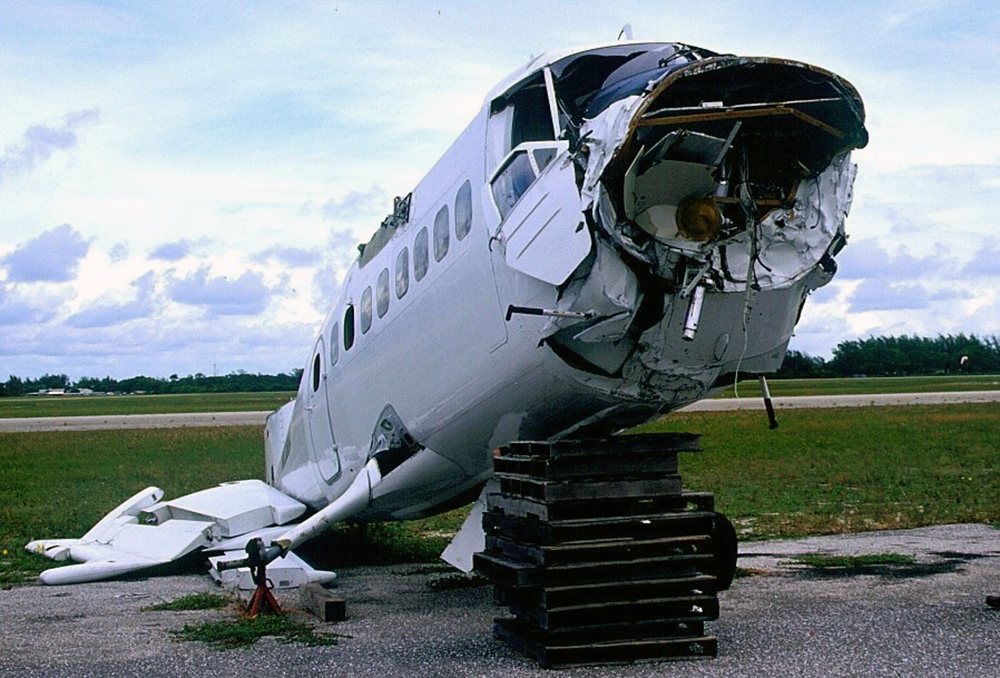
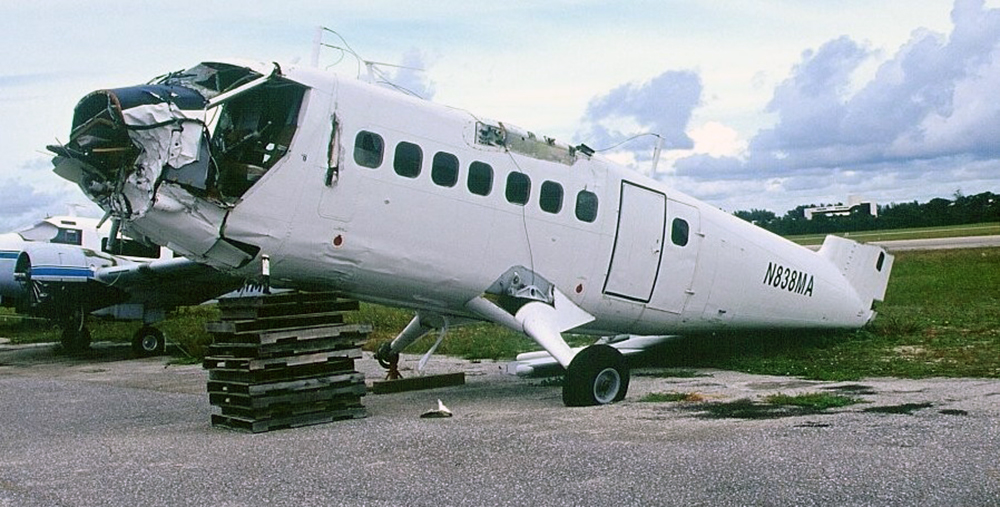
Crash of a De Havilland DHC-6 Twin Otter 200 in Palm Beach

Date & Time: Apr 5, 1999 at 0945 LT
Operator:
Registration:
N838MA
Survivors:
Yes
Schedule:
Palm Beach - Kissimmee
MSN:
188
YOM:
1968
Crew on board:
1
Crew fatalities:
Pax on board:
9
Pax fatalities:
Other fatalities:
Total fatalities:
0
Captain / Total flying hours:
8000
Captain / Total hours on type:
200.00
Aircraft flight hours:
16659
Circumstances:
The pilot reported that prior to takeoff, he completed a preflight inspection of the airplane that included checking the engine oil quantity. The line personnel topped off the oil reservoirs, and reportedly secured the engine oil reservoir filler caps. Approximately two minutes into the flight, the right engine oil pressure warning light illuminated. The pilot informed Palm Beach Approach Control of the engine oil pressure problem, shut down the right engine, and returned to Lantana. As the flight approached runway 03, the pilot heard a radio transmission from another airplane taxiing for takeoff. As the pilot continued the approach, with full flaps extended, he elected to go-around 1500 feet from the approach end of the 3000-foot runway. The airplane collided with the ground during the go-around maneuver to runway 15. The wreckage examination also disclosed that the right cowling showed oil streaming back from behind the engine and onto the wing strut. Inspection of the oil filler cap revealed that it had not been properly installed.
Probable cause:
The pilot's failure to secure the engine oil filler cap during the preflight inspection that resulted the subsequent loss of engine power, and his in-flight decision to attempt a single engine go-around with full wing flaps extended.
Final Report:

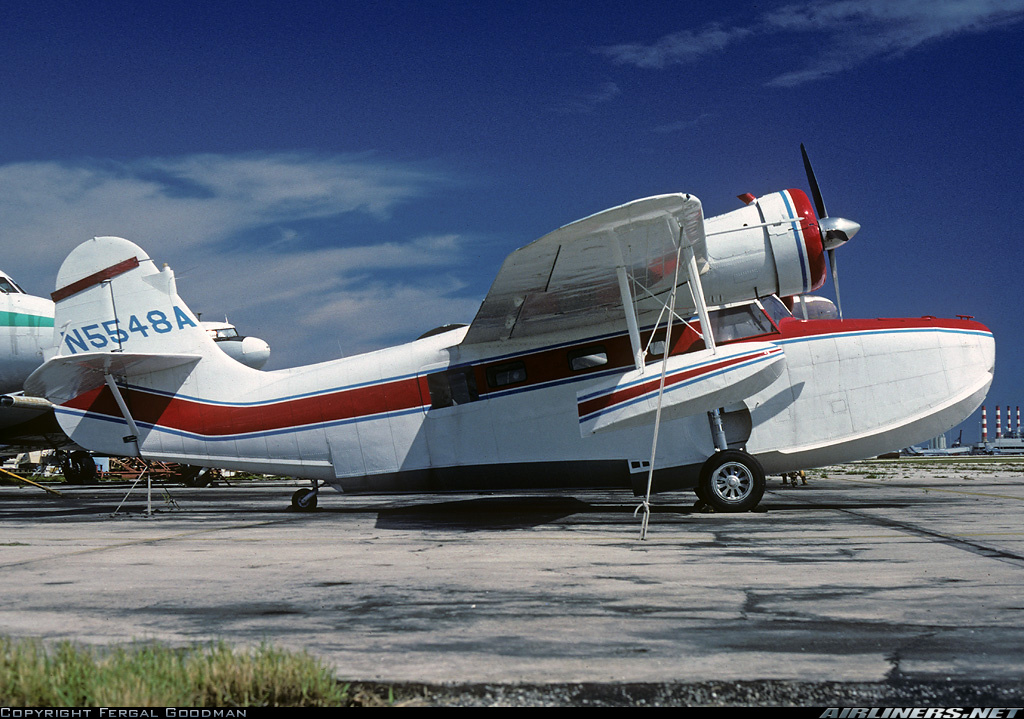
Crash of a Grumman G-21A Goose in Fort Lauderdale: 1 killed

Date & Time: Mar 25, 1999 at 1139 LT
Type of aircraft:
Registration:
N5548A
Flight Type:
Survivors:
Yes
Schedule:
Watson Island - Fort Lauderdale
MSN:
1150
YOM:
1942
Crew on board:
1
Crew fatalities:
Pax on board:
1
Pax fatalities:
Other fatalities:
Total fatalities:
1
Captain / Total flying hours:
10000
Captain / Total hours on type:
520.00
Aircraft flight hours:
13136
Circumstances:
The pilot was receiving a competency flight in the seaplane from an FAA inspector. The pilot was returning to their initial departure airport, descended to 1,000 feet, contacted the control tower for landing instructions, and was instructed to enter on a right base. Before he could acknowledge the landing instructions the engines started to make loud, rough, and unusual noises. The pilot informed the control tower that he was 2 miles south , declared an emergency, and stated he had a bad engine on the left side. The FAA inspector stated the pilot started the emergency procedure, the manifold pressure and rpm was fluctuating. The inspector could not determine the dead engine by the dead foot, dead engine method, because her rudder pedals were stowed. She pointed out a pasture and the pilot stated they were going to the water. She did not recall the pilot shutting down the engine or feathering the propeller. She could not recall the final seconds of the flight. The airplane collided with a tree, canal bank, and came to rest inverted in the canal. Examination of the airframe and flight control systems revealed no evidence of a precrash mechanical failure or malfunction. Examination of the left propeller revealed it was not feathered. The No. 6 front forward spark plug ignition lead was disconnected from the spark plug. The ignition lead shroud threaded coupling on the No. 4 front forward spark plug was unscrewed and the carbon wire was exposed. The left and right engines were removed from the airplane and transported to an authorized FAA approved repair station. The left engine was placed in an engine test cell. The engine was started, developed rated power, and achieved takeoff power. The spark plug lead was removed from the No.6 forward cylinder. The left magneto had a 125 rpm drop during the magneto check. The right magneto had a 75 rpm drop. The magneto drop exceeded the allowable drop indicated by the engine overhaul manual. The right engine was placed in a engine test cell. The engine was started, developed rated power, and achieved takeoff power. Review of the FAA inspectors FAA Form 4040.6 revealed she was not Event Based Current (EBC) for the 4th quarter of the Flight Standards EBC program, and she did not meet the EBC quarterly events required by the end of the 14-day grace period. FAA Order 4040.9 states for an FAA inspector to be eligible / assigned to perform flight certification job function they must be EBC current., and inspectors should not accept assignments without being in compliance with the FAA Order. Managers and supervisors should not assign inspectors who are not current. The FAA inspector's supervisor was aware that the inspector was not current. He contacted the FAA Safety Regulation Branch, FAA Southern Region Headquarters, and stated that FAA Southern Region indicated that the inspector could administer the checkride. FAA Southern Region stated at no time did they approve or agree to an operation outside the parameters of the FAR's, Inspector Handbook or FAA Order.
Probable cause:
The pilots failure to correctly identify an in-flight emergency (fluctuating manifold pressure and rpm due to a disconnected spark plug lead / unscrewed ignition lead shroud) and failure to complete the engine shutdown procedure once it was initiated (propeller not feathered). This resulted in a forced landing and subsequent in-flight collision with a tree, dirt bank and canal. Contributing to the accident was the FAA inspectors improper supervision of the pilot, and the improper supervision of the inspector by her supervisor, in his failure to follow written procedures / directives in assigning a non-current inspector to conduct a competency flight.
Final Report: