Country
code

São Paulo

Crash of a Cessna 500 Citation I in Marília

Date & Time: Dec 1, 2002 at 2310 LT
Type of aircraft:
Registration:
PT-LIY
Survivors:
Yes
Schedule:
Goiânia – Marília
MSN:
500-0219
YOM:
1975
Country:
Crew on board:
2
Crew fatalities:
Pax on board:
5
Pax fatalities:
Other fatalities:
Total fatalities:
0
Captain / Total flying hours:
2200
Captain / Total hours on type:
1200.00
Copilot / Total flying hours:
1300
Copilot / Total hours on type:
200
Circumstances:
Following an uneventful flight from Goiânia-Santa Genoveva Airport, the crew started the descent to Marília Airport by night. Poor weather conditions at destination forced the crew to make a direct approach to runway 03. After landing, the aircraft was unable to stop within the remaining distance, overran, lost its undercarriage and came to rest in bushes 143 metres past the runway end. All seven occupants were rescued, among them four were injured. The aircraft was damaged beyond repair.
Probable cause:
Poor approach configuration on part of the crew who landed the aircraft 750 metres past the runway threshold, reducing the landing distance available. The following contributing factors were identified:
- The crew completed an unstabilized approach,
- Poor approach planning,
- Limited visibility due to the night and poor weather conditions,
- The braking action was low because the runway surface was wet,
- The crew failed to initiate a go-around procedure.
Final Report:

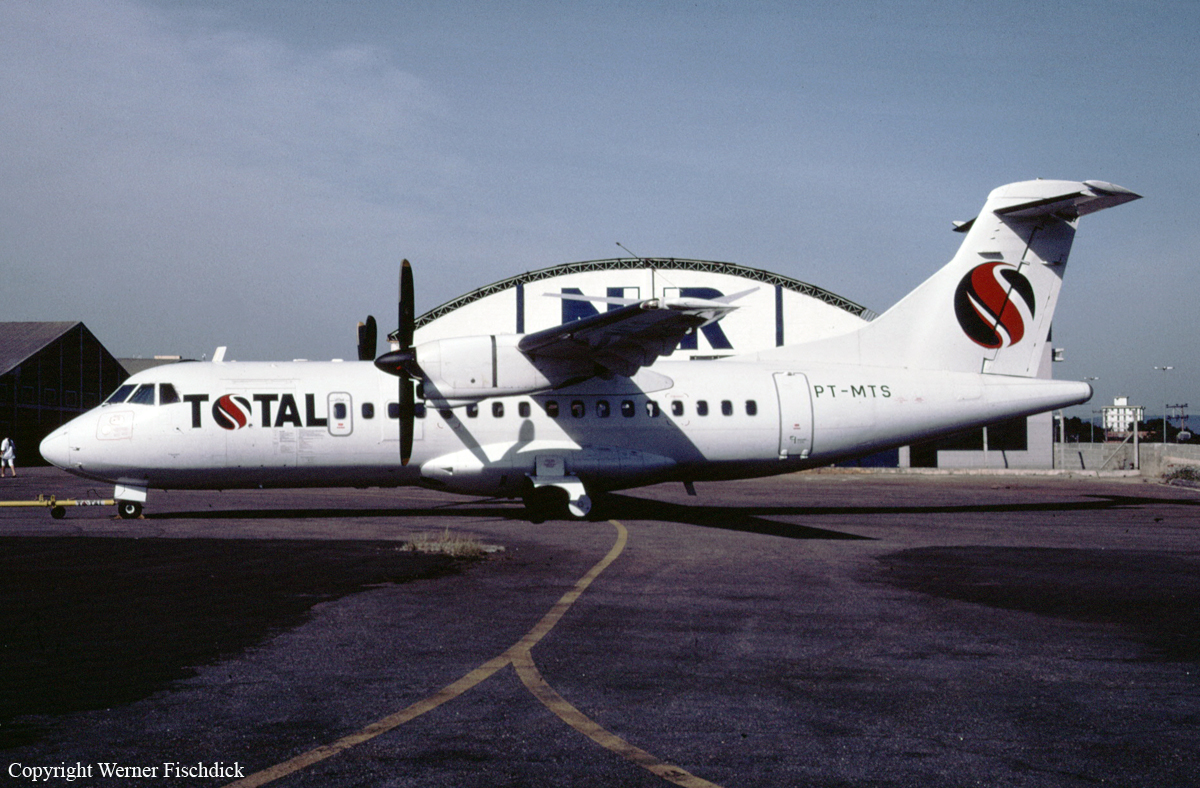
Crash of an ATR42-312 near Paranapanema: 2 killed

Date & Time: Sep 14, 2002 at 0540 LT
Type of aircraft:
Operator:
Registration:
PT-MTS
Flight Phase:
Flight Type:
Survivors:
No
Schedule:
São Paulo – Londrina
MSN:
026
YOM:
1986
Flight number:
TTL5561
Country:
Crew on board:
2
Crew fatalities:
Pax on board:
0
Pax fatalities:
Other fatalities:
Total fatalities:
2
Captain / Total flying hours:
6627
Captain / Total hours on type:
3465.00
Copilot / Total flying hours:
2758
Copilot / Total hours on type:
1258
Aircraft flight hours:
33371
Aircraft flight cycles:
22922
Circumstances:
The twin engine airplane departed São Paulo-Guarulhos Airport at 0440LT on a postal service (flight TTL5561) to Londrina with two pilots on board. About an hour into the flight, while cruising at an altitude of 18,000 feet, the autopilot disconnected while the crew was encountering technical problems with the elevator trim system. The captain asked the copilot to pull out the circuit breaker but this instruction was not understood immediately. Nevertheless, the copilot executed this request few seconds later. Shortly later, the aircraft nosed down and the Vmo alarm sounded, indicating to the crew that the aircraft's speed was above the maximum operating speed. The crew reduced the engine power to 10% but the aircraft entered an uncontrolled descent and crashed at a speed of 366 knots in an open field located 38 km south of Paranapanema. The aircraft was totally destroyed upon impact and both pilots were killed. Some debris were found at a depth of three metres.
Probable cause:
The following findings were identified:
- The pilots' perception about the situation was affected by lack of specific training and procedures, which, coupled with the limited time available for action and lack of clarity in communications, influenced the time elapsed for taking corrective actions.
- Communication between the crew was not clear at the time of emergency, making the co-pilot did not understand at first, the action to be performed, which increased the time spent to disarm the CB. Such facts, however, can not be separated from the situation experienced by pilots with inadequate training for emergency and in a short time to identify the problem and take the corrective actions.
- The company had not provided a regular CRM training to pilots. Furthermore, the captain did not receive simulator training for over one year. It was impossible to determine, however, if the regular training and updating of the CRM simulator training of the pilot would have prevented the accident.
- The removal of the pilot from his seat at the time of the emergency may have increased the time spent in identifying the crash and taking corrective actions, but it was not possible to establish whether the accident would be avoided if he would have been in the cockpit. The copilot was slow to understand the situation and initiate corrective actions, although the alarm 'whooler' has sounded, also increasing the elapsed time.
- The operational testing under J IC 27-32-00 allowed the partial completion of the procedures due to lack of clarity, which allowed the release of the aircraft for flight with a defective relay.
Furthermore, although the elevator trim system has been certified, no procedure for emergency triggering of the compensator in the manuals provided by the manufacturer, no replacement intervals of the components of the elevator trim system in "Time Limits" systems normal and reserves were not independent and the system had a low tolerance for errors.
Final Report:

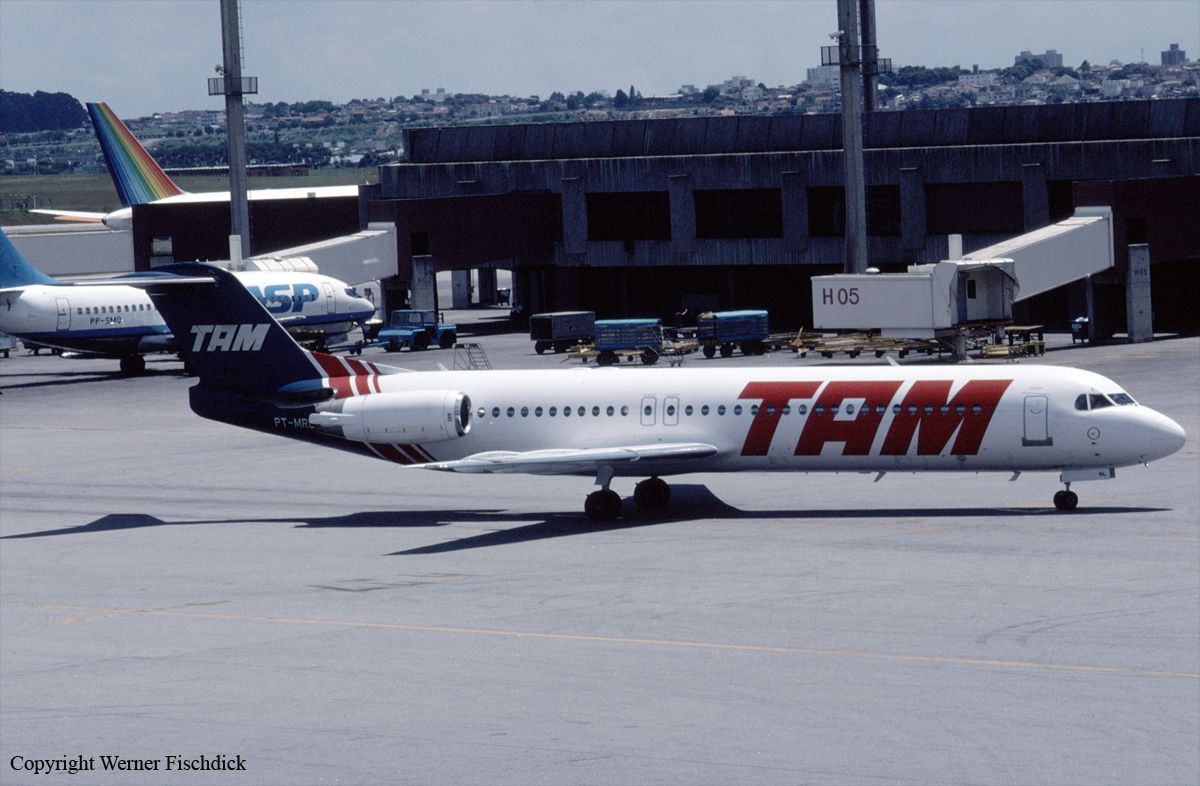
Crash of a Fokker 100 in Campinas

Date & Time: Aug 30, 2002 at 1205 LT
Type of aircraft:
Operator:
Registration:
PT-MRL
Survivors:
Yes
Schedule:
Salvador – São Paulo
MSN:
11441
YOM:
1993
Flight number:
JJ3499
Country:
Crew on board:
5
Crew fatalities:
Pax on board:
33
Pax fatalities:
Other fatalities:
Total fatalities:
0
Captain / Total flying hours:
6500
Captain / Total hours on type:
3600.00
Copilot / Total flying hours:
4300
Copilot / Total hours on type:
145
Circumstances:
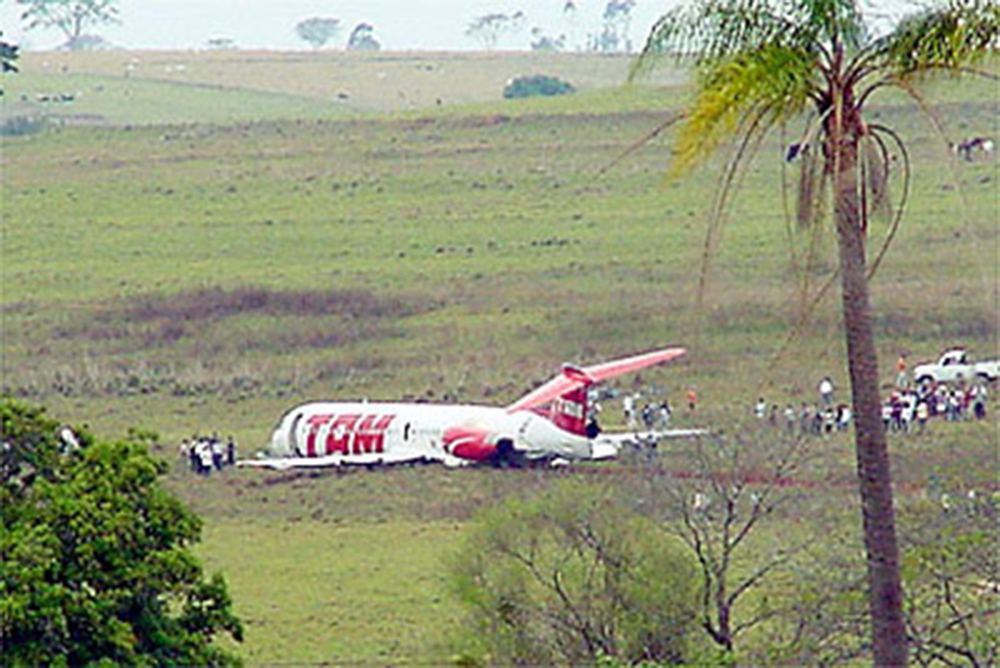
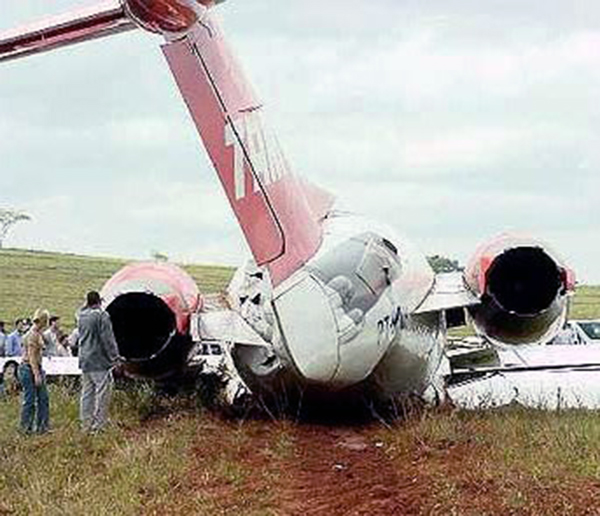
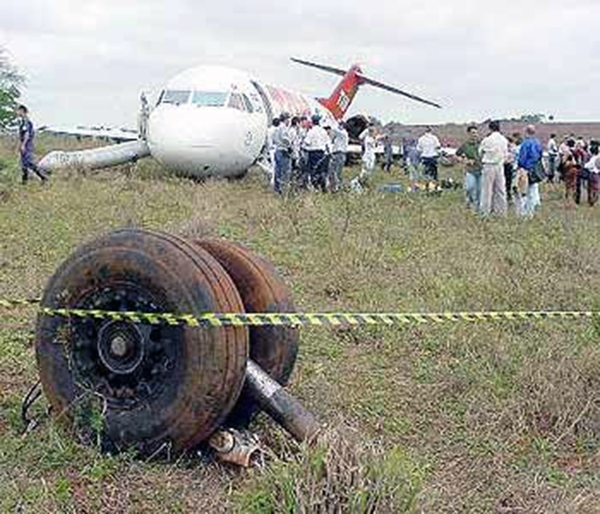
The aircraft departed Salvador-Deputado Luís Eduardo Magalhães Airport at 0846LT on a schedule service JJ3499 to São Paulo-Guarulhos Airport, carrying 33 passengers and five crew members. En route, while cruising at an altitude of 35,000 feet, the crew encountered technical problems with the primary hydraulic system. He contacted ATC and was cleared to divert to Campinas-Viracopos Airport for an emergency landing. On approach, the crew was unable to lower the undercarriage that remained blocked in their wheel well. The crew elected to lower the gear manually and several troubleshootings were unsuccessful. The decision was taken to complete a belly landing on runway 33. After touchdown, the aircraft slid for few dozen metres and eventually came to rest. All 38 occupants evacuated safely and the aircraft was damaged beyond repair. It was later transferred to the TAM Museum.
Probable cause:
A loss of hydraulic fluids occurred on a hose separating a fitting from a pump on the right engine, causing the malfunction of the primary hydraulic system and resulting in the degradation of the mechanical system of the landing gear control command.
Final Report:

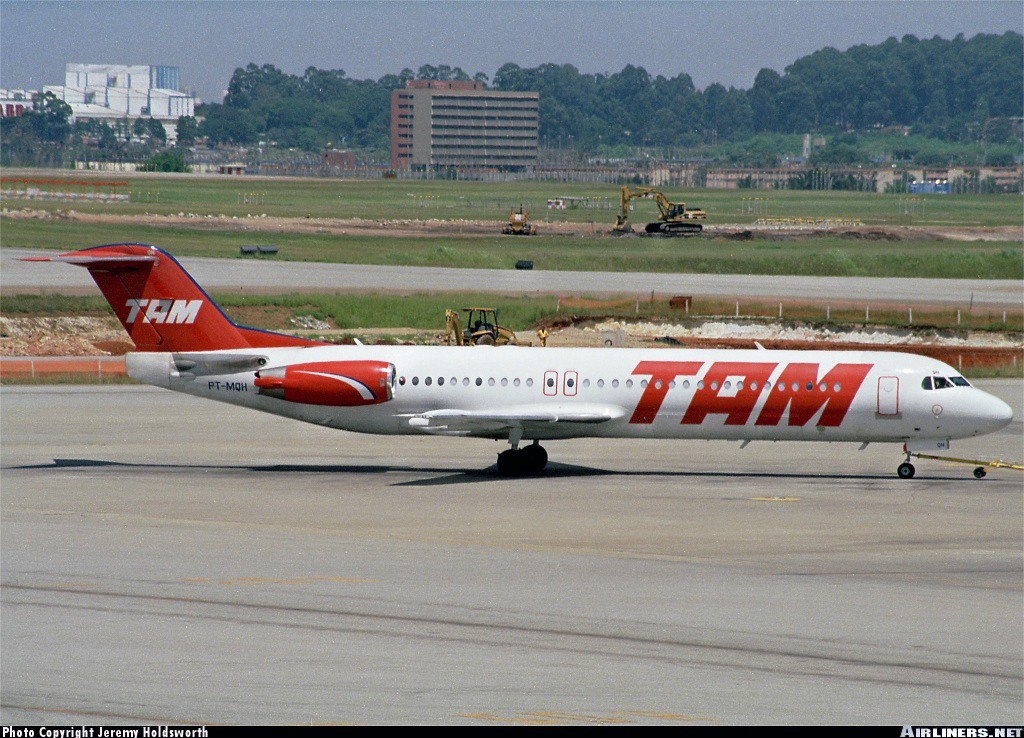
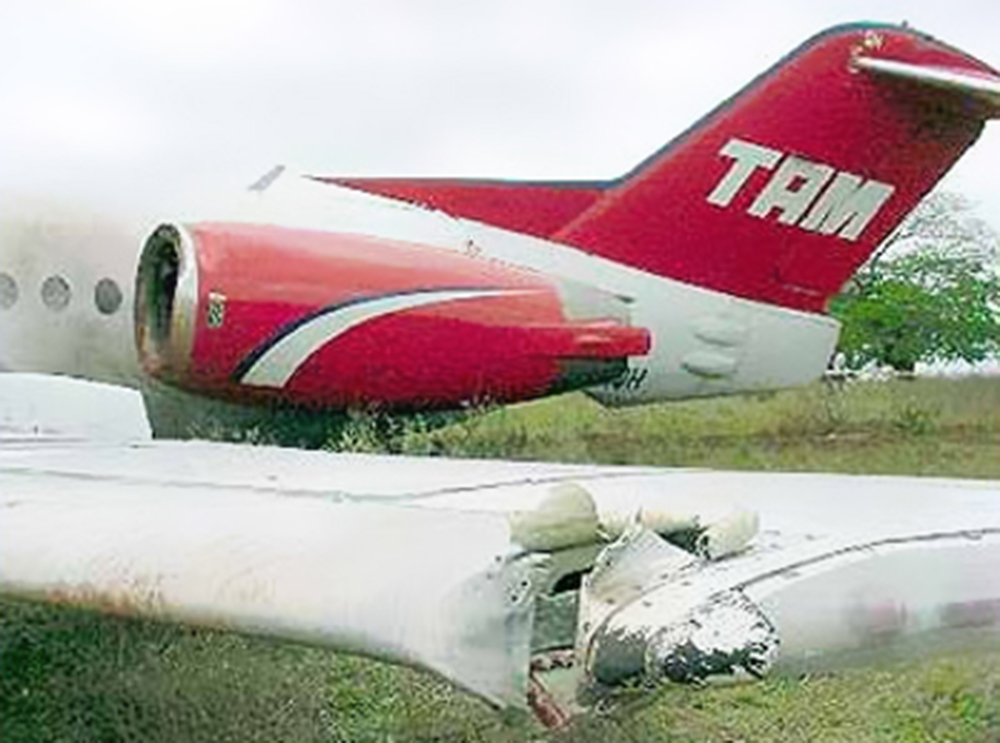
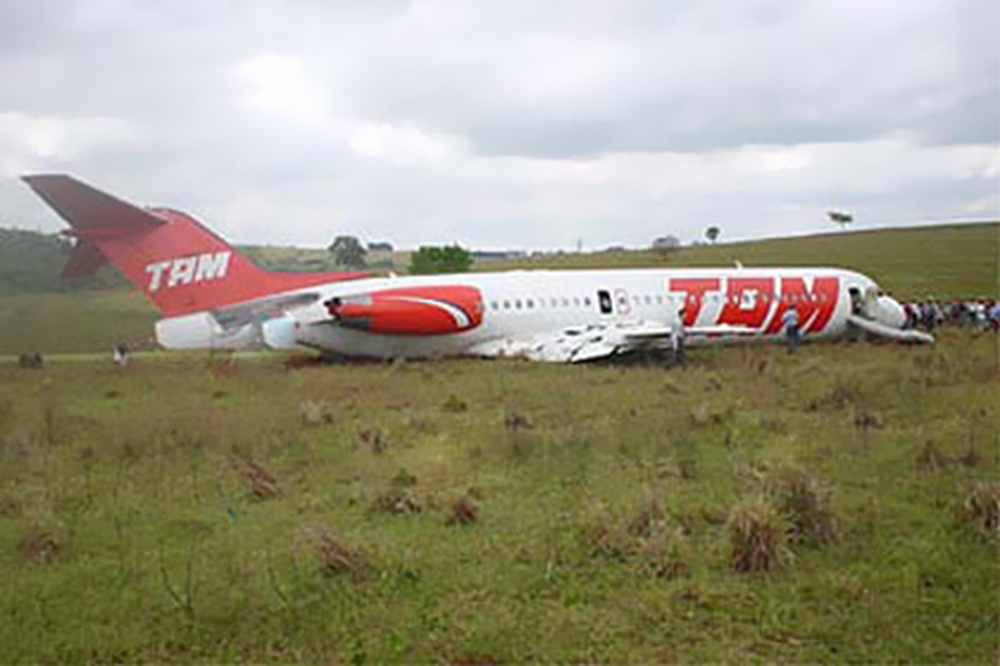
Crash of a Fokker 100 in Birigui

Date & Time: Aug 30, 2002 at 1045 LT
Type of aircraft:
Operator:
Registration:
PT-MQH
Flight Phase:
Survivors:
Yes
Schedule:
São Paulo – Campo Grande
MSN:
11512
YOM:
1994
Flight number:
JJ3804
Country:
Crew on board:
5
Crew fatalities:
Pax on board:
24
Pax fatalities:
Other fatalities:
Total fatalities:
0
Captain / Total flying hours:
7300
Captain / Total hours on type:
4000.00
Copilot / Total flying hours:
4000
Copilot / Total hours on type:
1200
Circumstances:
The aircraft departed São Paulo-Guarulhos Airport on a schedule flight (JJ3804) to Campo Grande, carrying 24 passengers and five crew members. Less than an hour into the flight, while cruising at FL350, the crew encountered technical problems with the fuel system, declared an emergency and was cleared to divert to Araçatuba Airport. On approach, at an altitude of 1,639 feet, both engines failed. The captain realized he could not reach Araçatuba Airport so he attempted an emergency landing in a prairie located 29,5 km from the airport. Upon landing, the aircraft lost its undercarriage, slid on the ground, killed a cow and came to rest. All 29 occupants evacuated, among them four were slightly injured. The aircraft was damaged beyond repair.
Probable cause:
While cruising at FL350, the crew noticed a technical problem with the 'fuel filter' and a 'fuel pressure low' was observed on the right engine. Following a check of the flight manual, the crew reported a fuel transfer issue and attempted an emergency diversion. It was determined that both engine stopped following the rupture of a fuel line connected to the right engine, causing a major fuel leak. The disconnection of the fuel line was the consequence of the rupture of a aluminium ring.
Final Report:

Crash of A Embraer EMB-820C Navajo in Fernandópolis: 1 killed

Date & Time: Jul 28, 2002 at 1630 LT
Registration:
PT-ETT
Flight Phase:
Flight Type:
Survivors:
Yes
Schedule:
Fernandópolis - Fernandópolis
MSN:
820-093
YOM:
1979
Country:
Crew on board:
1
Crew fatalities:
Pax on board:
5
Pax fatalities:
Other fatalities:
Total fatalities:
1
Aircraft flight hours:
3834
Circumstances:
The twin engine aircraft departed Fernandópolis Airport in the afternoon on a panoramic flight over the city with five passengers and one pilot on board. At this time, the visibility was poor due to fog down to 40 metres above the ground. Shortly after takeoff, the pilot lost control of the airplane that crashed, bursting into flames. A passenger was killed while five other occupants were injured, two seriously. The aircraft was destroyed.
Probable cause:
It was determined that the pilot was not qualified to pilot such type of aircraft. Investigations revealed he did not have any licence nor medical documents to prove he was able to conduct such flight with such aircraft. A poor flight planning and a poor evaluation of the weather conditions were considered as contributing factors.
Final Report:

Crash of a Embraer EMB-820C Navajo in São Paulo: 1 killed

Date & Time: Jun 5, 2001 at 2030 LT
Registration:
PT-EHL
Flight Type:
Survivors:
No
Site:
Schedule:
Franca – São Paulo
MSN:
820-048
YOM:
1977
Country:
Crew on board:
1
Crew fatalities:
Pax on board:
0
Pax fatalities:
Other fatalities:
Total fatalities:
1
Captain / Total flying hours:
2000
Captain / Total hours on type:
600.00
Aircraft flight hours:
5289
Circumstances:
The aircraft departed Franca Airport in the evening on a cargo flight to São Paulo, carrying one pilot and bank notes. On a night approach to São Paulo-Congonhas Airport, the pilot cancelled the IFR flight plan when he encountered technical problems with the right engine. He shut down the engine and continued the approach to runway 35R without informing ATC of his situation. Too high on the glide, he apparently decided to initiate a go-around when he lost control of the aircraft that rolled to the left, lost height and crashed in a residential area, bursting into flames. The aircraft was destroyed and the pilot was killed. Two people on the ground were injured.
Probable cause:
It was determined that the hydraulic pump on the right engine failed in flight, forcing the pilot to shut the engine down. It was reported that the pilot continued the approach in a single-engine configuration without informing ATC and that the aircraft was too high on the glide and approaching with an excessive speed. The pilot improperly analyzed the aircraft's flight conditions after shutting down the right engine, causing the aircraft to enter an approach configuration that was not compliant with the published procedures.
Final Report:

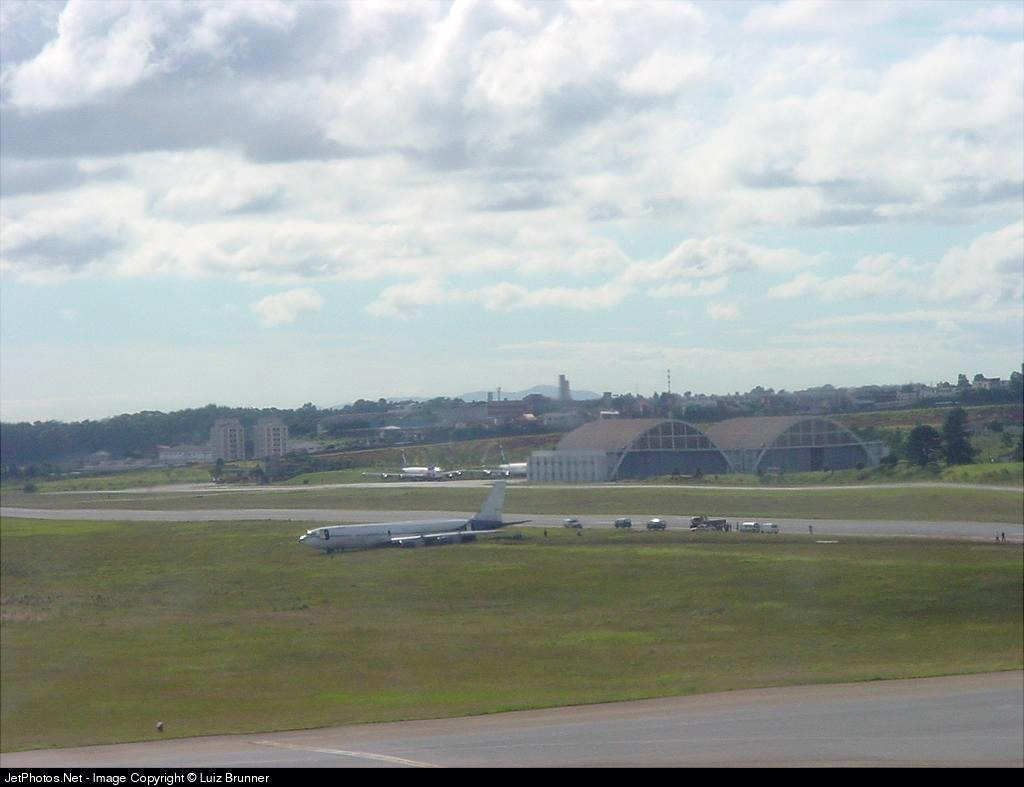
Crash of a Boeing 707-331C in São Paulo

Date & Time: Mar 7, 2001 at 0030 LT
Type of aircraft:
Operator:
Registration:
PT-MST
Flight Type:
Survivors:
Yes
Schedule:
Belém – Brasilía – São Paulo
MSN:
18711
YOM:
1964
Flight number:
SKC9101
Country:
Crew on board:
3
Crew fatalities:
Pax on board:
0
Pax fatalities:
Other fatalities:
Total fatalities:
0
Captain / Total flying hours:
4200
Captain / Total hours on type:
2543.00
Copilot / Total flying hours:
3858
Copilot / Total hours on type:
361
Aircraft flight hours:
70422
Aircraft flight cycles:
28047
Circumstances:
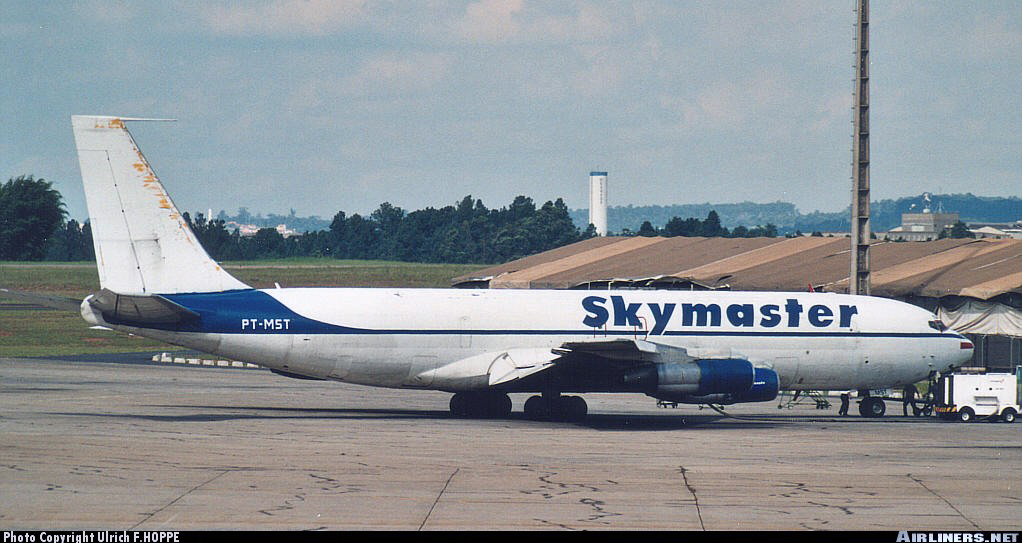
The aircraft was completing a cargo flight from Belém to São Paulo with an intermediate stop in Brasilía, carrying three crew members and a load of various goods such as mail and fish. While descending to São Paulo-Guarulhos Airport in good weather conditions at an altitude of 10,000 feet, the crew encountered technical problems with the trim system. Several manual controls and tests were conducted and the system worked before failing again between 6,000 and 4,700 feet. The captain decided to continue the approach but the aircraft became unstable and nosed down on short final. It landed hard on runway 09R, causing the undercarriage to be torn off. The aircraft slid for about 1,000 metres then veered off runway to the left and came to rest in a grassy area. All three crew members escaped uninjured while the aircraft was damaged beyond repair.
Probable cause:
The exact cause of the technical problems on the trim system could not be determined with certainty. The following contributing factors were identified:
- The decisions of the crew and more particularly of the captain during the last phase of flight were incorrect,
- The crew training program for emergency situation was incomplete,
- Improper use of flaps and slats on final approach made the situation worse,
- The captain did not follow the procedure determined for such an emergency situation and decided to continue the approach maneuver, increasing the risk margin and placing the airplane in critical operating conditions,
- Due to deviations from the published standard operational procedures, such as failure to complete the approach briefing and not following the approach checklist, the coordination among the flight crew was poor, leading to further deviations and putting the crew in a critical situation.
Final Report:

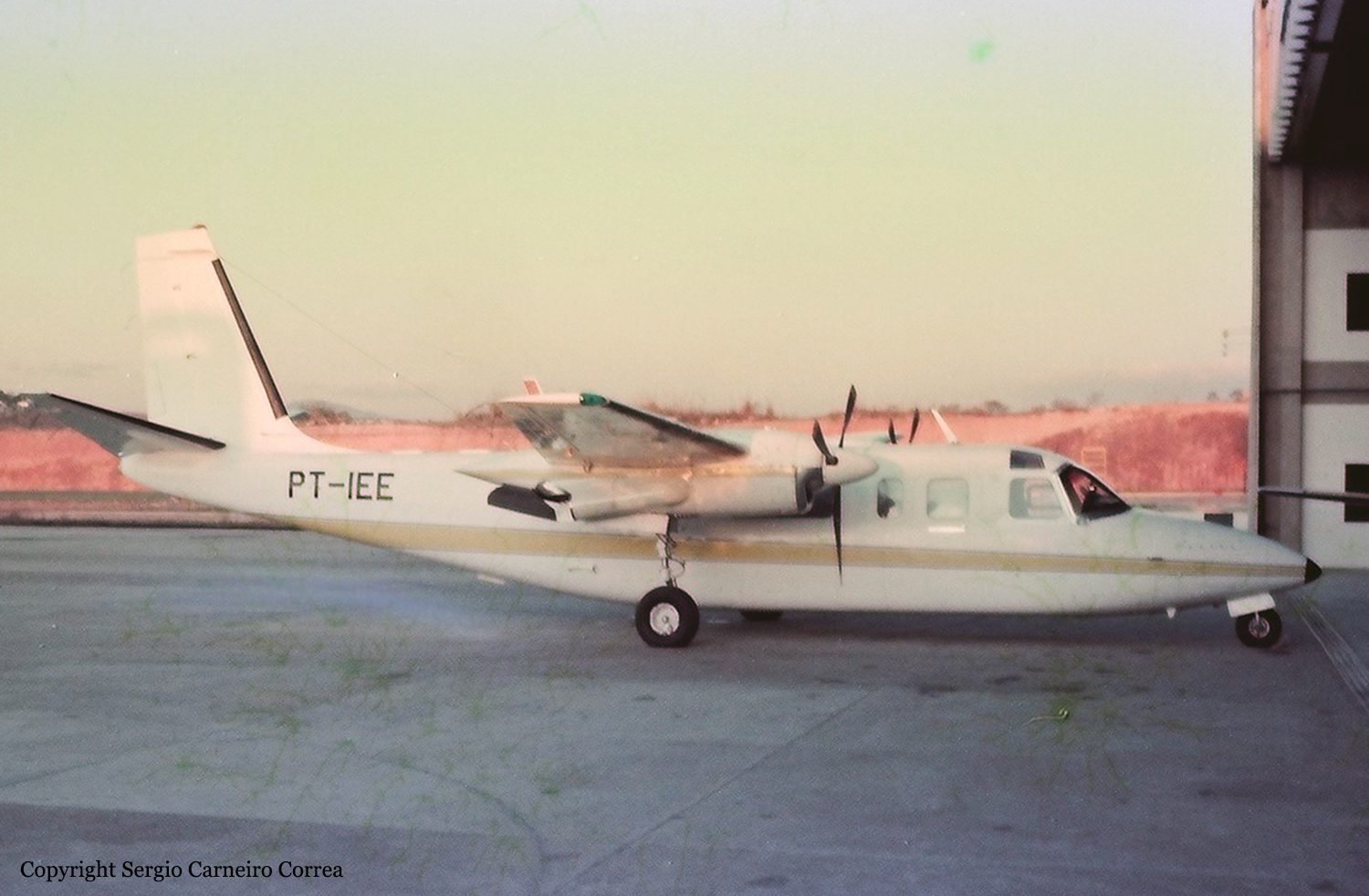
Crash of a Rockwell 681BT Turbo Commander in São Paulo: 7 killed

Date & Time: Dec 16, 2000 at 2120 LT
Registration:
PT-IEE
Flight Phase:
Survivors:
No
Site:
Schedule:
São Paulo – Maringá
MSN:
681-6071
YOM:
1972
Country:
Crew on board:
2
Crew fatalities:
Pax on board:
5
Pax fatalities:
Other fatalities:
Total fatalities:
7
Captain / Total flying hours:
5000
Captain / Total hours on type:
600.00
Copilot / Total flying hours:
2500
Copilot / Total hours on type:
200
Circumstances:
After takeoff from runway 17 at São Paulo-Congonhas Airport, the crew was cleared to climb to 5,500 feet maintaining heading 270. Weather conditions were poor with clouds, atmospheric turbulences and strong winds. At an altitude of 5,300 feet, the aircraft lost height and descended to 4,700 feet, an altitude that was maintained for 17 seconds. Then the aircraft entered an uncontrolled descent and crashed in four houses located in the district of Vila Anhanguera, about 5,5 km southwest of the airport. The aircraft and all four houses were destroyed. All seven occupants were killed while on the ground, six people were injured, one seriously.
Probable cause:
The accident occurred in poor weather conditions. It was determined that during initial climb, the aircraft's attitude, speed and altitude varied suddenly and rapidly, causing the pilot flying a stressful situation insofar as he believed that artificial horizons presented technical problems. In such a situation, investigators consider probable the hypothesis that the pilot made inadequate corrections, exacerbating the abnormal situation in which he was operating. The following contributing factors were identified:
- The crew were suffered fatigue because they had been on duty for more than 15 hours and were unable to observe satisfactory rest time at Congonhas airport,
- This fatigue certainly affected the pilots in their decision-making,
- The urge to return home and distrust of instruments in difficult flight conditions seriously compromised the performance of pilots and their ability to make decisions,
- A direct contact with passengers was stressful as they were going through a period of mourning and were eager to return home to Maringá,
- Weather conditions were unfavorable and contributed to the anxiety of the crew,
- Poor assessment of these conditions by the pilots,
- The working time of the pilots exceeded the limitations and the operator did not take into account adequate rest conditions for the crew,
- The training of the captain in instrument flights in recent months was insufficient.
Final Report:

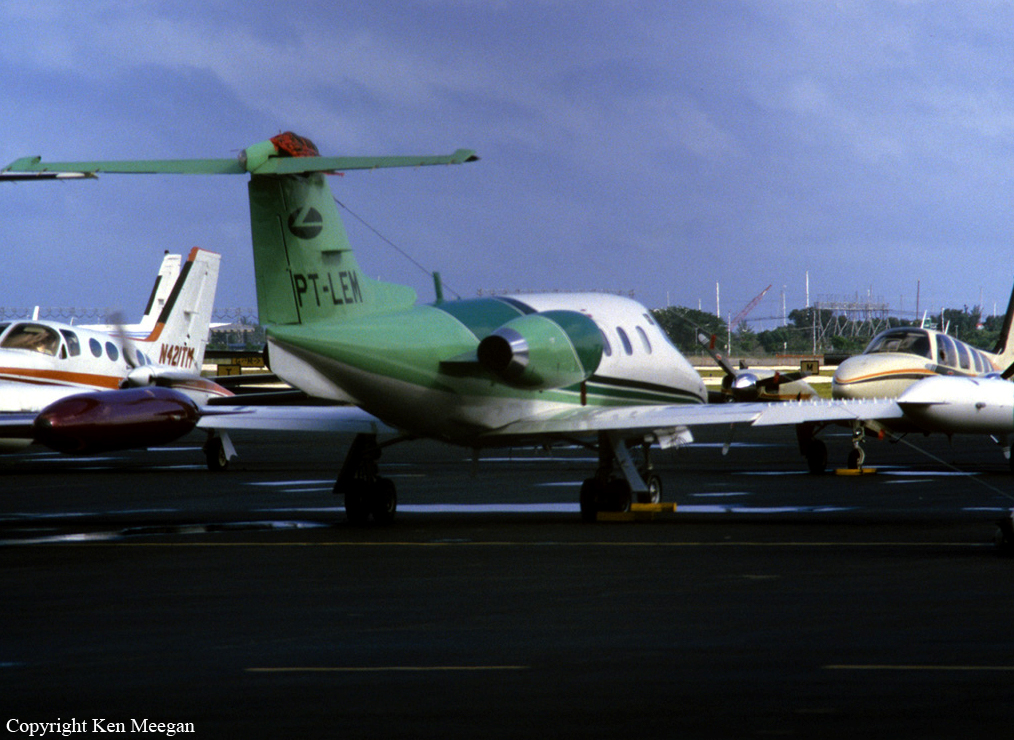
Crash of a Learjet 24D in Ribeirao Preto: 5 killed

Date & Time: Apr 7, 1999 at 1147 LT
Type of aircraft:
Registration:
PT-LEM
Flight Type:
Survivors:
No
Schedule:
São Paulo - Ribeirão Preto
MSN:
24-270
YOM:
1973
Country:
Crew on board:
5
Crew fatalities:
Pax on board:
0
Pax fatalities:
Other fatalities:
Total fatalities:
5
Captain / Total flying hours:
4000
Captain / Total hours on type:
4000.00
Copilot / Total flying hours:
6000
Copilot / Total hours on type:
100
Circumstances:
The aircraft departed São Paulo-Congonhas on a training flight to Ribeirão Preto-Leite Lopes Airport, carrying five crew members, instructor and pilots. On final approach to runway 18, during the last segment, just prior to touchdown, the aircraft rolled to the right, causing the right wing tip to struck the runway surface. The pilot-in-command overcorrected, the aircraft went out of control and crashed 420 metres past the first impact, bursting into flames. All five occupants were killed.
Probable cause:
Contributing Factors:
- There was the participation of individual psychological variables in the pilot-in-command's performance due to the excess of self-confidence and self-demand in his customary behavior, besides the dissimulation regarding his real qualification for the type of flight. The personality with traces of permissiveness and insecurity of the co-pilot also contributed to the occurrence, as it allowed the aircraft to be operated by an unqualified pilot, with no employment link with the company.
- There was a lack of adequate supervision by Manacá Táxi Aéreo, as it allowed a crew member who had not operated the type of aircraft for one year and had not made any type of flight for four months, besides not having any employment relationship with that company. It is also necessary to consider the failure of supervision at the organizational level due to the issue of an incorrect license by the DAC, giving rise to the possibility of its use for the revalidation of license in aircraft for which the pilot was not qualified to exercise the function of commander.
- The entire sequence of events began with pilot errors resulting from the pilot's lack of flight experience in the left-hand seat on the aircraft in question.
- The inadequate use of cockpit resources destined to the aircraft operation, due to an ineffective accomplishment of the tasks assigned to each crew member, besides the interpersonal conflict resulting from the co-pilot's intervention in the pilot in command operation, in the final approach phase, already close to the aircraft's touchdown, configure the collaboration of this factor to the accident.
- The inadequate use of the aircraft commands, by the pilot in command, making excessive aileron corrections in the final approach phase, near the landing.
- The pilot was qualified as a co-pilot on the equipment, but due to a typing error, he was issued a pilot license. Thus, the situation and operation of the pilot in question were totally irregular.
Final Report:

Crash of a Beechcraft A90 King Air in Franca: 2 killed

Date & Time: Mar 23, 1999 at 1910 LT
Type of aircraft:
Registration:
PT-OUL
Flight Phase:
Flight Type:
Survivors:
No
Schedule:
Franca – Ribeirão Preto
MSN:
LJ-125
YOM:
1966
Country:
Crew on board:
2
Crew fatalities:
Pax on board:
0
Pax fatalities:
Other fatalities:
Total fatalities:
2
Captain / Total flying hours:
3500
Captain / Total hours on type:
650.00
Copilot / Total flying hours:
206
Circumstances:
Less than a minute after takeoff from Franca Airport, while climbing in poor weather conditions, the twin engine aircraft nosed down and crashed in a huge explosion about 1,500 metres past the runway end. The aircraft was destroyed and both pilots were killed. They were completing a cargo flight to Ribeirão Preto, carrying documents on behalf of Banco do Brasil.
Probable cause:
The following findings were identified:
- The crew was in a hurry to take off in order to avoid poor weather approaching the airport,
- The crew took off from an intersection with a taxiway,
- Immediately after takeoff, the aircraft entered clouds,
- Approximately one minute after liftoff, the aircraft impacted ground,
- After the first impact, the aircraft flew for another 200 metres and again collided with the ground and exploded,
- The aircraft was totally destroyed by a post crash fire,
- The pilot had a hearing problem that was stabilized and was being researched by HASP. Considering the relationship between ear and ear balance, spatial disorientation in the pilot in
in the face of the adverse conditions it experienced: flight conditions by instruments associated with “windshear”. Since the search could not be completed above mentioned, this aspect remains undetermined,
- Individual characteristics contributed due to the habits acquired by the pilot and his eventual practice of taking off from the taxiway, delaying the point from which the aircraft would achieve the best characteristics flight performance,
- Poor weather conditions with CB's, sudden changes in wind, strong turbulence and rain, were conducive to the emergence of the phenomenon of “Windshear”, representing a real risk to the operation of any aircraft, being that voluntary entry or not, in this type of training, results almost always in the loss of control of the aircraft with unforeseeable consequences. The crew faced these conditions when the aircraft took off,
- It was evident from the witness statements that the pilot was in a hurry to take off, in addition to having used runway 23 from the intersection and towards the sector most affected by poor weather.
Final Report: