Crash of a Douglas C-47A-90-DL in Detroit: 3 killed

Date & Time: Nov 19, 1949 at 1011 LT
Operator:

Registration:
NC54337
Flight Type:
Survivors:
No
Site:
Schedule:
Teterboro – Dunkirk – Detroit
MSN:
20136
YOM:
1944
Flight number:
VV959
Crew on board:
2
Crew fatalities:
Pax on board:
0
Pax fatalities:
Other fatalities:
Total fatalities:
3
Captain / Total flying hours:
1957
Captain / Total hours on type:
1500.00
Copilot / Total flying hours:
1589
Aircraft flight hours:
3416
Circumstances:
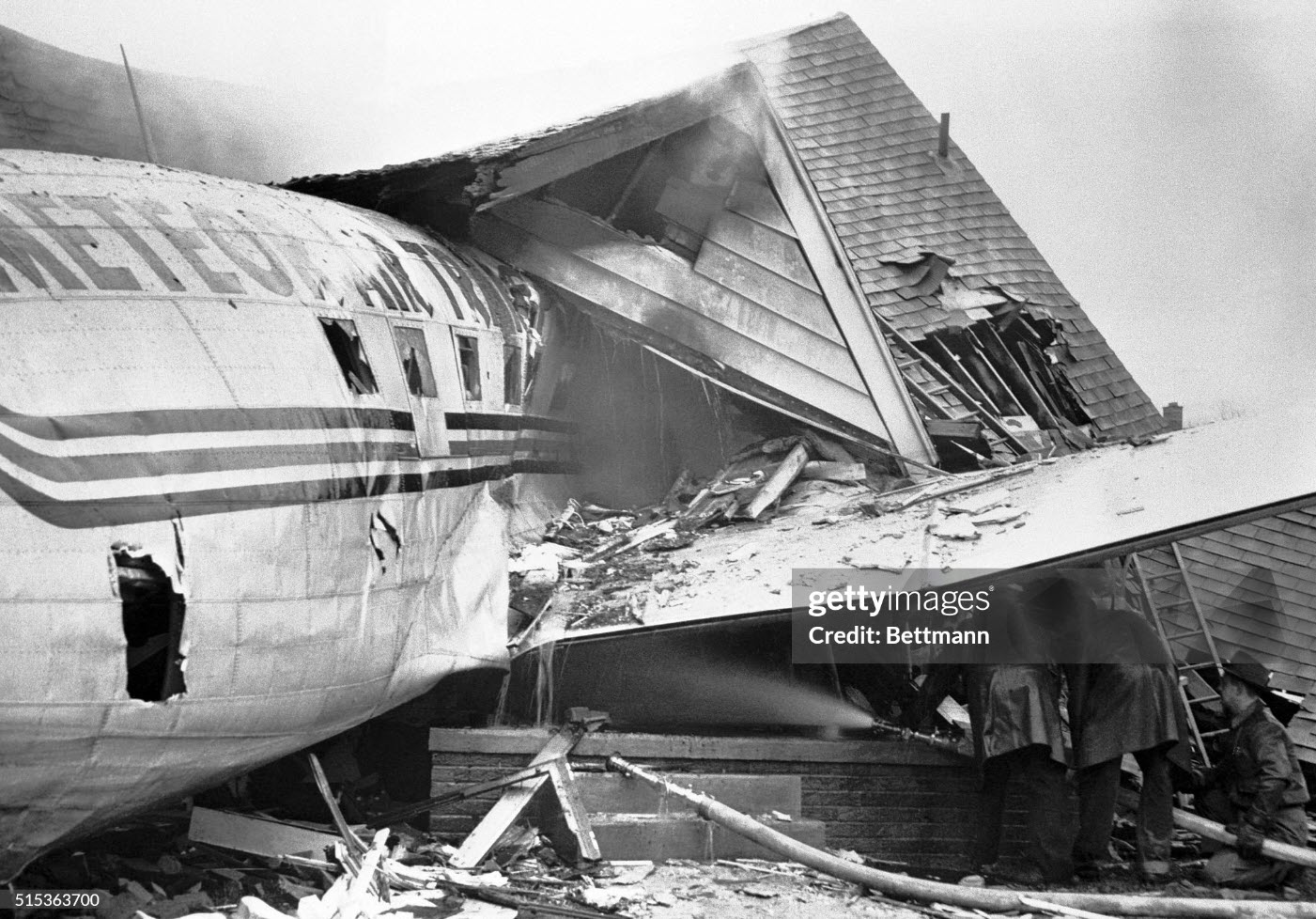
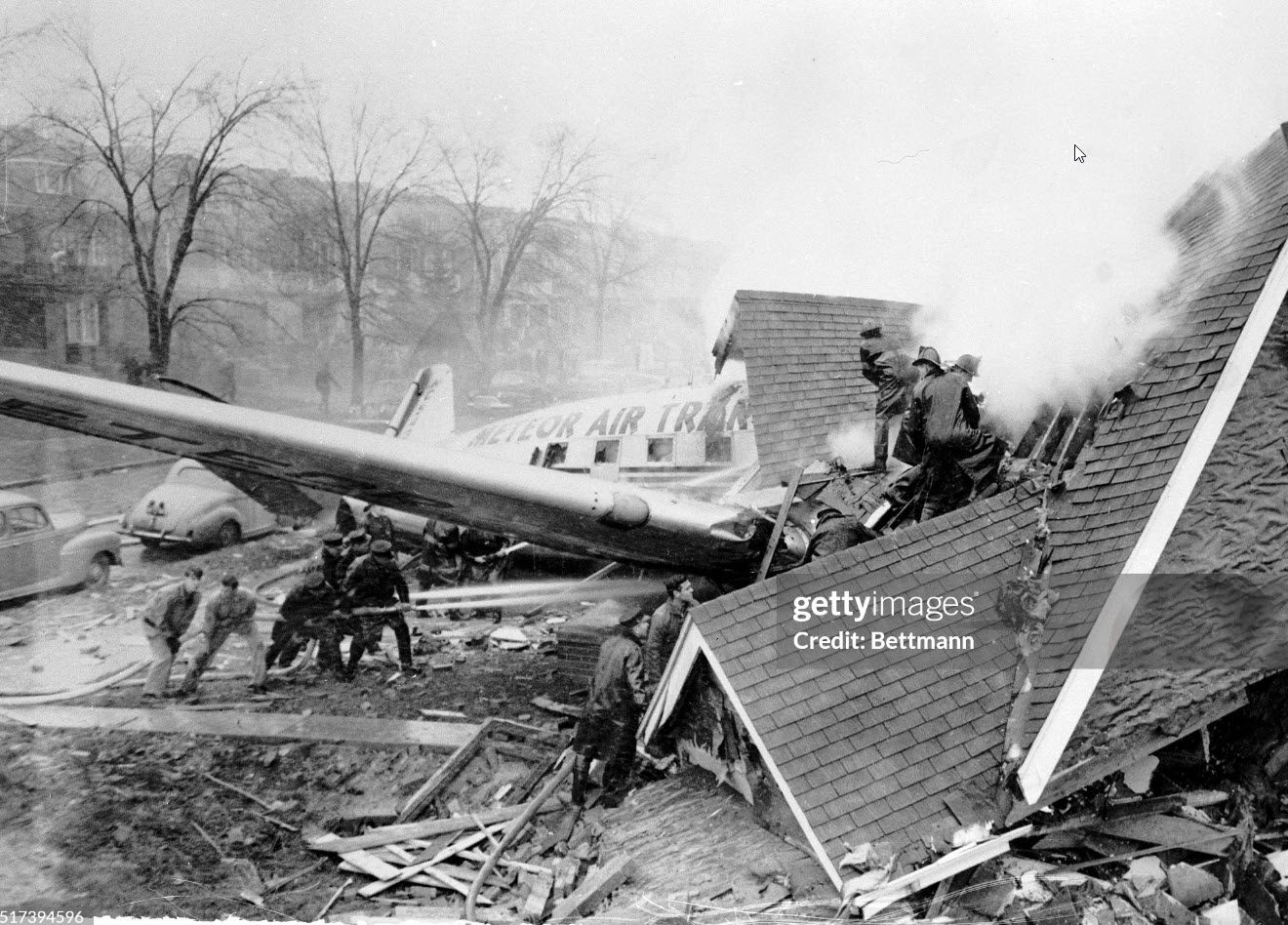
Due to snow conditions the flight was delayed at Dunkirk for several hours. During this time the crew obtained weather information and had the aircraft serviced with 230 gallons of fuel. Two known attempts to take off from Dunkirk were made, at 0215, and at 0405 but these were discontinued after a short take-off run because of the accumulation of snow on the aircraft. This snow had accumulated during the time the aircraft was on the ground. A special weather forecast requested from New York and delivered to the crew at 0355, predicted that between Dunkirk and Detroit ceilings would be 3,000 to 4,000 feet MSL, visibility seven miles or more, and that there would be icing in the clouds. At 0808, Captain Dede filed with Cleveland Air Route Traffic Control an IFR flight plan which described a route to Detroit by way of Clear Creek, Canada, at an altitude of 4,000 feet, with Cleveland, Ohio, being designated as the alternate airport. Twenty-nine minutes later, at 0837, the flight took off from Dunkirk. There was sufficient fuel aboard to fly three hours and 40 minutes, and the computed elapsed time to Detroit was one hour and 50 minutes. At this time the total gross weight of the aircraft was 27,050 pounds which was 150 pounds above the allowable limit. Routine progress reports were mad, by the flight when over Clear Creek and Windsor, Canada, and at 0954, Detroit Air Route Traffic Control cleared the flight to contact Detroit City Airport Approach Control Instructions were given the flight by Approach Control and Runway 25 was designated as the runway in use. The flight was also advised that the visibility, restricted by snow showers and smoke, was one mile, and that the surface wind was 15 miles per hour from the southwest. The Detroit City Airport tower controller first observed the aircraft one mile east southeast of the airport with its landing gear down, flying on an approximate heading of 300 degrees and at an altitude estimated to be 700 feet above the ground. When the flight was almost over the field, it requested permission to make a left circle of the air port before landing. Clearance to do this was granted and again the flight was instructed to land on Runway 25. The flight passed directly over the airport, turned left and then flew on an easterly heading until it was approximately three quarters of a mile east of the approach end of the runway. Here it was seen to make a steep left turn and change direction approximately 180 degrees. Although the aircraft straightened out from this turn, it continued to lose altitude until it struck the chimney of a house in a residential district of Detroit approximately 3,200 feet east of the airport. The aircraft then struck and demolished a second house approximately 45 feet west of the first house. Fire developed which partially destroyed the aircraft. Both pilots and one person on the ground were killed.
Probable cause:
The Board determines that the probable cause of this accident was the pilot's action in making a steep turn on final approach without at the same time maintaining adequate air speed, causing the aircraft to settle to the ground.
Final Report:
Crash of a Consolidated PBY-5A Catalina in Detroit: 2 killed

Date & Time: May 15, 1949
Type of aircraft:
Operator:
Registration:
34014
Flight Type:
Survivors:
Yes
Crew on board:
8
Crew fatalities:
Pax on board:
0
Pax fatalities:
Other fatalities:
Total fatalities:
2
Circumstances:
Water looped while landing in the Detroit River, in Detroit. Two crew members were killed and six others were injured. The aircraft was lost.

Crash of a Lockheed A-28A Hudson in Detroit: 1 killed

Date & Time: Jan 3, 1943 at 1500 LT
Type of aircraft:
Operator:
Registration:
42-47215
Flight Type:
Survivors:
Yes
Schedule:
Detroit - Detroit
MSN:
414-7135
YOM:
1942
Crew on board:
3
Crew fatalities:
Pax on board:
0
Pax fatalities:
Other fatalities:
Total fatalities:
1
Circumstances:
The crew was performing a local training flight at Detroit-Wayne County Airport. While in the circuit, weather conditions worsened and the approach was completed in icing conditions. The airplane stalled and crashed in a wooded area near the airport. A crew was killed and two others were seriously injured.
Crew:
2nd Lt Vincent A. Barsdis, instructor, †
2nd Lt Jack V. McGuire, pilot,
2nd Lt Earl Pifer, pilot.
Probable cause:
Subject aircraft was carrying a heavy load of ice [on the airframe]. This excessive load of ice resulted in a high-speed stall followed by a horizontal roll during which all flying speed was lost and the aircraft struck the ground descending at approximately 30 degrees. The aircraft was inspected ten minutes after the crash. There was an excessive ice formation on the outer surface of the wing and approximately one-quarter inch of ice on the deicer boots. The accident is attributed to two factors — a snow and rain squall moving in over and against the surface surface wind, plus the congestion of traffic caused by the sudden weather condition.

Crash of a Consolidated B-24D-CO Liberator near Hastings: 9 killed

Date & Time: Aug 14, 1942 at 2224 LT
Operator:
Registration:
41-11898
Flight Phase:
Flight Type:
Survivors:
No
MSN:
394
YOM:
1941
Crew on board:
9
Crew fatalities:
Pax on board:
0
Pax fatalities:
Other fatalities:
Total fatalities:
9
Circumstances:
The crew was engaged in a night training mission when he encountered some engine problems according to eyewitnesses. The four engine bomber went out of control, dove into the ground and crashed in a huge explosion in a field located some 10 km south of Hastings. All nine crew members were killed.
Crew:
Pvt Raymond W. Carillion,
2nd Lt James J. Daly,
S/Sgt John D. Hazen,
1st Lt Eugene G. King,
2nd Lt Maurice E. McCall,
Cpl Ernest L. Prather,
Pvt Steve J. Spataro,
Cpl George Eilert Strenge,
2nd Lt Louis Homer.
Probable cause:
Engine failure in flight.

Crash of a Lockheed A-29-LO Hudson in Detroit: 1 killed

Date & Time: Apr 4, 1942
Type of aircraft:
Operator:
Registration:
41-37148
Flight Phase:
Flight Type:
MSN:
414-6637
YOM:
1942
Crew on board:
1
Crew fatalities:
Pax on board:
0
Pax fatalities:
Other fatalities:
Total fatalities:
1
Circumstances:
Crashed in unknown circumstances at Detroit-Wayne County Airport prior to delivery to the Royal Air Force with FH347 registration. A crew member was killed, 1nd Lt Eldon E. Powell.

Crash of a Lockheed L-414 Hudson IIIA in Detroit

Date & Time: Mar 25, 1942
Type of aircraft:
Operator:
Registration:
41-37104
Flight Phase:
Flight Type:
Survivors:
Yes
MSN:
414-6593
YOM:
1942
Crew on board:
1
Crew fatalities:
Pax on board:
0
Pax fatalities:
Other fatalities:
Total fatalities:
0
Circumstances:
The airplane ground looped during takeoff at Detroit-Wayne County Airport and was destroyed by a post crash fire. The accident occurred prior to delivery to the Royal Air Force with FH303 as dedicated registration. There were no injuries.
Crew:
David Buxton.

Crash of a Waco UIC in Detroit: 1 killed

Date & Time: May 3, 1936 at 0650 LT
Type of aircraft:
Registration:
NC13420
Flight Type:
Survivors:
Yes
Schedule:
Detroit - Louisville
MSN:
3775
YOM:
1933
Crew on board:
1
Crew fatalities:
Pax on board:
3
Pax fatalities:
Other fatalities:
Total fatalities:
1
Circumstances:
On May 3, 1936, at approximately 0650LT, at Detroit, Michigan, a privately owned airplane was involved in an accident resultant death to one passenger, serious injury to another, and minor injury to the pilot. A third passenger was uninjured, and the aircraft was completely destroyed. The airplane, a Waco Model UIC, bore Federal licence number NC13420. The pilot was unlicensed. He had formerly held a Federal Transport pilot's licence, which expired on December 31, 1933. Returning from a cross-country flight to Louisville, Kentucky, the pilot landed at the Wayne County Airport to inquire about weather conditions at Detroit City Airport. He took off again a few minutes later to fly to the latter airport, which is but a short flight from the former. While circling the field at an altitude of about 200 feet preparatory to landing, the engine suddenly stopped. The pilot decided that he could not reach the airport and attempted to land downwind in some vacant lots. He overshot these badly and rather than risk striking houses, guided the nose of the airplane between two trees at the end of the vacant lots. The trees were struck while the airplane was still about 10 feet in the air, tearing off the wings and empennage. The engine and fuselage continued on about 25 feet before striking the ground, the slid along for about 20 feet more. The two passengers in the rear seat, who were under a single safety belt, were thrown forward from under the belt by the impact, causing fatal injury to one and serious injury to the other. Careful examination of the wreckage disclosed that the Lunkenheimer gasoline drain was in the drain position. This valve is located in such a manner that it is only about an inch from the left rudder pedal and a large movement of the rudder pedals, while taxying, could probably cause the valve to be accidentally opened. As the pilot states that he did not use this drain at any time during the trip, it is probable that while taxying at the Wayne County Airport, the valve was accidentally kicked open, allowing the gasoline to drain away, the supply being exhausted while preparing to land at the Detroit City Airport, thus causing the sudden engine stoppage. A check of the entire flight discloses that the pilot had put in approximately 8 hours of night flying just previous to the accident, and was probably greatly fatigued. This would had an effect on his judgment of speed and distance on the forced landing, in which he erred considerably.
Crew:
James H. Baughn, pilot.
Passengers:
Sadie Rowley, †
Joseph M. Charlton,
Morrell D. Banker.
Probable cause:
It is the opinion of the Bureau of Air Commerce that the probable cause of this accident was accidental opening of the gasoline drain valve while taxying, together with the pilot's misjudgment of speed and distance while negotiating a forced landing.
Final Report:

Crash of a Ford 4 in Flint: 3 killed

Date & Time: May 18, 1935 at 1835 LT
Type of aircraft:
Registration:
NC7864
Flight Phase:
Survivors:
Yes
Schedule:
Flint – Detroit
MSN:
4-AT-049
YOM:
1928
Crew on board:
2
Crew fatalities:
Pax on board:
10
Pax fatalities:
Other fatalities:
Total fatalities:
3
Circumstances:
Shortly after takeoff, while climbing to a height of some 75 feet, the right engine failed. The crew decided to return to Flint when during the last turn, the central engine failed as well. The aircraft stalled and crashed near the airport. Two passenger and the pilot Theodore E. Knowles were killed while all other occupants were injured. Theodore E. Knowles was the founder and owner of this local operator.
Probable cause:
It is the opinion of the Accident Board that the probable cause of this accident was carelessness and negligence on the part of the pilot for not replenishing his fuel supply before it got dangerously low and poor judgement on his part for attempting to return to the airport when there was open terrain ahead of him.
Final Report:

Crash of a Ford C-4A at Camp Skeel AFB

Date & Time: Jun 11, 1934
Type of aircraft:
Operator:
Registration:
31-403
Flight Phase:
Flight Type:
Survivors:
Yes
Schedule:
Camp Skeel AFB - Camp Skeel AFB
MSN:
5-AT-093
YOM:
1931
Crew on board:
3
Crew fatalities:
Pax on board:
0
Pax fatalities:
Other fatalities:
Total fatalities:
0
Circumstances:
Shortly after takeoff from Camp Skeel AFB, while climbing, the aircraft suffered an engine failure, stalled and crashed. All three crew members evacuated safely and the aircraft was damaged beyond repair.
Probable cause:
Loss of control during initial climb following an engine failure.

Crash of a Loening C-2C Air Yacht into Lake Michigan

Date & Time: Dec 28, 1933 at 1540 LT
Type of aircraft:
Operator:
Registration:
NC139H
Flight Phase:
Survivors:
Yes
Schedule:
Milwaukee – Muskegon
MSN:
236
YOM:
1929
Crew on board:
2
Crew fatalities:
Pax on board:
0
Pax fatalities:
Other fatalities:
Total fatalities:
0
Circumstances:
The float plane departed Milwaukee harbor at 1510LT on a flight to Muskegon. About 30 minutes into the flight, while cruising at a height of 200 feet in marginal weather conditions, the engine failed, maybe due to a valve issue according to the pilot. The crew reduced his altitude and ditched the airplane. The crew remained sitting in the cabin for about 5 hours when the right pontoon snapped off and the right wing cracked. The ship started to list and the crew get out on the left wing to balance it. Because the waves were hitting the seaplane hard, it cracked and eventually sank. Both pilots Pat Gossett and Ben Craycraft were rescued by the crew of the USCG vessel named 'Escanaba' shortly before midnight.
Probable cause:
Engine failure in flight.